
The Dogs of Spitalfields in Autumn
Spitalfields Life contributing photographer Sarah Ainslie and canine correspondent Andrew McCaldon have been out again in the parks, kicking up the leaves, enjoying the October sunshine and continuing their survey of East End dogs.
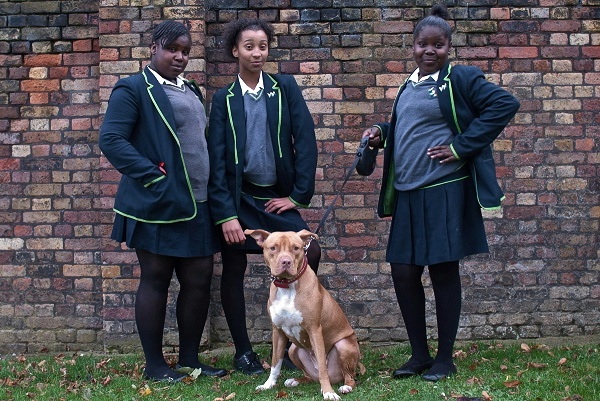
Storm (Staffordshire Bull Terrier) & Abeni & Leilah & Kermia
“We love dogs and we found Storm abandoned under a bridge. We washed her and fed her. We all liked her and we took her to the vets. She didn’t have any diseases or fleas and the vet said she was fine, so we decided to keep her.
At first she was called ‘Lightning’ but then we heard of another dog called that, so we changed her name to ‘Storm’ – we called her Storm because she’s so fast.
We also have a cat and a parrot at home. We used to have a rat too but the cat killed it. We’re all of us friends and Storm’s another member of the family. Things are different for us now we have her – life is happier.”
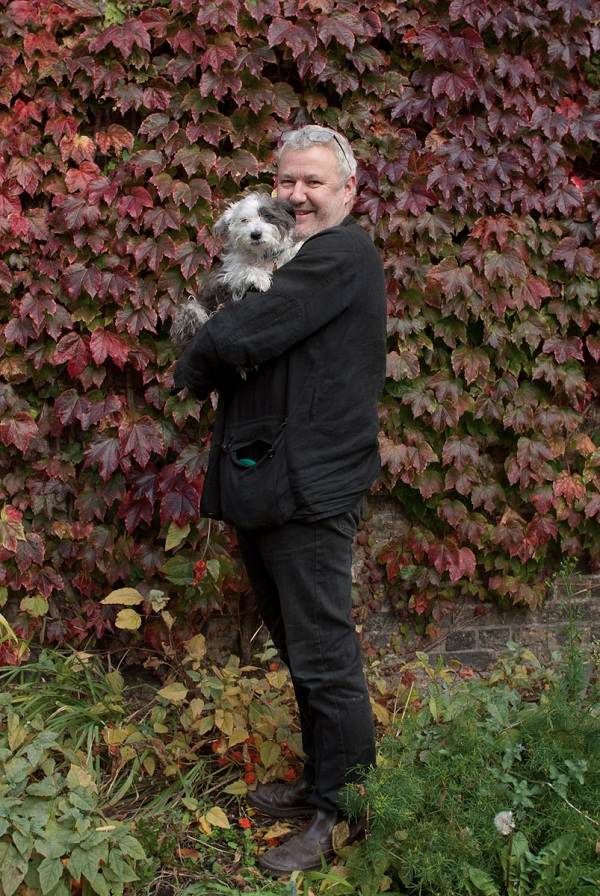
Glider (Chinese Crested/Yorkshire Terrier/Jack Russell cross) & Simon Rees
“It’s her birthday – she’s thirteen today!
She’s a bit deaf now and if she sees a pair of heels she just follows them. In Cambridge, she went off with a jogger one day – it took a lot of running before I eventually caught up with them both.
She has some sort of brain abnormality. I saw the result of the CAT scan, there was a huge mass on her brain and I was told she’d only have two weeks to live. That was five years ago and in fact, other than making her epileptic – thankfully – it hasn’t had any other affect.
You know, I’m never sure if Glider likes these walks or whether the real trigger for going out is the food she knows she’ll get afterwards.”
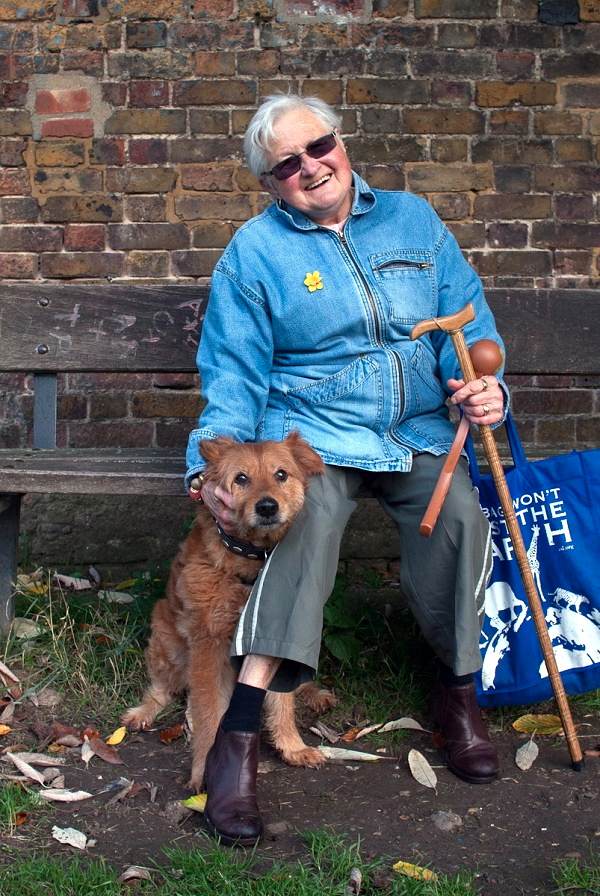
Rusty (Collie/Doberman cross) & Catherine Ray
“You wouldn’t believe his father was a Doberman, would you? But under his fur are black hairs. He’s twelve years old too but when I have him shaved off, every three months or so, people think he’s a pup.
They call me ‘The Biscuit Woman’ because I give all the dogs in the park little treats. The dogs were always trying to get into my pockets though, so now I have to keep the biscuits in a container.
My previous dog, Troy, was with me for fourteen years. When it came time for him to be put to sleep, I didn’t have the money and I wasn’t getting benefits around here, so I had to take him on the number eight bus all the way to place near Victoria. I met a woman on the bus and it was breaking her heart to see us. She put me in a taxi, paid the driver and said, ‘Take this woman where she needs to go.’
Now I’ve got Rusty with me. You see, a few years ago I buried my daughter and then I lost my husband and my brother in the space of a year. So Rusty’s company for me now.”
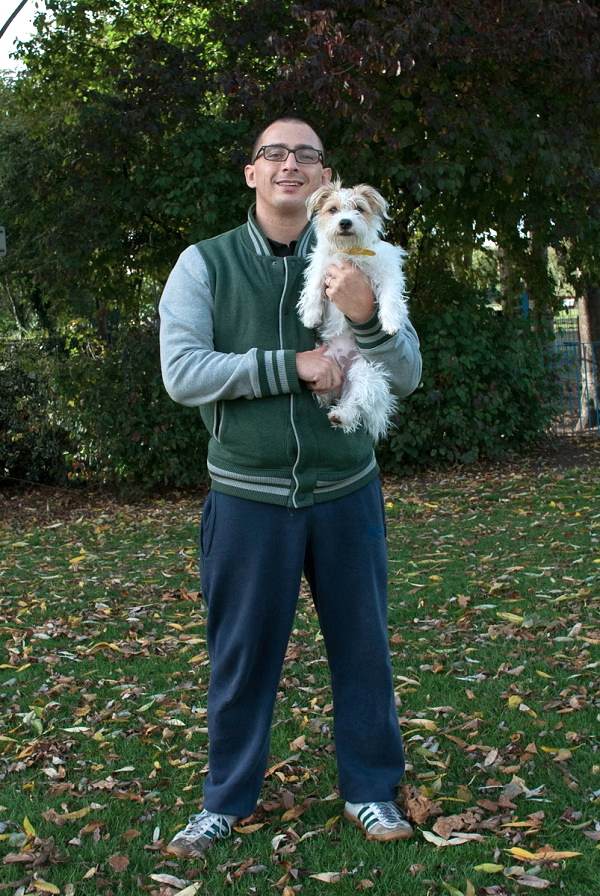
Clotty (Long-haired Jack Russell) & Gian Paolo Gori
“She’s sweet, polite and hyper. That’s because she’s a Jack Russell – she never tires and she really keeps me in training.
She’s clever too. We never had to struggle to teach her anything. She trained herself to fetch balls by putting them at the top of the stairs, letting them roll down and then taking them up to the top again.
Clotty has her meals cooked for her, usually beef or lamb mincemeat with some rice and vegetables, like carrots, broccoli or peas. I make cookies for her too, with ingredients like rice, flour, parsley, eggs and liver!”
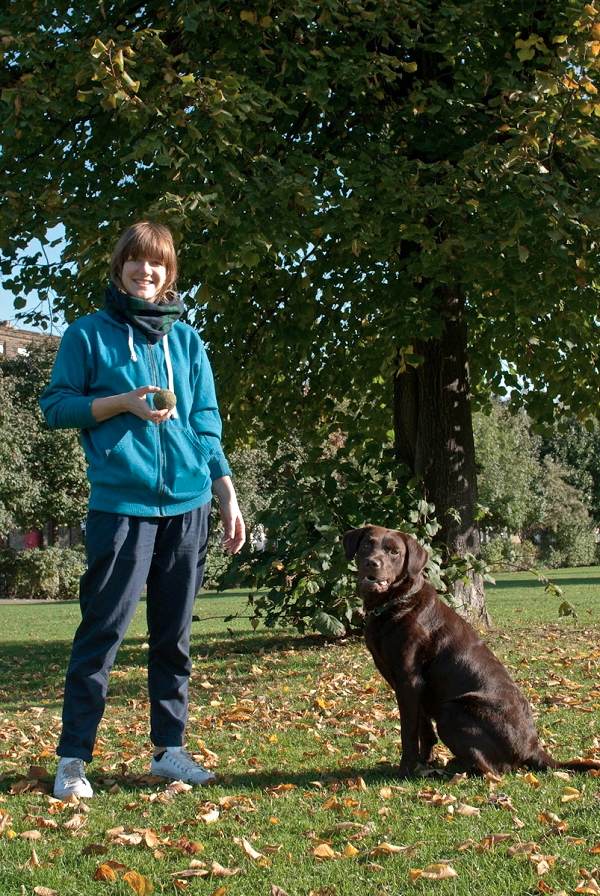
Roxy (Labrador) & Ali Mclean
“Roxy’s so playful today! Horses get friskier when it starts getting colder – so maybe the same thing happens with dogs?
She’s two years old and she’s my first dog since I’ve been living in London. I grew up in Aberdeen where we always had dogs and I went back to Scotland to get Roxy, as my friend owns her father. So she’s a piece of home and it’s nice to have that connection.
I share the responsibility for Roxy with my boyfriend, which is good because she’s got so much energy. She needs three hours walking a day – at least.”
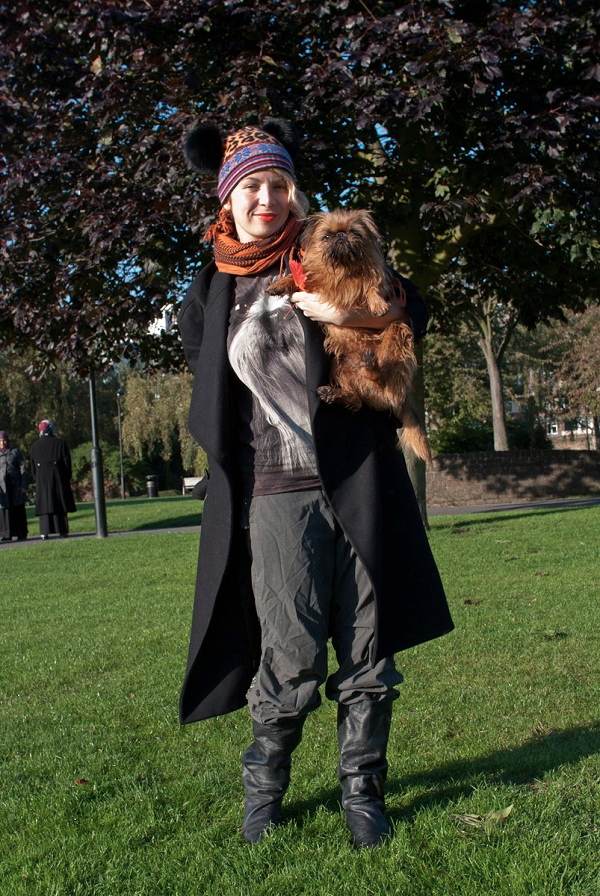
Anatole (Brussels Griffon) & Natasha Mason
“His full name is Anatole Wolfrus Zucowsky the Second. He was named after my Dad.
Out of all the breeds, Griffons are supposed to have the most human features and their character traits include having a big heart and an air of self importance! My Mum skypes Anatole from Spain and she’s already had her call this morning. She gives him a virtual tummy rub and I have to provide the real thing at the other end.
Having a dog has led to so much for me – I’ve been organising dog shows, I want to start a dog magazine and I’m about to go out to India to train as a canine behaviourist.
I’ve invented a new word – ‘dogalyst.’ A catalyst is something that causes a change, so a dogalyst is when a dog changes your life. Dogs have changed mine.”
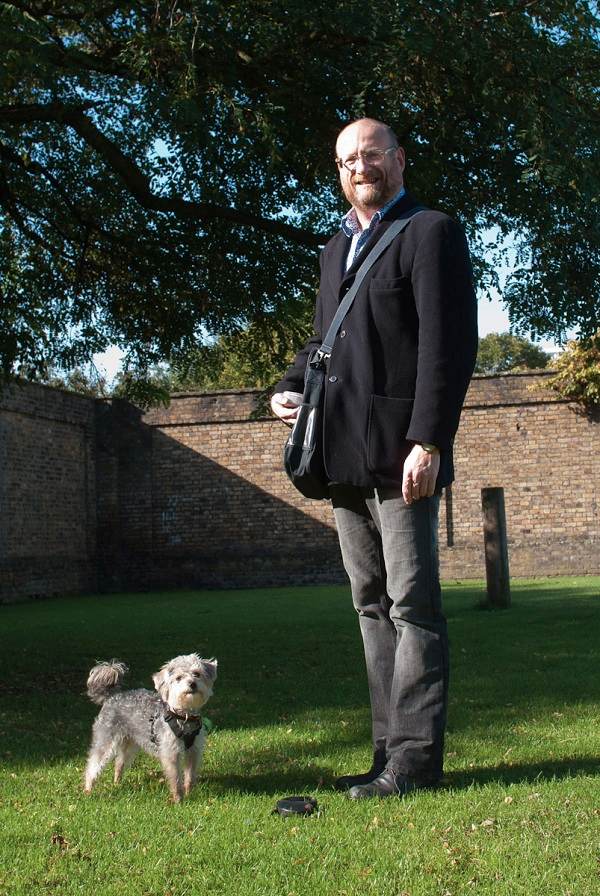
Maudie (Toy Poodle/Yorkshire Terrier cross) & Glenn Cleary
“I’m an only child and everyone in my family died, so I had nowhere for my feelings to go. Then I got Maudie. Now, I don’t have a life of my own.
When I was young there was an aristocratic cartoon character in the newspapers called Maudie Littlehampton, drawn by Osbert Lancaster. I loved her and I thought it was a fun name to give my dog.
Although she’s small, Maudie’s one of the fastest dogs in the park, other dogs give up chasing her because she doesn’t give them a chance.
I had a hip replacement, and I wanted a dog that didn’t pull me over – but instead I got one that trips me up.”

Max (German Shepherd) & Joe
“My granddaughter wanted a German Shepherd. Max was the runt of the litter and we really had to build him up.
He’s very fussy though, he doesn’t mind if it starts to rain while we’re out, but if it’s already raining before we leave he just won’t go anywhere.
I’m retired now. I was shafted and forced to leave my job, but actually it was the best thing that ever happened to me. These days, Max is my pastime. He’s my baby.”
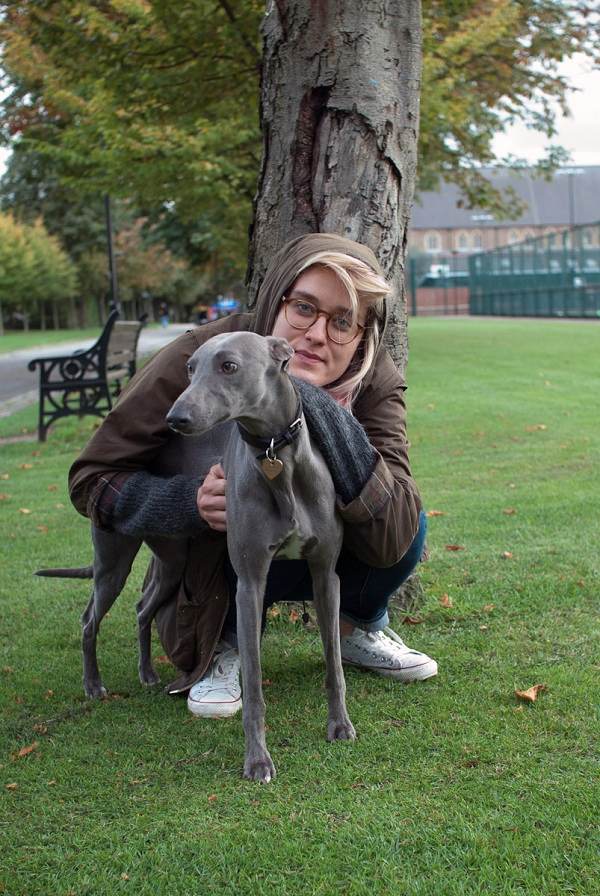
Horace (Blue Whippet) & Agatha
“Although I’m a photographer, Horace is very camera-shy, he’ll always look away when anyone takes a picture.
Horace comes with me for my work. He’s only three but he’s very well travelled. He’s got his own passport, has been to Paris and he loved the train to St. Petersburg. I used to take him on the tube and buses when he was a puppy, I wanted him to get used to the idea. It worked wonders – now he’s obsessed with trains.
I’m a very active person and that’s why I chose to get a whippet. I love watching Horace run.”
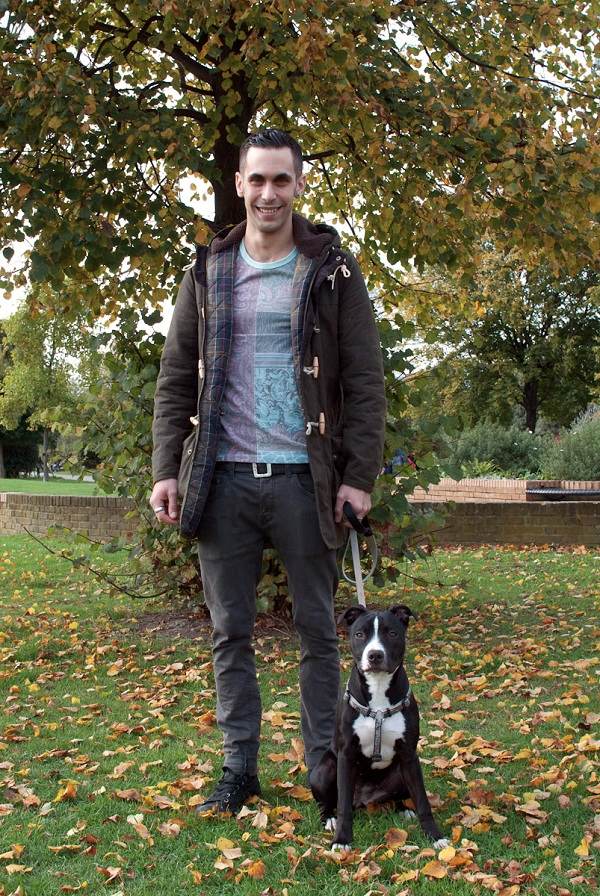
Mary Jane (Staffordshire Bull Terrier) & Riccardo Raia
“I am from Milano but life is hard in Italy in right now and there are no jobs for young people.
I came here alone and I wanted some company, so I found Mary Jane. I had another dog called ‘Blue’ in Italy but now my parents are looking after him. I would like to bring him here so they can be together.
Owning a dog here is better than at home. There’s a lot of parks and everyone loves dogs here. I’m very happy to now be part of London and, of course, Mary Jane is a British breed of dog!”

Neen (Lurcher) & Caroline Meadows & Bertie
“Neen is a rescue dog. I was driving to the Dogs Trust to look for a dog and saw Neen walking along a main road, looking very skinny and frightened. I had a tin of dog food in the back of the car and that’s how I managed to attract him. He had no microchip, no collar and I handed him into the police but no one claimed him, so he came to live with us.
We lived in a village in the Peak District until this January. It was a beautiful place, but of course dogs don’t care about gorgeous scenery. Neen prefers living here, where he can scavenge and there’s lots more different smells.
I think it will be great for Bertie to grow up with a dog. Children love animals, so many songs and books are about animals, and now he’ll have the real thing.”
Photographs copyright © Sarah Ainslie
The Dogs of Spitalfields in Spring
Nazir Tanbouli, Painter

“I was born into a family of painters, I’m the third generation,” Nazir Tanbouli revealed to me, “But when I came to London from Alexandria ten years ago as a thirty-one year old painter, I found it was impossible to get the chance show my paintings.”
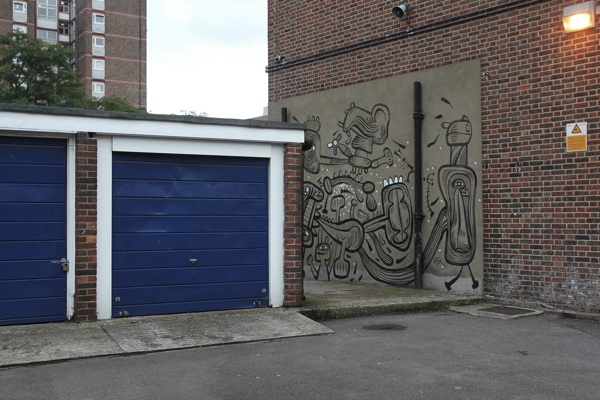
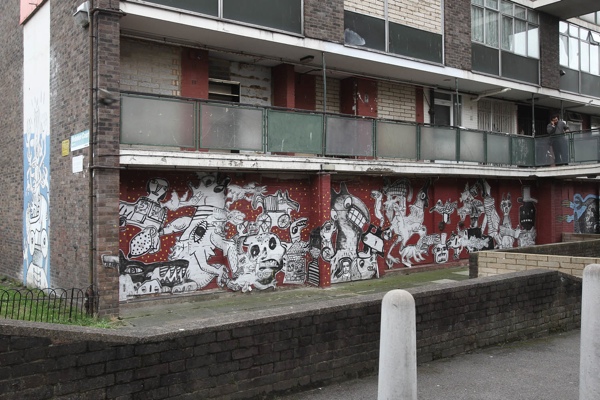
We were walking around the Kingsland Estate in Haggerston, a housing development built in 1952, expressing the optimism of the year of the Queen’s Coronation, and now pending demolition in 2012, the year of the Queen’s Diamond Jubilee. Most of the windows were bricked up in the decayed modernist blocks, with only the last die-hard residents awaiting the end of days. But in the meantime, Nazir has cunningly adorned the structures with a monumental series of murals. Counteracting the melancholy of dereliction, they brought the world to wonder at the poignant spectacle this summer, winning Nazir the audience he always sought for his work. Now that the crowds and news-crews have been and gone, Spitalfields Life Contributing Photographer Simon Mooney and I decided it was time to take a look for ourselves.
“I was always attracted to draw bigger than myself, “ Nazir admitted with an unapologetic grin,“When I was two years old, I was in my uncle’s studio and I destroyed his new canvas by drawing on it while he went out to get some cigarettes.” The Kingsland Estate murals saw the fulfilment of Nazir’s ambition to work on a large scale, painting fourteen buildings in three months and battling the inclement weather to finish in time for the scheduled demolition on the first of July. “After ten years of no maintenance and neglect, the flats were sold to a housing association, who are knocking some down and building some new,” Nazir told me, bemused that the long-awaited demolition is currently in abeyance, “My work was a reaction against their slow death, making the place fresh before they knocked it down, but since they haven’t knocked it down yet it has now entered another phase of slow death.”
We stood in front of the paper and paste mural that was the first of Nazir’s phantasmagorical Kingsland Estate murals. “It’s a lot of teeth, it’s a lot of bulging eyes and there’s a lot of tragedy but it’s communicated in a semi-comic way, “ he assured me as I cast my eyes at the grotesque faces coming at me from every direction, erupting like the angry spirits of the bricked-up buildings. “I used glue that cost me thirty pounds a bucket for this and it stayed,” he explained, before gesturing around sadly to the empty walls that surrounded it, “And I used glue that cost me two pounds a bucket for these and they’re gone – but the whole project only cost me £400.”
“Every entrance to the Estate had to have something to invite people in. I wanted them to become part of the experience and not just an audience. You see one picture and then another in the distance, and you find yourself in a labyrinth.” Nazir continued, as we turned a corner to arrive at the first of the painted murals that he did, using salvaged paint upon the base coat of the wall which had been painted blood red. On that rainy autumn afternoon, the bricked-up edifices which surrounded us gave the appearance of tombs sealed against grave robbers, yet Nazir’s paintings brought rampant chaotic life, manifesting creatures that crawled from the murky world of myth and the subconscious, creatures that would not be denied your attention. Creatures that challenged the rationalism which led to the conception of these little boxes stacked-up for people to live in.
Nazir’s studio is at the heart of the Estate, on the ground floor of Hebden Court, where he shivers now in a building without heating that has emptied out of tenants. I asked him how long before the flats will at last be demolished and he pointed to the new structure across the yard. “When the red building is complete,” he said, indicating the top floor flat that he is waiting to move into. Until then, Nazir is doing paintings to keep warm. “Drawing is like thinking on paper, but painting is a physical activity,” he informed me, “So, at this time of year, I come in and start painting at once or I get cold.”
On our walk, Nazir reserved his fondest affection for a painting in ink on concrete, a dynamic medium which permitted no error or correction and produced an absorbency of line not unlike ink on paper. He stood next to the wall, almost caressing it. “I’m not an artist if I cannot deliver something that people need daily, like the butcher and the baker do.” he declared, thinking out loud, and surrounded by the monsters that he both conjured and exorcised, “My purpose is to get rid of bad things. I am not an artist in residence, I am the resident who is an artist.”






Photographs copyright © Simon Mooney
Visitors are welcome to visit Nazir Tanbouli’s studio at 75 Hebden Court, Laburnum St, Haggerston E2 8BG, open each Friday, Saturday and Sunday from 2-6pm.
You may also like to read about
John Claridge’s Boxers (Round One)
Photographer John Claridge returned to the East End recently to visit the London Ex-Boxers Association and take portraits of the members. Coming from a family of boxers and being an ex-boxer himself, John possesses a natural empathy with these spirited men who were once the fiercest of opponents but are now the closest of friends.

Johnny Barnham (First fight 1950 – last fight 1955)

Ron Whittham (First fight 1950 – last fight 1961)

Joey Khan (First fight 1950 – last fight 1955)
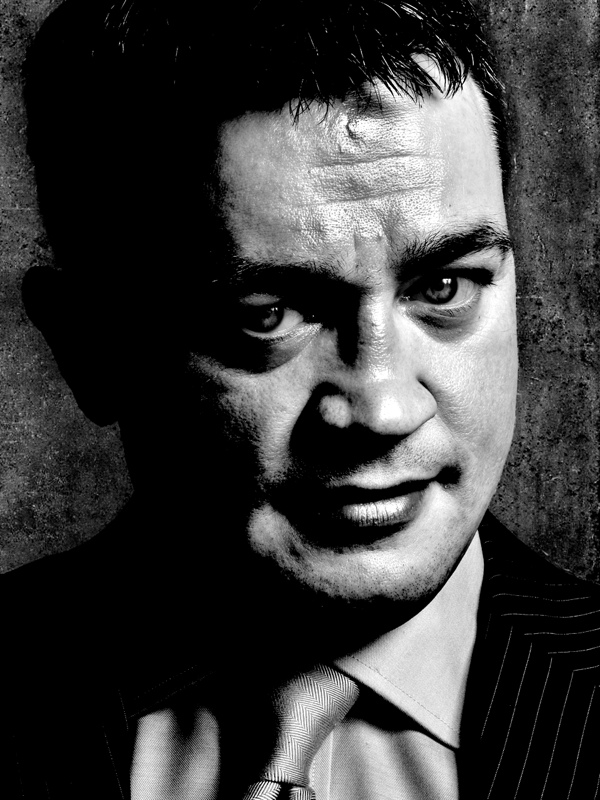
Dynamo Colin Dunne (First fight 1993 – last fight 2003)

Peter Cragg (First fight 1966 – last fight 1970)
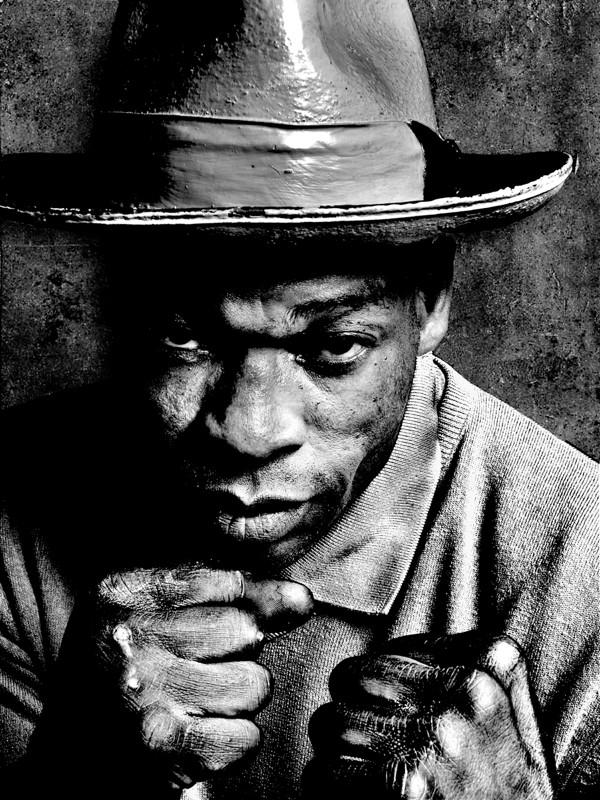
Sylvester Mittee (First fight 1977 – last fight 1988)

Ronnie Smith (First fight 1956 – last fight 1966)

Sammy McCarthy (First fight 1946 – last fight 1957)

Billy Graydon (First fight 1949 – last fight 1960)
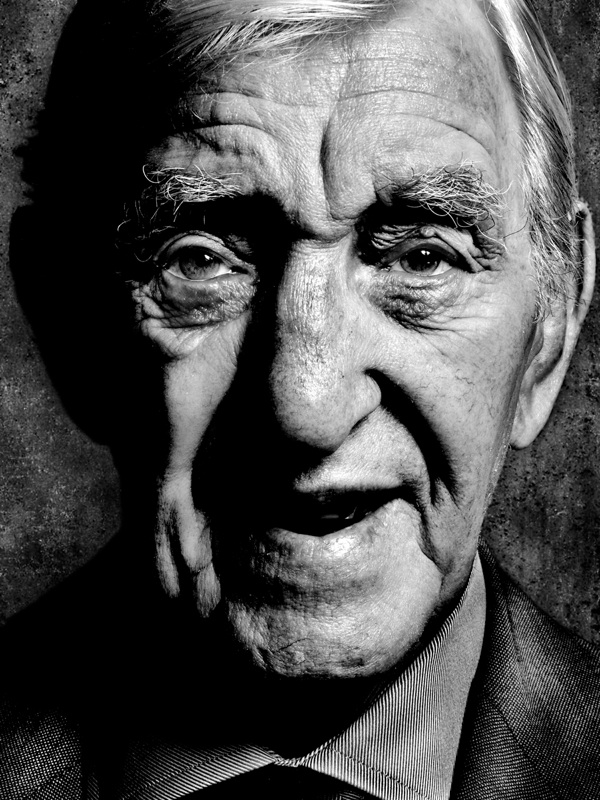
Ron Cooper (First fight 1944 – last fight 1953)

Dave Cooper (First fight 1966 – last fight 1972)

Paul Fairweather, Committee Member of London Ex-Boxers ( fought in 1965)
Photographs copyright © John Claridge
You may like to read these boxing stories
Sylvester Mittee, Welterweight Champion
Ron Cooper, Lightweight Champion
Sammy McCarthy, Flyweight Champion
and take a look at these other pictures by John Claridge
Along the Thames with John Claridge
At the Salvation Army with John Claridge
A Few Diversions by John Claridge
Signs, Posters, Typography & Graphics
Views from a Dinghy by John Claridge
In Another World with John Claridge
A Few Pints with John Claridge
Some East End Portraits by John Claridge
Sunday Morning Stroll with John Claridge
The Doors Of Old London

The door to Parliament
Look at all the doors where the dead people walked in and out. These are the doors of old London. Some are inviting you in and some are shutting you out. Doors that lead to power and doors that lead to prison. Doors that lead to the parlour, doors that lead to the palace, and doors that lead to prayer. These are the doors that I found among hundreds of glass slides once used for magic lantern shows by the London & Middlesex Archaeological Society, many more than a century old, and housed today at the Bishopsgate Institute.
Looking at life through a doorway, we are all either on the way in or on the way out. Like the door to your childhood home that got sold long ago, each one pictured here is evidence of the transient nature of existence, reminding you that you cannot go back through the portal of time.
Yet there is a powerful enigma conjured by these murky pictures of old doors, most of which will never open again. Like the pauper or the lost soul condemned to wander the streets, we cannot enter to learn what lies behind these doors of old London. But a closed door is an invitation to the imagination and we can wonder and dream, entering those hidden spaces in our fancy.
London has always been a city of doors, inviting both the curiosity and the suspicion of the passerby. In each street, there is a constant anticipation of people popping out, regurgitated onto the street by the building, and the glimpse to be snatched of the interior before the door closes again.
I cannot resist the notion that every door contains a mystery and all I need is a skeleton key. Then we can set out to explore as we please, going in one door and out another, until we have passed through all the doors of old London.


The entrance to the Carpenters’ Hall


The doors of Lambeth Palace

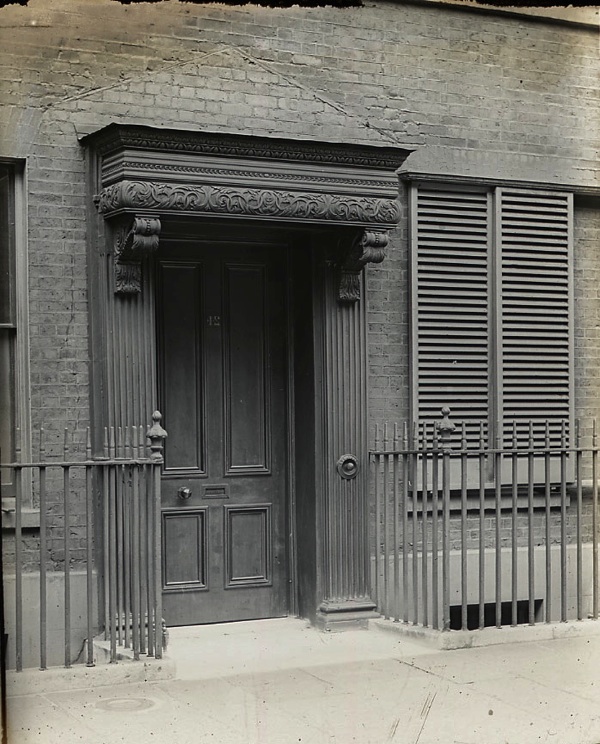


Door in the cloisters in Westminster Abbey

The door to the chamber of Little Ease at the Tower of London.


In St Benet’s Church, Paul’s Wharf.


Back door of 33 Mark Lane

Back door to Lancaster House.

In Crutched Friars.

14 Cavendish Sq.

The door to 10 Downing St

39a Devonshire St.


The door to the House of Lords

Wren doorway, Kensington Palace.

The door to Westminster Abbey
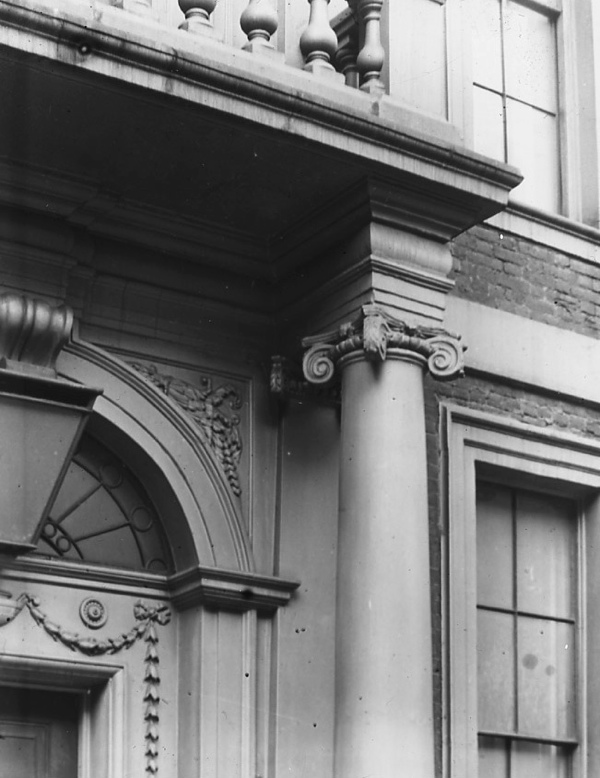


St Dunstan’s in the West

The entrance to Christ Church, Greyfriars.

The door to St Bartholomew’s, Smithfield

Temple Church

The Watchhouse, St Sepulcre’s, Smithfield.

Door by Inigo Jones at St Helen’s Bishopsgate.

Prior Bolton’s Door at St Bartholomew the Great.


At the Tower of London
Glass slides © Bishopsgate Institute
You may also like to take a look at
The Leather Shops of Brick Lane

Everything at Oceanic Leather is made in Brick Lane
Not so long ago, almost all the shops north of the railway bridge in Brick Lane sold leather jackets and bags manufactured locally, but now there are only a handful of these businesses left. So Spitalfields Life Contributing Photographer Sarah Ainslie and I went along to find out what is going on in the world of East End leather, and we encountered an entire spectrum of human emotion.
The manufacture of leather garments is an age-old industry on this side of London, existing as part of the clothing and textile trade that was a major source of employment here for centuries. A hundred years ago, the industry was predominantly Jewish but when Asian people arrived in significant numbers in the last century they worked as machinists in a trade that they eventually took over and now, a generation later, they find themselves presiding over its slow demise.
At Truth Trading, 151 Brick Lane, I encountered the father and son in a family business that began in 1978, sitting facing each other across a desk in an empty shop. “It’s dead! I make but I can’t sell,” declared Abdul Bari, leaping up almost apoplectic with frustration at the seventeen pounds they had taken that day, while his son sat watching with visible concern for his father’s distress. A skilled man who trained as a cutter and knew everything there is to know about the making of leather garments, Abdul Bari worked in the trade locally since 1968. Then he started making clothes at home before opening a shop in Commercial St, graduating through premises in Wentworth St and Bell Lane, then purchasing the Brick Lane premises in 1986. “We have a factory in Pakistan with one hundred sewing machines but it is closed down because there are no orders,” he lamented, leaving me searching for words that might console him.
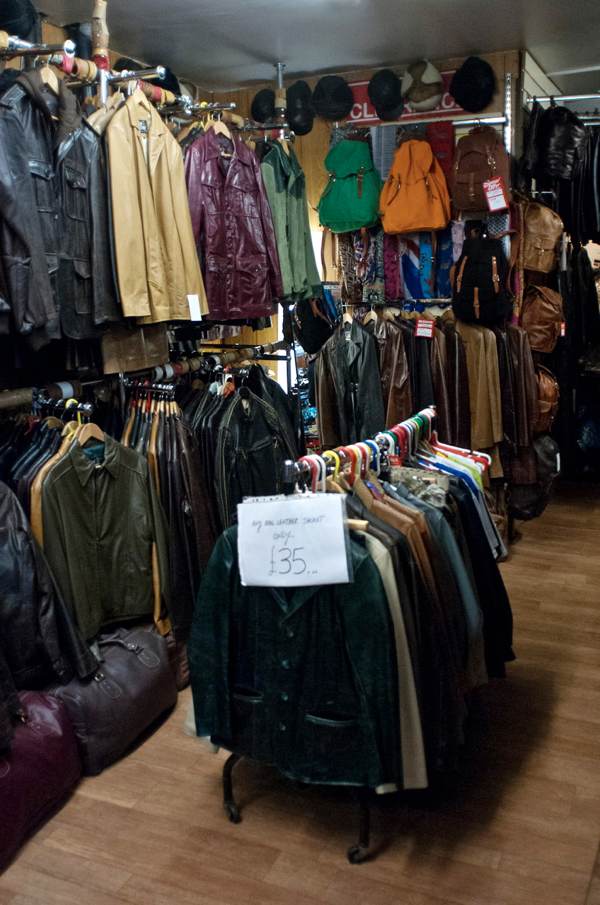
Across the road in the compact corner shop packed with glistening leather, Open Space, 200 Brick Lane, Mohammed Kamran was resolutely cheerful, explaining that his uncle Mohammed Yusuf Nagory started the business, making leather jeans and selling them at Kensington Market in the seventies. Moving to Brick Lane in the eighties, he started a factory with twenty-five people in Cheshire St which his nephew joined at fifteen years old. Today, as a smaller business they are sustained by loyal customers and have recently made costumes for Harry Potter and the West End theatre. Astonishingly, you can buy a handmade leather jacket there for as little as thirty-five pounds.
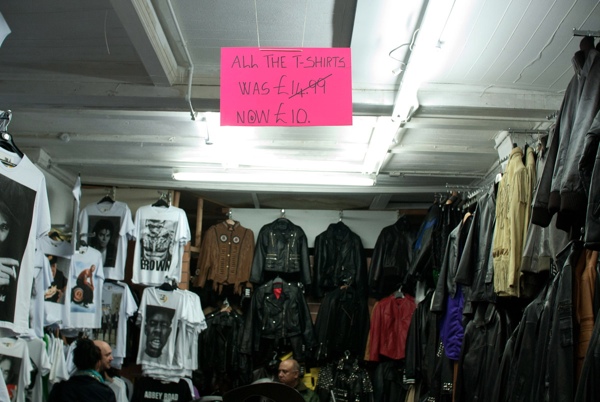
Mr Mahmood at the Brick Lane Boutique, 137 Brick Lane, who began working as a machinist twenty-six years ago and started his own business twenty years ago, explained the root of the problem to me. “When I started here, I used to sell everything I made, but now the Chinese use artificial leather and in the chain stores people can buy one of these jackets for £15. So why are they going to come here and spend £100 for real leather?” he asked, his eyes glistening with emotion as he gestured around his shop which was more-than-half given over to t-shirts, with leather jackets consigned to a corner. Fortunately our conversation was interrupted by a customer who did want to spend £100 for a real leather jacket and so I left Mr Mahmood to it, thankful that his salesmanship had been given an opportunity to shine.
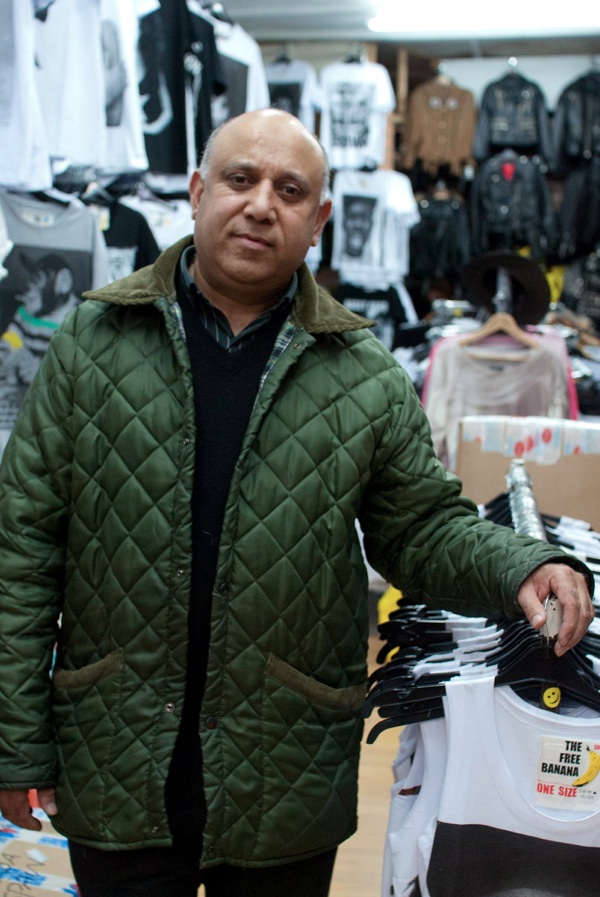
Bashir & Sons (London) Ltd at Bashir House is a towering landmark at 180 Brick Lane, where you can walk in to admire a vast stock of leather jackets in every permutation of design upon rails in a labyrinthine ground floor showroom. I was welcomed by the ebullient Mr Ahmed, one of the brothers in this family business which started forty-six years ago in Commercial St and moved to the current premises thirty-five years ago. “I started when I was sixteen,” he admitted to me in a nostalgic tone, “In those days, the customers just came and bought the stuff but now we have to sell it.” With outlets in Birmingham and elsewhere, this is an elaborate operation, manufacturing in Asia and distributing throughout Europe. “We’re not the biggest but the best,” Mr Ahmed assured me, demonstrating professional charm while boasting Dustin Hoffman and Lennox Lewis among his customers, “And we sell the largest selection of fancy sun glasses in London.”
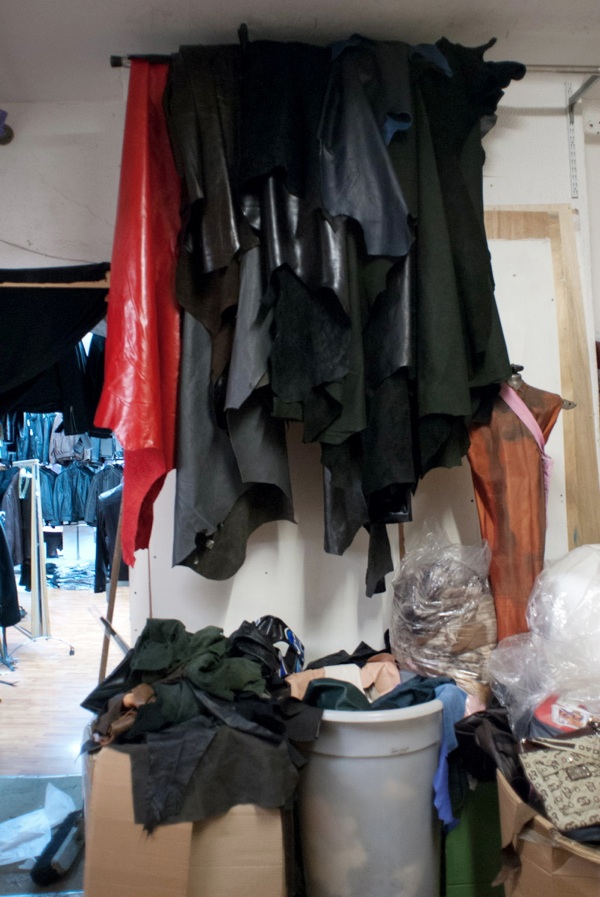
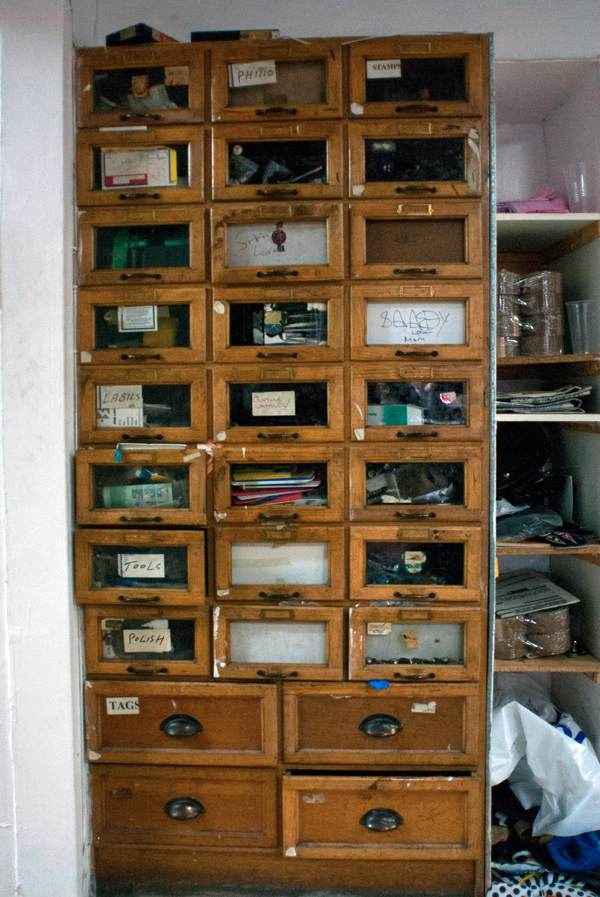
Further down, at 168 Brick Lane, another Ahmed, proprietor of Oceanic Leather was the most frank of the leather sellers, in spite of his self-effacing demeanour. “A lot of people left or went bankrupt. We had a regular business and then one day it dried up.” he revealed with a melancholy frown, “I’ve suffered pain, but I rode out the worst part of it.” In his store, everything has been made in the workshop above, though there is nothing to indicate this to customers, just piles of pieces of high quality leather stacked up in the crowded space attesting to the distinction of the garments on display.
My final call was Rana Leather, 160 Brick Lane, where I discovered the proprietor Mr Rana and his beefy assistant trying to squash an impossibly large number of leather jackets into a tiny cardboard box. The beefy assistant held the box shut while Mr Rana wrapped it in tape and they succeeded in packing a curious irregularly-shaped parcel. Afterwards, Mr Rana wiped perspiration from his brow while explaining that he was one of three brothers who ran the business which started on Fashion St in 1975. This busy shop was filled with boxes of clothes in transit, as much a warehouse for the wholesale trade as a retail outlet, and it indicated that a certain volume of business was being done on the premises.
All but one of the leather shops I visited owned their buildings, which proved to be the key factor in their survival when others that paid the escalating rents had gone. I was fascinated to find that most were run by skilled men, experienced leatherworkers who offer the facility to have clothes and bags made to order. It was even more remarkable to learn that for a modest price you can buy a good quality jacket which has been made by hand in a workshop on Brick Lane. There may be only a few left, but my discovery was that these leather shops still have plenty going for them – if people only knew.
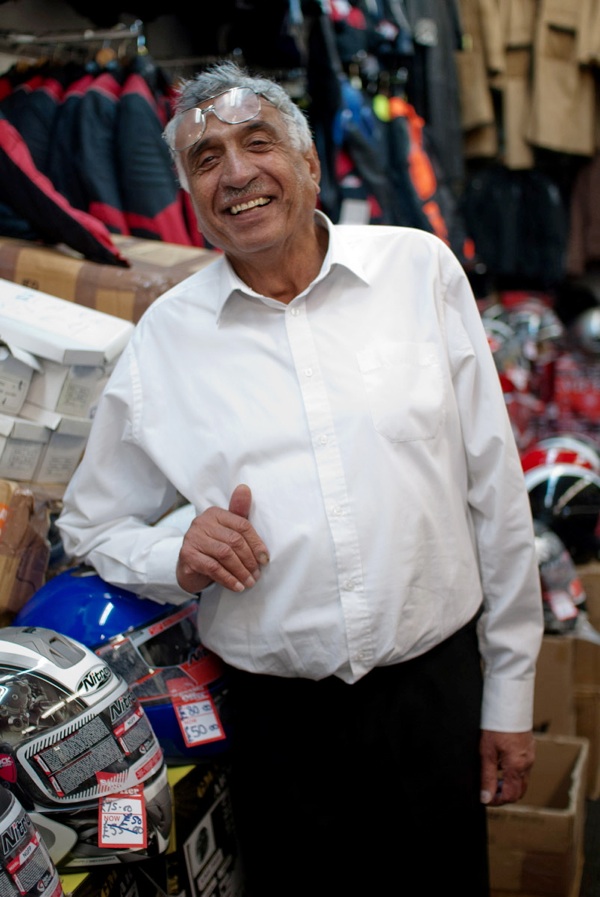
Abdul Bari, Truth Trading, founded his business by making clothes at home in 1978.
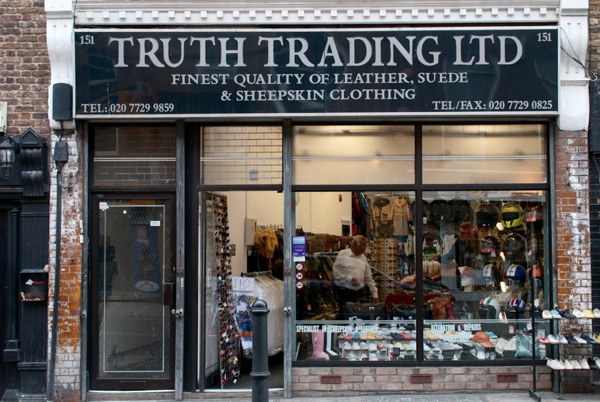
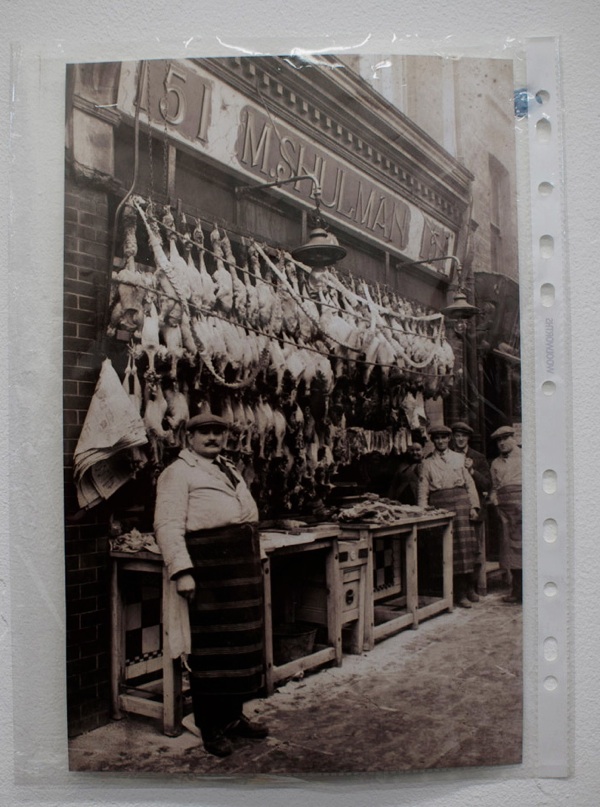
The grandchildren of M.Schulman, the kosher poulterer, gave this photo to Truth Trading, now operating from the same premises.
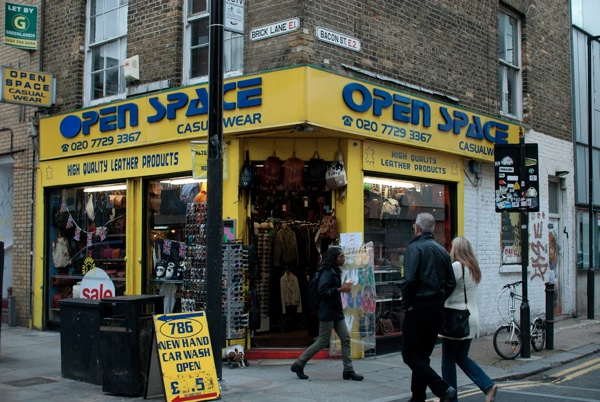
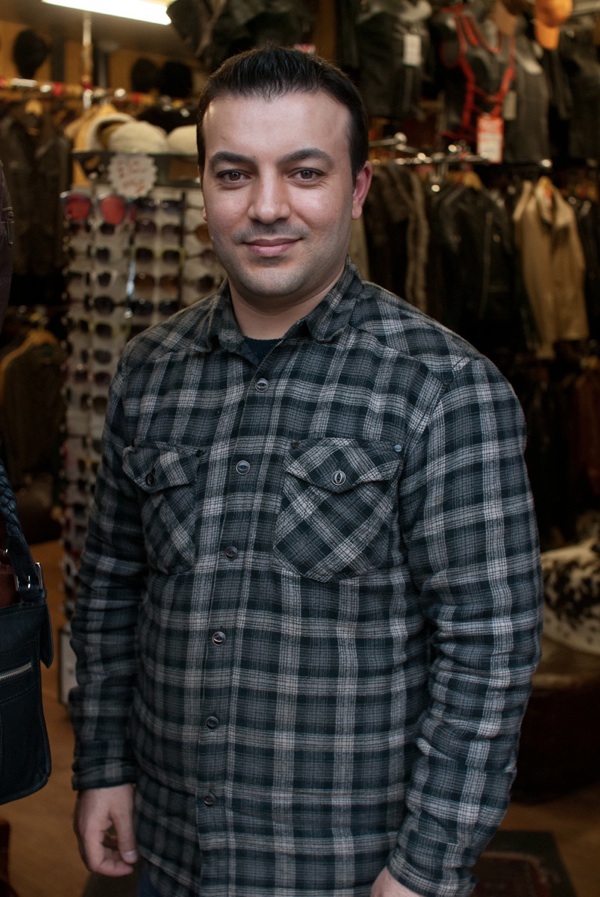
Mohammed Kamran’s uncle founded the business, Open Space, by selling leather jeans in Kensington Market in the seventies.
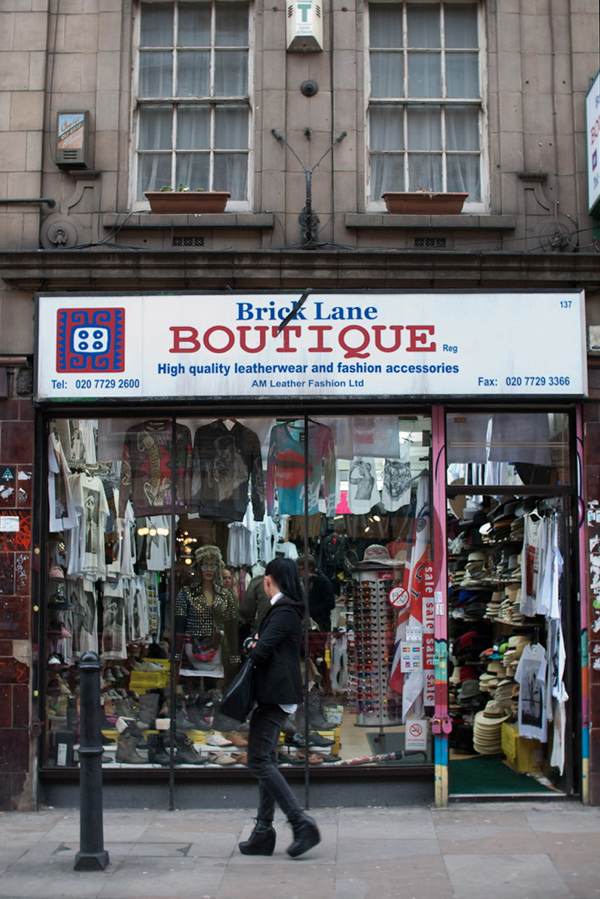
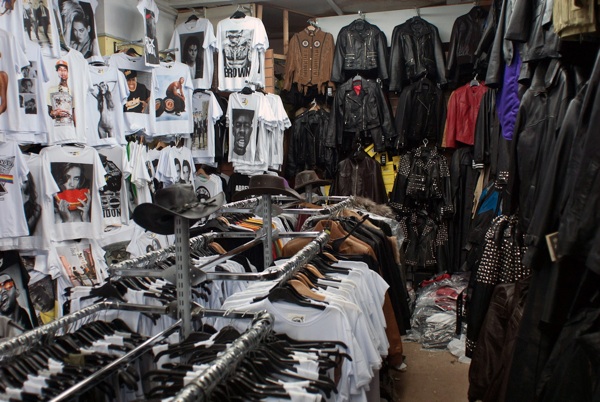
Mr Mahmood, Brick Lane Boutique, started as a machinist twenty-six years ago.
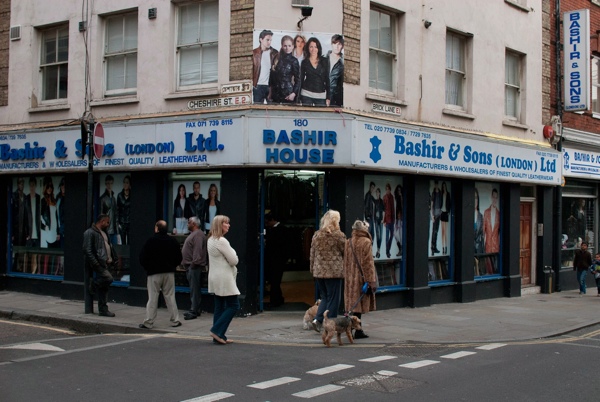
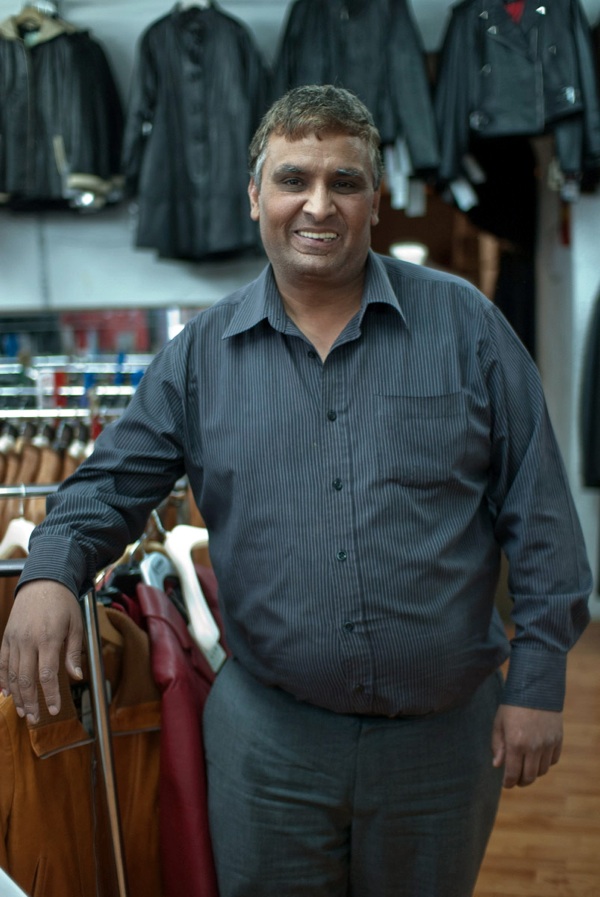
Mr Ahmed at Bashir Leather – “We are not the biggest but the best”

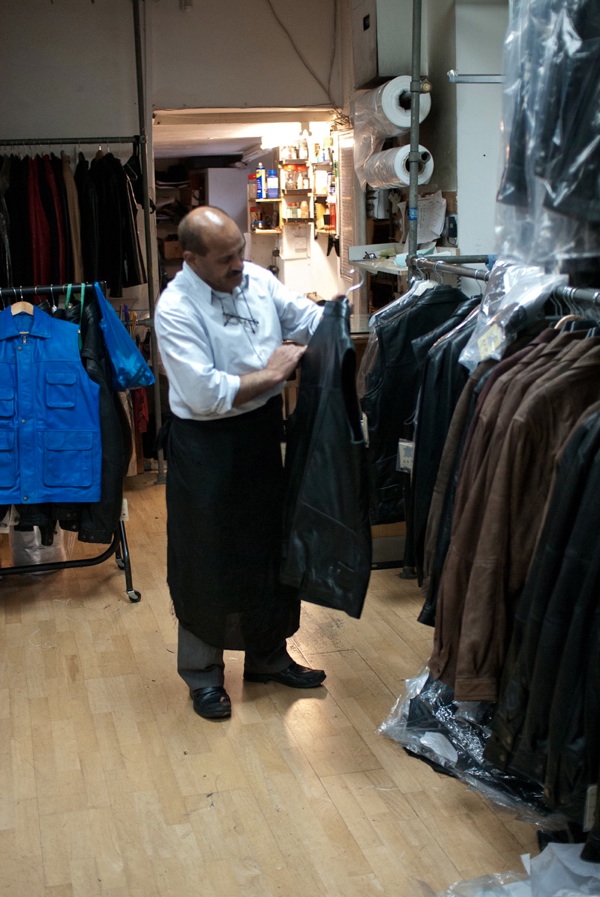
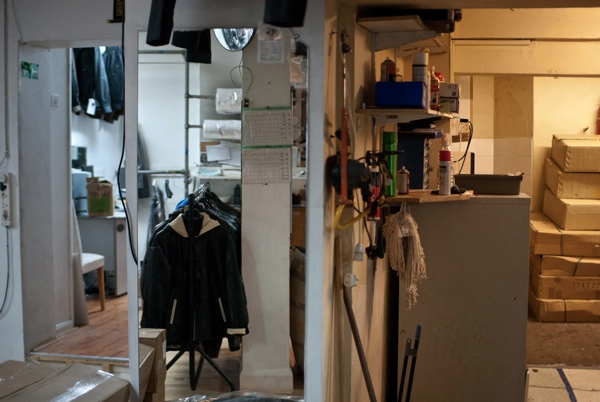
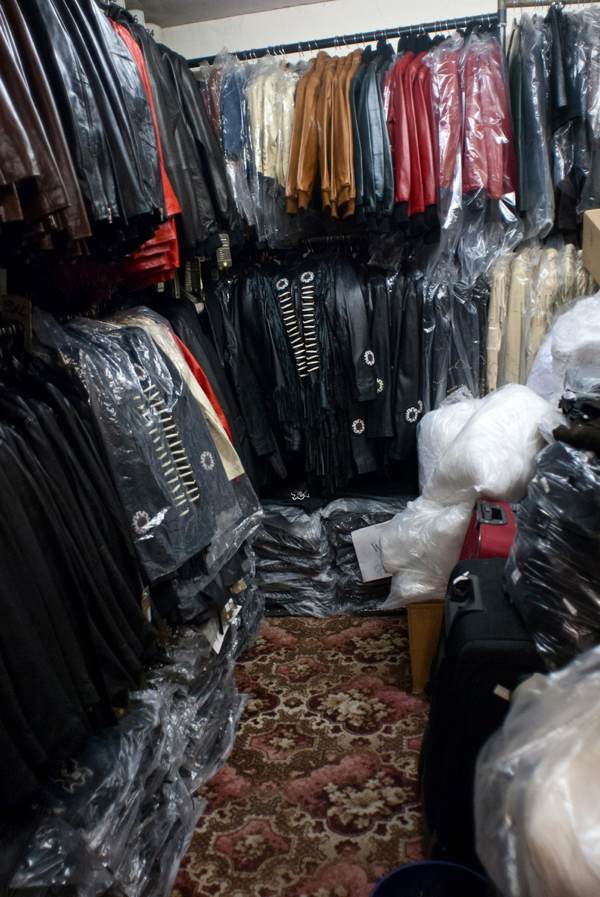

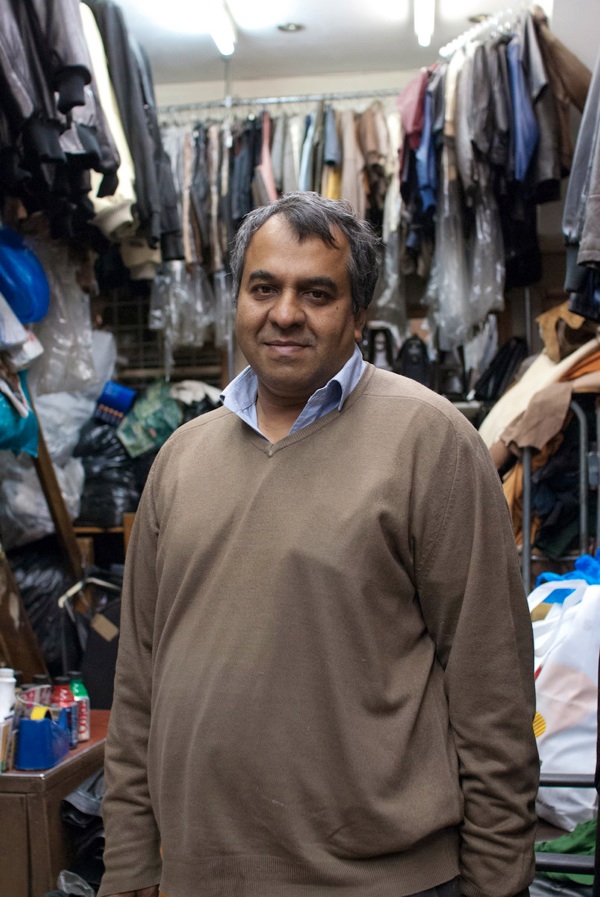
Ahmed, proprietor of Oceanic Leather.

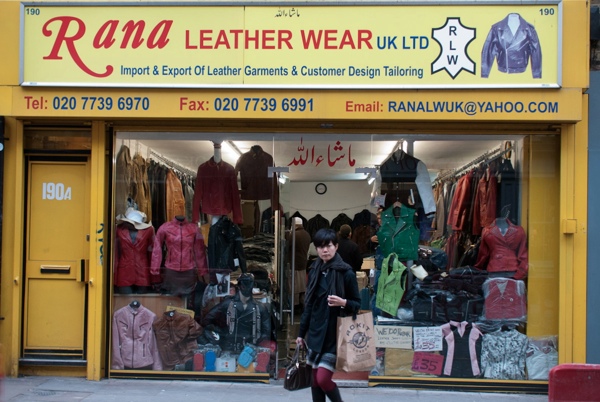
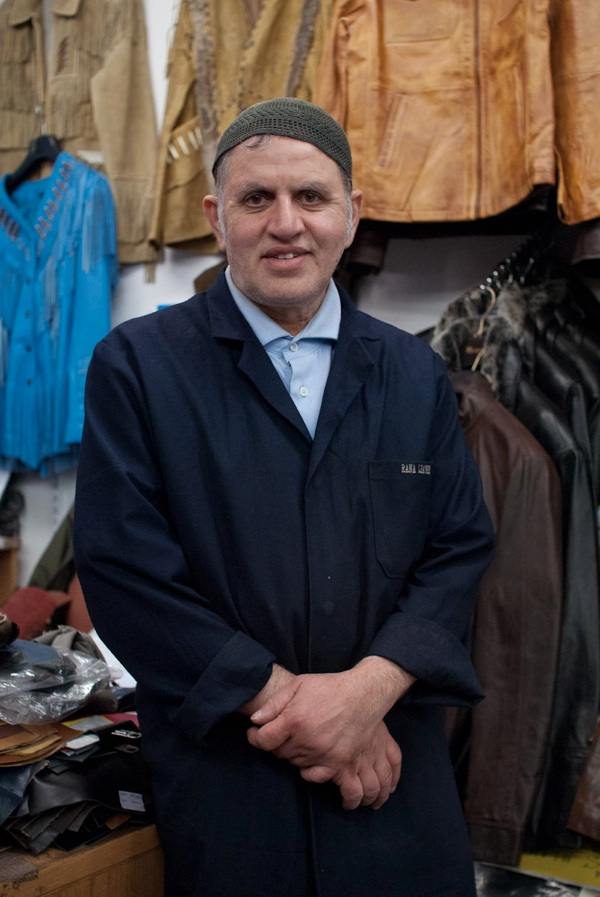
Mr Rana of Rana Leather
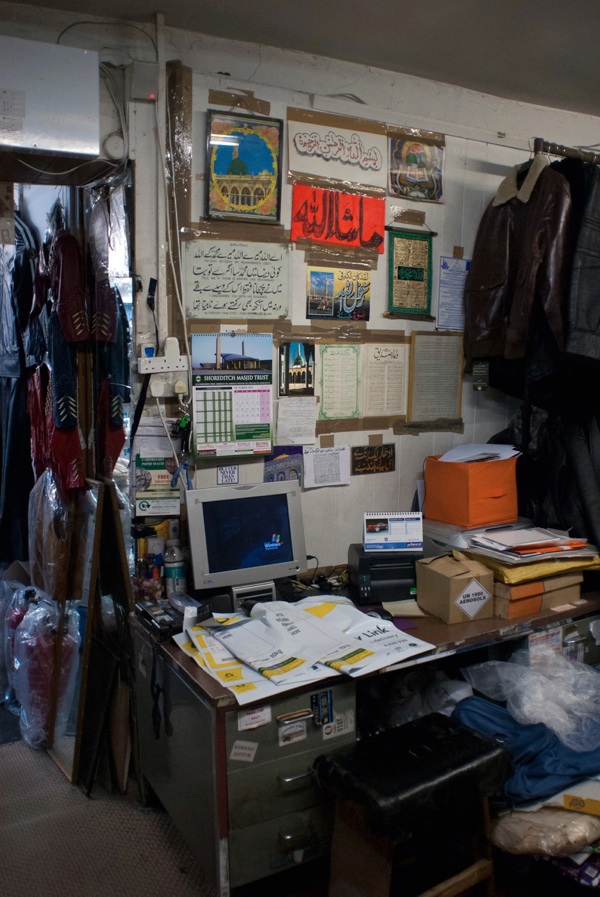
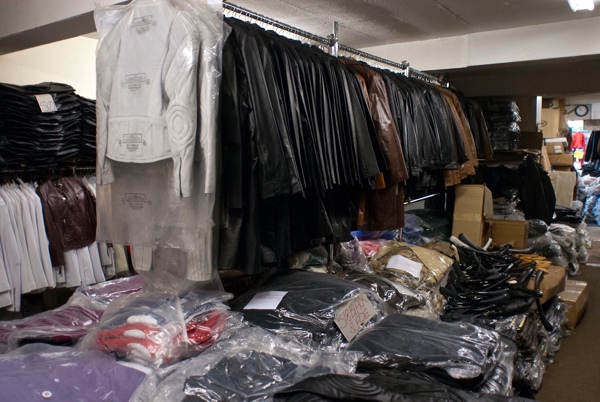
Photographs copyright © Sarah Ainslie
You may also like to read about
Recent Paintings by Marc Gooderham
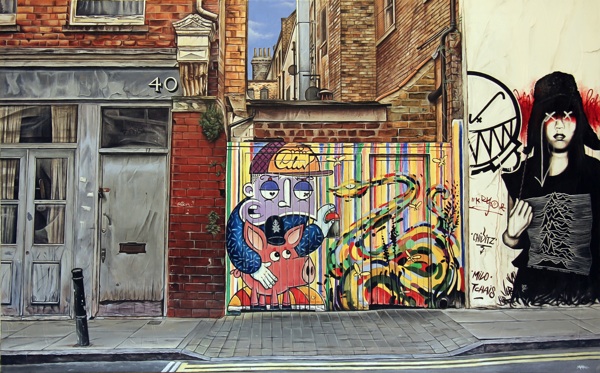
Lost Control Again (Hanbury St)
A year has passed since I came across the work of painter Marc Gooderham and here you see a selection of the new pictures he has created since then – of scenes that will be familiar to many readers. “My first year was just about getting going,” he admitted to me, “but now I’m in the flow of it and I’m in control of it. As time has gone by, I’ve thought more about composition and colour.”
“There’s so much more colour in my pictures because of the street artists, some of those works are so well painted, yet they’re giving it away – it keeps the streets really vibrant.” said Marc, modestly acknowledging the symbiotic relationship his paintings on canvas have with this most democratic of art forms.
Yet, speaking of his picture of Hanbury St, he says, “I saw that grey and the explosion of colour beside it, and I realised the grey had as much power as the colour.” Although they may appear superficially photorealistic, Marc subtly manipulates the elements he discovers to construct an intense personal vision which has a dreamlike quality. In each of his paintings, there is a dynamic contrast between the detailed rendering of architecture and the images applied by street artists, often amplified by an ethereal blue sky overhead.
It takes around a month for Marc to create a painting, building it up from architectural sketches and balancing the components. During the last year, as his paintings have got larger and his palette bolder, he has acquired a passionate following which means that once the pictures are the complete, the gallery takes them out of his hands. “It helps to have that routine of working on something and getting it finished within the month,” Marc confirmed, enjoying the momentum, “I like to paint them and there are people now that appreciate what I do, so that’s a good common ground.”
“Each of these paintings is about a discovery,” he confided to me, “I stumble upon them – I go out to explore the area and even though I am walking down familiar streets, I always find a new scene. There’s a lot to paint because the East End changes so quickly and my mission is to hunt out potential paintings, discovering more buildings that deserve to be painted.”
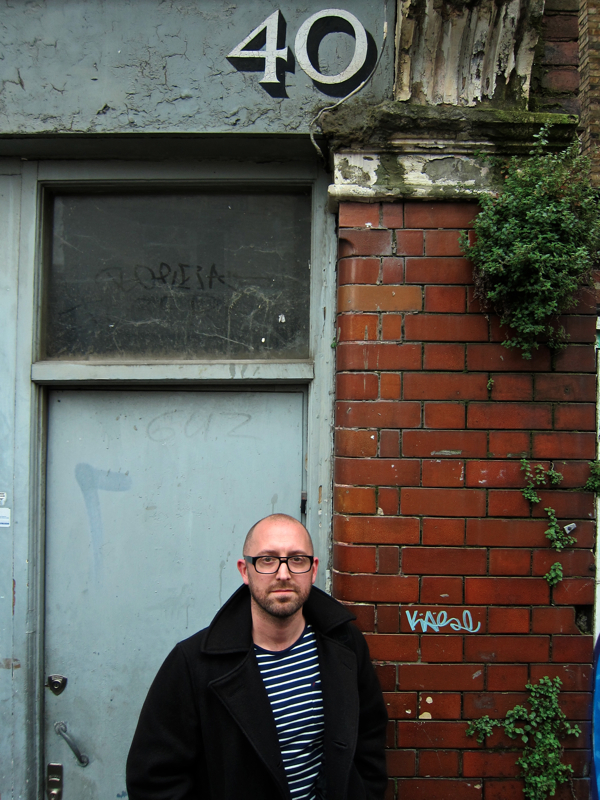
Marc Gooderham in Hanbury St yesterday.
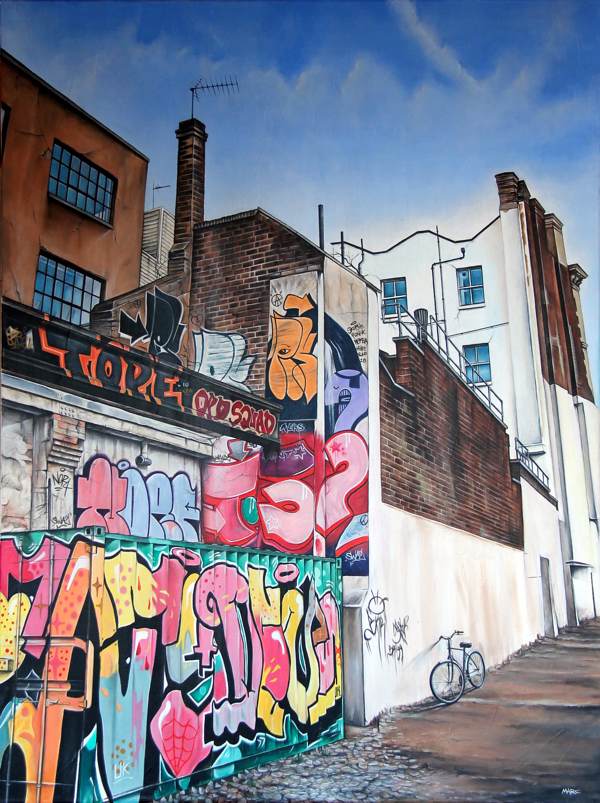
The Split (Holywell Lane Car Park)
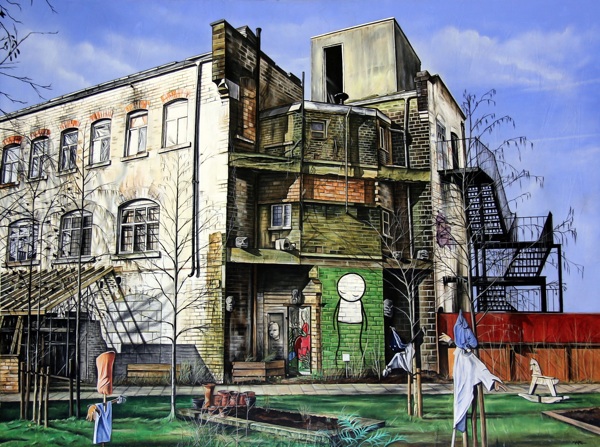
Wild and Free (Dalston Lane) – “I crept behind a car park, crawled through a fence and stumbled upon this, a large old house surrounded by scarecrows. It looked like a fantasy, a haunted house where the scarecrows were guarding the place.”
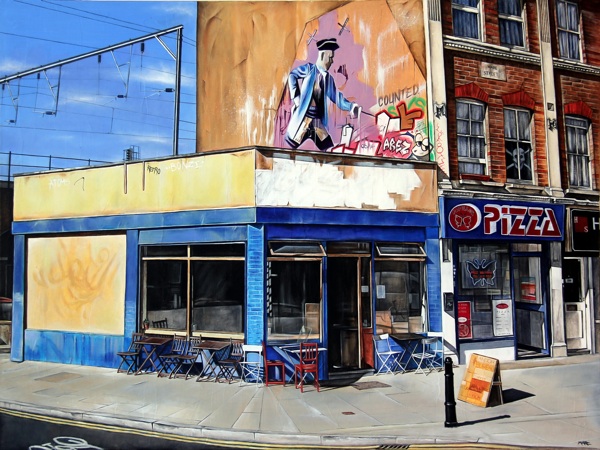
Blue Above the Wires (Mare St)
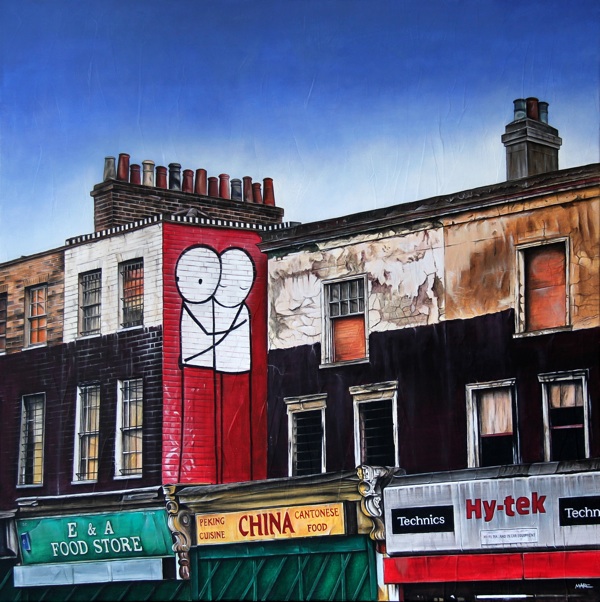
Smoke Stacks (Dalston Lane)
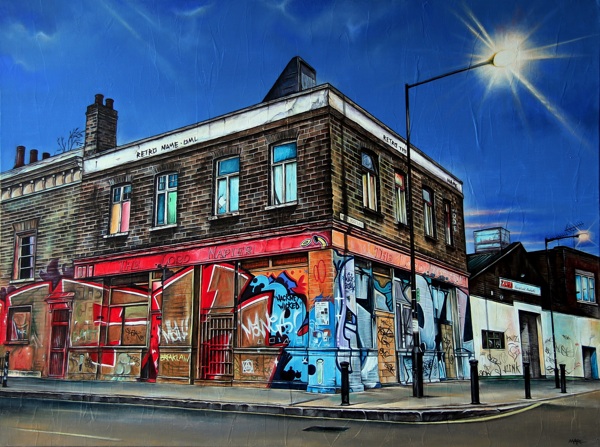
Nightfall on Whitepost Lane (Hackney Wick) – “I realised it looked as if it was glowing and so I went back during the day to find the right time when it looked like it was still alive, even though it was derelict.”
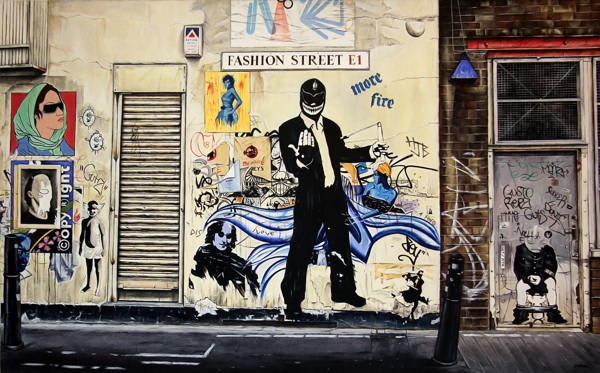
Fashion Street
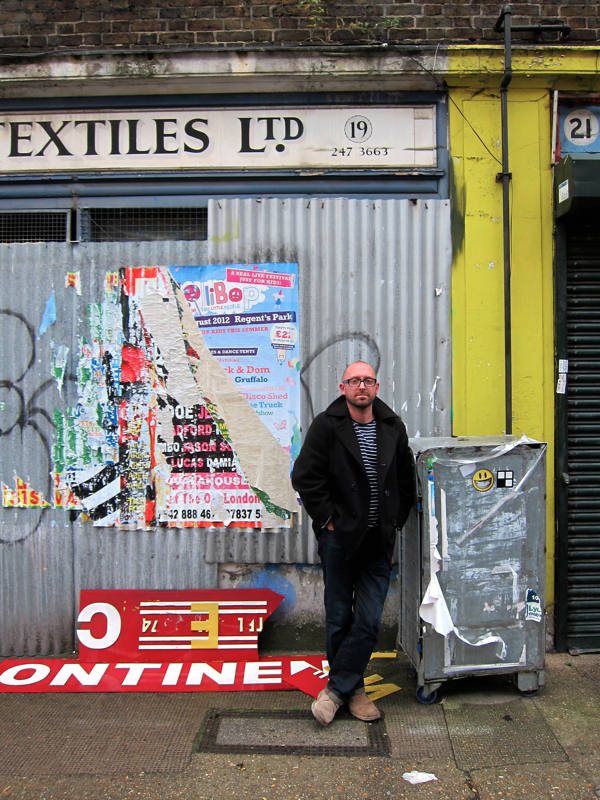
Marc Gooderham in Toynbee St.
Marc Gooderham’s work is represented by Artisan Galleries
You may also like to read my original profile
So Long, Spitalfields Fruit & Wool Exchange
After the proposal to demolish and redevelop the historic Spitalfields Fruit & Wool Exchange was rejected unanimously twice by the members of Tower Hamlets Council, last night the Mayor of London, Boris Johnson, overruled them and gave the plan his blessing. Now, the sixty small businesses based there have to move out by the end of November to make way for the corporate office block that will take the place of the current building. Today I am republishing this account of my visit to the Exchange earlier this year.
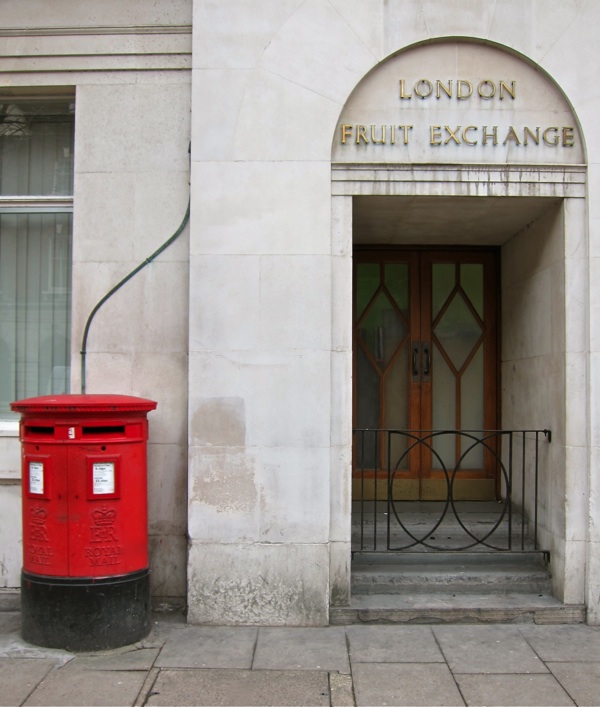
Opening in 1929, when the volume of imported produce coming through the docks more than doubled in the ten years after the First World War, the mighty Fruit & Wool Exchange in Spitalfields was created to maintain London’s pre-eminence as a global distribution centre. The classical stone facade, closely resembling the design of Nicholas Hawksmoor’s Christ Church nearby, established it as a temple dedicated to fresh produce as fruits that were once unfamiliar, and fruits that were out of season, became available for the first time to the British people.
After sixty years as a teeming warren of brokers and distributors, the building languished when the Fruit & Vegetable Market moved out from Spitalfields in 1991 and there were no wholesalers left to cross Brushfield St and supplement their supplies of British produce from the auctions at the Exchange. Since then, around sixty small businesses operated peaceably from the building which through its shabby grandeur reminded every visitor that it had once seen better days.
Yet it was only a matter of time before the notion of redevelopment arose, and when ambitious plans were revealed over a year ago for a huge new building to replace both the Exchange and the multi-storey car park behind it – filling two entire blocks – a sense of disquiet was generated in Spitalfields, especially among those who remembered the uneasy compromises entailed in the rebuilding of the Market.
Few have been convinced by the homogeneous box that was proposed to stand in place of the Exchange and many were disappointed when the creators of such mediocrity dismissed the current structure as of negligible architectural worth. In fact, the Commercial St end of the Exchange building closely matched the window structure and red brick of the eighteenth century houses in Fournier St, while the facade mirrored Christ Church itself. Since then, a revised proposal has been forthcoming which retains the Brushfield St frontage facing the Spitalfields Market but is far from being a design worthy to face Nicholas Hawksmoor’s masterpiece of English Baroque upon the opposite side of Commercial St.
And so, before it vanishes forever, I went over to take a look around and savour the past glories of the City of London Fruit & Wool Exchange for the last time.
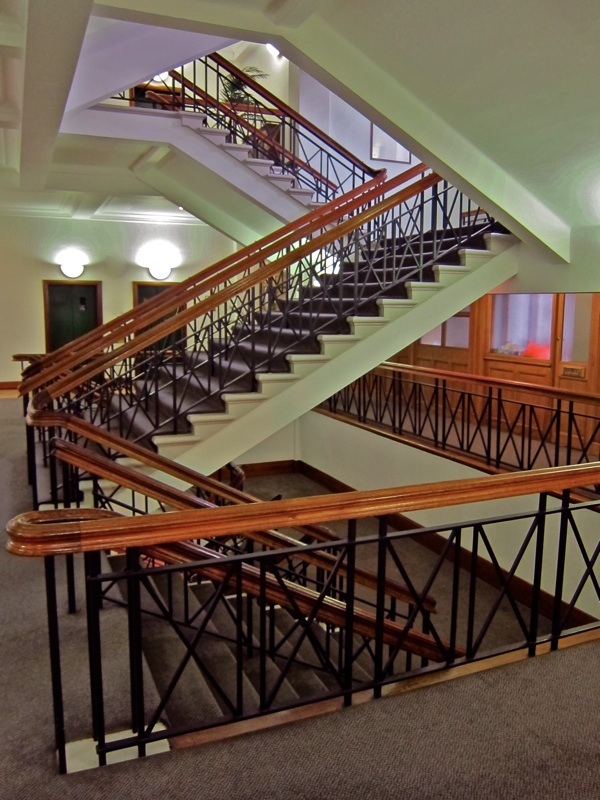
Ascending from the grand entrance, a double staircase worthy of a ballroom in a liner or fancy hotel leads you up to the auction rooms. Built as the largest in the country, seating nearly nine hundred people, these magnificent panelled chambers were each the height of two storeys within the building. Fitted with microphones, which were an extraordinary innovation in 1929, possessing elaborate glass roofs that promised to simulate daylight – even on dark and foggy days – to best illuminate the fruit, they were served by high-speed hydraulic lifts to whisk samples of each consignment from the basement in the blink of an eye. Too bad that a recent fire, occurring since the redevelopment was announced, meant they could never be visited again. Now the entrances to the most significant spaces which define this edifice are sealed with tape and off-limits for ever, while charred parquet flooring evidences the flames that crept out under the door.
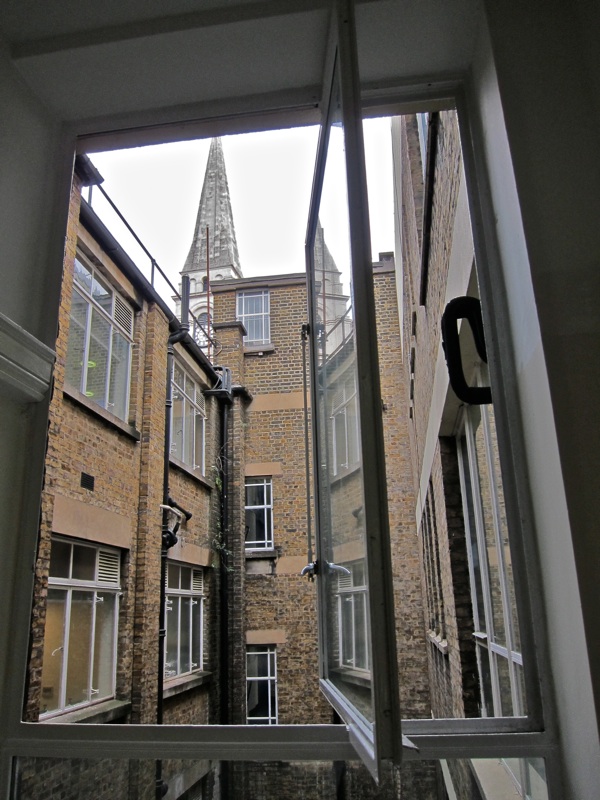
Instead, I had to satisfy myself with a stroll around the empty top floor through centrally-heated corridors maintained at a comfortable temperature ever since the offices were all vacated two years ago. Everywhere I could see evidence of the quality of this building, from the parquet floors which extend through each storey, to the well-detailed brass fixtures and high-quality Crittall window frames that were still in good order. Within the building, hidden light-wells permit glass-ceilings to be illuminated by daylight upon each storey. Peering into these spaces reveals the paradoxical nature of this edifice which presents ne0-classicism to the street but adopts a vigorous industrial-modernism within, employing vast geometric shaped concrete girders to support the roof spans of the auction rooms below and arranging rows of narrow metal windows in close grids that evoke Bauhaus design.
From the top, I descended through floors of long windowless corridors lined with doors, where an institutional atmosphere prevailed, hushing the speech of those stepping outside their offices as they enter these strange intermediary spaces that belong to no-one any more. My special curiosity was to explore the basement which served as a refuge for the residents of Spitalfields during the Blitz. It was here that Mickey Davies, an East End optician known as “Mickey the Midget,” became a popular hero through his work in improving the quality of this shelter. It had gained the reputation as the worst in London, but later acquired the name “Mickey’s Shelter” in acknowledgment of his good work. As a shelter marshall, Mickey witnessed the overcrowding and insalubrious conditions when ten thousand people turned up at this basement which had a maximum capacity of five thousand. He organised medical care and recruited volunteers to undertake cleaning rotas. And, thanks to his initiative, beds and toilets were installed, and even musical entertainment arranged.
The vast subterranean network of chambers has been empty for twenty years now – gloomy, neglected and scattered with piles of broken furniture. Although partitions have been fitted to create storage rooms – where, mysteriously, Rupert Murdoch recently installed his archive – the Commercial St end of the building remains open and forlorn, with concrete pillars adorned by graffiti. Fruit packers marked off batches of produce in pencil on the wall here, and amused themselves by writing their names and making clumsy doodles. In this lost basement, it is still possible to imagine the world of Mickey Davies, where thousands once slept upon the floor while the city burned outside.
From Brushfields St, the City of London Fruit & Wool Exchange appears implacable – yet I discovered it contains a significant part of the hidden history of Spitalfields that will shortly be erased, to leave just an empty facade.
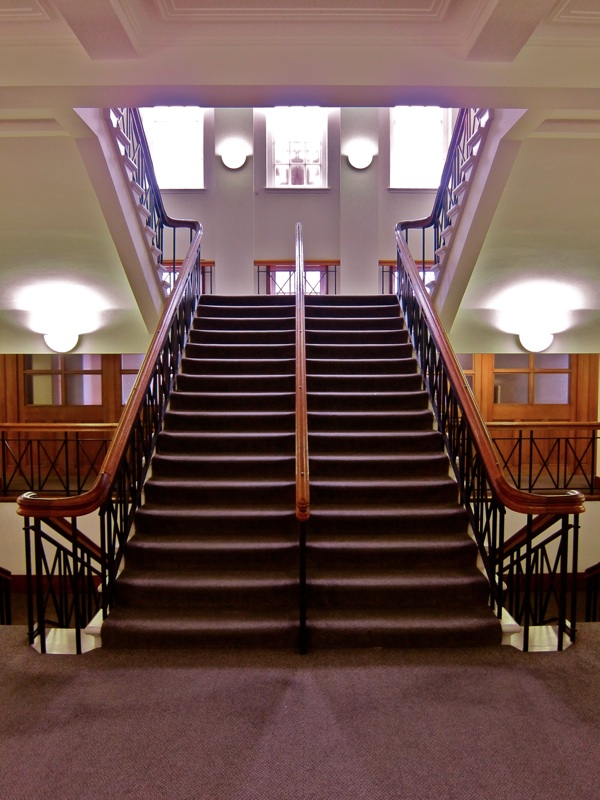
The central staircase, worthy of a ballroom in a liner or grand hotel.
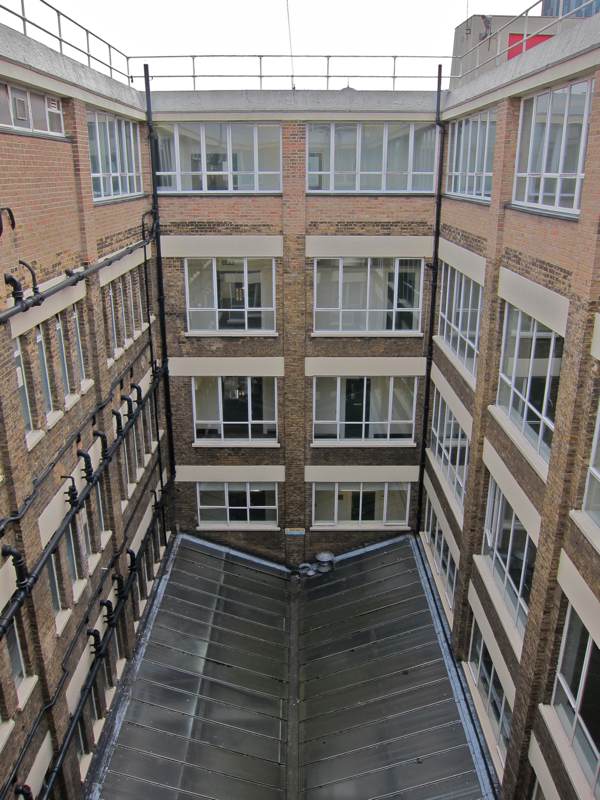
One of several light wells, lined with Crittall windows and permitting daylight to reach lower storeys.
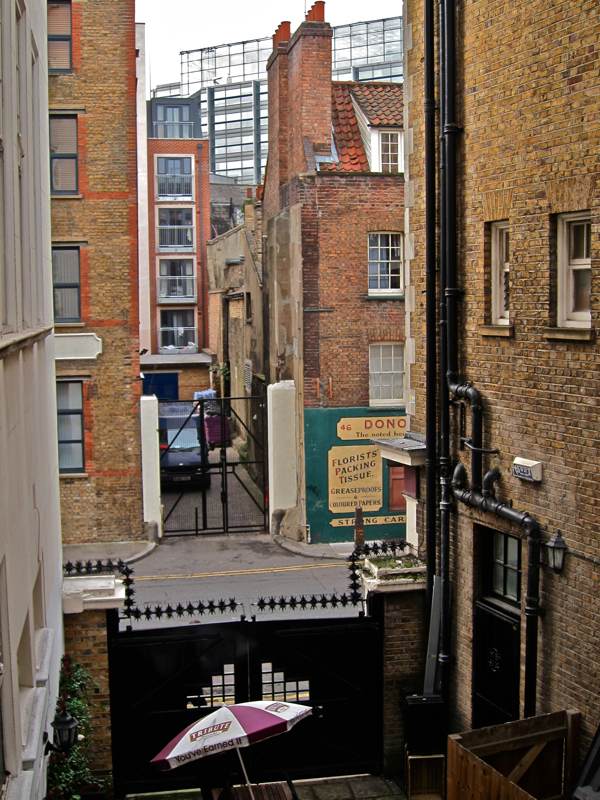
Looking out towards Crispin St from the rear of The Gun.
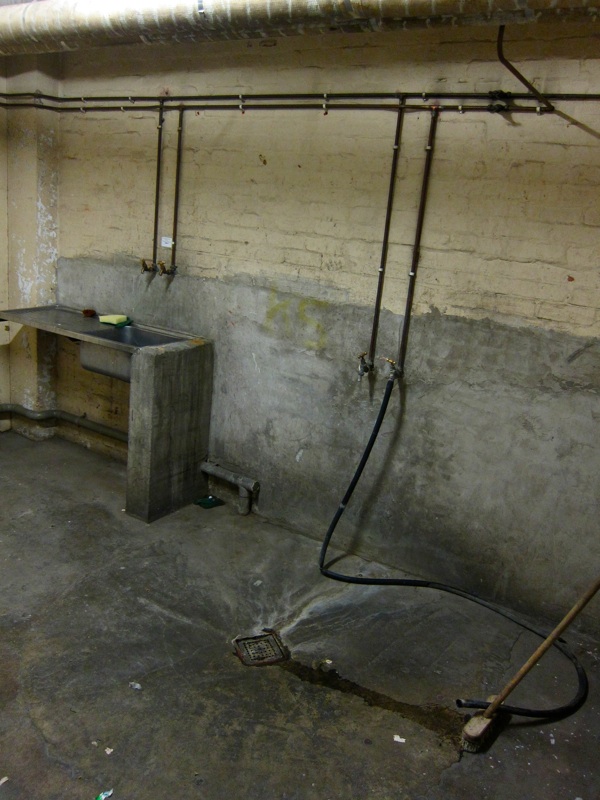
Washing room in the basement.
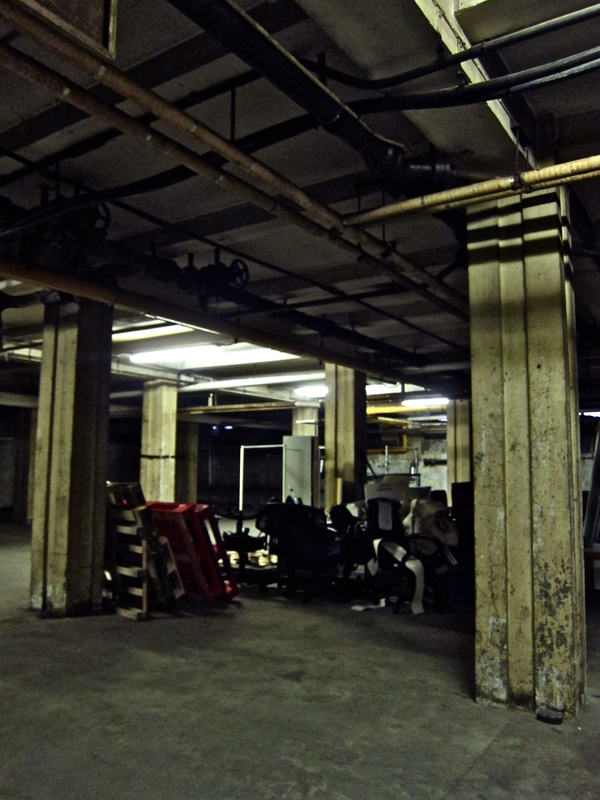
As many as ten thousand people slept here every night while taking shelter from the London Blitz.
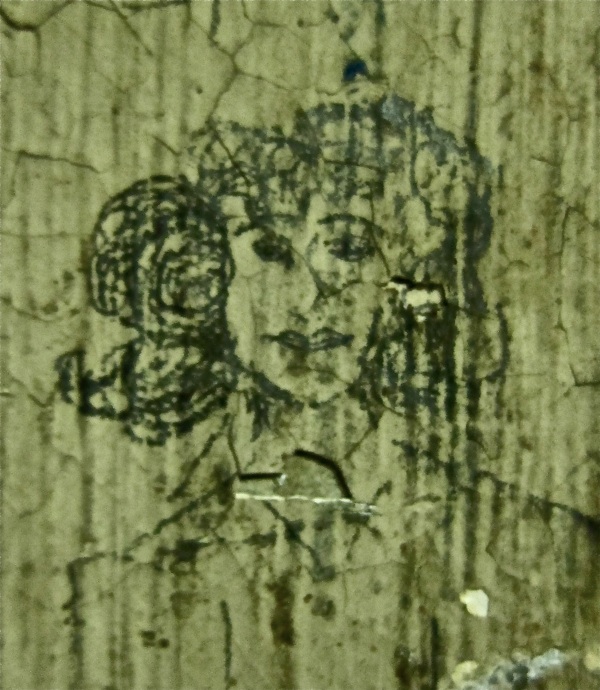
Nineteen forties graffiti portrait from the basement.

The telephone exchange.
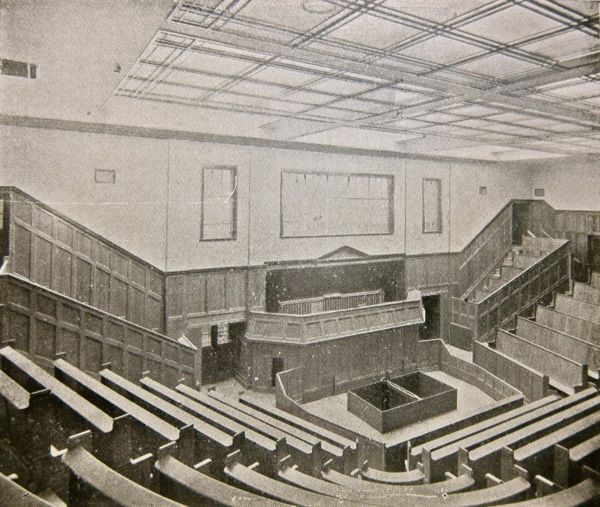
State of art auction room in 1929, lit by a glass ceiling offering “artificial daylight” on foggy days.

Fruit & vegetable auction
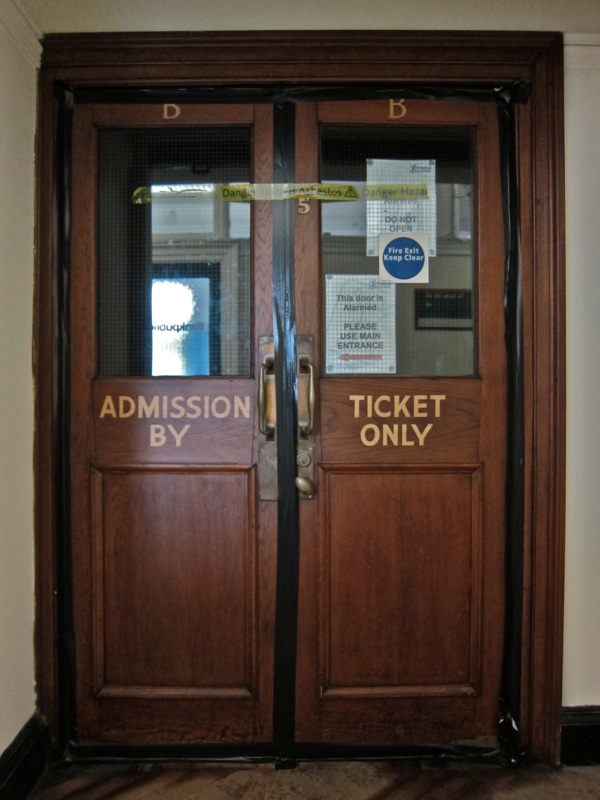
An entrance to the Auction Hall, now sealed permanently after a recent fire.
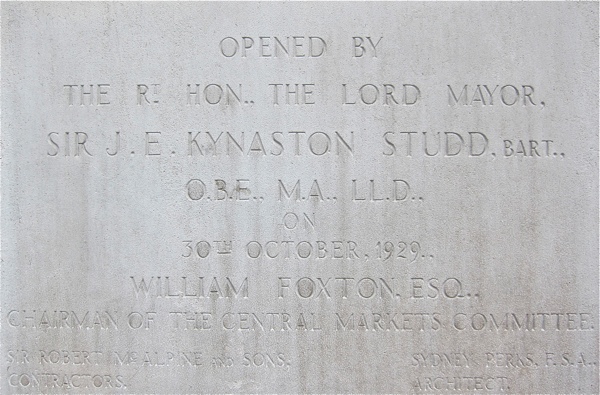
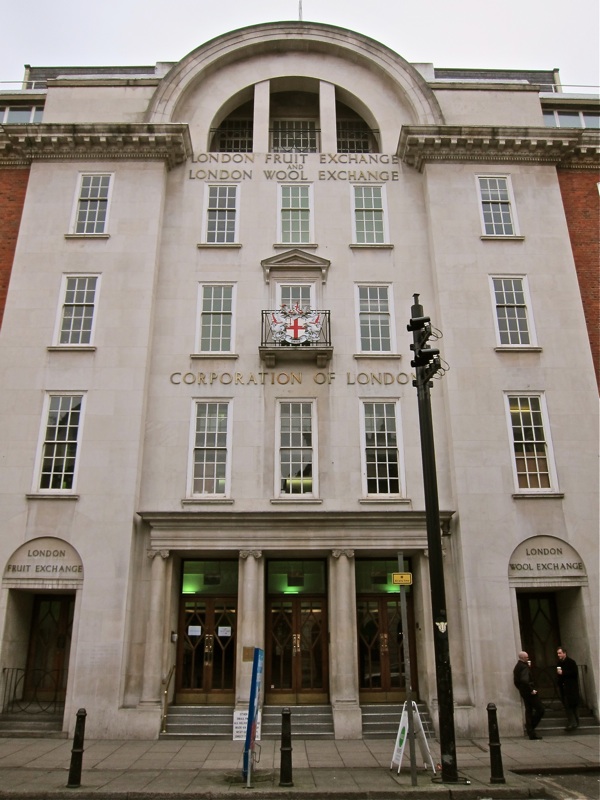
The broken pediment at the top of this frontage mirrors Nicholas Hawksmoor’s design of Christ Church.
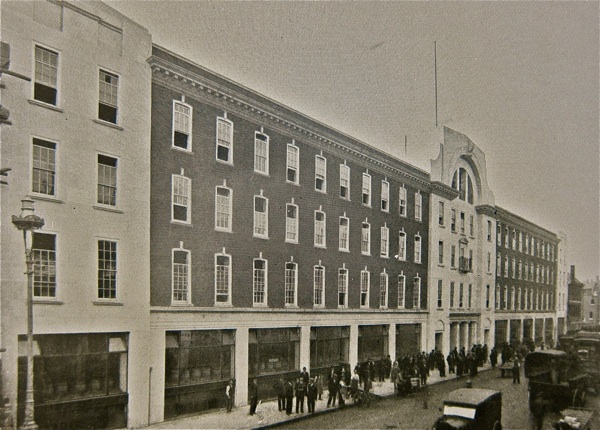
The Exchange in 1929. It is proposed that only this frontage be retained in the redevelopment.

View of Christ Church from the top floor.
You may also like to read about
At the Fruit & Wool Exchange, 1937
Mickey Davis at the Fruit & Wool Exchange
Fruit & Vegetable auction photograph courtesy of Stuart Kira
Other archive images courtesy of Tower Hamlets Local History Library & Archives












