
New Hope For Trinity Green Almshouses

Three years ago, I reported upon the sorry neglect that has occurred in recent years – under the stewardship of Tower Hamlets Council – of the Grade 1 listed Trinity Green Almshouses in Whitechapel designed by Sir Christopher Wren. The outcome of my article was the formation of the Friends of Trinity Green which has been instrumental in challenging Sainsbury’s plan to build a tower of luxury flats overshadowing the almshouses.
Yet no improvement to the maintenance of Trinity Green has resulted. Buildings that were decaying then are decaying still and the vacant Council-owned flat remains empty after all this time.
At the Cabinet Meeting today, Tower Hamlets Council members are discussing selling off the empty cottage at auction. In response, The Spitalfields Trust is offering to buy it and the entire site from the Council, taking on complete responsibility for the maintenance of Trinity Green and giving it a sustainable future. They propose creating an independent buildings preservation trust that would use income from rents and grants available to such heritage trusts to maintain the property and manage it in perpetuity.
Below you can read The Spitalfields Trust letter and, if you wish to support this initiative, please write today to John Biggs, Mayor of Tower Hamlets: john.biggs@towerhamlets.gov.uk
THE SPITALFIELDS TRUST
18 Folgate Street,
London E1 6BX
Cabinet Meeting – 20th March 2018
Regarding the disposal of 2 Trinity Green, Mile End Rd
Dear Mayor Biggs & Cabinet Members,
I am writing to you in relation to Trinity Green, one of the most important groups of Grade I listed buildings in London; buildings which are critical in the architectural history of London and which played an important role in the development of the conservation movement in Britain.
I attach our previous letter dated the 13th April 2016 in which we outlined our concerns surrounding the condition of the buildings and the lack of a comprehensive plan for their future management – a concern which is also shared by a number of other conservation and heritage groups.
Subsequent to this letter, we met onsite with Council officers and encouraged them to produce condition reports which we saw as an important first step to finding a comprehensive solution.
We are surprised that paragraph 3.17 of the report issued last Thursday 15th makes no mention of The Spitalfields Trust, nor of our initial approach which has led to this outcome. Indeed we would not have been aware of the report’s existence but for the intervention of The Friends of Trinity Green.
The Spitalfields Trust are still ready, willing and able – for the reasons set out in our previous letter – to engage with the Council. But we feel that there is a lack of understanding on the part of officers of the complexity of the situation and a lack of willingness to work with us to find a potential solution. It seems that this will now require direction and leadership from Councillors and the Mayor.
We feel that the proposed sale will impact adversely on finding a strategy for the site as a whole. It is obvious that only one comprehensive strategy can produce a durable solution, thus relieving the council of its significant obligations.
We estimate the restoration of the Chapel will cost £500,000, while the street frontage and green will cost £100,000. The notion that the Council will be able to cover this cost or be able to carry out the specialist work required is not realistic.
Consequently, The Spitalfields Trust would like to propose a comprehensive plan for the restoration and protection of Trinity Green which will be cost effective to the Council and will relieve it of its current and long-term obligations.
- We are prepared to purchase the site as a whole from Tower Hamlets Homes, to restore it fully.
- We are prepared to take on responsibility for the common parts of Trinity Green and to develop and carry out a comprehensive restoration plan for the common parts (e.g. the gates) of the buildings.
- We would transfer the common parts to a newly created buildings preservation trust, including the current owners of the buildings, which would be responsible for their long-term maintenance.
The Council is obliged as a best value authority under section 3 of the Local Government Act 1999 to “make arrangements to secure continuous improvement in the way in which its functions are exercised having regard to a combination of economy, efficiency and effectiveness.”
Selling No.2 at auction, with no provision to mitigate the short-term repairs or future expense of maintaining Trinity Green would be a short-sighted move. The Trust would not be prepared to purchase No 2 in isolation and instead proposes an overall strategy which takes into account the considerable cost of restoring the chapel and common areas which have been badly neglected.
We would like the opportunity to continue the dialogue begun in 2016, to meet and find an effective and durable solution.
Yours faithfully
Patrick Streeter
Chairman, The Spitalfields Trust

While this council owned cottage sits empty, the water tank has leaked for years damaging brick work

Council owned cottage to the left and privately owned cottage to the right reveal comparative levels of maintenance

Unappreciated interior of the chapel, where seventeenth century chandeliers have been removed leaving just the chains

This stone ball was removed from the roof of a council owned cottage and never replaced, meanwhile a vent punctures the cornice of this grade 1 listed building

After three hundred years, the hands have been removed from the clock face

Trinity Almshouses, Mile End Rd, 1695
Click here to learn more about the FRIENDS OF TRINITY GREEN
You may also like to read about
A Walk Through Time In Spitalfields Market

Once upon a time, the Romans laid out a graveyard along the eastern side of the road leading north from the City of London, in the manner of the cemetery lining the Appian Way. When the Spitalfields Market was demolished and rebuilt in the nineteen-nineties, stone coffins and funerary urns with copper coins were discovered beneath the market buildings – a sobering reminder of the innumerable people who came to this place and made it their own over the last two thousand years. Outside the City, there is perhaps no other part of London where the land bears the footprint of so many over such a long expanse of time as Spitalfields.
In his work, Adam Tuck plays upon this sense of reverberation in time by overlaying his own photographs upon earlier pictures to create subtly modulated palimpsests, which permit the viewer to see the past in terms of the present and the present in terms of the past, simultaneously. He uses photography to show us something that is beyond the capability of ordinary human vision, you might call it God’s eye view.
Working with the pictures taken by Mark Jackson & Huw Davies in 1991, recording the last year of the nocturnal wholesale Fruit & Vegetable Market before it transferred to Leyton after more than three centuries in Spitalfields, Adam revisited the same locations to photograph them today. The pictures from 1991 celebrate the characters and rituals of life within a market community established over generations, depicted in black and white photographs that, at first glance, could have been taken almost any time during the twentieth century.
In Adam Tuck’s composites, the people in the present inhabit the same space as those of the past, making occasional surreal visual connections as if they sense each others presence or as if the monochrome images were memories fading from sight. For the most part – according to the logic of these images – the market workers are too absorbed in their work to be concerned with time travellers from the future, while many of the shoppers and office workers cast their eyes around aimlessly, unaware of the spectres from the past that surround them. Yet most telling are comparisons in demeanour, which speak of self-possession and purpose – and, in this comparison, those in the past are seen to inhabit the place while those in the present are merely passing through.
Although barely more than a quarter cenury passed since the market moved out, the chain stores and corporate workers which have supplanted it belong to another era entirely. There is a schism in time, since the change was not evolutionary but achieved through the substitution of one world for another. Thus Adam’s work induces a similar schizophrenic effect to that experienced by those who knew the market before the changes when they walk through it today, raising uneasy comparisons between the endeavours of those in the past and the present, and their relative merits and qualities.

Brushfield St, north side.

Lamb St, south side.

Brushfield St, looking east.

In Brushfield St.

In Gun St.

Brushfield St, looking south-east.

Looking out from Gun St across Brushfield St.

In Brushfield St.

Market interior.

Northern corner of the market.

In Lamb St.

Lamb St looking towards The Golden Heart.
Photographs copyright © Mark Jackson & Huw Davies & Adam Tuck
Mark Jackson & Huw Davies photographs courtesy Bishopsgate Institute
You may like to look at more of Adam Tuck’s work
A Walk Through Time in Spitalfields
and Mark Jackson & Huw Davies pictures of the Spitalfields Market
Spitalfields Market Portraits, 1991
Night at the Spitalfields Market, 1991
Mark Jackson & Huw Davies’ Photographs of the Spitalfields Market
At The Pet Cemetery

Now that I have recovered from my chill, I thought I might venture an excursion on a rare day of sunlight last week and fulfil my long-held ambition to visit the pet cemetery in Ilford.
While I lay sick in my bed, watching the snow falling outside the window, I was keenly aware of the empty space at my feet and, when I rose and sat by the stove, there was an absence at the hearth where my old cat Mr Pussy once lay. Six months since his demise, I discovered a curiosity to view the garden of remembrance where more three thousand of his fellow creatures lie interred and see how they have been memorialised by adoring owners as a means to assuage their sense of loss.
It is a commonplace to observe the peace that prevails in a cemetery yet this was my first impression, provoked by the thought of the cacophonous din that would result if all these dogs, cats, pigeons and budgies were confined together within this space while they were alive. On closer examination, the collective emotionalism of so many affectionate elegies upon the gravestones expressing both gratitude and grief for dead pets is overwhelming. Especially as most of the owners who placed these monuments are dead too – including Sir Bruce Forsyth whose beloved collie Rusty is interred here.
Between the twenties and the sixties, animals were buried continuously in this quiet corner of Redbridge but then the cemetery was closed and fell into neglect until 2007, when it was reopened with a celebratory fly-past of racing pigeons and a military ceremony by the King’s Rifle Corps. Especially noticeable today are the white marble headstones for heroic animals, carrier pigeons that delivered vital wartime messages, dogs that rescued survivors from buildings in the Blitz and ships’ cats that killed rats on naval vessels.
Yet in spite of the heroism of animals in war and the depth of feeling evinced by domestic pets, the cemetery is quite a modest affair, just the corner of a field hidden behind the People’s Dispensary for Sick Animals. Curiously, many of the owners attribute themselves as ‘Mother’ and ‘Father’ on the gravestones, declaring a relationship to their pets that was parental and a bereavement which registered as the loss of a member of the family.
Animals surprise us by discovering and occupying a particular intimate emotional space close to our hearts that we did not realise existed until they came along. They forge an unspoken yet eternal bond, entering our psyche irrevocably, and thus while we consider ourselves their custodians, they become out spiritual guardians.

In memory of Binkie, an Adorable Little Budgie Who Died
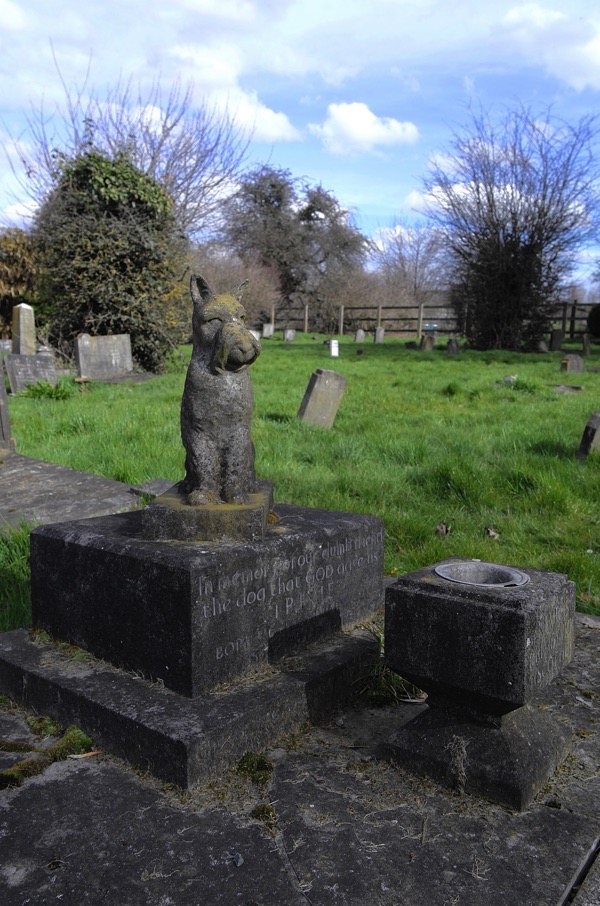
In Memory of our Dumb Friend, the Dog that God gave us, Trixie

Peter the Home Office Cat – Payment for Peter’s food was authorised by the Treasury thus, ‘I see no objection to your office keeper being allowed 1d a day from petty cash towards the maintenance of an efficient office cat.’ It seems that the money was requested not because Peter was underfed, but rather that he was overfed because of all the titbits that staff provided. It was felt that this ‘interfered with the mousing’, so if food was provided officially, the office keeper could tell staff not to give Peter any food.

In Loving memory of Our Boxers, Gremlin Gunner, Bramcote Badenia, Bramcote Blaise, Bramcote Benightful & Panfield Rhapsody

Be-Be, Our Little Dog So Loyal and True, Now He is in Peace God Bless You

In Loving Memory of our Darling Sally & Our Greyhound Swan & Our Cat Brandy Ball

In Loving Memory of Benny, a Brave Little Cat and Constant Companion to Those he Loved

Mary of Exeter, Awarded Dicken Medal for Outstanding War Service – A pigeon that made four flights carrying messages back from wartime France, returning seriously injured each time. On her last return, shrapnel damaged her neck muscles but her owner, Charlie Brewer an Exeter cobbler, made her a leather collar which held her head up and kept her going for another 10 years.

In Memory of Our Dear Pal Wolf

Mickey Callaghan, Here Lies Our Darling and You Always Will Be

In Memory of Simon, Served as ship’s cat on HMS Amethyst – Simon’s heroic ratting saving the crew from starvation during the hundred days the ship spent trapped by Communists on the Yangtze River in 1949. Simon was originally the Captain’s cat, a privileged creature who fished ice cubes out of his water jug and crunched them, but after he survived being blown up along with the Captain’s cabin, he was promoted to ‘Able Seacat’ and became pet of the whole crew. Unfortunately, the decision to bring the feline hero back to Britain proved the end of him as he caught cat flu in quarantine and died.

In Memory of Good Old Brownie

Memories of Our Faithful Doggie Pal Sally

My Babies Always In My Heart, Dede, Nicky, Sophie & Scruffy

In Memory of Rip DM, for Bravery in Locating Victims Trapped Under Blitzed Buildings – Rip was a stray who became the first search and rescue dog

In Memory of Jill who Adopted Us and Gave Us 15 Years of Loving Companionship

Shane, Bobby & Tina

In Loving Memory of Whisky, We Loved Him So, Mummy & Aunty Flo

Rusty, A Magnificent Irish Setter, We Were Better For Having Known Him, He Died with More Dignity Than That Most of Us Live – Rusty lived with Sir Bruce Forsyth in his touring caravan and performed on stage at the London Palladium. Rusty was a truly lovely fellow who performed all sorts of fantastic tricks, his favourite was to flip a biscuit off his nose and catch it in his mouth,’ recalled Sir Bruce, ‘But one day his back legs gave up on him. It was awful to witness – almost overnight he had become this pathetic, helpless animal. The only way I could take him outside for exercise was to grab hold of his tail and lift his back legs up, allowing him to walk on his front legs with his back end gliding along. This didn’t hurt him at all and he loved to be outside, but people in the street gave me filthy looks.’

In Fond Memory of Tops & Tiny Tim

In Loving Memory of Scottie Tailwaggger & Muffin

Our Buster, Faithful Intelligent Beautiful Golden Labrador

In Memory of Our Little Dog Sonny & Our Beloved Shandy, Quietly You Fell Asleep Without a Last Goodbye

In Loving Memory of Our Darling Poppet

Our Most Precious Snoopy

In Loving Memory of Perdix Crough Patrick, Bulldog

To the Dear Memory of Patch

In Loving Memory of Dinky & Dee-Dee

Beautiful Memories of Binkie, Golden Cocker Spaniel & Tender Memories of Joey, Blue Budgie

Nanoo, Sally & Rags

In Memory of Punch for Saving the Lives of Two British Officers in Israel by Attacked An Armed Terrorist

In Memory of Tiger & Rosie, Two Dear Old Strays

Peter, Loved by Everyone

Tim, Out Little Darling


Unfortunately, the Ilford Pet Cemetery is currently closed to visitors due to safety concerns after a Eucalyptus tree was brought down by the snow, but you can contribute to a fund to remove the tree and reopen the cemetery by clicking here
You may also like to read about
Viscountess Boudica’s St Patrick’s Day
On St Patrick’s Day, we celebrate our dearly beloved Viscountess Boudica of Bethnal Green who once entertained us with her seasonal frolics and capers but is now exiled to Uttoxeter

Beannachtaí na Féile Pádraig oraibh
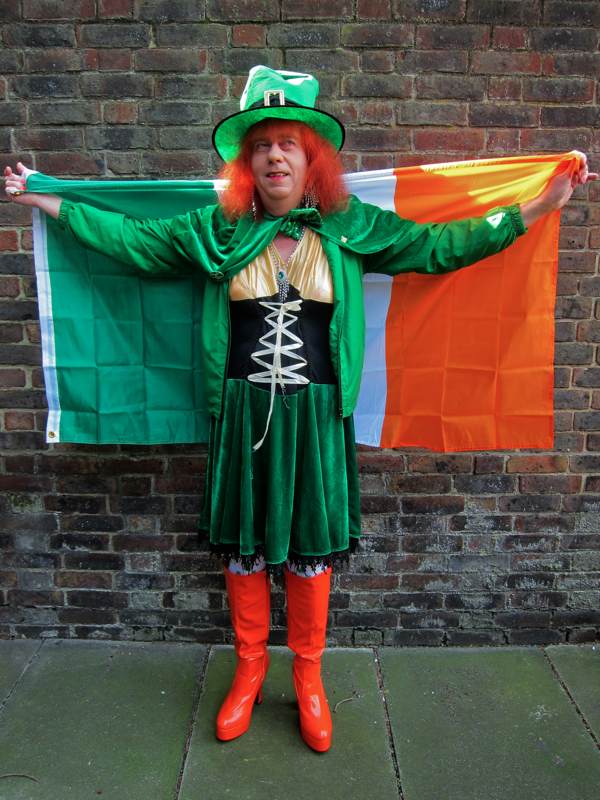
In the East End, we owe a debt of gratitude to Viscountess Boudica of Bethnal Green and we miss her inspirational example in observing each of the festivals of the year with passion and gusto. On St Patrick’s Day, I always found her togged up like a cheeky Leprechaun and swigging Guinness as if she was born to it, and when I enquired further I discovered this was precisely the case.
“My people were landowners near Dublin but when Elizabeth I sent her army into Ireland, we were forced to flee to France and then we returned to live in Gloucestershire,” she admitted to me with the melancholy refined smile of one from an ancient aristocratic lineage.“Once when I was a child, we were on holiday in Wales and I stared out to sea – I always felt there was something out there for me,” she continued, getting lost in contemplation as she surveyed the magnificent green and orange decorations that adorned her pink living room.
It was only as an adult that the Viscountess Boudica discovered her true origins. “Even before I found out I was Irish, I knew I was different from everybody else in relating to English culture, ” she confessed to me as she stroked her ginger locks and sipped her Guinness thoughtfully, “I need to go to Dublin in search of my roots…”

Éirinn go brách


Cá mbeidh tú ag fliuchadh na seamróige?


Sláinte!


Tabhair póg dom, táim Éireannach.



Viscountess Boudica’s jacket with Irish badges from the days she hung out with skinheads

Viscountess Boudica searches for St Patrick’s Day music

Viscountess Boudica recommends The Nolans and Sham 69 for your St Patrick’s Day listening


Viscountess Boudica pulls out one of her old Irish themed coats


Viscountess Boudica models the outfit she has designed for her trip to Dublin in search of her roots
Be sure to follow Viscountess Boudica’s blog There’s More To Life Than Heaven & Earth
Take a look at
The Departure of Viscountess Boudica
Viscountess Boudica’s Domestic Appliances
Viscountess Boudica’s Halloween
Viscountess Boudica’s Christmas
Viscountess Boudica’s Valentine’s Day
Read my original profile of Mark Petty, Trendsetter
and take a look at Mark Petty’s Multicoloured Coats
David Granick’s Spitalfields
Stepney Photographer David Granick (1912-80) has been receiving well-deserved recognition recently thanks to an exhibition at Tower Hamlets Local History Library & Archives which runs until 5th May and a book The East End in Colour 1960-80 edited by Chris Dorley-Brown and published by Hoxton Minipress.

Spitalfields Market, 1973

Brushfield St, 1970

Fournier St, 1968

Princelet St, 1968

Brick Lane/Hanbury St, 1976

Folgate St, 1979

Elder St, 1968

Elder St, 1965

Fleur de Lis St, 1966

Quaker St, 1970

Quaker St, 1978

Cheshire St, 1969

Black Lion Yard, 1966

Whitechapel Bell Foundry, 1969
Photographs copyright © Tower Hamlets Local History Library & Archives
You may also like to take a look at
Vivian Betts At The Primrose

Vivian & Toto outside The Primrose
You will not meet many who can boast the distinction of being brought up on the teeming thoroughfare of Bishopsgate but Vivian Betts is one who enjoyed that rare privilege, growing up above The Primrose on the corner of Primrose St where her parents were publicans from 1955 until 1974. Yet it was a different Bishopsgate from that of the present day with its soaring glass towers housing financial industries. In her childhood, Vivian knew a street lined with pubs and individual shops where the lamplighter came each night to light the gas lamps.
Living in a pub on the boundary of the City of London, Vivian discovered herself at a hub of human activity. “I had the best of both worlds,” Vivian confessed to me, when she came up to Spitalfields on a rare visit, “I had the choice of City life or East End life, I could go either way. I had complete freedom and I was never in any danger. My father said to me if I ever had any trouble to go to a policeman. But all my friends wanted to come over to my place, because I lived in a pub!”
Vivian knew Bishopsgate before the Broadgate development swallowed up the entire block between Liverpool St and Primrose St. And as we walked together past the uniform architecture, she affectionately ticked off the order of the pubs that once stood there – The Kings Arms, The Raven and then The Primrose – with all the different premises in between. When we reached the windswept corner of Primrose St beneath the vast Broadgate Tower, Vivian gestured to the empty space where The Primrose once stood, now swallowed by road widening, and told me that she remembered the dray horses delivering the beer in barrels on carts from the Truman Brewery in Brick Lane.
In this landscape of concrete, glass and steel, configured as the environment of aggressive corporate endeavour, it was surreal yet heartening to hear Vivian speak and be reminded that human life once existed there on a modest domestic scale. Demolished finally in 1987, The Primrose had existed in Bishopsgate at least since 1839.
“My brother Michael was born in 1942, while Bill my father was away in the war, and Violet my mother got a job as a barmaid, and when he came back she said, ‘This is how I want to spend my life.’ Their first pub was The Alfred’s Head in Gold St, Stepney, in about 1946, and she told me she was washing the floor there in the morning and I was born in the afternoon. We left when I was three and all I remember of Stepney was walking over a bomb site to look at all the caterpillars.
In 1955, we moved into The Primrose at 229 Bishopsgate, directly opposite the Spitalfields market – you could look out of the window on the first floor and see the market. My first memory of Bishopsgate was lying in bed and listening to the piano player in the pub below. We had three pianos, one in the public bar, one in the first floor function room and one in our front room. On Sunday lunchtimes at The Primrose, it was so busy you could hardly see through the barroom for all the hats and smoke.
I used to go to Canon Barnet School in Commercial St and, from the age of seven, my dad would see me across Bishopsgate and I’d walk through the Spitalfields Market on my way to school where the traders would give me an apple and a banana – they all knew me because they used to come drinking in the pub. It was a completely Jewish school and, because no-one else lived in Bishopsgate, all my friends were over in Spitalfields, mostly in the Flower & Dean Buildings, so I spent a lot of time over there. And I used to come to Brick Lane to go the matinees at the cinema every Saturday. Itchy Park was our playground – in those days, the church was shut but we used to peek through the window and see hundreds of pigeons inside.
My dad opened one of the first carveries in a pub, where you could get fresh ham or turkey cut and made up into sandwiches and, in the upstairs room, my mum did sit-down lunches for three shillings – it was like school dinners, steak & kidney pudding and sausage & mash. She walked every day with her trolley to Dewhurst’s the butchers opposite Liverpool St, she got all her fruit and vegetables fresh from the Spitalfields Market, and she used to go to Petticoat Lane each week to buy fresh fish.
Every evening at 5pm, we had all the banks come in to play darts. On Mondays, it was the ladies of The Primrose darts team and on Wednesdays it was the men’s darts league. And, once each year, we organised the Presentation Dance at the York Hall. Every evening in the upstairs function room, we had the different Freemason’s lodges. Whenever I came out of my living room, I could always see them but I had to look away because it was part of my life that I wasn’t supposed to see. After I left school, I went to work for the Royal London Mutual Insurance Co. in Finsbury Sq – five minutes walk away – as a punchcard operator and, whenever it was anyone’s birthday, I’d say ‘Come on back to my mum’s pub and she’ll make us all sandwiches.’
Then in 1973, Truman’s wrote to my dad and gave him a year’s notice, they were turning the pub over to managers in April 1974, so we had to leave. But I had already booked my wedding for July at St Botolph’s in Bishopsgate, and I came back for that. Eighteen months later, in 1976, my mum and dad asked me and my husband to go into running a pub with them. It was The Alexandra Hotel in Southend, known as the “Top Alex” because there were two and ours was at the top of the hill.
Three months after we moved in, my dad died of cancer – so they gave it to my mum on a year’s widow’s lease but they said that if me and my husband proved we could run it, we could keep it. And we stayed until 1985. Then we had a murder and an attempted murder in which a man got stabbed, and my husband said, ‘It’s about time we moved.’ And that’s when we moved to our current pub, The Windmill at Hoo, near Rochester, twenty-eight years ago. We had a brass bell hanging behind the counter at The Primrose that came off a train in Liverpool St Station which we used to call time and we’ve taken it with us – all these years – but though we don’t call time any more, we still use it to ring in the New Year.
I’ve only ever had two Christmases not in a pub in my life, when you’re born to it you don’t know anything else.”
Vivian told me that she often gets customers from the East End in The Windmill and they always recognise her by her voice. “They say, ‘We know where you come from!'” she confided to me proudly.

The Primrose, 229 Bishopsgate, as Vivian knew it.

Toto sits on the heater in the panelled barroom at The Primrose.

Vivian at Canon Barnet School in Commercial St.

Bill and Vi Betts

“My first Freemason’s Lodge night when I was twelve or thirteen in 1965. My brother Michael with his wife Valerie on the right.”

Vivian stands outside The Primrose in this picture, looking east across Bishopsgate towards Spital Sq with Spitalfields market in the distance.
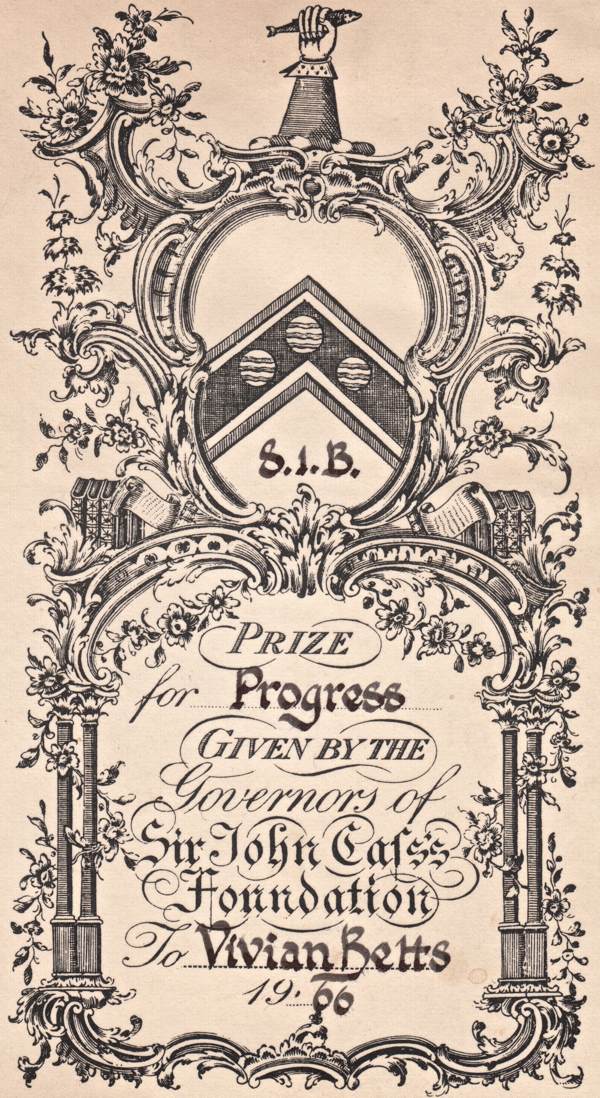
Vivian was awarded this certificate while a student at Sir John Cass School, Houndsditch.

Vivian on the railway bridge, looking west towards Finsbury Sq.

Vivian outside the door which served as the door to the pub and her own front door.

Vivian’s friends skylarking in Bishopsgate – “They always wanted to come over to my place because I lived above a pub!”
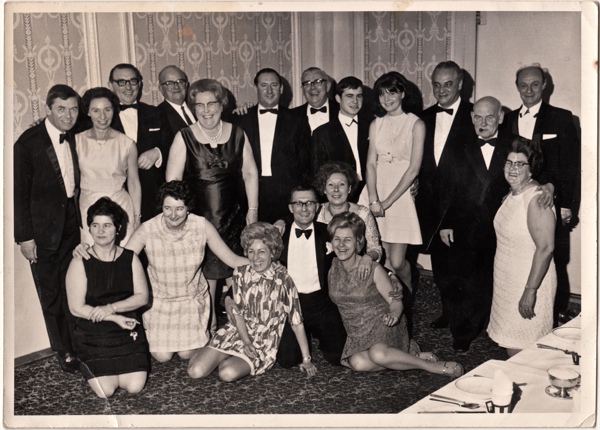
“When I was eight, we went abroad on holiday for the first time to Italy, we bought the tickets at the travel agents across the road and, after that, twelve or fourteen couples would come with us – my parents’ friends – and I was always the youngest there.”

Vivian prints out a policy at the Royal London Mutual Insurance Co. in Finsbury Sq.

“And what do you do?” – Vivian meets Prince Charles on a visit to Lloyd Register of Shipping in Fenchurch St.

“Harry the greengrocer and Tom the horse, they used to get their fruit & vegetables in the Spitalfields Market. My husband Dennis worked for this man when he was about twelve years of age, driving around the Isle of Dogs. He loved horses, and we’ve got a piece of land with our pub now and we’ve kept horses since 1980.”

Bill & Vi Betts in later years.

Vivian Betts at St Botolph’s Bishopsgate where she married her husband Dennis Campbell in 1974.

The Primrose in a former incarnation, photographed in 1912.

Bishopsgate with The Primrose halfway down on the right, photographed in 1912 by Charles Goss.

Bishopsgate today.
Archive photographs courtesy Bishopsgate Institute
You might also like to take a look at these other Bishopsgate Stories
The Romance of Old Bishopsgate
Dan Cruickshank, Photographer
Dan Cruickshank took these photographs between 1969 when he first came to Spitalfields and 1977 when he led the first campaign to stop British Land destroying Elder St. “I did it to document the buildings that were here then,” he explained to me in regret, “but sometimes you’d go back the next Saturday and there’d be virtually nothing left.”

Barrowmakers in Wheler St

Baker in Quaker St

Quaker St and Railway Dwellings

Junction of Bethnal Green Rd & Redchurch St

Weaver’s House at the corner of Bacon St & Brick Lane

Weavers’ houses in Sclater St, now demolished

Weavers’ houses in Sclater St, only those in foreground remain

Weavers’ houses in Sclater St, now demolished

Corner of Sclater St & Brick Lane

Houses in Hanbury St, now demolished

Houses in Hanbury St, now demolished

Old House in Calvin St, now demolished

Elaborate doorcase in Wilkes St, now gone

Brushfield St

Brushfield St, buildings on the right now demolished

Brushfield St, buildings on the right now demolished

Buildings in Brushfield St, now demolished

Brushfield St, buildings on the left now demolished

Looking from Brushfield St towards Norton Folgate

Selling Christmas trees in Spital Sq

Spital Sq with St Botolph’s Hall

Folgate St with Dennis Severs’ House in the foreground, houses in the background now demolished

House in Folgate St, now demolished

5 & 7 Elder St during squat to prevent complete demolition by British Land

Partial demolition of 5 & 7 Elder St

Rear of 5 & 7 Elder St during partial demolition

Inside 7 Elder St

Douglas Blain of Spitalfields Trust reads a paper in the loft of 7 Elder St after the roof was removed

Alleyway off Folgate St
Photographs copyright © Dan Cruickshank
You may also like to take a look at
Philip Marriage’s Spitalfields


