
Stanley Rondeau, Huguenot

If you visit Nicholas Hawksmoor’s Christ Church, Spitalfields on any given Tuesday, you will find Stanley Rondeau – where he works unpaid one day each week, welcoming visitors and handing out guides to the building. The architecture is of such magnificence, arresting your attention, that you might not even notice this quietly spoken white-haired gentleman sitting behind a small table just to the right of the entrance, who comes here weekly on the train from Enfield. But if you are interested in local history, then Stanley is one of the most remarkable people you could hope to meet, because his great-great-great-great-great-great-grandfather Jean Rondeau was a Huguenot immigrant who came to Spitalfields in 1685.
“When visiting a friend in Suffolk in 1980, I was introduced to the local vicar who became curious about my name and asked me ‘Are you a Huguenot?'” explained Stanley with a quizzical grin.“I didn’t even know what he meant.” he added, revealing the origin of his life-changing discovery,” So I went to Workers’ Educational Association evening classes in Genealogy and that was how it started. I’ve been at it now for thirty years. My own family history came first, but when I learnt that Jean Rondeau’s son John Rondeau was Sexton of Christ Church, I got involved in Spitalfields. And now I come every Tuesday as a volunteer and I like being here in the same building where he was. They refer to me as ‘a piece of living history’, which is what I am really. Although I have never lived here, I feel I am so much part of the area.”
Jean Rondeau was a serge weaver born in 1666 in Paris into a family that had been involved in weaving for three generations. Escaping persecution for his Protestant faith, he came to London and settled in Brick Lane, fathering twelve children. Jean had such success as weaver in London that in 1723 he built a fine house, number four Wilkes St, in the style that remains familiar to this day in Spitalfields. It is a measure of Jean’s integration into British society that his name is to be discovered on a document of 1728 ensuring the building of Christ Church, alongside that of Edward Peck who laid the foundation stone. Peck is commemorated today by the elaborate marble monument next to the altar, where I took Stanley’s portrait which you can see above.
Jean’s son John Rondeau was a master silk weaver and in 1741 he commissioned textile designs from Anna Maria Garthwaite, the famous designer of Spitalfields silks, who lived at the corner of Princelet St adjoining Wilkes St. As a measure of John’s status, in 1745 he sent forty-seven of his employees to join the fight against Bonnie Prince Charlie. Appointed Sexton of the church in 1761 until his death in 1790, when he was buried in the crypt in a lead coffin labelled “John Rondeau, Sexton of this Parish,” his remains were exhumed at the end of twentieth century and transported to the Natural History Museum for study.
“Once I found that the crypt was cleared, I made an appointment at the Natural History Museum, where Dr Molleson showed his bones to me.” admitted Stanley, widening his eyes in wonder. “She told me he was eighty-five, a big fellow – a bit on the chubby side, yet with no curvature of the spine, which meant he stood upright. It was strange to be able to hold his bones, because I know so much about his history.”, Stanley told me in a whisper of amazement, as we sat together, alone in the vast empty church that would have been equally familiar to John the Sexton.
In 1936, a carpenter removing a window sill from an old warehouse in Cutler St that was being refurbished was surprised when a scrap of paper fell out. When unfolded, this long strip was revealed to be a ballad in support of the weavers, demanding an Act of Parliament to prevent the cheap imports that were destroying their industry. It was written by James Rondeau, the grandson of John the Sexton who was recorded in directories as doing business in Cutler St between 1809 and 1816. Bringing us two generations closer to the present day, James Rondeau author of the ballad was Stanley’s great-great-great-grandfather. It was three generations later, in 1882, that Stanley’s grandfather left Sclater St and the East End for good, moving to Edmonton when the railway opened. And subsequently Stanley grew up without any knowledge of Huguenots or the Spitalfields connection, until that chance meeting in 1980 leading to the discovery that he is an eighth-generation British Huguenot.
“When I retired, it gave me a new purpose.” said Stanley, cradling the slender pamphlet he has written entitled, “The Rondeaus of Spitalfields.” “It’s a story that must not be forgotten because we were the originals, the first wave of immigrants that came to Spitalfields,” he declared. Turning the pages slowly, as he contemplated the sense of connection that the discovery of his ancestry has given him, he admitted, “It has made a big difference to my life, and when I walk around in Christ Church today I can imagine my ancestor John the Sexton walking about in here, and his father Jean who built the house in Wilkes St. I can see the same things he did, and when I hear the great eighteenth century organ, I know that my ancestor played it and heard the same sound.”
There is no such thing as an old family, just those whose histories are recorded. We all have ancestors – although few of us know who they were, or have undertaken the years of research Stanley Rondeau has done, bringing him into such vivid relationship with his ancestors. I think it has granted him an enviably broad sense of perspective, seeing himself against a wider timescale than his own life. History has become personal for Stanley Rondeau in Spitalfields.

The silk design at the top was commissioned from Anna Maria Garthwaite by Jean Rondeau in 1742. (5981.9A Victoria and Albert Museum. Photo courtesy of V&A images)

4 Wilkes St built by Jean Rondeau in 1723. Pictured here seen from Puma Court in the nineteen twenties, it was destroyed by a bomb in World War II and is today the site of Suskin’s Textiles.

The copy of James Rondeau’s song discovered under a window sill in Cutler St in 1936.

Stanley Rondeau standing in the churchyard near his home in Enfield, at the foot of the grave of John the Sexton’s son and grandson (the author of the song) both called James Rondeau, and who coincidentally also settled in Enfield.
Arful Nessa’s Sewing Machine
Contributing Writer Delwar Hussain writes a memoir of his mother and her sewing machine

Arful Nessa with her sewing machine table
Rather than the sound of Bow bells, I was born to the whirring of sewing machines in my ear. Throughout most of my childhood, my mother did piecework while my father worked in a sweatshop opposite the beigel shop on Brick Lane, stitching together leather jackets for Mark & Spencer. The factory closed down long ago.
Initially my mother’s industrial-grade Brother sewing machine was in the kitchen, in between the sink and the pine wood table. But it took up too much space there and was also considered dangerous, once ambulatory children started populating the house. It was decided that it would be moved to one of the attic rooms on the top floor of our home, following the custom of the Huguenot silk weavers of the past. There the machine lived and there my mother would be found hunched over it, during all hours of the day and often late into the night. She says it was most hard on her back and shoulders, which would ache from the work.
“The men used to work in the factories. I preferred to do it at home because it was less work compared to what they did. They had to work harder,” she explains, “I began before the children were born. I wasn’t doing much at home, so I thought I should try it and earn a little money. Other women were working as machinists then and an old neighbour who had lived on Parfett St taught me how to operate the machine. I couldn’t do pockets, but I did pleats, belts and hems on skirts for women who worked in offices. I took in work for a factory on Cannon St Rd that made suits and another on New Rd that made blouses.”
For a while my mother sewed the lining into jackets and winter coats, working for a short Sikh man who had a clothes shop on Fournier St. He had quick steps and a bunch of heavy keys dangling from the belt on his trousers. The man still owes her money, she recalls. He would give her wages in arrears, promising to pay, but it never materialised. Following him, she worked for another man, who also did not pay. “Where would you go looking for them today?” my mother asks, “Everyone we used to know around here has left. So much has changed.”
I remember the almost-sweet smell of the machine oil, the thick needles, bundles of colourful nylon yarn, piles and piles of skirts in all shades and sizes, the metal bobbin cases and the sound of the sewing machine. When the foot peddle was down, the vibration could be felt throughout the house. Strangely, this provided a sense of comfort – the knowledge that my mother was upstairs and everything in the world was as it should be.
When I was around twenty, my brothers and sisters and I colluded with each other to get rid of the sewing machine. It had lain dormant in the attic room ever since my mother gave up taking in piecework some years previously. The work had slowly become more irregular and less financially rewarding. “When I first started, I was able to earn around seventy-five pence per skirt, then towards the end, when there were many more women working, it dropped to around ten pence per coat.” These were also the days when much of the manufacturing in East London was being shipped out to parts of the world where there was cheaper labour, including Bangladesh and Turkey.
With my mother’s working paraphernalia left as it was, the space resembled Rodinsky’s room – he was the mythical recluse who once lived a few doors down from us in the attic of 19 Princelet St and who had disappeared one day, leaving everything intact. I had an idea to turn our attic into a study, installing my PC which my mother had bought for me from the money she had saved from sewing. With a separate monitor, keyboard and large hard drive, it was almost as big as her Brother sewing machine.
She had always been a hoarder, so we knew that getting rid of it was going to be a delicate and difficult matter. We had given her prior warnings, but these had fallen on deaf ears. Then one night, when she had gone to bed, my siblings and I crept upstairs and, with a lot of effort, detached the head of the sewing machine from the table. Huffing and puffing, we carried it down three flights of stairs and delicately dumped it at the end of our street. We did the same with the table base.
Of course, she discovered the machine was missing the next day and was incredibly upset. She had “spent one hundred and forty pounds on it,” she said. “It still worked,” she said, “why had we not told her, she could have given it to someone at least, instead of it being thrown away” and “what had she done to deserve children who were so wasteful.” After that, I forgot all about the Brother sewing machine that once lived in our attic.
Recently, I returned from a research trip to Dhaka. I am currently writing a book about the people of that city and had interviewed garment workers about their lives and fears. I came home and was speaking to my mother about it when the subject of her earlier life as a machinist came up. And then she announced her revelation.
My mother and our Somali neighbour had managed to rescue the sewing machine from where my brothers, sisters and I had thought we had discarded the thing. The two women had somehow managed to shuffle the table base along, scraping hard along the pavement. But instead of bringing it back to the house, they took it to the neighbour’s, where it was to stay in the garden until they decided what to do with it. The machine head on the other hand was far too heavy for them to carry and they abandoned it.
This disclosure had to be investigated. My mother and I immediately knocked on our neighbour’s door, and asked if it was still there. The neighbour led us to the garden where, hidden behind wooden boarding and tendrils of ivy, we found the sewing machine my mother had spent so many years working on.
Considering it had endured years outdoors, it looked like it was still in relatively good health. Bits of it, such as the bobbin winder and the spool base were slightly rusty, but the address of the showroom on Cambridge Heath Rd where my mother bought it was clearly labelled and the motor looked in working condition.
She is still upset with my brothers and sisters and me for throwing it away. This confused me. “Why would you want to hold onto something that is a source of oppression?” I asked, high-mindedly. “The machine helped to feed and educate my family,” she answered quietly.
My mother then reminded me that my aunt, her sister, also had a Brother sewing machine and made skirts for many years from her kitchen in Bethnal Green. We went to speak to her. She no longer works as a seamstress and has resorted to keeping her dismembered machine on the veranda of her ground floor flat. The table now stores pots and pans, baskets containing seeds and drying leaves. The head was in the bottom drawer of a metal cabinet next to it, wrapped up in a Sainsbury’s shopping bag. My aunt still has some of the cloth which she would make into skirts and she showed me the pleats on a piece of salmon-coloured material.
“Most of the women in this block worked for different factories and one of them taught me how to do it. I worked for a Turkish man on Mare St for around seven years. I would get started around 7am after the morning prayer at 6am. I can’t remember where the skirts were being sold, but they were for well known shops in the West End. In one day, I could work on fifty or sixty pieces. Some days I made around a hundred. I received around forty or fifty pence per piece and could earn around three hundred pounds per week. But it was all irregular, nothing was fixed. My children would help by cutting the loops off when they got home after school. There is no work anymore, but I kept the machine in case I needed to fix things. It still works.”
While I took notes, sitting on the chair she would sit on whilst working, I could hear dregs of conversation between the two sisters, comparing the quality of oranges in Bethnal Green market to Asda and Iceland, as well as recalling what happened to other women whom they both knew that had worked as seamstresses. This industry, now gone, is a piece of the thread that joins the past with the present in the East End and, in turn, unites the people who have come to make this part of London their home.

My aunt with her sewing machine in Bethnal Green


Arful Nessa
Photographs copyright © Sarah Ainslie
You may like to read Delwar Hussain’s other story about his mother
Chris Skaife, Master Raven Keeper & Merlin The Raven

Chris Skaife & Merlin
Every day at first light, Chris Skaife, Master Raven Keeper at the Tower of London, awakens the ravens from their slumbers and feeds them breakfast. It is one of the lesser known rituals at the Tower, so Spitalfields Life Contributing Photographer Martin Usborne & I decided to pay an early morning call upon London’s most pampered birds and send you a report.
The keeping of ravens at the Tower is a serious business, since legend has it that, ‘If the ravens leave the Tower, the kingdom will fall…’ Fortunately, we can all rest assured thanks to Chris Skaife who undertakes his breakfast duties conscientiously, delivering bloody morsels to the ravens each dawn and thereby ensuring their continued residence at this most favoured of accommodations.“We keep them in night boxes for their own safety,” Chris explained to me, just in case I should think the ravens were incarcerated at the Tower like those monarchs of yore, “because we have quite a lot of foxes that get in through the sewers at night.”
First thing, Chris unlocks the bird boxes built into the ancient wall at the base of the Wakefield Tower and, as soon as he opens each door, a raven shoots out blindly like a bullet from a gun, before lurching around drunkenly on the lawn as its eyes accustom to the daylight, brought to consciousness by the smell of fresh meat. Next, Chris feeds the greedy brother ravens Gripp – named after Charles Dickens’ pet raven – & Jubilee – a gift to the Queen on her Diamond Anniversary – who share a cage in the shadow of the White Tower.
Once this is accomplished, Chris walks over to Tower Green where Merlin the lone raven lives apart from her fellows. He undertakes this part of the breakfast service last, because there is little doubt that Merlin is the primary focus of Chris’ emotional engagement. She has night quarters within the Queen’s House, once Anne Boleyn’s dwelling, and it suits her imperious nature very well. Ravens are monogamous creatures that mate for life but, like Elizabeth I, Merlin has no consort. “She chose her partner, it’s me,” Chris assured me in a whisper, eager to confide his infatuation with the top bird, before he opened the door to wake her. Then, “It’s me!” he announced cheerily to Merlin but, with suitably aristocratic disdain, she took her dead mouse from him and flounced off across the lawn where she pecked at her breakfast a little before burying it under a piece of turf to finish later, as is her custom.
“The other birds watch her bury the food, then lift up the turf and steal it,” Chris revealed to me as he watched his charge with proprietorial concern, “They are scavengers by nature, and will hunt in packs to kill – not for fun but to eat. They’ll attack a seagull and swing it round but they won’t kill it, gulls are too big. They’ll take sweets, crisps and sandwiches off children, and cigarettes off adults. They’ll steal a purse from a small child, empty it out and bury the money. They’ll play dead, sun-bathing, and a member of the public will say, ‘There’s a dead raven,’ and then the bird will get up and walk away. But I would not advise any members of the public to touch them, they have the capacity to take off a small child’s finger – not that they have done, yet.”
We walked around to the other side of the lawn where Merlin perched upon a low rail. Close up, these elegant birds are sleek as seals, glossy black, gleaming blue and green, with a disconcerting black eye and a deep rasping voice. Chris sat down next to Merlin and extended his finger to stroke her beak affectionately, while she gave him some playful pecks upon the wrist.
“Students from Queen Mary University are going to study the ravens’ behaviour all day long for three years.” he informed me, “There’s going to be problem-solving for ravens, they’re trying to prove ravens are ‘feathered apes.’ We believe that crows, ravens and magpies have the same brain capacity as great apes. If they are a pair, ravens will mimic each other’s movements for satisfaction. They all have their own personalities, their moods, and their foibles, just like people.”
Then Merlin hopped off her perch onto the lawn where Chris followed and, to my surprise, she untied one of Chris’s shoelaces with her beak, tugging upon it affectionately and causing him to chuckle in great delight. While he was thus entrammelled, I asked Chris how he came to this role in life. “Derrick Coyle, the previous Master Raven Keeper, said to me, ‘I think the birds will like you.’ He introduced me to it and I’ve been taking care of them ever since.“ Chris admitted plainly, opening his heart, “The ravens are continually on your mind. It takes a lot of dedication, it’s early starts and late nights – I have a secret whistle which brings them to bed.”
It was apparent then that Merlin had Chris on a leash which was only as long as his shoelace. “If one of the other birds comes into her territory, she will come and sit by me for protection,” he confessed, confirming his Royal romance with a blush of tender recollection, “She sees me as one of her own.”

“Alright you lot, up you get!”


“A pigeon flew into the cage the other day and the two boys got it, that was a mess.”

“It’s me!”


“She chose her partner, it’s me.”


“She sees me as one of her own.”


Chris Skaife & Merlin

Charles Dickens’ Raven “Grip” – favourite expression, “Halloa old girl!”
Tower photographs copyright © Martin Usborne
Residents of Spitalfields and any of the Tower Hamlets may gain admission to the Tower of London for one pound upon production of an Idea Store card.
You may also like to take a look at these other Tower of London stories
Alan Kingshott, Yeoman Gaoler at the Tower of London
Graffiti at the Tower of London
Beating the Bounds at the Tower of London
Ceremony of the Lilies & Roses at the Tower of London
Bloody Romance of the Tower with pictures by George Cruickshank
John Keohane, Chief Yeoman Warder at the Tower of London
Constables Dues at the Tower of London
The Oldest Ceremony in the World
A Day in the Life of the Chief Yeoman Warder at the Tower of London
Adam Dant’s Maps Of London & Beyond

The Map of Spitalfields Life
Generously praising the quality of the books we have published, Richard Bucht, bookseller at Hatchards, described Spitalfields Life Books as ‘the last art publisher.’ Consequently, I am delighted to announce our most ambitious publishing project to date which is a mighty monograph undertaken in proud collaboration with Batsford Books (established 1843).
On June 7th, we are publishing MAPS OF LONDON & BEYOND, a spectacular hardback containing all your favourite maps by our Contributing Cartographer, Adam Dant. Large pages allow the reader to study all the astonishing and hilarious details – from gin-sodden drunks brawling in the gutter to the lofty paragons of enlightenment thought – and each plate is annotated with erudite commentary offering hours of fascination for the curious.
MAPS OF LONDON & BEYOND includes an interview with the artist by The Gentle Author.
Please support this ambitious venture by pre-ordering a copy, which will be signed by Adam Dant with an individual drawing on the flyleaf and sent to you on publication.
CLICK TO ORDER A SIGNED COPY OF MAPS OF LONDON & BEYOND BY ADAM DANT
Below are a selection of maps from the book

The Map of the Coffee Houses

The Map of Shoreditch as the globe

The Map of Shoreditch as New York

The Map of Shoreditch in the year 3000

The Hackney Treasure Map

The Map of Industrious Shoreditch

The Map of Wallbrook
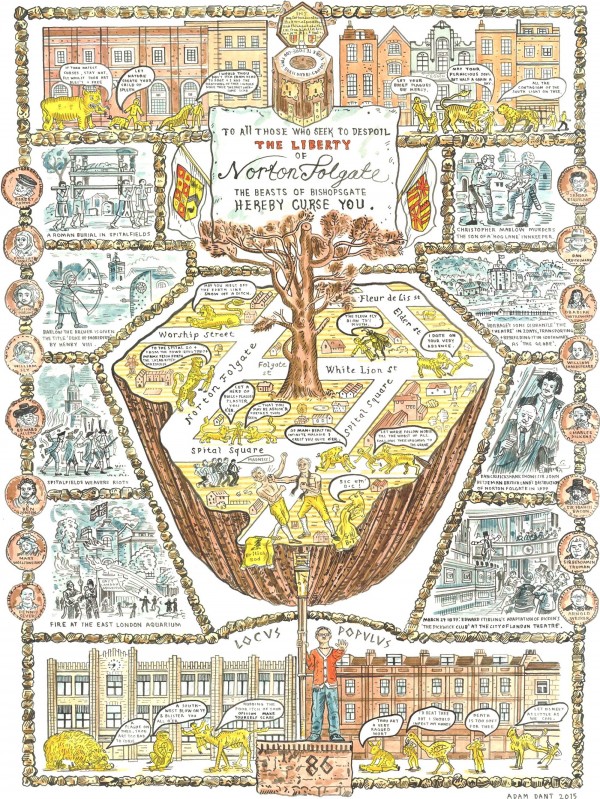
The Map of Norton Folgate

The Map of William Shakespeare’s Shordiche

The Map of Thames Shipwrecks
Maps copyright © Adam Dant

CLICK TO ORDER A SIGNED COPY OF MAPS OF LONDON & BEYOND BY ADAM DANT




Batsford Books, 1893

Bradley Thomas Batsford

Batsford colophon designed by George Kruger Gray

Letitia Batsford

John Stow’s Spittle Fields

At the Bishopsgate Institute, I love to study the 1599 copy of John Stow‘s Survey Of London. As a publisher myself, I find it touching to see the edition that John Stow himself produced, with its delicate type resembling gothic script, and sobering to recognise what a great undertaking it was to publish a book four hundred years ago – requiring every page of type to be set and printed by hand.
Born into a family of tallow chandlers, John Stow became a tailor yet devoted his life to writing and publishing, including an early edition of the works of Geoffrey Chaucer who had lived nearby in Aldgate more than a century earlier. In Stow’s lifetime, the population of London quadrupled and much of the city he knew as a youth was demolished and rebuilt. The sense of grief that he felt to see the city of his youth destroyed inspired him to write and publish his great work – a survey that would record this change for posterity. Consequently, on the title page of the Survey, Stow outlines his intention to include “the Originall, Antiquity, Increase, Modern estate and description of that citie.”
Yet in contrast to the dramatic changes he witnessed at first hand, John Stow also described his wonder at the history that was uncovered by the redevelopment, drawing consolation for his sense of loss by setting his life’s experience against the great age of the city and the generations who preceded him in London .
SPITTLE FIELDS
There is a large close called Tasell close sometime, for that there were Tasels planted for the vse of Clothworkers: since letten to the Crosse-bow-makers, wherein they vsed to shoote for games at the Popingey: now the same being inclosed with a bricke wall, serueth to be an Artillerieyard, wherevnto the Gunners of the Tower doe weekely repaire, namely euerie Thursday, and there leuelling certaine Brasse peeces of great Artillerie against a But of earth, made for that purpose, they discharge them for their exercise.
Then haue ye the late dissolued Priorie and Hospitall, commonly called Saint Marie Spittle, founded by Walter Brune, and Rosia his wife, for Canons regular, Walter Archdeacon of London laid the first stone, in the yeare 1197.
On the East side of this Churchyard lieth a large field, of olde time called Lolesworth, now Spittle field, which about the yeare 1576 was broken vp for Clay to make Bricke, in the digging whereof many earthen pots called Vrnae, were found full of Ashes, and burnt bones of men, to wit, of the Romanes that inhabited here: for it was the custome of the Romanes to burne their dead, to put their Ashes in an Vrna, and then burie the same with certaine ceremonies, in some field appoynted for that purpose, neare vnto their Citie: euerie of these pots had in them with the Ashes of the dead, one peece of Copper mony, with the inscription of the Emperour then raigning: some of them were of Claudius, some of Vespasian, some of Nero, of Anthonius Pius, of Traianus, and others: besides those Vrnas, many other pots were there found, made of a white earth with long necks, and handels, like to our stone Iugges: these were emptie, but seemed to be buried ful of some liquid matter long since consumed and soaked through: for there were found diuerse vials and other fashioned Glasses, some most cunningly wrought, such as I haue not seene the like, and some of Christall, all which had water in them, northing differing in clearnes, taste, or sauour from common spring water, what so euer it was at the first: some of these Glasses had Oyle in them verie thicke, and earthie in sauour, some were supposed to haue balme in them, but had lost the vertue: many of those pots and glasses were broken in cutting of the clay, so that few were taken vp whole.
There were also found diuerse dishes and cups of a fine red coloured earth, which shewed outwardly such a shining smoothnesse, as if they had beene of Currall, those had in the bottomes Romane letters printed, there were also lampes of white earth and red, artificially wrought with diuerse antiques about them, some three or foure Images made of white earth, about a span long each of them: one I remember was of Pallas, the rest I haue forgotten.I my selfe haue reserued a mongst diuerse of those antiquities there, one Vrna, with the Ashes and bones, and one pot of white earth very small, not exceeding the quantitie of a quarter of a wine pint, made in shape of a Hare, squatted vpon her legs, and betweene her eares is the mouth of the pot.
There hath also beene found in the same field diuers coffins of stone, containing the bones of men: these I suppose to bee the burials of some especiall persons, in time of the Brytons, or Saxons, after that the Romanes had left to gouerne here. Moreouer there were also found the sculs and bones of men without coffins, or rather whose coffins (being of great timber) were consumed. Diuerse great nailes of Iron were there found, such as are vsed in the wheeles of shod Carts, being each of them as bigge as a mans finger, and a quarter of a yard long, the heades two inches ouer, those nayles were more wondred at then the rest of thinges there found, and many opinions of men were there vttred of them, namely that the men there buried were murdered by driuing those nayles into their heads, a thing vnlikely, for a smaller naile would more aptly serue to so bad a purpose, and a more secret place would lightly be imployed for their buriall.
And thus much for this part of Bishopsgate warde, without the gate.

A copper coin from the Spitalfields Roman Cemetery that I wear around my neck

Bishopsgate Ward entry by John Stow in his Survey of London


Monument to John Stow in St Andrew Undershaft
Archive images courtesy Bishopsgate Institute
Photograph of Stow’s monument copyright © Estate of Colin O’Brien
You may also like to read about
At Caravanserail
Contributing Writer Rosie Dastgir visits Caravanserail, the new French bookshop in Cheshire St

In the wide shop window of Caravanserail on Cheshire St sit a pair of plush winged armchairs, facing one another over a dimpled copper table as if in silent dialogue. It is a beguiling scene, and I enter to find an elegant new French and English bookshop, café and gallery space in the middle of Spitalfields.
Founded by two French cousins, Anne Vegnaduzzo and Laura Cleary, Caravanserail offers a rendezvous for French and English books, art exhibitions, poetry readings, music and translation events in one space. The name evokes hostelries where travellers and merchants stopped by for the night on their journeys.
“It’s more home than shop,” says Anne, when I remark upon the cosy atmosphere. Behind the counter I spy a set of Hornsea tea and coffee caddies, like the ones we had at home when I was growing up. There are croissants and copper cafetieres, and tea served in blue and white china tea cups for book browsers in search of sustenance.
“Caravanserail is a place to rest,” Laura says, “and it’s also a place to learn and interact for our neighbourhood and those traveling through it.”
The cousins grew up in France, though they have both travelled beyond Europe for work and study. Laura studied Turkish in Istanbul, and considered moving to Turkey before landing a job with the French Embassy in Beirut for six years, and Anne worked in Paris, and then Vancouver, for an artists’ agency
When Laura moved to London in 2015, she felt it was the perfect hub for what they both had in mind, offering a diverse cultural mix in a city that is favourable to start ups and small businesses. The project began incubating during the run up to the Brexit referendum in June 2016.
“We knew it could happen,” Anne tells me, “and then it did, and we opened after that.”
The result did not deter them, they insist.
In December 2016, they decided they wanted to open a book shop together. It was just six months after the referendum, with much talk of a downturn in the economy and a feared exodus of French and other EU nationals.
Were they nervous about opening a business at that moment?
“On the contrary,” Laura says, “it felt more necessary than ever before.”
They began looking around for a place in the East End, attracted by the cultural dynamism of an area with a long history of migration. Like the French Huguenots before them, Laura and Anne are part of a wave of French arrivals in London, a younger crowd who escape the pull of the Lycees in South Kensington and Kentish Town into Bethnal Green, Haggerston, and Spitalfields.
Laura was walking around Spitalfields one day when she came across a former vintage clothes shop. “We stopped by The Society Club next door, and there was a friendly guy there who told us that the premises were available.”
Laura felt at once that this was the one. It was a Saturday, and Anne was in Paris. The cousins had to make a quick decision – the landlord wanted a deposit by Monday. The shop was run down, dark and dingy and neon lit, with a low ceiling, but it was the wide window that convinced them. They imagined the vista of books and art from the street into the shop, the snug for people to sit by the window, sipping coffee and browsing through a book.
That was the coup de foudre moment. The next challenge was how to transform the dilapidated shop into the hybrid platform they had in mind. They drummed up the services of an architect friend in Paris, and within a week or so, he had produced a set of drawings.
“We wanted to have a space where people can hang out, a bookshop and a gallery, and a space for events,” Laura says. Six months later, give or take a few snags, they had it: tawny wooden floors and book shelving, white walls with exposed copper piping snaking around the ceiling, and pockets of bright, warm light. They opened the shop in July 2017, just over a year after the referendum, and have not looked back.
On offer there are book titles in French and English, and international literature translated into English. Laura explains that a big difference between the United Kingdom and France is that there is little translated fiction. Around five per cent of fiction sales here last year came from books in translation, while in France it is closer to fifty per cent. In addition to literature, there are art books, graphic novels and a dedicated section of children’s books, in both languages.
Contemporary art photography is displayed on the walls and the shelving that doubles as a seating area for music, art and literary events in the evenings. First Tuesdays of the month are for spoken word events in collaboration with BoxedIn. More recently, they have introduced a monthly evening on the art of translation, and there are jazz and poetry evenings, and book events for children.
On the day I visit, I am shopping for the birthday of an old friend who is half French. There is a wall of the striking white-spined novels so prominent in classic French bookshops – Madame Bovary is turned out to face me. I cannot quite decide, and select Albert Camus’ L’Etranger for my teenage daughter, who’s studying French A level. Then I notice a select supply of stationery that is hard to resist, and I choose two birthday cards, designed by Letter Press de Paris.
I scan titles in translation and in the original French by authors such as Leila Slimani, whose bestseller, Lullaby, is displayed prominently, and Muriel Barbery’s The Elegance of the Hedgehog. There is the eye-catching graphic novel by Hamid Sulaiman, Freedom Hospital, A Syrian Story. I’m spoilt for choice, but eventually I pick a book on 25 contemporary French artists, and also Lauren Binet’s latest novel in English, The Seventh Function of Language, described by one reviewer as a post-modern hybrid of other texts. It feels right for my half-French, West London dwelling friend.


Photographs copyright © Sarah Ainslie
Caravanserail, 5 Cheshire St, E2 6ED – open Tuesdays to Sundays.
Rosie Dastgir’s novel, Une Petite Fortune, is published by Editions Bourgois in France and Quercus in the UK.
You may also like to read about
Henry Mayhew, The London Vagabond
Chris Anderson introduces his new biography of Henry Mayhew, The London Vagabond

When Henry Mayhew died in 1887, one newspaper noted ‘The chief impression created in the public mind was one of surprise that he should still be alive.’ Yet nearly forty years earlier, his London Labour & the London Poor had gripped the country, confronting it with the voices of those who had been overlooked. His masterwork began as a series of ‘Letters’ commissioned by The Morning Chronicle and, from 1849 onwards, these grew into a panoramic survey of London’s poorest workers, a long exposure snapshot of mid-nineteenth century life.
The Spitalfields silk weavers were the first group of the working poor Mayhew reported on. Descended from Huguenot refugees, their livelihood was undermined by free trade after the abolition of import tariffs on French silk. Their experience was common among many highly-skilled London workers, as their quality of life deteriorated from the early years of the century, eroded by technological and social change. Late at night, in a narrow Shoreditch street, Mayhew mounted the stairs to a top floor room and visited an old weaver, sick in bed. The weaver lived and worked in a shared top floor room, cobwebbed with sagging clothes lines, where three looms jostled among several beds. The old man asked his daughter, Tilly, to pull up a chair for Mayhew, then began his tale.
“Yes, I was comfortable in ’24. I kept a good little house and I thought, as my young ones growed up – why I thought as I should be comfortable in my old age, and ‘stead of that, I’ve got no wages. I could live by my labour then, but now, why it’s wretched in the extreme. Then I’d a nice little garden and some nice tulips for my hobby, when my work was done. … As for animal food, why it’s a stranger to us. Once a week, may be, we gets a taste of it, but that’s a hard struggle, and many a family don’t have it once a month … Tilly, just turn up that shell now and let the gentlemen see what beautiful fabrics we’re in the habit of producing – and then he shall say whether we ought to be in the filthy state we are. Just show the light, Tilly! That’s for ladies to wear and adorn them. And make them handsome’”
(It was an exquisite piece of maroon coloured velvet. That, amidst all the squalor of the place, seemed marvellously beautiful, and it was a wonder to see it unsoiled amid all the filth that surrounded it).
Mayhew formed a close bond with the Spitalfields silk weavers. Yet The Morning Chronicle fired him after a year – for asking for more work, they said – for speaking up for the workers, Mayhew said. He revived the Letters as his own weekly serial, entitled London Labour & the London Poor. Increasingly, he focused on street folk, costers and other itinerant traders, yet he continued to support the silk weavers cause, even after London Labour ended abruptly in court over unpaid printer’s bills.
On Tuesday 4th May 1852 at the school room, St John’s St, Brick Lane, The Trade Society for the Protection of Native Industry convened a mass meeting to ‘adopt resolutions condemnatory of the present unregulated and stimulated system of competition, which is reducing the working classes of this country to the continental level’. Mayhew came on stage to loud cheering. He told how he had commenced his ‘inquiries into the state of the working classes, being at the time an inveterate Free-trader’ with The Morning Chronicle, but his research among the poor had converted him to protectionism.
Mayhew returned to Spitalfields for a very different occasion four years later, as part of his second major series, The Great World of London. On the evening of 8th April 1856, he summoned a gathering of professional villains, the ‘Swell Mobsmen’ at the White Lion Tavern, Fashion St. Entry was by ticket only, signed by Mayhew and stating the police were barred. A hundred crooks gathered in the well-lit, comfortable room where a ‘free and easy’ atmosphere prevailed.
“A stranger would have had no suspicion that the men there assembled were at war with society. They one and all appeared well fed, well clad, and at ease with themselves. In the course of the evening several showily-dressed youths, who were evidently the ‘aristocracy’ of the class, walked into the room. These were mainly habited as clerks or young men in offices, some wearing gold guard chains, others with pistol keys dangling from their waistcoat pockets, and having diamond pins in their cravats. They were, however, all ‘mobsmen,’ as they are called – men who in some instances, we are assured, are gaining their £10 or even £20 a week by light-fingered operations. Indeed, several present were pointed out as ‘tip-top sawyers,’ ‘moving in the best society and doing a heavy business’. Beside those there were a few notorious ‘cracksmen’ (house-breakers) and one or two ‘fences’ (receivers of stolen goods), who were said to be worth their weight in gold.”
Mayhew proposed a society to help these people to go straight. In the event, most of the Swell Mobsmen seemed appreciative but unpersuaded.
“A few candidly stated ‘they didn’t seem to care’ about reforming themselves, but they would gladly assist any of their body who was desirous of so doing.”
A unique exploration of working Londoners, London Labour & the London Poor influenced an entire generation of writers, Charles Dickens among them. A pioneering work of social science, criminology and oral history, it was a century ahead of its time, yet within a few years of Mayhew’s death the work was all but forgotten, along with its author.
Only when the great metropolis that Mayhew loved lay in ruins after the Blitz did London Labour & the London Poor resurface. By the late sixties, all four volumes were available once more, riding the wave of a Victorian revival. ‘It is a book’, wrote W. H. Auden in 1968, ‘in which one can browse for a lifetime without exhausting its treasures.’ Yet a veil remained over Mayhew and, by the seventies, as academics fought over the meaning of his legacy, the historian E. P. Thompson observed:
“He was the subject of no biography and there is something like a conspiracy of silence about him in some of the reminiscences and biographies of his contemporaries … Mayhew remains a puzzling character and some final clue seems to be missing.”
By the eighties, when London Labour & the London Poor had become established as a fixture on the reading list for courses on literature, history, criminology, culture studies and more, the Penguin edition could still open with, ‘It is strange that not more is known about the life of Henry Mayhew.’ Today, Mayhew crops up on the National Curriculum, feted as a philanthropist. His work inspires novels and films exploring the lost world of Victorian London. Terry Pratchet dedicated his final novel, Dodger, to Mayhew. Even so, his life has remained shrouded – until now.
Born into a wealthy family, Mayhew’s public school years were cut short and he was shipped off to Calcutta as a midshipman. Taken on at his father’s law firm upon his return, he left when – absentmindedly – he got his father arrested. Then he became a journalist and dramatist in eighteen-thirties London, neither considered respectable occupations, crowning the decade by founding Punch. It became the most successful magazine of the century and should have set him up for life.
Instead, his path led to bankruptcy and prison. He spent years in exile in Guernsey and Germany. In between, he became famous for his revelations about the poor and brought out London Labour & the London Poor in 1851. He was a respected children’s author, a popular comic novelist, a criminologist who gave evidence to Parliamentary Select committees and a war correspondent. He wrote for the stage, tried to enter politics, the darling of both radicals and conservatives for attacking the liberal mantra of Free Trade. He was known as a philosopher and as a scientist, who revered his friend Michael Faraday, and sought to bring electric lighting to London decades before it arrived.
Mental illness haunted him though, his periodic peaks alternating with deep troughs. He mixed with Charles Dickens, William Makepeace Thackeray and stood at the centre of the burgeoning literary world, met with government ministers to advocate social reforms, and mingled with costers, dockers and the underworld too, keeping an open house for thieves and paroled prisoners. His closeness to some of them backfired in blackmail and death threats. His wife, Jane Jerrold, who dealt with the bailiffs for him and secretly co-wrote much of his work, left him when their children had grown up and insisted on being buried under her maiden name. Forgotten, Henry Mayhew spent his last decades moving from one Bloomsbury bedsit to another, plotting new schemes and new books, even until the very last.

The Oyster Stall. “I’ve been twenty years and more, perhaps twenty-four, selling shellfish in the streets. I was a boot closer when I was young, but I had an attack of rheumatic fever, and lost the use of my hands for my trade. The streets hadn’t any great name, as far as I knew, then, but as I couldn’t work, it was just a choice between street selling and starving, so I didn’t prefer the last. It was reckoned degrading to go into the streets – but I couldn’t help that. I was astonished at my success when I first began, I made three pounds the first week I knew my trade. I was giddy and extravagant. I don’t clear three shillings a day now, I average fifteen shillings a week the year through. People can’t spend money in shellfish when they haven’t got any.”

The Irish Street-Seller. “I was brought over here, sir, when I was a girl, but my father and mother died two or three years after. I was in service, I saved a little money and got married. My husband’s a labourer, he’s out of worruk now, and I’m forced to thry and sill a few oranges to keep a bit of life in us, and my husband minds the children. Bad as I do, I can do a penny or tuppence a day better profit than him, poor man! For he’s tall and big, and people thinks, if he goes round with a few oranges, it’s just from idleniss.”

The Groundsel Man. “I sell chickweed and grunsell, and turfs for larks. That’s all I sell, unless it’s a few nettles that’s ordered. I believe they’re for tea, sir. I gets the chickweed at Chalk Farm. I pay nothing for it. I gets it out of the public fields. Every morning about seven I goes for it. I’ve been at business about eighteen year. I’m out till about five in the evening. I never stop to eat. I am walking ten hours every day – wet and dry. My leg and foot and all is quite dead. I goes with a stick.”

The Baked Potato Man. “Such a day as this, sir, when the fog’s like a cloud come down, people looks very shy at my taties. They’ve been more suspicious since the taty rot. I sell mostly to mechanics, I was a grocer’s porter myself before I was a baked taty. Gentlemen does grumble though, and they’ve said, “Is that all for tuppence?” Some customers is very pleasant with me, and says I’m a blessing. They’re women that’s not reckoned the best in the world, but they pays me. I’ve trusted them sometimes, and I am paid mostly. Money goes one can’t tell how, and ‘specially if you drinks a drop as I do sometimes. Foggy weather drives me to it, I’m so worritted – that is, now and then, you’ll mind, sir.”

The London Coffee Stall. “I was a mason’s labourer, a smith’s labourer, a plasterer’s labourer, or a bricklayer’s labourer. I was for six months without any employment. I did not know which way to keep my wife and child. Many said they wouldn’t do such a thing as keep a coffee stall, but I said I’d do anything to get a bit of bread honestly. Years ago, when I as a boy, I used to go out selling water-cresses, and apples, and oranges, and radishes with a barrow. I went to the tinman and paid him ten shillings and sixpence (the last of my savings, after I’d been four or five months out of work) for a can. I heard that an old man, who had been in the habit of standing at the entrance of one of the markets, had fell ill. So, what do I do, I goes and pops onto his pitch, and there I’ve done better than ever I did before.”

Coster Boy & Girl Tossing the Pieman. To toss the pieman was a favourite pastime with costermonger’s boys. If the pieman won the toss, he received a penny without giving a pie, if he lost he handed it over for nothing. “I’ve taken as much as two shillings and sixpence at tossing, which I shouldn’t have done otherwise. Very few people buy without tossing, and boys in particular. Gentlemen ‘out on the spree’ at the late public houses will frequently toss when they don’t want the pies, and when they win they will amuse themselves by throwing the pies at one another, or at me. Sometimes I have taken as much as half a crown and the people of whom I had the money has never eaten a pie.”

The Street- Seller of Nutmeg Graters. “Persons looks at me a good bit when I go into a strange place. I do feel it very much, that I haven’t the power to get my living or to do a thing for myself, but I never begged for nothing. I never thought those whom God had given the power to help themselves ought to help me. My trade is to sell brooms and brushes, and all kinds of cutlery and tinware. I learnt it myself. I was never brought up to nothing, because I couldn’t use my hands. Mother was a cook in a nobleman’s family when I was born. They say I was a love child. My mother used to allow so much a year for my schooling, and I can read and write pretty well. With a couple of pounds, I’d get a stock, and go into the country with a barrow, and buy old metal, and exchange tinware for old clothes, and with that, I’m almost sure I could make a decent living.”

The Crockery & Glass Wares Street-Seller. “A good tea service we generally give for a left-off suit of clothes, hat and boots. We give a sugar basin for an old coat, and a rummer for a pair of old Wellington boots. For a glass milk jug, I should expect a waistcoat and trowsers, and they must be tidy ones too. There is always a market for old boots, when there is not for old clothes. I can sell a pair of old boots going along the streets if I carry them in my hand. Old beaver hats and waistcoats are worth little or nothing. Old silk hats, however, there’s a tidy market for. There is one man who stands in Devonshire St, Bishopsgate waiting to buy the hats of us as we go into the market, and who purchases at least thirty a week. If I go out with a fifteen shilling basket of crockery, maybe after a tidy day’s work I shall come home with a shilling in my pocket and a bundle of old clothes, consisting of two or three old shirts, a coat or two, a suit of left-off livery, a woman’s gown maybe or a pair of old stays, a couple of pairs of Wellingtons, and waistcoat or so.”

The Blind Bootlace Seller. “At five years old, while my mother was still alive, I caught the small pox. I only wish vaccination had been in vogue then as it is now or I shouldn’t have lost my eyes. I didn’t lose both my eyeballs till about twenty years after that, though my sight was gone for all but the shadow of daylight and bright colours. I could tell the daylight and I could see the light of the moon but never the shape of it. I never could see a star. I got to think that a roving life was a fine pleasant one. I didn’t think the country was half so big and you couldn’t credit the pleasure I got in going about it. I grew pleaseder and pleaseder with the life. You see, I never had no pleasure, and it seemed to me like a whole new world, to be able to get victuals without doing anything. On my way to Romford, I met a blind man who took me in partnership with him, and larnt me my business complete – and that’s just about two or three and twenty year ago.”

The Street Rhubarb & Spice Seller. “I am one native of Mogadore in Morocco. I am an Arab. I left my countree when I was sixteen or eighteen years of age, I forget, sir. Dere everything sheap, not what dey are here in England. Like good many, I was young and foolish – like all dee rest of young people, I like to see foreign countries. The people were Mahomedans in Mogadore, but we were Jews, just like here, you see. In my countree the governemen treat de Jews very badly, take all deir money. I get here, I tink, in 1811 when de tree shilling pieces first come out. I go to de play house, I see never such tings as I see here before I come. When I was a little shild, I hear talk in Mogadore of de people of my country sell de rhubarb in de streets of London, and make plenty money by it. All de rhubarb sellers was Jews. Now dey all gone dead, and dere only four of us now in England. Two of us live in Mary Axe, anoder live in, what dey call dat – Spitalfield, and de oder in Petticoat Lane. De one wat live in Spitalfield is an old man, I dare say going on for seventy, and I am little better than seventy-three.”

The Street-Seller of Walking Sticks. “I’ve sold to all sorts of people, sir. I once had some very pretty sticks, very cheap, only tuppence a piece, and I sold a good many to boys. They bought them, I suppose, to look like men and daren’t carry them home, for once I saw a boy I’d sold a stick to, break it and throw it away just before he knocked at the door of a respectable house one Sunday evening. There’s only one stick man on the streets, as far as I know – and if there was another, I should be sure to know.”

The Street Comb Seller. “I used to mind my mother’s stall. She sold sweet snuff. I never had a father. Mother’s been dead these – well, I don’t know how long but it’s a long time. I’ve lived by myself ever since and kept myself and I have half a room with another young woman who lives by making little boxes. She’s no better off nor me. It’s my bed and the other sticks is her’n. We ‘gree well enough. No, I’ve never heard anything improper from young men. Boys has sometimes said when I’ve been selling sweets, “Don’t look so hard at ’em, or they’ll turn sour.” I never minded such nonsense. I has very few amusements. I goes once or twice a month, or so, to the gallery at the Victoria Theatre, for I live near. It’s beautiful there, O, it’s really grand. I don’t know what they call what’s played because I can’t read the bills. I’m a going to leave the streets. I have an aunt, a laundress, she taught me laundressing and I’m a good ironer. I’m not likely to get married and I don’t want to.”

The Grease-Removing Composition Sellers. “Here you have a composition to remove stains from silks, muslins, bombazeens, cords or tabarets of any kind or colour. It will never injure or fade the finest silk or satin, but restore it to its original colour. For grease on silks, rub the composition on dry, let it remain five minutes, then take a clothes brush and brush it off, and it will be found to have removed the stains. For grease in woollen cloths, spread the composition on the place with a piece of woollen cloth and cold water, when dry rub it off and it will remove the grease or stain. For pitch or tar, use hot water instead of cold, as that prevents the nap coming off the cloth. Here it is. Squares of grease removing composition, never known to fail, only a penny each.”

The Street Seller of Birds’ Nests. “I am a seller of birds’-nesties, snakes, slow-worms, adders, “effets” – lizards is their common name – hedgehogs (for killing black beetles), frogs (for the French – they eats ’em), and snails (for birds) – that’s all I sell in the Summertime. In the Winter, I get all kinds of of wild flowers and roots, primroses, buttercups and daisies, and snowdrops, and “backing” off trees (“backing,” it’s called, because it’s used to put at the back of nosegays, it’s got off yew trees, and is the green yew fern). The birds’ nests I get from a penny to threepence a piece for. I never have young birds, I can never sell ’em, you see the young things generally die of cramp before you can get rid of them. I gets most of my eggs from Witham and Chelmsford in Essex. I know more about them parts than anybody else, being used to go after moss for Mr Butler, of the herb shop in Covent Garden. I go out bird nesting three times a week. I’m away a day and two nights. I start between one or two in the morning and walk all night. Oftentimes, I wouldn’t take ’em if it wasn’t for the want of the victuals, it seems such a pity to disturb ’em after they made their little bits of places. Bats I never take myself – I can’t get over ’em. If I has an order of bats, I buys ’em off boys.”

The Street-Seller of Dogs. “There’s one advantage in my trade, we always has to do with the principals. There’s never a lady would let her favouritist maid choose her dog for her. Many of ’em, I know dotes on a nice spaniel. Yes, and I’ve known gentleman buy dogs for their misses. I might be sent on with them and if it was a two guinea dog or so, I was told never to give a hint of the price to the servant or anybody. I know why. It’s easy for a gentleman that wants to please a lady, and not to lay out any great matter of tin, to say that what had really cost him two guineas, cost him twenty.”
Images courtesy Bishopsgate Institute


