
Adam Dant’s New Cries Of Spittelfields

(click on this image to enlarge)
Contributing Artist Adam Dant sent me his latest print, a limited edition hand-tinted woodcut of the NEW CRIES OF SPITTELFIELDS that he finished just last week, showing many of the familiar street characters of our beloved East End neighbourhood. If you would like to buy a copy, drop the artist a line: Adamdant@adamdant.com
Meanwhile, you can attend my illustrated lecture at the Society of Genealogists in Clerkenwell this Thursday 15th March at 2pm, showing images of itinerant traders over the last four hundred years. Click here for tickets


Cries of London 1600, reproduced from Samuel Pepys’ Album © Magdalene College, Cambridge (Click this image to enlarge)
You may like to take a look at
H.W.Petherick’s London Characters
John Thomson’s Street Life in London
Aunt Busy Bee’s New London Cries
Marcellus Laroon’s Cries of London
More John Player’s Cries of London
William Nicholson’s London Types
Francis Wheatley’s Cries of London
John Thomas Smith’s Vagabondiana of 1817
Thomas Rowlandson’s Lower Orders

CLICK TO BUY A COPY OF THE GENTLE AUTHOR’S CRIES OF LONDON FOR £20
At Wood St Stables

Just occasionally, I hear distant horses’ hooves in the street outside when I am sitting writing at my desk in Spitalfields. It always causes me to stop and consider this evocative, once familiar sound, that echoes down through the centuries. When horses were the primary mode of transport, there would have been hundreds of stables in the City, but today there is only one. So I decided to follow the sound of the hooves back to their source in Wood St and pay a visit to the last stable, the home of the City of London Mounted Police – and Spitalfields Life contributing photographer Patricia Niven came along with me.
Passing among the shining glass towers of the City and then entering Wood St Police Station, we were ushered behind the desk, past a sign that said “Level of threat: normal,” down a passageway, through a courtyard and into the stables where the magnificent beasts are kept. Leather harnesses hung from the walls, straw was scattered upon the floor and the acrid smell of the farmyard prevailed here in this quiet enclave, a world apart from the corporate financial culture that surrounds it.
These are the last working horses in the City, out on the street in pairs for four hours at a stretch as they undertake patrols three times a day. Exchanged fortnightly, the troupe of ten is divided equally between here and Bushey Park where they get to run free and where training takes place. Mounted police officers double up as stable hands, cleaning kit and mucking out, grooming and feeding their charges. And, consequently, the stable is a scene of constant activity from seven each morning, when they arrive to wake the horses before setting out on the first patrol at eight thirty.
“I never envisaged, when I joined the police, I’d end up riding a horse,” admitted Sergeant Nick Bailey, greeting us eagerly, “I joined the police to ride motorbikes, but I suppose you could say I found a different horsepower.” Yet, in spite of his alacrity, Sergeant Bailey is a passionate horseman who grew up riding and competed in equestrian events before the demands of police work caused him to choose between his career and sporting endeavours. Now with thirty years service behind him, he came to the City of London to take charge of the mounted police just twelve months ago from Bridgend in Wales, where he set up the equestrian department. “My wife and family are still in Wales, I go back every third week” he confessed with a shrug, yet he was keen to outline his busy year that began with the Lord Mayor’s Show and included student protests, an English Defence League demo, football matches at Watford and Arsenal, and a Heavy Metal festival.
Before the mounted police were created in 1946, horses were drafted in from the cavalry and recently the stable had a visit from blind ninety-seven-year-old who had lead the last cavalry charge in battle – an event which filled Sergeant Bailey with awe. “I can’t imagine what that was like,” he confided, as a vision of a distant harsher world, even if he admitted that “if a bomb went off, we would have horses out on the streets for seven hours at a stretch.”
Sergeant Bailey introduced his four horses in the stalls that morning. Trader, a powerful white stallion quivering with life, reached over to scrutinise us while Little Dave, a smaller dark horse, eyed us from a distance – weary from the traffic patrol that morning. Opposite, Finn, the oldest horse, with ten years service, stood composed and dignified and then Roxie, the only mare, pushed her glossy striped head over the gate to greet us enthusiastically.
There are one hundred and twenty five horses in the Metropolitan Police today where twenty years ago there were over two hundred and fifty. A fact which makes Sergeant Bailey evangelical on behalf of his charges, advocating the horses’ credentials as cheaper and greener than motorcars. “In the Summer, cafe owners bring out a bucket of water for them,” he told me, “People feel safer when they see horses on the street.”


Photographs copyright © Patricia Niven
You may also like to read about
At A & E Batchelor Ltd, Saddlers
Harry Permutt, Master Goldsmith

Harry Permutt, Master Goldsmith
At eighty-two years old, Harry Permutt believes he is the oldest working goldsmith in Hatton Garden. As the grandson of immigrants who made their lives in Petticoat Lane at the beginning of the last century and as one who has learnt his skills over more than sixty years in the Clerkenwell jewellery trade – working his way up to become a master goldsmith – Harry carries an astonishing collection of stories and a rare depth of historical perspective.
Yet Harry’s vision is tinged with melancholy these days, as I discovered when I visited him at his beautiful old workshop in Panther House, Mount Pleasant from which he is being evicted at the end of this month prior to redevelopment for luxury flats. Hidden in a back street at the junction of Grays Inn Rd and Clerkenwell Rd, the attractive towering castle-like structure of Panther House was built by lithographers Malby & Sons in 1905. Harry told me it was built on the site of the madhouse attached to the old Fleet Prison and as long as he can remember – which is around eighty years – it has been used for workshops for small tradesmen and craftworkers. Supplying essential skills to the lucrative jewellery business in Hatton Garden, their activities have defined the identity of this corner of London for centuries but now they are struggling to find space to work.
In spite of the poignant circumstances of my visit to see his atmospheric workshop before he loses it, Harry was able to rise to the occasion magnificently, regaling me with lyrical tales of old Clerkwenwell.
“In Clerkenwell, from Goswell Rd up until Mount Pleasant, I know everything about. Please God! For guys like me, Clerkenwell is known as the ‘Well.’ From the top of St John St to the Angel, go around in a half circle and you’ve got the back way where all the engravers were, you’ve got the silversmiths, the trophy makers, the masonic jewellers and the polishing workshops. All dingy, dirty basements. We have lived in basements like nobody would ever believe. We had fire gilding and mercury gilding in the Goswell Rd on the site where the University of London is now. In Britton St, where all the condemned houses were, Old Joe, one of the polishers I worked with down in Benjamin Hill, he had been born down there. The one room flat that they rented was surrounded with prostitution. It was so colourful, we knew everybody down there by name. This was where the burglars brought their stuff, it goes back to the Dickensian days when you could do anything and get away with anything. It spread out from the City into the Well and we got mixed up with the Sicilians on the one side and the Italians on the other, of which the twain never met. They were rogues, especially just after the War. They brought back a lot of stuff that was illegal and you did whatever work came to hand. You’d never let a job go and you charged accordingly. One of the oldest Italian families, I still work for them. The grandmother she still lives here and her husband was one of the big villains down here in the old days.
My grandparents came into Middlesex St as immigrants from Russia and Poland in 1917. They had four sons who were educated at the Jewish Free School in Strype St, Spitalfields and they all became cabinet makers, including my father, before they went off and did other things. They were such good cabinet makers, they were commissioned to do all the veneers in the lounge saloons on the Queen Mary. One of my uncles was picked for the England Cricket team but he died of tuberculosis.
My grandmother ran a fruit and veg business in Petticoat Lane, she got all the stallholders together and they started to trade into the Spitalfields Market. It was a poor family but my grandparents did very well for themselves,
I failed my eleven-plus and I told my parents I wanted to go to art school. At Central School of Arts, I studied jewellery – mounting, setting and enamelling. Then, because I had family in the business from Russia dealing in diamonds and so forth, my father was coming down here to Clerkenwell and he knew some of the Italian families, so I got introduced down here and I got an apprenticeship.
I started at 144 St John St, facing us used to be the the old LCC block of flats where all the prostitutes used to hang out. After I graduated from Central, the governor said to me, ‘Harry, throw everything out the window and start again from the beginning.’ So I swept floors for a year and made the tea until I graduated up. But I had to break my apprenticeship to do National Service and I got sent to Korea. In 1956, I came back and finished and started to work on my own, running here, there and everywhere. Technically, I was a ‘runner.’ A runner is a ‘jewellery runner,’ you learn how to pick up the nice pieces of jewellery. You ply your trade that way. You go round markets and you go ‘on the knocker,’ house to house. Four o’clock in the morning I used to go to Bermondsey and Camden Passage. You could get the finest pieces of jewellery out of Bermondsey in those days. I used to sell them to the antiques dealer from Macy’s New York.
A ‘runner’ is considered equally knowledgeable to a ‘mounter’ in the jewellery business. You get taught and you pick up how all this works. It’s a shake of hand, that’s how we still do business together among those that know. In doing that, you get a reputation and – thank goodness – I have still got mine, because that’s how I get work.
From 1957, work was so prolific in the jewellery trade I used to share workshops and I got offers to go around the world buying for other people. I never been employed by anybody since my apprenticeship days. I used to do their work first in the back of the workshop in the Clerkenwell Rd and then I would bring my own work in. The old boss there who knew my father, said, ‘Come and work for me!’ but I said to my dad, ‘I’m not going to work for him, he’s untrustworthy,’ which he was. They were a load of crooks. I used to deal in the ‘Garden,’ but I never did much because I don’t like the ‘Garden.’
I am a bench guy and nothing more. I didn’t actually get taught, I taught myself from the stuff I was handling in the old days. I didn’t learn from books, I learnt from hands. There are only about three of us left that can do what I do, I can restore gold and silver, I can do everything but then I don’t do anything modern. I can handle it but I don’t like it, I have my own views.
I will die doing my work at my bench. I love fine art and it is the fascination of what I do that keeps me going, I go into raptures over it. It’s not the value for me, it’s the fascination. When you restore antique jewellery, you’ve got to copy it so that it is exact. I had a friend who was a great artist who taught me me how to copy properly, that was Tom Keating. He took me under his wing. He used to say to me, ‘Harry, if you are going to copy something, be exact and you can’t go wrong.’
I’m working and working and I’m coming up to eighty-two and I’m staying healthy. My family have always been associated with this side of London, they call it the ‘East End.’ Let it be the ‘East End’ but it’s bloody marvellous. We all grew up here, we are all ‘toe-rags’ for want of a better word.”

Harry works on a pair of earrings with his French pipe


Kevin Cordery, Polisher & Plater shares the workshop with Harry

Panther House was built in 1905

Panther House in Mount Pleasant is to be redeveloped for luxury flats
You may also like to read about
The Doors Of Old London

The door to Parliament
Look at all the doors where the dead people walked in and out. These are the doors of old London. Some are inviting you in and some are shutting you out. Doors that lead to power and doors that lead to prison. Doors that lead to the parlour, doors that lead to the palace, and doors that lead to prayer. These are the doors that I found among hundreds of glass slides once used for magic lantern shows by the London & Middlesex Archaeological Society, many more than a century old, and housed today at the Bishopsgate Institute.
Looking at life through a doorway, we are all either on the way in or on the way out. Like the door to your childhood home that got sold long ago, each one pictured here is evidence of the transient nature of existence, reminding you that you cannot go back through the portal of time.
Yet there is a powerful enigma conjured by these murky pictures of old doors, most of which will never open again. Like the pauper or the lost soul condemned to wander the streets, we cannot enter to learn what lies behind these doors of old London. But a closed door is an invitation to the imagination and we can wonder and dream, entering those hidden spaces in our fancy.
London has always been a city of doors, inviting both the curiosity and the suspicion of the passerby. In each street, there is a constant anticipation of people popping out, regurgitated onto the street by the building, and the glimpse to be snatched of the interior before the door closes again.
I cannot resist the notion that every door contains a mystery and all I need is a skeleton key. Then we can set out to explore as we please, going in one door and out another, until we have passed through all the doors of old London.


The entrance to the Carpenters’ Hall


The doors of Lambeth Palace


Door in the cloisters in Westminster Abbey

The door to the chamber of Little Ease at the Tower of London.


In St Benet’s Church, Paul’s Wharf.


Back door of 33 Mark Lane

Back door to Lancaster House.

In Crutched Friars.

14 Cavendish Sq.

The door to 10 Downing St

39a Devonshire St.


The door to the House of Lords

Wren doorway, Kensington Palace.

The door to Westminster Abbey


St Dunstan’s in the West

The entrance to Christ Church, Greyfriars.

The door to St Bartholomew’s, Smithfield

Temple Church

The Watchhouse, St Sepulcre’s, Smithfield.

Door by Inigo Jones at St Helen’s Bishopsgate.

Prior Bolton’s Door at St Bartholomew the Great.


At the Tower of London
Glass slides courtesy Bishopsgate Institute
You may also like to take a look at
East End Women In Colour
These portraits were all taken by Contributing Photographer Sarah Ainslie for Spitalfields Life over the past eight years. You can see them in Sarah’s exhibition WOMEN OF THE EAST END AT WORK which runs at the Brady Centre in Hanbury St until 30th March as part of Women’s History Month.

Sue Venning, Proprietor, G Kelly Pie & Mash, Roman Rd

Elfet, Garage Mechanic, Three Colts Lane

Anjum Ishtaq, Heba Women’s Project, Brick Lane

Mrs Mustapha, Nazal Dry Cleaners, Hackney Rd

Sandra Esqulant, Publican at The Golden Heart, Spitalfields, and Molly

Shakala, Customer Assistant at Favorite Fried Chicken

Fatima Chowdury, Jumara Noor Eli and Sumsun Nahar Shirna at Mahir Sarees in Bethnal Green

Arful Nessa, Home Machinist, Spitalfields

Laura Porter, Powerlifter, Bethnal Green

Carol Burns, Manager, C.E. Burns Waste Paper Merchants, Spitalfields

Chloe Robertson, Electroplater at Margolis Silver, London Fields
Photographs copyright © Sarah Ainslie
You may also like to take a look at
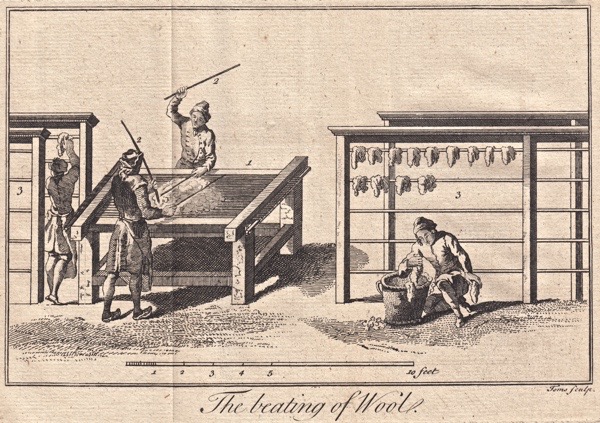
The Principal Operations Of Weaving
These copperplate engravings illustrate The Principal Operations of Weaving reproduced from a book of 1748 in the collection at Dennis Severs House. Many of these activities would have been a familiar sight in Spitalfields three centuries ago.


Ribbon Weaving




Dennis Severs House, 18 Folgate House, Spitalfields, E1
You make also like to read about
Peta Bridle’s Latest Drypoint Etchings
Again, almost a year since has passed since we heard from Peta Bridle, but yesterday she sent me her new drypoint etchings of urban subjects to add to her growing portfolio of people and places in London

The Still & Star, Aldgate – “The pub was opened in 1820 and is the only remaining slum pub in the City of London, converted from a private dwelling. Last year, it was granted Asset of Community Value status but when I returned to give the landlord a print of his pub last autumn I discovered it had closed down. I am not sure what the pub’s fate will be.”

Two Roman Towers, London Wall, City of London –“Next to the Museum of London stands Bastion 14, a surviving section of the London Wall. The ancient Roman and Medieval stones contrast starkly with the new glass towers looming behind. I wonder which tower will still be standing in another thousand years?”

The Late Rodney Archer’s House, Fournier St – “I only had the pleasure to meet Rodney once at his home when I bought a textile print from him.”

The Late Rodney Archer’s Spitalfields Garden

Newham Books – “Run by Vivian Archer, this is a proper bookshop, crammed with books from floor to ceiling. They have been open for forty years this year – Congratulations!”

Bookartbookshop, Pitfield St, Hoxton – “This tiny corner shop sells artists’ books and small press publications”

Richard Lee, Sclater St – “Very obligingly, Richard let me take his photo whilst he was mending a puncture. His stall was originally set up on this pitch by his grandfather, Henry William Lee in the eighteen-eighties. Henry William passed the business on to his son Henry George Lee and now his grandson Richard runs the stall every Sunday in Sclater St Market on the same spot.”

Culpeper’s Herbs – “Here is a selection used by Herbalist Nicholas Culpeper who lived near Puma Court off Commercial St in Spitalfields. Here he ran his clinic and grew herbs to tend the sick in the seventeenth century. From left to right: Dandelion, Campion, Ox-eye Daisy, Buttercup & Ragwort.”

De Walvisch, Wapping – “I first saw this boat when I visited Hermitage Moorings last September over the Open House weekend. Then I contacted the owners and they kindly allowed me to draw their home. De Walvisch means ‘The Whale’ and she is a Dutch sailing Klipper boat from 1896. The boat has retained its original roef (deckhouse) and riveted iron hull. The owners told me that De Walvisch used to deliver eels to London along the Thames.”

Paul Gardner, Gardners Market Sundriesmen, Commercial St – “Here is my new picture of Paul Gardner. He patiently allowed me to draw him again after my last plate of him wore out. When you enter Paul’s shop you can barely move, so only about four people at a time can squeeze in! The shelves bow with the weight of bags and heaped in front of the counter are more bags and balls of string. Paul is a fourth generation Market Sundriesman and his great-grandfather James Gardner opened his shop here in the 1870.”
 Waterloo Station – “This is a station I use frequently, and the clock and streams of people caught my eye.”

Crescent Trading, Quaker St – “The last remaining cloth warehouse in Spitalfields. where you can buy fine wool cloths, silks, damasks and cottons, Crescent Trading is run by two dapper gentlemen, Philip Pittack & Martin White. Whenever I visit, they are always beautifully attired in smart suits and ties.”

Shad Thames, Bermondsey – “A riverside street lined with converted warehouses, in Victorian times, these were used to house tea, coffee and spice. When I first moved to London in the nineties you could walk along here and still smell the aroma of spices trapped in the brickwork.”

Gas Holders, Bethnal Green – “Viewed from Mare St, along Corbridge Crescent past Empress Coaches, you see a fine pair of nineteenth century gas holders. English Heritage have decided not to list them and instead granted the owners a Certificate of Immunity against listing, permitting the gas holders to be destroyed and the site redeveloped.”

Blossom St, Norton Folgate – “Running the length of Blossom St are a row of Victorian warehouses built in 1868. Once the headquarters of Nicholls & Clarke they now stand empty, awaiting their fate. This is such a beautiful atmospheric street with its black brickwork and cobbles, I find it inconceivable that a tower block could one day loom in its place.”

Fruit & Wool Exchange, Spitalfields – “Viewed from the top of Spitalfields Market, the dignified Wool and Fruit Exchange stood in Brushfield St since 1927, yet today only a part of the facade remains.”

Phoenix Wharf, Wapping High St – “This beautiful old wharf caught my eye when I was out on a walk. It was built around 1830 and is the oldest wharf in Wapping. Luckily the building itself is not under threat, but the view we have of it now will change forever as the car park opposite is due for redevelopment along with Swan Wharf next door. The developers plan to reduce the Stepney lamppost, the oldest gas lamp left in London, to a stump.”

Oxgate Farm, Cricklewood – “One could easily walk past this without realising what a beautiful building lies behind the scaffolding. Yet once inside it is peaceful and quiet, and modern London is shut off completely. Oxgate Farm has stood here since 1465 and was once part of a thousand acre Manor of Oxgate owned by St. Paul’s Cathedral but now it is reduced to just the farm and back garden. Although Oxgate Farm has managed to survive the centuries, now it badly needs repairs to stop it falling down.”

Archaeological finds from the Bishopsgate Goodsyard – From the left to right – Bone spoon, bone button (top), ceramic wig curler (beneath), green glass phial(top), green glass bottle (beneath), white ceramic spoon (top), pair of ceramic marbles and a child’s bone whistle. (Courtesy of Museum of London Archaeology).

Tiles from the Bishopsgate Goodsyard – “Eighteenth century tin-glazed delftware wall tiles, as used in the fire surrounds of upper and middle class households. On the top left, I like the grumpy expression on the fisherman’s face – probably because he had tangled his line around his companions legs – also, the expressive posture of the couple talking in the meadow below appeals to me, she with her hand on her hip and clutching her bag.” (Courtesy of Museum of London Archaeology)

Gary Arber, W F Arber & Co Ltd – In 2014, Gary closed the print shop opened by his grandfather Walter in 1897 – “Gary is stood next to a Golding Jobber which he told me was used to print handbills for the suffragettes. On his right stands a Supermatic machine and, behind him in the corner, is a Heidelberg which he filled with paper to show me how it worked. The whole room was a confusion of boxes and paper with the odd tin toy thrown in, and lots of string hanging from the ceiling. I feel privileged to have been invited downstairs to make this record of his print shop.”

Spoons by Barn The Spoon – “From left to right: A cooking spoon. A spoon of medieval design. A spoon based on a Roma Gypsy design. The small spoon in the centre is a sugar spoon. A shovel. The large spoon on the right is a Roman ladle spoon. Barn told me the word ‘Spon’ which is carved on the handle is an old Norse word which means ‘chip of wood.’”

Leila’s Shop, Calvert Avenue “- I love visiting Leila’s Shop throughout the year to discover the fresh vegetables of every season, straight from the field and piled up in mouth-watering displays.”

Donovan Bros, Crispin St – “Although it is not a shop anymore I believe Donovan Bros are still producing packaging. I like the muted colours the shop front has been painted and wonder what the shop would have looked like inside?”

Borough Market, London Bridge – “This is the view overlooking Borough Market, looking from the top of Southwark Cathedral tower. The views of London from up there are beautiful but I don’t like the height too much!”

Wapping Old Stairs – “To reach the stairs you have a to go along a tiny passage to the side of the Town of Ramsgate. Originally, the stairs were a ferry point for people wishing to catch a boat along the river. I think they are quite beautiful and I like to see the marks of the masons’ tools, still left on the stones after all this time.”

The Widow’s Son, Bow (now closed for redevelopment) – “The landlady stands holding a hot cross bun in front of a large glass Victorian mirror with the pub name etched onto it. Every Good Friday, they have a custom where a sailor adds a new bun in a net hanging over the bar to celebrate the widow who once lived here, who made her drowned sailor son a hot cross bun each Easter in remembrance.”

E.Pellicci, Bethnal Green Rd – “Nevio Pellicci kindly allowed me to make a couple of visits to take pictures as reference to create this etching. It was at Christmas time and after they closed for the afternoon. Daisy my daughter is sitting in the corner.”

Tanya Peixoto at bookartbookshop, Pitfield St. “I am friends with Tanya who runs this shop and she has stocked my homemade books in the past.”

Des at Des & Lorraine’s Junk Shop, Bacon St – “An amazing place that I want to re-visit since I never got to look round it properly …”
Prints copyright © Peta Bridle
You may also like to take a look at


