
Geoffrey Fletcher Among The Meths Men

The work of Geoffrey Fletcher (1923–2004) is an inspiration to me, and today I am publishing these fascinating drawings he made in Spitalfields in the nineteen sixties accompanied by an excerpt from his 1967 book Down Among the Meths Men.
If you want to know who they are, the meths men of Skid Row, then I will introduce them as the alcoholic dependents of the East End. They are to be found primarily in an area of of a couple of square miles known as Skid Row. It is a Rotten Row and only beginning to attract the attention of the trend setters.
Skid Row was originally a place of fields. Bodies were tipped there in the plague, their remains turn up occasionally. The most architecturally interesting part of Skid Row are the streets built by the Huguenots, who settled there after the St Bartholomew massacre. A century and a half ago, the rest of the East End surrounded the Huguenot quarter and brought it low. Ultimately the area will be rebuilt. No plans have been made to preserve the houses of Queen Anne’s time, as far as I am informed. I should like to see the whole of Skid Row preserved intact, with its inhabitants, though I recognise this is not a conventional view.
It is necessary, therefore, to contemplate it before it disappears, street by street. Without a doubt, reformers will eventually overtake these suburbs of Hell. They will tear down the fine, rotten houses, build over the bombed site and cart off the wet rags, old mattresses, waste paper and vegetable refuse that makes the quarter so attractive. In that event, London will have lost one of its major advantages, for there is nothing to be gained from well swept streets and office blocks.
Stand in Artillery Lane, watch a meths man rubbing his itchy sores and then eye the stream of commuters pouring into Liverpool St Station intent on the suburbs. Now and again, a meths man will appear among them, a goblin in rags. In their haste for home and respectability, they have nothing to say to him. Nor he to them. He is the inarticulate voice crying from the wilderness of old bricks, bug-ridden rags, cinders and sickly grass. His bloated, alchohol-distorted face is something from an uneasy dream, he sways in front of you in tipsy despair, blurred, disgusting, shaking like an Autumn leaf, the apotheosis of the antihero, a Prophet without a message.
There is a curious camaraderie among the meths men, perhaps the only attractive quality a conventional observer would allow them. It is a ghostly solidarity, the fag end of what is called co-operation, citizenship, the team spirit or any other of those names used commonly to cover up the true nature of the forms of society.
When I got to the Synagogue, I found them on the steps, eight men and a woman. One of the school was in the cooler. A negro roadsweeper languished over his muck wagon at the corner and a few young prostitutes, on the job, hung about in Brick Lane. Brick Lane is marvellous, a melting pot of all the nationalities that grew from the loins of Adam, greasy, feverish Brick Lane, the Bond St for the people of the abyss. Fournier St was a perspective of houses, once the homes of silk merchants and Huguenot weavers, over-used and neglected till the very imposts of the carved doors had become faint and bent with dejection. From the over-tenanted houses, the signs of fruit merchants and Jewish tailors creaked in the wind. The rain had given way to the thin mist of a Winter day.
The Chicksand group sat in a row, staring at nothing. Absolutely nothing. It reminded me of the brass monkeys. I knew the woman. The Chicksand men called her Beth, referring to her native quarter of Bethnal Green. Beth showed signs of recognition, lifted up her weary red eye-lids and stretched out a hand for a fag. I distributed Woodbines. Meths women are heavy drinkers, and can get through three or four wine bottles full in a morning, but they tend to begin slowly and build up as the day wears on. Next to her was Liverpool Jack, an ex-merchant seaman whose nerves had gone West on the convoys, and a man called Pee. He had no other name, nor could any other have done him credit. He was the most abject of the meths men. He had made two or three attempts at suicide, and his last one nearly rang the bell. I thought, sometimes I overdo my relish for offbeat experiences.

In Itchy Park, beside Christ Church, Spitalfields

Meths woman, 1965

Meths men on the prowl in Artillery Passage, 1965

Meths people in Artillery Passage, 1966

Meths men gather round the fire outside the Spitalfields Market

Meths men waiting to move on the corner of Fournier St, 1965

The old meths site in Fieldgate St, Whitechapel

Spitalfields Market scavengers

Meths man asleep in Widegate St, 1965
You may also like to read
James Boswell At The Art Workers Guild
A rare exhibition of James Boswell’s Lithographs & Drawings opens today at the Art Workers Guild, 6 Queen Sq, WC1N 3AT and runs until next Saturday 10th March

Petticoat Lane in the sixties (Courtesy of David Buckman)
When Ruth Abel met the artist James Boswell (1906-71) in the sixties, he introduced her to the East End. “We spent quite a bit of time going to Bloom’s in Whitechapel. We went regularly to visit the Whitechapel Gallery and then we took a walk afterwards,” she recalled fondly, “James had been going for years, and I was trying to make my way as a journalist and was looking at housing, so we just wandered around together. It was a treat to go the East End for a day.”
“He was in the Communist Party, that was what took him to the East End originally,” she continued, “and he liked the liveliness, the life and the look of the streets, and it inspired him.”
James came from New Zealand to study painting at the Royal College of Art in 1925 and was shocked by the squalor and poverty he found in London. Determined to do what he could to bring about change, he joined the Communist Party after he graduated in 1932 and became a graphic artist, believing that his talent could better serve his political beliefs through painting banners, designing leaflets, and drawing illustrations and cartoons.
Although these pictures of Cable Street and Petticoat Lane were created decades apart and are executed in different styles, they reveal a common delight in human detail, with the inhabitants of the street seeming so completely at home it is as if they and the cityscape are merged into one. Yet, “He did not draw them on the spot,” Ruth revealed to me, as I pored over James’ drawings trying to identify the locations, “he worked on them when he got back to his studio. He had a photographic memory, although he always carried a little black notebook and he would just make few scribbles in there for reference.”
In 1934, James married the artist Betty Soars and then, in 1936, he joined the publicity department of Shell as a means to support his wife and daughter Sal. During the Second World War, James served as a radiographer and continued to draw, documenting all aspects of the conflict as he encountered it in Iraq and then Malta and Sicily. His Communism prevented him from becoming an official War Artist yet his work was acquired by the War Artists’ Committee even though it was not exhibited until 2006. Subsequently, he renounced Communism but remained a Socialist to the end and his graphic works were integral to the successful Labour Party election campaigns of 1945 and 1964.
After the war, James became art editor of Lilliput, a popular literary magazine, where he encouraged many younger artists including Ronald Searle and Paul Hogarth. In 1951, James painted a huge mural for the Sea & Ships pavilion at the Festival of Britain. He was a polymath whose entire working life was occupied by diverse pursuits to make ends meet. In later years, these included editing Sainsbury’s in-house magazine, producing book jackets and illustrations, designing record covers and drawing cartoons for the weekly letters’ page for the Sunday Telegraph. All this was undertaken while filling sketchbooks with drawings done in the street and continuing to paint, exhibiting regularly with the London Group over thirty-five years. In 1966, he separated from his wife Betty and lived with Ruth thereafter
James devoted the last decade of his life to abstract painting. Yet he is chiefly remembered for his influential graphic representations of the East End for Ealing Pictures’ film posters such as It Always Rains on Sunday (1947), The Blue Lamp (1949) and Pool of London (1950), and through his book jackets and illustrations for A Kid for Two Farthings (1953) by Wolf Mankowitz, and A Hoxton Childhood (1969) by A.S. Jasper.

Cable St in the forties (Click image to enlarge)

Pennyfields
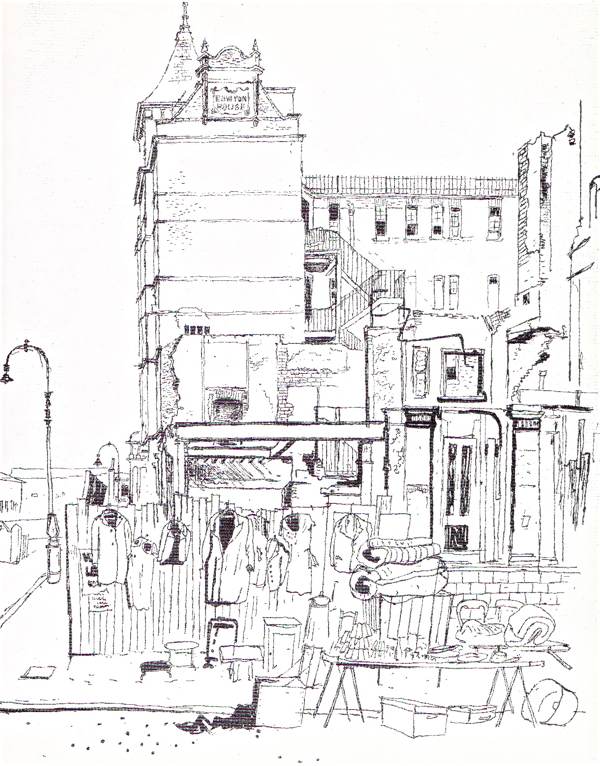
Rowton House

Old Montague St, Whitechapel

Gravel Lane, Wapping

Brushfield St, Spitalfields


Wentworth St, Spitalfields


Brick Lane


Fashion St, illustration by James Boswell from “A Kid for Two Farthings” by Wolf Mankowitz, 1953.

Russian Vapour Baths in Brick Lane from “A Kid for Two Farthings.”

James Boswell (1905-1971)


Leather Lane Market, 1937
Images copyright © Estate of James Boswell

CLICK HERE TO BUY A COPY OF A HOXTON CHILDHOOD BY A.S. JASPER ILLUSTRATED BY JAMES BOSWELL
So Long, Vittoria Wharf

Unusual concrete structure with glass block detailing embedded in the roof slab
By the time you read this – barring a miracle – Vittoria Wharf may already be gone. Contributing Architectural Photographer Morley Von Sternberg braved the frost to record these buildings when the builders permitted a final opportunity for access for the last week. He arrived just as they began to remove the roof, thereby exposing the structure as a palimpsest that tells the story of more than a century of manufacturing tradition on this site.
Thus ends one of the most mind-numbing and nonsensical East End planning controversies of recent years, as these well-used buildings are reduced to rubble for the sake of a superfluous new footbridge over the River Lea, linking Hackney Wick and the Queen Elizabeth Olympic Park, supplementing a pair of existing crossings each within less than two minutes walk.
When the Olympic Authority was created, planning control of the site of the games and surrounding areas was removed from local councils. Afterwards, Boris Johnson set up the Mayor of London’s London Legacy Development Corporation which inherited the power to decide what happened next to this publicly-owned land and property, without the requirement of any democratic accountability. Consequently, although 10,000 signed a petition, 1,300 wrote letters of objection and Mayor of Tower Hamlets John Biggs, Member of Parliament for Bethnal Green & Bow Rushanara Ali and five cross-party London Assembly Members challenged the demolition of Vittoria Wharf, it has gone ahead without any meaningful consultation.
Originally built in 1900 beside the River Lea in Hackney Wick by Vulcanite Roofing Felt, Vittoria Wharf acquired its popular identity when it was named after the mother of one of the proprietors of Byron & Byron Curtain Fixtures. They were the last to use premises for manufacturing before it was compulsorily purchased by the Olympic Authority as part of a large scale buy up of industrial premises.
The 1900 waterfront elevation of Vittoria Wharf with its wall of iron frame warehouse windows conceals extensively remodelling following bomb damage, undertaken in 1947 for Frank F Pershke Ltd, Manufacturers & Importers of Printing Machines. This was by architect Peter Caspari and engineer Felix Samuely, renowned for his work on the De La Warr Pavilion, Bexhill. The 20th Century Society commended this work as a “pioneering collaboration” between Caspari and Samuely, whose ingenious reconstruction was at the cutting edge of new architecture as well as making good use of scarce materials.
In 2009, after the departure of Byron & Byron, the premises were converted to around seventy small workspaces and artists studios, along with a cafe and gallery known as Vittoria Wharf & Stour Space, with the following policy – ‘Our vision was to create a forward thinking space that could find new ways of sustaining creativity and innovative business with social value at its core.’ This endeavour was subsequently recognised as a model of grassroots development and granted Asset of Community Value as part of the Localism Act in 2011.
Yet they were evicted last year and an architecturally significant, publicly-owned building in use by a lot of people is being demolished for an unecessary new footbridge and undisclosed future development, in spite of unanimous public opposition. Now the roof is gone from Vittoria Wharf, the lid needs to be taken off the LLDC. Because the entire sorry debacle leaves innumerable pertinent questions unanswered, most obviously – What kind of Olympic Legacy is this?


Photographs copyright © Morley Von Sternberg
[youtube nGVb_q2cUFY nolink]
You may also like to read about
Tower Hamlets Advertisements, 1967
To divert me while I have been poorly, Stefan Dickers the Archivist at Bishopsgate Institute kindly sent me these wonderful advertisements from a History of Tower Hamlets produced by the council in 1967 and I could not resist showing them to you. Fifty years later, it is poignant to contemplate these proud images of manufacturing and long-established local businesses which are now all gone.


Images courtesy Bishopsgate Institute
You might also like to take a look at
Adverts from the Jewish East End
Adverts from Stepney Borough Guide
Tony Bock On The Railways

A mischievous trainspotter changes the departure time at Liverpool St Station
“I have always liked railway stations, a focal point of the community – the start and finish of a journey,” Photographer Tony Bock admitted to me, introducing these elegant pictures. “Often the journey was a daily chore, but sometimes it was an occasion,” he added, in appreciation of the innate drama of rail travel.
Tony’s railway photographs date from the years between 1973 and 1978, when he was living in the East End and worked on the East London Advertiser, before he left to take took a job on the Toronto Star, pursuing a career as a photojournalist there through four decades.
“Although plenty has been written about the architecture of railways and the industrial ‘cathedrals’ – from the perspective of the twenty-first century, it is easy to forget the great change the railway brought when it first arrived in the mid-nineteeth century. Liverpool St Station was opened in 1874 and survived largely unchanged into the nineteen seventies.
So, in 1977, when proposals to redevelop the station were suggested, I decided to spend some time there, documenting the life of the station with its astonishing brick and iron architecture. I loved the cleaners, taking a break, and the young lad taking it upon himself to reschedule the next train – ‘Not This Train’! Meanwhile, the evening commuters heading home looked as if they were being drawn by a mysterious force.
Next door to Liverpool St was Broad St Station, only used for commuter trains from North London then and already it was looking very neglected. Only a few years later, it closed when Liverpool St was redeveloped.
Over in Stratford, the rail sheds dated back to the days when the Great Eastern Railway serviced locomotives there. Surprisingly, British Rail were still using some of the sheds in 1977, maintaining locomotives amongst the rubble that eventually became the site of the Olympic Park.
Finally, from the very earliest days of railways, I found three posters on the wall in the London Dock, Wapping. The one in the centre is from the Great Northern Railway, dated 1849, the other two from the North Union Railway Company, dated 1836, and it is still possible to read that one hundred and twelve pounds or ten cubic feet would be carried for three shillings according to the Rates, Tolls and Duties. The North Union operated in Lancashire and only lasted until 1846. How did these posters survive, they were likely one hundred and thirty years old. I wonder if anyone was able to salvage them?
I suppose there is an irony that I am writing this today in my home which is a village railway station built by the Canadian Pacific Railway in 1904. The building now sits in woods, since the local branchline is long gone. Yet any station – grand or modest – will always carry a significance for the community they are part of.”


Farewells at LIverpool St


Ticket collecting at Liverpool St

Cleaners, taking a break, at Liverpool St.


Commuters at Broad St Station.

Waiting for a train at Victoria Station

Wartime sign in the cellar of Broad St Station, demolished in 1986.

Stratford Railway works, now engulfed beneath the Olympic site

Repair sheds at Stratford

Engine sheds at Stratford

Railway posters dating from 1836 in London Dock, Wapping
Photographs copyright © Tony Bock
You may like to see these other photographs by Tony Bock
East End Snowmen Of Yesteryear
While languishing in my bed with a chill these past few days, I have been watching the snow falling outside and recalling the transient souls of those long-gone East End snowmen of yesteryear that I was able immortalise with my camera

At first I came upon them in yards and gardens, but before long they were scattered all over the parks and open spaces, lonely sentinels with frozen smiles. Snowmen are short-lived beings and many of those I photographed were just completed, only to be destroyed shortly after my pictures were taken. Yet when I returned later, I often found they had been reconstructed, and – as others appeared in the vicinity and the creators sought to be distinctive – a strange kind of evolution was taking place.


You may also like to take a look at
The Gentle Author At The Society Of Genealogists
I am giving an illustrated lecture on the CRIES OF LONDON at the Society of Genealogists in Clerkenwell on Thursday 15th March at 2pm, showing images of itinerant traders over the last four hundred years and talking about the reality of the lives of those who once eked an ingenious living on the streets we walk today.
If you have never visited the Society in Charterhouse before, this is the ideal introduction.

Of all the CRIES OF LONDON I have come across, this anonymously-published set believed to be by Luke Clennell is my favourite. The hawkers in his woodcuts look filthy, with bad skin and teeth, dressed in ragged clothes, either skinny as cadavers or fat as thieves, and with hands as scrawny as rats’ claws.You can almost smell their bad breath and sweaty unwashed bodies, pushing themselves up against you in the crowd to make a hard sell.
Luke Clennell was apprenticed as an engraver to Thomas Bewick and then moved to London in 1804 as a young man, seeking a career as a painter and winning a major commission in 1816 from the Earl of Bridgewater to do portraits of more than four hundred guests at dinner in the Guildhall. The impossibility of getting all these subjects to sit for him drove Clennell to a nervous breakdown and he was committed to Salisbury Asylum. Although he recovered sufficiently to continue his career, he was afflicted with mental illness for the rest of his life and died in Newcastle Asylum in 1840.
The distinctive quality of Clennell’s Cries, first published as ‘London Melodies & Cries of the Seasons’ in 1812, stands out among the hundreds of anonymous woodcuts published in chapbooks in the early nineteenth century by virtue of their lively texture and unapologetic, unsentimental portraiture.
Clennell’s hawkers are never going to be framed on the parlour wall and they do not give a toss. They own their defiant uncouth spirit. They are a rough bunch with ready fists that you would not wish to encounter in a narrow byway on a dark night. Yet they are survivors who know the lore of the streets, how to scratch a living out of little more than resourcefulness, and how to turn a shilling as easily as a groat.
With unrivalled spirit, savage humour, profane vocabulary and a rapacious appetite, Luke Clennell’s woodcuts are the most street-wise of all the Cries. He gloried in the grotesque features and unrestrained personalities of hawkers, while also permitting them an unbridled humanity that we can only regard with esteem. They call to me across the centuries, crying, “Sweet and Pretty Beau-Pots – One a-Penny” and “Buy my Live Scate.”

Rabbit, Rabbit – Nice fat Rabbit

All Round & Sound, Full Weight, Threepence a Pound, my Ripe Kentish Cherries.

Buy my Fresh Herrings, Fresh Herrings, O! Three a Groat, Herrings, O!

Buy a Nice Wax Doll – Rosy and Fresh.

The King’s Speech, The King’s Speech to both Houses of Parliament.

Here’s all a Blowing, Alive and Growing – Choice Shrubs and Plants, Alive and Growing.

Hot Spice Gingerbread, Hot – Come buy my Spice Gingerbread, Smoaking Hot – Hot Spice Gingerbread, All Hot.

Any Earthen Ware, Plates, Dishes, or Jugs, today – any Clothes to Exchange, Madam?

Hot Mutton Dumplings – Nice Dumplings, All Hot.

Buy a Hat Box, Cap Box, or Bonnet Box.

Buy my Baskets, a Work, Fruit, or a Bread Basket.

Chickens, a Nice Fat Chicken – Chicken, or a Young Fowl.

Sweet and Pretty Beau-Pots, One a-Penny – Chickweed and Groundsel for your Birds.

Buy my Wooden Ware – a Bowl, Dish, Spoon or Platter.

Six Bunches a-Penny, Sweet Lavender – Six Bunches a-Penny, Sweet Blooming Lavender.

Here’s One a-Penny – Here’s Two a-Penny, Hot Cross Buns.

Lilies of the Valley, Sweet Lilies of the Valley.

Cats Meat, Dogs Meat – Any Cat’s or Dog’s Meat Today?

Buy my Live Scate, Live Scate – Buy my Dainty Fresh Salmon.

Mackerel, O! Four for shilling, Mackerel, O!

Hastings Green and Young Hastings. Here’s Young Peas, Tenpence a Peck, Marrow-fat Peas.

Self-portrait by Luke Clennell (1781–1840)
Images courtesy Bishopsgate Institute
You may like to take a look at
H.W.Petherick’s London Characters
John Thomson’s Street Life in London
Aunt Busy Bee’s New London Cries
Marcellus Laroon’s Cries of London
More John Player’s Cries of London
William Nicholson’s London Types
Francis Wheatley’s Cries of London
John Thomas Smith’s Vagabondiana of 1817
Thomas Rowlandson’s Lower Orders
More of Thomas Rowlandson’s Lower Orders
Adam Dant’s New Cries of Spittlefields

CLICK TO BUY A COPY OF THE GENTLE AUTHOR’S CRIES OF LONDON FOR £20


