
Moyra Peralta’s Portraits
Next tickets for THE GENTLE AUTHOR’S TOUR OF SPITALFIELDS are available for Saturday 22nd June
Remembering photographer Moyra Peralta (1936-2024) who died on 8th May aged eighty-eight

Sylvia in Tenterground, Spitalfields
This compelling photograph has been haunting me with its tender emotional resonance. Sylvia’s once-smart shoes and flowery dress tell us about the life she wished to lead – and maybe about the life she had led – yet it is apparent from Moyra Peralta’s affectionate portrait that the life Sylvia aspired to was lost to her forever. Unwillingly to enter a night shelter, she slept rough in Spitalfields in the seventies and today this photograph exists as the only lasting evidence that, in spite of her straitened circumstance, Sylvia kept her self-respect.
Through the seventies and until the end of the nineties, Moyra Peralta befriended people living on the street in the capital, visiting them several times each week. “I miss that world terribly,” she admitted to me, looking back on it, “my relationships were more social than photographic, but in the process of those relationships I took portraits – there are those here that I knew over thirty years, most of these people I knew for well over twenty to thirty years.”
“Definitions of the homeless lost all meaning for me.” Moyra emphasised, “As a photographer, I tried to show the human face, rather than the problem of homelessness itself because those termed ‘homeless’ are not an alien grouping – they are people of all ages and backgrounds, many of whom have met with crippling misfortunes.”
Moyra’s intimate photographs succeed as portraits of heroic individuals, evoking the human dignity of those marginalised by society. “To me, those I have photographed are an important part of our social history.” Moyra asserted to me, “I want my photographs to rescue people from oblivion and celebrate their lives lived in a climate of disregard.”

John T in Lincoln’s Inn Fields.

Bert known as ‘Birdman’ slept outdoors since the age of fourteen. He had an affinity with the black swans and sparrows in St James’ Park and was treated with tolerance by the Park Police.

Two men sitting in a cellar.

Maxie on the steps of the Cumberland Hotel, Marble Arch.

Maxie pours Stan a drink at Marble Arch.

Eddie and Brian tell tall stories on Kinsgway

Brian raps on the church door, Kingsway

Man and a cat in a Cyrenian short stay hostel, 1974.

Grant and pal laughing at the Bullring, South Bank

Mary reads the Big Issue in Holborn

Tommy M in Lincoln’s Inn Fields

Bill H, Cyrenian House, Barons Court, in the seventies.

Brian D at Middlesex Hospital, 1997

Brian’s begging hand.

Francis at Cable St

JW and Jim at Pratt St, Camden

John T, Storyteller, Whetstone 1995.

John T, the valentine.

Kerry’s Christmas Tree, Kingsway 1994.

Drag artistes from the Vauxhall Tavern give a surprise performance to entertain guests at a night shelter, 1974

Drag artistes improvise costumes at the Vauxhall shelter.

Billy and Maxie, two ex-servicemen at Marble Arch, 1976. Billy (left) died of a broken heart the year after Maxie’s death

Billy at Marble Arch in the seventies.

Sid takes tea at Ashmore Rd short stay hostel in West London.

Resident washing dishes at West London Mission, St Luke’s House – part of former Old Lambeth Workhouse, 1974.

Tiny, ex-circus hand and born wanderer extends a greeting at the Vauxhall Night Shelter, 1974.

Man and his bottle in Central London, seventies

Disabled Showman Zy with his wheels.

Zy plays a trick with his teeth

Brian the Poet in Kingsway, 1994.

Photographs copyright © Estate of Moyra Peralta
You may also like to read about
So Long, Moyra Peralta
Next tickets for THE GENTLE AUTHOR’S TOUR OF SPITALFIELDS are available for Saturday 22nd June
Photographer Moyra Peralta (1936-2024) died on 8th May aged eighty-eight

Men sleeping outside Itchy Park
“I felt Spitalfields was my home at one time, even though I was never resident there apart from staying at Providence Row for the occasional night.” admitted photographer Moyra Peralta when she showed me these pictures, taken while working in the shelter in Crispin St during the seventies and eighties.
“Every time I look at these, I see myself there,” she confided, contemplating her affectionate portraits of those she once knew who lived rough upon the streets of Spitalfields, “yet it doesn’t feel like me anymore, now that I am no longer in touch and I have no idea how many have died.” Despite its obvious social documentary quality, Moyra’s photography is deeply personal work.
Recalling the days when she and her partner, Rodger, studied under Jorge Lewinsky in the sixties, Moyra revealed the basis of her vision. “It opened up the mental apparatus to see photography not as an amateur hobby but as something fundamental to life. And it was doing the Soup Run that triggered off the urge to record. At first, I couldn’t believe what I saw, because in the day you didn’t see it. At night, you see a lot of things you wouldn’t otherwise see – hundreds of men sleeping at the back of a hotel in Central London, when there was no sign of them by day because they went to the day shelter.”
Forsaking her chosen path as a teacher, Moyra spent more than a decade working in shelters and on the street, befriending those with no other place to go and taking their pictures. “I started out as a volunteer on the night Soup Run, but once I got to know the men individually, I thought – that’s it, I don’t want to be anywhere else. I realised they didn’t lose their soul, and that spirit was what turned me from a volunteer into a full-time worker at Providence Row,” she confessed.
“Our children were exposed to the scene and spent every Christmas with us at the night shelter where we volunteered. We used to have people home for the weekend as long as they didn’t drink, but I think they found it quite a struggle to stay sober for two days. I could quite understand why people would drink, when it’s so cold you can’t sleep and you’re scared of being attacked by ‘normal’ people.”

Gerry B. in his cubicle at Providence Row – “Gerry sent me a letter containing only a few lavender seeds and a one pound note – the significance of which I shall never know, for Gerry died a few days later. He always had been so very kind and I never quite knew why. Like many before him, his remains were laid in a pauper’s grave.
I remember, above all, his intervention on my first evening at work, when men in the dormitory had planned a surprise to test the reaction of the greenhorn on the night shift. Forewarned is forearmed, and the equanimity with which I viewed a row of bare bottoms in beds along the dormitory wall stood me in good stead for future interaction.”

“The women’s entrance at the corner of Crispin St & Artillery Lane, where Sister Paul is seen handing out clean shirts to a small group of men.”

Dining Room at Providence Row.

“The two Marys, known as ‘Cotton Pickin’ and ‘Foxie,’ making sandwiches at Providence Row for the daily distribution in Crispin St.”

Providence Row Night Refuge, Crispin St.

Men waiting for sandwiches outside Providence Row Night Refuge, 1973. “Established in 1880, this refuge offered free shelter and food to those who needed it for over one hundred years.”

Market lorries in Crispin St.

White’s Row and Tenterground.

Charlie & Bob outside Christ Church. “Charlie was a well-known East End character and Bob was my co-worker at the night shelter.”

Charlie, Bob & J.W. “Charlie rendering ‘Danny Boy’ to his captive audience.”

Charlie & Bob.

Sleeping in a niche, Christ Church 1975. “The crypt was opened in 1965 as a rehabilitation hostel for meths and crude spirit drinkers.”

Mary M. in Spitalfields.

“In Brushfield St beside Spitalfields Market, Dougie is seen having his lunch at ‘Bonfire Corner.’ Traditionally there had been a fire on this corner since the fifties.”
Sylvia, Tenterground 1978. “This homeless woman slept rough but accepted meals from Providence Row in Crispin St.”

Brushfield St, 1976. “Discarded vegetables at the closing of each market day proved a godsend to people on low incomes.”

Painter, Providence Row.

The bonfire corner at Spitalfields Market, 1973. “There had been deaths here from market lorries reversing. Ted McV., however, died of malnutrition and exposure. “

Peggy

Old Mary, seventies.

John Jamieson, Commercial St 1979.

John Jamieson smiling.

J.W. with harmonica

J.W. & Pauline in Whitechapel, eighties

Pauline in Whitechapel, eighties.

Willie G. in pensive mood, rolling a fag in Whitechapel, 1976.

Gunthorpe St, 1974

Michael, Cable St 1973

Moyra & her partner Rodger in Spitalfields, late seventies.
Photographs copyright © Estate of Moyra Peralta
You may also like to read about
The Doss Houses of Spitalfields
At Fulham Palace

Next tickets for THE GENTLE AUTHOR’S TOUR OF SPITALFIELDS are available for Saturday 22nd June

You enter the park by the Thames and go through a gate in a high wall to find yourself in a beautiful vegetable garden with an elaborate Tudor gate. Beyond the Tudor gate lies Fulham Palace, presenting an implacable classically-proportioned facade across a wide expanse of lawn bordered by tall old trees. You dare to walk across the grass and sneak around to the back of the stately home where you discover a massive Tudor gateway with ancient doors, leading to a courtyard with a fountain dancing and a grand entrance where Queen Elizabeth I once walked in. It was only a short walk from the tube but already you are in another world.
For over a thousand years the Bishops of London lived here until 1975 when it was handed over to the public. But even when Bishop Waldhere (693-c.705) acquired Fulham Manor around the year 700, it was just the most recent dwelling upon a site beside the Thames that had already been in constant habitation since Neolithic times. Our own St Dunstan, who built the first church in Stepney in 952, became Bishop of London in 957 and lived here. By 1392, a document recorded the great ditch that enclosed the thirty-six acres of Britain’s largest medieval moated dwelling.
Time has accreted innumerable layers and the visitor encounters a rich palimpsest of history, here at one of London’s earliest powerhouses. You stand in the Tudor courtyard admiring its rich diamond-patterned brickwork and the lofty tower entrance, all girded with a fragrant border of lavender at this time of year. Behind this sits the Georgian extension, presenting another face to the wide lawn. Yet even this addition evolved from Palladian in 1752 to Strawberry Hill Gothick in 1766, before losing its fanciful crenellations and towers devised by Stiff Leadbetter to arrive at a piously austere elevation, which it maintains to this day, in 1818.
Among the ecclesiastical incumbents were a number of botanically-inclined bishops whose legacy lives on in the grounds, manifest in noteworthy trees and the restored glasshouses where exotic fruits were grown for presentation to the monarch. In the sixteenth century, Bishop Grindal (1559-1570) sent grapes annually to Elizabeth I, and “The vines at Fulham were of that goodness and perfection beyond others” wrote John Strype. As Head of the Church in the American Colonies, Bishop Henry Compton (1675-1753), sent missionaries to collect seeds and cuttings and, in his thirty-eight tenure, he cultivated a greater variety of trees and shrubs than had previously been seen in any garden in England – including the first magnolia in Europe.
At this time of year, the walled garden proposes the focus of popular attention with its lush vegetable beds interwoven with cosmos, nasturtiums, sweet peas and french marigolds. A magnificent wisteria of more than a century’s growth shelters an intricate knot garden facing a curved glasshouse, following the line of a mellow old wall, where cucumber, melons and tomatoes and aubergines are ripening.
The place is a sheer wonder and a rare peaceful green refuge at the heart of the city – and everyone can visit for free .


Cucumbers in the glasshouse


Melon in the glasshouse


Five hundred year old Holme Oak

Coachman’s House by William Butterfield

Lodge House in the Gothick style believed to have been designed by Lady Hooley c. 1815

Tudor buildings in the foreground with nineteenth century additions towards the rear.


Sixteenth century gate with original oak doors

The courtyard entrance

Chapel by William Butterfield

Tudor gables


All Saints, Fulham seen from the walled garden


Freshly harvested carrots and vegetable marrows


Ancient yews preside at All Saints Fulham
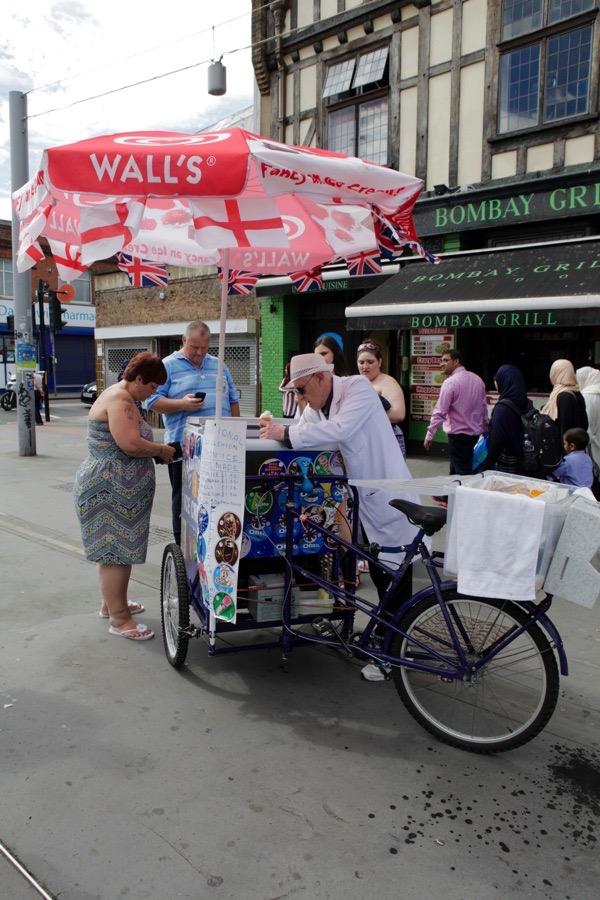
George Parrin, Ice Cream Seller

Next tickets for THE GENTLE AUTHOR’S TOUR OF SPITALFIELDS are available for Saturday 22nd June
My pal George is out pedalling around the streets again, so if you see him be sure to stop him and buy one!

‘I’ve been on a bike since I was two’
I first encountered Ice Cream Seller, George Parrin, coming through Whitechapel Market on his bicycle. Even before I met him, his cry of ‘Lovely ice cream, home made ice cream – stop me and buy one!’ announced his imminent arrival and then I saw his red and white umbrella bobbing through the crowd towards us. George told me that Whitechapel is the best place to sell ice cream in the East End and, observing the looks of delight spreading through the crowd, I witnessed the immediate evidence of this.
Such was the demand on that hot summer afternoon that George had to cycle off to get more supplies, so it was not possible for me to do an interview. Instead, we agreed to meet next day outside the Beigel Bakery on Brick Lane where trade was a little quieter. On arrival, George popped into the bakery and asked if they would like some ice cream and, once he had delivered a cup of vanilla ice, he emerged triumphant with a cup of tea and a salt beef beigel. ‘Fair exchange is no robbery!’ he declared with a hungry grin as he took a bite into his lunch.
“I first came down here with my dad when I was eight years old. He was a strongman and a fighter, known as ‘Kid Parry.’ Twice, he fought Bombardier Billy Wells, the man who struck the gong for Rank Films. Once he beat him and once he was beaten, but then he beat two others who beat Billy, so indirectly my father beat him.
In those days you needed to be an actor or entertainer if you were in the markets. My dad would tip a sack of sand in the floor and pour liquid carbolic soap all over it. Then he got a piece of rotten meat with flies all over it and dragged it through the sand. The flies would fly away and then he sold the sand by the bag as a fly repellent.
I was born in Hampstead, one of thirteen children. My mum worked all her life to keep us going. She was a market trader, selling all kinds of stuff, and she collected scrap metal, rags, woollens and women’s clothes in an old pram and sold it wholesale. My dad was to and fro with my mum, but he used to come and pick me up sometimes, and I worked with him. When I was nine, just before my dad died, we moved down to Queens Rd, Peckham.
I’ve been on a bike since I was two, and at three years old I had my own three-wheeler. I’ve always been on a bike. On my fifteenth birthday, I left school and started work. At first, I had a job for a couple of months delivering meat around Wandsworth by bicycle for Brushweilers the Butcher, but then I worked for Charles, Greengrocers of Belgravia delivering around Chelsea, and I delivered fruit and vegetables to the Beatles and Mick Jagger.
At sixteen years old, I started selling hot chestnuts outside Earls Court with Tony Calefano, known as ‘Tony Chestnuts.’ I lived in Wandsworth then, so I used to cycle over the river each day. I worked for him for four years and then I made my own chestnut can. In the summer, Tony used to sell ice cream and he was the one that got me into it.
I do enjoy it but it’s hard work. A ten litre tub of ice cream weighs 40lbs and I might carry eight tubs in hot weather plus the weight of the freezer and two batteries. I had thirteen ice cream barrows up the West End but it got so difficult with the police. They were having a purge, so they upset all my barrows and spoilt the ice cream. After that, Margaret Thatcher changed the law and street traders are now the responsibility of the council. The police here in Brick Lane are as sweet as a nut to me.
I bought a pair of crocodiles in the Club Row animal market once. They’re docile as long as you keep them in the water but when they’re out of it they feel vulnerable and they’re dangerous. I can’t remember what I did with mine when they got large. I sell watches sometimes. If anybody wants a watch, I can go and get it for them. In winter, I make jewellery with shells from the beach in Spain, matching earrings with ‘Hello’ and ‘Hola’ carved into them. I’m thinking of opening a pie and mash shop in Spain.
I am happy to give out ice creams to people who haven’t got any money and I only charge pensioners a pound. Whitechapel is best for me. I find the Asian people are very generous when it comes to spending money on their children, so I make a good living off them. They love me and I love them.”




Photographs copyright © Estate of Colin O’Brien
You might also like to read about
Matyas Selmeczi, Silhouette Artist
A Walk In The City With PC Lew Tassell
Next tickets for THE GENTLE AUTHOR’S TOUR OF SPITALFIELDS are available for Saturday 22nd June
Taking advantage of the early summer sunshine, Lew Tassell and I enjoyed a recent stroll through the City as he regaled me with tales of yesteryear.

PC Lewis Tassell on the beat in the seventies
‘Over my thirty years in the City of London Police I spent a lot of time engaged in duties other than walking the beat – security assignments, interviews, meetings and conferences in different locations in the Square Mile. Here are a few places of which I have fond memories and one in particular that was tragically sad.’

Pump Court
‘Working for twenty years in the Fraud Squad and a further sixteen years at the Serious Fraud Office, I spent a lot of time at case conferences in barristers’ chambers at 4 Pump Court off Middle Temple Lane where Henry Fielding lived in the eighteenth century.
The original buildings dated back to 1625 but many were destroyed during World War II and 4 Pump Court was rebuilt in 1952. The case in question took a number of years and led to the successful conviction of two fraudsters after a long trial at the Old Bailey in which the prosecution was led by a senior barrister from 4 Pump Court.
Walking through the Temple Estate is like stepping back in time, a haven in the centre of the metropolis. There are still gas lamps in Middle Temple Lane which in the eighties they were being switched on and off manually each day, although they are automatic today. ‘

Middle Temple Lane

Royal Courts of Justice
‘The Royal Courts of Justice house the High Court and Court of Appeal of England & Wales. During the seventies whilst working in the CID at Bishopsgate Police Station, I had a case of theft that went to trial at the Central Criminal Court, Old Bailey. All cases where the defendant elected to go to trial ended up at the Bailey no matter how trivial. This used to annoy some judges who were more used to dealing with high profile cases of murder, rape, robbery or fraud, rather than simple theft.
In fact my case was moved at the last minute from the Old Bailey, where they had no court available, to the Law Courts. So I ended up giving evidence here and it was all over in about two days with the defendant was found guilty.’

Micks Cafe
‘This was a Fleet St institution in the seventies when it was open twenty-four hours and seven days a week. It was constantly busy during the day but even busier at night when it was frequented by the print workers, drunks on their way home and homeless people who went there to keep warm, especially in winter.
On night duty in the seventies, we carried out a plain clothes observation in the cafe. It was suggested that the place was a location for dealing stolen gear and whatever was wanted by print workers could be sourced at Micks, though not – I should add – from those that ran it.
Needless to say the observations were fruitless since we stuck out like sore thumbs, sitting at cramped grimy tables sipping stewed tea all night. The establishment later acquired a apostrophe and became Mick’s Cafe before it closed in the nineties.’


St Paul’s Cathedral
‘I had many security duties at St Paul’s and I have had the good fortune to visit every part, from the crypt beneath to the cross on the top. One night when the cathedral was closed and sealed, I was tasked with patrolling the crypt alone in the dim light of the early hours of the morning. It was one of the few times that I have been truly spooked. I stood before the sarcophagus of the Duke of Wellington and immediately behind me was the tomb of Admiral Horatio Nelson. For some reason I started to shiver. Perhaps it was just the weight of history coupled with the fact it was in the middle of the night and I was on my own in the dark?
In 1982 I was on a security detail for a Service of Celebration & Thanksgiving to mark 60 years of the BBC in the presence of Her Majesty The Queen & His Royal Highness The Duke of Edinburgh, as well as many other VIPs. Sir Charles Groves was conducting the BBC Symphony Orchestra with members of the Scottish, Welsh & Northern Symphony Orchestras. It was by ticket only and there were no exceptions. When I checked in Sir Charles, he was followed by a woman who I stopped because she did not have a ticket. Sir Charles turned and exclaimed ‘That’s my wife, if you don’t let her in there will be no bloody music’. Today here is a memorial stone to him in the cathedral.’


Wood St Police Station
‘My base in the Fraud Squad for twenty years was Wood St Police Station. It was built in 1965 to house the communications department, the stables and garage as well as accommodation in the tower block, mainly for single men and women who were serving in the force.
When I joined the Squad in 1979, they occupied what was the former living accommodation. It was a fine building but not really conducive for use as a police station. The garage was underground with low ceilings that had exposed pipes and ductwork, making it unsuitable for many police vehicles and the canteen was directly above the stables which made it unpleasant in hot weather. In later years much of the building fell into disrepair because alterations could not be made to bring it up to the standard required for a modern police station since it was a Grade II* listed building. The building is now to be converted to a luxury hotel.’


Guildhall
‘This is a fifteenth century Grade I listed building with a stunning medieval Great Hall where I fulfilled security duties at many functions over the years – banquets for visiting heads of state and Lord Mayor’s banquets. On two occasions, I even attended banquets myself as a guest at celebrations of the achievements of the Fraud Squad.’


Moorgate Station
‘As a police officer there are many tragic events that you have to deal with as best you can. On 28th February 1975 I was on early duty when I went into the front office at Bishopsgate Police Station. The phone rang and was answered by the sergeant. He asked me to walk around to Moorgate tube before my break as a train had run into the buffers. At the time, it was the worst peacetime accident on the London Underground that had happened. Forty-three people died and seventy-four others were injured. I still use Moorgate tube and I am always reminded of that dreadful day. There is a plaque at the station and a memorial in Finsbury Sq listing the names of those who died.’
You may also like to trace our previous walks
Postcards From Petticoat Lane
Next tickets for THE GENTLE AUTHOR’S TOUR OF SPITALFIELDS are available for Saturday 22nd June

Today I am sending you postcards from Petticoat Lane. Here are the eager crowds of a century ago, surging down Middlesex St and through Wentworth St, everyone hopeful for a bargain and hungry for wonders, dressed in their Sunday best and out to see the sights. Yet this parade of humanity is itself the spectacle, making its way from Spitalfields through Petticoat Lane Market and up to Aldgate, before disappearing into the hazy distance. There is an epic quality to these teeming processions which, a hundred years later, appear emblematic of the immigrants’ passage through this once densely populated neighbourhood, where so many came in search of a better life.
At a casual glance, these old postcards are so similar as to be indistinguishable – but it is the differences that are interesting. On closer examination, the landmarks and geography of the streets become apparent and then, as you scrutinise the details of these crowded compositions, individual faces and figures stand out from the multitude. Some are preoccupied with their Sunday morning, while others raise their gaze in vain curiosity – like those gentlemen above, comfortable at being snapped for perpetuity whilst all togged up in their finery.
When the rest of London was in church, these people congregated to assuage their Sunday yearning in a market instead, where all temporal requirements might be sought and a necessary sense of collective human presence appreciated within the excited throng. At the time these pictures were taken, there was nowhere else in London where Sunday trading was permitted and, since people got paid in cash on Friday, if you wanted to buy things cheap at the weekend, Petticoat Lane was the only place to go. It was a dramatic arena of infinite possibility where you could get anything you needed, and see life too.


Images copyright © Bishopsgate Institute
You might also like to read about
Laurie Allen of Petticoat Lane
The Wax Sellers of Wentworth St
Margaret Rope’s East End Saints
Click here to book your ticket for THE GENTLE AUTHOR’S TOUR OF SPITALFIELDS

A familiar East End scene of 1933 – children playing cricket in the street and Nipper the dog joining in – yet it is transformed by the lyrical vision of the forgotten stained glass artist Margaret Rope, who created a whole sequence of these sublime works – now dispersed – depicting both saints of legend and residents of Haggerston with an equal religious intensity.
This panel is surmounted by a portrayal of St Leonard, the sixth century French saint, outside a recognisable St Leonard’s church, Shoreditch, with a red number six London bus going past. Margaret Rope’s extraordinary work mixes the temporal and the spiritual, rendering scenes from religious iconography as literal action and transforming everyday life into revelations – describing a universe that is simultaneously magical and human.
Between 1931 and 1947, the artist known simply to her family as ‘”Tor,” designed a series of eight windows depicting “East End Everyday Saints” for St Augustine’s church off the Hackney Rd, portraying miracles enacted within a recognisable East End environment. And for many years these charismatic visionary works were a popular attraction, until St Augustine’s was closed and Margaret Rope’s windows removed in the nineteen eighties, with two transferred across the road to St Saviour’s Priory in the Queensbridge Rd and the remaining six taken out of the East End to be installed in the crypt of St Mary Magdalene, Munster Sq. Intrigued by the attractive idea of Margaret Rope’s transcendent vision of the East End, I set out to find them for myself this week.
At St Saviour’s Priory, Sister Elizabeth was eager to show me their cherished windows of St Paul and St Margaret, both glowing with luminous rich colour and crammed with intricate detail. St Paul, the patron saint of London, is depicted at the moment of his transformative vision, beneath St Paul’s Cathedral – as if it were happening not on the road to Damascus but on Ludgate Circus. The other window, portraying St Margaret, has particular meaning for the sisters at St Saviours, because they are members of the Society of St Margaret, whose predecessors first came from Sussex to Spitalfields in 1866 to tend to the victims of cholera. In Margaret Rope’s window, St Margaret resolutely faces out a dragon while Christ hands a tiny version of the red brick priory to John Mason Neale, the priest who founded the order. Both windows are satisfyingly engaging exercises in magical thinking and the warmth of the colour, especially the turquoise greens and soft pinks, delights the eye with its glimmering life.
I found the other six windows in the crypt of St Mary Magdalene near Regents Park, used as a day centre for seniors, where they are illuminated from the reverse by fluorescent tubes. The first window you see as you walk in the door is St Anne, which contains an intimate scene of a mother and her two children, complete with a teddy bear lying on the floor and a tortoiseshell cat sleeping by the range. Next comes St George, who looks like a young athlete straight out of the Repton Boxing Club, followed by St Leonard, St Michael, then St Augustine and St Joseph. All share the same affectionate quality in their observation of human detail, rendered with a confidence that sets them above mere decorative windows. These are poems in stained glass that manifest the resilient spirit of the East End which endured World War II. Another window by Margaret Rope in St Peters in the London Docks, completed in 1940, showed people celebrating Midnight Mass at Christmas in a bomb shelter.
Margaret Edith Aldrich Rope was born in 1891 into a farming family on the Suffolk coast at Leiston. Her uncle George was a Royal Academician, and she was able to study at Chelsea College of Art and Central School of Arts & Crafts, where she specialised in stained glass. Unmarried, she pursued a long and prolific working life, creating over one hundred windows in her fifty year career, taking time out to join the Women’s Land Army in World War I and to care for evacuees at a hospital in North Wales during World War II, before returning to her native Suffolk at the age of eighty-seven in 1978.
Her nickname “Tor” was short for tortoise and she signed all her works with a tortoise discreetly concealed in the design – and upon close examination, every window reveals hidden texts inscribed into the richly coloured shadows. So much thought and imagination is evident in these modest works in the magical realist style – which transcend their period as neglected yet enduring masterpieces in the underrated art of stained glass – that I recommend you make your acquaintance with the stylish work of Margaret Rope, which celebrates the miraculous quality of the everyday.

St Leonard is portrayed in a moment of revelation outside St Leonard’s Church, Shoreditch, with Arnold Circus in the background and a London bus passing in the foreground.

The lower panel of the St George window.

A domestic East End scene from the lower panel of the St Anne’s window.

This tortoise-shell cat is a detail from the panel above.

The lower panel from the St Michael window.

Mother Kate, Prioress of St Saviour’s and Father Burrows with his dog, Nipper, standing outside St Augustine’s in York St, now Yorkton St. In the right hand corner you can see the tortoise motif that Margaret Rope used to sign all her works.

Sisters of St Saviour’s Priory, portrayed in the lower panel of the St Margaret window, 1932.

Margaret Rope’s St Paul and St Margaret, now in the entrance of Saviour’s Priory, Queensbridge Rd.

Stained glass artist, Margaret Edith Aldrich Rope known as “Tor” (1891-1988)


