
Peri Parkes’ East End
Click here to book your ticket for THE GENTLE AUTHOR’S TOUR OF SPITALFIELDS

House in the East, 1980-81
It was through the artist Doreen Fletcher, who is celebrated for her paintings of the East End, that I first learnt about the work of Peri Parkes.
Doreen wrote, ‘My good friend Peri Parkes was perhaps the artist with the most integrity I have ever met. His standards were so high that he was reluctant to exhibit anything he produced, always finding the outcome lacking somehow. Fellow artists tried hard to persuade him to have a one man show to no avail. He painted the East End assiduously during the eighties until he took a teaching post in Cornwall in 1992, however he continued to revisit to Bow right up until his death too soon at the age of fifty-six.’
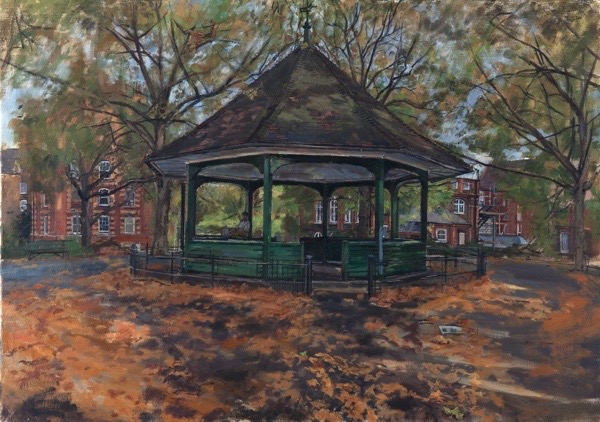
On Doreen’s recommendation, I took the train to Hertford to meet Peri’s daughters, Lucie & Zoe who showed me fifty of their father’s paintings which have been mostly stored in a cupboard since he died in 2009. The quality and significance of this work was immediately apparent and I knew at once that I must devote a chapter in my book East End Vernacular, Artists Who Painted London’s East End Streets in the 20th Century to celebrate the rare talent and rigorous vision of Peri Parkes.
Out of the tragedy of a broken relationship, Peri Parkes created a transcendent series of paintings and it is impossible not to touched by the self portraits that he included in his work, of the lonely man walking in the park or climbing onto his bike.
Lucie & Zoe are the custodians of this legacy and they spoke affectionately to me about their father as we sat surrounded by his wonderful paintings.
Zoe – My father was from Hampstead Garden Suburb in Finchley. He had a Greek mother – who named him Pericles, she came from quite a well-to-do family and his father was a solicitor. Dad was born and grew up there but he left home very young, about sixteen. Then he met Lindsey, my mum, and they had me when he was just eighteen. My grandmother bought a house in Ridge Rd Crouch End and we all lived there.
Lucie – When he was nineteen, he got a scholarship to the Slade. I should add that when he was sixteen, he went off to Afghanistan, back-packing. He and mum first met at the railway station, just before he was about to leave and there was obviously a spark. Once he came back, they met up again and married when he was eighteen and mum was seventeen.
Zoe – When I was a baby, he used to take me off to college with him. He put me on his back and off we would go to the Slade.
Lucie – Mum had agoraphobia after she had Zoe, so he had to take her with him – a nineteen-year-old with his baby.
Zoe – They split up when I was six and Lucie was three, around 1979. He went to stay with his friend Martin Ives in a prefab in Conder St, Stepney and we stayed with our mum in her mum’s house. After that he got a housing association flat next to Bow Rd Station and then he moved just around the corner to Mornington Grove.
Lucie – He never had a studio, he just painted in the flat where he lived. He was completely unmaterialistic and his whole flat was his studio with bare floors, bare walls, furniture that he picked up from skips or off the street, boxes and then piles and piles of paints. All over the furniture there was paint splatters and full ashtrays. He did not really ever think about comfort.
Zoe – He was so driven by painting. He had a one track mind. He did not really want anything else in life but to be able to paint and to go to the pub.
Lucie – We used to go and stay with him every other weekend in the prefabs and hang around in the back yard, I remember doing snail races and counting slugs while he painted.
Zoe – He took us round galleries quite a lot, which as children was quite boring to us – but he used to get very enthusiastic about things he wanted to see.
Lucie – To say he was very self-absorbed is only half the picture because he was not egotistical, he was actually quite a humble person, and a loving and affectionate dad. I remember lying in bed in the prefabs when it was freezing cold and he used to tell us stories, and they were brilliant. We loved him and loved being with him, but he was not really able to give to his relationships because everything was about painting.
Zoe – I think he struggled with depression a lot, whether it was to do rejection as an artist or with not getting things right. He was a real perfectionist and he had massive temper flare ups if he was not satisfied with his work. Yet he had a real community in London. He used to go to the Coborn Arms every night and he had a crew of friends there.
Lucie – Nothing he did was ever right or good enough for him. He was always striving to be better. He could not give his paintings away let alone sell them but, if he did give one away to a family member, he took it back because it was not quite good enough. If he was here now, he would be looking at his paintings, very dissatisfied, and he would want to make changes.
He was driven to paint what he saw in front of him. I do not think he was driven to tell the story of the East End, it was just that, wherever he was, he painted obsessively to capture what he was seeing. Most of them are from his window in his living room or the back of his prefab.
Zoe – He was always submitting pictures for exhibitions and competitions, and he took the rejection quite personally.
Lucie – When his relationship broke down with mum he was deeply hurt. I think the more things went wrong in his life, the more he channelled everything into painting. I can remember him taking us home on the tube once and him looking at us and tears pouring down his face. That sticks with me because I knew then that he really cared and was hurt by the whole thing, but he could not express any of that – it all went into his painting.
Zoe – I look at these paintings and I see them as dad’s life at the time, from the time arrived in the East End in 1977 until he left in 1992. The style at the beginning is quite different from the later ones. He went on holiday to the tiny town of St Just on the farmost westerly point of Cornwall and fell in love with it. The day after returning from holiday he saw a job for a part time art teacher there in the newspaper, it was like an act of fate. He had taught Art at the Blessed John Roche School in Poplar and he wanted out of London. He loved it in Cornwall and lived in the most remote place. He said Cornwall was as close as he could get to Greece in this country.
Arnold Circus, 1990-92

The Dinner Ladies, c.1986-9 (Wellington Way School, Bow E3)

Wellington Way School E3, 1985-6

Bow Triangle in Winter, 1990-92

The Departure, c.1992-4 (Mornington Grove, Bow E3)

Bow Church, c.1987-92

Conder St, Stepney, 1977-80

Conder St, Stepney, c.1980

City view from St Bernard’s School, St Matthew’s Row, E2, c.1987 (Click on this image to enlarge)
Paintings copyright © Estate of Peri Parkes

Click here to buy a copy of EAST END VERNACULAR for £25
David Johnson’s Cafes
Click here to book your ticket for THE GENTLE AUTHOR’S TOUR OF SPITALFIELDS

Fredson’s Cafe, Alie St
David Johnson took these magnificent photographs of cafes in Kodachrome around 1980.
“When I lived in East London, I started this project to photograph some classic cafes, mainly in the East End – but also elsewhere as I came across them in my travels. I think it was the sign-writing and eclectic typography which were the main attractions. I realised that they were not going to be around much longer. Many were run by Italian families who started up in the post-war period. Annoyingly, I did not make a note of the locations – so if you can help, please leave a comment.”
David Johnson

Aeron Cafe

Bridge Cafe

Corner Parlour

Alfredo’s Cafe, Islington

Sign at Alfredo’s Cafe

Flock-In

Gee’s Cafe

George’s Cafe, Whitechapel

The Happy Fillet

Jim’s Cafe, Islington

Jubilee Cafe

Moon & Sixpence Cafe

Norman’s Nosh Bar

Norman’s Nosh Bar

Phyllis’s Cafe

Silvio Cafe

The Ninety Eight

The Village Rest

Viking Cafe

Magno Cafe

Leslie’s Cafe

Crawford Cafe

Cafe

Empire Cafe

Photographs copyright © David Johnson
You may also like to take a look at
David Johnson’s East End
Click here to book your ticket for THE GENTLE AUTHOR’S TOUR OF SPITALFIELDS

Liverpool St Station
Shall we take a tour around the East End in the early eighties in the company of David Johnson, courtesy of his wonderful Kodachrome photographs?
“My interest in London’s history goes back to the late sixties, when as a teenager I would take the train from Oxford and then, using a Red Bus Rover ticket and a copy of Geoffrey Fletcher’s The London Nobody Knows, discover some of the most interesting and off-beat parts of the capital. In 1977, seeking a job after graduating and with a strong interest in photography, I ended up in London selling cameras in Tottenham Court Rd. I first explored the old wharves and docklands before they disappeared and then, after moving to Dalston, the East End. Derelict buildings, faded signs, architecture on a human scale are all things which I liked to photograph then – and still do today.”
David Johnson
 Liverpool St Station
 Liverpool St Station
 Liverpool St Station

Artillery Lane

Brushfield St

Christ Church Spitalfields

Fashion St

Spitalfields barber

Hanbury St

Brick Lane

Homeless men in Spitalfields

The City from Spitalfields

Whitechapel Market

Wapping Police Station

Wapping

St Paul’s School, Wellclose Sq

Wapping High St

River Plate Wharf

Wapping

Wapping Pier Head

The Gun, Isle of Dogs

The Black Horse, Limehouse

Grove Place, Hackney

Empress Coaches, Hackney

Regent’s Canal

Cat & Mutton Bridge

Broadway Market

Broadway Market

George Tallet, Fishmonger, Hackney

Carr’s Pet Stores, Hackney

Trederwen Rd, Hackney
Photographs copyright © David Johnson
Doreen Fletcher’s Early Paintings
Click for tickets for The Gentle Author’s Tour of Spitalfields

In the week before the opening of Doreen Fletchers’s exhibition of new paintings, EAST, on Saturday 8th June at Townhouse, it is my pleasure to show a selection of her early paintings which originate from the Potteries where Doreen grew up. These pictures comprise a significant body of work painted by Doreen in her teens and early twenties.

Salvation Army Building, 1970 (Courtesy of Brampton Museum)

Brook St, 1975
“This was the very first urban oil painting I ever did. I was inspired by the fact that each time I returned to visit my parents, a little more of their environment had disappeared and I felt an urgent need to record what remained. I little realised at the time I had found both a subject and a content that would last a lifetime.”

Bungalow in Summertime, 1976
“When I painted this, I had already lived in London for two years with my boyfriend, an art student at Wimbledon. During the summers we decamped to our hometown of Newcastle-under-Lyme on his motorbike which I loved riding pillion. On summer evenings, we drove around the countryside, stopping for a drink at a country inn and savouring the contrast between our new, busy lifestyles in London and the peaceful country lanes we travelled.
One evening, I was taken aback to see a suburban bungalow in the middle of a field. It looked completely out of place and reminded me of the house where my great uncle lived in which the heavy oak furniture seemed out of scale in the small rooms. Due to this I had developed a prejudice against what I saw as ‘bungalow culture.’”

House in Whitfield Ave, 1977
“The house where I grew up was declared not fit for human habitation in 1974. My parents were happy to move into a council property they were offered across the road from this one. There was a huge garden with two greenhouses where my dad grew vegetables in regimented rows, with tomatoes and chrysanthemums. He was delighted, but my mother was lonely and missed the intimacy of the cramped streets with a shop on every corner near the town centre.”

The Albert, Liverpool Rd, 1977

Takeaway Chip Shop, 1979
“This is typical of chip shops dotted all over Newcastle and the Potteries where long queues would form at tea-time and again after the pubs had closed.”

Black & Yellow Door, 1980
“Notice the foot scraper that all terraced houses had in those days, for knocking off the clay from clogs and later Wellingtons. The bright colours of the paintwork were trendy in the early-mid seventies, as opposed to the dull browns, navy blues and maroons favoured in the fifties and sixties.”

Beats Grocers, 1980 (Courtesy Potteries Museum & Art Gallery)

Finesse Hair Salon, 1980
“Hairdressers such as this abounded in the sixties and many remain today. My mum went every Friday to have her hair ‘set’ and, twice a year, she subjected herself to the torture of strong-smelling perm lotion, with her hair screwed in rollers, then baked under a hairdryer for a couple of hours. As a result, she did not have much left of her once luxurious hair by the time she was fifty. I grew up fearful of these hairdressers and, to this day, I delay a haircut as long as possible.”

House with Pylon, 1980

Gardeners’ Hut, Westlands, 1980

11 Whitfield Avenue

Red House in Talke, 1980
“When I went on the bus with my mum to visit my gran at Talke during the school holidays, we passed this house somewhere around Talke Pitts and, even amongst the red brick of the Midlands, it struck me as very red indeed. I must have been eight or nine but the memory of it remained and, when I went in search of it fifteen years later, I was delighted to find it was still standing.”

Sheldon’s Hair Salon, Knutton, 1982
“It is my mother who is looking in the window of Sheldon’s hairdressers and dress shop. She went once a week to have her hair ‘set.’ At that time, she was ten years younger than I am now but considered herself old at fifty-five and dressed accordingly. When I was a child, we used to take a walk each Sunday afternoon to places such as Knutton, a former mining village on the outskirts of Newcastle-under-Lyme. Even in such a small place, a shop like Sheldon’s could support its proprietors.”

Chatwins Bakers, 1982
“I painted this ten years after I left Newcastle and five years after I first envisaged it. Chatwins Bakery was a family business, alive and thriving today, having expanded from fresh bread baked daily by John Chatwin and sold by horse and cart to twenty shops throughout Staffordshire, Cheshire and North Wales.”

Wrights Grocers, 1982
“I painted this in the early eighties while I was living in Paddington but it recalls a corner shop in my hometown. In the background, a row of condemned houses awaits demolition and it is apparent the grocery store is not long for this world either. The goods it contains are typical of what was on offer in any small shop across the country.”

Church in Brampton, 1982
“Although I was sent to a strict Church of England Primary School, I have been a non-believer since the age of five and a committed atheist since I was twelve. In spite of this, the Methodist, puritanical blood runs deep in my veins and I have never been attracted to Baroque architecture preferring the severe Victorian architectural styles of Newcastle and Stoke.”

View from Clayton Fields, Newcastle-under-Lyme, 1985 (Courtesy of Brampton Museum)
“This was a commission from Newcastle Borough Council. I was asked to removed the green and white stripes on the side of one of the buildings in the distance because the Chief Executive considered them an eyesore.”

Tiffany Dance Hall, 1979

Tiffany’s at Night, 1988
“Tiffany’s in the early seventies was the centre of the universe. I went there on Saturday afternoons with my friend Janet and later we graduated to Wednesday evenings from 7pm-10pm. It was the only time in my life that I visited a Dance Hall, they have never interested me since”

Winter in the Park, 1989
“This is the sister painting to the ‘Gardeners’ Hut’ but done many years later.”

Northern Stores, 1998
“Even in the sixties, the Northern Stores was an anachronism. It was a hardware shop I enjoyed visiting with my dad on Saturday mornings when he would buy something for his allotment, perhaps chicken feed or paraffin or a bag of nails for mending a fence. My pleasure at being out with him was heightened by the awareness that our next stop would be the art materials shop or the bookshop where he always spent more on me than he did on his own needs.”
Paintings copyright © Doreen Fletcher

You may also like to take a look at
The Creeping Plague Of Ghastly Facadism
I am giving a free lecture based on my book THE CREEPING PLAGUE OF GHASTLY FACADISM at the Barbican Library on Tuesday 11th June at 6pm. CLICK HERE TO RESERVE YOUR TICKET

An affront in Spitalfields
As if I were being poked repeatedly in the eye with a blunt stick, I cannot avoid becoming increasingly aware of a painfully cynical trend in London architecture which threatens to turn the city into the backlot of an abandoned movie studio. If walls could speak, these would tell tales of bad compromises and angry developers who, dissatisfied with the meagre notion of repair and reuse, are driven solely by remorseless greed.
Meanwhile, bullied into sacrificing historic buildings of merit, cowed planning authorities must take consolation in the small mercy of retaining a facade. The result is that architects are humiliated into creating passive-aggressive structures, like the examples you see below – gross hybrids of conflicted intentions that scream ‘Look what you made me do!’ in bitter petulant resentment.
‘A kind of authenticity’ is British Land’s oxymoronical attempt to sell this approach in their Norton Folgate publicity, as if there were fifty-seven varieties of authenticity, when ‘authentic’ is not a relative term – something is either authentic or it is phoney.

Shameless in Artillery Lane

Not even pretending in Gun St either

A sham marriage in Chiswell St

Lonely and full of dread in Smithfield

Can you spot the join in Fitzrovia?

Looming intimations of ugliness in Oxford St

A fracture in Hanway St

A hollow excuse in Central London

The veneer of luxury in the West End

A prize-winning abomination on the Caledonian Rd

Barely keeping up appearances at UCL Student Housing

In Gracechurch St, City of London

St Giles High St, Off Tottenham Court Rd

‘A kind of authenticity’ – Facadism in Norton Folgate according to British Land

CLICK HERE TO ORDER A COPY FOR £15
You may also like to take a look at
Visit The Secret Gardens Of Spitalfields
Gardens in Spitalfields are open for visitors this year on Saturday 8th June from 10am – 4pm. Find details at the website of the National Gardens Scheme.
I have just four tickets remaining for The Gentle Author’s Tour of Spitalfields at 2pm that day, so if you are clever you can fit both in on the same day.
These hidden enclaves of green are entirely concealed from the street by the houses in front and the tall walls that enclose them. If you did not know of the existence of these gardens, you might think Spitalfields was an entirely urban place with barely a leaf in sight, but in fact every terrace conceals a string of verdant little gardens and yards filled with plants and trees that defy the dusty streets beyond.


You may also like to read about
So Long, The Gallant
I am sorry to report that The Gallant sank after capsizing in a sudden violent storm early on Tuesday 21st May, twenty-two nautical miles north of the Bahamas island of Great Inagua with eight sailors on board. Six – four men and two women – were rescued from a life raft, but the two other crew members – Emma T (31) and Léa B (28) – were lost at sea.

The Gallant arriving in Greenwich
In 2019, photographer Rachel Ferriman & I were at the shore to welcome the first sailing ship in more than a generation arriving at the London Docks with a cargo of provisions from overseas. Over subsequent years, the Gallant became a regular sight on the Thames, bringing produce from Portugal and the Caribbean. Although it was a small beginning, we were inspired by this visionary endeavour which set out to connect farmers directly with customers and make the delivery by sail power.
On board, we met Alex Geldenhuys who explained how she started this unique project.
“We are very excited because this is our first visit to London and we believe this cargo has not been delivered here by sail for forty years or more. We have olive oil, olives, almonds, honey, port wine from Portugal and chocolate and coffee from the Caribbean.
I set up New Dawn Traders in 2013. At first, we were working with ships crossing the Atlantic once a year bringing chocolate, coffee and rum but then I started the European voyages three years ago. We do two or three voyages a year which means we are learning more quickly.
With the captains, we decide when and where we will go and what we will pick up. We started in Portugal and most of our suppliers are based in the north of the country, small family farms producing olive oil. They give the best care for the land and contribute most to the local community. These farmers do mixed agriculture and so they also produce honey, almonds and chestnuts.
Next year, we look forward to working with Thames barges, meeting the Gallant in the estuary after the long distance voyage and delivering the cargo to London, just as they were designed to do. We will be back in the spring and customers can order online and then come down to the dock to collect their produce.”
The Gallant was a handsome schooner and we were delighted to explore such a fine vessel moored in the shadow of Tower Bridge while the tanned and scrawny crew were unloading crates of olive oil, coffee and rum, loading them onto bicycle panniers for transport to the warehouse in Euston.
Down in the cabin, we met captains Guillaume Roche & Jean Francois Lebleu, studying charts of the estuary in preparation for their journey to Great Yarmouth, the next port of call. Guillaume began by telling me the story of the Gallant and revealing his ambition and motives for the undertaking.
“I am co-owner of the ship with Jean Francois, we take it in turns to be captain. The Gallant was built as a fishing boat in Holland in 1916, but, when we bought her two years ago to use her as a cargo vessel, she had been converted to carry passengers so we had to build a hatch for loading and enlarge the hold.
We are both professional seamen who have worked on big ships in the merchant navy and we want to do something about Climate Change, but the only thing we know is how to sail a ship. As well as delivering cargo by sail, we want to spread the word to encourage others so this can be the beginning of something bigger.”
Jean Francois outlined the pattern of their working year.
“This summer we did two voyages to northern Europe from Portugal, two ports in France, a lot of ports in England – Bristol, Penzance, Newhaven, Ramsgate, London and Great Yarmouth. Next we go to Holland to deliver cargo there.
Over the winter, we will do maintenance before we sail across the Atlantic to the Caribbean and Central America to load rum, chocolate, coffee, mezcal and spices, and stop off in the Azores on the return voyage to pick up honey and tea. And we will bring this cargo back to London next year.”
The work of The Gallant goes on. You can order produce from Sail Cargo London and learn more by following New Dawn Traders.


The crew of the Gallant

Alex Geldenhuys, founder of New Dawn Traders

Guillaume Roche & Jean Francois Lebleu, Captains of the Gallant

Celestin, First Mate of Gallant

Davide, Deck Hand


The cargo is delivered to the warehouse by pedal power
Photographs copyright @ Rachel Ferriman
You may also like to read about


