
Emanuel Litvinoff, Writer

At ninety-six years old, Emanuel Litvinoff is taking it easy now, enjoying long afternoons of contemplation, gazing out from the tall windows of his tiny flat in a Georgian terrace in Mecklenburgh Square, Bloomsbury, to the tall plane trees where woodpeckers and crows are to be seen. Yet still he thinks back to the two tenements off Cheshire St where he grew up in the nineteen twenties.
In 1913, Emanuel’s mother and father fled Odessa to escape the pogroms in which thousands of Jews were killed – they travelled steerage and hoped to get to New York but they never made it beyond Spitalfields where Emanuel was born in 1915. When the First World War broke out, Emanuel’s father returned to Russia and never returned, which left Emanuel’s mother to bring up her family alone by taking in sewing. These were the circumstances in which Emanuel grew up, within the confines of his East End Jewish ghetto – “the small planet” as he termed it in his writing – and his beautiful account is full of feeling, remarkable for its emotional candour and lack of sentimentality, tracing the kindness and the cruelties of existence in a series of clear-eyed episodes from life of the young writer.
Although Emanuel won a scholarship to study the trade of his choice upon leaving school, he discovered that every one he selected was closed off to him as a Jew, and so he struggled, taking a series of menial jobs through the depression of the nineteen thirties and ended up working in the fur trade, nailing wet fur to boards. “It was tough,” admitted Emanuel. “I was often so hungry that I would hallucinate. We fought every day for our lives.” He remembers queueing for food in Whitechapel, applying to the Jewish Board of Guardians for a pair of boots and sleeping rough. Yet Emanuel was a born writer and in 1942 a slim volume of sombre poems was published, and when, on his first wife, Cherry Marshall’s, encouragement, he submitted a short story to an Evening Standard competition, he won a car. In the post-war literary world, Emanuel counted Dylan Thomas among the fans of his work as his writing took flight in the creation of articles, poems, novels and plays. And, with a strong moral sense enforced by his own experience Emanuel wrote a poem that challenged T.S. Eliot over the antisemitism expressed in his early work, and even Eliot had to admit, “It’s a good poem.”
All this I knew before I went to visit Emanuel Litvinoff, but when I walked into his room, lined with books and illuminated by floor-to-ceiling windows, where he lives with his second wife Mary McClory, I was touched by the modest presence of the man. Recently Camden Council have withdrawn the support for Emanuel which had been recommended by doctors at University College Hospital after Emanuel received treatment there, leaving Mary to take care of her husband without any assistance. Emanuel’s response is sanguine. “It seems the same as 1931 all over again,” he said, shaking his head in disappointment, “This is a depression caused by financiers and bankers, but it’s the poorest who are paying for it.”
Mary and Emanuel have been together for twenty-seven years and have a twenty-five year old son, Aaron. Now Mary has given up her job as a teacher to care for Emanuel full-time and while he sits perched in his chair wedged between bookshelves, she has created three elaborate balcony gardens for him to look out upon, growing rocket, beetroot, sweetpeas, nasturtiums and California poppies from seed and even potatoes in a pot. A sense of peace borne of mutual trust presides over this couple here in this quiet flat, looking down upon the old square. Mary brought out some original editions of Emanuel’s books which she had been looking at to compile a collection of his poetry and Emanuel was eager to examine these treasured copies, holding the pages right up to his nose and scanning the lines of verse as if for the first time, yet travelling a half-remembered journey in his mind.
Although frail, Emanuel certainly retains his charm and, when he stands, his physical presence, natural authority and stature become apparent too.“After a lapse of time, the past becomes a mythical country,” he wrote in 2008. A sentiment that has specific meaning for Emanuel Litivinoff as one who has travelled such an odyssey over almost a century and for whom the distant past of his childhood can be recalled only in fragments now – yet thanks to his extraordinary literary talent, it is a story and a world that exists forever in the pages of his masterpiece of autobiography, “Journey Through a Small Planet.”

Emanuel at his flat in Mecklenburgh Square, 2011.

Emanuel revisits Brick Lane, 1972.

Emanuel standing on the Pedley St bridge off Cheshire St in 1972

Emanuel with his brothers Abe and Pinny on 18th December, 1940.

Emanuel is the second from the right in the second row of this picture of class one at Wood Close School in the nineteen twenties.

The earliest photograph of Emanuel with his two brothers

Emanuel Litvinoff
New portraits copyright © Lucinda Douglas-Menzies
Find out more at www.emanuel-litvinoff.com
A Door in Cornhill

The Bronte sisters visit their publisher in Cornhill, 1848
An ancient thoroughfare with a mythic past, Cornhill takes its name from one of the three former hills of the City of London – an incline barely perceptible today after centuries of human activity upon this site, building and razing, rearranging the land. This is a place does not declare its multilayered history – even though the Roman forum was here and the earliest site of Christian worship in England was here too, dating from 179 AD, and also the first coffee house was opened here by Pasqua Rosee in 1652, the Turk who introduced coffee to London. Yet a pair of carved mahogany doors, designed by the sculptor Walter Gilbert in 1939 at 32 Cornhill – opposite the old pump – bring episodes from this rich past alive in eight graceful tableaux.
Walter Gilbert (1871-1946) was a designer and craftsman who developed his visual style in the Arts & Crafts movement at the end of the nineteenth century and then applied it to a wide range of architectural commissions in the twentieth century, including the gates of Buckingham Palace, sculpture for the facade of Selfridges and some distinctive war memorials. In this instance, he modelled the reliefs in clay which were then translated into wood carvings by B.P Arnold at H. H. Martyn & Co Ltd of Cheltenham.
Gilbert’s elegant reliefs appeal to me for the laconic humour that observes the cool autocracy of King Lucius and the sullen obedience of his architects, and for the sense of human detail that emphasises W. M. Thackeray’s curls at his collar in the meeting with Anne and Charlotte Bronte at the offices of their publisher Smith, Elder & Co. In each instance, history is given depth by an awareness of social politics and the selection of telling detail. These eight panels take us on a journey from the early medieval world of omnipotent monarchy and religious penance through the days of exploitative clergy exerting controls on the people, to the rise of the tradesman and merchants who created the City we know today.

“St Peter’s Cornhill founded by King Lucius 179 AD to be an Archbishop’s see and chief church of his kingdom and so it endured for the space of four hundred years until the coming of Augustine the monk of Canterbury.”

“Eleanor, Duchess of Gloucester, did penance walking barefoot to St Michael’s Church from Queen Hithe, 1441.”

“Cornhill was an ancient soke of the Bishop of London who had the Seigneurial oven in which all tenants were obliged to bake their bread and pay furnage or baking dues.”

“Cornhill is the only market allowed to be held afternoon in the fourteenth century.”

“Birchin Lane, Cornhill, place of considerable trade for men’s apparel, 1604.”

“Garraway’s Coffee House, a place of great commercial transaction and frequented by people of quality.”

“Pope’s Head Tavern in existence in 1750 belonging to Merchant Taylor’s Company, the Vinters were prominent in the life of Cornhill Ward.”


“This well was discovered, much enlarged, and this was pump was erected in the year 1799 by the contributions of the Bank of England, the East India Company, the neighbouring Fire Offices, together with the bankers and traders of the Ward of Cornhill.”

“On this spot a well was first made and a house of correction built thereon by Henry Wallis, Mayor of London in the year 1282.”

These flowers commemorate a recent episode in the history of Cornhill – the spot where Ian Tomlinson, newspaper seller, died in April 2009 after being hit with a baton by a policeman whilst trying to find his way home on the day of the G20 protests.
You might also like to read about
Spitalfields Antiques Market 23

This is Nicola & Tiger, two sassy ladies who have been selling costume jewellery together for five years, and they obviously love what they do because they never stop. “We don’t wear much jewellery ourselves because we’re so busy working, it could get broken.” explained Nicola, with an ironic grin to illustrate the rough and tumble life of the market. Although,“If we were to go out in the evening, we would wear jewellery,” Tiger assured me – no stranger to social grace – before adding with a playful shrug, “but we are so busy working we never go out.” Both experienced restorers with an art school background, Nicola & Tiger met through the trade and have built up their business from one table to six, all lined with a vast selection of glittery and sparkling things.

This is Fernanda, a spirited woman who came to London from Lisbon in 1959, and has great taste in knitwear among her many other accomplishments. “If it covers the expenses, then I am not disappointed because I want to get rid of my stuff, ” admitted Fernanda, widening her eyes for emphasis and speaking frankly, “If I stayed at home, I would give it away, so this way, at least I get to I come here. I have nothing else to do, and I made friends here.” Peering out shyly from behind her stall and blushing at her own weakness, Fernanda admitted to me she has a collection over over three hundred fans at home. With quiet determination, she comes each week on the train with three suitcases of her possessions to sell. “At the moment, I am trying to sell it all which is going to take the rest of my life!” she confessed happily, delighted at this perennial excuse to join her friends here in the market every Thursday.

This is Daniel Dullaway who has been coming here for just three months selling early modern British Twentieth Century Art. “I am drawn to artists that are barely known,” he confided to me, revealing his own retiring nature,“those who did it for a living but never became famous.” And he produced a folder of wonderful old pen and ink sketches of detectives by Raymond Sheppard, founder of the Wapping Group. Always with a reliably intriguing selection of pictures to show and a range of works to suit every pocket, Daniel told me he is finding his way in the sale rooms. “Sometimes you buy loads of pictures and lose money,” he admitted with a tragic grin, his deep brown eyes shining soulfully,” but then you sell one for a lot of money and it builds up your confidence – it’s a bug.”
Photographs copyright © Jeremy Freedman
You may also like to take a look at
In Search of Shakespeare’s London

Sir William Pickering, St Helen’s, Bishopsgate, 1574.
Almost a year has passed since I visited the newly discovered site of William Shakespeare’s first theatre in Shoreditch, yet over all this time I have been thinking about where else in London I can locate Shakespeare. The city has changed so much that very little remains from his time and even though I may discover his whereabouts, such as his lodging in Silver St in 1612 – usually the terrain is unrecognisable. Silver St is lost beneath the Barbican now.
Yet, in spite of everything, there are buildings in London that Shakespeare would have known, and, in each case, there are greater or lesser reasons to believe he was there. During these past months, as the mental list of places where I could enter the same air space as Shakespeare has grown, so has my desire to visit them all and discover what remains to meet my eyes that he would also have seen.
Midsummer Day is as good a day as any to go in search of Shakespeare’s London and so I set out under a moody sky, walking first over to St Helen’s Bishopsgate where Shakespeare was a parishioner, according to the parish tax inspector who recorded his failure to pay tax on 15th November 1597. This ancient church is a miraculous survivor of the Fire of London, the Blitz and the terrorist bombings of the nineteen nineties, and contains spectacular monuments that Shakespeare could have seen if he came here, including the eerie somnolent figure of Sir William Pickering of 1574 illustrated above. There is great charm in the diverse collection of melancholic Elizabethan statuary residing here in this quaint medieval church with two naves, now surrounded by modernist towers upon all sides, and there is a colourful Shakespeare window of 1884, the first of several images of him that I encountered upon my walk.
From here, I followed the route that Shakespeare would have known, walking directly South over London Bridge to Southwark Cathedral, where he buried his younger brother Edmund, an actor aged just twenty-seven in 1607, at the cost of twenty shillings “with a forenoone knell of the great bell.” Again there is a Shakespeare window, with scenes from the plays, put up in 1964, and a memorial with an alabaster figure from 1912, yet neither is as touching as the simple stone to poor Edmund in the floor of the choir. I was fascinated by the medieval roof bosses, preserved at the rear of the nave since the Victorians replaced the wooden roof with stone. If Shakespeare had raised his bald pate during a service here, his eye might have caught sight of the appealingly grotesque imagery of these spirited medieval carvings. Most striking is Judas being devoured by Satan, with only a pair of legs protruding from the Devil’s hungry mouth, though I also like the sad face of the old king with icicles for a beard.
Crossing the river again, I looked out for the Cormorants that I delight to see as one of the living remnants of Shakespeare’s London, which he saw when he walked out from the theatre onto the river bank, and wrote of so often, employing these agile creatures that can swallow fish whole as as eloquent metaphors of all-consuming Time. My destination was St Giles Cripplegate, where Edmund’s sons who did not live beyond infancy were baptised and William Shakespeare was the witness. Marooned at the centre of the Barbican today like a galleon shipwrecked upon a beach, I did not linger long here because most of the cargo of history this church carried was swept overboard in a fire storm in nineteen forty, when it was bombed and then later rebuilt from a shell. Just as in that searching game where someone advises you if you are getting warmer, I began to feel my trail had started warm but was turning cold.
Yet, resolutely, I walked on through St John’s Gate in Clerkenwell where Shakespeare once brought the manuscripts of his plays for the approval by the Lord Chamberlain before they could be performed. And, from there, I directed my feet along the Strand to the Middle Temple, where, in one of my favourite corners of the city, there is a sense – as you step through the gates – of entering an earlier London, comprised of small squares and alleys arched over by old buildings. Here in Fountain Court, where venerable Mulberry trees supported by iron props surround the pool, stands the magnificent Middle Temple Hall where the first performance of “Twelfth Night” took place in 1602, with Shakespeare playing in the acting company. At last, I had a building where I could be certain that Shakespeare had been present – but it was closed.
I sat in the shade by the fountain and took stock, and questioned my own sentiment now my feet were weary. Yet I could not leave, my curiosity would not let me. Summoning my courage, I walked past all the signs, until I came to the porter’s lodge and asked the gentleman politely if I might see the hall. He stood up, introducing himself as John and assented with a smile, graciously leading me from the sunlight into the cavernous hundred-foot-long hall, with its great black double hammer-beam roof, like the hand of God with its fingers outstretched or the darkest stormcloud lowering overhead. It was overwhelming.
“You see this table,” said John, pointing to an old dining table at the centre of the hall, “We call this the ‘cup board’ and the top of it is made of the hatch from Sir Francis Drake’s ship ‘The Golden Hind’ that circumnavigated the globe” And then, before I could venture a comment, he continued, “You see that long table at the end – the one that’s the width of the room, twenty-nine feet long – that’s made from a single oak tree which was a gift from Elizabeth I, it was cut at Windsor Great Park, floated down the Thames and constructed in this hall while it was being built. It has never left this room.”
And then John left me alone in the finest Elizabethan hall in Britain. Looking back at the great carved screen, I realised this had served as the backdrop to the performance of ‘”Twelfth Night” and the gallery above was where the musicians played at the opening when Orsino says, “If music be the food of love, play on.” The hall was charged and resonant. Occasioned by the clouds outside, sunlight moved in dappled patterns across the floor from the tall windows above.
I walked back behind the screen where the actors, including Shakespeare, waited, and I walked again into the hall, absorbing the wonder of the scene, emphasised by the extraordinary intricate roof that appeared to defy gravity. It was a place for public display and the show of power, but its elegant proportion and fine detail also permitted it to be a place for quiet focus and poetry. I sat on my own at the head of the twenty-nine foot long table in the only surviving building where one of William Shakespeare’s plays was done in his lifetime, and it was a marvel. I could imagine him there.

Judas swallowed by Satan

An old king at Southwark


St Giles Cripplegate where Edmund’s sons were baptised and William Shakespeare was the witness.

St John’s Gate where William Shakespeare brought the manuscripts of his plays to the Lord Chamberlain’s office to seek approval.

The Middle Temple Hall where “Twelfth Night” was first performed in 1602.

The twenty-nine foot long table made from a single oak from Windsor Great Park.

The wooden screen that served as the backdrop to the first production of” Twelfth Night.”
You may like to read these:
At Shakespeare’s First Theatre
The Door to Shakespeare’s London
Colin O’Brien’s Clerkenwell Car Crashes

Accident, daytime 1957
When photographer Colin O’Brien lived at Victoria Dwellings on the corner of Clerkenwell Rd and Faringdon Rd, there was a very unfortunate recurring problem which caused all the traffic lights at the junction to turn green at once. In the living room of the top floor flat where Colin lived with his parents, an ominous “crunch” would regularly be heard, occasioning the young photographer to lean out of the window with his box brownie camera and take the spectacular car crash photographs that you see here. Unaware of Weegee’s car crash photography in New York and predating Warhol’s fascination with the car crash as a photographic motif, Colin O’Brien’s car crash pictures are masterpieces in their own right.
Yet, even though they possess an extraordinary classically composed beauty, these photographs do not glamorise the tragedy of these violent random events – seen, as if from from God’s eye view, they expose the hopeless pathos of the situation. And, half a century later, whilst we all agree that these accidents were profoundly unfortunate for those involved, I hope it is not in poor taste to say that, in terms of photography they represent a fortuitous collision of subject matter and nascent photographic talent. I say this because I believe that the first duty of any artist is to witness what is in front of you, and this remarkable collection of pictures which Colin took from his window – dating from the late forties when he got his first camera at the age of eight until the early sixties when the family moved out – is precisely that.
Yesterday, I accompanied Colin as he returned to the junction of the Clerkenwell Rd and Faringdon Rd in the hope of visiting the modern buildings upon the site of the former Victoria Dwellings. To our good fortune, once we explained the story, Tomasz, the superintendent of Herbal Hill Buildings, welcomed Colin as if he were one of current residents who had simply been away for the weekend. Magnanimously, he handed over the keys of the top flat on the corner – which, by a stroke of luck, is currently vacant – so that Colin might take pictures from the same vantage point as his original photographs.
We found a split-level, four bedroom penthouse apartment with breathtaking views towards the City, complete with statues, chandeliers and gold light switches. It was very different to the poor, three room flat Colin lived in with his parents where his mother hung a curtain over the gas meter. Yet here in this luxury dwelling, the melancholy of the empty rooms was inescapable, lined with tired beige carpet and haunted with ghost outlines of furniture that had been taken away. However, we had not come to view the property, we had come to look out the window and after Colin had opened three different ones, he settled upon the perspective that most closely correlated to his parents’ living room and leaned out.
“The Guinness ad is no longer there,” he commented – almost surprised – as if, somehow, he expected the reality of the nineteen fifties might somehow be restored up here. Apart from the blocks on the horizon, little had changed, though. The building on the opposite corner was the same, the tube embankment and bridge were unaltered, the Booth’s Distillery building in Turnmills St still stood, as does the Clerkenwell Court House where Dickens once served as cub reporter. I left Colin to his photography as he became drawn into his lens, looking back into the midst of the last century and upon the urban landscape that contained the emotional history of his youth.
“It was the most exciting day of my life, when we left,” admitted Colin, with a fond grin of reminiscence, “Canvassers from the Labour Party used to come round asking for our votes and my father would ask them to build us better homes, and eventually they did. They built Michael Cliffe House, a tower block in Clerkenwell, and offered us the choice of any flat. My parents wanted one in the middle but I said, ‘No, let’s get the top flat!’ and I have it to this day. I took a photo of lightning over St Paul’s from there, and ran down to Fleet St and sold it to the Evening Standard.”
Colin O’Brien’s car crash photographs fascinate me with their intense, macabre beauty. As bystanders, unless we have specialist training, car crashes only serve to emphasise the pain of our helplessness at the destructive intervention of larger forces, and there is something especially plangent about these forgotten car crashes of yesteryear. In a single violent event, each one dramatises the sense of loss that time itself engenders, as over the years our tenderest beloved are taken from us. And they charge the photographic space, so that even those images without crashes acquire an additional emotionalism, the poignancy of transience and the imminence of potential disaster. I can think of no more touching image of loneliness that the anonymous figure in Colin O’Brien’s photograph, crossing the Clerkenwell Rd in the snow on New Year’s Eve, 1961.
After he had seen the interior of Herbal Hill Buildings, Colin confided to me he would rather live in Victoria Dwellings that stood there before, and yet, as he returned the keys to Tomasz, the superintendent, he could not resist asking if he might return and take more pictures in different conditions, at a different time of day or when it was raining. And Tomasz graciously assented as long as the apartment remained vacant. I understood that Colin needed the opportunity to come back again, now that the door to the past had been re-opened, and, I have to confess to you that, in spite of myself, I could not resist thinking, “Maybe there’ll be a car crash next time?”

Accident in the rain.

Accident in the rain, 2.


Snow on New Year’s Eve, 1961.

Trolley buses, nineteen fifties.

Clerkenwell Italian parade, nineteen fifties.

Firemen at Victoria Dwellings, nineteen fifties.


Have a Guinness when you’re tired


Colin’s photograph of the junction of the Clerkenwell Rd and Faringdon Rd view, taken yesterday, from Herbal Hill Buildings that now stand on the site of the former Victoria Dwellings.

Colin O’Brien sees his childhood view for the first time in fifty years.
Photographs copyright © Colin O’Brien
More photographs by Colin O’Brien
Rob Ryan in Spitalfields

Three years ago, the papercut supremo Rob Ryan opened up a shop, Ryantown in Columbia Rd that sold his designs exclusively. With its white interior and brightly coloured wares covered in his signature graphics, it has a comparable feel to Keith Haring’s Pop Shop on Lafayette St in Greenwich Village. And just as Haring’s style incarnated the vibrant life of New York’s East Village in the nineteen eighties, Rob Ryan has created a visual language that is the most widely recognised expression of the explosion of creativity and new life which has taken place in the East End in the past ten years.
Yet Rob Ryan came to the East End many years earlier. He was one of the artists who benefited from the cheap studio spaces that were available in the Spitalfields Market after the fruit & vegetable market left. For years he worked there, making paintings like those shown here, before he reinvented the venerable art of the papercut in such superlative fashion – and in doing so found for himself the perfect marriage of artist and medium.
I was always curious to see what kind of paintings Rob Ryan did before the papercuts came along and made him famous. So I twisted his arm to bring out some of these old pictures which I publish for you here today. And I took this opportunity to ask Rob a little about the early years in Spitalfields, when he fuelled up with a full cooked lunch at the Market Cafe in Fournier St before each day’s work at his studio in the market.
“I got laid off from my job in 1991 – I was working for a typesetter and I was working from home – and at the same time I was made homeless with a two year old child. While we were on the list for a council flat, we were sent off to Wood Green for nine months. It was a state of limbo and I thought, ‘I’m not going to do any of my own art work until we get a flat.’ Once I moved into my first council flat, in Westminster in 1992, somebody said they had a desk available in a studio with four other illustrators above Barbarella Shoes in Shoreditch High St. And I was there a couple of years before I heard about Spitalfields Arts Projects – they were opening up artists’ studios on the old market. I moved into one of the smallest studios there, on the first floor, and there was a shop on Brushfield St where I could display my work.
My work was very much as it is now, except in ink and paint. I realised that a lot of people after leaving art school – as I had done – took jobs to pay for their studios and then it was too much for them to get there. So I got a job in a cinema in the evenings and at the weekends. I worked twenty hours a week, enough to keep myself going, and I went in to my studio from Monday to Friday. Lorna, my wife, has always supported me in my work, she worked as a teacher. I used to take the kids to school, and then I’d get on my bike and cycle over to the East End and work until three, and then I’d pick up the kids from school, and take them home and give them tea before I’d go to work at five thirty at the cinema, and then I’d come back at the end of the evening.
It sounds like a struggle, but I had such a good time and it all seemed normal at the time. I was always planning shows and working towards shows. I was always busy. I wasn’t working in a commercial way at all. We used to have exhibitions and we only thought to invite the people we knew. Few people found out and nobody ever turned up. But because I had no-one telling me what to do for ten years, maybe it allowed me to build up some level of confidence. I’ve always believed in myself, even before college, I knew that this what I wanted to devote my life to.
I wasn’t working in papercuts at all at that time – that work fell into place a bit later. What set me free was screen-printing. My mind spins around in lots of different directions. Everything changed when I moved to Bethnal Green and set up a screen-printing studio, and then I started doing printing for others and I would just make enough money that I could give up my weekend job. I got asked to do posters and magazine covers. I was really inspired by being busy doing stuff for other people. The level of energy was heightened, and then the papercutting thing came in about eight years ago, in 2003…”
The deceptive simplicity of Rob Ryan’s style is the outcome of years developing his distinctive visual poetic language. And, like William Morris who also took inspiration from traditional techniques to create designs for a wide audience, Rob Ryan has found a way to reinvent papercutting that has true popular appeal, reaching its apotheosis now in books, prints, cards, mugs, teapots, bottles, plates, vases, t-shirts, watering cans, raincoats, umbrellas, moneyboxes, scarves, badges, tiles, tapestries and tapes – all emblazoned with his instantly recognisable designs.
Ten years ago, when Rob was making the pictures you see here, no-one could have predicted the direction his work would take or the outcome that would result. His unlikely success is an inspiration to all the thousands of young artists in East London, the heroic result of following a personal intuition. As he told me plainly, “I didn’t feel any different then, I didn’t feel any better than anyone else. I always look as it as, this is the only work I can do.”


Rob Ryan at work today in Bethnal Green.

In 1992, Rob Ryan’s first East End studio was a desk above Barbarella Shoes on Shoreditch High St – on the extreme left of the left hand crescent-shaped window.

From 1995, Rob Ryan’s studio was the third and fourth windows from the right, at the West end of the Spitalfields Market – this picture shows James Mason walking past in 1967.
Paintings copyright © Rob Ryan
You can see Rob Ryan’s current work at www.misterrob.co.uk, follow his blog here and learn about Ryantown here.
You may also like to read
Colin O’Brien’s Brick Lane Market

Let us take a walk through Cheshire St, Brick Lane, Sclater St and Club Row in the company of photographer Colin O’Brien to experience the life of the Sunday market in the nineteen eighties.
“I loved markets as a child, because I grew up during the nineteen forties in Clerkenwell and I used to go to Leather Lane to hear the patter of the stallholders. There is this mystique about markets for me. I love being surrounded by people and I feel safe in a crowd.” Colin told me, his grey eyes shining in excitement, as we made our way through the crowd onto the bare ground between Cheshire St and Grimsby St where traders sold their wares upon the frozen earth, by the light of lamps and candles.
“I’m a bit of a collecting sort of person, myself.” Colin admitted as we scanned the pitiful junk on sale, so carefully arranged in the frost, “I like old things.” It was a bitterly cold morning which led me to ask Colin why we were there. “I tend to go when it’s snowing,” Colin revealed cheerfully as we picked our way through the slush on Brick Lane, “there is a comradeship and drama.”
Examining Colin’s pictures later, just a fraction of the total, I realised that most were taken when the market was clearing up and portrayed individuals rather than the crowd. “Packing up is when everything happens,” he explained to me, “they dump all the unsold stuff in the street and the scavengers come to take it. You look at what’s discarded and it’s the history of the time.”
I noticed that the woman sitting at the centre of Colin’s photograph “Coming & goings at the corner of Brick Lane” was surrounded by five men and yet not one was looking at her. I realised that he had photographed her invisibility, and that the same was true for his other soulful portraits of market-goers, market-traders, homeless people, old people and marginal characters – all portrayed here with human sympathy through the lens of Colin O’Brien, yet gone now for ever.

On Brick Lane.


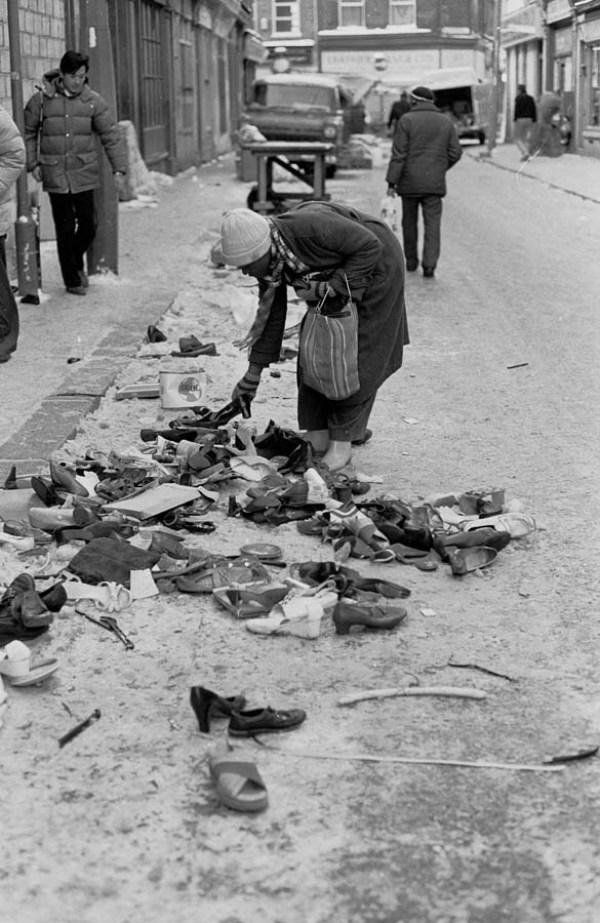


At Club Row.

Comings and goings at the corner of Brick Lane.


At the time of the miners’ strike.

Boy with a typewriter on Cheshire St

Taking down the stalls on Brick Lane.

On Sclater St


In Cheshire St.


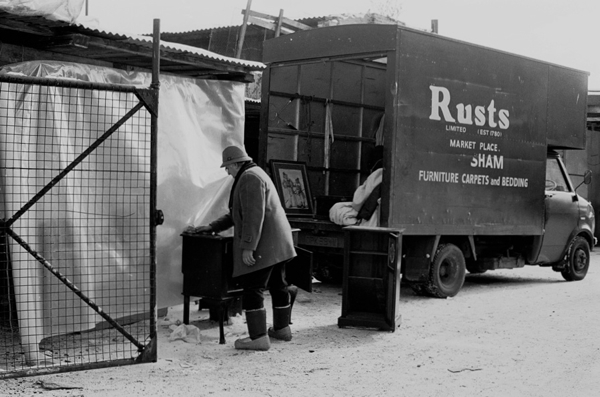


Photographs copyright © Colin O’Brien
More photographs by Colin O’Brien
Travellers’ Children in London Fields
You may also like to take a look at


