
Syd Shelton’s East Enders

Brick Lane 1978
Photographer Syd Shelton‘s enduring fascination with the East End was sparked by a childhood visit from Yorkshire with an uncle and aunt more than fifty years ago. “My cousin was was working in a mission somewhere off Bethnal Green Rd,” Syd recalled, “It was a scary part of London then and I remember my uncle looked out of the window every few minutes to check the wheels were still on his car!”
“The day I left college in 1968, I came down to London and I have worked here ever since, photographing continuously in Hackney and Tower Hamlets,” Syd admitted to me.
In the seventies, Syd became one of the founders of Rock Against Racism, using music as a force for social cohesion, and his photographs of this era include many affectionate images of racial harmony alongside a record of the culture of racism . “It was an exciting time when, after the death of Altab Ali, the Asian community stood up to be counted and the people of the East End became militant against the National Front,” he explained, “In 1981, I got a studio in the Kingsland Rd and I only gave it up recently because the rents became too expensive.”
Syd’s portraits of East Enders span four decades yet he did not set out consciously to document social change. “I never started this as a project, it’s only when I looked back that I realised I had taken swathes of pictures of people in the East End,” he explained, “So now I come back and spend a day on the streets each week to continue.”
“I say I am not a documentary photographer, because I like to talk to people before I take my picture to see what I can coax out of them,” he qualified,“Taking photos is what makes my heart beat.”

Bethnal Green 1980

Linda, Kingsland Rd 1981

Bethnal Green 1980

Bagger, Cambridge Heath Rd 1979

Columbia Rd 1978

Jubilee St, 1979

Petticoat Lane 1981

Brick Lane 1978

Aldgate East 1979

Brick Lane 1980

Hoxton 1979

Tower Hamlets 1981

Brick Lane 1976

Jubilee St 1977

Brick Lane 1978

School Cleaners’ Strike 1978

Petticoat Lane 1978

David Widgery, Limehouse 1981

Sisters, Bow 1984

Sisters, Tower Hamlets 1988

Bow Scrapyard 1984

Ridley Rd Market 1992

Ridley Rd Market 1992

Ridley Rd Market 1995

Whitechapel 2013

Shadwell 2013

Brick Lane 2013

Dalston Lane 2013

Bethnal Green 2013
Photographs copyright © Syd Shelton
You may also like to take a look at
Bandele “Tex” Ajetunmobi, Photographer
Monty Meth’s Bookbinders
As a twenty-one year old photojournalist, Monty Meth visited Sangorski & Sutcliffe, traditional bookbinders, and took portraits of the craftsmen and women at their workshop in Poland St, published in ‘The Sphere’ in September 1947. Remarkably, Sangorski & Sutcliffe are still in business today, producing bindings in the time honoured-fashion and operating now from premises in Victoria.

Head of the firm, Mr Stanley Bray, works on the special binding for ‘The Rubaiyat of Omar Khayyam’ a task which it will take him ten years to complete. Around him can be seen the original drawings of the two previous bindings which were lost – the first in the Titanic disaster and the second during the London Blitz. The covers will contain one thousand and fifty-one jewels inset into the leather, use five thousand pieces of leather and contain one hundred square feet of gold leaf. The completed book will be a fine and rare specimen of the English bookbinder’s art.

Cutting the edges of the book – the instrument being operated by the craftsman in this picture is a miniature “plough,” whose accuracy and fineness of finish are essential to good work.

The sections of the book are sewn on a frame. This type of frame is essentially the same as those in use for hundreds of years in the bookbinding craft. Each section – usually of eight or sixteen pages – is sewn to the cords singly, until the whole book has been built up ready for the boards or covers to be added.

Sewing in the headband – this band, woven in at the top and bottom of the book will protect it against rough usage in handling on the bookshelves. In the finished volume, both the headbands are covered by the leather binding. The headbands are made up of silks in contrasted colours.

The cords which bind the sections of the book are frayed out so that they can be laced into the boards which form the covers. The smoothness of the finish of the leather depends upon this operation.

Cutting up a skin for leather back and corners. The original, rich, dark-red, native-tanned Nigerian goatskin, almost identical to the Morocco used by French and English master-binders of the eighteenth century, is now used for binding many books in this country today. The leather is usually British-dyed. Here it is being cut to size for back and corners ready for paring, as shown below. The grain of the leather adds to the finish of the book.

Before being pasted to the back and corners of the book, the leather has to be pared to a suitable thickness. The leather must be capable of being turned neatly over all the joints and it must also be of uniform thickness. Hence it is pared by an expert on a stone, a task which calls for great skill and sureness of touch.

The bands on the back of the book are sharpened. Before a book is lettered, the expert finisher secures as much definition as possible. Later he will add lines across the back which will add greatly to the general attractiveness of the book.

The leather margin of the front cover is decorated with gold leaf ornamentation. This work is undertaken by a finisher, who is responsible for all the tooling on the leather. He is the aristocrat of the bindery, and upon his invention in design and skill in execution the final appearance of the book depends. The craftsman above is considered by experts to be one of the best in the country today.

A very important feature of bookbinding is the restoration of old books – they come from rare bookshelves and most of them are old classics. Under an expert craftsman’s hand, they will regain all their old charm and use.

The completed volumes, hand-produced in every binding detail, receive their final pressing from twelve to twenty-four hours. After that, they will be ready to sustain the roughest usage. This massive press is over one hundred years old and is still in full use.
At one time, Britain enjoyed a great reputation for the craftsmanship of our hand bookbinders. From Cromwellian times onwards right up to the late-Victorian days, leather-bound books lined the shelves of our forefathers. Very few firms remain in this country to pursue this ancient craft, but amongst those which remain, Sangorski & Sutcliffe hold a very high place – in fact, amongst connoisseurs of bookbinding they rank at the very top. The binding of a book necessitates thirty-eight different operations – as yet, no machine has been invented which competes in skill and artistry with the art of the hand bookbinder. At their workshops in Poland St, craftsmen have prepared books for many exhibitions since 1904 – and as proof that this kind of bookbinding is still in demand by book lovers all over the world, sixty-five per cent of theoutput is for export.
You may also like to read my profile of Monty Meth
Monty Meth, Photographer & Journalist
and take a look at
Monty Meth, Journalist & Photographer

Can you spot Monty Meth in this photograph of the Cambridge & Bethnal Green Boys Club Summer camp at Greatstone in Kent in 1939? Wearing the jacket in the front row, Monty is distinguished by his ear-to-ear smile – a distinctive expression of a generous spirit that still graces his visage seventy-five years later.
Already, when this was taken, Monty was attending photography classes given by Harry Tichener, Member of the Royal Photographic Society and Manager of the Boys Club, who took this picture recording that glorious fleeting moment in the last summer before World War II. Today Monty credits his experience at the Club as the first step towards his career in Fleet St, firstly as a Photographer and then as a Journalist, winning him the News Reporter of the Year in 1970. Yet he is equally aware that it could all have turned out very differently.
“There is no doubt that without the Club, I should have become a bit of a ‘tea leaf,'” he confessed to me,“We used to knock things off from shops – I’m not proud of what we did, but you had no choice other than to be one of the boys. Not only did the Club give me some principles, it showed me how to think and act.”
When I visited Monty this week at his home in Oakwood, North London, I found – even at eighty-eight years old – he had already been up since five-thirty and out for his morning swim at six o’clock at the pool, long before I arrived. Monty met me at the Underground station and we walked together through the suburban streets with their carefully-tended gardens to reach the well-appointed home he shares with Betty his wife, where we settled down to chat.
“I was born in Bethnal Green at 10 Columbia Rd, above a barber’s shop where two families shared a few rooms. It was opposite the triangle where taxis waited and my memory is of horses and carts. My mother Millie came to London from Newcastle as a domestic servant to a Jewish family in Stepney and my father Max came from Austria. He was a bread roundsman and that’s how they met. They married in 1918 at New Rd Synagogue and had three sons, Arthur in 1919, Ron in 1921 and me in 1926. We moved from Columbia Rd to a new block of flats opposite the Children’s Hospital in the Hackney Rd in 1938 and I used to go after school to learn Talmud and Torah at the synagogue on the corner of Chance St. Afterwards, at seven o’clock, I used to bunk into the Cambridge & Bethnal Green Boys Club in the Blue Anchor on the next corner, and I got thrown out regularly until I was twelve.
In 1938, when I was old enough, I join the Club but I only stayed until 1944 when I went into the Royal Navy, yet I am absolutely certain that my career as a photographer which followed came as a result of my experiences there. I worked on the newsheet with David Roxan who preceded me in Fleet St and became a reporter at the News of the World, and I attended Harry Tichener’s Photography Class. As a result of my contacts with Bernard Collier and Bobby Gray, who were also in his class but had taken jobs at a picture agency in Fleet St called Photopress, I joined the agency when I left school at fourteen years old as a Messenger Boy, delivering photographs to newspapers for ten shillings a week. A year later, the Topical Press Agency offered me double the wages and I stayed with them until I went into the Navy.
When I returned to the Topical Press Agency after the war, I worked first in the dark room and then as a Photographer. I won an award for my work from Encyclopaedia Britannica but, in 1954, I didn’t see a future as a Photographer in Fleet St. I was writing and doing photo-stories for magazines on subjects like the Cornish china clay industry, the trug makers of Herstmonceux and traditional bookbinders, when I took a job as a feature journalist in Leeds. Betty came down from Scotland and we decided to set up home there, until 1965 when I became Industrial Correspondent for the Daily Mail – which was much less right wing in those days.
I was made Industrial Editor and, in 1970, I won Newspaper Reporter of the Year, before being recruited by Beecham as head of Communications where I stayed seventeen years, leaving in 1989 when they were bought by the Americans and became Smith Kline Beecham. Then in my sixties, I started a consultancy business that I ran with a colleague from the Daily Mail until 1999 when I was seventy-four.
I was a good Photographer and a pretty good Journalist. I had a good education and, at ten years old ,we were writing essays – what the Club gave me was the confidence to stand up and speak, I learnt how to take minutes, be part of a committee and accept responsibility.”
Determined to apply his skills to benefit others, Monty took over the Enfield Over-Fifties Forum upon his retirement and built up the membership from seventy to six thousand, mobilising a significant campaigning group to advocate the interests of seniors in his neighbourhood. And, returning to where it all started, Monty became Chairman of the Cambridge & Bethnal Green Old Boys from 2000 until 2012, raising £37,000 for charities dedicated to maintaining the kind of youth club culture from which he once drew such benefit so long ago.

Monty Meth with his Macintosh Classic of 1990, from which he runs the Enfield Over-Fifties Forum

The ‘intruder’ at the Queen’s visit – photograph by Montagu Meth of Topical Press Agency, published in Daily Mirror 4th March 1951

Winston Churchill goes to vote – photograph by Montagu Meth of Topical Press Agency, published in Daily Telegraph 26th October 1951

10 Columbia Rd where Monty Meth was born above the barber’s shop (now a cafe) in 1926

Monty Meth when he joined the Royal Navy in 1944 at eighteen

Monty (centre) with his brothers, Arthur and Ron

Monty as Industrial Editor of the Daily Mail

Monty is News Reporter of the Year in 1970

Monty and Betty
Monty Meth has asked me to announce that this year’s 90th Cambridge & Bethnal Green Anniversary Dinner on September 1st, celebrating the foundation of the Club in 1924, will also be the last.
You may also like to read these other stories of members of Cambridge & Bethnal Green Boys Club
and watch
Viscountess Boudica’s St Patrick’s Day

Beannachtaí na Féile Pádraig oraibh
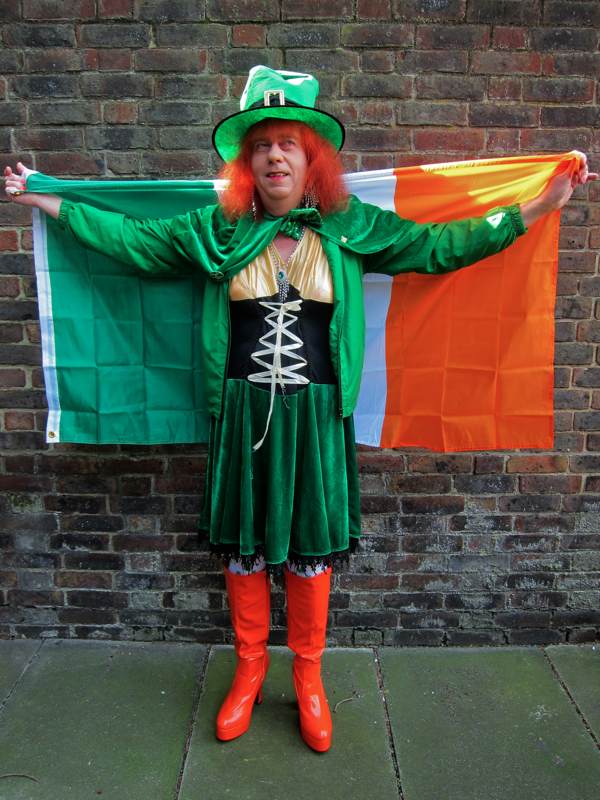
In the East End, we owe a debt of gratitude to Viscountess Boudica of Bethnal Green for her inspirational example in observing each of the festivals of the year with passion and gusto. This week finds her togged up like a cheeky Leprechaun and swigging Guinness as if she was born to it, and when I enquired further I discovered this was precisely the case.
“My people were landowners near Dublin but when Elizabeth I sent her army into Ireland, we were forced to flee to France and then we returned to live in Gloucestershire,” she admitted to me with the melancholy refined smile of one from an ancient aristocratic lineage.“Once when I was a child, we were on holiday in Wales and I stared out to sea – I always felt there was something out there for me,” she continued, getting lost in contemplation as she surveyed the magnificent green and orange decorations that adorned her pink living room.
It was only as an adult that the Viscountess Boudica discovered her true origins. “Even before I found out I was Irish, I knew I was different from everybody else in relating to English culture, ” she confessed to me as she stroked her ginger locks and sipped her Guinness thoughtfully, “Now I’m planning to go to Dublin in the next six months in search of my roots…”

Éirinn go brách


Cá mbeidh tú ag fliuchadh na seamróige?


Sláinte!


Tabhair póg dom, táim Éireannach.



Viscountess Boudica’s jacket with Irish badges from the days she hung out with skinheads

Viscountess Boudica searches for St Patrick’s Day music

Viscountess Boudica recommends The Nolans and Sham 69 for your St Patrick’s Day listening


Viscountess Boudica pulls out one of her old Irish themed coats


Viscountess Boudica models the outfit she has designed for her trip to Dublin in search of her roots
Be sure to follow Viscountess Boudica’s blog There’s More To Life Than Heaven & Earth
Take a look at
Viscountess Boudica’s Domestic Appliances
Viscountess Boudica’s Halloween
Viscountess Boudica’s Christmas
Viscountess Boudica’s Valentine’s Day
Read my original profile of Mark Petty, Trendsetter
and take a look at Mark Petty’s Multicoloured Coats
At St Mary Stratford Atte Bow

In 1311, the residents of Bow became sick of trudging through the mud each winter to get to the parish church of St Dunstan’s over in Stepney, so they raised money to build a chapel of ease upon a piece of land granted by Edward II ‘in the middle of the King’s Highway.’ Seven hundred years later, it is still there and now the traffic hurtles past on either side, yet in spite of injuries inflicted by time, the ancient chapel retains the tranquillity of another age.
Even as you step through the churchyard gates of St Mary and cast your eyes along the undulating stone path bordered by yews, the hubbub recedes as the fifteenth century tower looms up before you. At this time of year, a galaxy of celandines spangles the grass among the tombs as a reminder of the former rural landscape of Bow that has been overtaken by the metropolis. Partly rebuilt in 1829 after a great storm brought down the tower, new ashlar stone may be easily distinguished from the earlier construction, topped off in the last century by red bricks after the church took a direct hit in World War II.
Once you enter the door, the subtly splayed walls of the nave, the magnificent wooden vaulted roof and the irregular octagonal stone pillars reveal the medieval provenance of the ancient structure which is domestic in proportion and pleasing in its modest vernacular. Escaping the radical alterations which damaged too many old churches, St Mary was restored gently in 1899 by C R Ashbee, who set up his School of Handicrafts in Bow at the end of the nineteenth century. Ashbee inserted twenty-two foot oak beams across the nave at ceiling height to hold the structure together, fitted discreet double-glazing to exclude the sound of iron cartwheels upon the cobbles and added a choir vestry at the rear in understated Arts & Crafts design.
Beneath your feet, previous residents of Bow lie packed together in a vault sealed by a Health Inspector in 1890, now rehydrated by rising water as tributaries of the River Lea flow beneath the shallow foundations. Meanwhile, on the day of my visit, a mother and toddler group played happily upon the floor inches above above the charnel house and laughing children delighted in racing up and down the nave – past the stone font of 1410, replaced in 1624 with a one of more modern design and which lay in the rector’s garden for three hundred years before it was re-instated.
Monuments to members of the wealthy Coborn family loom overhead. One is for Alice who died of smallpox at fifteen years old on her wedding day in 1699 and, challenging it from across the nave, a much more elaborate memorial to her wealthy step-mother Prisca who died two years later – hinting perhaps at long-forgotten family tensions.
Diverting the eye from such distractions, the architecture draws your attention forward and an elaborate Tudor ceiling rewards your gaze in the chancel, where C R Ashbee’s richly-coloured encaustic tiles rival the drama of the celandines in the churchyard outside and a curious post-war Renaissance style window offers whimsical amusement with its concealed animals lurking within the design.
Not overburdened with history, yet laced with myriad stories – St Mary’s was once the parish of Samuel Henshall who saw the potential in patenting the corkscrew before anyone else and of George Lansbury, the pioneering Socialist, whose granddaughter, the actress Angela Lansbury, who came back to honour his centenary recently.
Reflecting the nature of our era, the current focus of work at St Mary’s is the organisation of a food bank to serve the needs of local people, but if Geoffrey Chaucer or Samuel Pepys came through Bow – as they did centuries ago – they would still recognise the chapel of ease of their own times and its lively East End parish, of rich and poor, fish merchants, reformers and entrepreneurs.


The bells of Bow

Oak beam added by C R Ashbee as part of his restoration of 1900 and double-glazing, against the noise of the cartwheels upon the cobbles, which is the oldest example in a church in Britain

Tudor roof in the chancel


Bow’s oldest monument, commemorating Grace Amcott, wife of wealthy ‘ffyshmongr’ 1551

Encaustic tiles of 1900 by C R Ashbee

Iron Flag from the tower discovered among the bomb damage of World War II

East Window with architectural design and concealed animals

Cat from the east window

Parish chest, seventeenth century

Medieval font of 1410, rescued after three hundred years in a garden

C R Ashbee’s choir vestry of 1900


Medieval tower restored in 1829 with ashlar stone and with brick after World War II bomb damage


The statue of Gladstone has his hands daubed with red paint

Bow in 1702

Bow Church seen from the east, early eighteenth century

Bow Church seen from the west, eighteenth century

Bow Church seen from the west, early nineteenth century

1905

C R Ashbee’s drawing of his proposal for the renovation of the church in 1899

St Mary’s Football Team, 1910

St Mary’s Football Team, 1938

Wartime damage
With grateful thanks to Joy Wotton for her kind assistance with this feature
You may also like to read about
Easter Flowers at St Dunstan’s
The Gentle Author’s Marylebone Pub Crawl
While in Marylebone preparing for my MAGIC LANTERN SHOW at the beautiful Daunt Books, Marylebone High St, on Thursday 20th March, I could not resist the resist the selfless task of visiting all the pubs on behalf of my readers – & I hope you will join me for a drink at the Dover Castle, Weymouth Mews, next Thursday after the show.

Angel in the Fields, Thayer St since 1852

Tudor Rose, Blandford St since 1848

Barley Mow, Dorset St since 1791

At the Barley Mow

Old coach booths at the Barley Mow

At Angel in the Fields

Angel in the Fields, Thayer St

Angel in the Fields

Angel in the Fields

Angel in the Fields

Angel in the Fields

Angel in the Fields

The Queens Head, Marylebone High St since 1863 – now The Marylebone

Angel in the Fields

Lord Tyrawley, Marylebone High St since 1869 – now Prince Regent

Dover Castle, Weymouth Mews since 1807

The Old Rising Sun, Marylebone High St 1866 – now Coco Moco

Gunmakers, Aybrook St

Gunmakers

The Beehive, Homer St since 1848

Pair of regulars at The Harcourt Arms, since 1869 in Harcourt St

Golden Eagle, in Marylebone Lane since 1891

The Dover Castle
You may like to read about my previous pub crawls
The Gentle Author’s Next Pub Crawl
The Gentle Author’s Spitalfields Pub Crawl
The Gentle Author’s Dead Pubs Crawl
The Gentle Author’s Next Dead Pubs Crawl
An Afternoon In Old Marylebone

With the recent change in the weather, I thought I could risk a trip beyond Spitalfields and so I took the Metropolitan Line from Liverpool St Station over to Baker St and spent a pleasant afternoon exploring the wonders of Marylebone.
It was a reconnaissance in advance of my MAGIC LANTERN SHOW at the beautiful Daunt Books, Marylebone High St, next Thursday 20th March, where I shall be showing one hundred of my favourite photographs and lantern slides of London, old and new, and telling the stories of the people and the places.
Peeling off from the teeming crowds heading for Madame Tussauds and the Planetarium, I crossed Euston Rd to the parish church of St Mary, that once stood upon the banks of the bourne which gives the place its name and flowed south from here towards Oxford St where it became the Tyburn. Thomas Hardwick’s cool classicism of 1813 promised a welcome respite from the clamour of the traffic racing past outside, an effect only marginally undermined by the array of gruesome Lentern sculptures of the Crucifixion including a skeleton carrying a cross.
From here, I took the shortcut through the cobbled churchyard, beside St Marylebone School founded as the Day School of Industry in 1791, and turned right past the obelisk commemorating Charles & Sarah Wesley that commands a tiny yard, offered now as a garden of ease and reflection for exhausted shoppers struggling up from Oxford St. Lest I should get distracted by the fancy shops in the High St myself, I turned right again into Paddington St to peer into James Taylor & Sons, Shoemakers since 1857, when the founder walked from Norwich to start the business.
Crossing the road, I entered the narrow Grotto Passage which offers a portal to another Marylebone than the affluence which prevails elsewhere. Through the passage, you discover the Grotto Ragged & Industrial School beside a huge Laundry House at the centre of Ossington Buildings, a nineteenth-century complex of social housing dating from 1888. These narrow streets lead you through to the seclusion of Paddington St Gardens, a former burial ground, bordered by iron bollards with St Mary Le Bone 1828 in relief. Here in the gardens, school children at play and mothers with their tots attest to the domestic life of Marylebone, while in Chiltern St I discovered Webster’s Ironmongers in business since 1870, a rare survivor of the traditional businesses that once lined these streets before the chain stores of Oxford St ventured northwards. The current owner has been behind the counter for thirty years, cherishing Websters as a temple to the glories of hardware and household goods.
Turning another corner into Manchester St, with its magnificent early nineteenth century terraces, delivered my return to the London of wealth, ascending in architectural grandeur as I strolled down towards Manchester Sq, commanded by The Wallace yet fascinating to me for the elaborate drinking fountain given by the Citizens of Shoreditch and the wrought iron curlicules of the decorative lamps upon the stucco villas. Turning east across Thayer St and into Marylebone Lane, the Golden Hind Fish Bar has long been a personal landmark with its immaculate fascia of 1914, perfect save the loss of the letter ‘D,’ spelling “Golden Hin…”
A different urban landscape opens up beyond the charismatic meander of Marylebone Lane, it is that of wide boulevards and tall mansions comprising Wimpole St and Harley St, interwoven by cobbled mews in which you can wander, as if behind the scenes at the theatre, observing the scenery from the reverse – where the mish-mash of accreted structures concealed by those impermeable facades are revealed. Leaving these exposed thoroughfares where the traffic hurtles through and the pavement grants no shelter to the lone pedestrian, I set out to walk west as the shadows lengthened, crossing Marylebone High St again and following Paddington St as it became Crawford St where the neighbourhood declines towards Edgeware Rd.
My destination was Robert Smirke’s St Mary’s Bryanston Sq of 1823, defining a favourite corner of Marylebone where, bordered by the Euston Rd, Edgeware Rd and Oxford St, a quiet enclave of old London persists.

Marylebone Parish Church by Thomas Hardwick 1813

Inside Marylebone Parish Church

Staircase by Thomas Hardwick

Memorial to Charles & Sarah Wesley in Marylebone High St

James Taylor & Sons Ltd, shoes made since 1857

The late Lord Butler’s lasts

Industrial dwellings in Grotto Passage

The Grotto Ragged & Industrial School, Established 1846

Looking through Grotto Passage towards Paddington St Gardens

Old mausoleum in Paddington St Gardens

Websters of Chiltern St since 1870

In Manchester St

Drinking fountain from Shoreditch now in the grounds of The Wallace

Decorative lamps in Manchester Sq

The Golden Hind Fish Bar of 1914 in Marylebone Lane

44 Wimpole St

“cobbled mews in which you can wander, as if behind the scenes at the theatre”

90 Harley St, London’s oldest dental practice established 1924

“the mish-mash of accreted structures concealed by those impermeable facades”

Daunt Books, Marylebone High St

Meacher, Higgins & Thomas, chemist since 1814 – Purveyors of photographic chemicals

St Mary’s, Bryanston Sq, by Robert Smirke

At Baker St, the return to Whitechapel


