
City Of London Churches

Spire of St Margaret Pattens designed by Christopher Wren in the medieval style
I took my camera and crossed over Middlesex St from Spitalfields to the City of London. I had been waiting for a suitable day to photograph spires of City churches and my patience was rewarded by the dramatic contrast of strong, low-angled winter light and deep shadow, with the bonus of showers casting glistening reflections upon the pavements.
Christopher Wren’s churches are the glory of the City and, even though their spires no longer dominate the skyline as they once did, these charismatic edifices are blessed with an enduring presence which sets them apart from the impermanence of the cheap-jack buildings surrounding them. Yet they are invisible, for the most part, to the teeming City workers who come and go in anxious preoccupation, barely raising their eyes to the wonders of Wren’s spires piercing the sky.
My heart leaps when the tightly woven maze of the City streets gives way unexpectedly to reveal one of these architectural marvels. It is an effect magnified when walking in the unrelieved shade of a narrow thoroughfare bounded on either side by high buildings and you lift your gaze to discover a tall spire ascending into the light, and tipped by a gilt weathervane gleaming in sunshine.
While these ancient structures might appear redundant to some, in fact they serve a purpose that was never more vital in this location, as abiding reminders of the existence of human aspiration beyond the material.

In the porch of St James Garlickhythe where I sheltered from the rain

St Margaret Pattens viewed from St Mary at Hill

The Monument with St Magnus the Martyr
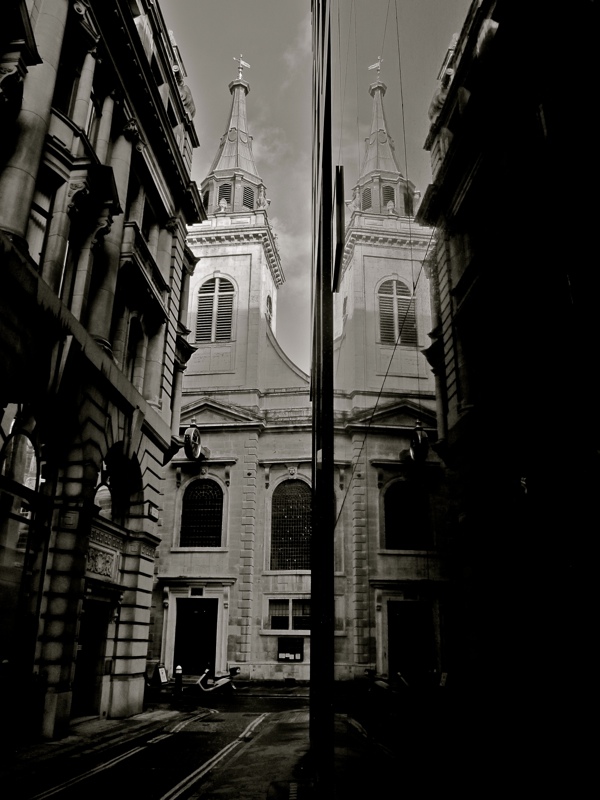
St Edmund, King & Martyr, Lombard St

St Michael Paternoster Royal, College Hill

Wren’s gothic spire for St Mary Aldermary

St Augustine, Watling Street

St Brides, Fleet St

In St Brides churchyard

St Martin, Ludgate

St Sepulchre’s, Snow Hill

St Michael, Cornhill

St Mary Le Bow, Cheapside

St Alban, Wood St

St Mary at Hill, Lovat Lane

St Peter Upon Cornhill

At St James Garlickhythe

St Lawrence Jewry, Gresham St

St Mary Le Bow, Cheapside

St Margaret’s, Lothbury

St Vedast, Foster Lane

Christchurch Greyfriars, Newgate St

Christchurch Greyfriars, Newgate St

St Mary Le Bow, Cheapside

St Mary Le Bow, Cheapside

St James, Garlickhythe

St Michael Paternoster Royal, College Hill

Churchyard of St Laurence Pountney

St Magnus the Martyr, Lower Thames St

St Dunstan in the East, Idol Lane

All Hallows Staining, Mark Lane

St Botolph’s, Aldgate
You may also like to take a look at
The Old River Thames

There is a dark and glistening river that flows through my dreams – it is the old river Thames, carrying away the filth and debris of the city and, in return, delivering the riches of the world upon the flood tide rising. How much I should like to have known London as it is recorded in these photographs – with a strong current of maritime life at its heart.
The broad expanse of water in Central London is curiously empty today, yet a century ago when many of these magic lantern slides from the Bishopsgate Institute were taken for the London & Middlesex Archaeological Society, it was a teeming thoroughfare with wharves and jetties lining the banks. In the (reversed) glass slide above, you see barges unloading their cargo next to the Houses of Parliament and you might deduce that this method of transport could provide an answer to the congestion problems of our own era, if it were not for the fact that all the wharves have gone long ago.
Each day the tide goes up and down by twenty feet. For half the day, the water flows in one direction and for the other half in the other direction, with a strange moment of stillness in between while the tide turns. Such is the surge engendered that the force of the current at the centre presents a formidable challenge to a lone rower and would defeat any swimmer. In spite of our attempt to tame it with the flood barrier, the Thames manifests a force of nature that deserves our respect, especially as the water level rises year by year.
You might think that the river has become merely a conduit for drainage and an itinerary for tourist trips these days, yet do not forget that this mighty river is the very reason for the location of London, here on the banks of the Thames.

Shipping near Tower Bridge, c. 1910

St Paul’s Cathedral from the river, c. 1920

Tower of London from the river, c. 1910

Wandsworth Creek, c, 1920

Off Woolwich, c.1920

Greenwich pier, c. 1920

Steamboat pier at Chelsea, c. 1870

St Paul’s Cathedral from Bankside, c. 1920

Billingsgate Market, c. 1910

Houses of Parliament from South Bank, c. 1910

Tower of London from the Thames, c.1910

Ice floes on the Thames, c. 1920

St Paul’s Cathedral from Bankside, c. 1910

Victoria Embankment, c. 1920

Oxford & Cambridge Boat Race at Putney Bridge, c. 1910

St Paul’s Cathedral from Waterloo Bridge, c. 1920

London Docks, c. 1920

Customs House, c. 1910

Lots Rd and Battersea Bridge, c. 1910

Somerset House was on the riverfront until the Victoria Embankment was constructed in 1870.
Images courtesy © Bishopsgate Institute
You may also like to take a look at
The Alphabet Of London
Although this Alphabet of London in the archive at the Bishopsgate Institute dates from more than one hundred and fifty years ago, it is remarkable how many of the landmarks illustrated are still with us. The original facade of newly-opened ‘Northern Station’ which is now newly-uncovered after recent renovations – at the terminus we know as ‘King’s Cross’ – reveals that this alphabet was produced in the eighteen fifties. The Houses of Parliament which were begun in 1840 and took thirty years to complete were still under construction then and, consequently, Big Ben is represented by an undersized artist’s impression of how it was expected to look. Naturally, I was especially intrigued by – “O’s the market for Oranges, eastward a long way. If you first ask for Houndsditch you won’t take the wrong way.” I wonder which East East market this could refer to?


Pictures courtesy Bishopsgate Institute
A Model Of London, 1840

Andrew Byrne – ‘Today the East End, tomorrow the world!’
Today I introduce the beginning of a long story that will extend over many years to come – it is the making of a complete 1/1500 scale model of London in 1840, extending from Paddington Station in the west to the River Lea in the east. ‘I’d like to have a time machine to go back to London in 1840,’ admitted Andrew Byrne with a wistful smile, ‘but time machines don’t exist, so this model is the next best thing.’
On the top floor of an old stable block, at the edge of the Old Royal Naval College in Greenwich, the project has its genesis. Here, Contributing Photographer Colin O’Brien & I paid a visit upon Andrew and his collaborator David Armitage to record the beginnings of this ambitious endeavour.
Quite naturally, the project is starting with a model of East London. ‘Today the East End, tomorrow the world,’ as Andrew puts it with characteristic bravado. The laser cut baseboard of the territory lay before us with just a few terraces in place at present. David, who trained at the London College of Furniture and has a background in making early music instruments, cuts individual buildings from different strips of wood that have been fashioned to the profile of houses – just as you and I might slice a Battenburg cake. Meanwhile, Andrew scrutinises a table covered with old maps and cross references these with early aerial photographs to establish the nature of the roofs of the houses and terraces.
They have been working on the model since last August and – all being well – they hope to complete the East End before the end of this year. Already, a conversation is underway to discuss the possibility of installing the model in the new Museum of London when it opens in the former Smithfield Market building.
Volunteer model makers with experience are required to participate in this epic project, so if you have the necessary expertise, the willingness and six hours a week spare, please email at_byrne@yahoo.co.uk
You can expect further updates on this project from me in years to come.

David Armitage places a house in the East End, 1840

Andrew Byrne studies old maps and archive photos

David trims terraces of houses from a strip


David Armitage, modelmaker

The buildings are the size of Monopoly houses

Work in progress on the model of the East End at 1/1500 scale
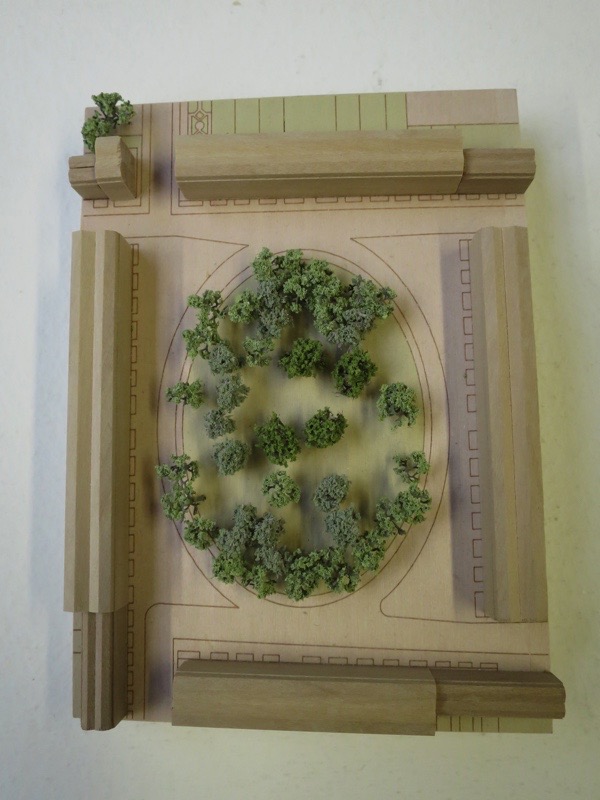
Bedford Sq, Bloomsbury at 1/1500 – an experiment with scale for the model of London

Torrington Sq, Bloomsbury at 1/500, another experiment with scale for the model
Photographs copyright © Colin O’Brien
You might also like to read about
My Spring Shirt

I pulled this shirt out of my cupboard this week in advance of the arrival of spring. If you look closely, you will see the collar is wearing through but this does not diminish my affection for this favoured garment that I have worn for years now, bringing it out just for these few months at the end of winter. Although most of the clothes I own are of undecorated design, there is a gentle lyrical quality about this pattern that appeals to me.
When I wear this shirt with a dark jacket, the colours really sing and I feel am doing my bit in participating in the seasonal change. This contrast of formal clothing with a sprigged shirt can express dignified restraint while at the same time revealing an attachment to flowers, plants, gardens and nature – a contrast that I recognise in my own personality.
I love the conceit of having violets on my shirt when those in my garden are in flower and I enjoy the subtle tones of all the flowers portrayed, remaining as recognisable species while artfully stylised to make a pattern. The evocation of the natural world in this simple design touches a chord for me and, as with so many things that trigger an emotional response, I discovered that my passion for these floral patterns from Liberty goes back a long way.
When I came across the familiar photograph of my mother Valerie as a child, which you can see below, I did a double-take when I recognised the pattern on the dress. It was a Liberty print, very similar to my spring shirt which I hold in such affection. In that moment, I recalled that my grandmother Katherine bought fabric at Liberty in London and had it made up into dresses for my mother in the nineteen-thirties. This was a gesture which made such an unforgettable impression on my mother that for her whole life she carried her delight in these cotton dresses, which were so magical to her as a little girl in Somerset. Floral prints fed her innocent imagination, nurtured by ‘Songs of the Flower Fairies’ and performing as one of Titania’s attendants in a school play.
A generation later, I grew up with the received emotion of this memory – a story my mother told me when I was a child. I thought I had forgotten, but I realised it was through an unconscious recollection of the photograph of my mother in the Liberty dress that I was attracted to this flowery shirt, without understanding the origin of my desire at the time.
The story was confirmed when my Uncle Richard moved out of the old house where he and my mother grew up and, in my grandmother’s dressing table, I found a small leather pocket diary from the thirties recording her London trip with the entry, “Stayed at Claridges. Ordered carpet and sideboard at Harvey Nichols and bought materials at Liberty.” My grandmother was the daughter of a diminished aristocratic family who married my grandfather Leslie, a bank manager, and adopted an autocratic manner to ameliorate her loss of status. Consequently, my mother, with admirable resourcefulness, ran away from home at nineteen to escape my bossy grandmother and married my father Peter, who was a professional footballer – an act of social rebellion that my grandmother never forgave.
Nevertheless, the taste I acquired for these old-fashioned designs reflects the fondness my mother carried for that special moment in her childhood which she never forgot, when my grandmother showed maternal kindness to her little daughter in the gift of flowery cotton dresses. An act which came to represent everything about my grandmother that my mother could embrace with unqualified affection, and she encouraged me to remember the best of people too, a prerogative I claim in this instance as the sole living representative of these characters.
Today, I wear my shirt as the sympathetic illustration of a narrative which extends over three generations, culminating in my own existence upon this earth, and as I button my spring shirt, before walking out to celebrate sunshine and a new beginning, I am reminded that I alone carry these emotional stories now, clothing me in the humble affections of my forebears.

The Gentle Author’s mother ‘Valerie’ in the nineteen-thirties

Liberty of London
You may like to read these other stories of The Gentle Author’s family
Spring Flowers At Bow Cemetery

The Winter has taken it out of me, but feeling the warmth of the sun today and seeing these sprouting bulbs in such profusion restored my hope that benign weather will come before too long.
Some of my earliest crayon drawings are of snowdrops, and the annual miracle of Spring bulbs erupting out of the barren earth never ceases to touch my heart – an emotionalism amplified in a cemetery to see life spring abundant and graceful in the landscape of death. The numberless dead of East London – the poor folk buried for the most part in unmarked communal graves – are coming back to us as perfect tiny flowers of white, purple and yellow, and the sober background of grey tombs and stones serves to emphasis the curious delicate life of these vibrant blooms, glowing in the sunshine.
Here within the shelter of the old walls, the Spring bulbs are further ahead than elsewhere the East End and I arrived at Bow Cemetery just as the Snowdrops were coming to an end and the Crocuses were in full flower. Thus a sequence of flowers is set in motion, with bulbs continuing through until April when the Bluebells will come leading us through to the acceleration of Summer growth, blanketing the cemetery in lush foliage again.
I found myself alone in the vast cemetery save a few Magpies, Crows and some errant Squirrels, chasing each other around. Walking further into the woodland, I found yellow Winter Aconites gleaming bright against the grey tombstones and, crouching down, I discovered wild Violets in flower too. Beneath an intense blue sky, to the chorus of birdsong echoing among the trees, Spring was making a persuasive showing.
Stepping into a clearing, I came upon a Red Admiral butterfly basking upon a broken tombstone, as if to draw my attention to the text upon it, “Sadly Missed,” commenting upon this precious day of sunshine. Butterflies are rare in the city in any season, but to see a Red Admiral, which is a sight of high Summer, this early in the year is extraordinary.
My first assumption was that I was witnessing the single day in the tenuous life of this vulnerable creature, but in fact the hardy Red Admiral is one of the last to be seen before the onset of frost and can emerge from months of hibernation to enjoy single days of sunlight. Such is the solemn poetry of a lone butterfly in Winter.
It may be a few weeks yet before it is officially Spring, but we are at the beginning now, and I offer you my pictures as evidence, should you require inducement to believe it.

Bulbs awakening from their Winter sleep.


A single Red Admiral butterfly, out of season – “sadly missed”
Find out more at Friends of Tower Hamlets Cemetery Park
You may also like to read about
Wonderful London Pubs
In these grey cold days, I get a powerful urge to seek refuge in a cosy corner of an old pub and settle down for the rest of the day. There are plenty of attractive options to choose from in this selection from the popular magazine Wonderful London edited by St John Adcock and produced by The Fleetway House in the nineteen-twenties.

The Old Axe in Three Nuns Court off Aldermanbury. It was once much larger and folk journeying to Chester, Liverpool and the North used to gather here for the stage coach.

The Doves, Upper Mall, Chiswick.

The Crown & Sceptre, Greenwich – once a popular resort for boating parties from London, of merry silk-clad gallants and lovely ladies who in the summer evenings came down the river between fields of fragrant hay and wide desolate marshes to breathe the country air at Greenwich.

At the Flask, Highgate, labourers from the surrounding farms still drink the good ale, as their forerunners did a century ago.

Elephant & Castle – The public house was once a coaching inn but it is so enlarged as to become unrecognisable.

The Running Footman, off Berkeley Sq, is named after that servant whose duty it was to run before the crawling old family coach, help it out of ruts, warn toll-keepers and clear the way generally. He wore a livery and carried a cane. The last to employ a running footman is said to have been ‘Old Q,’ the Duke of Queensberry who died in 1810.

The Grenadier in Wilton Mews, where coachmen drink no more but, at any moment – it would seem – an ostler with a striped waistcoat and straw in mouth might kick open the door and walk out the place.

The Spaniards in Hampstead dates from the seventeenth century and here the Gordon Rioters gathered in the seventeen-eighties, crying “No Popery!”

The Bull’s Head at Strand on the Green is an old tavern probably built in the sixteenth century. There is a tradition that Oliver Cromwell, while campaigning in the neighbourhood, held a council of war here.

Old Dr Butler’s Head, established in Mason’s Avenue in 1616. The great Dr Butler invented a special beer and established a number of taverns for selling it, but this is the last to bear his name.

The grill room of the Cock, overlooking Fleet St near Chancery Lane. It opened in 1888 with fittings from the original tavern on the site of the branch of the Bank of England opposite. Pepys wrote on April 23rd 1668, “To the Cock Alehouse and drank and ate a lobster and sang…”

The Two Brewers at Perry Hill between Catford Bridge and Lower Sydenham – an old hedge tavern built three hundred years ago, the sign shows two brewer’s men sitting under a tree.

The Old Bell Tavern in St Bride’s Churchyard, put up while Wren was rebuilding St Bride’s which he completed in 1680. There is a fine staircase of unpolished oak.

Coach & Horses, Notting Hill Gate. This was once a well-known old coaching inn, but it still carries on the tradition with the motor coaches.

The Anchor at Bankside. With its shuttered window and projecting upper storey, it enhances its riverside setting with a sense of history.

The George on Borough High St – one of the oldest roads in Britain, for there was a bridge hereabouts when Roman Legionaries and merchants with long lines of pack mules took the Great High Road to Dover.

The Mitre Tavern, between Hatton Garden and Ely Place. It bears a stone mitre carved on the front with the date 1546. Ely Place still has its own Watchman who closes the gates a ten o’clock and cries the hours through the night.

The George & Vulture is in a court off Cornhill that is celebrated as the place where coffee was first introduced to Britain in 1652 by a Turkish merchant, who returned from Smyrna with a Ragusan boy who made coffee for him every morning.

The Bird in Hand, in Conduit between Long Acre and Floral St, formerly a street of coach-makers but now of motorcar salesmen.

The Old Watling is the oldest house in the ward of Cordwainer, standing as it did when rebuilt after the Fire, in 1673.

The Ship Inn at Greenwich got its reputation from courtiers on their way to and from Greenwich Palace and in 1634 some of the Lancashire Witches were confined her, but now it is famous for its Whitebait dinners.

The Olde Cheshire Cheese – the Pudding Season here starts in October.

The Cellar Bar at the Olde Cheshire Cheese

The Chop Room at the Olde Cheshire Cheese

The Cellar Cat guards the vintage at the Old Cheshire Cheese. Almost under Fleet St is a well, now unused, but pure and always full from some unknown source. To raise the iron trap door which keeps the secret and to light a match and stoop down over this profound hole and watch the small light flickering uncertainly over the black water is to leave modern London and go back to history.
Images courtesy Bishopsgate Institute
You may like to take a look at
The Taverns of Long Forgotten London
Alex Pink’s East End Pubs Then & Now
The Gentle Author’s Next Pub Crawl
The Gentle Author’s Spitalfields Pub Crawl
The Gentle Author’s Dead Pubs Crawl
The Gentle Author’s Next Dead Pubs Crawl


