
The Door In Cornhill

The Bronte sisters visit their publisher in Cornhill, 1848
An ancient thoroughfare with a mythic past, Cornhill takes its name from one of the three former hills of the City of London – an incline barely perceptible today after centuries of human activity upon this site, building and razing, rearranging the land. This is a place does not declare its multilayered history – even though the Roman forum was here and the earliest site of Christian worship in England was here too, dating from 179 AD, and also the first coffee house was opened here by Pasqua Rosee in 1652, the Turk who introduced coffee to London. Yet a pair of carved mahogany doors, designed by the sculptor Walter Gilbert in 1939 at 32 Cornhill – opposite the old pump – bring episodes from this rich past alive in eight graceful tableaux.
Walter Gilbert (1871-1946) was a designer and craftsman who developed his visual style in the Arts & Crafts movement at the end of the nineteenth century and then applied it to a wide range of architectural commissions in the twentieth century, including the gates of Buckingham Palace, sculpture for the facade of Selfridges and some distinctive war memorials. In this instance, he modelled the reliefs in clay which were then translated into wood carvings by B.P Arnold at H. H. Martyn & Co Ltd of Cheltenham.
Gilbert’s elegant reliefs appeal to me for the laconic humour that observes the cool autocracy of King Lucius and the sullen obedience of his architects, and for the sense of human detail that emphasises W. M. Thackeray’s curls at his collar in the meeting with Anne and Charlotte Bronte at the offices of their publisher Smith, Elder & Co. In each instance, history is given depth by an awareness of social politics and the selection of telling detail. These eight panels take us on a journey from the early medieval world of omnipotent monarchy and religious penance through the days of exploitative clergy exerting controls on the people, to the rise of the tradesman and merchants who created the City we know today.

“St Peter’s Cornhill founded by King Lucius 179 AD to be an Archbishop’s see and chief church of his kingdom and so it endured for the space of four hundred years until the coming of Augustine the monk of Canterbury.”

“Eleanor, Duchess of Gloucester, did penance walking barefoot to St Michael’s Church from Queen Hithe, 1441.”

“Cornhill was an ancient soke of the Bishop of London who had the Seigneurial oven in which all tenants were obliged to bake their bread and pay furnage or baking dues.”

“Cornhill is the only market allowed to be held afternoon in the fourteenth century.”

“Birchin Lane, Cornhill, place of considerable trade for men’s apparel, 1604.”

“Garraway’s Coffee House, a place of great commercial transaction and frequented by people of quality.”

“Pope’s Head Tavern in existence in 1750 belonging to Merchant Taylor’s Company, the Vinters were prominent in the life of Cornhill Ward.”

You might also like to read about
Portraits From The Surma Centre
Contributing Photographer Patricia Niven and Novelist Sarah Winman, author of “A Year of Marvellous Ways,” made this series of portraits and interviews at the Surma Centre at Toynbee Hall.
“After the Second World War, Britain required labour to assist in post-war reconstruction. Commonwealth countries were targeted and, in what was then East Pakistan (it became Bangladesh after the 1971 Liberation War), vouchers appeared on Post Office counters, urging people to come and work in the United Kingdom, no visa required. The majority of men who came in the fifties and sixties came from a rural background where education was scarce and illiteracy was common. But this generation were hard workers, used to working with their hands, men who could commit to long hours, who had an eagerness to work and a young man’s inquisitiveness to see the world: the perfect workforce to help rebuild this nation. And they did rebuild it, and were soon found working in factories and ship yards, building roads and houses, crossing seas in the merchant navy. These pioneers were the men we met at the Surma Centre.” – Sarah Winman

Shah Mohammed Ali, age 75 years.
I came to this country in November 1961 because my uncle was already living here and inspired me to come. In East Pakistan, I had been working in a shop. I felt life was good. My earliest memory of London was Buckingham Palace. I missed my friends and family but I really missed the weather back home. I became a factory worker, and worked all over the country: a cotton factory in Oldham, a foundry in Sheffield, an aluminium factory in London and Ford motor factory in Dagenham. Ford gave me a good, comfortable life. We had friends all over the country and they would tell us if there was more money being offered at a different factory and then we’d move. I thought I would stay in Britain for four years and then go back home. My heart is in Bangladesh. The roses smell sweeter.

Eyor Miah, age 69 years.
I came to this country in September 1965. I had been a student in East Pakistan. Life was hard, my father was a sailor. I read in a Bengali newspaper stories of people travelling and earning money, and I thought that I, too, would like to do that. I wrote to somebody I knew here to help me. It was a slow process, all done by mail, because of course, there was no internet. It took me two years to gain my papers. I didn’t mind because I was very determined to achieve.
When I first arrived, I became a machinist in the tailoring industry and I earned £1 and ten shillings a week. My weekly outlay was £1 and the rest I saved. Brick Lane was very rundown then. The Jewish population were very welcoming, probably because they were eager for workers! We would queue up outside the mosque and they would come and pick the ones they wanted. In 1969 I bought a house for £55. Of course, I missed my mother who stayed in Bangladesh, and before 1971 I actually thought I would return to live. After that date though, I felt Britain was my home and life was better here.
After tailoring, I worked in restaurants and then began my own business as a travel agent, set up my own restaurants and grocery shop. I have four children. Life has been good to me.

Rokib Ullah, age 81 years.
I came to this country in 1959, because workers were being recruited from the Commonwealth to rebuild after the Second World War. Life in East Pakistan then was good. I was very young and working as a farmer. My fellow countrymen told me about the work in the UK and I came here by air. When I arrived, the airport was so small, not like it is today. And the weather was awful, so bad, not like home, I found that difficult, together with missing my neighbours and friends. I worked in a tyre factory, and then in garment and leather factories. I planned to stay here and earn enough money, and then return to Bangladesh. I am a pensioner now and frequently go back to Bangladesh. It is in my heart. One day I plan to go there forever.

Syed Abdul Kadir, age 77 years.
I first came to this country in 1953. I was in the navy in Karachi and I was selected by the Pakistan Government to be in the Guard of Honour in London at the Queen’s Coronation. I remember this day very clearly. It was June and the weather was cold. When Queen Elizabeth was crowned the noise was tremendous. There were shouts of “God Save the Queen!” and gun salutes were fired. We marched to Buckingham Palace where more crowds were waiting. The Queen and her family came out on the balcony and the RAF flew past the Mall, and the skies above Victoria Embankment were lit up by fireworks. I feel very lucky to have been part of this, and I still have my Coronation ceremony medal.
Since my first visit, I developed a fondness for the British culture, its people and the Royal Family. I have always believed this country looks after its poor.
I owe the Pakistan Navy for much of my experiences in life and was lucky to travel and to see the world. I actively participated in the 1965 India-Pakistan war and the 1971 Pakistan war and have medals for both.
My family are settled here and my life revolves around grandchildren. I have been coming to Surma since 2004. When someone sees me, they call me “Captain!” We are like a family here.

Shunu Miah, age 79 years.
I came to this country in November 1961. Back home, I helped my father farm. It was a good life, still East Pakistan, the population was low, not much poverty, food for everyone: it was a land of plenty. It wasn’t a bad life, I was young and was just looking for more. My uncle had been in the UK since 1931, my father since 1946, both encouraged me to come.
Cinema here was my greatest memory. Back home, cinema was rare. Every Saturday and Sunday there was a cinema above Cafe Naz on Brick Lane, or I’d go to the cinema in Commercial Rd, or up to the West End. It was so exciting, the buildings, the underground, the lights! People were friendly and welcoming then. I saw Indian films, but also Samson and Delilah and the Ten Commandments with Charlton Heston.
I have worked at the Savoy Hotel as a kitchen porter and also in cotton factories in Bradford. What did I miss? Family and friends, of course, but also the weather. The smell of flowers, too, they are much stronger back home. I thought I would stay here and work for three or four years, go home and buy land, build a house and live happily ever after. I have helped to build homes for my family in Bangladesh. I have never been able to own a home here.

Abul Azad, Co-ordinator at the Surma Centre.
“These men are very loyal to a country that has given them a home,” said Abul Azad, the charismatic project co-ordinator at Surma Centre in Whitechapel. “When they first arrived, living conditions were bad, sometimes up to ten people lived in a room. Facilities were unhealthy, toilets outside, and nothing to protect them from an unfamiliar cold that many still talk about. Most intended to earn money to send back to families, and then return after a few years – a dream realised by few, especially after the settlement of families. Instead they were open to exploitation, often working over sixty hours a week, the consequence of which is clearly visible today in low state pensions, due to companies not paying the correct National Insurance contributions. And most Bangladeshi people don’t have private pensions. Culturally, pensions are not of this generation. Their families are their pension – always imagined they would be looked after. But times are changing for everyone.”
Surma runs a regular coffee morning, providing support for elderly Bangladeshi people. The language barrier is still the greatest hindrance to this older generation and Surma provides a specialist team ready to assist their needs – both financially and socially – and to provide free legal advice. It is also quite simply a haven for people to get out of the house and to be amongst their peers, to read newspapers, to have discussions, to talk about what is happening here and in Bangladesh.
There is something profound that holds this group together, a deep unspoken, clothed in dignity. Maybe it is the history of a shared journey, where the desire for a better life meant hours of physical hardship and unceasing toil and lonely years of not being able to communicate. Maybe it is quite simply the longing for home, remaining just that: an unrealised dream. Whatever it is – “This is a very beautiful group.” said Abul Azad.
Photographs copyright © Patricia Niven
You may also like to take look at these other portraits by Patricia Niven and Sarah Winman
St Patrick’s Day In Bethnal Green
Viscountess Boudica is already making her preparations in readiness for St Patrick’s Day on Thursday

Beannachtaí na Féile Pádraig oraibh
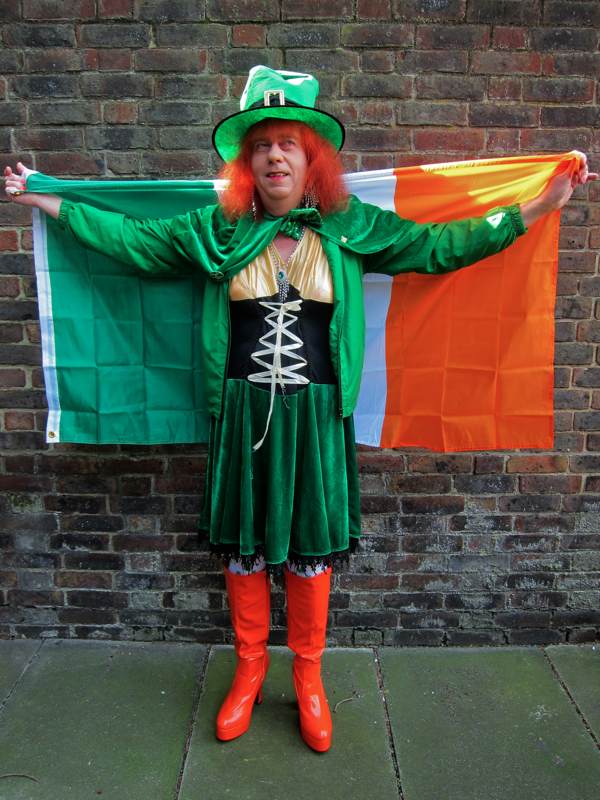
In the East End, we owe a debt of gratitude to Viscountess Boudica of Bethnal Green for her inspirational example in observing each of the festivals of the year with passion and gusto. This week finds her togged up like a cheeky Leprechaun and swigging Guinness as if she was born to it, and when I enquired further I discovered this was precisely the case.
“My people were landowners near Dublin but when Elizabeth I sent her army into Ireland, we were forced to flee to France and then we returned to live in Gloucestershire,” she admitted to me with the melancholy refined smile of one from an ancient aristocratic lineage.“Once when I was a child, we were on holiday in Wales and I stared out to sea – I always felt there was something out there for me,” she continued, getting lost in contemplation as she surveyed the magnificent green and orange decorations that adorned her pink living room.
It was only as an adult that the Viscountess Boudica discovered her true origins. “Even before I found out I was Irish, I knew I was different from everybody else in relating to English culture, ” she confessed to me as she stroked her ginger locks and sipped her Guinness thoughtfully, “Now I’m planning to go to Dublin in search of my roots…”

Éirinn go brách


Cá mbeidh tú ag fliuchadh na seamróige?


Sláinte!


Tabhair póg dom, táim Éireannach.



Viscountess Boudica’s jacket with Irish badges from the days she hung out with skinheads

Viscountess Boudica searches for St Patrick’s Day music

Viscountess Boudica recommends The Nolans and Sham 69 for your St Patrick’s Day listening


Viscountess Boudica pulls out one of her old Irish themed coats


Viscountess Boudica models the outfit she has designed for her trip to Dublin in search of her roots
Be sure to follow Viscountess Boudica’s blog There’s More To Life Than Heaven & Earth
Take a look at
Viscountess Boudica’s Domestic Appliances
Viscountess Boudica’s Halloween
Viscountess Boudica’s Christmas
Viscountess Boudica’s Valentine’s Day
Read my original profile of Mark Petty, Trendsetter
and take a look at Mark Petty’s Multicoloured Coats
Amy Cooper’s Needlework

One afternoon, I walked down the Mile End Rd to the Bancroft Library, where the Local History collection is housed, to view a small collection of Spitalfields silk and lace. The archivist produced a cardboard chocolate box from the nineteen sixties with a Raeburn portrait of a child on the top. He kindly placed a table beside the window in the dying afternoon light and covered it with a piece of grey paper. The he opened the box and unwrapped the precious packages inside wrapped in white tissue paper, arranging them on the table, so that in the last light of day I could photograph them for you.
The first item to catch my eye was this little silk purse with the phrase SPITALFIELDS SCHOOL OF DESIGN 1848 elegantly picked out in gold thread. Not only is the stitching neat and regular, the balance and spacing of the typography is perfect. This curious item has no wear, it cannot have had any function beyond displaying the accomplishment of its own creation. It fits neatly into the palm of the hand and is exquisite in every detail, the string of golden glass beads looped around the edges, the delicate string handle, the jet button and the oyster blue silk lining.
Next I examined the needlebook below, with embroidery of flowers on both covers, and – taking the utmost care – I unfastened the ribbons that held it closed. Opening it up, I found a scrap of paper folded in between the pages of needles which tells us the maker. This needlebook was made by Miss Amy Cooper: she was born in 1794 & died in 1891. The script itself had a delicacy and restraint, similar to the handwriting of “No more twist!” pinned on the Lord Mayor’s unfinished waistcoat in The Tailor of Gloucester.
I love the aesthetic, using pale silk and embroidering subtly coloured flowers in natural colours, as fresh as the day they were stitched. The use of different toned threads in the recognisable heather and rose flowers suggests Amy worked from nature. Every individual stitch is a decision made with the same care you might bring to the selection of vocabulary and arrangement of words in a poem. Fine details, like the sky blue lining, the grey glass beads sewn at intervals around the edge of covers and the use of bordered ribbon upon the spine, draw the eye to observe the nuances of this lovely artefact. When someone invests as much time and consideration as Amy did here, it deserves our closest examination and rewards us in turn by delighting the eye.
Amy Cooper lived to be ninety-seven, born five years after the French Revolution, she died in the year that automobiles began manufacture. The three sisters who donated the collection, which belonged to their mother Mrs Ann Maitland MacEwen, knew nothing of its origins – so we cannot say if Amy made them all or establish what is the connection to the Spitalfields School of Design, which was an early government project to promote design in industry, founded at 37 Crispin St in 1842. Amy would have been fifty-four in 1848, when the purse was made, and I would like to think she made it as an example to show her pupils at the school.
The other two items that complete this modest collection are two girls’ lace caps. The workmanship of these pieces is inconceivably intricate and the awe-inspiring skill on display bears testimony to long hours of patient labour.


With thanks to Tower Hamlets Local History Library & Archive
You may also like to read about
The East London Group In Southend
As well as painting the East End streets, the celebrated East London Group of Artists also ventured further afield in search of subject matter and today we preview a new exhibition which explores this aspect of their work. The East London Group of Artists – Out of the City opens at the Beecroft Gallery in Southend on 19th March and runs until 25th June.

Windy Day on Marine Parade, Southend by Brynhild Parker (courtesy of Beecroft Gallery)

Poole Harbour by Elwin Hawthorne, 1934

Thorpe Bay by Henry Silk, 1933

Tattingstone Wonder by Walter Steggles, 1937

Church at Cranham by Essex Lilian Leahy, 1934

Bungay by Harold Steggles, 1934

The Wharfe at Arthington Viaduct by John Cooper, mid- thirties

North Foreland Lighthouse by Elwin Hawthorne, 1931

Chesil Bank from Portland by Harold Steggles, 1938

The Quay, Appledore by Brynhild Parker, 1931

Essex Landscape by Harold Steggles, 1934

The Thames At Cookham by Walter Steggles, 1931

Essex Landscape by Harold Steggles, 1930

Felpham by Walter Steggles, 1936

Entrance to the Port by Brynhild Parker, 1938

Ilfracombe by Elwin Hawthorne, 1933

Alnwick by Harold Steggles, 1936

At Brighton by Cecil Osborne, 1936

The new enlarged edition of From Bow to Biennale: Artists of the East London Group by David Buckman can be ordered direct from the publisher Francis Boutle and copies are on sale in bookshops including Brick Lane Bookshop, Broadway Books, Newham Bookshop, Stoke Newington Bookshop and London Review Bookshop.
You may also like to read about
The East London Group Rediscovered
When I first published David Buckman‘s introduction to his book From Bow To Biennale in these pages in 2012, The East London Group – one of the major artistic movements to come out of the East End in the last century – was almost forgotten.
Four years and several exhibitions later, the East London Group is rediscovered and an enlarged and revised edition of David Buckman’s essential ground-breaking book is newly published.

The Arches, Mare St by Albert Turpin
How is it that one of the most innovative, commercially successful, and – in its time – hugely publicized British art groups of the twentieth century became neglected? That was the case until my book From Bow to Biennale: Artists of the East London Group was published in 2012. During the writing of it, whenever I mentioned the Group to experts in this period, the response was usually – East London Group, just a name.
My curiosity about the East London Group was aroused many years ago when I read an illustrated feature about it in the April 1931 issue of “Studio” magazine. As a private interest in early twentieth-century art developed over time and as I earned a living as a freelance journalist in a largely unrelated field, I would occasionally return to a photocopy of that article, which acted like a maggot in my mind.
At the end of the eighties, when I was researching my dictionary “Artists in Britain since 1945” in my spare time, I decided to call at the last known address in Hampstead of the painter Phyllis Bray to check if she was still active. By then Phyllis was suffering from Parkinson’s Disease but, as we chatted, the East London Group was mentioned. She had been a member and, for several years, was married to its founder, John Cooper. She directed me to her daughter, Philippa, also an artist, who held the Red Book of press cuttings about the Group’s activities during the twenties and thirties.
Thus began – when I could afford the time – the long, painstaking research to tell the Group’s story. As a start, the book of cuttings was photocopied to ensure a second copy existed and it became a collection that expanded as more cuttings were found. One of the problems for a researcher is that people who save cuttings sometimes do not date or source them or, if they do, someone else decides to tidy them up years later by snipping off these essential details. The Red Book had been subject to this treatment at some stage and, consequently, many weeks were spent in correspondence with likely helpers and in microfilm booths at the newspaper library in Colindale, pursuing clues on the back of the cuttings or the choice of typeface employed.
It emerged that the Group had achieved enormous, largely flattering press coverage, for its exhibitions, with the “Daily Mail” covering one show three times. Writing in the “Studio” in 1929 – as the Group forayed into the West End – F. G. Stone commented how its painters had found “beauty about the streets of the district that is known to the Post Office as E.3.” Just over a year later, the distinguished critic T. W. Earp in the “New Statesman” thought these artists “furnish the best exhibition of young English contemporary painting which has been shown in London this year.” Early in 1933, American writer Helen McCloy in the “Boston Evening Transcript,” judged that “Never has there been so peculiarly English a group in modern art as these young workingmen” who had been able to convey “the very spirit of the Cockney, the happy robust soul who is England.” By end, in 1936, when the Group was holding its eighth annual show at Lefevre Galleries, the “Sunday Times” termed it “the most interesting and promising of our younger art societies.”
By then, John Cooper was middle-aged and had only a few years to live, dying in 1943. As a charismatic young painter from Yorkshire, he had inspired such raw material as errand boys, shopgirls, basket-makers and window cleaners to give up their precious spare time several days a week to attend his East End classes. After teaching in Bethnal Green, he moved to a school in Bow where he attracted several dozen students. Many of these painters, showing as the East London Art Club, had an exhibition at the Whitechapel Art Gallery in December 1928. This prompted Charles Aitken, its former director, then in charge of what is now Tate Britain, to display some of the pictures at the Millbank gallery early in 1929, and that show lead to the Lefevre Galleries series, provincial shows, participation in mixed exhibitions in Britain and abroad, plus solo shows for many of the members.
At the 1936 Venice Biennale, two East London Group members, Elwin Hawthorne and Walter Steggles, participated alongside luminaries such as Frank Brangwyn, Barbara Hepworth, Gilbert Spencer and Philip Wilson Steer. Walter was one of the six surviving East London Group members that I traced, providing unique memories that otherwise would have died with him. When a small reunion was organized at Phyllis Bray’s house, Walter told her daughter Philippa – “John Cooper should have been decorated for what he did for artists.”
Walter, like his brother Harold, was grateful for the variety of teaching provided at Bow. John Cooper had been at the Slade School of Fine Art just after World War I and decided that a number of ex-Slade friends could aid his work and a few would later exhibit with the Group too. Phyllis Bray was one, William Coldstream another, but his real coup was to get Walter Sickert to make the trip into this unfashionable part of London to impart unique and often eccentric wisdom. Here was artistic royalty, and Lilian Leahy, who eventually married Elwin Hawthorne, recalled to me how as Sickert sat expounding, dressed in plus-fours and diamond-patterned socks, shopgirls would giggle with their hands over their mouths.
The East London Group website lists the thirty-five artists I claim as members. In addition to the history of the Group, the book contains biographical essays on more than twenty of these, including such colourful characters as Murroe FitzGerald, Irish Civil War death sentence escapee, eventually managing director in London of the Acme Flooring & Paving Co – and Albert Turpin, professional window cleaner, Anti-Fascist protestor and Labour mayor of Bethnal Green, whose passion was to record the disappearing End End that he grew up in. Yet many of the other members remain ghostly figures, despite my research into their personal histories.
As well as attracting Walter Sickert, John Cooper involve dozens of celebrities in his project. Charles Aitken encouraged the influential art dealer Joseph Duveen to buy paintings. Samuel Courtauld, Lord Melchett, Lord Burnham and the writer Arnold Bennett gave early financial help. Lady Cynthia Mosley and Osbert Sitwell opened exhibitions. The Prime Minister Ramsay MacDonald and Labour Party stalwart George Lansbury attended exhibitions and gave moral support. As their reputation developed over the years, the Group sold to influential collectors with the Lefevre Galleries welcoming extra, non-catalogue pictures, as sales rose and, on occasion, an exhibition’s term was extended.
As I investigated, I found that John Cooper and his Group became involved in more than exhibitions of paintings. It was these multifarious non-gallery activities that consumed my time, calling for detective work. It emerged that the Group was involved in making a documentary film about their activities. Also, members also painted pictures for stage plays and contributed to Shell’s popular range of posters. Phyllis Bray created three huge murals for the New People’s Palace in Mile End Rd and John Cooper revived mosaic teaching at the Central School of Art, becoming director of Courtauld-Cooper Studios and producing exciting Modernist work.
With such a large body of diverse work to its credit and dozens of works in public collections, the Group must take its place in any history of British Art in the first half of the century. Its omission would be scholarly negligence. And the story did not end with World War II as – thanks to the enduring inspiration of John Cooper – many members continued painting, long after the East London Group expired.

Trinity Almshouses, Mile End Rd by Elwin Hawthorne, c.1935 (Private collection)

Shoreditch Church from Hackney Rd by Albert Turpin, c.1955 (Private collection)

Cable St by Albert Turpin (Private collection)

Rebuilding St Matthew’s Church, Bethnal Green by Albert Turpin, c.1956 (Private collection)

Marian Square, Hackney by Albert Turpin, 1952 (Private collection)

Salmon and Ball, Bethnal Green by Albert Turpin, c.1955 (Private collection)

Bow Rd by Elwin Hawthorne, 1931 (Walter Steggles Bequest)

Grove Rd, Bow by Harold Steggles (Private collection)

Devons Rd, Bow, E3 by Elwin Hawthorne, c.1931 (Private collection)

Sunday Morning, Farringdon Rd by Cecil Osborne, c.1929 (Royal Pavilion and Museums, Brighton & Hove)

Columbia Market, Bethnal Green by Albert Turpin

Canal at Mile End by Walter Steggles

St Clements Hospital Bow by Grace Oscroft

Bryant & May Factory, Bow by Grace Oscroft

Old Houses in the East End by Grace Oscroft, dated 1934

Hackney Empire by Albert Turpin

Pavilion in Grove Hall Park, Bow, by Harold Steggles
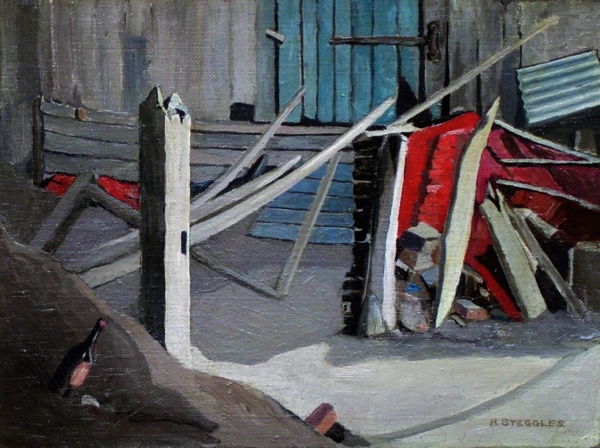
The Lumber Yard by Harold Steggles, dated 1929

The Scullery by Walter Steggles

The Stable by Walter Steggles, exhibited at the Tate 1929

Brymay Wharf by Walter Steggles

Bow Backwater by Walter Steggles

Brymay Wharf by Walter Steggles

Old Ford Rd by Harold Steggles

The Chapel by Walter Steggles, dated 1932

Railway siding by Walter Steggles, dated 1929

Bow Bridge by Walter Steggles

Blackwall by Harold Steggles

Warner St, Clerkenwell, by Harold Steggles

Canonbury Tower by Harold Steggles, dated 1938

Canonbury Grove by Elwin Hawthorne

The Chair by the Bed by Henry Silk

Interior by Brynhild Parker (Cheltenham Art Gallery & Museum)

North East Bethnal Green by George Board, c.1930, oil on canvas (Walter Steggles Bequest)

Illustrated London News, December 29th, 1928.
The new enlarged edition of From Bow to Biennale: Artists of the East London Group by David Buckman can be ordered direct from the publisher Francis Boutle and copies are on sale in bookshops including Brick Lane Bookshop, Broadway Books, Newham Bookshop, Stoke Newington Bookshop and London Review Bookshop.
You may also like to read about
Room To Let In Old Aldgate

I would dearly love to rent the room that is to let in this old building in Aldgate, photographed by Henry Dixon for the Society for Photographing Relics of Old London. Too bad it was demolished in 1882. Instead I must satisfy myself with an imaginary stroll through the streets of that long lost city, with these tantalising glimpses of vanished buildings commissioned by the Society as my points of reference. Founded by a group of friends who wanted to save the Oxford Arms, threatened with demolition in 1875, the Society for Photographing Relics of Old London touched a popular chord with the pictures they published of age-old buildings that seem to incarnate the very soul of the ancient city. London never looked so old as in these atmospheric images of buildings forgotten generations ago.
Yet the melancholy romance of these ramshackle shabby edifices is irresistible to me. I need to linger in the shadows of their labyrinthine rooms, I want to scrutinize their shop windows, I long to idle in these gloomy streets – because the truth is these photographs illustrate an imaginary old London that I should like to inhabit, at least in my dreams. Even to a nineteenth century eye, these curious photographs would have proposed a heightened reality, because the people are absent. Although the long exposures sometimes captured the few that stood still, working people are mostly present only as shadows or fleeting transparent figures. The transient nature of the human element in these pictures emphasises the solidity of the buildings which, ironically, were portrayed because they were about to disappear too. Thus Henry Dixon’s photographs preserved in the Bishopsgate Insitute are veritable sonnets upon the nature of ephemerality – the people are disappearing from the pictures and the buildings are vanishing from the world, only the photographs themselves printed in the permanent carbon process survive to evidence these poignant visions now.
The absence of people in this lost city allows us to enter these pictures by proxy, and the sharp detail draws us closer to these streets of extravagant tottering old piles with cavernous dour interiors. We know our way around, not simply because the geography remains constant but because Charles Dickens is our guide. This is the London that he knew and which he romanced in his novels, populated by his own versions of the people that he met in its streets. The very buildings in these photographs appear to have personality, presenting dirty faces smirched with soot, pierced with dark eyes and gawping at the street.
How much I should delight to lock the creaky old door, leaving my rented room in Aldgate, so conveniently placed above the business premises of John Robbins, the practical optician, and take a stroll across this magical city, where the dusk gathers eternally. Let us go together now, on this cloudy March day, through the streets of old London. We shall set out from my room in Aldgate over to Smithfield and Clerkenwell, then walk down to cross the Thames, explore the inns of Southwark and discover where our footsteps lead …

This row of shambles was destroyed for the extension of the Metropolitan Railway from Aldgate to Tower Hill, 1883.

Sir Paul Pindar’s House in Bishopsgate was moved to the Victoria & Albert Museum in 1890.

At the corner of St Mary Axe and Bevis Marks, this overhanging gabled house was destroyed in 1882.

In College Hill.

St Giles Cripplegate, which now stands at the centre of Barbican complex.

Old buildings in Aldersgate St.

Shaftesbury House by Inigo Jones in Aldersgate St, demolished after this photo was taken in 1882.

Chimneypiece in the Sessions House, Clerkenwell Green, where Dickens was once a cub reporter.

In Cloth Fair, next to Smithfield Market.

At the rear of St Bartholomew’s Church.

In the graveyard of St Bartholomew the Great.

In Charterhouse, Wash House Court.

The cloisters at Charterhouse.

St Mary Overy’s Dock

Queen’s Head Inn Yard.

White Hart Inn Yard.

King’s Head Inn Yard.

In Bermondsey St.

At the George, Borough High St.
You can see more pictures from the Society for Photographing Relics of Old London in The Ghosts of Old London and In Search of Relics of Old London.
Images courtesy Bishopsgate Institute


