
Some Sights Of Wonderful London
It is my pleasure to publish these splendid pictures selected from the three volumes of Wonderful London edited by St John Adcock and produced by The Fleetway House in the nineteen-twenties. Not all the photographers were credited – though many were distinguished talents of the day, including East End photographer William Whiffin (1879-1957).

Roman galley discovered during the construction of County Hall in 1910

Liverpool St Station at nine o’clock six mornings a week

Bridge House in George Row, Bermondsey – constructed over a creek at Jacob’s Island

The Grapes at Limehouse

Wharves at London Bridge

Old houses in the Strand

The garden at the Bank of England that was lost in the reconstruction

In Huggin Lane between Victoria St and Lower Thames St by Andrew Paterson

Inigo Jones’ gate at Chiswick House at the time it was in use as a private mental hospital

Hoop & Grapes in Aldgate by Donald McLeish

Book stalls in the Farringdon Rd by Walter Benington
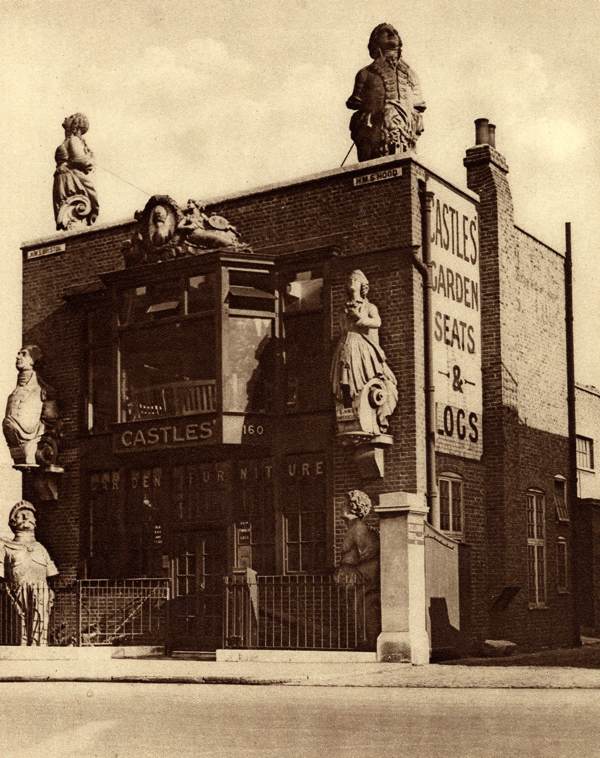
Figureheads of fighting ships in the Grosvenor Rd by William Whiffin

The London Stone by Donald McLeish

Dirty Dick’s in Bishopsgate

Poplar Almshouses by William Whiffin

Old signs in Lombard St by William Whiffin

Penny for the Guy!

Puddledock Blackfriars

Punch & Judy show at Putney

Eighteenth century houses at Borough Market by William Whiffin

A plane tree in Cheapside

Wapping Old Stairs by William Whiffin

Houndsditch Old Clothes Market by William Whiffin

Bunhill Fields

The Langbourne Club for women who work in the City of London

On the deck of a Thames Sailing Barge by Walter Benington

Piccadilly Circus in the eighteen-eighties

Leadenhall Poultry Market by Donald McLeish

London by Alfred Buckham, pioneer of aerial photography. Despite nine crashes he said, “If one’s right leg is tied to the seat with a scarf or a piece of rope, it is possible to work in perfect security.”
Photographs courtesy Bishopsgate Institute
People Of Wonderful London
It is my pleasure to publish these dignified and characterful portraits of Londoners, believed to be by photographer Donald McLeish (1879-1950), selected from the three volumes of Wonderful London edited by St John Adcock and produced by The Fleetway House in the nineteen-twenties.

Telescope Man on Westminster Bridge

Old woman who inhabited the alleys off Fleet St

Breton Onion Seller

Costermonger and child

Cats’ Meat Man

Knife Grinder

Charwoman

Islington Window Cleaner

Flower Seller

Concertina Player

Hurdy-Gurdy Man

Gramophone Man

Escapologist

Wandering Harpist

Street Sweeper

Scavenger

District Messenger

Telephone Messenger

Railway Fireman

Railway Engine Driver

Carman

Railway Porter

Gold Beaters

Gas Fitters

Chimney Sweep

Telephone Cable Man
Photographs courtesy Bishopsgate Institute
You might also like to take a look at
John Thomson’s Street Life in London
William Nicholson’s London Types
Charles Keeping, Illustrator

The illustrations of Charles Keeping (1924–1988) burned themselves into my consciousness as a child and I have loved his work ever since. A major figure in British publishing in the last century, Keeping illustrated over one hundred books (including the entire novels of Dickens) and won the Kate Greenaway and Carnegie Medals for his superlative talent.
In 1975, Keeping published ‘Cockney Ding Dong,’ in which he collected songs he remembered sung at home as a child. Illustrated with tender portraits of his extended family, the book is an unusual form of autobiography, recreating an entire cultural world through drawing and popular song.
Recently, I visited the Keeping Gallery at Shortlands in Kent to meet Vicky and Sean Keeping who talked to me about their father’s work, as we sat in the family home where they grew up and where much of his work is now preserved and displayed for visitors. You can read my interview at the end of this selection of illustrations from ‘Cockney Ding Dong.’


Illustrations copyright © Estate of Charles Keeping
The Gentle Author – So why did your father create ‘Cockney Ding Dong’ ?
Vicky Keeping – We come from a family – he came from a family – where they all got together. They’d have their beer, they enjoyed their beer, and their Guinness – some of the women drank Guinness – and they would all sing and his Uncle Jack would play the piano. And everybody had their own song, so people would give their song and Dad loved that. We still know them all still, because we loved it, and people didn’t say, ‘Oh no, I’m not going to do it!’ They just got up and sang, and it was lovely and the songs were all from the music hall.
The Gentle Author – But he wasn’t a Cockney – where was he was from?
Vicky Keeping – He was from Vauxhall and he was born in Vauxhall Walk, Lambeth. He was very much brought up by the female side of his family. His father passed away when he was ten, he had a burst ulcer. He was a driver on the Daily Star.
Sean Keeping – Before that, his father had been a professional boxer between about 1912 and 1922. He had many professional fights. I know he definitely fought the British champion at the time and won! A chap called Ernie Rice.
His father came from a very poor family and he was orphaned. They had a watercress stall in Lambeth Walk but they died in the workhouse. His mother’s family were also Londoners from Lambeth who came from a nautical background – his grandfather had been a sailor in the Merchant Navy. In the eighteenth century, they had come up to London from the West Country. Like many families, they had not originated in London.
Vicky Keeping – His grandfather was very important to Dad, because he was a great storyteller and would tell stories from his voyages and the different people he met and he was – I suppose – a bit ahead of his time because he was welcoming to all and would speak very positively about the people he met around the world. Dad loved hearing his stories, so he learnt from his grandfather that storytelling was important. That came through to us as well – when we sat round the family tea table we were encouraged to tell stories.
Very sadly, Dad’s dad and Dad’s grandfather passed away in the same year – in 1934 – when Dad was ten. It left Dad and his sister Grace and their mum Eliza very poorly off, but they lived in this extended family with Dad’s granny who was a very strong influence. Dad idolised her and his aunties, and they thought he was the blonde blue-eyed boy and they loved him dearly.
Sean Keeping – They lived in a small terraced house in 74 Vauxhall Walk, which was right alongside the market, and Dad’s early influences were not just his family but also the characters in Vauxhall Market – those often crop up in his books.
Vicky Keeping – One of the things that Dad loved to do in the garden was to look through a little knot hole to see the Schweppes bottling plant and the workhorses and that was something that never left him, that memory of horses.
There was no obvious creativeness in his background, but Dad said his father used to come home – because he worked in print – and bring home paper, and Dad’s sister Grace used to write a story and Dad would illustrate it.
Sean Keeping – He was not a child who would have gone running around the streets, they were children who would sit at home writing a story and drawing. From a very young age, Dad showed a fantastic aptitude for drawing and we’ve got some drawings of his from when he was twelve and thirteen, and they are really fantastic – showing a London of working horses and working people, that’s what he was trying to depict in his drawings.
Vicky Keeping – He was called up in the Second World War but he worked for Clowes the printers when he left school at thirteen. He was not a particularly great scholar at school. One of the things was that he found difficult was that he was left-handed and the teachers would try to get him to write with his right hand.
Sean Keeping – Working for Clowes the printers, he would go around on a horse & cart delivering paper, and that was where he met one of the characters who had a great influence on him – Tom Cherry. Many of the burly-looking men driving a horse through London in Dad’s pictures – they’re Tom Cherry, and usually he drew a little boy sitting next to him which was Dad. Tom had a great influence, telling him stories about London and the people of London.
Vicky Keeping – Dad became a Telegrapher on a frigate and he was on the boat at D-Day. After the war, he tried to get into Art College but that was very difficult, so he worked collecting pennies from gas meters. He worked for the Gas Light & Coke Company and he would go around on a bicycle, with a big sack on his shoulder with all the pennies in it, going from door to door in North Kensington. He used to tell us funny stories. At that time, North Kensington was a poor area and I think he got a lot out of the characters he met there, but he hated working for a company, for a boss, and he decided he wanted to do something better.
He went to night classes at the Regent St Polytechnic but, because he left school at thirteen with no formal qualifications and had been through the war, it was very difficult for him to get in at first. He tried and tried, and eventually he spent time in a psychiatric hospital due to his experiences in the War. I think it was also to do with his father. When his father and his grandfather died in the same year, they were laid out in the front room and – as a ten year old – Dad had to go and kiss them. That had a profound effect on him. He spent six months in a psychiatric hospital and two weeks of those were in a deep sleep. Yet he talked about the great characters he met there and there was a Psychiatrist, Dr Sargent, who knew Dad should go to Art College and he supported him in writing letters – and eventually that’s what happened.
Sean Keeping – When Dad went to Art College, he had to fight hard to get a grant because, at that stage, his mother had been widowed for a number of years and she had a job cleaning, so there was not a lot of money around. But eventually, he got a grant to go to Regent St Polytechnic. Right after the war, there were two types of students – those that had just come out of the forces who were much more mature and those who had come directly from school. So it was an interesting mix of people and mix of cultures.
The Gentle Author – How did he set out to make an income as an illustrator?
Sean Keeping – Dad was not motivated by making a career or making money or even motivated – I think – by success. Dad was motivated by one thing and that was doing what he wanted to do – drawing pictures of things that he wanted to draw pictures of – so he never really thought about a career. But then he got a job on the Daily Herald, drawing the strip cartoon and that started to pay very well, and from that he was able to move out of the council flat that he lived in with his mother in Kennington and buy a small terraced house in Crystal Palace.
When they were looking for houses, once he was making money from the strip cartoon, they looked in two areas – one was Crystal Palace and the other was Chelsea. Now the idea that you might choose Crystal Palace or Chelsea to look for a house nowadays is an strange idea, but they decided on Crystal Palace!
(Transcription by Rachel Blaylock)

Visit The Keeping Gallery at Shortlands in Kent where you can see the work of both Charles & Renate Keeping preserved in their family home. Visits are by appointment arranged through the website and Shortlands is a short train ride from Victoria.
Where Handel & Hendrix Were Neighbours

Jimi Hendrix’ bedroom in Brook St
Did you know that George Frideric Handel once lived at 25 Brook St in Mayfair and James Marshall (Jimi) Hendrix lived next door at number 23? – thus rendering it irresistible not to speculate how these two musical legends might have co-existed.
On moving into a new home, no-one can know if it will be their ultimate address – as Brook St was for both Handel & Hendrix. Handel was thirty-eight years old when he moved into number 25 in 1723, the same year that he was appointed Composer of Music to the Chapel Royal. He visited London twice in his twenties, but it was when his patron Queen Anne died and George I became King of Great Britain that Handel came to London for good.
Hendrix was twenty-six years old in January 1969 when he moved into the top flat at number 23 rented by his girlfriend Kathy Etchingham, at the time he was giving his final performances with The Jimi Hendrix Experience. Seeing the blue plaque for Handel encouraging Hendrix to go out and buy ‘Music for the Royal Fireworks’ and ‘Messiah’ on LP.
Handel lived thirty-six years in his house, growing in success and producing an entire repertoire of opera and oratorio, but Hendrix died within two years of moving in. In what proved to be his final months, the flat at number 23 offered Hendrix a peaceful enclave to socialise in private and focus on his songwriting.
Those of a literal-minded disposition might assume Handel was much tidier that Hendrix, preferring an austere minimalist interior by contrast to the lush textiles chosen by Hendrix & Etchingham, and purchased nearby at John Lewis in Oxford St. Yet the truth is that Hendrix’ flat has been reconstructed from photographs while very little is known of Handel’s domestic arrangements. We may observe that Handel & Hendrix shared a foppish love of long velvet coats and big curly hair.
It is too obvious to imagine Handel taking a sturdy broom handle to clout his bedroom ceiling when he grew sick of the sound of Hendrix’s record player in the early hours, although it is equally conceivable to envisage Handel waking from his slumbers in delighted surprise to hear his own music emanating – as if by magic – from above, when Hendrix gave his copy of ‘Messiah’ a night-time spin upon the turntable.
Handel & Hendrix both presented large public personalities, but their neighbouring residences in Brook St offered them the opportunity to retreat and pursue their devotion to the craft and struggle of innovative musical composition in private in the middle of London. On the eve of his death on 18th September 1970 at the Samarkand Hotel in Notting Hill, Jimi Hendrix wrote a lyric entitled ‘The Story of Life’ – ‘The story of life is quicker than the wink of an eye. The story of love is hello and goodbye. Until we meet again.’
Disregarding the two hundred years which separate them, I shall now cherish the fancy of old Handel paying a visit upon young Hendrix and the two pals sitting crossed-legged together upon scatter cushions in their curls and velvet finery, while alternating puffs upon a shared roll-up and quaffing red wine as Hendrix extemporises on his guitar and blind Handel conducts in approval by twirling a drunken finger in the smoke that curls in the air.

In George Frideric Handel’s bedroom at 25 Brook St

Hendrix in his bedroom at 23 Brook St, 1969 © Barrie Wentzell

In Hendrix’ bedroom

Handel – ‘Handel & Hendrix shared a foppish love of long velvet coats and big curly hair’

In Handel’s bedroom

In Hendrix’ bedroom

In Handel’s bedroom (Portrait bust courtesy of The Royal Collection)

Jimi Hendrix’ windows were on the top floor at the left and Handel’s were on the first floor at the right
Visit Handel & Hendrix in London, 25 Brook St, Mayfair, W1K 4HB
You might also like to read about
John Gillman’s Bus Ticket Collection

John Gillman, 1964
Look at this bright young lad in his snazzy red blazer with his hair so neatly combed, how he radiates intelligence and initiative – trust him to come up with a smart idea, like collecting every variety of London bus, trolley and tram ticket so that people might wonder at them half a century later in the age of contactless! Here John Gillman explains his cunning ploy –
“This album has followed me around for more than fifty years and survived house moves, down-sizings and other clear-out initiatives. Unlike other collections of mine (such as stamps & coins), that have long since disappeared, there was something about it that I believed to be important.
I had not looked at it for many years until The Gentle Author suggested the Bishopsgate Institute might like to add it to their archive, which – to my delight – they have. This prompted me to look at it again with a more considered gaze and what I found was quite surprising.
It was a slightly disconcerting but nonetheless enjoyable encounter with my younger self. The album contains a number of tickets that I bought between the ages of eleven and thirteen, along with an eclectic mix of older miscellaneous examples. So it is a like a diary of my youthful journeys taken.
In 1961, some friends and I discovered that there was enjoyment – and occasionally excitement – to be had by buying Red Rover bus tickets. These entitled you to unlimited travel at the weekend and there are seven examples in the album. We would head off as soon after the ticket became valid at 9:30 in the morning and return in the early evening for dinner. Occasionally, we would take a packed sandwich lunch but we would also eat out – usually fish and chips or, on one occasion, pie and mash with liquor in the East End.
We also held aspirations to purchase a Green Rover ticket one day which allowed access to country buses but, since I do not have one in the collection, I must presume we never did this. We planned to head off into Kent and visit Pratts Bottom – mainly because we found the name hilarious and wanted to see it on a signpost.
What strikes me most today are the detailed notes I wrote. Much of it is in my very best handwriting and, in some cases, I used a typewriter (although I have no idea where I gained access to one). I clearly undertook a lot of research and some items I still find fascinating. The ‘Workman’s Ticket,’ for example, with – as I noted assiduously – ‘unusual punch holes.’ And the special editions, such as those for the Festival of Britain in 1951 and Last Tram Week in 1952. Some are even earlier, issued before 1933, as indicated in my meticulous notes. There is also a collection of 1963 Christmas tickets in gay colours. I remember that the yellow version was particularly rare and the one in my album had obviously spent some time on the floor of the bus.
Each morning, on the way to school, we added up the digits that made up the ticket number – and, if they totalled twenty-one, it was going to be a lucky day. Some people believed that the initials next to the number on the older tickets foretold the initials of your future wife, which proved to be something of a challenge if it was just an ‘X’.”

(click to enlarge and study the tickets in detail)

(click to enlarge and study the tickets in detail)

(click to enlarge and study the tickets in detail)

(click to enlarge and study the tickets in detail)

(click to enlarge and study the tickets in detail)

(click to enlarge and study the tickets in detail)

(click to enlarge and study the tickets in detail)

(click to enlarge and study the tickets in detail)

(click to enlarge and study the tickets in detail)

(click to enlarge and study the tickets in detail)

(click to enlarge and study the tickets in detail)

(click to enlarge and study the tickets in detail)

(click to enlarge and study the tickets in detail)

(click to enlarge and study the tickets in detail)


Images courtesy Bishopsgate Institute
You may also like to take a look at
Some Working People by John Claridge
In June, I am publishing the definitive collection of over two hundred photographs of John Claridge’s EAST END. We need a couple more readers to invest £1000 to support production of this important book. Email spitalfieldslife@gmail.com if you can help and I will send you further information. You can also assist publication by clicking here to pre-order a signed copy for £25.

Groundsman, E.15 (1965)
“This is the groundsman at the Memorial Ground where I played football aged ten in 1954.”
When John Claridge went back ten years later to the pitch near West Ham Station where he played football as a child, he found the groundsman was just as he remembered, with his cardigan and tie, and he took the photograph you see above. There is a dignified modesty to this fine portrait – a quality shared by all of those published here – expressed through a relaxed demeanour.
John’s subjects present themselves to his lens as emotionally open yet retaining possession of themselves, and this translates into a vital relationship with the viewer. To each of these people, John was one of their own kind and they were comfortable being photographed by him. And, thanks to the humanity of John’s vision, we have the privilege to become party to this intimacy today.

Kosher Butcher, E2 (1962) – “The chicken was none too happy!”

Brewery, Spitalfields (1964) Clocking in at the Truman Brewery, Brick Lane.

Lady with Gumball Machine, Spitalfields (1967) – “She came out of her kiosk and asked, ‘Will you photograph me with my gumball machine?'”

Saveloy Stall, Spitalfields (1967) – “It was a cold day, so I had two hot dogs.”

Whitechapel Bell Foundry, E1 (1982) Established in 1598, where the Liberty Bell and Big Ben were cast.

Rag & Bone Man, E13 (1961) – “Down my street in Plaistow, there were not many cars about – all you could hear was the clip-clop of the horse on the wet road.”

Shoe Repairs Closed Saturday, Spitalfields (1969) – “I asked, ‘Why are you open on Saturday?’ He replied, ‘I was just busy.'”

Spice, E1 (1976) – “Taken at a spice warehouse in Wapping. The smells were fantastic, you could smell it down the street.”

Portrait, Spitalfields (1966) – “This is a group portrait of friends outside of their shop. The two brothers who ran the shop, the lady who worked round the corner and the guy who worked in the back.”

Anglo Pak Muslim Butcher, E2 (1962)

Butchers, Spitalfields (1966) -“I had just finished taking a picture next door, when this lady came out with a joint of meat and asked me to take her photograph with it.”

Fishmongers, E1 (1966) Early morning, unloading fish from Grimsby.

Beigel Baker, E2 (1967) -“After a party at about four or five in the morning, we used to end up at Rinkoff’s in Vallance Rd for smoked salmon beigels.”

Newsagent, Spitalfields (1966) -“I said, ‘Shame about Walt Disney dying, can I take your picture next to it?’ and he said, ‘Alright.'”

Selling Shoes, Spitafields (1963) – “My dad used to tell me what his dad told him, ‘If you’ve got a good pair of shoes, you own the world.'”

Strudel, E2 (1962) – “You’ll like this, boy!’ I had just taken a photograph outside this lady’s shop. I said, ‘I think your window looks beautiful.’ and she asked me in for a slice of apple strudel. It was fantastic! But she would not accept any money, it was a gift. She said, ‘You took a picture of my shop.'”

Number 92, Spitalfields (1964)

Tubby Isaac’s, Spitalfields (1982) – “Aaahhh Tubby’s, where I’ve had many a fine eel.”

Junkyard Dog, E16 (1982) – “I was climbing over the wall into this junkyard. All was quiet, when I noticed this pair of forbidding eyes – then I made my exit.”
Photographs copyright © John Claridge
You may also like to take a look at

Click here to pre-order your signed copy of John Claridge’s EAST END for £25
Please email spitalfieldslife@gmail.com if you are willing to invest £1000 in publishing a handsome hardback of John Claridge’s East End photographs
A Couple Of Pints With John Claridge
On 2nd June, I am publishing the definitive collection of over two hundred photographs of John Claridge’s EAST END. Please email spitalfieldslife@gmail.com if you are willing to invest £1000 to help me publish this important book and I will send you further information. You can also support publication by clicking here to pre-order a signed copy for £25.

THE DRINK, E14 1964
John Claridge claims he is not a drinker, but I was not entirely convinced once I saw this magnificent set of beer-soaked pictures that he lined up on the bar, exploring aspects of the culture of drinking and pubs in the East End. “I used to go along with my mum and dad, and sit outside with a cream soda and an arrowroot biscuit,” John assured me, recalling his first childhood trips to the pub,“…but they might let you have a drop of brown ale.”
Within living memory, the East End was filled with breweries and there were pubs on almost every corner. These beloved palaces of intoxication were vibrant centres for community life, tiled on the outside and panelled on the inside, and offering plentiful opportunities for refreshment and socialising. Consequently, the brewing industry thrived here for centuries, inspiring extremes of joy and grief among its customers. While Thomas Buxton of Truman, Hanbury & Buxton in Spitalfields used the proceeds of brewing to become a prime mover in the abolition of slavery, conversely William Booth was motivated by the evils of alcohol to form the Salvation Army in Whitechapel to further the cause of temperance.
“When I was fifteen, we’d go around the back and the largest one in the group would go up to the bar and get the beers,” John remembered fondly, “We used to go out every weekend, Friday, Saturday and Sunday. We’d all have our suits on and go down to the Puddings or the Beggars, the Deuragon, the Punchbowl, the Aberdeen, the Iron Bridge Tavern or the Bridge House.” Looking at these pictures makes me wish I had been there too.
Yet the culture of drinking thrives in the East End today, with hordes of young people coming every weekend from far and wide to pack the bars of Brick Lane and Shoreditch, in one non-stop extended party that lasts from Friday evening until Sunday night, and stretches from the former Truman Brewery up as far as Dalston.
Thanks to John’s sobriety, we can enjoy a photographic pub crawl through the alcoholic haze of the East End in the last century – when the entertainment was homegrown, the customers were local, smoking and dogs were permitted, and all ages mixed together for a night out. Cheers, everybody!

A SMOKE, E1 1982. – “There was a relaxed atmosphere where you could walk in and talk to anybody.”

THE CONVERSATION, E1 1982. – “Who is he speaking to?”

DARTBOARD, E17 1982. -“I used to be a darts player, just average not particularly good.”

SINGING, E1 1962. -“She’d just come out of the pub…”

THE MEETING, E14, 1982. -“You don’t know what’s going on. There’s a big flash car parked there. Are they doing a piece of business?”

SLEEP, E1 1976. – “They used to club together and get a bottle of VP wine from the off-licence, and mix it with methylated spirits.”

BEERS, E1 1964. – “This is Dickensian. You wonder who’s going to step from that door. Is it the beginning of a story?”

ROUND THE BACK, E3 1963.

DOG, E1 1963. -“Just sitting there while his master went to get another pint of beer.”

EX-ALCHOHOLIC, E1 1982. – “He lived in Booth House and seemed very content that he had pulled himself out of it.”

LIVE MUSIC, E16 1982. -“It was a cold winter’s day and raining, but I had to get this picture. Live music and dancing in a vast expanse of nothing?”

THE BEEHIVE, E14 1964. – “She never stopped giggling and laughing.”
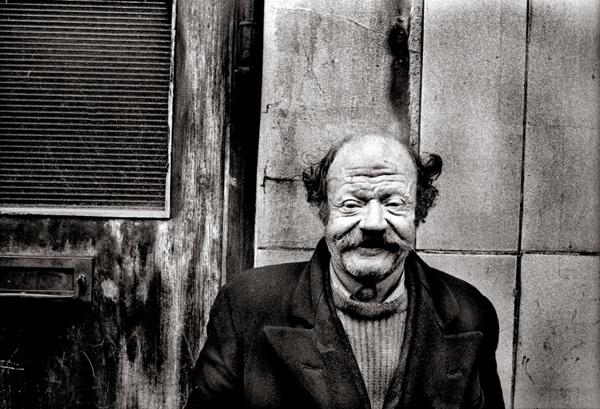
THE SMILE, E2 1962. -“He said, ‘Would you like me to smile?’ He was probably not long for this world, but he was very happy.”

IN THE BAR, E14 1964. -“I’d just got engaged to my first wife and she was one of my ex-mother-in-law’s friends. Full of life!”

THROUGH THE GLASS, E1 1982. -“I think the guy was standing at the cigarette machine.”

THE CALL, E16 1982. -“Terry Lawless’ boxing gym was above this pub. It looks as if everything is collapsing and cracking, and the shadows look like blood pouring from above.”

WHITE SWAN, E14 1982

LIGHT ALE, 1976 -“Four cans of light ale and he was completely out of it.”

CLOSED DOWN, Brick Lane 1982.
Photographs copyright © John Claridge
You may also like to take a look at


