
Geraldine Beskin, Witch
My friend Geraldine Beskin the Witch is hosting a celebration of SATURNALIA with live music from Cunning Folk and storytelling from Jo Clayton from 6:30pm tonight at the Atlantis Bookshop in Museum St, Bloomsbury, WC1. She described it to me as ‘a bit of festive fun with a twist.’ All welcome!

Geraldine Beskin presides as serenely as the Mona Lisa from behind her desk at the Atlantis Bookshop in Museum St, Bloomsbury – the oldest occult bookshop in the world, one of London’s unchanging landmarks and the pre-eminent supplier of esoteric literature to the great and the good, the sinister and the silly, since 1922. “My father came into the shop one day and Michael Houghton, a poet and a magician, who founded it and knew everyone from W.B.Yeats to Aleister Crowley, took a good look at him and said, ‘You’ll own this place one day,'” Geraldine told me, with a gentle smile that indicated a relaxed acceptance of this happy outcome as indicative of the natural order of things.
“I started working here when I was nineteen, and I’ve read a tremendous amount and I’ve done some of it – because you have to be a reader to be a good bookseller,” she said, casting her eyes around with proprietary affection at the sage green shelves lined with diverse and colourful books old and new, organised in alphabetical categories from angels and fairies, by way of magic and paganism, to werewolves and vampires.“This place was set up by magicians for magicians and that’s a tradition we continue today,” boasted Geraldine, who guards this treasure trove with her daughter Bali, the third generation in the book trade and a fourth generation occultist.
Yet in spite of the exoticism of her subject matter, Geraldine recognises the necessity for a certain rigour of approach.“There are New Age shops that sell dangly things and crystals, but we don’t, we’re a quality bookshop” she said, laying her cards boldly yet politely upon the table,”We are not faddist, we have an awareness of the contents of the books.” Working at her desk, sustained by copious amounts of tea, Geraldine is an enthusiastic custodian of a wide range of esoteric discourse upon matters spiritual. “The esoteric is an endless source of fascination,” she assured me, her eyes sparkling to speak of a lifetime’s passion,“There are so many facets to the esoteric that you need never run out of things to be amazed by.”
I am ashamed to confess that even though I pass it every time I walk to the West End, I never visited the Atlantis Bookshop before because – such is the nature of my credulity – I was too scared. But thanks to Simon Costin of the Museum of British Folklore who arranged my introduction to Geraldine, I made it across the threshold eventually, and once I was in conversation with Geraldine who admits to being a witch and practising witchcraft, although she prefers the term “occultist,” I discovered my fears were rootless. However, my ears pricked up at the innocent phrase, “I’ve done some of it,” which Geraldine dropped into the middle of her sentence quite naturally and so I enquired further, curious to learn more about the nature of “it.”
“My grandmother, me and my daughter all do it. My dad did it.” she declared, as if “it” was the most common thing in the world, “I come from a family of esoterics. I was born into it, so I think it would be immoral to own a shop like this and not appreciate what people are doing. Loosely it could be called witchcraft, but in reality it is a certain perception or background intuition.”
“Our subject has become very fashionable and young academics don’t have a bloody clue, which is very frustrating for us.” she continued, rolling her eyes at the inanity of humanity,“We try to disabuse people of the myths about witches, they are good kind people on the whole. Most witches are as mortgage-bound and dog-walking as everyone else. Most witches do healing, and buy toilet paper. And there is this side of trying to commune with nature and be aware of the cycle of change. It’s a very rich and rewarding way of life. I practise a bit of magic – there’s so much you can’t learn from books and you have to do it yourself.”
With her waist-length grey hair, deep eyes, and amusingly authoritative rhetorical style, Geraldine is an engaging woman of magnanimous spirit. And I cannot deny a certain vicarious excitement on my part, brightening a grim wintry morning to discover myself seated in this elegant empty bookshop in Bloomsbury in conversation with a genuine witch. Yet I was still curious about the nature of “it.” So I asked again.
“Witchcraft is a very benign religion, where you work around the seasons of the year,” explained Geraldine patiently, in a pleasant measured tone, “You start off in darkness, and, in Mid-Summer, the Holly King and the Corn King have a fight and the Holly King wins and then the light begins to decline. At Yule, they fight again and the Corn King wins and the light begins to come back to the world. In agrarian societies, people got up at dawn and worked until dusk, and they adjusted how they lived by the seasons. It was the Christians who gave us the devil and we don’t know what to do with him. We have a horned god who is the god of positive male energy – not a devil at all, but the poor soul has been demonized over the years.”
Geraldine convinced me that esoteric cultures from the ancient world remain vibrant, by reminding me that witches were always “green,” ahead of their time in ecological awareness, and – although she could not disclose names – by revealing that top celebrities, from princes to pop-stars, have always frequented the Atlantis Bookshop. “We make a play of only giving out the names of our famous dead customers,” she confided to me with a tantalising smirk. “Most of our customers are practitioners – witchcraft has become the default teenage rebellion religion today,” she added with an ambivalent grin, confirming that, in spite of everything, the future looks bright for witches.
[youtube g-jge7oUWAI nolink]

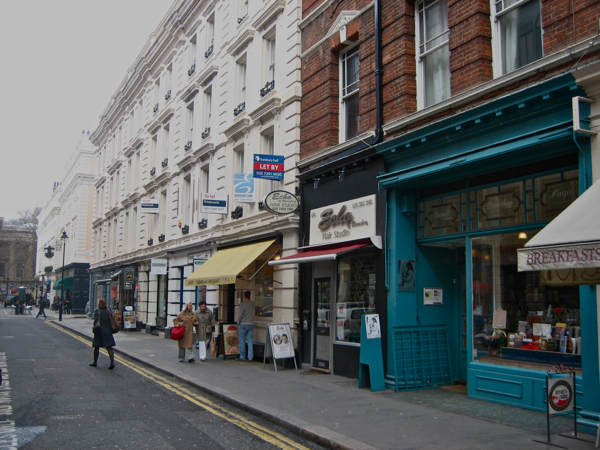
The British Museum awaits at the end of the street


Geraldine and her sister Tish outside the bookshop in the nineteen seventies – “Those were the days when the Rolling Stones and the Beatles used to come in.”
Brutal East End

Ashington House, Bethnal Green
There is little that divides opinion as sharply as concrete modernist architecture, inspiring an unreconcilable split between those who want it demolished and those who want it preserved. Yet the architectural term brutal is of French origin and simply refers to the use of raw concrete (béton brut), even if it is widely used as an expression of the perceived barbarism of buildings in this style.
Photographer Simon Phipps has spent fifteen years surveying these vanishing structures, capturing their lively geometry and dramatic use of textures before they are destroyed, to produce BRUTAL LONDON published by September Books, a catalogue of the capital’s most distinguished examples. His elegant black and white photography draws attention to the idealism of this style which, even when it was misguided, now appears preferable to the ubiquitous cynicism of much new architecture conceived merely as short-life cladding to achieve an effect.

Haggerston School, Weymouth Terrace, E2. Designed by Ernö Goldfinger for the London County Council. Built 1964–67, listed grade II.

Barbican, Silk St, City of London, EC2. Designed by Chamberlin, Powell & Bon for the Corporation of the City of London, Built 1962–82, listed grade II.

Robin Hood Gardens, Woolmore St, Poplar, E14. Designed by Alison and Peter Smithson for the Greater London Council. Built 1969–72, unlisted.

Glenkerry House, Brownfield Estate. Designed by Ernö Goldfinger for London County Council. Built by Greater London Council. Built 1965–67, listed grade II*.


Shoreditch Fire Station, Old Street, EC1. Designed by the Special Works Department of the London County Council Architects’ Department led by Geoffrey Horsfall. Built 1964, unlisted.

Golden Lane Estate, Goswell Rd, City of London, EC2. Designed by Chamberlin, Powell & Bon. Built 1953–63, listed grade II, (Crescent House Listed grade II*).

Newling Estate, Old Market Sq, Bethnal Green, E2. Designed by London County Council Architects’ Department. Built 1963, unlisted.

Keeling House, Claredale St, Bethnal Green, E2. Designed by Denys Lasdun of Fry, Drew, Drake & Lasdun. Built 1957–59, listed grade II*.

Middlesex St Estate, Middlesex St, City of London, E1. Corporation of London Architects’ Department. Built 1965–75, unlisted.

Crown Estate,Victoria Park Rd, E9. Designed by John Spence & Partners for the Crown Estate. Built 1967–77, unlisted.

Charles Hayward Building, part of the Queen Elizabeth Hospital for Children, Hackney Rd, E2. Designed by Lyons Israel Ellis. Built 1972, demolished 2015.

Bethnal Green Fire Station, Roman Rd, E2. Designed by Greater London Council Architects’ Department. Built 1966–67, unlisted.
Photographs copyright © Simon Phipps
Click here to order a copy of BRUTAL LONDON from September Books
You may also like to take a look at
Nicholas Borden’s Recent Paintings

Click the image to enlarge this painting
Any eagle-eyed readers who have been sitting on the top deck of a number 8 bus going through Bethnal Green in the last few days may have spotted Nicholas Borden standing at his easel upon the steps of St John working on this painting of the crossing outside the Salmon & Ball.
Three years have passed since I first met Nicholas painting at his easel on the corner of Vallance Rd in a blizzard and he is still working on the street most days, even if he has managed to find a more sheltered location beneath the portico of Sir John Soane’s church.
When we had the cold snap recently, Nicholas painted the view from his kitchen window that you see below but otherwise – blessed with the constitution of a fisherman – he can reliably discovered at his easel upon the London street in all weathers.
To keep up to date with Nicholas Borden’s work follow him on Instagram/nicholas1_borden

Nicholas Borden at work under the portico of St John on Bethnal Green

View from Nicholas’ flat in Cassland Crescent, Hackney

River Lea

Regent’s Canal

Near Victoria Park

Lake at Victoria Park

Wilton Way, Hackney

At St Paul’s Cathedral

East End Terrace
Paintings copyright © Nicholas Borden
You may like to take a look at more of Nicholas Borden’s work
Nicholas Borden’s East End View
Nicholas Borden’s Winter Paintings
At Benjamin Truman’s House

Behold, the winter dusk is glimmering in this old house in Princelet St built in the seventeen-twenties for Benjamin Truman. A hundred years later, a huge factory was added on the back which more than doubled the size. In the twentieth century, this became the home of the extended Gernstein family from whom the current owners bought the house in the eighties. Notable as Lionel Bart’s childhood home, who once returned to have his portrait taken by Lord Snowden on the doorstep, in recent years it has served as the location for innumerable film and photo shoots. And now, as if to complete the circle, the house has been sold to the proprietors of the Old Truman Brewery.


You may also like to take a look at
The Alphabet Of Lost Pubs S-T
Among the cherished hostelries in this penultimate installment of my series of The Alphabet of Lost Pubs, is The Still & Star in Aldgate which I have been campaigning to save. I can report that the City of London have deferred their decision on its future to consider an Application for Asset of Community Value status for this pub. Keep your fingers crossed! My time-travelling pub crawl is presented in collaboration with Heritage Assets who work in partnership with The National Brewery Heritage Trust, publishing these historic photographs of the myriad pubs of the East End from Charrington’s archive for the first time.

The Scarborough Arms, 11 St Marks St, Aldgate, E1 (Opened before 1855 and closed in 2011 for conversion to residential use)

The Sebright Arms, 26 Coate St Haggerston, E2 (Opened before 1849, rebuilt 1936 and open today)

The Sekforde Arms, 34 Sekforde St, Clerkenwell, EC1 (Opened before 1839 and closed in 2015)

The Shakespeare’s Head, 46 Percival St, Clerkenwell, EC1 (Opened before 1839, rebuilt in the twentieth century and demolished in 2012)

The Ship Aground, 144 Lea Bridge Rd, Hackney, E5 (Opened before 1871, closed 2009 and now a Sikh temple)

The Ship, 10 Narrow St, Limehouse, E2 (Opened before 1722 destroyed by enemy action on the 12th August 1944)

The Ship & Bell, 74 Prusom St, Wapping, E1 (Opened before 1810 but damaged by enemy action on the 9th September 1940 and closed)

The Smithfield Tavern, Charterhouse St, Smithfield, EC1 (Opened before 1851 as ‘The Red Cow,’ rebuilt 1871, closed 1942, reopened 1946, renamed ‘The Smithfield Tavern’ in 1952 and closed in 2015)

The Spread Eagle Hotel, 1 Manor Rd, West Ham, E15 (Opened before 1886, damaged by enemy action and closed between September 1940 and January 1941, rebuilt on Mitre Rd and now a supermarket)

The Star, 31 Aldersgate St, EC1 (Opened before 1839, closed 1963 and now demolished)

The Star of the East, 83 Goldsmith’s Row, Hackney, E2 (Opened before 1861, closed 1983 and now a shop)

The Star & Garter, 233 Whitechapel Rd, E1 (Opened before 1807, closed 2001 and now a fried chicken shop)

The Still & Star, Little Somerset St, Aldgate, E1 (Opened before 1820 and open today, but under imminent threat of demolition)

The Suffolk Arms, 76 Boston St, Bethnal Green, E2 (Opened before 1839 but now demolished and the space occupied by Hackney City Farm)

The Sugar Loaf, 65 Cannon St, City of London, EC4 (Opened before 1839, renamed ‘O’Neil’s’ in 1999 and open today)

The Sultan, 112 Grange Rd, Plaistow, E13 (Opened before 1872 but demolished in 2005)

The Sussex Arms, 71 Upper North St, Poplar, E15 (Opened before 1863, closed in 1963 and now demolished)

The Sussex Arms, 107A Culford Rd, N1 (Opened before 1856, renamed ‘The Scolt Head’ in 2006 and open today)

The Swan, 73 Clapton Common, Upper Clapton, E5 (Opened before 1745 but closed in 2009 and now a synagogue)

The Swan & Sugar Loaf, 53 Fetter Lane, Holborn, EC4 (Opened before 1800 but destroyed by enemy action in May 1941)

The Temple St Tap, 428 Hackney Rd, E2 (Opened before 1934, renamed ‘Septembers’ in 1983 and demolished in 2000)

The Thatched House, 245 High Rd, Leytonstone, E11 (Opened before 1826, closed by 2008 and now a betting shop)

The Three Compasses, 99 Dalston Lane, E8 (Opened before 1849 and open today)

The Three Crowns, 237 Mile End Rd, E1 (Opened before 1719, renamed ‘L’Oasis’ in 1999, closed in 2010 and now an Italian restaurant)

The Three Crowns (West’s Brewery Tap), 311 Hackney Rd, E2 (Established 1822 and closed 1929)

The Three Nuns Hotel, 11 Aldgate High St, EC3 (Opened before 1665, rebuilt 1876, closed 1960 and now demolished)

The Ticket Porter, Arthur St, City of London, EC4 (Opened before 1841, but closed and demolished in 1970)

The Trafalgar, 17 Remington St, N1 (Opened before 1856 but closed in the eighties and now offices)

The Two Brewers, 197 High St, Stratford, E15 (Opened before 1776, closed in 1995 and demolished in 2006)
Photographs courtesy Heritage Assets/The National Brewery Heritage Trust

You may also like to take a look at
Sarah Ainslie’s Bingo Portraits

Ever since the Mecca Bingo Hall closed in Hackney Rd last year, pending demolition and redevelopment into luxury flats, a bus has departed most nights at five-thirty from the nearest street corner picking up the former clientele from Bethnal Green and delivering them to the Mecca Bingo Hall in Camden Town. Last Sunday, Contributing Photographer Sarah Ainslie & I joined the merry throng on the bus for the trip across town to bring you the first instalment in this series of portraits of the Bingo stalwarts of Bethnal Green.

Joyce Allen
“I’ve been playing Bingo since I was nineteen and now I’m eighty-nine”

Julia Ettridge
“Joyce and I lost our husbands in 1995, and we have been coming to Bingo together every week since”

Audrey
“I’m eighty-one, I went to school in Hoxton and I’ve lived in London all my life. I have survived cancer and I live alone but my son and daughter give me money to go Bingo once a week, I look forward to it.”

Josephine & Bob Williams
“We’ve been married fifty years and we’ve always gone to bingo together.”

Josephine Williams
“It hasn’t made me rich but it hasn’t made me poor either!”

Rose & Sharon Davis
“It’s disgusting that they shut the Bingo hall in Bethnal Green. It was on our doorstep and you could always guarantee there’d be someone you knew to talk with, it was our community. It’s sad. We called it home.” – Sharon Davis

Anne Liddiard
“If I win I’m satisfied but, if I don’t win, I’m also satisfied because I’ve had a night out with friends”

Susan Liddiard
“I started playing Bingo when I was sixteen and I’m sixty-three now. Four generations of our family went to Mecca Bingo. The men went to the British Lion and the women went to Bingo, then the women joined the men afterwards in the pub and they all went home at closing time.”

Photographs copyright © Sarah Ainslie
You may like to see these other portraits by Sarah Ainslie
Sarah Ainslie’s Holland Estate Portraits
Sarah Ainslie’s Parmiter’s Portraits
Sarah Ainslie’s Wardrobe Portraits
Sarah Ainslie’s Somali Portraits
Sarah Ainslie’s Boundary Estate Cooking Portraits

The development proposed to replace the Bingo Hall in the Hackney Rd
Bob Mazzer At The Ace Cafe
Contributing Photographer Bob Mazzer & I joined a Bike Couriers Reunion at the Ace Cafe on the North Circular recently. Despite their fearsome black leather outfits, we enjoyed a generous reception from the bikers. “They’re outsiders,” Bob explained to me, “So they welcomed us because they recognised we’re outsiders too.”


Photographs copyright © Bob Mazzer
Ace Cafe, North Circular Rd, London NW1
You may also like to take a look at these other photographs by Bob Mazzer
Bob Mazzer’s Street Photography


