The Gentle Author’s Tour Of Spitalfields
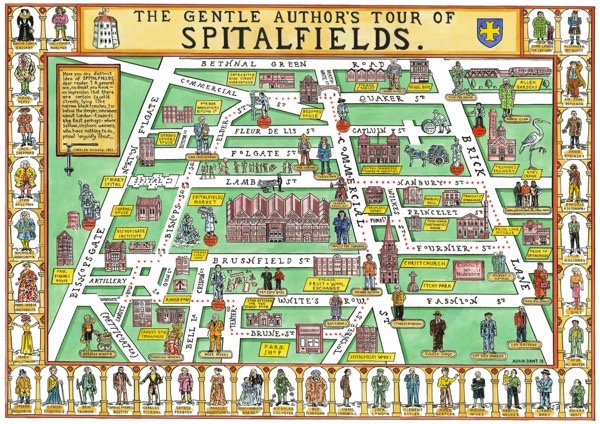
Map of the Gentle Author’s Tour drawn by Adam Dant
I invite you to join me in an experiment. Over the years, many readers have asked me if I would host walking tours, telling the stories of people I have written about.
It was an idea I was reluctant to pursue until now. What changed my mind was the realisation that there needs to be an engaging alternative to the ghoulish tours that currently dominate Spitalfields, dwelling upon the details of the Whitechapel murders and which are – in effect – premised upon violence against women.

Drawing on my stories published in these pages over the past twelve years, I have devised a new walking tour of Spitalfields. Ramble with me through two thousand years of culture in the heart of London and encounter some of the people and places that make this historic neighbourhood distinctive.
I invite you to join my tour in the footsteps of all those who came before, with a keen eye and an open heart, to discover the manifold wonders of Spitalfields.
Tours will take place on Saturday 18th and Sunday 19th, and on Saturday 25th and Sunday 26th September, hosted by The Gentle Author and starting outside Christ Church, Spitalfields, at noon.
(18th, 19th, 25th & 26th September are sold out)
Two extra tours announced on Saturday 2nd & Sunday 3rd October at noon.
Tickets cost £50 and include a signed copy of one of The Gentle Author’s books as a souvenir.
Email spitalfieldslife@gmail.com to reserve a place. Please give your first and second choice of date and specify which book of mine you would like. Numbers are strictly limited.
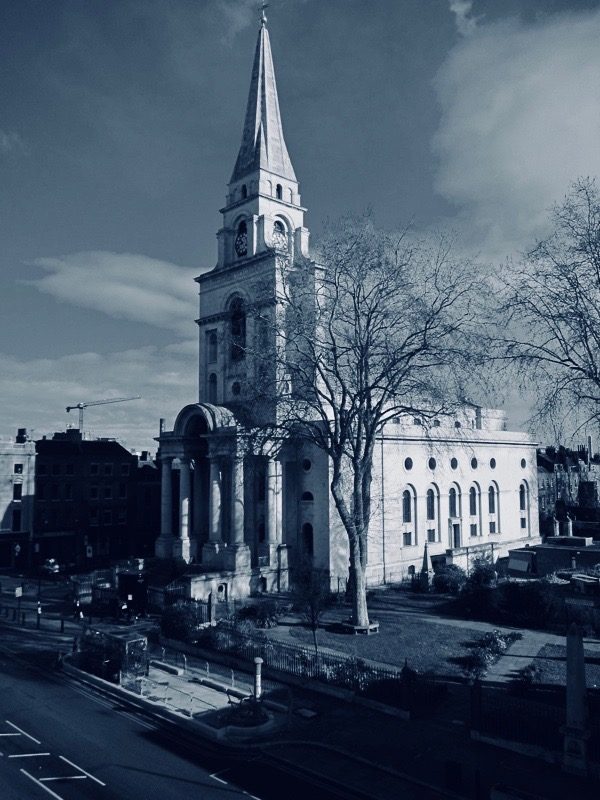
Christ Church Spitalfields
The Bethnal Green Mulberry Is Saved Again!
While the Gentle Author takes a holiday, we are celebrating the joys of the season with a HARVEST SALE, selling all our books at half price so you can treat yourself and your friends and family. Simply add code ‘HARVEST’ at checkout to claim your discount.
CLICK HERE TO VISIT THE SPITALFIELDS LIFE BOOKSHOP

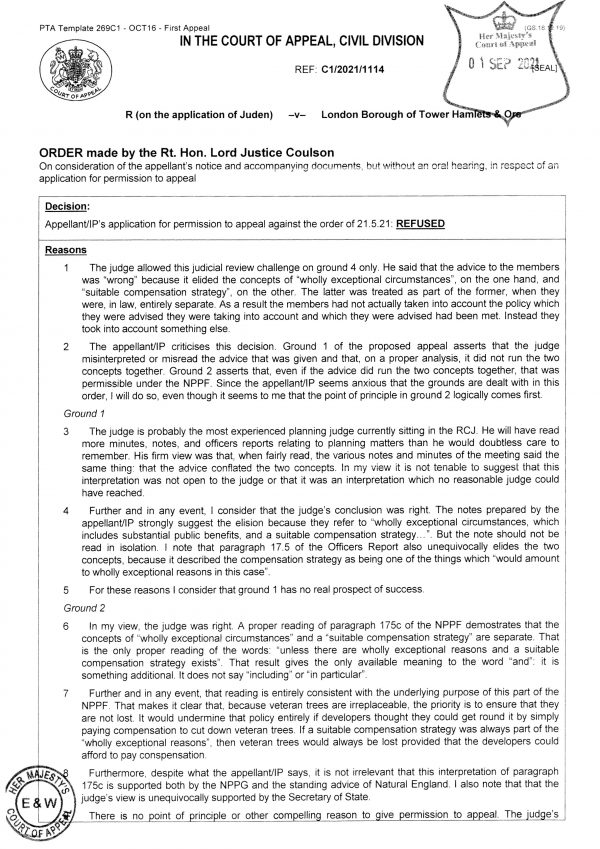
After our joyous victory in the High Court in May when we saved the Bethnal Green Mulberry, I was dismayed when developer Crest Nicholson applied to appeal the decision. Consequently, it was a great relief to get the news this week that their application has been denied by Her Majesty’s Court of Appeal and the Lord Justice of Appeal has confirmed that the matter is now concluded.
The Bethnal Green Mulberry is now safe for generations to come. We saved it twice!
If the appeal had been granted, we would have fought it but we would much rather not fight the same battle twice. You can read the complete statement below from the Lord Justice of Appeal and I was particularly delighted by these paragraphs:
6. In my view the judgement was right. A proper reading of 175c of NPPF (National Planning Policy Framework) demonstrates that the concepts of “wholly exceptional circumstances” and a “suitable compensation strategy” are separate. That is the only proper reading of the words “unless there are wholly exception reasons and a suitable compensation strategy exists.” That result gives the only available meaning to the word “and.” It is something additional. It does not say ”including” or “in particular.”
7. Further and in any event, that reading is entirely consistent with the underlying purpose of this part of the NPPF. That makes it clear that because veteran trees are irreplaceable, the priority is that they are not lost. It would undermine that policy entirely if developers thought they could get round it by simply paying compensation to cut down veteran trees. If a suitable compensation strategy was always part of the “wholly exceptional reasons,” then veteran trees could always be lost provided that developers could afford to pay compensation.
8. Furthermore, despite what the appellant/IP says, it is not irrelevant that this interpretation of paragraph 175c is supported both by NPPG and Natural England. I also note that the Judge’s view is supported unequivocally by the Secretary of State.
We are grateful to everyone who supported our campaign, especially our patron Dame Judi Dench, those who signed the petition and those who contributed to our legal fund. I am very much looking forward to distributing the cuttings of Shakespeare Mulberry to our donors this autumn.
We all owe a debt of gratitude to our superlative legal team, Richard Harwood QC, Andrew Parkinson and Susan Ring.
In 2040, the Bethnal Green Mulberry will reach its five hundredth birthday and I hope as many of my readers who can make it will be there will join me in raising a glass in Bethnal Green and celebrate this glorious occasion.

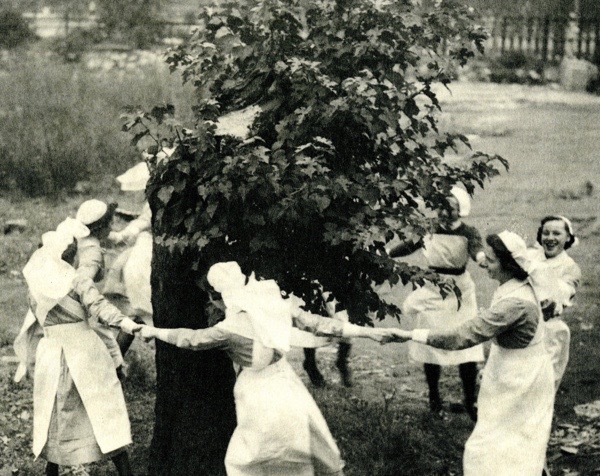
Nurses dancing around the Bethnal Green Mulberry
Click here to read my feature in The Daily Telegraph about the scandal of the Bethnal Green Mulberry
Read more here about the Bethnal Green Mulberry
The Bethnal Green Mulberry Verdict
The Fate of the Bethnal Green Mulberry
At Minto Place, Bethnal Green
While the Gentle Author takes a holiday, we are celebrating the joys of the season with a HARVEST SALE, selling all our books at half price so you can treat yourself and your friends and family. Simply add code ‘HARVEST’ at checkout to claim your discount.
CLICK HERE TO VISIT THE SPITALFIELDS LIFE BOOKSHOP
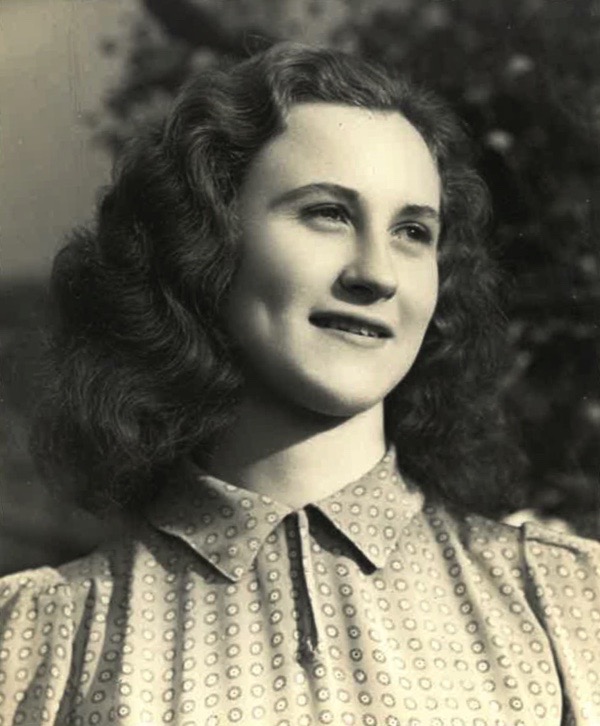
Joyce Ellis
Billy Reading sent me this memoir by his great aunt Joyce Ellis, recalling her childhood visits to Minto Place, Bethnal Greet, home of her beloved grandfather James Ward (born 1861) and aunt Mary Ward (born 1888)
During the thirties, Mum and I used to visit my grandfather James Ward nearly every week in Bethnal Green, travelling by tram and bus from our home in Leyton. He lived at 5 Minto Place which was part of a terrace of houses whose front door opened straight onto the pavement. It was a rented house and the front upstairs bedroom was sub-let to Mr & Mrs Shave whom we never met.
Steep linoleum-clad stairs led directly up to grandfather’s tiny workroom at the back of the house. His trade was making hand-sewn ballet shoes, made from lovely soft leather, black, red and white, which when finished would dangle streamer-like on hooks from their long laces around the wall. He also made light-soled shoes and I can see him now, using hob and last, cutting, fixing the sole and hammering the tacks into place.
My grandfather sewed ballet shoes with waxed thread using two needles simultaneously which were curved at the ends, one held in each hand. He always wore a well-worn coarse apron, deeply marked with grease and dirt, and his hands bore the evidence of years of hard work. A fire burned in the grate in his work room in winter and it was stifling hot in summer, even when the sash window overlooking the yard and the adjoining grimy rooftops was thrown open wide. Frequently, he stopped for a rolled fag of good British Oak tobacco, which was lit by a homemade bullet-shaped lighter with a huge uncontrollable flame that had to be carefully manoeuvred to avoid singeing his moustache. And he supped large mugs of tea, in which he left the spoon whilst he drank.
Meanwhile, downstairs in the tiny scullery, Aunt Mary managed all the household duties in a quiet detached fashion. There was a coal-burning copper for clothes washing in one corner, with a deep sink and scrubbed wooden drainer attached, beside a small table and a cooker. Everything was spotlessly clean but very basic. When needed, odd slip mats were placed on the linoleum covered floor. Obviously, times were hard yet my Aunt was a wonderful manager, making the best of what was available.
Refreshments with my Aunt were taken in the dark front room. Bread, butter and jam, and quite often soda bread was provided, plus a good solid dripping cake with a handful of dried fruit. The fireplace had an over-mantle with ornaments and framed sepia photographs and, in winter, a coal fire flickered (excellent for making toast) and shone on the china cupboard with its coloured glass and decorated plates. The gas mantle over the fireplace was lit when dusk descended but not before in an effort to keep costs to a minimum. A fire would only be lit in a bedroom if the inhabitant was seriously ill – this was the only exception!
The scullery door led out into a small, walled backyard. It contained the lavatory with its scrubbed wooden seat and newspaper, carefully cut and hung on a string. The communal tap of the house was also in the yard alongside the tin bath hung from a nail on the wall. Jim, the terrier dog, had his kennel in the corner beside the mangle with large wooden rollers.
My grandfather had a disfiguring lump in his back. Apparently, he broke a bone years earlier while climbing a ladder at home but he scorned doctors and paid no attention to it at the time. In later years however, it gave forth an unpleasant discharge, although he never made any fuss about it. A very tough man, as those of his time and circumstances were, he had to survive and any show of weakness was scorned and belittled. His personal remedy for his ailment was ‘a good dose of liquorice powder,’ a tonic which he also administered to his dog.
Aunt Mary dutifully moved into Minto Place to care for my grandfather during his middle to later years. Missionary work in the East End of London was her life’s work and calling. Quite often accommodation went with the job and finally she became a caretaker and companion to a couple at a Jewish Mission close by Bethnal Green station. She always thought of the welfare of others with complete disregard for herself.
My grandfather was an Air Raid Warden during the Blitz and ruled Minto Place and its inhabitants with authority. His ‘local’ was the Lord Canrobert, just around the the corner in Canrobert St, to which made his way with clockwork regularity for a pint of beer. Cribbage was played and I seem to remember money being paid in weekly for various Thrift Clubs, a means of ensuring money was available, however little, when needed. Sometimes an unattended pram would be seen outside with a couple of young children in it, whilst the parents were imbibing, but mostly pubs were male-dominated while the women stayed at home.
Wolverly St playground and the dark satanic school with its high walls faced Minto Place. Neighbours often gathered at their hearthstone doorways, some sitting on chairs in sociable groups, for this was the place to exchange views or just watch life pass by. A cool breeze could be created by leaving the front and back doors wide open the filter air through the house. If you were lucky enough to scrounge an orange box from the market, add a set of old pram wheels, you were much sought after by companions. Home made scooters, were also popular, as well as hoops, tops and whips.
One method of washing was the Bag Wash. Clothes were boiled in vast coppers and taken home, after they had been mangled, to drape over what was available to dry, and irons were permanently kept by the fire to be heated when necessary.
This was the hey-day of the Pawn Broker with three brass balls hanging outside the shop. People in need of money urgently to pay off a debt, usually the rent, pledged whatever they thought might bring forward some ready cash – a suit of clothes, a watch perhaps – in the vain hope that they could pay back the Broker to redeem the items at a later date.
Most streets had a corner shop where such essentials as firewood at a penny a bundle could be bought. Paraffin and Carbolic Acid for drains were dispensed to your own tin or bottle, and Vinegar was stored in wooden casks – everything was sold loose. There were biscuits displayed in tins from which you made your own choice – pick ‘n’ mix – and broken biscuits were much sought after because they were cheaper. Household soap was sold as a long bar, cut to size as required, and stored for a while to harden in order to last longer.
Groups of musicians begged in the streets, frequently ex-service First World War veterans who were quite often limbless or blind and ever hopeful of a penny thrown their way. Unfortunately, most passersby were just as hard up themselves and could not afford to contribute.
East End Sunday mornings were never complete without a visit to crowded Petticoat Lane in Aldgate for shopping and meeting friends. The choice of goods and produce was vast, ranging from home made toffee and cough candies to fruit, flowers and vegetables. Herrings were sold straight out of deep barrels and live eels wriggled in trays until they came under the thud of the cleaver to be chopped into small pieces for the waiting customer. They did not come fresher than that! I shall leave the smell that pervaded the air to your imagination.
Hawkers sold bottles of medicine which they said would cure all your ailments. I well remember one who had the answer to the elimination of worms, which were quite prevalent in those days – I suppose through lack of general hygiene. He would have the offending worms on display, preserved in glass bottles, to support his claims. One had to be careful of bag-snatchers and pick-pockets in such crowds.
Nearby, Club Row was for the sale of livestock – puppies, barely old enough to leave their mothers, chicks to be reared in back yards for much-needed eggs, goldfish to be carried away triumphant in a jam jar. More or less anything could be bought or sold there.
Horse-drawn carts and wagons, both commercial and domestic – including the baker and the milkman – were still the main form of transport. While the carters were in pubs and cafes at lunchtime, horses were given their nosebags containing chaff, usually leaving great drifts of the stuff in the road where they had thrown up their heads to eat the reminder of the bag and spilt the contents. Great long stone drinking troughs were located at busy street corners for their consumption. Someone was always on the look out, ready to rush out armed with a bucket and shovel to sweep up the resultant manure for sale to the few who may have had a postage stamp-sized garden. I think the going rate was a penny a bucket.
My grandfather’s pride and joy was a very heavy bicycle on which he travelled everywhere, lit by a huge acetylene lamp. He had a black cape and sou’wester for wet days. When we lived in Leyton, Chingford and later Ilford, he regularly visited us on Sundays ‘on the bike’ up until his late seventies. His first encounter with a roundabout on the Woodford Avenue completely flummoxed him and he said he went round it the wrong way. Rene & I always received sixpence pocket money on these welcome visits. When we lived at 20 Flempton Rd, Leyton E10, my dad and grandad rented an allotment nearby. They shared the cost of seed, the work and the produce. Grandad cycled his share back to Bethnal Green in a hessian sack tied around his body. Dad built a nice shed with seats on three sides and hooks to keep the tools. A well was sunk and protected with a creosoted wooden lid.
Grandfather died in his mid-eighties after a short illness. Aunt Mary brought us the news – few people had telephones – and I can still remember the shock and emptiness that his death brought me. No more to hear the eagerly-awaited bell ring out on his bike to herald his arrival. No more to hear the latest news of Minto Place and its environs. He was a much-loved hardworking Victorian man, full of character and strength.
Minto Place was patched up many times after bomb attacks and was eventually pulled down for redevelopment. Aunt Mary was temporarily rehoused in a flat in the Guinness Buildings, Victoria Park, Bethnal Green, which was a dreadful depressing old building, long overdue for demolition. It was so dark that the light had permanently to be kept switched on. Lines of washing, secured from the balconies, stretched across courtyards until it was dry. Conversations seemed to echo from every level and the smell and feel of poverty was all around.
Thankfully, she was transferred to a block of flats know as Peabody Buildings in the Cambridge Heath Rd district of Bethnal Green, where she lived for a while, before finally moving as part of a London County Council scheme to relocate people out of London into the countryside at the edge of the Green Belt at Chigwell Row in Essex. It was retired person’s flat but it was not long before she found part-time work, helping the family with housekeeping. I hope they appreciated her fully and thought themselves fortunate to have her services, as there never was a more conscientious or hardworking person. She lived entirely for other people – Church, family and work were her priorities.
Aunt Mary visited us at Babbacombe Gardens, Ilford, once a month, travelling by bus to Gants Hill and changing. When my brother Martin was born in 1953, she took over from my mother at the time of his birth and stayed a couple of weeks to undertake all the household duties to the last detail.
Although she never had much money to spend, Aunt Mary had the magic touch with cookery and was always able to turn basic ingredients into an appetising meal. Her needlework was also born out of making something out of nothing. Invariably, second hand material was used and her stitches were so tiny they could hardly be seen.
BBC Radio Four was her constant companion, enabling her to keep abreast of current affairs, and reading widely was a great joy. The bible was the source of her knowledge, direction and peace of mind yet she was never sanctimonious or forced her faith upon us. Poetry was of particular interest to her and she would sometimes borrow my books to share and read aloud with her friends. I remember the Welsh poet W.H. Davies being one of her many favourites. Perhaps his early days as a tramp appealed to her?
Aunt Mary died aged seventy-six and is buried in Chigwell Row churchyard. Only upon reflection as an adult do I fully realise and appreciate her sterling, selfless qualities and sensitivity which endured unwaiveringly. I feel privileged to have such a dear aunt as my mentor.
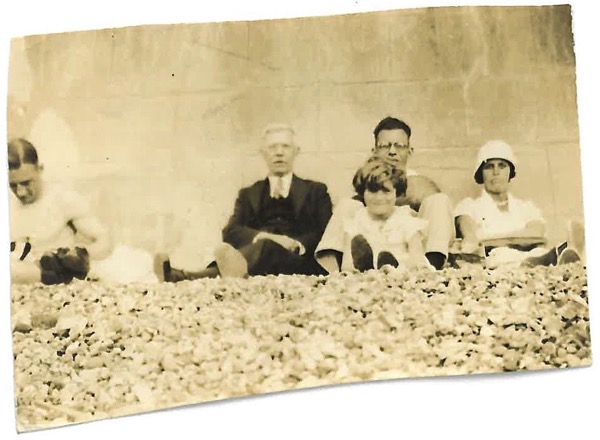
James Ward enjoys a trip to the beach dressed in a three piece suit
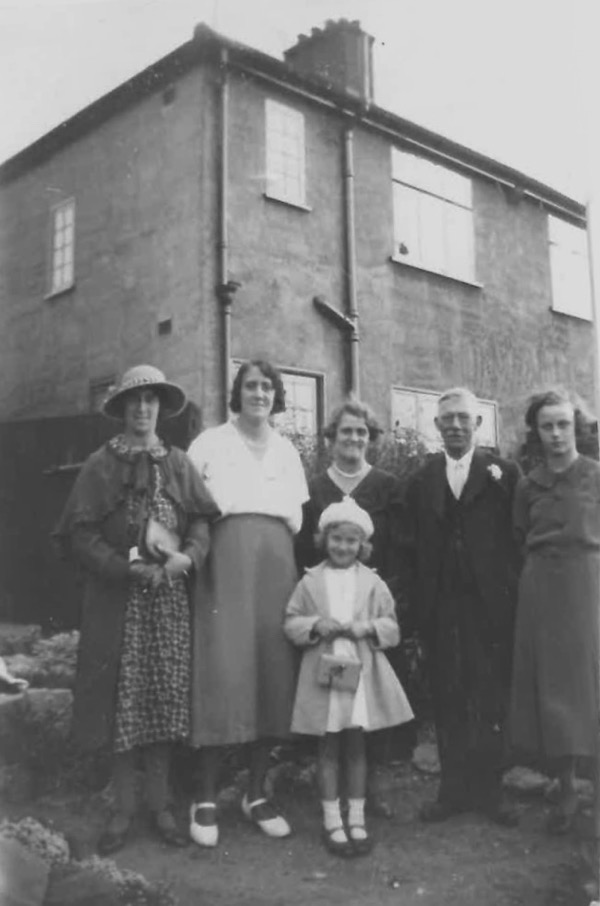
A family group during the Second World War with James Ward second from right
You may also like to read
Memoirs Of William Henry Knapp
While the Gentle Author takes a holiday, we are celebrating the joys of the season with a HARVEST SALE, selling all our books at half price so you can treat yourself and your friends and family. Simply add code ‘HARVEST’ at checkout to claim your discount.
CLICK HERE TO VISIT THE SPITALFIELDS LIFE BOOKSHOP
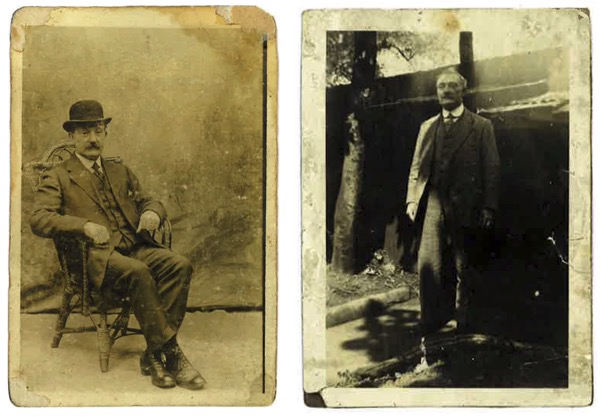
William Henry Knapp
Jeanette Crawley sent me her transcript of ten pages of a memoir written in 1935 by her great-grandfather William Henry Knapp (1872-1952), describing his early life working in the City of London for a Provisions Merchant at the end of the nineteenth century.
You might assume that the work of a City delivery boy was mundane, yet William delivered breakfasts to condemned prisoners at Newgate, tangled with Secret Service agents and attended executions. ‘Every day was of interest,’ he concluded retrospectively.
I first saw the light on the 27th July 1872 at 73 Carter Lane, London EC2, formerly Shoemakers Row. My father was employed at the above address for forty-five years in the manufacture of tobacco etc and was resident for thirty-two years past, at the place where I grew and noted the ever-changing aspect of the City proper.
At that time, cabs plied for hire and buses made their regular call at such places as the Mansion House and other notable buildings. I also well remember the extra horse ridden by a boy to help pull the bus up Ludgate Hill – what a contrast to the present day.
I attended the local infant school and rose by gradual stages until it was time for lessons on a higher plane and I graduated to St Thomas Charterhouse, a school of sound teaching and hard and fast rules. I see today in my mind’s eye – fifty-four years after – the urbane and full-bearded headmaster, Mr Smith, who in turn was well supported by most efficient class masters Mr Wallace, Mr Cose etc. who were there to teach and no nonsense. I also well remember that a cane was provided but never shared. In my day, recreation consisted of just the bank holiday and two weeks in the summer – what a contrast. As regards the education then and now – well, I will not give it a voice but just think it.
Home life was very regimented and, as I see things today, distinctly correct and helpful to shaping of the lives, creating and fitting us as men and women for the life to be. Parents were eminent and ruled as parents should.
During my school days many great events happened. The Tay Bridge disaster, the Nile expedition, Boer War and later the African War, etc. etc. All very terrible in their way and I well remember seeing the return of some of the guards who fought in their regimentals in those days and were bespattered with blood and dust. In spite of leaving, still the war game goes on.
Now I get along to the age of fourteen years, the usual time for launching out to get one’s own living. I well remember, after a domestic episode in which my father and myself were the chief factors, he giving his dictum that I must find work inside two days or go back to school and, as I preferred the former, I got going and obtained a situation in a house which I served truly and well for over five years.
I can visualise the employer – my ideal of a real man – questioning me as to my own ability for work. Among the questions put was how much can you carry? So, sticking out my chest, I answered ‘Three quarters of a hundredweight, Sir,’ and from that day onward, during my junior capacity, I was well loaded each time I went delivering.
I would point out that we had no trollies, trucks or tricycles, but just a tray containing goods on which I carried the weight of which often totalled a hundredweight and had to be delivered in rotation to the numerous customers. The title of the firm was Sherwood & Vesper Provision Merchants, 45 Ludgate Hill, London EC2, that was controlled by George Beach Newman and to him I owe my knowledge of the Provision Trade.
My start in life was eight shillings per week for thirteen hours a day, and I recall my father’s question, ‘Where are your wages?’ I proudly placed same in front of him. He then decided that I would hand four shillings to my mother, place two shillings and sixpence in the bank and retain one shilling and sixpence for myself and buy my own clothes – what a proposition for a youth of today.
One of the duties, during my first years, was to take in the last breakfast of the condemned in Newgate Prison. That came about by the fact that we served the celebrated firm of Ring Brymer, the City Caterers, and through them it became my duty to deliver such necessaries.
During the five years with my first firm, many incidents occurred that have been imprinted on my mind, such men as Alderman Treelawn, Sir John Bennett and local characters like W. Straken, the Ludgate Hill Stationers, the sons of the latter were in everyday touch with me and his daughters had a smile for me. For, behold, I was by that time junior clerk and cashier and, as such, received the esteem of the above.
Leading up to those years was the memory of the Phoenix Park Murders and, after the trial, the chief culprit Brady and others were executed at Newgate. Carey the informer was acquitted, receiving a free pardon and I believe a solatium from the British government and free passage to Australia. A destination he failed to reach because he was followed on board the vessel and shot by a man named O’Donnell who was brought back to England and executed at Newgate. As a small boy at that time, I remember among the crowd outside was brother of O’Donnell who, when the black flag went up, excitedly shouted, ‘My brother died bravely’ and, but for the police protection, would have been roughly handled.
Ireland was a mass of trouble in those days and their next actions to voice their demand for Home Rule was the deputing of members of their secret Clan to blow up many important and Public buildings in and about London with dynamite. I well remember many members of the Clan were captured in a house in Nelson Sq, Blackfriars Rd, but, from that time and onwards, there was a reign of terrorism which put the authorities at their wits end.
And, while touching on this subject, I now come to the time when I, in the capacity of junior clerk at Ludgate Hill, was the unconscious messenger and bearer of news of great portent as between the celebrated Secret Service agent Major Le Caron and the British government. The Major was the chief of the Fenian organisation on the American side and his good work between the two countries helped in a large degree to stamp out the Fenian menace. But, from the time of his leaving America for England, he went in daily fear of his life and was guarded wherever he went, and what he could not openly do, I did through my employer Mr Newman.
The connection of the aforesaid was – as under my employ – my employer’s name was George Beach Newman, Le Caron’s real name was William Beach and they in turn were the cousins of the celebrated Jam Manufacturers T.W.Beach. So you see, by their aid, Le Baron was able to distribute his knowledge and not forced to be his own messenger.
His career as Secret Service man was very valuable and I had grown into manhood when next I saw him, by chance, seated in a carriage on his way to Hastings which also was my destination. I did hear, just a few years afterwards, of his death and, as his age was somewhere in his fifties, he died comparatively a young man.
My first working years were very interesting as well as being hard-working and, as a man today beyond the sixty mark, I can think of the romance attached to my first job necessitating my calling at some of the most important buildings, firms and institutions in the City. Some are demolished or out of date but just a few remain and I can recount from memory a few of the places and firms.
My old firm was on Ludgate Hill, next St Martin’s Court, which is bordered on one side by the well known City Stationers, W. Straker. While I have him in mind, I must tell you that his first start in life was sitting in a small window in the left hand corner of St Paul’s Church and printing visiting cards at so much per hundred while you wait. In his case, one can quote the old adage, ‘nothing succeeds like success.’ What a character he was, good features, curly grey hair, immaculately dressed. If he ever wore a hat, it was of the sombrero type worn at a rakish angle, with a silk coat, plush waistcoat and very pronounced black and white check trousers. In his spare time, on bright days, he would parade the pavement near or about his premises and people naturally asked, ‘Who’s that?’ He was a city character once seen could never be forgotten.
At the extreme end of St Martin’s Court stood what we boys called the old London Wall – a mass about forty feet by ten and possibly the position of the ancient Lud Gate, one of the many gates protecting the City. I well remember with the tools of those days it took considerable time to demolish it.
Harking back to my birthplace, the room above the factory in which I was born, stood on the old site of Blackfriars Priory and close handy was also the Church of St Anne’s Blackfriars, destroyed in the Great Fire of London but never rebuilt, where is a grand playhouse to this day and, upon that site, stood Shakespeare’s Blackfriars Theatre. All that remains today of that particular site is the Old Apothecaries Hall, where I have seen the giant spit support a whole Bullock.
My early work took me to the halls of all the great City companies and I was always impressed by their stately grandeur, and many a tasty morsel has come the way of yours truly – for my work took me right into the kitchens to see his highness the Chef, who reigned supreme in all matters pertaining to food.
When the factory buildings adjacent were demolished, the workers came across the old foundations of the priory and many interesting finds were made including some thousands of arm and leg bones and skulls. I think it was conjectured at the time that there were remains of old Friars or a collection of remains from the Great Fire.
We now retrace to Ludgate Circus where stands the King Lud public house, very famous in its day. On the opposite side, Q.Dells the Phrenologist who placated his windows with leaflets on his knowledge of the human brain and was also another of the City’s characters.
My firm found every public house of note to Temple Bar and – possibly the best house of all still remains – The Old Cheddar Cheese, in those days run by another notability, Beauford Moore. I had the honour of delivering the real Cheshire Cheese that stood on the public house bar for all and Sundry to taste.
In Cornhill stood the firm of Ring & Brymer, the most noted of all City Caterers, where Turtle Soup was made from real turtles. I have seen them myself delivered by the vanload and no other firm at that time knew better how to serve up and prepare a banquet than they. When I review those days bygone – what an account – one regular order alone was forty pounds of Harris’s bladders of lard and, during the year, an order for two hundred and fifty York Hams and always ten special hams for the Lord Mayor’s Banquet.
Their weekly order averaged about fifty pounds, payable every Friday morning. This would make the mouths water of tradesmen today. At that time, the Mansion House used to have its own kitchen and staff. The chef was supreme, his name sounded to us like ‘Shrubshole.’ The housekeeper on many occasions handed me some titbit with a kindly, ‘Would you like this, sonny?’ and sonny did, you bet!
There is one more episode of my early days on Ludgate Hill and that was the coming to my old firm – just before Christmas time – of fine grand elderly gentlemen who were the principals of Courage’s, the Brewers which at that time was termed ‘Tomkins, Courage Cracknel & Co.’ Those five gents used to select and taste from two hundred and fifty to three hundred Stilton Cheeses to give away as Christmas presents. Each and every one of them had to be packed there and then, under their watchful eye, and labelled to Mr or Mr so-and-so. There they sat around an improvised table, tasting cheese, drinking some celebrated Courage’s Stout and munching Bath Water Biscuits. A sight for the Gods, and I doubt if it will ever occur again in the Provision Trade. These reminiscences are as good as a tonic to me. In spite of hard work and long hours, every day was of interest.
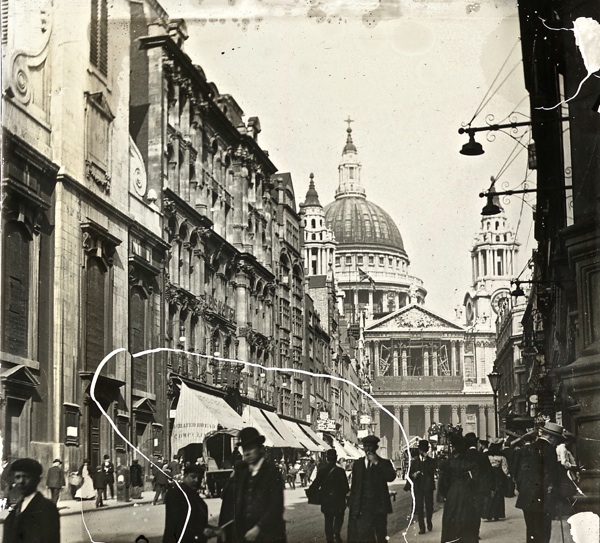
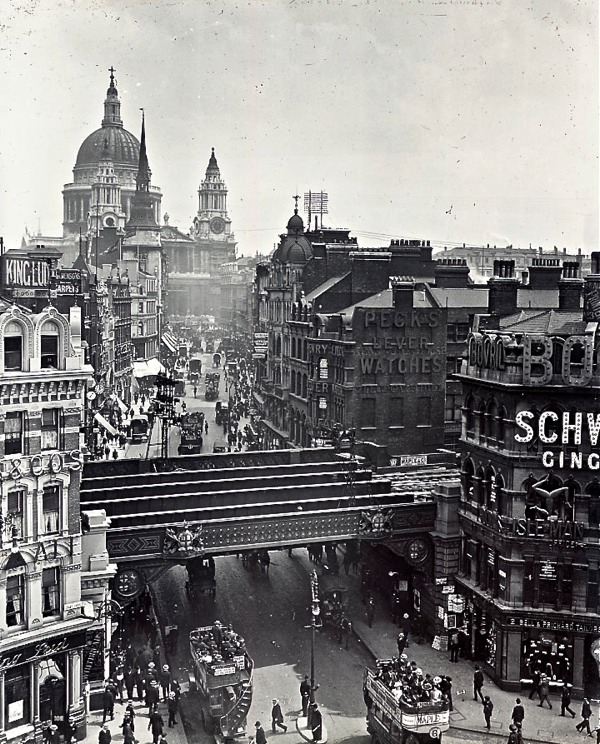
Photographs of Ludgate Hill courtesy of Bishopsgate Institute
Henrietta Keeper’s Photographs
While the Gentle Author takes a holiday, we are celebrating the joys of the season with a HARVEST SALE, selling all our books at half price so you can treat yourself and your friends and family. Simply add code ‘HARVEST’ at checkout to claim your discount.
CLICK HERE TO VISIT THE SPITALFIELDS LIFE BOOKSHOP

Henrietta Keeper, Singer
Henrietta Keeper (widely known as “Joan”), the vivacious octogenarian ballad singer who performed at E.Pellicci in the Bethnal Green Rd on Fridays, once invited me to round to her tiny flat to show me her remarkable collection of photographs and meet her daughter Lesley, custodian of the family album.
These pictures show Henrietta’s life as it existed within a small corner of the East End on the boundary of Spitalfields and Bethnal Green in the nineteen fifties. On one side of Vallance Rd was Cranberry St where Henrietta’s mother-in-law Selina lived and took care of her daughters while the family waited for a house of their own. On the other side of Vallance Rd was Selby St where Henrietta’s husband Joe and his brother Jim ran Keeper & Co, making coal deliveries. And at the end of Vallance Rd was New Rd where Henrietta worked as a machinist at Bartman & Co making coats and jackets.
Having grown up in Bethnal Green during the war and brought her own family up though the austerity that followed, Henrietta was a woman of indefatigable spirit. Most remarkable of all, she sang throughout her life, winning innumerable singing competitions and giving free concerts.
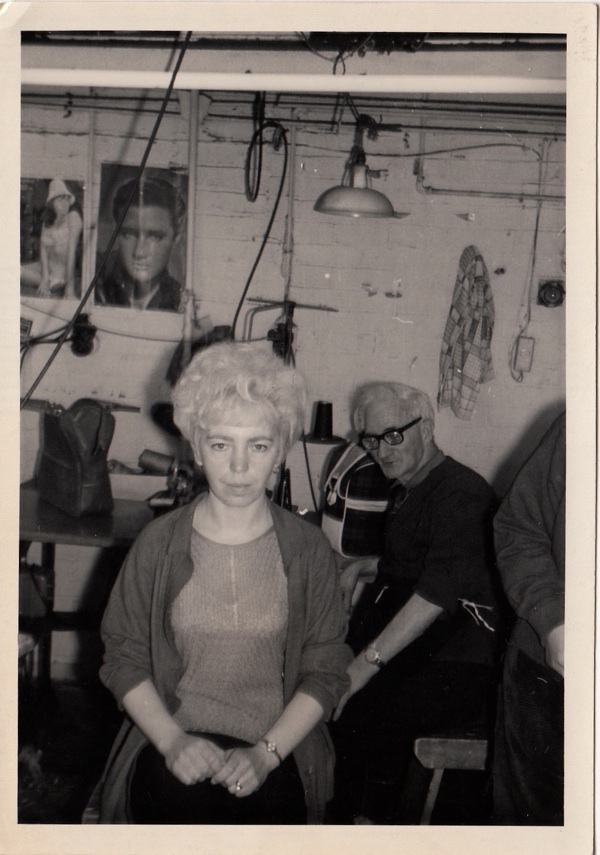
Henrietta with fellow machinist Izzie. “When I was nineteen I started here and I became the top machinist,” she explained, “I think my hair looks a bit like Barbara Windsor’s in this picture.”
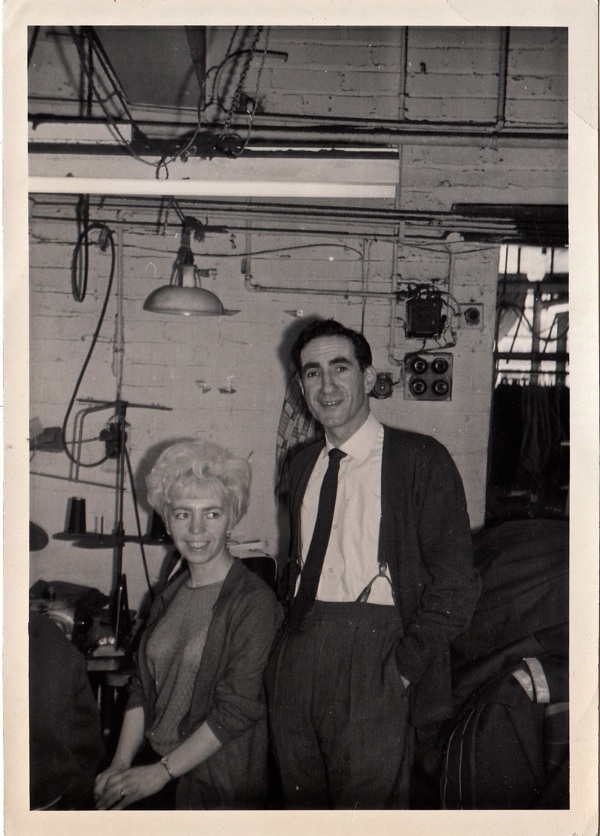
Henrietta with Mr Bartman at Bartman & Co.

“This is Selina Keeper, my mother-in-law at her house in Cranberry St. She was real Victorian lady. She used to whip the cup of tea off the table before you had finished it!” said Henrietta. And Lesley added, “She had a best front room that she kept under lock and key, and only once – when she unlocked it – did I go in, but she said ‘Get out!’ You couldn’t touch anything. It had to be kept perfect.”

“My husband Joe took this picture of his two best friends George Bastick and Leslie Herbert in Nelson Gardens next to St Peter’s Church, Bethnal Green. What a pity he isn’t in it?”

Coronation Day, 1953, celebrated at Hemming St, Bethnal Green. Lesley is in the blazer on the right hand side of the front row and Henrietta can be distinguished by her blonde hair beneath the Union Jack, peering round the lady in front of her.

“This is Jim Keeper, my brother-in-law, with his horse Trigger. My husband, Joe, worked with him and he had the biggest coal round in the East End – Keeper & Co. Joe was so strong he could carry a two hundredweight sack of coal on his back up the stairs of the buildings with ease. The brothers used to go home to lunch with their mum in Cranberry St and take Trigger with them. She always collected the horse manure for her roses while they were there and when the Queen Mother visited the East End, she leaned over the fence and said ‘This one should win best garden.'”

“Taken in 1947 at Southend, when I was twenty, this is Cathy Tyler, my sister Marie and me – I was known as Minxie at the time and we all sang together like the Andrews sisters. I was a bit shocked when I saw it because you can see I am pregnant. I thought, ‘Is that me?'”

Henrietta (far right) photographed with her workmates by a street photographer around Brick Lane during a lunch break in the fifties.

This is Henrietta’s daughter Lesley visiting Petticoat Lane with her grandfather James Keeper in 1953. “He was a delivery man with a horse and cart, they called it a ‘carman,'” Henrietta remembered, “he was also a cabinet-maker and he brought me beautiful polished wooden boxes that he made.”

Henrietta and her husband Joe with their daughter Lesley on a trip to Columbia Rd.

The two children on the right are Lesley and Linda Keeper playing at Cowboys and Indians with their friends in the nineteen fifties in Cranberry St while they lived with their grandmother. Lesley remembers Mrs Dexter across the road who called out “Play nicely on the debris!” to the children and you can see the bomb site where they played in the back of the photograph. Today Cranberry St no longer exists, just the stub of road beside Rinkoff’s bakery in Vallance Rd indicates where it once was.

Henrietta singing at a Holiday Camp at Selsey Bill in the nineteen sixties.
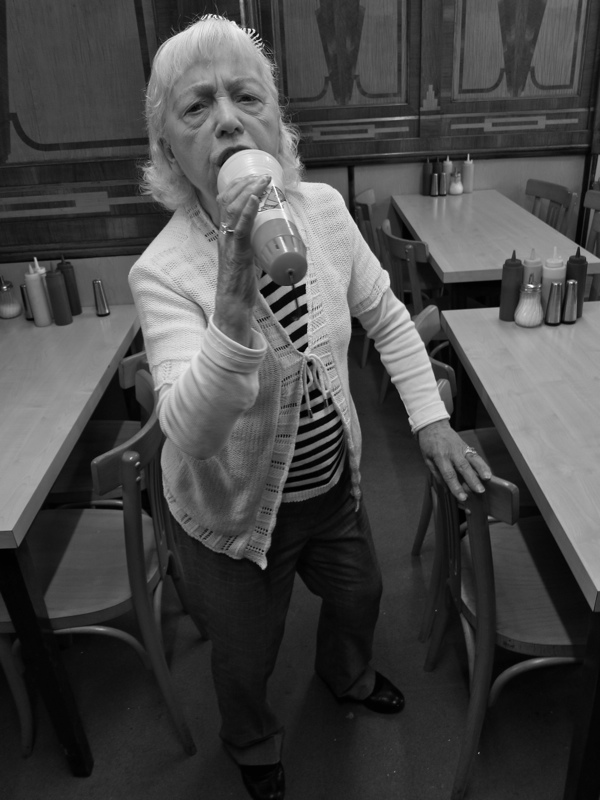
Henrietta singing at Pelliccis
You may like to read my original portrait
Tree Huts Of Epping Forest
While the Gentle Author takes a holiday, we are celebrating the joys of the season with a HARVEST SALE, selling all our books at half price so you can treat yourself and your friends and family. Simply add code ‘HARVEST’ at checkout to claim your discount.
CLICK HERE TO VISIT THE SPITALFIELDS LIFE BOOKSHOP
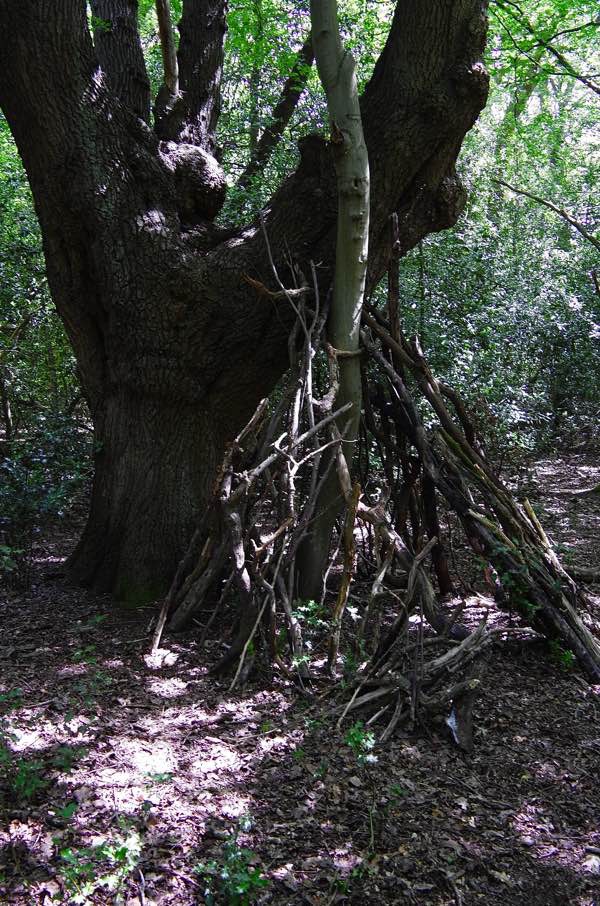
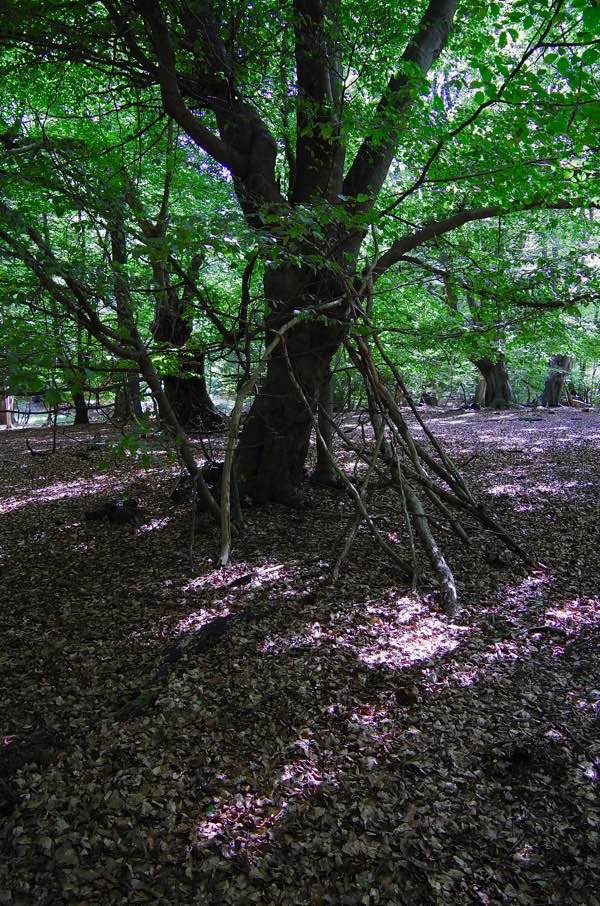
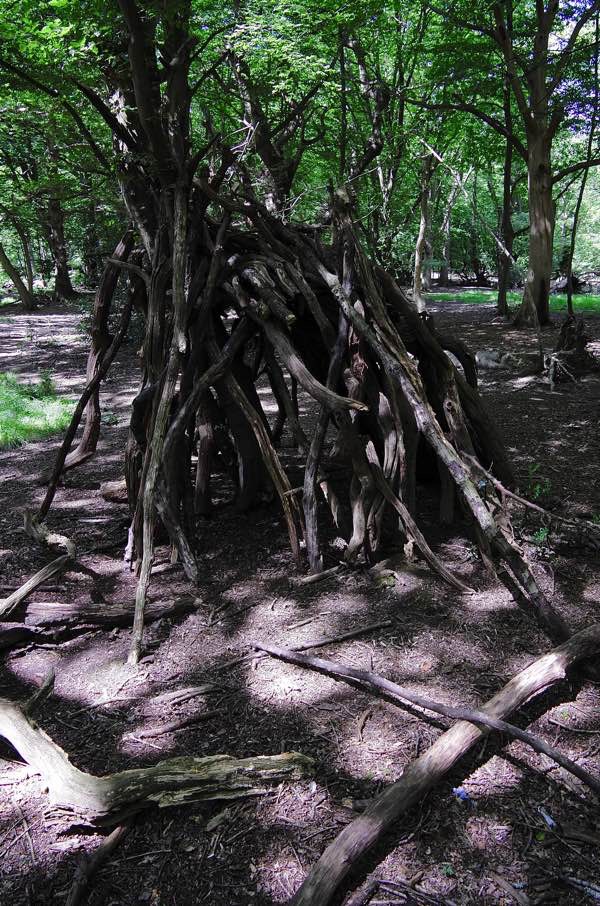
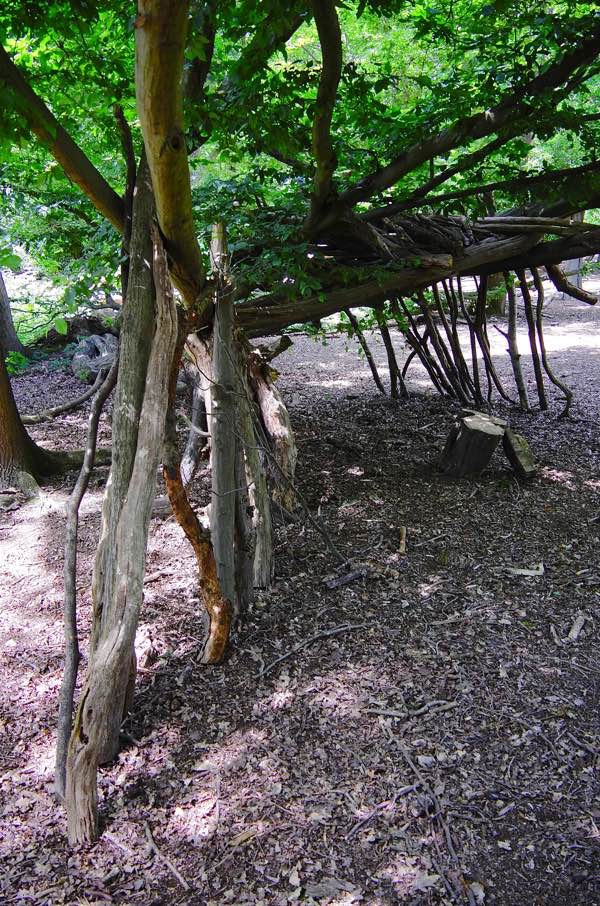
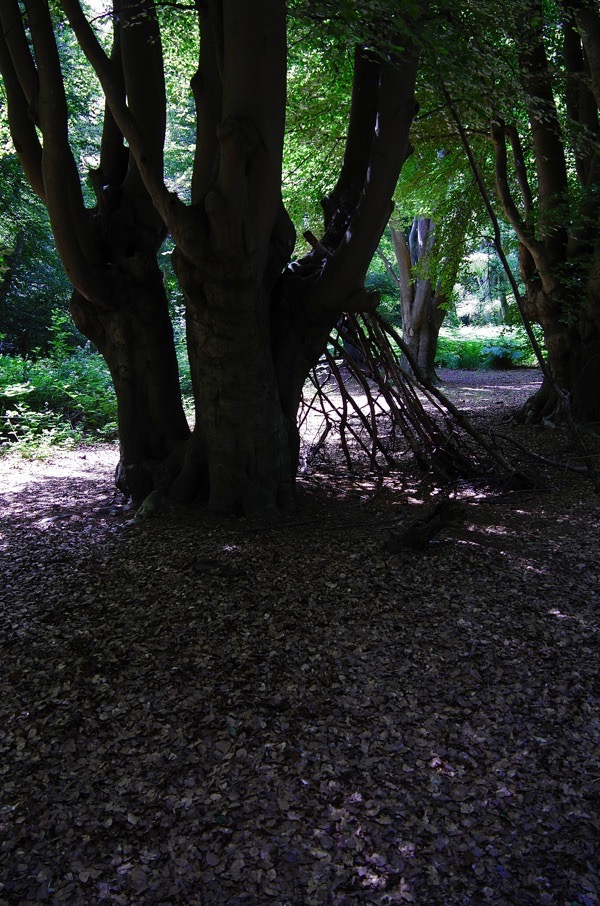
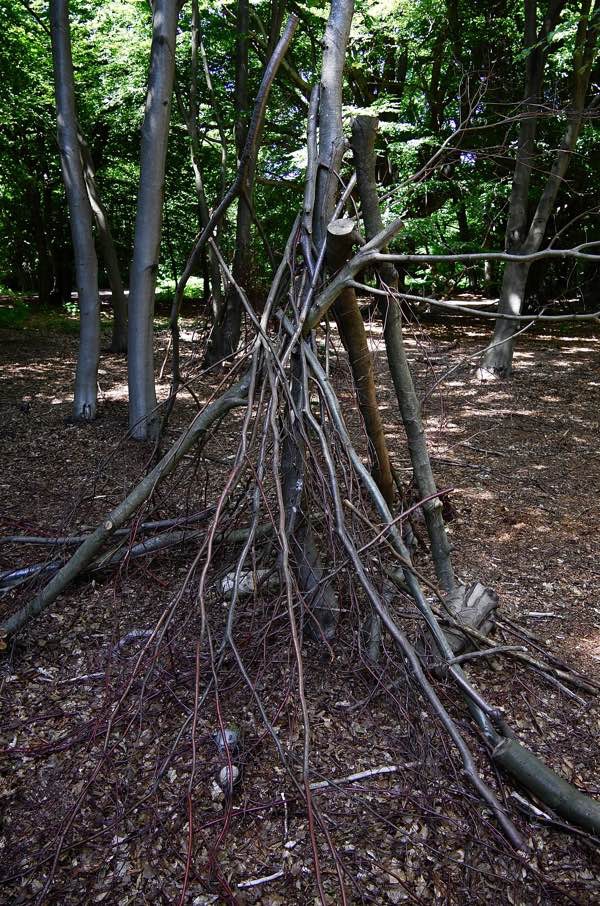
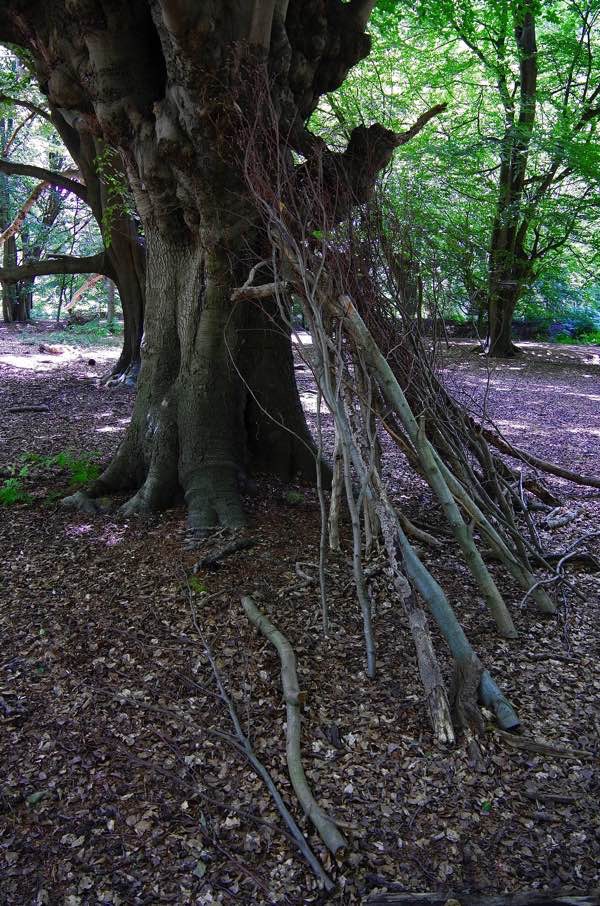
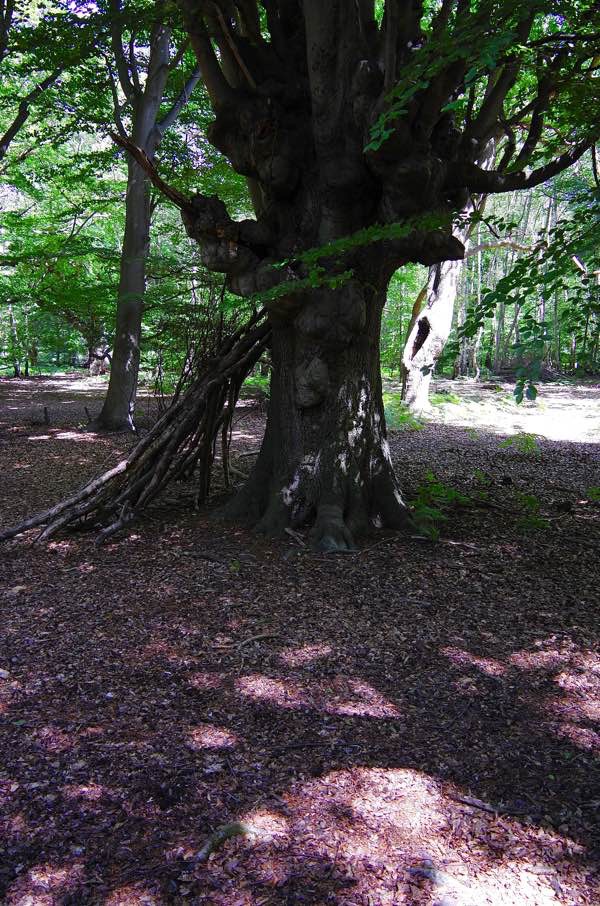
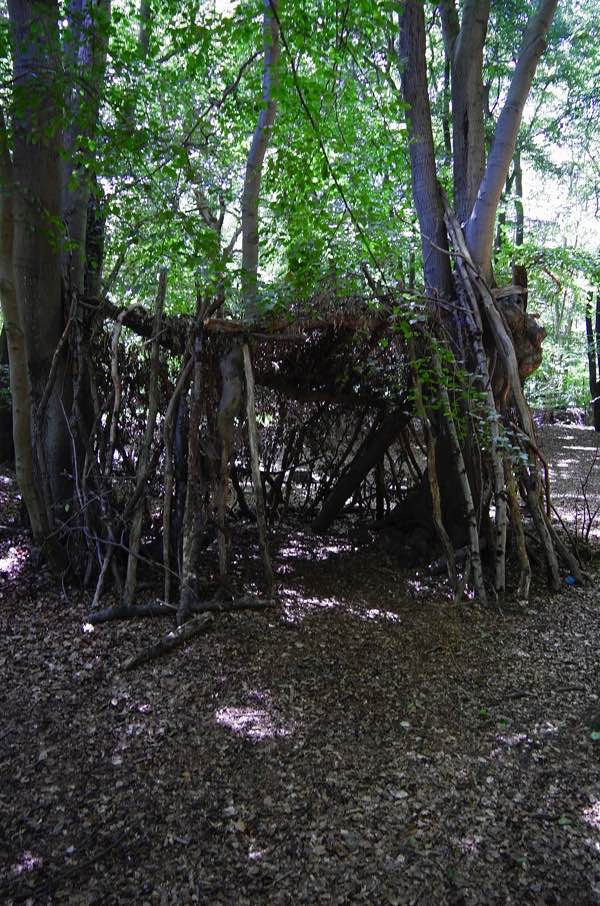
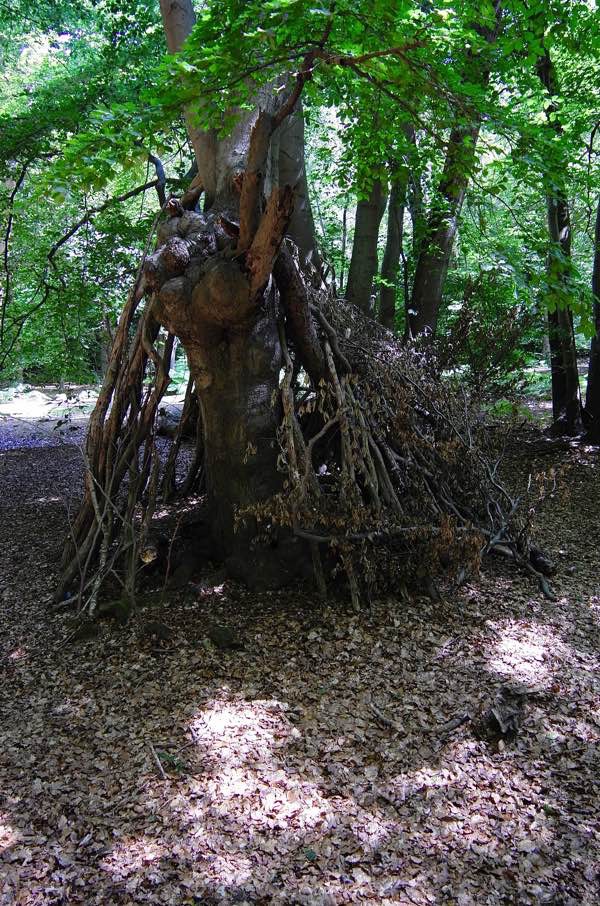
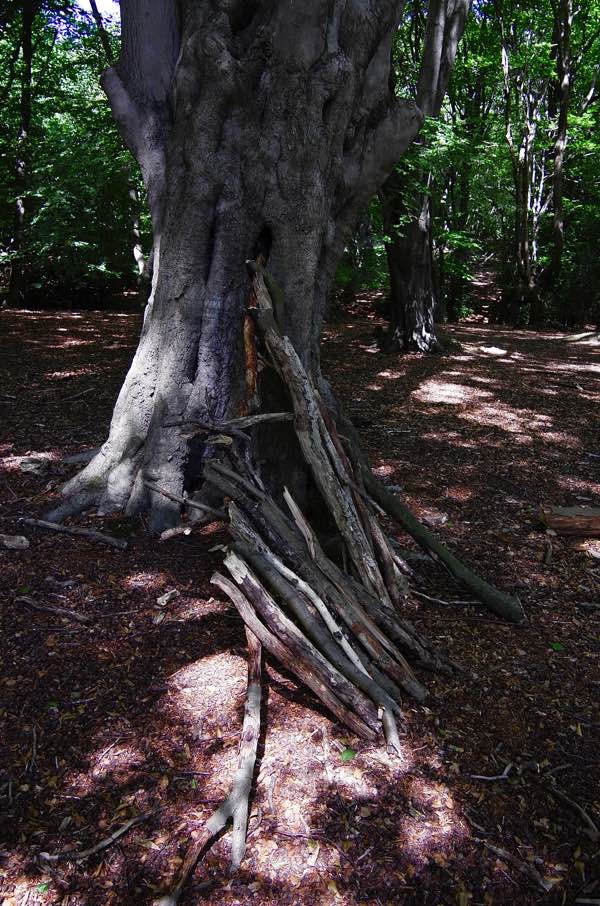
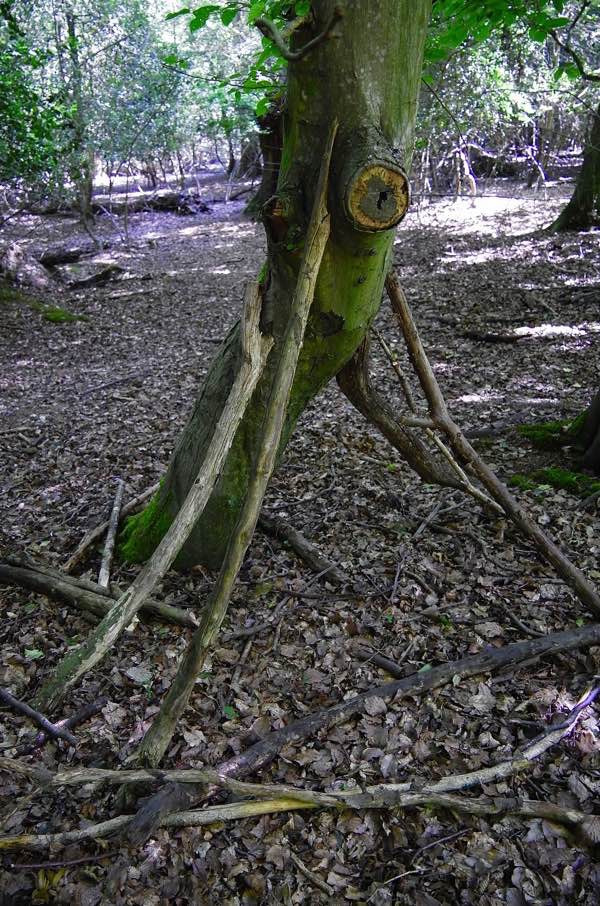
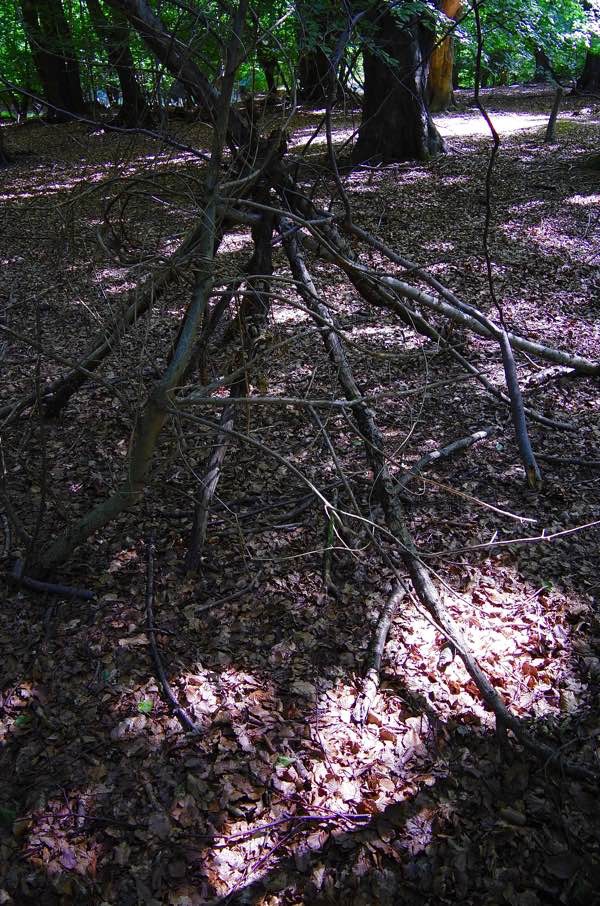
Who can resist the lure of the forest in summer? Since Epping Forest is a mere cycle ride from Spitalfields, each year I visit to seek refuge among the leafy shades. And, in the depths of the forest, I come upon these makeshift tree huts which fascinate me with the variety and ingenuity of their design.
Who can be responsible? Is it children making dens or land artists exploring sculptural notions? Clearly never weatherproof, they are not human habitations. I wondered if the sprites and hobgoblins had been at work constructing arbors for the spirits of the forest. But then I remembered I had seen something similar once before, Eeyore’s hut at the edge of the Hundred Acre Wood.
Some are elaborate constructions that are worthy of architecture and others merely collections of twigs which tease the eye, questioning whether they are random or deliberate. They conjure an air of ritualistic mystery and, the more I encountered, the more intrigued I became. So much effort and skill expended suggest deliberate purpose or intent, yet they remain an enigma.











You may also like to take a look at
My Quilt
While the Gentle Author takes a holiday, we are celebrating the joys of the season with a HARVEST SALE, selling all our books at half price so you can treat yourself and your friends and family. Simply add code ‘HARVEST’ at checkout to claim your discount.
CLICK HERE TO VISIT THE SPITALFIELDS LIFE BOOKSHOP
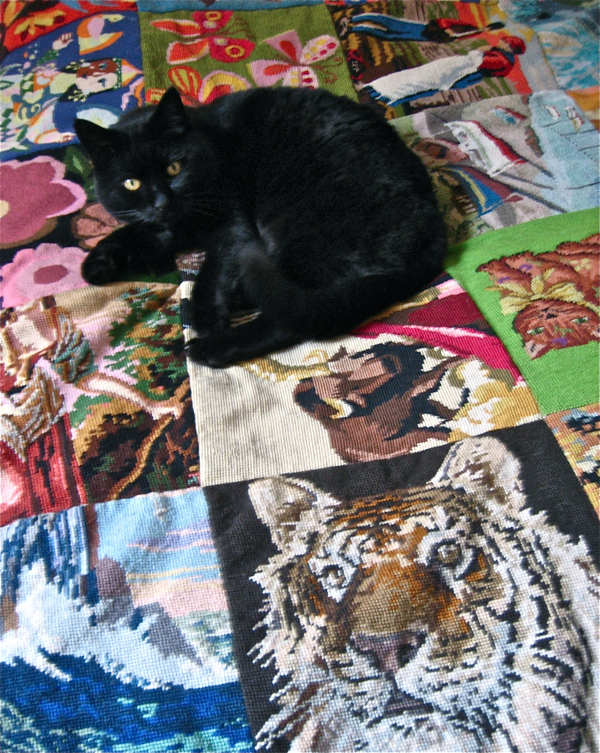
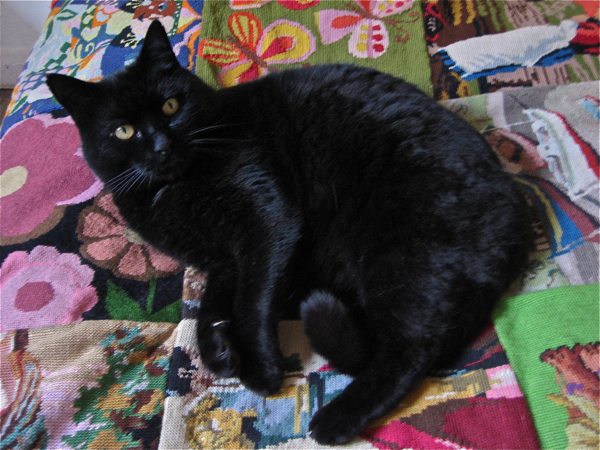
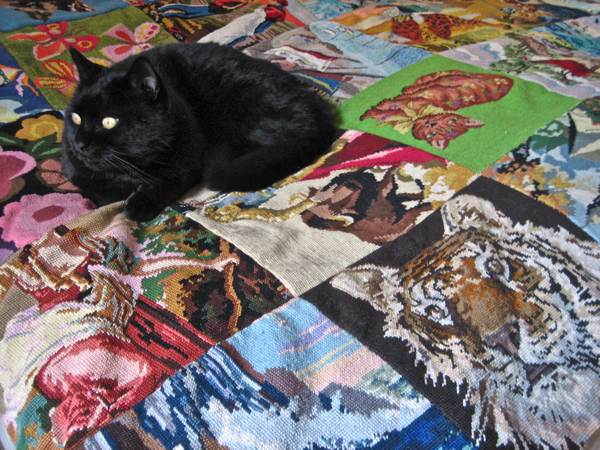
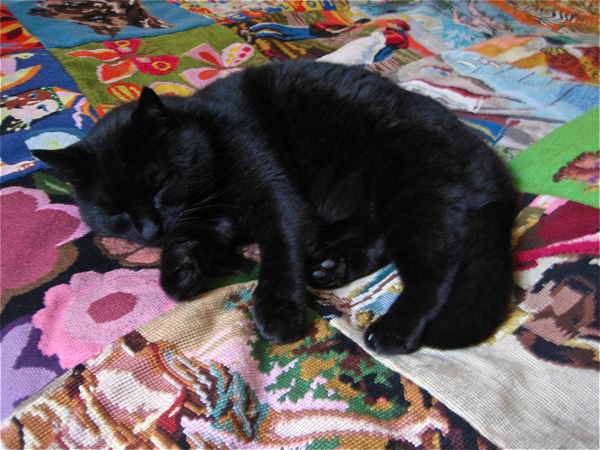
My old cat on my quilt
The great majority of my stories were written beneath this quilt that I made a few years ago and which has special meaning for me. Once dusk gathers on winter afternoons, I retreat to my bed to work, abandoning my desk that has become piled with layers of paper and taking consolation in the warmth and comfort under my quilt, as the ideal snug location to devise my daily compositions. When autumn enfolds the city and rain falls outside, I am happy in my secure private space, writing to you through the long dark nights in Spitalfields.
This is the only quilt I ever made and I make no claims for my ability as a stitcher which is functional rather than demonstrating any special skill. Once I made a shirt that I sewed by hand, copying the pattern from one I already had, and it took me a week, with innumerable unpicking and resewing as I took the pieces apart and reassembled them until I achieved something wearable. It was a beautiful way to spend a week, sitting cross-legged sewing on the floor and although I am proud of the shirt I made, I shall not attempt it again.
My quilt is significant because I made it to incarnate the memory of my mother, and as a means to manifest the warmth I drew from her, and illustrated with the lyrical imagery that I associate with her – something soft and rich in colour that I could enfold myself with, and something that would be present in my daily life to connect me to my childhood, when I existed solely within the tender cocoon of my parents’ affections. My sweetest memories are of being tucked up in bed as a child and of my parents climbing onto the bed to lie beside me for ten minutes until I drifted off.
For several years, after the death of my father, I nursed my mother as she succumbed to the dementia that paralysed her, took away her nature, her mind, her faculties and her eventually her life. It was an all-consuming task, both physically and emotionally, being a housewife, washing bed sheets constantly, cooking food, and feeding and tending to her as she declined slowly over months and years. And when it was over, at first I did not know what to do next.
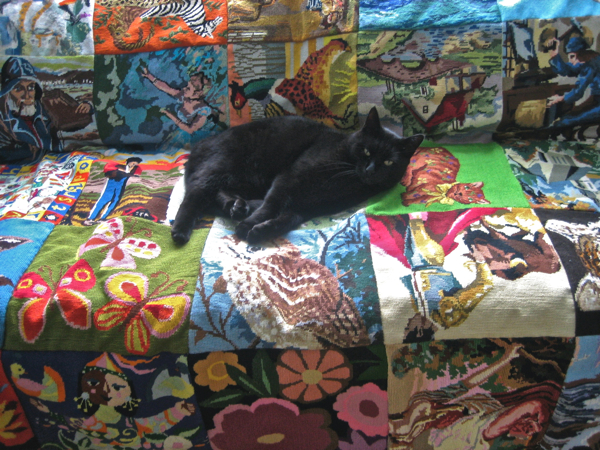
One day, I saw a woollen tapestry at a market of a fisherman in a sou-wester. This sentimental image spoke to me, like a picture in a children’s book, and evoking Cornwall where my mother was born. It was made from a kit and entailed hours of skillful work yet was on sale for a couple of pounds, and so I bought it. At once, I realised that were lots of these tapestries around that no-one wanted and I was drawn to collect them. Many were in stilted designs and crude colours but it did not matter to me because I realised they look better the more you have, and it satisfied me to gather these unloved artifacts that had been created at the expense of so much labour and expertise, mostly – I suspected – by old women.
I have taught myself to be unsentimental about death itself, and I believe that human remains are merely the remains – of no greater meaning than toenails or hair clippings. After their demise, the quality of a person does not reside within the body – and so I chose to have no tombstone for my parents and I shall not return to their grave. Instead, through making a quilt, I found an active way to engage with my emotion at the loss of a parent and create something I can keep by me in fond remembrance for always.
I laid out the tapestries upon the floor and arranged them. I realised I needed many more and I discovered there were hundreds for sale online. And soon they began to arrive in the mail every day. And the more I searched, the more discriminating I became to find the most beautiful and those with pictures which I could arrange to create a visual poem of all the things my mother loved – even the work of her favourite artists, Vermeer, Millet, Degas and Lowry, as well as animals, especially birds, and flowers, and the fishing boats and seascapes of her childhood beside the Cornish coast.
Over months, as the quilt came together, there with plenty of rejections and substitutions in the pursuit of my obsession to create the most beautiful arrangement possible. A room of the house was devoted to the quilt, where my cat came to lie upon the fragments each day, to keep me company while I sat there alone for hours contemplating all the tapestries – shuffling them to discover new juxtapositions of picture and colour, as each new arrival in the mail engendered new possibilities.
The natural tones of the woollen dyes gave the quilt a rich luminous glow of colour and I was always aware of the hundreds of hours of work employed by those whose needlecraft was of a far greater quality than mine. After consideration, a soft lemon yellow velvet was sought out to line it, and a thin wadding was inserted to give it substance and warmth but not to be too heavy for a summer night.
It took me a year to make the quilt. From the first night, it has delighted me and I have slept beneath it ever since. I love to wake to see its colours and the pictures that I know so well, and it means so much to know that I shall have my beautiful quilt of memories of my mother to keep me warm and safe for the rest of my life.
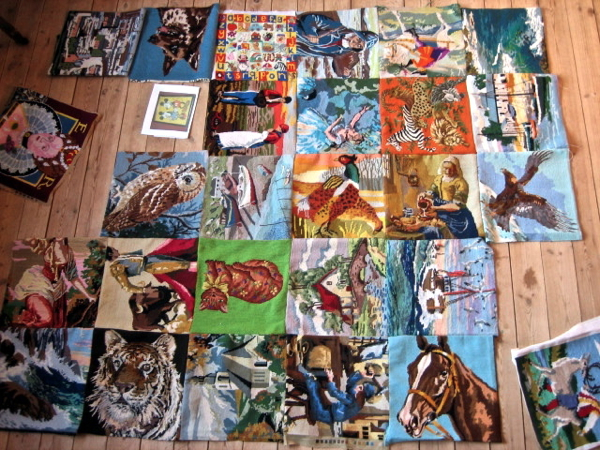


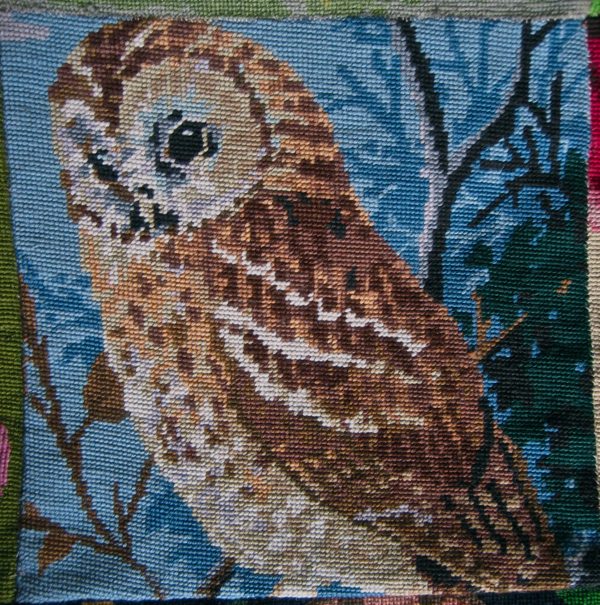
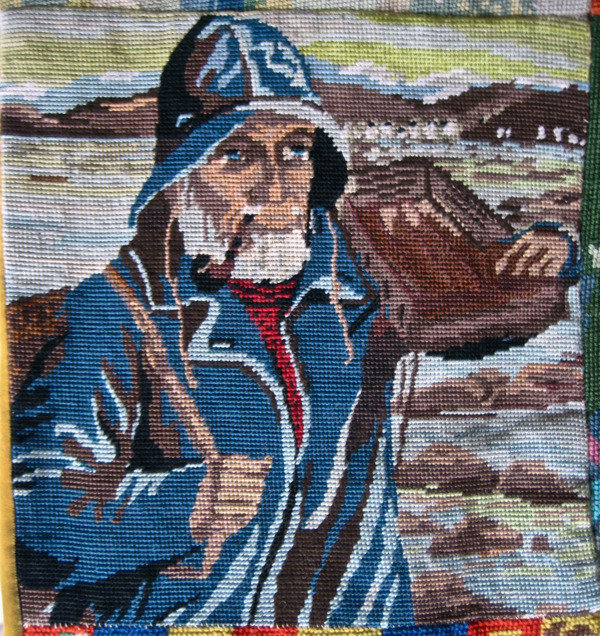
The first tapestry I bought.
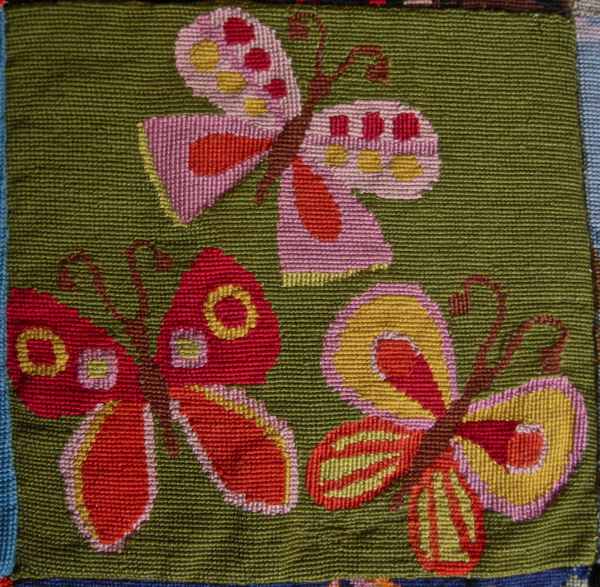
Seventies silk butterflies from Florida.

From Thailand.
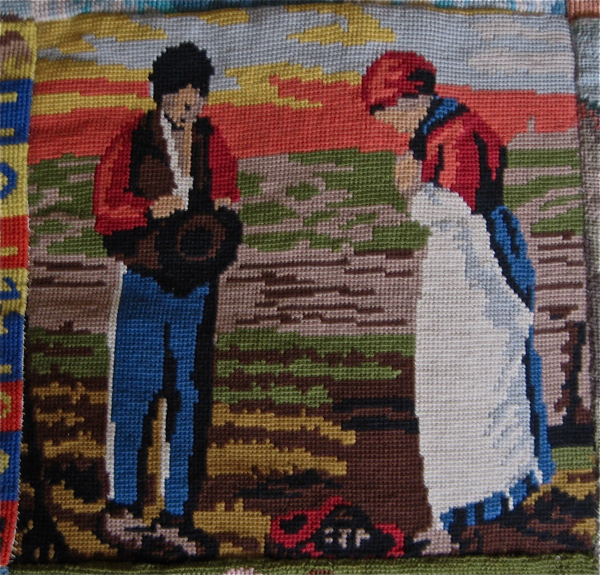
My grandmother had a print of Millet’s “The Angelus” in her dining room for more than sixty years.

Note the tiny stitches giving detail to the lion’s head in this menagerie.
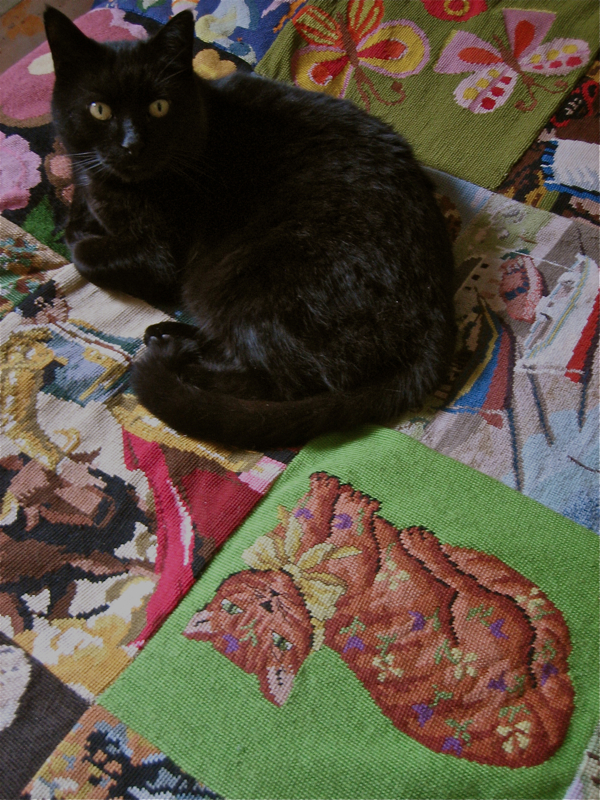
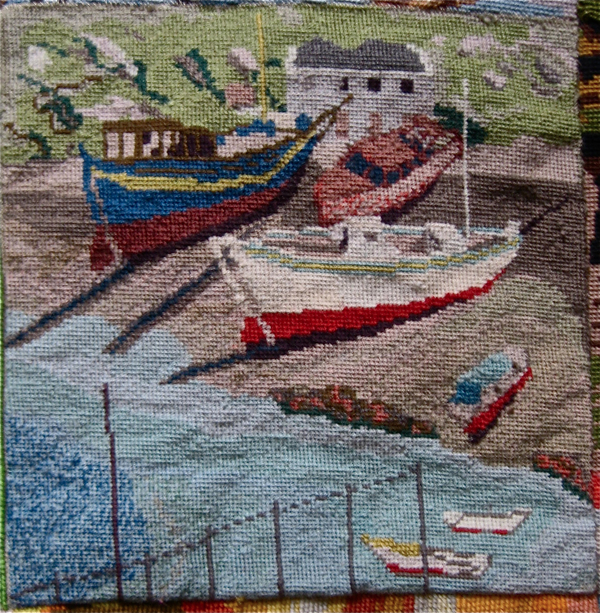
A unique tapestry from a painting of a Cornish fishing village.
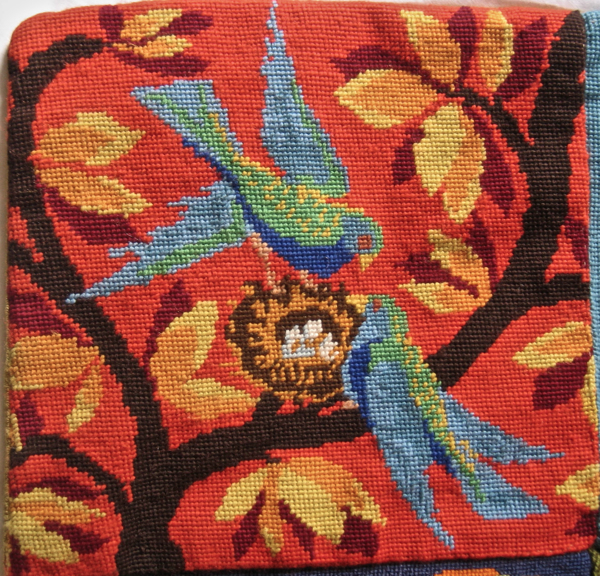
From the Czech Republic.

These squirrels never made it into the quilt.
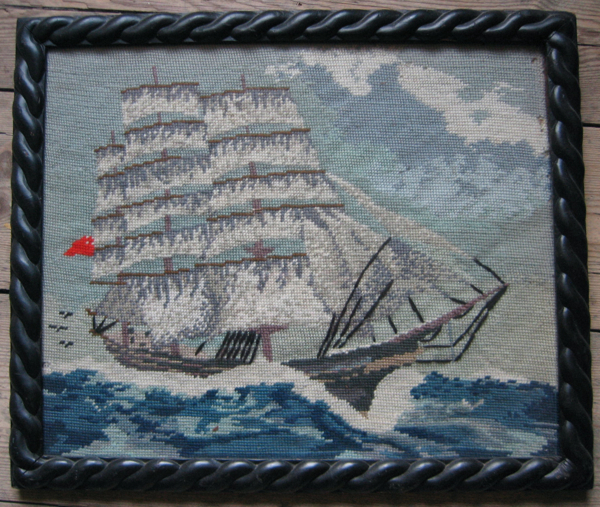
I could not take this wonderful seascape from its frame, it hangs on my bedroom wall today