An Old House in Whitechapel

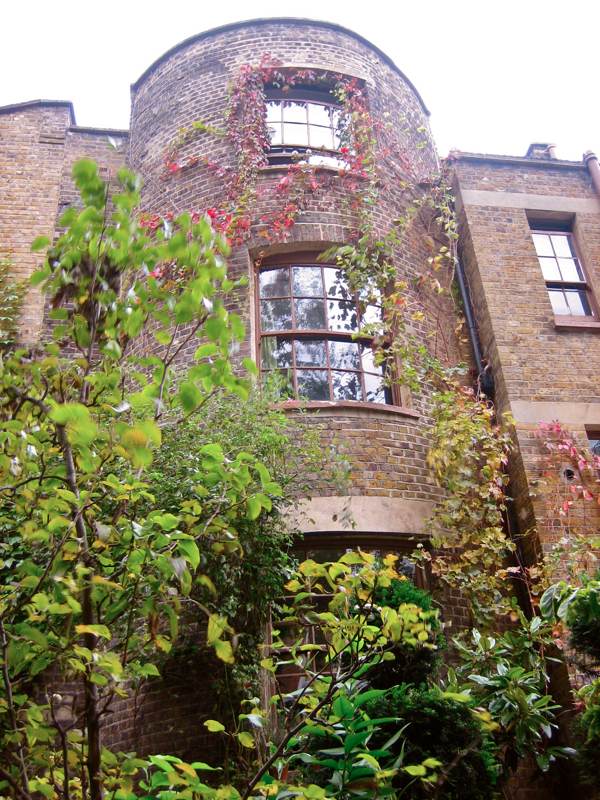
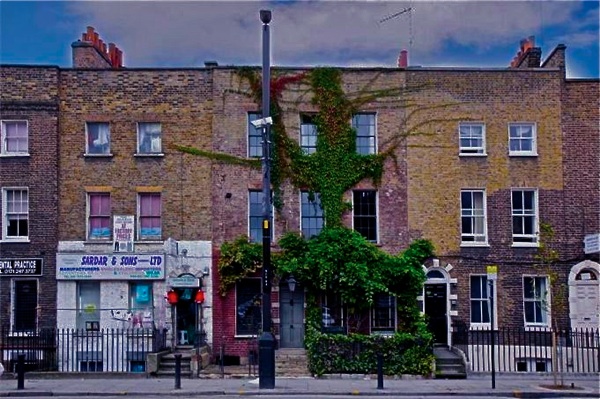
There is a magnificent old house in New Rd in Whitechapel, rich in patina and heavy with creepers, yet surrounded on either side by offices and workshops. It appears an untouched survival from an earlier age, and I half-expect to see an old, old man climbing the worn steps, the original resident of the house where nothing has changed. He is now over two hundred years old and oblivious to the transformation in the world around him. I shall call him Mr Redman.
New Rd follows the line of a rampart constructed as the Eastern defence of the City of London at the time of the English Civil War, and the Whitechapel Mound – which formerly stood upon the site of the Royal London Hospital and to which some infer mystical significance – was a bulwark attached to this earthwork. Around 1750, the rampart was flattened and laid out as New Rd where speculative builders constructed terraces and sold them to sea captains and merchants from the nearby docks. Gloucester Terrace, containing the old house in question, was built in 1797 – facing fields to the East and with mews to the rear, both gone long ago.
The first recorded owners in the early nineteenth century were the Redman family who made their living in the shipping business. They had three sons – a sea captain who became one of the elder brethren at Trinity House on Tower Hill, another who was a ship owner and a third who started a chandlery business in the basement kitchen, establishing independent premises for his enterprise in the 1840s. By the 1850s, the family had prospered and moved to Kentish Town, and by the 1880s the house was Jewish owned, as the surrounding streets became a ghetto for those fleeing for their lives from Eastern Europe. The ground floor was opened up as a tailoring shop and through the twentieth century the upper floors also became clothing workshops as Pakistanis and then Bengalis arrived, creating a reputation for New Rd as the prime location for the manufacture of school uniforms.
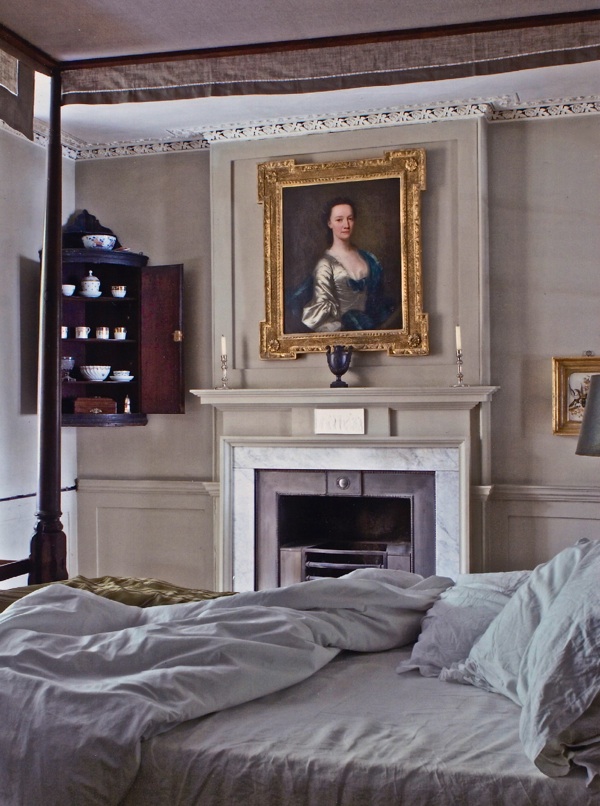
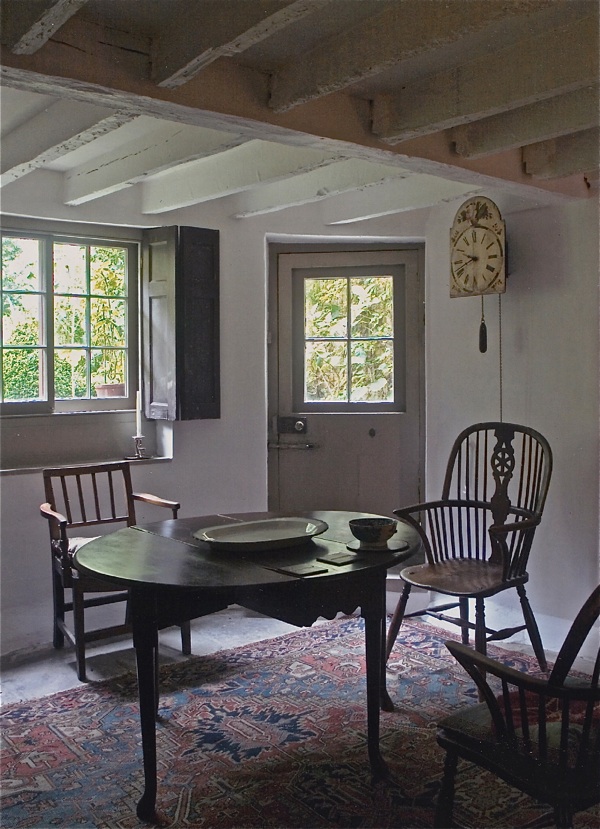
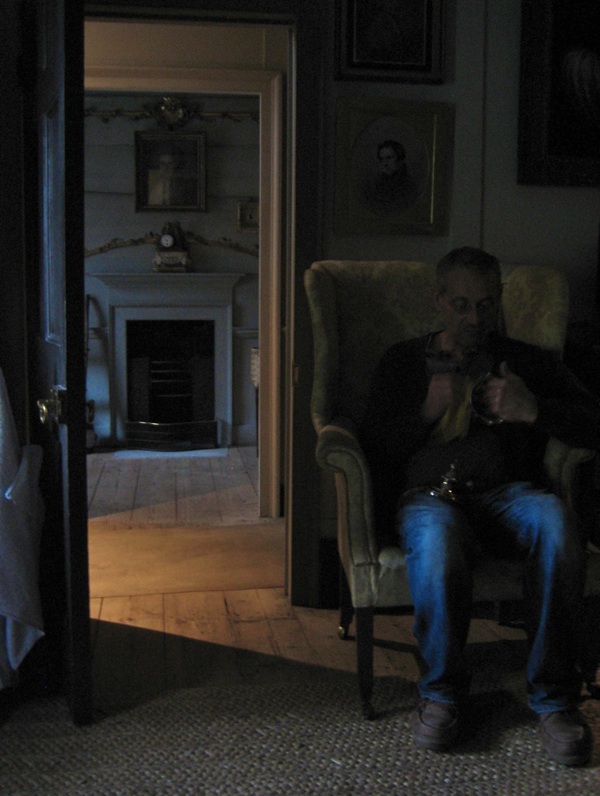
When Tim Whittaker, director of the Spitalfields Trust, bought the old house from a maker of twin sets, it had not been inhabited for more than thirty years. Tim took up the nineteenth century floorboards on the ground floor, laid down when it was converted to a shop, and he found the worn Georgian floor beneath, with lines that indicated the former position of the partition walls, allowing him to reinstate them in an arrangement close to the original. With a lifetime’s experience of working with old buildings, both for the National Trust and more recently in Spitalfields, Tim set out to make no impositions upon the house and, after ten years of renovations, his achievement is to have restored it as a seamless whole.
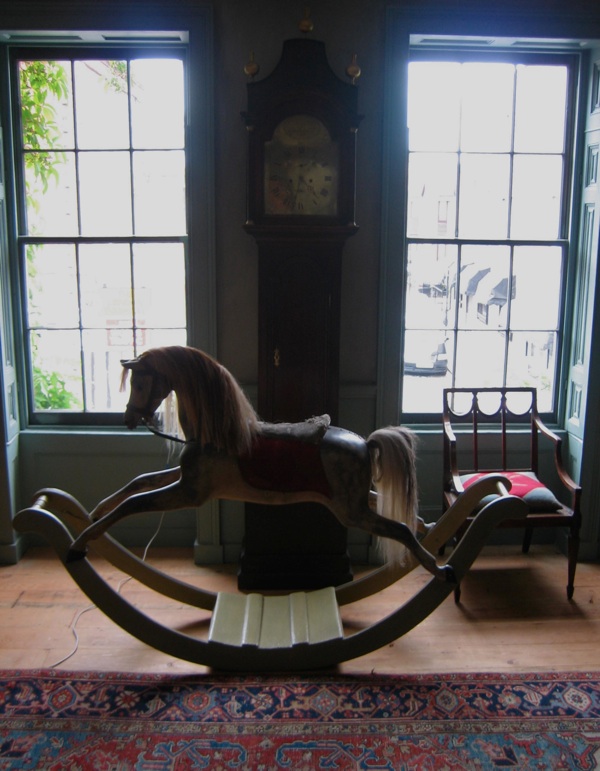
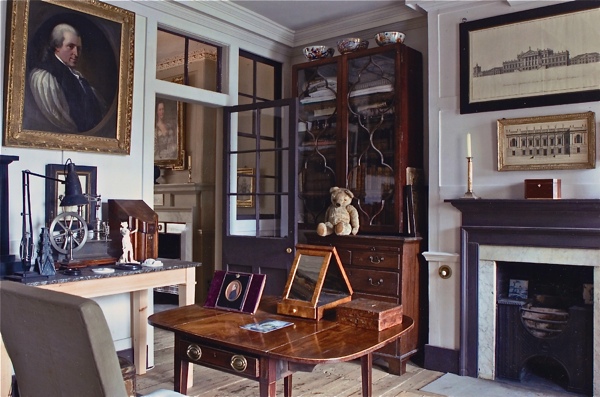
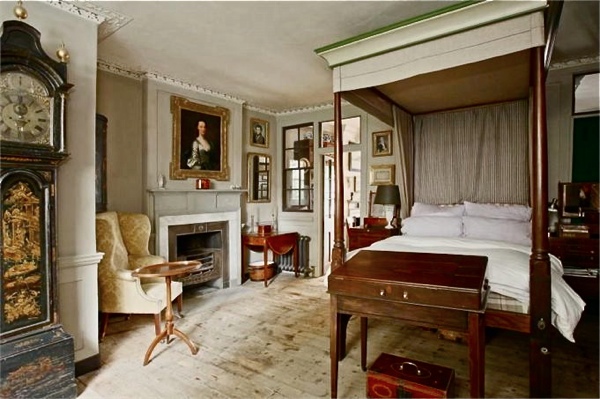
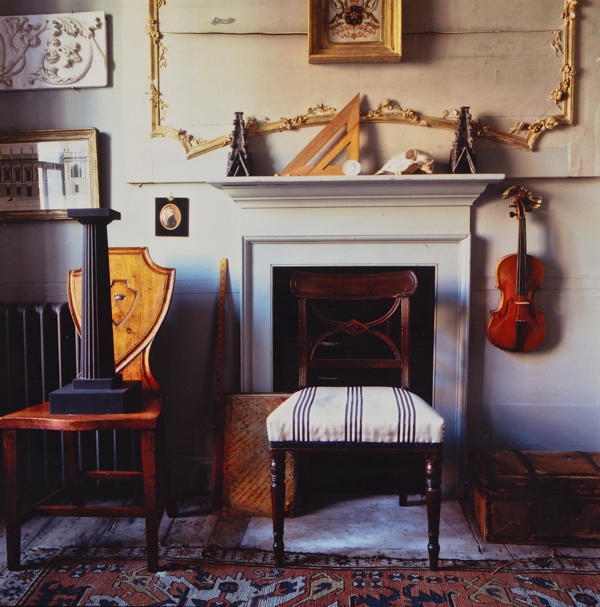
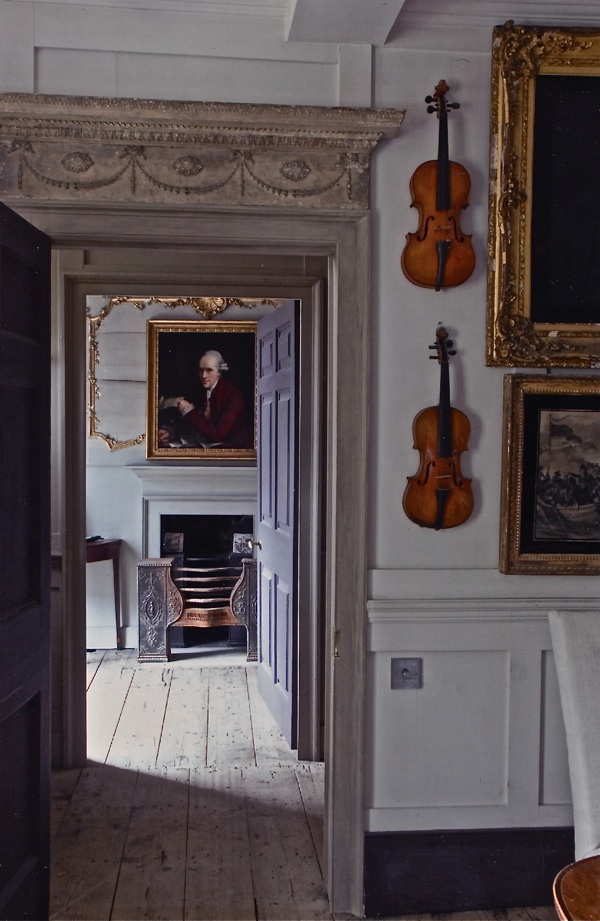
With a trained eye, Tim sought to replace the missing fireplaces with suitable examples of the period and where possible he used salvaged timbers to harmonise with the textures that two centuries of use have imparted to this dignified old edifice, which has been both workplace and dwelling. Offering interesting, idiosyncratic spaces and subtle eye-catching detail, this was never a grand house but an everyday living environment, full of charm.
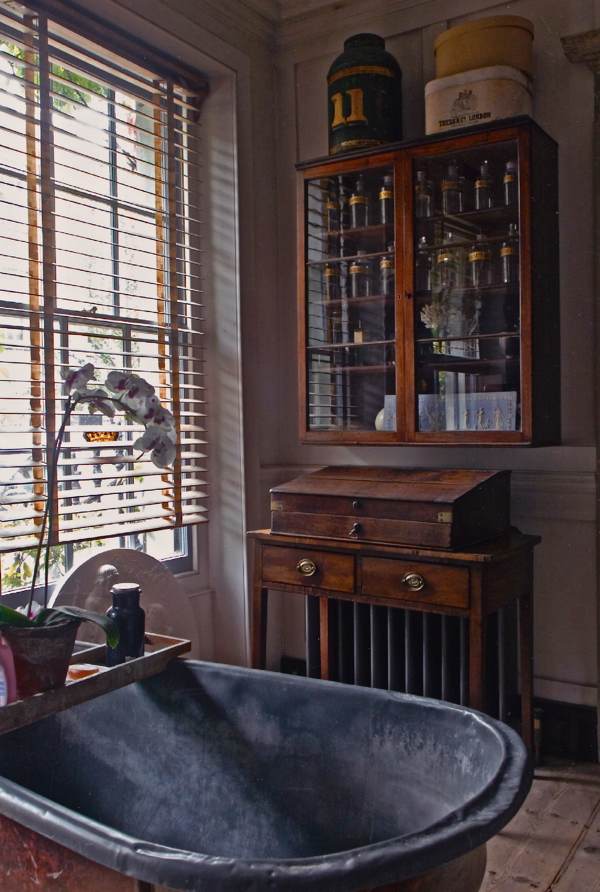
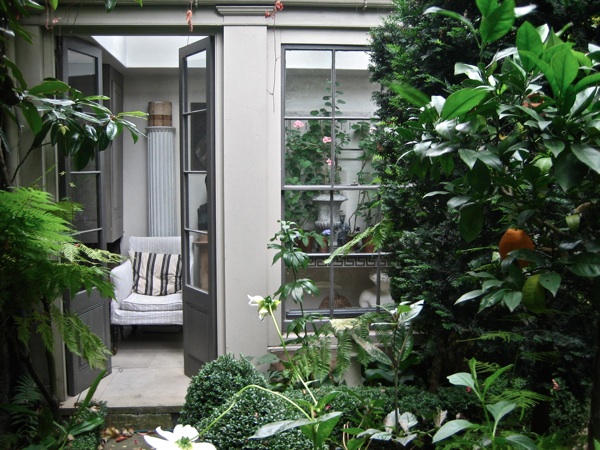
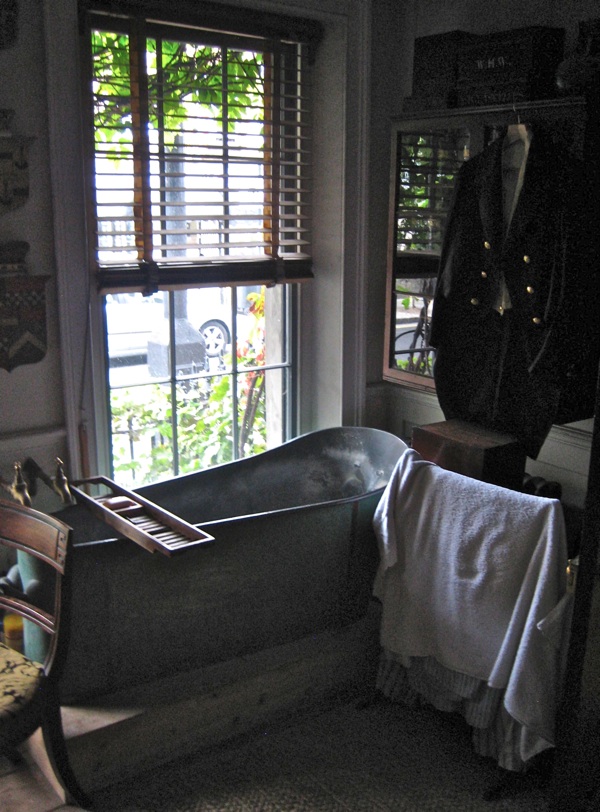
Reflecting this utilitarian spirit, Tim has installed a bath in the first room on the ground floor and delights to sit here, soaking in hot water and peering out the window at the ceaseless parade of life, up and down New Rd. Yet step through into the room at the back and sounds of the street fade away. Here, fine eighteenth century plasterwork – with details of ears of corn and oak leaves – draws your eye, leading you to a drunken bay window, tilted to one side, and creating the distinct impression of being upon a ship. Only, instead of looking upon an expanse of ocean, you discover a dense garden where dahlias grow six feet high and oranges ripen in the climate protected between high walls.
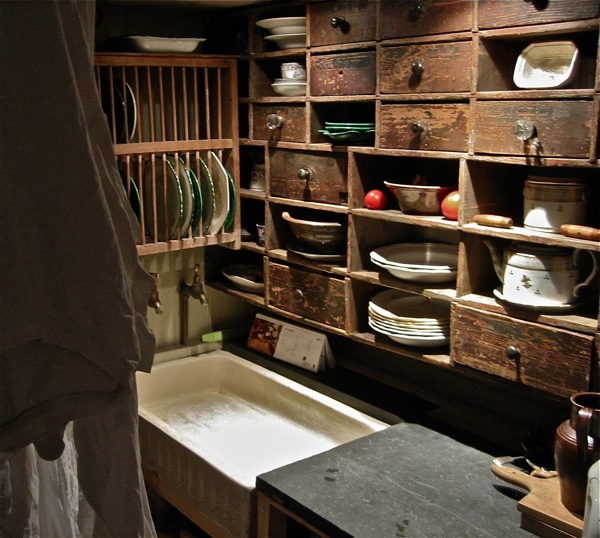
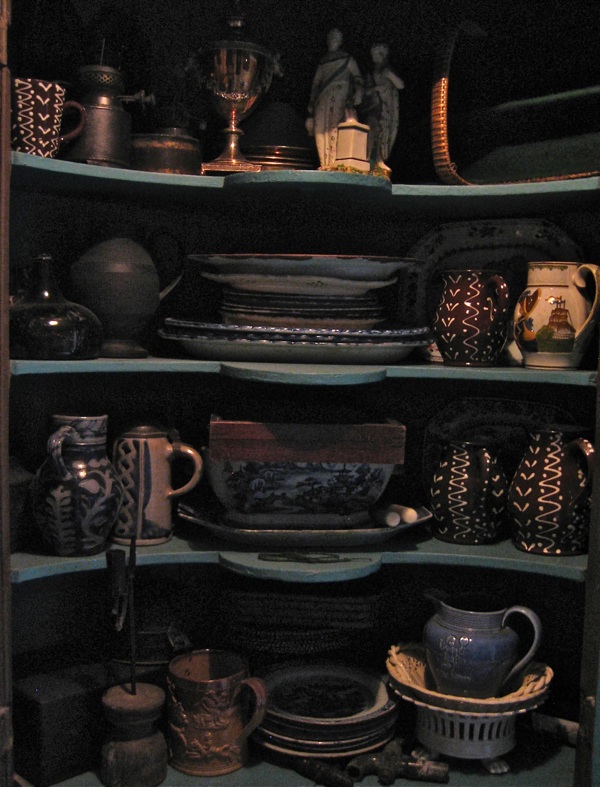
Step down to the basement, where Tim lifted the flagstones that were laid directly upon earth in rooms just six feet high, digging deeper to lay a damp course and lower the floor, before relaying them and creating the cosiest spaces in the house. “When I started, I didn’t have much money, so I took my time and the house told me what it should be like – it led me, and I stopped telling it what it should be,” explained Tim with a bemused smile, as we sipped hot tea at the kitchen table whilst peering out to the dark clouds lowering over Whitechapel that morning. “I wanted the house to work as it did in the early years of its life in the first decades of the nineteenth century, because that was the period I felt romantic about,” he admitted to me with a blush at his own sentiment, casting his eyes around lovingly at his glorious collection of old china and portraits that fills the house.
Amidst the clatter of Whitechapel, the old house in New Rd stands as an enclave of peace where – thanks to Tim Whittaker – the world of two centuries ago still lingers and where, if old, old Mr Redman should return and climb the worn steps to put his key in the lock after a long, long voyage, he would discover his house shipshape and welcoming – just as he might expect it.

Photographs 3,4,5,9 & 10 © Tim Clinch
You may also like to read about
The Romance of Old Whitechapel
or
Alan Kingshott, Yeoman Gaoler at the Tower
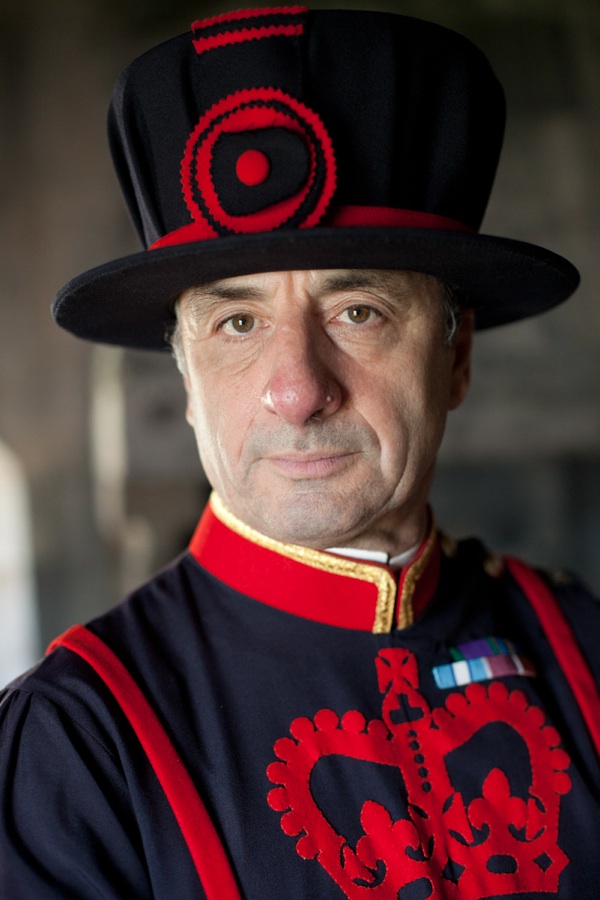
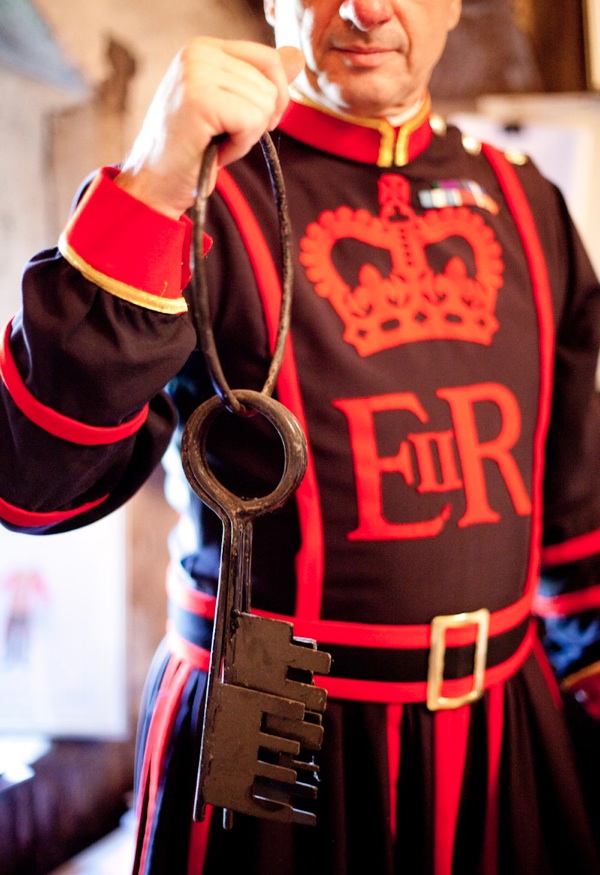
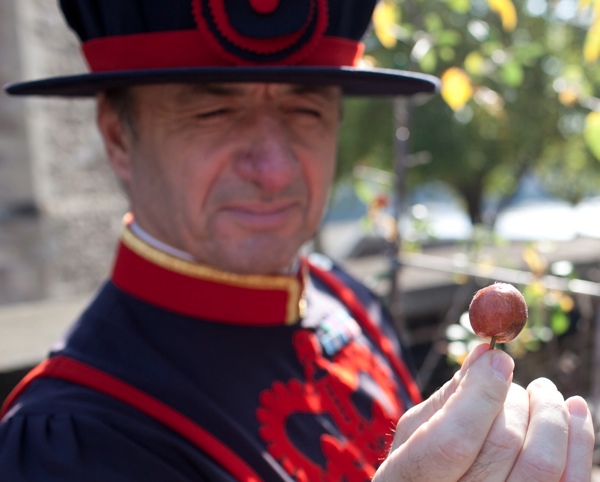
You might think that when a man has reached the position of manager of the Comet store in Bognor Regis, he had reached the summit of his achievement, but Alan Kingshott always knew there was more to life. One day when he was visiting Crawford Butler – a close friend from his twenty-five years in the Royal Hussars, who had become a Yeoman Warder at the Tower of London – Alan learnt there was a vacancy and realised he needed a change.
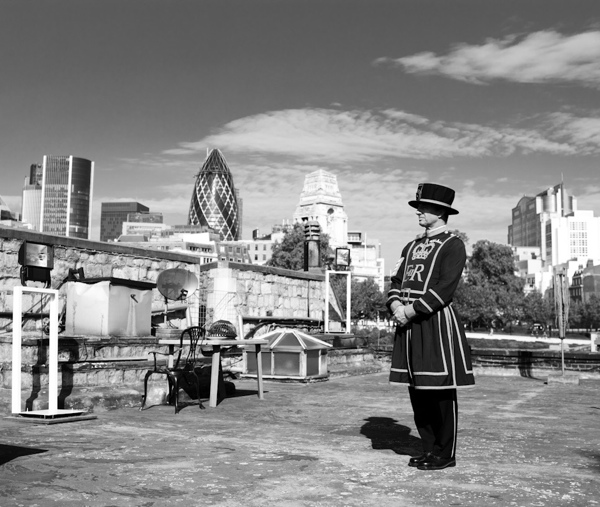
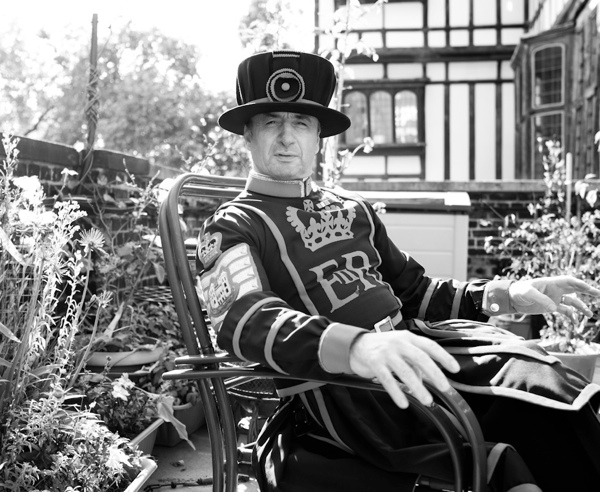
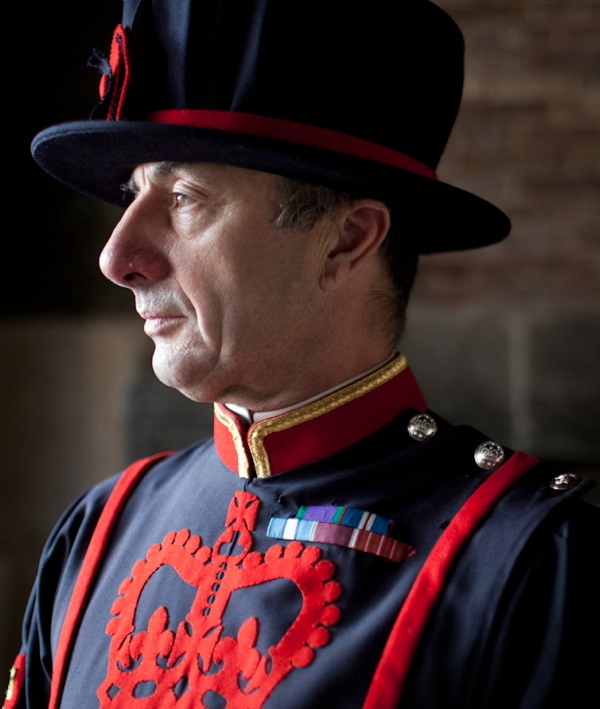
“Crawford said, ‘Apply,’ and I did,” Alan told me, still a little startled even fourteen years later to find himself behind a desk in the twelfth century Byward Tower, in this legendary fortress by the Thames. Yet, from the moment you meet Alan, and he fixes you with his dark, glinting eyes deep-set beneath straggly eyebrows, peering at you over his magnificent specimen of a nose, you are aware of an appealing balance of gravity and levity, as if he were born to this role which requires a lofty hauteur on ceremonial occasions and a playful nature greeting young visitors to the Tower. His sombre poise is such that he appears to have stepped from one of George Cruickshank’s engravings of the Yeoman Warders, with the dramatic possibility that at any moment he might reveal himself as a comic impostor – which is another way of saying that while Alan treats his job with utmost seriousness, he does not take himself too seriously.
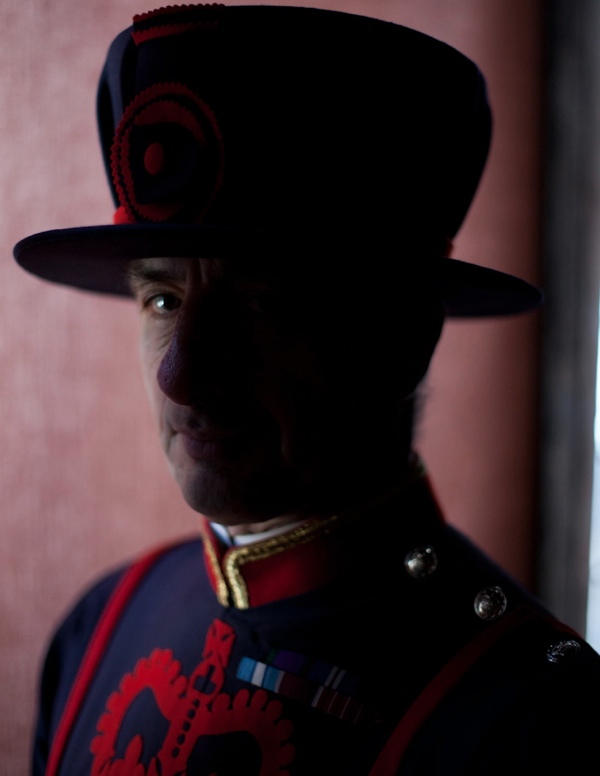
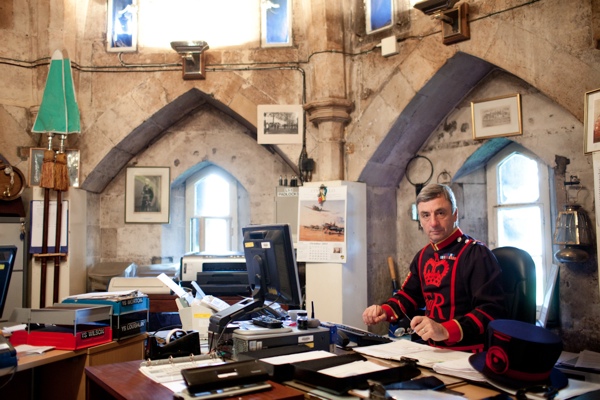
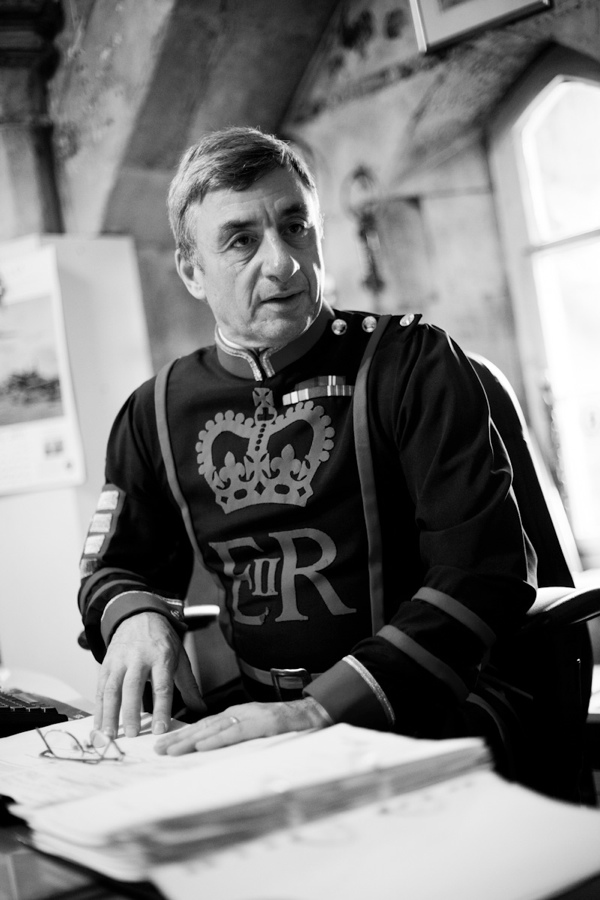
Spitalfields Life Contributing Photographer Martin Usborne and I ducked our heads as we stepped through the low doorway, leaving the clamour of the tourist crowds in the Autumn sunshine and entering the peace and shadow of the octagonal medieval chamber where we found Alan, the Yeoman Gaoler in his red and blue Tudor uniform, enthusiastically tip-tapping at his computer keyboard. The paraphernalia of his job – bunches of huge keys, ceremonial axes in sheaths, and a gleaming brass lantern – complementing the usual office furnishings of filing trays, corporate calendars, telephones and box files.“I look after the day to day running of the Yeoman Warders, keep the diary, prepare for all the ceremonies and corporate events, and I order the uniforms – I’d be fibbing if I didn’t admit there were challenges” admitted Alan, removing his spectacles and reclining in contemplation with the urbane confidence of a senior executive, “It’s a varied job, but the amount of paper that comes at me is massive and it’s coming at me from all angles.”
Much as I was in thrall to the historical romance of gaoler’s role, I was happy learn that this benign managerial job has replaced the incarceration and torture of a bloodier age. In this respect, Alan’s experience at Comet has proved to be as crucial as his time in the forces.“Becoming a retail manager, after twenty-five years in the army,” he recalled, “it was a mountain to climb, learning to deal with customers, yet I quite enjoyed it.” On 1st April 1998, Alan came to the Tower as a Yeoman Warder and was appointed to Yeoman Sergeant in 2004, ascending to the role of Yeoman Gaoler just four months ago. “I don’t get to engage with the public anymore, that’s one of the sadder parts,” Alan confided regretfully, “– to me that was the icing on the cake of this job and I hugely enjoyed it.” An observation which led me to ask why he wore the uniform, an impertinent question that Alan took with good grace. “I could be called out at any moment if there’s a first aid incident,” he explained politely.
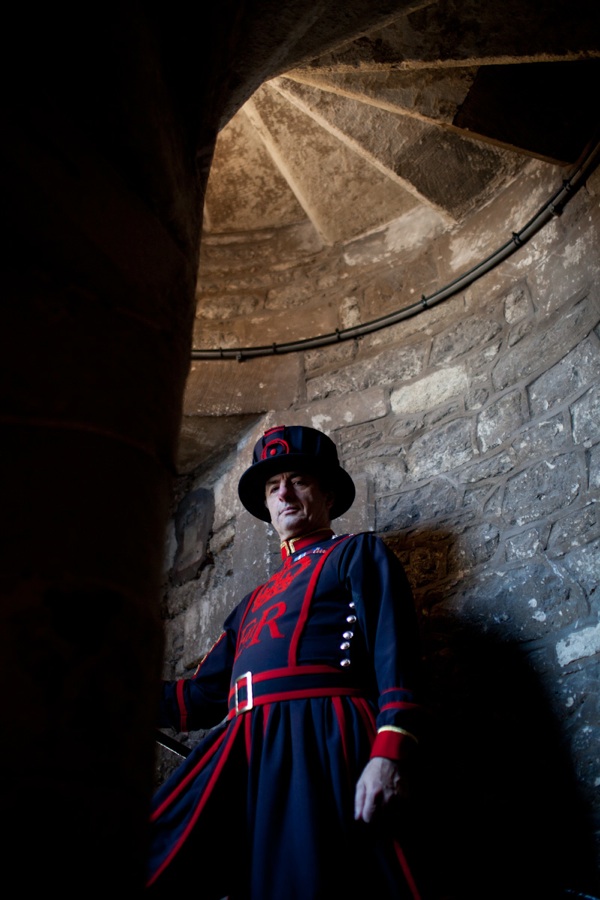
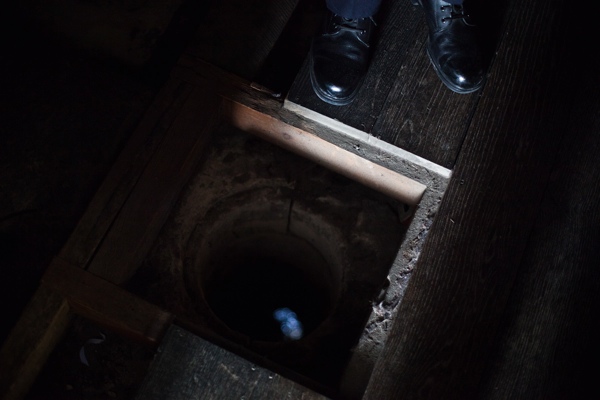
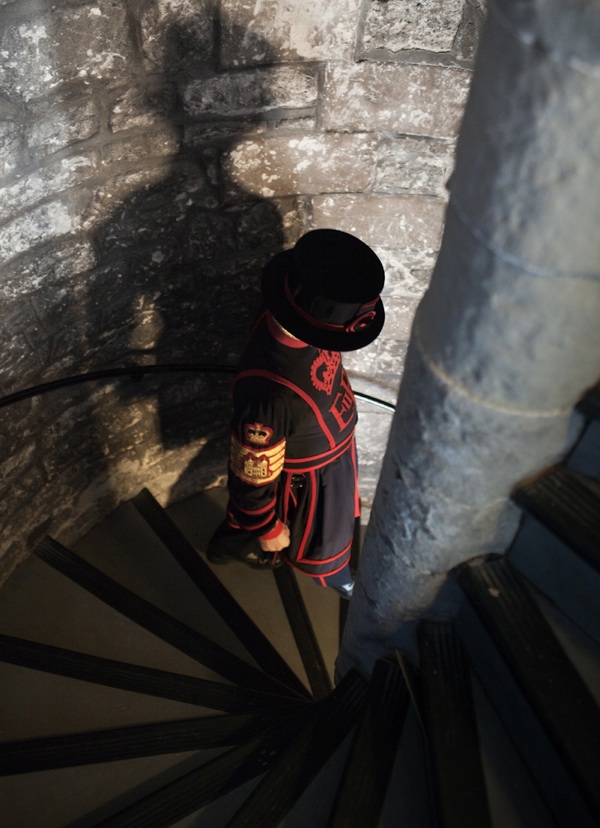
Living up above with his wife, Pat, in the twelfth century apartments at the top of the gatehouse, Alan climbs out of bed each morning early, pulls on his colourful uniform and descends the spiral stone staircase to his office.“I was down here at quarter past seven today and I might finish work at nine in the evening. Some days, I’ll work fifteen or sixteen hours – it’s a long day. My wife works in the Jewel House and we used to get the same days off a week, but now we only get two days off a month together.” he revealed with a frown, outlining the rigours of his task, as we ascended to the room over the gate itself and he pulled up panels in the floor to expose the stone chutes where once boiling liquids were dropped upon unwelcome guests below.
“We’ve been to Parliament, climbed up Big Ben, visited Number 10 and I’ve met the Queen.” Alan informed me in a near whisper, conceding some perks of the job, while indicating the mural painted here in 1300 of angels upon a ground of sage green, emblazoned with fleur de lys and popinjays. We stood in silent awe in the room where the shades are permanently down to protect the mysterious ancient painting, as more figures came into focus from the ether – the Angel Gabriel holding scales with the balance of righteousness tipped against Lucifer, the Virgin Mary and John the Baptist – all shimmering in the half-light.
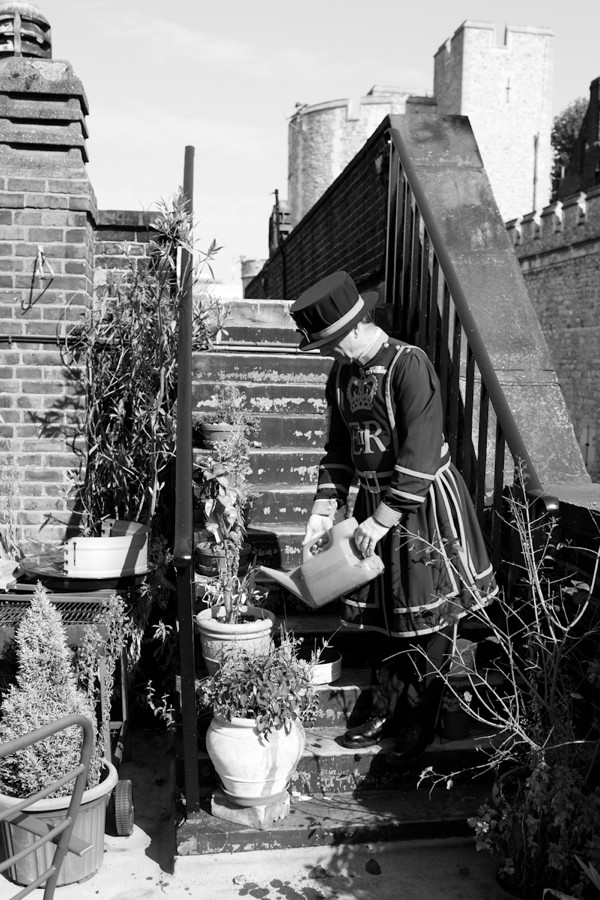
Alan led me through a door onto the perimeter wall where he has cultivated a secret garden with cherry trees, crab apples, azaleas and rhododendrons in pots. An experienced gardener, he explained that these acid-loving shrubs need watering with rainwater, filling a can from the rainwater butt and taking this opportunity to irrigate his precious charges. Then, as we made our farewells down in Water Lane, a crowd of excited visitors formed seeking Alan’s attention and instantly he switched to performance mode. Next year when John Keohane, the current Chief Yeoman Warder retires, Alan is the only one qualified to be his successor. “It’s going to be steep learning curve for me,” he confessed with a grin. Alan Kingshott is a man on the rise at the Tower of London.
Photographs copyright © Martin Usborne
You may also like to read about
The Beating of the Bounds at the Tower of London
The Ceremony of the Lilies & Roses at the Tower of London
The Bloody Romance of the Tower with pictures by George Cruickshank
John Keohane, Chief Yeoman Warder at the Tower of London
The Signs of Old London

The little wooden midshipman outside Solomon Gillis’ chandlery, 157 Leadenhall St
Even though most of the signs of old London were destroyed in the Great Fire of 1666, a few created just after that date survive today in the City – anachronisms affixed to modern buildings, as if they were Penny Blacks stuck onto Jiffy padded envelopes. Yet in the Bishopsgate Institute archive, I found plenty of atmospheric pictures of curious stone plaques which lasted into the era of photography, only to be destroyed by the blitz and subsequent redevelopment.
It was Charles I who gave people the right to hang out signs as they pleased, when once they were restricted to innkeepers – “for the better finding out such citizens’ dwellings, shops, pubs or occupations, without impediment, molestation, or interruption to their heirs or successors.” An elaborate language of symbols quickly grew in the common understanding, such as a dragon for an apothecary, a sugar loaf for a grocer, a wheatsheaf for a baker, a frying pan for a confectioner, and – as still seen in Spitalfields today – a spool for a silk weaver.
As time went by, the meanings of the signs became more complex and arcane as shops changed ownership but retained the signs as identifiers of the buildings. James Maddox, the coffin maker at St Olaves had the symbol of three coffins and a sugarloaf, the sugarloaf because it was a former grocers and three coffins as his personal device. Opposite St Dunstan’s in Fleet St, a sign of three squirrels first put up by Henry Pinkley the goldsmith in 1649, was appropriated by the bankers who moved in afterwards, and this symbol of the three squirrels continued to be used by the National Westminster Bank until the mid-twentieth century.
Lombard St was once famed for its array of magnificent signs, and eighteenth century prints show quaint symbols hung upon elaborate wrought iron brackets outside every single premises in Cornhill and Cheapside. Anticipating our modern concern with brands and logos, these devices suited the city before streets were numbered and when many of the populace did not read. But during heavy weather and in strong wind, these monstrous signs creaked and groaned – and, in 1718, a huge sign in Bride St collapsed killing four people and taking part of the shop front with it. Such was the severity of the problem of the forest of hanging signs crowding the streets of London, that a commission was appointed in 1762 to take them all down and fix them onto the shopfronts – thereby creating the modern notion of the fascia sign declaring the identity of the premises.
“The Commissioners are empowered to take down and remove all signs and emblems, used to denote the trade, occupation or calling – any sign posts, sign boards, sign irons, balconies, penthouses, show boards, spouts and gutters projecting into the streets etc, and all other encroachments and projections whatsoever in the said cities and liberties – and cause the same, or such parts thereof as they think fit to be affixed or placed on the front of the houses, shops, alehouses or buildings to which they belong.”
Street numbers were only in partial use at the beginning of the eighteenth century, becoming widespread by the end of the century as a standardised system to identify properties. Although many were reluctant to give up the language of signs and symbols, by the middle of the nineteenth century, the signs were commonly replaced by the familiar pattern of a board with signwriting above the shopwindow. Most of the decorative signs to found in the City of London today are pastiches created a hundred years ago as nostalgic tributes to a bygone age, though two favourites of mine are the golden owl on the House of Fraser, facing South over London Bridge, and the figure of Atlas holding up the globe on the exterior of Barclays in Cheapside.
Just three signs remain in common usage, the barbers’ pole (with its bloody red and white stripe recalling when barbers were also surgeons), the chemists’ pestle and mortar, and the pawnbrokers’ three balls – originally blue, they turned gold in the early nineteenth century and are said to be based upon the crest of the Dukes of Medici, itself derived from coins taken by Crusaders from Byzantium.

At the sign of the Fox in Lombard St.
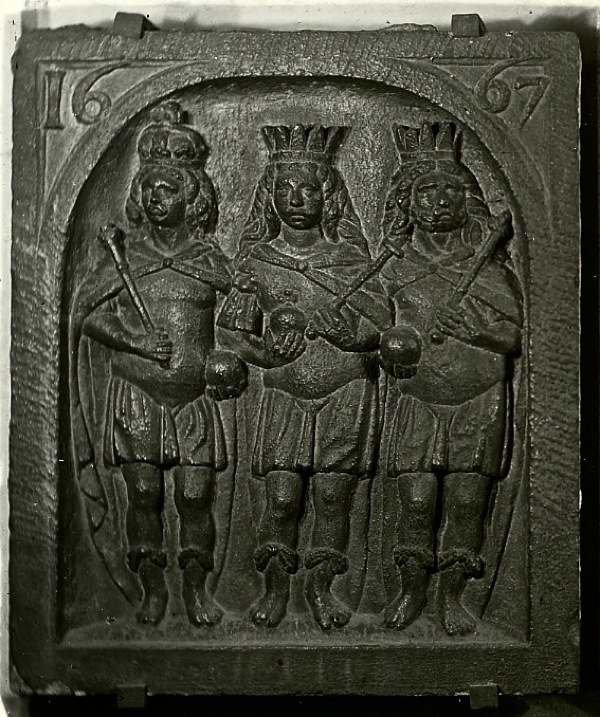
At the sign of the Three Kings in Lombard St.

At the sign of the Half Moon in Holywell St, off the Strand.
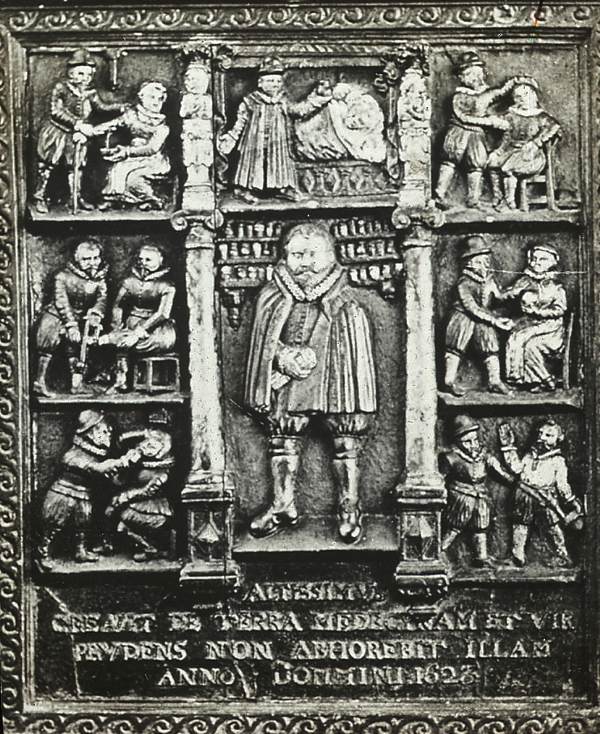
A physician.
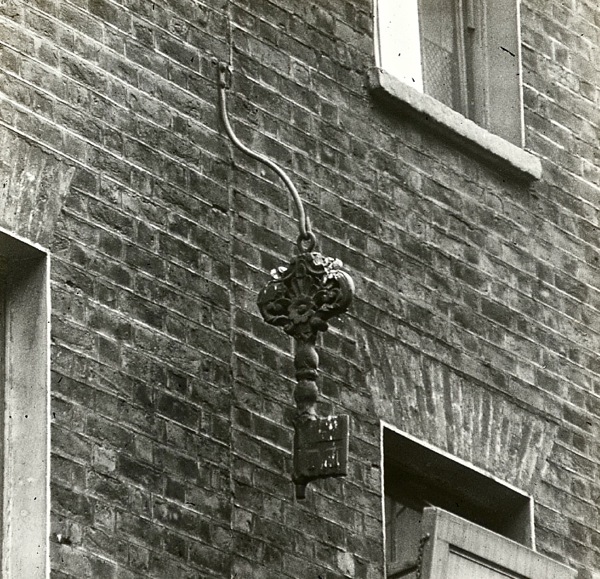
A locksmith.

At the sign of the Lamb & Flag

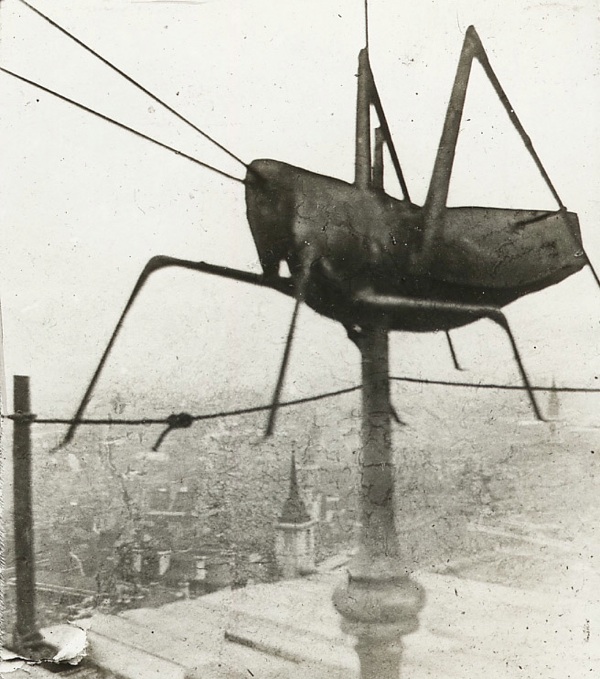
The grasshopper, symbol of industry and personal emblem of Sir Thomas Gresham who founded the Royal Exchange, is to be found all over the City of London even today.

At the sign of Three Squirrels in Fleet St.


At the sign of the Bull & Mouth in Aldgate.


This was the symbol of the Cutlers.
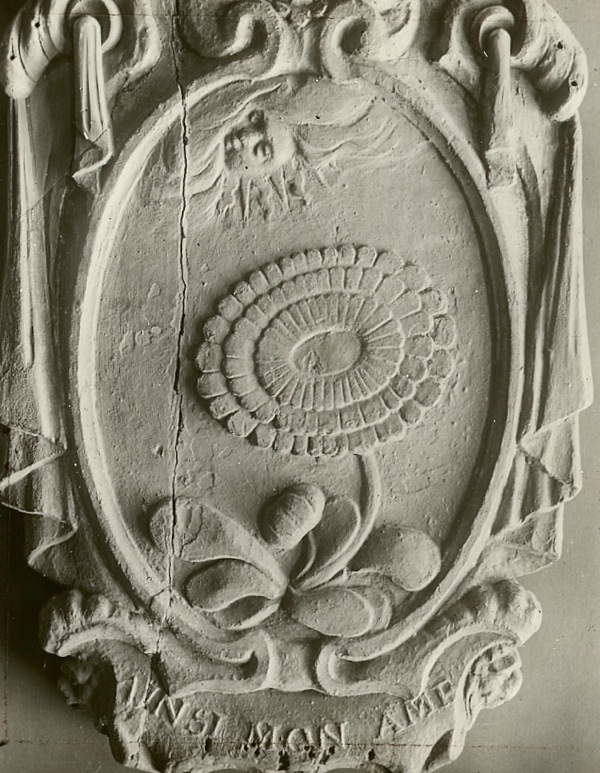
Child’s bank at the sign of the Marigold in Temple Bar.


In Ely Place, off Hatton Garden – this mitre came from an episcopal palace and was set into the wall of a public house.


The maid of the Mercer’s company is still to be seen in Corbet Court off Gracechurch St.

An old sign that remains in situ outside St Paul’s tube station.“When ye have sought the Citty round, yet still this is the highest ground. August 27th 1698”

“- an old sign affixed to a modern building, like a Penny Black stuck onto a Jiffy padded envelope.”
Archive photographs copyright © Bishopsgate Institute
You may also like to read about Peter Hardwicke, Signwriter
Everything Happens in Cable St
Celebrating the seventy-fifty anniversary of the Battle of Cable St today, Cable St resident Roger Mills takes over as guest writer to present some of those featured in his new book Everything Happens in Cable St published this week.

When I told people I was writing a book about Cable Street, many assumed it would all be about the Battle of 1936 when the locals halted the march by Oswald Mosley and his blackshirts. Yet that only makes up part of my book Everything Happens in Cable St. It is an oral history, featuring interviews with some of the Battle veterans – but it is also about the creative and cultural life of the area, things that have taken place in the more recent past.
The portraits here by Spitalfields Life contributing photographer Jeremy Freedman taken on Cable St, feature some of those I spoke to – all from different walks of life and each one with a unique story to tell. I have lived along Cable Street for decades and, over the years, made contact with hundreds of people. I wanted to record their stories and their lives before they faded from memory.

Kim McGee was one of the Basement Writers who gathered in the vault-like rooms beneath the old St. George’s Town Hall in Cable St to share their poetry. Writers brought together by teacher Chris Searle in the nineteen seventies, after he was sacked for publishing his pupils’ poetry against the wishes of the governors and all the schoolchildren came out on strike in support.
“I was one of Chris Searle’s pupils. He inspired me. We would have lessons where he moved all the tables and chairs out of the way, and we’d sit scattered around the room. He would say, “Just call me Chris.” And we’d say, “Is that allowed?” I was one of the school strikers and I went on the march to Trafalgar Square. I only went so far because I was a bit nervous. I’m still in touch with Chris Searle, which is pretty good going after all those years. I do storytelling for children now, I read folk tales and rearrange them a bit and make puppets of the characters. For a basically shy person, you wouldn’t think I’d be up there doing it. It’s funny when you look back and think, “This is where I am and that’s where I was then.” I think that it’s due to having people who believed in you when you were a kid, giving you a respect you never imagined having.’

Ray Newton is secretary of the History of Wapping Trust, which over the years has produced a stream of local books and postcards. Ray was born in the part of Cable Street known as Shadwell.
“You knew everybody and most people worked locally. My dad was a docker and his father was a docker, and my mum’s family were lightermen, so I was brought up with the river. In this little area, you either worked in the docks or you were a carman, or you worked in a factory or something. I didn’t go to work the docks. In the nineteen fifties my dad bought a pub in the Highway. Most of the dockers and lightermen who used it had been in the First World War. They were very interesting people. That’s where I learnt all my local history. When my dad died, I became a publican at twenty-three years old. I did that for over eight years. The pub was demolished and my brother who had a betting shop asked me to be a manager. I did that, but I thought, “Well, I don’t want to do this for the rest of my life.” So I went to university and got a degree. I was about thirty-six, I suppose. I did teacher training and went to West Ham College to teach sixteen to nineteen-year-olds.”

Denise Jones married in her last year as a student at Brighton Art College, and she and husband Dan moved to London in 1967. ‘When we approached a local estate agent he was shocked, saying, “You don’t want to live there! Cable Street is a horrible place!”” she recalled.
Denise told me about the origin of Stepney Books in 1973, beginning as a Saturday stall in Whitechapel Market. Denise’s friend Celia Stubbs was amongst the volunteer staff and, while wandering along the row of stalls, she discovered one selling second-hand books and comics. Celia became entranced by stallholder Jim Wolveridge’s recollections of his East End upbringing and realised that there was a book there. Stepney Books became a small publisher and Jim’s book “Ain’t It Grand,” was released in 1976.
Early publications included “Victoria Park” by Charles Poulson, a history of the famous “lung for East London,” while “Under Oars” by Thames lighterman, Harry Harris, arrived via the author’s son as a copper-plate handwritten manuscript, written forty years earlier. It would probably have remained a family heirloom if not for Stepney Books. Others followed – “Children of the Green” by Doris M. Bailey, an autobiographical portrait of a Bethnal Green family between the wars – “Tough Annie,” which chronicled the life of Annie Barnes, a suffragette friend of Sylvia Pankhurst – and two autobiographies, “Looking Back – A Docker’s Life “by Joe Bloomberg and “Memories of Old Poplar” by John Blake.
Denise is a local councillor and a past leader of Tower Hamlets Council.
Most people do not realise that the story of “To Sir, With Love” is set in Cable Street, based upon the true story of E. R. Braithwaite, who came from Guyana to teach in East London. Alf Gardner was one of the real-life pupils at the school where Braithwaite taught. Alf doesn’t think much of the book – or the film they made from it in the mid-sixties, starring Sidney Poitier and Lulu. He feels that neither the book or the film represent the school as it really was.
Alf remembers Cable Street’s “red-light” years in the nineteen fifties. Personally, I have always found it hard to equate the softly-spoken and slightly formal pensioner with the eighteen-year old thrill-seeker that he once was. Alf and his drinking pal, Dave visited such places as the scarily named “Black Door,” a wretched basement bar off Leman Street, with a clientele of razor-slashed members of the underworld – where, on one of their visits, a man at the bar produced a pistol, waving it around at the other customers.
In his self-published book “An East End Story,” Alf recalls his friend Dave’s attempts to impress a lady friend with tales of life on the wild side. When she asks Alf if it was as notorious as the scandal sheets made out, he replied, “Much worse”.
Alf wrote, “I explained that the area, like Soho, was a red-light district respectable women avoided day or night. Far from deterring Eileen, my deliberate discouraging description of Cable St seemed to arouse her interest more, giving me the impression that she was keen to visit some of the bars at the earliest opportunity.”

I talked to Director Frances Mayhew amongst the magnificent decrepitude of Wilton’s Music Hall. She stumbled across the building in 1997, while working as an intern for Broomhill Opera.
“It was completely boarded-up. We came in through the window and had a look around. Everyone fell in love with it. It was derelict, most of the original features had been ripped out and looted generations ago. I came back about six years later under the new Wilton’s Music Hall Trust, I saw the new electrics being put in and it got its first proper license since about 1880. The original pub was called the “Prince of Denmark” but it became known as the “Mahogany Bar” because of the wood in it. When John Wilton came here in the eighteen fifties, he bought up the four adjoining terraced houses with a vision to build a hall in the back yards. He knocked through the houses sideways, leftways, upways, downways – until it became this beautiful honeycombed building. You can get quite lost in it.”
“The bar is open, but because the building is so fragile I don’t think we could handle being super-popular at the moment. There’s something nice about this area in that you can find little hidden gems – you stumble across a bit of history that you wouldn’t see elsewhere. When people do come here they have quite a personal reaction. They get a feeling, or an atmosphere, or a vibe. We’d hate them not to feel that. They feel they’ve made a bit of a discovery and walked into a time warp.”

Alan Gilbey was one of Chris Searle’s school strikers and a Basement Writer. When I first met him there he did not speak much but would spend group meetings scratching brilliant cartoons onto a pad at a furious rate.
He later formed a theatre group “Controlled Attack” and also worked as a community drama worker on the Isle of Dogs. During this period, he took on the Battle of Cable Street, when “Shattersongs,” was performed by WOOF! Theatre Company at the Half Moon Theatre in Mile End in the late nineteen eighties. It used cabaret-style songs, comedy and semi-surreal imagery to represent not just the Battle but contemporary anti-fascist activity. Alan was particularly pleased that they managed to acquire a real lorry to represent the one turned over for use as a barricade in 1936.
Alan is now a screenwriter and script consultant, working in the world of animation, utilising his lifelong love of cartoons.

Dan Jones lives in Cable Street with his wife Denise. He was instrumental in setting up the Basement Youth Project in the late nineteen sixties and has fronted any number of community groups and campaigns.
Dan is also an artist. An entire wall in his house is taken up with one of his murals, painted on heavy wooden panels and bolted into the brickwork, depicting children in the playground of nearby St. Paul’s School. The rhymes they are chanting float in the air around them. Dan’s fascination with different cultures is reflected in his paintings, a trip to West Africa as a teenager is recalled in the colourful cloths and head-ties of women on market day, and vivid sketches of village life chart his trips to Bangladesh.
An equal amount of the pictures represent Dan’s lifelong association with the labour movement. He told me, “A lot of my larger work is screwed onto the wall in various trade union places. I made a large one for the National Union of Seamen depicting the 1966 seaman’s strike. Although I had imagined the faces of the seamen I’d painted on to it, when we took it out on a march people kept coming up claiming they’d worked with the crew members on it. Invented people became real in their minds!”

Maggie Pinhorn told me, “I grew up in the countryside but I always wanted to come to London. As soon as I could I left home and came to art school here at Central Saint Martin’s. From then on this was the place I wanted to be. I loved it.” Maggie studied theatre design but her real interest was in film. She worked on James Bond’s Japanese adventure, “You Only Live Twice,” the four-wheeled children’s fantasy “Chitty Chitty Bang Bang,” and – with perhaps fate playing a hand in directing Maggie eastwards – the big screen incarnation of telly comedy “Till Death Us Do Part,” the story of Wapping racist bigot, Alf Garnett.
But Maggie felt constrained in the art department, eager to create her own work and was happier collapsing onto mattresses in subterranean cinemas to watch experimental European films flickering through a haze of cigarette smoke. “I started Alternative Arts and produced a film in the early 1970s called “Dynamo,” made in basement strip clubs in Soho,” she told me – but she soon found herself working in a different sort of Basement.
“Dan Jones at the Basement Youth Project had got this idea about how these kids he was working with could make a film but he didn’t know how to go about it. I went and talked to him. I said, “Yeah, I’d be interested in doing that.”Firstly, I had to be checked out by the Inner London Education Authority to see that I was a suitable person.” she remembered, “That became increasingly useful later on – when I had to go down to Leman St Police station to bail out members of the cast, I could show I didn’t have a police record.” The subsequent forty-minute production “Tunde’s Film,”was co-directed by Maggie and local youth Tunde Ikoli.
These days, Alternative Arts is involved in a wide range of community activities.

In the late seventies Paul Butler’s interest in murals led him to contact Dave Binnington after reading an article about his work. “Then, one day,” Paul told me, “Dave called out of the blue, asking if I would be interested in a new project in Cable St.”
The Cable St Mural was an ambitious project, a huge depiction of the 1936 Battle of Cable St on the wall of St. George’s Town Hall. About the time that Paul arrived, much of Binnington’s original work was destroyed by right-wing vandals and he left the project. “I was left holding the proverbial baby.” said Paul.
He got in touch with two other artists, Ray Walker and Desmond Rochfort and, working as a team, they renovated what they could but largely redesigned the whole thing.“In some ways I relished it. It was a great opportunity. I was pretty inexperienced and I was probably biting off far more than I could chew. But in the end, I think I managed to chew it.” he said. Paul found the process stimulating if sometimes slightly unnerving, certainly in regards to the physical working conditions, “The scaffolding was very high. It didn’t half keep you fit, battling the wind, your paint flying off, splattering all over. We never used ladders, we used to go straight up the outside, grabbing hold of the scaffolding poles like a monkey. We all made a huge contribution towards the mural but none of us claimed ownership of it. We were extremely proud and extremely pleased with it. It was a fantastic time – a great moment in our lives.”

Roger Mills, writer, long-term Cable St resident, and author of Everything Happens in Cable St published this week by Five Leaves Publications.
Photographs copyright © Jeremy Freedman
You may also like to read these other Cable St stories
The Stepney School Strike of 1971
Stephen Gill’s Trolley Portraits
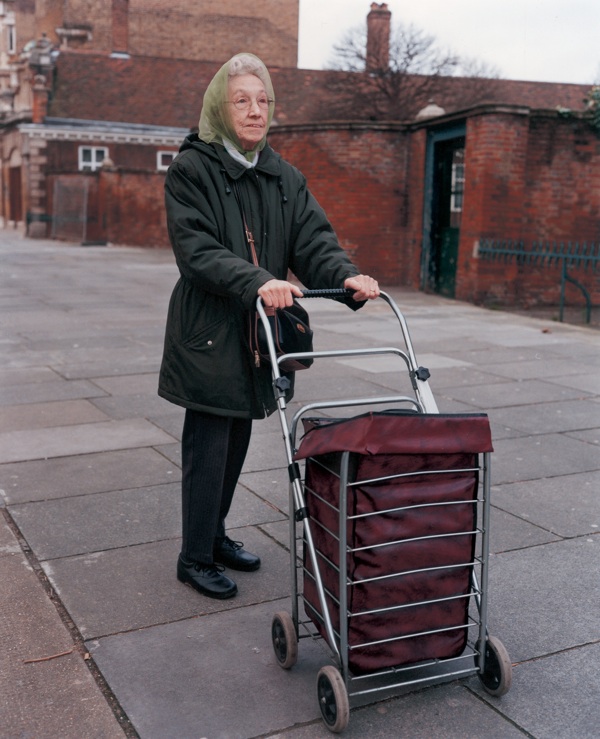
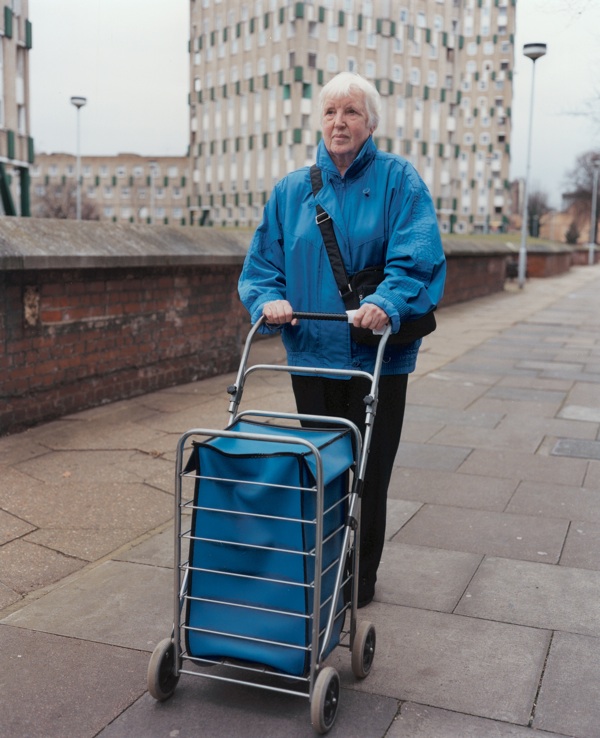
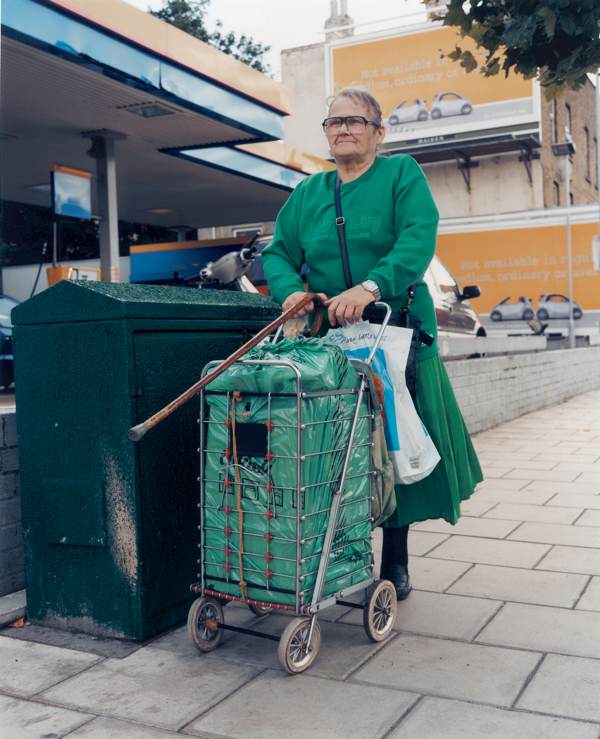
When photographer Stephen Gill slipped a disc carrying heavy photographic equipment ten years ago, he had no idea what the outcome would be. The physiotherapist advised him to buy a trolley for all his kit, and the world became different for Stephen – not only was his injured back able to recover but he found himself part of a select group of society, those who wheel trolleys around. And for someone with a creative imagination, like Stephen, this shift in perspective became the inspiration for a whole new vein of work, manifest in the fine East End Trolley Portraits you see here today.
Included now within the camaraderie of those who wheel trolleys – mostly women – Stephen learnt the significance of these humble devices as instruments of mobility, offering dominion of the pavement to their owners and permitting an independence which might otherwise be denied. More than this, Stephen found that the trolley as we know it was invented here in the East End, at Sholley Trolleys – a family business which started in the Roman Rd and is now based outside Clacton, they have been manufacturing trolleys for over thirty years.
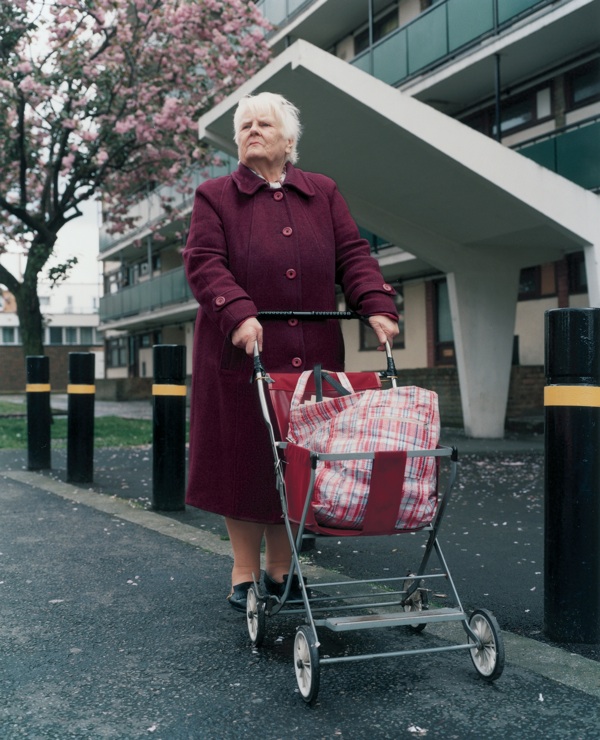
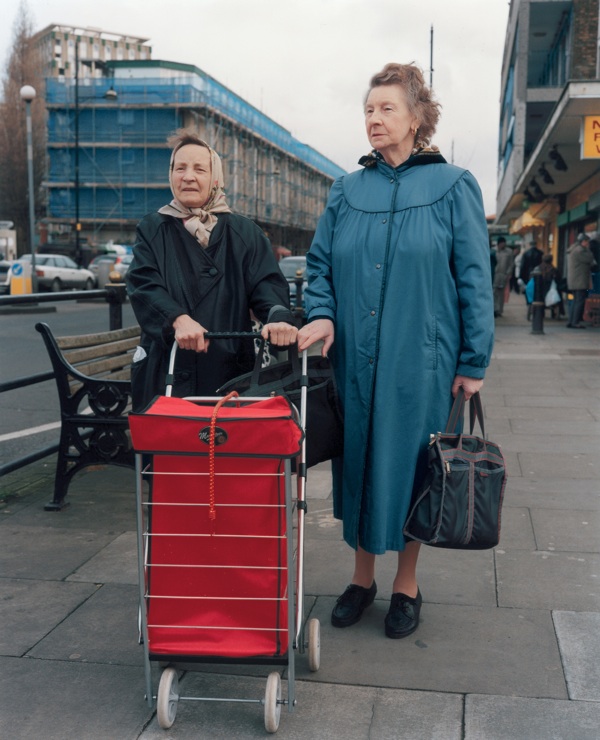
In particular, the rich Autumnal palette of Stephen Gill’s dignified portraits appeals to me, veritable symphonies of deep red and blue. Commonly, people choose their preferred colour of trolley and then co-ordinate or contrast their outfits to striking effect. All these individuals seem especially at home in their environment and, in many cases – such as the trolley lady outside Trinity Green in Whitechapel, pictured above – the colours of their clothing and their trolleys harmonise so beautifully with their surroundings, it is as if they are themselves extensions of the urban landscape.
Observe the hauteur of these noble women, how they grasp the handles of their trolleys with such a firm grip, indicating the strength of their connection to the world. Like eighteenth century aristocrats painted by Gainsborough, these women claim their right to existence and take possession of the place they inhabit with unquestionable authority. Monumental in stature, sentinels wheeling their trolleys through our streets, they are the spiritual guardians of the territory.




Photographs copyright © Stephen Gill
Sandy & Candy at This Shop Rocks
Sandy
Candy
Vintage clothes shops come and go on Brick Lane, with one opening as quickly as another closes, so that I can barely keep track of them all. Yet, in the here-today-gone-tomorrow world of recycled fashions, This Shop Rocks distinguishes itself with a more eclectic stock than its competitors. Those who know about these thing have whispered to me that it is the best. In other words, the phrase “This Shop Rocks” upon the facia is no hyperbole.
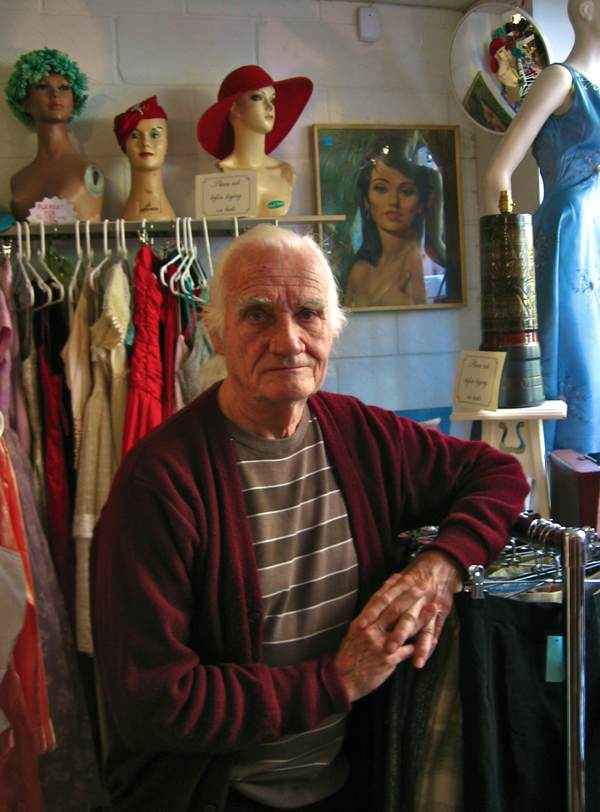
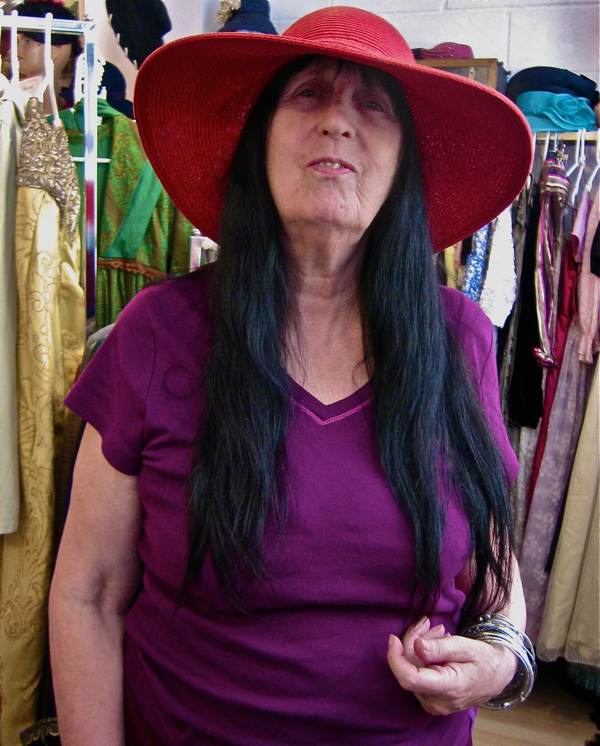
Anyone that has been inside will recognise Sandy, the hatmaker, famous for his white ponytail and louche repartee, and Candy, queen of vintage, carelessly flaunting her raven locks and razor wit. Sandy & Candy Sanderson preside like royalty from the corner booth in this snazzy emporium of glad rags, running the family business with their son Timothy – the prince in waiting – who regularly hosts sparkling nights in Dalston where customers can swan around in their swanky frocks.
Eager to discover what makes This Shop Rock, I asked Sandy how he came to be here on Brick Lane, which caused him to roll his eyes in droll amusement. ” There are so many considerations,” he informed me in wonder, adopting a quizzical smile and placing a hand upon his chin in dreamy contemplation, as he sought to compose a conscientious answer.
“When our kids grew up and left home, Candy & I bought an old minibus and travelled all over Europe and North Africa. We came back when one of our sons got married and intended to go travelling again, but instead we got sidetracked into opening this shop in Brick Lane. We’re old-fashioned antique dealers, we’ve always bought and sold everybody else’s old tat. Like everybody else, we had to make the school fees. We’ve done a lot of things because we’ve been around a long time.
I was at art school in Taunton when I met Candy in a coffee bar in Weston Super Mare fifty-one years ago. We got married pretty much at once. Just after both of us finished art school, we started a studio pottery and we were very good at throwing pots but no good at flogging them. Then we became weavers and we got thrown out of the Quantocks Weavers’ Guild because we used silk in our weft. So – we were living on the front in Burnham on Sea at the time – we opened up one of the front rooms as a public aquarium, until we got reported to the RSPCA for cruelty to fish and the council closed us down. Just after that we bought a forty five foot yawl, and we left Somerset and moved to Tollesbury in Essex.
Both of us were peace campaigners and we were on the Aldermaston marches. It was a lot of fun. I don’t want to claim the moral high ground – to us, it just seemed sensible. We joined CND and were very active in the Peace Movement. We still retain the same views but we feel there isn’t any point in it now. When you are young you feel you can change things for the better, but once you get rid of one bastard, there is another one waiting to take his or her place. You can’t really win.
I became an art teacher in a brand new comprehensive in Chelmsford, I started dealing in antiques in my spare time. Candy went to Colchester one day and bought a nice old pine cupboard, but she had to buy a lot of things that came with it at the auction. So we put a list in the window of our cottage and we sold the lot. And that inspired us to start, we caught the bug and went to local auctions and bought a whole lot. We opened up an antiques shop in our house, and I gave up teaching and went into the antiques trade.
We moved from there to Suffolk where we bought an old farmhouse with barns and stables and rode about a bit – Candy ran a riding school. When we needed to make money, we started to sell antiques again and I did restoration, but we got excited about paintings. The same thing happened, we bought one we wanted and a lot came with it. So we became art dealers, we dealt from home with exhibitions in the barn and did art fairs. We opened an antiquarian shop in Coggeshall because Candy knows a lot about books. We were second-hand book dealers, and we sold antiquarian maps and early prints.
When our kids grew up, we sold the farm and bought an old Mercedes truck on its last legs and a mahogany horse box. For five or six years, we made our way around Europe. We made a bob or two by drawing people’s homes, cafes, restaurants, and scenic stuff – anything we could try to sell and the public would buy. We were able to keep ourselves doing that, we enjoyed ourselves immensely and we met a lot of hippies. It was the weirdos that made places interesting. We were in Gibraltar at the time of the millennium, and we went as far north as Denmark and as far South as the Sahara.
We decided to come to Brick Lane because it had a reputation for selling vintage things and I make hats so it seemed a logical place to be. Five years ago, we came here and we love it. Sometimes somebody tries something on and their face lights up and it’s sheer pleasure. It’s a natural state of things for young people to do this – put on the clothes of their forebears – at this age I was wearing a lot of stuff from the twenties, and the Edwardians were very fashionable then too. We flog anything from Victorian right through to seventies gear. Candy & Tim do the clothes, and I buy and make hats. Hats are interesting in that it’s an excuse to make a piece of sculpture that someone can wear. I quite enjoy it really.
We are open seven days a week and I do five, but I am here more than I need to be because I get bored quite easily. I must be doing something, not just sitting at home with Candy. She can’t be doing with just sitting either. We’re survivors, that’s what we do, we survive. One of these days we’re going to get back in that truck and set off again…”
Of the many journeys people have travelled to reach Brick Lane, Sandy & Candy’s must be one of the most circuitous. But it explained completely why they are proprietors of the most interesting vintage clothes shop, because along the way they have learnt so much about culture that they thoroughly understand the meaning of their clothes. This is the secret of why This Shop Rocks.
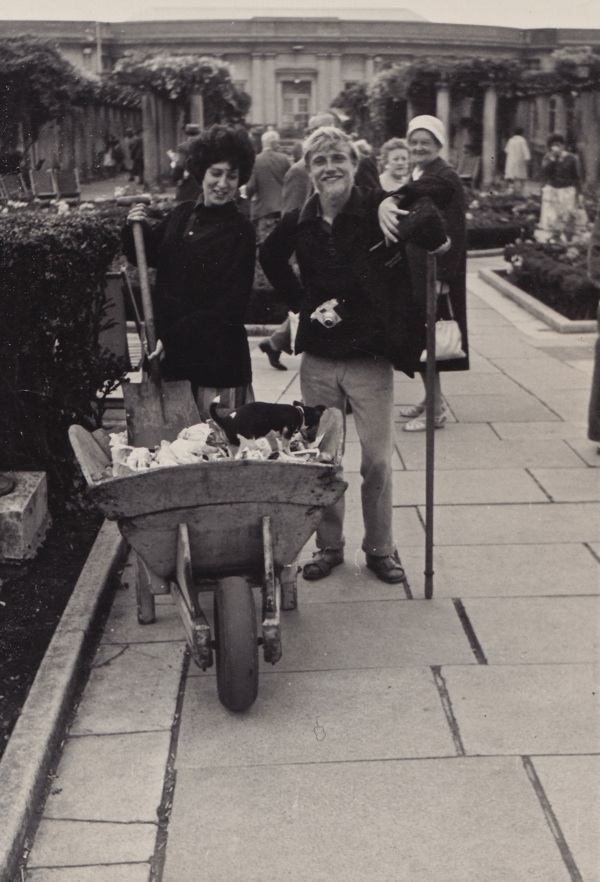
Candy & Sandy at Weston Super Mare in the nineteen sixties.
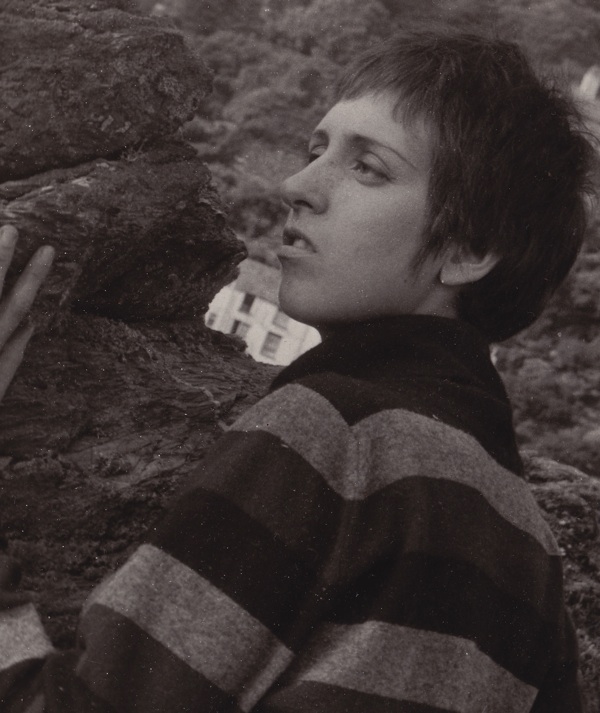
Candy in Cornwall in the nineteen fifties.
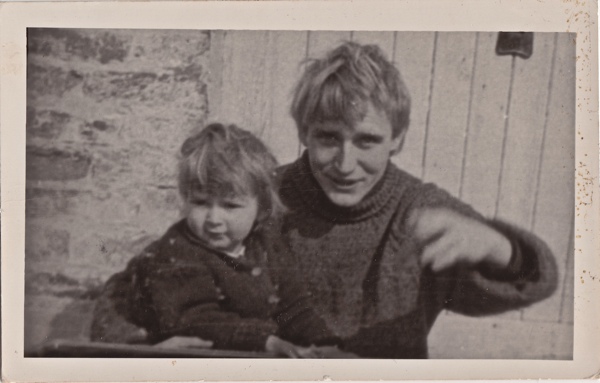
Sandy with his son in the nineteen sixties in Wiltshire.
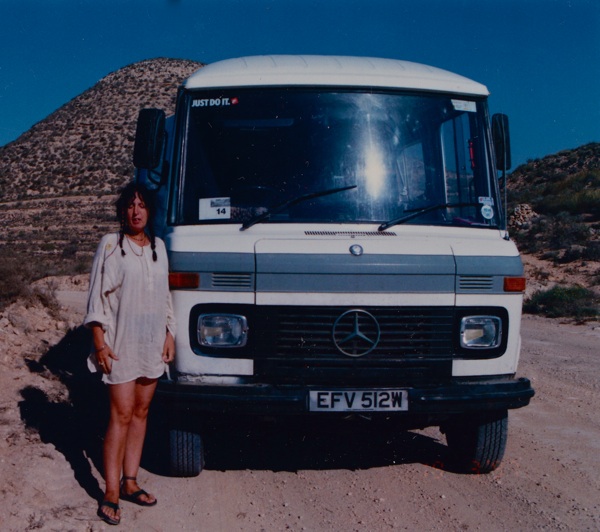
Candy on the road in Northern Spain in the nineteen nineties.
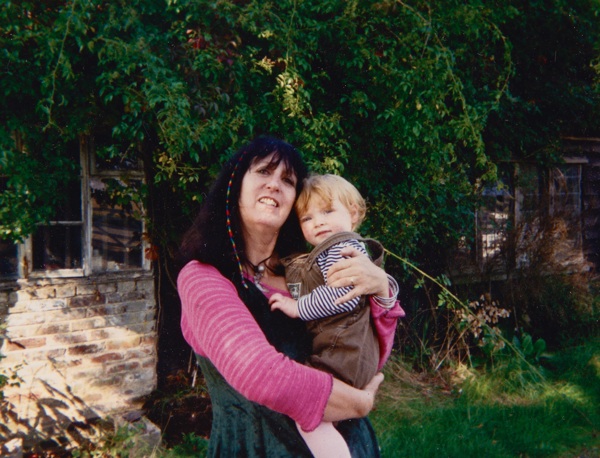
Candy in Suffolk with a grandchild in the nineteen nineties.
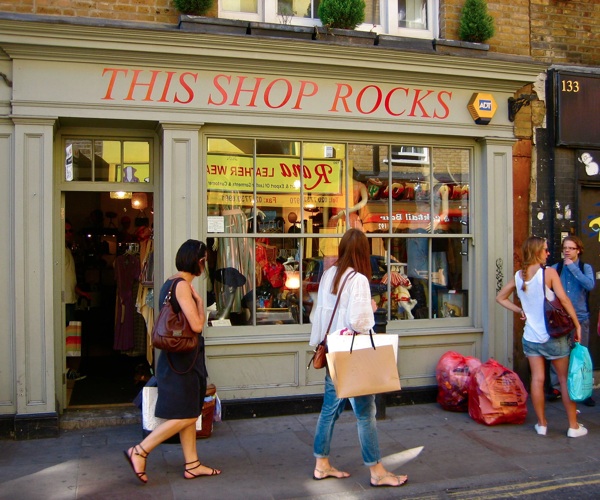
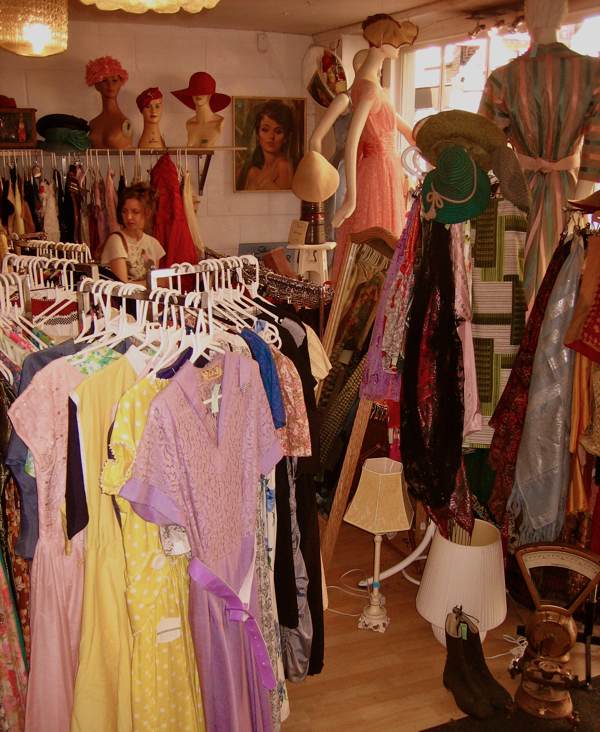
“a snazzy emporium of glad rags”
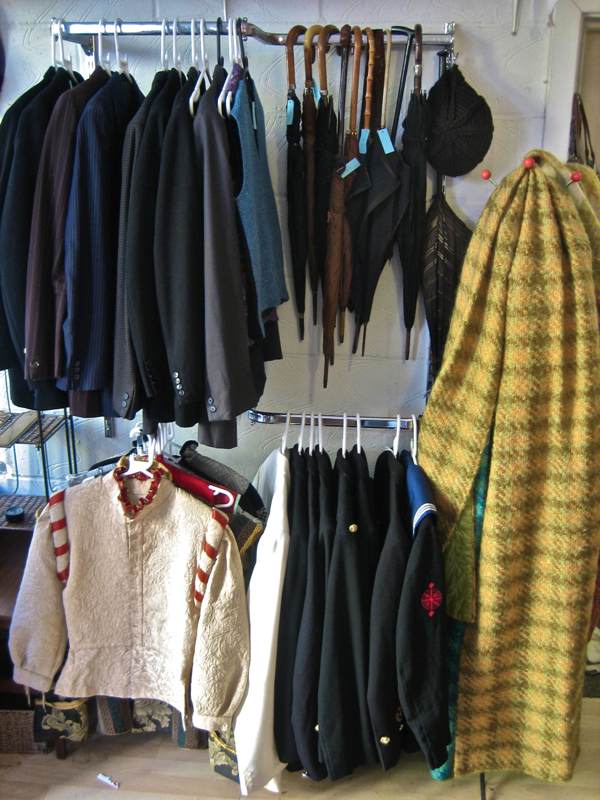
The men’s department.
Harry Harris, Lighterman
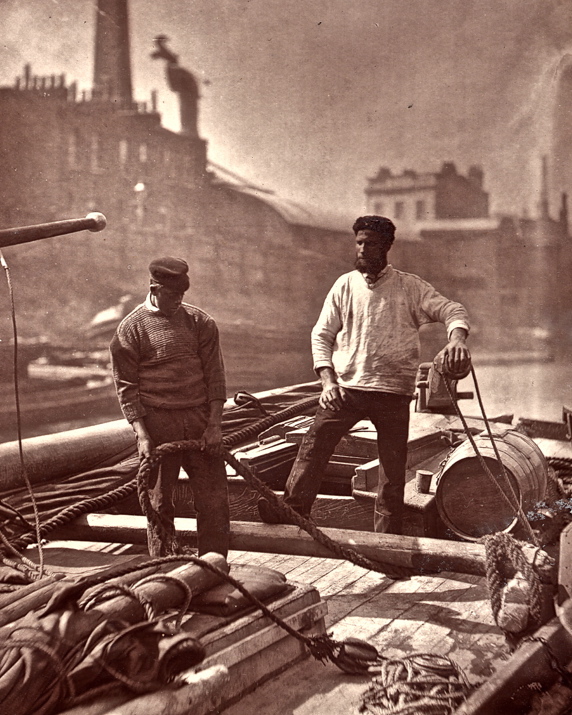
Workers on the Silent Highway
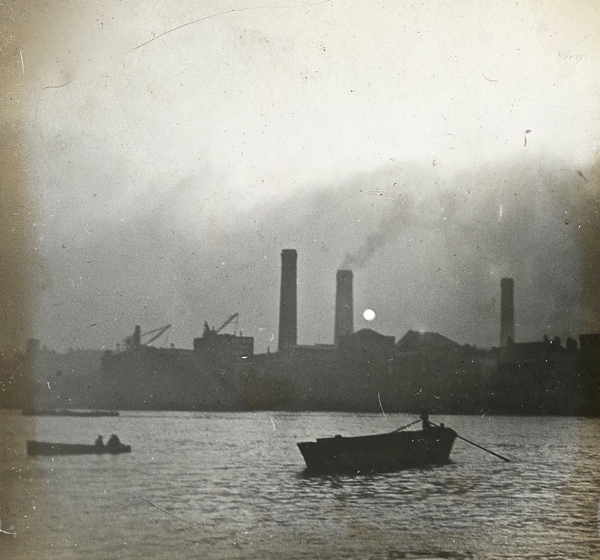
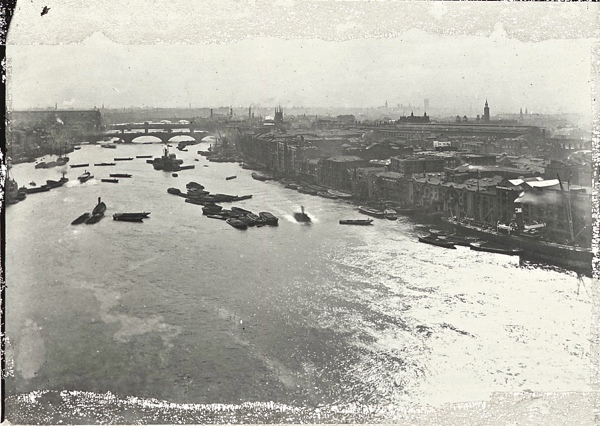
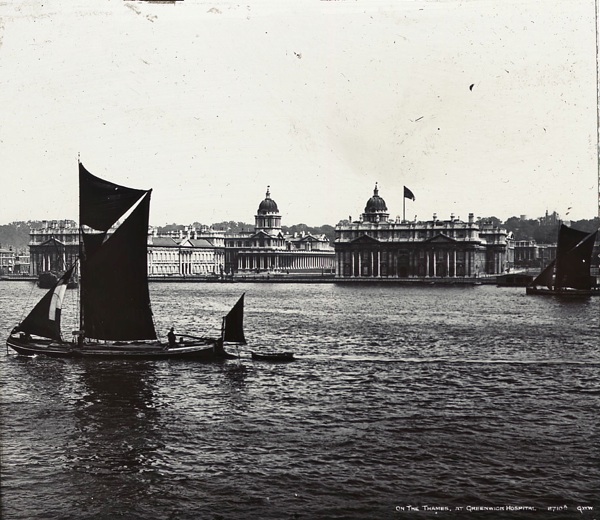
Inspired by my day among the lightermen this week, I sought out these excerpts from the account by Harry Harris entitled Under Oars, Reminiscences of a Thames Lighterman 1894-1909, written in a ledger which was passed on to his son Bob Harris and published by Stepney Books in 1978.
“At the age of thirteen, I was asked, ‘What do you want to be?’ The answer was obvious. Aunt Louie wondered whether Harry boy would like to become a missionary? I said, ‘A lighterman or perhaps go to sea?’ I was then warned of the dangers of these two jobs. The true story was related about a ship-wrecked crew eating the boy. Rather cheekily, she was reminded that missionaries had met the same fate.
Father was then a foreman for W. Pells & Son and had an opportunity of having me with him to get some experience, or perhaps a warning, before the actual apprenticeship. In June, 1894, I saw the opening of Tower Bridge by the Prince of Wales, later Edward VII, who was aboard the leading vessel. A large number of guests were invited to view the scene from one of Pells’ barges moored below London Bridge, and refreshments were provided. I was the boat boy and busy with the passengers to and fro. Pocket money was scarce in those days for me, but I was not allowed to accept any money or tips. I can still feel the itch in my hand to pick up sixpences and coppers.
On the 14th August, 1894, I was apprenticed to my father. A brother foreman wanted a handy boy, so arrangements were made for me to commence at twelve shillings a week, but after two weeks work – the governor having seen me – he decided that my size of boy was only worth ten shillings. My father was indignant, so he took me into his firm at twelve shillings a week.
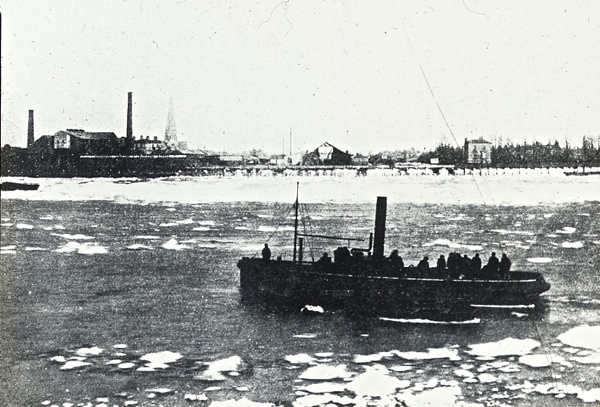
The following Winter was the coldest for years, the river becoming unnavigable owing to the ice. Heavy snow having fallen in the London district, the City Council dumped the snow into the river. Every bridge and embankment saw this dumping going on day after day, it quickly froze together forming ice floes. The ice adhered to barges, and many broke adrift and were to be seen floating up or down river. But looking back on that time, the remaining impression is they were light-hearted days. We found fun all the time, hours were long, work was strenuous, yet I cannot remember any dissatisfaction with my sphere in life. Summertime always compensated for Winter.
I must wander from this journey to mention the fog. The river then becomes a black area, if one was suddenly caught. One would never start in a dense fog but, if caught in one, might carry on and be lucky to finish the job. The ears became eyes, and all senses alert to get a bearing, yelling out to anchored craft, ‘Where are you?’ Fog is the worst enemy of river work. Signs of fog can be observed but indications of its clearing other than a breeze are very few.
We young lightermen were rather clannish and somewhat despised the ‘landsman.‘ Our chief topic of conversation was the river or life on the river. This had a language of its own, so I presume that our shore friends were often fed up by attempting to listen to an account of an incident in the day’s work given in the vernacular. You either ‘fetched’ or ‘went by,’ ‘saved tide’ or ‘lost tide.’ Arches were called ‘bridge holes.’ Flood tide work was ‘bound up along,’ ebb the reverse. The point was the ‘pint.’ The Quay man would be bound to ‘K dock,’ or ‘the German,’ or ‘the Batty,’ ‘down the Vic and dock her’ or perhaps ‘Jack’s Hole.’ The creek was always ‘crick.’ Back-slang was often used, cabin becoming ‘nibac’ and so on.
A large number of lightermen went by nicknames, all very apt, either featuring physical or psychological defects or assets, such as Tubby, Podge, Narrow, Rasher, Dabtoe, Winkle-eye, Hoppy, Humpy and Wiggy. Little Biggie was a tiny man of that name. Man Green was the smallest ever. Titty Mummy was about six foot two and big in proportion. Happy Wright, Bosco Dean, Whisper Rivers, Moaner, Doctor Brooks, Mad Brady, Bonsor Corps, Knocker, Knacker, Knicker, Sancho, Pongo, Walloper, Curly, Gingers, Coppers and Snowies. Robinsons were Cockies, Blythes were Nellies, Hopkins and Perkins, Pollys. Mashers, Starchers, Stiffies and Rum and Rags. Fireworks, Redhot, Burn’em, Never Sweat, Dozey, Slowman, Squibs, Gentle Annie, Soft Roe, and Pretty.
‘A full roadun’ was a week’s work including Sunday and nights. A ‘thgin’ (tidgeon) was an easy night. Tarpaulins were ‘cloths,’ extra rope a ‘warp,’ oars ‘paddles’ and a pump was the ‘organ.‘ Tugs were ‘toshers,’ the space aft of the cabin bench was ‘Yarmouth Roads.‘ Anchor the ‘killick.’ If a lighterman had a ‘waxer’ (cheap drink) for a friend, he would be told that ‘there was one behind the pump.’ The dock official whose duties were to enforce charges on craft when incurred was and still is the ‘Bogie Man.’ The ‘ditch’ is the river, ‘fell in the ditch’ is falling overboard. ‘Gutsers,’ ‘sidewinders,’ ‘chimers,’ ‘stern butt’ (always a more vulgar word is used) and ‘glancing blow’ were terms describing blows to craft by collision with other craft.
When reporting damage, a man would often say ‘ just a glancing blow,’ especially if he was responsible. These were viewed suspiciously by the foreman. I worked under a foreman to whom this term was a ‘red rag.’ Lightermen were ever optimistic!”
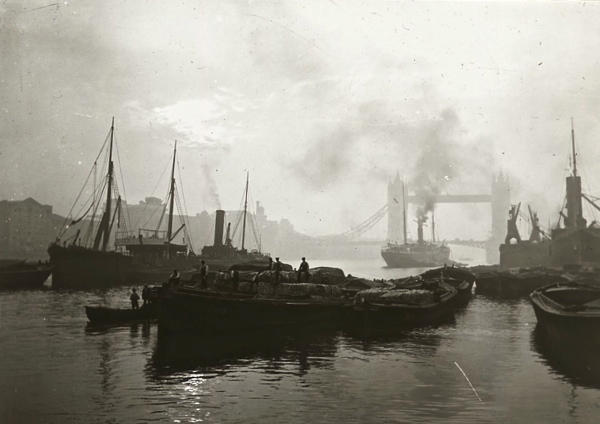
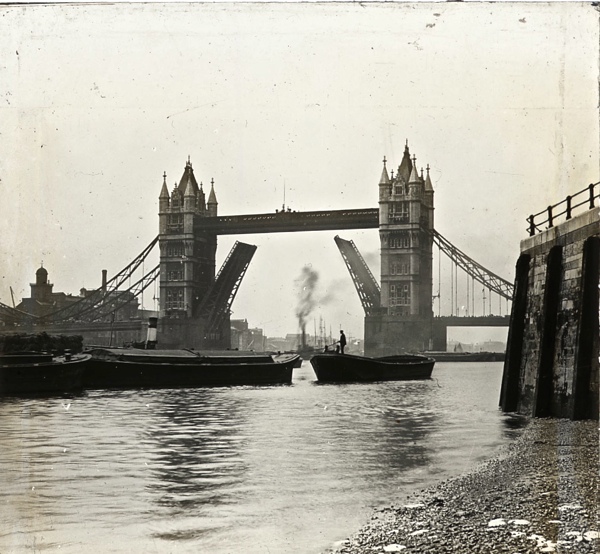
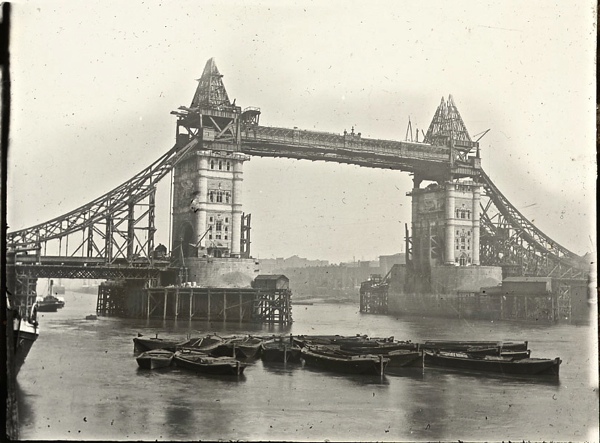
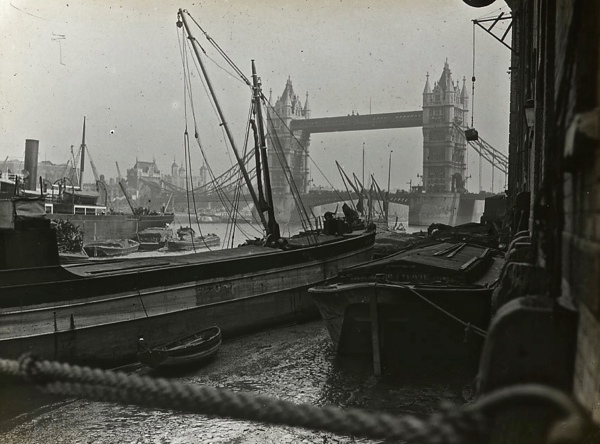
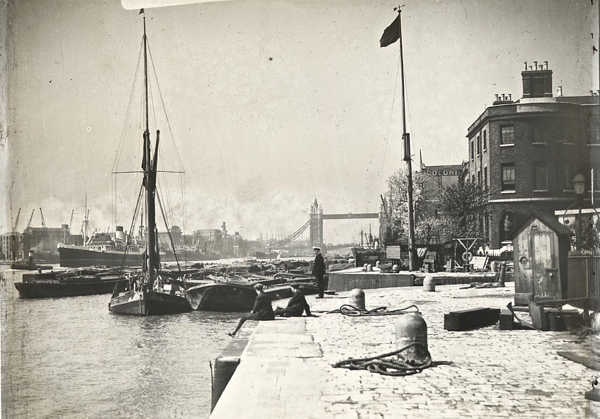
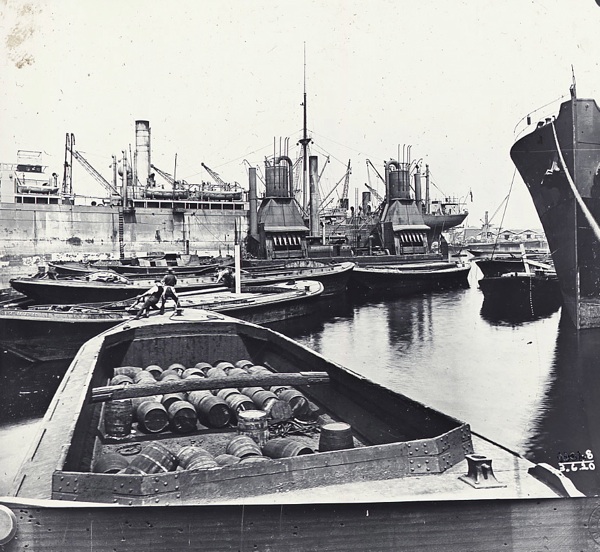
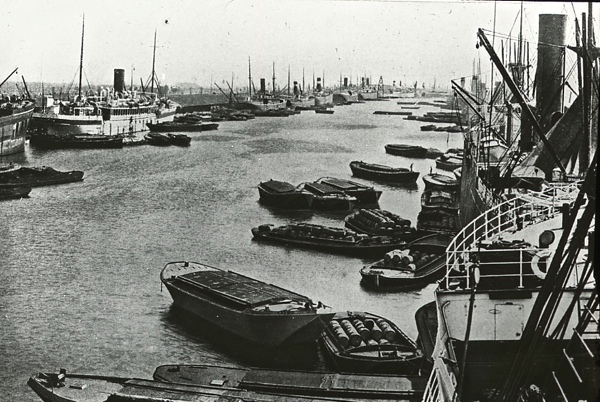
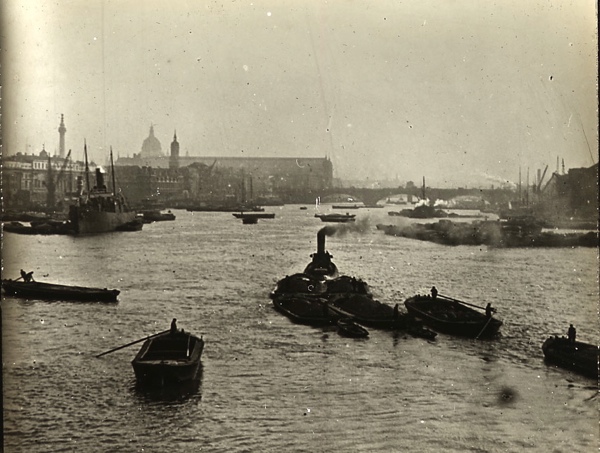
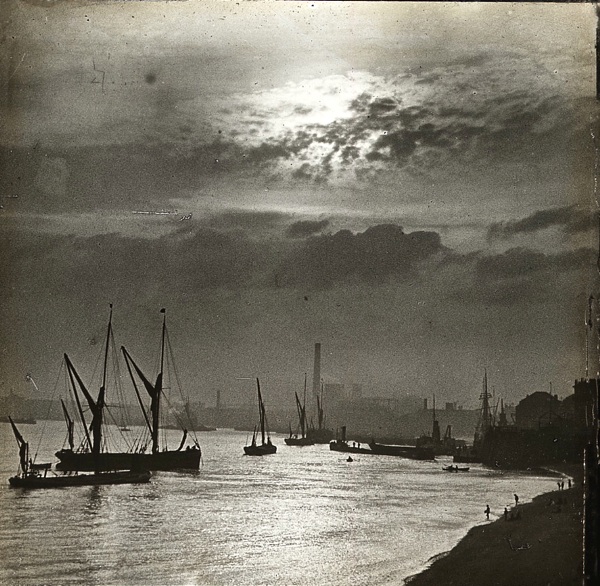
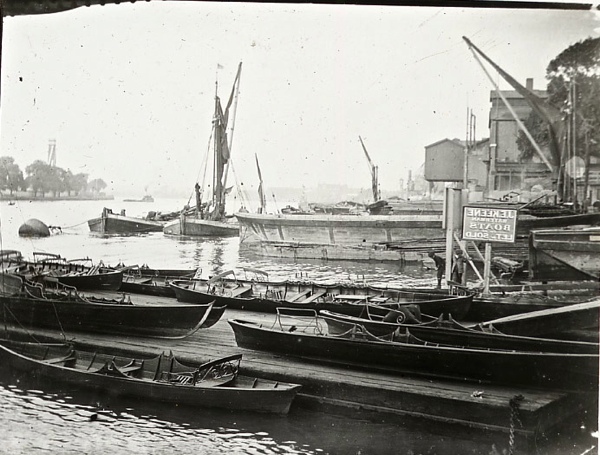
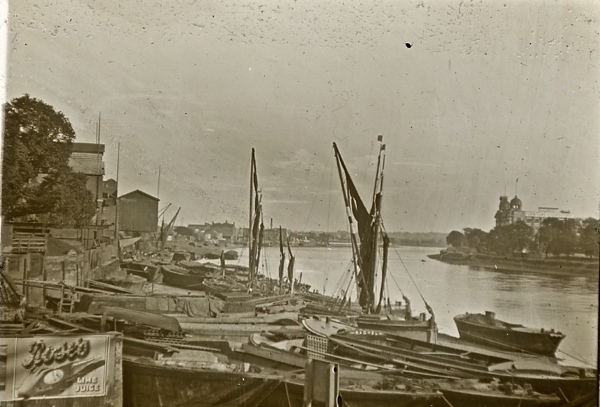
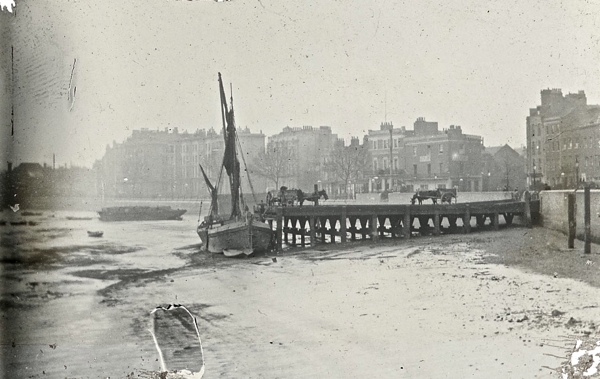
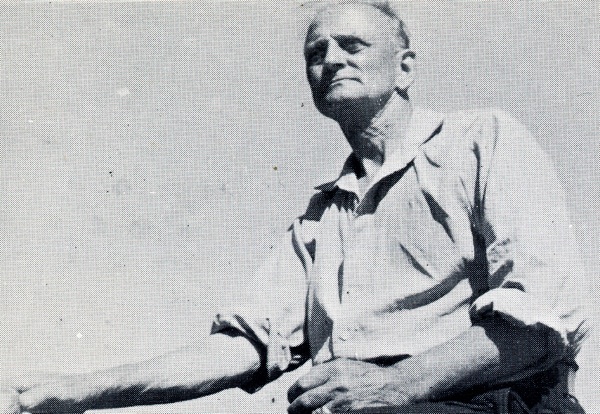
Harry Harris, Lighterman, photographed in 1947.
Photographs copyright © Bishopsgate Institute
You may also like to read