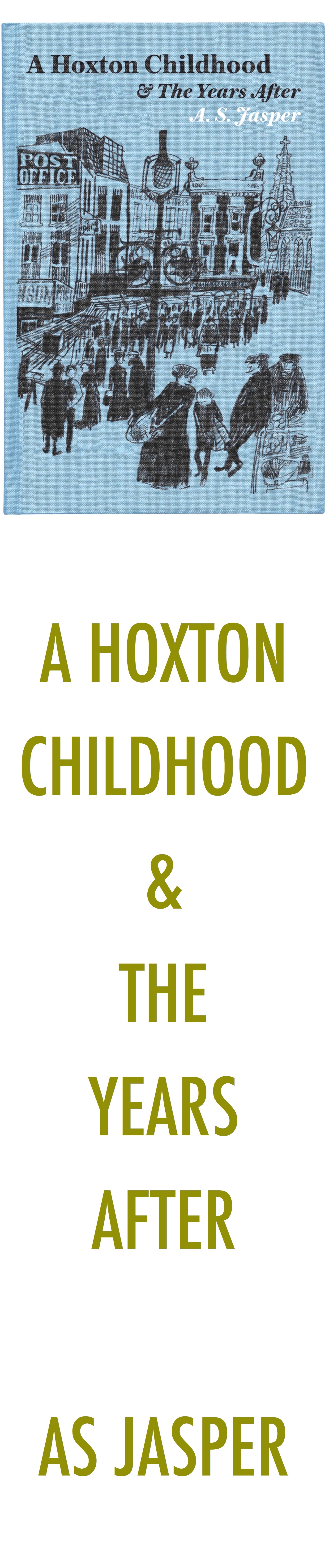
16th December, Three Kings

In Christian tradition, the Magi – also referred to as the Wise Men, Three Kings or Kings from the East – are a group of distinguished travellers who visited the infant Jesus bearing gifts of gold, frankincense and myrrh. “Magus” is a term derived from Greek, meaning a priest.
The Gospel of St. Matthew – the only one of the four Gospels to mention the Magi – states that they came “from the East” to worship Christ, “born King of the Jews.” Although the account does not tell how many they were, the three gifts led to the assumption that they were three, although some early traditions held that they were as many as twelve. Their identification as kings in later Christian writings is linked to Old Testament prophesies, such as that in Isaiah, which describe the Messiah being worshipped by kings.
Traditions identify a variety of names for the individual Magi. In the Western Christian church, they have been known as – Kaspar, Caspar, Gaspar, Gathaspa, Jaspar or Jaspas – Melchior, Melichior or Melchyo – and Balthasar, Bithisare or Balthassar. In my image I have shown, the Czech names for the Magi (as well as the Czech words for Three Kings and the names of their gifts). The names apparently derive from a Greek manuscript composed in Alexandria around 500 A.D. which has been translated into Latin with the title Excerpta Latina Barbari. In contrast, the Syrian Christians name the Magi – Larvandad, Gushnasaph and Hormisdas, probably Persian in origin. In the Eastern churches -Ethiopian Christianity has Hor, Karsudan and Basanater, while the Armenians have Kagpha, Badadakharida and Badadilma. One Armenian tradition identifies the Magi as Balthasar coming from Arabia, Mechior coming from Persia and Gasper coming from India.
The gifts symbolise Christ’s sovereignty (gold), divinity (frankincense) and death (myrrh, an oil used in embalming), while the day of celebration of the Three Kings’ arrival in Bethlehem is January 6th (Twelfth Night or the Feast of the Epiphany) and, in some cultures, this is the date on which children receive their Christmas gifts.
Marco Polo claimed that he was shown the three tombs of the Magi at Saveh, south of Tehran, in the 1270s – “In Persia is the city of Saba, from which the Three Magi set out and in this city they are buried, in three very large and beautiful monuments, side by side. And above them there is a square building, beautifully kept. The bodies are still entire, with hair and beard remaining.” Meanwhile, a shrine of the Three Kings at Cologne Cathedral, according to tradition, also contains the bones of the Three Wise Men. Reputedly, they were first discovered by Saint Helena on her famous pilgrimage to Palestine and the Holy Lands. The Magi are still sometimes referred to as the Three Kings of Cologne and the city’s coat-of-arms has three crowns on it in their honour.
In Poland, people take small boxes containing chalk, a gold ring, incense and a piece of amber – in memory of the gifts of the Magi – to church to be blessed on the evening of Twelfth Night. Once at home, they inscribe the date and “K+M+B+” with the blessed chalk above every door in the house to provide protection against illness and misfortune for those within. The letters, with a cross after each one, stand for names of the Three Kings — Kaspar, Melchior and Balthasar. They remain above the doors all year until they are inadvertently dusted off or replaced by new markings the next year. By happy coincidence, my dad who is Polish also has the initials K.M.B. – Krzysztof Maria Bommer!
Illustration copyright © Paul Bommer
Jimmy Huddart, Spitalfields Market Porter
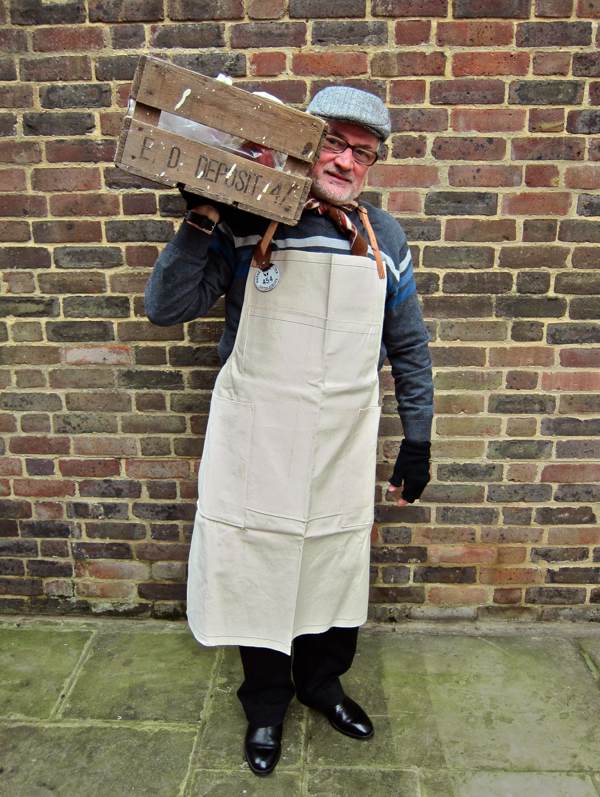
A market porter of forty years standing, Jimmy Huddart is proud to display the clothing of his trade. He keeps this apron pristine for ceremonial occasions now, but it is of the traditional design made of the full width of strong canvas, with leather straps and reinforcement across the front where the boxes cause most wear. In use, an apron like this would quickly acquire a brown tinge yet provide its owner with at least two years of wear, with prudent repairs. In the pocket, Jimmy always kept his porter’s knife and string to sew up broken sacks. And the offcuts from these aprons were used to make “cotchel” bags, which held all the fruit and vegetables that the porter might acquire for his own use, gathering it in the lining of his coat as he went about his work. “Cotchelling up,” they called it – and today, although employees in the market now get a vegetable box to take home, it is still referred to as a “cotchel.”
The most significant item in the outfit is the porter’s licence, indicated by the enamel badge. Throughout Jimmy’s time in the market, you could only work as a porter if you had one of these and it was a badge of office, denoting its own rights and privileges which had to be earned. At first, young men entered the market as “empty boys,” collecting and sorting empty wooden boxes and claiming the deposits, until they had earned the right to become licenced porters. Before the introduction of fork-lift trucks, this was intense physical work, manhandling crates of fruit and sacks of vegetables, and manoeuvring the heavy wooden barrows piled high with produce which had a life of their own once you set them going.
“I grew up in Bethnal Green, Brady St, and, at the age of twelve, I used to go to the market to watch all the tussle and bustle, and all the porters with their barrows. At school, I was very much interested in carpentry but I couldn’t get an apprenticeship, although by then I had already been introduced to the market. I loved to go up the Spitalfields with my Uncle Bill, he worked for a haulage company and we used to go around the farms in Kent to collect the English plums and apples and deliver them to the market. There was something about it, the atmosphere and the characters – a love of it developed inside me – and I wanted to become a porter. If you worked in the market or the docks you earned better than the average salary.
When I was fifteen, my uncle got me a job with Percy Dalton at the corner of Crispin St and Brushfield St. He was a well-dressed Jewish man, softly spoken, who had started his business with a barrow selling roast peanuts and he took me under his wing. The first day I started working for Percy Dalton, he showed me how to sweep the shop. He was that sort of person, hands on. He had a fruit shop at the front and in the warehouse there’d be eight people roasting peanuts. The peanut factory backed onto the alley where the lorries came, he had these red vans with Percy Dalton on the side that you always saw outside dog meetings and football matches. He was a likeable man, very popular, and people often came to him for advice. If you were in trouble you could go and speak to him, he would lend you money if you needed it. He always said, get a corner shop and you get two premises for the price of one.
I used to go out with the drivers all around the London Docks to pick up the fruit and make deliveries. I looked forward to it among my duties – being a boy, they took care of me and bought me breakfast, and they taught me how to stack a lorry. But I wanted to be a porter, so I asked in the market if I could work as an empty boy until I came of age. A job come up as a banana boy for Ruby Mollison, helping him to ripen the bananas, hanging them up in the ripening room. I used to wear a leather glove when I had to put my hand under the banana stalk because I was frightened of the spiders. When you cut a bunch of bananas, you cut a “v” shape and they come away from the stalk, and that’s where your spider might be. They could be very dangerous, especially if they were pregnant, and if you were bitten you’d have to go to hospital because your arm could get paralysed by the poison.
Then a chance came up at Gibson Pardoe as an empty boy with the view of getting a licence, and I worked with them for a year until Alf Hayes of the porters’ union came to me and said, “There’s an opportunity to work in the flower market as a porter, would you be interested?” and I was issued a porter’s licence at twenty-one. But there was decline in the fruit trade in the nineteen seventies and they brought in fork-lift trucks. The job changed, it became less physical and where you once needed four porters now you only needed two. I can recall the first time I was given an electric truck. It was one of two milk floats all sprayed up without a scratch on them and they said to me, “treat it like it was new-born baby.” My first trip with it was to go over to Commercial St, and I was making a delivery there when a forty-ton truck came past and clipped it, taking half the fibre-glass roof with it. Luckily, I wasn’t seriously injured, only shaken up. I explained to governor what happened, that it was an accident and he said, “Did you get the number plate ?” He never asked if I was hurt or injured in any way. I suppose you could say, that’s the market sense of humour.
I became elected to the union. In life, I always believed in fairness and I recognise there has to be give and take. I had to build up trust from my members and in dealing with the traders too, yet most of the problems were solved over a cup of tea and a handshake. I was the porters’ representative for ten years but Alf Hayes, who was my inspiration, he had been porters’ representative for forty years before me. The porters’ union was founded in the depression of the twenties and thirties. Although they had to keep it a secret, they invented a form of recognition so they could discuss it – it was “union” backwards, “you’ve got none.” It was lost on those who weren’t in the know, and the union became fully recognised in the late nineteen thirties.
My sport was road running and thirty-five of us formed the Spitalfields Market Runners. Celebrating the tercentenary of the market in 1982, we were supported by the traders and greengrocers and porters in a relay from the Spitalfields Market to Southend Pier and back. We each ran ten miles and the whole of the market came together to do something for charity.“
Jimmy remembers when unemployed porters once waited for work under the clock at the centre of the Spitalfields Market and how the union acquired an office so that traders seeking a porter could telephone, thereby saving the humiliation of the porters. Yet now, in common with the other London markets, the porters are becoming deregulated, losing their licences as the balance in the labour market shifts again. However, after forty years as a porter, Jimmy chooses to remain positive – because experience has granted him a broad perspective upon the endlessly shifting culture and politics of communal endeavour in market life.
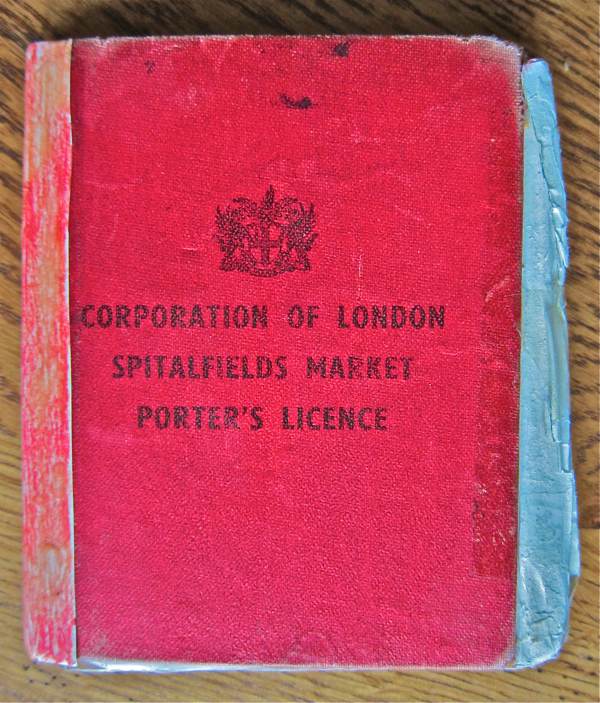
Jimmy’s Huddart’s porter’s licence.

The final year of the licenced porters.
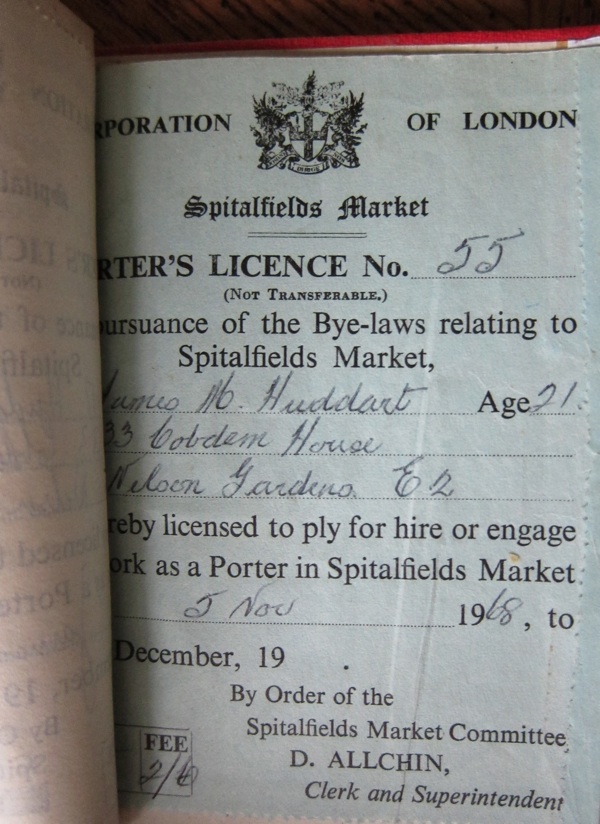
Jimmy’s first year as a porter at twenty-one years old.
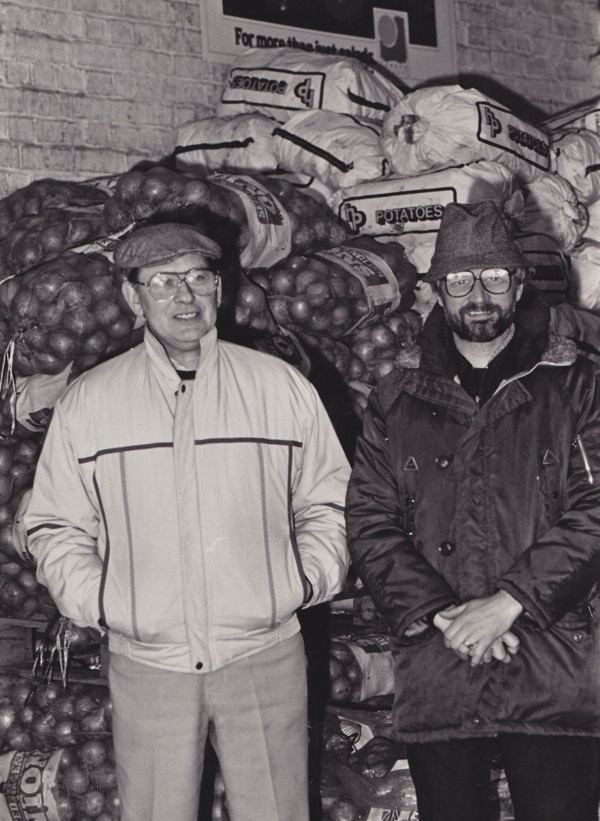
Jimmy (right) with his predecessor in the porter’s union Alf Hayes, photographed in the 1980s.

Jimmy Huddart, Honorary Fruit Porter to the Worshipful Society of Fruiterers
You may also like to read about
Peter Thomas, Fruit & Vegetable Supplier
Ivor Robins, Fruit & Vegetable Purveyor
John Olney, Donovan Brothers Ltd
Jim Heppel, New Spitalfields Market
Blackie, the Last Spitalfields Market Cat
and take a look at these galleries of pictures
Chapter 3. The Burial of the Victims

On 15th December 1811, one week after their violent deaths, the Marr family were buried in the churchyard of St George’s-in-the-East in the shadow of the pepperpot tower designed by Nicholas Hawksmoor. In spite of the frost, crowds of mourners lined the Highway from early morning and at one o’clock the coffins were carried out from the draper’s shop at 29 Ratcliffe Highway, where the deceased met their end, and into the church where two months earlier the family had attended the christening of Timothy Marr junior.
The following verse was inscribed upon the stone –
- Stop mortal, as you pass by
- And view the grave werein doth lie
- A Father, Mother and a Son
- Whose Earthly course was shortly run.
- For lo all in one fatal hour
- O’er came were they with ruthless power
- And murdered in a cruel state
- Yea, far too horrid to relate!
- They spared no-one to tell the tale
- One for the other could not wail
- The other’s fate in anguish sighed
- Loving they lived, together died
- Reflect, O Reader, o’er their fate
- And turn from sin before too late
- Life is uncertain in this world
- Oft in a moment we are hurled
- To endless bliss or endless pain
- So let not sin within your reign.
Meanwhile, no progress had yet been made in the detection of the perpetrators of the crime. Three Greek sailors loitering with blood on their trousers on the Ratcliffe Highway were arrested on the night of the murders but released again once an alibi was established, proving they had just come up from Gravesend.
More pertinently, Mr Pugh the carpenter who had undertaken the improvements to the Mr Marr’s shop was questioned. He had employed a subcontractor to make the shop window, who requested the iron chisel (discovered on the shop counter after the killings) which Mr Pugh had borrowed from a neighbour. Once the work was complete the chisel could not be found, though the contractor claimed he had left it in the shop for Mr Pugh. However, Mr Pugh was found to be of good character and had a reliable alibi too. Either Mr Marr succeeded in finding the chisel after Margaret Jewell, the servant girl, had gone out at ten to midnight to buy oysters – or he had kept it secretly all along and brought it out in vain self-defence against persons unknown – or one of the murderers had brought it into the house as a weapon and not used it.
Without any significant leads in the case, the neighbourhood was left with only speculation and the deadly brooding fear that – although the Marr family were now buried – the train of events unleashed by their savage murder on the night of 11th December was far from over.
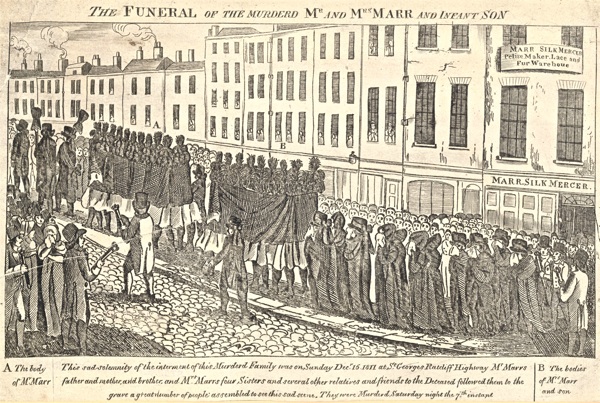


Click on Paul Bommer’s map of the Ratcliffe Highway Murders to explore further
The Maul & The Pear Tree – P.D. James’ breathtaking account of the Ratcliffe Highway Murders, inspired me to walk from Spitalfields down to Wapping to seek out the locations of these momentous events. Commemorating the bicentenary of the murders this Christmas, I am delighted to collaborate with Faber & Faber, reporting over coming weeks on these crimes on the exact anniversaries of their occurrence.
The Map of the Ratcliffe Highway Murders – In collaboration with Faber & Faber, Spitalfields Life has commissioned a map from Paul Bommer which will update throughout December as the events occur. Once you have clicked to enlarge it, you can download it as a screensaver or print it out as a guide to set out through the streets of Wapping.
Ratcliffe Highway Murder Walk – Spitalfields Life will be hosting a dusk walk on Wednesday 28th December at 3pm from St Georges in the East, visiting the crime scenes and telling the bone-chilling story of Britain’s first murder sensation. The walk will take approximately an hour and a half, and conclude at the historic riverside pub The Prospect of Whitby. Booking is essential and numbers are limited, so please email spitalfieldslife@gmail.com to sign up. Tickets are £10.
Thanks to the Bishopsgate Institute and Tower Hamlets Local History Archive for their assistance with my research.
You may like to read the earlier installments of this serial which runs throughout December
15th December, Yule Log

The Yule Log is a large wooden log, burned in the hearth as a part of Yule or Christmas celebrations. Originally an entire tree, it was carefully chosen and brought into the house with great ceremony to provide lasting warmth throughout the Twelve Days of Christmas (from Christmas Eve until Epiphany). In some European traditions, the largest end of the log would be placed in hearth while the rest of the tree stuck out into the room.
Ideally, the log would be lit with a brand made out of remnant of last year’s log, and it was hoped and considered a sign of great luck, that the log would burn throughout the twelve days. The Yule Log has frequently been associated with germanic paganism, practiced across northern Europe prior to the arrival of Christianity. One of the first to make this connection was the English historian Henry Bourne, writing in the 1720s, who described the practice occurring in the Tyne valley and theorised that it derived from sixth or seventh century Anglo-Saxon pagan customs – in old English folklore, Father Christmas was sometimes portrayed carrying a Yule Log.
The Yule Log brought prosperity and protection from evil, and by keeping the remnant of the log, the protection was believed to last all year. As well as being a protective amulet, the log became a source of rivalry – causing members of a rural communities to compete to possess the largest. According to historian and folklorist Professor Ronald Hutton, the traditions of the Yule Log died out in Britain at the end of the nineteenth century because of “the reduction in farm labour and the disappearance of the old-fashioned open hearths.”
In France and Wallonia, and francophone regions of the world – such as Quebec and in Lebanon – the Bûche de Noël (“Christmas Log”) is a traditional dessert, a cake in the shape of a Yule Log. Usually taking the form of a large cylindrical “roulade,” covered with chocolate icing, incised with a fork to resemble the tree’s bark – one end is lopped off and stood up to indicate the rings of the “log.”
I have shown here a Quebecois lumberjack, Alain Hauteville, sitting on the Yule Log he has just chopped down. The tree he chose was one that a childhood sweet-heart of his had written his initials into the bark many moons ago, before spurning him for a wealthy silk merchant in Montreal. After completing his thirsty work, young Al is enjoying a brew from his Thermos and a smoke,before dragging the lumber back to his cabin at the forest’s edge.
Illustration copyright © Paul Bommer
14th December, Christmas Pudding

Christmas Pudding is a steamed pudding traditionally served on Christmas Day. Originating in England and Ireland, and sometimes known as “Plum” or “Figgy Pudding,” it can be traced back at least to the fifteenth century when it contained meat as well as fruit and spices.
By the Victorian period, Christmas Pudding had become heavy with dried fruits and nuts, usually made with suet (all that remains of the medieval meat ingredient) and dark in appearance – effectively black – as a result of the dark sugars and black treacle included, and its long cooking time. The mixture was moistened with the juice of citrus fruits, brandy and some recipes called for dark beers such as stout or porter.
In the nineteenth century, Christmas Puddings were boiled in a cloth and they were round. However, in twentieth century they were prepared in basins, acquiring the shape we recognise today. Traditionally, the pudding is made four or five weeks before Christmas on what is called “Stir-up Sunday” with all the household stirring the mixture for good luck, although they can be made a year or even two in advance. It was common practice to include small silver coins in the mixture as prizes which could be kept by those who found them in their portion.
Once cooked, turned out, decorated with holly, doused in brandy, and flamed (or “fired”), the pudding is always brought to the table ceremoniously and greeted with a round of applause. Charles Dickens descibes the scene in “A Christmas Carol.”
- “Mrs Cratchit left the room alone – too nervous to bear witnesses – to take the pudding up and bring it in… Hallo! A great deal of steam! The pudding was out of the copper. A smell like a washing-day. That was the cloth. A smell like an eating-house and a pastrycook’s next door to each other, with a laundress’s next door to that. That was the pudding. In half a minute, Mrs Cratchit entered – flushed, but smiling proudly – with the pudding, like a speckled cannon-ball, so hard and firm, blazing in half of half-a-quartern of ignited brandy, and bedight with Christmas holly stuck into the top.”
Today, the term “Figgy Pudding” is known mainly because of the sixteenth century secular carol “We Wish You A Merry Christmas” which repeats, “Oh bring us a figgy pudding” in the chorus, confirming it as a traditional Christmas dish served during the season and given to Christmas carolers.
- Good tidings we bring to you and your kin
- We wish you a Merry Christmas and a Happy New Year.
- Now! bring us some Figgy Pudding
- and bring some out here!
- Illustration copyright © Paul Bommer
At The “What Pub Next ?” Club
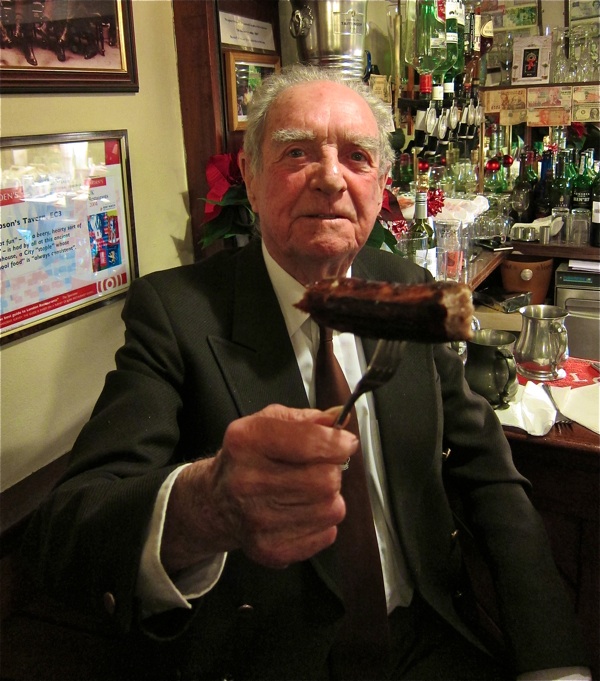
“I only come here to make your lives happier, I don’t enjoy it”
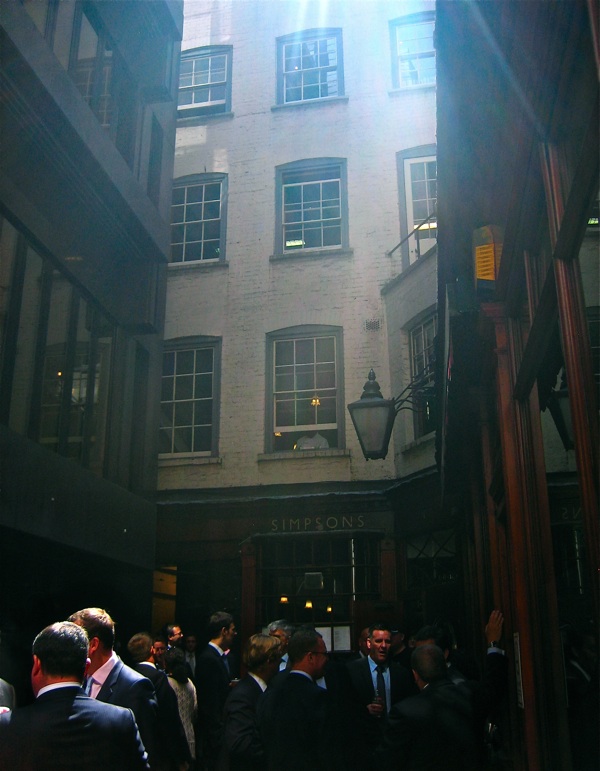
It was August when I last visited Simpsons Chop House – the oldest tavern in the City of London, established 1757 – so I was delighted to be invited back last week by Jean Churcher to join the members of the “What Pub Next?” Club for their December shindig. Believed to have been founded in the nineteen fifties, this venerable society of wags once had a membership of over three hundred and they used to visit all the pubs in the City.
Yet, even though the “What Pub Next?” Club was officially disbanded two years ago – even though there are only a handful of members left alive – even though there are no new members, no junior members, only senior members in their eighties and nineties – even though they no longer stray to any other pubs, adopting Simpsons Chop House (thirty seven and a half, Cornhill) as their headquarters – even though the question “What Pub Next?” is no longer asked – such is the intoxicating nature of this fellowship that these rebel diehards continue to put on their club ties and gather regularly for old time’s sake. So I think we must indulge them, because after all these years they simply cannot keep themselves from getting together for beanos.
Escaping the icy gusts blowing down Cornhill, I walked through Ball Court into the yard and discovered the eighteenth century edifice of Simpsons looming overhead, then I climbed down a windy stair to join the members of the “What Pub Next?” Club, who were merrily clinking tankards and celebrating as if Christmas had come already. So pervasive was the sense of mischief and fun, that whilst I could enjoy the experience offered by the “What Pub Next?” Club at once, appreciating the exact the nature of the organisation proved to be more elusive. Several original members squinted and strained when I asked them if they could remember when they first came along or if they could recall how it started. The genesis of the “What Pub Next?” Club is lost, it seems, in an endless haze of conviviality.
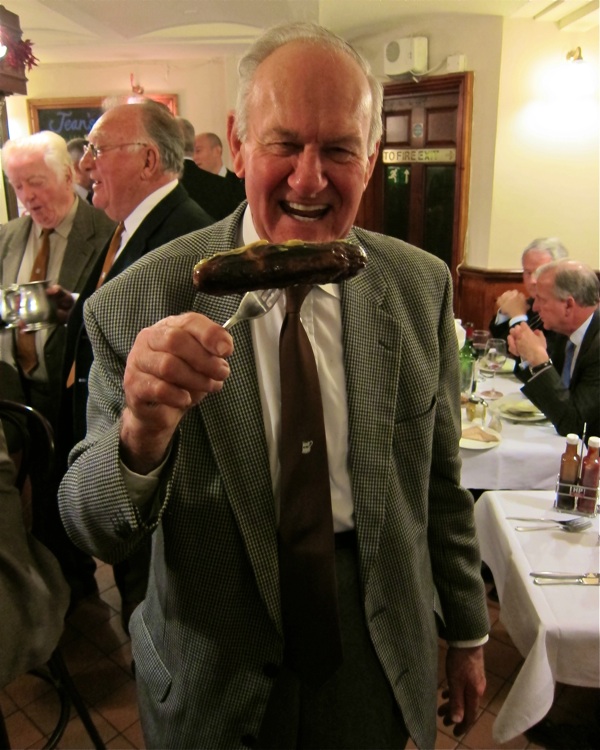
“I’m not sure anyone knows when it began,” queried ninety-one-year-old Douglas, whose daughters had dropped him off while they did their Christmas shopping. “It had to be a Bass pub, they had to serve draft beer,” interposed his friend “Ginger” helpfully, gesticulating with a sausage. “And we had to drink a spoonful of Worcestershire sauce as an initiation,” contributed Brian with a chuckle, adding to the picture for my benefit.
“By Jingo, let us have what we are here for!” exclaimed Pat authoritatively, the most senior member at ninety-two, reaching out for a mustard smothered sausage on a stick.“I know everyone here but don’t for a minute think that I can recall their names,” he informed me, “because somewhere along the way, I lost my memory – I can remember their name as long as as it’s Brian.” A comment which was the catalyst for general hilarity. “I only come here to make your lives happier, I don’t enjoy it,” he continued, adopting a stern tone, waving his hands around and holding court now, before asking rhetorically, “Can you enjoy life without laughing? Life’s far too serious not to be taken lightly.” It was a maxim that could easily be the motto of the “What Pub Next?” Club.
Originating among employees of the Australia & New Zealand Bank who wanted to learn about British culture whilst posted to London before they returned to the antipodes, the “What Pub Next?” Club quickly became a social focus for hundreds of City workers in the nineteen sixties. All that was required for membership was a tie – a tie that was ceremonially cut off with giant shears belonging to Mr True, the tailor at the Bell in Cannon St, if members left to return to their country of origin. These stumps of ties were nailed to wall in the cellar of Simpsons along with pairs of girls’ knickers acquired by undisclosed means, I was assured. A story that was the cue to remember Sid Cumberland, who had his little finger cut off by mistake during the tie ceremony – though fortunately the surgeons at Barts were able to sew his pinkie on again and Sid returned to New Zealand with only a crooked digit as evidence of his misadventures in London.
The late Ken Wickes is venerated as the president and founder of the “What Pub Next?” Club, remembered today by a brass plate over the bar. “Every year he resigned and every year he was re-elected,” they told me affectionately. The name of the late “Reverend Strudwick” was evoked in a whisper, yet although he inspired a devotion that bordered on religion, he was not a priest just one whose initials were R.E.V. In fact – I learnt – “Struddy” was poet who wrote cryptic verses which had to be deciphered in order to answer the question“What Pub Next?” Not all of these examples are quotable in print but among those that I can give are – The Watling (the which fish), The Globe (Shakespeare’s auditorium), The Sugar Loaf (the sweetbread) and The Wood-in-Shades (Woo’d in Hell).
By now, the Port was being passed around in a pewter tankard and – with so few members of the Club left – it was circulating at the speed of a horse on a merry-go-round. As a consequence, the momentum and eloquence of the conversation accelerated too, so that the story of the WPNC trip to the Bass brewery and the account of the WPNC Morris dancing on the banks of the Stour passed me by. Yet I grasped an impression of the glorious history of the noble club, enough to understand why they should all wish to keep meeting and celebrating for ever.
“I worked fifty years in the City and I’ve still got my bowler hat and brolly at home. I remember the first thing I did when I started work at the insurance exchange in 1962 was go and buy a bowler. “ Brian confided to me with a sentimental smile as he passed the Port back and forth – turning contemplative and pausing for a moment to ask, “Do they still wear bowler hats?”

Jean – “I have a garter made of a club tie, it only goes to my knee now but it used to go all the way up!”
The WPN club tie with its discreet logo is de rigeur on these occasions.

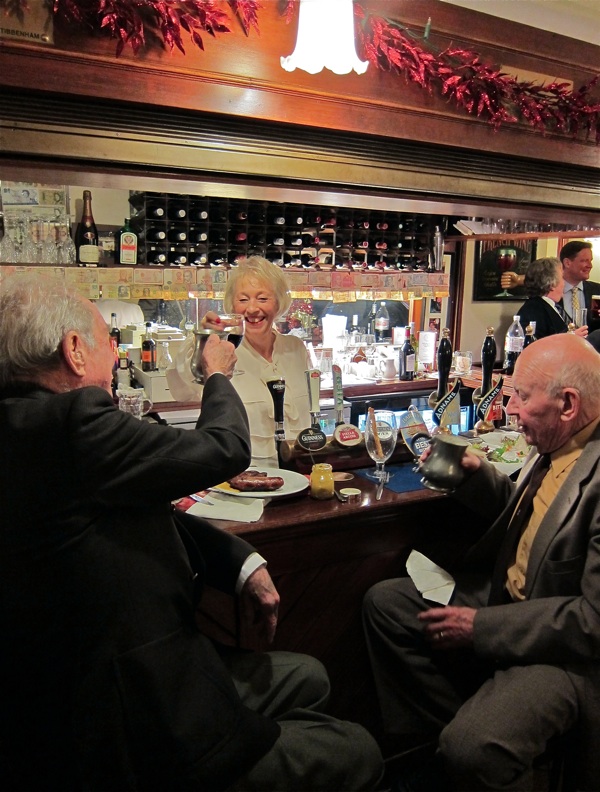
Jean Churcher, the celebrated raconteuse of Simpsons Chop House.

Quaffing the Port from a pewter tankard.

Happy Christmas from the members of the “What Pub Next?” Club!

Cheese on toast with Worcestershire Sauce is the traditional conclusion of proceedings at the WPN Club.
You may also like to read my earlier report
Justin Knopp, Typoretum
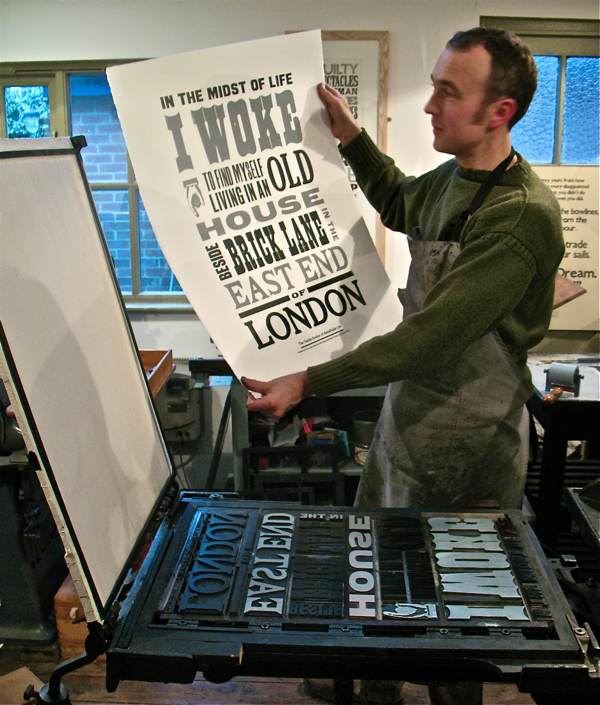
After interviewing more than eight hundred people, I agreed to give my first interview – conducted by Tim Rich for the debut issue of Random Spectacular, published this week by St Jude’s in aid of Maggie’s Centres. Described as a collaborative exploration of the visual arts, the magazine includes work by Spitalfields Life regulars Paul Bommer, Joanna Moore and Rob Ryan among many others. Justin Knopp of Typoretum was commissioned to create a print to accompany my interview and so I took the opportunity to travel by train from Liverpool St to Coggeshall to visit him in his workshop.
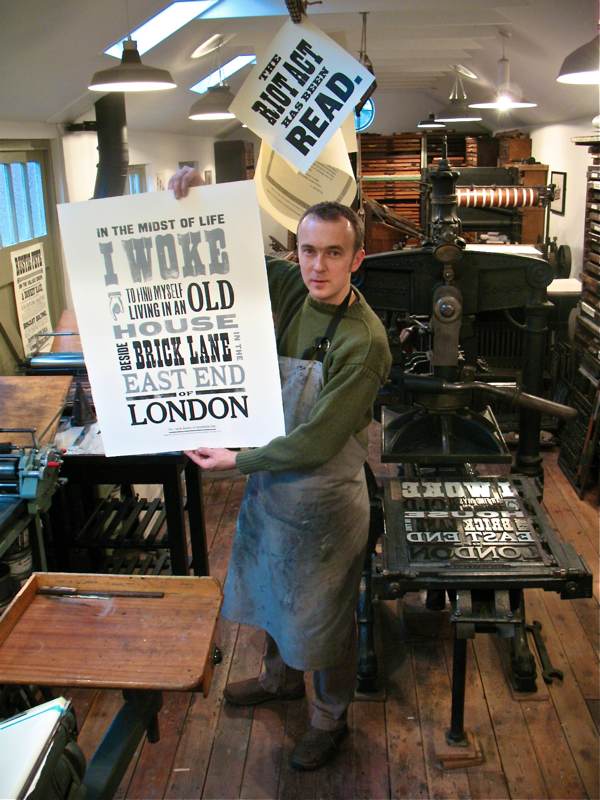
Justin Knopp
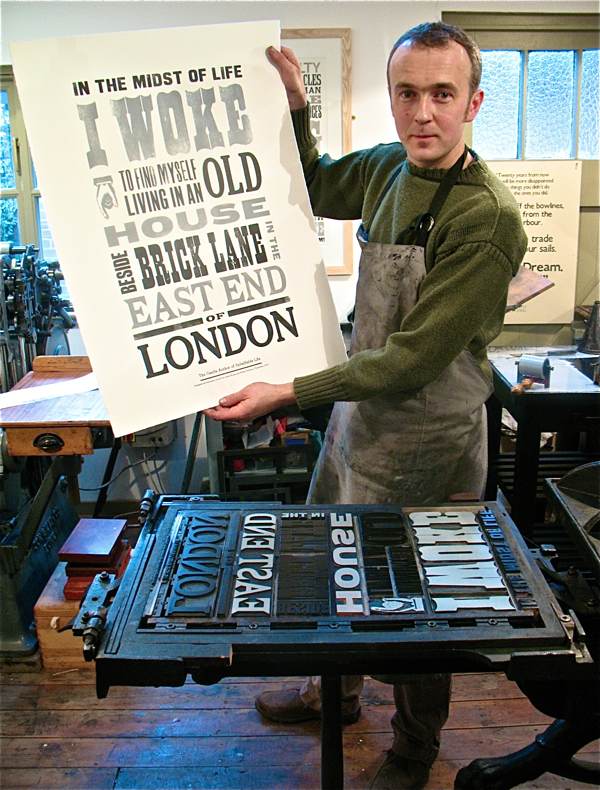
I had not met Justin Knopp of Typoretum before he designed the print you see him holding in this photograph – I had not even spoken with him – yet when a copy arrived out of the blue, I was so impressed that I got on the train up to Coggeshall at once, eager to go and find the man behind this clever piece of typography.
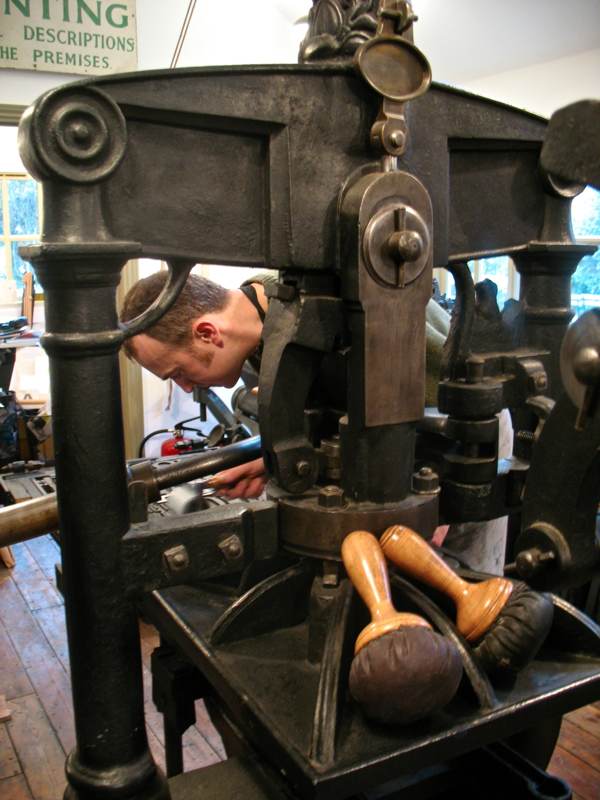
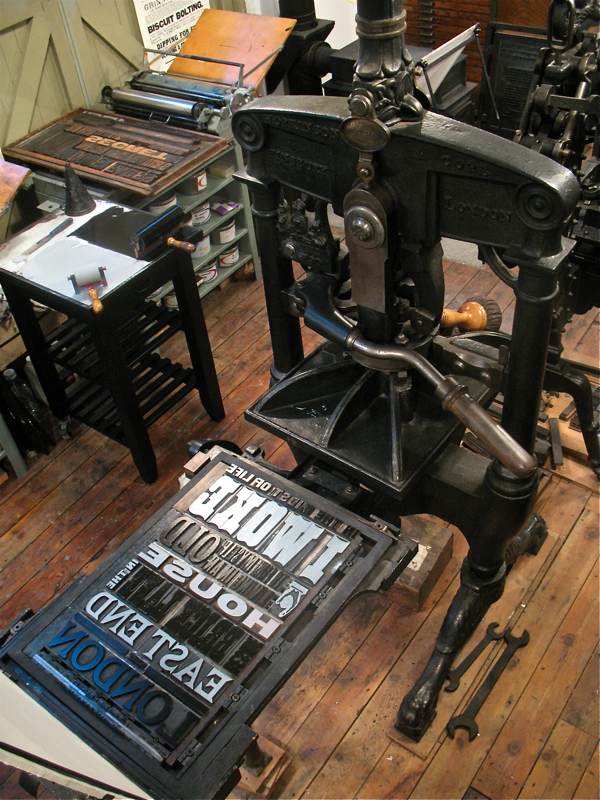
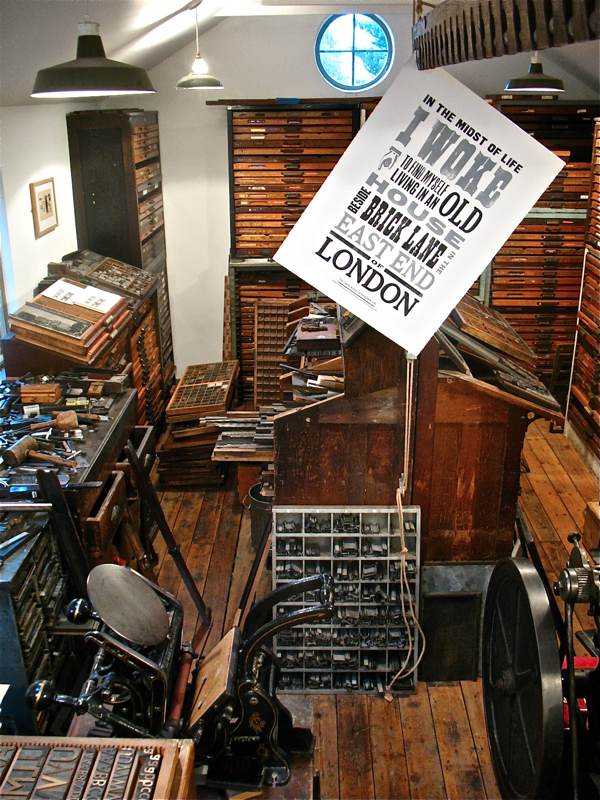
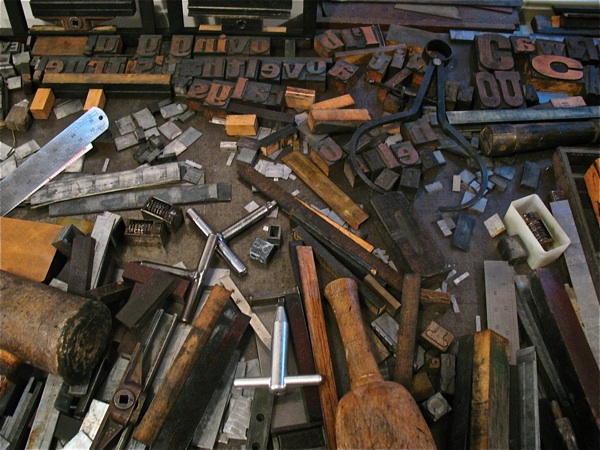
Situated where the suburbs of Essex have unravelled into green fields and villages with old flint churches, Coggeshall is an ancient market town lined with medieval houses upon Stane St, the Roman road which is the continuation of Old St. Outlying the village, behind a modest nineteenth century terrace, you will find a long weatherboarded shed with a plume of blue smoke drifting through the orchard from the chimney of the wood-burning stove within. Here, in a single long room lined with trays of magnificent wooden type and filled with gleaming iron printing presses crouching like tamed mythical beasts, Justin Knopp – printer, typographer and retained fireman – works his subtle magic.
Justin was born in Coggeshall though he studied in London at St Martin’s College of Art in Covent Garden before returning after graduation in 1994. “My family are all from London for generations,” he told me as he started blending ink with a palette knife upon a glass plate, “before that they were from round here, Maldon. They were bootmakers.” And then he went silent, assuming the grimace of concentration upon the task in hand.
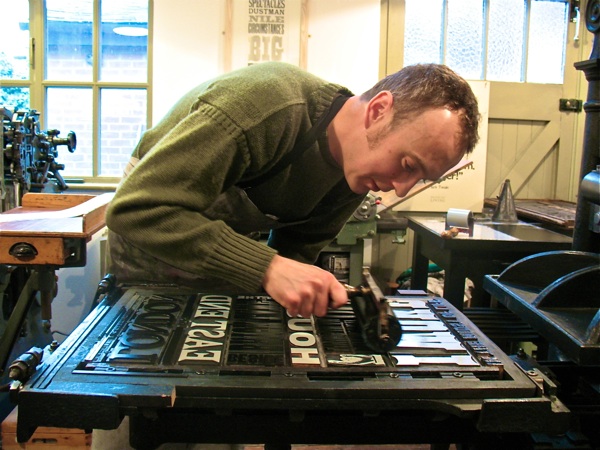
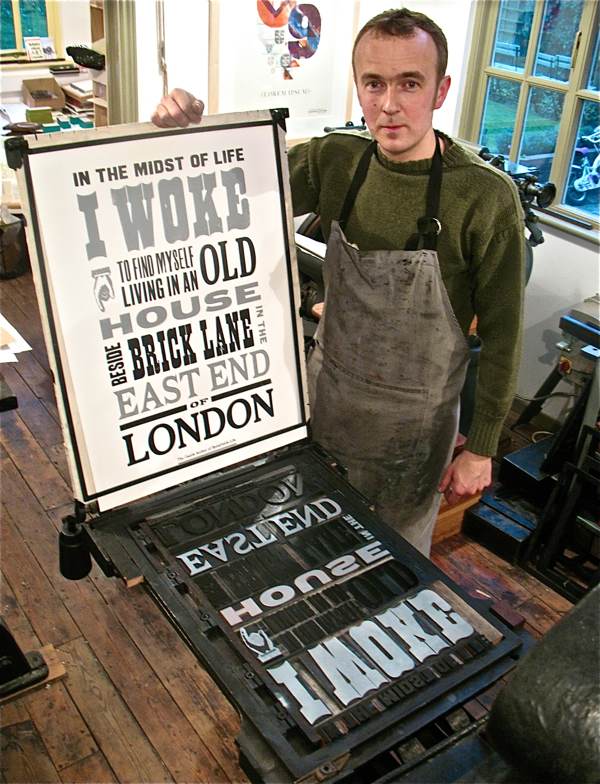
Meanwhile, the printer’s pie sat upon the Albion Press of 1851 awaiting the ink and I could not fail to be impressed that although Justin had used a different typeface for each line, all the lines were of equal length. “I like the challenge of fitting the type into the block,” he explained, observing my interest, “It certainly makes life difficult, but it’s a bit of a house style of mine!” After years of commuting and working as a graphic designer in London while pursuing letterpress as a hobbyist, Justin took the brave step of starting out on his own in 2009. He built the shed, installed the presses and never looked back.
“I started doing this because I loved it and I knew lots of the old boys that were doing it” he confided to me as he began to roll the ink onto the type, “and I thought, ‘It’s dying out and that’s a terrible shame,’ so it became my ambition to carry it on.” In fact, Justin’s school playground sat beside The Anchor Press, one of the largest printing factories in the country at the time and although it is long gone, Justin befriended many of the veterans of the printworks, recording the oral history and archiving the photographic record. The outcome of this passion was that Justin was gifted collections of type and presses that he has supplemented with his own acquisitions.
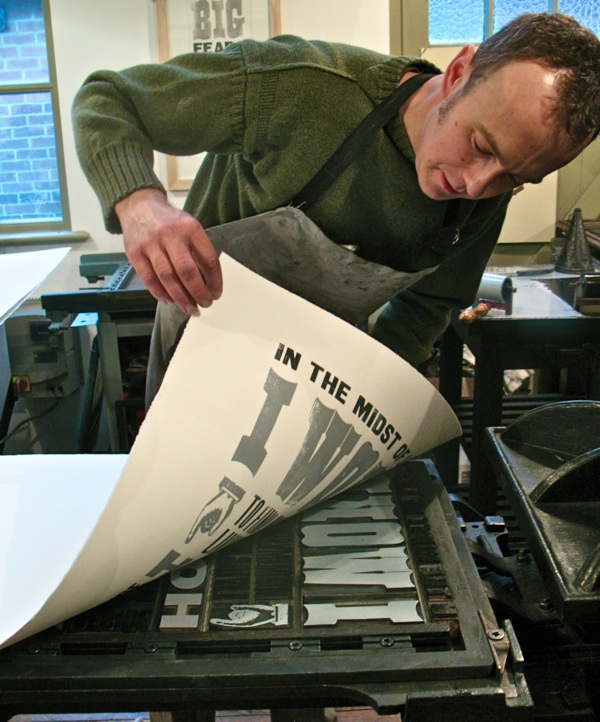
Bringing a contemporary sensibility to the use of these classic typefaces, Justin finds himself in demand, not just for business cards and wedding invitations, but providing fine letterpress printing for all kinds of projects such as the recent limited edition of Haruki Murakami’s “1Q84.” “Lots of weird and wonderful things we get involved with,” admitted Justin with a delighted smile, as he laid the paper down delicately upon the type, placing the packing on top and rolling the whole contraption forward beneath the press before pulling upon the lever and leaning back with his whole weight.
“I like a degree of imperfection,” he confessed, scrutinising the resulting print with a frown, “but any more than that and it looks badly printed.” Justin is scrupulous to achieve what he terms, the “kiss” impression that sits upon the surface of the paper, not the indented imprint that is commonly associated with letterpress yet merely an indicator of poor quality printing. The truth is that the print looked mighty fine to me, an enormous thrill to see my words emblazoned in such style.
By now, Justin’s wife Cecilia arrived with his two excited daughters from school to interrupt the calm of the print shop. “Which of you is going to be a printer?” he teased, as each gave him the kiss impression upon the cheek, and I could not but envy these children growing up with a printing press at home. Then, while the family went for tea, Justin carried on, re-inking the block and studying each impression as it came off the press. “Printing in this way, there’s a lot more variation,” he said, permitting himself grudging satisfaction as he hung the prints on the drying rack suspended from the ceiling, “each one can be unique, which is nice.”
Working assiduously in his Guernsey sweater and canvas apron, surrounded by nineteenth century presses and bringing new life to old techniques, Justin is a happy man. He is at home here, with a busy family life and an active involvement in village life that includes firefighting duties too. “I’ve gone from doing it purely for the love of it to making a living out of it, and we’re still alive!” he declared to me, casting his eyes around his beautiful print workshop in triumph.


Copies of Justin Knopp’s print are available from the Spitalfields Life online shop and copies of Random Spectacular magazine will be available from St Jude’s.