
13th December, St Lucy’s Day

Saint Lucy (283–304), also known as Santa Lucia, was a wealthy young Christian martyr who was killed in Syracuse, Sicily, by Diocletian for refusing to submit to her heathen husband. She is now venerated as a saint by Christians around the world and her feast day is 13th December. With a name derived from lux, lucis – meaning “light” – she is the patron saint of those who are blind or have eye-trouble (as well as, bizarrely, salesmen, writers and those with throat infections).
In the legend, she had her eyes put out before being killed and, in some versions of the tale, God restores her sight. She is shown on the right with two of her symbols – the palm-frond of Martyrdom and her own eyes upon a salver or cake-stand!
Saint Lucy is one of the very few saints celebrated by members of the Lutheran Church among the Scandinavian peoples, who take part in Saint Lucy’s Day celebrations that retain elements of germanic paganism. December 13th was the date of the Winter Solstice in the Julian Calendar (replaced by today’s Gregorian Calendar in Britain in 1752, when Wednesday, 2nd September was immediately followed by Thursday, 14th September – a change that brought consternation and rioting). This timing and her name meaning light, are factors in the particular devotion to St. Lucy performed in Scandinavian countries where young girls dress as the saint in honour of her feast.
Traditionally, the oldest daughter of any household will wear a white robe with a red sash and a wreath of evergreens and twelve lighted candles upon her head. Assisted by any siblings, she serves coffee and a special St Lucia bun (a Lussekatt in Swedish) to her parents and family. The Lussekatter or Lussebollar are spiced buns flavoured with saffron and other spices, customarily presented in the form shown in my drawing, an inverted “S” with two raisins a-top – perhaps representing St Lucy’s plucked out eyes?
The metaphysical poet and Dean of St. Paul’s Cathedral, John Donne, wrote “A Nocturnal upon St. Lucie’s Day, being the shortest day” in 1627. The poem begins – “Tis the year’s midnight, and it is the day’s,” describing the describing into sterility and darkness at this time when “The world’s whole sap is sunk.” A good day for coffee and buns, in other words!
I would like to take this opportunity to wish all my Scandinavian friends (plus any Lucies) a “God Jul!”
Illustration copyright © Paul Bommer
12th December, Mr Fezziwig’s Ball

This jolly couple are Mr. and Mrs. Fezziwig, two lovable characters from Charles Dicken’s seasonal novella “A Christmas Carol.”
Mr. Fezziwig is the owner of the business for whom Ebenezer Scrooge worked as an apprentice with Dick Wilkins, and in Stave 2 of “A Christmas Carol” he gives a Christmas ball for his family, friends and employees. Old Fezziwig is a happy man with a large Welch (or welsh) wig, and he and his beloved wife are shown here dancing the “Sir Roger de Coverley,” a lively tune, popular in the eighteenth and nineteenth centuries.
Scrooge revisits Fezziwig with the Ghost of Christmas Past and, realising that Fezziwig is one of the few people to whom he is thankful, says, “He has the power to render us happy or unhappy, to make our service light or burdensome, a pleasure or a toil…The happiness he gives is quite as great as if it cost a fortune.” Scrooge is reminded how much he once appreciated Fezziwig, and since Fezziwig might be the elder Scrooge’s model — in kindness, generosity, affection for his employees, relationship with family and apparent happiness — Scrooge is confronted with the fact that his own choices have diverged from those of one he admired. Consequently, he has a stab of remorse for how he has treated his own employee, Bob Cratchett.
The other Fezziwigs mentioned by Dickens are the couple’s three unnamed daughters, described as “beaming and lovable,” and courted collectively by six young gentlemen!
Yo ho, my boys! Hilli-ho! Chirrup!
Illustration copyright © Paul Bommer
The Dogs of Spitalfields in Winter
Spitalfields Life Contributing Photographer Sarah Ainslie and writer Andrew McCaldon have been out in the parks again, braving the frost to continue their survey of East End canines.
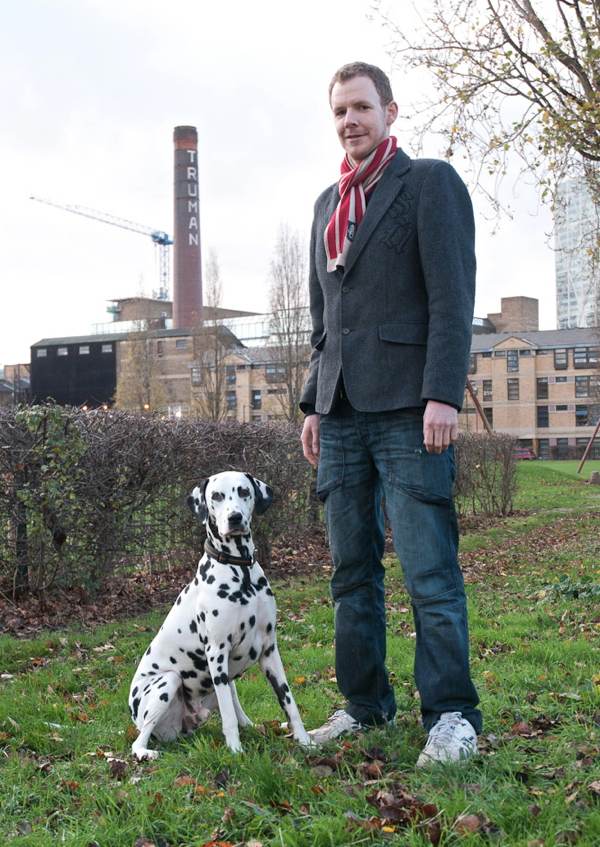
Max (Dalmatian) & Hugo Coster
“I saw his picture online – one inch by five inches – and that was it. I grew up in the States and had two Dalmatians as a kid, though Max is the first as my own responsibility. I’ve had rats and cats but dogs take it to a whole new level.
It’s nice having him – I meet about twenty new people every day. Recently I was walking him in Hyde Park and met an improv actor who was doing a show called ‘Hounded.’ He said they’d love to have Max chase people dressed as foxes through Soho on a Friday night. And we did! They had bugles going off. The drunk revellers got in on the action too. Max loved it!
With Max, people want to stop and talk. It’s made London a more friendly place for me.”
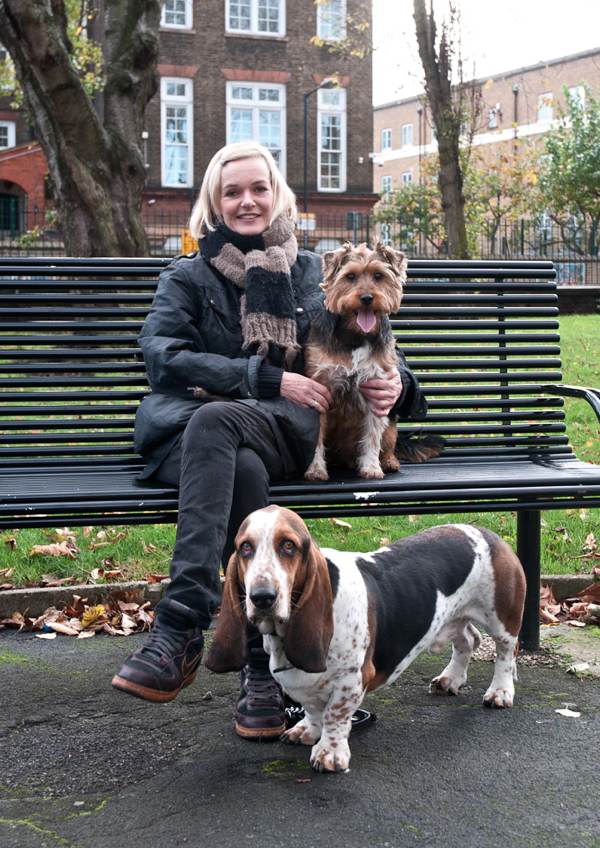
Percy (Basset Hound), Ronnie (Terrier) & Evon Gregory
“I’d had Percy for about six months but he wasn’t good on his own, he used to wail all the time. Then I was having coffee with Leila outside her shop when a guy came up with a rucksack of puppies, saying he couldn’t cope with them. He opened the bag and Ronnie was just there. I looked at him and Leila said ‘Are you sure about this?’ but I’ve no regrets.
Percy and Ronnie get on very well. Percy is a proper alpha male, very protective, very stubborn, and Ronnie loves everybody, he’s social, he’s always happy. They’re like ‘The Odd Couple.’
I was very ill for over a year, and if it hadn’t been for the dogs I wouldn’t have left the house at all. So I realised afterwards how important they both were.”
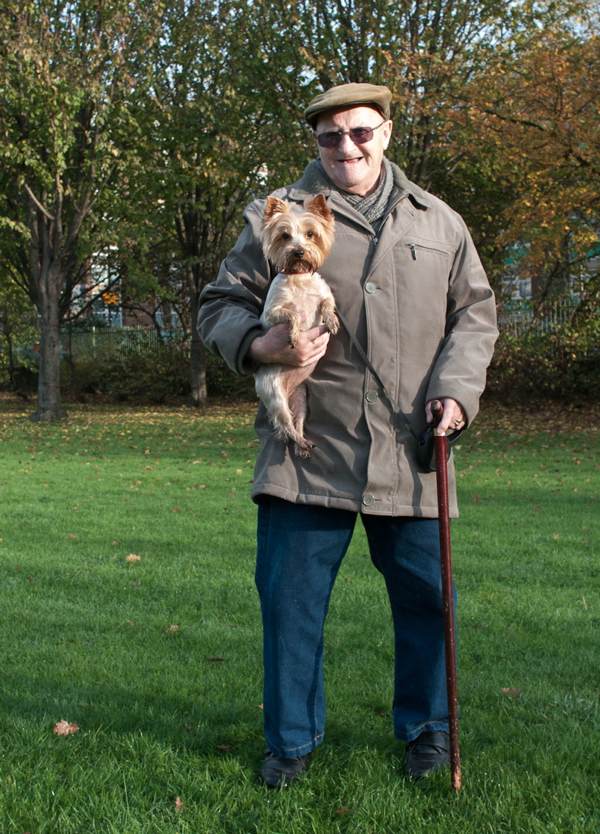
Molly (Miniature Yorkshire Terrier) & Alan Styman
“My wife went out one day and ,when she came home, she put her hand in her pocket and she pulled Molly out and held her in her hand. She was so tiny, it was unbelievable.
I was born in Bethnal Green and I worked as an estates manager for Tower Hamlets for a long while, then I became a chauffeur. I drove all sorts of people, executives from the big banks, Judi Dench and her husband, Placido Domingo – I drove him about, to and fro the opera house. And Tommy Steele.
I loved it.
My wife and I live in sheltered housing now and it can be very boring, stuck indoors. Molly keeps me active, and if you make a fuss of her you make a friend for life. The amount of people around here who see me and say ‘Hello Molly!’ – they all know her but I haven’t the faintest idea who they are.”
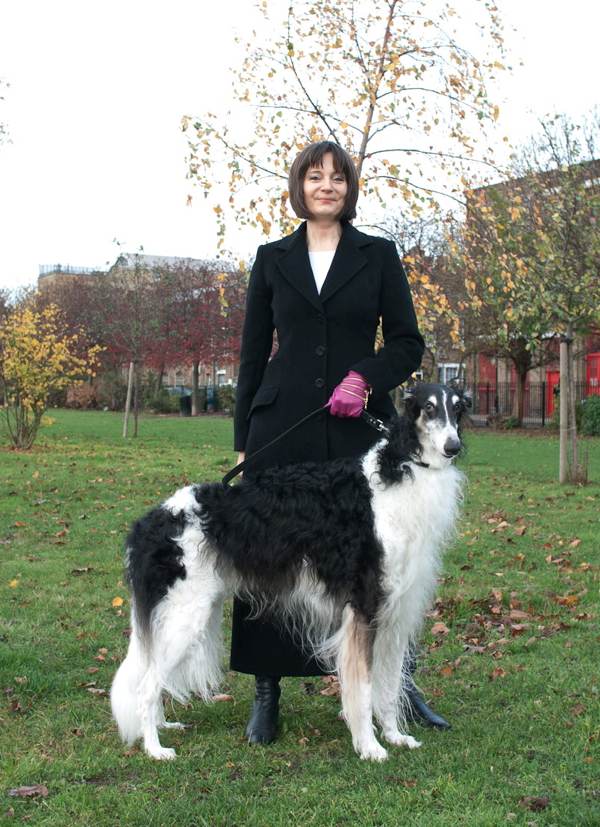
Blesk (Borzoi) & Svetlana Cunnington
“I’ve had dogs from the Whippet family all my life, and I had another Borzoi in Switzerland, where I am from. My husband and I went to Russia to fetch Blesk. He was six months in quarantine and we went down to see him every Saturday and Sunday to try and cheer him up.
For me, these dogs represent speed, swiftness and beauty – and beauty will save the world.
He’s a continuation of me. We went on a holiday to Moscow, three days later we had a phone call to say ‘your dog is dying.’ Blesk wasn’t eating, only lying there. It was sadness, he had given up. He thought we had left him again, just as he was when he was in quarantine. Ever since then, we have never been on holiday without him.
He’s my angel.
I have a son, he’s twenty-one now, and in the Swiss army. You learn that you can’t have your children with you forever, they can’t always be your companion but your dog stays with you.”
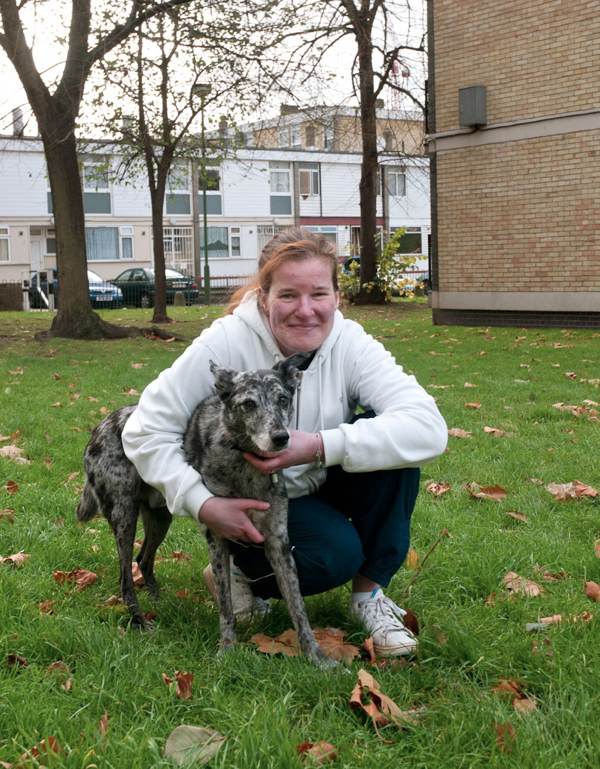
Charlie (Border Collie-Labrador-Whippet-Greyhound-cross) & Leanne Winters
“I’ve had him since he was a pup. My Nan owned Charlie’s mother. He’s got his Mum’s grey colour and the black bits belong to his Dad.
He’s a unique dog, all on his own. People either call him a fox, a wolf or a hyena!
I’ve lived here for thirty years and people have seen me with different dogs, I’ve had a five or six so far. Charlie’s the best – more lovable, more playful. He brings me happiness. He doesn’t listen to a blind word I say, but there we are. He peed on my friend’s leg the other day, cos she’d been standing still for a long time and he thought she was a tree. He’s good like that!”
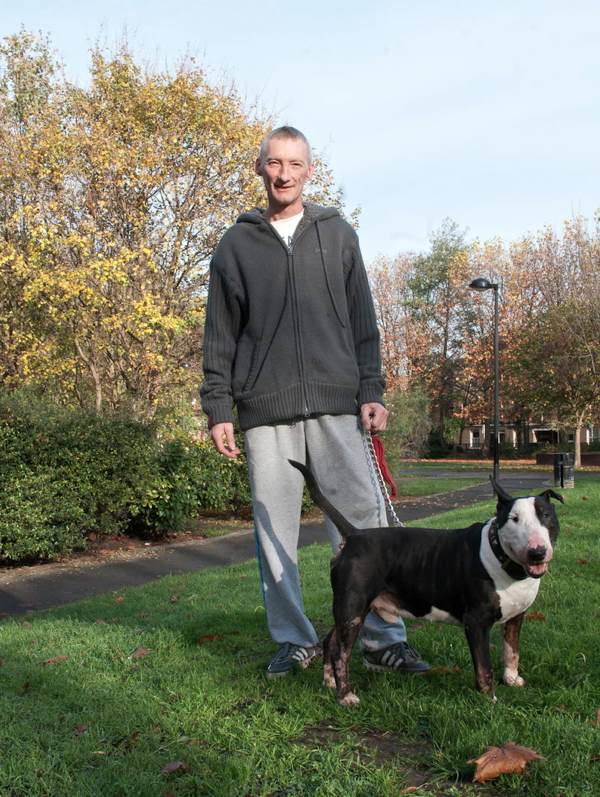
Nelson (English Bull Terrier) & Stuart Morris
“Eleven years old, he’s an old boy now. He’s called Nelson after “The Nelson’s Head” round the corner – yeah, and he also has a patch over one eye. I bought him as a guard dog for the pub when I owned it. I didn’t keep the pub in the end, but I kept Nelson.
Their reputation is the problem with these dogs, though it’s not the dogs, it’s the people who bring them up – whether it’s six inches of Chihuahua or an Alsatian, if you bring them up angry, they’ll be angry.
You can’t get a better dog for a kid. My granddaughter’s two and, if Nelson’s having his dinner and she puts her hand into his mouth, he’ll stop eating.
He’s as good as gold.”
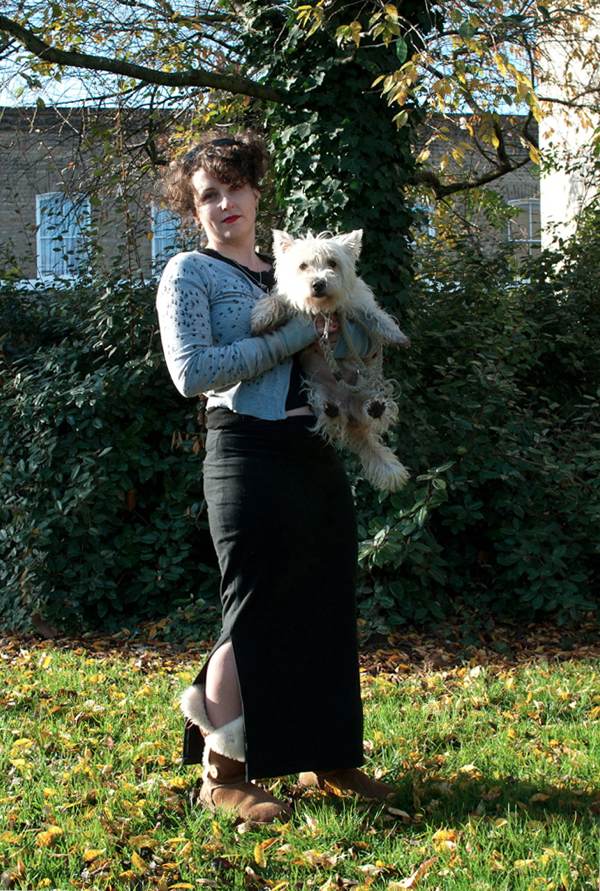
Malinka (West Highland Terrier) & Sara Dixon
“‘Mally,’ ‘Monkey,’ ‘Moo,’ ‘Malinka the Stinker!’
I like Westies. At school, one of my boyfriends had a West Highland Terrier and we used to put gel in its hair. We were fourteen and it was fun.
Malinka’s a dope, but a nice dope. She’s scared of prams and she barks at leaves passing the door. I was burgled, I could hear them downstairs yet the entire time Malinka was under the bed, fast asleep.
She always sleeps under my bed. And she sits on the bottom stair, I’m often out all day – she’s worn that stair thin, waiting for me.”
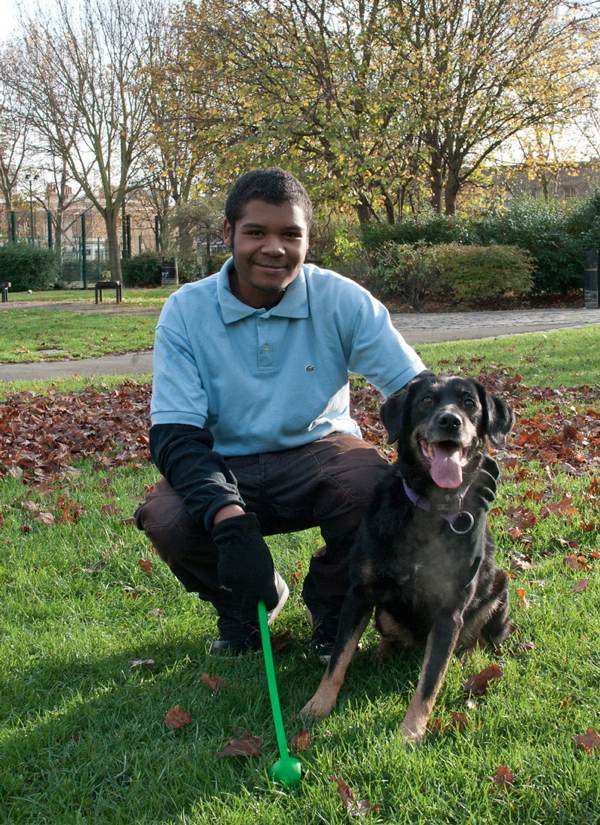
Shadow (Rottweiler–Black Labrador cross) & Edmond Cuvelier
“Me, my Mum and sister moved to San Francisco while my Dad stayed in France and that’s when we got Shadow, ten years ago. Now I’m studying over here. All my family’s in Europe and we were all moving here anyways, so I found a college nearby.
Coming over, the only problem for Shadow was the flight. She was in the place where they keep all the suitcases, for twelve hours, and as soon as she got off the plane she started crying.
I do miss my friends over there, but I’m making new friends here. I got here two months before my course started and Shadow was good company during that time – and she still is.”
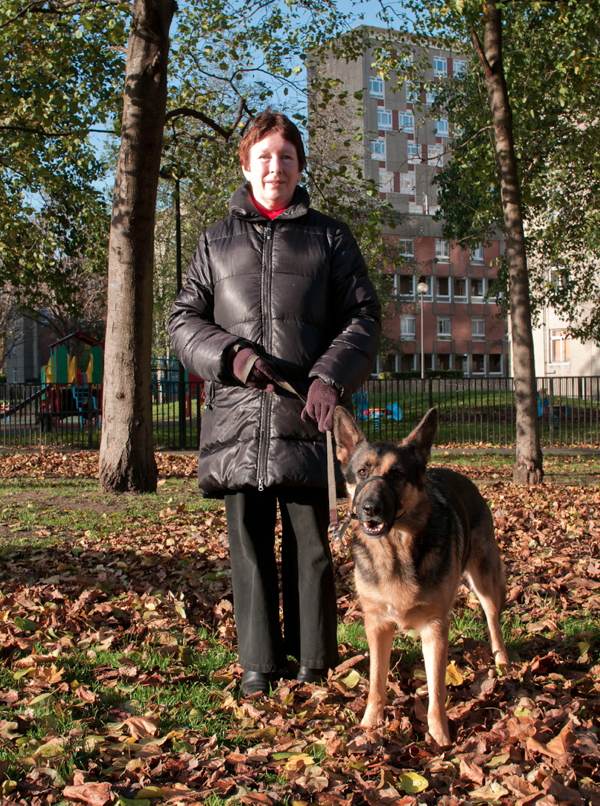
Sam (Alsatian) & Yvonne Davis
“My brother lives in Essex and he kept seeing this dog with a drug addict – the dog was getting thinner and on its last legs. So one day he gave the addict some money for the dog and took him away.
We called him Sam. I have him Monday to Thursdays and then my brother, he’s a taxi driver, picks Sam up in his cab and they go home to Essex together.
He’s a bit vocal at times, a bit nervous. Yesterday, my son suddenly banged open a cupboard and Sam flew for his life.
Two different parents might not be ideal but compared to what his previous life was like, it’s much better. Now he’s loved.”
Photographs copyright © Sarah Ainslie
You may also like to take a look at
11th December, Christmas Truce
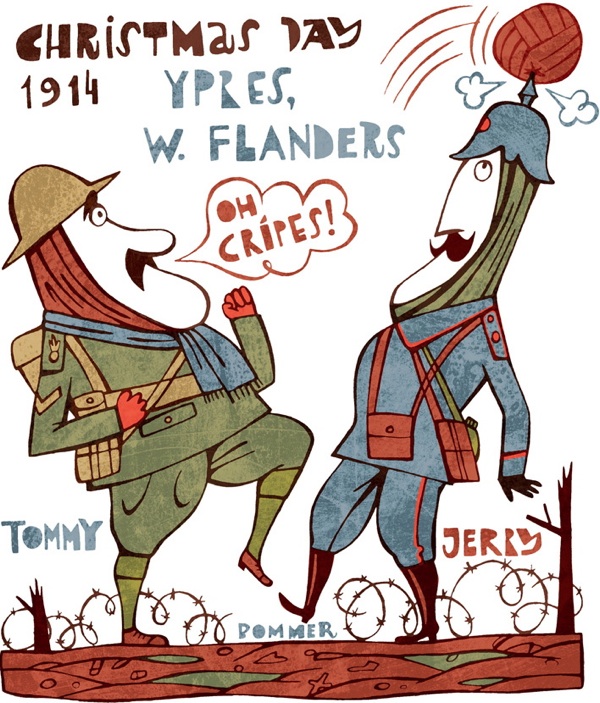
This image commemorates that extraordinary moment of Christmas 1914, at the start of World War I, when men from both sides come together in an act of defiance and goodwill. Although there was no official truce, about 100,000 British and German troops were involved in an unofficial cessation of fighting along the length of the Western Front. The first truce began on Christmas Eve when German Troops began decorating the area around their trenches in the region of Ypres, Flanders in modern-day Belgium.
The Germans placed candles on their trenches and upon Christmas trees, then continued the celebration by singing Christmas carols. The British responded by singing carols of their own, and the two sides continued by shouting Christmas greetings to each other. Soon afterwards, there were excursions across the “No Man’s Land” where small gifts were exchanged, food, tobacco and alcohol, and souvenirs such as buttons and hats. The artillery in the region fell silent that night and the truce also allowed a breathing spell in which recently-fallen soldiers could be brought back behind their lines. Joint services of burial were held. The fraternisation was not, however, without its risks – some soldiers were shot by opposing forces. In some sectors, the truce lasted through Christmas night, but it continued until New Year’s Day in others.
General Sir Horace Smith-Dorrien, Commander of the British II Corps, was irate when he heard what was happening and issued strict orders forbidding friendly communication with the opposing German troops. In the following years of the war, artillery bombardments were ordered on Christmas Eve to try to ensure that there were no further lulls in combat. Troops were also rotated through various sectors of the front to prevent them from becoming overly familiar with the enemy. However, deliberate dampening of hostilities occurred – for example, artillery was fired at precise points, at precise times, to avoid enemy casualties by both sides.
On Christmas Day, after a night of carol singing, a private with the Welsh Fusiliers recalled that feelings of goodwill had grown so much that at dawn Bavarian and British soldiers clambered spontaneously out of their trenches. A football was produced from somewhere – though none could recall from where. “It wasn’t a game as such, more a kick-around and a free-for-all. There could have been fifty on each side for all I know. I played because I really liked football. I don’t know how long it lasted, probably half an hour.”
A wonderful moment of hope and peace in the midst of the conflict that was, at that time, the costliest of life in human history.
Peace on Earth, Goodwill to all Men!
Illustration copyright © Paul Bommer
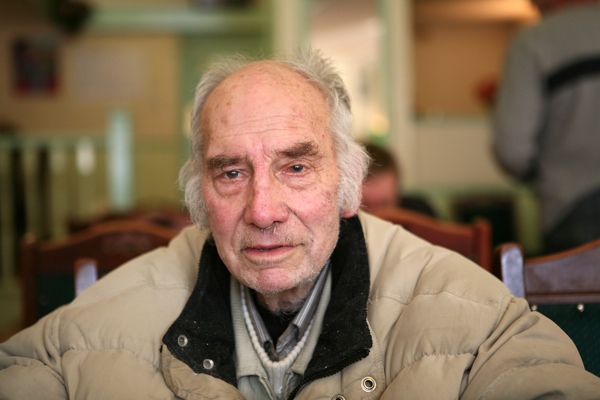
Henry Chapman, Jack Of All Trades
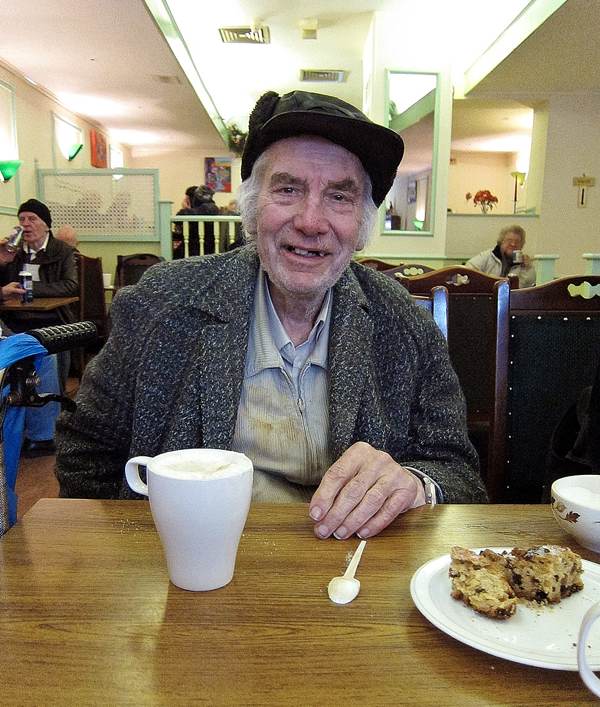
Harry has been coming to the Sunday market for more than seventy-five years
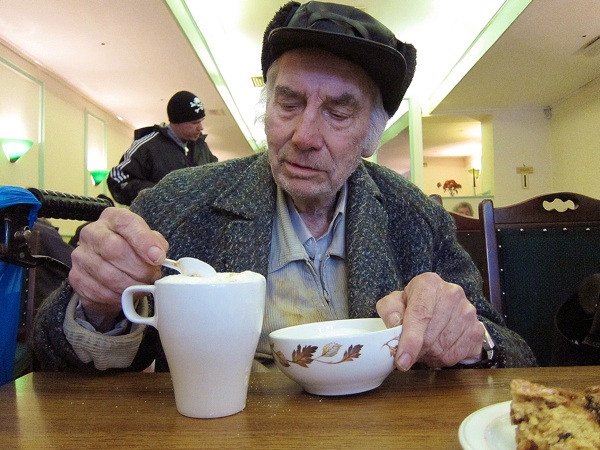
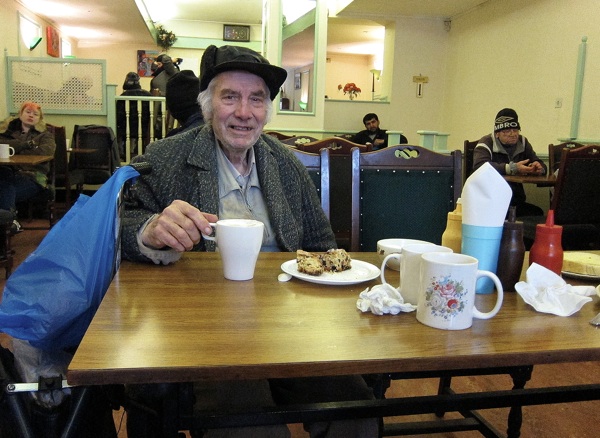
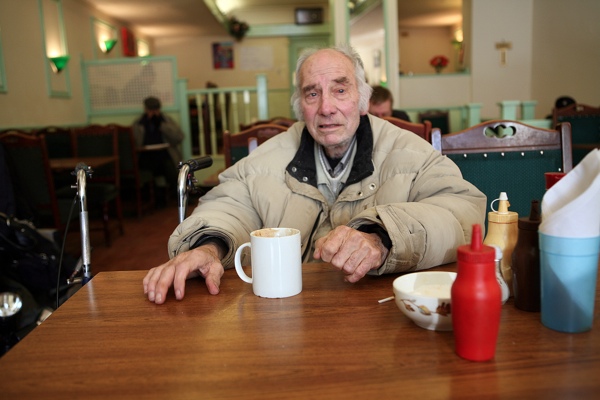
For as long as Gina Christianou can remember – certainly as long ago as the days of the animal market in Club Row – Henry Chapman, known universally as Harry, has been coming to her restaurant in the Bethnal Green Rd each Sunday, ordering sausage, egg and chips, and drinking seven cups of coffee, one after the other, to sustain him while enjoying the busy social life of this celebrated Spitalfields meeting point. After all this time, at eighty-three years old, Harry has become a fixture – so that now, as long as he is there occupying his central position at the front of Gina’s Restaurant on Sunday, you can know that all is well with the world.
With his bright-eyed charm and extravagantly bushy eyebrows, Harry is a popular character and his table is always full with those eager to share his company, yet few even know where Harry comes from each Sunday. So last week, Spitalfields Life Contributing Photographer Colin O’Brien and I waited at the next table until there was a gap in the flow and, once introductions had been exchanged, we were delighted to accept Harry’s gracious invitation to join him while he enjoyed his fifth cup of coffee of the morning. “I never drink it anywhere else,” he explained to me with a complicit smile, revealing that these seven cups at Gina’s comprise his entire caffeine intake for the week – just in case I might assume he were an immoderate character.
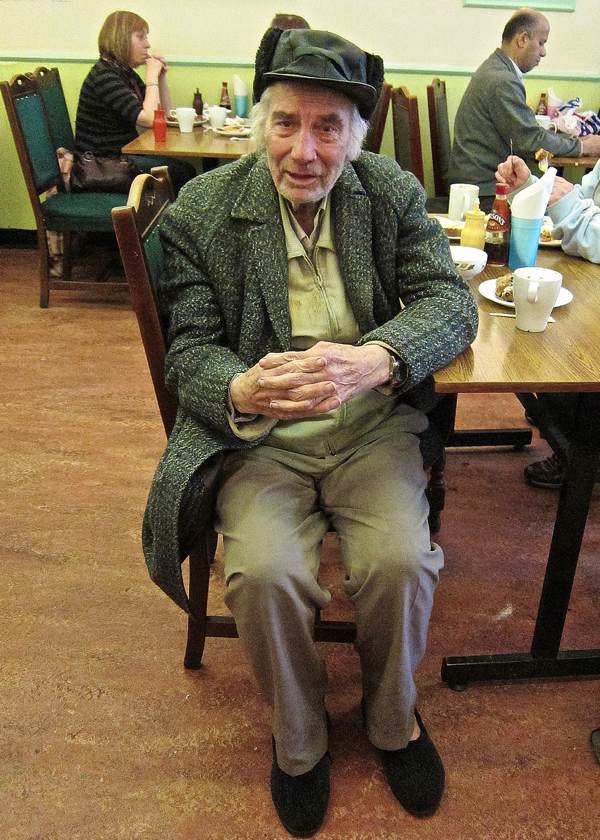
These days, Harry always wears his carpet slippers for comfort’s sake and has a walking frame, yet he still hops on the bus and comes all the way from Battersea each week to Spitalfields, just as he has done regularly for more than seventy-five years.
“It’s a kind of habit, I was only a boy when I used to come here from Battersea with my father. They sold cats and dogs here then, you could buy a goat – even foxes and eagles. I always get here about half past eight and I might leave at two or three o’clock, it depends on how I feel. I shall go home and get something to eat and watch television and go to bed.
On Monday morning, I collect my pension and then I go to a cafe in Peckham to see my friends and decide where we are going to go on Thursday. Every Thursday, I go out with a couple of mates and we take a trip by bus. Last week, I went to Dartford and Gravesend – I don’t like Dartford very much, I was there in the fever hospital for four months when I was a child, though I can’t remember it because it’s such a long time ago. We always meet outside the betting shop before we set out.
On Tuesday and Wednesday, I go to the cafe where I live. It’s on the street and it’s tiny, you couldn’t hardly call it a cafe because they only sell cakes, beans on toast, eggs on toast, no dinners. I don’t cook for myself. I don’t even make tea at home, I only keep it in case a visitor wants a cup, I drink orange juice. I’ve lived in my council flat in Battersea for the past twenty-seven years and I have a cat called Jake, he’s twelve years old.
My wife was Irish and she liked to drink but I don’t drink because I used to suffer with very bad migraines – floating lights, sickness and diarrhoea. I was paralysed for a while, then I wore glasses for six years and I recovered, but my wife left me and took the children with her. After I got divorced, I was in lodgings and met Mr Cornish, and he asked me to go and live with him, and I worked for him organising charity events. He used to take me all over the West End to get Sandeman’s port, silk ties at Liberty and perfume at Penhaligons, and I went to all the theatres to collect tickets for the shows and the Harlem Globetrotters, and I met the Prince & Princess of Bengal and Melissa Martin and Sheila Hancock and Leslie Crowther. Sometimes, he sent me to Marks & Spencer to get cakes for nothing and we’d have a raffle. But he was an old man and after three years he died, and that’s when I went to live with an elderly lady, as her lodger, until she died too. Then I went to live with my brother until I had to go into hospital to have an operation to put a plastic valve in my heart, and after that I got the flat I have now. That was in 1985 and now it’s leaking, so they are talking about keyhole surgery.
When I was a boy, I used to go and take care of the horses in Battersea Park. After I left school, I set out to be a carpenter but I couldn’t get an apprenticeship so I went to work in a papermill, from there I got a job in a steelworks and then I worked in a corn chandler, then a couple of years in the navy, then eighteen years in the gas works at Wandsworth as coke plant operator, followed by fifteen years at the council maintaining the streets, changing light-bulbs in street lights, laying pavement slabs and street sweeping until I had to retire. I needed the heart operation, so I took early retirement and I haven’t worked since – I suppose you could say I am a Jack of all trades.
I regret that I don’t see my children, they know where I live but they haven’t been to see me for twenty years. I don’t have any other relatives, just my half-brother and sister, and they’re probably dead now because they’re older than me. I might get a Christmas invitation, otherwise I’ll spend it by myself. It doesn’t matter if I’m on my own because it doesn’t worry me, I’ll have Jake. I’m not unhappy, I live on my own and do as I please. I journey on with life. I’ll be here next week, if nothing happens to me.”
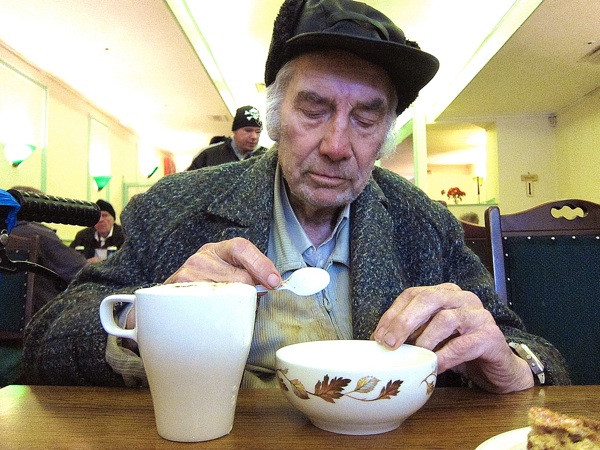
Henry Chapman, Jack of all trades.
Photographs copyright © Colin O’Brien
You also like to read about
Chapter 2. Horrid Murder

The River Thames Police Office occupies the same site today on the Thames beside Wapping New Stairs as it did in 1811. Once news of the murders on the Ratcliffe Highway reached here in the early hours of December 8th, Police Officer Charles Horton who was on duty at the time, ran up Old Gravel Lane (now Wapping Lane) and forced his way through the crowd that had gathered outside the draper’s shop. He searched the house systematically and, apart from the mysterious chisel on the counter, he found five pounds in Timothy Marr’s pocket, small change in the till and £152 in cash in a drawer in the bedroom – confirming this was no simple robbery.
In the bedroom, he also found the murder weapon, a maul or heavy iron mallet such as a ship’s carpenter would use. It was covered in wet blood with human hair sticking to it. At least two distinct pairs of footprints were discerned at the rear door, containing traces of blood and sawdust – the carpenters had been at work in the shop that day. A neighbour confirmed a rumbling in the house as “about ten or twelve men” were heard to rush out.
Primary responsibility for fighting crime in the parish of St George’s-in-the-East lay with the churchwardens who advertised a £50 reward for information, including the origin of the maul. The Metropolitan Police was only established in 1829 – in 1811 there was no police force at all as we would understand it and, as news of the mystery spread through newspaper reports, a disquiet grew so that people no longer felt the government was capable of keeping then safe in their own homes. Indicative of government concern at the national implications of the case, the Home Secretary offered a reward of £100.
Meanwhile a constant stream of sightseers passed through the Marr’s house, viewing the bodies laid out on their beds, and some left coins in a dish because Mr Marr had only left sufficient capital for his creditors to be paid nineteen shillings in the pound. The bill for the renovation of the shop was yet to settled.
Three days after the crime, on 10th December 1811, when the inquest was held at the Jolly Sailor public house just across the Highway from Marr’s shop, a vast crowd gathered outside rendering the wide Ratcliffe Highway impassable. Walter Salter, the surgeon who had examined the bodies, Margaret Jewell the servant, John Murray the neighbour and George Olney the watchman all told their stories. The jury gave a verdict of wilful murder.
For two centuries the Ratcliffe Highway had an evil reputation. Wapping was the place of execution for pirates, hanged on the Thames riverbank at low water mark until three tides had flowed over them. Slums spread across the marshy ground between the Highway and the Thames, creating the twisted street plan of Wapping that exists today. This unsavoury neighbourhood grew up around the docks to service the needs of sailors and relieve them as completely as possible of their returning pay. Now it seemed that these murders had confirmed everyone’s prejudices, superstitions and fears of the Highway – sometimes referred to as the Devil’s Highway.
Whoever was responsible for these terrible crimes was still abroad walking the streets.
Expect further reports over coming days as new developments in this case occur.

River Police Headquarters, Wapping New Stairs
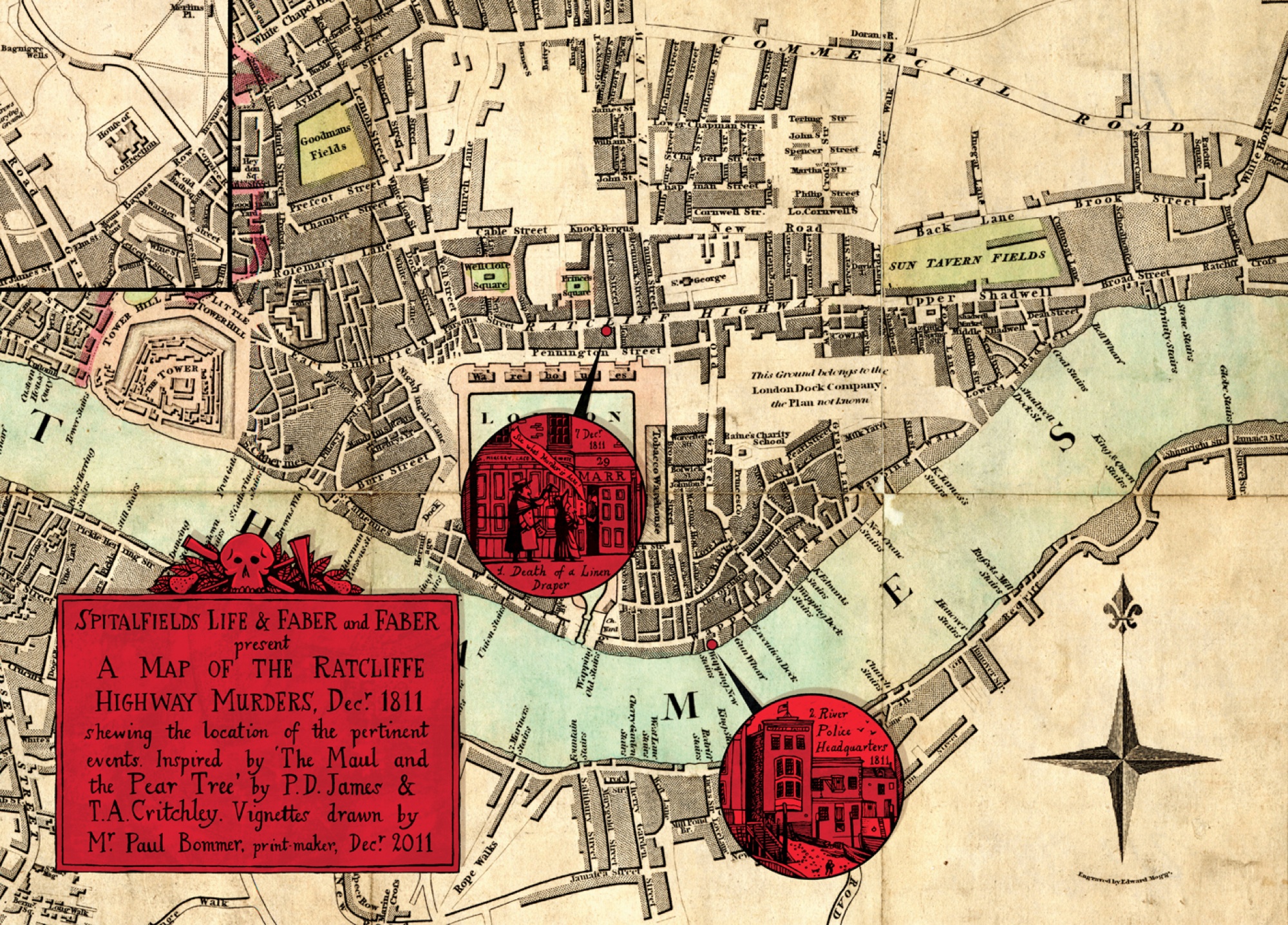
Click on Paul Bommer’s map of the Ratcliffe Highway Murders to explore further
The Maul & The Pear Tree – P.D. James’ breathtaking account of the Ratcliffe Highway Murders, inspired me to walk from Spitalfields down to Wapping to seek out the locations of these momentous events. Commemorating the bicentenary of the murders this Christmas, I am delighted to collaborate with Faber & Faber, reporting over coming weeks on these crimes on the exact anniversaries of their occurrence.
The Map of the Ratcliffe Highway Murders – In collaboration with Faber & Faber, Spitalfields Life has commissioned a map from Paul Bommer which will update throughout December as the events occur. Once you have clicked to enlarge it, you can download it as a screensaver or print it out as a guide to set out through the streets of Wapping.
Ratcliffe Highway Murder Walk – Spitalfields Life will be hosting a dusk walk on Wednesday 28th December at 3pm from St Georges in the East, visiting the crime scenes and telling the bone-chilling story of Britain’s first murder sensation. The walk will take approximately an hour and a half, and conclude at the historic riverside pub The Prospect of Whitby. Booking is essential and numbers are limited, so please email spitalfieldslife@gmail.com to sign up. Tickets are £10.
Thanks to the Bishopsgate Institute and Tower Hamlets Local History Archive for their assistance with my research.
You may like to read the first installment of this serial which runs throughout December
10th December, Old Father Christmas

Please welcome Old Father Christmas, also known in times past, as Grandfather Christmas, Old Christmas or even simply Old Winter.
Nowadays, with the global domination of American commercial culture, this fellow, Britain’s Father Christmas and Santa Claus, an import from the US, have become virtually synonymous and almost indistinguishable. But let me tell you – gentle readers – that once upon a time they were quite distinct from each other.
As you will all know, Santa Claus is a Anglicised corruption of “Sinterklaas,” the Dutch for St Nicholas, brought over to the States by immigrants from the Low Countries in the seventeenth century (when New York was called Nieuw Amsterdam). There he fused with the British Father Christmas and became Santa, losing his bishop’s robes on the way. The Victorian poem “A Visit From St Nick,” by Clement Clarke Moore, did much then to embellish this character and, in 1931, the Coca Cola company gave him their red and white livery which he wears to this day.
Old Father Christmas, on the other hand, is a much more ancient figure. Pagan in origin and an embodiment of arcane Mid-Winter revelries, he is made up, in part, of the Norse god Odin and the Roman gods Jupiter (Jove) and Saturn ( whose great feast, Saturnalia, was at this time). He is no gift-bearer (Christmas presents almost never featured in Yuletide celebrations before the Victorian period) but was instead the personification of festive cheer, feasting, warmth and merriment – so very welcome in the bitter, bleak, icy Winter months. He has a longer beard that his American counterpart and wears long gowns and a hooded robe, often fur-trimmed ( and almost never red!) – as opposed to Santa’s soft-drink-branding tie-in tunic and pants suit. He is big, and he is merrie – he is, in essence, the Ghost of Christmas Present, as portrayed by Dicken’s in “A Christmas Carol.” As for transport, he has many ways of getting about. Sometimes he would arrive on a white horse, bells a-jingling, sometimes a white donkey, or, as here, a white goat! In parts of the country, the tradition was that he came out from the North a-stride a great white goose!
During the Commonwealth in the sixteen fifties, the Puritans banned celebration of Christmas, deeming it an orgy of pagan idolatry (they were not, I suspect, far off). One of the earliest surviving images of Father Christmas is a subversive pamphlet published in 1653. Old Winter approaches a border or city wall where a soldier on guard says, “Keep out, you come not here,” to which the old man (here sporting long robes and a very fetching broad-brimmed felt or fur hat) counters, “O Sir, I bring good cheere.” Behind him stands a country peasant who says, “Old Christmas Welcome, do not fear.”
Ladies, Gentlemen, I hope and trust that you will all make Old Christmas very welcome in your hearts and homes, because the world would not suffer any from a little more merriment and good cheer!
Illustration copyright © Paul Bommer












