
The Whitechapel Nobody Knows (Part One)

I am delighted to resume my series of The East End Nobody Knows in collaboration with Spitalfields Life Contributing Artist Joanna Moore, by visiting Trinity Green Almshouses off the Mile End Rd. You only have to step through the emerald green gates to discover that this place has kept its age-old repose. Designed Sir William Ogbourne in 1695, as almshouses for retired and invalid mariners upon ground given Captain Henry Mudd of Ratcliffe, the conception was of fourteen cottages around a central chapel. Yet even though a bomb destroyed the rear half of this courtyard in 1943, the ship-shape sense of order is miraculously still intact. Look out for Basil, the old ginger tom who takes the role of master & commander now all the seafaring folk have departed.

Sculptor Roy Emmins lives in a tiny flat built upon the roof of a nineteen forties residential block at the rear of the Royal London Hospital, where he has created a wonderful sculpture garden to exhibit his works among plants and flowers. With a natural sensitivity to the anatomy of animals, Roy’s work is in a magical realist vein, evoking an entire of menagerie of creatures in stone, bronze, wood, paper mache and even tin foil. Six days a week, Roy walks from his flat in Whitechapel to his studio at the far end of Cable St where he has been working alone secretly for the past ten years, creating a vast body of superlative works, and up here in his sculpture garden among the chimney pots of Whitechapel, Roy’s sculpture exists in its own enchanted universe, known only to the lucky few.

These modest terraces in Walden St and Turner St – dating from 1809-15 – were derelict for fifteen years and would have been demolished if it had not been for the intiative of Tim Whittaker, Director of the Spitalfields Trust. He recognised the dignity of these self-effacing structures, built for the lower middle classes, their early residents included a surgeon, a sea captain, a plumber, a shopkeeper and a Chelsea pensioner. Completed two years ago, this award-winning restoration employs weatherboarded extensions in an historically appropriate vernacular aesthetic to win extra space and uses salvaged materials to subtle effect in preserving the shabby poetry of these old houses. As Tim put it to me, “I wanted to give Whitechapel back a bit of the romance it had lost.”

From Roy Emmins’ roof you can look down upon St Augustine with St Philip’s Church in Newark St, a soaring example of mid-nineteenth century red brick gothic that today houses the Royal London Hospital’s Library and Museum. If you walk into the ground floor you will encounter the sepulcral hush of medical students cramming for exams, while down in the crypt is the medical museum – open to the general public – where you can discover attractions as various as the Elephant Man’s hat, collections of gallstones preserved in specimen cases as if they were gulls’ eggs, Victorian autopsy sets and George Washington’s dentures.
Illustration copyright © Joanna Moore
You may also like to take a look at
The Spitalfields Nobody Knows (Part One)
The Spitalfields Nobody Knows (Part Two)

Be sure to seek out Joanna Moore (left) and her friends Helena Maratheftis (AKA Thefty) and Nhatt Nichols (AKA Nhattattack) at their stall in the Upmarket, Old Truman Brewery, Brick Lane on Sunday where they will be selling their London-themed prints and Christmas cards.
9th December, Babushka

Babushka is a traditional figure in Russian folklore who distributes presents to children around Christmas-time. Her name literally means “Grandmother” (which makes you wonder what Kate Bush was singing about!) The legend is she declined to go with the Wise Men, when they stopped at her house for food and rest en route to Bethlehem, to see the baby Jesus – because of the cold weather, and because she had housework and baking to do.
However, after the Magi left, she regretted not going and set off to catch up, filling her basket with presents and pastries. She never did catch up or find the baby Jesus, and it is said she wonders the earth ’til this day, visiting each house at Christmas and leaving toys and treats for good children. The morals of this story? Don’t put off ’til to-morrow what you can do today and a clean house, it’s not all that important!
I have an old book entitled North Russian Architecture, with a slip-case, a faux wood cover and hundreds of photographs of log-cabins and shingled, onion-domed shrines and chapels. They provided my reference for the buildings behind her.
Illustration copyright © Paul Bommer
8th December, The Spider & The Cave

When I was a child, my father, who is Polish, would tell me a traditional tale that he himself had been told when he was a boy.
According to legend, the Three Kings stopped at Herod’s palace in Jerusalem on their way to Bethlehem looking for the new-born king that the Star had prophesied. Herod, of course, knew nothing about this new-born king but was unsettled by the news. And, in the days following the Magi’s departure, the perceived threat to his sovereignty grew and grew until at last, in a fit of rage, he ordered his men to kill all new-born male children across the land .
Getting wind of this from the Three Kings, the Holy Family fled Bethlehem in Judea for Egypt and, at one point – as Herod’s men approached – they took refuge in a cave. There a spider, sensing who was hiding in his cave, quickly wove an intricate web across the entrance and Herod’s men, seeing the web, assumed that the cave had been unoccupied for some time and passed on without entering.
There is no mention of this story in the Bible but there is, I believe, a reference to it in the Quran. Tradition holds that the cave in question lies today on the outskirts of Cairo.
The moral of the story? Don’t kill spiders and look out for small miracles.
Illustration copyright © Paul Bommer
Simon Costin’s Dickens Diorama

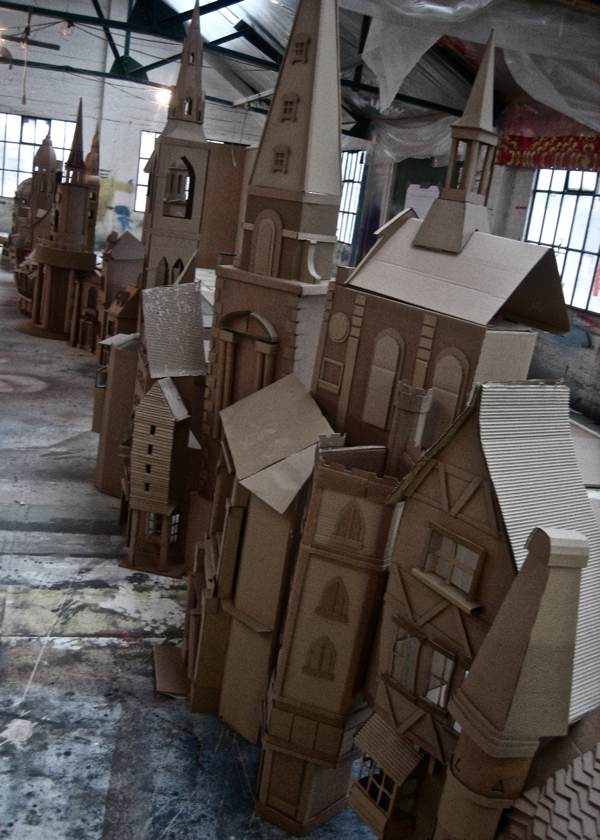
Just recently, I took the 42 bus from Liverpool St Station down to Camberwell to visit Simon Costin where he was working on the top floor of an old scenery warehouse, recreating the nineteenth century city out of cardboard boxes for the new exhibition Dickens & London which opens tomorrow at the Museum of London. It sounded such a hare-brained scheme – a zany childhood fantasy writ large – that I could not resist going over to take a look, and I was not disappointed because I was confronted with a creditable terrace of tottering cardboard towers, even as I walked in the door.
Simon and his team of four were busily cutting up cardboard boxes, sticking storeys and roofs together, slicing out panels for windows and doors, and attaching tiles and bricks individually. Scattered around were books of old photographs that served as references, yet this was no literal architectural recreation but rather a dreamlike impression of the monstrous shambolic city which Dickens knew and that we all visit through his novels. As each edifice was completed, Simon proudly carried it across the room and added it to the quickly-growing warren of structures he was assembling, shuffling and swapping his property portfolio critically, like a whimsical land magnate.
Just as Charles Dickens’ London was a location of mystery, an unknowable labyrinth of human life, so Simon Costin has brought his own story to the cardboard diorama through referencing the work of his great-great-grandfather, William Pettit Griffith, a forgotten architect. Only the almshouses in the Balls Pond Rd survive today out of Griffith’s work built in London in the nineteenth century, though he was also the architect who fought to save St John’s Gate in Clerkenwell and conceived its renovated form that we know today.
In family lore, William Pettit Griffith was a shadowy figure who died in obscure poverty but Simon discovered a direct relationship with his long-gone forbear through an unlikely encounter with a stranger who revealed herself to have second sight. Two elderly women approached Simon in the tearoom at the Royal Academy. One explained that the other was blind yet blessed with a psychic gift and she saw a guardian angel at Simon’s shoulder. The figure she described was a Victorian gentleman with unusual hair that curled on both sides of his head, just as William Pettit Griffith’s hair does in the only portrait, which you see below.
This uncanny experience led Simon to research his enigmatic ancestor and he found they had lived in close proximity – as if they followed each other around London, one hundred and fifty years apart. Simon once squatted in a flat at 67 Guildford St and Griffith had lived at 117. Then, Simon moved to a flat that turned out to be around the corner from Griffith’s practice in Bermondsey. Next, Simon had a studio on Wharf Rd in Islington, close to Eagle Wharf Rd where Griffith had lived, and now Simon lives five minutes from the almhouses, the last Griffith building standing.
Dickens’ novels are full of long-lost relatives reunited through chance. A phenomenon that both confirms the dislocation of people in the teeming city, yet reveals the underlying connections which are usually hidden. Simon’s discoveries have brought him into a personal relationship with the nineteenth century city, and he has envisaged his nocturnal diorama of London as a place of wonder, of horror and awe.
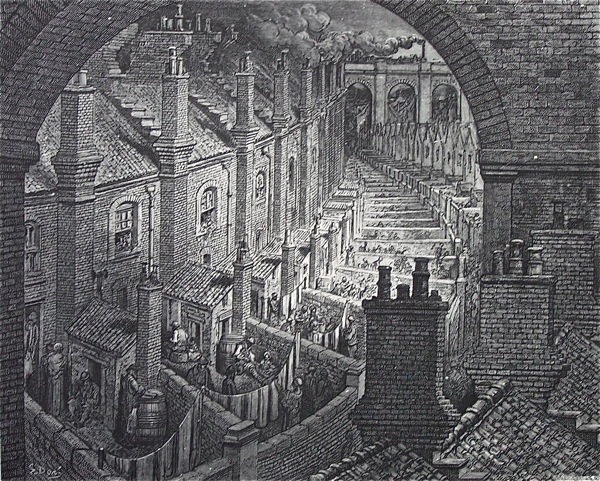
Gustave Dore’s London
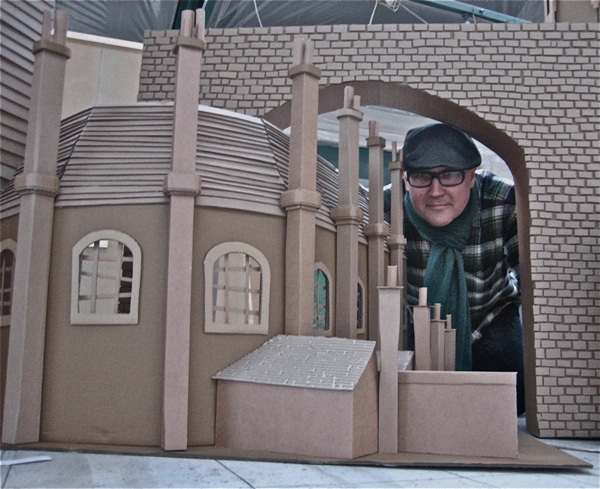
Simon Costin’s London.
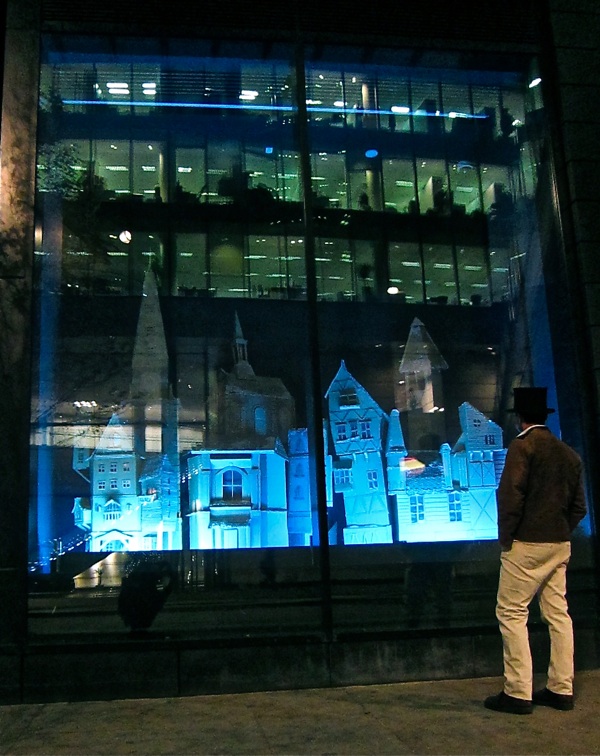
Part of the diorama at the Museum of London, seen from London Wall.

Simon Costin, great-great-grandson of William Pettit Griffith
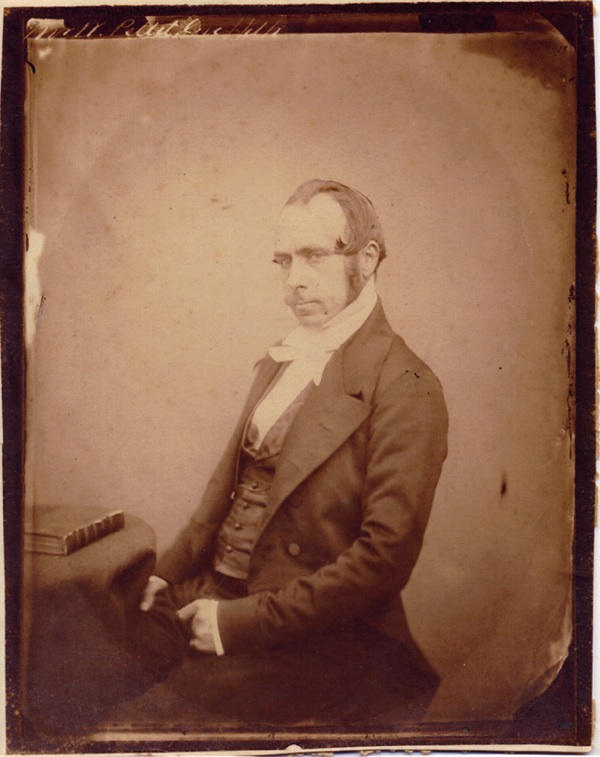
William Pettit Griffith, Simon Costin’s great-great-grandfather.
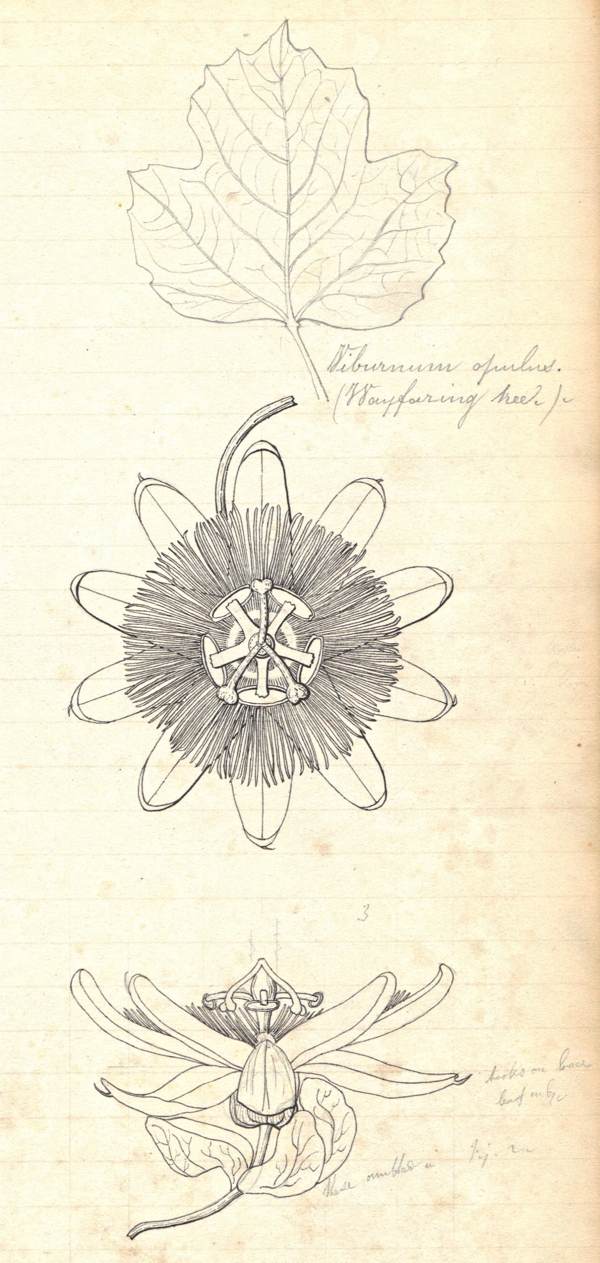
From the notebook of William Pettit Griffith
Simon Costin was assisted in creating his diorama by Jenna Rossi-Camus, Rachel Champion, Russell Harris and Yasemen Hussein.
You may also like to read about
Two Hundred Years Ago Tonight…

The site of the atrocity of 7th December
Late on 7th December 1811, on the site where this Saab dealership now stands, Timothy Marr, a twenty-four-year-old linen draper was closing up his business at 29 Ratcliffe Highway – a stone’s throw from St George’s-in-the-East. In the basement kitchen, his wife – Celia – was feeding their three-and-a-half-month-old baby, Timothy junior. At ten to midnight on the last night of his life, the draper sent out his servant girl, Margaret Jewell, with a pound note and asked her to pay the baker’s bill and buy some oysters for a late supper.
Timothy Marr made his fortune through employment in the East India Company and had his last voyage aboard the Dover Castle in 1808. With the proceeds, he married and set up shop just one block from the London dock wall. Already, Mr Marr’s business was prospering and in recent weeks he had employed a carpenter, Mr Pugh, to modernise the old place. The facade had been taken down, replaced with a larger shop window and the work had been completed smoothly, apart from the loss of a chisel.
When Margaret Jewell walked down the Highway she found Taylor’s oyster shop shut. Retracing her steps along the Ratcliffe Highway towards John’s Hill to pay the baker’s bill, she passed the draper’s shop again at around midnight where, although Mr Marr now had put up the shutters with the help of James Gowen, the shop boy, she could see Mr Marr at work behind the counter.
“The baker’s shop was shut,” Margaret later told the Coroner, so she went elsewhere in search of oysters and, finding nowhere open, returned to the draper’s about twenty minutes later to discover it dark and the door locked. She jangled the bell without answer until – to her relief – she heard a soft tread inside on the stair and the baby cried out.
But no-one answered the door. Panic-stricken and fearful of passing drunks, Margaret waited a long half hour for the next appearance of George Olney, the watchman, at one o’clock. Mr Olney had seen Mr Marr putting up the shutters at midnight but later noticed they were not fastened and when he called out to alert Mr Marr, a voice he did not recognise replied, “We know of it.”
John Murray, the pawnbroker who lived next door, was awoken at quarter past one by Mr Olney knocking upon Mr Marr’s door. He reported mysterious noises from his neighbour’s house shortly after twelve, as if a chair were being pushed back and accompanied by the cry of a boy or a woman.
Mr Murray told the watchman to keep ringing the bell while he went round the back through the communal yard to the rear door, which he found open with a faint light visible from a candle on the first floor. He climbed the stairs in darkness and took the candle in hand. Finding himself at the bedroom door, he said, “Mr Marr, your window shutters are not fastened” but receiving no answer, he made his way downstairs to the shop.
It was then he discovered the first body in the darkness. James Gowen was lying dead on the floor just inside the door with his skull shattered with such violence that the contents were splattered upon the walls and ceiling. In horror, the pawnbroker stumbled towards the entrance in the dark and came upon the dead body of Mrs Marr lying face down in a pool of blood, her head also broken. Mr Murray struggled to get the door open and cried in alarm, “Murder! Murder! Come and see what murder is here!” Margaret Jewell screamed. The body of Mr Marr was soon discovered too, behind the counter also face down, and someone called out,“The child, where’s the child?” In the basement, they found the baby with its throat slit so that the head was almost severed from the body.
When more light was brought in, the carpenter’s lost chisel was found upon the shop counter, but it was perfectly clean.
Later this week and over the coming Christmas season, you may expect further reports upon the development of this extraordinary case.

Timothy Marr’s shop.

Click on Paul Bommer’s map of the Ratcliffe Highway Murders to explore further
The Maul & The Pear Tree – P.D. James’ breathtaking account of the Ratcliffe Highway Murders, inspired me to walk from Spitalfields down to Wapping to seek out the locations of these momentous events. Commemorating the bicentenary of the murders this Christmas, I am delighted to collaborate with Faber & Faber, reporting over coming weeks on these crimes on the exact anniversaries of their occurrence.
The Map of the Ratcliffe Highway Murders – In collaboration with Faber & Faber, Spitalfields Life has commissioned a map from Paul Bommer which will update throughout December as the events occur. Once you have clicked to enlarge it, you can download it as a screensaver or print it out as a guide to set out through the streets of Wapping.
Ratcliffe Highway Murder Walk – Spitalfields Life will be hosting a dusk walk on Wednesday 28th December at 3pm from St Georges in the East, visiting the crime scenes and telling the bone-chilling story of Britain’s first murder sensation. The walk will take approximately an hour and a half, and conclude at the historic riverside pub The Prospect of Whitby. Booking is essential and numbers are limited, so please email spitalfieldslife@gmail.com to sign up. Tickets are £10.
Thanks to the Bishopsgate Institute and Tower Hamlets Local History Archive for their assistance with my research.
7th December, El Caganer
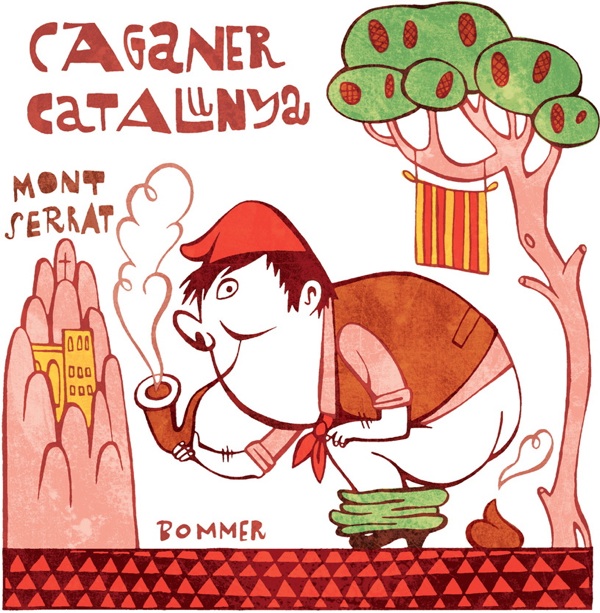
This cheeky fellow is what the Catalans called “El Caganer” – literally the pooper – and has been a characteristic of traditional Nativity scenes all over Catalonia for centuries. No self-respecting Catalan Bethlehem scene would be complete without him! Yet although an integral and essential part of the scene, this colourful character is often difficult to spot. He is usually to be found in an ‘outlying’ area – behind a suitably placed bush, for example – and not actually centre stage with the infant Jesus himself!
Originally, the Caganer was always portrayed as a Catalan peasant wearing a traditional hat called a barretina — a red stocking hat (sometimes with a black band), a bit like a Liberty or Phrygian cap. Nowadays, he comes in many shapes and forms, from monk to shepherd, Barcelona or Madrid football player to famous film star – all performing the exact same action – defecating. That’s right! They are actually squatting down, with their trousers round their knees, having a bowel movement! A google search will soon reveal Barak Obama, Queen Elizabeth II, Nicolas Sarkozy, even Pope Benedict, all having what the cockneys call an “Eartha Kitt!”
So what do these figures of El Caganer actually stand for? Believe it or not, the widely-accepted answer to that question is really a very simple one. Their ”fertilizer” enriches the earth around them, thus promising a buena cosecha (a good harvest) during the forthcoming year. This translates into a general good omen for the future. Upon purchasing a Caganer, you are told that owning him will bring good luck and prosperity. Another explanation is that he represents the equality of all people: regardless of status, race, or gender, everyone poops! One thing is certain, they say much about the Catalan sense of humour. I hope he does not cause you (too much) offense. If the Catholic church in Catalonia accept him, I am sure you can do the same.
I have shown our man attending to nature’s needs in the beautiful Catalan countryside. In the background stands Montserrat (which literally means “jagged or serrated mountain” in Catalan), a mountain shrine outside Barcelona. The name describes the peculiar aspect of the rock formation, which is visible from a great distance. The mountain is composed of strikingly pink conglomerate and has a Benedictine Abbey near its summit where the famous Black Madonna is housed. The Jesuit order was founded here by St Ignatius of Loyola.
Bon Nadal!
Illustration copyright © Paul Bommer
6th December, St Nicholas
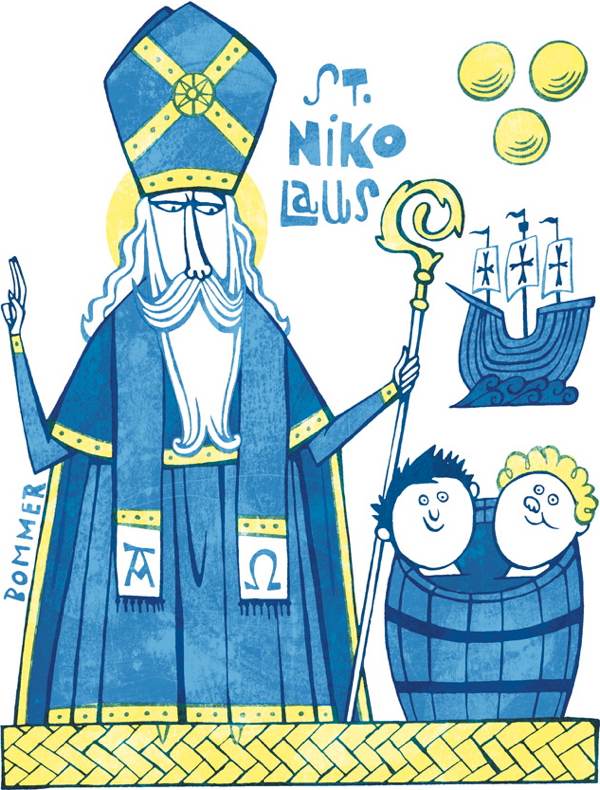
St Nicholas was the greek Bishop of Myra (now Demre in Lycia, part of modern-day Turkey) in the early fourth Century AD. Many miracles are attributed to his intercession and, over the centuries, he became a hugely popular saint. He had a reputation for secret gift-giving, such as putting coins in the shoes of those who left them out for him, and thus became the model for Santa Claus, whose English name comes from the Dutch Sinterklaas (St Nick). In 1087 his relics were furtively transported to Bari in South-Eastern Italy, which is why is he sometimes referred to Saint Nicholas of Bari. His feastday is today, December 6th. Happy St Nick’s Day!
Saint Nicholas is the patron saint of sailors, merchants, archers, thieves, pawnbrokers, children, and students (amongst others) throughout Christendom. He is show here in classical episcopal attire, with a few of the symbols assigned to him on the right – the three golden balls, a ship and infants in a barrel.
The most famous story involves helping out a poor man with three daughters. The father couldn’t afford a dowry for his three girls – it would have meant they remained unmarried and possibly be forced into prostitution. St Nick interceded by secreting donating three purses of gold coins over three nights, one for each of the three daughters. In some stories he threw the purses in through a window to avoid being identified as the donor, in others he dropped the money down the chimney, where it landed – plop – into the stocking of one of the girls. Hence the pawnbroker’s balls, Christmas stockings and gift-giving associated with the saint.
Another legend tells how a famine struck the land and a malicious butcher lured three little children into his house, where he slaughtered and butchered them, placing their remains in a barrel to cure, planning to sell them off as ham. Saint Nicholas, visiting the region to care for the hungry, not only saw through the butcher’s horrific crime but also resurrected the three boys from the barrel by his prayers. Hence the symbol of kids in a barrell or vat (I have only shown two not three as I ran our of space!) and hence St Nick’s association with children.
However, it is likely that the legend grew up from a misinterpretation of ancient icons and images of the saint where he is shown baptising heathens in a font. To show reverence for the saint, the men being christened were shown small, and over time, misread as being nippers in brine. (Misinterpretation of icons happened a lot in the past – google “St Agatha, patron saint of bellringers” to see another example!)
Illustration copyright © Paul Bommer












