
Graffiti at the Tower of London

Now that tourists are scarce and the trees are bare once more, it suits me to visit the Tower of London and study the graffiti. The austere stone structures of this ancient fortress by the river reassert their grim dignity in Winter when the crowd-borne hubbub subsides, and quiet consideration of the sombre texts graven there becomes possible. Some are bold and graceful, others are spidery and maladroit, yet every one represents an attempt by their creators to renegotiate the nature of their existence. Many are by those who would otherwise be forgotten if they had not possessed a powerful need to record their being, unwilling to let themselves slide irrevocably into obscurity and be lost forever. For those faced with interminable days, painstaking carving in stone served to mark time, and to assert identity and belief. Every mark here is a testimony to the power of human will, and they speak across the ages as tokens of brave defiance and the refusal to be cowed by tyranny.

“The more affliction we endure for Christ in this world, the more glory we shall get with Christ in the world to come.” This inscription in Latin was carved above the chimney breast in the Beauchamp Tower by Philip Howard, Earl of Arundel in 1587. His father was executed in 1572 for treason and, in 1585, Howard was arrested and charged with being a Catholic, spending the rest of his life at the Tower where he died in 1595.

Sent to the Tower in 1560, Hew Draper was a Bristol innkeeper accused of sorcery. He pleaded not guilty yet set about carving this mysterious chart upon the wall of his cell in the Salt Tower with the inscription HEW DRAPER OF BRISTOW (Bristol) MADE THIS SPEER THE 30 DAYE OF MAYE, 1561. It is a zodiac wheel, with a plan of the days of the week and hours of the day to the right. Yet time was running out for Hew even as he carved this defiant piece of cosmology upon the wall of his cell, because he was noted as “verie sick” and it is low upon the wall, as if done by a man sitting on the floor.

The rebus of Thomas Abel. Chaplain to Katherine of Aragon, Abel took the Queen’s side against Henry VIII and refused to change his position when Henry married Anne Boleyn. Imprisoned in 1533, he wrote to Thomas Cromwell in 1537, “I have now been in close prison three years and a quarter come Easter,” and begged “to lie in some house upon the Green.”After five and half years imprisoned at the Tower, Abel was hung, drawn and quartered at Smithfield in 1540.

Both inscriptions, above and below, have been ascribed to Lady Jane Grey, yet it is more likely that she was not committed to a cell but confined within domestic quarters at the Tower, on account of her rank. These may be the result of nineteenth century whimsy.

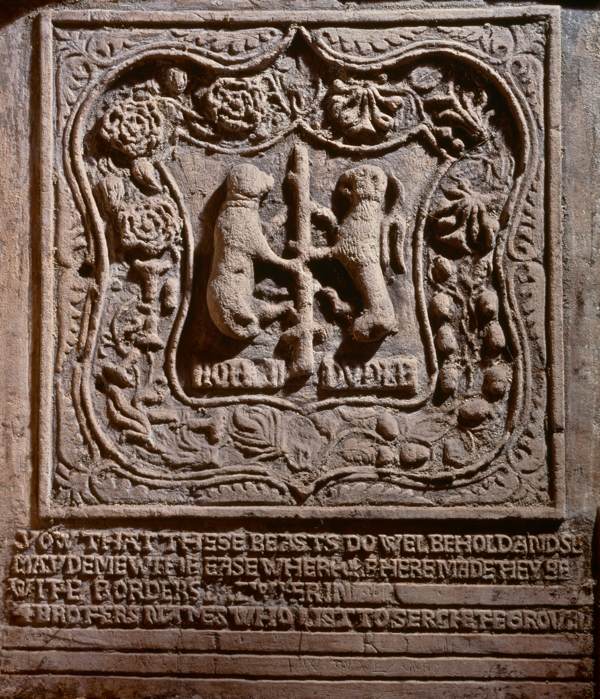
JOHN DUDLE – YOU THAT THESE BEASTS DO WEL BEHOLD AND SE, MAY DEME WITH EASE WHEREFORE HERE MADE THEY BE, WITH BORDERS EKE WHEREIN (THERE MAY BE FOUND) 4 BROTHERS NAMES WHO LIST TO SERCHE THE GROUNDE. The flowers around the Dudley family arms represent the names of the four brothers who were imprisoned in the Tower between 1553-4 , as result of the attempt by their father to put Lady Jane Grey upon the throne. The roses are for Ambrose, carnations (known as gillyflowers) for Guildford, oak leaves for Robert – from robur, Latin for oak – and honeysuckle for Henry. All four were condemned as traitors in 1553, but after the execution of Guildford they were pardoned and released. John died ten days after release and Henry was killed at the seige of San Quentin in 1557 while Ambrose became Queen Elizabeth’s Master of the Ordinance and Robert became her favourite, granted the title of Earl of Leicester.

Edward Smalley was the servant of a Member of Parliament who was imprisoned for one month for non-payment of a fine for assault in 1576. Thomas Rooper, 1570, may have been a member of the Roper family into which Thomas More’s daughter married, believed to be enemies of Queen Elizabeth. Edward Cuffyn faced trial in 1568 accused of conspiracy against Elizabeth and passed out his days at the Tower.

BY TORTURE STRANGE MY TROUTH WAS TRIED YET OF MY LIBERTIE DENIED THEREFORE RESON HATH ME PERSWADYD PASYENS MUST BE YMB RASYD THOGH HARD FORTUN CHASYTH ME WYTH SMART YET PASEYNS SHALL PREVAIL – this anonymous incsription in the Bell Tower is one of several attributed to Thomas Miagh, an Irishman who was committed to the Tower in 1581 for leading rebellion against Elizabeth in his homeland.

This inscription signed Thomas Miagh 1581 is in the Beauchamp Tower. THOMAS MIAGH – WHICH LETH HERE THAT FAYNE WOLD FROM HENS BE GON BY TORTURE STRAUNGE MI TROUTH WAS TRYED YET OF MY LIBERTY DENIED. Never brought to trail, he was imprisoned until 1583, yet allowed “the liberty of the Tower” which meant he could move freely within the precincts.

Subjected to the manacles fourteen times in 1594, Jesuit priest Henry Walpole incised his name in the wall of the Beauchamp Tower and beneath he carved the names of St Peter and St Paul, along with Jerome, Ambrose, Augustine and Gregory – the four great doctors of the Eastern church.


JAMES TYPPING. STAND (OR BE WEL CONTENT) BEAR THY CROSS, FOR THOU ART (SWEET GOOD) CATHOLIC BUT NO WORSE AND FOR THAT CAUSE, THIS 3 YEAR SPACE, THOW HAS CONTINUED IN GREAT DISGRACE, YET WHAT HAPP WILL IT? I CANNOT TELL BUT BE DEATH. Arrested in 1586 as part of the Babington Conpiracy, Typping was tortured, yet later released in 1590 on agreeing to conform his religion. This inscription is in the Beauchamp Tower.

T. Salmon, 1622. Above his coat of arms, he scrawled, CLOSE PRISONER 32 WEEKS, 224 DAYS, 5376 HOURS. He is believed to have died in custody.

A second graffito by Giovanni Battista Castiglione, imprisoned in 1556 by Elizabeth’s sister, Mary, for plotting against her and later released.

Nothing is known of William Rame whose name is at the base of this inscription. BETTER IT IS TO BE IN THE HOUSE OF MOURNING THAN IN THE HOUSE OF BANQUETING. THE HEART OF THE WISE IS IN THE MOURNING HOUSE. IT IS MUCH BETTER TO HAVE SOME CHASTENING THAN TO HAVE OVERMUCH LIBERTY. THERE IS A TIME FOR ALL THINGS, A TIME TO BE BORN AND A TIME TO DIE, AND THE DAY OF DEATH IS BETTER THAN THE DAY OF BIRTH. THERE IS AN END TO ALL THINGS AND THE END OF A THING IS BETTER THAN THE BEGINNING, BE WISE AND PATIENT IN TROUBLE FOR WISDOM DEFENDETH AS WELL AS MONEY. USE WELL THE TIME OF PROSPERITY AND REMBER THE TIME OF MISFORTUNE – 25 APRIL 1559.

Ambrose Rookwood was one of the Gunpowder Plotters. He was arrested on 8th November 1606 and taken from the Tower on 27th January 1607 to Westminster Hall where he pleaded guilty. On 30th January, he was tied to a hurdle and dragged by horse from the Tower to Westminster before being hung, drawn and quartered with his fellow conspirators.
Photographs copyright © Historic Royal Palaces
You may also like to read about
5th December, Krampus
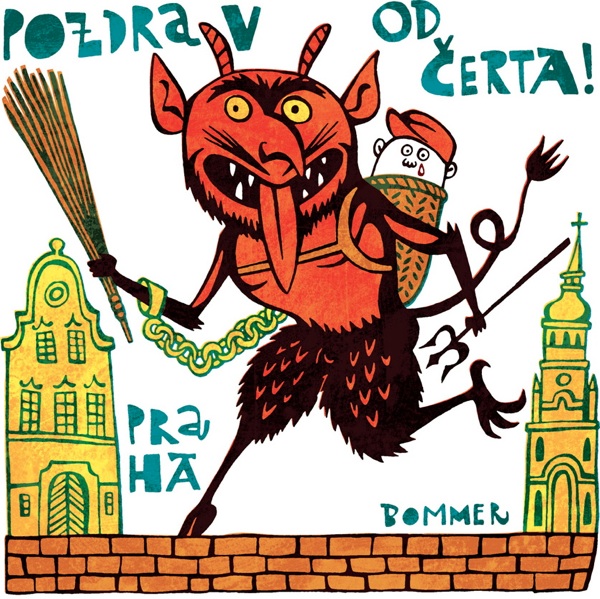
Krampus is a mythological creature or demon, particular to parts of eastern and northern Europe, especially Austria and Hungary. He accompanies Saint Nicholas during the Christmas season, warning and punishing bad children (in contrast to St. Nick, who gives gifts to good children). Due to German and Austrian influence, the myth of Krampus is also prevalent in Croatia, (Czecho)Slovakia, Slovenia and northern Italy.
The word Krampus originates from the Old High German word for claw (Krampen). Traditionally, young men dress up as Krampus in the first two weeks of December, particularly on the evening of 5th December (St Nicholas’ Eve, known in German as ‘Krampusnacht’), and roam the streets frightening children and women with rusty chains and bells. In some rural areas, the tradition also includes birching – corporal punishment with a birch rod – by Krampus, especially of young girls.
Images of Krampus usually show him with a basket on his back used to carry away bad children and dump them into the pits of Hell. He is occasionally shown with wings (though not here!) and usually with two different sorts of feet, one cloven and the other taloned.
In old Czechoslovakia, Krampus is known as “Cert” and here I have shown him trawling the streets of Prague this very night! Don’t worry about the child in Cert’s basket – he has been very naughty and had many stern warnings from his grandparents, so he had it coming!
Illustration copyright © Paul Bommer
Tom Burch, Farrier

Tom Burch & Finn
On the corner of Wood St and Love Lane – beneath the shadow of the solitary tower of St Alban’s – is the last stable in the City of London where Spitalfields Life Contributing Photographer Patricia Niven and I went to meet Tom Burch, the farrier, on his monthly visit to change the horses’ shoes. Even as we entered the yard at the rear of the police station, the pungent aroma of burnt toenail clippings assailed us, indicating that Tom was already at his work.
Where once the horses would have been taken to the forge, now Tom works out of a specially-equipped van with a furnace and a portable anvil. Otherwise, dressed in his custom-made leather apron with a split down the middle allowing him to take the horse’s foot between his legs, he presents an image which has been familiar in the City of London for more than two millennia. The only working farrier in the City now, Tom is a liveryman of the Worshipful Company of Farriers, one of the original twelve livery companies in the City, dating back to 1356.
Tom has come to shoe the nine horses kept by the City of London Police for the past fifteen years. None of those that were here when he started remain yet the horses that Tom visits today recognise him intimately – standing patiently throughout the process, lifting their feet obligingly, even raising the next when the previous one is complete. “A horse is a beast of flight but these animals are trained to stand their ground,” he confirmed, as he gripped the hoof of Finn, a large white stallion, in preparation for removing the old shoe.
After a month, the hoof will have grown a quarter of an inch and over time the shoe will become uncomfortable if it is not changed – and here in the City the horses walk on concrete which wears away the metal shoes quickly. With his farrier’s knife, Tom trims the hoof once the old shoe is off and then removes the new shoe from the furnace with pincers, hammering it to fit. “I’ve got a picture in my head of the shape of the horse’s foot, so I am altering the shoe to it,” he explained, turning red-faced with droplets of perspiration forming on his brow as he gripped the glowing arc of steel upon the anvil, pounding it with his blacksmith’s hammer and sending sparks flying.
Taking the shoe in his pincers, Tom pressed it into place on the horse’s foot, inducing plumes of brown smoke as the hoof singed. “Finn, I don’t suppose there’s any chance of putting your weight on the other leg?” he asked and the creature obliged, unable to resist acquiescing to such a polite request. “It has to fit,” added Tom, speaking to me now, as he returned the shoe to the anvil to work it further, “the shoe must be level and the foot must be level.” Then he plunged the finished shoe into a bucket of cold water that suddenly bubbled into life as the iron cooled.
On the return trip, Tom nailed the shoe into place firmly in an action that caused me to wince, yet did not even occasion a blink from the horse. “The hoof is made of hair, it takes a year to grow and the area where the nails go is insensitive,” Tom assured me, returning again to the silent absorption that is his natural mode of working.“Some horses prefer to have their hooves shod clockwise, others I will do diagonally and if they’re nervous I will do them one at a time.” he revealed to me, thinking out loud, as he filed down the shoe now it was nailed in place. Farriers tend to be solitary characters, attending to the same horses regularly and becoming in tune with their charges. “You have to be quite content with your own company, because a lot of the time you are by yourself.” he confessed with a placid smile. And then, in a moment of repose at the completion of the morning’s work, Tom spoke a little of his personal history whilst standing at Finn’s side.
“When I was a kid, my dad had a farm near Canterbury. He bought me a pony and, until I was sixteen, I worked at the stable up the road where local people and showjumpers kept their horses. Then I did a four year apprenticeship as a farrier and followed it by working as a blacksmith for three years. In 1979, the Metropolitan Police were advertising for a farrier based at Bow, and I stayed thirty years until I retired in 2009. I gave up riding when I became a farrier, I just didn’t have the time, and when I joined the police I discovered other things to do, like golf.
It’s not the kind of job to do unless you enjoy it because it’s hard work. I enjoy working with animals, but thirty years doing big horses like this every day is enough. I’ve got arthritis in both knees, but I can’t just give up because I have been doing it so long. Now, it’s no longer a full-time job. I only have three days a month when I get up early, otherwise I can sleep in until half past six. After thirty years of getting up at half past four, it’s difficult to sleep in.
I’ve got two and a half more years until I’m sixty and then that’ll be it completely. You have to maintain a certain standard. I don’t want it to be said,“Tom’s shoes are dropping off right, left and centre.” A friend who did his apprenticeship with me, his son is doing his apprenticeship now and he will be qualified when I come to retire, so we have agreed he can take my van.”
It was time for Tom to pack up the van for another month and drive back to his home in Kent, five miles from where he grew up. Meanwhile, horses that had been on duty early that morning were being walked in circles around the yard as exercise before duty that evening and their hooves echoed in the quiet courtyard. “Would you like a horseshoe for luck?” Tom offered unexpectedly, eagerly pulling the nails out of one of Finn’s shoes worn down by the streets of London. He handed me the shoe with a generous smile, I wrapped it in my handkerchief, we shook hands and I carried it back to Spitalfields as my proud souvenir of meeting Tom Burch, the lone farrier in the City of London.


One shoe off, one shoe on.

The old shoe worn by city streets.

Shaping the new shoe, hot from the furnace.

Fitting the shoe.


The new shoe in place.

Planing off the excess.


A farrier’s knife.


A horseshoe for luck.
Photographs copyright © Patricia Niven
You may also like to read about
4th December, the Boar’s Head
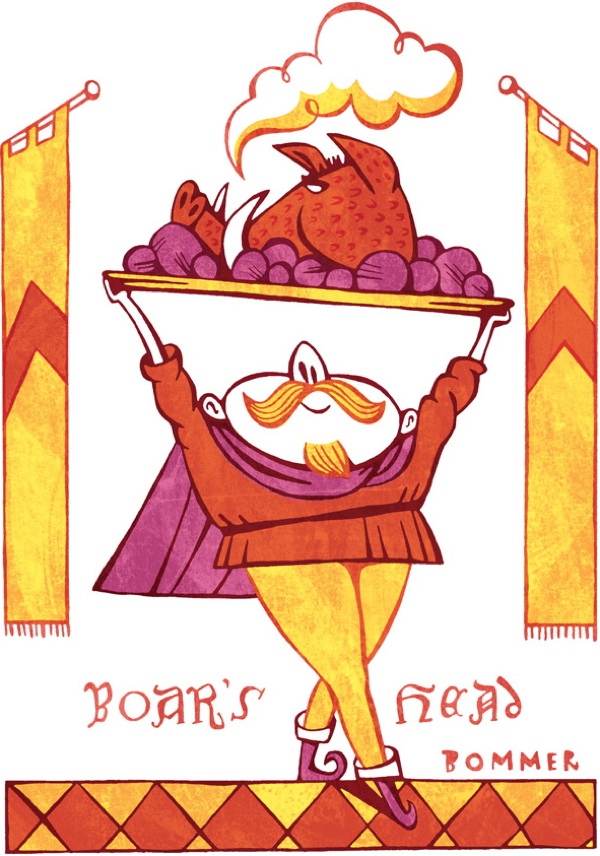
Long before the turkey, and even before the goose, the traditional centre-piece of any Tudor or Medieval Yule-tide feast worth its salt (if, indeed a “centre” could be found amongst all the pies, roasts, marchpanes and sweetmeats!) was the roasted head of a wild boar, replete with apple or citron in its mouth.
According to folklorists, the boar’s head tradition was “initiated in all probability on the Isle of Britain by the Anglo-Saxons, although our knowledge of it comes substantially from Medieval times…. [In ancient Norse tradition] sacrifice carried the intent of imploring Freyr to show favor to the New Year. The boar’s head with apple in mouth was carried into the banquet hall on a gold or silver dish to the sounds of trumpets and the songs of minstrels.”
In Scandinavia and England, St. Stephen may have inherited some of Freyr’s legacy. His feast day is December 26th, Boxing Day, and thus he came to play a part in the Yuletide celebrations which were previously associated with Freyr (or Ingwi to the Anglo-Saxons). In old Swedish art, Stephen is shown tending to horses and bringing a boar’s head to a Yuletide banquet. Both elements are extra-canonical and may be Pagan survivals. Christmas Ham is an old tradition in Sweden and England, and may have originated as a winter solstice boar sacrifice to Freyr.
The Boar ( or just its head) was adopted by Richard III ( “A Horse! A Horse! My Kingdom for a Horse!”) as an heraldic badge, a fact still commerorated today by a smattering of taverns across the land named the Boar’s Head.
Illustration copyright © Paul Bommer
Gary Aspey, Wheel Truer
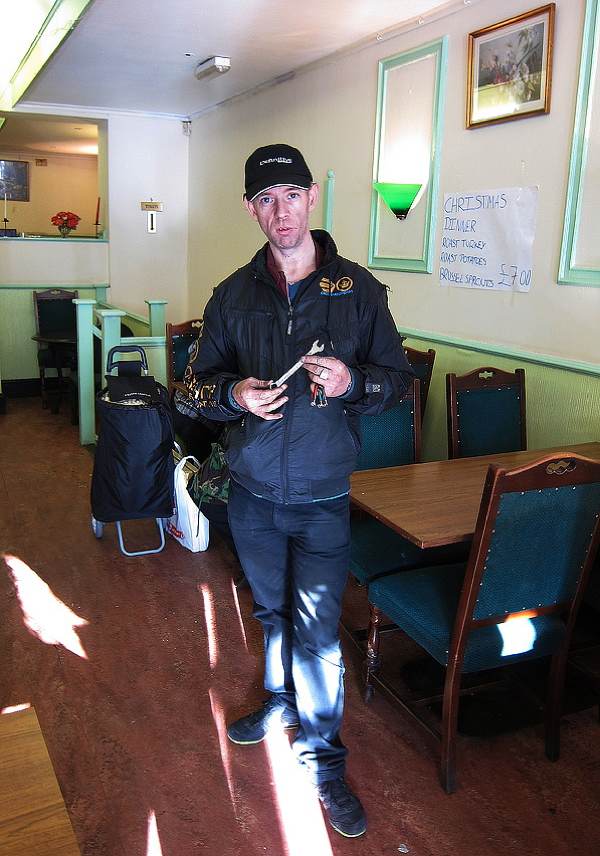
Gary shows off his £45 spanner
Last Sunday at Gina’s Restaurant, while I was getting a cup of tea after my weekly visit to the fly-pitchers in the Bethnal Green Rd, Gary Aspey sidled up to Spitalfields Life Contributing Photographer Colin O’Brien who was with me and asked to have his picture taken. Naturally, Colin was delighted to oblige and while he was snapping, Gary told me his life story, revealing a fiercely independent spirit. A skinny guy, streamlined for speed in his close-fitting clothes – experience has taught Gary to be circumspect yet he has learnt the art of survival, earning his living by repairing bikes and today he freewheels through existence on the Raleigh Carlton he restored himself.
“It’s a skill within a skill,” Gary explained with authorative intent, when I asked about being a wheel truer, and he showed me the cherished set of keys he carries around slung on his little finger, which allow him to adjust the tension of individual spokes with rare skill, thereby restoring the true form to a damaged or twisted wheel. And it was impossible not to appreciate Gary’s chosen identity as integral to his straight-talking manner and open-hearted nature. Being a qualified bicycle repair technician and frame builder, there is little Gary does not know about bikes, and I discovered there is a lot more to it than you might imagine.
“I’ve seen everything in life in this market. One Sunday, a woman got stabbed in front of me and I saved her life by holding her stomach together. They were stealing a bike and she got in the way, they cut her right across. There used to be so many stolen bikes down here, one time. I’ve seen people going round with boltcutters cutting through bike locks in broad daylight. I’ve been stabbed a few times. I’ve been robbed, gangs of three and four come up to you from behind and if you don’t give your money they knife you. I walked through Old St this morning and they were all coming out of the clubs and throwing bottles at each other. It affronts everyone in this country.
I was born in Bermondsey, but we can get by. My mother hit me, my dad hit me, it was the drugs and alcohol. I didn’t get on. When I was seven, I got hit and I thought, “I want a better life,” so I left. I lived with an old lady, Nelly – her husband was a cabbie. I was running through the back of Bermondsey one day, my cheek was swollen with a bruise out to here and I had a black eye. She said, ‘I’ve seen you, I know your dad. Did he do that to you?’ She took me in.
Back in the seventies when I was a child, I cycled up here to the street that was all bicycle dealers. I worked for George in the market and then at his shop, Angel Cycles. My dad used to do bikes, but he was out of it before I met George. His dad had two stalls here before him, one selling bicycle parts and another selling army surplus, that’s how George made his money, and in 1950 he took the shop in St John St. That man taught me everything I know, he showed me how to straighten a wheel using a true key and wheel jib, – and I never looked back. With my true key, I straightened out the buckled front wheel of a bike for a woman and she gave me twelve pounds.
Nowadays I do the repairs for Camden Cycles in the Grays Inn Rd and in the evenings I build frames in my house. You’ve got to be interested in the culture and technicalities of bikes to be a frame restorer. I will strip them down by hand, it takes five to seven hours to remove the paint. Then I build up the layers again and bake it in a special oven. I’m qualified and I do it legally and responsibly, that’s the only way to do it. I’m always so busy. I never stop. When I first worked in the market I never had fourpence, but I didn’t rob anybody, I used my hands and my skills. If you want to get on in this world you’ve got to believe in yourself.
If you look at me very closely, I’m a dabbling boy. I do what’s around. At quarter past five we put the stall out. For me, it’s like a walk in the park. I’ve been married, I’ve been a carer and I’ve adopted a girl of ten. I’m strong at being strong.”
Once Gary had told his story, he was eager to get on his bike, so Colin and I went round the corner to meet George and his assistant, a senior gentleman by the name of “Young George” who goes to buy the tea and sandwiches. George turned out to be a placid gentleman in his seventies who has been coming to the market for over sixty years. With a helpless smile, he confided to me that he had to close his repair shop because he was unable to overcome his habit of undercharging. Recalling how his father put him on the corner of Brick Lane at thirteen years old to sell three tins of boot polish for a tanner, George was amused to admit that this paternal attempt to encourage a commercial instinct failed miserably. Even today, driving up from Kent to sell a few spare parts is primarily a social exercise. A chance for him and Young George to have a day out and catch up with their regular customers that are now old friends.
To a lonely child cycling the city, like Gary, the culture of street cycle repair offered companionship and a means of earning a living too. Over forty years, the velocipede has now come to incarnate a state of being for Gary Aspey. As he put it to me succinctly – “On a bicycle, people have freedom of movement and freedom of mind.”
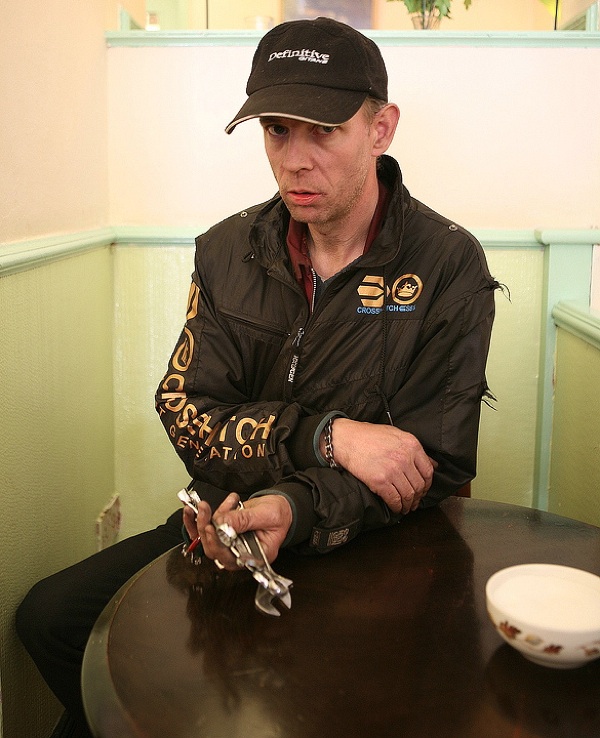
“It’s a skill within a skill.”
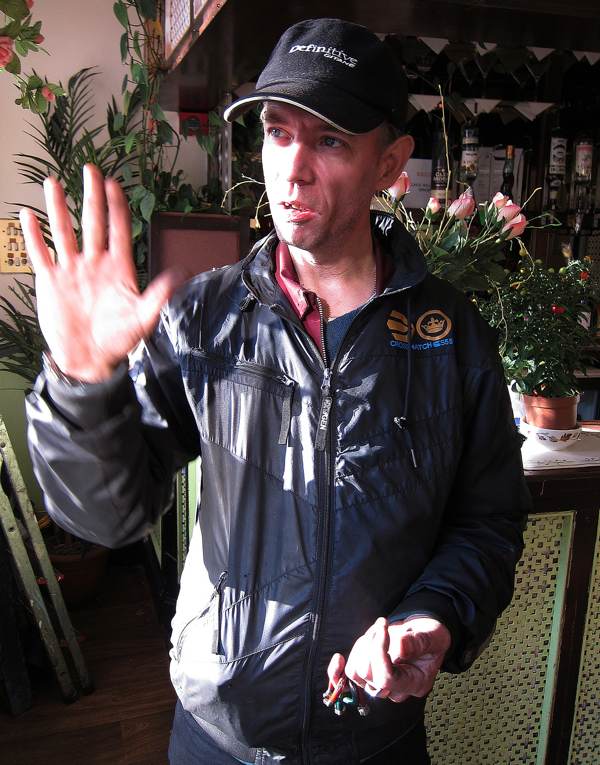
“I was born in Bermondsey, but we can get by”
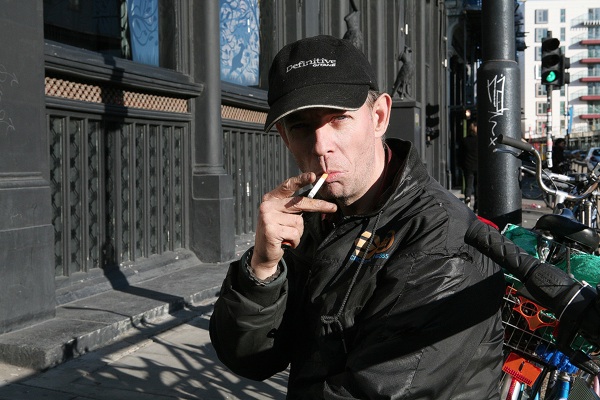
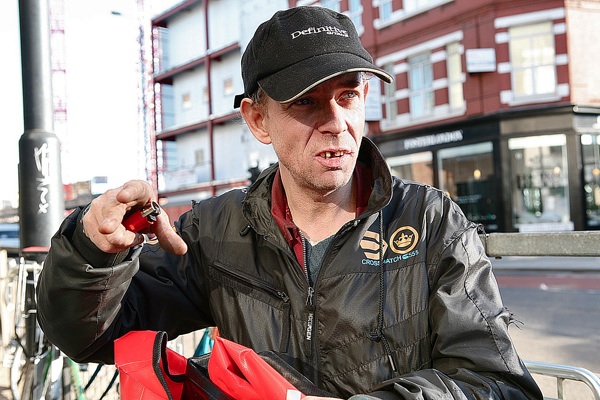
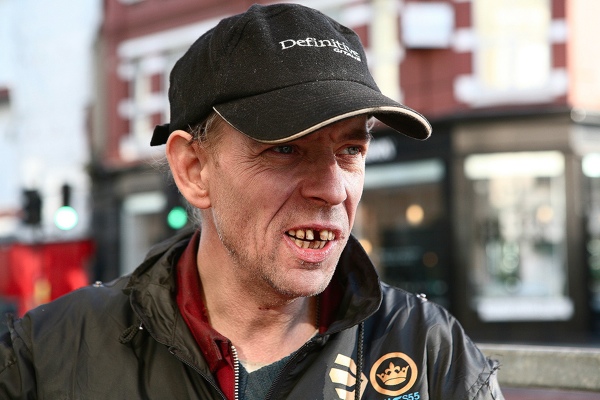
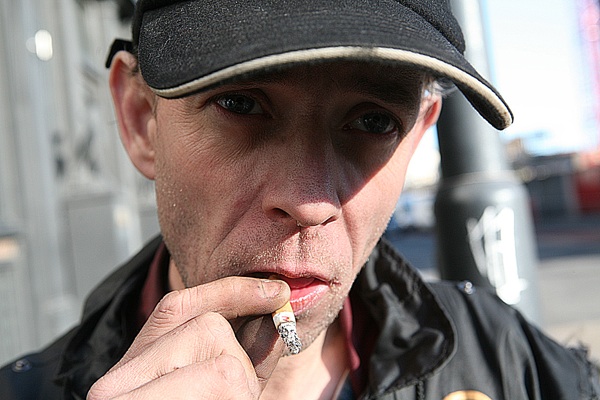
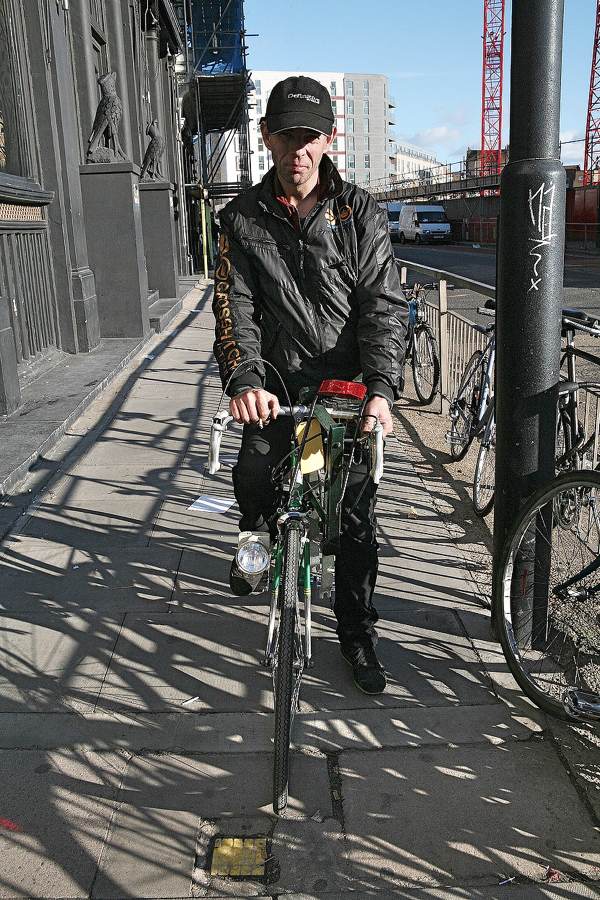
Gary and his Raleigh Carlton – “On a bicycle, people have freedom of movement and freedom of mind.”
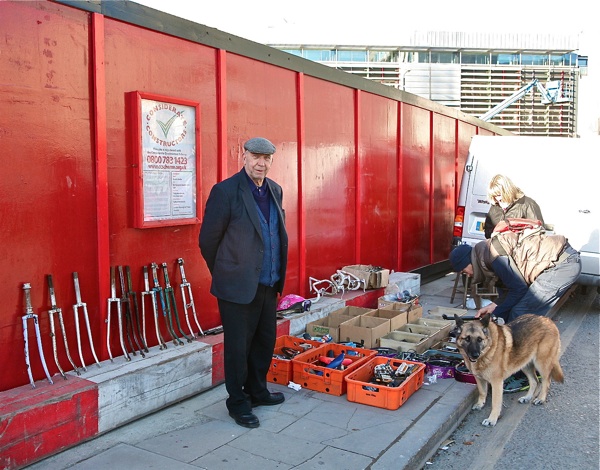
“That man taught me everything I know”
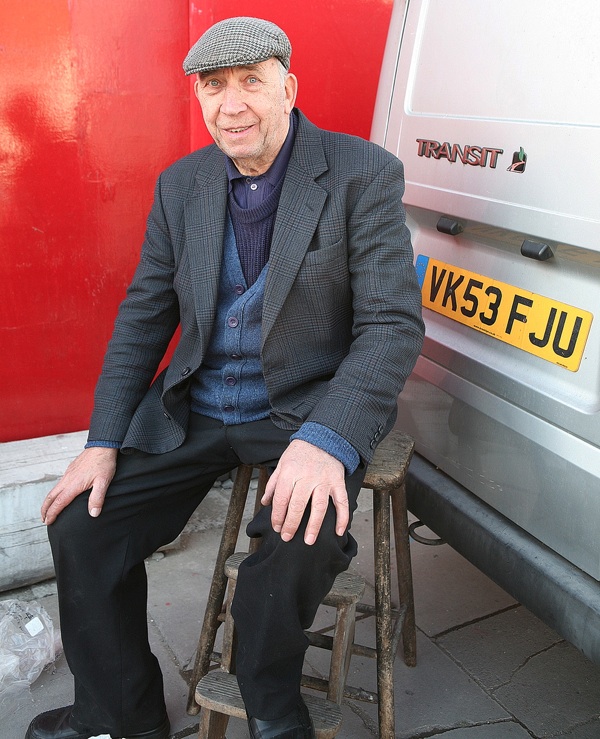
George has been dealing in bicycle spares in the market for sixty years.
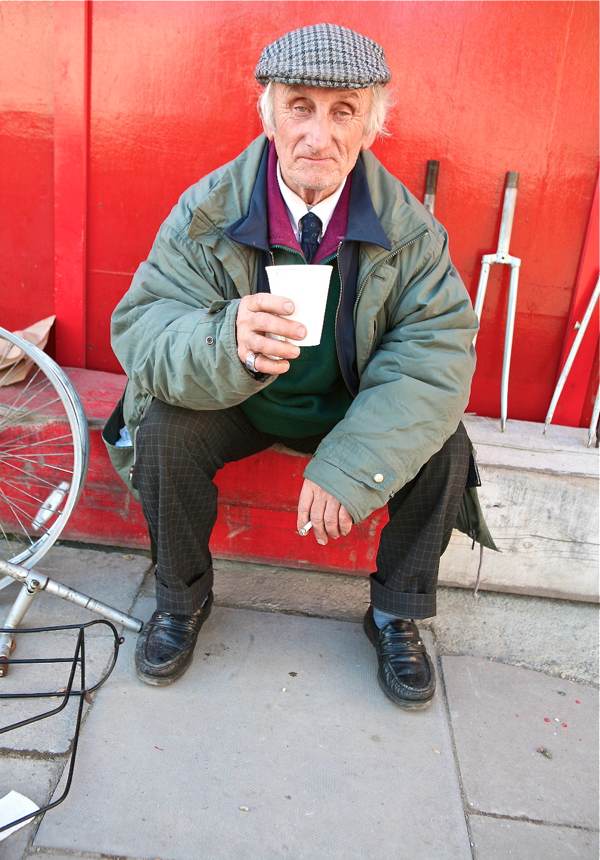
George’s assistant, “Young George.”
Photographs copyright © Colin O’Brien
You may also like to read about
3rd December, Jack Frost
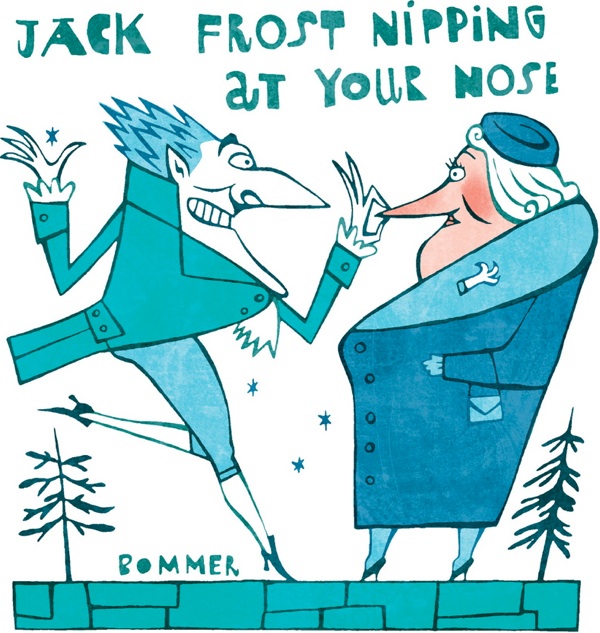
“Chestnuts roasting on an open fire, Jack Frost nipping on your nose, Yuletide carols being sung by a choir, and folks dressed up like Eskimos.”
In English folklore, Jack Frost appears as an elfin creature who personifies crisp, cold, winter weather but his origins stem from Scandinavian legend where he was named Jokul Frosti, meaning Icicle Frost, by the Norse Vikings. He is renowned for his artistic talents, while sneaking through towns late at night, painting beautiful frost designs on windows and over the winter leaves and grass – as well as nipping noses, fingers and toes wherever he can!
The verse above is, of course, from the “Christmas Song”, written and composed by Torme and Wells in 1946 and most famously sung by Nat “King” Cole.
Wrap up warm!
Illustration copyright © Paul Bommer
The Return of Shelf

The lights were burning late last night at the former Ship & Blue Ball in Boundary St, one of the East End’s most notorious criminal landmarks. Here in 1963, the Great Train Robbery was plotted in the room above the pub. Today the building houses the Bold Creative agency, yet long after all the employees left yesterday, shadowy figures were still to be glimpsed inside by those hurrying through Boundary Passage in the gloom. Assuming the role of investigative reporter, I went round after dark to question the two women at the centre of this new conspiracy of an entirely innocent nature. They are Katy Hackney and Jane Petrie, and they were busy organising their swag in preparation for the return of Shelf.
Ten years ago, Shelf opened in Cheshire St and became an essential Christmas destination, never disappointing as a source of new trinkets and old tricks and artful wooden decorations from the Black Forest. When Katy & Jane closed the shop and took it online this year, I thought it was the end of my annual visit there to seek wonders, so I am delighted to welcome their return, taking over the Ship & Blue Ball each weekend between now and Christmas.
The blinds were down when I arrived and Katy hustled me inside where she and Jane were laying out their haul of new discoveries and old favourites upon a huge table. Now there is a nip in the air, Jane helpfully suggested I needed a pair of traditional Swedish mittens handknitted by their friend Bodil who lives in a tin hut by a lake in Mellurüd. Strung up like kippers, these are available in adult and children’s sizes and there are only as many pairs as Bodil has managed to craft.
If you are looking for Russian dolls, wind-up birds that sing, characterful felt glove puppets, cuddly lions from Sri Lanka, happy chopping boards, kaleidoscopes, wooden molecule building sets, and unusual games and prints and children’s books, this is the place to come. In the last ten years, Katy & Jane have been all over Europe, Japan, East & West Coast America, and Dundee, collecting zany old stationery – jotters and labels and ribbons and printed tags and bags and tin badges and scraps and all manner of ephemera including hundred-year-old-butter-papers and fifty-year-old Italian lemonade labels and vintage orange wrappers and ladybird books and interesting packets of seeds. Previously, they hoarded their favourites in the basement of the shop for their own pleasure, but now they have decided to part with it all in medley packs.
While I examined all the swag minutely, Katy & Jane enthused about the novelty of weekends with their children, since since the Cheshire St shop closed. Yet the old delight was rekindled, to see all the strange and marvellous things at Shelf that you cannot find anywhere else. “Our elaborate hobby,” they call it.
Vist the Shelf blog The Other Side of the Shelf and Jane Petrie’s Costume Detail blog.


A wind-up bird that sings

Gift bags of stocking fillers.

Kellner figures, made by the same family in Leipzig since 1919.

Screenprint by Beyond Thrilled.

Paper mache stag by Rachel Warren.

Birds crossing Victoria Park by John Dilnot.


The essential map, drawn by Adam Dant with stories by yours truly.


Designs by Frerk Muller, an eighty-one year old beatnik from Berlin.


Kay Hackney & Jane Petrie with their swag – an innocent conspiracy.

Plaster letters dug up in the Californan desert, originally designed for titling silent films.
Photograph of Katy Hackney & Jane Petrie © copyright Jeremy Freedman
Shelf will be open at 13a Boundary St for the next three weekends, 3rd & 4th, 10th & 11th, 17th & 18th plus Thursday 22nd & Friday 23rd December, daily from 11am to 7pm. Artist Paul Bommer will be the guest exhibitor on the first weekend, knitwear designer Jo Gordon on the second and printmaker Beyond Thrilled on the third.












