
2nd December, Smoking Bishop
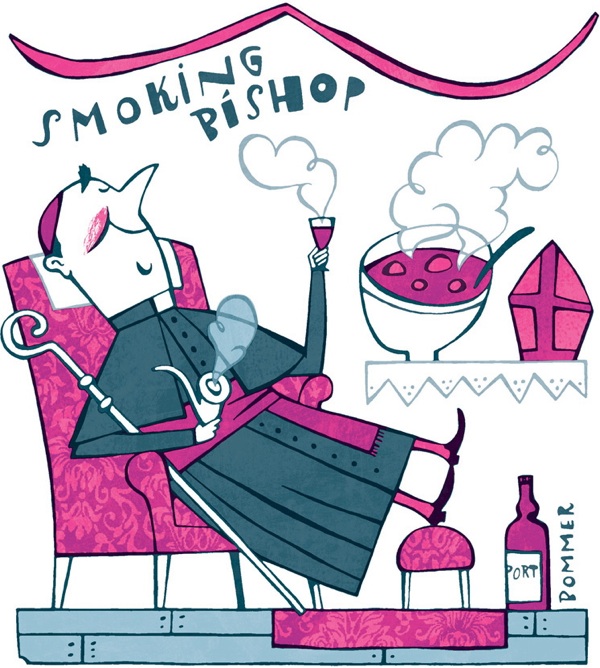
Nowadays, we may celebrate Christmas with a glass or four of mulled wine. But our Victorian and Georgian forebears had a vast panoply of punches, cups, caudles, noyeaux, neguses, shrubs, flips and possets at their disposal to mark the season. This included a range of “clerical” punches, spiced and served piping-hot with the addition of roasted (and clove-studded) lemons and seville oranges. If the drink was burgundy based it was termed a “pope,” if claret-based it was deemed an “archbishop” and if port was the main constituent the punch was called a “bishop,” and so on.
At the very end of Dickens’ “A Christmas Carol,” a reformed Ebeneezer Scrooge tells Bob Cratchett “… we will discuss your affairs this very afternoon over a bowl of Smoking Bishop, Bob!” Now you know what that is.
This particular smoking bishop is Monsignor Cathal Septimus O’Herlihy, Bishop of Ballygramore, enjoying a glass of this edifying brew after a hard day. Note his mitre, crozier, cincture and zucchetto!
Illustration copyright © Paul Bommer
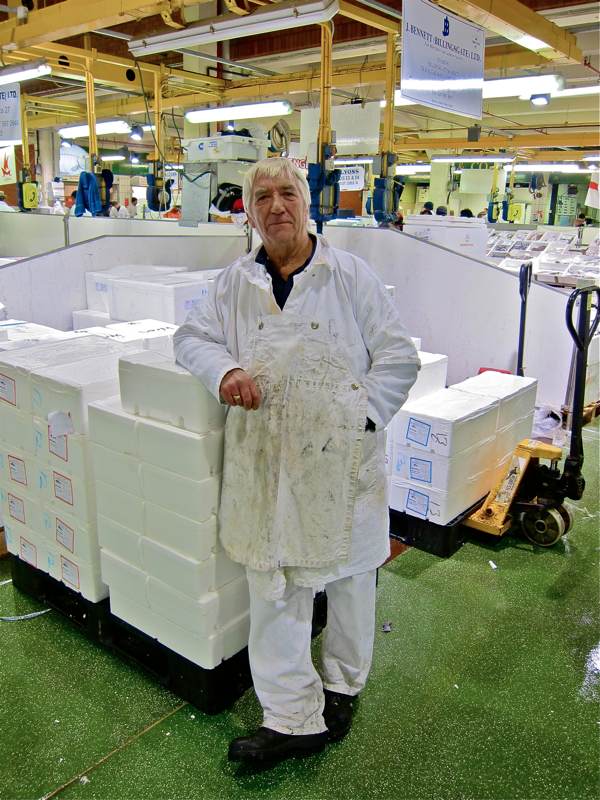
Charlie Caisey, Fishmonger

Eighty-one year old fishmonger Charlie Caisey retired twenty years ago yet he cannot keep away from the fish market for long, so I was delighted to give him an excuse for a nocturnal visit – showing me around and introducing me to his pals. These days, Charlie maintains his relationship with the fish business through involvement with the school at Billingsgate, where he teaches young people training as fishmongers and welcomes school parties visiting to learn about fish.
Universally respected for his personal integrity and generosity of spirit, Charlie turned out to be the ideal guide to the fish market. Thanks to him, I had the opportunity to shake the hand and take the portraits of many of Billingsgate’s most celebrated characters, and now that he can look back with impunity upon his sixty years of experience in the business, Charlie told me his story candidly. He did not always enjoy the high regard that he enjoys today, Charlie forged his reputation in an arena fraught with moral challenges.
“In 1950, when I joined Macfisheries and started in a shop at Ilford, I was told, “You’ll never make a fishmonger,” and they moved me to another shop in Leytonstone. I was honest and in those days fishmongers always added coppers to the scale but I wouldn’t do that. Later, when I ran my shop, it was always sixteen ounces to the pound.
In Leytonstone, it was an open-fronted shop with sawdust on the floor. You had a blocksman who did the fishmongering, a frontsman who served the customers and a boy who ran around. At twenty-one, I was a boy fishmonger and then the frontsman decided to leave, so I moved up when he left. And I found I had an uncanny ability at arranging fish in shows! I made quite a little progress there, even though I was never taught – just three weeks at Macfisheries’ school.
I got my first management of a fish shop within three years, I was sent out to a poor LCC estate at Hainault. It was a fabulous shop but it was losing money, this was where I learnt to run a business and I worked up a bit of a storm there, working eighty hours a week and accounting the stock to a farthing. As a consequence, I was offered a first hand job in a shop behind Selfridges where all the customers were lords and ladies, but I refused because, if I was manager in my own shop, it would have been a step down. So then they sent me to run a shop in Bayswater. It was a lovely shop, when I arrived I had never seen many of the fish that were on display there, and I became wrapped up in it. We had a great cosmopolitan public including ladies of the oldest profession in the world.
Within a couple of years, Macfisheries moved me to Notting Hill Gate at the top of Holland Park Avenue – absolutely fabulous. I served most of the embassies and the early stars of television. The likes of Max Wall, Dickie Henderson and the scriptwriter of The Good Life were customers of mine. I built up quite a reputation and I was the first London manager to earn £1000 a year. From there I went to Knightsbridge running the largest fish shop in London, opposite Harrods. In 1965, I had thirty-five staff working under me and I worked fourteen hours a day.
My dream was to go into business on my own but I had no money. When I started my own shop, the sad part was how poor it was. It had holes in the floor, no proper drainage and no refrigeration. I’d never been to Billingsgate Market in my thirteen years at Macfisheries and when I went with my small orders, it was a different ball game. The dealers treated me like an idiot, the odd shilling was going on the prices and I was given short measures. Yet I never took it personally and I started to earn their respect because I always paid my bills every week. And, in twenty years, my turnover went from twelve thousand pounds to over half a million a year.
Most of my experience and knowledge has come from the customers. My experience of life came from the other side of the counter. They showed me that if you go out and look, there is a better life. When I think of Stratford while I was growing up, it was a stinky place because of the smell from the soap factories. My family were all railway people, my father was an uneducated labourer and what that man used to do for such a small amount of money and bad working conditions. We were poor because my marvellous parents were underpaid for their labours. I didn’t leave London during the war and I witnessed all the horrors. I missed lots of school because I was in the East End all through the bombing, so I’ve always been conscious of my poor education. Basically, I’m a shy man and I’m always amazed that I can stand up in front of people and speak, but I can do it because it comes from the heart.
Don’t ever do what I did. I went eighteen years without a holiday. It was a little crazy, I was forty before I had time to learn to drive.”
Dawn came up as Charlie told me his story and we walked out to the back of the fish market where the porters throw fish to the seals from the wharf. Through his tenacity, Charlie proved his virtue as a human being and won respect as a fishmonger too. Yet although he may regret the inordinate struggle and hard work that kept him away from his family growing up, Charlie is still in thrall to his lifelong passion for this age-old endeavour of distributing and selling the strange harvest of the deep.

Clearing away after a night’s trading at Billingsgate, 7:40am.

Roger Barton, fifty-one years at Billingsgate – a porter who became a dealer twenty-six years ago.

Tom Burchell, forty-five years in the fish business.

Alan Cook, lobster specialist for forty-eight years.

Simon Chilcott, twenty years at Bard Shellfish.
Leonard Hannibal, porter for fifty years – “I never had a day off, never had backache or flu.”

Mick Jenn, fifty years in eels – “Me dad was an empty boy and I started off in an eel factory.”

Terry Howard, fifty-nine years in shellfish – “I played football in the 1960 Olympics.”

Anwar Kureeman, eight years at Billingsgate – “I am a newcomer.”

Paul Webber, thirteen years at J.Bennett, Billingsgate’s largest salmon dealers.

Andres Slips came from Lithuania seven years ago – “I couldn’t speak English when I arrived, now my mother would blush to hear my language.”

Edwin Singers, fifty-two years a porter – “known as the richest porter in Billingsgate.”

Geoff Steadman, fourth generation fish dealer, thirty-three years at Chamberlain & Thelwell.

Colin Walker, porter of forty-six years, adds up his bobbin money in Shimmy’s Cafe.

Charlie in his first suit at fifteen –“From Willoughbys, I paid for it myself at half a crown a week.”

Charlie at the Macfisheries School of Fishmongery (He is third from right in back row).


Charlie in his fish shop in the seventies.
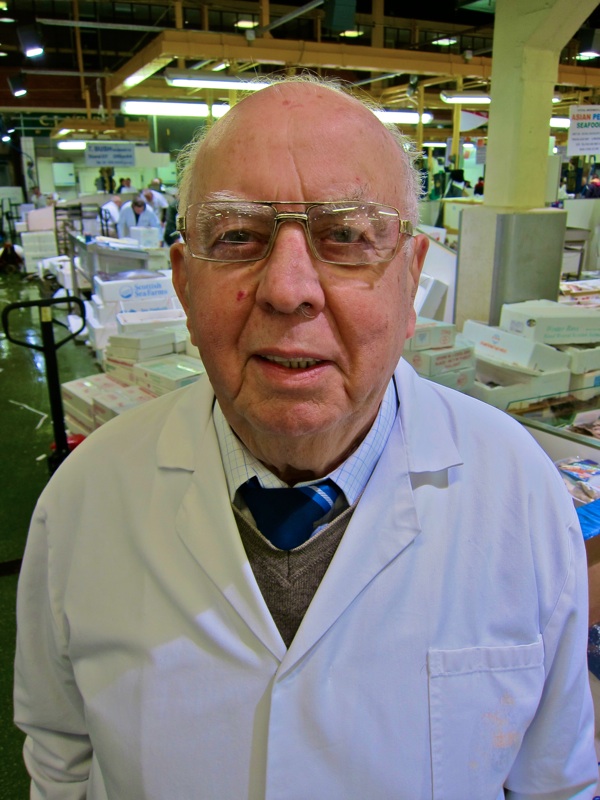
Charlie Caisey – the little fish that became a big fish.
You may recall I met Charlie Caisey at The Fish Harvest Festival
You may also like to take a look at
Boiling the Eels at Barney’s Seafood
Paul Bommer’s Advent Calendar

Albert the Umbrella
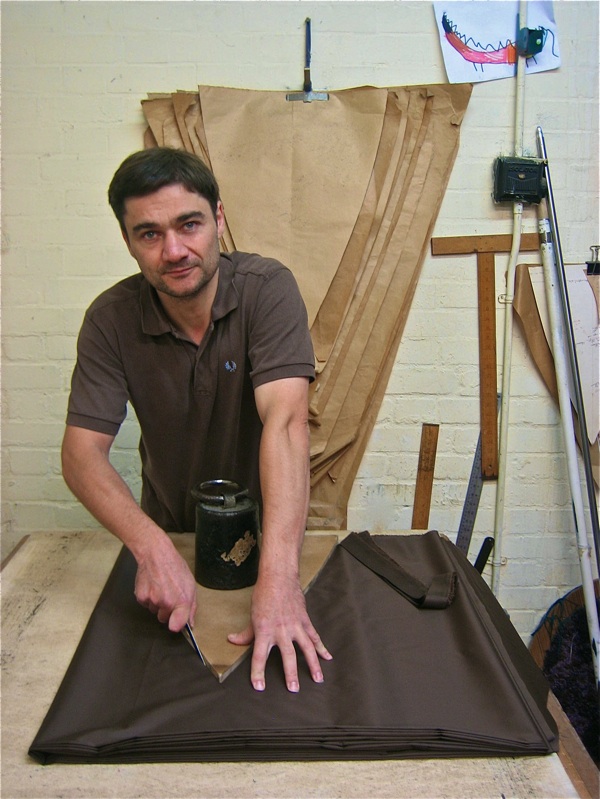
This is Richard Ince, sixth generation umbrella maker and proprietor of James Ince & Sons, the oldest established umbrella makers in Britain, founded in Spitalfields in 1805. He is seen here cutting the covers for the manufacture of Albert the Umbrella, his collaboration with Ally Capellino, the bag lady of Shoreditch. It was my pleasure to introduce Ally and Richard to each other recently, and Albert is the happy outcome.
At the end of the Summer, Ally cycled up from her studio in Calvert Avenue to Richard’s umbrella factory in Vyner St next to the canal. Behind a nondescript facade, Richard makes umbrellas here by hand in the same way his family have done for generations, still using many of the old tools and equipment from their former factory in Spitalfields. The cutting table in the picture above was salvaged after an incendiary bomb hit in World War II and is charred underneath, evidencing its dramatic history. Even the weight that Richard uses to hold the template in place while cutting the covers has been in the business at least three generations.
Ally – a designer with a fascination for the technical processes of making things – was immediately intrigued by Richard’s factory and, within half an hour, she was selecting fabrics and considering what kind of umbrella might complement the elegant simplicity of her bags. The result is a model of understatement – with a beechwood shaft, a chestnut handle, copper handsprings and discreet leather detailing, Albert the Umbrella sports a plain cover of soft grey or brown.
A few weeks ago, I visited the factory when Terry Coleman, the East End’s most senior umbrella maker, came in to fit the copper handsprings for Ally’s umbrellas, using an old stock of springs that were manufactured in the nineteen fifties. Then, last week, I returned to see Richard cut the covers and follow the process to completion. The machinist sewed the triangular pieces together in pairs and then niftily combined them to make the eight-panelled cover. Next, the metal tips were attached, then the cover was sewn to the frame and the leather strip which holds the umbrella furled was stitched in place. Finally Richard himself fitted the metal ferrule and the handles, and – Hey Presto! – a new umbrella by James Ince & Sons, designed by Ally Capellino and carrying a little bit of the history of the East End with it.
Since most of the archives of the family business were destroyed in the London Blitz, Richard has begun collecting examples of his forebears’ handiwork ,and he brought out some magnificent dusty specimens and laid them on the cutting table for me to photograph. At first, he showed me snazzy patterned umbrellas from the fifties and forties, and then cool colonial sunshades from the thirties. He has a stack of huge old patio umbrellas, all faded by Summers long gone – even an early fishing umbrella from the very beginning of the twentieth century – that we did not venture to open in the tiny workshop.
Even as I was taking my pictures, Richard produced more and more umbrellas, and unfurled them to magical effect. He produced parasols and carriage umbrellas from the nineteenth century, many in tattered silk and whalebone yet still luxuriant in their colour and design. He produced umbrellas with exquisite handles and unusual frames. It was a whole lost world of umbrellas.
A naturally modest man who carries his expertise lightly, Richard probably knows more about umbrellas than anyone alive, yet he does not advertise that he makes the trick umbrellas for Mary Poppins and Hagrid. In fact, when Richard manufactures umbrellas, he does not always sew his “James Ince & Sons” label in them. So I am very proud to have been the one to put Ally Capellino and James Ince & Sons together and announce that – as a result – you can now go into a shop in the East End and buy an umbrella made by hand in the East End, by the oldest umbrella maker in this country. Ladies & Gentlemen, please welcome Albert the Umbrella!
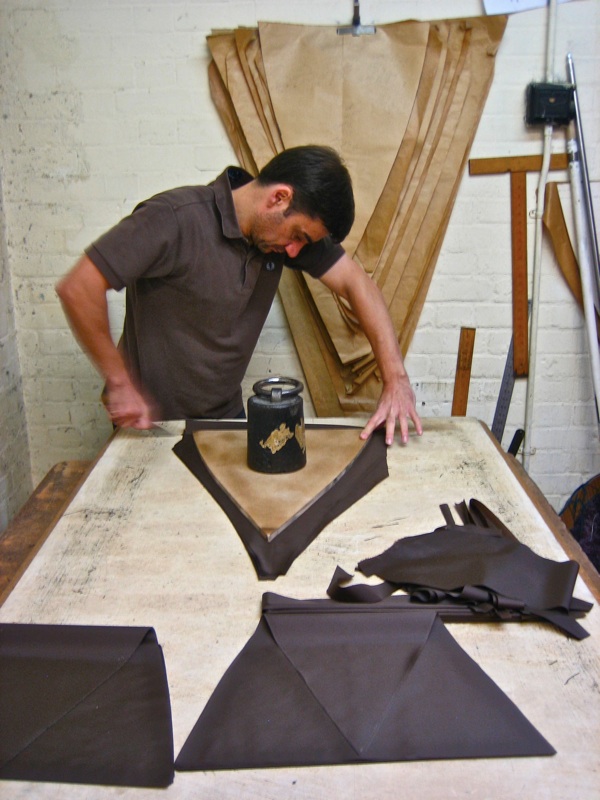
Cutting the covers.
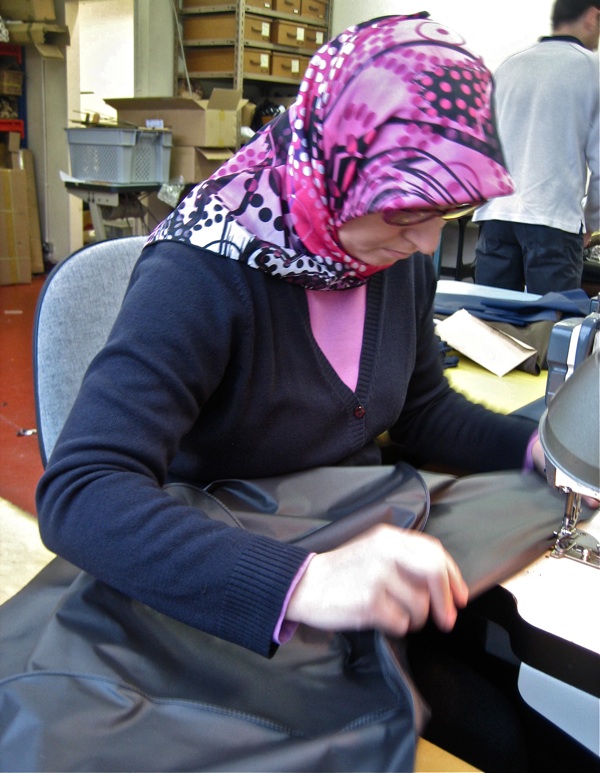
Sewing the covers together.
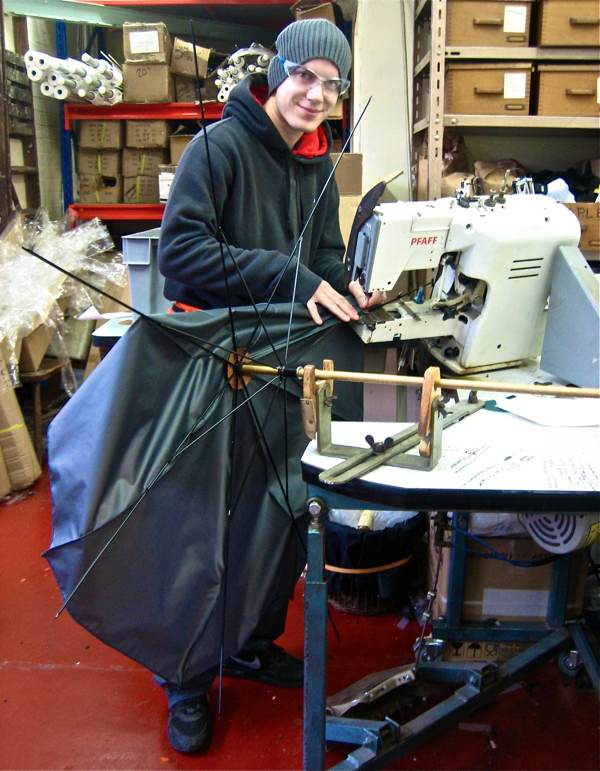
Sewing the cover to the frame.
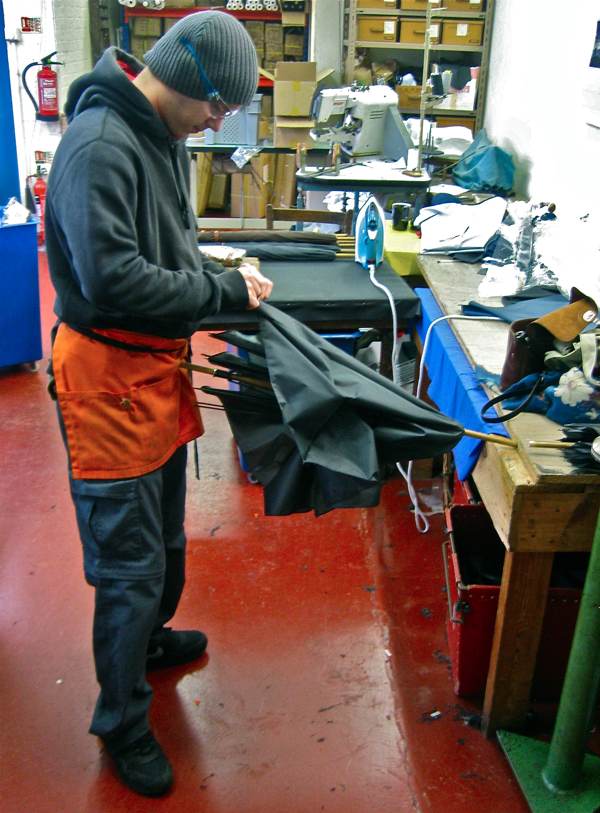
Tipping the umbrella.
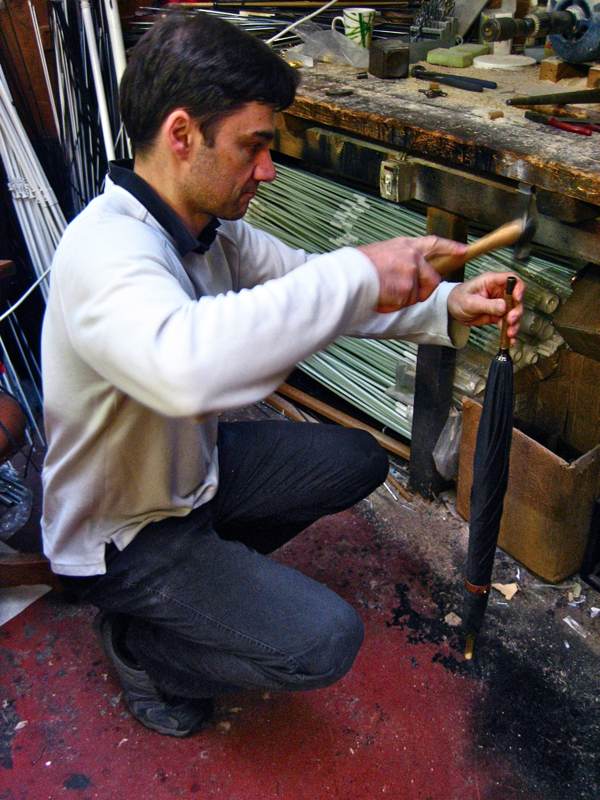
Fitting the ferrule.
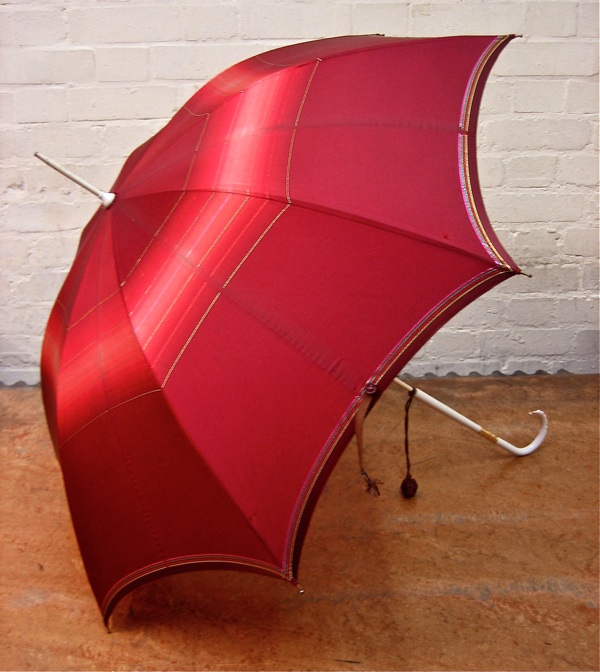
1950s art silk umbrella by James Ince & Sons Ltd.
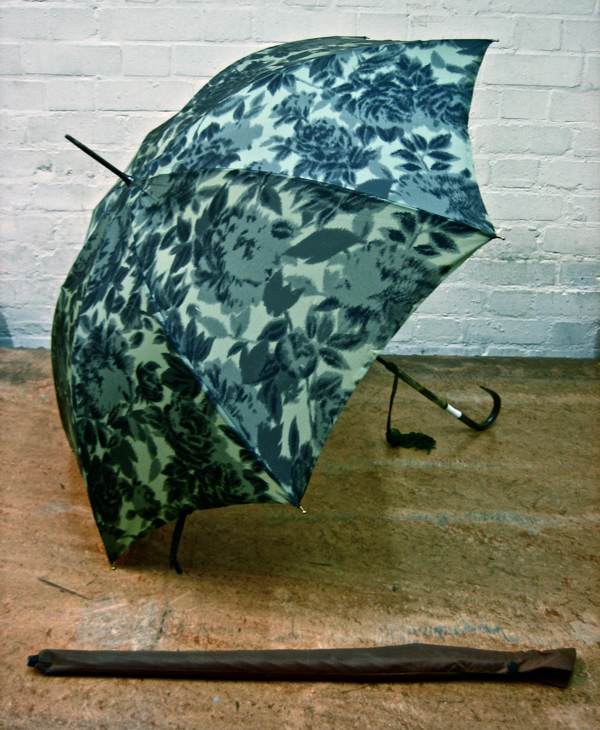
1950s umbrella with cover by James Ince & Sons Ltd.
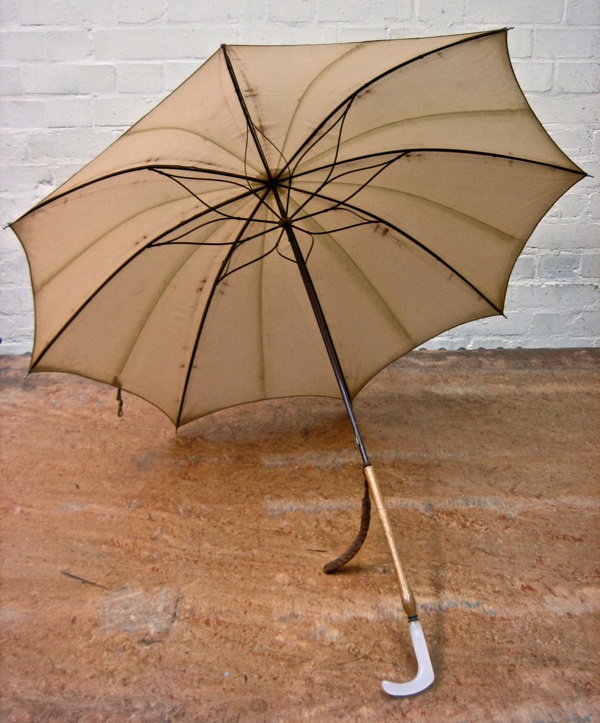
An unusually structured decorative frame from the early twentieth century.
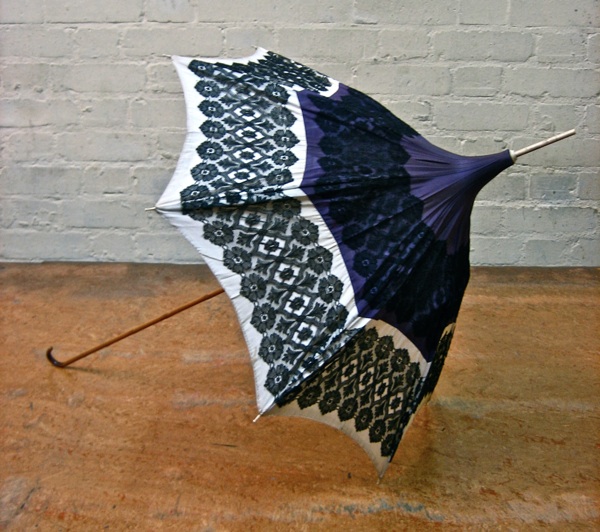
Silk parasol from the 1880s.
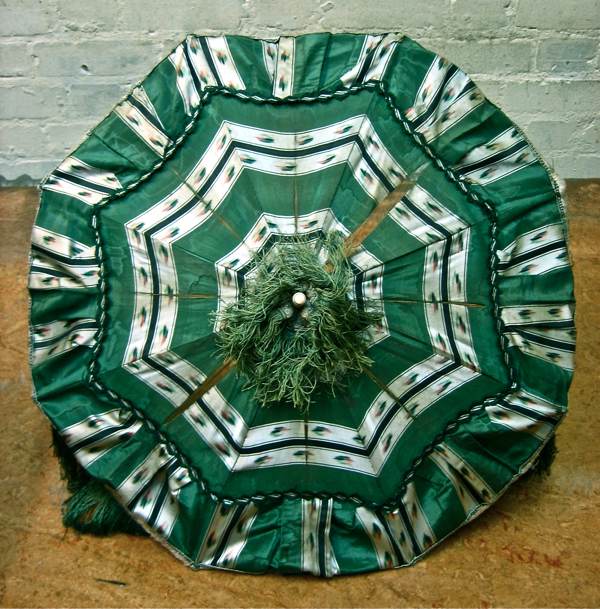
Silk parasol from the 1850s.

Carriage umbrella from 1830s.
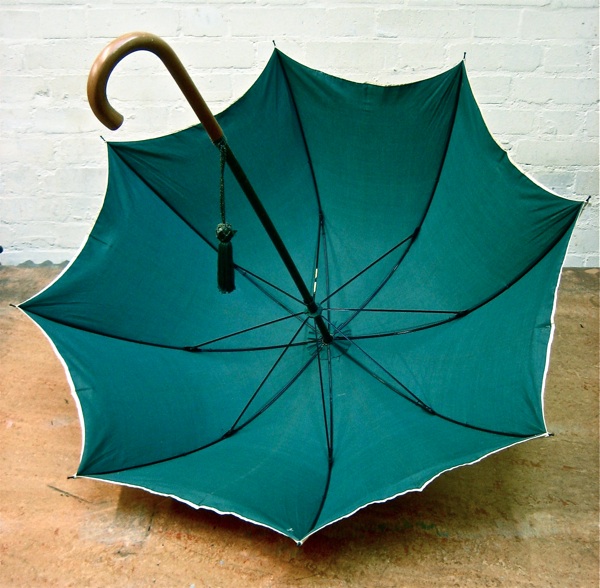
Colonial umbrella from 1930s.

Nineteenth century silk umbrellas with frames made of whalebone.
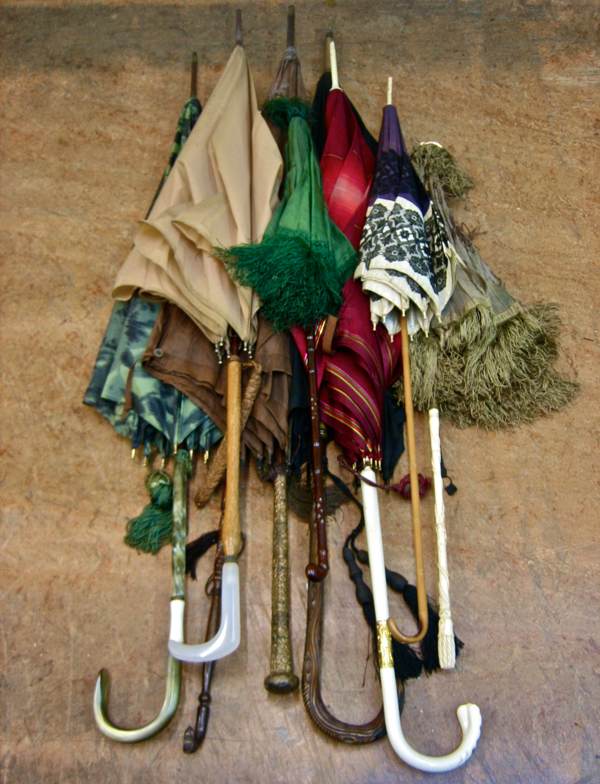
From Richard Ince’s personal collection.

Albert the Umbrella, designed by Ally Capellino manufactured by James Ince & Sons.
Albert the Umbrella is available in either brown or grey, and for sale exclusively at Ally Capellino’s shops in Calvert Avenue and Golborne Rd.
You may also like to read about
Steve Dobkin, Bacon St Salvage

“People see a big guy, six foot tall with a bit of a growl on his face – but they don’t realise that when you get to know me, I really am a pleasant person.” confessed scrap dealer Steve Dobkin yesterday, as we sought refuge together in the warmth of the makeshift cubicle that serves as his office, squeezed between the piles of second-hand kitchen equipment which are the source of his livelihood. Yet such an apology was entirely unnecessary because Steve has a reputation as the gentle giant on Bacon St.
Operating from an eighty foot shed at the Western extremity of the street, Steve always has an intriguing array of steel furniture standing on the pavement and if you enter his premises you find yourself surrounded by towers of it, receding into the gloom and piled up to the ceiling. Outside, on the wall facing the car park, is a magnificent ever-changing gallery of street art of which Steve is the patron. “I don’t understand it, but when they ask, I say ‘Do what you want.'” he admitted to me with a shy smile.
Last Winter, the cold became too much for Steve, standing around in the tin shed all day in all weathers, so he build a wooden shack to keep himself warm. “I always thought, ‘Don’t have an office, you can put catering equipment there,’ but you’ve got to take care of yourself because none of us is getting any younger.” Steve confided, as the dusk gathered and the temperatures fell outside.
“My dad Sam Dobkin used to sell furniture down here in Brick Lane in the seventies, you could sell any furniture then as long as it was cheap. He was a scrap dealer always looking for an outlet. The first time I came down here was when I was around six years old, in 1972. I worked for him at weekends and holidays. I began selling off the back of a truck but I knew that – rather than selling it all for scrap – you could get more money if you had somewhere to keep it and resell it.
Nowadays, our stuff is all cleaned up and guaranteed, but in those days what you saw was what you got – just stuff straight out of a skip. It’s a form of progress, I work with electricians, gas fitters and water fitters to get everything repaired. People are buying more this way because it’s cheaper and they can see it working here. People like that extra bit of service. I try to give the customer what they want, if we can modify it by cutting equipment down to size, we will. You can spend fifty grand fitting out a kitchen or you can do it here for five. If you are opening up a restaurant, you want to do it as cheap as you can and get better stuff later when it takes off.
I love my job. I love being here. I like getting up in the morning and coming here. When someone pulls up outside and you jump into the truck to take a look and make deal, that’s a buzz. I’m always thinking – Who’s calling up? – What am I going to be getting? – What am I going to be selling it for? Sometimes, they ring you up to sell a lot of flooring but when you get there you’re buying a lot of catering equipment – that’s a real buzz. That’s the kind of excitement you get.
Things have been much better since the recession. Whereas before kitchens were too busy, now they’ve got time to look around and think about replacing stuff. I’ve already sent out two loads of sold equipment this morning and I was serving three customers at the same time, measuring stuff up and answering questions – it gave me a headache. I’m like my dad in that I could sell snow to the Eskimos.
You’ve got communities that come in here, they’ve got different ways to speak and you have to learn it. English people, they don’t bid for it, but Chinese and Turkish people they like to make a bid, whereas Indians will grind you into the ground if you let them. It’s different cultures, you stand your ground and be patient. No one community spends more money than another. And I’ve got to be friends with Indian people, they bring me curries. I never had so many curries since I came here. I never even had curry before I came here! You work with the people that turn up, you can’t start shouting and screaming or you’ll never make any money. I always try to find the best in everyone.
I had my first premises in 1990 in Grimsby St in one of the railway arches, next a place on Cheshire St and then one on the far side of Bacon St before I came here in 1999. I don’t know where the time has gone, but it’s been very good.
As soon as I get the right amount of money, I’ll be off – except I don’t know what the right amount of money is! You want to sell up and you think about what you’d do with the money, but then you think of all the things you’d miss. I’d miss getting up the morning and coming down here. I’m not interested in being rich, just happy with my little shop trickling along nice and easy. I have no website, no advertising and when I leave work, I switch my phone off. I don’t even like it when I get too many customers here. One day I’ll be the manager, the next day I’ll be out cleaning the cooker. I’ve got two people that work with me but I’m no better than anyone. My son Perry and daughter Louise work here with me too, but I wouldn’t take it on if I was them. They haven’t done it since six years old like I have, they don’t know the same love for it that I have.
I’ve come to like people more because of this job. I’ve no grudge against anyone. When I first came down here, it was hard – but as the years have gone by I have realised it is not personal. I’m trying to sell at the best price and they’re trying to get it as cheap as they can. All around this area, it’s a great place to work. The first three months you’re a newcomer – but after that, if your stall breaks everyone will come to help you. If you think you’re going to make fortune you won’t, instead you’ll discover a great sense of community.”


Photographs copyright © Jeremy Freedman
You may also like to read these other Bacon St stories
Marc Gooderham, Painter
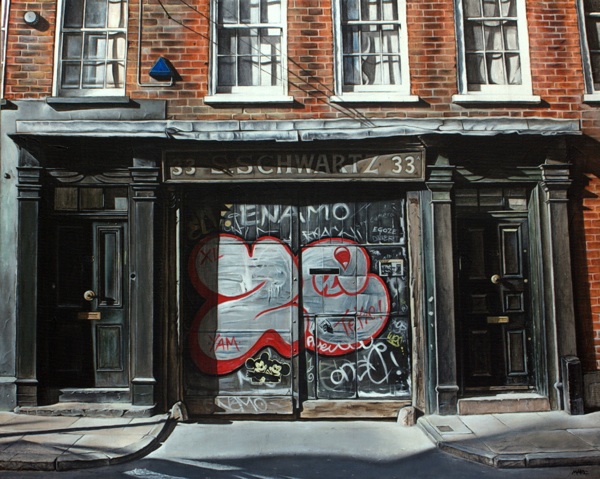
Later Afternoon, Fournier St, Spitalfields
There are so many art galleries in my neck of the woods that I have adopted the Jean-Luc Godard approach to visiting them. In other words, I take it at a run just as Anna Karina, Sami Rey and Claude Brasseur sprinted through the Louvre in “Band à Part.” Yet very occasionally – as I am nipping in and out of every gallery in Redchurch St on the first Thursday of the month – something will stop me in my tracks and cause me to linger. Such was the case when I first came upon the visionary paintings of Marc Gooderham.
Here was the world – the very streets – that I knew, but subtly transformed as if by memory or dream. Marc chooses places that exist in the periphery of vision and recreates them in his mind’s eye, revealing the otherness of the familiar with understated surrealism.
It was this shock of recognition that first halted me in front of his pictures, pausing to establish the locations and then becoming seduced by the brooding melancholy of these deserted streets, absent of pedestrians yet haunted by the presence of all those who have come through. With some of these places, I thought only I had spotted their unlikely appeal – because, like Marc, I am drawn to the shabby poetry of these disreputable and neglected corners, sites that characterise the distinctive identity of London more truthfully than the homogeneous sheen of all the gleaming corporate palaces.
“This project started from exploring the city and wandering the streets, so I know it will be an endless undertaking because there’s always something new to discover around every corner,” Marc admitted to me with a helpless smile, as we trudged the empty streets around Petticoat Lane one morning recently. “What makes this such a fascinating place is the proximity of the City of London to these old terraces – and the contrast of the street art makes it even more interesting.” he continued, raising his eyes to the boarded up, tumbledown buildings. “I try to avoid catching the bus,” he confessed as we crossed Commercial St, “so I get the chance to walk and discover the next site for a painting. Once I find the site, I take lots of photographs and make sketches, looking for the best time of day.”
Starting with a pencil sketch to establish the perspective, Marc builds up his paintings in washes of acrylic upon canvas. At first he paints the sky, then the architecture and finally the accretions upon the surface of the buildings. He calls these, the three key elements to a painting – elements that combine in a moment circumscribed by the fleeting light. It is a moment set against the age of the buildings and the ephemeral street art which can change overnight.
When Marc and I visited some of his locations, I was fascinated to discover he had rearranged them in his pictures, removing lampposts and reconfiguring the proportions to create his desired effect. Just as these sites do not draw attention to themselves, Marc’s paintings are quiet works that withhold their painterly and conceptual sophistication behind a superficial veil of heightened realism.
A softly-spoken man with gentle intense eyes, Marc works three days of every week at a job to pay the bills and spends the rest of his time devoted to his paintings which each take six weeks from conception to completion. For the last two years, Marc has been working on this epic series of paintings of lonely corners, assembling a set that he plans eventually to show as a gazetteer of his personal vision of London. Or, as Marc put it plainly, “Two years ago, I devoted my life to painting.”
Inspired by L.S. Lowry and Edward Hopper, Marc Gooderham’s cityscapes beneath a Northern sky possess a soulfulness and mystery that hint at undisclosed life behind those doors and windows. They are well-worn settings for the enigmatic human drama of the city, comprising more stories than you can ever know.
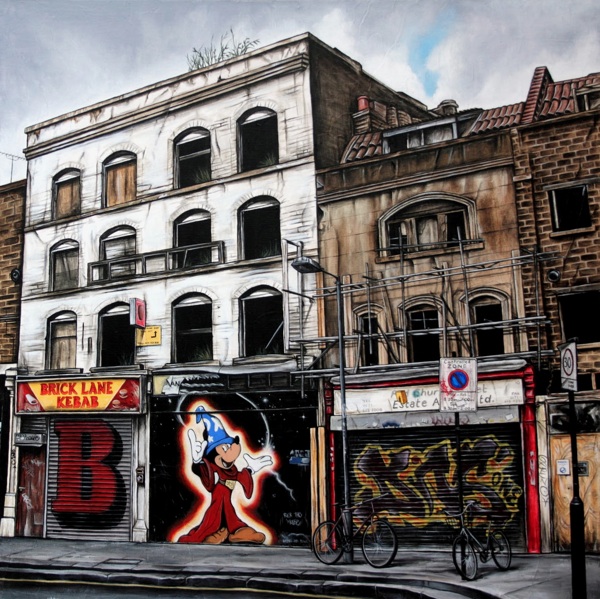
Together Again, Redchurch St.
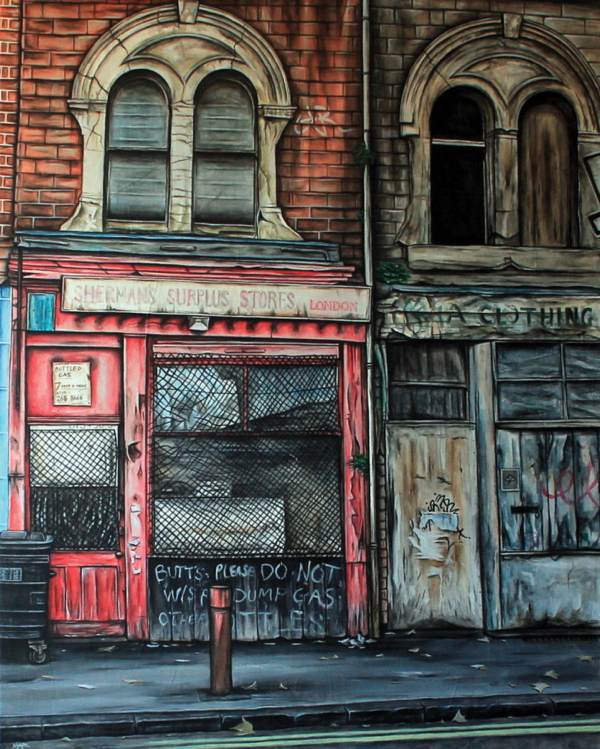
Vallance Rd, Whitechapel
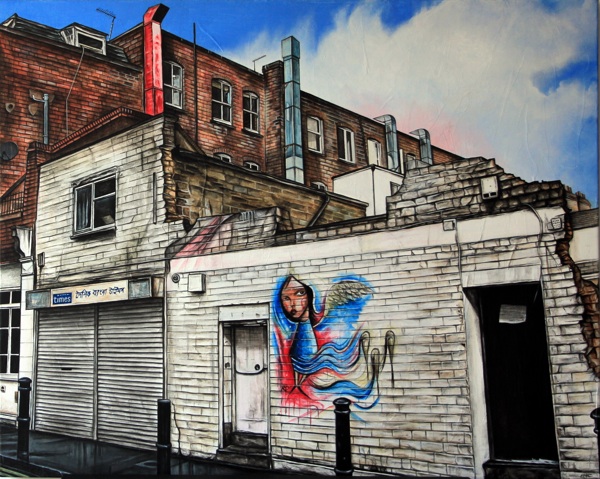
Fallen, Hanbury St.
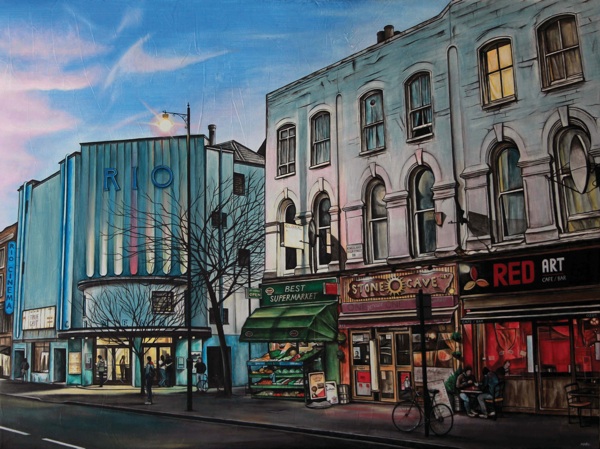
Rio Cinema, Dalston.
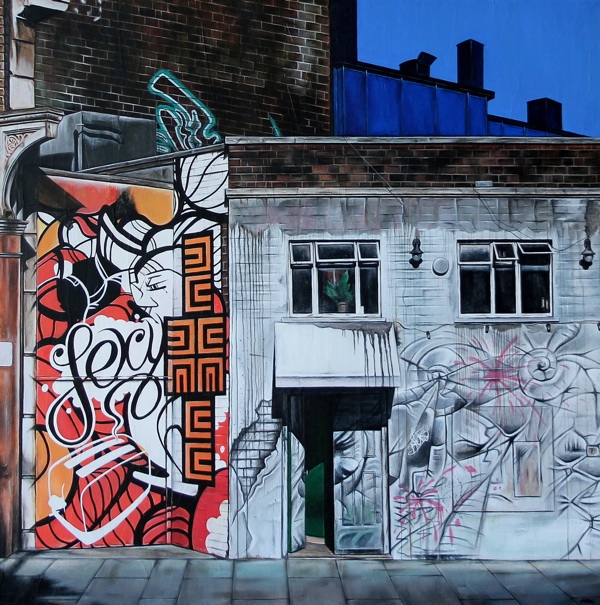
The Tyger, Great Eastern St.
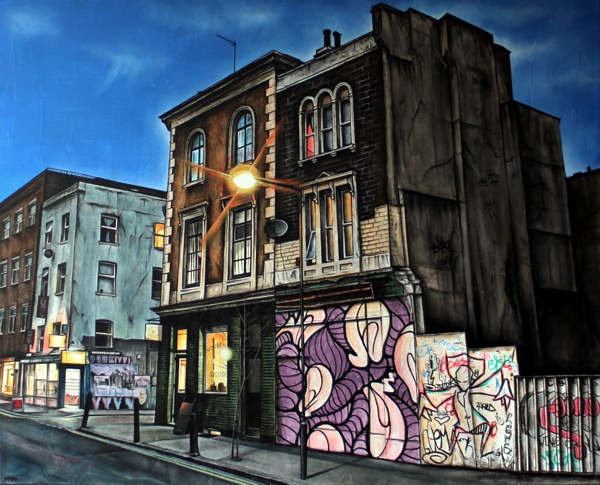
Corner of The Street, Redchurch St.

The Lonely Stretch, Coronet St.
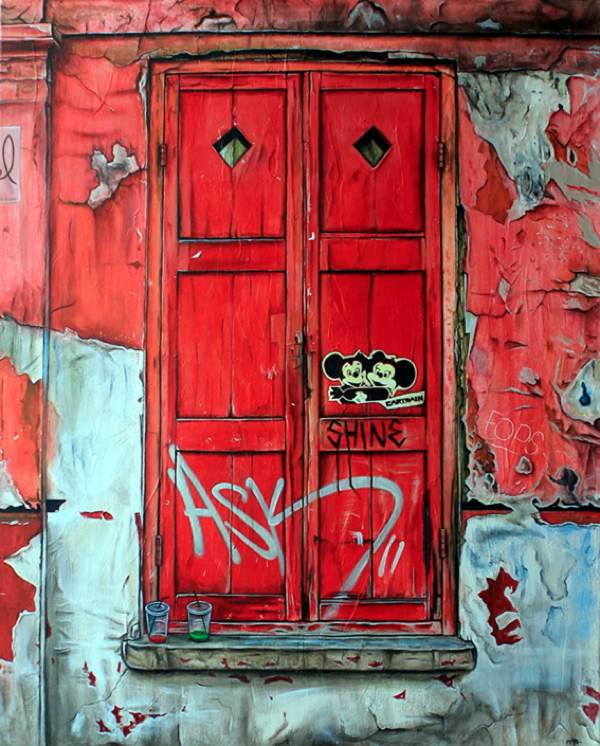
Back To The Old House, Princelet St.
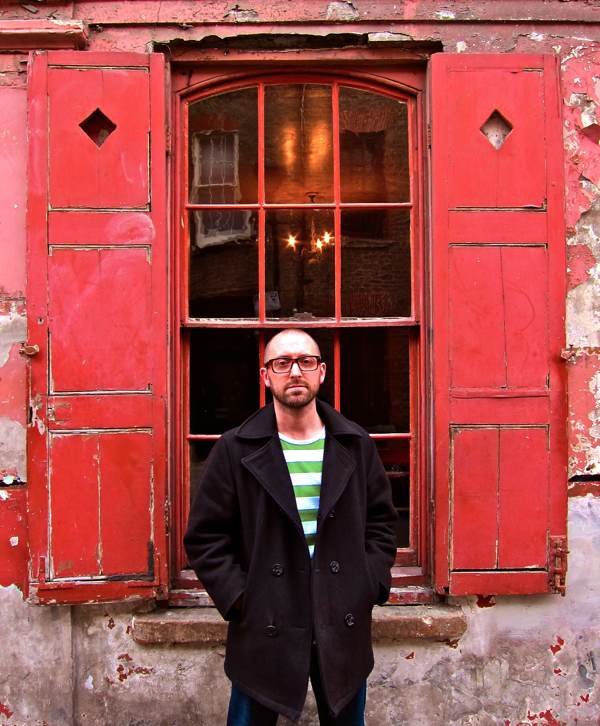
Marc Gooderham
Paintings copyright © Marc Gooderham
John Thomas Smith’s Vagabondiana II

Already – I am reliably informed – the police are clearing homeless people from the Whitechapel Rd in advance of 2012 when this route will be transformed into the Olympic Mile. Meanwhile, the imminent opening of a new shopping centre made of sea containers, selling lifestyle brands to young professionals at the junction of Bethnal Green Rd and Norton Folgate, presages a rough time for the fly-pitchers who gather at this spot each Sunday morning to trade a few possessions on the pavement in the hope of earning a little spare cash.
When John Thomas Smith published his Vagabondiana in 1815, he included “remarkable beggars and itinerant traders and others persons of notoriety” and even two centuries later it appears that all manner of street people are treated with equal contempt. Yet there is an irony to Smith’s title because, in his unsentimental portraits, the street hawkers retain their self possession and dignity, revealed as resourceful individuals striving with brave tenacity to forge a modest living.
It was a year ago I first discovered John Thomas Smith’s etchings of vagabonds in the Bishopsgate Archive and yesterday I was excited to come across a further collection from which I publish these examples. Revisiting Smith’s work, I like it even more for the sharp eye and humane sensibility employed to such magnificent effect in these finely drawn images.
Living in Spitalfields, I am constantly aware of the drama of the street traders, arriving early to set up their wares, standing all day in the cold and wearily packing away their heavy goods when everyone else has gone home. Daily, this arduous ritual continues, yet these same traders are tireless in maintaining the buoyant good spirits that are essential in market life. Even so, they are not guaranteed of an income, their livelihoods are at the mercy of the weather, the whims of the passing crowd, or – in the case of the Bethnal Green Rd fly-pitchers – the loutish market inspectors moving them on.
If there is no job and you have no money, then selling things on the street can be a way to survive and achieve self -respect too, asserting your identity as a participant in the drama of urban life. This is why I find these drawings by John Thomas Smith so touching – because he witnesses the quiet heroism of the outcast poor who recreated themselves as street sellers. Equally, it fills me with regret to see their contemporary counterparts treated so poorly. Because this lamentable state of affairs – in which the most vulnerable are exposed to the most harassment – suggests that we have not progressed very far in two hundred years.


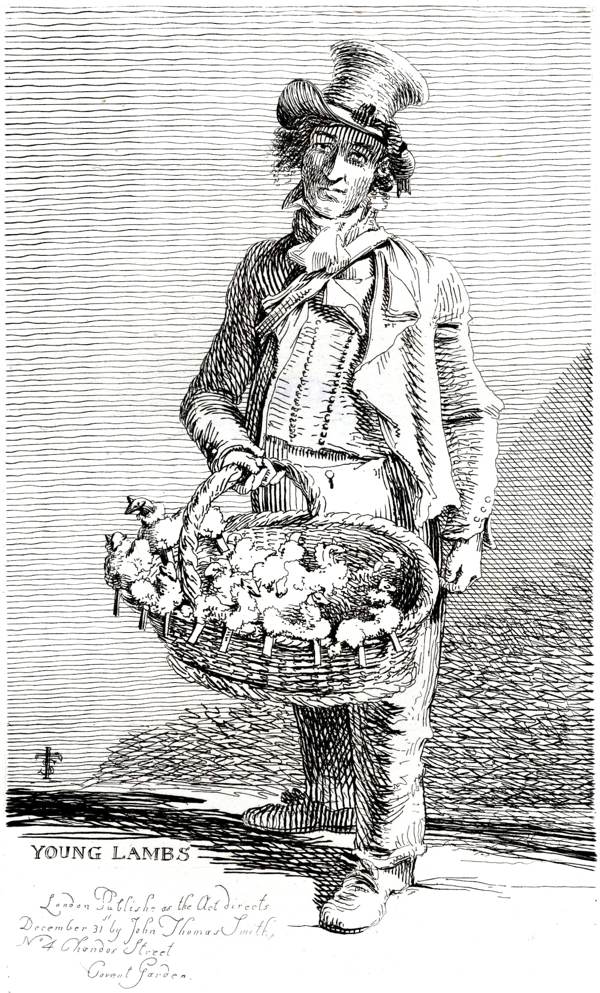
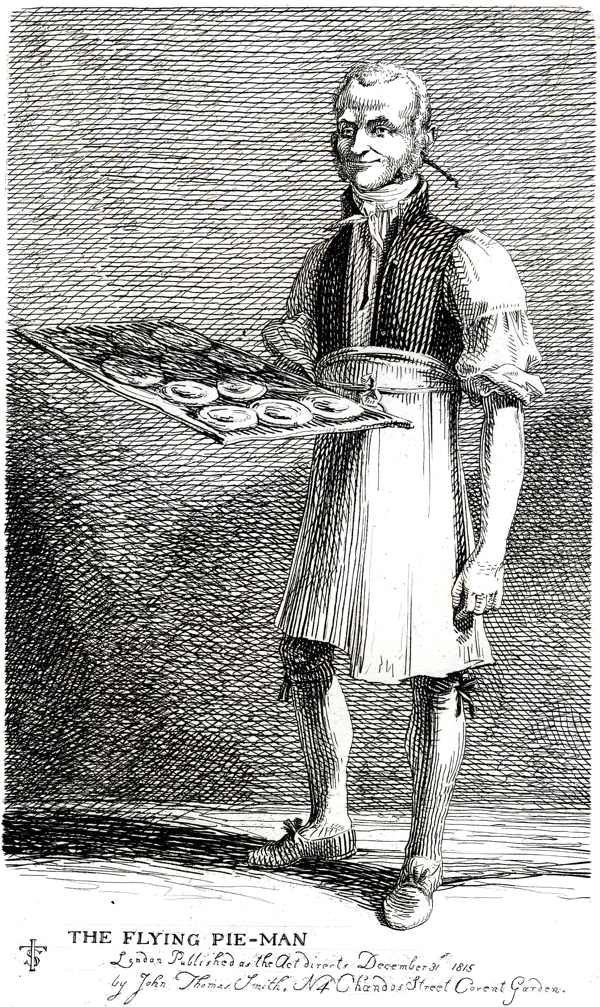


Images from Bishopsgate Institute
You may like to see the original post
John Thomas Smith’s Vagabondiana of 1817
and read about
The Fly-Pitchers of Spitalfields












