
At Gardners Market Sundriesmen

Paul Gardner
When people ask me about this place, I can only respond by declaring,“You cannot really say you have been to Spitalfields unless you have shook the hand of Paul Gardner, the fourth generation paper bag seller,” because Gardners Market Sundriesmen in Commercial St is the centre of our particular universe here in this corner of the East End. Established in 1870 by Paul’s great-grandfather James, this remarkable family business – the oldest here – has come to incarnate the very essence of the Spitalfields.
Other shops only sell paper bags in bulk, but Paul Gardner will sell you as few as you please – and the entire nature of his business is based upon this subtle premise, which means it has become the essential destination for the smallest traders. Stallholders, shopkeepers, designers and makers – Paul welcomes them all at his shop and many have been coming back for decades, making the regular pilgrimage and enjoying the unhurried chit-chat with Paul that has been a rare constant through volatile times. “Someone came round the other day, I hadn’t seen them in fifteen years,” Paul told me with a smile of amazement, “‘What, are you still here?’ they asked.” Yet the beauty and the wonder of it is that Gardners Market Sundriesmen is still here, to remind us what Spitalfields is all about.
“Most of my customers have been coming here a long time, so I can always find something to talk about,” Paul confided to me as we sat in the shop chatting – one morning before seven recently – while the traffic roared up and down Commercial St in the rainy darkness outside, “That’s what I say to my wife, ‘At least I enjoy going to work, I don’t have to work for someone I don’t like.'” It was coming up to the last weekend before Christmas and Paul needed to reassure himself because trade had been slow. “I must admit, it has been quiet all week,” he said, leaning over the counter with his chin propped upon his fist in contemplation, gazing towards to the door and willing customers to walk through it. “It’s a bit grim when you’re waiting like a lemon.”
If I had not been there keeping him company, sitting beside him on a vast stack of paper bags with “Fish & Chips” printed on them, Paul would have been writing in his diary, kept since the age of thirteen – making entries like, “Had a slightly better day moneywise – steamroller outside – glad to get away on time,” or “Not that busy, but I still didn’t have time to put things out.” Otherwise, Paul passes the peaceful hours by counting luggage tags and plastic bags, securing them in bundles of fifty with elastic bands. “I remember coming into the shop when I was child and smelling the paper bags,” he reminisced affectionately, as he counted, “I sat on a pile of bags and the customers gave me sixpence. My father took me to get one my first haircuts in Hanbury St and my mother cried when she saw it. One day, I had six sausage rolls – the good old days!”
Prompted by this last thought, Paul sent me across the road to get two cups of tea. It was daylight now and the procession of stony-faced office-workers had begun. When I got back, Paul was happily serving one of his long-term customers. “She’s a very pleasant lady but her cheques invariably bounce,” he revealed to me in a whisper after she left, with a smile as he put the cheque in the cash register, as if this aspect of her personality were an endearing quality. Yet – as soon as she had gone – another customer arrived, it was a fishmonger on his way to set up in Chapel Market in the rain. He threw cash onto the counter with a sample bag, declaring enigmatically, “I need them like this only different,” and dashing back to his van before the traffic warden arrived. “They expect you to be like Mystic Meg and read their minds,” Paul quipped – pulling a comic grimace as he sought the required bags – since he always remembers his customer’s previous orders.
Old market traders and young hipster designers, Nigerian jewellery sellers and Bengali garment makers, they all came wanting bags. “We’re doing a week’s trade in a day, but we have Mount Everest still to climb and we’re just at the Base Camp.” declared Trevor from Liverpool St Chicken, exercising seasonal hyperbole, as he put in his order for thousands of bags. In spite of their impatience, the traders waited quietly – a reflection of the universal esteem that Paul enjoys. Meanwhile, some complained that business was down and others bragged that it was up. Unflustered, Paul ran back and forth between the counter and the stockroom, answering the phone (“Bishopsgate 5119 Gardners”), expertly totting up the totals and the VAT with super-quick mental arithmetic, stamping receipts, giving change and sending the bags flying out the door. Then, in the middle of it all, the delivery of bags that Paul had been expecting arrived, but as soon as they were stacked on the pavement in Commercial St – before they even made it into the shop – customers began carrying them off – “I’m taking four packs of the brown paper bags, Paul,” I heard one call.
Here at the boundary of the City, this has always been the place of markets and the preserve of small businesses. Both kinds of endeavour rely upon Paul who, as custodian of the most venerable family business, carries much of the history and culture of this place. Everyone has reason to come to Gardners. Even the Rector of Christ Church buys luggage labels to write prayers upon and local residents get their Christmas wrappings from Paul. Gardners Market Sundriesmen is both the focus of the community in Spitalfields and the manifestation of what makes this neighbourhood distinctive. So, as long as we have Gardeners Market Sundriesmen, we can know that the identity of the place is alive.
“Oh blimey, I didn’t think I was going to get busy at all, but then about nine thirty it just went mental,” exclaimed Paul, mopping the perspiration from his brow and sweeping his wavy grey hair to one side, “I didn’t even realise what time it was until it was one o’clock.” He looked a little startled, until the inevitable realisation came upon him and he broke into a wide smile. “It must be Christmas!” he announced in a cheer, spreading his arms with delight. Before I departed, I helped Paul carry the remaining stacks of brown paper bags from the pavement into the shop.“Thanks for coming in, I think you brought me some good luck,” he said, as we shook hands and made our farewells.

The view from behind the counter.


“One day, I had six sausage rolls – the good old days!”

“Bishopsgate 5119 Gardners”

“I didn’t even realise what time it was until it was one o’clock”


Gardners Market Sundriesmen, 149 Commercial St, London E1 6BJ (6:30am – 2:30pm, Monday to Friday)
You may also like to read about
Chapter 4. New Sanguinary Atrocities

Late on the night of 19th December 1811, events were to take an even more remarkable turn. Mr Anderson, the Parish Constable, who lived in New Gravel Lane opposite the King’s Arms in Shadwell, decided to cross the road after closing time to get a top-up for his pint-pot from his good friend Mr Williamson, the landlord. As he opened his front door, he saw a nearly-naked man suspended in mid-air by sheets knotted together from a garret window of the pub opposite screaming, “Murder! Murder!” Mr Anderson grabbed his sword and staff from his house and emerged again just as John Turner, the lodger, dropped the last eight feet into the arms of the watchman Shadrick Newhall.
Mr Anderson prised open the pavement flap that led to the cellar of the King’s Arms. Inside, on the cellar steps, the landlord’s dead body was visible in the darkness, lying upside down with its legs splayed in the direction of the bar room above. An iron bar smothered in blood lay alongside the corpse, Mr Williamson’s throat was cut to the bone, his head was beaten in and his right leg fractured. He had put up a courageous fight, revealed by the hand dreadfully hacked up as if in his last moments he had clutched at the knife that finished him off. One thumb dangled loosely in the blood trickling down the staircase.
As Mr Andersen stood transfixed at his discovery, a cry came from the crowd gathering in the street, “Where’s the old man?” Startled from his reverie, Andersen made his way up the stairs, stepping carefully over the body. On the ground floor, he found the corpses of Mrs Williamson and the servant girl, Bridget Harrington, both slaughtered with equal cruelty. In the darkness of the first floor bedroom, he came upon the Williamson’s grandchild, Kitty Stillwell, lying in her bed asleep and unharmed. Overcome with powerful mixed emotions, he carried the sleepy little girl from the house into the street.
As John Turner recovered himself, he explained that he had seen a tall man in a long Flushing coat standing over the body of Mrs Williamson, corresponding to a description of a man seen outside the King’s Arms that night. A window at the back which had been used for escape was left open with bloodstains on the sill. It was discovered that Mr Williamson’s watch was missing.
That night, the wardens of St Paul’s Shadwell gathered in the vestry in incredulous horror, realising that they were caught up in events so chillingly macabre as to be entirely beyond control of any mortal. No-one could say how many more murders were yet to come or predict where these disquieting events might lead. They did all they could, which was to issue a reward of one hundred guineas.
Earlier that day, a critical discovery had been made concerning the maul which had been used in the slaying of Timothy Marr and his family. Although a handbill had been published requesting information as to the origin of the maul, it was only now that the blood and hair were removed from the maul to reveal the owner’s intials I.P.
As the feast of Christmas came closer and innocent children lay sleepless in their beds listening for the tinkle of St Nicholas’ sleigh bells, all across London their parents lay awake in terror craning for any sound that might presage the imminent invasion of unknown intruders with violent murderous intent.
Below you can see the site of the King’s Arms today. The building was swept away with the expansion of the London docks in the nineteenth century, now these walls that weave through Wapping are mere remnants of the docks that survived the bombing of World War II to be closed down in the late twentieth century, and behind this wall is a housing estate of recent date.
Reports will be posted as there is further news of these escalating occurrences.


Click on Paul Bommer’s map of the Ratcliffe Highway Murders to explore further
The Maul & The Pear Tree – P.D. James’ breathtaking account of the Ratcliffe Highway Murders, inspired me to walk from Spitalfields down to Wapping to seek out the locations of these momentous events. Commemorating the bicentenary of the murders this Christmas, I am delighted to collaborate with Faber & Faber, reporting over coming weeks on these crimes on the exact anniversaries of their occurrence.
The Map of the Ratcliffe Highway Murders – In collaboration with Faber & Faber, Spitalfields Life has commissioned a map from Paul Bommer which will update throughout December as the events occur. Once you have clicked to enlarge it, you can download it as a screensaver or print it out as a guide to set out through the streets of Wapping.
Ratcliffe Highway Murder Walk – Spitalfields Life will be hosting a dusk walk on Wednesday 28th December at 3pm from St Georges in the East, visiting the crime scenes and telling the bone-chilling story of Britain’s first murder sensation. The walk will take approximately an hour and a half, and conclude at the historic riverside pub The Prospect of Whitby. Booking is essential and numbers are limited, so please email spitalfieldslife@gmail.com to sign up. Tickets are £10.
Thanks to the Bishopsgate Institute and Tower Hamlets Local History Archive for their assistance with my research.
You may like to read the earlier installments of this serial which runs throughout December
19th December, Marley’s Ghost

Much of what we now think of as Christmas comes from the writings of Charles Dickens and in particular “A Christmas Carol,” his famous ghost story of 1843 which opens –
Marley was dead to begin with. There is no doubt whatever about that. The register of his burial was signed by the clergyman, the clerk, the undertaker, and the chief mourner. Scrooge signed it. And Scrooge’s name was good upon ‘Change, for anything he chose to put his hand to. Old Marley was as dead as a door-nail.
Mind! I don’t mean to say that I know, of my own knowledge, what there is particularly dead about a door-nail. I might have been inclined, myself, to regard a coffin-nail as the deadest piece of ironmongery in the trade. But the wisdom of our ancestors is in the simile and my unhallowed hands shall not disturb it, or the Country’s done for. You will therefore permit me to repeat, emphatically, that Marley was as dead as a door-nail.
Ebenezer Scrooge is a miserable old man who works in his counting house with his clerk, Bob Cratchit, who writes out records of accounts while Scrooge oversees the business.
On Christmas Eve, Scrooge receives several visitors. First, his nephew who invites Scrooge to dine with him for Christmas. Next come two gentlemen, collecting for charity, and we discover from them that Scrooge’s partner, Jacob Marley, died on Christmas Eve seven years previously. Yet Scrooge refuses to give them anything, declaring he helps the poor already through supporting prisons and workhouses. Closing up the office, Scrooge permits Bob a holiday on Christmas Day, but insists he come back to work early next morning – Boxing Day was not usually a holiday in the nineteenth century, but the day when tradesmen collected their Christmas “boxes” – tips from their customers.
That evening, at his lodging Scrooge is visited by the ghost of Jacob Marley weighed down by massive chains made up of cashboxes, keys and padlocks. The ghost says that anyone who does not mix with others in life must travel amongst them after death and tells Scrooge that he too wears a chain, even larger, and warns of three spirits which will visit that night…
Illustration copyright © Paul Bommer
18th December, Christmas Crackers
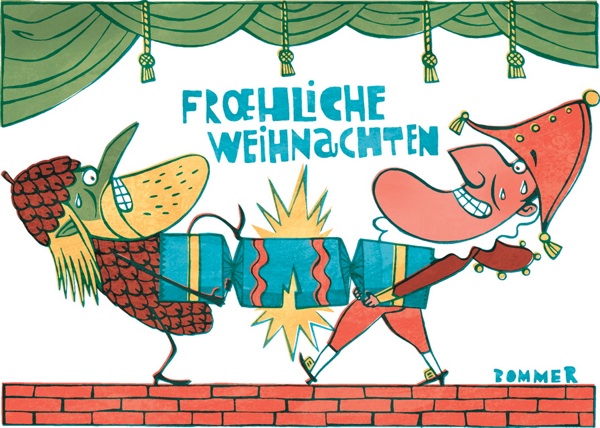
Crackers or bon-bons are an integral part of Christmas celebrations. A cracker consists of a cardboard tube wrapped in a brightly decorated twist of paper, contriving a resemblance to an over-sized sweet-wrapper. The cracker is pulled by two people and it splits unevenly – much in the manner of a wishbone – accompanied by a small bang, created by friction upon a chemically impregnated card strip (similar to that used in a cap gun).
In Russia (where they are called “хлопушка”) and in some countries of the former Soviet Union, crackers are a part of New Year celebrations – however these are closer to pyrotechnical devices, normally used outdoors and, activated by one person, produce a bigger bang accompanied by fire and smoke.
In one version of the tradition, the person with the larger portion of cracker keeps the contents, while in another, each will have their own cracker and will keep its contents regardless of who got the larger part. Typically, these contents are a coloured paper hat or crown (a hang-over from Saturnalia perhaps?), a small toy or other trinket and a motto, a joke or piece of trivia on a small strip of paper. Ready-made crackers are sold in boxes, typically with different designs in red, green and gold, but making crackers from scratch using the tubes from used toilet rolls and tissue paper is a popular activity for children, and kits can also be purchased.
Crackers were invented by Thomas J. Smith of London in 1847 – as a development of his bon-bon sweets, which he sold in a twist of paper (the origins of the traditional sweet-wrapper). As sales of bon-bons slumped, Smith came up with promotional ideas. His first notion was to insert mottoes into the wrappers of the sweets (cf. fortune cookies) but this had only limited success. He was inspired to add the “crackle” element when he heard the crackle of a log upon the fire. Consequently, the size of the wrapper had to be increased to incorporate the banger and the sweet itself was dropped to be replaced by a small gift. This new product was initially marketed as the Cosaque (i.e. Cossack) but the onomatopoeic “cracker” soon superseded it as rival varieties were introduced to the market. The other elements of the modern cracker – gifts, paper hats and varied designs – were all introduced by Tom Smith’s son, Walter Smith, to differentiate his product from the copycat manufacturers which sprang up.
The image I have drawn is based on a late Victorian greetings card that I stumbled upon on Facebook, showing a pine-cone sprit and Mr Punch pulling a cracker, with the legend “Merry Christmas” that I have replaced that with German, which I think has a charm all of its own – plus, to my Englische ears, it sounds funny!
Illustration copyright © Paul Bommer
Columbia Road Market 74
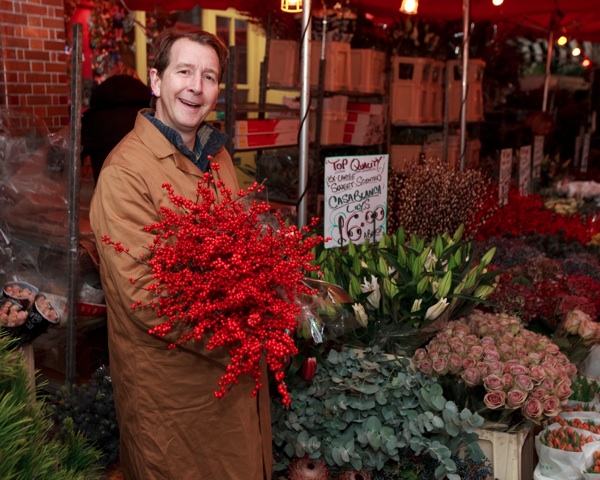
Carl Grover
The forest has come to Columbia Rd. Even before you arrive you can smell pine, drifting upon the breeze, and once you step onto the cobbles, there are needles underfoot. At either end of this narrow thoroughfare, a forest has grown overnight, filling the street with luxuriant green undergrowth and bringing the atmosphere of mystery and romance to the market which makes this Sunday before Christmas unique. You wonder – as you walk between the crowded, glistening trees – if you might emerge into a magical landscape, yet – even as this reverie takes you – sonorous voices are heard. “Is this the call of the woodland folk?” you ask.
In fact, it is the magnificent resounding tone of Denise Burridge, the diva blessed with the fullest voice amongst the hardy chorus of traders that compose the clamorous symphony of Columbia Rd Market. This is where your expectations, hopes, wishes and dreams of plants and flowers can be fulfilled, and it is all going for a song.
At the Eastern end of the street, Christmas trees are sold by the Burridges, the family who have been more involved with the history of this market than any other for generations – while, selling trees at the Western end, you will find the Hartnetts who have claim to be the longest standing traders here, for over a century. Yet, at the Western extremity, also keep an eye out for the cheery face of Albert Dean, the fourth Albert Dean in succession in his family to be selling flowers from this pitch – which means that for more than a hundred years you could have here and bought flowers from an Albert Dean on this corner.
As you make your way amongst the throng down the centre of the street, sensations crowd upon you – losing sense of yourself in the horde, the stalls appear to float by like tableaux populated with the extravagantly good-humoured spirits of flowers and herbs, offering their beneficence. (Today, Spitalfields Life Contributing Photographer Jeremy Freedman has captured these familiar market characters in their wintry guises.)
Advent is a season of ritual and tradition, and the Sunday before Christmas is my favourite time to come to Columbia Rd in anticipation of carrying off a tree, a bough of mistletoe, branches of holly, cut flowers, house plants and pots of bulbs – because, as we reach Midwinter, it tempers my sadness at the tender loss of Summer to fill the house with greenery and assure myself that life sustains itself yet, out there in the silence of the greenwood.

Mick Grover
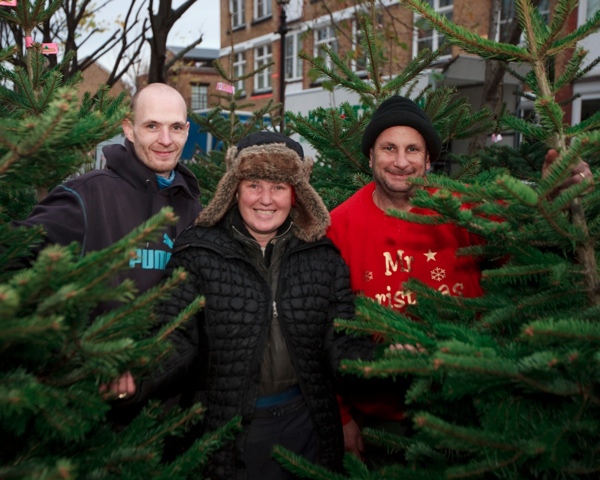
At A.E. Hartnett & Sons Ltd
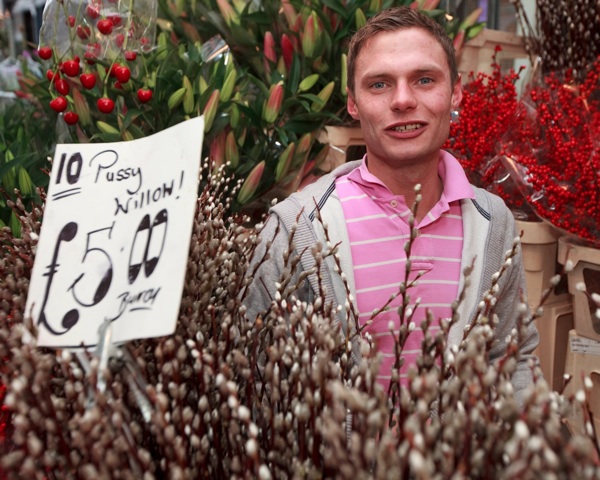
Albert Dean
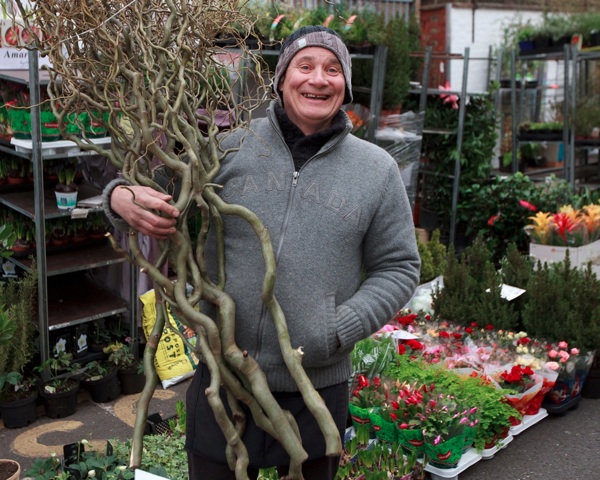
Billy Burridge

Dennis Madden
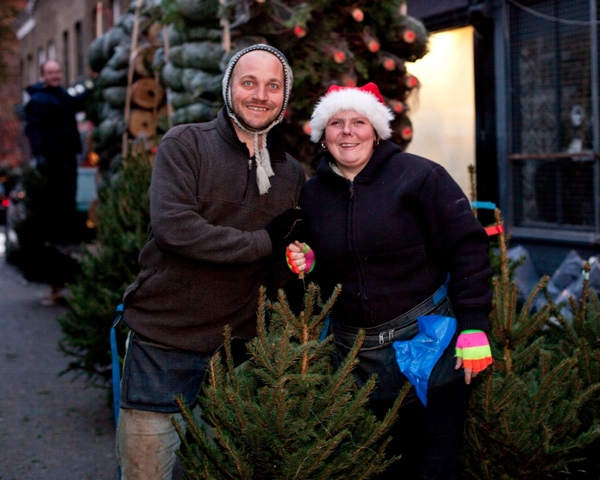
Denise Burridge and admirer

George Burridge and Luke
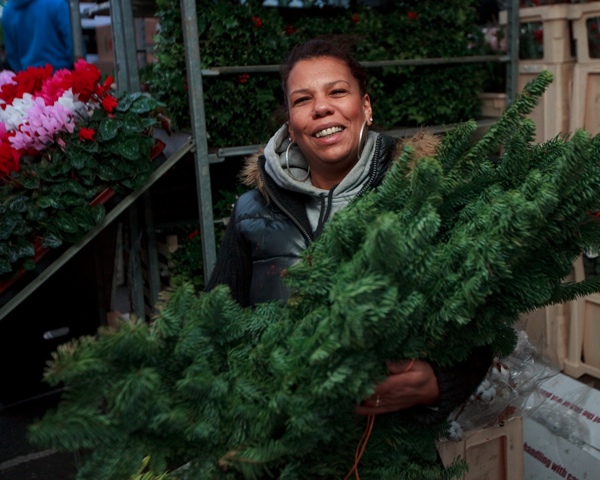
Lisa Burridge
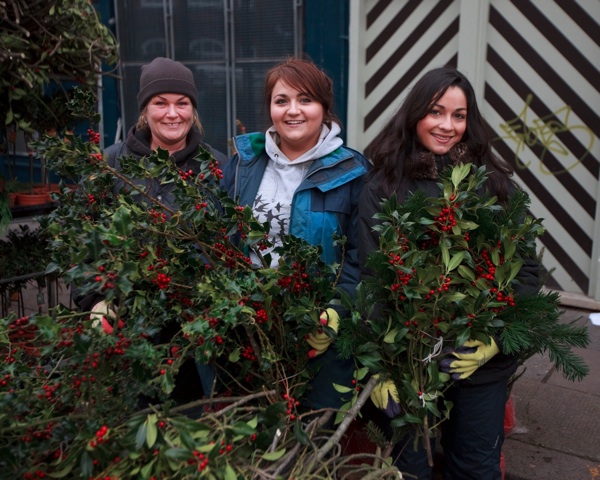
Sue, Frankie and Georgia Burridge
Photographs copyright © Jeremy Freedman
17th December, Saturnalia

Today marks the start of Saturnalia, an ancient Roman festival in honor of the god Saturnus. One of the most popular Roman festivals, it was marked by tomfoolery, mayhem, merriment and the reversal of social roles, in which slaves and masters switched places (much like the Lord of Misrule in medieval celebrations).
Saturnalia was introduced around 217 BCE to raise morale after a crushing military defeat at the hands of the Carthaginians. Originally celebrated for a day on December 17th, its popularity saw it grow until it became a week-long extravaganza, ending on the 23rd. Efforts to shorten the celebration were unsuccessful – Augustus tried to reduce it to three days and Caligula to five (Party poopers! How did they get the reputation of being hell-raisers?), but these attempts caused uproar and revolt among the Roman citizens.
Saturnalia involved the conventional sacrifices, a couch (lectisternium) set out in front of the temple of Saturnus and the untying of the ropes that bound the statue of Saturnus during the rest of the year. A Saturnalicius princeps was elected master of ceremonies for the proceedings and, besides the public rites, there were a series of holidays and customs celebrated privately – including a school holiday, the making and giving of small presents (saturnalia et sigillaricia) and a special market (sigillaria). And gambling was allowed for all, even slaves.
Saturnalia was a time to eat, drink and be merry. The toga was not worn, but rather colorful and informal ‘dinner clothes’ and the pileus (a freedman’s hat, close-fitting and brimless like a fez) was worn by everyone. Slaves were exempt from punishment and treated their masters with (a pretense of) disrespect, celebrating a banquet before, with, or served by the masters. Yet the reversal of the social order was mostly superficial – the banquet would often be prepared by the slaves and they would prepare their masters’ dinner as well. It was license within careful boundaries, reversing the social order without subverting it.
The customary greeting for the occasion is a “Io, Saturnalia!” — Io (pronounced “e-o”) being a Latin interjection related to “ho” (as in “Ho, praise to Saturn”).
Saturnus was the Roman god of agriculture and harvest whose reign was described as a Golden Age of abundance and peace by many authors. In medieval times, he was known as the Roman god of dance, agriculture, justice and strength, often portayed holding a sickle or scythe in one hand and a bundle of wheat in the other. Saturnus is sometimes identified with the Greek Cronus, the god of Time (hence chronological, chronic, &c.) who famously ate his children. Fear not, the children were later regurgitated intact through the intervention of their mother and went on to become the gods of Olympus! A gruesome tale, yet viewed metaphorically it can be seen as a simple moral – that Time eats everything in the end.
I have shown old Saturnus in his chariot pulled by winged serpents, wearing his purple robes and party pileus and brandishing his scythe. The roundels on his chariot depict the star signs Capricorn and Aquarius which he governs. Flying like this through the Winter sky, he puts me in mind of a classical Santa Claus – I did think about labelling his serpents Cometa and Vulpes (Comet & Vixen) or Saltor and Cupido (Dancer & Cupid) as a homage to “A Visit From St. Nick,” but I wasn’t sure my Latin was up to the task!
Saturday is sacred to Saturnus.
Io Saturnalia!
Illustration copyright © Paul Bommer
Chris Kelly’s Columbia School Portraits, 1996
It is my pleasure to publish Chris Kelly‘s portraits of an entire class at Columbia Primary School, Columbia Rd, Bethnal Green. Distinguished by extraordinary presence and insight, these tender pictures taken fifteen years ago are the outcome of a unique collaboration between the photographer and the schoolchildren. Chris has been taking photographs for education and health services, and voluntary organisations in the East End for almost twenty years, and these astonishing timeless portraits illustrate just one aspect of the work of this fascinating photographer.

I like myself because I am smart and cool and my name is Rufus and Rufus means red one and I really like to play with my friends.

My name is Abdul. I am eight years old. I was born in 7.10.88 and I like trainers called keebok classic.

When I grow up I want to be a singer and travel around the world. My name is Jay and I am eight years old.

My name is Imran. I am eight years old. I like going to school. I like drawing. My sister Happy gives me sweets.

Hello my name is Salma and I was born in 1988. I am eight years old. I like to go to Bangladesh. At school I like Art. I go to Columbia Primary School. And my teachers name is Lucy.

I like myself because I am smart and cool. My name is Ibrahim. My age is eight years old.

My name is Jamal. I go to Columbia School and I am eight years old. I enjoy reading and art and the new book bags. I am special because there are no other people like me.

I’m eight. I like to play. My mummy loves me. My name is Shumin.

I am special because I am good at reading and maths. I am good at running. I am eight years old and I am year three. My address is London E2. My best friend is Rokib. My name is Kamal.
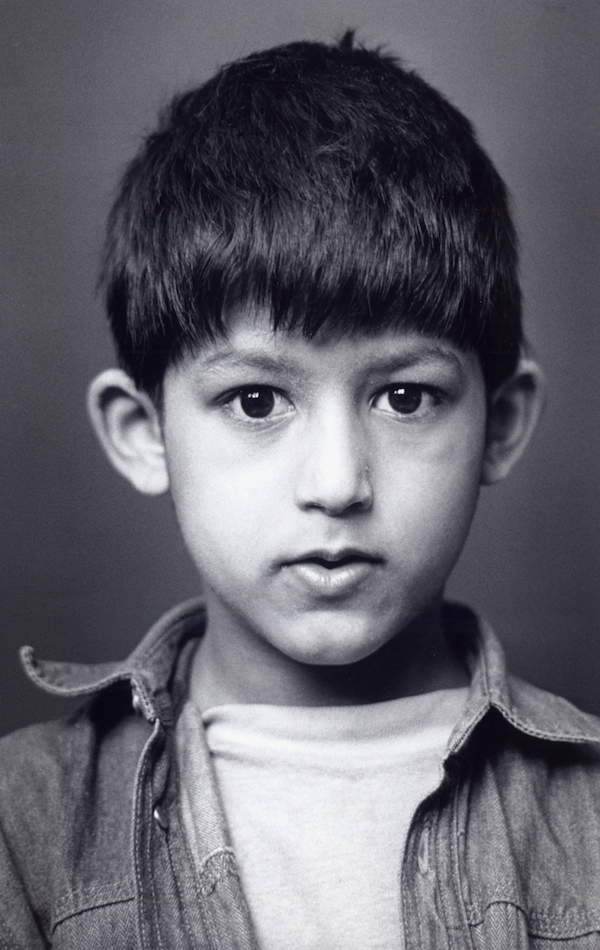
My name is Kamal Miah. I like chocolate cake with chocolate custard. I love computers at home. I learn at Columbia School. Before school I drink fizzy drink and I eat chips. My date of birth is 13.10.88. My best chocolate bar is Lion. My best colour is dark blue. I’m good at maths. Speling group is C.

I am eight years old. My name is Nazneen. I like doing maths and I like doing singing. I have three sisters. And I have lots of friends.

My name is Paplue. I like football and I like fried chicken because they give me chicken. I am eight.

My name is Rahima. I was born in October the eleventh. I’m eight years old. I go to Columbia School. I live in number thirty.

My name is Halil. I am eight years old. I like to play with my three game boys. I like to see funny films.

My name is Litha. I like chocolate. I was born in London. I am eight years old. I live in a flat. When I grow up I want to be a hairdresser.

My name is Robert. I am eight years old and I live in London E2. I like where I live because I have lots of friends to play with.

My name is Rajna. I’m good at running. I do writing at home. And I’m the middle sister.

I am eight years old. I go to school. I play in the playground and my name is Dale.

My name is Sadik. I’m eight years old. I am quite good at football. I practise with my uncle.

My name is Rokib, I am eight years old. I am special because I can read and write and I can do maths and I can be thoughtful and helpful.

My name is Shafia. I am eight years old. I have two sisters. My big sister is called Nazia and my baby sister is called Pinky.

My name is Shokar. I like kick boxing and swimming and I like football.

My name is Urmi and I like going to Ravenscroft Park. I have a black bob cut, browny skin and black eyes. I am eight years old.

My name is Wahidul. I am eight years old. My favourite prehistoric animals are dinosaurs and I like reading and science.

My name is Yousuf. I want to be a computer designer. If I want to be a computer designer I have to be an artist as well.

My name is Ferdous. I am eight years old. I go to Columbia School. My favourite thing is playing games. My date of birth is 10.12.88.

My name is Akthar. I like to go to Victoria Park. I am eight years old.

Hello my name is Fahmida. I am eight years old and I was born in 1989. I like to play skipping and Onit. I like going to school. In school I like Art.

I go to play out with my friends. I go to the shops with my mum. I go to my sisters new house. My name is Ashraf and I’m eight years old.

My name is Fateha. I go to school. I like art. I am eight years old. I am lucky that I’ve got a good art teacher.
Photographs copyright © Chris Kelly
Chris Kelly hopes to make contact with the subjects of these pictures again, now twenty-three years old, for the purpose of taking a new set of portraits. So, if you were one of these children, please get in touch with chriskellyphoto@blueyonder.co.uk
You may also like to take a look at












