
Christmas With Boudica

It is the season of rebirth and transformation, and – behold – the Brick Lane trendsetter formerly known as Mark Petty is no more – in his place, welcome Boudica Denvorgilla Veronica Scarlet Redd. It was solemnized by oath in November and now he asserts to the postman, “If they spell it wrong, I will summon an army.”
Spitalfields Life Contributing Photographer Sarah Ainslie and I paid a visit upon Boudica at his house in Bethnal Green last week to admire his Christmas decorations, before we set out to accompany him to Ridley Rd where each year at this time he distributes gifts to old friends in the market. Yet the first point of interest was his new identity, and Boudica produced the certificate to show us. “When I was a child, I never knew my name was Mark Petty for years,” he confessed to me with a beaming smile, as he flourished the piece of paper proudly, “It was always,’Hey you!’ or ‘Where are you?'” A situation that is happily resolved, now that no-one will ever be able to ignore his name again.
I knew that he chose the name “Boudica” because she stood up for the right to be different – a cause that Boudica himself espouses in every aspect of his life – but I was curious to understand the significance of his other choices. Denvorgilla is an old Irish name referring to Boudica’s Celtic roots, since he is descended from a long line of Irish aristocracy who fled when Elizabeth I sent the troops into Ireland, escaping to France before settling in Gloucestershire. In fact, Boudica is titled and although, with characteristic modesty of temperament, he chooses not to use it, I cannot deny a certain nobility in his bearing. On a contrasting note, Veronica drives from a cherished Go-Cat commercial in the nineteen eighties, while Scarlet Redd refers both to Boudica’s favourite colour and to Sharon Redd, the singer remembered for her album “Redd Hot.”
There was no time to dwell upon these notions of identity that morning. Once we had scrutinized the paperwork and applauded Boudica’s honeycomb bells, it was time for the three of us to hurry along to the bus stop. Snatching an umbrella, as we set out into the grim December rain, Boudica handed me the bags of mince pies, cards and gifts to carry and I was only too happy to follow along in his train, fulfilling the role of Boudica’s attendant Christmas elf. The bus quickly filled up with shoppers and I was puzzled, at first, by their curious indifference to Boudica’s magnificent ankle-length scarlet leather cloak and tall cat-in-the-hat style fluffy red bonnet, until I realised that at Christmas everyone expects to see people dressed in full-length red suits with a fur trim. Far from standing out, as Boudica’s usually does, on this occasion he was the one most appropriately dressed for the season, shaming the rest of us in our drab attire.
Yet, as we descended from the bus at the entrance to Ridley Rd Market, an excited frisson travelled through the crowd, busy about their festive errands in the rain, while applause and cheers arose from the stallholders in their lit booths, peering over piles of shining fruit and vegetables. “Boudica, you look lovely!” called one, drawing roars of approval from his colleagues and causing Boudica to assume that regal stillness which is the preserve of only the most dignified of public figures. Boudica has superlative aplomb, and in spite of the cold and the damp, everyone was euphoric to see him arriving bearing gifts and offering more than a passing resemblance to Spirit of Christmas Present.
Parcels, mince pies and cards were distributed – reciprocated with hugs and handshakes and generous embraces. Joy was incarnate in Ridley Rd Market thanks to one of the East End’s most beloved characters, Boudica Denvorgilla Veronica Scarlet Redd.

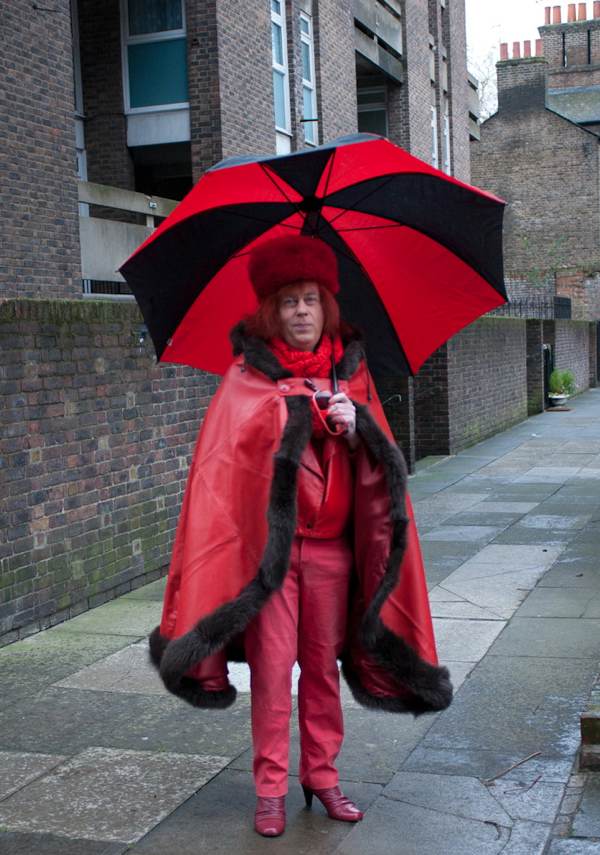

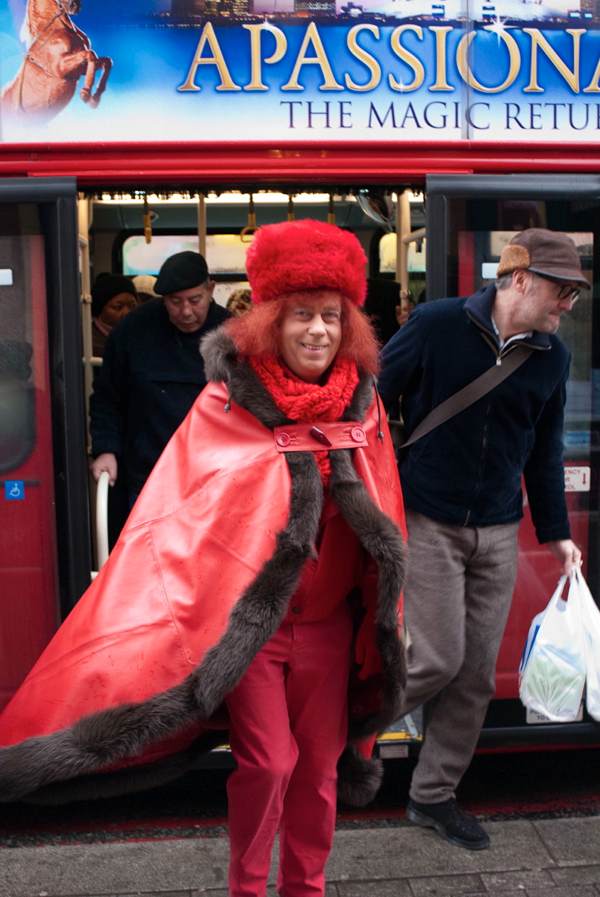
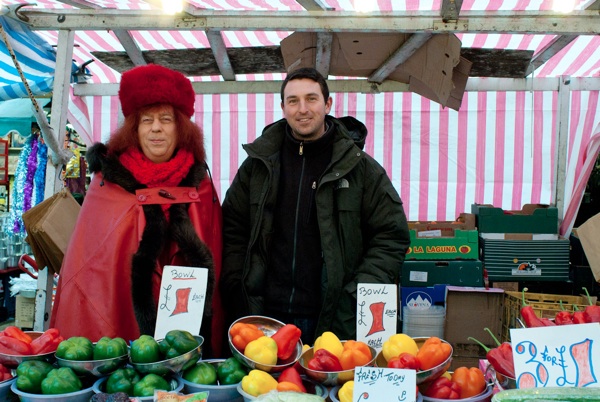
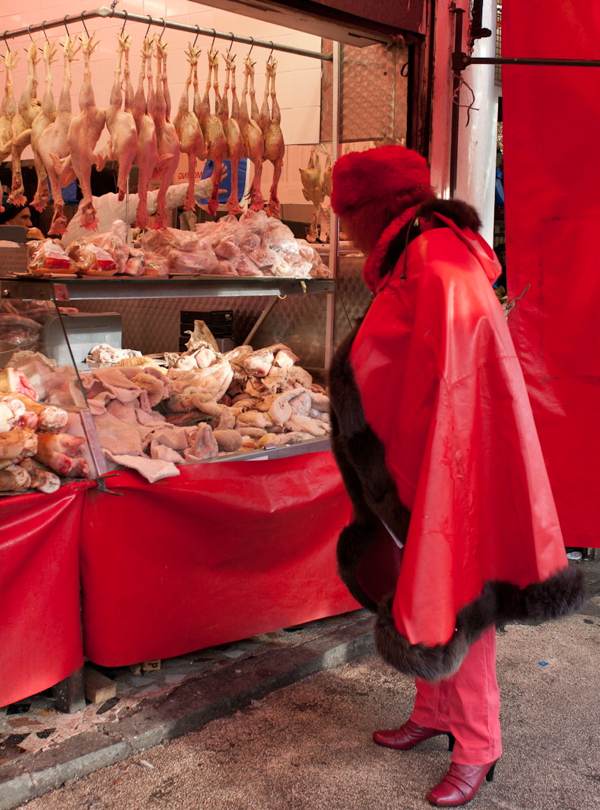
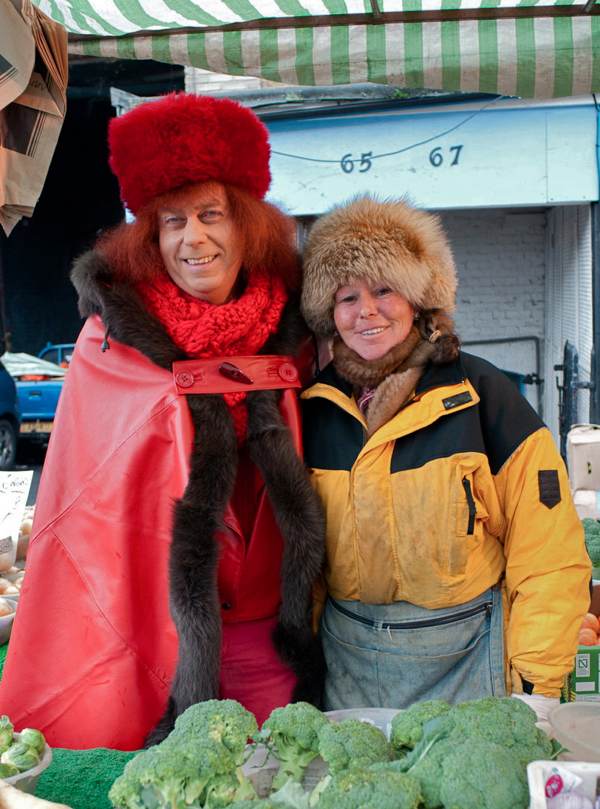
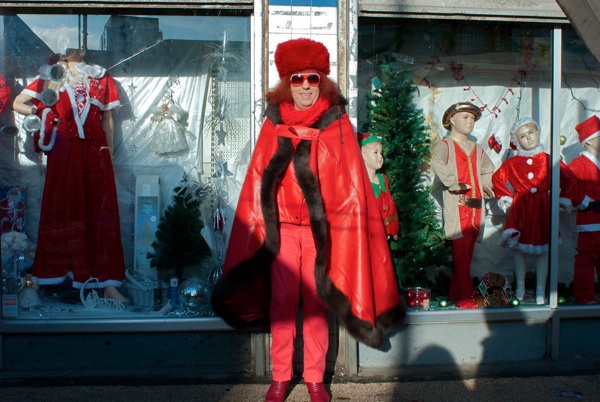
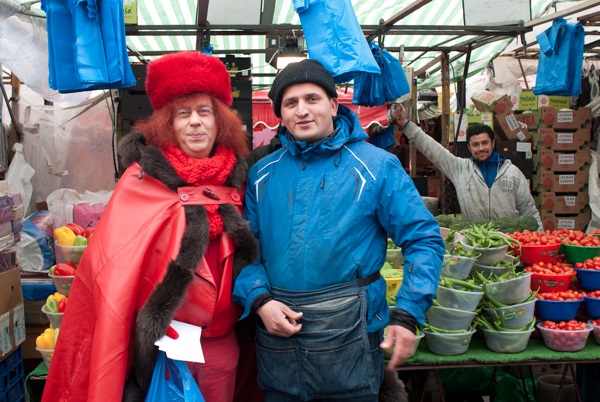
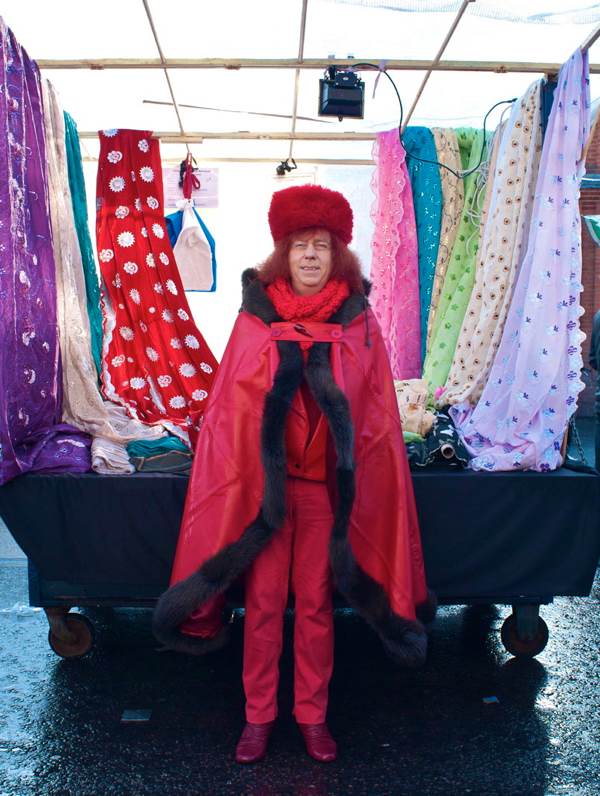
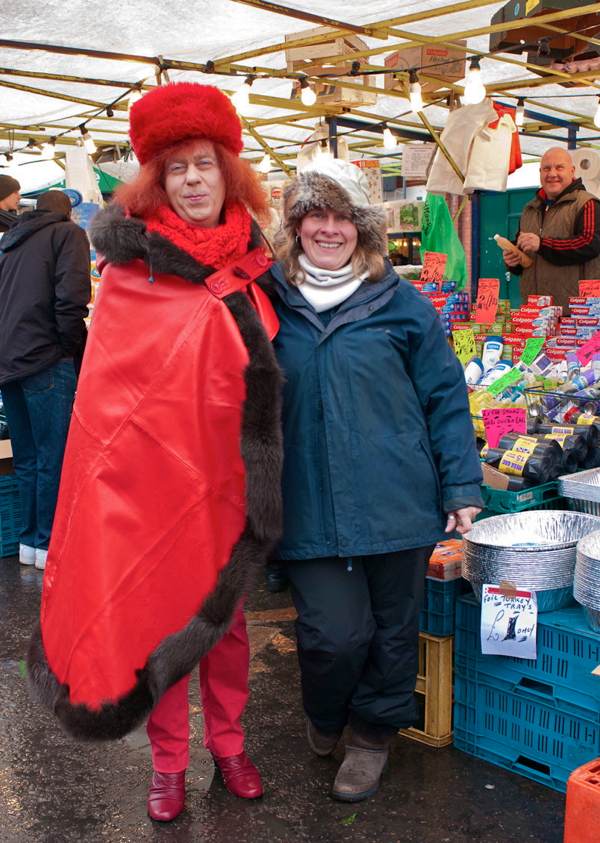
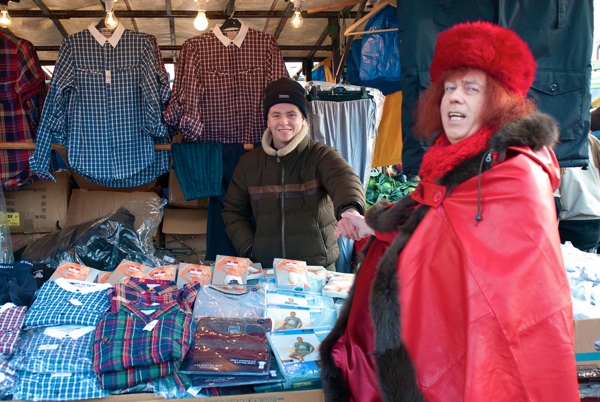
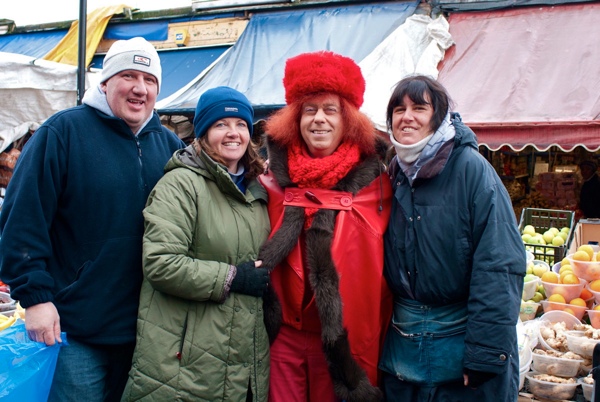
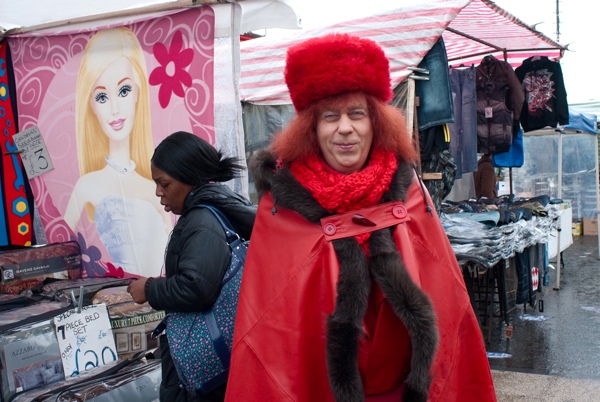
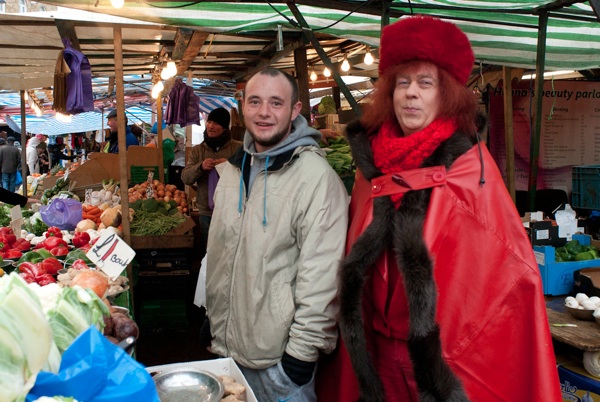
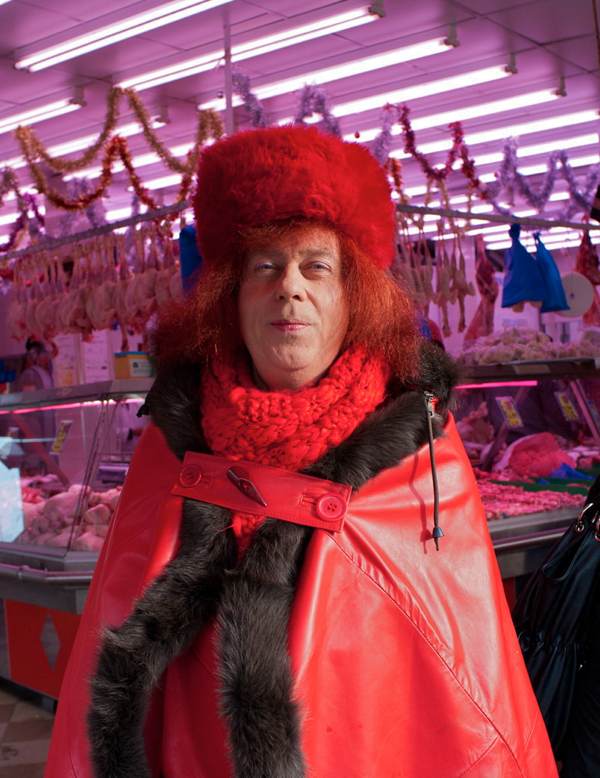
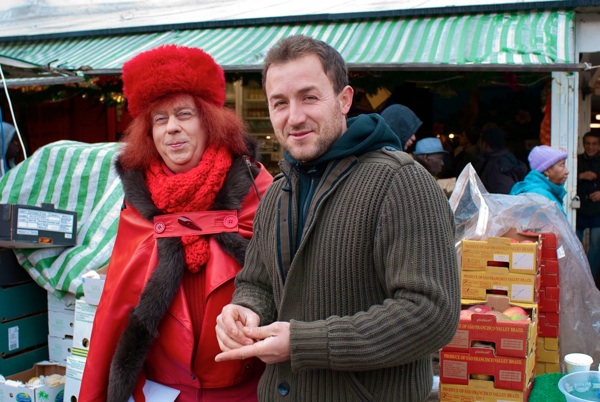
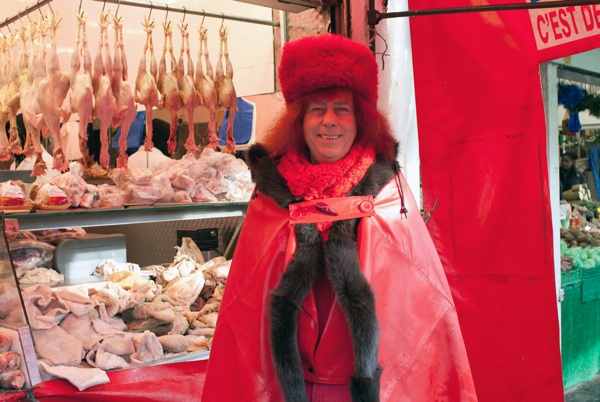
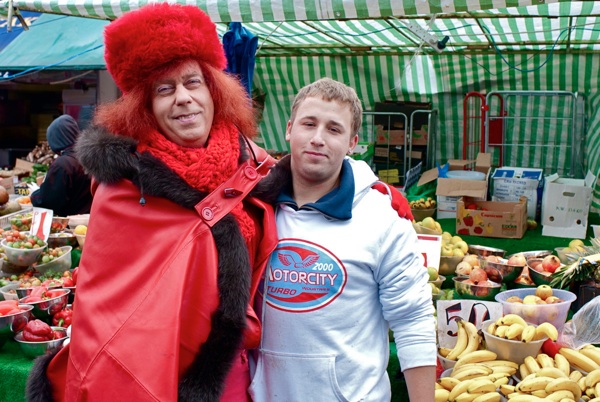
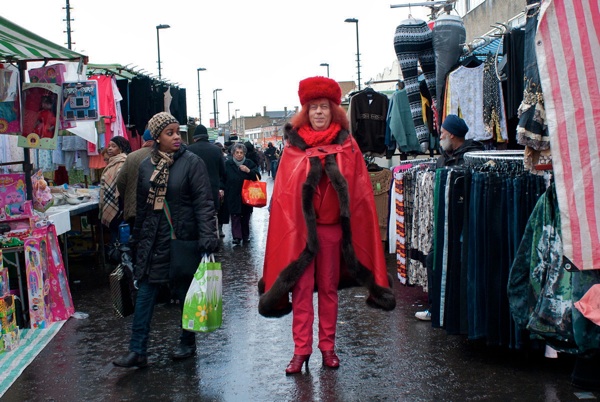
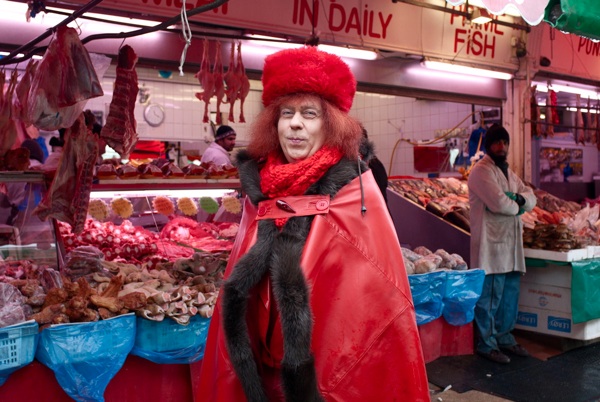
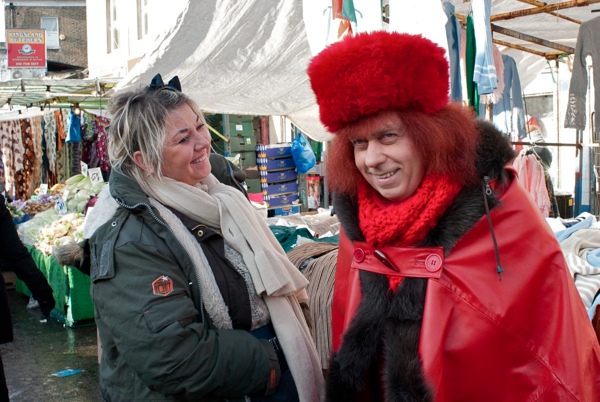
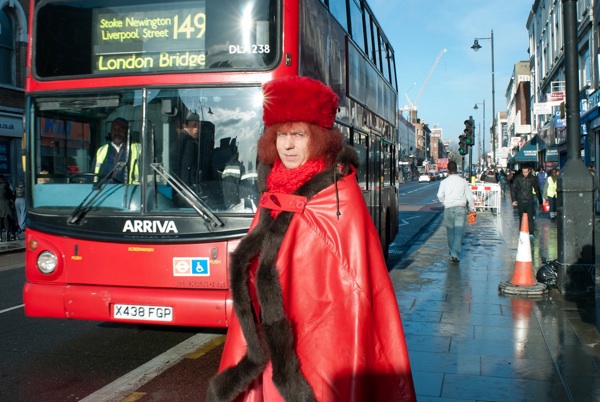


Boudica – “Next year, I’m going to get a chariot.”

John Leech’s original drawing of the Ghost of Christmas Present from “A Christmas Carol.”
Photographs copyright © Sarah Ainslie
Read my original profile of Mark Petty, Trendsetter
and take a look at Mark Petty’s Multicoloured Coats,
23rd December, Wren Boys

Wren Day, also known as Wren’s Day, Hunt the Wren Day or the Hunting of the Wrens (in Irish, Lá an Dreoilín) is traditionally celebrated on 26th December, St Stephen’s Day, in parts of Ireland, the Isle of Man, Wales and Newfoundland. The tradition consists of “hunting” a fake wren, and putting it on top of a decorated pole. Known as “wrenboys,” crowds of mummers, musicians or strawboys celebrate the Wren (also pronounced as the Wran) by dressing up in masks, straw suits and colourful motley clothing and, accompanied by traditional céilí music bands, parade through the towns and villages in remembrance of a festival once observed by the druids. These crowds are sometimes called wrenboys.
In past times, an actual bird was hunted by Wrenboys on St. Stephen’s Day and the captured wren was tied to the Wrenboy leader’s staff pole, sometimes dead, sometimes alive – to be killed after the parade. The parade song, of which there are many variations, called for donations from the townspeople and often, the boys gave a feather from the bird to patrons for good luck. The money was used to host a dance held that night at which the pole, decorated with ribbons, wreaths and flowers, as well as the Wren, was the centrepiece. Over time, the live bird was replaced with a fake one that was hidden,rather than chased and the band of young boys was expanded to include girls, and adults were permitted to join in. Nowadays, the money that is collected from townspeople is usually donated to a local school or charity.
Some theorise that the Wren celebration has descended from Celtic mythology. The origin maybe a Samhain or Midwinter sacrifice, since in Celtic lore the Wren is a symbol of the past year and the wren is known for singing even in mid-winter, and sometimes explicitly called “Winter Wren.” Celtic names of the Wren (draouennig, drean, dreathan, dryw etc.) also suggest an association with druidic ritual. The tradition may also have been influenced by Scandinavian settlers during the Viking invasions prior to the tenth century. Various associated legends exist, such as a Wren being responsible for treachery against Irish soldiers who fought the maurading Viking invaders by beating its wings upon their shields, and for betraying the Christian martyr Saint Stephen after whom the day is named. This mythological association with duplicity is a possible reason why the bird was hunted by Wrenboys on St. Stephen’s Day and may explain why a pagan sacrificial tradition was continued into Christian times. Despite the abandonment of the Wren killing practice, devoted Wrenboys ensure that the gaelic tradition of celebrating the Wren continues today.
In 1955, Liam Clancy recorded “The Wran Song,” which was sung in Ireland by Wrenboys. In 1972, Steeleye Span recorded “The King” on “Please to See the King,” which is along similar lines, and they made another version, “The Cutty Wren,” on their album “Time.” While “Hunting the Wren” is on John Kirkpatrick’s album “Wassail!” and The Chieftains made a collection of Wrenboy tunes on “Bells of Dublin.”
I lived in Ireland for five years though, sadly, I never saw nor heard anyone mention the Wrenboy tradition, but perhaps that was just because I was in Dublin. These fine fellas above are the Bogside Wranboys of Ballygramore and can play many a tune to set your feet a-tapping!
Illustration copyright © Paul Bommer
Chapter 5. Indescribable Panic

At Dove Cottage in Keswick, three hundred miles north of London, Robert Southey and Thomas de Quincey were reading the national newspapers with feverish excitement – as, like thousands of others, they followed every turn in the saga of the murders in Shadwell in December 1811. Southey declared it a rare example of “a private event of that order which rose to the dignity of a national event.” De Quincey wrote “the panic was indescribable. One lady, my next neighbour, whom I personally knew, living at that moment, during the absence of her husband, with a few servants in a very solitary house, never rested until she had placed eighteen doors (so she told me, and indeed satisfied me by oracular proof), each secured by ponderous bolts, and bars, and chains, between her own bedroom and any intruder of human build.”
In London, the question was raised how John Turner, the lodger at the King’s Arms, could have seen the murderer and then abandoned the infant Kitty Stilwell to her fate in seeking his own escape from the building. But De Quincey, having read the newspaper reports, launched into a powerful imaginative identification with the lodger. In justification of leaving the child sleeping, De Quincey surmised that the lodger “felt sure that sure that the murderer would not be satisfied to kill the poor child whilst unconscious. This would be to defeat his whole purpose in murdering her at all – to be an epicure of murder.” A startling creative leap.
At the inquest, Turner explained in his own words, “I went to bed and had not been there above five minutes before I heard the front door being banged to: very hard. Immediately afterwards I heard the servant exclaim ‘We are all murdered’ or ‘shall be murdered’ two or three times, I cannot be exactly sure which of the expressions she made use of. I had not been asleep. I heard the sound of two or three blows, but with what weapon I cannot say. Shortly afterwards, I heard Mr Williamson cry out, ‘I’m a dead man.'”
Although he knew of the murders a week earlier, astoundingly, Turner unlocked his door and crept downstairs where he spied through a doorway upon the murderer in the dark rifling through the pockets of a victim. “I did not see his face, and I only saw that one person. I was fearful and I went upstairs as quick but as softly as I could. I thought first of getting under the bed, but was fearful I should be found. I then took the two sheets, tied them together, tied them to the bed post, opened the window and lowered myself down by the sheets.”
No-one knew where the murder or murderers would strike next. “Many of our readers” wrote Thomas Macaulay years later, “can remember the state of London just after the murders of Marr and Williamson – the terror which was on every face – the careful barring of doors – the providing of blunderbusses and watchmen’s rattles. We know of a shop keeper who on that occasion sold three hundred rattles in ten hours.”
Regular reports will be forthcoming here during the Christmas holidays.

Robert Southey

Thomas de Quincey
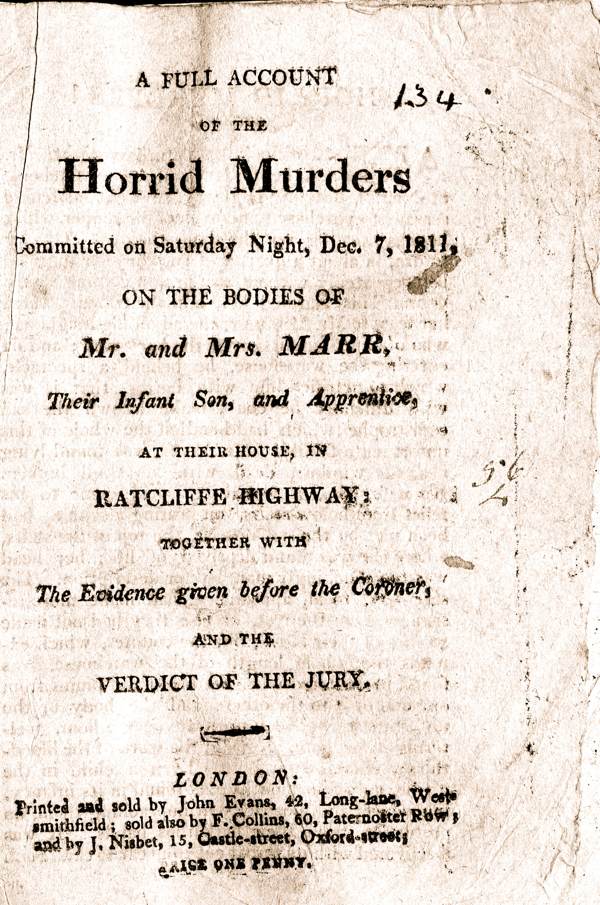

Click on Paul Bommer’s map of the Ratcliffe Highway Murders to explore further
The Maul & The Pear Tree – P.D. James’ breathtaking account of the Ratcliffe Highway Murders, inspired me to walk from Spitalfields down to Wapping to seek out the locations of these momentous events. Commemorating the bicentenary of the murders this Christmas, I am delighted to collaborate with Faber & Faber, reporting over coming weeks on these crimes on the exact anniversaries of their occurrence.
The Map of the Ratcliffe Highway Murders – In collaboration with Faber & Faber, Spitalfields Life has commissioned a map from Paul Bommer which will update throughout December as the events occur. Once you have clicked to enlarge it, you can download it as a screensaver or print it out as a guide to set out through the streets of Wapping.
Ratcliffe Highway Murder Walk – Spitalfields Life will be hosting a dusk walk on Wednesday 28th December at 3pm from St Georges in the East, visiting the crime scenes and telling the bone-chilling story of Britain’s first murder sensation. The walk will take approximately an hour and a half, and conclude at the historic riverside pub The Prospect of Whitby. Booking is essential and numbers are limited, so please email spitalfieldslife@gmail.com to sign up. Tickets are £10.
Thanks to the Bishopsgate Institute and Tower Hamlets Local History Archive for their assistance with my research.
You may like to read the earlier installments of this serial which runs throughout December
Chapter 1, Two Hundred Years Ago Tonight …
22nd December, Mari Lwyd
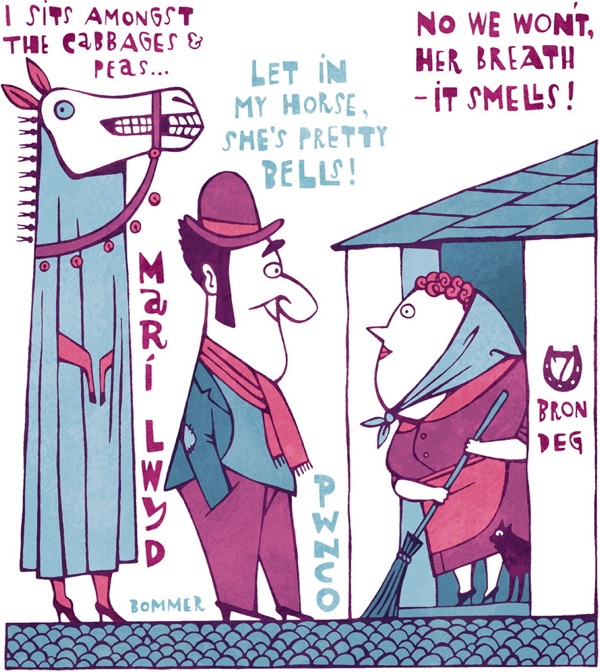
The Mari Lwyd (Y Fari Lwyd in Welsh or Grey Mare in English) is the strangest and most ancient of customs by which people in Wales mark the passing of the darkest days of Midwinter. Perhaps deriving from an ancient rite for the Celtic goddesses Rhiannon and Epona, the Mari Lwyd is associated with South-East Wales, in particular Glamorgan and Gwent. Though almost forgotten during the mid-20th century, nowadays some folk associations in Llantrisant, Llangynwyd, Cowbridge and elsewhere are trying to revive it.
The Mari Lwyd itself consists of a mare’s skull fixed to the end of a wooden pole with coloured ribbons and white sheets fastened to the base of the skull, concealing the pole and the person carrying it. The eye sockets are often filled with green bottle-ends and the lower jaw is spring-loaded, so that the Mari’s operator can snap it at passersby. During the ceremony, the skull is carried through the streets of the village by a party that stands in front of every house to sing traditional songs in a rhyme contest (pwnco) between the Mari party and the inhabitants of the house, who challenge each other with insulting verses.
The Mari Lwyd has become associated with the resurgence of Welsh folk culture, and the town council of Aberystwyth (in Ceredigion, well outside the Mari Lwyd’s traditional area) organised “The World’s Largest Mari Lwyd” for the Millennium celebrations in 2000.
A mixture of the Mari Lwyd and Wassail customs occurs in the border town of Chepstow, South Wales, in January. A band of English Wassailers meet with the local Welsh Border Morris Side, The Widders, on the bridge in Chepstow. They greet each other, exchanging flags in a gesture of friendship, and celebrate the occasion with dance and song before performing the pwnco at the doors of Chepstow Castle.
My mother is from Ruthin in the wild North of Wales, but here I have shown a scene from the small mining village of Pen-Y-Senfi in Glamorgan. The lady at the door is Mrs Dai Bread, the baker’s wife and the man asking her the questions is Ifor Rees-Davies, a handyman, while the figure under the blanket is young Gereint Pritchard (known as “Mitzi”), son of Nelly the Tripe. This particular Mari Lwyd actually imagines herself to be Marie Lloyd, the star of Edwardian Music Hall, infamous for her saucy performances and innuendo. When banned her from singing her song “I Sits Amongst the Cabbages and Peas” because of its implied reference to urination, she promised to alter the lyrics appropriately – and sung “I Sits Amongst the Cabbages and Leeks” instead!
Nadolig Llawen a Blwyddyn Newydd Dda!
Illustration copyright © Paul Bommer
21st December, Wassail

There are several related traditions of “Wassail.” Firstly, wassailing is an ancient Southern English custom performed to ensure a good crop of cider apples next year, yet wassail also refers both to the salute “Waes Hail” (a contraction of the Middle English phrase “wæs hæil” meaning”good health”), and also to the drink of “wassail” which is a hot mulled cider drunk. The giving of libations and the pouring of a drink as an offering was common in many religions of antiquity.
In the cider-producing counties in the South West of England, wassailing involves singing and drinking the health of the orchards – the purpose being to awaken the cider apple trees and scare away evil spirits, ensuring a good harvest next year. The ceremonies vary from village to village but all have the same core elements. A wassail King and Queen lead the song from one orchard to the next, and the wassail Queen will be lifted up into the boughs of the tree where she will place toast soaked in wassail from a “Clayen Cup” as a gift to the tree spirits. Then an incantation is recited –
Here’s to thee, old apple tree, That blooms well, bears well. Hats full, caps full, Three bushel bags full, An’ all under one tree. Hurrah! Hurrah!
At Carhampton near Minehead, the apple orchard Wassailing is held on the Old Twelfth Night (17th January) as a ritual to ask God for a good apple harvest. The villagers form a circle around the largest apple tree, hang pieces of toast soaked in cider in the branches for the robins who represent the good spirits of the tree and then a shotgun is fired overhead to scare away evil spirits and the group sings –
Old Apple tree, old apple tree,
We’ve come to wassail thee,
To bear and to bow apples enow,
Hats full, caps full, three bushel bags full,
Barn floors full and a little heap under the stairs
My partner’s surname is Appleton – a name of Anglo-Saxon origin, originating from many of the places thus called, for example Appleton in Cumberland, Lancashire, Yorkshire, Norfolk, Cheshire, Berkshire and Kent. Recorded as “Apeltun” and “Epletune” in the Domesday Book of 1086 for the various counties, it derives from the Old English pre-seventh century “aeppeltun,” an orchard, a compound of “aeppel,” an apple, plus “tun,” an enclosure or settlement. Here I have shown two of Nick’s ancestors in the Kentish orchard from which they got their name. They wear Anglo-Saxon garb (note Aethelwulf Aeppeltun’s garnet-encrusted cloak broach), drinking ale or cider from horns and making merry on this, the shortest day of the year. Note too the drink-soaked crust in the branches, the dormant skep in the orchard and the tipsy Robin Redbreast looking on. Behold, the birth of the English binge-drinking culture.
Wassail! Drink Hale!
Illustration copyright © Paul Bommer
At NAFAS

Wendy Davis, National Chairman of NAFAS
One Christmas, my presents arrived wrapped in red foil and garnished with artfully contrived arrangements of pine cones, lichen-encrusted branches and holly leaves sprayed gold. I knew something was up – my mother had joined a flower arrangment society. The truth is that I come from a passionate family of flower arrangers. My grandmother used to stand beech leaves in jars of obscure chemicals and then flatten them under the carpet for months in preparation for Christmas when she would fix them in oasis with honesty pods and plastic hellebores. Famously, for an exceptionally ambitious display, she once grew gladioli and set them at angles using a protractor, to create the effect of the sun rising.
So you can imagine my excitement when I was invited to tea with Wendy Davis, Chairman of the National Association of Flower Arrangment Societies, at the magnificent eighteenth century headquarters in Devonshire Sq where the activities of their seventy-two thousand members are co-ordinated. Wendy was flushed with pride from a recent triumph at Westminster Abbey, where she had organised the display for the four hundredth anniversary of the King James Bible. Twenty-one years ago, a close friend took Wendy along to a flower arranging class in Llangollen, North Wales and she has never looked back since, yet she still carries an awareness of the essentially modest nature of her chosen art.
Wendy is inspired by Julia Clements, the third president after Constance Spry and Mary Pope, the pioneering founder of the Association in 1959. A legend among flower arrangers and author of dozens of classic books on the subject, Julia Clements died in November after celebrating her one hundred and fourth birthday this year. “A week before she died, we were doing flower arranging together,” Wendy confided to me, as we sipped tea from floral cups in the quiet of her panelled office. “She started flower arranging classes after the war to give people something to do that wouldn’t cost money,” explained Wendy, lapsing into respectful silence and taking another sip of her tea.
Leading me up the fine old staircase, winding through the centre of the house, Wendy showed me the expansive reception rooms with cases storing all manner of flower-arranging trophies and the grand conference room where representatives from the twenty-one regions convene. On the top floor, modestly appointed shared bedrooms provide accommodation for members from out of London whilst visiting on Association business. Staffed by a core of five paid staff and a great many voluntary helpers, the prevailing atmosphere at NAFAS is of civility and respect.
Wendy taught me how to spot the ubiquitous NAFAS triangle, the ideal compositional form for a floral arrangement, permitting the most elegant use of flowers and foliage. It need hardly be said that there is an elaborate culture at NAFAS with a refined aesthetic code of its own, maintained through demonstrators that teach the visual vocabulary and judges who qualify to make assessments in the all-important competitions. Make no mistake, flower arranging is a highly competitive global arena these days with NAFAS sending contestants to Boston for the world championships and acting as consultant to Indian universities upon the creation of flower arranging qualifications.
Wendy prefers to speak of the personal meaning that is incarnate when flowers are used to express emotion. “When I’ve done funeral flowers for members of my family and friends, it’s how I say goodbye to them,” she confessed, turning thoughtful as we descended the stairs again. Certainly, I associate flower arranging with churches and the innate poetry that exists in such ephemeral displays set against unremitting stone. Wendy related the story of an eleven-year-old boy who won a trophy in a NAFAS scheme to encourage flower arranging among the young. He could not collect the award because his father died, but he made a floral arrangement in memory of his father. “Some people said it was morbid, but I said, ‘no, creating this is part of the healing process.'” Wendy informed me with a tender smile.
I cannot deny that flower arrangements strike an emotional chord for me too. I can never walk past, I must always stop and pay due reverence to any floral composition – contemplating the thought and care expended in its creation. And flowers from the garden displayed in old china have been a fond motif throughout my life. In fact, I do not remember those Christmas presents which came adorned so beautifully with pine cones and holly, I only remember the decoration.
The flower arrangers might seem strangely placed here at the edge of the City surrounded by financial industries – yet the truth is they are a gentle civilising influence upon their neighbours, preaching their NAFAS message of “Friendship through flowers.”

National Association of Flower Arranging Societies headquarters in Devonshire Square.
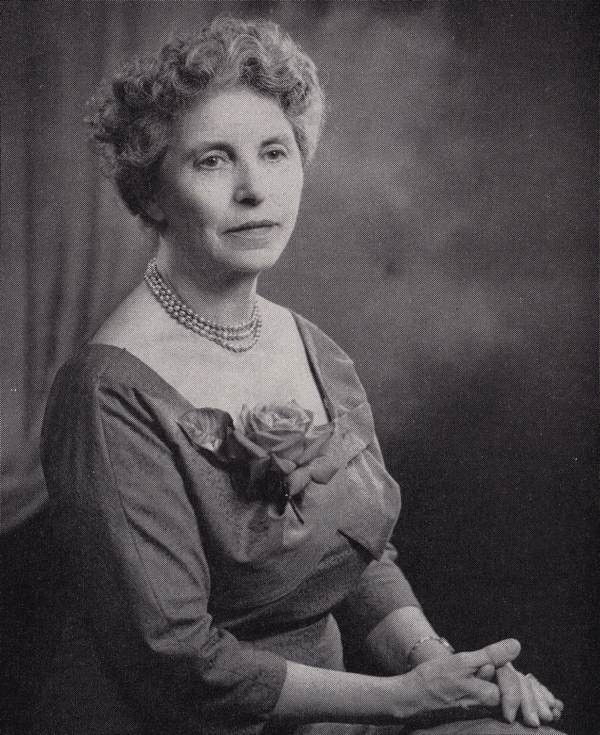
First president of NAFAS, Mary Pope – a pioneer in the flower arrangement movement.
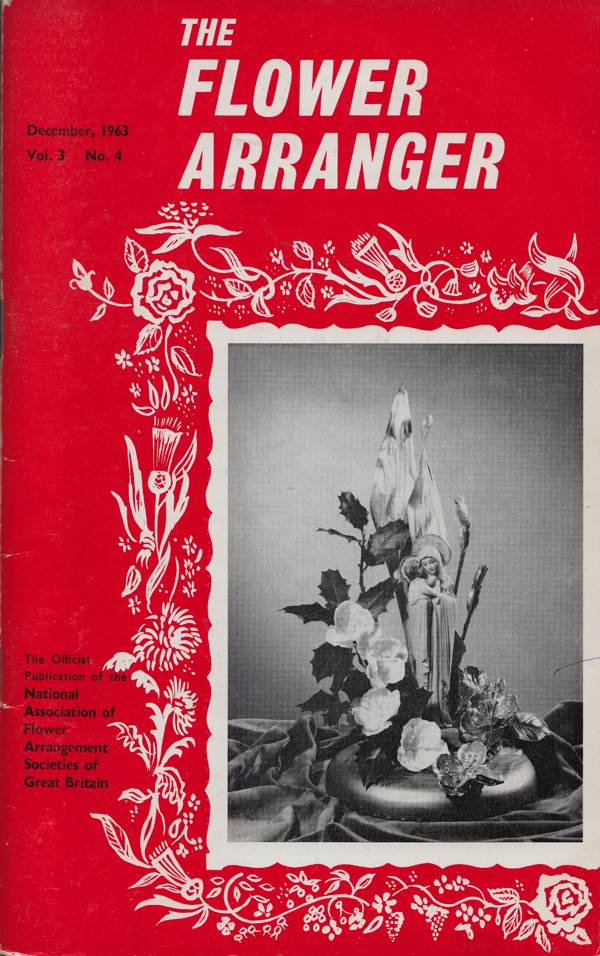

The Lady Mayoress of Plymouth admires a flower arrangement at Saltram House, 1963.
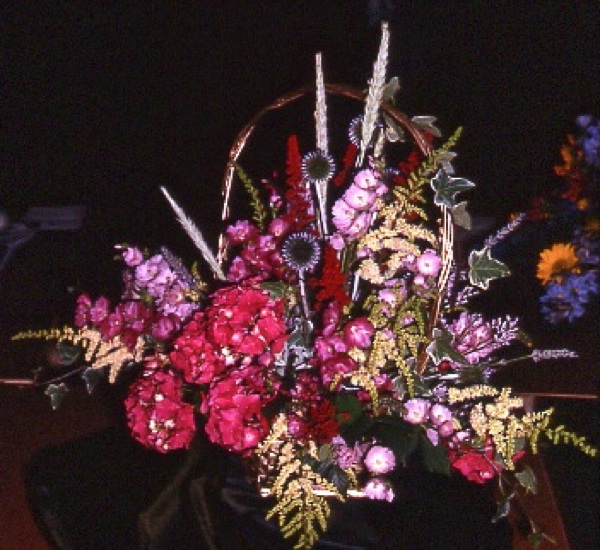

At the Buxton Festival, Mrs Russell Ritchie Innis presents the Paul Revere silver bowl to Mary Pope as a gift from the National Association of Garden Clubs of USA, 1964.
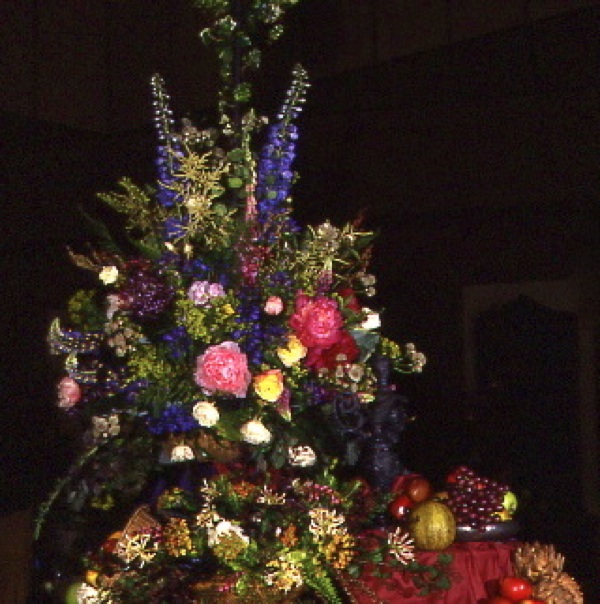

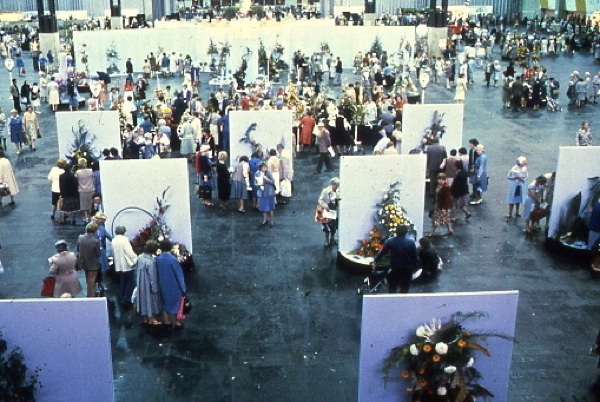
Admiring a table decoration in scarlet and green at Taunton’s Christmas exhibition, 1963.
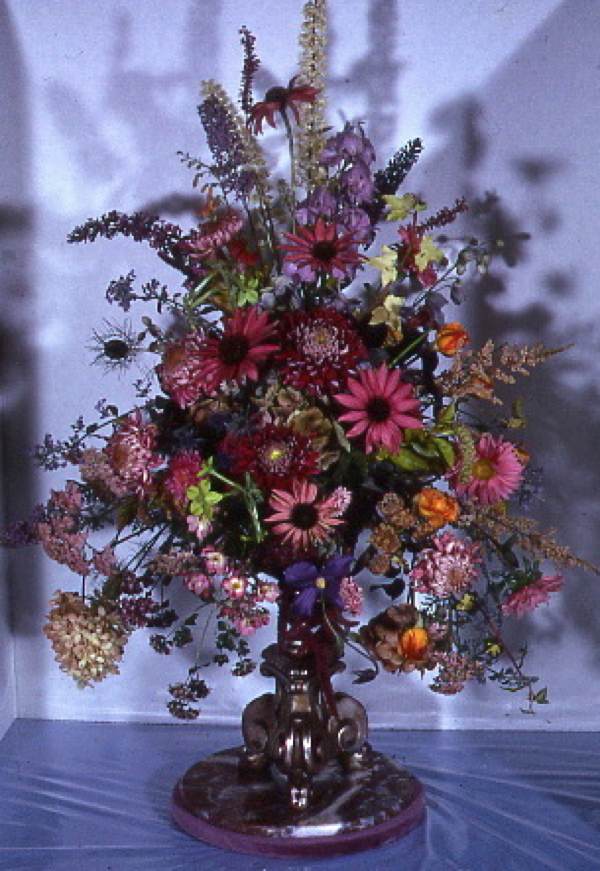

Tom Hill, winner of the trophy for the best arrangement at the Mercia & North Wales Show, Nantwich.
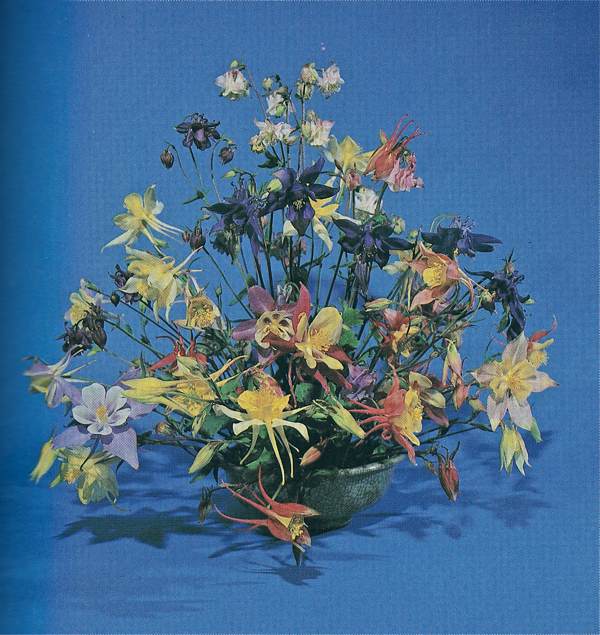
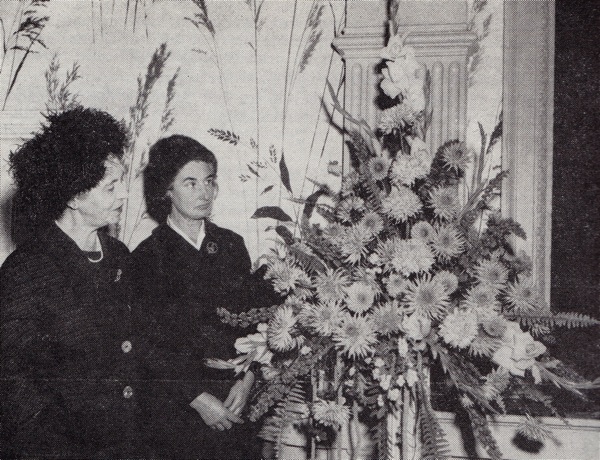
Mary Pope and Margaret Hewitt OBE admire a pedestal arrangement of the Liverpool Flower Arrangement Society staged by Hugh Mather of St Helens.
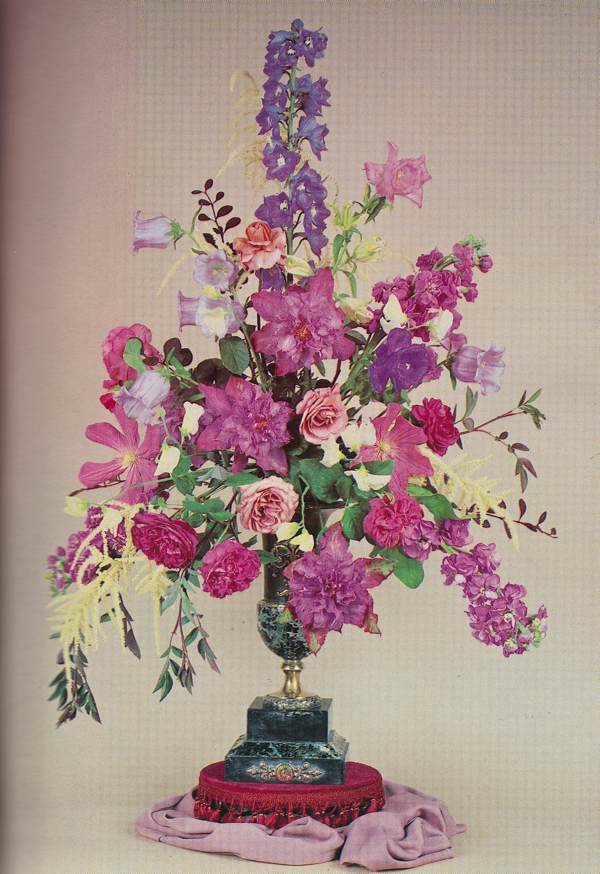
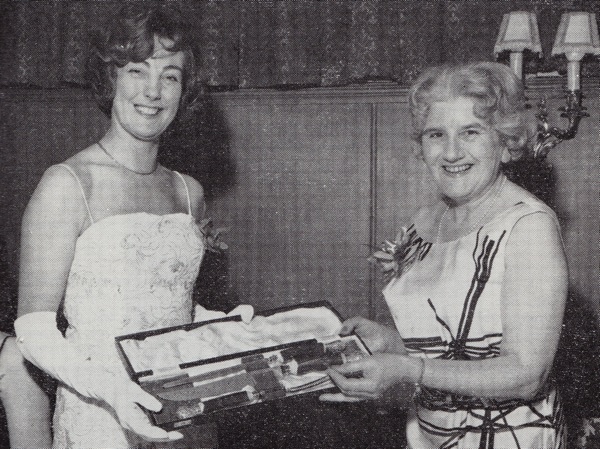
Mrs E. Allen, National Chairman receives a Sheffield carving set from Mrs B. Denton, Chairman of Sheffield Floral Club.



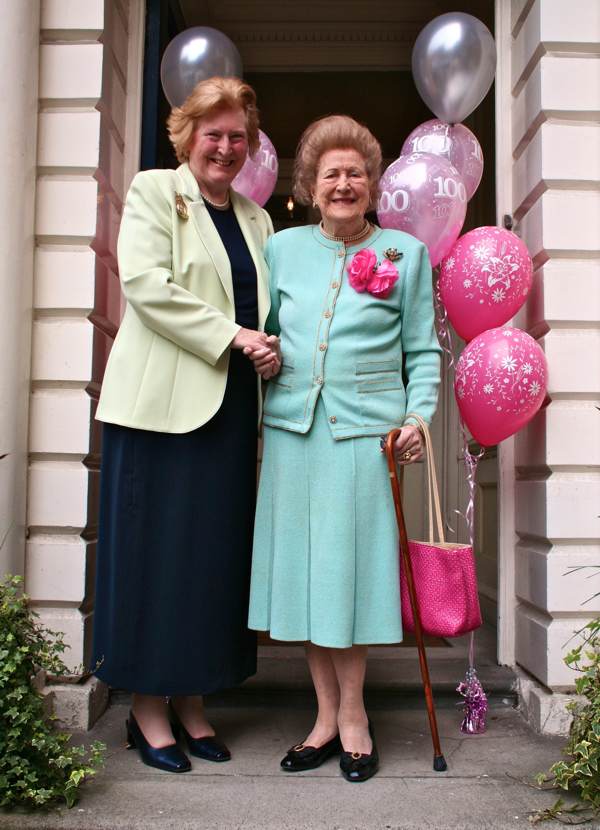
Veteran flower arranger, Julia Clements, celebrates her hundredth birthday at NAFAS in 2006.

A Christmas kissing bough engraved by Joan Hassall, from an early issue of The Flower Arranger.
Archive images copyright © NAFAS
20th December, The Box of Delights
“The Box of Delights” is a children’s fantasy novel by the former Poet Laureate John Masefield, his sequel to “The Midnight Folk.” First published in 1935 and set around Christmas-time, culminating on Christmas Day, I always find myself reading it at this time.
The protagonist is a boy of ten, Kay Harker, who on returning home to Seekings House from boarding school finds himself mixed up in a battle to possess a magical “Box of Delights,” which permits the owner to go small (to shrink), to go swift (to fly), to experience wonders contained within the box and to go into the past.
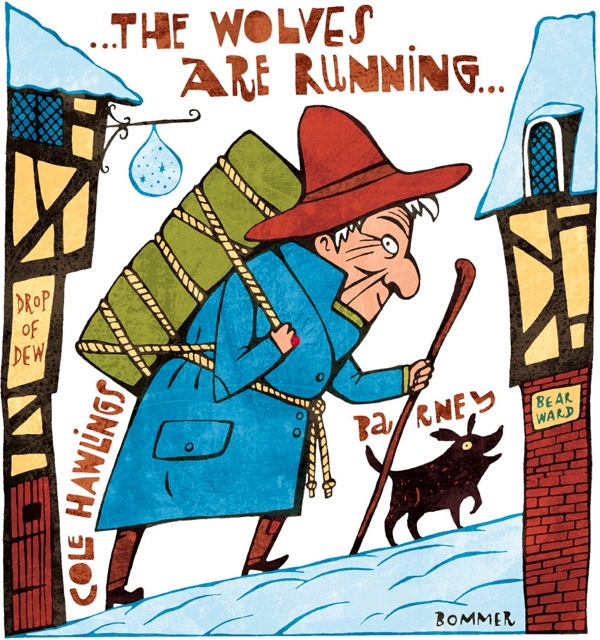
The owner of the box is an old Punch & Judy man man called Cole Hawlings whom Kay meets at the railway station on his way home. “And now, Master Harker, now that the Wolves are Running, perhaps you could do something to stop their Bite?” entreats the old man. He asks Kay to protect the magic box which brings Kay and his friends many adventures. But Kay is in danger – Abner Brown will stop at nothing to get his hands on it. Yet the police don’t believe Kay, so when his guardian, friends and the Bishop are “scrobbled” just before Christmas, he knows he must act alone…
It is a great book peopled with mysterious bright-eyed immortals, Romans, Druids, fairies, Herne the Hunter, gangsters dressed as curates, talking rats, witches and much more besides. It is quite dated but all the more charming for that – characters in the book use expressions like “it’s the Purple Pim” and “queer coughdrops”! The story also features a Brazen Head used by the evil wizard Abner Brown (assisted by his wife and Kay’s former governess, the sly witch Sylvia Daisy Pouncer) for divination – it is a motif that has long fascinated me and after which Dublin’s oldest pub is named.
Above, I have shown Cole Hawlings, the Punch & Judy man, with his booth wrapped in green baize upon his back, walking near the Drop of Dew Inn in the Bear Ward of old Condicote, accompanied by his dog Barney. Note his exceptionally bright eyes and his ring, a “longways cross” of gold and garnets. Although not immediately apparent, he is very old indeed, living into the modern day from pagan times and is none other than the medieval Spanish philosopher and alchemist Ramon Llull.
If you have not read “The Box of Delights,” I recommend you do.
Illustration copyright © Paul Bommer












