
More Curry Chefs of Brick Lane

Abdul Tahid, Head Chef at Papadoms, 94 Brick Lane
Spare a thought for the Curry Chefs of Brick Lane who carry on cooking through the festive season while everybody else puts their feet up. Like Bob Cratchit, these men only get one day off at Christmas, yet it is a measure of the all-consuming nature of their work that they did not seem unduly interested the possibility of a day’s break when I visited last week, rather they were passionate to maintain the ceaseless production of curry required daily to feed the insatiable appetites of their hungry customers.
It was a year ago that I first began visiting the kitchens of Brick Lane to pay my respects to these unacknowledged curry heroes, and once the temperatures dipped again it was time to return in the company of Spitalfields Life Contributing Photographer Jeremy Freedman to make the acquaintance of more cooks and to extend the portfolio of portraits. Today I am publishing the complete gallery of pictures, revealing more faces of these reclusive men whose cherished duty it is to mix the spices and create the curry to sustain us all through the darkest depths of Winter.
“When I started, I dreamed of being a chef,” confessed Jamal Uddin, Head Chef at Bengal Cuisine, referring to his ambition when he came here to Brick Lane from Bangladesh aged nineteen. For the last fourteen years, Jamal has reigned supreme in his kitchen with a Tandoori Chef, a Cook and a Porter working under his supervision as he prepares as many as two hundred curries every day. “I love cooking,” he admitted to me as his gleaming face broke into a smile, though whether it was the intensity of his emotion or the humidity in the kitchen that was the cause of his glowing complexion, I never ascertained.
Syed Jahan Mir, Head Chef at Chillies Restaurant, told me he came to this country at the age of eighteen with his mother and father. Syed was able to learn from his father who was also a chef and they started out together at first, working side by side in the same restaurant. “He’s better than me, but now he is retired to Sunderland I am the best!” Syed asserted, placing a hand on his chest protectively. “Of course I like it,” he confirmed for me with fierce pride, “Twenty-four years, I’ve been doing this, just making curry – it’s my profession.” A poet with spices, Syed creates his own personal mixture for curry. “It’s all the blending,” he emphasised, running his fingers through the golden powder in a steel dish to demonstrate its special properties.
Mohammed Salik still remembers arriving in Britain at the age of seven. “It was quaint and nice here and the people so good, not overcrowded and dirty like my country,” he recalled with a sublime smile of reminiscence, “My dad used to work at the Savoy, but I wanted to be part of the community here in Brick Lane.” Starting as kitchen porter, Mohammed spent the first five years watching and learning and is now Head Chef at Eastern Eye Restaurant. Our brief conversation in the kitchen was eclipsed by the arrival of a bucket on a piece of string from the restaurant above and inside was a yellow slip of paper, occasioning a polite, apologetic glance from Syed as he turned away to study the handwriting and order his team to work, making up the order.
At Cinnamon, Head Chef and veteran of twenty-five years in the business, Daras Miya was keen to introduce me to the two smiley, hardworking young Kitchen Porters under his care, skinny twenty-four year old Belal Ahmed who has been there three months and also works as a waiter, and nineteen year old Mizanor Rahman who started a week ago. Newly married and with little English, wide-eyed Mizanor was experiencing his first Winter in London, after marrying his wife who came from Britain to Bangladesh find a husband.
In some establishments, Curry Chefs came to sit at tables to meet me. At others, I passed through the private door and descended the staircase – where incense sticks burned stuck in half a potato for stability – to reach the kitchen below. Here in these secret domains, the Curry Chefs work incessantly creating meals for customers they never see and who do not see them. Yet when required to face the camera, all the Chefs assumed the same gracious, arms-crossed posture without prompting.
I never learnt the origin of this apparently innate piece of body language, which expresses perfectly their subtle balance of pride and modesty, both protective and assertive too. They present themselves to the camera with the dignified optimism which defines these brave men who began their lives in another continent and have embraced the role of Curry Chef as the means to further an existence in a new land .

Jamal Uddin, Head Chef for fourteen years at Bengal Cuisine, 12 Brick Lane.

Zulen Ahmed, Head Chef at Saffron, 53 Brick Lane, for ten years.

Syed Jahan Mir, Head Chef at Chillies Restaurant, 76 Brick Lane.

Abdul Ahad Forhad, Curry Chef at Monsoon, 78 Brick Lane – “I’m the master of curry!”

Mohammed Salik, Head Chef at Eastern Eye Balti House, 63a Brick Lane.

Nurul Alam, Head Chef at Preem & Prithi, 124/6 Brick Lane, cooks three hundred curries a night.

Daras Miya, Head Chef at Cinnamon, 134 Brick Lane.

Head Chef Shaiz Uddin with his colleague Monul Uddin, Tandoori Chef at Masala, 88 Brick Lane.

Monzur Hussain, Head Chef at Shampan, 78 Brick Lane.

Rana Miah, Brick Lane’s longest serving Curry Chef stands centre, flanked by Kholilur Rahman and Mizanur Khan in the kitchen of the Aladin, 132 Brick Lane.

Belal Ahmed & Mizanur Rahman, porters at Cinnamon 134, Brick Lane.

Dayem Ahmed, kitchen porter of six months standing and aspiring chef, at Shampan.
Photographs copyright © Jeremy Freedman
Jeremy Freedman’s portraits of The Curry Chefs of Brick Lane will be exhibited at Rich Mix from 23rd February until 31st March 2012.
Read my original feature The Curry Chefs of Brick Lane
At W. F. Arber & Co Ltd, Printing Works
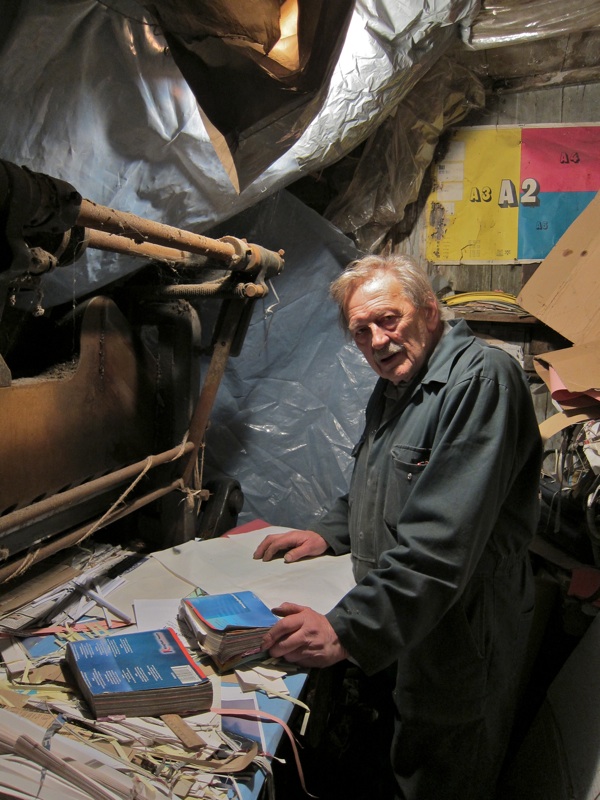
Gary Arber with his Furnival guillotine
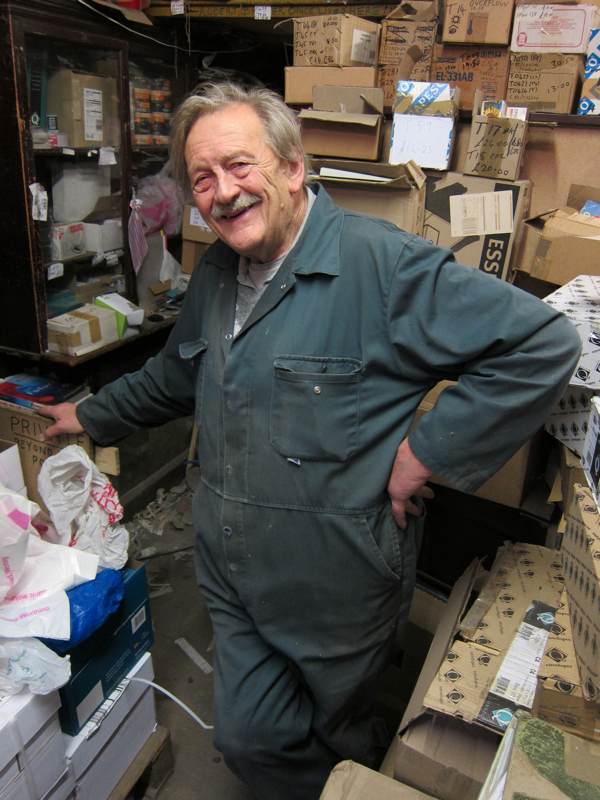
It was the Friday before Christmas, and when I arrived at W. F. Arber & Co Ltd, Printing Works, at 459 Roman Rd there was a sign hanging in the window that said “Back in ten minutes,” so I rang and waited. Before long, the friendly face of Gary Arber – third generation in the family business – appeared from out of the gloom and welcomed me inside the premises established by his grandfather Walter Francis Arber in 1897. Eyes sparkling in excitement, Gary locking the door again behind us and led me back to the trimming room at the rear, where he had been busy.
Each time I visit, Gary shows me a new part of the building – whether the printing works in the basement, the “comp” room up above or, on this occasion, the trimming room at the rear – so I cannot resist the expectation that there may be infinite recession in the mysterious backrooms, crowded passageways and dusty staircases of this magnificent old place where all the paraphernalia of the last century has been permitted to accumulate, unhindered by any tidying up.
At the front, customers come and go, calling in for envelopes and ballpoint pens, but beyond the counter is Gary’s sole preserve, the location where memory becomes history and the presence of his forebears still lingers. Behind the shop, we entered the former toy showroom unused in forty years yet still sporting its jaunty pastel-toned children’s wallpaper. The shop telephone was once here and the walls are inscribed with decades of useful phone numbers. As we walked through, Gary retrieved a fifty-year-old plastic lamb on wheels from the debris and squeezed it to make a plaintive “baah!” sound, as if to express its distress at being left behind.
Gary often thinks of his grandmother Emily Arber, the suffragette, who insisted his grandfather print the handbills for her friend Mrs Pankhurst free of charge. The same presses still sit in the basement and researchers come sometimes to ask Gary about his doughty grandmother, though he must disappoint them because she never spoke directly of her involvement with the cause of female suffrage once the vote was won. She presided with unquestionable authority when Gary first worked here, for a couple of years from the age of sixteen before he joined the Royal Air Force. “She ruled,” is Gary’s term for her stubborn influence. “She was deaf and she only understood by lipreading – if she disagreed with you, she would not look at your mouth, so you could not argue.” Gary worked in the print shop in the basement then, but Emily kept him running up and down the stairs. “She was obsessed with beetles, only she called them ‘beadles,'” Gary recalled fondly, “and if she found a crack in the yard where they might enter, she called me to bung the hole up with cement ‘to stop the beadles getting in.'”
Behind the disused toy showroom, we came to a dark antechamber with one door lined with steel plate and another that once had a glass panel now artfully boarded up with planks of different width and hue. Stepping through, we entered a single-storey wooden structure – a lean-to – which had been the “comp” room before it was moved to Gary’s grandparents’ former living room on the first floor in the nineteen fifties. A string of light bulbs led us further back into the darkness where a massive iron machine crouched in the shadow – a Furnival guillotine. Over the decades, Gary has maintained this beast in fine fettle and he delighted to fetch a telephone directory to place between its monstrous jaws. A great wheel, of the scale you might expect upon a steam engine, span into roaring motion and, drawing upon twenty horse power, the guillotine sliced through the directory with unnerving ease. The beast was satiated by Gary’s offering and after a demonstration of such ferocious power, it was time for us mortals to return to the reassurance of daylight.
Customers were popping in for their last Christmas errands, which prompted Gary to bring out his ledgers from the nineteen sixties and recall the lines that once formed at dawn on Christmas Eve outside W. F. Arber & Co as customers came to pay off the final instalments on the toys they had been saving for all year. Then, arrangements had to be made for dispatch that night once the children were in bed. In those days, Gary himself would fulfil the role of Father Christmas – a character he was born to play – driving around the East End streets as late as three on Christmas morning until every package was safely delivered and awaiting its sleeping recipient. Leafing through the Christmas Club records, we found the page for Mrs Pellicci of E. Pellicci in Bethnal Green in 1968, a pram and bicycle for Anna and Nevio.
Our sentimental reverie was interrupted by an affray on the pavement outside in which the aggrieved parties were making loud threats to kill each other, drawing the attention of half a dozen squad cars within minutes. Nothing new for Gary, he took it as the cue to tell me about the shoplifters he once pursued from his shop, demanding they return the parcel they had taken and – when the police failed to arrive – evincing a promise from the felons never to return to the Roman Rd, then shaking hands with them before the gathered crowd and striding back to his shop with his bag of toys under his arm, like a true hero.
This is the fearless nobility of Gary Arber, ex-flying ace. One of the best storytellers I know, an individual of multiple talents and generosity of spirit, and now at eighty years old, a legend in the Roman Rd.

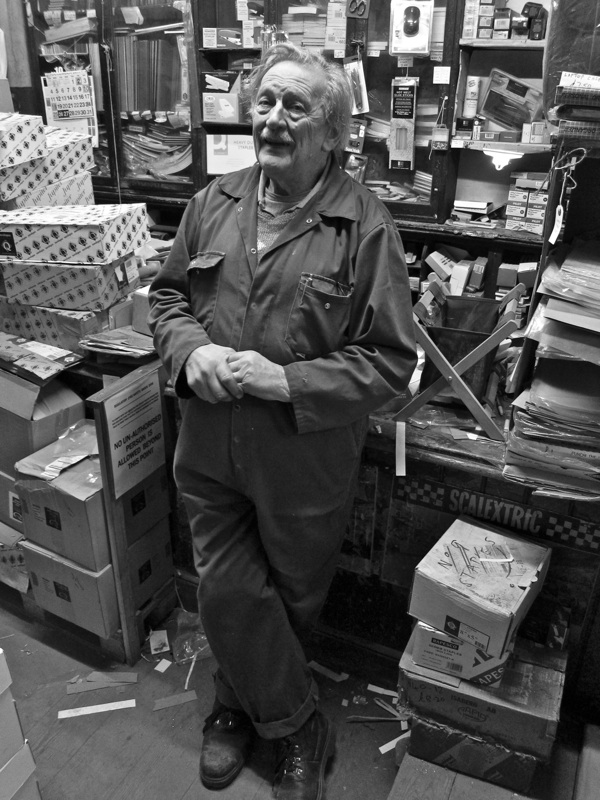
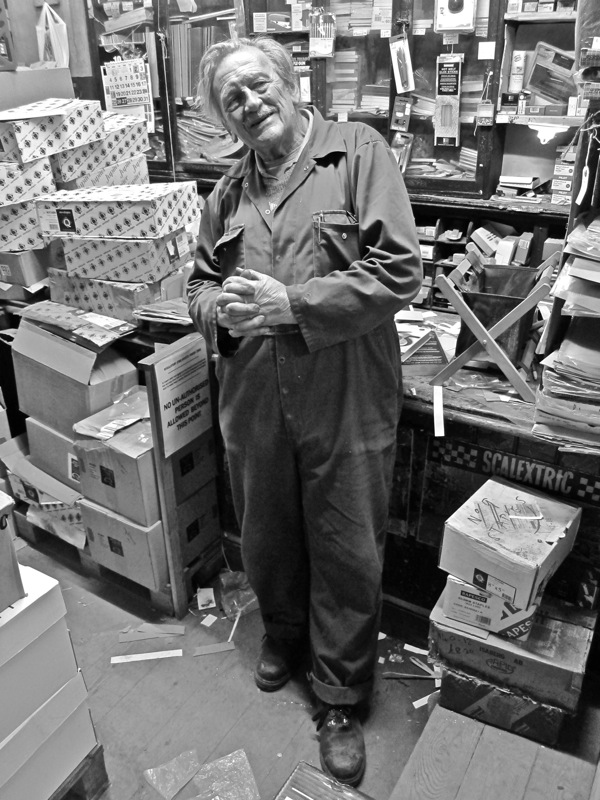
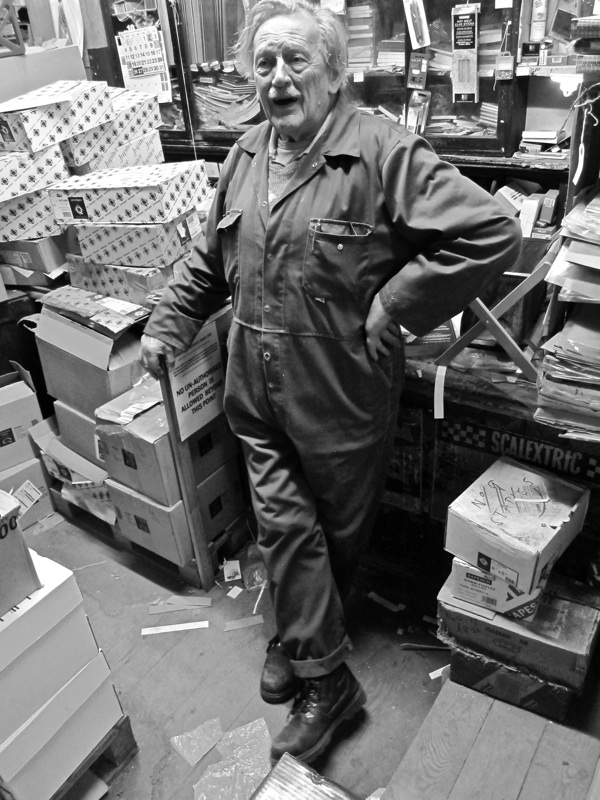
You may also like to read my original profile of Gary Arber, Printer
take a look at Gary Arber’s Collection
Chapter 8. A Verdict

As the magistrates took their seats in Shadwell on 27th December 1811, the first snow of the Winter began to fall upon London. It did not cool the enthusiasm of the crowd in the street outside, eager to catch a glimpse of the major suspect in the Ratcliffe Highway murders, John Williams, as he arrived in manacles from Coldbath Fields Prison of which this fragment of old wall in Clerkenwell Close is now the only visible remnant.
Once the hour passed at which Williams was due to arrive and when the door of the courtroom eventually opened, those inside were surprised to see not the prisoner and his guards but instead a solitary police officer with a grim expression. When the turnkey at the gaol had gone to prepare the suspect for his trip to Shadwell that morning, he discovered Williams suspended by the neck from the iron bar which crossed the cell, provided for prisoners to hang their clothes. The body was cold and lifeless, and the universal conclusion was that John Williams had passed judgement upon himself. Thus the days proceedings were undertaken on the assumption that his guilt would now be revealed.
Mrs Vermilloe was questioned again but acted strangely – she would not confirm that the maul her husband and nephew William Rice had identified was the one from John Peterson’s tool kit. Asked when she was first suspicious of John Williams, she explained it was when the socks claimed to have been worn by Williams were discovered to be bloodstained. When pushed as to why she had not revealed this before, she admitted to fearing he (or some of his acquaintances) would murder her.
Told that she need not fear John Williams any longer because he had hung himself, she exclaimed “Good God! I hope not!” The magistrate asked her why she hoped not and she replied “I should have been sorry, if he had been innocent, that he should have suffered.” Mrs Vermilloe knew more than she was prepared to say.
Once she learned Williams was dead, she changed her story, saying that it was the discovery of the initials I.P upon the maul that first drew her suspicion to him. In this transparently convenient alteration, Mrs Vermilloe began a prejudicial trend adopted by each of the other witnesses that day, which was to take the easy path of pinning guilt upon a dead man. But even this could not erase the names of those morally ambiguous individuals associated with John Williams who will always remain at the periphery of this story. John Cuthperson, John Harrison and John Richter, his room-mates, Cornelius Hart and Jeremiah Fitzpatrick, carpenters, John Cobbett, a coal-heaver and Williams’ only intimate friend, William Ablass, a tall stout seaman, commonly called Long Billy, who was lame. This last individual, Ablass, had once sailed with Williams from Rio de Janeiro on the Roxburgh Castle and witnesses had seen them together at the King’s Arms on the evening of the Williamsons’ murder. Though Ablass had an alibi for the rest of the night given by a woman at his lodging house, which led to his discharge, it was a weak piece of testimony.
Lacking any clear evidence implicating anyone else, the belief that John Williams was the sole murderer of both the Marrs and the Williamsons grew. With this belief came a powerful realisation that so monstrous a villain, multiple murderer and self destroyer, must be made into an example for the whole nation because in the end he had cheated the majesty of Law. Few had any doubt that John Williams was getting his just deserts in the next world but they also wanted to see him receive punishment here on earth too. If there was not to be the spectacle of an execution, then something else had to be devised quickly before the year’s end, because public vengeance had to be satisfied.
There will be a further report on this case before the year’s end.

Coldbath Fields Prison by Thomas Rowlandson

Click on Paul Bommer’s map of the Ratcliffe Highway Murders to explore further
The Maul & The Pear Tree – P.D. James’ breathtaking account of the Ratcliffe Highway Murders, inspired me to walk from Spitalfields down to Wapping to seek out the locations of these momentous events. Commemorating the bicentenary of the murders this Christmas, I am delighted to collaborate with Faber & Faber, reporting over coming weeks on these crimes on the exact anniversaries of their occurrence.
The Map of the Ratcliffe Highway Murders – In collaboration with Faber & Faber, Spitalfields Life has commissioned a map from Paul Bommer which will update throughout December as the events occur. Once you have clicked to enlarge it, you can download it as a screensaver or print it out as a guide to set out through the streets of Wapping.
Ratcliffe Highway Murder Walk – Spitalfields Life will be hosting a dusk walk on Wednesday 28th December at 3pm from St Georges in the East, visiting the crime scenes and telling the bone-chilling story of Britain’s first murder sensation. The walk will take approximately an hour and a half, and conclude at the historic riverside pub The Prospect of Whitby. Booking is essential and numbers are limited, so please email spitalfieldslife@gmail.com to sign up. Tickets are £10.
Thanks to the Bishopsgate Institute and Tower Hamlets Local History Archive for their assistance with my research.
You may like to read the earlier installments of this serial which runs throughout December
Chapter 1. Two Hundred Years Ago Tonight …
Chapter 3. The Burial of the Victims
Chapter 4. New Sanguinary Atrocities
Chapter 7. Three Wise Magistrates

At St Paul’s Shadwell, where the murdered Williamson family were interred at Christmas 1811.
On Christmas Day, the three Shadwell magistrates paid a call upon Mr Vermilloe, the landlord of The Pear Tree, residing in Newgate Gaol where the Old Bailey now stands. The mysterious package they carried was not a gift, it contained the iron bar used to murder Mr Williamson and the maul found at the scene of the Marrs’ murder. Mr Vermilloe confirmed both items as originating from the tool chest of John Peterson kept at The Pear Tree. However, Mr Vermilloe, who was imprisoned for debt, had his eye upon the reward money and this must cast a shadow upon his testimony.
It is unlikely that John Williams, the principal suspect, now residing at Coldbath Fields Prison in Clerkenwell, could have committed these crimes alone. Two men were seen running up towards the Ratcliffe Highway from the King’s Arms at the time the alarm of the murder was given. The shorter of the two was lagging behind and the taller man remonstrated “Come along Mahoney (or Hughie), come along.” Consequently, a suspicious Irishman by the name of Maloney had been arrested and another Irishman by the name of Driscoll, who had the misfortune to lodge near to the King’s Arms, was being held after a pair of his trousers were found to be blood-stained.
On Boxing Day, as the court convened in Shadwell, it began to sleet. Most likely based upon a tip-off from Vermilloe, John Williams’ room-mate John Richter was examined on account of a pair of his trousers that had been found hastily washed yet still stained with blood. Richter was questioned about his relationship to two Irish carpenters, Cornelius Hart and Jeremiah Fitzpatrick. Hart was the subcontractor who had worked for Mr Pugh and requested the chisel to create the new window for Mr Marr’s shop. He had been seen calling on Williams at The Pear Tree a few nights before the Marr’s murder but he denied it. Richter said he had seen Hart, Fitzpatrick and Williams together on the Sunday following the Marr’s murder.
After an adjournment, John Cuthperson, the other room-mate at The Pear Tree, revealed that on the morning after the murder of the Williamsons, he complained that a pair of his socks had been worn by someone else and caked in mud. It was John Williams who then took them into the yard and washed them.
At the end of the second day, the accumulation of statements had not clarified the picture at all. The magistrates were by no means certain that John Williams was their man and it became apparent that the case might unravel like string around a Christmas parcel. The strategy for the third day was to question Williams in relation to the stories of his confederates and see if he would betray himself, revealing guilt through inconsistency with the new testimonies. But just at the point that the judiciary were beginning to establish control of the case, all their speculations were about to be confounded for ever by something entirely unanticipated – an appalling event that would be revealed next morning.
We shall continue tomorrow, reporting upon the second day’s court proceedings in Shadwell.


Click on Paul Bommer’s map of the Ratcliffe Highway Murders to explore further
The Maul & The Pear Tree – P.D. James’ breathtaking account of the Ratcliffe Highway Murders, inspired me to walk from Spitalfields down to Wapping to seek out the locations of these momentous events. Commemorating the bicentenary of the murders this Christmas, I am delighted to collaborate with Faber & Faber, reporting over coming weeks on these crimes on the exact anniversaries of their occurrence.
The Map of the Ratcliffe Highway Murders – In collaboration with Faber & Faber, Spitalfields Life has commissioned a map from Paul Bommer which will update throughout December as the events occur. Once you have clicked to enlarge it, you can download it as a screensaver or print it out as a guide to set out through the streets of Wapping.
Ratcliffe Highway Murder Walk – Spitalfields Life will be hosting a dusk walk on Wednesday 28th December at 3pm from St Georges in the East, visiting the crime scenes and telling the bone-chilling story of Britain’s first murder sensation. The walk will take approximately an hour and a half, and conclude at the historic riverside pub The Prospect of Whitby. Booking is essential and numbers are limited, so please email spitalfieldslife@gmail.com to sign up. Tickets are £10.
Thanks to the Bishopsgate Institute and Tower Hamlets Local History Archive for their assistance with my research.
You may like to read the earlier installments of this serial which runs throughout December
Chapter 1. Two Hundred Years Ago Tonight …
Chapter 3. The Burial of the Victims
Chapter 4. New Sanguinary Atrocties
A Child’s Christmas in Devon
Over successive Christmases, as I was growing up, I witnessed the disintegration of my family until today I am the lone survivor of the entire clan, the custodian, charged with carrying the legacy of all their stories. Where once I was the innocent child in the midst of a family drama unknown to me, now I am a sober adult haunted by equivocal memories of a conflict that only met its resolution in death. Yet in spite of this, whenever I examine the piles of old photographs of happy people which are now the slim evidence of the existence of those generations which precede me, I cannot resist tender feelings towards them all.
I was an only child and, though I wished for playfellows occasionally, I do not regret it because the necessity to invent my own amusement gave me my life as a writer. Since there were just the three of us, I had quite separate relationships with my mother and my father, and I never perceived us as a family unit. My father’s parents and my mother’s father died before I was born, and so it was only when we went to visit my grandmother at Christmas that we were forced to confront our identity as part of a larger tribe.
Even the journey to my grandmother’s house, a forty minute drive over the hills, was fraught with hazard. As I lay in bed surrounded by my presents newly-unwrapped on Christmas morning, I could hear my parents in the kitchen discussing which was the greater risk – of skidding on black ice on the upland roads or getting washed away in floods surging down the valleys. Though, throughout my entire childhood, we never encountered any mishap on this journey, even if the emotional dangers of the visit were immense.
In the week before Christmas, my mother would have her hair “done” in hope of passing her mother’s inspection on Christmas Day and as we climbed into the car, even as she closed the door, she would be checking in the mirror and repeatedly asking, “Do you think my hair looks alright?” Complementing my mother’s worry over her hair was my father’s anxiety over his engine. As the owner of a series of secondhand wrecks bought on the cheap, he was reluctant to undertake any journey that involved an incline, which proved to be something of a problem in Devon. We would always arrive as late as my father could manage and, parking in the old yard in the back of grandmother’s house, pass through the wooden garden gate and walk slowly down the path in trepidation to arrive at the kitchen door.
Inside the house, my grandmother would be discovered at the scrubbed wooden table, beating something vigorously in a mixing bowl with a wooden spoon, still dressed in the fur coat and velvet turban she wore to church that morning. One memorable Christmas, she cast down the kitchen utensil as we entered. “You look a fright, Valerie! What have you done to your hair?” she exclaimed, advancing and running her fingers through my mother’s hair to dishevel it. My mother ran through the hallway, up the stairs and along the passage to lock herself into the bathroom, as she re-entered the emotional drama of her childhood in the house where she had grown up.
My grandmother had her reasons. The youngest daughter of an declining aristocratic family, without any inheritance, she married a bank manager yet hoped to reassert the fortunes of her noble line by marrying my mother off to local land-owning gentry. She felt it had been churlish of her daughter not to co-operate. Instead my mother escaped, climbing over a wall at night and fleeing from the typing and secretarial college where she had been sent when the possibility of university had been denied her. Running away to the nearest market town, my mother took a room in a lodging house, found employment at the local library and married my father, who was the centre-forward in the football team and worked as an engineer at a foundry.
My mother’s marriage was the death of my grandmother’s social aspirations. And since my grandfather gave up his position as a bank manager to go on the stage, pursuing an energetic career as a conjurer in vaudeville that led him to an early grave, she became a lone sentinel of her class. Naturally, she kept no photographs of my mother or my father or me in the house lest visiting Rotarians might see them, but once a year she invited us over as an act of Christian charity. The truth is that we were the poor relations. My father laid out the bills next to his pay packet each week and often wept in helpless anger when his meagre earnings were insufficient to cover even our modest expenses. Yet at Christmas, we wore the best clothes we had and, maintaining solidarity, did our best to keep up appearances and resist my grandmother’s insinuations.
Once emotions had subsided and I had persuaded my tearful mother from the bathroom, we convened in the drawing room for an aperitif. My uncle Richard would be arriving back from the pub full of cheery good humour after drinks with his friends in the amateur dramatics and the cricket club. Seizing this moment, “Would you like a glass of sherry?” my grandmother announced, filling with sudden enthusiasm, before adding with a tactful glance in my father’s direction, “I think I have bottle of beer for Peter.” Impoverished by the early death of my grandfather who indulged her aristocratic spending capacities, “We’ve had to cut back this year, I haven’t been able to do as much as I normally do,” my grandmother would inform us, catching my eye to indicate that I should not expect too much from her.
With saintly self-control, my father would take a seat by the fire and do his best to maintain silence in the face of this humiliation. It was only after his death that I discovered he had been born the illegitimate child of a house maid, a source of such shame that he never revealed the truth even to my mother. “None of these people have worked a day in their lives,” he would repeat to us in the car, every year on the way home, venting his vituperation and drawing further tears from my mother. In spite of the tensions of the day, she was always reluctant to leave her childhood home that held so many happy memories buried beneath the recent conflicts.
My grandmother’s house was a great source of wonder to me with its old silver, arts and crafts’ oak furniture and seventeenth century Dutch paintings, and the attics filled with stage properties and conjuring tricks. Once I could slip away upstairs, this was where I spent the hours after Christmas lunch, playing alone in the dusty chill until it was time to leave. My uncle never left his childhood home. He never worked, but lived for cricket scoring and collecting jazz records, and my grandmother waited upon him until she died, knocked over by a swinging coalhouse door one Winter night when she was eighty-four. He did not know how to make a bed or boil a kettle and, after she was gone, he grew so fat that he could not bend over to reach the floor, living ankle deep in rubbish. The last time I visited the drawing room, I discovered he had worn a path in the carpet through to the floorboards between his armchair and the television. In his room on the first floor, he had worn the mattress through to the springs and, entering the next room, I found he had done the same in there too and in the next. I remember telephoning him with the news that my father had died. “Well, I never did like Peter,” was his immediate response. Eventually, thieves broke in and stripped the house – when he could no longer get out of bed – and he lay there helpless as they carried the family heirlooms out to the truck.
There was only one childhood Christmas when we did not visit my grandmother. It was the year that a particularly virulent form of gastro-entiritis struck. My mother, my father and me, we were all afflicted with flu and lay in our beds on Christmas Day. Yet at three in the afternoon, we convened in the kitchen in our dressing gowns, clutching hot water bottles and we drank a cup of hot water together. I think it was the sweetest drink I ever tasted and I cherish the memory of that day, isolated together in our intimate cell of sickness, as my happiest childhood Christmas.
When I grew up and left home, I always returned for Christmas. Now that I live in the city and have no relatives left alive, I have no reason go back. Yet I miss them all, I even feel nostalgic about their fights and their angry words and I cannot resist the feeling they are all still there – my parents in their house, and my grandmother and my uncle in their house – and I wonder if they are having Christmas without me this year.
Chapter 6. The Prime Suspect

On Christmas Eve, a vital break in the case came when the maul used as the weapon to kill the Marrs was recognised by Mr Vermilloe, the landlord of The Pear Tree. He reported that the initials I.P. were those of its owner John Peterson, a German carpenter from Hamburg who had recently lodged at The Pear Tree and left his tool chest there for safe keeping when he returned to sea.
This breakthrough led to to John Williams. He was twenty-seven, an ordinary seaman who had once sailed with Timothy Marr on the Dover Castle. Upon his return from sea, he had taken lodgings down by the river at The Pear Tree in Cinnamon Street, Wapping – still cobbled today as it was in 1811. Although superior in education to his colleagues and possessing a fastidious, even foppish concern for his appearance, he was of quick temper and easily provoked into brawls. As well as the connection to Mr Marr, he had been seen at the King’s Arms on the evening of the murder of the Williamsons and returning to his lodging that night after twelve, he requested his room-mates to put out the candle. This circumstantial evidence was enough to lead to his arrest and remand at Coldbath Fields Prison in Clerkenwell, pending further investigation.
That very evening, John Williams was brought to Shadwell for interrogation in front of the magistrates in a crowded courthouse. John Turner, the Williamson’s lodger who had seen the killer standing over Mrs Williamson’s corpse was there but although he recognised John Williams as a regular at the King’s Arms, he could not positively identify him as the killer. The questioning moved on to the laundress who washed John Williams’ clothes. She confirmed bloody finger marks upon a shirt but was unclear of the date of this discovery. Then Mrs Vermilloe took the stand (her husband was confined to Newgate Prison for debt) and when she was overcome with emotion at being asked to identify the maul, two little boys were sent for who had been playing with it.
At this moment, John Williams was questioned about his bloody shirt only to describe a fight he had with a number of Irish coal-heavers over a card game at The Royal Oak. Next, his fellow lodgers were asked about Williams’ mysterious request to put out the candle, and it became unclear which night this incident occurred. Next, one of the boys who had been playing with the maul, William Rice, aged eleven years old, arrived. He confirmed that the maul used to kill the Marrs was the same one from The Pear Tree and he had not seen it for a month.
It was now late on Christmas Eve, and the magistrates decided to adjourn proceedings until after the holiday. At this point John Williams could contain his frustration no longer and attempted to speak – calling out a question – but was forced to desist. We shall never know what he tried to ask. Instead, he was taken back to Coldbath Fields Prison and residents of the neighbourhood were able to sleep peacefully in their beds for the first time in many weeks, secure now in the widely-held but entirely tenuous assumption that the killer was under lock and key.
You may read a further report upon the resumption of the hearing on Boxing Day.

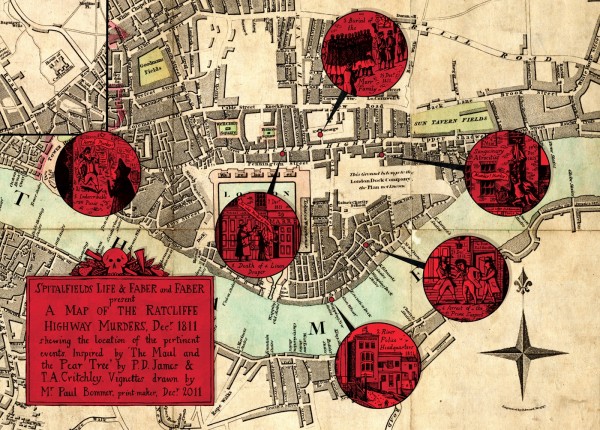
Click on Paul Bommer’s map of the Ratcliffe Highway Murders to explore further
The Maul & The Pear Tree – P.D. James’ breathtaking account of the Ratcliffe Highway Murders, inspired me to walk from Spitalfields down to Wapping to seek out the locations of these momentous events. Commemorating the bicentenary of the murders this Christmas, I am delighted to collaborate with Faber & Faber, reporting over coming weeks on these crimes on the exact anniversaries of their occurrence.
The Map of the Ratcliffe Highway Murders – In collaboration with Faber & Faber, Spitalfields Life has commissioned a map from Paul Bommer which will update throughout December as the events occur. Once you have clicked to enlarge it, you can download it as a screensaver or print it out as a guide to set out through the streets of Wapping.
Ratcliffe Highway Murder Walk – Spitalfields Life will be hosting a dusk walk on Wednesday 28th December at 3pm from St Georges in the East, visiting the crime scenes and telling the bone-chilling story of Britain’s first murder sensation. The walk will take approximately an hour and a half, and conclude at the historic riverside pub The Prospect of Whitby. Booking is essential and numbers are limited, so please email spitalfieldslife@gmail.com to sign up. Tickets are £10.
Thanks to the Bishopsgate Institute and Tower Hamlets Local History Archive for their assistance with my research.
You may like to read the earlier installments of this serial which runs throughout December
Chapter 1, Two Hundred Years Ago Tonight …
Chapter 3. The Burial of the Victims
24th December, Nativity

We all know this story, pretty much. Advent calendars end on Christmas Eve with the Nativity. A family scene, a sense of peace and calm, and mystery and magic – something we can all relate to, whether or not we are Christians. So that is it, for now. I hope you have enjoyed my Advent Calendar – I certainly enjoyed creating it. A big thank you to those who offered support, words of encouragement, suggestions and praise – I have really appreciated all the feedback. I am off for a glass or two of something sparkling and a lie-down. Advent itself ends as the magic takes place tonight.
Merry Christmas, one and all, from Paul Bommer & The Gentle Author!
Illustration copyright © Paul Bommer












