
Cambridge & Bethnal Green Boys Club Films
[youtube sWw5GqelxcM nolink]
When I interviewed football referee Maxie Lea last year, he produced a box of dusty old reels of celluloid that comprised the film archive of the Cambridge & Bethnal Green Boys Club and asked me if I knew where he could find a home for them. In due course, the collection was passed over to the Bishopsgate Institute who have transferred the eleven hours of film onto disc and next Thursday January 12th at midday they are holding a public screening. It promises to be an exciting – even emotional – occasion since many of those featured in these films will be present to offer live commentary as they see their former selves on film for the first time in over forty years.
Spanning the period from 1960 to 1972, these magical films offer a fascinating glimpse into the lost world of East End Boys Clubs. Beginning in 1924 as the Jewish Boys Club, the Cambridge & Bethnal Green Boys Club operated from premises in Chance St and had an idealistic intent at its core, adopting the motto, “serva corpus, cole mentem, animam cura,” – keep fit, cultivate your mind, think of your soul. In 1936, the Jewish prerequisite for membership of the Club was dropped, opening it to everyone, as an egalitarian response to the rise of antisemitism in the East End.
Club member Ron Goldstein, who joined in 1933, fondly appreciates the raising of expectations that was encouraged. As he admitted to me, “Half of the boys would have ended up as the next generation of gangsters and criminals if it had not been for the Club. It was our first time to mix with people who never had to work from an early age and our first chance to consider the ethical side of life. We were a bunch of young tearaways. The Club managers from Cambridge had a very upper class way of talking and we used to take the mickey, but it was different at the weekend camps, everyone dressed the same and we all mucked in together.”
Although the Club closed in 1990, there are still enough members of the Cambridge & Bethnal Green Boys Club around to remind us of its honourable endeavour – and the beauty of these playful films is that they celebrate the vibrant human quality of this project dedicated to nurturing sympathy and encouraging the best in people, despite the tyranny of circumstance.
[youtube N_guzqClZjg nolink]
[youtube s68zvBQ0hRo nolink]
[youtube Ez4wa9ScP5w nolink]
The Cambridge & Bethnal Green Boys Club Film Screening at the Bishopsgate Institute is at midday Thursday 12th January. Admission is free.
Read my other Cambridge & Bethnal Green Boys Club Stories
Maxie Lea MBE, Football Referee
Ron Goldstein, Cambridge & Bethnal Green Boys Club
At the Cambridge & Bethnal Green Boys Club 86th Annual Reunion
Ronald Searle in Spitalfields

“… furry faces peering incongruously from the jackets of hawkers.”
As a tribute to the graphic genius of Ronald Searle who died on New Year’s Eve aged ninety-one, I am republishing these drawings he made in Spitalfields in 1953 when he came here with his wife, Kaye Webb, to report upon the animal market in Club Row for their book, “Looking at London and People Worth Meeting.” A. R. J. Cruickshank wrote in the introduction, ”This book rediscovers for us some of the odd places and odd faces of London that most of us have forgotten, if we ever knew them. The warm-hearted humanity of Kaye Webb’s writing and the tender sympathy of Searle’s drawings are beautifully matched.”
Curious, considering our national reputation, that of all the street markets in London only one should sell dogs. This can be found any Sunday morning by taking a bus to Shoreditch High St and following your ears. a cacophony of whimpers, yaps, yelps and just plain barking will guide you to the spot where Bethnal Green Rd branches off to Sclater St.
There you may find them – the unclaimed pets of a hundred homes : new-born litters of puppies tumbling over each other in children’s cots ( the most popular form of window display) : “mixed bags” of less lively youngsters huddling docilely together in laundry baskets; lively-looking sheepdogs, greyhounds and bulldogs straining at the ends of leashes and furry little faces peering incongruously from the jackets of hawkers, who often look as if they’d be happier in the boxing ring.
The sales technique of their owners is almost as varied as the ware and almost always accompanied by much affectionate handling of the dogs. “It’s good for business and sometimes they mean it,” we were told by an impartial vendor of bird-seed who has been on the same pitch for twenty years. “Hi, mate, buy a dog to keep you warm!” said the man with the Chows to a pair of shivering Lascar seamen. “E’s worth double, lady, but I want ‘im to ‘ave a good ‘ome” or “Here’s a good dog, born between the sheets, got his pedigree in my pocket!” “Who’d care for a German sausage? – stretch him to make up the rations”, the salesman with the dachshund said, demonstrating too painfully for amusement.
R.S.P.C.A. interference is needed less often now. The days are gone when sores were covered with boot polish; when doubtful dogs were dyed with permanganate of potash; when, as tradition has it, you could enter the market at one end leading a dog, lose it half way, and buy it back at the other end. In fact the regular dog hawkers were never the ones to deal in stolen pets. “Stands to reason, this is the first place they’d come, and besides, look at the number of coppers there are about anyway.” But it is still possible to buy pedigree forms “at a shop down the road”, “just a matter of thinking up some good names and being able to write”.
The regular merchants, whose most frequent customers are the pet shops, are mostly old-timers ( some who have been coming for forty years and from as far away as Southend) and since a new law was passed insisting that all animal sellers should have licences, the ‘casuals’ are forbidden. But on the occasion of our visit the law had not yet been made and we passed quite a number of them. Most attractive was a red-cheeked lad with a spaniel puppy – “I call him Gyp; we’ve got his mother, but there’s no room for another, so my uncle said to come here.” Every time he was asked: “How much do you want, son?” he stumbled over his answer and hugged the dog closer. And when the would-be buyer moved on, his eyes sparkled with relief.
That day the dog section of Club Row was not very busy; it was too cold. But the rest of the market waxed as usual. Unlike its near neighbour, Petticoat Lane, Club Row Market has a strong local flavour. The outsiders who make the long journey to its “specialised streets” are mostly purposeful men looking for that mysterious commodity known as Spare Parts.
In Club Row itself are to be found bicycles, tyres, an occasional motor bike or a superannuated taxi. The police are frequently seen about here looking for “unofficial goods”. Chance St sells furniture and “junk”, Sclater St is a nest of singing birds, rabbits, white mice, guinea pigs and their proper nourishment. In the Street of Wirelesses the air is heavy with crooning, and Cheshire St is clamorous with “Dutch auctions”, or demonstrating remarkable inventions like the World’s Smallest Darning Loom (“Stop your missus hating you … now you can say ‘you might darn this potato, dear, while I have shave’ … and she’ll do it before you’ve wiped the soap off!”).
We found one street devoted to firearms, chiefly historic, and another where secretive, urgent men offered us “a good watch or knife”, implying that it was “hot” and therefore going cheap. But we had learned that this was “duffing” and the watch was most probably exactly the same as those sold on the licenced stalls just up the street.
At ten to one the market reaches a crescendo. One o’clock is closing time and many of the stallholders won’t be back until next Sunday. This is the time when the regulars know where to find bargains, but it needs strong elbows. Our way out, along Wheler St, under the railway bridge and past the faded notice which says ‘Behold the Lamb of God Cometh”, brought us back to the dog market. It was surprisingly quiet. On the other side of the road we spotted a small figure hurrying off with the spaniel puppy. It looked as if Gyp was safe for another week anyway.
I hope you will not consider it vain if I reveal that Kaye Webb gave me this book and inscribed it under the title with my name and the text ” – also a person worth meeting!” It was my good fortune that Kaye, the legendary editor of Picture Post, Lilliput and Puffin Books, was the first person to recognise my work and encourage me in my writing. When I used to stay with her in her flat overlooking the canal in Little Venice, I remember she had some of Ronald Searle’s work framed on the wall in the spare room, and I spent many hours admiring both his Japanese prison camp drawings and his portraits of the bargees from the Paddington basin.
Kaye’s marriage to Ronald Searle ended in 1967 and she died in 1995. Today, I keep my copy of “Looking at London and People Worth Meeting” on the shelf as an inspiration to me now I am writing pen portraits myself, and I sometimes think of Kaye here in these streets over half a century ago and imagine Ronnie – as she referred to him – bringing out his sketchbook in Sclater St where I buy my fruit and vegetables each Sunday.

“…the rest of the market waxed as usual” – a bookseller in action on Brick Lane
Peter Hardwicke, Signwriter (Part Two)

Over a year ago, I featured Peter Hardwicke, the talented East End signwriter who may be the last in our metropolis working solely by eye. Yet since he continues, working all this time to enhance our streets, I decided that it was time for another survey, so he may receive due credit for his more recent designs that might otherwise pass as anonymous.
Here you see Peter in Puma Court outside Cleo’s Barber Shop where he was in the process of adorning the frontage with some handsome utilitarian lettering, celebrating this modest family business begun by Kyriacos Cleovoulou in 1962 and now carried on by his children Renée, George and Panayiotis. The capitals that Peter has used for “Cleo’s” are a font which is derived from the work of one of his nameless predecessors in the early twentieth century. In fact, the adjoining building has an old faded sign which reads “Jones Dairy” in this same lettering and the work of this unknown Spitalfields master is also to be seen fifty yards away, spelling out S. Schwartz at 33 Fournier St, and may still be discerned upon the facade of the former Market Cafe, now Townhouse at 5 Fournier St.
This style of elegant yet undecorated hand-painted lettering with its subtle detail and gothic idiosyncrasy sits naturally here in Spitalfields among the eighteenth and nineteenth century buildings, and is ideally suited to the independent traders which define the nature of this area at the edge of the City. In fact, this particular alphabet has proved so popular that Peter is now designing it as the “Spitalfields” font, a unique face that has its roots in the history of this neighbourhood and gives typographic expression to the specific quality of the place. As well as Cleo’s, you can see it locally on the English Restaurant in Brushfield St and in Columbia Rd on Angela Flanders perfumery and the Columbia Pottery. Most recently, Peter painted it in the front of Tracey Emin’s new shop in Crispin St, using a soft white tone upon a dark green ground to create the visual identity for this high profile commission, which has both a vibrant graphic quality and looks like it belongs too.
When I came upon Peter in Puma Court in the week before Christmas, he was shivering in the chill and admitted to me that he was waiting for the paint to dry. So I persuaded him to join me for a cup of tea, on the principle that the paint would dry just as quickly unsupervised.
“I work outside all year round and I can deal with the cold but the rain has stopped me in my tracks – it’s unprofessional to carry on because water and paint don’t get on very well. The customers get nervous and ask, ‘Will it come off?'” Peter confessed to me as he sipped from his steaming mug, ever conscientious to finish his work before Christmas.
“For ten years, I worked for a company of general signwriting contractors doing brewery work, church and builders’ boards and generic signwriting, but I wasn’t stimulated by it, working to graphic designers’ artwork.” he explained when I asked how he came to be working solo. “I am an old school signwriter that likes to talk directly to the client to select the fonts and the colours. I’ve found it a rewarding way to work, dealing with independent shopkeepers. I like to look at the built environment and choose fonts that are sympathetic to the architecture and the surrounding cityscape. I look at the other shops and I do research.”
This is Peter’s special quality, that he pays attention to the world around him and creates work which sits naturally in the street, occupying its location boldly while being sympathetic to its neighbours. He told me that he recognises the signature of around ten unnamed signwriters whose work is visible in the East End and who have been his predecessors over the last century. “When I look at Jones Dairy and S.Schwartz, I can tell it’s the same guy by the spacing and I feel sympathy with him,” he confided to me with a sentimental smile.
Yet Peter’s biggest influence was the signwriter he was apprenticed to, Ted Ambridge. “My boss, he was the champion,” Peter assured me, “He had very good contacts in Watney Combe Reid and Truman’s and he got the contracts for most of the pubs in the East End. He did the Ten Bells in Commercial St, and we painted The Gun in Brushfield St together. He did the board telling the history of the pub and I did the generic figure work.”
Peter Hardwicke understands the culture of East End signwriting. Working placidly, he paints his lettering straight onto the frontage with a fluency that is his alone. It is a kind of magic. Everything fits, the balance and rhythm of the work is perfect – this is Peter’s gift. His work becomes part of the building, rather than merely sitting upon the front, it completes the structure and the shop frontage looks properly dressed to face the world. In streets like Columbia Rd, where Peter did almost all the shops, the effect is tangible – Peter’s work improves the street.
The vindication of Peter’s talent is that he is in greater demand than ever before. “I think people are bored with computer generated artwork,” he said as stood up to return to his work, “even my younger clients, they’d rather have it done professionally than use stick on letters – it shows they’ve got taste.”
Below you can see a selection of Peter’s work in the vicinity and you can view his archive here.

Peter paints the “Spitalfields” font – perfect without guidelines or templates.

Peter Hardwicke at work in Crispin St.

Emin International, Crispin St

Treacle, Columbia Rd

The English Restaurant, Brushfield St

Laxeiro, Columbia Rd

Jones Dairy, Ezra St

The Painted Lady, Redchurch St

Columbia Pottery, Columbia Rd

Glitterati, Columbia Rd

Val’s Sandwich Bar, Columbia Rd

Angela Flanders, Columbia Rd

Labour & Wait, Redchurch St
Photographs copyright © Jeremy Freedman
You may like to read my original story Peter Hardwicke, Signwriter
and take a look at The Signs of Old London
Chapter 10. Epilogue

In the months after the burial of John Williams at the crossroads in Shadwell on 31st December 1811, some further evidence came to light. A search of The Pear Tree revealed a jacket with a bloodied pocket, blood stained trousers abandoned in the privy and a bloody French knife hidden in a mouse-hole – the knife that could have been used to slit the victims’ throats. However none of these items could be incontrovertibly connected to John Williams.
Most interesting was the testimony of the Captain of the Roxburgh Castle upon which Williams and William Ablass had sailed together out of Rio de Janeiro. They were a very bad crew, with Ablass – a violent character among the very worst of them, imprisoned in Surinam for leading a mutiny. Ablass was held in chains on suspicion of being Williams’ accomplice to the Shadwell murders but released without sufficient evidence to charge him. The two men escaping up New Gravel Lane after the murder of the Williamsons were described as one short and one tall, but both Williams and Ablass were tall, which means if Williams was guilty then Ablass must be innocent, it was concluded. The converse deduction was not addressed.
In writing these episodes over the last month retelling the story of the Ratcliffe Highway Murders, I am primarily indebted to the conscientious work of P.D.James and T.A. Critchley in their shrewdly written book The Maul and the Pear Tree published by Faber & Faber, which stands as the definitive account, and I strongly recommend it to all who wish to learn the fuller story. In 1811, the systematic approach to crime solving that we recognise today – of suspects, clues, motive and alibi – was simply not in existence. Yet P.D.James and T.A. Critchley succeed in organising the arbitrary random scraps of evidence that survive into a coherent picture on the lines of our modern approach, and creating an exciting narrative in the process. They suggest that John Williams himself could have been an eighth victim – despatched by the killers in a staged suicide to shut him up and prevent their detection. Though to my ears this sounds overly contrived, after studying this story, I understand that it is irresistible to speculate upon a mystery that remains one of the greatest unsolved crimes in our history. You must read the book and draw your own conclusion.
Both multiple murders were on commercial premises within a quarter mile of each other and there is sufficient evidence to confirm more than one culprit. Immediately, this excludes the notion of a random diabolic psycho-killer on the loose and instead suggests organised crime, a protection racket of intimidation – which is entirely credible in such a bad neighbourhood with a high proportion of transients and little policing.
It is likely that Mr Marr knew that the oyster shop and bakers would be shut when he sent Margaret Jewell, the servant girl, out on 7th December, because he needed privacy for whatever negotiation was to take place with his expected guests at midnight. And in doing so, Mr Marr saved the girl’s life. It is possible that Mr Marr took the chisel himself – when it went missing – to keep it as self-defence from persons unknown. This would explain its re-appearance on the night of the murder and why it was clean and untouched with blood. It is established that Mr Marr was in debt and sailed on the Dover Castle with Cornelius Hart, the carpenter who used the chisel to construct the new shop window and who was connected to the Pear Tree through John Williams. To me, there is the hint of a hidden narrative here weaving these characters together, and maybe of the resurgence of some old grievance from Mr Marr’s seafaring days.
Intimidation alone cannot account for the extremity of the violence, but it could if the negotiation had turned bad and led to the killing of Mr Marr and his shop assistant, and then Mrs Marr too as witness. If there happened to be an unhinged individual with a violent murderous tendency among the group – someone like William Ablass – that alone can explain the murder of the baby. In this context, the Williamsons’ subsequent murder may be comprehended as damage limitation, if somehow they had learnt the truth of the earlier killings.
It appears that a principal witness, Mrs Vermilloe, the landlady of the Pear Tree, had been intimidated or threatened and also that she was convinced of the innocence of John Williams. To me, John Williams’ suicide speaks of his expectation of the outcome of any trial, irrespective of whether he was guilty or innocent. He took his own life rather than live through the ordeal that he knew lay ahead.
This fascinating tale – of which we shall never know the truth – speaks of a Britain not so long ago when the metropolis grew rapidly and the first national media had come into existence but there was no police force yet. Nowadays, Mr Marr’s financial dealings and phone records could be scrutinised, and the maul analysed for fingerprints and DNA, and the Ratcliffe Highway (now known simply the Highway) has CCTV cameras installed.
It was the widespread public unease generated by this case, driven by the universal terror of killers in the night and encouraged by the press reports that turned the Ratcliffe Highway Murders into the first national crime sensation, which contributed directly to the establishment of the Metropolitan Police in 1829. Such was the association with violence that the name of “Ratcliffe” was dropped from maps over time. Today, traffic thunders along the Highway past the headquarters of News International, occupying the site of former London Docks just fifty yards from the location of the Marrs’ shop.
John Williams’ body was exhumed a hundred years later when a water main was installed in Cable St and his skull was kept for many years as a curiosity behind the bar in the public house at the crossroads. In recent years, The Crown & Dolphin has been converted to flats but I have not been able to discover what became of the skull. Does anyone know?

Click on Paul Bommer’s map of the Ratcliffe Highway Murders to explore further
The Maul & The Pear Tree – P.D. James’ breathtaking account of the Ratcliffe Highway Murders, inspired me to walk from Spitalfields down to Wapping to seek out the locations of these momentous events. Commemorating the bicentenary of the murders this Christmas, I have been delighted to collaborate with Faber & Faber, reporting on these crimes on the exact anniversaries of their occurrence.
The Map of the Ratcliffe Highway Murders – In collaboration with Faber & Faber, Spitalfields Life commissioned this map from Paul Bommer. Once you have clicked to enlarge it, you can download it as a screensaver or print it out as a guide to set out through the streets of Wapping.
Thanks to the Bishopsgate Institute and Tower Hamlets Local History Archive for their assistance with my research.
You may like to read the earlier installments of this serial
Chapter 1, Two Hundred Years Ago Tonight …
Chapter 3. The Burial of the Victims
Chapter 4. New Sanguinary Atrocities
Chapter 5. Indescribable Panic
The Book of Spitalfields Life

It is my delight – on this New Year’s Day – to announce the news to you that the book of Spitalfields Life will be published by Saltyard Books (an imprint of Hodder & Stoughton) on March 1st. For over a year, I have been working to bring this mighty four hundred and fifty page book into existence, and here you will find one hundred and fifty of your favourite stories, published as a handsome illustrated hardback designed by distinguished typographer David Pearson.
Everything you seek in London can be found in this book – street life, street art, markets, diverse food, immigrant culture, ancient houses and history, pageants and parades, rituals and customs, traditional trades and old family businesses. Spend a night in the bakery at St John with baker Justin Piers Gellatly, ride the rounds with Kevin Read the Spitalfields milkman, drop in to the Golden Heart for a pint with landlady Sandra Esqulant, meet Paul Gardner the fourth-generation paper bag seller, Steve Brooker the mudlark who discovers treasure in the Thames, Bill Crome the window cleaner who sees ghosts and Alan Hughes the master bell-founder whose business started in 1570. In these pages, you can join the bunny girls for their annual reunion at The Grapes, visit the wax sellers of Wentworth Street and the curry chefs of Brick Lane, and discover the site of Shakespeare’s first theatre in Shoreditch.
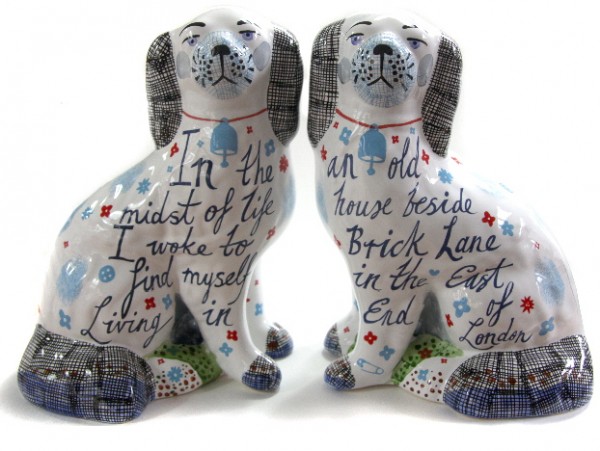
As you can see, Rob Ryan made these fine Staffordshire dogs to grace the cover and it has been a pleasure to collaborate with him on a set of bells that tintinnabulate throughout the book as colophons to divide the stories one from another. Equally, it has been my privilege to work with Lucinda Rogers, commissioning her to make a suite of six large detailed drawings of the streets of Spitalfields which will be published in the book as double page spreads. Finally, to complete the trio, Mark Hearld – a favourite artist whose work is new to Spitalfields Life – has contributed lyrical images of the creatures that share our neighbourhood, the cats, rats, foxes and pigeons – as well as magnificent endpapers of the rooftops of Spitalfields.
Alongside prime examples of the work of Spitalfields Life Contributing Photographers, Sarah Ainslie, Lucinda Douglas-Menzies, Jeremy Freedman, Phil Maxwell, Patricia Niven and Martin Usborne, you will find the first publication of photographs by Mark Jackson & Huw Davies recording the last year of the Fruit & Vegetable Market, George Gladwell’s pictures of Columbia Rd Market in the 1960s and the Society for Photographing the Relics of Old London’s images of London in the 1880s.
When I set out to write my daily stories of Spitalfields Life in 2009, I had hardly written prose before and I did not know where it would lead, but it was my intention to pursue the notion of recording the stories that nobody else was writing. Although it was not in my mind that this would become a book, over time many readers wrote asking for a collection of these stories and then, in the Summer of 2010, several esteemed publishers came over to Spitalfields to discuss the notion of publication in print. Meanwhile, I discovered that Elizabeth Hallett, editor of a select list of titles at Saltyard Books, had subscribed to Spitalfields Life and been reading it daily from within a few weeks of commencement, and so I was happy to accept her as my publisher.
More than a year ago, I promised to invite you – dear readers – to a wonderful party in Spitalfields to meet all the infinite variety of people that you have been reading about in these pages, and now it is time to issue that glorious invitation. On the evening of Friday 2nd March, please join me in Nicholas Hawksmoor’s towering masterpiece of Christ Church, Spitalfields at a gathering to celebrate the people of Spitalfields, as we launch this book of their stories into the world.
Your loyal servant
The Gentle Author
 You may also like to read about
and watch this short film introducing the Art of Mark Hearld.
Chapter 9. A Shallow Grave

John Williams was buried here outside The Crown & Dolphin at the junction of Cannon St Rd and Cable St on 31st December 1811. It was a tradition for a murderer who committed suicide while awaiting execution to be buried at the crossroads nearest the scene of their crime, with a wooden stake driven through the heart – and this was the ultimate fate of John Williams.
This practice – which was not unusual at the time – had its roots in folklore and the superstitious belief that only by driving a stake through the heart could the ghost of the murderer be prevented from returning to earth to plague the living. Even if the spirit were able to break free of the impaling stake, it would hover eternally irresolute at the crossroads. Although there was no legal authority for this custom, it was in this instance sanctioned personally by the Home Secretary, along with permission for a procession displaying the body publicly, prior to burial.
Londoners had been cheated of the spectacle of a public execution, so instead they were able to enjoy a parade. On the night before, the Deputy Constable of St George’s-in-the-East sat alone in a hackney coach with the dead body, transporting it from Coldbath Fields Prison in Clerkenwell over to Shadwell. The blinds of the coach were shut because if the body were exposed to the eyes of the mob there was little chance that it would survive intact. It must have been a grim ride.
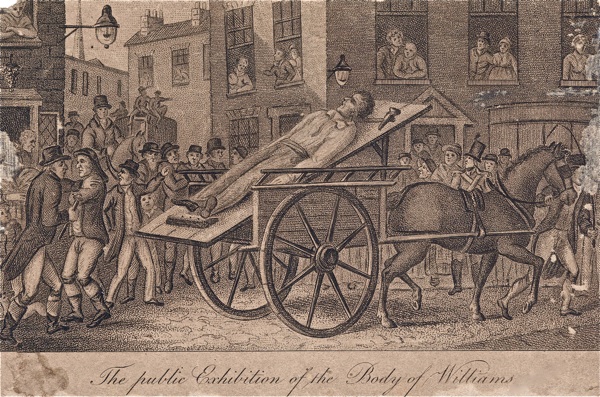
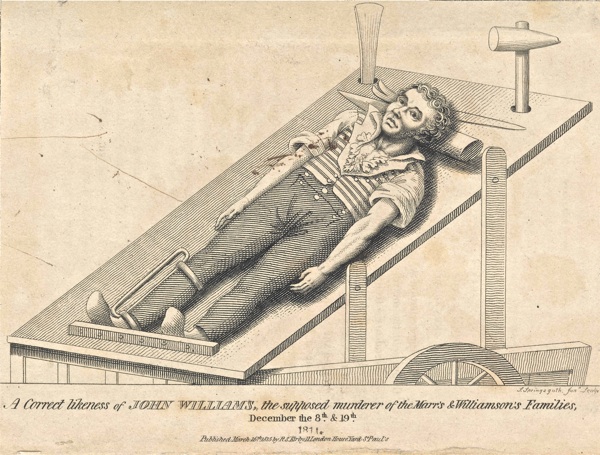
On the morning of New Year’s Eve, John Williams’ body was attached to a cart specially rigged with a raked platform allowing maximum exposure to the crowd, and with the maul and the chisel displayed on either side of his head. Above his head was affixed the iron bar used to kill Mr Williamson and at the back of the neck, the sharpened stake was placed ready for use at the burial. Travelling along the Ratcliffe Highway past the Marrs’ draper’s shop, the procession set out on a journey around Wapping, taking in The Pear Tree and The King’s Arms along the way. When the cart reached the draper’s shop it halted because Williams’ head lurched unexpected to one side, as if he were taking a last look at the scene of his crime. Once someone had climbed up and straightened the head, the procession went on its way. It was estimated that ten thousand people turned out to witness the parade and although the Home Secretary feared the crowd might seize the body to exact direct physical vengeance, he was mistaken because the entire proceeding passed off in macabre silence.
At the crossroads, a grave four feet deep, three feet long and two feet wide had been dug and once John Williams’ body was tumbled into this hole – made deliberately too small – one of the escorts drove the stake through his heart. As the stake entered John Williams’ heart, the silence of the crowd was finally broken and cathartic shouts and cheers filled the air. A quantity of quick lime was thrown into the hole, it was hastily filled up with earth, and the paving stones were replaced and hammered down at once.
As darkness fell upon East London, people at last felt more comfortable to venture from their homes into the dark streets of Wapping, Shadwell, Whitechapel and Spitalfields as the New Year’s celebrations got underway. But the confident verdict of the Shadwell Bench, that John Williams was the sole murderer of both the Marrs’ and Williamsons’ families, could have deceived no-one for long.
Early in the New Year, you may expect the final report on this case.

The procession passes The King’s Arms.

The procession arrives at the crossroads with The Crown & Dolphin in the background.

Click on Paul Bommer’s map of the Ratcliffe Highway Murders to explore further
The Maul & The Pear Tree – P.D. James’ breathtaking account of the Ratcliffe Highway Murders, inspired me to walk from Spitalfields down to Wapping to seek out the locations of these momentous events. Commemorating the bicentenary of the murders this Christmas, I am delighted to have collaborated with Faber & Faber, reporting on these crimes on the exact anniversaries of their occurrence.
The Map of the Ratcliffe Highway Murders – In collaboration with Faber & Faber, Spitalfields Life commissioned this map from Paul Bommer. Once you have clicked to enlarge it, you can download it as a screensaver or print it out as a guide to set out through the streets of Wapping.
Thanks to the Bishopsgate Institute and Tower Hamlets Local History Archive for their assistance with my research.
You may like to read the earlier installments of this serial
Chapter 1. Two Hundred Years Ago Tonight …
Chapter 3. The Burial of the Victims
Chapter 4. New Sanguinary Atrocities
Chapter 5. Indescribable Panic
David Kira Ltd, Banana Merchants

To anyone that knows Spitalfields, David Kira Ltd is a familiar landmark at 1 Fournier St next to The Ten Bells. Here, at the premises of the market’s foremost banana merchant – even though the business left twenty years ago – the name of David Kira still stands upon the fascia to commemorate the family endeavour which operated on this site for over half a century.
By a fluke of history, the shop that trades here now has retained the interior with minimum intervention, which meant that when David’s son Stuart Kira returned recently he found it had not been repainted since he left in 1991 and his former office, where he worked for almost thirty years – and even his old chair – was still there, existing today as part of a showroom for shoes and workwear.
This is a story of bananas and it began with Sam Kira in Southend, a Jewish immigrant from Poland who became naturalized in 1929 and started a company called “El Dorado Bananas.” Ten years later, his son opened up in Fournier St as a wholesaler, taking a lease from Lady Fox but having to leave the business almost at once when the war came, bringing conscription and wiping out the banana trade. Yet after the war, he built up the name of David Kira, creating a reputation that is still remembered fondly in Spitalfields and, since the shop remains, it feels as if the banana merchants only just left.
“When I first came to the market as a child of seven, we lived in Stoke Newington and took the 647 trolley bus to Bishopsgate and walked down Brushfield St. Every opportunity, I came down to enjoy the action and the atmosphere, and the biggest thrill was getting up early in the morning – I always remember being sent round to the Market Cafe to get mugs of tea for all the staff. When I joined my father David in 1962, aged sixteen, my grandfather Sam had died many years earlier. There was me and my father, John Neil (who had been with my father his entire working life), Ted Witt our cashier, two porters, Alf Lee and Billy Alloway (known as Billy the thief) and we had an empty boy. Our customers were High St greengrocers and market fruit traders, and we prided ourselves on only selling the best quality produce. Perhaps this was why we had a lot of customers. It was hard work and long working hours, getting up at half past four every morning to be at the market by five thirty. I used to sleep for a couple of hours in the afternoon when I got home, until about six, then I’d get up and return to bed at eleven until four thirty – I did that six days a week.
We received our shipments direct from Jamaica through the London Docks – bananas in their green state on long stalks – they arrived packed in straw on a lorry and it was very important that they be unloaded as soon as they arrived, whatever time of day or night the ship docked, because the enemy of the banana is the cold. They were passed by hand through a hatch in the floor to the ripening rooms downstairs – it took five days from arrival until they were saleable. Since the bananas came from the tropics, it was not so much the heat you had to recreate as the humidity. We had a single gas flame in the corner of each ripening room, the green bananas hung close together on hooks from the ceiling and, when the flame was turned down, a little ethylene gas was released before the door was sealed. Once they were ripened, they had to be boxed. You stood with a stalk of bananas held between your legs and struck off each bunch with a knife, placing it in a special box, three foot by one foot – a twenty-eight pound banana box.
During the sixties, dates were only sold at Christmas but in the seventies when the Bangladeshi people arrived, we started getting requests for dates during Ramadan. I contacted one of the dates suppliers and I asked him to send me thirty cases, and they were sold to Bengali greengrocers in Brick Lane before they even touched the floor. Subsequently, we sold as many dates as we could get hold of, more even than at Christmas. During this period, we also saw the decline of the High St greengrocers due to the supermarkets, however we found we were able to compensate for the loss of trade by fulfilling the requirements of the Asian community.
Eventually, they started importing pre-boxed bananas in the eighties, so our working practices changed and the banana ripening rooms became obsolete. My late father would be turning in his grave if he knew that bananas are now placed in cold storage, which means they will quickly turn black once they get home.
In 1991, when the market moved, we were offered a place in the new market hall but trading hours became a free-for-all and, although we started opening at three am, we were among the last to open. By then I was married and had children, and without the help of my father and John Neil who had both retired, I found it very difficult to cope. It was detrimental to my health – so, after a year, I sold the company as a going concern. I didn’t know what I wanted to do, but by chance I bumped into a colleague who worked in insurance and he introduced me to his manager. I realised in that type of business I could continue to be self-employed, so I trained and qualified and I have done that for the past twenty years. When I think back to the market, I only got two weeks a year holiday and I felt guilty even to put that pressure on my father and John Neil when I was away.”
Proud of his father’s achievement as a banana merchant, Stuart delighted to tell me of Ethel, the rat-catching cat – named after the ethylene gas – who loved to sleep in the warmth of the banana ripening rooms and of Billy Alloway’s tip of sixpence that he nailed to the wall in derision, which stayed there as his memorial even after he died. Stuart cherishes his memory of his time in the market, recognising it as a world with a culture of its own as much as it was a place of commerce. Today, the banana trade has gone from Spitalfields where once it was a way of life, now only the name of David Kira – heroic banana merchant – survives to remind us.

Sam Kira (far right) dealing in bananas in London and Southend.

Sam Kira’s naturalization papers.

David Kira at the Spitalfields Fruit Exchange – he is centre right in the fifth row, wearing glasses and speaking with his colleague.
 The banana trade ceased during World War II.

David Kira as a young banana merchant.

David Kira (left) with his son Stuart and business partner John Neil.

David Kira and staff.


Stuart Kira stands in the doorway of his former office of twenty years, where his father and grandfather traded for over fifty years, now part of a shoe shop.

Stuart Kira returns to the old premises today.

David Kira Ltd, 1991
First and last pictures copyright © Mark Jackson & Huw Davies, 1991
You may also like to read about
Jimmy Huddart, Spitalfields Market Porter
Peter Thomas, Fruit & Vegetable Supplier
Ivor Robins, Fruit & Vegetable Purveyor
John Olney, Donovan Brothers Ltd
Jim Heppel, New Spitalfields Market
Blackie, the Last Spitalfields Market Cat
and take a look at these galleries of pictures












