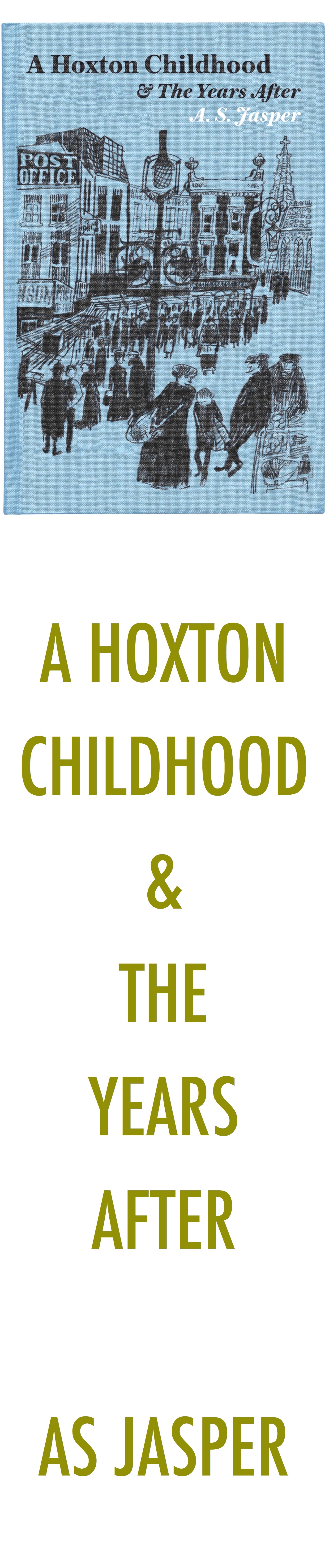
Pedro da Costa Felgueiras, Lacquer & Paint Specialist (Japanner)
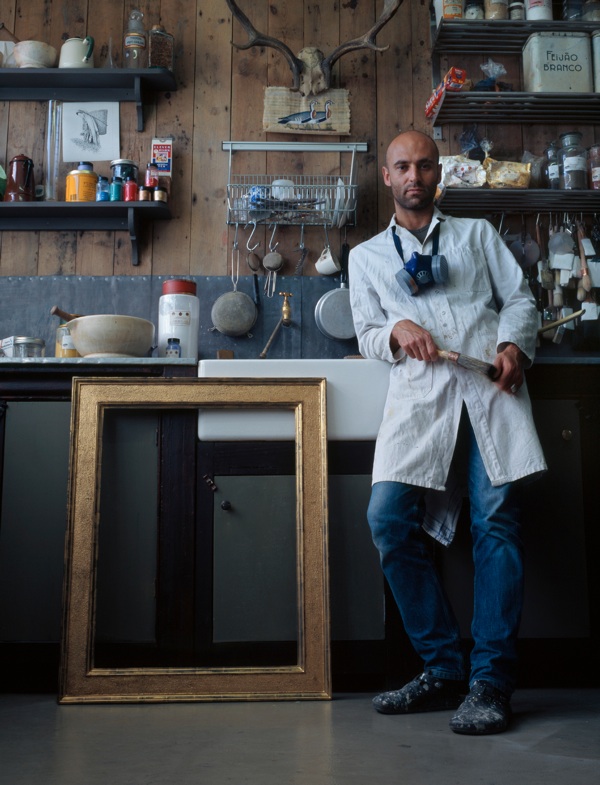
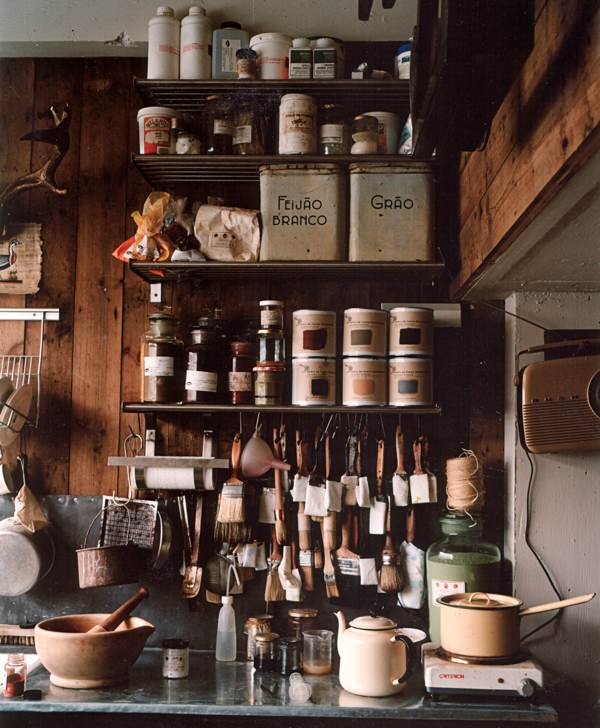
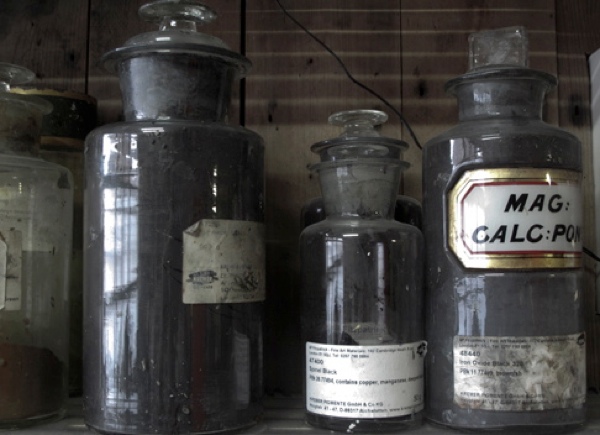
Pedro da Costa Felgueiras will tell you that he is a lacquer and paint specialist, or japanner – but I think he is an alchemist. In his secret workshop in a Hoxton backstreet, Pedro has so many old glass jars filled with mysterious coloured substances, all immaculately arranged, and such a diverse array of brushes, that you know everything has its purpose and its method. Yet even as Pedro begins to explain, you realise that he is party to an arcane universe of knowledge which defies the limits of any interview.
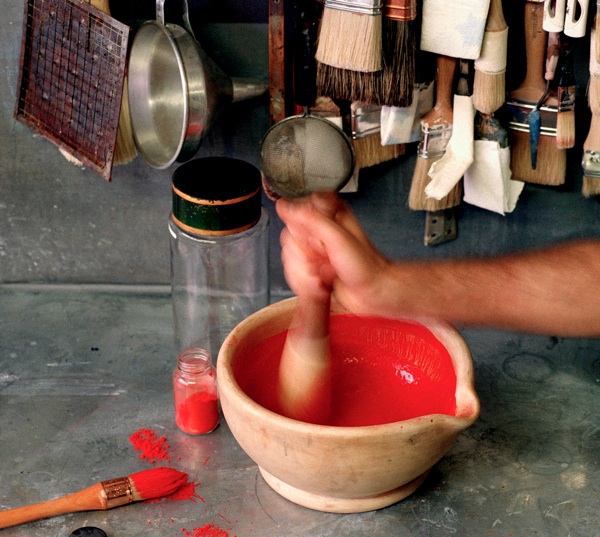
Pedro showed me Cochineal, the lush red pigment made from crushed beetles – very expensive at present due to the floods in Asia. Pedro showed me Shellac, which is created by the Kerria lacca beetle as a coating to protect its eggs and, once harvested, is melted down and stretched out in huge transparent sheets like caramel – and is commonly used to make chocolate bars shiny. Pedro showed me Caput Mortuum, a subdued purple first produced by grinding up Egyptian mummies – Whistler was so horrified when he discovered the origin that he buried the paintings in which he used this pigment in his back garden. Pedro showed me his broad Japanese lacquer brush, of the kind made from the hair of pearl divers, selected as the finest and densest fibre. Pedro showed me his fine Japanese lacquer brush made from the tail of a rat, as he delighted to explain, once he had put it in his mouth to wet it.
“I find it very difficult to get excited about new paints,” he confided to me in his hushed yet melodious Portuguese accent, as the epilogue to this catalogue of wonders, “modern colours are brighter, but they will not last, they will flake away in twenty-five years.”
“Sometimes I feel I was born a hundred years after my time.” Pedro mused, “My earliest memories are of Sunday church, and of the gold and coloured marble, which I found quite overwhelming. But everybody else wanted new things – because they were surrounded by old things, they wanted plastic.” Growing up in Queluz just outside Lisbon, it was the Baroque palace covered in statues that cast its spell upon Pedro and when he discovered the statues had been made in Whitechapel, then he knew he had found his spiritual home. “I don’t know why I ended up here,” he admitted, “I had the desire to do something with my life and I would not have been able to do that if I stayed in Portugal.”
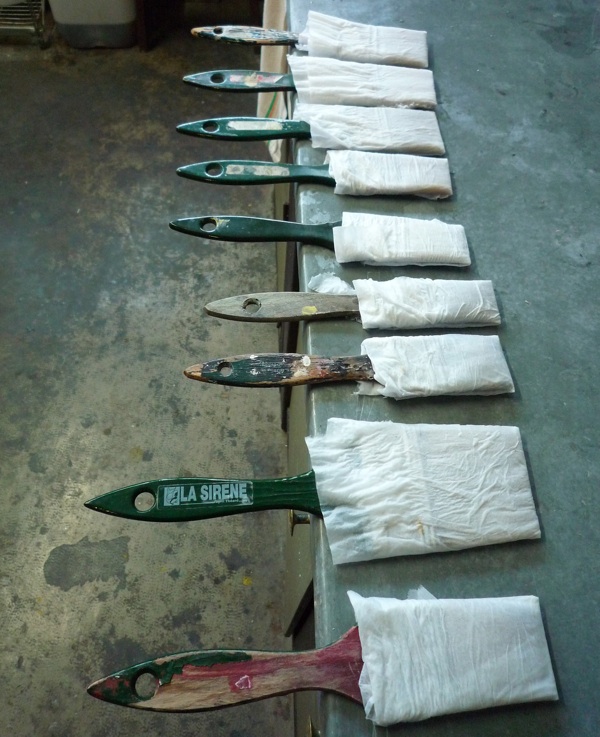
“When I first came to Spitalfields I used to walk around and look at the old houses, and now I have ended up working in many of them.” he continued, thinking back, “In London, I was fascinated by the junk markets and I bought things, and I wanted to restore them – it all came from that.” Pedro undertook a B Sc in restoration and was inspired by the work of Margaret Balardi who inducted him into the elaborate culture of japanning. “The first thing she taught me was how to wash my brush,” Pedro recalled with a grin.
“In the eighteenth century when they imported lacquer ware from the East, they started imitating it and used European techniques to do it. At first, they imported the ingredients from Japan but they couldn’t do it here and people died of it because it is poisonous,” Pedro explained, adding that he studied lacquer work in Japan and can do both Eastern and European styles. “I keep everything clean and I don’t touch it,” he assured me.
In the centre of the workshop was a fine eighteenth century lacquered case for a grandfather clock that had been cut down for a cottage when it went out of fashion in the nineteenth century. Pedro was painting the newly-made base and top, using the same paints as the original and adding decoration from an old pattern book. To reveal the finish, he wiped a damp swab across the old japanning and it instantly glowed with its true colour, as it will do again when he applies a new coat of shellac to unify the old and the new.
Using old manuals, Pedro taught himself to mix pigments and blend them with a medium, and now his talent and expertise are in demand at the highest level to work with architects and designers, creating paint that is unique for each commission. In the eighteenth century, every house had a book which recorded the paint colours used in the property and Pedro brought some of these out to show me that he makes for his customers today, with samples of the colours that he contrived to suit. There is a tangible magic to these natural pigments which possess a presence, a depth, a subtlety, and a texture all their own.
“I remember when it was a hobby and now it has become a job.” said Pedro, gazing in satisfaction around his intricately organised workshop,“You have to be diligent without cutting corners. It’s all about time. You grind the pigment by hand and it takes hours. It’s hard work. You can’t expect to paint a room in a week. It takes three days for the paint to dry and it will change colour over time – it’s alive really!”
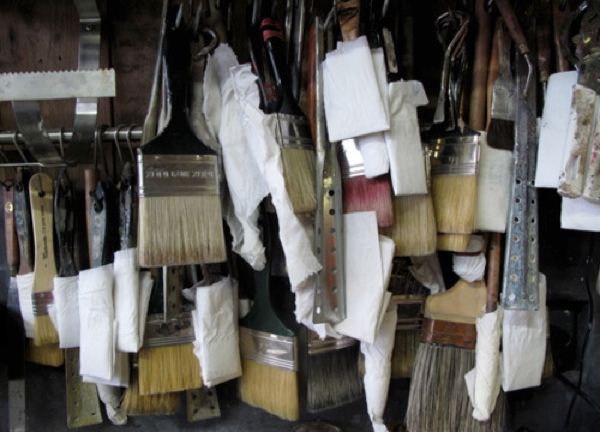
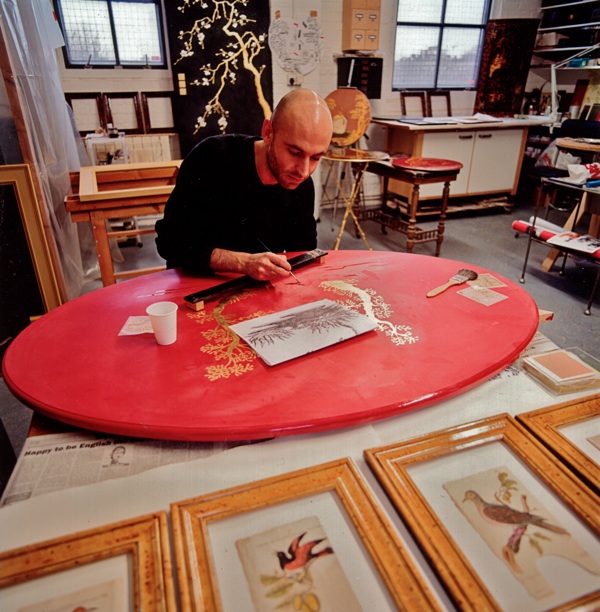
Pedro paints a lacquer table to a design by Marianna Kennedy.
You may also like to read about
At Globe Town Market Square

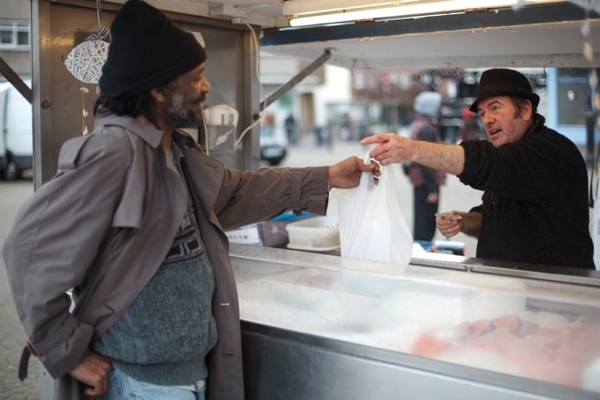
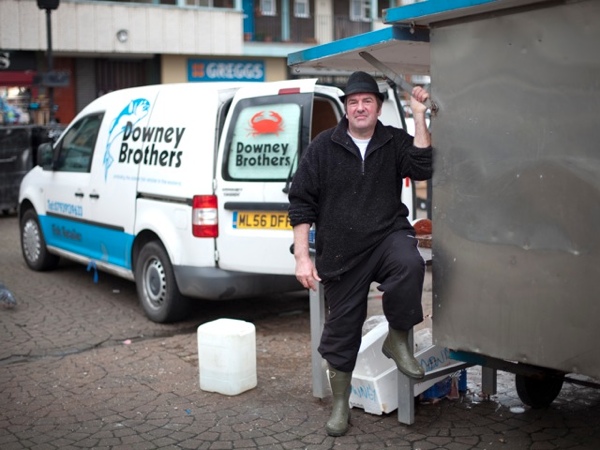
“It’s West End quality, East End prices!” declared Del Downey, third generation fishmonger, in proud response to my delight at buying a beautiful pair of fresh plaice for a mere seven pounds at Globe Town Market Square in the Roman Rd yesterday.
It was a rare flash of emotion for such a dignified gentleman. Yet when Del heard the cry of a gull overhead and placed a couple of sprats on the roof of his van, and two seagulls came and he confided to me they were called George and his wife – after his father and mother – I realised Del was a fishmonger with the soul of a poet. “I’d like to think, if there is an afterlife, it might be the spirits of my mum and dad, looking after me.” he added with a tender grin, before returning to the business of cleaning fish after this unexpected moment of poetry in the midst of the working day.
I had not come to Globe Town Market Square in search of poetry and, perhaps, this nineteen fifties shopping precinct is not the most picturesque of locations for a market. But – speaking with Del Downey the fishmonger and Leslie Herbert who sells fruit and vegetables from a collection of ancient barrows – I quickly discovered that these two traders, who have operated side by side here as long as anyone can remember, carry between them an inheritance of East End market life stretching back generations. And, if Del’s speculation is true, their forebears are still hovering overhead in the form of a flock of herring gulls.
“My family have been selling fish in the East End for a hundred and thirty years,” revealed Del, who has been in the business himself for thirty-seven years, “My grandfather Cornelius Downey had a shop in Bethnal Green opposite the Repton Boxing Club and my father George started with a stall down the Roman Rd in the nineteen thirties with his brother Harry, from when he was fifteen. I’ve seen whole generations of customers go through, from grandparents, to their children and their babies. It’s quite easy here because I know what my customers want, and how much they like to spend, before they even speak. That’s what a family business is all about.”
And then, as if in confirmation of this, Del intuited that his next customer wanted the middle part of a piece of cod, which prompted her to admit, “I’m sixty and my mum brought me here when I was a baby. I remember your dad, short, fat and handsome. I’ve been coming here all my life.” Del smiled coyly and wrapped up her fish. “See ya’ later!” she called brightly and was on her way. “I’m quite happy with the trade I’ve got,” Del confessed to me, with a private smile of satisfaction as he returned to filleting mackerel, his bare hands glowing pink in the icy cold to match his ruddy features that were as weather-beaten as those of a fisherman. Certainly there was a constant stream of custom, even as we chatted, though Del assured me that this was a quiet week because the supply of fish had not yet fully resumed after the holiday break.
“I just sell English fish, we’re an island surrounded by fish.” he said as he worked, scraping a wooden comb across the fish to remove the scales with its iron spikes and speaking half to himself, without lifting his gaze from his work, “It’s the best fish in the world and people are used to eating the best. They come and ask for the middle bit of the cod and they know they can get it – that’s the privilege of living in this country.”
Del’s neighbour Leslie Herbert’s ancestry in markets is equally noble. “It must be thirty odd years,” he exclaimed, scratching his head in puzzlement as searched back in his mind, “My family has always had fruit and veg stalls in the Roman Rd. My dad Leslie, my grandad Wally, they were all in the game and before that I don’t really know… Wally died when my dad was fourteen and then he carried on until he was eighty four. So when I left school at sixteen, I had a job and I went straight into it. I enjoy my work, I’ve never been a lazy person but as I get older I feel it a bit more. I’m sixty-one.”
“I’ve always tried to sell good stuff at a reasonable price. On Mondays, I buy the apples, oranges and lemons at the Spitalfields Market, but I go back every day to get fresh vegetables. The market opens at midnight so I have to be there by two to get the proper stuff. Then I start setting up here at six thirty and finish at two thirty. The only time I don’t set out is when it snows. The rain and the wind we can deal with it, but when it snows people don’t come out. Sundays and Mondays are my days off. In Summer, Monday is my fishing day.”
Leslie’s son Mark served the customers while he and I chatted, and Leslie showed off his wooden barrows that are more than a hundred years old. “I’ve had this once since I started,” he told me squatting down to show the carved lettering indicating the makers, Hiller Bros. Placing his hand protectively on a handmade wheel, “These can’t be replaced,” he assured me. “In the warm weather, we have to hose the wheels down otherwise the wood shrinks and the iron rims fall off.”
Leslie stood and observed the line of different races all waiting to buy fruit and vegetables at his stall. As former East Enders have moved out to the suburbs and newcomers have taken their place, he has discovered that immigrants bring a culture of home cooking which has benefited his trade, counteracting the loss of business to supermarkets. “We are always especially busy around Ramadan. Dates are a big seller,” he told me, contemplating changing times.
Del Downey sells his fish at the price his regular customers can afford and accepts a low profit margin as a consequence, because their loyalty means he is able to earn sufficient to make a modest living that he knows is reliable. Similarly, Leslie Herbert sells fruit and vegetables that are fresher and cheaper than you will find in a supermarket. So, although Globe Town Market Square once used to be full of stalls and now there are only a few, I hope there are enough people in the East End who recognise the value offered by such a market – enough to sustain these stallholders and keep this culture alive.


Leslie Herbert with his son Mark.


Carol Goggin, another celebrated stalwart of Globe Town Market Square.

Del and George, his pet seagull.

Globe Town Market Square
Photographs copyright © Jeremy Freedman
The Pumps of Old London

“We never know the worth of water till the well is dry” -Thomas Fuller, 1732
Hardly anyone notices this venerable pump of 1832 in Shoreditch churchyard, yet this disregarded artifact may conceal the reason why everything that surrounds it is there. Reverend Turp of St Leonard’s explained to me that the very name of Shoreditch derives from the buried spring beneath this pump, “suer” being the Anglo-Saxon word for stream.
The Romans made their camp at this spot because of the secure water source and laid out four roads which allowed them to control the entire territory from there – one road led West to Bath, one North to York, one East to Colchester and one South to Chichester. In fact, this water source undermined the foundations of the medieval church and caused it to collapse, leading to the construction of the current building by George Dance but, even then, there were still problems with flooding and the land was built up to counteract this, burying the first seven steps out of ten at the front of the church. Later, human remains from the churchyard seeped into this supply (as in some other gruesome examples) and it was switched over to mains water. Today, the sad old pump in Shoreditch has lost its handle, had its nozzle broken and even its basin is filled with concrete, yet a lone primrose flowers – emblematic of the mystic quality that some associate with these wellsprings, as sources of life itself.
Before the introduction of the mains supply in London, the pumps were a defining element of the city, public water sources that permitted settlement and provided a social focus in each parish. Now, where they remain, they are redundant relics unused for generations, either tolerated for their picturesque qualities or ignored by those heedless of their existence. When I began to research this subject, I found that no attention had been paid to these valiant survivors of another age. So I set out West to seek those other pumps that had caught my attention in my walks around the city and make a gallery for you of the last ones standing.
Holborn is an especially good place to look for old pumps, there I found several fine examples contemporary with the stately Georgian squares, and the Inns of Court proved rewarding hunting ground too. At Lincoln’s Inn, the porter told me they still get their water supply untreated from the Fleet river, encouraging me to explore South of Fleet St at the Temple, although to my disappointment Pump Court no longer has a pump to justify its name.
Up in Soho, at Broadwick St, you will find London’s most notorious pump, the conduit that brought a cholera epidemic killing more than five hundred people in 1854. Now it has been resurrected as a monument to the physician who detected the origin of the infection and had the pump handle removed. Today, the nearest pub bears his name, John Snow. The East End’s most famous specimen, the Aldgate Pump – that I have written of elsewhere in these pages – was similarly responsible for a lethal epidemic, underlining the imperative to deliver a safe water supply, an imperative that ultimately rendered these pumps redundant.
Perhaps the most gracious examples I found were by St Paul’s Cathedral, “Erected by St Faith’s Parish, 1819,” and in Gray’s Inn Square. Both possess subtle expressive detail as sculptures that occupy their locations with presence, and in common with all their pitiful fellows they stand upright like tireless flunkies – ever hopeful and eager to serve – quite oblivious to our indifference.
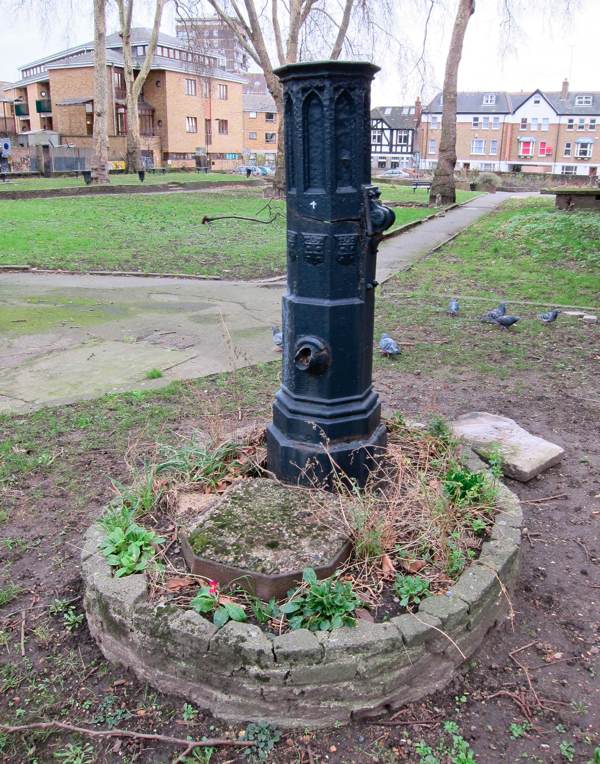
In Shoreditch churchyard, this sad old pump of 1832 has lost its handle, had its nozzle broken and basin filled with concrete, and is attended by a lone primrose.
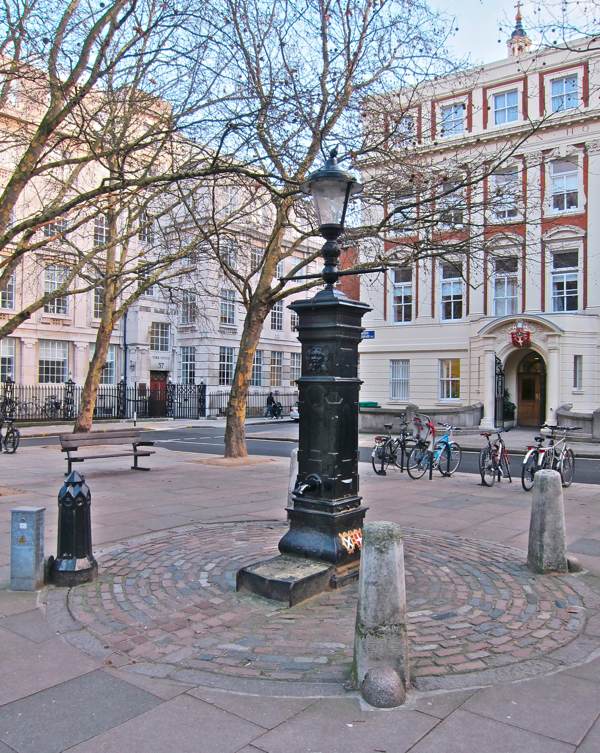
In Queen’s Sq, Holborn this pump of 1840 has the coats of arms of St Andrew and St George.
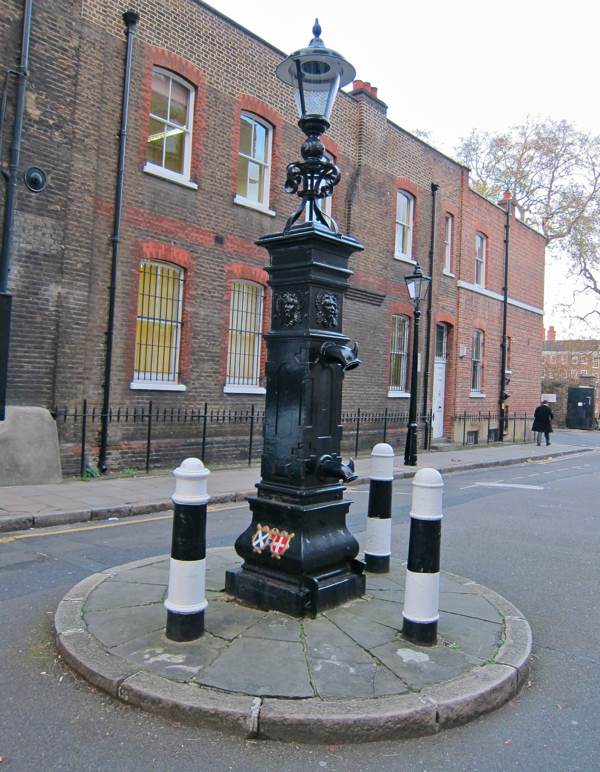
In Bedford Row, Holborn, this is contemporary with its colleague in Queens Sq.
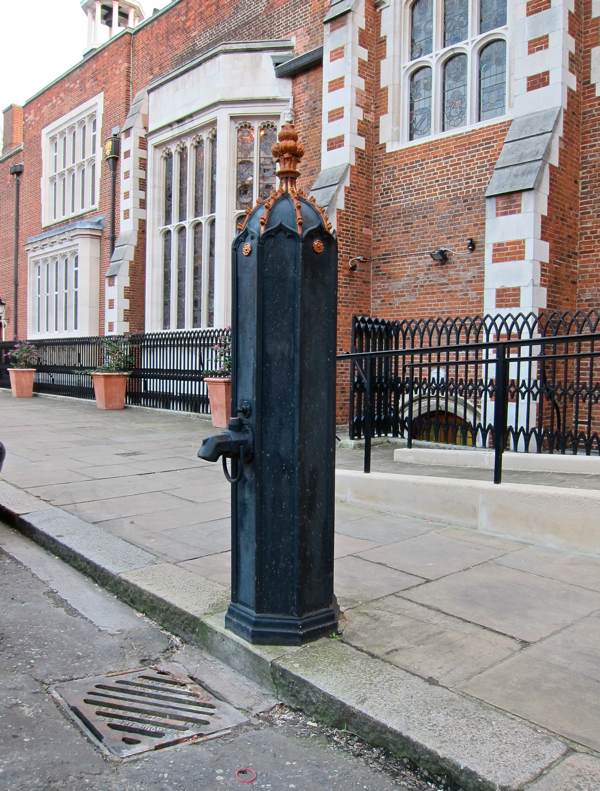
In Gray’s Inn Sq – where, in haste, a passing lawyer mislaid a red elastic band.

This appealing old pump in Staple Inn is a pastiche dated 1937.

This is the previous pump in the location above, more utilitarian and less picturesque.
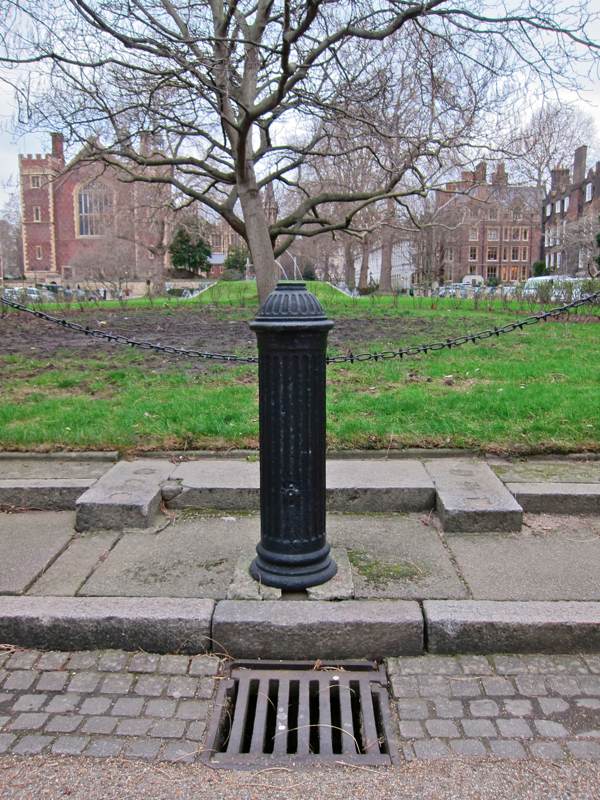
In New Square, Lincoln’s Inn.
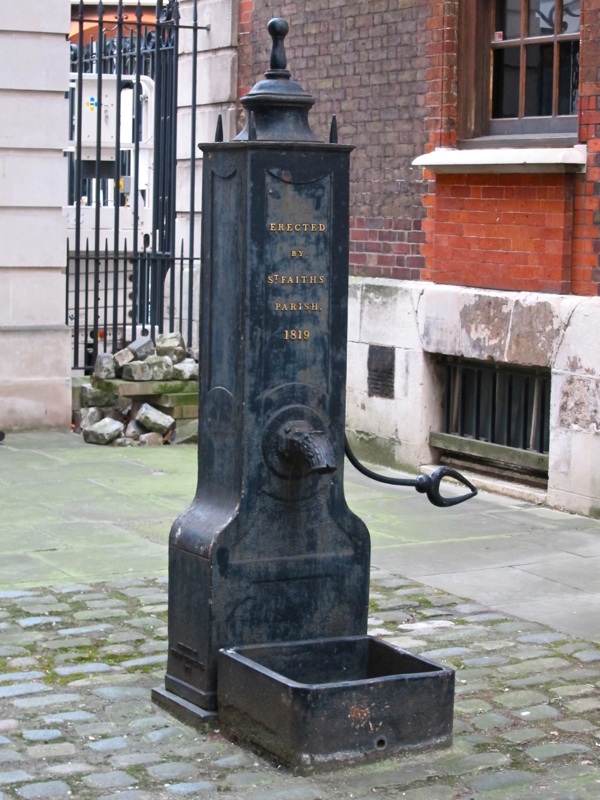
Between Paternoster Sq and St Paul’s Churchyard.
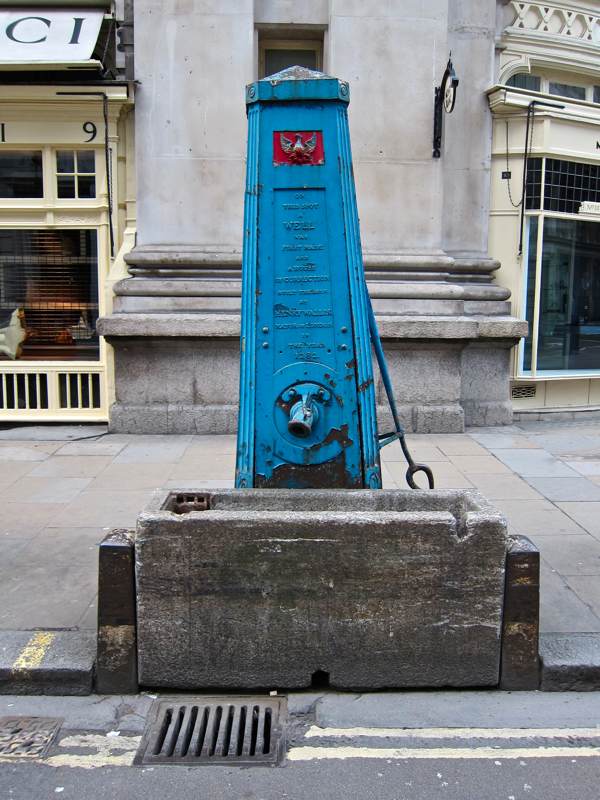
Outside the Royal Exchange in Cornhill. The text on the pump reads, “On this spot a well was first made and a house of correction built thereon by Henry Wallis Mayor of London in the year 1282.” Designed by architect Nathaniel Wright and erected in 1799.
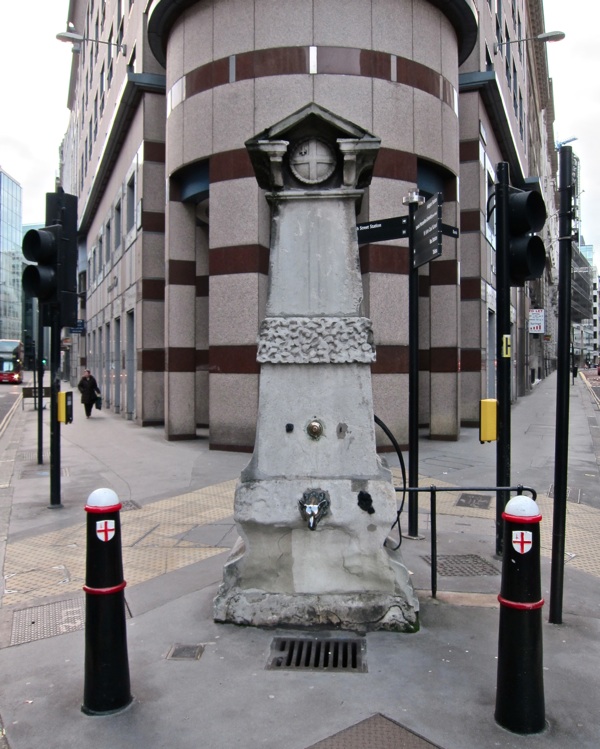
Aldgate Pump marks the boundary between the East End and the City of London. The faucet in the shape of a wolf commemorates the last of these beasts to be shot outside the walls of the City.

London’s most notorious pump in Broadwick St, Soho. Five hundred people died in the cholera epidemic occasioned by this pump in 1854. Reinstated in 1992 to commemorate medical research in the service of public health, the nearby pub is today named “John Snow” after the physician who traced the outbreak to this pump. A red granite kerbstone across the road marks the site of the original pump.
Archive image courtesy Bishopsgate Institute
You may also like the to read about
At Dirty Dick’s
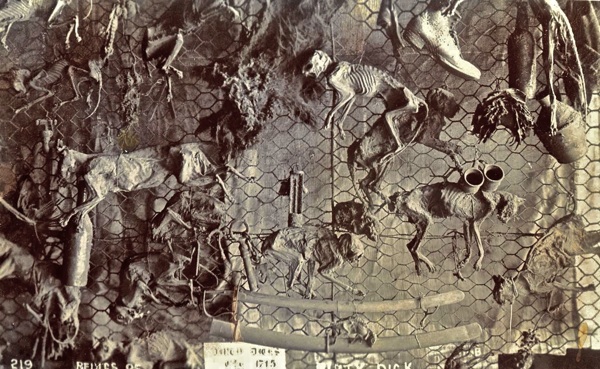
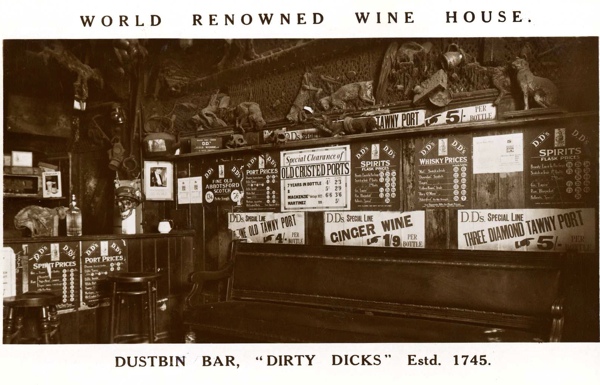
These are the dead cats that once hung behind the counter of the celebrated “Dustbin Bar” at Dirty Dick’s Old Port Wine & Spirit House in Bishopsgate. It is a location that holds a special place in my affections as the first pub I ever went into in London, one day after work at the Bishopsgate Institute.
Although this was longer ago than I care to admit and regrettably the cats in this picture had already gone by then, yet I still recall the sense of expectation, entering the narrow frontage and walking back, and back, and back through the warren of rooms with sawdust on the floor – descending ever deeper into the bowels of the city, it seemed. And I can only imagine how this strange drama might have been enhanced by the presence of umpteen dead cats suspended from the ceiling.
This was how it was described in 1866 – “A small public house or rather a tap of a wholesale wine and spirit business…a warehouse or barn without floorboards – a low ceiling, with cobweb festoons dangling from the black rafters – a pewter bar battered and dirty, floating with beer – numberless gas pipes tied anyhow along the struts and posts to conduct the spirits from the barrels to the taps – sample phials and labelled bottles of wine and spirits on shelves – everything covered with virgin dust and cobwebs.”
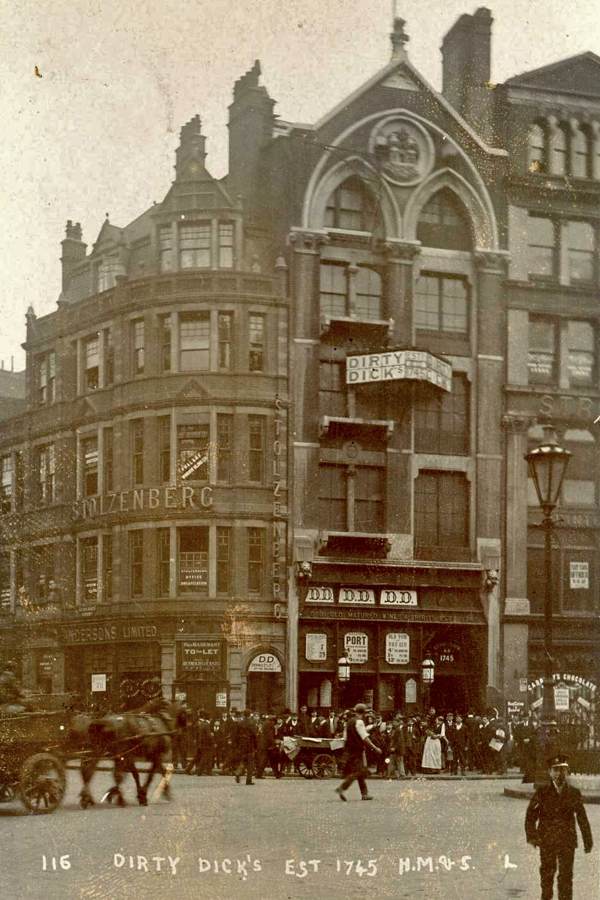
Yet all was not as it might seem, because the presence of these curious artefacts was not due to unselfconscious eccentricity, it was an early and highly successful example of what we should call a “theme pub.” Established in 1745 as The Old Jerusalem, the drinking house took the name of Dirty Dick’s in 1814 and adopted his story along with it. The original of Dirty Dick was Nathaniel Bentley, a successful merchant with a hardware shop and warehouse in Leadenhall St in the mid-eighteenth century. After his bride-to-be died on their wedding day – so the legend goes – he never cleaned up again, never washed or changed his clothes. “It’s of no use, if I wash my hands today, they will be dirty again tomorrow,” he declared. Bentley died in 1809, and the Bishopsgate Distillers appropriated this story of the notorious dirty hardware merchant, adorning their bar with dead cats and cobwebs to perpetuate the legend.
Charles Dickens knew Dirty Dick’s and was fascinated with this myth of one who sealed up the door on the wedding breakfast and left the cake and table decorations to acquire dust eternally. In a letter to the printer of his weekly publication “Household Words” dated 30th December 1852, he wrote “Don’t leave out the Dirty Old Man, he is capital.” And it has been suggested that Nathaniel Bentley was the inspiration for the character of Miss Havisham in “Great Expectations.”
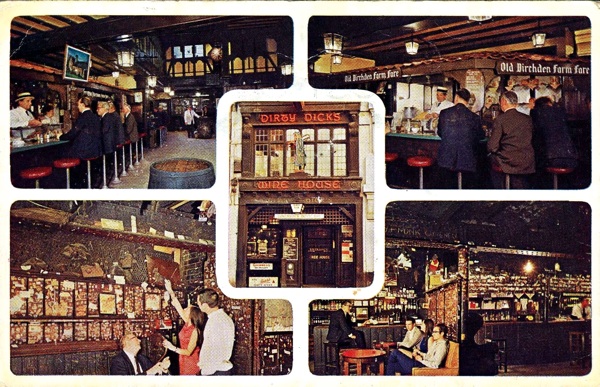
Dirty Dick’s was rebuilt in the eighteen seventies, though the cellars are of an earlier date, and now the bizarre artefacts are banished to a glass case, yet it is still worth a visit. Explore the wonky half-timbered spaces and seek out the secluded panelled rooms at the rear, where you can enjoy a quiet drink away from the commotion of Bishopsgate to contemplate the ancient coaching inns that once lined this street, long before the age of the train and the motor car.
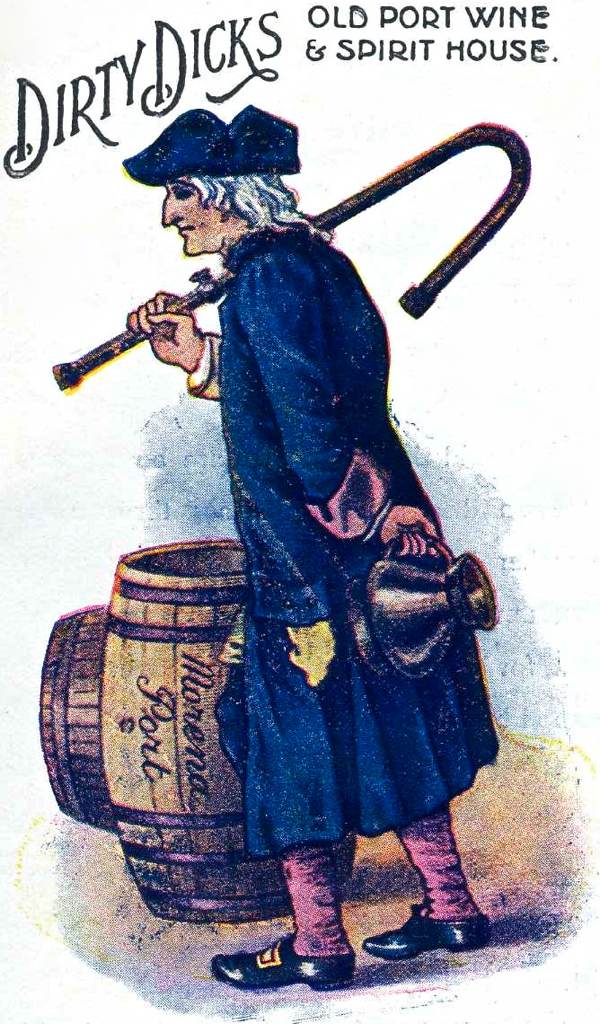
Nathaniel Richard Bentley – the origin of the myth of Dirty Dick.

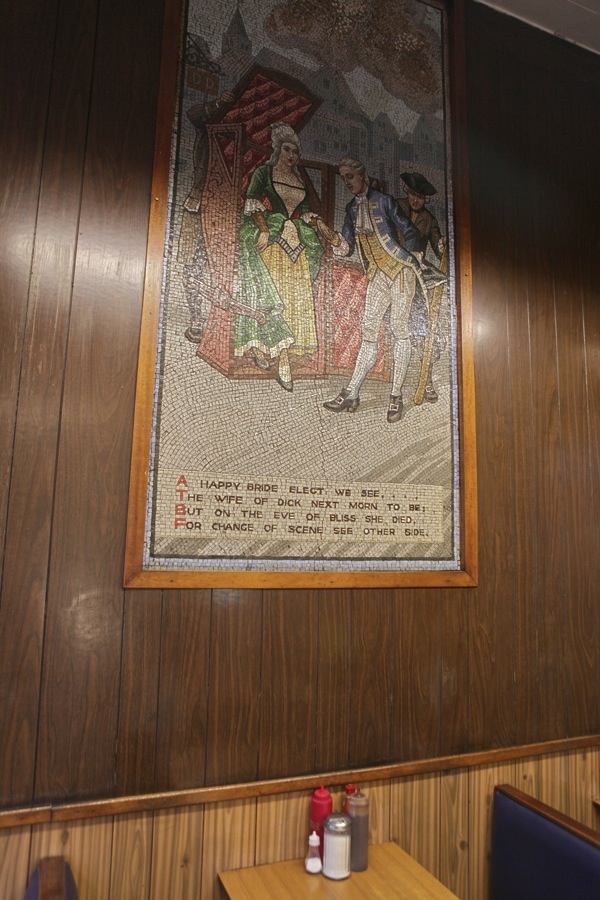
Part of the adjoining City Corner Cafe was once an alley leading into Dirty Dick’s adorned with a series of these mosaics which illustrated the tale.


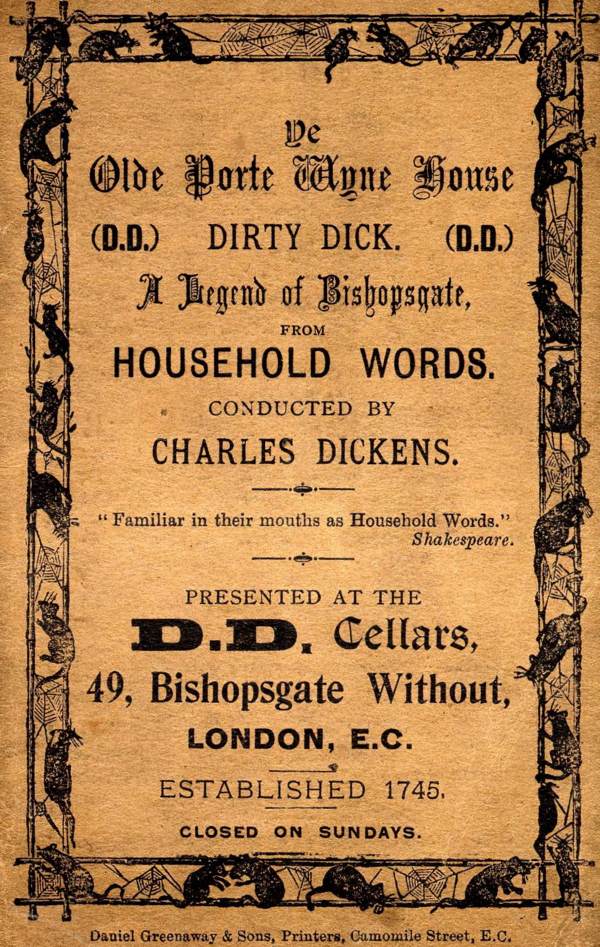
Dirty Dick by William Allingham
A Lay of Leadenhall
In a dirty old house lived a Dirty Old Man.
Soap, towels or brushes were not in his plan;
For forty long years as the neighbours declared,
His house never once had been cleaned or repaired.
‘Twas a scandal and a shame to the business-like street,
One terrible blot in a ledger so neat;
The old shop with its glasses,black bottles and vats,
And the rest of the mansion a run for the rats.
Outside, the old plaster, all splatter and stain,
Looked spotty in sunshine, and streaky in rain;
The window-sills sprouted with mildewy grass,
And the panes being broken, were known to be glass.
On a rickety signboard no learning could spell,
The merchant who sold, or the goods he’d to sell;
But for house and for man, a new title took growth,
Like a fungus the dirt gave a name to them both.
Within these there were carpets and cushions of dust,
The wood was half rot, and the metal half rust;
Old curtains—half cobwebs—hung grimly aloof;
‘Twas a spiders’ elysium from cellar to roof.
There, king of the spiders, the Dirty Old man,
Lives busy, and dirty, as ever he can;
With dirt on his fingers and dirt on his face,
The dirty old man thinks the dirt no disgrace.
From his wig to his shoes, from his coat to his shirt,
His clothes are a proverb—a marvel of dirt;
The dirt is prevading, unfading, exceeding,
Yet the Dirty Old Man has learning and breeding.
Fine folks from their carriages, noble and fair,
Have entered his shop, less to buy than to stare,
And afterwards said, though the dirt was so frightful,
The Dirty Man’s manners were truly delightful.
But they pried not upstairs thro’ the dirt and the gloom,
Nor peeped at the door of the wonderful room
That gossips made much of in accents subdued,
But whose inside no one might brag to have viewed.
That room, forty years since, folks settled and decked it,
The luncheon’s prepared, and the guests are expected,
The handsome young host he is gallant and gay,
For his love and her friends are expected today.
With solid and dainty the table is dressed—
The wine beams its brightest—flowers bloom their best;
Yet the host will not smile, and no guest will appear,
For his sweetheart is dead, as he shortly shall hear.
Full forty years since turned the key in that door,
‘Tis a room deaf and dumb ’mid the city’s uproar;
The guests for whose joyance that table was spread,
May now enter as ghosts, for they’re everyone dead.
Though a chink in the shutter dim lights come and go,
The seats are in order, the dishes a row;
But the luncheon was wealth to the rat and the mouse,
Whose descendants have long left the dirty old house.
Cup and platter are masked in thick layers of dust,
The flowers fallen to powder, the wine swath’d in crust,
A nosegay was laid before one special chair,
And the faded blue ribbon that bound it is there.
The old man has played out his part in the scene
Wherever he now is let’s hope he’s more clean;
Yet give we a thought, free of scoffing or ban,
To that Dirty Old House and that Dirty Old Man.
(First published by Charles Dickens in Household Words, 1853)
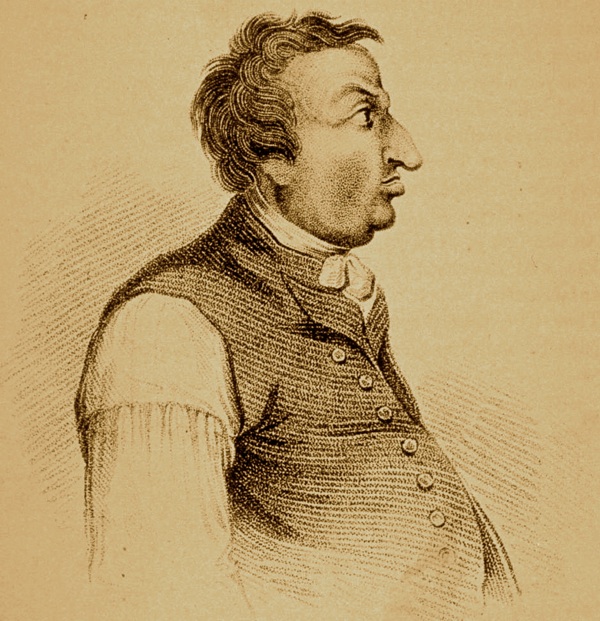
Nathaniel Bentley, Eccentric Character & Hardwareman of Leadenhall St – the well-known Dirty Dick
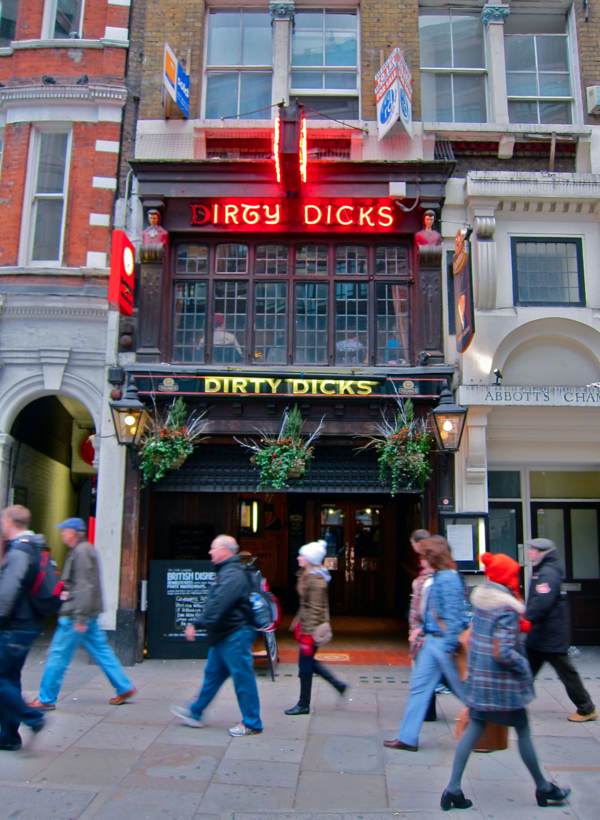
Photograph of City Corner Cafe copyright © Patricia Niven
Archive pictures courtesy of Bishopsgate Institute
You may also like to read about
The Romance of Old Bishopsgate
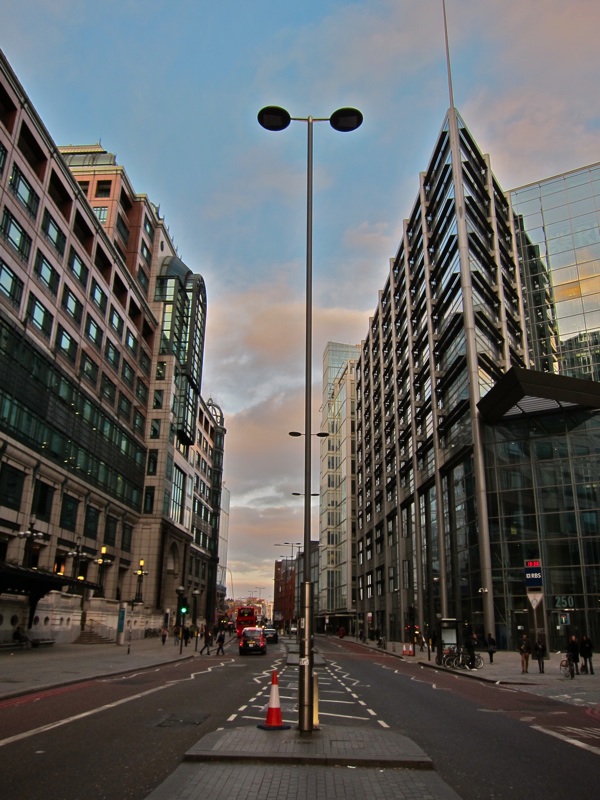
Headquarters of RBS
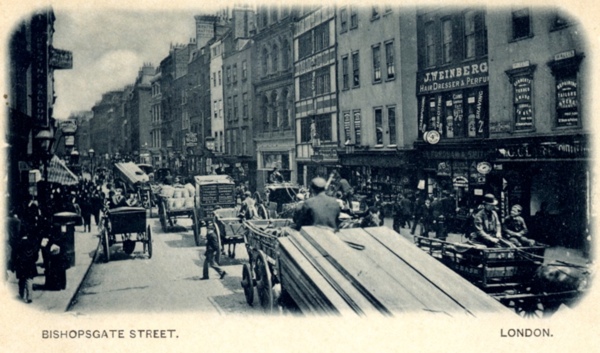
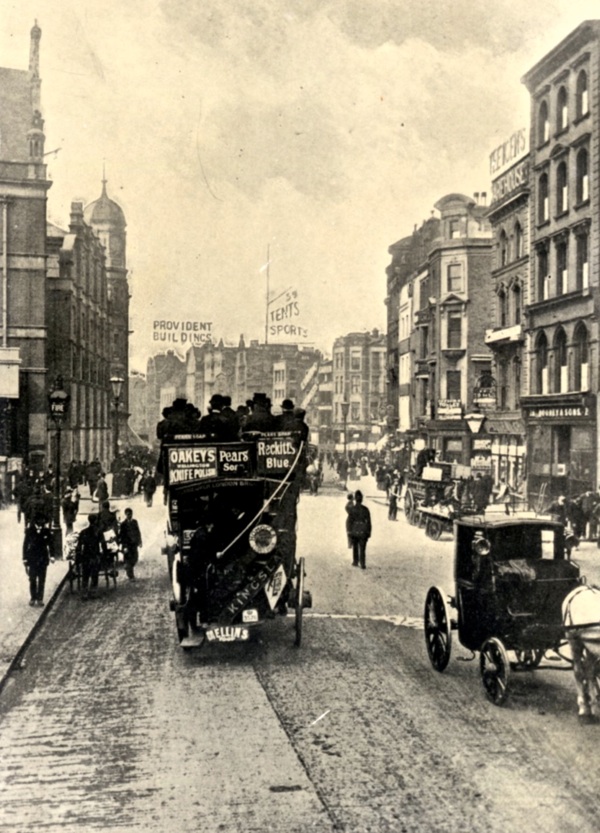
Thomas Hugo, the nineteenth century historian of Bishopsgate, wrote a history of this thoroughfare prefaced with a quote from his predecessor, John Strype in 1754 –“The fire of London not coming unto these parts, the houses are old timber buildings where nothing is uniform.” While the rest of London had been rebuilt after 1666, Bishopsgate alone retained the character of the city before the fire and in 1857 Thomas Hugo was passionate that this quality not be destroyed – as he wrote in the strangely prescient introduction to his “Walks in the City: No 1. Bishopsgate Ward.”
“This quarter, so hallowed and glorified by olden memories, is unquestionably deserving of a foremost place in our affectionate regard. Our history, our literature and our art are associated with the charmed ground in closest and most indissoluble union. You can scarcely open a single volume illustrative of our national history which does not carry you in imagination to that still picturesque assemblage of edifices where, amid its overhanging Elizabethan gables and stately Caroline facades, its varied masses of pleasantly mingled light and shade, its frequent churches and sonorous bells, the greatest and best of Englishmen have successfully figured among their fellows, and to whose adorning and embellishment the noblest powers have in all ages been devoted. And yet, unhappily, this is the spot where alterations are most commonly made, and with perhaps least regard to the irreparable loss which they necessarily involve. Here, where, for all who are versed in our country’s literature, every stone can speak of its greatness, where the name of every street and lane is classical, where around multitudes of houses fair thoughts and pleasant memories congregate as their natural home and common ground, the demon of transformation rules almost unquestioned, lays its merciless finger on our valued treasures, and leaves them metamorphosed beyond recognition only to work a similar atrocity upon some other precious object. Special attention, therefore, on every account, as well as for beauty, the value, and the excellence of that which still remains, as for the insecurity and uncertainty of its tenure, is most urgently and imperatively demanded.”
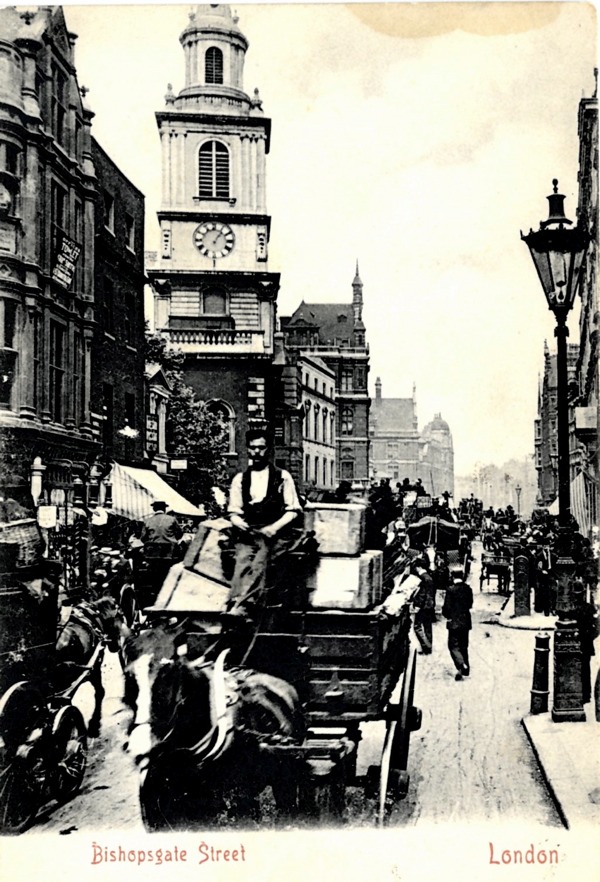
John Keats was baptised in St Botolph’s Church, Bishopsgate.

The Bishop’s Gate was on the site of one of the gates to the Roman city of Londinium, from which led Ermine St, the main road North. First mentioned in 1210, Bishop’s Gate was rebuilt in 1479 and 1735, before it was removed in 1775. In 1600, Will Kemp undertook his jig from here to Norwich in nine days.
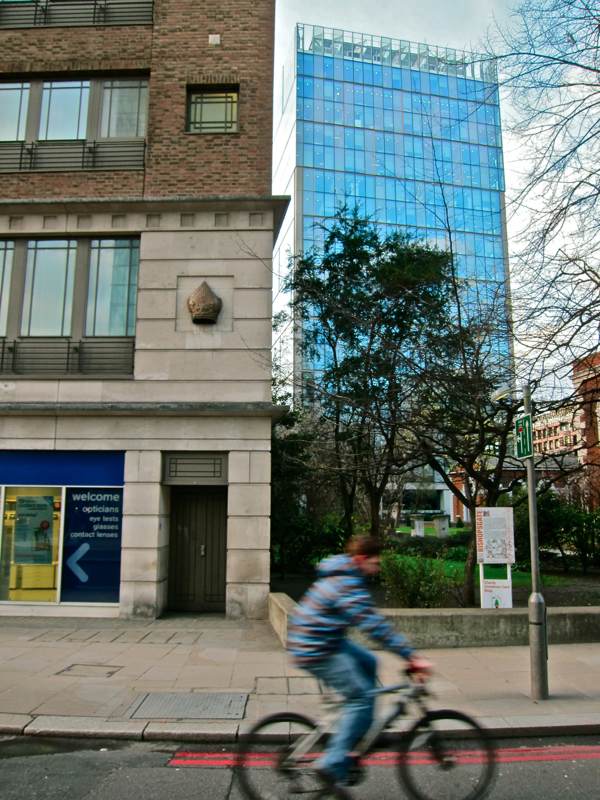
A mitre set into the wall marks the site of the former Bishop’s Gate today.
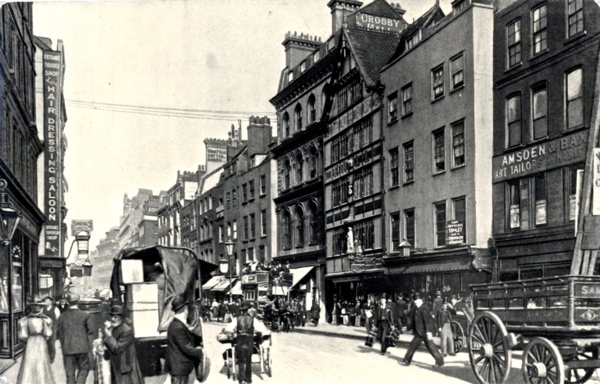
Crosby Hall, the half-timbered building at the centre of this picture was once Richard III’s palace. Other residents here included Thomas More, Walter Raleigh and Mary Sidney, the poet. Built by wool merchant John Crosby in 1466, it was removed to Cheyne Walk, Chelsea in 1910.


Elizabethan houses in Bishopsgate, 1857.
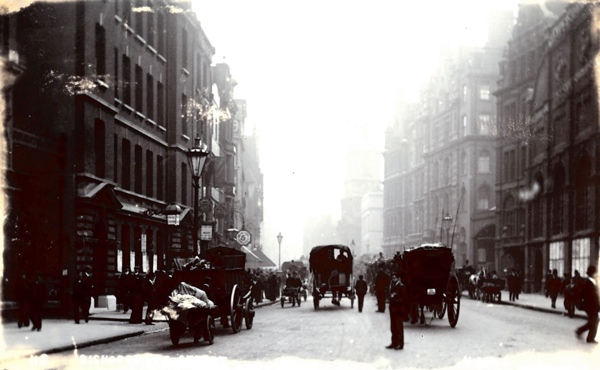
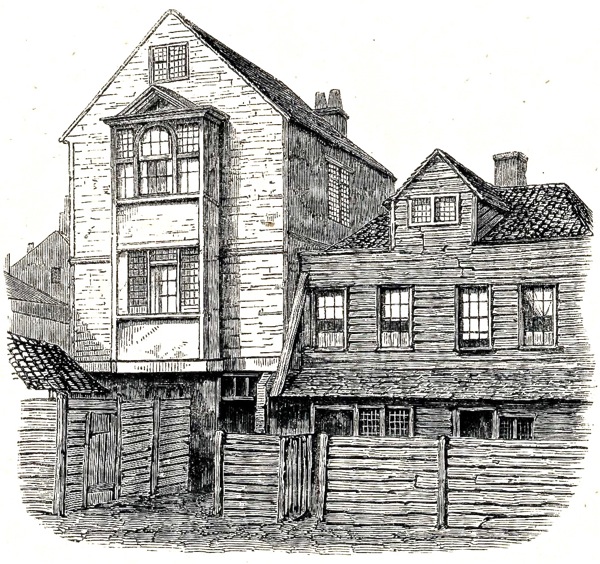
The Lodge, Half Moon St, Bishopsgate Without, 1857.
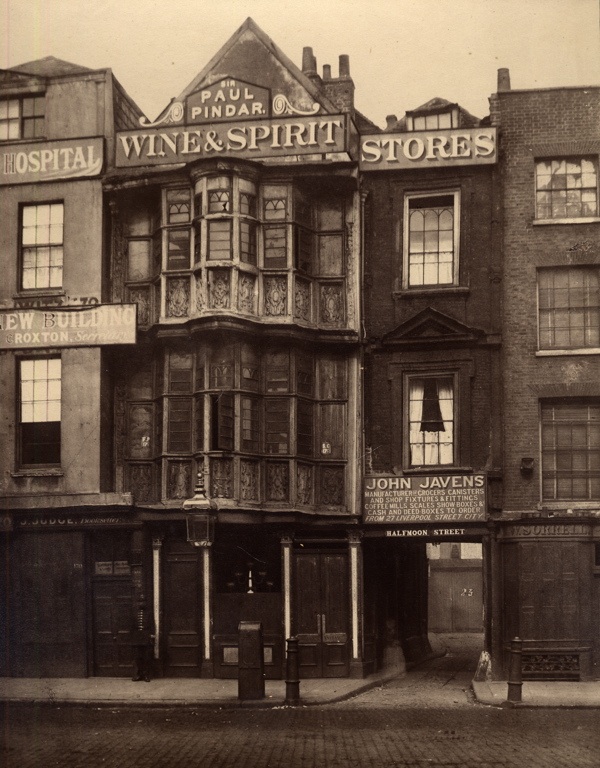
Paul Pindar’s House, Bishopsgate photographed by Henry Dixon for the Society for Photographing the Relics of Old London in the eighteen eighties. Paul Pindar was James I’s envoy to Turkey and his house was moved to the Victoria & Albert Museum in 1890.
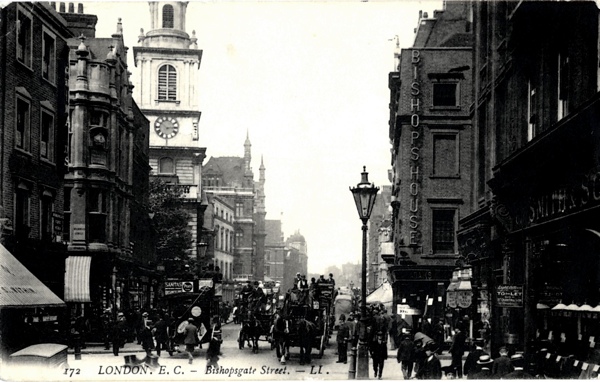

A chef takes a break in White Hart Court.
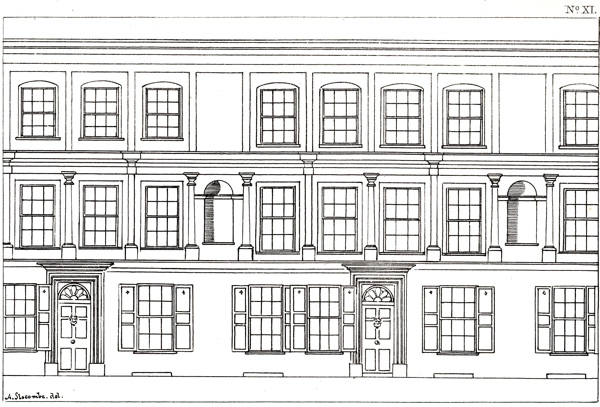
Houses designed by Inigo Jones built in White Hart Court, Bishopsgate in 1610.

Bishopsgate in the aftermath of the IRA bomb in 1993.

The newly completed Heron Tower boasts Europe’s largest indoor fish tank.
Archive images courtesy Bishopsgate Institute
You may also like to read about
Panayiotis Charalambous, Tyre Fitter
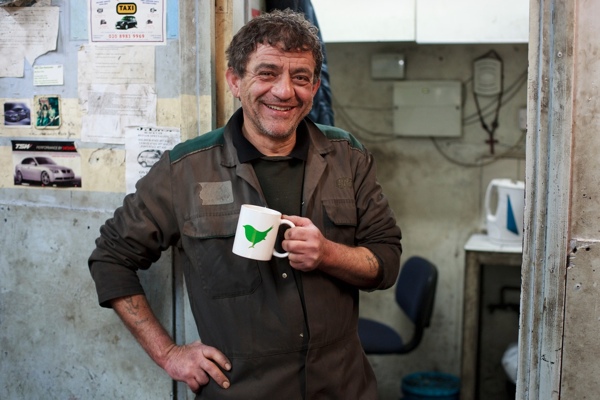
One of the friendliest places I know in the Roman Rd is D & G Autos where there is always a stream of taxi drivers lining up to get their tyres fixed and enjoying the opportunity for a chinwag. Most of the customers have been coming as long as Panayiotis has been here, which is more than thirty years, and consequently everyone feels completely at home.
This nineteen fifties shopping precinct might – at first – appear a strange location for an auto shop, but if you go around to the rear of the former butcher’s premises, you will discover the yard where the tyres get changed. This is the hub of activity, as the tyrefitters make quick work of getting the taxis back on the road while the cabbies wander in and out of the workshop, exchanging banter and seeking refuge in this safe haven from the turbulence and clamour of the city traffic.
Yet in spite of the spectacle, the most powerful sensation to greet the casual visitor is the smell of oil which permeates the air inside the shop, coating every surface with grime, casting an inky black shadow and defining the extent of this territory where no-one minds getting dirty. “You never lose the smell,” said Panayiotis, as we stood for a moment to savour the fragrant atmosphere,“when I take a week off, it really hits me!”
He and his colleagues William Boyle (known as Baldrick) and Ryan Leon wear dark clothing caked with oil, and their hands are ingrained with it too, the proud badge of their work – setting them apart from the rest of the world and engendering the playful spirit of anarchy that pervades in the auto shop. Everyone is an equal player here. The taxi drivers are their own bosses and Panayiotis is keen to emphasise that he does not set himself above his mates. “I won’t ask the guys to do anything I wouldn’t do, I work hands-on, everybody together.” he assured me with an eager smile. And the evidence of this was all around us in the tiny workshop, as the business of fitting tyres went on furiously while the cabbies stood around chatting, swigging tea and regarding the activity in the same way that drinkers eye a snooker table at the centre of a barroom.
After I left school at fifteen, I worked for two brothers who ran a garage in Hackney but the trade took a dip so I got laid off. A friend who worked here asked if I could do him a favour and take a look at a broken machine, so I came over and refitted it and it worked – I replaced one of the parts. They gave me a job and there you are, I’ve been here thirty-six years. My old guvnor, Terry Harding, he got ill about thirteen years ago and passed away, so I kept it going for his wife until two years ago when we came to an agreement and now I own the business.
When things are going well, it’s easy but this year may get tricky. We predominantly fit taxi drivers and it’s a constant trade, but with the new low emission zone it’s half what it usually is because the owners are replacing their fleets and the new vehicles won’t require replacement tyres for six months. We sell new tyres but the trade is predominantly remoulds because of the price, ninety-eight out of a hundred we sell are remoulds – a remould is £42 whereas a new one is £90. We send a used tyre back to the factory and they strip it back to the wire and rebuild it, we just do the fitting. Even in the recession people still need their tyres changed but now they are leaving it as long as possible, until it bursts – they come in with tyres that are down the wire, down to the canvas.
We’re pretty easy guys here, stuck in the nineteen seventies. There’s no office or reception rooms, you just walk in and here we are. We get a lot of bullshit merchants. You create a gap between the ears – what they say goes in but when it reaches the bulshit level, you switch off. The problem is sometimes they take liberties, but if they owe you an amount of money and you ask for it nicely I think you are more likely to get paid. I’ve been fortunate in that I have only had two people knock me back in forty years.
You see, it’s a repeat business, the majority of my customers have been coming for ever. If you provide a service and look sharp and try hard and you don’t take liberties, then they will come back. If someone wants me to fit a pair of brake pads, if I can do it I will. Any time here, you might see six or seven taxis queueing up. To an outsider, it looks like we’re doing well but you’d realise it’s not so, if you saw what we took. People don’t just come for tyres, they come to get their oil topped up or check their wheel alignment.
In general, I enjoy it. It’s like a social club really, they are in and out all day. I don’t think I’ll ever become a millionaire because it’s a turnover trade, you’ve got to sell a lot to make a profit. But it’s provided a living for me, I’ve brought up four kids and I’m happy.
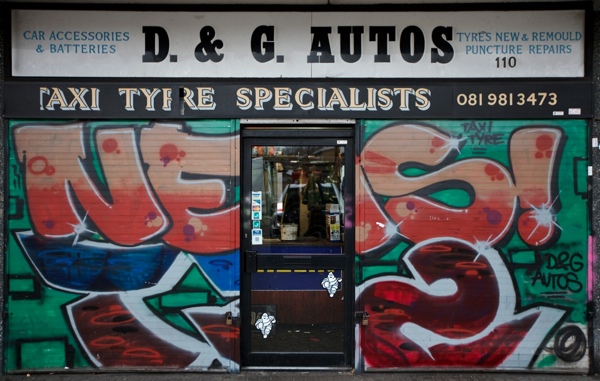
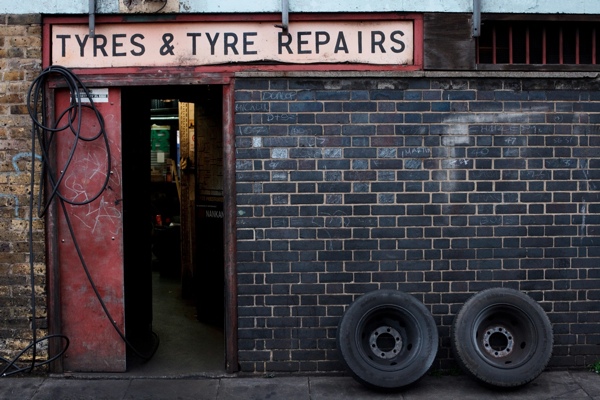
The shopfront facing Roman Rd.

Terry Harding, Panayiotis’ former boss, pictured in 1976.
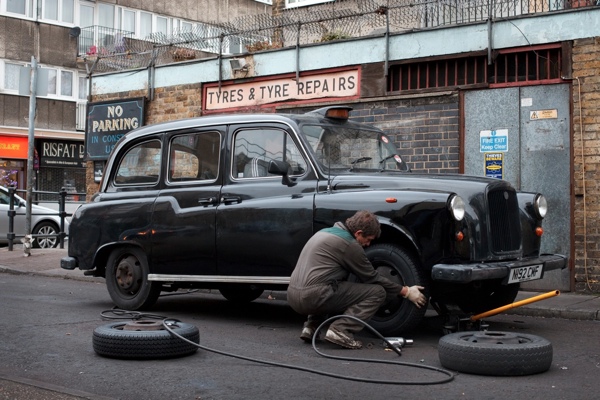
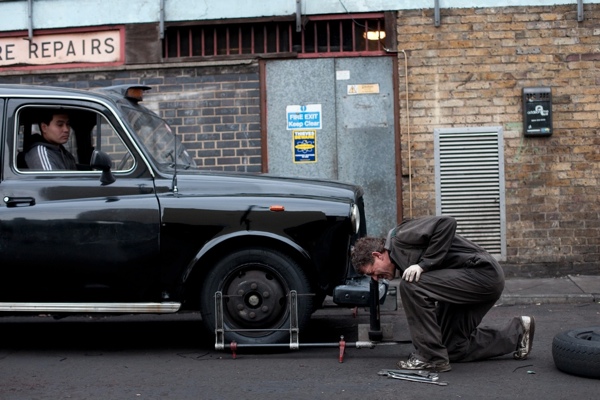
Panayiotis changes a tyre.
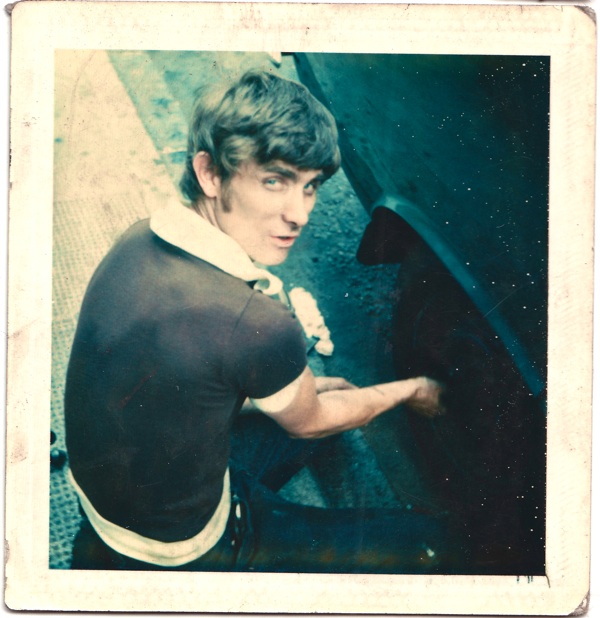
Terry changes a tyre in 1976.
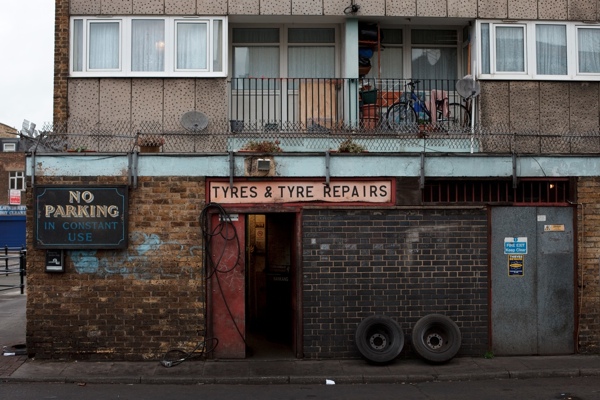
The yard at the back where the taxis pull up.
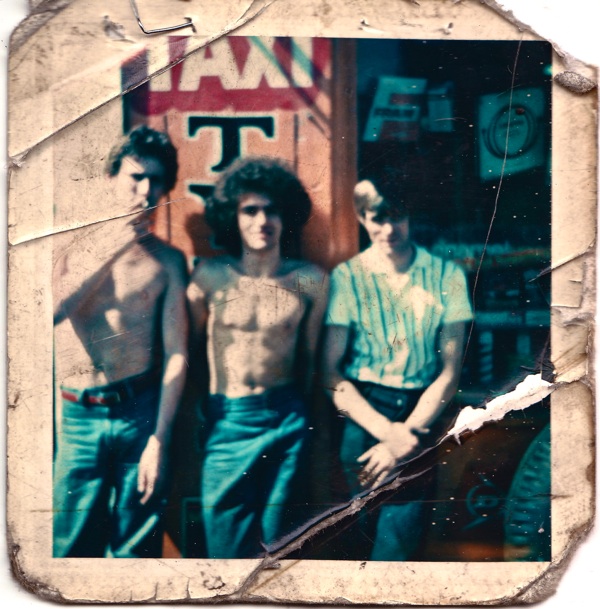
Panayiotis (centre) with Terry on the right and William on the left, in 1976.
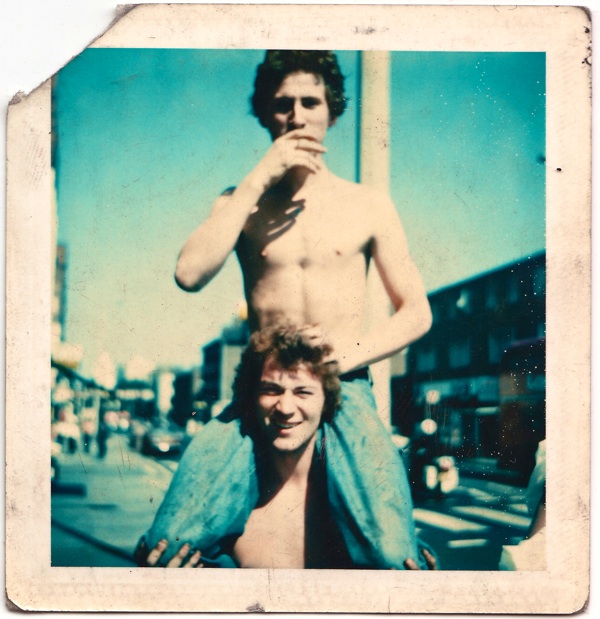
William & Brian, tyrefitters of the Roman Rd in 1976.
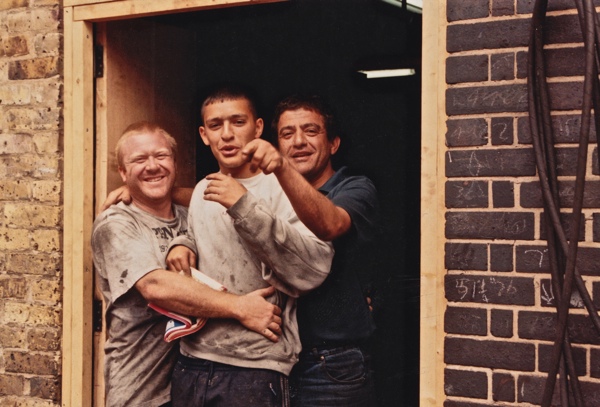
Brian, Mo & Panayiotis, in recent years.
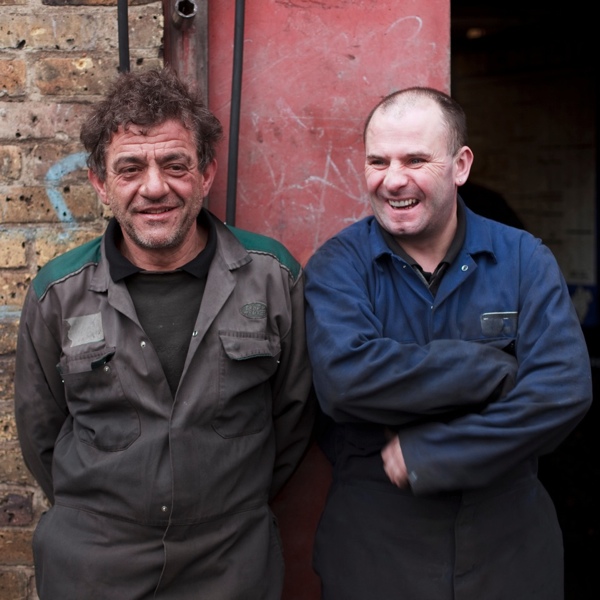
Panayiotis with his mate William Boyle, known as Baldrick.
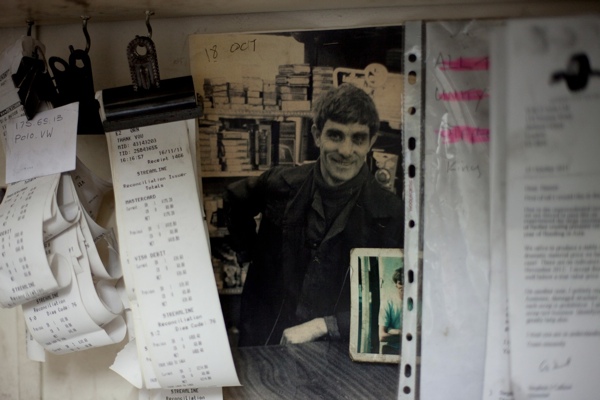
Remembering Terry Harding at D & G Autos, 110 Roman Rd, E2 0RN.
New photographs copyright © Jeremy Freedman
You may also like to read about At Three Colts Lane
Dave Thompson, Joiner

In Spitalfields, Dave Thompson is famous for the blue overalls he has worn as long as anyone can remember, popular for the apples and eggs he brings up fresh from Kent each day, but – most of all – he is celebrated for his superlative joinery.
Over the last fifteen years, Dave has been at the core of a group of craftsmen who have worked continuously upon the renovation of the eighteenth century houses and, as a result, he has earned the affections of many of the owners. They treasure Dave for the skill and application he brings to his work, yet such is his magnanimous nature that he chooses to reciprocate their appreciation of his talent with regular deliveries of apples and eggs. Thus it has come to be understood, among those who dwell in the ancient streets beside Christ Church, that only when you are in receipt of Dave’s deliveries from Kent can you truly be said to have arrived in Spitalfields.
To seek Dave, you have to look in a special place secluded from the public gaze and known only to the initiated. On the Eastern side of Brick Lane lies part of the Truman Brewery once inhabited by dray horses and coopers, here in an old cobbled yard stands a crumbling stable block where at its furthest extremity, framed by an elegant brick arch, you will find Dave’s workshop. Any residual doubt whether this is the correct location will be assuaged by the presence of the massive pile of scrap timber you see tossed to the right of the arch.
Yet, by the time you reach the woodpile, you will very likely already have heard the sound of Dave’s machine tools roaring within his workshop, and you will know that this is the place and Dave is inside at work. Certainly, this was my experience when I arrived and opened the door to be greeted by Dave’s smile, his blue overalls standing out in sharp contrast to the yellow wood shavings and sawdust that surrounded him.
I come from a little village, Loose near Maidstone in Kent. At school, I learnt what I could do and I started off in furniture making at Maidstone Art College where I did City & Guilds Carpentry and Joinery, basic and advanced. Then I worked as a cabinet maker in a furniture factory for eight years, making fireside chairs and stuff like that, and I worked in East Farleigh making bespoke kitchens. I was lucky to get the chance to come to London but it was a big gamble – I was offered the choice of being made redundant and getting five thousand pounds, so I took it.
When I first came up to Spitalfields fifteen years ago, I was restoring 1 and 3 Fournier St for James Hutcheson. He had a showroom at the front and I had my workshop at the back, but after three years he sold number 3 to Marianna Kennedy & Charles Gledhill, and I worked for them. That was six years of my life, then I moved over to the Truman Brewery stable block. I knew nothing about the restoration of old buildings when I first come up here but I learnt a lot working with Jim Howett, he’s been here thirty years and he’s got a lot of specialist knowledge.
If you can do something like mouldings, everybody wants you to make them because in every old house the mouldings are different. One of my specialities is fitting shutters in rooms that don’t have shutter cases and making new panelling. I’ve done a lot of external shutters in Wilkes St and Princelet St. When you do restoration, you try to use the old timber. Often if the panelling is damaged, you can patch it up and put it back. It was all good work they did in the old days. They didn’t have the tools but they had all the time in the world. I’ve never had to look for work, I’ve been up here so long now that people just come to me – but it’s been hard, for years I got up at four thirty every morning to get into London by six.
In Eleanor Jones’ house in Fournier St, I put in a big pair of curved doors on the first floor that are the same as on the ground floor. I had a lot of curved work to do the bay window and Bogdan helped me, he was a very good joiner from Poland. The two of us put our heads together and sorted that out. One day, he came in and said he’d been to the specialist. It was cancer. He’d had his chips. He did quite a lot of work around here and extensively renovated the Market Coffee House. He was one of the best.
Since then, I’ve done a lot of work for people in Fournier St. When I started, I used to fit shutters, internal and external, but most of the time now, I’m doing work for people making joinery for their carpenters to fit on site. As you get older and wiser, you don’t fit it, you make it and leave that to someone else. Matt Whittle and Tony Clarence are two blokes I work with, we started at the same time fifteen years ago. There was quite a little gang of people and we all got to know each other and we’d be working together restoring the same houses. Sometimes, the people would sell the houses, and we’d get paid to rip out the work we did and then do it all over again to suit the new owner.
About three years ago, I had a quadruple heart bypass. I used to work quite long hours but now all I do is get in at six and work until three, four days a week. Not so stressful. I’ve got an old farm cottage in Loose. Unfortunately, it’s only a two bedroom cottage. I restored it myself and I like to be comfortable. I’m sixty-five in April, I don’t think I’ve got many more years – though it is getting to the stage in Spitalfields where there is less and less to do. But I’ve left my mark and I’m proud of the work I’ve done here.
One day – to his alarm – Dave saw that some contractors had tried to cut corners by tearing an eighteenth century door case off the front of a house in Wilkes St and throwing it in a skip. Yet thankfully, when the building inspectors enforced the listed status of the building, it was Dave who got the painstaking job to piece the fragments back together and reconstruct it with the help of Diana Reynell (a grotto designer) who restored the mouldings. And the dignified door case in question stands today, as if it had never been broken.
The emotionalism with which this event is charged for Dave reveals the depth of his personal involvement with these old houses. His conscientious labour over all these years has comprised the culmination of his life’s work and it honours those craftsmen whose work he has furthered.
Even as he and his fellows have pursued the long task of restoring these buildings, residents have come and gone, raising the question of who – if anybody – truly has ownership of these properties. Because, as much as these buildings manifest the status and taste of their occupants, they also commemorate the talents of the artisans who have worked upon them, both recently and long ago.

Dave worked on the restoration of 1 Fournier St in the nineteen nineties.

Fragments of the eighteenth century doorcase torn from the wall but rescued from the skip in Wilkes St.

The eighteenth century doorbox reinstated by Dave at number 13 Wilkes St and replicated at number 1.

Doorboxes at 7 & 9 Fournier St by Dave, commissioned by neighbours John Nicolson and Kate Jenkins.

Dave Thompson, joiner, outside his workshop in the former stable of the Truman Brewery.