So Long, Mother Levy’s Nursing Home
Last week, Peabody demolished the historic Mother Levy’s Nursing Home in Spitalfields – in arrogant disregard of the widespread public demand for it to be preserved. Today, I am republishing my profile of Tom Ridge as a salute to the valour he showed in leading such a magnificent campaign which culminated in a unanimous vote by Tower Hamlets Council to save this beautiful old building. Yet even this was not enough to succeed, and my feature is accompanied by Tom’s recent statement which is touching in its dignity and restraint at such an emotional time.
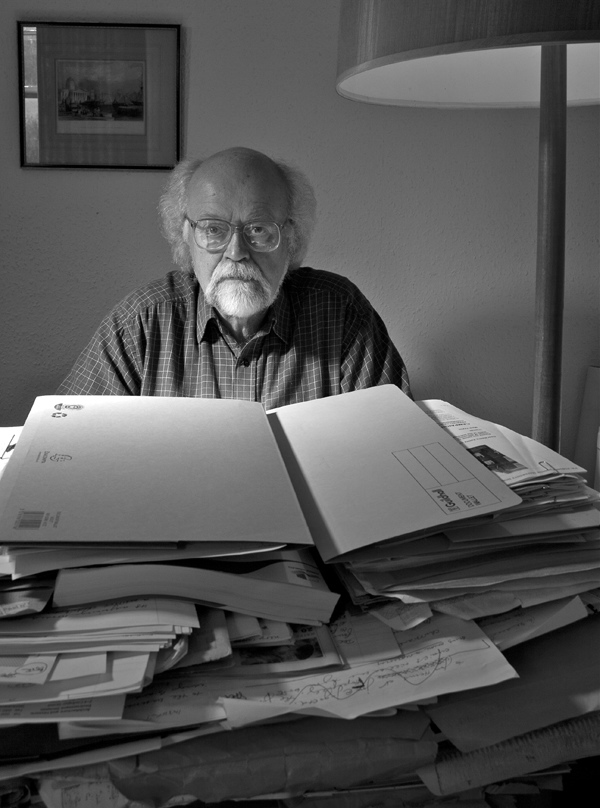
Tom Ridge
For over twenty years, historian Tom Ridge has been fighting selflessly to save significant buildings that tell the story of the East End. A noble warrior who has single-handedly pursued a relentless campaign, writing letter after letter – waging what he terms “an endless battle” – Tom’s latest combat has been to prevent the demolition of the former Jewish Maternity Hospital in Underwood Rd in Spitalfields.
Beyond its obvious significance as part of the history of the Jewish East End, the edifice was also important as the last example of its kind in the country. Operating from 1911 until 1940, this pioneering institution was the personal mission of Alice Model who started and ran the hospital to help the sick among the poor and women at home with babies. Popularly known as Mother Levy’s Nursing Home, it was the first organisation in this country to provide home helps and maternity nurses, and among the many generations of East Enders who came into the world within the walls of this dignified Arts & Crafts building were Alma Cogan, Arnold Wesker and Lionel Bart.
The possibility of converting the elegant structure – which resembles a painting by Vermeer upon its street frontage – was never entertained, instead it was destroyed in a development by Peabody that was hastened through, in which a token consultation of the immediate residents was invited and then their wishes were ignored. Meanwhile, Angela Brady of Brady Mallalieu – the architectural practise designing the new building – who is the current RIBA president, said in The Guardian on 5th October 2011, “Let’s ask what people want,” emphasising that she is, “enthralled by the ‘rich mix’ of the capital’s culture.”
In harsh contrast to these sentiments, the developers sent a Prior Notification of Demolition to Tower Hamlets Council Planning Department that same month. Obtaining this approval in advance of any public consultation meant that Peabody could demolish the buildings irrespective of what the people of the East End had to say, and without any assessment of the historical importance of the existing structure or the environmental impact of a new block upon this quiet corner of Spitalfields.
Regrettably, this alarming set of circumstances is a familiar story for Tom Ridge, just the latest episode in a conflict in which for too long he has been a lone warrior, chasing bureaucrats around and becoming expert at deciphering their game of weasel words, as large organisations pursue their own interests at the expense of the culture of the East End. Occasionally, Tom will confess the weight of emotional responsibility he carries for his “failures” – those instances where he has lost the battle against developers and part of our history has gone forever – but it almost impossible to get him to disclose his successes.
Yet we all owe Tom Ridge a debt of gratitude for those important facets of the East End that have survived thanks to his heroic campaigning. It was he who discovered that an old building by the canal had been used by Dr Barnardo and was responsible for saving it, and creating the Ragged School Museum there – “because there should be a museum of the East End in the East End.” It was he who led the successful campaign to save the Bancroft Rd Local History Library when the Council would have preferred to close it down and sell off the collection. It was he who prevented buildings being constructed upon the small public park at the heart of Bethnal Green, by ensuring it was listed as of historic importance.
When Tom arrived in the East End from Liverpool in 1965, at the age of twenty-three, and asked the way to St Saviour’s School where he had been employed to teach geography, he was told to go over Stinkhouse Bridge and the walk down to cross Gunmakers’ Arms Bridge. Entranced by the poetry of these names – dating from 1818 – Tom did not at first realise their significance as part of a six mile ring of waterways, originating from the time when, “London was the greatest industrial city in the world with the greatest port in the world.” Years later, Tom set up the East End Waterways group to preserve the canals and their attendant structures – “because the Waterways are the last places of peace and tranquillity in the East End.”
“I fell in love with the East End and its people – maybe it’s because I come from Liverpool which is also a port city.” Tom confided to me, tracing the origins of his passion, “I was born on a council estate in Everton, and my greatest excitement was travelling on the overhead railway along seven miles of dockland and looking into each of the docks, and seeing all the things there.”
Working in a post-war bomb-damaged East End as a young teacher, he witnessed the social effects of the closure of the London docks and the rebuilding of the territory. “I shall never forget the old cleaning ladies at the school saying to me, ‘Mr Ridge, we do miss our cottages. They took our cottages away.’”Tom recalled in sombre reminiscence, speaking of his days at St Saviour’s in Bow, –“what they were talking about were their terraced houses, that were almost entirely swept away.”
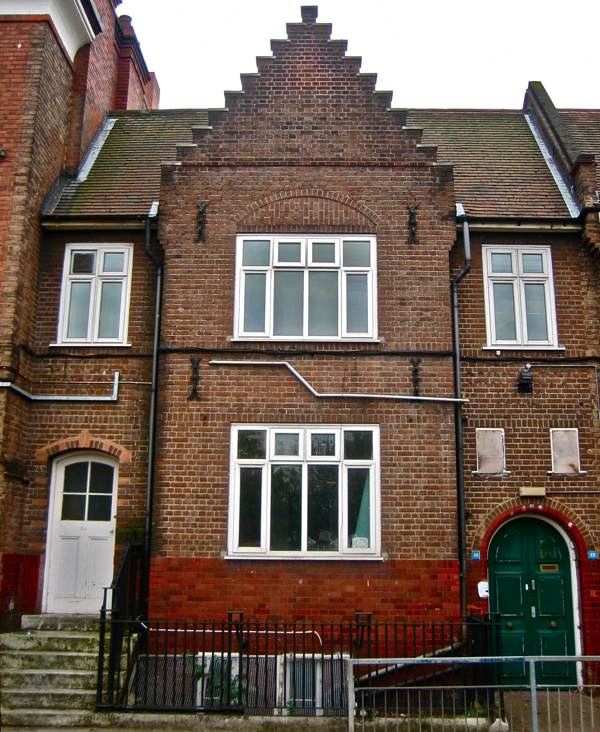
The Jewish Maternity Hospital in Underwood Rd. An elegant crow-stepped gabled building reminiscent of a streetscape by Vermeer. Although it had lost its diamond-paned leaded windows, it retained its original doors and ironwork.
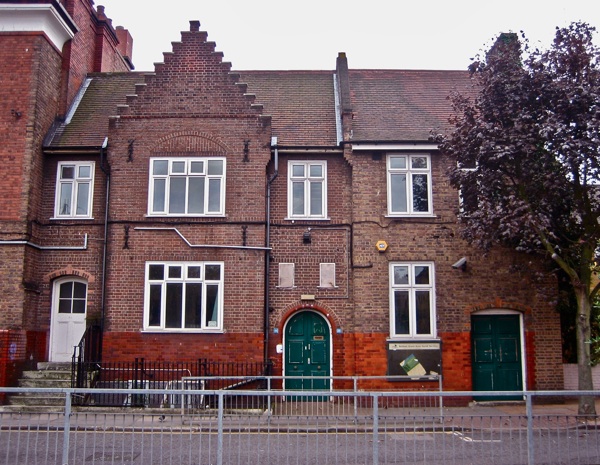
The Arts & Crafts style cottage was designed by John Myers in 1911.

No amount of commemoration by Peabody will compensate for this shocking and needless destruction of a little building which meant so much to so many people. And as an affordable family home, it would have been a living memorial to a unique maternity hospital.
There are now only two historic Jewish welfare buildings which stand testament to that extraordinary outburst of vitality and creativity known as the Jewish East End. But the old people’s home in Mile End Road and the soup kitchen for the Jewish Poor in Spitalfields are relatively unknown and unloved buildings, compared to the pride of place which was embodied in the name “Mother Levy’s.”
This name and the remarkable history of the unique hospital run by women for women will live on in the history books about the East End, but as built evidence and a living memorial for future generations to understand and appreciate the Jewish East End, and the East End as an historic point of arrival for migrants from Europe and indeed the whole world, Mother Levy’s is dead.
All the buildings at the former hospital are being demolished by Peabody, aided and abetted by officers in Tower Hamlets Council but against the unanimous wishes of its elected Councillors.All four hospital buildings on Underwood Road could and should have been adapted for residential use (with the utilitarian buildings at the back replaced by new homes). We began the campaign with this proposal but discovered that Peabody’s architects had already drawn up their plans for new buildings on the site of the former Jewish Maternity Hospital, which Peabody had purchased from Tower Hamlets Council in March 2011. It was at this point that Dr Sharman Kaddish, as director of Jewish Heritage UK, made her compromise proposal for the retention of the two cottages and their conversion to family homes.
Our petition to Peabody was based on this proposal and signed by about 760 people, including Arnold Wesker and former MP Mildred Gordon and councillors from all four political groups on Tower Hamlets Council. Dozens of letters were written to Peabody’s Chief Executive, Stephen Howlett. They included letters from the chairs of the Jewish East End Celebration Society and the East London History Society, Cllr Rabina Khan, and Cllr Bill Turner, the secretary of SAVE Britain’s Heritage and Lord Janner of Braunstone QC.
At the full council meeting on 29 November 2011, Cllr Judith Gardiner proposed the Labour group’s motion calling on the Mayor to negotiate with Peabody, and Peabody to spare the cottages. The motion noted that Peabody has a duty to optimise the amount of housing it provides but also to protect the borough’s heritage. Cllr Peter Golds, Leader of the Conservative group, spoke in support. Additionally, John Penrose MP, Minister for Tourism and Heritage recommended engagement between the Campaign, Council and Peabody for an amicable settlement to keep the two cottages. But Peabody was unmoved and, in demolishing the oldest and most attractive part of the former hospital, Peabody has committed the gross act of cultural vandalism which we all tried to prevent.
Tower Hamlets Council has the highest housing target in London and unless it formally identifies all its unlisted buildings which are heritage assets, and insists on their retention and adaptation by developers and housing associations, the borough will go on losing historical buildings capable of re-use. It is said that the Council has a list of 600 planned building sites for new housing. Most of the 600 sites will have existing buildings and doubtless many of them are unlisted buildings of some architectural and/or historic interest. Although none of them are likely to have been loved as much as Mother Levy’s, her tragic death must signal a new start for Tower Hamlets.
Had the 2008 Planning Statement for the redevelopment of the former hospital been made available for public comment, an altogether more transparent process may well have resulted in the retention and adaptation of the two cottages. Several years ago, Planning Statements for three redundant Tower Hamlets Council buildings were made available for public comment. As a matter of extreme urgency, all present and future council disposals must be subject to the same good practice. And as an integral part of this process, the Council must draw up a list of all unlisted heritage assets for retention and adaptation.
Tom Ridge
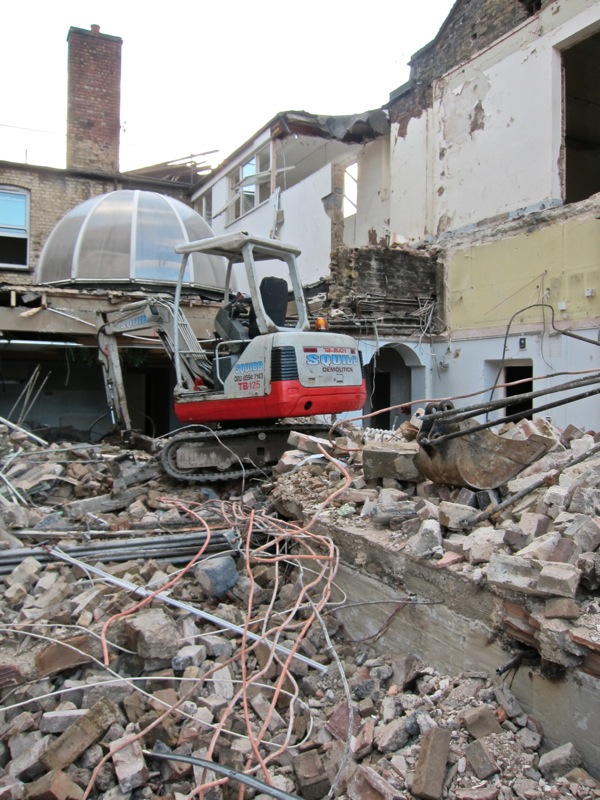
This is what became of the former Mother Levy’s Nursing Home where Alma Cogan, Lionel Bart, Arnold Wesker and many thousands of Jewish East Enders were born.
Portrait of Tom Ridge copyright © Lucinda Douglas Menzies
You may like to leave your own salute to Tom Ridge on the Save Mother Levy’s Campaign Facebook page
Peter Stanton, Empress Coaches

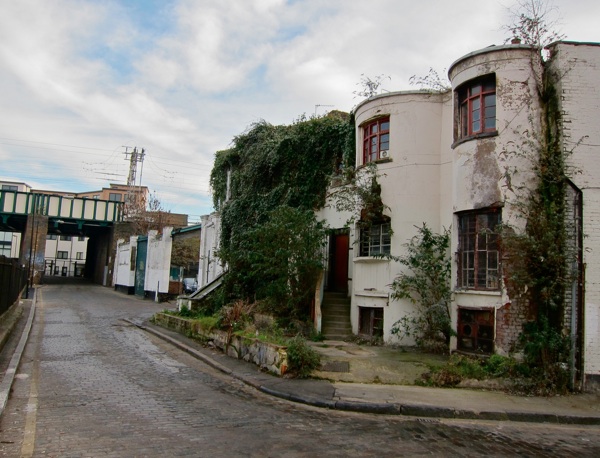
One of the corners of the East End that intrigues me most is at the boundary of Bethnal Green and Hackney, where a narrow path bordered by crumbling old brick walls leads up from the Hackney Rd to the junction of Mare St and the Regent’s canal. Cutting through at an angle to the grid of streets, it has the air of a field track that was there before the roads and the railway. Looming overhead against the skyline is a tall ruinous structure with the square proportions of a medieval castle, London’s last unreconstructed bomb site, left to decay since an incendiary hit in World War II. Beyond this, you pass under the glistening railway arches to arrive at the canal where, to your left, a vista opens up with majestic gasometers reaching up the sky and a quaint old building with bay-fronted windows entirely overgrown with ivy, cowering beneath. This is the headquarters of Empress Coaches.
Yesterday there was ice on the canal, which made me all the more grateful for the generous welcome extended by Peter Stanton, third generation of the Stanton family at the coach yard and still operating from the extravagantly derelict premises purchased by his grandfather.
Edward Thomas Stanton was an enterprising bus driver who bought his bus in 1923 and created a fleet operating from a yard in Shrubland Rd, London Fields, whence he initiated several familiar bus routes – including the No 8 pictured above on the office wall – journeys that became part of the perception of the city for generations of Londoners. In 1927, he bought the property here in Corbridge Crescent but when the buses were nationalised in 1933, he made £35,000 from the sale of the fleet, permitting him to retire and hand over to his son Edward George Stanton, changing the business from buses to coaches at the same time. “It was a bloody fortune then!” declared Peter, his grandson still presiding with jocularity over the vestiges of this empire today. Outside the fleet of coaches in their immaculate cream paintwork, adorned with understated traditional signwriting sat dignified and perfect as swans amidst the oily filth of the garage, ready to glide out over the cobbles and onto the East End streets.“A coach yard within two miles of the City of London, it will never happen again,” declared Peter in wonder at the arcane beauty of his inheritance.
“My father came here at sixteen with his sister Ivy who did all the accounts,” he explained, sitting proudly among framed black and white photographs that trace the evolving design of coaches through the last century. At first, the bodies of the vehicles were removed in the Winter to convert to flat trucks out of season and these early examples resemble extended horsedrawn coaches but, as the century wore on, heroically streamlined vehicles took over. And the story of Empress Coaches itself became interwoven with the history of the twentieth century when they were requisitioned during World War II to drive personnel around airfields in Norfolk, while the staff that remained in London took refuge in the repair pit in the coach yard as a bomb shelter during the blitz.
“My father didn’t encourage me to come into the business,” admitted Peter, who joined in 1960, “But after being brought up around coaches and coming up here every Saturday morning with your dad, it gets into your blood and I could think of nothing else but going into it. I started off at the bottom, I was crawling under the coaches greasing them up. I was a mechanic for twenty-two years but then me and my brother Trevor bought out the company from the rest of the family, and the two of us took it over.”
“In those days, people didn’t go on holidays, they had a day out to the sea on a coach. And they had what they called “beanos,” pub and work excursions going to Margate or Southend and stopping at a pub on the way back and arriving back around midnight. Those pubs used to lose their local trade because people didn’t want to go into a bar filled with a lot of drunken East Enders. They were very rowdy and the girls were as bad as the boys.” revealed Peter, able to take amusement now at this safe distance and pulling a face to indicate that there is little he has not seen on the buses. “Put it like this, I used to say that when you took a coachload of girls out on a beano and their boyfriends and husbands came to pick them up at one o’clock – if they knew what I knew these girls had been up to they wouldn’t be so welcoming. In other words, they were not so innocent in those days as people thought they were. But the police were the worst, they went bloody barmy and they did things they would nick anybody else for doing!”
“When I first started there were six beanos every Saturday in the Summer but in the whole of the last year we only did two.” he admitted with a private twinge of disappointment. As the beanos decreased in the sixties, Empress Coaches were called upon by the military for troop movements. “We used to do the Trooping of the Colour, we drove the troops from Caterham Barracks with a police escort. It was the time of the IRA and they had to check all the bins along the way and have a guy with a jammer sitting in the front of the bus, so if there was a remote-controlled bomb it wouldn’t go off. They told us, ‘Whatever you do, drive on. Even if you hit someone.’ There’d be twenty of our coaches full of soldiers plus an escort.”
These are now the twilight years at Empress Coaches, after the family sold the business and are simply employed to keep it ticking over, which explains why little maintenance is undertaken. Yet the textures of more than eighty years of use recall the presence of all those who passed through and imbue the place with a rare charmed atmosphere. I was not the first to recognise the appeal of its patina, as I discovered when Peter reeled off the list of film crews that had been there, most notably “Tinker, Tailor, Soldier, Spy” who wallpapered his office with the gold wallpaper you see in the top picture. “We’ve had Michael Caine here,” he boasted, “Gary Oldman, Ray Winstone and Dennis Waterman too.”
“After I spent fifty-two years of my life here, I’ve got be here.” Peter assured to me, biting into a sandwich and chewing thoughfully,“It’s more than likely this place will be redeveloped before too long and that will be the end of it, but in the meantime – I’m just trying to keep this show on the road!”

Edward Thomas Stanton, the enterprising bus driver who invented the number eight bus route.

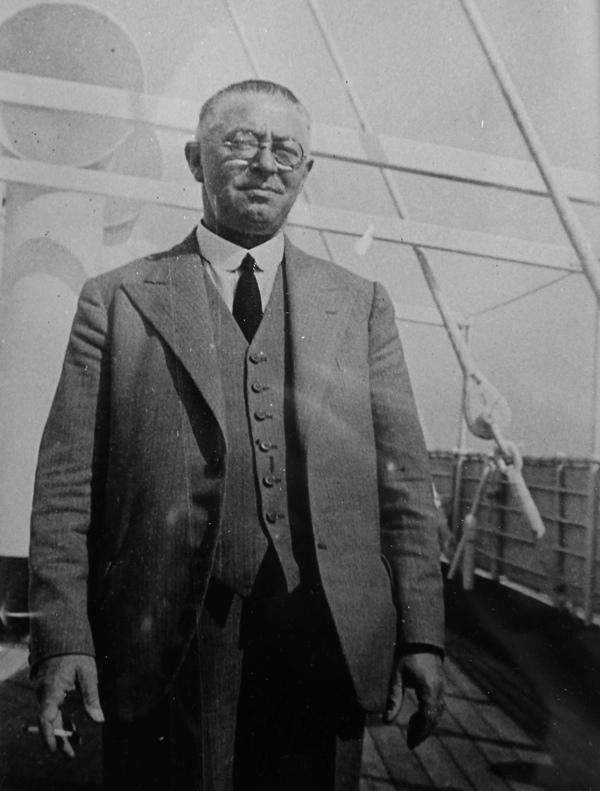
Edward George Stanton in his leather bus driver’s coat.
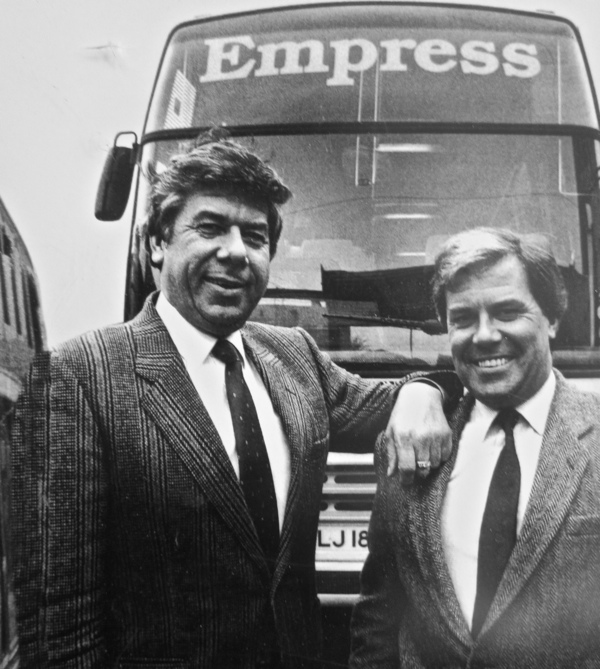
Brothers Peter and Trevor Stanton.
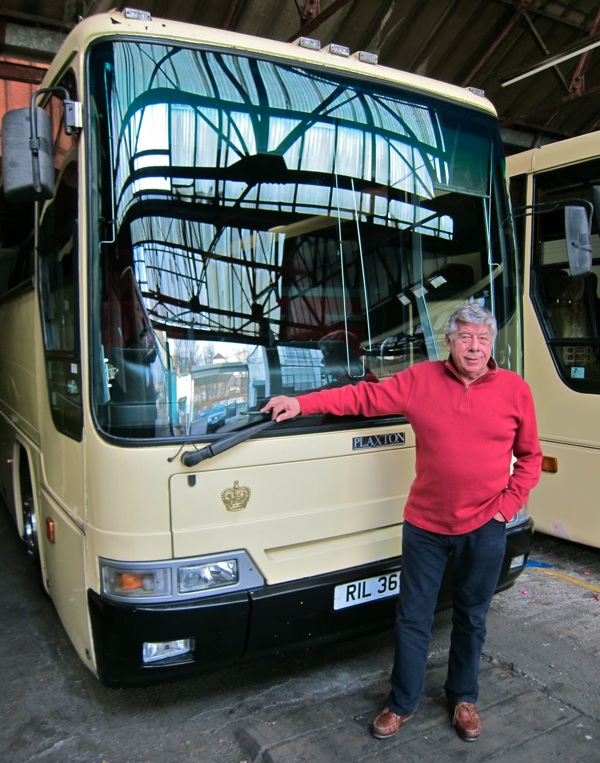
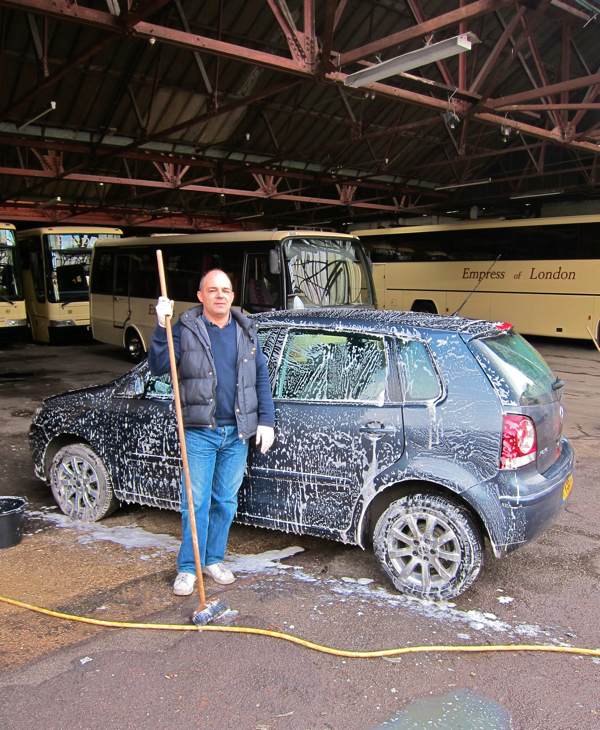
Mark Stanton, Trevor’s son.

Jason Stanton, Peter’s son.
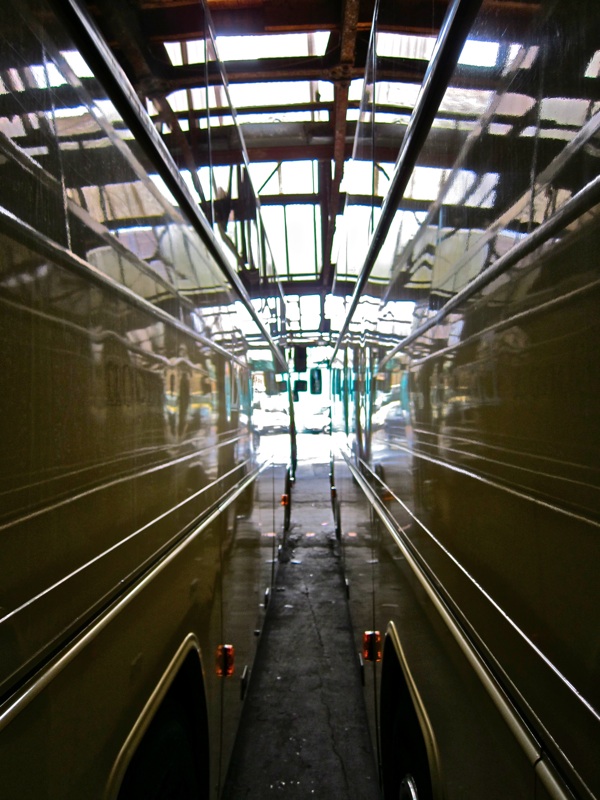
Between the coaches.
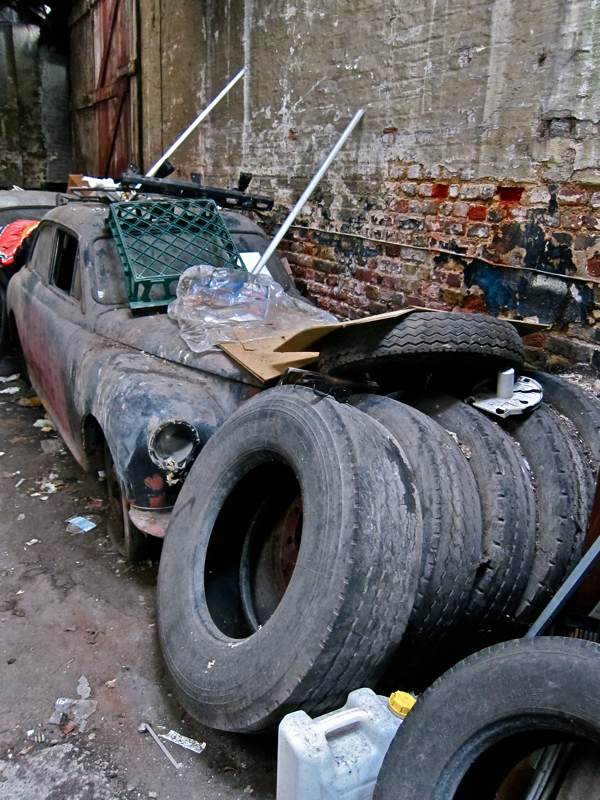
A forgotten corner of the yard.
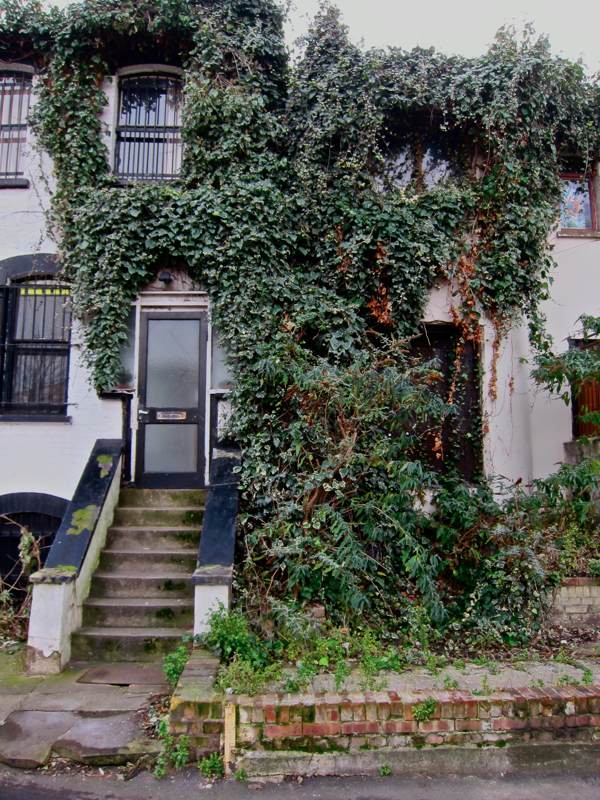
Empress Coaches, the office entrance.


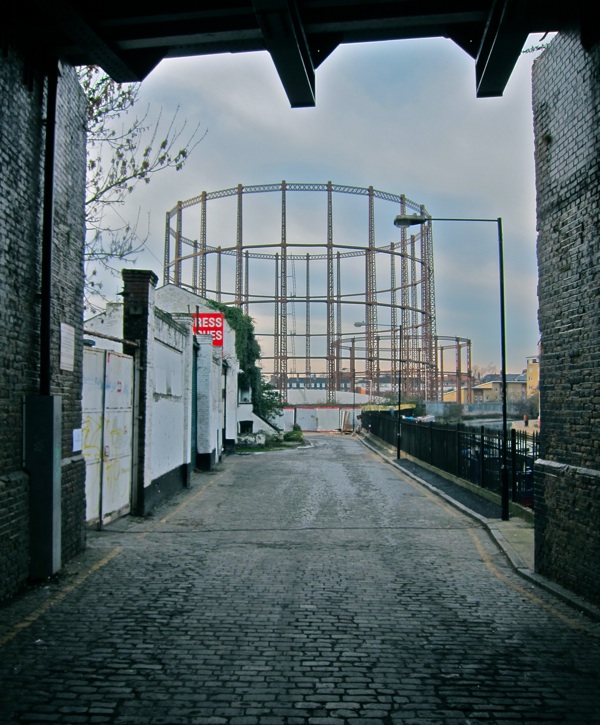
Corbridge Crescent, with the canal to the right.

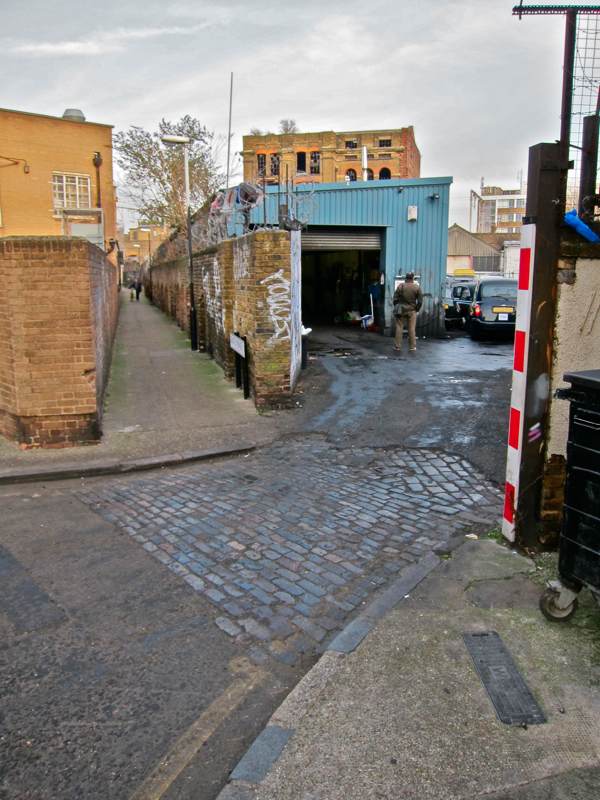
A narrow path leading from the Hackney Rd to the junction of Mare St and the Regent’s canal.
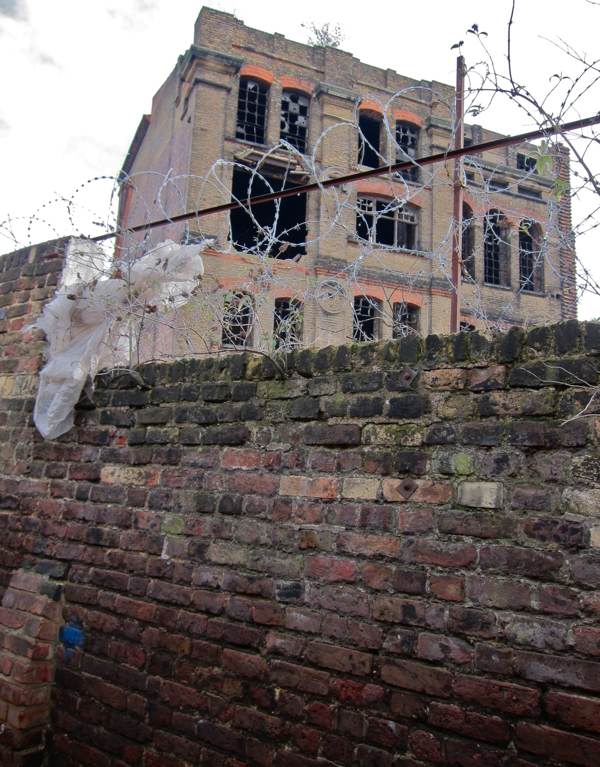
London’s last unreconstructed bomb site.
You may also like to read about two nearby industries
Spitalfields Market Nocturne
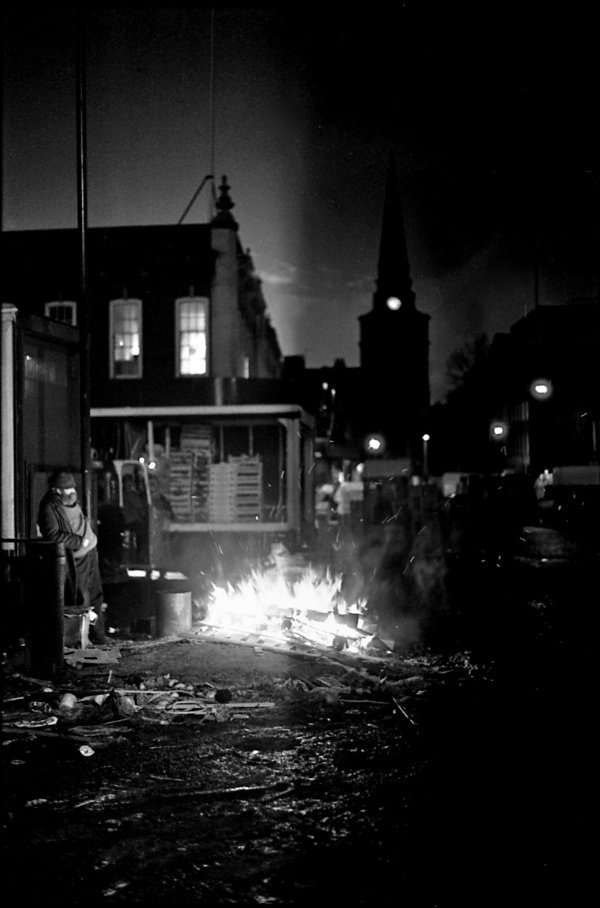
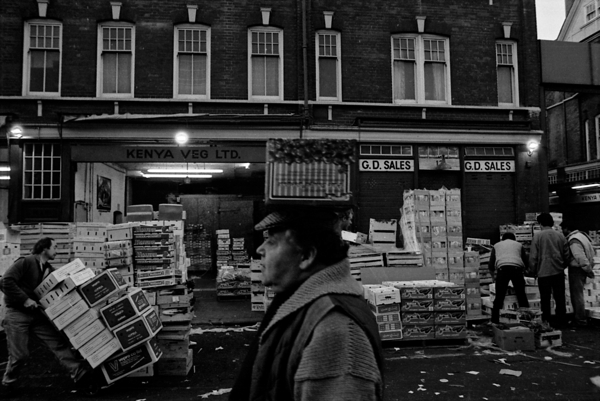
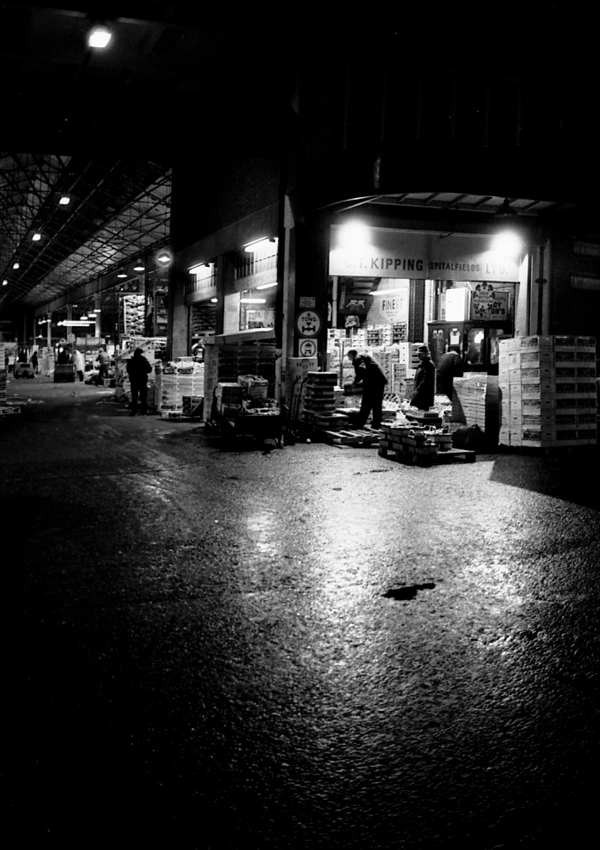
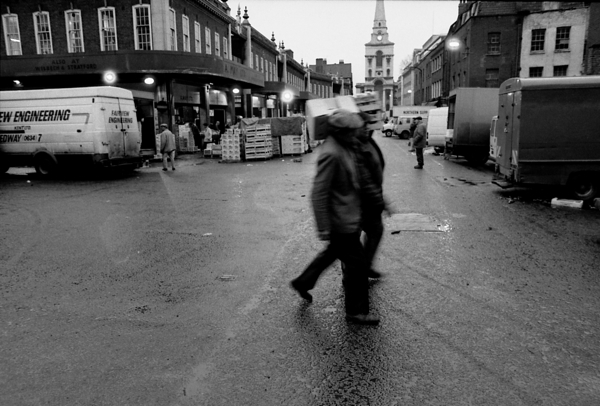
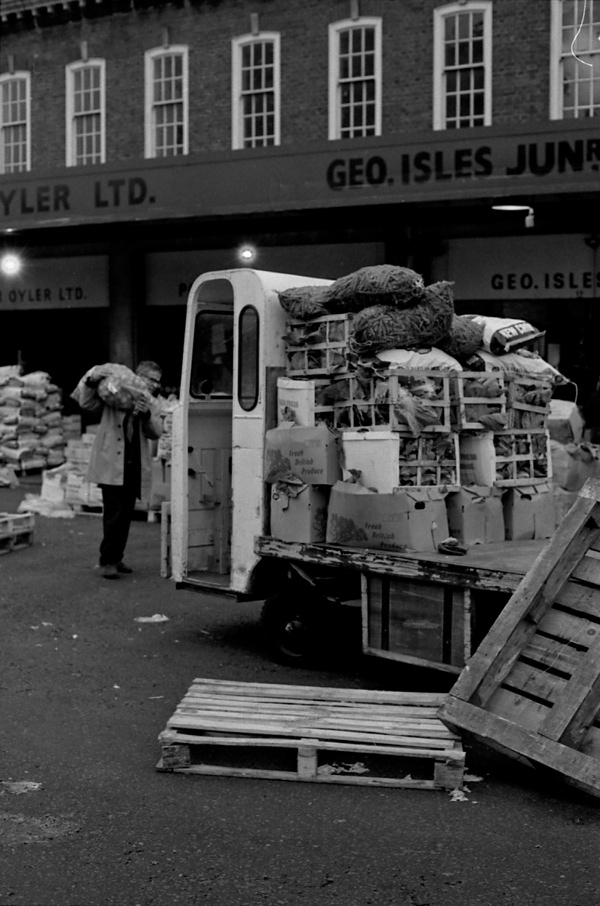
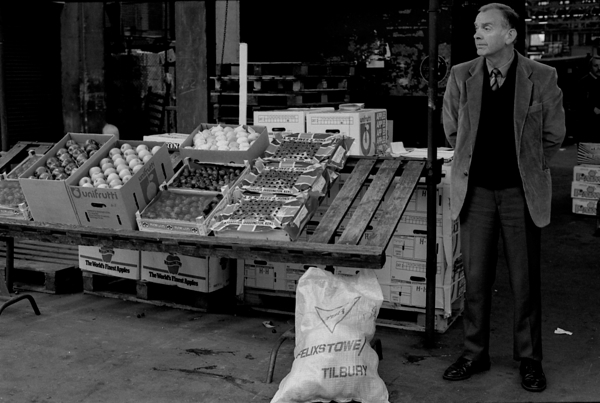
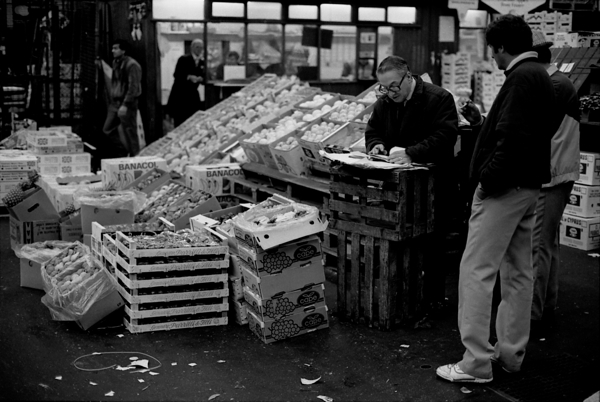
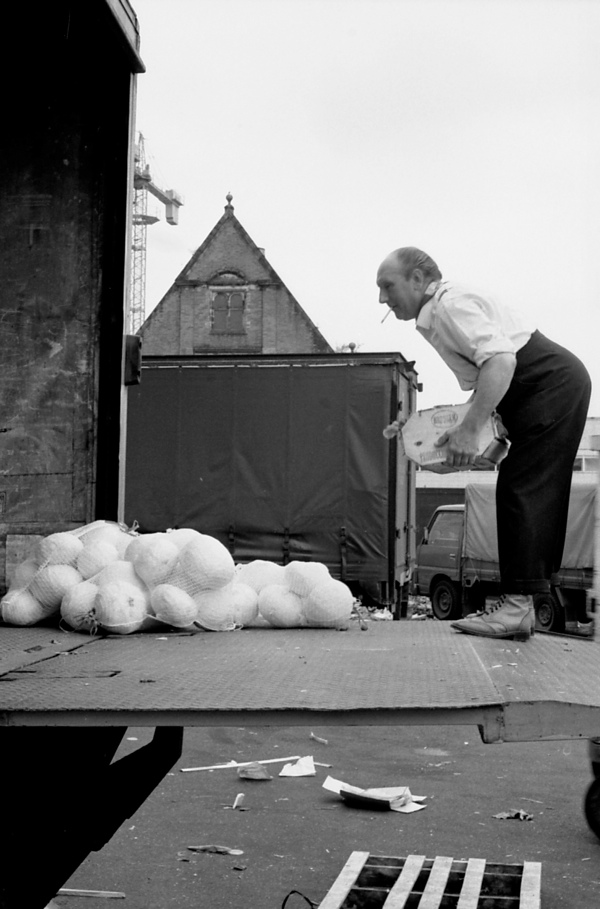
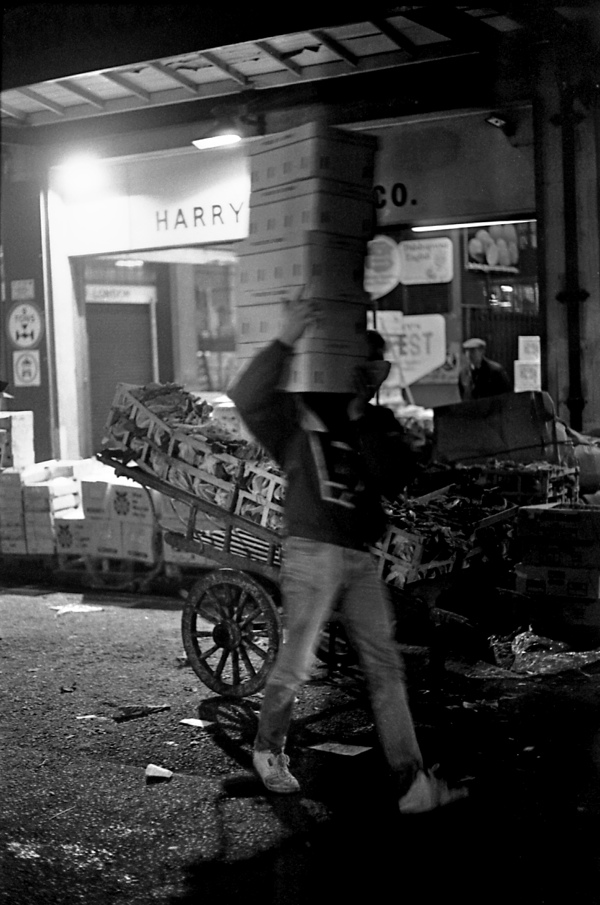
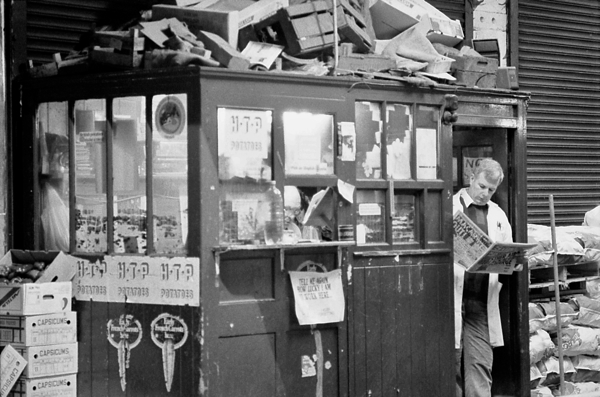
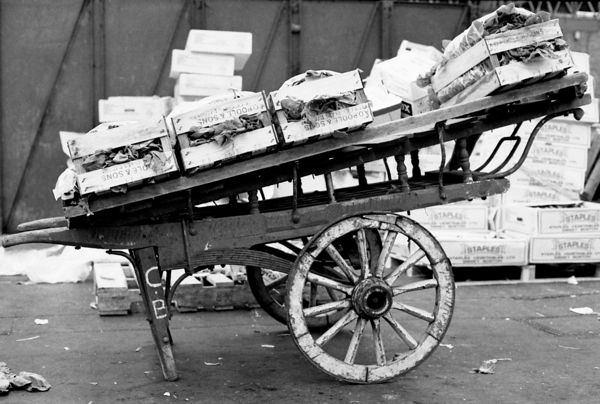
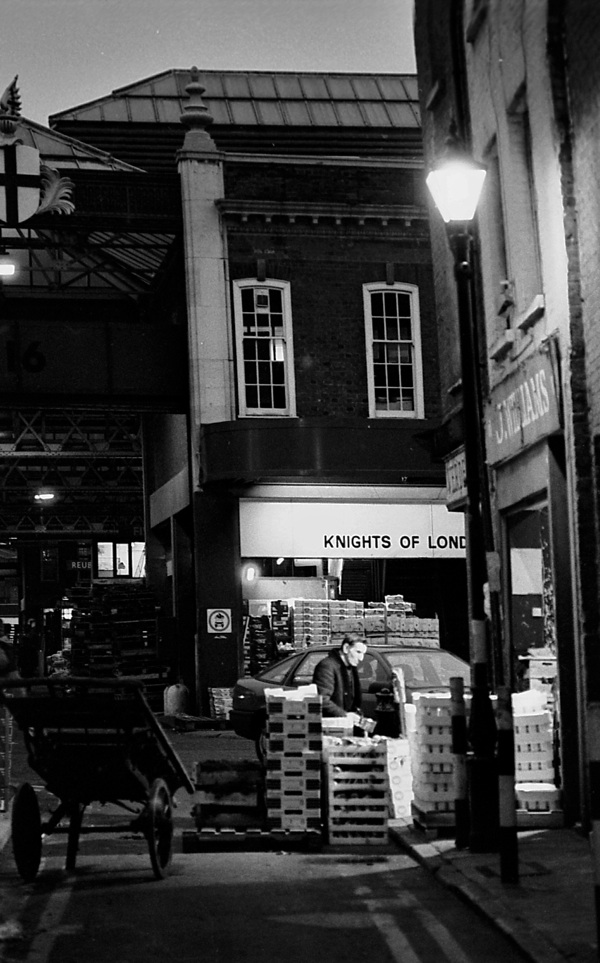
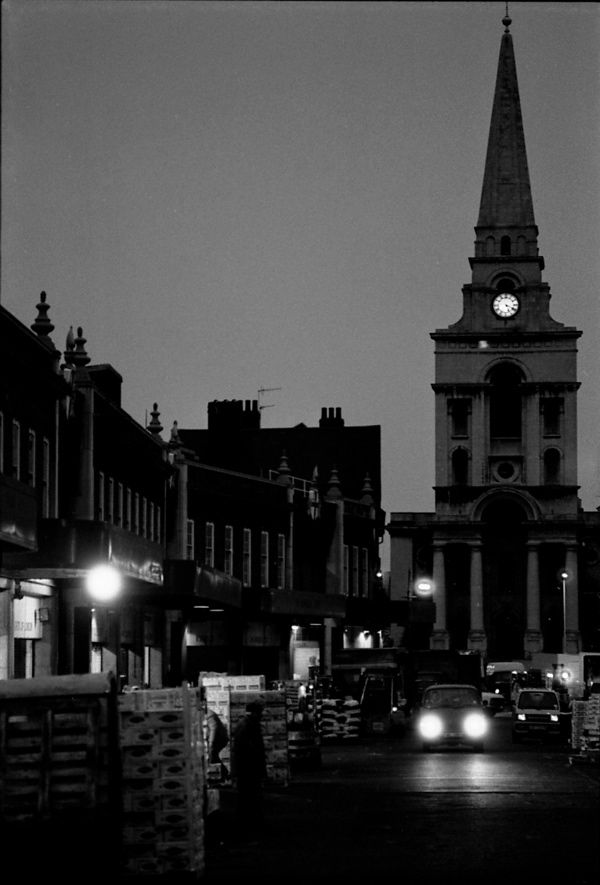
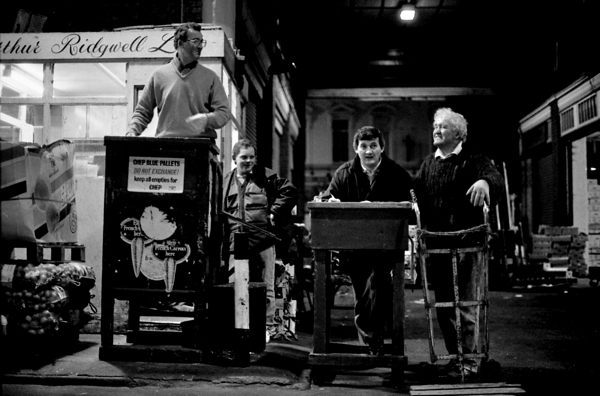
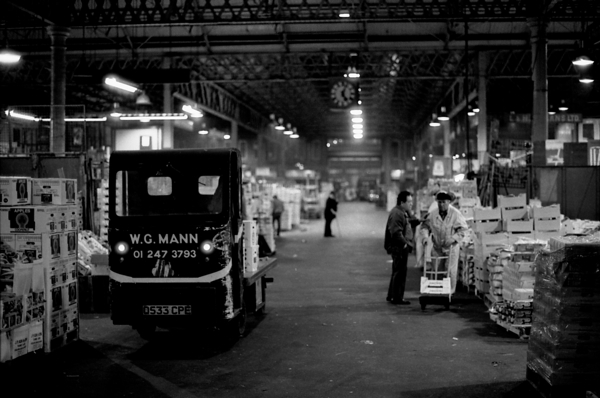
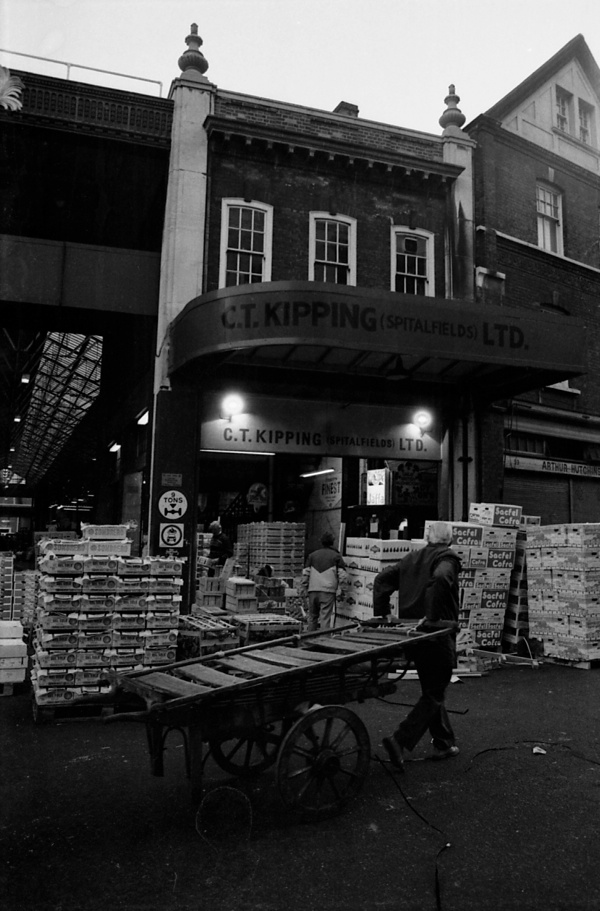
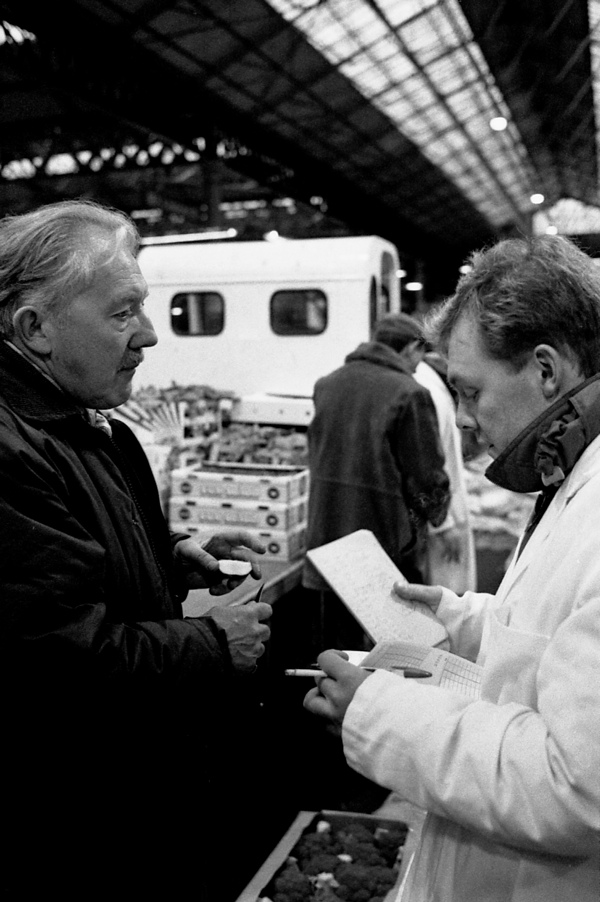
Nowadays the Spitalfields Market shuts at night, but for centuries this was when it opened, as a vast nocturnal wholesale market for fruit and vegetables. Initiated by charter signed by Charles I in 1638, it existed in Spitalfields until 1991 when it moved to a custom-built market hall in Leytonstone.
I have already published a few pictures of the market by Mark Jackson & Huw Davies – two poets with cameras who came nightly during the last year and took thousands of photographs – but, returning to their vast canon of work to choose which to include in the Spitalfields Life book, I came across so many more wonderful images which have not been seen before that I could not resist publishing another selection for you today.
At the new market hall in Leytonstone forklift trucks were introduced, but in Spitalfields human labour dominated when it came to moving produce around whether by barrow, trolley or up on the shoulder. Such an occupation required brawn and physical fitness, attracting many ex-boxers, and the rigours of market life encouraged idiosyncrasy, as everyone fell into their larger-than-life roles over decades. Mark & Huw’s photographs delight in the dramatic chiaroscuro of bonfires, flaring lamps, glistening wet streets, velvet darkness and the coming dawn which impart these photographs an undeniable romance as a unique record of the last days of ancient market.
It is my privilege to be able to publish some of these photographs in print for the very first time in the book of Spitalfields Life, and the Bishopsgate Institute, which has digitized the entire collection, will be exhibiting a selection to coincide with publication.
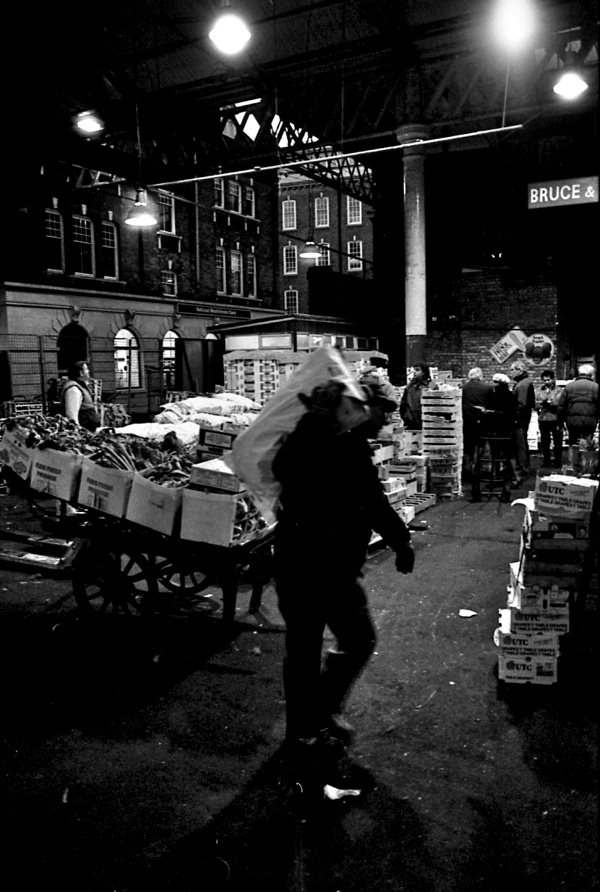
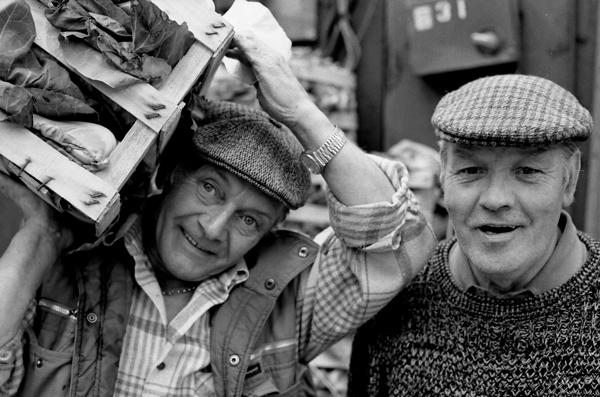
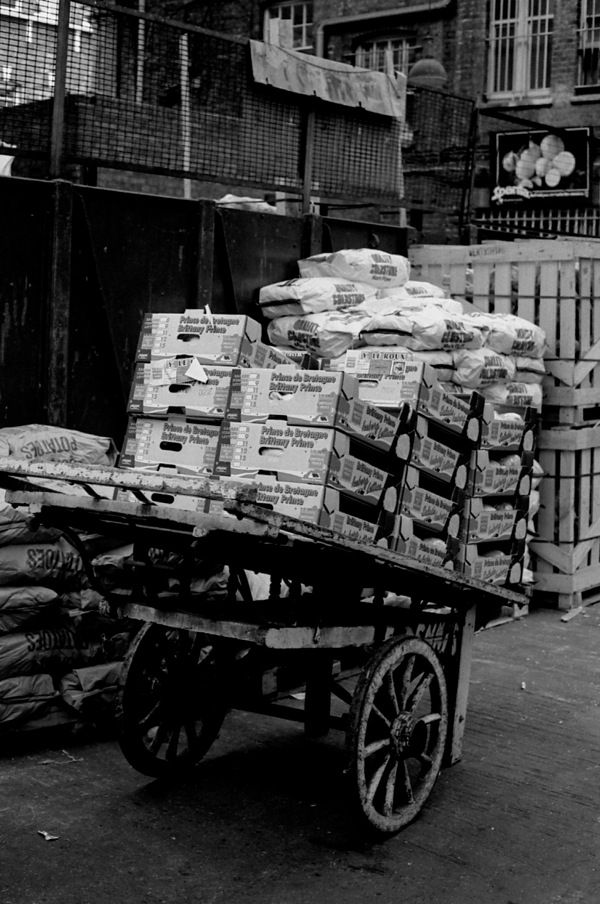
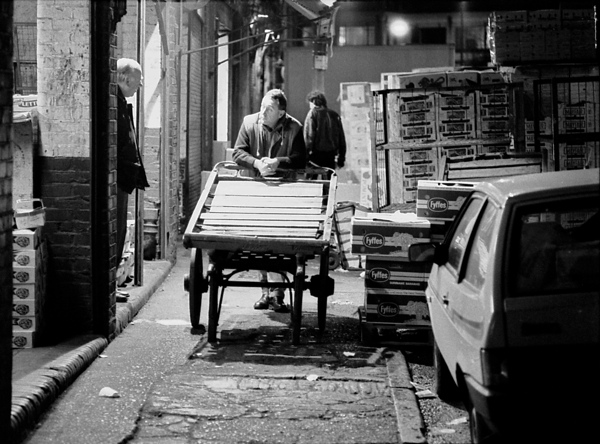
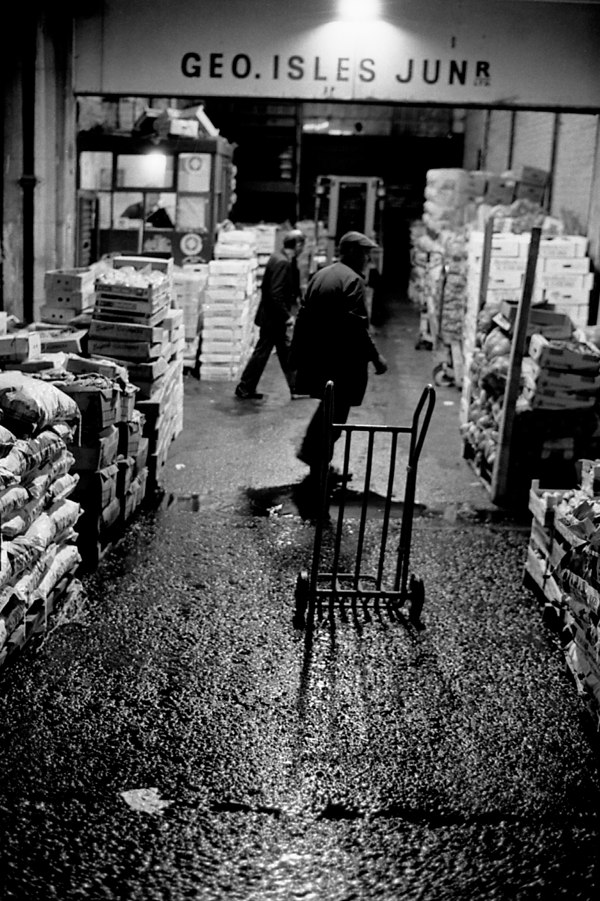
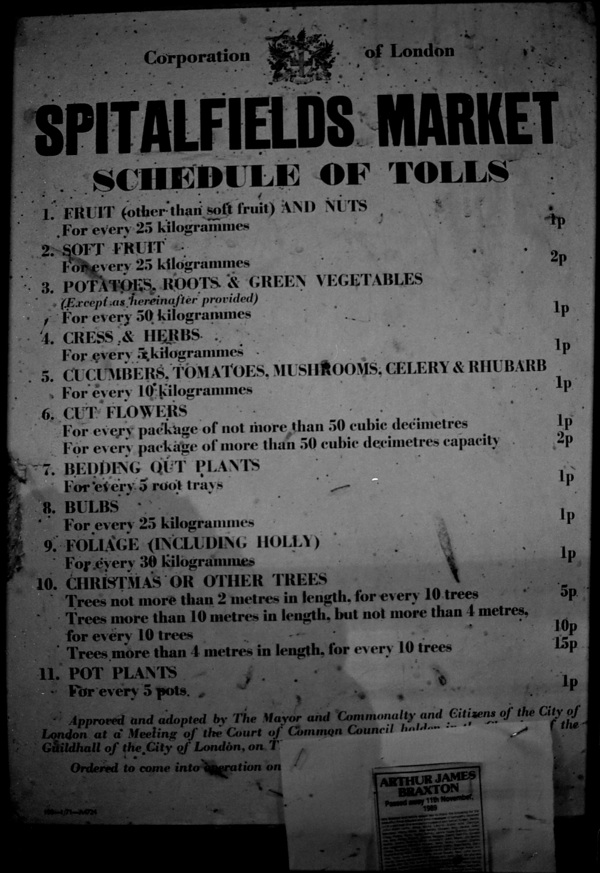
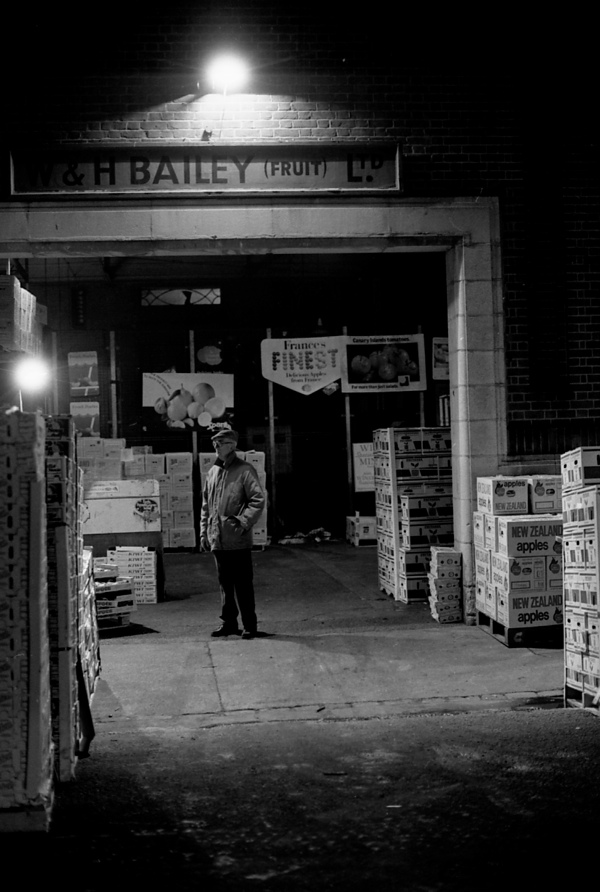
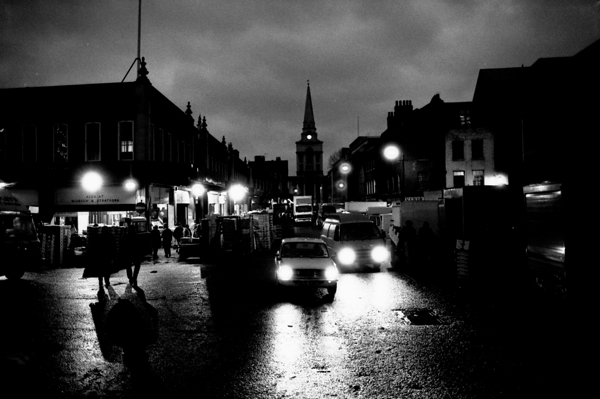
Photographs copyright © Mark Jackson & Huw Davies
You can see the original selection of
Mark Jackson & Huw Davies’ Photographs of the Spitalfields Market
and read about
Spitalfields Market Portraits, 1991
The Microcosm of London

Billingsgate Market
(click on this plate or any of the others below to enlarge to full screen and examine the details)
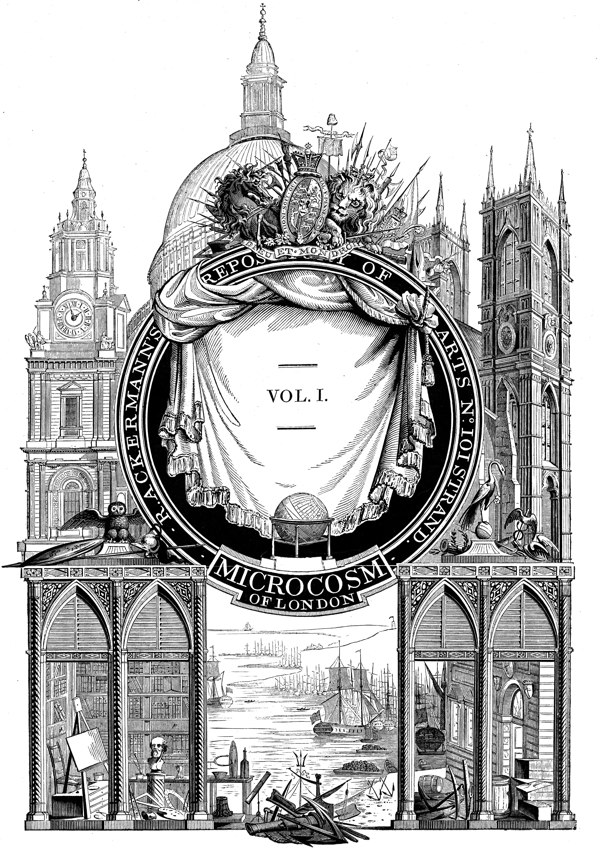
In 1897, Charles Gosse, the first archivist at the Bishopsgate Institute, was lucky enough to buy a handsome 1809 edition of all three volumes of Thomas Rowlandson and Augustus Pugin’s “Microcosm of London” from Quaritch booksellers in Piccadilly with just one plate missing, yet it took him until 1939 to track down a replacement to fill the gap and complete his copy. And the single plate cost him more in 1939 than the entire three volumes in 1897. Then, unfortunately, the volumes was stolen in the nineteen eighties but, thankfully, returned to the Bishopsgate intact years later as part of Operation Bumblebee, tracking art thefts back to their owners – and just waiting on the shelf there for me to come upon them last week.
Augustus Charles Pugin, the architectural draftsman (and father of Augustus Welby Pugin who designed the Palace of Westminster) had the idea to create a lavish compendium of views of London life but it was the contribution of his collaborator Thomas Rowlandson which brought another dimension, elevating these images above the commonplace. While Pugin created expansive and refined architectural views, Rowlandson peopled them with an idiosyncratic bunch of Londoners who take possession of these spaces and who, in many cases, exist in pitifully unsentimental human contrast to the refinement of their architectural surroundings.
In only a few plates – such as Carlton House and the House of Commons – does Thomas Rowlandson submit to the requirement of peopling these spaces with slim well-dressed aspirational types that we recognise today from those familiar mock-ups used to sell anonymous cheap architecture to the gullible. Yet the most fascinating plates are those where he has peopled these rationally conceived public spaces with the more characterful and less willowy individuals that illustrate the true diversity of the human form and satisfy our voyeuristic tendencies, celebrating the grotesque and the theatrical. In Billingsgate Market, Rowlandson takes a composition worthy of Claude and peoples it with fish wives fighting, showing affectionate delight in the all-too familiar contrast exemplified by aspirational architecture and the fallibility which makes us human.

Fire in London – the dreadful fire which took place on 3rd March 1791 at the Albion Mills on the Surrey side of Blackfriars Bridge. We have selected this from many objects of a similar nature which frequently occur in this great metropolis, because the representation afforded an opportunity of a more picturesque effect, the termination of the bridge in front and St Paul’s in the background contribute interesting parts to a representation which is altogether great and awful.

Pillory, Charing Cross. A place chosen very frequently for this kind of punishment, probably on account of its being so public a situation. An offender thus exposed to public view is thereafter considered infamous. There are certain offences which are supposed to irritate the feelings of the lower classes more than others, in which case a punishment by Pillory becomes very serious.

Guildhall. Examination of a bankrupt before his creditors, Court of King’s Bench Walk. The laws of England, cautious of encouraging prodigality and extravagance allow the benefits of the bankruptcy laws to none but the traders. If a trader is unable to pay his debts it is misfortune and not a fault.

Leaden Hall Market is a large and extensive building of considerable antiquity, purchased by the great Whittington in 1408 and by him presented to the City.

Astley’s Amphitheatre. Mr Rowlandson’s figures are here, as indeed they invariably are, exact delineations of the sort of company who frequent public spectacles of this description. With respect to teaching horses to perform country dances, how far thus accomplishing such an animal renders him more happy or a more valuable member of the horse community is a question I leave to be discussed by the sapient philosophers.

Bartholomew Fair, a spirited representation of this British Saturnalia. To be pleased in their own way, is the object of all. Some hugging, some fighting, others dancing, while many are enjoying the felicity of being borne along with the full stream of the mob.

Bow St Office, giving an accurate representation of this celebrated office at the time of an examination. The police of this country has hitherto been very imperfect, until Henry Fielding, by his abilities, contributed the security of the public, by the detection and prevention of crimes.

Covent Garden Market. The plate represents the bustle of an election for Westminster. The fruit and vegetable market certainly diminishes the beauty and effect of this place as a square, but perhaps the world does not furnish another instance of another metropolis supplied with these articles in equal goodness and profusion.

Christie’s Auction Room. The various effect which the lot – A Venus – has on the company is delineated with great ability and humour. The auctioneer, animated by his subject, seems to be rapidly pouring forth such a string of eloquence as cannot fail to operate on the feelings of his auditors.

The House of Commons is plainly and neatly fitted up, and accommodated with galleries, supported by slender iron capitals adorned with Corinthian capitals, from the ceiling hangs a handsome branch.

Drawing from life at the Royal Academy, Somerset House

The College of Physicians. There is nothing remarkable in the interior of the building except the library and the great hall – which is handsomely represented in this print is a handsome well-proportioned room. The eager disputatious attitude of the figure which is represented as leaning forward in the act of interrogating the candidate, is finely contrasted with two figures on the right hand, one of whom seems to have gathered up his features in supercilious indifference.

Exhibition Room, Somerset House. It would not be easy to find ay other artist, except Mr Rowlandson who was capable of displaying so much separate manner in the delineations placed upon the walls and such an infinite variety of small figures, contrasted with each other in a way so peculiarly happy. To point out any number of figures as peculiarly entitled to attention, would be an insult to the spectator, as very many would necessarily be left out of the catalogue, and everyone of taste will discern them at a glance.

Pass-Room, Bridewell. An interesting and accurate view of this abode of wretchedness. It was provided that paupers, claiming settlement in distant parts of the kingdom should be confined for seven days, prior to being sent of their respective parishes. This is the room apportioned by the magistrate for one class of miserable females.

Royal Cock Pit. It is impossible to examine this picture with any degree of attention, and not enjoy the highest degree of satisfaction at this successful exertion of the artists’ abilities. The regular confusion which this picture exhibits, tells a tale that no combination of words could possibly have done so well.

The Hall, Carlton House. Conceived with classic elegance that does honour to the genius of the late Mr Holland who as the architect, the tout-ensemble is striking and impressive.

The Custom House, in the uppermost of which is a magnificent room running the whole length of the building. On this spot is a busy concourse of nations who pay their tribute towards the support of Great Britain. In front of this building, ships of three hundred and fifty tons burthen can lie and discharge their cargoes.
Text extracts by William Henry Pyne.
Images courtesy of Bishopsgate Institute
You may also like to take a look at
On Sunday Morning
On Sunday – when I was a child – my father always took me out for the morning. It was a routine. He led me by the hand down by the river or we took the car. Either way, we always arrived at the same place.
He might have a bath before departure and sometimes I walked into the bathroom to surprise him there lying in six inches of soapy water. Meanwhile downstairs, my mother perched lightly in the worn velvet armchair to skim through the newspaper. Then there were elaborate discussions between them, prior to our leaving, to negotiate the exact time of our return, and I understood this was because the timing and preparation of a Sunday lunch was a complex affair. My father took me out of the house the better to allow my mother to concentrate single-mindedly upon this precise task and she was grateful for that opportunity, I believed. It was only much later that I grew to realise how much she detested cooking and housework.
A mile upstream there was a house on the other riverbank, the last but one in a terrace and the front door gave directly onto the street. This was our regular destination. When we crossed the river at this point by car, we took the large bridge entwined with gryphons cast in iron. On the times we walked, we crossed downstream at the suspension footbridge and my father’s strength was always great enough to make the entire structure swing.
Even after all this time, I can remember the name of the woman who lived in the narrow house by the river because my father would tell my mother quite openly that he was going to visit her, and her daughters. For she had many daughters, and all preoccupied with grooming themselves it seemed. I never managed to count them because every week the number of her daughters changed, or so it appeared. Each had some activity, whether it was washing her hair or manicuring her nails, that we would discover her engaged with upon our arrival. These women shared an attitude of languor, as if they were always weary, but perhaps that was just how they were on Sunday, the day of rest. It was an exclusively female environment and I never recalled any other male present when I went to visit with my father on those Sunday mornings.
To this day, the house remains, one of only three remnants of an entire terrace. Once on a visit, years later, I stood outside the house in the snow, and contemplated knocking on the door and asking if the woman still lived there. But I did not. Why should I? What would I ask? What could I say? The house looked blank, like a face. Even this is now a memory to me, that I recalled once again after another ten years had gone by and I glanced from a taxi window to notice the house, almost dispassionately, in passing.
There was a table with a bench seat in an alcove which extended around three sides, like on a ship, so that sometimes as I sat drinking my orange squash while the women smoked their cigarettes, I found myself surrounded and unable to get down even if I chose. At an almost horizontal angle, the morning sunlight illuminated this scene from a window in the rear of the alcove and gave the smoke visible curling forms in the air. After a little time, sitting there, I became aware that my father was absent, that he had gone upstairs with one of the women. I knew this because I heard their eager footsteps ascending.
On one particular day, I sat at the end of the bench with my back to the wall. The staircase was directly on the other side of this thin wall and the women at the table were involved in an especially absorbing conversation that morning, and I could hear my father’s laughter at the top of the stairs. Curiosity took me. I slipped off the bench, placed my feet on the floor and began to climb the dark little staircase.
I could see the lighted room at the top. The door was wide open and standing before the end of the bed was my father and one of the daughters. They were having a happy time, both laughing and leaning back with their hands on each other’s thighs. My father was lifting the woman’s skirt and she liked it. Yet my presence brought activities to a close in the bedroom that morning. It was a disappointment, something vanished from the room as I walked into it but I did not know what it was. That was the last time my father took me to that house, perhaps the last time he visited. Though I could not say what happened on those Sunday mornings when I chose to stay with my mother.
We ate wonderful Sunday lunches, so that whatever anxiety I had absorbed from my father, as we returned without speaking on that particular Sunday morning, was dispelled by anticipation as we entered the steamy kitchen with its windows clouded by condensation and its smells of cabbage and potatoes boiling.
My mother was absent from the scene, so I ran upstairs in a surge of delight – calling to find her – and there she was, standing at the head of the bed changing the sheets. I entered the bedroom smiling with my arms outstretched and, laughing, tried to lift the hem of her pleated skirt just as I saw my father do in that other house on the other side of the river. I do not recall if my father had followed or if he saw this scene, only that my mother smiled in a puzzled fashion, ran her hands down her legs to her knees, took my hand and led me downstairs to the kitchen where she checked the progress of the different elements of the lunch. For in spite of herself, she was a very good cook and the ritual of those beautiful meals proved the high point of our existence at that time.
The events of that Sunday morning long ago when my father took me to the narrow house with the dark staircase by the river only came back to me as a complete memory in adulthood, but in that instant I understood their meaning. I took a strange pleasure in this knowledge that had been newly granted. I understood what kind of house it was and who the “daughters” were. I was grateful that my father had taken me there, and from then on I could only continue to wonder at what else this clue might reveal of my parents’ lives, and of my own nature.
You may also like to read about
John Thomas Smith’s Vagabondiana III
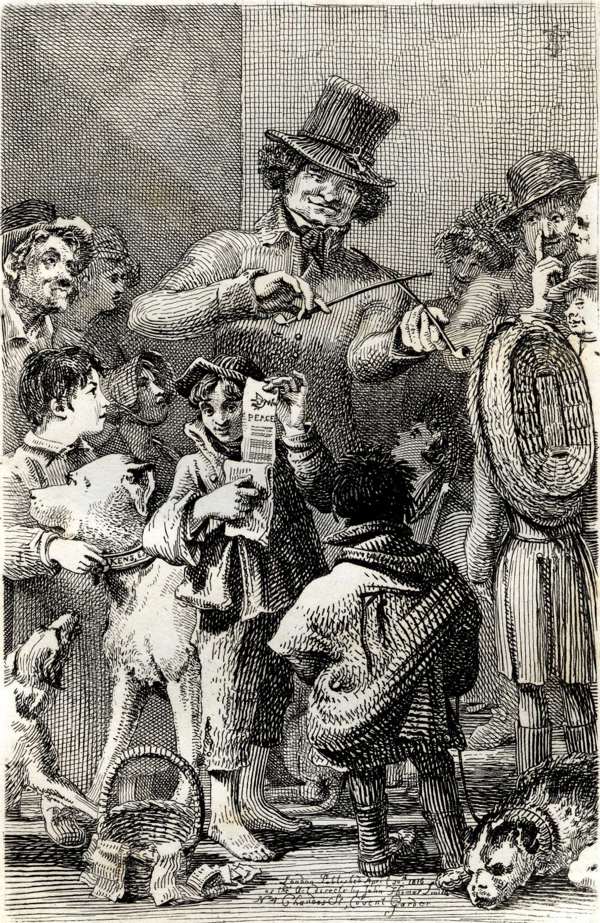
I keep returning to the Bishopsgate Institute to look at John Thomas Smith’s “Vagabondiana” – the collection of his magnificent etchings of street people in London, drawn from life two hundred years ago. The delicate, vivid lines and vigorous hatching of this rare artist evoke an entire world for me, and the closer I examine his work, the more I become in thrall to his compassionate yet unsentimental vision of existence.
In Spitalfields, there is a ceaseless street pageant that is never less than engaging. You do not have to walk down a street many times for the leading characters to emerge and, oftentimes, I drift – as if in dream – engrossed by the elaborate panoply of life, as familiar faces appear and disappear, emerging like figures from a mechanical clock and then passing by upon their business to vanish from my gaze. Looking at John Thomas Smith’s portraits, I know he had the same experience and became fascinated, as I have been, to speak with those whose paths he crossed frequently in the city and discover the stories of those who might otherwise remain strangers.
Among his work, I found plates of figures in the clothing of the early seventeenth century, where he had redrawn images of the lost street life of an earlier London. While I look back two centuries to his work at the beginning of the nineteenth century, speculating upon our contemporary street life as the echo of that former age, John Thomas Smith looked back two centuries to another London. And, for both of us, the street cries form a continuum.
Just as I am familiar with the presence of Tom the Sailor, Molly the Swagman, Mick Taylor, the peacock feather sellers, the Bengali trolley men (and the many others I have written of in these pages), as constant inhabitants of the street – always present somewhere in the edge of my consciousness while I am walking round Spitalfields – so, “Vagabondia” records those who impinged daily upon the attention of John Thomas Smith in London two hundred years ago. Thanks to him, those that he knew live for me to the degree that I would not be entirely surprised, glancing from my window upon an empty midnight street in Spitalfields, to see one of these people coming trudging out of the shadows.

Of all the calamities with which a great city is infected there can be none so truly awful as that of the plague, when the street doors of the houses that were visited with the dreadful pest were padlocked up and only accessible to surgeons and medical men, whose melancholy duty frequently exposes them even to death itself.

Ratcatcher – The bite of the rat is keen, and the wound it inflicts painful and difficult to heal, owing to the form of its teeth, which are long, sharp and irregular.

The floors were not wetted, but rubbed dry, even until they bore a very high polish, particularly when it was the fashion to inlay staircases and floors of rooms with yellow, black and brown woods. These floors were rubbed by the servants who wore brushes on their feet, and they were, and indeed are, so highly polished, in some of the country mansions, that in some instances they are dangerous to walk upon.

It appears from the extreme neatness of this man and the goods that he exhibits for sale that they are of a very superior quality, probably of foreign manufacture. England can boast of superiority in almost every description of manufacture but it never rivalled the basket-makers and willow-workers of France and Holland. They have a great selection of wood and the females are taught the art of twisting it at a very early age.

Saloop, the subject of this etching, has superseded almost every other midnight street refreshment, being a beverage easily made, and a long time considered as a sovereign cure for headache arising from drunkennesss. It is a celebrated restorative among the Turks, and with us it stands recommended in consumptions, bilious cholics and all disorders stemming from acrimony in the juices.
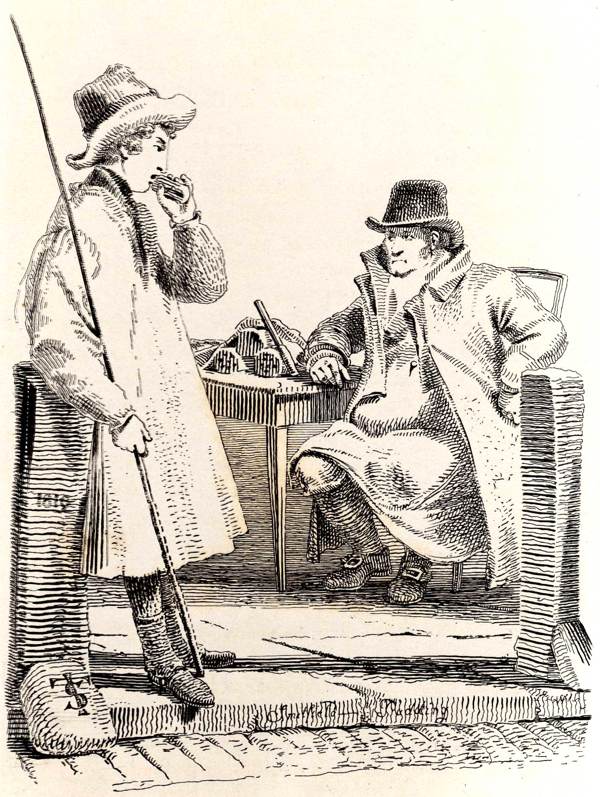
Smithfield Pudding – It would be almost criminal to proceed in my account without a due encomium on the subject of it. The good qualities of an English pudding, more especially when it happens to be enriched with the due portion of enticing plums, are well known to most of us. The places where this excellent commodity is chiefly exposed to sale, in the manner described in the engraving, are those of the greatest traffic such as Smithfield on a market morning, where waggoners, butchers and drovers are sure to find their pence for a slice of hot pudding. Fleet Market, Leadenhall, Honey Lane and Spitalfields have each their hot pudding men.

A journeyman Prickle-maker who works in a cellar on the western side of the Haymarket. A Prickle is a basket used by the wine merchants for their empty bottles, and it is made loose with open-work so that when it is filled with bottles, it may ride easily in the wine merchant’s caravan, and without the least risk of breaking them.

Daniel Clarey, an industrious Irishman, well known to the London schoolboy as a gingerbread-nut lottery office keeper. Every adventurer in his scheme is sure of having a prize from seven to one hundred nuts, and some of his gingerbread shot are so highly seasoned, they are as hot as the noble Nelson’s balls, when he last peppered the jackets of England’s foes.

A lad who occasionally sweeps the crossing at the end of Princes St, Hanover Sq, and wears a long waistcoat surmounted by a soldier’s jacket.
Images courtesy © Bishopsgate Institute
You may also like to take a look at
At Norton Folgate Almshouses

Before Christmas, Spitalfields architect Chris Dyson took me to the Norton Folgate Almhouses in Puma Court, where he is one of the trustees, to show me the renovations. And yesterday I went back to meet Alfons Jedrzejewski – widely known as Alec – who is the most senior resident and also the first to return after the works.
For many years I have passed the railings of the almshouses as I walked through Puma Court, leaving the clamor of Commercial St behind me and entering the peaceful streets of eighteenth century houses beyond. So I was intrigued to enter through the old iron gates at last and visit this appealing backwater in the midst of the city. Established at first in Blossom St – West of here – in 1728, this site for the Norton Folgate almshouses was purchased in 1851, when the widening of Commercial St to permit the increasing traffic from the London Docks required the demolition of the former premises.
“The site was bought by the trustees for the sum of 1,500 pounds and 52 pounds 16 shillings for interest, the said commissioners of works conveyed to Henry Soper and nine others, being the survivors of the trustees appointed by order of court of the 10th May 1851, a piece of ground described as situate on the East side of Commercial St and the North side of Red Lion Court (as Puma Court was then known) in the parish of Christ Church, Spitalfields, which said piece of ground was delineated in the plan drawn and therein coloured pink, upon the trust’s indenture of the 4th December 1746.”
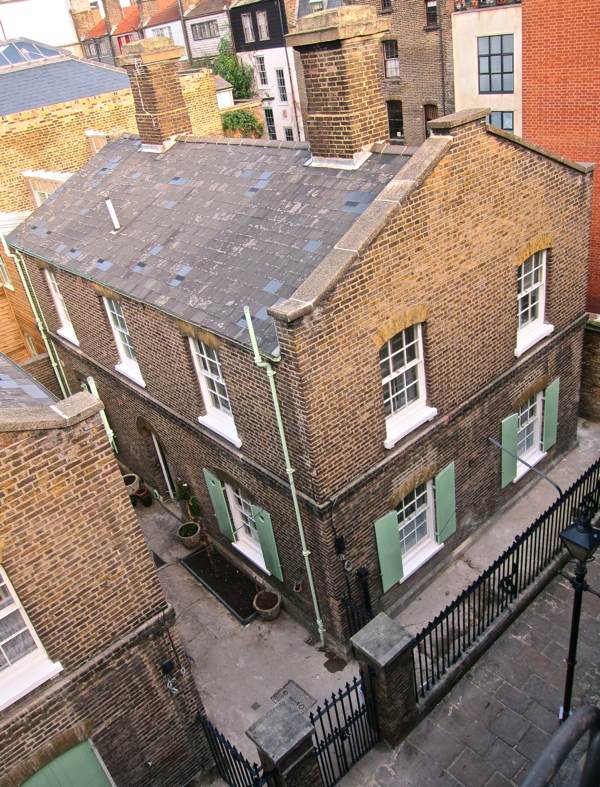
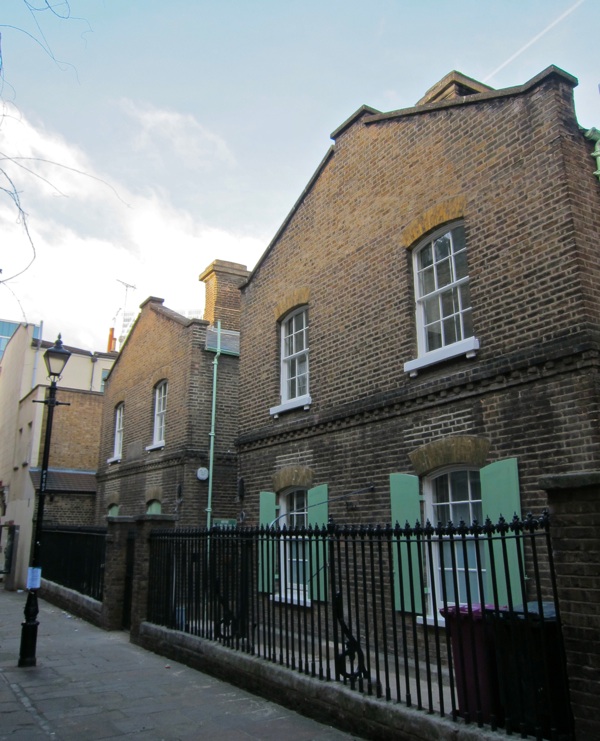
This pair of modest yet elegantly proportioned brick structures, each containing eight rooms on two storeys, was built by architect T. E. Knightley in 1860. Every resident received two shillings and sixpence a month, a ticket for a quartern loaf of bread per week, six hundredweight of coal on 21st December and materials for dinner on Christmas Day. There were fifteen single people and one married couple living here in 1897, they each had a one room and the average age was sixty-four. It was a humane endeavour, offering a secure haven for those who could no longer earn a living and existing in sharp contrast to the poverty which dominated the neighbourhood at that time.
During the last century, those sixteen rooms were combined into eight one-bedroom flats and the recent renovation involving the construction of extensions by architects Manalo & White to the rear, replacing former washhouses with four additional rooms, makes four two-bedroom flats, permitting the possibility that families could live here in future. These extensions have been sensitively conceived to complement the existing almshouses, following the lines of the original structures and clad in oak weatherboarding that will quickly weather to a sympathetic patina. For residents, these modern rooms created in the gaps between the old buildings offer characterful living spaces with high pitched ceilings on the upper floors and clever use of skylights and windows in corners to bring in daylight from several directions at once.
After a ten month sojourn in Shepherds Bush, Alec is relieved to be back in the place where he has lived for the last forty-two years. “I prefer to be here,” he confided to me, rolling his eyes to communicate the alien nature of life in West London, “I feel more happy here.” Hale and healthy at eighty-six, Alec was born in 1926 in Tors in Poland. He served in the Polish army during World War II and came to London in May 1946 to start a new life after he discovered that all his relatives in Poland had been killed by Stalin. Just a few snaps and photobooth portraits in a frame upon the wall of Alec’s living room in Norton Folgate Almhouses attest to the existence of his family now, and his flat also contains the memory of the last twenty-three years of his marriage to his wife Halina who died nineteen years ago.
When he first came to London, Alec worked as a house painter until – following Halina’s prudent advice – he took a job on the railway that would give him a pension, working for twenty-one years in the parcels office at Liverpool St station. “A friend of mine, who worked at Kings Cross and lived at 8 Wilkes St, told me about these flats,” explained Alec, emphasising the importance he places upon mobility, “you have good transport links here, underground, buses and British Rail.” Significant because the highlight of Alec’s week now is his trip to Leytonstone to visit his girlfriend Maria and take her the fresh fish that she loves so much which he buys for her at Asda.
Over one hundred and fifty years, this discreet pair of buildings in Puma Court has offered a safe harbour for life – as Alec will attest – and now these thoughtfully-conceived renovations carry the Norton Folgate Almshouses forward into another century, as the need for good quality housing at an affordable price in Spitalfields becomes ever more pressing.

Almshouses of 1860 by T.E.Knightley with new extension to the rear by Manalo & White, 2011.
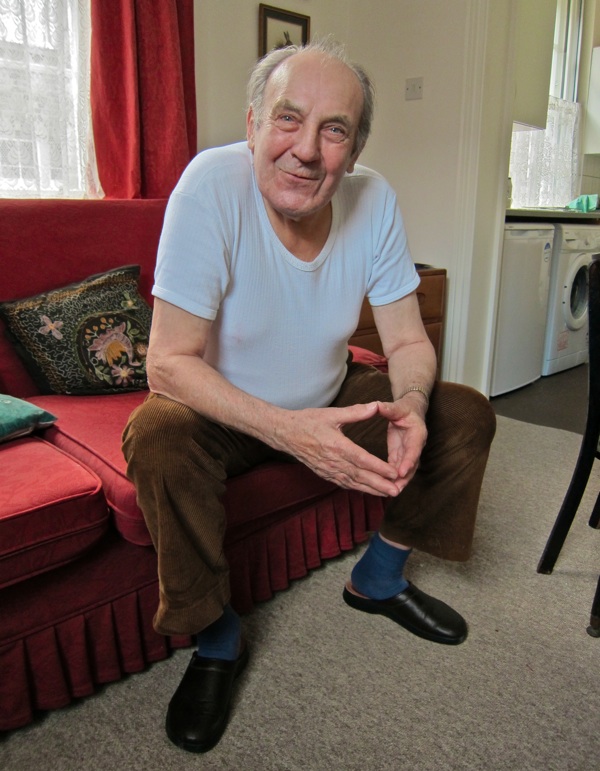
Eighty-six year old Alfons Jedrzejewski – widely known as Alec – has lived in the Norton Folgate Almshouses for forty-two years.
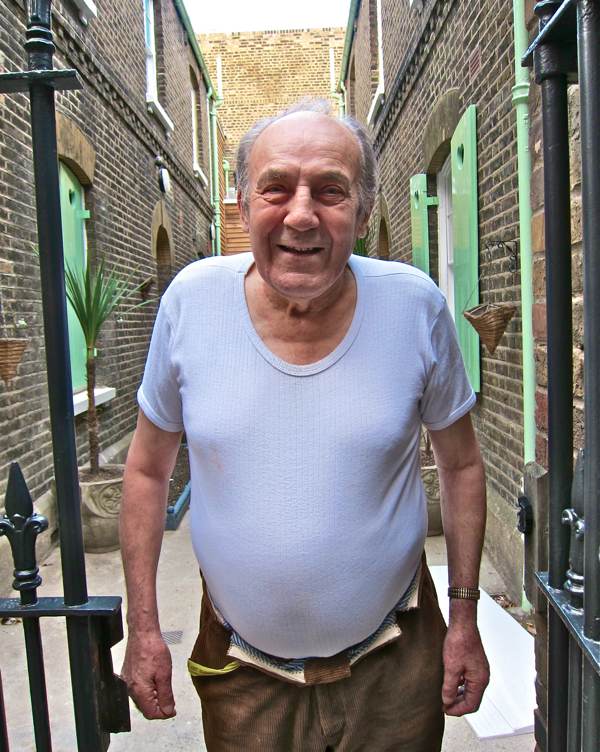
After ten months in Shepherd’s Bush, Alec is glad to be back -“I prefer it it here, I feel more happy here.”

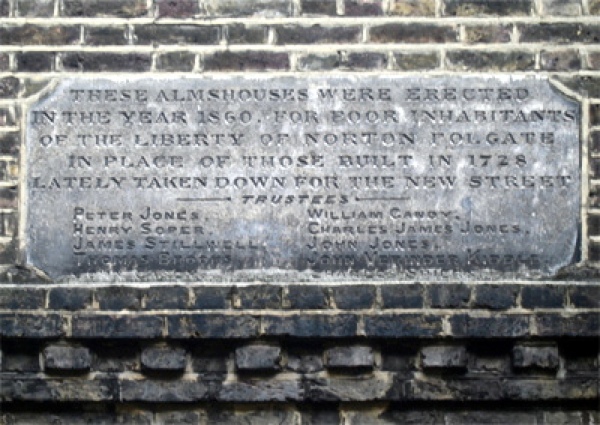
The current trustees are James Talbot (Chairman), Rachel N. Blake, Chris Dyson RIBA FRSA, Emma King, Reverend Andy Rider, Hannah Spiring and Chris Weavers.
You may also like to read about