
Chapter 10. Epilogue

In the months after the burial of John Williams at the crossroads in Shadwell on 31st December 1811, some further evidence came to light. A search of The Pear Tree revealed a jacket with a bloodied pocket, blood stained trousers abandoned in the privy and a bloody French knife hidden in a mouse-hole – the knife that could have been used to slit the victims’ throats. However none of these items could be incontrovertibly connected to John Williams.
Most interesting was the testimony of the Captain of the Roxburgh Castle upon which Williams and William Ablass had sailed together out of Rio de Janeiro. They were a very bad crew, with Ablass – a violent character among the very worst of them, imprisoned in Surinam for leading a mutiny. Ablass was held in chains on suspicion of being Williams’ accomplice to the Shadwell murders but released without sufficient evidence to charge him. The two men escaping up New Gravel Lane after the murder of the Williamsons were described as one short and one tall, but both Williams and Ablass were tall, which means if Williams was guilty then Ablass must be innocent, it was concluded. The converse deduction was not addressed.
In writing these episodes over the last month retelling the story of the Ratcliffe Highway Murders, I am primarily indebted to the conscientious work of P.D.James and T.A. Critchley in their shrewdly written book The Maul and the Pear Tree published by Faber & Faber, which stands as the definitive account, and I strongly recommend it to all who wish to learn the fuller story. In 1811, the systematic approach to crime solving that we recognise today – of suspects, clues, motive and alibi – was simply not in existence. Yet P.D.James and T.A. Critchley succeed in organising the arbitrary random scraps of evidence that survive into a coherent picture on the lines of our modern approach, and creating an exciting narrative in the process. They suggest that John Williams himself could have been an eighth victim – despatched by the killers in a staged suicide to shut him up and prevent their detection. Though to my ears this sounds overly contrived, after studying this story, I understand that it is irresistible to speculate upon a mystery that remains one of the greatest unsolved crimes in our history. You must read the book and draw your own conclusion.
Both multiple murders were on commercial premises within a quarter mile of each other and there is sufficient evidence to confirm more than one culprit. Immediately, this excludes the notion of a random diabolic psycho-killer on the loose and instead suggests organised crime, a protection racket of intimidation – which is entirely credible in such a bad neighbourhood with a high proportion of transients and little policing.
It is likely that Mr Marr knew that the oyster shop and bakers would be shut when he sent Margaret Jewell, the servant girl, out on 7th December, because he needed privacy for whatever negotiation was to take place with his expected guests at midnight. And in doing so, Mr Marr saved the girl’s life. It is possible that Mr Marr took the chisel himself – when it went missing – to keep it as self-defence from persons unknown. This would explain its re-appearance on the night of the murder and why it was clean and untouched with blood. It is established that Mr Marr was in debt and sailed on the Dover Castle with Cornelius Hart, the carpenter who used the chisel to construct the new shop window and who was connected to the Pear Tree through John Williams. To me, there is the hint of a hidden narrative here weaving these characters together, and maybe of the resurgence of some old grievance from Mr Marr’s seafaring days.
Intimidation alone cannot account for the extremity of the violence, but it could if the negotiation had turned bad and led to the killing of Mr Marr and his shop assistant, and then Mrs Marr too as witness. If there happened to be an unhinged individual with a violent murderous tendency among the group – someone like William Ablass – that alone can explain the murder of the baby. In this context, the Williamsons’ subsequent murder may be comprehended as damage limitation, if somehow they had learnt the truth of the earlier killings.
It appears that a principal witness, Mrs Vermilloe, the landlady of the Pear Tree, had been intimidated or threatened and also that she was convinced of the innocence of John Williams. To me, John Williams’ suicide speaks of his expectation of the outcome of any trial, irrespective of whether he was guilty or innocent. He took his own life rather than live through the ordeal that he knew lay ahead.
This fascinating tale – of which we shall never know the truth – speaks of a Britain not so long ago when the metropolis grew rapidly and the first national media had come into existence but there was no police force yet. Nowadays, Mr Marr’s financial dealings and phone records could be scrutinised, and the maul analysed for fingerprints and DNA, and the Ratcliffe Highway (now known simply the Highway) has CCTV cameras installed.
It was the widespread public unease generated by this case, driven by the universal terror of killers in the night and encouraged by the press reports that turned the Ratcliffe Highway Murders into the first national crime sensation, which contributed directly to the establishment of the Metropolitan Police in 1829. Such was the association with violence that the name of “Ratcliffe” was dropped from maps over time. Today, traffic thunders along the Highway past the headquarters of News International, occupying the site of former London Docks just fifty yards from the location of the Marrs’ shop.
John Williams’ body was exhumed a hundred years later when a water main was installed in Cable St and his skull was kept for many years as a curiosity behind the bar in the public house at the crossroads. In recent years, The Crown & Dolphin has been converted to flats but I have not been able to discover what became of the skull. Does anyone know?


Click on Paul Bommer’s map of the Ratcliffe Highway Murders to explore further
The Maul & The Pear Tree – P.D. James’ breathtaking account of the Ratcliffe Highway Murders, inspired me to walk from Spitalfields down to Wapping to seek out the locations of these momentous events. Commemorating the bicentenary of the murders this Christmas, I have been delighted to collaborate with Faber & Faber, reporting on these crimes on the exact anniversaries of their occurrence.
The Map of the Ratcliffe Highway Murders – In collaboration with Faber & Faber, Spitalfields Life commissioned this map from Paul Bommer. Once you have clicked to enlarge it, you can download it as a screensaver or print it out as a guide to set out through the streets of Wapping.
Thanks to the Bishopsgate Institute and Tower Hamlets Local History Archive for their assistance with my research.
You may like to read the earlier installments of this serial
Chapter 1, Two Hundred Years Ago Tonight …
Chapter 3. The Burial of the Victims
Chapter 4. New Sanguinary Atrocities
Chapter 5. Indescribable Panic
The Book of Spitalfields Life

It is my delight – on this New Year’s Day – to announce the news to you that the book of Spitalfields Life will be published by Saltyard Books (an imprint of Hodder & Stoughton) on March 1st. For over a year, I have been working to bring this mighty four hundred and fifty page book into existence, and here you will find one hundred and fifty of your favourite stories, published as a handsome illustrated hardback designed by distinguished typographer David Pearson.
Everything you seek in London can be found in this book – street life, street art, markets, diverse food, immigrant culture, ancient houses and history, pageants and parades, rituals and customs, traditional trades and old family businesses. Spend a night in the bakery at St John with baker Justin Piers Gellatly, ride the rounds with Kevin Read the Spitalfields milkman, drop in to the Golden Heart for a pint with landlady Sandra Esqulant, meet Paul Gardner the fourth-generation paper bag seller, Steve Brooker the mudlark who discovers treasure in the Thames, Bill Crome the window cleaner who sees ghosts and Alan Hughes the master bell-founder whose business started in 1570. In these pages, you can join the bunny girls for their annual reunion at The Grapes, visit the wax sellers of Wentworth Street and the curry chefs of Brick Lane, and discover the site of Shakespeare’s first theatre in Shoreditch.
As you can see, Rob Ryan made these fine Staffordshire dogs to grace the cover and it has been a pleasure to collaborate with him on a set of bells that tintinnabulate throughout the book as colophons to divide the stories one from another. Equally, it has been my privilege to work with Lucinda Rogers, commissioning her to make a suite of six large detailed drawings of the streets of Spitalfields which will be published in the book as double page spreads. Finally, to complete the trio, Mark Hearld – a favourite artist whose work is new to Spitalfields Life – has contributed lyrical images of the creatures that share our neighbourhood, the cats, rats, foxes and pigeons – as well as magnificent endpapers of the rooftops of Spitalfields.
Alongside prime examples of the work of Spitalfields Life Contributing Photographers, Sarah Ainslie, Lucinda Douglas-Menzies, Jeremy Freedman, Phil Maxwell, Patricia Niven and Martin Usborne, you will find the first publication of photographs by Mark Jackson & Huw Davies recording the last year of the Fruit & Vegetable Market, George Gladwell’s pictures of Columbia Rd Market in the 1960s and the Society for Photographing the Relics of Old London’s images of London in the 1880s.
When I set out to write my daily stories of Spitalfields Life in 2009, I had hardly written prose before and I did not know where it would lead, but it was my intention to pursue the notion of recording the stories that nobody else was writing. Although it was not in my mind that this would become a book, over time many readers wrote asking for a collection of these stories and then, in the Summer of 2010, several esteemed publishers came over to Spitalfields to discuss the notion of publication in print. Meanwhile, I discovered that Elizabeth Hallett, editor of a select list of titles at Saltyard Books, had subscribed to Spitalfields Life and been reading it daily from within a few weeks of commencement, and so I was happy to accept her as my publisher.
More than a year ago, I promised to invite you – dear readers – to a wonderful party in Spitalfields to meet all the infinite variety of people that you have been reading about in these pages, and now it is time to issue that glorious invitation. On the evening of Friday 2nd March, please join me in Nicholas Hawksmoor’s towering masterpiece of Christ Church, Spitalfields at a gathering to celebrate the people of Spitalfields, as we launch this book of their stories into the world.
Your loyal servant
The Gentle Author
 You may also like to read about
and watch this short film introducing the Art of Mark Hearld.
Chapter 9. A Shallow Grave

John Williams was buried here outside The Crown & Dolphin at the junction of Cannon St Rd and Cable St on 31st December 1811. It was a tradition for a murderer who committed suicide while awaiting execution to be buried at the crossroads nearest the scene of their crime, with a wooden stake driven through the heart – and this was the ultimate fate of John Williams.
This practice – which was not unusual at the time – had its roots in folklore and the superstitious belief that only by driving a stake through the heart could the ghost of the murderer be prevented from returning to earth to plague the living. Even if the spirit were able to break free of the impaling stake, it would hover eternally irresolute at the crossroads. Although there was no legal authority for this custom, it was in this instance sanctioned personally by the Home Secretary, along with permission for a procession displaying the body publicly, prior to burial.
Londoners had been cheated of the spectacle of a public execution, so instead they were able to enjoy a parade. On the night before, the Deputy Constable of St George’s-in-the-East sat alone in a hackney coach with the dead body, transporting it from Coldbath Fields Prison in Clerkenwell over to Shadwell. The blinds of the coach were shut because if the body were exposed to the eyes of the mob there was little chance that it would survive intact. It must have been a grim ride.
On the morning of New Year’s Eve, John Williams’ body was attached to a cart specially rigged with a raked platform allowing maximum exposure to the crowd, and with the maul and the chisel displayed on either side of his head. Above his head was affixed the iron bar used to kill Mr Williamson and at the back of the neck, the sharpened stake was placed ready for use at the burial. Travelling along the Ratcliffe Highway past the Marrs’ draper’s shop, the procession set out on a journey around Wapping, taking in The Pear Tree and The King’s Arms along the way. When the cart reached the draper’s shop it halted because Williams’ head lurched unexpected to one side, as if he were taking a last look at the scene of his crime. Once someone had climbed up and straightened the head, the procession went on its way. It was estimated that ten thousand people turned out to witness the parade and although the Home Secretary feared the crowd might seize the body to exact direct physical vengeance, he was mistaken because the entire proceeding passed off in macabre silence.
At the crossroads, a grave four feet deep, three feet long and two feet wide had been dug and once John Williams’ body was tumbled into this hole – made deliberately too small – one of the escorts drove the stake through his heart. As the stake entered John Williams’ heart, the silence of the crowd was finally broken and cathartic shouts and cheers filled the air. A quantity of quick lime was thrown into the hole, it was hastily filled up with earth, and the paving stones were replaced and hammered down at once.
As darkness fell upon East London, people at last felt more comfortable to venture from their homes into the dark streets of Wapping, Shadwell, Whitechapel and Spitalfields as the New Year’s celebrations got underway. But the confident verdict of the Shadwell Bench, that John Williams was the sole murderer of both the Marrs’ and Williamsons’ families, could have deceived no-one for long.
Early in the New Year, you may expect the final report on this case.

The procession passes The King’s Arms.

The procession arrives at the crossroads with The Crown & Dolphin in the background.

Click on Paul Bommer’s map of the Ratcliffe Highway Murders to explore further
The Maul & The Pear Tree – P.D. James’ breathtaking account of the Ratcliffe Highway Murders, inspired me to walk from Spitalfields down to Wapping to seek out the locations of these momentous events. Commemorating the bicentenary of the murders this Christmas, I am delighted to have collaborated with Faber & Faber, reporting on these crimes on the exact anniversaries of their occurrence.
The Map of the Ratcliffe Highway Murders – In collaboration with Faber & Faber, Spitalfields Life commissioned this map from Paul Bommer. Once you have clicked to enlarge it, you can download it as a screensaver or print it out as a guide to set out through the streets of Wapping.
Thanks to the Bishopsgate Institute and Tower Hamlets Local History Archive for their assistance with my research.
You may like to read the earlier installments of this serial
Chapter 1. Two Hundred Years Ago Tonight …
Chapter 3. The Burial of the Victims
Chapter 4. New Sanguinary Atrocities
Chapter 5. Indescribable Panic
David Kira Ltd, Banana Merchants

To anyone that knows Spitalfields, David Kira Ltd is a familiar landmark at 1 Fournier St next to The Ten Bells. Here, at the premises of the market’s foremost banana merchant – even though the business left twenty years ago – the name of David Kira still stands upon the fascia to commemorate the family endeavour which operated on this site for over half a century.
By a fluke of history, the shop that trades here now has retained the interior with minimum intervention, which meant that when David’s son Stuart Kira returned recently he found it had not been repainted since he left in 1991 and his former office, where he worked for almost thirty years – and even his old chair – was still there, existing today as part of a showroom for shoes and workwear.
This is a story of bananas and it began with Sam Kira in Southend, a Jewish immigrant from Poland who became naturalized in 1929 and started a company called “El Dorado Bananas.” Ten years later, his son opened up in Fournier St as a wholesaler, taking a lease from Lady Fox but having to leave the business almost at once when the war came, bringing conscription and wiping out the banana trade. Yet after the war, he built up the name of David Kira, creating a reputation that is still remembered fondly in Spitalfields and, since the shop remains, it feels as if the banana merchants only just left.
“When I first came to the market as a child of seven, we lived in Stoke Newington and took the 647 trolley bus to Bishopsgate and walked down Brushfield St. Every opportunity, I came down to enjoy the action and the atmosphere, and the biggest thrill was getting up early in the morning – I always remember being sent round to the Market Cafe to get mugs of tea for all the staff. When I joined my father David in 1962, aged sixteen, my grandfather Sam had died many years earlier. There was me and my father, John Neil (who had been with my father his entire working life), Ted Witt our cashier, two porters, Alf Lee and Billy Alloway (known as Billy the thief) and we had an empty boy. Our customers were High St greengrocers and market fruit traders, and we prided ourselves on only selling the best quality produce. Perhaps this was why we had a lot of customers. It was hard work and long working hours, getting up at half past four every morning to be at the market by five thirty. I used to sleep for a couple of hours in the afternoon when I got home, until about six, then I’d get up and return to bed at eleven until four thirty – I did that six days a week.
We received our shipments direct from Jamaica through the London Docks – bananas in their green state on long stalks – they arrived packed in straw on a lorry and it was very important that they be unloaded as soon as they arrived, whatever time of day or night the ship docked, because the enemy of the banana is the cold. They were passed by hand through a hatch in the floor to the ripening rooms downstairs – it took five days from arrival until they were saleable. Since the bananas came from the tropics, it was not so much the heat you had to recreate as the humidity. We had a single gas flame in the corner of each ripening room, the green bananas hung close together on hooks from the ceiling and, when the flame was turned down, a little ethylene gas was released before the door was sealed. Once they were ripened, they had to be boxed. You stood with a stalk of bananas held between your legs and struck off each bunch with a knife, placing it in a special box, three foot by one foot – a twenty-eight pound banana box.
During the sixties, dates were only sold at Christmas but in the seventies when the Bangladeshi people arrived, we started getting requests for dates during Ramadan. I contacted one of the dates suppliers and I asked him to send me thirty cases, and they were sold to Bengali greengrocers in Brick Lane before they even touched the floor. Subsequently, we sold as many dates as we could get hold of, more even than at Christmas. During this period, we also saw the decline of the High St greengrocers due to the supermarkets, however we found we were able to compensate for the loss of trade by fulfilling the requirements of the Asian community.
Eventually, they started importing pre-boxed bananas in the eighties, so our working practices changed and the banana ripening rooms became obsolete. My late father would be turning in his grave if he knew that bananas are now placed in cold storage, which means they will quickly turn black once they get home.
In 1991, when the market moved, we were offered a place in the new market hall but trading hours became a free-for-all and, although we started opening at three am, we were among the last to open. By then I was married and had children, and without the help of my father and John Neil who had both retired, I found it very difficult to cope. It was detrimental to my health – so, after a year, I sold the company as a going concern. I didn’t know what I wanted to do, but by chance I bumped into a colleague who worked in insurance and he introduced me to his manager. I realised in that type of business I could continue to be self-employed, so I trained and qualified and I have done that for the past twenty years. When I think back to the market, I only got two weeks a year holiday and I felt guilty even to put that pressure on my father and John Neil when I was away.”
Proud of his father’s achievement as a banana merchant, Stuart delighted to tell me of Ethel, the rat-catching cat – named after the ethylene gas – who loved to sleep in the warmth of the banana ripening rooms and of Billy Alloway’s tip of sixpence that he nailed to the wall in derision, which stayed there as his memorial even after he died. Stuart cherishes his memory of his time in the market, recognising it as a world with a culture of its own as much as it was a place of commerce. Today, the banana trade has gone from Spitalfields where once it was a way of life, now only the name of David Kira – heroic banana merchant – survives to remind us.

Sam Kira (far right) dealing in bananas in London and Southend.

Sam Kira’s naturalization papers.

David Kira at the Spitalfields Fruit Exchange – he is centre right in the fifth row, wearing glasses and speaking with his colleague.
 The banana trade ceased during World War II.

David Kira as a young banana merchant.

David Kira (left) with his son Stuart and business partner John Neil.

David Kira and staff.


Stuart Kira stands in the doorway of his former office of twenty years, where his father and grandfather traded for over fifty years, now part of a shoe shop.

Stuart Kira returns to the old premises today.

David Kira Ltd, 1991
First and last pictures copyright © Mark Jackson & Huw Davies, 1991
You may also like to read about
Jimmy Huddart, Spitalfields Market Porter
Peter Thomas, Fruit & Vegetable Supplier
Ivor Robins, Fruit & Vegetable Purveyor
John Olney, Donovan Brothers Ltd
Jim Heppel, New Spitalfields Market
Blackie, the Last Spitalfields Market Cat
and take a look at these galleries of pictures
More Curry Chefs of Brick Lane

Abdul Tahid, Head Chef at Papadoms, 94 Brick Lane
Spare a thought for the Curry Chefs of Brick Lane who carry on cooking through the festive season while everybody else puts their feet up. Like Bob Cratchit, these men only get one day off at Christmas, yet it is a measure of the all-consuming nature of their work that they did not seem unduly interested the possibility of a day’s break when I visited last week, rather they were passionate to maintain the ceaseless production of curry required daily to feed the insatiable appetites of their hungry customers.
It was a year ago that I first began visiting the kitchens of Brick Lane to pay my respects to these unacknowledged curry heroes, and once the temperatures dipped again it was time to return in the company of Spitalfields Life Contributing Photographer Jeremy Freedman to make the acquaintance of more cooks and to extend the portfolio of portraits. Today I am publishing the complete gallery of pictures, revealing more faces of these reclusive men whose cherished duty it is to mix the spices and create the curry to sustain us all through the darkest depths of Winter.
“When I started, I dreamed of being a chef,” confessed Jamal Uddin, Head Chef at Bengal Cuisine, referring to his ambition when he came here to Brick Lane from Bangladesh aged nineteen. For the last fourteen years, Jamal has reigned supreme in his kitchen with a Tandoori Chef, a Cook and a Porter working under his supervision as he prepares as many as two hundred curries every day. “I love cooking,” he admitted to me as his gleaming face broke into a smile, though whether it was the intensity of his emotion or the humidity in the kitchen that was the cause of his glowing complexion, I never ascertained.
Syed Jahan Mir, Head Chef at Chillies Restaurant, told me he came to this country at the age of eighteen with his mother and father. Syed was able to learn from his father who was also a chef and they started out together at first, working side by side in the same restaurant. “He’s better than me, but now he is retired to Sunderland I am the best!” Syed asserted, placing a hand on his chest protectively. “Of course I like it,” he confirmed for me with fierce pride, “Twenty-four years, I’ve been doing this, just making curry – it’s my profession.” A poet with spices, Syed creates his own personal mixture for curry. “It’s all the blending,” he emphasised, running his fingers through the golden powder in a steel dish to demonstrate its special properties.
Mohammed Salik still remembers arriving in Britain at the age of seven. “It was quaint and nice here and the people so good, not overcrowded and dirty like my country,” he recalled with a sublime smile of reminiscence, “My dad used to work at the Savoy, but I wanted to be part of the community here in Brick Lane.” Starting as kitchen porter, Mohammed spent the first five years watching and learning and is now Head Chef at Eastern Eye Restaurant. Our brief conversation in the kitchen was eclipsed by the arrival of a bucket on a piece of string from the restaurant above and inside was a yellow slip of paper, occasioning a polite, apologetic glance from Syed as he turned away to study the handwriting and order his team to work, making up the order.
At Cinnamon, Head Chef and veteran of twenty-five years in the business, Daras Miya was keen to introduce me to the two smiley, hardworking young Kitchen Porters under his care, skinny twenty-four year old Belal Ahmed who has been there three months and also works as a waiter, and nineteen year old Mizanor Rahman who started a week ago. Newly married and with little English, wide-eyed Mizanor was experiencing his first Winter in London, after marrying his wife who came from Britain to Bangladesh find a husband.
In some establishments, Curry Chefs came to sit at tables to meet me. At others, I passed through the private door and descended the staircase – where incense sticks burned stuck in half a potato for stability – to reach the kitchen below. Here in these secret domains, the Curry Chefs work incessantly creating meals for customers they never see and who do not see them. Yet when required to face the camera, all the Chefs assumed the same gracious, arms-crossed posture without prompting.
I never learnt the origin of this apparently innate piece of body language, which expresses perfectly their subtle balance of pride and modesty, both protective and assertive too. They present themselves to the camera with the dignified optimism which defines these brave men who began their lives in another continent and have embraced the role of Curry Chef as the means to further an existence in a new land .

Jamal Uddin, Head Chef for fourteen years at Bengal Cuisine, 12 Brick Lane.

Zulen Ahmed, Head Chef at Saffron, 53 Brick Lane, for ten years.

Syed Jahan Mir, Head Chef at Chillies Restaurant, 76 Brick Lane.

Abdul Ahad Forhad, Curry Chef at Monsoon, 78 Brick Lane – “I’m the master of curry!”

Mohammed Salik, Head Chef at Eastern Eye Balti House, 63a Brick Lane.

Nurul Alam, Head Chef at Preem & Prithi, 124/6 Brick Lane, cooks three hundred curries a night.

Daras Miya, Head Chef at Cinnamon, 134 Brick Lane.

Head Chef Shaiz Uddin with his colleague Monul Uddin, Tandoori Chef at Masala, 88 Brick Lane.

Monzur Hussain, Head Chef at Shampan, 78 Brick Lane.

Rana Miah, Brick Lane’s longest serving Curry Chef stands centre, flanked by Kholilur Rahman and Mizanur Khan in the kitchen of the Aladin, 132 Brick Lane.

Belal Ahmed & Mizanur Rahman, porters at Cinnamon 134, Brick Lane.
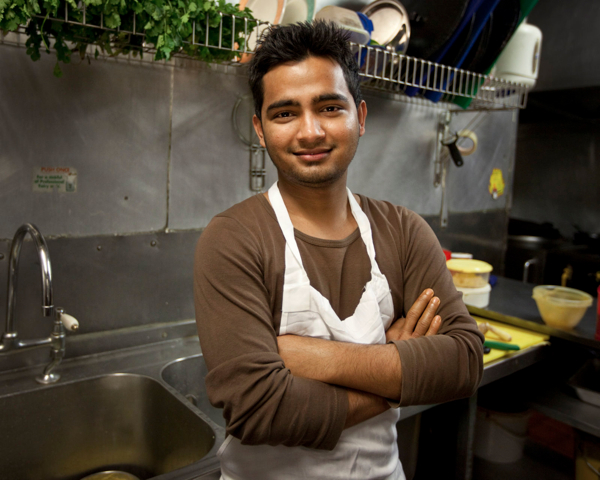
Dayem Ahmed, kitchen porter of six months standing and aspiring chef, at Shampan.
Photographs copyright © Jeremy Freedman
Jeremy Freedman’s portraits of The Curry Chefs of Brick Lane will be exhibited at Rich Mix from 23rd February until 31st March 2012.
Read my original feature The Curry Chefs of Brick Lane
At W. F. Arber & Co Ltd, Printing Works

Gary Arber with his Furnival guillotine
It was the Friday before Christmas, and when I arrived at W. F. Arber & Co Ltd, Printing Works, at 459 Roman Rd there was a sign hanging in the window that said “Back in ten minutes,” so I rang and waited. Before long, the friendly face of Gary Arber – third generation in the family business – appeared from out of the gloom and welcomed me inside the premises established by his grandfather Walter Francis Arber in 1897. Eyes sparkling in excitement, Gary locking the door again behind us and led me back to the trimming room at the rear, where he had been busy.
Each time I visit, Gary shows me a new part of the building – whether the printing works in the basement, the “comp” room up above or, on this occasion, the trimming room at the rear – so I cannot resist the expectation that there may be infinite recession in the mysterious backrooms, crowded passageways and dusty staircases of this magnificent old place where all the paraphernalia of the last century has been permitted to accumulate, unhindered by any tidying up.
At the front, customers come and go, calling in for envelopes and ballpoint pens, but beyond the counter is Gary’s sole preserve, the location where memory becomes history and the presence of his forebears still lingers. Behind the shop, we entered the former toy showroom unused in forty years yet still sporting its jaunty pastel-toned children’s wallpaper. The shop telephone was once here and the walls are inscribed with decades of useful phone numbers. As we walked through, Gary retrieved a fifty-year-old plastic lamb on wheels from the debris and squeezed it to make a plaintive “baah!” sound, as if to express its distress at being left behind.
Gary often thinks of his grandmother Emily Arber, the suffragette, who insisted his grandfather print the handbills for her friend Mrs Pankhurst free of charge. The same presses still sit in the basement and researchers come sometimes to ask Gary about his doughty grandmother, though he must disappoint them because she never spoke directly of her involvement with the cause of female suffrage once the vote was won. She presided with unquestionable authority when Gary first worked here, for a couple of years from the age of sixteen before he joined the Royal Air Force. “She ruled,” is Gary’s term for her stubborn influence. “She was deaf and she only understood by lipreading – if she disagreed with you, she would not look at your mouth, so you could not argue.” Gary worked in the print shop in the basement then, but Emily kept him running up and down the stairs. “She was obsessed with beetles, only she called them ‘beadles,'” Gary recalled fondly, “and if she found a crack in the yard where they might enter, she called me to bung the hole up with cement ‘to stop the beadles getting in.'”
Behind the disused toy showroom, we came to a dark antechamber with one door lined with steel plate and another that once had a glass panel now artfully boarded up with planks of different width and hue. Stepping through, we entered a single-storey wooden structure – a lean-to – which had been the “comp” room before it was moved to Gary’s grandparents’ former living room on the first floor in the nineteen fifties. A string of light bulbs led us further back into the darkness where a massive iron machine crouched in the shadow – a Furnival guillotine. Over the decades, Gary has maintained this beast in fine fettle and he delighted to fetch a telephone directory to place between its monstrous jaws. A great wheel, of the scale you might expect upon a steam engine, span into roaring motion and, drawing upon twenty horse power, the guillotine sliced through the directory with unnerving ease. The beast was satiated by Gary’s offering and after a demonstration of such ferocious power, it was time for us mortals to return to the reassurance of daylight.
Customers were popping in for their last Christmas errands, which prompted Gary to bring out his ledgers from the nineteen sixties and recall the lines that once formed at dawn on Christmas Eve outside W. F. Arber & Co as customers came to pay off the final instalments on the toys they had been saving for all year. Then, arrangements had to be made for dispatch that night once the children were in bed. In those days, Gary himself would fulfil the role of Father Christmas – a character he was born to play – driving around the East End streets as late as three on Christmas morning until every package was safely delivered and awaiting its sleeping recipient. Leafing through the Christmas Club records, we found the page for Mrs Pellicci of E. Pellicci in Bethnal Green in 1968, a pram and bicycle for Anna and Nevio.
Our sentimental reverie was interrupted by an affray on the pavement outside in which the aggrieved parties were making loud threats to kill each other, drawing the attention of half a dozen squad cars within minutes. Nothing new for Gary, he took it as the cue to tell me about the shoplifters he once pursued from his shop, demanding they return the parcel they had taken and – when the police failed to arrive – evincing a promise from the felons never to return to the Roman Rd, then shaking hands with them before the gathered crowd and striding back to his shop with his bag of toys under his arm, like a true hero.
This is the fearless nobility of Gary Arber, ex-flying ace. One of the best storytellers I know, an individual of multiple talents and generosity of spirit, and now at eighty years old, a legend in the Roman Rd.


You may also like to read my original profile of Gary Arber, Printer
take a look at Gary Arber’s Collection
Chapter 8. A Verdict

As the magistrates took their seats in Shadwell on 27th December 1811, the first snow of the Winter began to fall upon London. It did not cool the enthusiasm of the crowd in the street outside, eager to catch a glimpse of the major suspect in the Ratcliffe Highway murders, John Williams, as he arrived in manacles from Coldbath Fields Prison of which this fragment of old wall in Clerkenwell Close is now the only visible remnant.
Once the hour passed at which Williams was due to arrive and when the door of the courtroom eventually opened, those inside were surprised to see not the prisoner and his guards but instead a solitary police officer with a grim expression. When the turnkey at the gaol had gone to prepare the suspect for his trip to Shadwell that morning, he discovered Williams suspended by the neck from the iron bar which crossed the cell, provided for prisoners to hang their clothes. The body was cold and lifeless, and the universal conclusion was that John Williams had passed judgement upon himself. Thus the days proceedings were undertaken on the assumption that his guilt would now be revealed.
Mrs Vermilloe was questioned again but acted strangely – she would not confirm that the maul her husband and nephew William Rice had identified was the one from John Peterson’s tool kit. Asked when she was first suspicious of John Williams, she explained it was when the socks claimed to have been worn by Williams were discovered to be bloodstained. When pushed as to why she had not revealed this before, she admitted to fearing he (or some of his acquaintances) would murder her.
Told that she need not fear John Williams any longer because he had hung himself, she exclaimed “Good God! I hope not!” The magistrate asked her why she hoped not and she replied “I should have been sorry, if he had been innocent, that he should have suffered.” Mrs Vermilloe knew more than she was prepared to say.
Once she learned Williams was dead, she changed her story, saying that it was the discovery of the initials I.P upon the maul that first drew her suspicion to him. In this transparently convenient alteration, Mrs Vermilloe began a prejudicial trend adopted by each of the other witnesses that day, which was to take the easy path of pinning guilt upon a dead man. But even this could not erase the names of those morally ambiguous individuals associated with John Williams who will always remain at the periphery of this story. John Cuthperson, John Harrison and John Richter, his room-mates, Cornelius Hart and Jeremiah Fitzpatrick, carpenters, John Cobbett, a coal-heaver and Williams’ only intimate friend, William Ablass, a tall stout seaman, commonly called Long Billy, who was lame. This last individual, Ablass, had once sailed with Williams from Rio de Janeiro on the Roxburgh Castle and witnesses had seen them together at the King’s Arms on the evening of the Williamsons’ murder. Though Ablass had an alibi for the rest of the night given by a woman at his lodging house, which led to his discharge, it was a weak piece of testimony.
Lacking any clear evidence implicating anyone else, the belief that John Williams was the sole murderer of both the Marrs and the Williamsons grew. With this belief came a powerful realisation that so monstrous a villain, multiple murderer and self destroyer, must be made into an example for the whole nation because in the end he had cheated the majesty of Law. Few had any doubt that John Williams was getting his just deserts in the next world but they also wanted to see him receive punishment here on earth too. If there was not to be the spectacle of an execution, then something else had to be devised quickly before the year’s end, because public vengeance had to be satisfied.
There will be a further report on this case before the year’s end.

Coldbath Fields Prison by Thomas Rowlandson

Click on Paul Bommer’s map of the Ratcliffe Highway Murders to explore further
The Maul & The Pear Tree – P.D. James’ breathtaking account of the Ratcliffe Highway Murders, inspired me to walk from Spitalfields down to Wapping to seek out the locations of these momentous events. Commemorating the bicentenary of the murders this Christmas, I am delighted to collaborate with Faber & Faber, reporting over coming weeks on these crimes on the exact anniversaries of their occurrence.
The Map of the Ratcliffe Highway Murders – In collaboration with Faber & Faber, Spitalfields Life has commissioned a map from Paul Bommer which will update throughout December as the events occur. Once you have clicked to enlarge it, you can download it as a screensaver or print it out as a guide to set out through the streets of Wapping.
Ratcliffe Highway Murder Walk – Spitalfields Life will be hosting a dusk walk on Wednesday 28th December at 3pm from St Georges in the East, visiting the crime scenes and telling the bone-chilling story of Britain’s first murder sensation. The walk will take approximately an hour and a half, and conclude at the historic riverside pub The Prospect of Whitby. Booking is essential and numbers are limited, so please email spitalfieldslife@gmail.com to sign up. Tickets are £10.
Thanks to the Bishopsgate Institute and Tower Hamlets Local History Archive for their assistance with my research.
You may like to read the earlier installments of this serial which runs throughout December
Chapter 1. Two Hundred Years Ago Tonight …
Chapter 3. The Burial of the Victims
Chapter 4. New Sanguinary Atrocities


