
Chapter 7. Three Wise Magistrates

At St Paul’s Shadwell, where the murdered Williamson family were interred at Christmas 1811.
On Christmas Day, the three Shadwell magistrates paid a call upon Mr Vermilloe, the landlord of The Pear Tree, residing in Newgate Gaol where the Old Bailey now stands. The mysterious package they carried was not a gift, it contained the iron bar used to murder Mr Williamson and the maul found at the scene of the Marrs’ murder. Mr Vermilloe confirmed both items as originating from the tool chest of John Peterson kept at The Pear Tree. However, Mr Vermilloe, who was imprisoned for debt, had his eye upon the reward money and this must cast a shadow upon his testimony.
It is unlikely that John Williams, the principal suspect, now residing at Coldbath Fields Prison in Clerkenwell, could have committed these crimes alone. Two men were seen running up towards the Ratcliffe Highway from the King’s Arms at the time the alarm of the murder was given. The shorter of the two was lagging behind and the taller man remonstrated “Come along Mahoney (or Hughie), come along.” Consequently, a suspicious Irishman by the name of Maloney had been arrested and another Irishman by the name of Driscoll, who had the misfortune to lodge near to the King’s Arms, was being held after a pair of his trousers were found to be blood-stained.
On Boxing Day, as the court convened in Shadwell, it began to sleet. Most likely based upon a tip-off from Vermilloe, John Williams’ room-mate John Richter was examined on account of a pair of his trousers that had been found hastily washed yet still stained with blood. Richter was questioned about his relationship to two Irish carpenters, Cornelius Hart and Jeremiah Fitzpatrick. Hart was the subcontractor who had worked for Mr Pugh and requested the chisel to create the new window for Mr Marr’s shop. He had been seen calling on Williams at The Pear Tree a few nights before the Marr’s murder but he denied it. Richter said he had seen Hart, Fitzpatrick and Williams together on the Sunday following the Marr’s murder.
After an adjournment, John Cuthperson, the other room-mate at The Pear Tree, revealed that on the morning after the murder of the Williamsons, he complained that a pair of his socks had been worn by someone else and caked in mud. It was John Williams who then took them into the yard and washed them.
At the end of the second day, the accumulation of statements had not clarified the picture at all. The magistrates were by no means certain that John Williams was their man and it became apparent that the case might unravel like string around a Christmas parcel. The strategy for the third day was to question Williams in relation to the stories of his confederates and see if he would betray himself, revealing guilt through inconsistency with the new testimonies. But just at the point that the judiciary were beginning to establish control of the case, all their speculations were about to be confounded for ever by something entirely unanticipated – an appalling event that would be revealed next morning.
We shall continue tomorrow, reporting upon the second day’s court proceedings in Shadwell.


Click on Paul Bommer’s map of the Ratcliffe Highway Murders to explore further
The Maul & The Pear Tree – P.D. James’ breathtaking account of the Ratcliffe Highway Murders, inspired me to walk from Spitalfields down to Wapping to seek out the locations of these momentous events. Commemorating the bicentenary of the murders this Christmas, I am delighted to collaborate with Faber & Faber, reporting over coming weeks on these crimes on the exact anniversaries of their occurrence.
The Map of the Ratcliffe Highway Murders – In collaboration with Faber & Faber, Spitalfields Life has commissioned a map from Paul Bommer which will update throughout December as the events occur. Once you have clicked to enlarge it, you can download it as a screensaver or print it out as a guide to set out through the streets of Wapping.
Ratcliffe Highway Murder Walk – Spitalfields Life will be hosting a dusk walk on Wednesday 28th December at 3pm from St Georges in the East, visiting the crime scenes and telling the bone-chilling story of Britain’s first murder sensation. The walk will take approximately an hour and a half, and conclude at the historic riverside pub The Prospect of Whitby. Booking is essential and numbers are limited, so please email spitalfieldslife@gmail.com to sign up. Tickets are £10.
Thanks to the Bishopsgate Institute and Tower Hamlets Local History Archive for their assistance with my research.
You may like to read the earlier installments of this serial which runs throughout December
Chapter 1. Two Hundred Years Ago Tonight …
Chapter 3. The Burial of the Victims
Chapter 4. New Sanguinary Atrocties
A Child’s Christmas in Devon

Over successive Christmases, as I was growing up, I witnessed the disintegration of my family until today I am the lone survivor of the entire clan, the custodian, charged with carrying the legacy of all their stories. Where once I was the innocent child in the midst of a family drama unknown to me, now I am a sober adult haunted by equivocal memories of a conflict that only met its resolution in death. Yet in spite of this, whenever I examine the piles of old photographs of happy people which are now the slim evidence of the existence of those generations which precede me, I cannot resist tender feelings towards them all.
I was an only child and, though I wished for playfellows occasionally, I do not regret it because the necessity to invent my own amusement gave me my life as a writer. Since there were just the three of us, I had quite separate relationships with my mother and my father, and I never perceived us as a family unit. My father’s parents and my mother’s father died before I was born, and so it was only when we went to visit my grandmother at Christmas that we were forced to confront our identity as part of a larger tribe.
Even the journey to my grandmother’s house, a forty minute drive over the hills, was fraught with hazard. As I lay in bed surrounded by my presents newly-unwrapped on Christmas morning, I could hear my parents in the kitchen discussing which was the greater risk – of skidding on black ice on the upland roads or getting washed away in floods surging down the valleys. Though, throughout my entire childhood, we never encountered any mishap on this journey, even if the emotional dangers of the visit were immense.
In the week before Christmas, my mother would have her hair “done” in hope of passing her mother’s inspection on Christmas Day and as we climbed into the car, even as she closed the door, she would be checking in the mirror and repeatedly asking, “Do you think my hair looks alright?” Complementing my mother’s worry over her hair was my father’s anxiety over his engine. As the owner of a series of secondhand wrecks bought on the cheap, he was reluctant to undertake any journey that involved an incline, which proved to be something of a problem in Devon. We would always arrive as late as my father could manage and, parking in the old yard in the back of grandmother’s house, pass through the wooden garden gate and walk slowly down the path in trepidation to arrive at the kitchen door.
Inside the house, my grandmother would be discovered at the scrubbed wooden table, beating something vigorously in a mixing bowl with a wooden spoon, still dressed in the fur coat and velvet turban she wore to church that morning. One memorable Christmas, she cast down the kitchen utensil as we entered. “You look a fright, Valerie! What have you done to your hair?” she exclaimed, advancing and running her fingers through my mother’s hair to dishevel it. My mother ran through the hallway, up the stairs and along the passage to lock herself into the bathroom, as she re-entered the emotional drama of her childhood in the house where she had grown up.
My grandmother had her reasons. The youngest daughter of an declining aristocratic family, without any inheritance, she married a bank manager yet hoped to reassert the fortunes of her noble line by marrying my mother off to local land-owning gentry. She felt it had been churlish of her daughter not to co-operate. Instead my mother escaped, climbing over a wall at night and fleeing from the typing and secretarial college where she had been sent when the possibility of university had been denied her. Running away to the nearest market town, my mother took a room in a lodging house, found employment at the local library and married my father, who was the centre-forward in the football team and worked as an engineer at a foundry.
My mother’s marriage was the death of my grandmother’s social aspirations. And since my grandfather gave up his position as a bank manager to go on the stage, pursuing an energetic career as a conjurer in vaudeville that led him to an early grave, she became a lone sentinel of her class. Naturally, she kept no photographs of my mother or my father or me in the house lest visiting Rotarians might see them, but once a year she invited us over as an act of Christian charity. The truth is that we were the poor relations. My father laid out the bills next to his pay packet each week and often wept in helpless anger when his meagre earnings were insufficient to cover even our modest expenses. Yet at Christmas, we wore the best clothes we had and, maintaining solidarity, did our best to keep up appearances and resist my grandmother’s insinuations.
Once emotions had subsided and I had persuaded my tearful mother from the bathroom, we convened in the drawing room for an aperitif. My uncle Richard would be arriving back from the pub full of cheery good humour after drinks with his friends in the amateur dramatics and the cricket club. Seizing this moment, “Would you like a glass of sherry?” my grandmother announced, filling with sudden enthusiasm, before adding with a tactful glance in my father’s direction, “I think I have bottle of beer for Peter.” Impoverished by the early death of my grandfather who indulged her aristocratic spending capacities, “We’ve had to cut back this year, I haven’t been able to do as much as I normally do,” my grandmother would inform us, catching my eye to indicate that I should not expect too much from her.
With saintly self-control, my father would take a seat by the fire and do his best to maintain silence in the face of this humiliation. It was only after his death that I discovered he had been born the illegitimate child of a house maid, a source of such shame that he never revealed the truth even to my mother. “None of these people have worked a day in their lives,” he would repeat to us in the car, every year on the way home, venting his vituperation and drawing further tears from my mother. In spite of the tensions of the day, she was always reluctant to leave her childhood home that held so many happy memories buried beneath the recent conflicts.
My grandmother’s house was a great source of wonder to me with its old silver, arts and crafts’ oak furniture and seventeenth century Dutch paintings, and the attics filled with stage properties and conjuring tricks. Once I could slip away upstairs, this was where I spent the hours after Christmas lunch, playing alone in the dusty chill until it was time to leave. My uncle never left his childhood home. He never worked, but lived for cricket scoring and collecting jazz records, and my grandmother waited upon him until she died, knocked over by a swinging coalhouse door one Winter night when she was eighty-four. He did not know how to make a bed or boil a kettle and, after she was gone, he grew so fat that he could not bend over to reach the floor, living ankle deep in rubbish. The last time I visited the drawing room, I discovered he had worn a path in the carpet through to the floorboards between his armchair and the television. In his room on the first floor, he had worn the mattress through to the springs and, entering the next room, I found he had done the same in there too and in the next. I remember telephoning him with the news that my father had died. “Well, I never did like Peter,” was his immediate response. Eventually, thieves broke in and stripped the house – when he could no longer get out of bed – and he lay there helpless as they carried the family heirlooms out to the truck.
There was only one childhood Christmas when we did not visit my grandmother. It was the year that a particularly virulent form of gastro-entiritis struck. My mother, my father and me, we were all afflicted with flu and lay in our beds on Christmas Day. Yet at three in the afternoon, we convened in the kitchen in our dressing gowns, clutching hot water bottles and we drank a cup of hot water together. I think it was the sweetest drink I ever tasted and I cherish the memory of that day, isolated together in our intimate cell of sickness, as my happiest childhood Christmas.
When I grew up and left home, I always returned for Christmas. Now that I live in the city and have no relatives left alive, I have no reason go back. Yet I miss them all, I even feel nostalgic about their fights and their angry words and I cannot resist the feeling they are all still there – my parents in their house, and my grandmother and my uncle in their house – and I wonder if they are having Christmas without me this year.
Chapter 6. The Prime Suspect

On Christmas Eve, a vital break in the case came when the maul used as the weapon to kill the Marrs was recognised by Mr Vermilloe, the landlord of The Pear Tree. He reported that the initials I.P. were those of its owner John Peterson, a German carpenter from Hamburg who had recently lodged at The Pear Tree and left his tool chest there for safe keeping when he returned to sea.
This breakthrough led to to John Williams. He was twenty-seven, an ordinary seaman who had once sailed with Timothy Marr on the Dover Castle. Upon his return from sea, he had taken lodgings down by the river at The Pear Tree in Cinnamon Street, Wapping – still cobbled today as it was in 1811. Although superior in education to his colleagues and possessing a fastidious, even foppish concern for his appearance, he was of quick temper and easily provoked into brawls. As well as the connection to Mr Marr, he had been seen at the King’s Arms on the evening of the murder of the Williamsons and returning to his lodging that night after twelve, he requested his room-mates to put out the candle. This circumstantial evidence was enough to lead to his arrest and remand at Coldbath Fields Prison in Clerkenwell, pending further investigation.
That very evening, John Williams was brought to Shadwell for interrogation in front of the magistrates in a crowded courthouse. John Turner, the Williamson’s lodger who had seen the killer standing over Mrs Williamson’s corpse was there but although he recognised John Williams as a regular at the King’s Arms, he could not positively identify him as the killer. The questioning moved on to the laundress who washed John Williams’ clothes. She confirmed bloody finger marks upon a shirt but was unclear of the date of this discovery. Then Mrs Vermilloe took the stand (her husband was confined to Newgate Prison for debt) and when she was overcome with emotion at being asked to identify the maul, two little boys were sent for who had been playing with it.
At this moment, John Williams was questioned about his bloody shirt only to describe a fight he had with a number of Irish coal-heavers over a card game at The Royal Oak. Next, his fellow lodgers were asked about Williams’ mysterious request to put out the candle, and it became unclear which night this incident occurred. Next, one of the boys who had been playing with the maul, William Rice, aged eleven years old, arrived. He confirmed that the maul used to kill the Marrs was the same one from The Pear Tree and he had not seen it for a month.
It was now late on Christmas Eve, and the magistrates decided to adjourn proceedings until after the holiday. At this point John Williams could contain his frustration no longer and attempted to speak – calling out a question – but was forced to desist. We shall never know what he tried to ask. Instead, he was taken back to Coldbath Fields Prison and residents of the neighbourhood were able to sleep peacefully in their beds for the first time in many weeks, secure now in the widely-held but entirely tenuous assumption that the killer was under lock and key.
You may read a further report upon the resumption of the hearing on Boxing Day.


Click on Paul Bommer’s map of the Ratcliffe Highway Murders to explore further
The Maul & The Pear Tree – P.D. James’ breathtaking account of the Ratcliffe Highway Murders, inspired me to walk from Spitalfields down to Wapping to seek out the locations of these momentous events. Commemorating the bicentenary of the murders this Christmas, I am delighted to collaborate with Faber & Faber, reporting over coming weeks on these crimes on the exact anniversaries of their occurrence.
The Map of the Ratcliffe Highway Murders – In collaboration with Faber & Faber, Spitalfields Life has commissioned a map from Paul Bommer which will update throughout December as the events occur. Once you have clicked to enlarge it, you can download it as a screensaver or print it out as a guide to set out through the streets of Wapping.
Ratcliffe Highway Murder Walk – Spitalfields Life will be hosting a dusk walk on Wednesday 28th December at 3pm from St Georges in the East, visiting the crime scenes and telling the bone-chilling story of Britain’s first murder sensation. The walk will take approximately an hour and a half, and conclude at the historic riverside pub The Prospect of Whitby. Booking is essential and numbers are limited, so please email spitalfieldslife@gmail.com to sign up. Tickets are £10.
Thanks to the Bishopsgate Institute and Tower Hamlets Local History Archive for their assistance with my research.
You may like to read the earlier installments of this serial which runs throughout December
Chapter 1, Two Hundred Years Ago Tonight …
Chapter 3. The Burial of the Victims
24th December, Nativity

We all know this story, pretty much. Advent calendars end on Christmas Eve with the Nativity. A family scene, a sense of peace and calm, and mystery and magic – something we can all relate to, whether or not we are Christians. So that is it, for now. I hope you have enjoyed my Advent Calendar – I certainly enjoyed creating it. A big thank you to those who offered support, words of encouragement, suggestions and praise – I have really appreciated all the feedback. I am off for a glass or two of something sparkling and a lie-down. Advent itself ends as the magic takes place tonight.
Merry Christmas, one and all, from Paul Bommer & The Gentle Author!
Illustration copyright © Paul Bommer
Christmas With Boudica

It is the season of rebirth and transformation, and – behold – the Brick Lane trendsetter formerly known as Mark Petty is no more – in his place, welcome Boudica Denvorgilla Veronica Scarlet Redd. It was solemnized by oath in November and now he asserts to the postman, “If they spell it wrong, I will summon an army.”
Spitalfields Life Contributing Photographer Sarah Ainslie and I paid a visit upon Boudica at his house in Bethnal Green last week to admire his Christmas decorations, before we set out to accompany him to Ridley Rd where each year at this time he distributes gifts to old friends in the market. Yet the first point of interest was his new identity, and Boudica produced the certificate to show us. “When I was a child, I never knew my name was Mark Petty for years,” he confessed to me with a beaming smile, as he flourished the piece of paper proudly, “It was always,’Hey you!’ or ‘Where are you?'” A situation that is happily resolved, now that no-one will ever be able to ignore his name again.
I knew that he chose the name “Boudica” because she stood up for the right to be different – a cause that Boudica himself espouses in every aspect of his life – but I was curious to understand the significance of his other choices. Denvorgilla is an old Irish name referring to Boudica’s Celtic roots, since he is descended from a long line of Irish aristocracy who fled when Elizabeth I sent the troops into Ireland, escaping to France before settling in Gloucestershire. In fact, Boudica is titled and although, with characteristic modesty of temperament, he chooses not to use it, I cannot deny a certain nobility in his bearing. On a contrasting note, Veronica drives from a cherished Go-Cat commercial in the nineteen eighties, while Scarlet Redd refers both to Boudica’s favourite colour and to Sharon Redd, the singer remembered for her album “Redd Hot.”
There was no time to dwell upon these notions of identity that morning. Once we had scrutinized the paperwork and applauded Boudica’s honeycomb bells, it was time for the three of us to hurry along to the bus stop. Snatching an umbrella, as we set out into the grim December rain, Boudica handed me the bags of mince pies, cards and gifts to carry and I was only too happy to follow along in his train, fulfilling the role of Boudica’s attendant Christmas elf. The bus quickly filled up with shoppers and I was puzzled, at first, by their curious indifference to Boudica’s magnificent ankle-length scarlet leather cloak and tall cat-in-the-hat style fluffy red bonnet, until I realised that at Christmas everyone expects to see people dressed in full-length red suits with a fur trim. Far from standing out, as Boudica’s usually does, on this occasion he was the one most appropriately dressed for the season, shaming the rest of us in our drab attire.
Yet, as we descended from the bus at the entrance to Ridley Rd Market, an excited frisson travelled through the crowd, busy about their festive errands in the rain, while applause and cheers arose from the stallholders in their lit booths, peering over piles of shining fruit and vegetables. “Boudica, you look lovely!” called one, drawing roars of approval from his colleagues and causing Boudica to assume that regal stillness which is the preserve of only the most dignified of public figures. Boudica has superlative aplomb, and in spite of the cold and the damp, everyone was euphoric to see him arriving bearing gifts and offering more than a passing resemblance to Spirit of Christmas Present.
Parcels, mince pies and cards were distributed – reciprocated with hugs and handshakes and generous embraces. Joy was incarnate in Ridley Rd Market thanks to one of the East End’s most beloved characters, Boudica Denvorgilla Veronica Scarlet Redd.


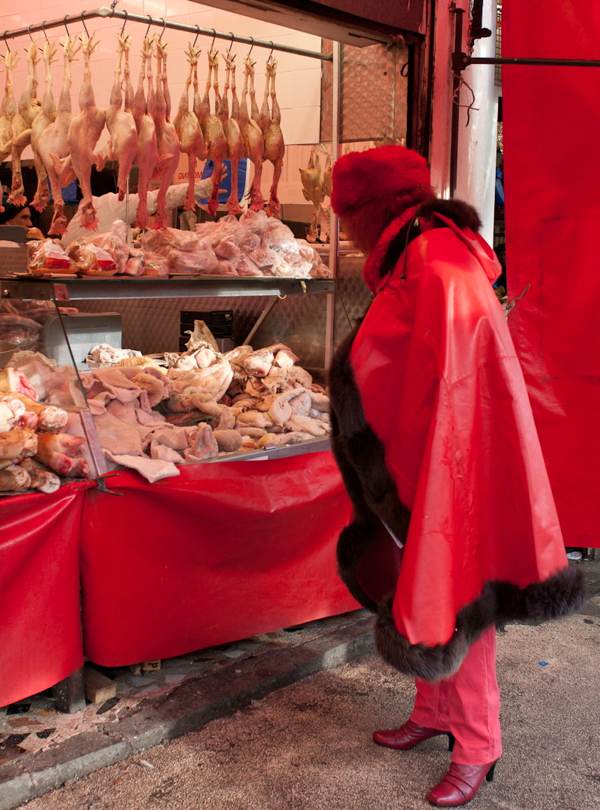


Boudica – “Next year, I’m going to get a chariot.”

John Leech’s original drawing of the Ghost of Christmas Present from “A Christmas Carol.”
Photographs copyright © Sarah Ainslie
Read my original profile of Mark Petty, Trendsetter
and take a look at Mark Petty’s Multicoloured Coats,
23rd December, Wren Boys

Wren Day, also known as Wren’s Day, Hunt the Wren Day or the Hunting of the Wrens (in Irish, Lá an Dreoilín) is traditionally celebrated on 26th December, St Stephen’s Day, in parts of Ireland, the Isle of Man, Wales and Newfoundland. The tradition consists of “hunting” a fake wren, and putting it on top of a decorated pole. Known as “wrenboys,” crowds of mummers, musicians or strawboys celebrate the Wren (also pronounced as the Wran) by dressing up in masks, straw suits and colourful motley clothing and, accompanied by traditional céilí music bands, parade through the towns and villages in remembrance of a festival once observed by the druids. These crowds are sometimes called wrenboys.
In past times, an actual bird was hunted by Wrenboys on St. Stephen’s Day and the captured wren was tied to the Wrenboy leader’s staff pole, sometimes dead, sometimes alive – to be killed after the parade. The parade song, of which there are many variations, called for donations from the townspeople and often, the boys gave a feather from the bird to patrons for good luck. The money was used to host a dance held that night at which the pole, decorated with ribbons, wreaths and flowers, as well as the Wren, was the centrepiece. Over time, the live bird was replaced with a fake one that was hidden,rather than chased and the band of young boys was expanded to include girls, and adults were permitted to join in. Nowadays, the money that is collected from townspeople is usually donated to a local school or charity.
Some theorise that the Wren celebration has descended from Celtic mythology. The origin maybe a Samhain or Midwinter sacrifice, since in Celtic lore the Wren is a symbol of the past year and the wren is known for singing even in mid-winter, and sometimes explicitly called “Winter Wren.” Celtic names of the Wren (draouennig, drean, dreathan, dryw etc.) also suggest an association with druidic ritual. The tradition may also have been influenced by Scandinavian settlers during the Viking invasions prior to the tenth century. Various associated legends exist, such as a Wren being responsible for treachery against Irish soldiers who fought the maurading Viking invaders by beating its wings upon their shields, and for betraying the Christian martyr Saint Stephen after whom the day is named. This mythological association with duplicity is a possible reason why the bird was hunted by Wrenboys on St. Stephen’s Day and may explain why a pagan sacrificial tradition was continued into Christian times. Despite the abandonment of the Wren killing practice, devoted Wrenboys ensure that the gaelic tradition of celebrating the Wren continues today.
In 1955, Liam Clancy recorded “The Wran Song,” which was sung in Ireland by Wrenboys. In 1972, Steeleye Span recorded “The King” on “Please to See the King,” which is along similar lines, and they made another version, “The Cutty Wren,” on their album “Time.” While “Hunting the Wren” is on John Kirkpatrick’s album “Wassail!” and The Chieftains made a collection of Wrenboy tunes on “Bells of Dublin.”
I lived in Ireland for five years though, sadly, I never saw nor heard anyone mention the Wrenboy tradition, but perhaps that was just because I was in Dublin. These fine fellas above are the Bogside Wranboys of Ballygramore and can play many a tune to set your feet a-tapping!
Illustration copyright © Paul Bommer
Chapter 5. Indescribable Panic

At Dove Cottage in Keswick, three hundred miles north of London, Robert Southey and Thomas de Quincey were reading the national newspapers with feverish excitement – as, like thousands of others, they followed every turn in the saga of the murders in Shadwell in December 1811. Southey declared it a rare example of “a private event of that order which rose to the dignity of a national event.” De Quincey wrote “the panic was indescribable. One lady, my next neighbour, whom I personally knew, living at that moment, during the absence of her husband, with a few servants in a very solitary house, never rested until she had placed eighteen doors (so she told me, and indeed satisfied me by oracular proof), each secured by ponderous bolts, and bars, and chains, between her own bedroom and any intruder of human build.”
In London, the question was raised how John Turner, the lodger at the King’s Arms, could have seen the murderer and then abandoned the infant Kitty Stilwell to her fate in seeking his own escape from the building. But De Quincey, having read the newspaper reports, launched into a powerful imaginative identification with the lodger. In justification of leaving the child sleeping, De Quincey surmised that the lodger “felt sure that sure that the murderer would not be satisfied to kill the poor child whilst unconscious. This would be to defeat his whole purpose in murdering her at all – to be an epicure of murder.” A startling creative leap.
At the inquest, Turner explained in his own words, “I went to bed and had not been there above five minutes before I heard the front door being banged to: very hard. Immediately afterwards I heard the servant exclaim ‘We are all murdered’ or ‘shall be murdered’ two or three times, I cannot be exactly sure which of the expressions she made use of. I had not been asleep. I heard the sound of two or three blows, but with what weapon I cannot say. Shortly afterwards, I heard Mr Williamson cry out, ‘I’m a dead man.'”
Although he knew of the murders a week earlier, astoundingly, Turner unlocked his door and crept downstairs where he spied through a doorway upon the murderer in the dark rifling through the pockets of a victim. “I did not see his face, and I only saw that one person. I was fearful and I went upstairs as quick but as softly as I could. I thought first of getting under the bed, but was fearful I should be found. I then took the two sheets, tied them together, tied them to the bed post, opened the window and lowered myself down by the sheets.”
No-one knew where the murder or murderers would strike next. “Many of our readers” wrote Thomas Macaulay years later, “can remember the state of London just after the murders of Marr and Williamson – the terror which was on every face – the careful barring of doors – the providing of blunderbusses and watchmen’s rattles. We know of a shop keeper who on that occasion sold three hundred rattles in ten hours.”
Regular reports will be forthcoming here during the Christmas holidays.

Robert Southey

Thomas de Quincey


Click on Paul Bommer’s map of the Ratcliffe Highway Murders to explore further
The Maul & The Pear Tree – P.D. James’ breathtaking account of the Ratcliffe Highway Murders, inspired me to walk from Spitalfields down to Wapping to seek out the locations of these momentous events. Commemorating the bicentenary of the murders this Christmas, I am delighted to collaborate with Faber & Faber, reporting over coming weeks on these crimes on the exact anniversaries of their occurrence.
The Map of the Ratcliffe Highway Murders – In collaboration with Faber & Faber, Spitalfields Life has commissioned a map from Paul Bommer which will update throughout December as the events occur. Once you have clicked to enlarge it, you can download it as a screensaver or print it out as a guide to set out through the streets of Wapping.
Ratcliffe Highway Murder Walk – Spitalfields Life will be hosting a dusk walk on Wednesday 28th December at 3pm from St Georges in the East, visiting the crime scenes and telling the bone-chilling story of Britain’s first murder sensation. The walk will take approximately an hour and a half, and conclude at the historic riverside pub The Prospect of Whitby. Booking is essential and numbers are limited, so please email spitalfieldslife@gmail.com to sign up. Tickets are £10.
Thanks to the Bishopsgate Institute and Tower Hamlets Local History Archive for their assistance with my research.
You may like to read the earlier installments of this serial which runs throughout December
Chapter 1, Two Hundred Years Ago Tonight …


