
At Dirty Dick’s

These are the dead cats that once hung behind the counter of the celebrated “Dustbin Bar” at Dirty Dick’s Old Port Wine & Spirit House in Bishopsgate. It is a location that holds a special place in my affections as the first pub I ever went into in London, one day after work at the Bishopsgate Institute.
Although this was longer ago than I care to admit and regrettably the cats in this picture had already gone by then, yet I still recall the sense of expectation, entering the narrow frontage and walking back, and back, and back through the warren of rooms with sawdust on the floor – descending ever deeper into the bowels of the city, it seemed. And I can only imagine how this strange drama might have been enhanced by the presence of umpteen dead cats suspended from the ceiling.
This was how it was described in 1866 – “A small public house or rather a tap of a wholesale wine and spirit business…a warehouse or barn without floorboards – a low ceiling, with cobweb festoons dangling from the black rafters – a pewter bar battered and dirty, floating with beer – numberless gas pipes tied anyhow along the struts and posts to conduct the spirits from the barrels to the taps – sample phials and labelled bottles of wine and spirits on shelves – everything covered with virgin dust and cobwebs.”
Yet all was not as it might seem, because the presence of these curious artefacts was not due to unselfconscious eccentricity, it was an early and highly successful example of what we should call a “theme pub.” Established in 1745 as The Old Jerusalem, the drinking house took the name of Dirty Dick’s in 1814 and adopted his story along with it. The original of Dirty Dick was Nathaniel Bentley, a successful merchant with a hardware shop and warehouse in Leadenhall St in the mid-eighteenth century. After his bride-to-be died on their wedding day – so the legend goes – he never cleaned up again, never washed or changed his clothes. “It’s of no use, if I wash my hands today, they will be dirty again tomorrow,” he declared. Bentley died in 1809, and the Bishopsgate Distillers appropriated this story of the notorious dirty hardware merchant, adorning their bar with dead cats and cobwebs to perpetuate the legend.
Charles Dickens knew Dirty Dick’s and was fascinated with this myth of one who sealed up the door on the wedding breakfast and left the cake and table decorations to acquire dust eternally. In a letter to the printer of his weekly publication “Household Words” dated 30th December 1852, he wrote “Don’t leave out the Dirty Old Man, he is capital.” And it has been suggested that Nathaniel Bentley was the inspiration for the character of Miss Havisham in “Great Expectations.”
Dirty Dick’s was rebuilt in the eighteen seventies, though the cellars are of an earlier date, and now the bizarre artefacts are banished to a glass case, yet it is still worth a visit. Explore the wonky half-timbered spaces and seek out the secluded panelled rooms at the rear, where you can enjoy a quiet drink away from the commotion of Bishopsgate to contemplate the ancient coaching inns that once lined this street, long before the age of the train and the motor car.

Nathaniel Richard Bentley – the origin of the myth of Dirty Dick.


Part of the adjoining City Corner Cafe was once an alley leading into Dirty Dick’s adorned with a series of these mosaics which illustrated the tale.


Dirty Dick by William Allingham
A Lay of Leadenhall
In a dirty old house lived a Dirty Old Man.
Soap, towels or brushes were not in his plan;
For forty long years as the neighbours declared,
His house never once had been cleaned or repaired.
‘Twas a scandal and a shame to the business-like street,
One terrible blot in a ledger so neat;
The old shop with its glasses,black bottles and vats,
And the rest of the mansion a run for the rats.
Outside, the old plaster, all splatter and stain,
Looked spotty in sunshine, and streaky in rain;
The window-sills sprouted with mildewy grass,
And the panes being broken, were known to be glass.
On a rickety signboard no learning could spell,
The merchant who sold, or the goods he’d to sell;
But for house and for man, a new title took growth,
Like a fungus the dirt gave a name to them both.
Within these there were carpets and cushions of dust,
The wood was half rot, and the metal half rust;
Old curtains—half cobwebs—hung grimly aloof;
‘Twas a spiders’ elysium from cellar to roof.
There, king of the spiders, the Dirty Old man,
Lives busy, and dirty, as ever he can;
With dirt on his fingers and dirt on his face,
The dirty old man thinks the dirt no disgrace.
From his wig to his shoes, from his coat to his shirt,
His clothes are a proverb—a marvel of dirt;
The dirt is prevading, unfading, exceeding,
Yet the Dirty Old Man has learning and breeding.
Fine folks from their carriages, noble and fair,
Have entered his shop, less to buy than to stare,
And afterwards said, though the dirt was so frightful,
The Dirty Man’s manners were truly delightful.
But they pried not upstairs thro’ the dirt and the gloom,
Nor peeped at the door of the wonderful room
That gossips made much of in accents subdued,
But whose inside no one might brag to have viewed.
That room, forty years since, folks settled and decked it,
The luncheon’s prepared, and the guests are expected,
The handsome young host he is gallant and gay,
For his love and her friends are expected today.
With solid and dainty the table is dressed—
The wine beams its brightest—flowers bloom their best;
Yet the host will not smile, and no guest will appear,
For his sweetheart is dead, as he shortly shall hear.
Full forty years since turned the key in that door,
‘Tis a room deaf and dumb ’mid the city’s uproar;
The guests for whose joyance that table was spread,
May now enter as ghosts, for they’re everyone dead.
Though a chink in the shutter dim lights come and go,
The seats are in order, the dishes a row;
But the luncheon was wealth to the rat and the mouse,
Whose descendants have long left the dirty old house.
Cup and platter are masked in thick layers of dust,
The flowers fallen to powder, the wine swath’d in crust,
A nosegay was laid before one special chair,
And the faded blue ribbon that bound it is there.
The old man has played out his part in the scene
Wherever he now is let’s hope he’s more clean;
Yet give we a thought, free of scoffing or ban,
To that Dirty Old House and that Dirty Old Man.
(First published by Charles Dickens in Household Words, 1853)

Nathaniel Bentley, Eccentric Character & Hardwareman of Leadenhall St – the well-known Dirty Dick

Photograph of City Corner Cafe copyright © Patricia Niven
Archive pictures courtesy of Bishopsgate Institute
You may also like to read about
The Romance of Old Bishopsgate

Headquarters of RBS
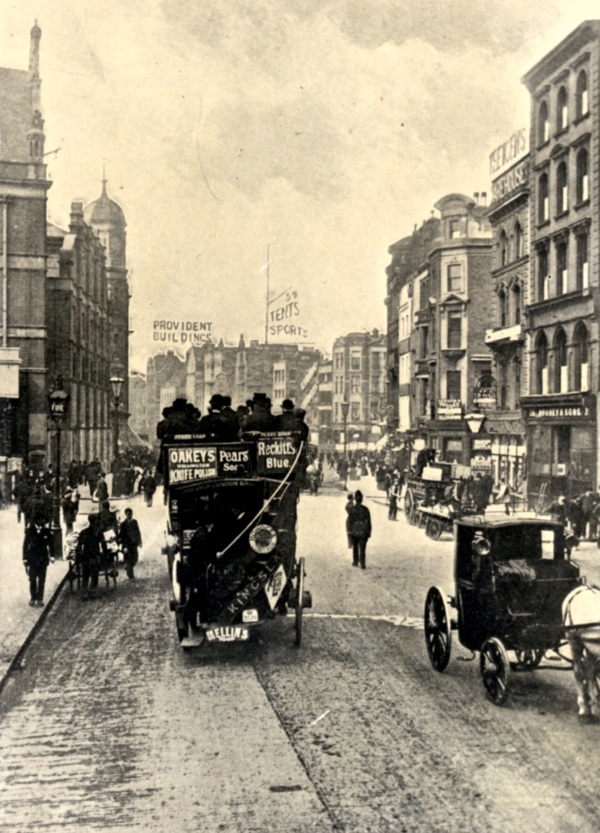
Thomas Hugo, the nineteenth century historian of Bishopsgate, wrote a history of this thoroughfare prefaced with a quote from his predecessor, John Strype in 1754 –“The fire of London not coming unto these parts, the houses are old timber buildings where nothing is uniform.” While the rest of London had been rebuilt after 1666, Bishopsgate alone retained the character of the city before the fire and in 1857 Thomas Hugo was passionate that this quality not be destroyed – as he wrote in the strangely prescient introduction to his “Walks in the City: No 1. Bishopsgate Ward.”
“This quarter, so hallowed and glorified by olden memories, is unquestionably deserving of a foremost place in our affectionate regard. Our history, our literature and our art are associated with the charmed ground in closest and most indissoluble union. You can scarcely open a single volume illustrative of our national history which does not carry you in imagination to that still picturesque assemblage of edifices where, amid its overhanging Elizabethan gables and stately Caroline facades, its varied masses of pleasantly mingled light and shade, its frequent churches and sonorous bells, the greatest and best of Englishmen have successfully figured among their fellows, and to whose adorning and embellishment the noblest powers have in all ages been devoted. And yet, unhappily, this is the spot where alterations are most commonly made, and with perhaps least regard to the irreparable loss which they necessarily involve. Here, where, for all who are versed in our country’s literature, every stone can speak of its greatness, where the name of every street and lane is classical, where around multitudes of houses fair thoughts and pleasant memories congregate as their natural home and common ground, the demon of transformation rules almost unquestioned, lays its merciless finger on our valued treasures, and leaves them metamorphosed beyond recognition only to work a similar atrocity upon some other precious object. Special attention, therefore, on every account, as well as for beauty, the value, and the excellence of that which still remains, as for the insecurity and uncertainty of its tenure, is most urgently and imperatively demanded.”

John Keats was baptised in St Botolph’s Church, Bishopsgate.

The Bishop’s Gate was on the site of one of the gates to the Roman city of Londinium, from which led Ermine St, the main road North. First mentioned in 1210, Bishop’s Gate was rebuilt in 1479 and 1735, before it was removed in 1775. In 1600, Will Kemp undertook his jig from here to Norwich in nine days.

A mitre set into the wall marks the site of the former Bishop’s Gate today.

Crosby Hall, the half-timbered building at the centre of this picture was once Richard III’s palace. Other residents here included Thomas More, Walter Raleigh and Mary Sidney, the poet. Built by wool merchant John Crosby in 1466, it was removed to Cheyne Walk, Chelsea in 1910.


Elizabethan houses in Bishopsgate, 1857.


The Lodge, Half Moon St, Bishopsgate Without, 1857.

Paul Pindar’s House, Bishopsgate photographed by Henry Dixon for the Society for Photographing the Relics of Old London in the eighteen eighties. Paul Pindar was James I’s envoy to Turkey and his house was moved to the Victoria & Albert Museum in 1890.


A chef takes a break in White Hart Court.

Houses designed by Inigo Jones built in White Hart Court, Bishopsgate in 1610.


Bishopsgate in the aftermath of the IRA bomb in 1993.

The newly completed Heron Tower boasts Europe’s largest indoor fish tank.
Archive images courtesy Bishopsgate Institute
You may also like to read about
Panayiotis Charalambous, Tyre Fitter

One of the friendliest places I know in the Roman Rd is D & G Autos where there is always a stream of taxi drivers lining up to get their tyres fixed and enjoying the opportunity for a chinwag. Most of the customers have been coming as long as Panayiotis has been here, which is more than thirty years, and consequently everyone feels completely at home.
This nineteen fifties shopping precinct might – at first – appear a strange location for an auto shop, but if you go around to the rear of the former butcher’s premises, you will discover the yard where the tyres get changed. This is the hub of activity, as the tyrefitters make quick work of getting the taxis back on the road while the cabbies wander in and out of the workshop, exchanging banter and seeking refuge in this safe haven from the turbulence and clamour of the city traffic.
Yet in spite of the spectacle, the most powerful sensation to greet the casual visitor is the smell of oil which permeates the air inside the shop, coating every surface with grime, casting an inky black shadow and defining the extent of this territory where no-one minds getting dirty. “You never lose the smell,” said Panayiotis, as we stood for a moment to savour the fragrant atmosphere,“when I take a week off, it really hits me!”
He and his colleagues William Boyle (known as Baldrick) and Ryan Leon wear dark clothing caked with oil, and their hands are ingrained with it too, the proud badge of their work – setting them apart from the rest of the world and engendering the playful spirit of anarchy that pervades in the auto shop. Everyone is an equal player here. The taxi drivers are their own bosses and Panayiotis is keen to emphasise that he does not set himself above his mates. “I won’t ask the guys to do anything I wouldn’t do, I work hands-on, everybody together.” he assured me with an eager smile. And the evidence of this was all around us in the tiny workshop, as the business of fitting tyres went on furiously while the cabbies stood around chatting, swigging tea and regarding the activity in the same way that drinkers eye a snooker table at the centre of a barroom.
After I left school at fifteen, I worked for two brothers who ran a garage in Hackney but the trade took a dip so I got laid off. A friend who worked here asked if I could do him a favour and take a look at a broken machine, so I came over and refitted it and it worked – I replaced one of the parts. They gave me a job and there you are, I’ve been here thirty-six years. My old guvnor, Terry Harding, he got ill about thirteen years ago and passed away, so I kept it going for his wife until two years ago when we came to an agreement and now I own the business.
When things are going well, it’s easy but this year may get tricky. We predominantly fit taxi drivers and it’s a constant trade, but with the new low emission zone it’s half what it usually is because the owners are replacing their fleets and the new vehicles won’t require replacement tyres for six months. We sell new tyres but the trade is predominantly remoulds because of the price, ninety-eight out of a hundred we sell are remoulds – a remould is £42 whereas a new one is £90. We send a used tyre back to the factory and they strip it back to the wire and rebuild it, we just do the fitting. Even in the recession people still need their tyres changed but now they are leaving it as long as possible, until it bursts – they come in with tyres that are down the wire, down to the canvas.
We’re pretty easy guys here, stuck in the nineteen seventies. There’s no office or reception rooms, you just walk in and here we are. We get a lot of bullshit merchants. You create a gap between the ears – what they say goes in but when it reaches the bulshit level, you switch off. The problem is sometimes they take liberties, but if they owe you an amount of money and you ask for it nicely I think you are more likely to get paid. I’ve been fortunate in that I have only had two people knock me back in forty years.
You see, it’s a repeat business, the majority of my customers have been coming for ever. If you provide a service and look sharp and try hard and you don’t take liberties, then they will come back. If someone wants me to fit a pair of brake pads, if I can do it I will. Any time here, you might see six or seven taxis queueing up. To an outsider, it looks like we’re doing well but you’d realise it’s not so, if you saw what we took. People don’t just come for tyres, they come to get their oil topped up or check their wheel alignment.
In general, I enjoy it. It’s like a social club really, they are in and out all day. I don’t think I’ll ever become a millionaire because it’s a turnover trade, you’ve got to sell a lot to make a profit. But it’s provided a living for me, I’ve brought up four kids and I’m happy.

The shopfront facing Roman Rd.

Terry Harding, Panayiotis’ former boss, pictured in 1976.

Panayiotis changes a tyre.

Terry changes a tyre in 1976.

The yard at the back where the taxis pull up.

Panayiotis (centre) with Terry on the right and William on the left, in 1976.


William & Brian, tyrefitters of the Roman Rd in 1976.


Brian, Mo & Panayiotis, in recent years.

Panayiotis with his mate William Boyle, known as Baldrick.

Remembering Terry Harding at D & G Autos, 110 Roman Rd, E2 0RN.
New photographs copyright © Jeremy Freedman
You may also like to read about At Three Colts Lane
Dave Thompson, Joiner

In Spitalfields, Dave Thompson is famous for the blue overalls he has worn as long as anyone can remember, popular for the apples and eggs he brings up fresh from Kent each day, but – most of all – he is celebrated for his superlative joinery.
Over the last fifteen years, Dave has been at the core of a group of craftsmen who have worked continuously upon the renovation of the eighteenth century houses and, as a result, he has earned the affections of many of the owners. They treasure Dave for the skill and application he brings to his work, yet such is his magnanimous nature that he chooses to reciprocate their appreciation of his talent with regular deliveries of apples and eggs. Thus it has come to be understood, among those who dwell in the ancient streets beside Christ Church, that only when you are in receipt of Dave’s deliveries from Kent can you truly be said to have arrived in Spitalfields.
To seek Dave, you have to look in a special place secluded from the public gaze and known only to the initiated. On the Eastern side of Brick Lane lies part of the Truman Brewery once inhabited by dray horses and coopers, here in an old cobbled yard stands a crumbling stable block where at its furthest extremity, framed by an elegant brick arch, you will find Dave’s workshop. Any residual doubt whether this is the correct location will be assuaged by the presence of the massive pile of scrap timber you see tossed to the right of the arch.
Yet, by the time you reach the woodpile, you will very likely already have heard the sound of Dave’s machine tools roaring within his workshop, and you will know that this is the place and Dave is inside at work. Certainly, this was my experience when I arrived and opened the door to be greeted by Dave’s smile, his blue overalls standing out in sharp contrast to the yellow wood shavings and sawdust that surrounded him.
I come from a little village, Loose near Maidstone in Kent. At school, I learnt what I could do and I started off in furniture making at Maidstone Art College where I did City & Guilds Carpentry and Joinery, basic and advanced. Then I worked as a cabinet maker in a furniture factory for eight years, making fireside chairs and stuff like that, and I worked in East Farleigh making bespoke kitchens. I was lucky to get the chance to come to London but it was a big gamble – I was offered the choice of being made redundant and getting five thousand pounds, so I took it.
When I first came up to Spitalfields fifteen years ago, I was restoring 1 and 3 Fournier St for James Hutcheson. He had a showroom at the front and I had my workshop at the back, but after three years he sold number 3 to Marianna Kennedy & Charles Gledhill, and I worked for them. That was six years of my life, then I moved over to the Truman Brewery stable block. I knew nothing about the restoration of old buildings when I first come up here but I learnt a lot working with Jim Howett, he’s been here thirty years and he’s got a lot of specialist knowledge.
If you can do something like mouldings, everybody wants you to make them because in every old house the mouldings are different. One of my specialities is fitting shutters in rooms that don’t have shutter cases and making new panelling. I’ve done a lot of external shutters in Wilkes St and Princelet St. When you do restoration, you try to use the old timber. Often if the panelling is damaged, you can patch it up and put it back. It was all good work they did in the old days. They didn’t have the tools but they had all the time in the world. I’ve never had to look for work, I’ve been up here so long now that people just come to me – but it’s been hard, for years I got up at four thirty every morning to get into London by six.
In Eleanor Jones’ house in Fournier St, I put in a big pair of curved doors on the first floor that are the same as on the ground floor. I had a lot of curved work to do the bay window and Bogdan helped me, he was a very good joiner from Poland. The two of us put our heads together and sorted that out. One day, he came in and said he’d been to the specialist. It was cancer. He’d had his chips. He did quite a lot of work around here and extensively renovated the Market Coffee House. He was one of the best.
Since then, I’ve done a lot of work for people in Fournier St. When I started, I used to fit shutters, internal and external, but most of the time now, I’m doing work for people making joinery for their carpenters to fit on site. As you get older and wiser, you don’t fit it, you make it and leave that to someone else. Matt Whittle and Tony Clarence are two blokes I work with, we started at the same time fifteen years ago. There was quite a little gang of people and we all got to know each other and we’d be working together restoring the same houses. Sometimes, the people would sell the houses, and we’d get paid to rip out the work we did and then do it all over again to suit the new owner.
About three years ago, I had a quadruple heart bypass. I used to work quite long hours but now all I do is get in at six and work until three, four days a week. Not so stressful. I’ve got an old farm cottage in Loose. Unfortunately, it’s only a two bedroom cottage. I restored it myself and I like to be comfortable. I’m sixty-five in April, I don’t think I’ve got many more years – though it is getting to the stage in Spitalfields where there is less and less to do. But I’ve left my mark and I’m proud of the work I’ve done here.
One day – to his alarm – Dave saw that some contractors had tried to cut corners by tearing an eighteenth century door case off the front of a house in Wilkes St and throwing it in a skip. Yet thankfully, when the building inspectors enforced the listed status of the building, it was Dave who got the painstaking job to piece the fragments back together and reconstruct it with the help of Diana Reynell (a grotto designer) who restored the mouldings. And the dignified door case in question stands today, as if it had never been broken.
The emotionalism with which this event is charged for Dave reveals the depth of his personal involvement with these old houses. His conscientious labour over all these years has comprised the culmination of his life’s work and it honours those craftsmen whose work he has furthered.
Even as he and his fellows have pursued the long task of restoring these buildings, residents have come and gone, raising the question of who – if anybody – truly has ownership of these properties. Because, as much as these buildings manifest the status and taste of their occupants, they also commemorate the talents of the artisans who have worked upon them, both recently and long ago.

Dave worked on the restoration of 1 Fournier St in the nineteen nineties.

Fragments of the eighteenth century doorcase torn from the wall but rescued from the skip in Wilkes St.

The eighteenth century doorbox reinstated by Dave at number 13 Wilkes St and replicated at number 1.

Doorboxes at 7 & 9 Fournier St by Dave, commissioned by neighbours John Nicolson and Kate Jenkins.

Dave Thompson, joiner, outside his workshop in the former stable of the Truman Brewery.
Cambridge & Bethnal Green Boys Club Films
[youtube sWw5GqelxcM nolink]
When I interviewed football referee Maxie Lea last year, he produced a box of dusty old reels of celluloid that comprised the film archive of the Cambridge & Bethnal Green Boys Club and asked me if I knew where he could find a home for them. In due course, the collection was passed over to the Bishopsgate Institute who have transferred the eleven hours of film onto disc and next Thursday January 12th at midday they are holding a public screening. It promises to be an exciting – even emotional – occasion since many of those featured in these films will be present to offer live commentary as they see their former selves on film for the first time in over forty years.
Spanning the period from 1960 to 1972, these magical films offer a fascinating glimpse into the lost world of East End Boys Clubs. Beginning in 1924 as the Jewish Boys Club, the Cambridge & Bethnal Green Boys Club operated from premises in Chance St and had an idealistic intent at its core, adopting the motto, “serva corpus, cole mentem, animam cura,” – keep fit, cultivate your mind, think of your soul. In 1936, the Jewish prerequisite for membership of the Club was dropped, opening it to everyone, as an egalitarian response to the rise of antisemitism in the East End.
Club member Ron Goldstein, who joined in 1933, fondly appreciates the raising of expectations that was encouraged. As he admitted to me, “Half of the boys would have ended up as the next generation of gangsters and criminals if it had not been for the Club. It was our first time to mix with people who never had to work from an early age and our first chance to consider the ethical side of life. We were a bunch of young tearaways. The Club managers from Cambridge had a very upper class way of talking and we used to take the mickey, but it was different at the weekend camps, everyone dressed the same and we all mucked in together.”
Although the Club closed in 1990, there are still enough members of the Cambridge & Bethnal Green Boys Club around to remind us of its honourable endeavour – and the beauty of these playful films is that they celebrate the vibrant human quality of this project dedicated to nurturing sympathy and encouraging the best in people, despite the tyranny of circumstance.
[youtube N_guzqClZjg nolink]
[youtube s68zvBQ0hRo nolink]
[youtube Ez4wa9ScP5w nolink]
The Cambridge & Bethnal Green Boys Club Film Screening at the Bishopsgate Institute is at midday Thursday 12th January. Admission is free.
Read my other Cambridge & Bethnal Green Boys Club Stories
Maxie Lea MBE, Football Referee
Ron Goldstein, Cambridge & Bethnal Green Boys Club
At the Cambridge & Bethnal Green Boys Club 86th Annual Reunion
Ronald Searle in Spitalfields

“… furry faces peering incongruously from the jackets of hawkers.”
As a tribute to the graphic genius of Ronald Searle who died on New Year’s Eve aged ninety-one, I am republishing these drawings he made in Spitalfields in 1953 when he came here with his wife, Kaye Webb, to report upon the animal market in Club Row for their book, “Looking at London and People Worth Meeting.” A. R. J. Cruickshank wrote in the introduction, ”This book rediscovers for us some of the odd places and odd faces of London that most of us have forgotten, if we ever knew them. The warm-hearted humanity of Kaye Webb’s writing and the tender sympathy of Searle’s drawings are beautifully matched.”
Curious, considering our national reputation, that of all the street markets in London only one should sell dogs. This can be found any Sunday morning by taking a bus to Shoreditch High St and following your ears. a cacophony of whimpers, yaps, yelps and just plain barking will guide you to the spot where Bethnal Green Rd branches off to Sclater St.
There you may find them – the unclaimed pets of a hundred homes : new-born litters of puppies tumbling over each other in children’s cots ( the most popular form of window display) : “mixed bags” of less lively youngsters huddling docilely together in laundry baskets; lively-looking sheepdogs, greyhounds and bulldogs straining at the ends of leashes and furry little faces peering incongruously from the jackets of hawkers, who often look as if they’d be happier in the boxing ring.
The sales technique of their owners is almost as varied as the ware and almost always accompanied by much affectionate handling of the dogs. “It’s good for business and sometimes they mean it,” we were told by an impartial vendor of bird-seed who has been on the same pitch for twenty years. “Hi, mate, buy a dog to keep you warm!” said the man with the Chows to a pair of shivering Lascar seamen. “E’s worth double, lady, but I want ‘im to ‘ave a good ‘ome” or “Here’s a good dog, born between the sheets, got his pedigree in my pocket!” “Who’d care for a German sausage? – stretch him to make up the rations”, the salesman with the dachshund said, demonstrating too painfully for amusement.
R.S.P.C.A. interference is needed less often now. The days are gone when sores were covered with boot polish; when doubtful dogs were dyed with permanganate of potash; when, as tradition has it, you could enter the market at one end leading a dog, lose it half way, and buy it back at the other end. In fact the regular dog hawkers were never the ones to deal in stolen pets. “Stands to reason, this is the first place they’d come, and besides, look at the number of coppers there are about anyway.” But it is still possible to buy pedigree forms “at a shop down the road”, “just a matter of thinking up some good names and being able to write”.
The regular merchants, whose most frequent customers are the pet shops, are mostly old-timers ( some who have been coming for forty years and from as far away as Southend) and since a new law was passed insisting that all animal sellers should have licences, the ‘casuals’ are forbidden. But on the occasion of our visit the law had not yet been made and we passed quite a number of them. Most attractive was a red-cheeked lad with a spaniel puppy – “I call him Gyp; we’ve got his mother, but there’s no room for another, so my uncle said to come here.” Every time he was asked: “How much do you want, son?” he stumbled over his answer and hugged the dog closer. And when the would-be buyer moved on, his eyes sparkled with relief.
That day the dog section of Club Row was not very busy; it was too cold. But the rest of the market waxed as usual. Unlike its near neighbour, Petticoat Lane, Club Row Market has a strong local flavour. The outsiders who make the long journey to its “specialised streets” are mostly purposeful men looking for that mysterious commodity known as Spare Parts.
In Club Row itself are to be found bicycles, tyres, an occasional motor bike or a superannuated taxi. The police are frequently seen about here looking for “unofficial goods”. Chance St sells furniture and “junk”, Sclater St is a nest of singing birds, rabbits, white mice, guinea pigs and their proper nourishment. In the Street of Wirelesses the air is heavy with crooning, and Cheshire St is clamorous with “Dutch auctions”, or demonstrating remarkable inventions like the World’s Smallest Darning Loom (“Stop your missus hating you … now you can say ‘you might darn this potato, dear, while I have shave’ … and she’ll do it before you’ve wiped the soap off!”).
We found one street devoted to firearms, chiefly historic, and another where secretive, urgent men offered us “a good watch or knife”, implying that it was “hot” and therefore going cheap. But we had learned that this was “duffing” and the watch was most probably exactly the same as those sold on the licenced stalls just up the street.
At ten to one the market reaches a crescendo. One o’clock is closing time and many of the stallholders won’t be back until next Sunday. This is the time when the regulars know where to find bargains, but it needs strong elbows. Our way out, along Wheler St, under the railway bridge and past the faded notice which says ‘Behold the Lamb of God Cometh”, brought us back to the dog market. It was surprisingly quiet. On the other side of the road we spotted a small figure hurrying off with the spaniel puppy. It looked as if Gyp was safe for another week anyway.
I hope you will not consider it vain if I reveal that Kaye Webb gave me this book and inscribed it under the title with my name and the text ” – also a person worth meeting!” It was my good fortune that Kaye, the legendary editor of Picture Post, Lilliput and Puffin Books, was the first person to recognise my work and encourage me in my writing. When I used to stay with her in her flat overlooking the canal in Little Venice, I remember she had some of Ronald Searle’s work framed on the wall in the spare room, and I spent many hours admiring both his Japanese prison camp drawings and his portraits of the bargees from the Paddington basin.
Kaye’s marriage to Ronald Searle ended in 1967 and she died in 1995. Today, I keep my copy of “Looking at London and People Worth Meeting” on the shelf as an inspiration to me now I am writing pen portraits myself, and I sometimes think of Kaye here in these streets over half a century ago and imagine Ronnie – as she referred to him – bringing out his sketchbook in Sclater St where I buy my fruit and vegetables each Sunday.

“…the rest of the market waxed as usual” – a bookseller in action on Brick Lane
Peter Hardwicke, Signwriter (Part Two)

Over a year ago, I featured Peter Hardwicke, the talented East End signwriter who may be the last in our metropolis working solely by eye. Yet since he continues, working all this time to enhance our streets, I decided that it was time for another survey, so he may receive due credit for his more recent designs that might otherwise pass as anonymous.
Here you see Peter in Puma Court outside Cleo’s Barber Shop where he was in the process of adorning the frontage with some handsome utilitarian lettering, celebrating this modest family business begun by Kyriacos Cleovoulou in 1962 and now carried on by his children Renée, George and Panayiotis. The capitals that Peter has used for “Cleo’s” are a font which is derived from the work of one of his nameless predecessors in the early twentieth century. In fact, the adjoining building has an old faded sign which reads “Jones Dairy” in this same lettering and the work of this unknown Spitalfields master is also to be seen fifty yards away, spelling out S. Schwartz at 33 Fournier St, and may still be discerned upon the facade of the former Market Cafe, now Townhouse at 5 Fournier St.
This style of elegant yet undecorated hand-painted lettering with its subtle detail and gothic idiosyncrasy sits naturally here in Spitalfields among the eighteenth and nineteenth century buildings, and is ideally suited to the independent traders which define the nature of this area at the edge of the City. In fact, this particular alphabet has proved so popular that Peter is now designing it as the “Spitalfields” font, a unique face that has its roots in the history of this neighbourhood and gives typographic expression to the specific quality of the place. As well as Cleo’s, you can see it locally on the English Restaurant in Brushfield St and in Columbia Rd on Angela Flanders perfumery and the Columbia Pottery. Most recently, Peter painted it in the front of Tracey Emin’s new shop in Crispin St, using a soft white tone upon a dark green ground to create the visual identity for this high profile commission, which has both a vibrant graphic quality and looks like it belongs too.
When I came upon Peter in Puma Court in the week before Christmas, he was shivering in the chill and admitted to me that he was waiting for the paint to dry. So I persuaded him to join me for a cup of tea, on the principle that the paint would dry just as quickly unsupervised.
“I work outside all year round and I can deal with the cold but the rain has stopped me in my tracks – it’s unprofessional to carry on because water and paint don’t get on very well. The customers get nervous and ask, ‘Will it come off?'” Peter confessed to me as he sipped from his steaming mug, ever conscientious to finish his work before Christmas.
“For ten years, I worked for a company of general signwriting contractors doing brewery work, church and builders’ boards and generic signwriting, but I wasn’t stimulated by it, working to graphic designers’ artwork.” he explained when I asked how he came to be working solo. “I am an old school signwriter that likes to talk directly to the client to select the fonts and the colours. I’ve found it a rewarding way to work, dealing with independent shopkeepers. I like to look at the built environment and choose fonts that are sympathetic to the architecture and the surrounding cityscape. I look at the other shops and I do research.”
This is Peter’s special quality, that he pays attention to the world around him and creates work which sits naturally in the street, occupying its location boldly while being sympathetic to its neighbours. He told me that he recognises the signature of around ten unnamed signwriters whose work is visible in the East End and who have been his predecessors over the last century. “When I look at Jones Dairy and S.Schwartz, I can tell it’s the same guy by the spacing and I feel sympathy with him,” he confided to me with a sentimental smile.
Yet Peter’s biggest influence was the signwriter he was apprenticed to, Ted Ambridge. “My boss, he was the champion,” Peter assured me, “He had very good contacts in Watney Combe Reid and Truman’s and he got the contracts for most of the pubs in the East End. He did the Ten Bells in Commercial St, and we painted The Gun in Brushfield St together. He did the board telling the history of the pub and I did the generic figure work.”
Peter Hardwicke understands the culture of East End signwriting. Working placidly, he paints his lettering straight onto the frontage with a fluency that is his alone. It is a kind of magic. Everything fits, the balance and rhythm of the work is perfect – this is Peter’s gift. His work becomes part of the building, rather than merely sitting upon the front, it completes the structure and the shop frontage looks properly dressed to face the world. In streets like Columbia Rd, where Peter did almost all the shops, the effect is tangible – Peter’s work improves the street.
The vindication of Peter’s talent is that he is in greater demand than ever before. “I think people are bored with computer generated artwork,” he said as stood up to return to his work, “even my younger clients, they’d rather have it done professionally than use stick on letters – it shows they’ve got taste.”
Below you can see a selection of Peter’s work in the vicinity and you can view his archive here.

Peter paints the “Spitalfields” font – perfect without guidelines or templates.

Peter Hardwicke at work in Crispin St.

Emin International, Crispin St

Treacle, Columbia Rd

The English Restaurant, Brushfield St

Laxeiro, Columbia Rd

Jones Dairy, Ezra St

The Painted Lady, Redchurch St

Columbia Pottery, Columbia Rd

Glitterati, Columbia Rd

Val’s Sandwich Bar, Columbia Rd

Angela Flanders, Columbia Rd

Labour & Wait, Redchurch St
Photographs copyright © Jeremy Freedman
You may like to read my original story Peter Hardwicke, Signwriter
and take a look at The Signs of Old London


