
At M&G Hardware & Ironmongery
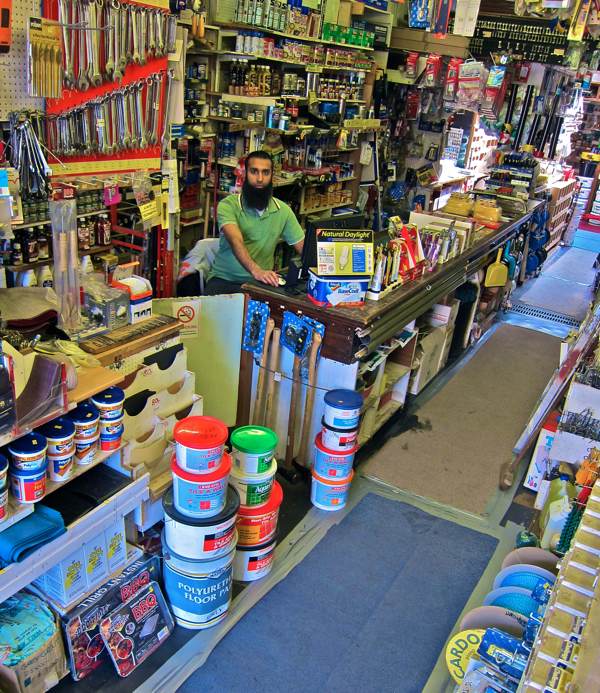
Sarfaraz Loonat
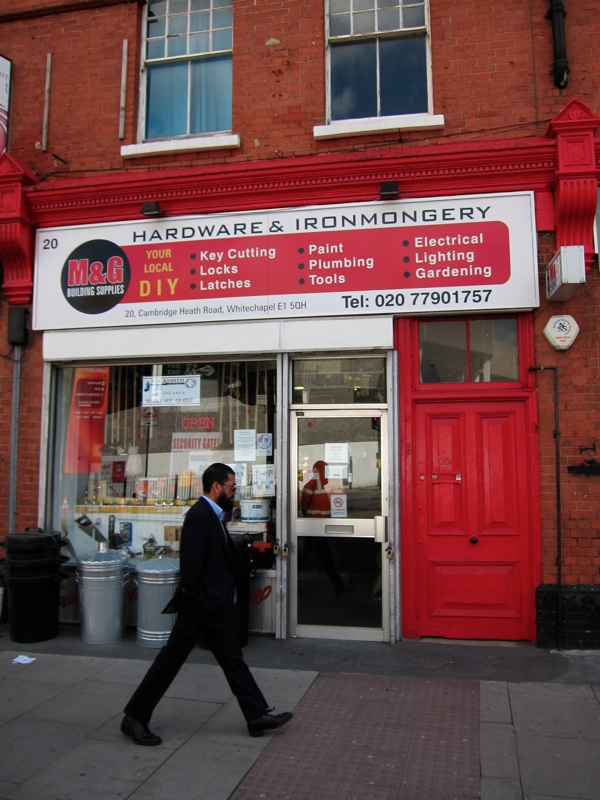
If you need to have a key cut, get scissors sharpened or buy a sturdy metal bucket, there is no better place in Whitechapel to go than M&G Building Supplies, Hardware & Ironmongery at 20 Cambridge Heath Rd, where you can be assured of a generous welcome by proprietor Sarfaraz Loonat. Sitting behind the counter like the captain at the bridge of a great ship, he waits poised to supply your every need in do-it-yourself and household maintenance. In his mind, Sarfaraz has an exact virtual replica of the shop and, by searching this mental labyrinth, he can instantly recall where every single size and type of nut, bolt, watering can, hinge or spanner can be located in the crowded shelving, cupboards, racks and draws of his actual shop. Sarfaraz relishes the opportunity to offer a personal service that cannot be matched by the superstores and, for connoisseurs of ironmongery and hardware, M & G is a rare delight.
If you should ask, Sarfaraz will be proud to tell you that the business was started in 1884 by James de Hailes, as a locksmith and ironmongers, just around the corner in the appropriately-named Key Close. He will bring out the old photographs and explain that the shop moved to its present location after the original premises was destroyed in the blitz, and he will inform you that it once occupied three generations of the de Hailes family. First there was James, then his son James George, and finally his daughter Dorothy who ran it with her husband Ronald Bull until September 1985, when they put the shop up for sale. At sixty-two, Dorothy, who had worked for her grandfather James since she was a small girl, recalled affectionately, “My only clear memory of him was when burnt me with his cigar by accident.” Adding regretfully, “It is sad to go, but we have worked here a long time and we want a bit of enjoyment.”
Fortunately, Malagar Singh bought the shop, succumbing inexorably to the irresistible magnetism of ironmongery and cherishing the endeavour with equal devotion to that shown by the de Hailes family – so that when he came to retire four years ago, he was diligent to appraise his successor. This was the point at which the young contender appeared, ambitious twenty-seven year old Sarfaraz, graduate in business management and rising employee of Philip Green’s Arcadia Group in the West End. “For two years I enjoyed working there,” Sarfaraz admitted to me, leaning over the counter at M&G to confide, “but when I decided to get married, I need more money to buy a flat for me and my wife to live in. And, even though I saved the company hundreds of thousands of pounds in my work preventing fraud, they refused to give me a pay rise. It was always my dream to have a business of my own. So I sat down with my grandfather, my uncles and my father, explained my situation and told them that I needed to do something with my life.”
Sarfaraz was overjoyed when his grandfather suggested that he consider the hardware store.“We had a family meeting and they said they’d back me,” Sarfaraz explained, “It was a bit daunting though, when I went along to meet Mr Singh. He was quite up for it, but he said, ‘You’ve got to work here for two weeks and if I like you, you can have it.'” Then, once Sarfaraz confessed that he had no holiday weeks left that year, Mr Singh turned dogmatic. “If you really want this, you must hand in your notice,” he insisted, challenging Sarfaraz to show the whole-hearted commitment which running a hardware store entails.“I wanted to implement the corporate way of doing things at once,” Sarfaraz told me with a blush at his former self, “but Mr Singh insisted I abide by the traditional way. My wife Mohsina came along and worked with me – and, after four weeks, Mr Singh handed over the keys and left.”
And so, with an interest-free loan from his family and after selling his car, Sarfaraz began a new life at M&G Ironmongers as a married man. “It was a complete unknown but with the love and support of my family, it was possible,” Sarfaraz assured me with a tender smile, “they gave me the confidence to believe I could do it.”
“After four years, I have paid back my family. I remember the first day I woke up and had no debt on my head – the shackles were off! I had two fantastic years at first, followed by one year of not taking a penny home due to a drop in sales caused by the economic crisis – we lived hand to mouth – but then this past year has been my best yet. People search on Google to learn how to do-it-yourself, and they are slowly buying tools and making their own toolkits. Through the recession, they have gained confidence in doing household repairs themselves. Often couples come in together, fathers come in with their children or they bring their friends. People are working together to get things done.”
In the meantime, Sarfaraz and his wife had two daughters, and all their friends and relatives now assist in keeping the shop staffed until the children are of school age. “Then it will be me and my wife together in this shop full-time and our aim will be to work towards buying a house for our family.” said Sarfaraz, eagerly envisaging his future.
“Most Asian shopkeepers they go for takeaway chicken or mobile phone shops, but I wanted to do something different. There aren’t many Indian Gujaratis in the hardware trade, it’s mostly white guys and some Sikhs.” he declared, growing passionate in his personal manifesto, “Offering a friendly service is very important to me. If people come in to buy two screws, I will give them five. I want them to know I am trying to look after them, it’s not just about the money. I expect to be here behind the counter with my wife in twenty years time. This shop has a story and a history, and I’m not going to be the one to let it die.”
Making an unexpected radical choice, Sarfaraz Loonat swapped the corporate world for that of the independent shopkeeper and, at thirty-two years old, he has found that the challenge has given him more self-respect and and satisfaction, as well as bringing him back to heart of his family and the centre of his local community in Whitechapel.
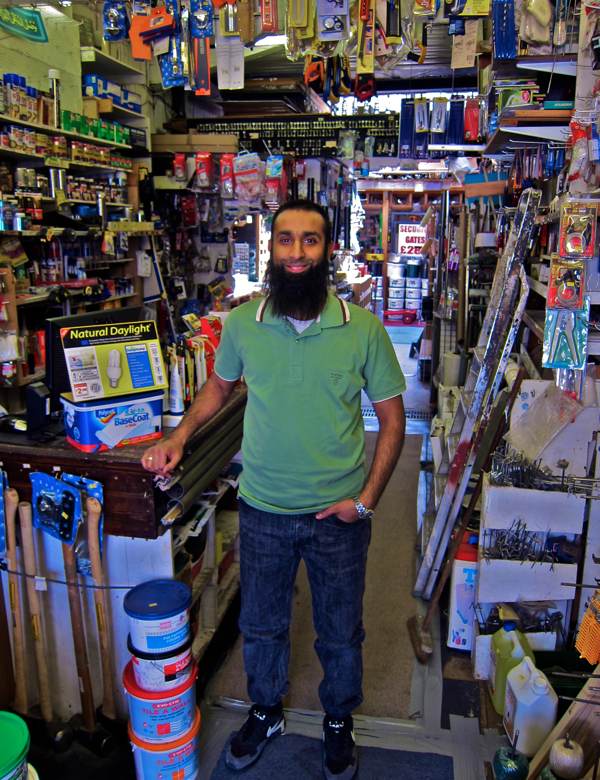
Sarfaraz Loonat – “It was always my dream to have a business of my own.”
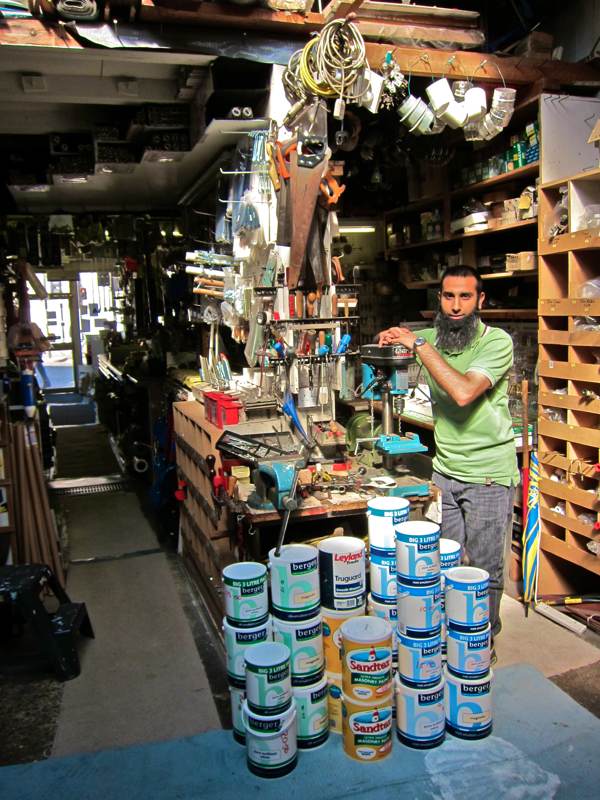

Sarfaraz’s nephew Mohammed Mayat helps out in the shop.
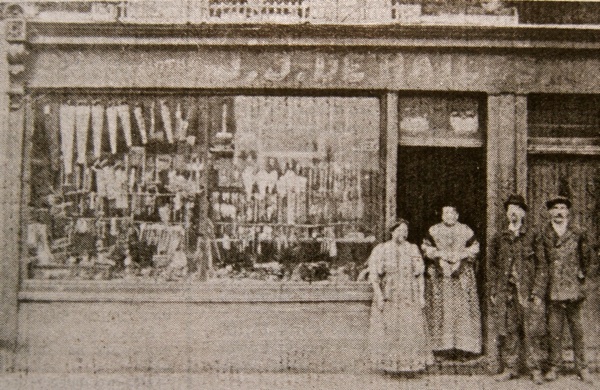
De Hailes’ Locksmith & Ironmongery in Key Close, Whitechapel, 1890. James George de Hailes stands on the far right with his father James next to him.
M&G Building Supplies, Hardware & Ironmongery, 20 Cambridge Heath Rd, Whitechapel, E1 5QH
You may also like to read about Sarfaraz’s father and uncles
The East End Trades Guild needs you!
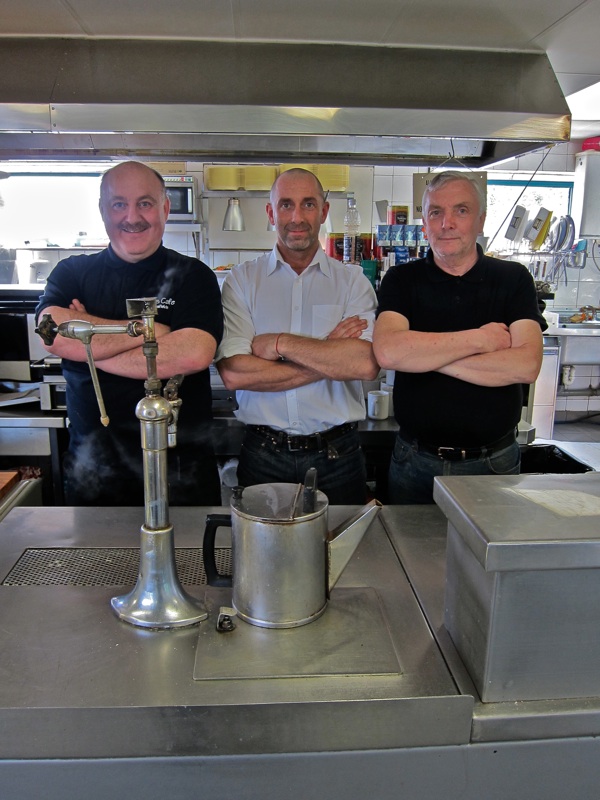
With this sign, Paul Gardner, fourth generation paper bag seller and proprietor of Spitalfields’ oldest family business, eloquently expresses the situation that he and other small independent traders find themselves in. “2 & 8” is rhyming slang for “a bit of a state,” as he explained to me when I called round to his shop, Gardners’ Market Sundriesmen in Commercial St, yesterday.
Since the rebuilding of the Spitalfields Market introduced expensive office property and chain-stores into the neighbourhood, landlords have been pushing up rents mercilessly to the detriment of the small trades and family businesses which have always characterised this area at the boundary of the City of London.
Now change is in the air, as these independent traders are gathering together to form The East End Trades Guild, a union that can square up to exploitative landlords, demand the concessions from local government that are being granted to corporations, and be an advocate for the interests of shopkeepers and small businesses. It all started after community organiser Krissie Nicolson went to visit Paul Gardner, when she read in the pages of Spitalfields Life that he was being confronted with an overnight rent increase from £15,000 to £25,000 a year. It soon became clear that many others were facing similar pressure and then – in a defining moment – the Duke of Uke, Britain’s only ukulele shop, was forced out of Hanbury St. Matthew Reynolds, the proprietor, had created a destination that drew people from far and wide, encouraging some high-end brands to open there beside him, and raising the value of all the property in the street. Through this example, the simple paradox became apparent – upmarket companies are moving into the area because of the attractive identity created by local businesses, and those same businesses are getting pushed out as a result.
In such a climate, looking to short-term gain, landlords have escalated rents wildly with destructive outcome – as seen in Cheshire St, where exorbitant increases led to the departure of Shelf, Mimi, Labour and Wait, and other businesses which drew customers to come there from across London. Over a year later, many of those properties remain empty in a street that has lost its passing trade as a consequence, such is the hubris of the greedy landlord. The irony here is that the Duke of Uke has now opened in Cheshire St and looks set to bring it back to life by attracting other businesses, just as happened in Hanbury St. Maybe in a few years, he will get pushed out once more when the properties surrounding him are full, after he has put the street back on the map?
Landlords are seduced by fantasies of replacing independent traders with chain-stores, yet I am informed that among the largest chain-stores in Spitalfields some are unable to pay their rents. These overblown corporate enterprises stumble from one financial crisis to the next, seeking constant recapitalisation while still adding to their property portfolios by opening more unprofitable shops. As an alternative to this, a responsible private individual who commits themselves to paying a realistic rent long-term is a more prudent option for the owner of the property – if the landlords were not blinded by the pound signs in their eyes. Pursued to its bitter end, the landlords’ short-term profit motive will result in streets lined with chain-stores, and then the value of the commercial property will fall when the area resembles everywhere else and its distinctive appeal is gone.
Unless this situation can be changed, the outcome will be a complete loss of the culture of artisans and family businesses that has defined Spitalfields historically. As Raphael Samuel, the foremost historian of the East End, wrote with remarkable prescience in 1988 –“The fate of Spitalfields Market illustrates in stark form some of the paradoxes of contemporary metropolitan development – on the one hand, the preservation of “historic” houses, on the other, the wholesale destruction of London’s hereditary occupations and trades and the dispersal of its settled communities. The viewer is thus confronted with two versions of “enterprise” culture – the one that of family business and small scale firms, the other that of international high finance with computer screens linking the City of London to the money markets of the world.”
It was in Spitalfields that the match girls of Bryant & May met to form the very first trade union in the nineteenth century and now, demonstrating the same indomitable spirit, the shopkeepers and independent small businesses of the East End are gathering next Monday 30th April at 6:30pm at the Bishopsgate Institute to inaugurate The East End Trades Guild, which launches formally as a pressure group in September. All local small trades are invited to this open meeting to discuss what can be done to ensure their survival and to contribute ideas which can form the policy for the guild. If you are a shopkeeper or you run a small business in the East End, you need to be there to make your voice heard.
Paul Gardner, whose plight was the catalyst for the founding of The East End Trades Guild is its founder member. When I visited him in the building in Commercial St where his family have traded, serving the people of the East End for over one hundred and forty years, he said to me, “I hope it will unite us and give the little businesses a chance to survive, because unless something is done we’re all going to be gone from here in the next five years.”

Graphic by James Brown
You may also like to read
CHIT CHAT – The Umbrella Maker, The Dairyman & The Paper Bag Seller
and the article that started it all
Paul Gardner, Paper Bag Seller
and Raphael Samuel’s essay
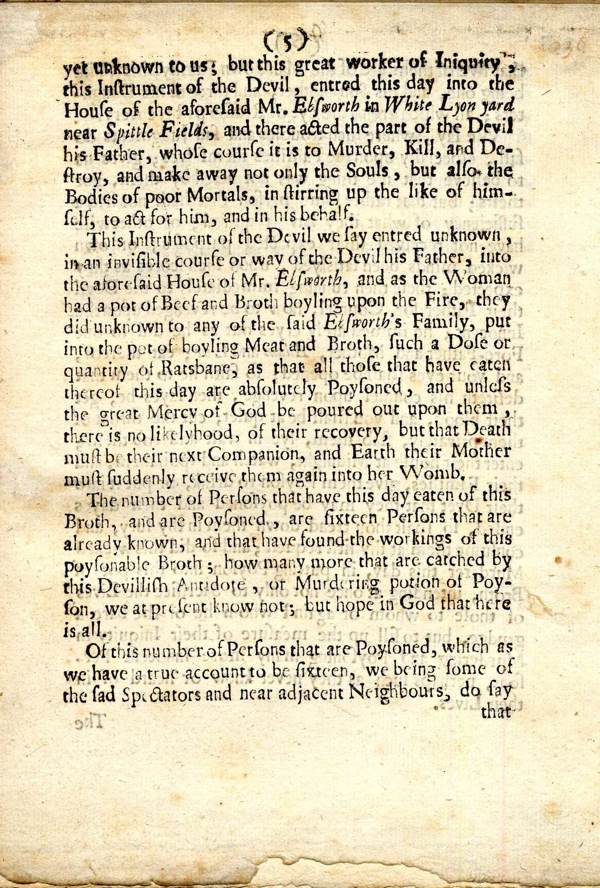
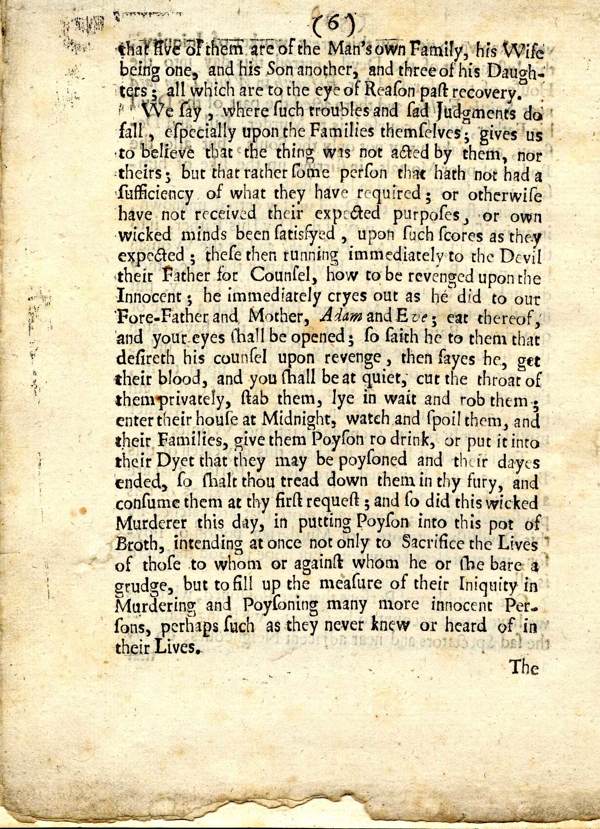
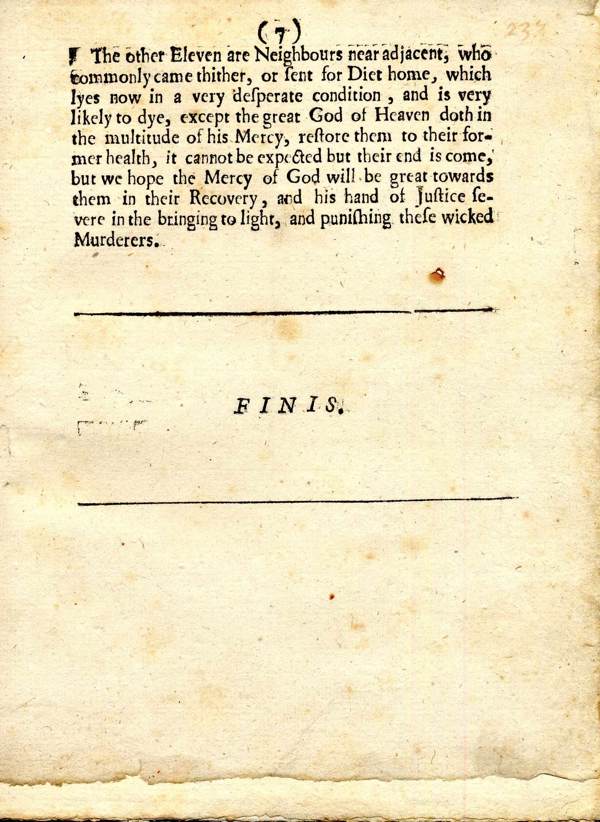
Strange & Terrible News From Spittle-Fields

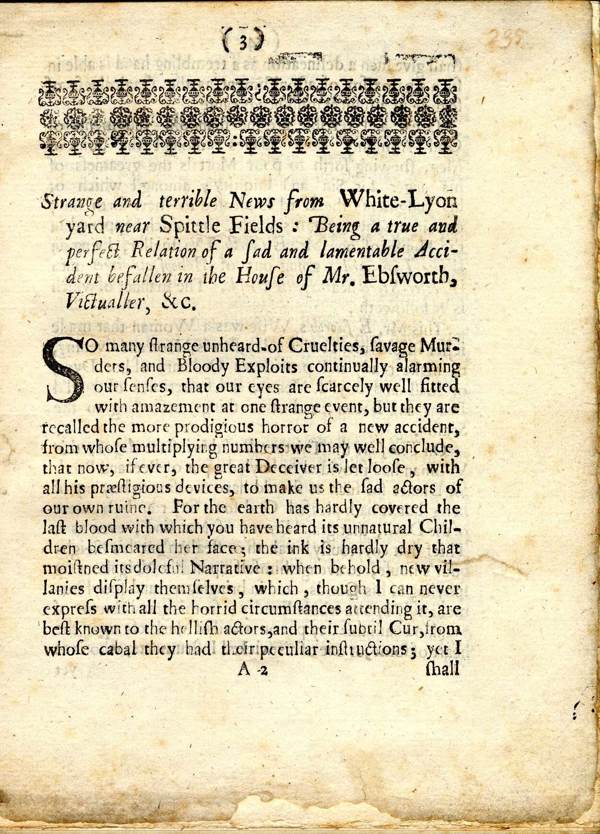
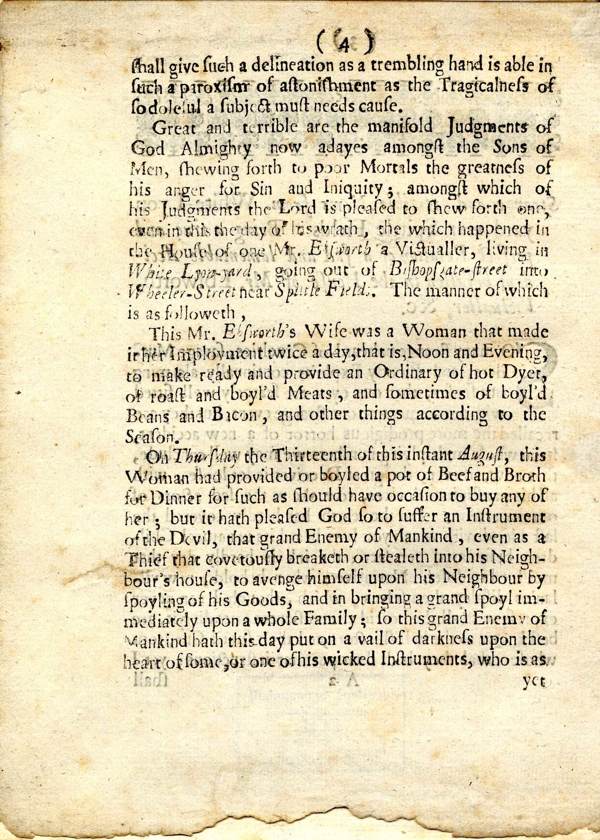
Paul Bommer’s Delft Tiles

Spitalfields Life Contributing Artist Paul Bommer has painted one hundred and twenty faux delft tiles that will be displayed in the living room of an eighteenth century house in a new exhibition – opening at 15 Wilkes St on Friday night and running through next weekend. Paul’s sly witty style is perfectly at home on tiles, bringing an extra level of humour and sophistication to this appealing vernacular art.“I’ve always been fond of delft tiles and the graphics of that period,” he admitted to me, “it’s like Folk Art at the low end, a popular medium illustrating the characters people knew and the things they used.” Many of the tiles that Paul has created were directly inspired by stories on Spitalfields Life and it is my pleasure to publish a selection here. Be sure to come along to Wilkes St and see the rest for yourself.
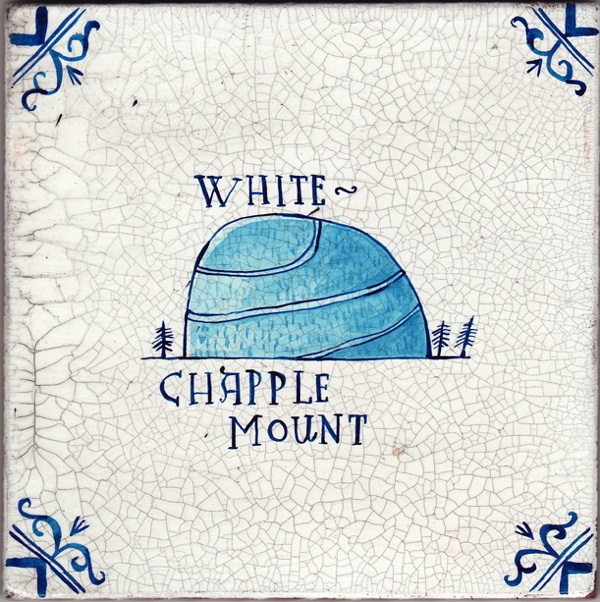
The former Whitechapel Mount, claimed by some to be a primeval earthwork of mystical significance, by others to be a spoil heap from digging the City’s eastern defences during the English Civil War.





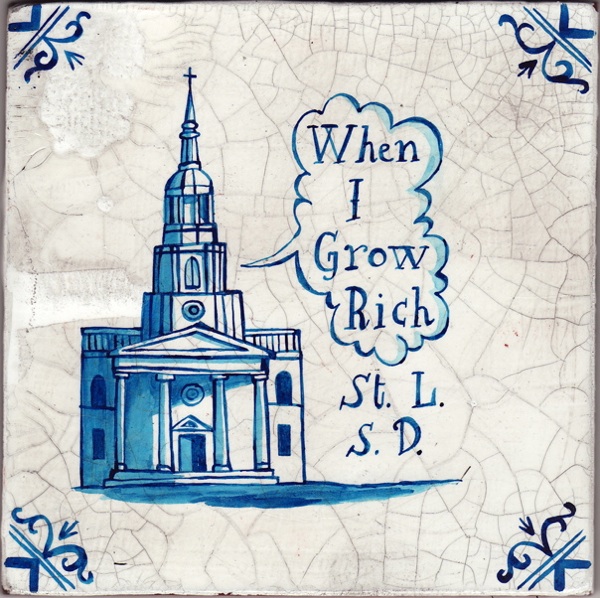
Shakespearian Actors at St Leonard’s Shoreditch

James Ince & Sons, Umbrella Makers

With Jack London at Frying Pan Alley

Tubby Isaac’s Jellied Eels Stall
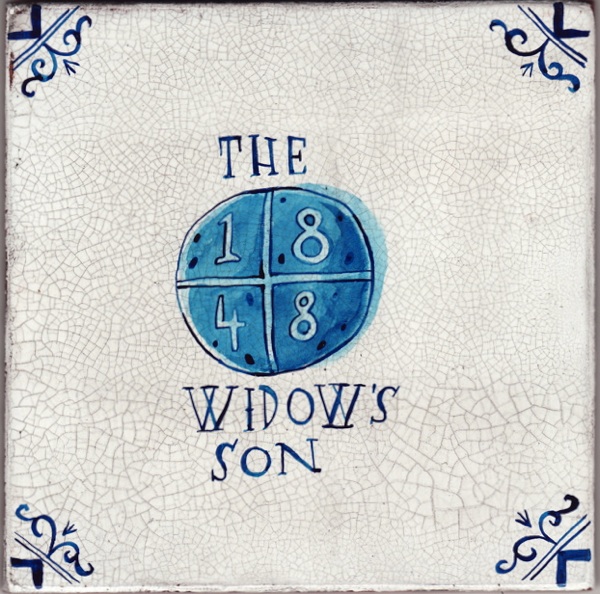
The Ceremony of the Widow’s Buns at Bow


The Ship & Blue Ball in Boundary St where they planned the Great Train Robbery.

Peter Hardwicke, London’s last signwriter working by eye.


John Twomey Fencing Champion & landlord of the Ten Bells.
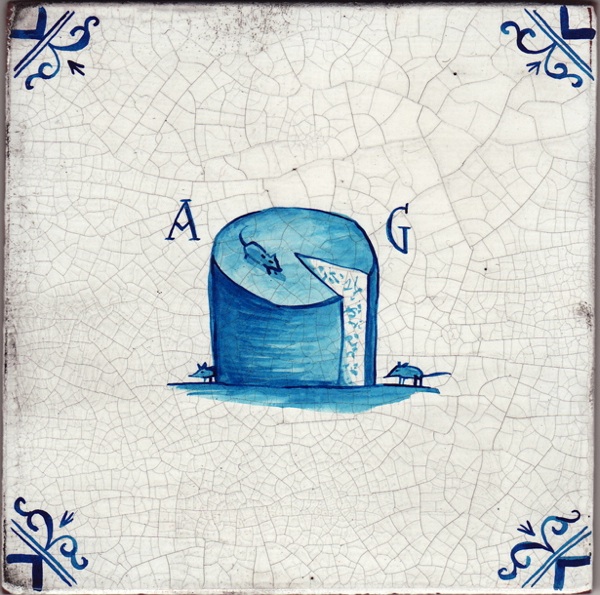
Alex Guarneri, Cheesemonger at Andruoet


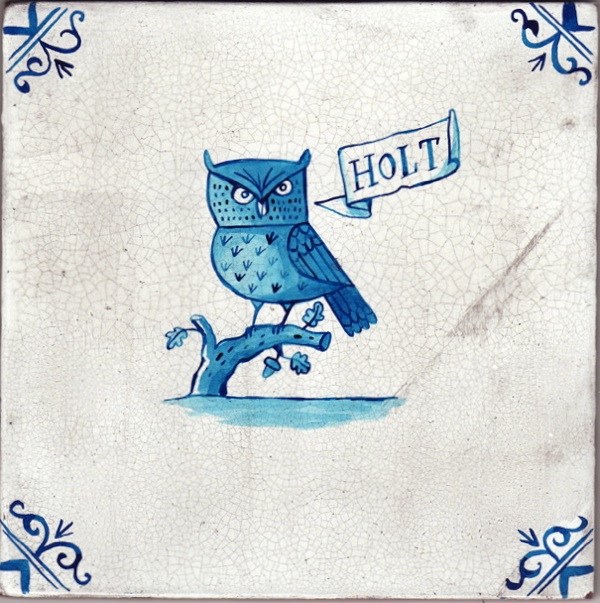
The owl is the symbol of the town of Holt in Norfolk, home of Old Town, the clothing company that hold regular fittings for their London customers in Spitalfields.
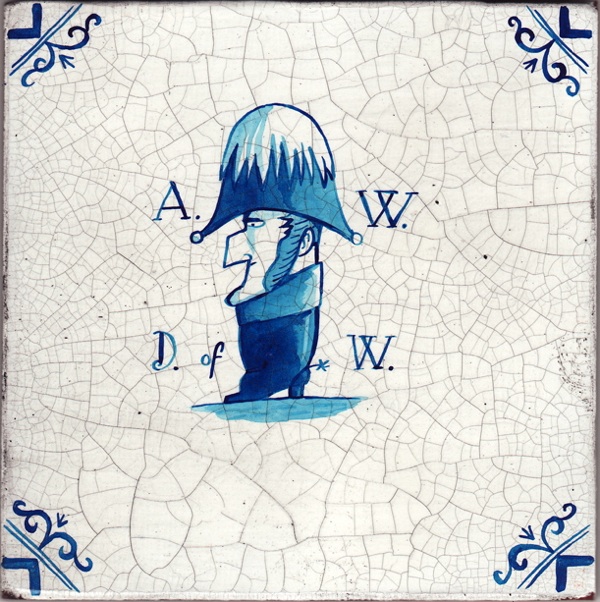
The Duke of Wellington

In Rhyming Slang “Butcher’s Hook” = Look

In Rhyming Slang “Titfer” = Hat

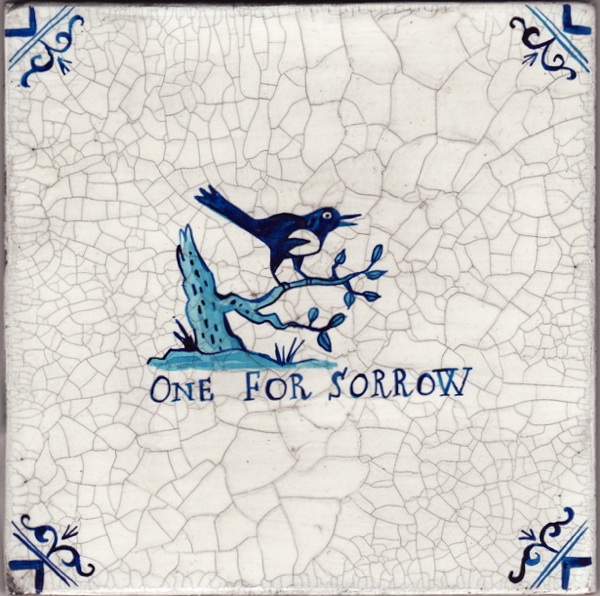
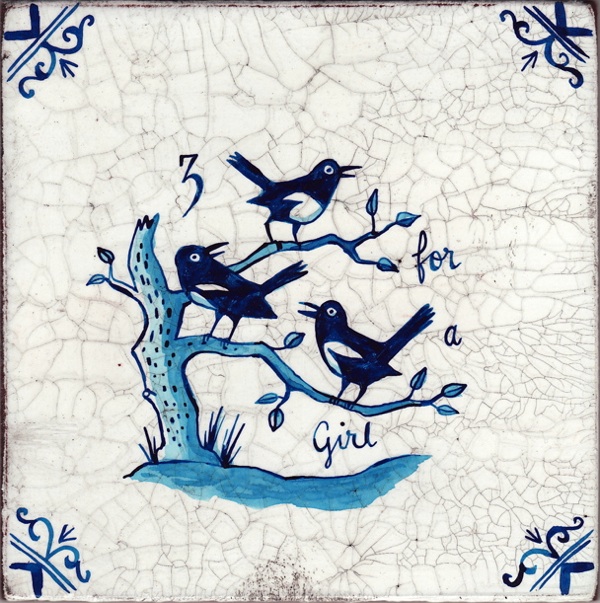



You may also like to read about
Bluebells at Bow Cemetery
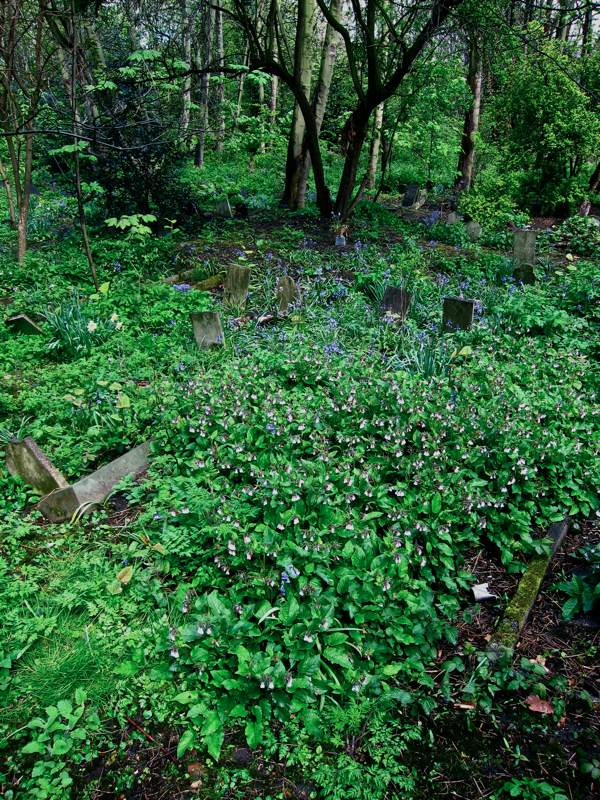
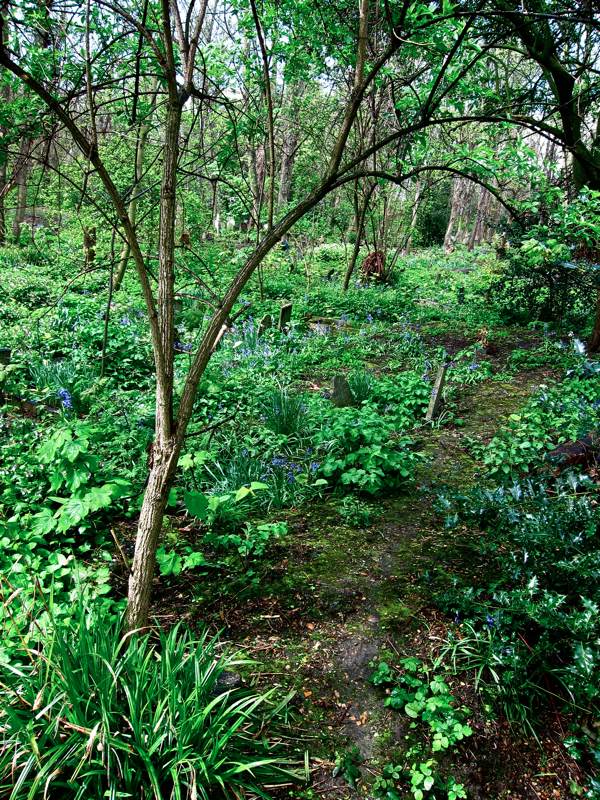
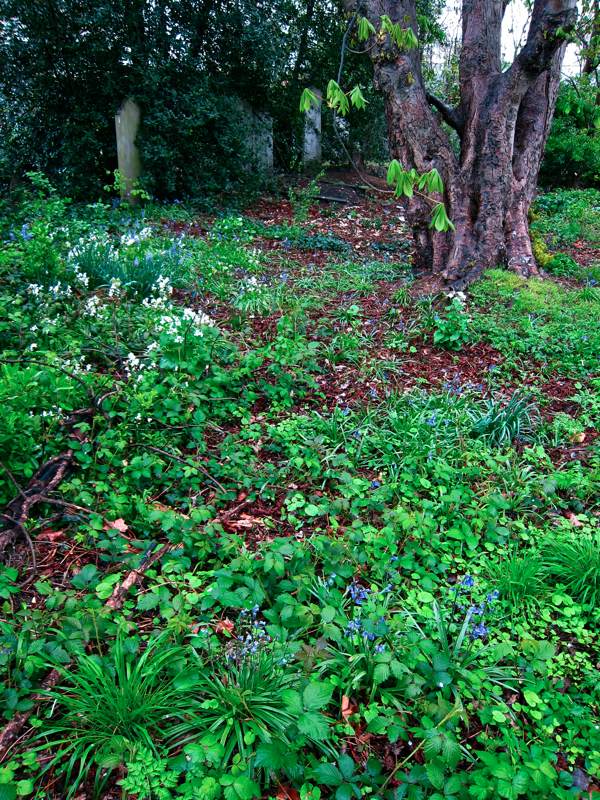
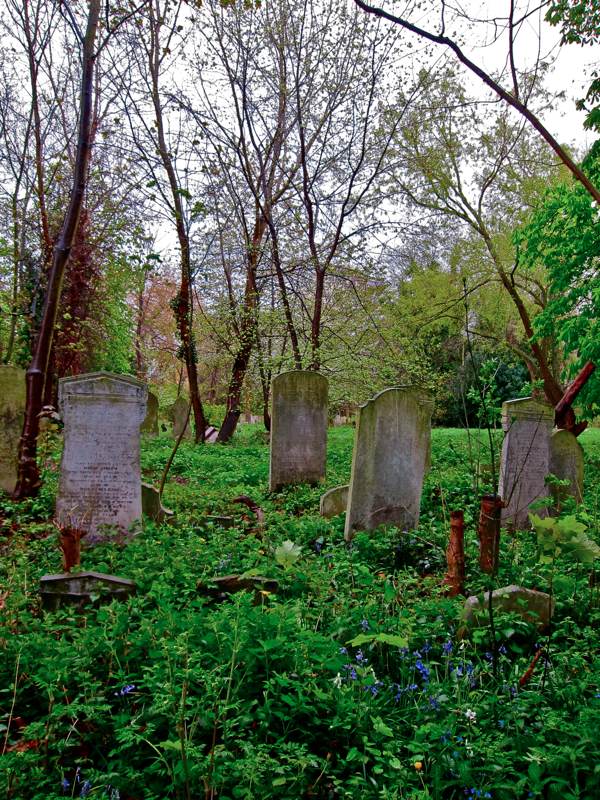
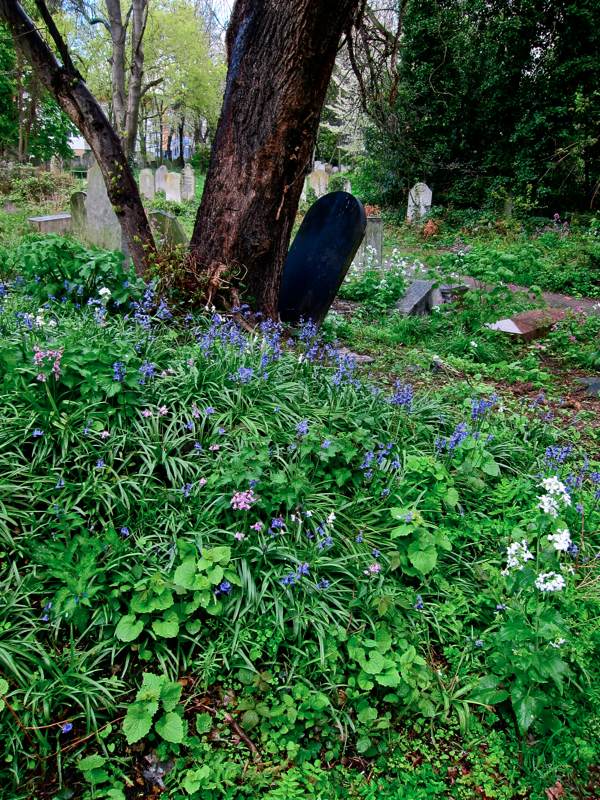
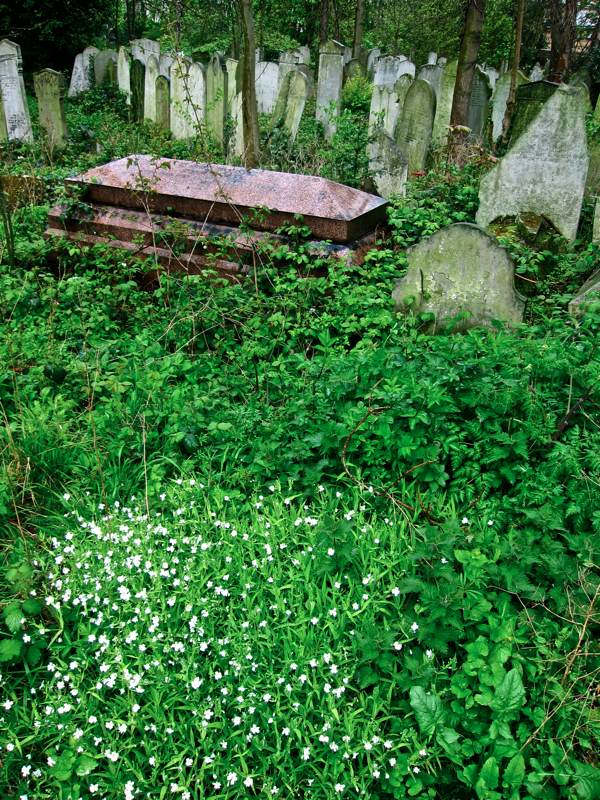
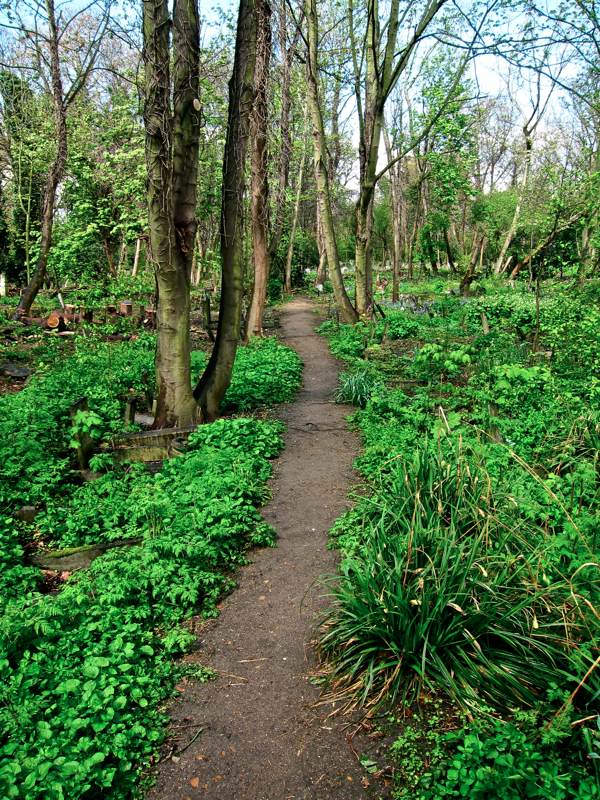
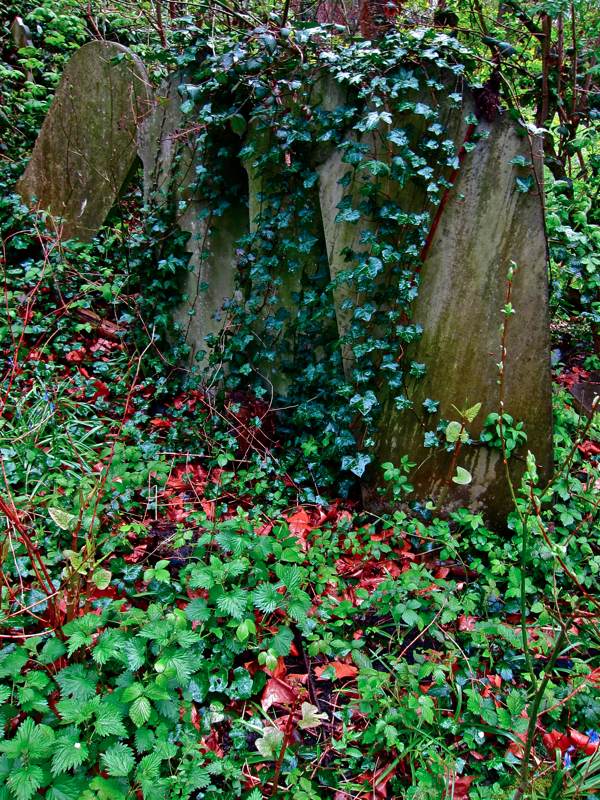
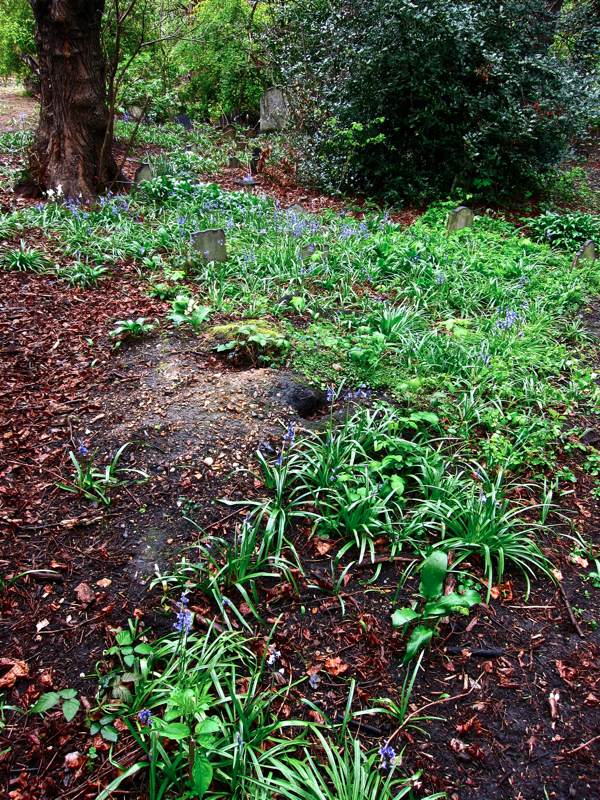
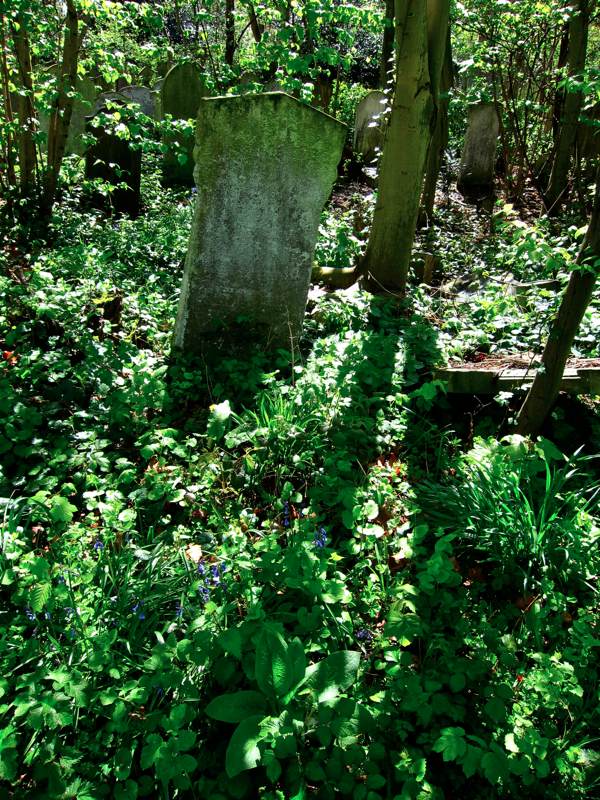
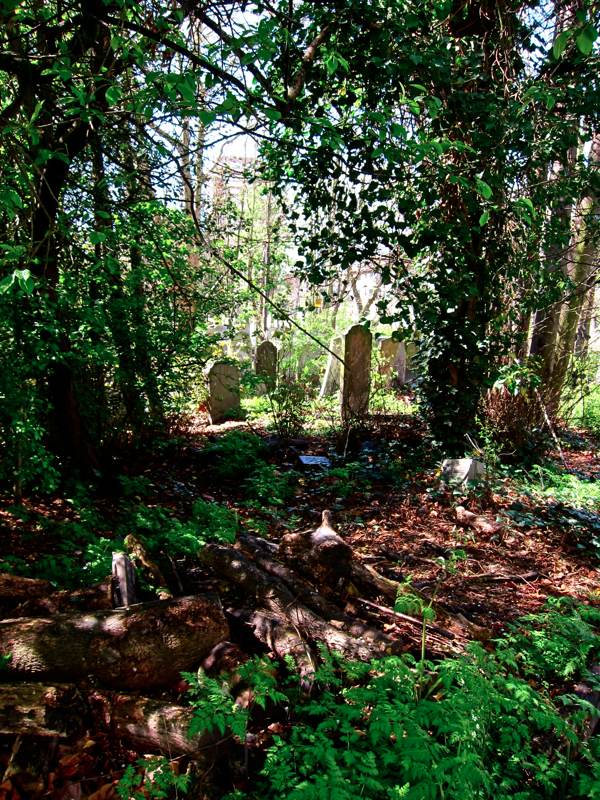
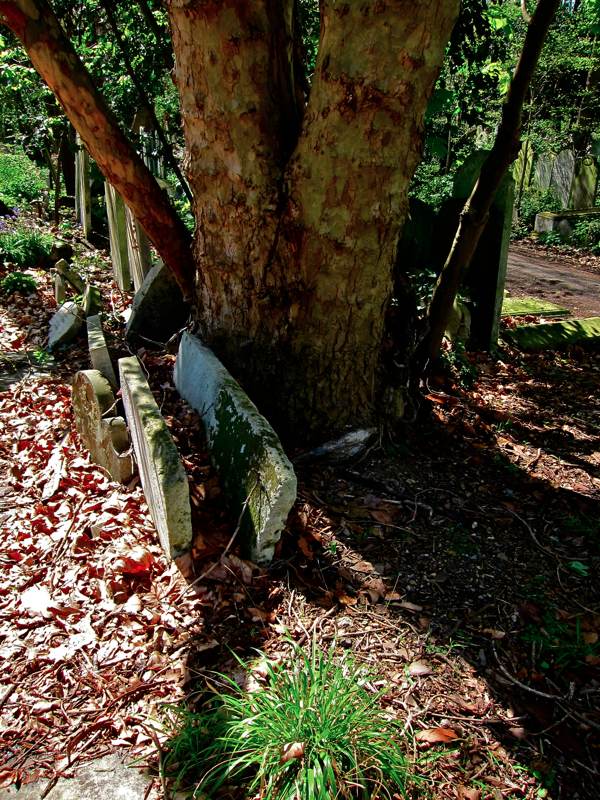
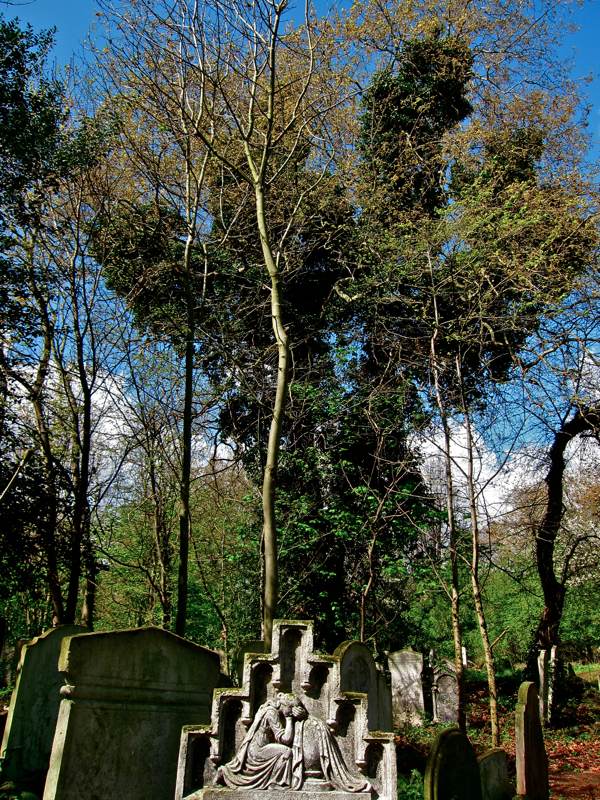
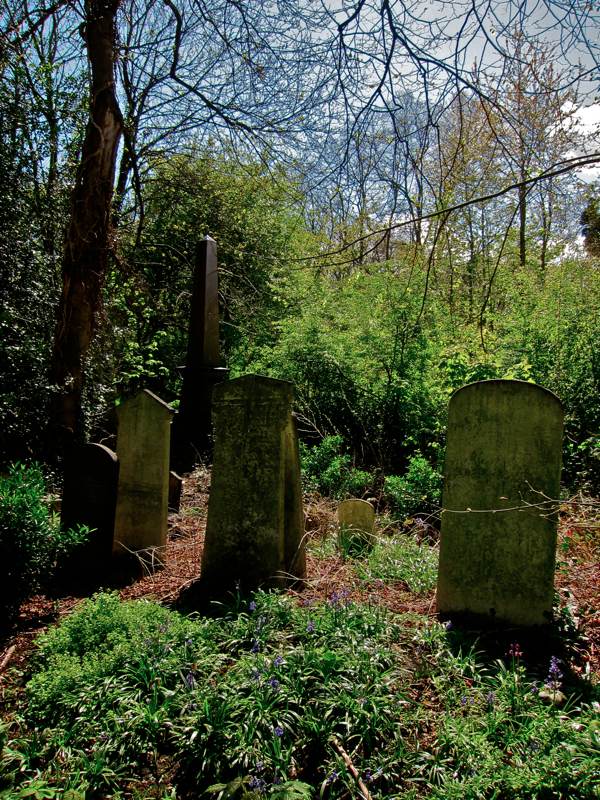
With a few bluebells in flower in my garden in Spitalfields, I was inspired make a visit to Bow Cemetery and view the display of bluebells sprouting under the tall forest canopy that has grown over the graves of the numberless East Enders buried there. In each season of the the year, this hallowed ground offers me an arcadian refuge from the city streets and my spirits always lift as I pass between the ancient brick walls that enclose it, setting out to lose myself among the winding paths, lined by tombstones and overarched with trees.
Equivocal weather rendered the timing of my trip as a gamble, and I was at the mercy of chance whether I should get there and back in sunshine. Yet I tried to hedge my bets by setting out after a shower and walking quickly down the Whitechapel Rd beneath a blue sky of small fast-moving clouds – though, even as I reached Mile End, a dark thunderhead came eastwards from the City casting gloom upon the land. It was too late to retrace my steps and instead I unfurled my umbrella in the cemetery as the first raindrops fell, taking shelter under a horse chestnut, newly in leaf, as the shower became a downpour.
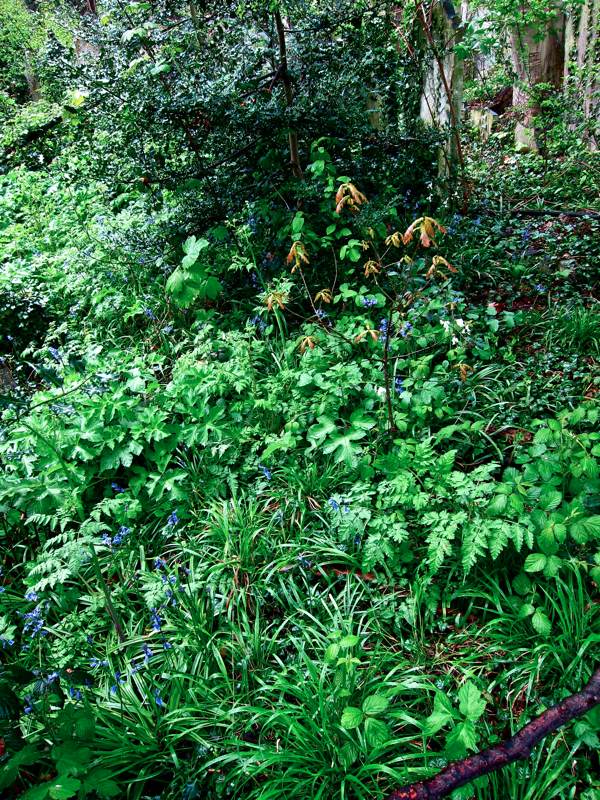
Standing beneath the dripping tree in the half-light of the storm, I took a survey of the wildflowers around me, primroses spangling the green, the white star-like stitchwort adorning graves, a scattering of palest pink ladies smock highlighting the ground cover, yellow celandines sharp and bright against the dark green leaves, violets and wild strawberries nestling close to the earth and may blossom and cherry blossom up above – and, of course, the bluebells’ hazy azure mist shimmering between the lines of stones tilting at irregular angles. Alone beneath the umbrella under the tree in the heart of the vast graveyard, I waited. It was the place of death, but all around me there was new growth.
Once the rain relented sufficiently for me to leave my shelter, I turned towards the entrance in acceptance that my visit was curtailed. The pungent aroma of wild garlic filled the damp air. But then – demonstrating the quick-changing weather that is characteristic of April – the clouds were gone and dazzling sunshine descended in shafts through the forest canopy turning the wet leaves into a million tiny mirrors, reflecting light in a vision of phantasmagoric luminosity. Each fresh leaf and petal and branch glowed with intense colour after the rain. I stood still and cast my eyes around to absorb every detail in this sacred place. It was a moment of recognition that has recurred throughout my life, the awe-inspiring rush of growth of plant life in England in spring.








You may also like to read about
Find out more at www.towerhamletscemetery.org
In the Footsteps of C.A. Mathew
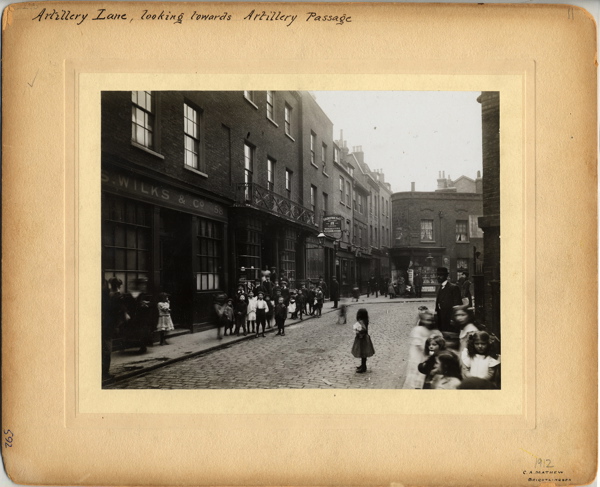
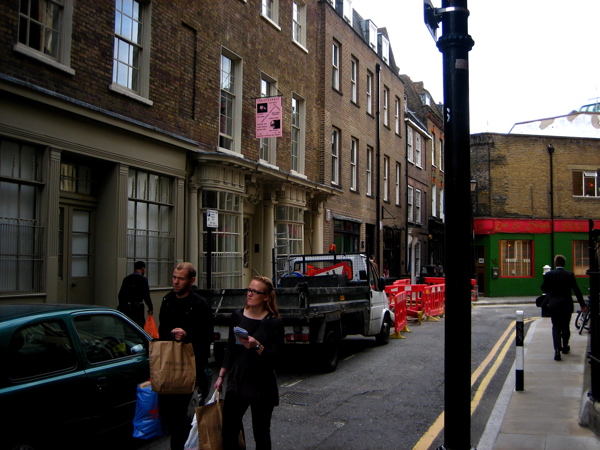
One hundred years ago yesterday, 20th April 1912, C.A.Mathew took photographs on the streets of Spitalfields. Today I publish my pictures of the same views as they are now.
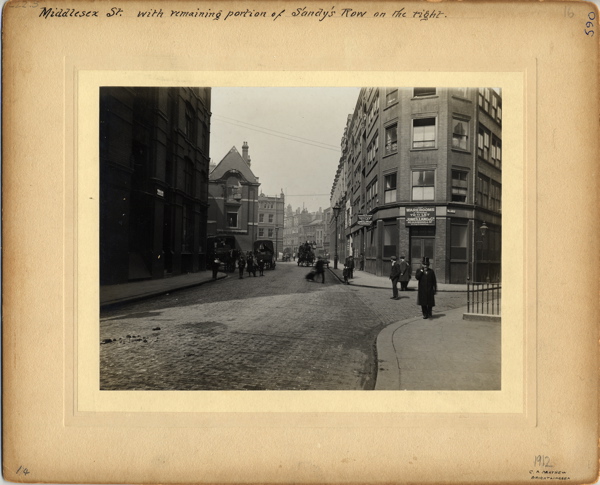
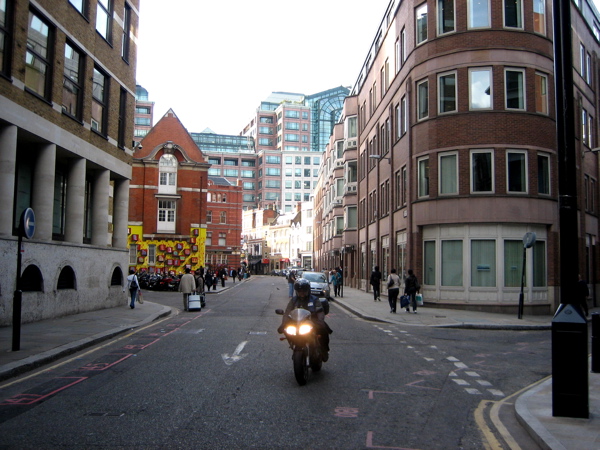
It is a hundred years ago this week that C.A.Mathew visited Spitalfields in April 1912, but he was present once again as my invisible guide when I walked through the close-knit streets to take new pictures in the same locations, and make a photographic assessment of the changes that a century has brought. I had copies of his pictures with me, and in each instance I held them up to ascertain the correct alignment of buildings and other landmarks that told me I was in the same spot exactly.
Being in his footsteps revealed that C.A.Mathew composed his photographs to expose the most sympathetic play of light and shade, demonstrating a subtlety of tone that I dare not attempt to replicate in a different season at another time of day, in another age. Yet there was the delight of recognition when I knew I had found the right place and a sense of dislocation when there was no clue left. Disoriented, I found myself half in the world of a century ago and half in the present day.
When I discovered locations that cross-referenced precisely with the pictures, I felt a sense of elation because the street acquired a whole new dimension and the people in the old photographs took on a more tangible reality, as I contemplated the places where they stood. I relished being party to this secret knowledge and I knew C.A.Mathew was with me. But equally, I recognised an emptiness in the areas that are unrecognisably changed, and recent buildings appeared mere transient constructions to my eyes that had grown accustomed to the world of 1912. C.A.Mathew forsook me in these places, and I refrained from taking photographs when I could find no visible connection. Yet I told myself to resist sentimentality, because the world that C.A.Mathew photographed two years before World War I was one of flux too, only in his pictures could it be fixed eternally.
All streets belong to cars today and we cannot linger on the roadway or step off the pavement without risking our lives. A fact that became vividly apparent to me when I stood momentarily in the middle of the Bishopsgate traffic, risking my safety in my attempt to discover C.A.Mathew’s vantage point upon Middlesex St, before following his path Eastward. I have always been fascinated by the change of scale and atmosphere, walking from the expanse of Bishopsgate through into the medieval streets at the edge of Spitalfields. And in C.A.Mathew’s pictures this change is also emphasised by social contrast, because he found these small streets full of people that lived there. There is a domestic quality that continues to draw me back to these streets, alleys and byways which still evoke their previous inhabitants through scale and form. A century ago, Bishopsgate was a major thoroughfare as it is now – and both my pictures and C.A.Mathew’s show people going somewhere. However in the alleys which are no longer inhabited as they once were, people do not occupy the space with the same sense of belonging as their predecessors in these photographs. They were more at home in these streets than we are today.
Unlike C.A.Mathew, my walk was on a working day and I found myself surrounded by suits, participants in the omnipresent corporate drama of the City, as hundreds of anxious business men took to the streets for a lunchtime walk in the September sunshine. They had escaped the office for a furtive cigarette, to make a private call or have confidential discussions about problems at work. Some passersby spied me with suspicious fleeting curiosity as I stood to take my pictures, very different from the people of a century ago who stood in groups to participate in the novelty of a photograph. Yet I delighted in the exotic drama of everyday life in the twenty-first century, seeing it from the perspective of C.A.Mathew.
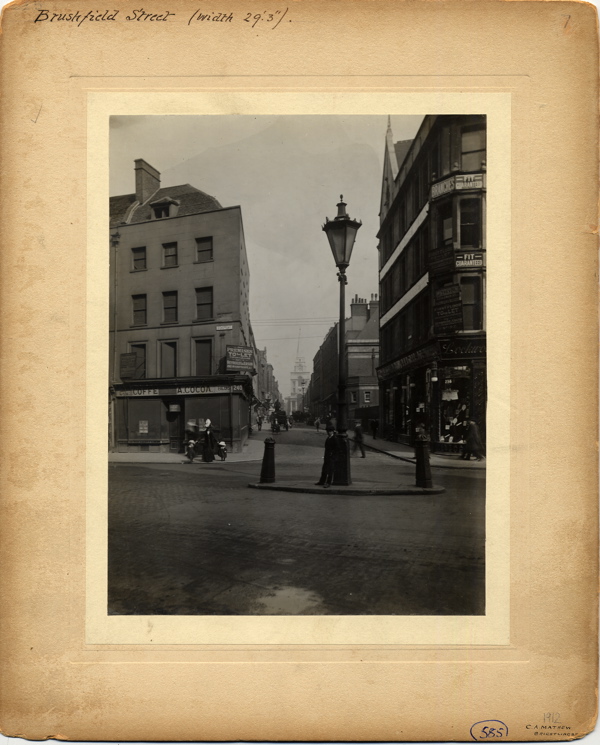
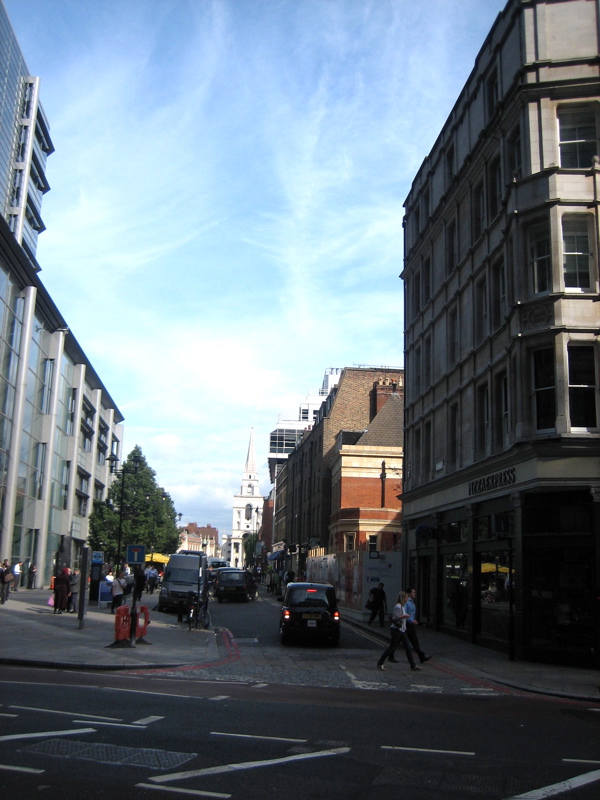
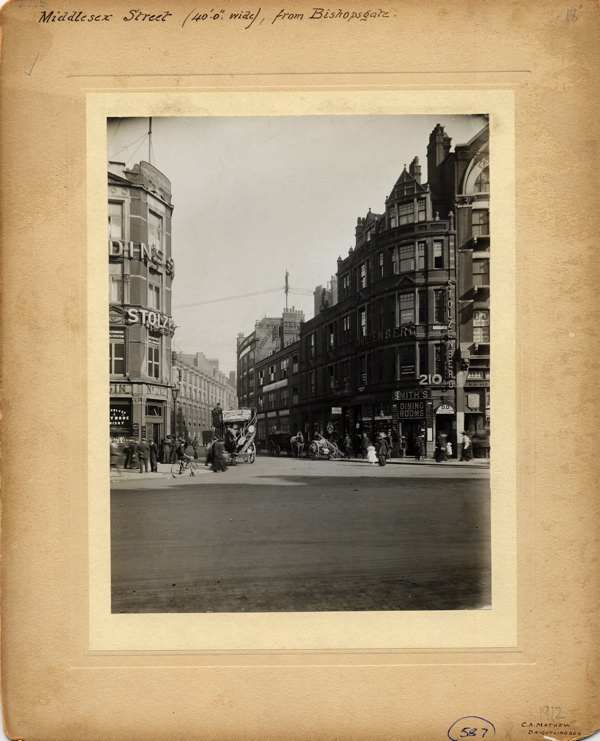
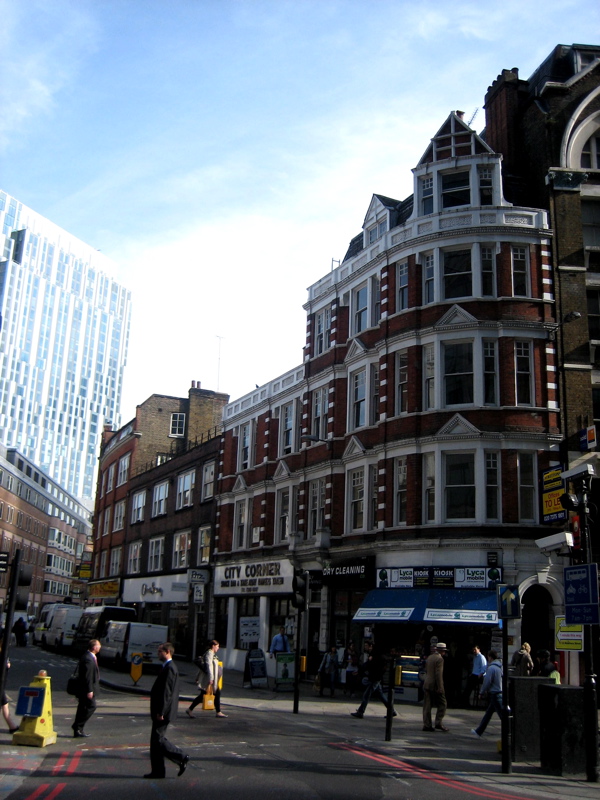
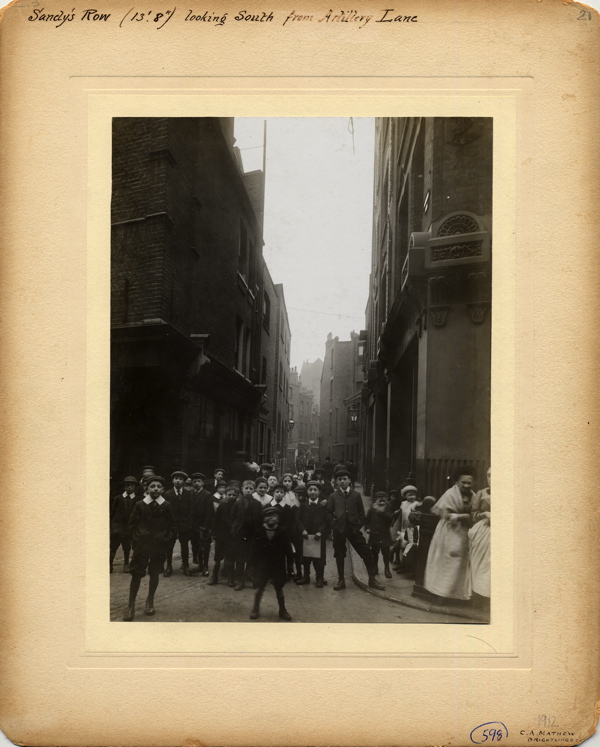
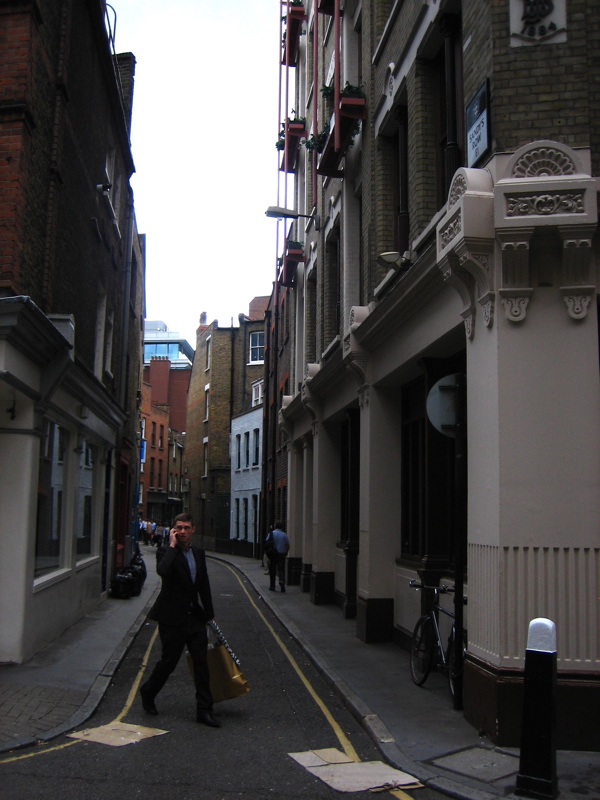
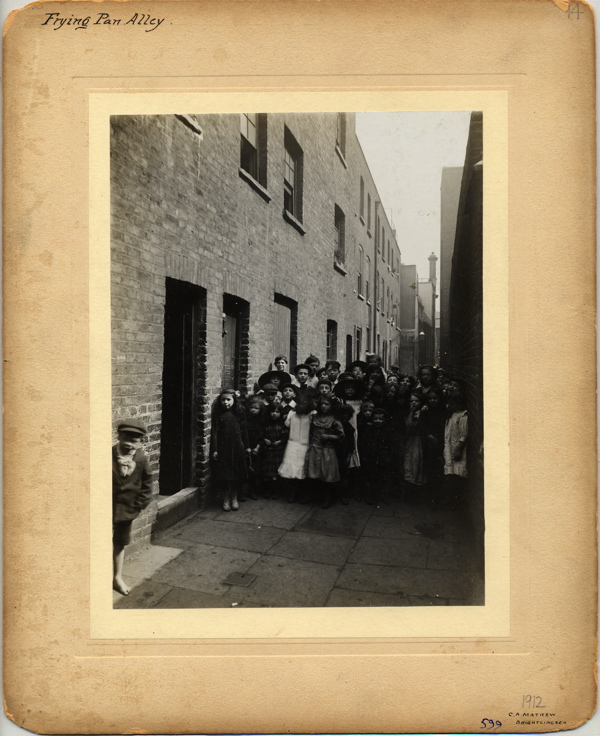
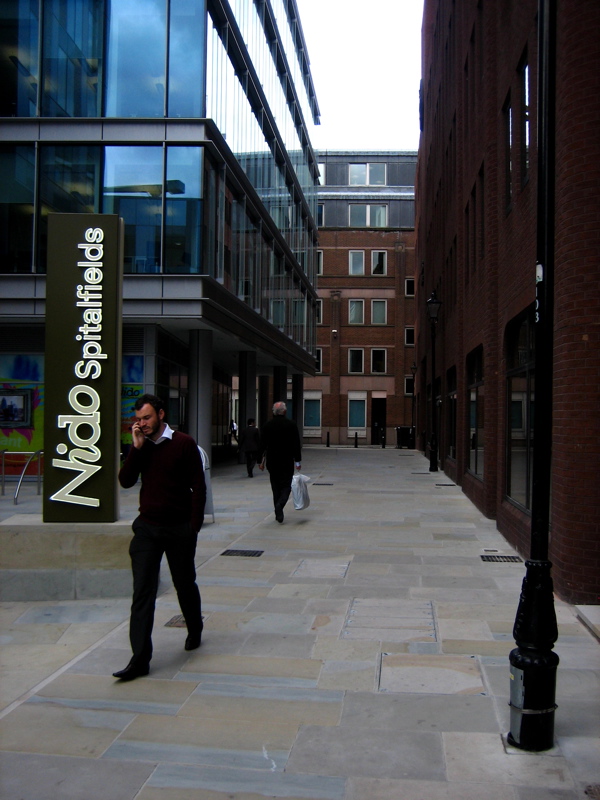
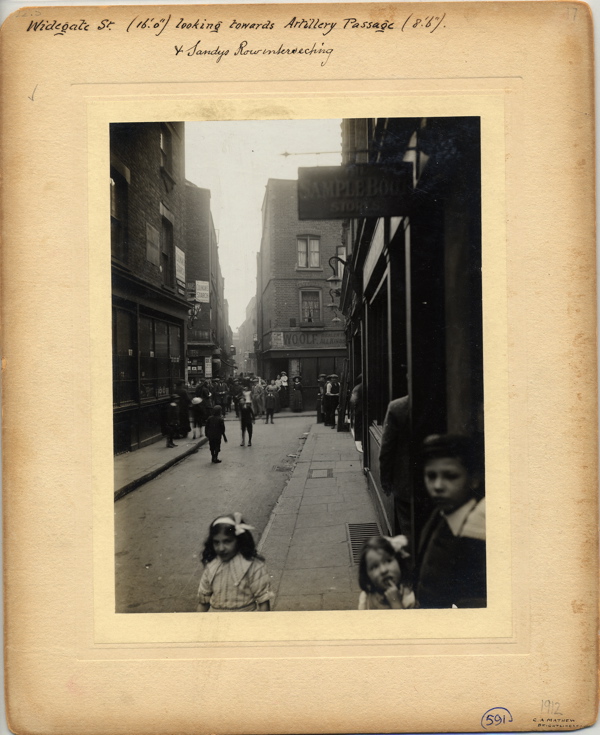
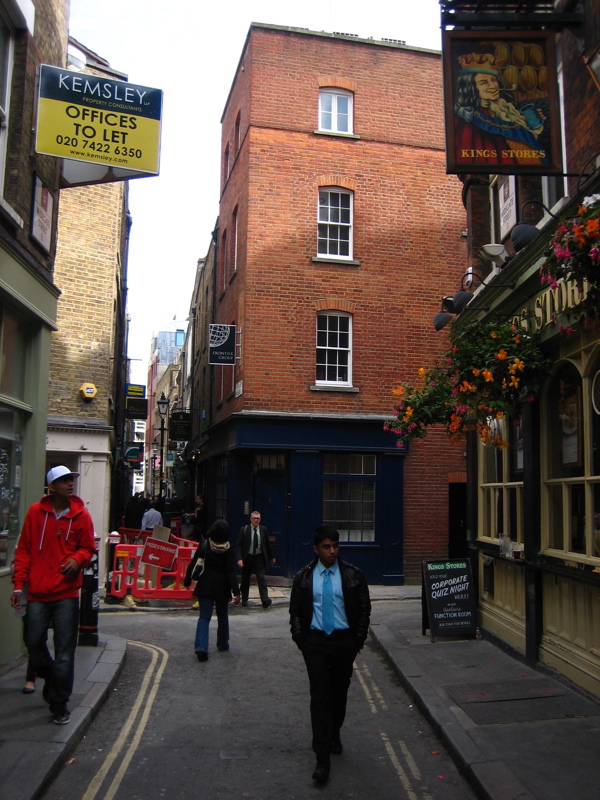
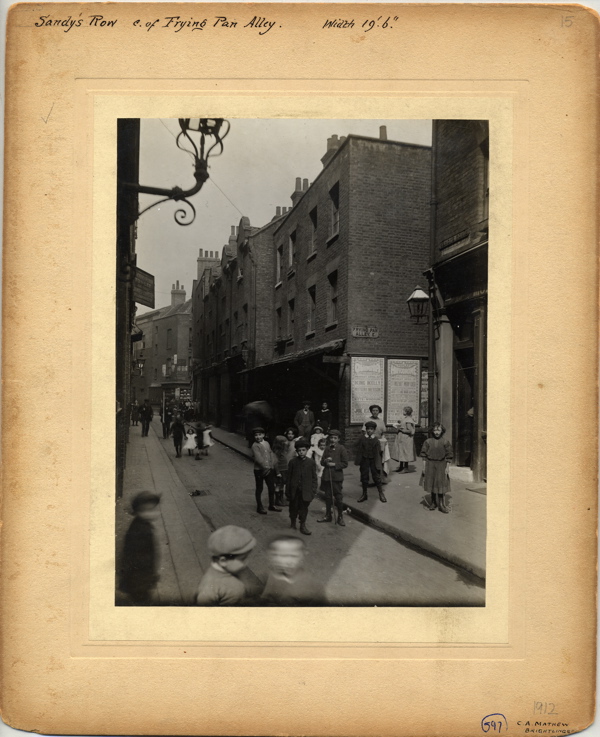
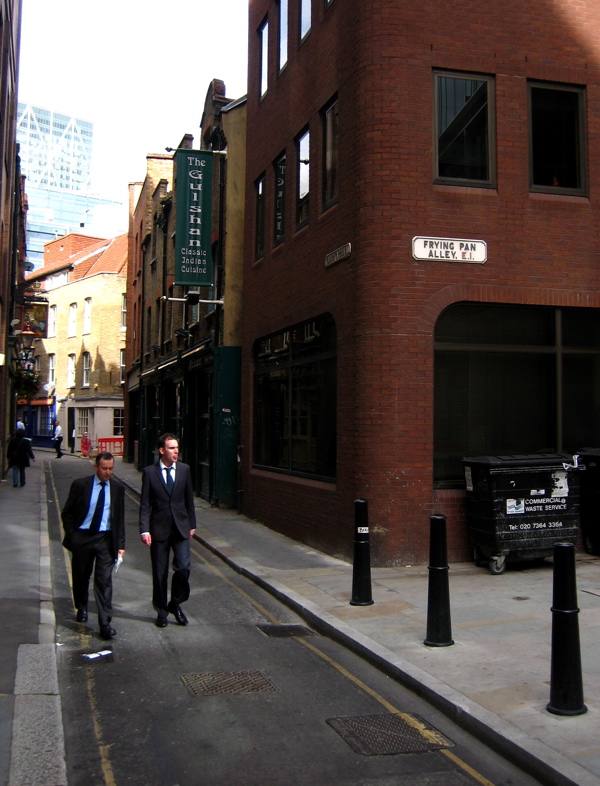
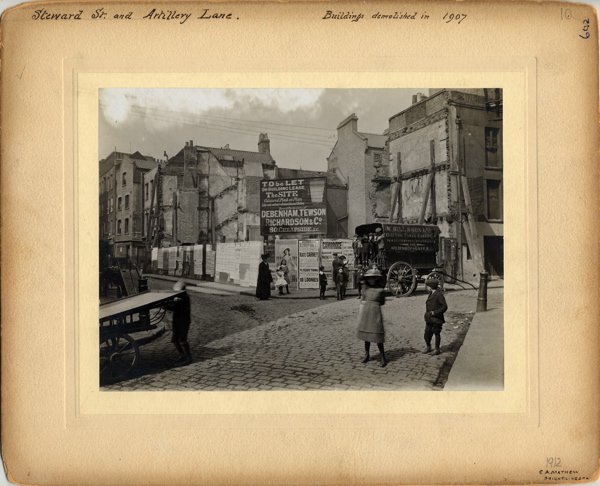
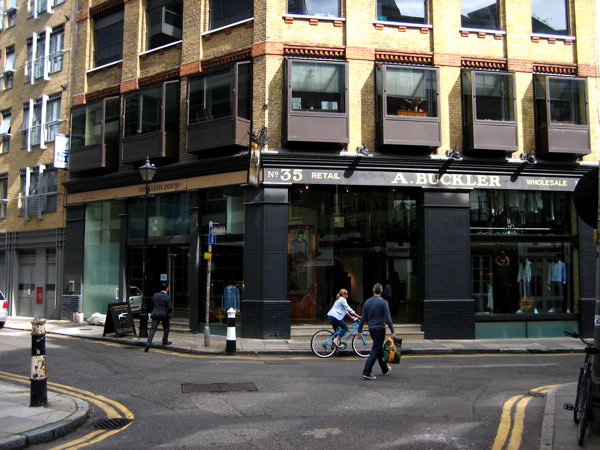
In this photograph, only the bollard on the left hand side remains from the earlier picture.
C.A.Mathew’s photographs courtesy Bishopsgate Institute
C.A.Mathew, Photographer
I am republishing my story about C.A. Mathew to commemorate the centenary of the day he walked out of Liverpool St Station and spent an afternoon taking photographs in Spitalfields. His pictures have subsequently become our primary visual record of that time, and tomorrow you can see my photographs of the same views as they are now.
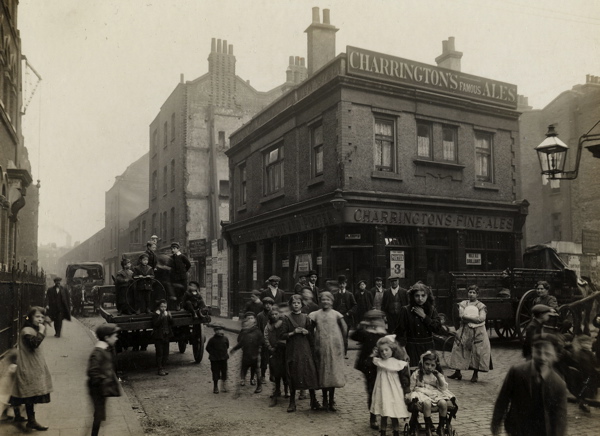
In Crispin St, looking towards the Spitalfields Market
On Saturday April 20th 1912, C.A.Mathew walked out of Liverpool St Station with a camera in hand. No-one knows for certain why he chose to wander through the streets of Spitalfields taking photographs that day. It may be that the pictures were a commission, though this seems unlikely as they were never published. I prefer the other theory, that he was waiting for the train home to Brightlingsea in Essex where he had a studio in Tower St, and simply walked out of the station, taking these pictures to pass the time. It is not impossible that these exceptional photographs owe their existence to something as mundane as a delayed train.
Little is known of C.A.Mathew, who only started photography in 1911, the year before these pictures and died eleven years later in 1923 – yet today his beautiful set of photographs preserved at the Bishopsgate Institute exists as the most vivid evocation we have of Spitalfields at this time.
Because C.A.Mathew is such an enigmatic figure, I have conjured my own picture of him in a shabby suit and bowler hat, with a threadbare tweed coat and muffler against the chill April wind. I can see him trudging the streets of Spitalfields lugging his camera, grimacing behind his thick moustache as he squints at the sky to apprise the light and the buildings. Let me admit, it is hard to resist a sense of connection to him because of the generous humanity of some of these images. While his contemporaries sought more self-consciously picturesque staged photographs, C.A.Mathew’s pictures possess a relaxed spontaneity, even an informal quality, that allows his subjects to meet our gaze as equals. As viewer, we are put in the same position as the photographer and the residents of Spitalfields 1912 are peering at us with unknowing curiosity, while we observe them from the reverse of time’s two-way mirror.
How populated these pictures are. The streets of Spitalfields were fuller in those days – doubly surprising when you remember that this was a Jewish neighbourhood then and these photographs were taken upon the Sabbath. It is a joy to see so many children playing in the street, a sight no longer to be seen in Spitalfields. The other aspect of these photographs which is surprising to a modern eye is that the people, and especially the children, are well-dressed on the whole. They do not look like poor people and, contrary to the widespread perception that this was an area dominated by poverty at that time, I only spotted one bare-footed urchin among the hundreds of figures in these photographs.
The other source of fascination here is to see how some streets have changed beyond recognition while others remain almost identical. Most of all it is the human details that touch me, scrutinizing each of the individual figures presenting themselves with dignity in their worn clothes, and the children who treat the streets as their own. Spot the boy in the photograph above standing on the truck with his hoop and the girl sitting in the pram that she is too big for. In the view through Spitalfields to Christ Church from Bishopsgate, observe the boy in the cap leaning against the lamppost in the middle of Bishopsgate with such proprietorial ease, unthinkable in today’s traffic.
These pictures are all that exists of the life of C.A.Mathew, but I think they are a fine legacy for us to remember him because they contain a whole world in these few streets, that we could never know in such vibrant detail if it were not for him. Such is the haphazard nature of human life that these images may be the consequence of a delayed train, yet irrespective of the obscure circumstances of their origin, this is photography of the highest order. C.A.Mathew was recording life.
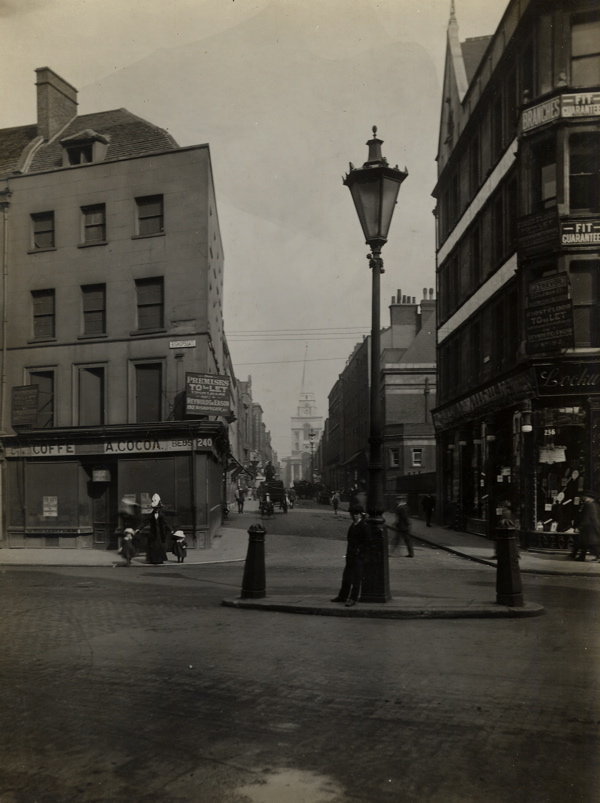
Looking down Brushfield St towards Christ Church, Spitalfields.
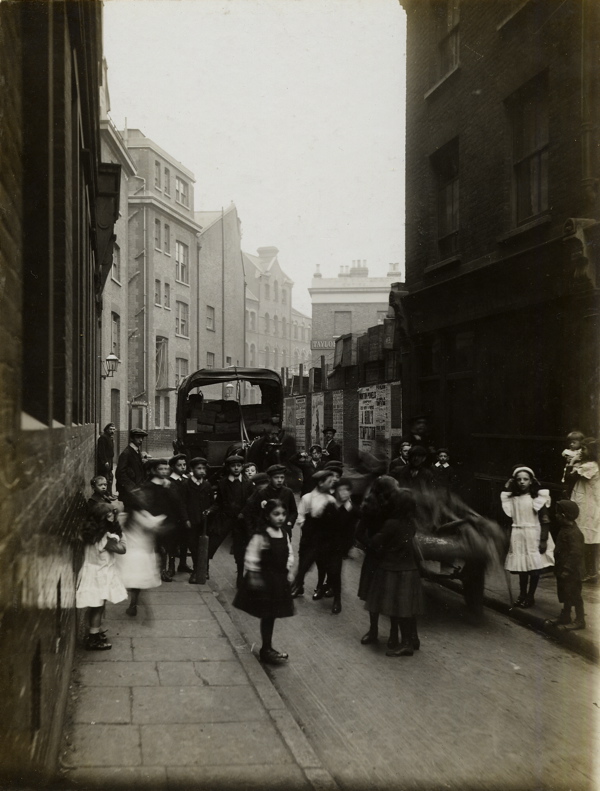
Bell Lane looking towards Crispin St.
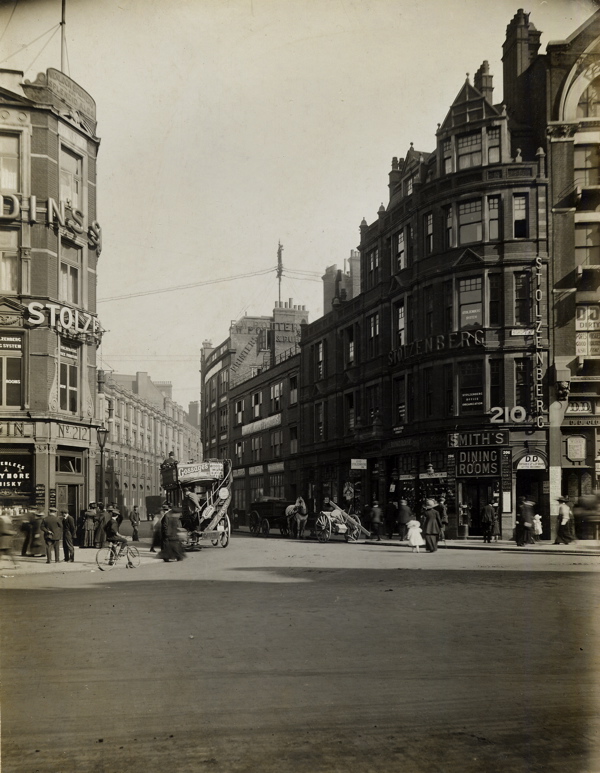
Looking up Middlesex St from Bishopsgate.
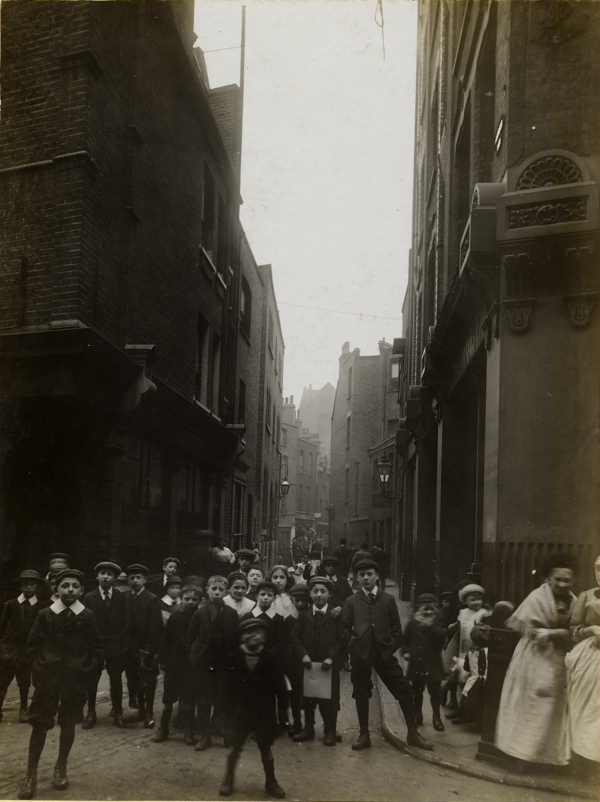
Looking down Sandys Row from Artillery Lane – observe the horse and cart approaching in the distance.
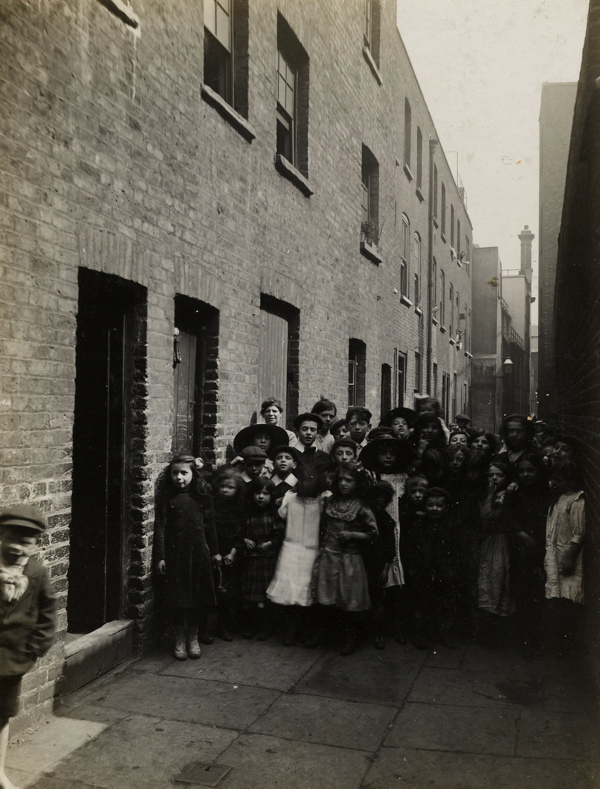
Looking down Frying Pan Alley towards Crispin St.
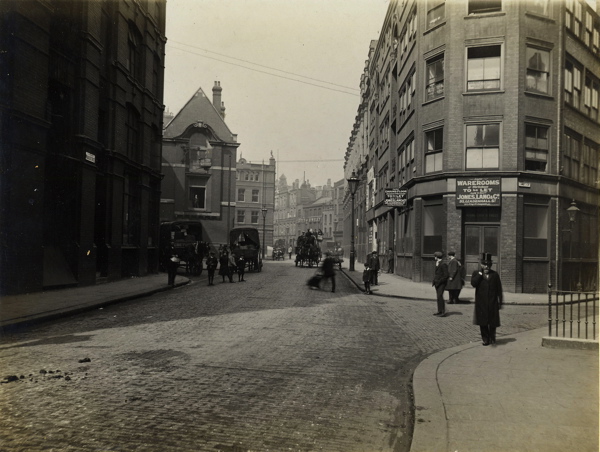
Looking down Middlesex St towards Bishopsgate.
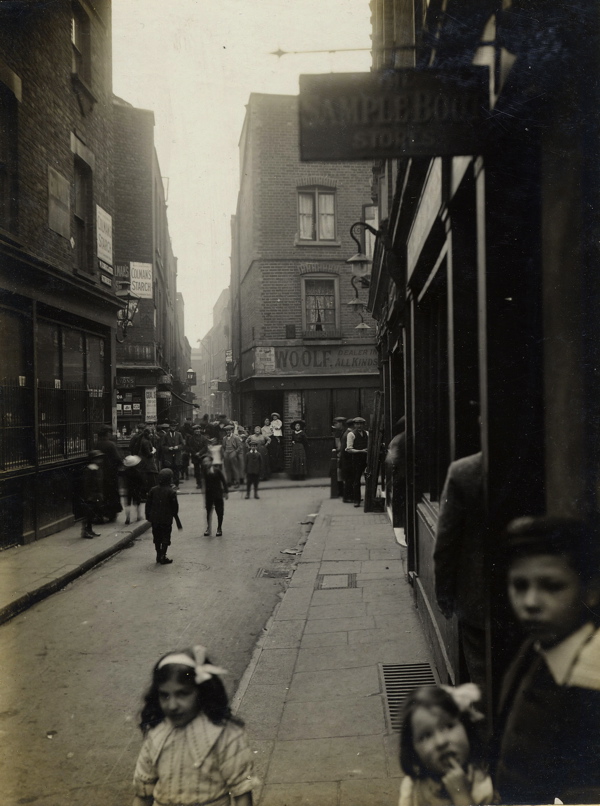
Widegate St looking towards Artillery Passage.
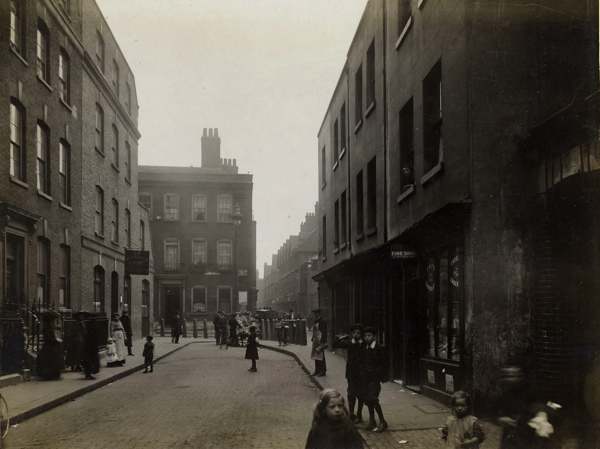
In Spital Square, looking towards the market.
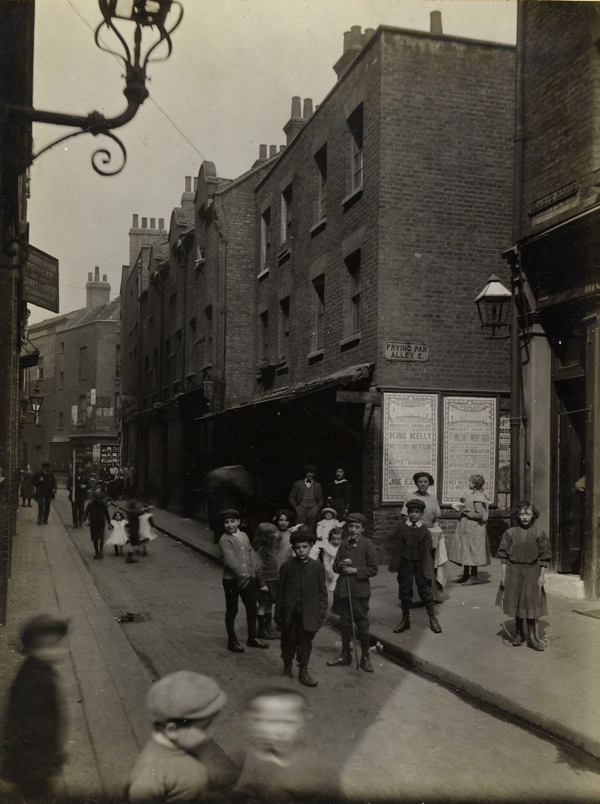
At the corner of Sandys Row and Frying Pan Alley.
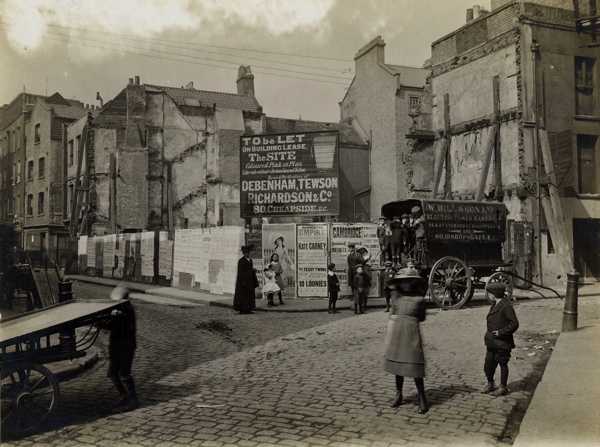
At the junction of Seward St and Artillery Lane.
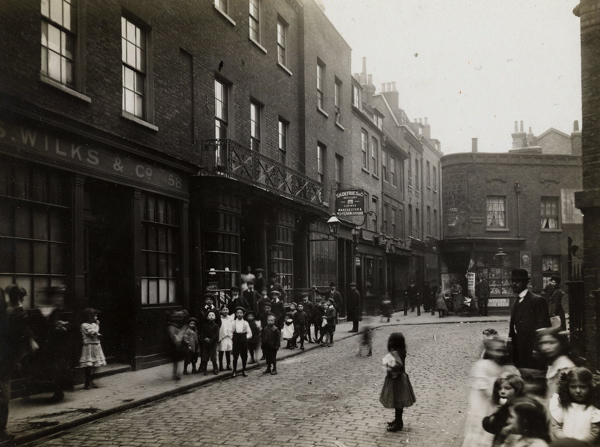
Looking down Artillery Lane towards Artillery Passage.
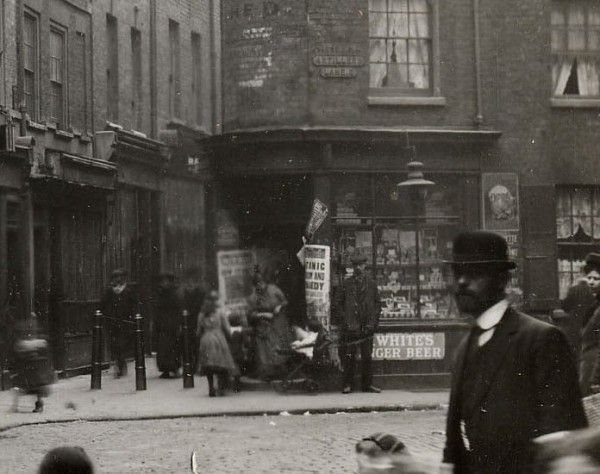
An enlargement of the picture above reveals the newshoarding announcing the sinking of the Titanic, confirming the date of this photograph as 1912.
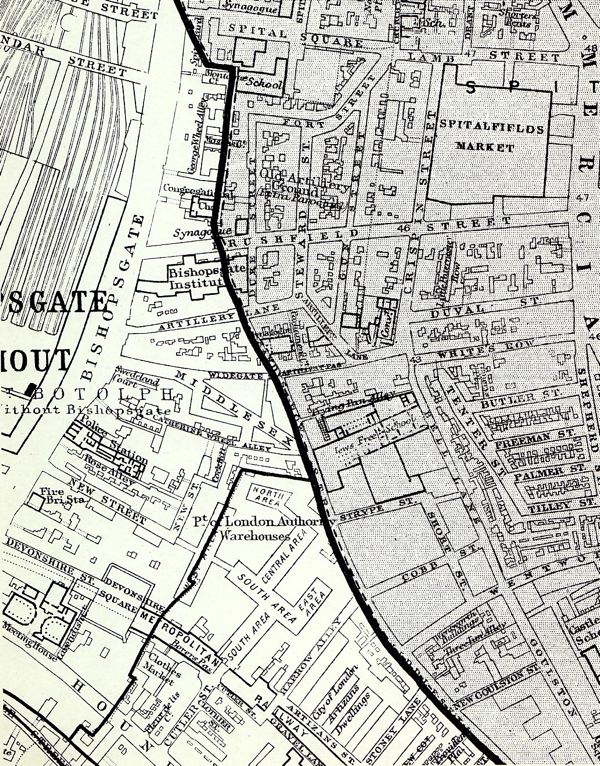
Spitalfields as C.A.Mathew found it, Bacon’s “Citizen” Map of the City of London 1912.
Photographs courtesy of Bishopsgate Institute












