The Cats of Spitalfields
Contributing Photographer Chris Kelly is renowned for her volume of cat photography The Necessary Cat – A Photographer’s Memoir, so I asked her if she would make a survey of the cats of Spitalfields and am delighted to publish her portraits of local felines and their human slaves.
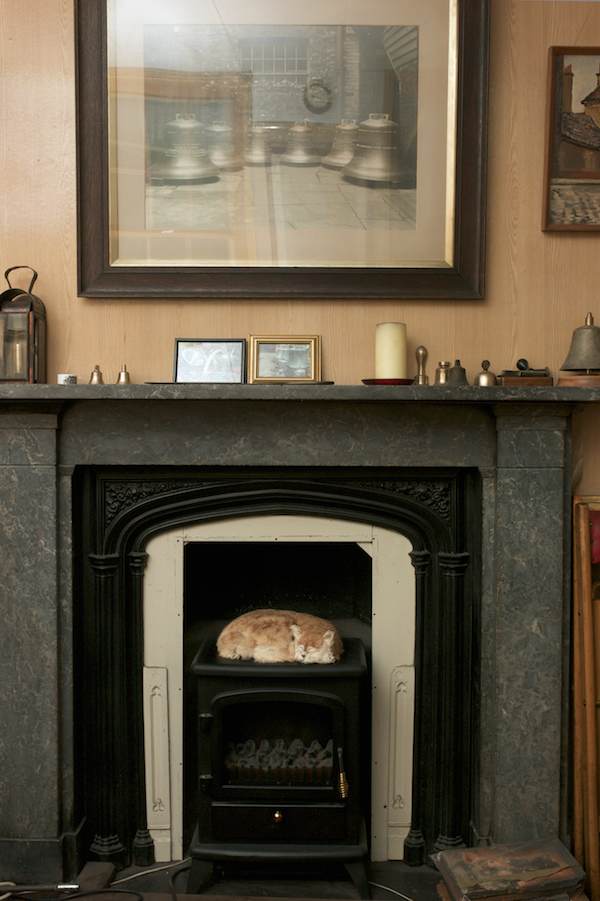
In the Bell Foundry Office, Whitechapel
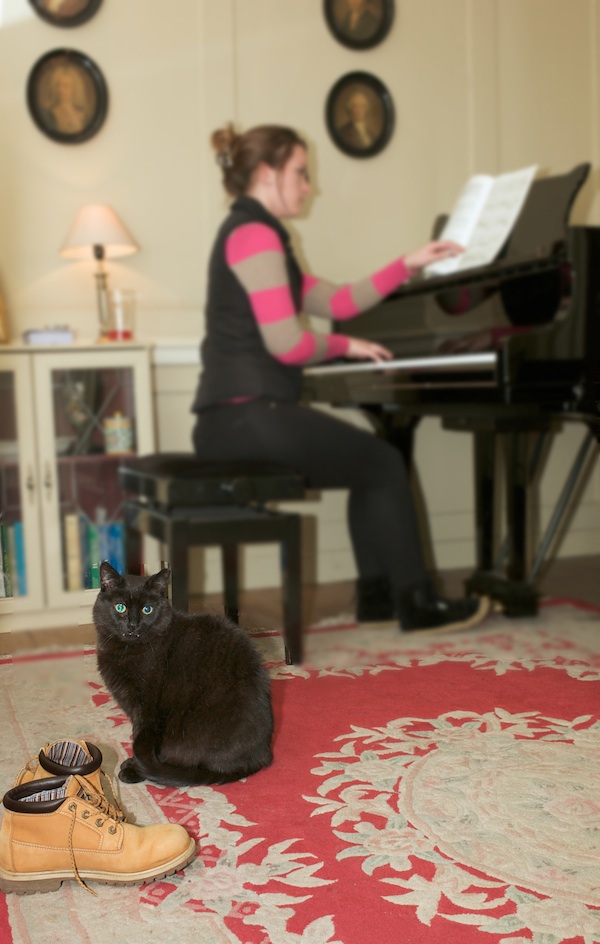
Sooty the Bell Foundry Cat
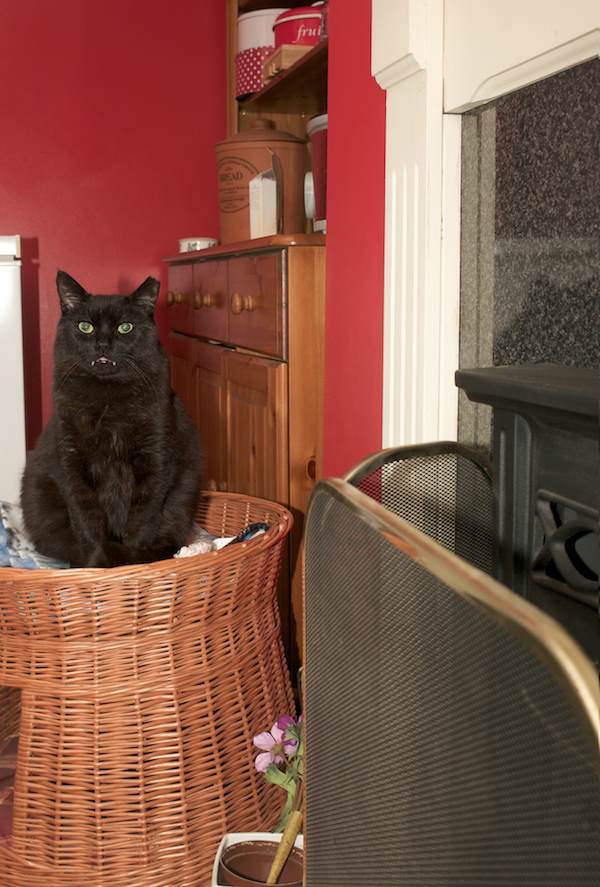
Sooty the Bell Foundry Cat & Kathryn Hughes, Master Bell Founder
“Sooty came from a London charity called Paws for Life, they rehome elderly cats or those with medical problems. He was a fighting tom taken off the streets and is FIV positive. For the first few months here he just hid in corners, but the whole house is his domain now although heʼs not allowed in the foundry.
We got him to deal with the mice and he catches any that come out from under the cooker. He sleeps upstairs with our two girls and follows us around. Itʼs lovely to have him here, especially if any one of us is alone in the house.
We think heʼs about seven or eight. Heʼs fairly scarred and scabbed and half of one ear is missing. He likes to be king of the castle. Heʼs usually fine with girls, although heʼll give ours a nip if theyʼre a bit slow to put out his breakfast. He doesnʼt like men much, especially if theyʼre wearing big boots and he only comes down to the office when the men have gone home.
He loves listening to music but only piano music and singing, he hates the trumpet and violin. He sometimes sits on a chair near the piano when my daughter is playing.
Our previous cat Sandy walked in off the street and stayed for ten years. He was the complete feral cat, he could climb a vertical ladder in the yard and be away over the rooftops. He was never really ours. He was an excellent ratter and there were plenty of the nasty large creatures around when foundations were being rebuilt. Heʼd present them to us, of course.
We acquired the toy cat in the office when Sandy died. Itʼs very lifelike and a source of great amusement and cat jokes.”
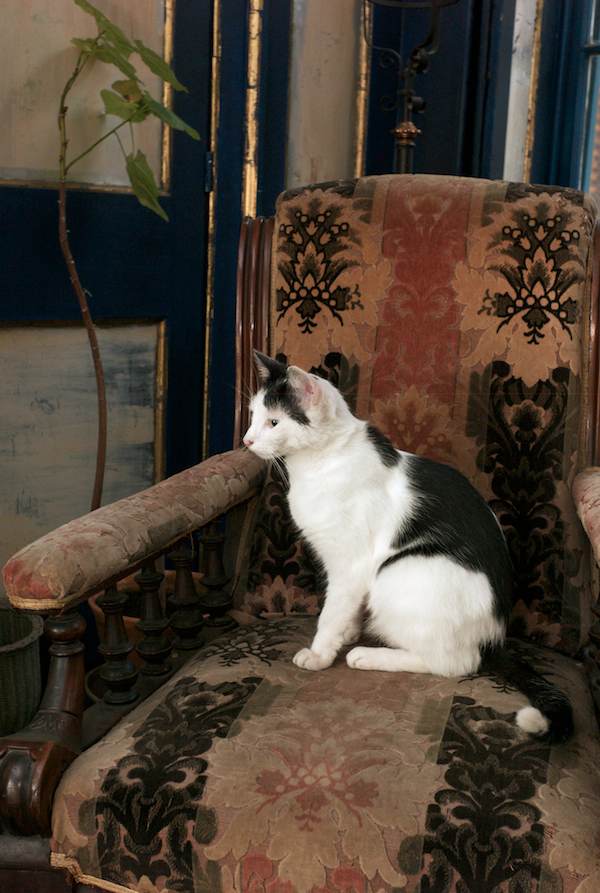
Earl
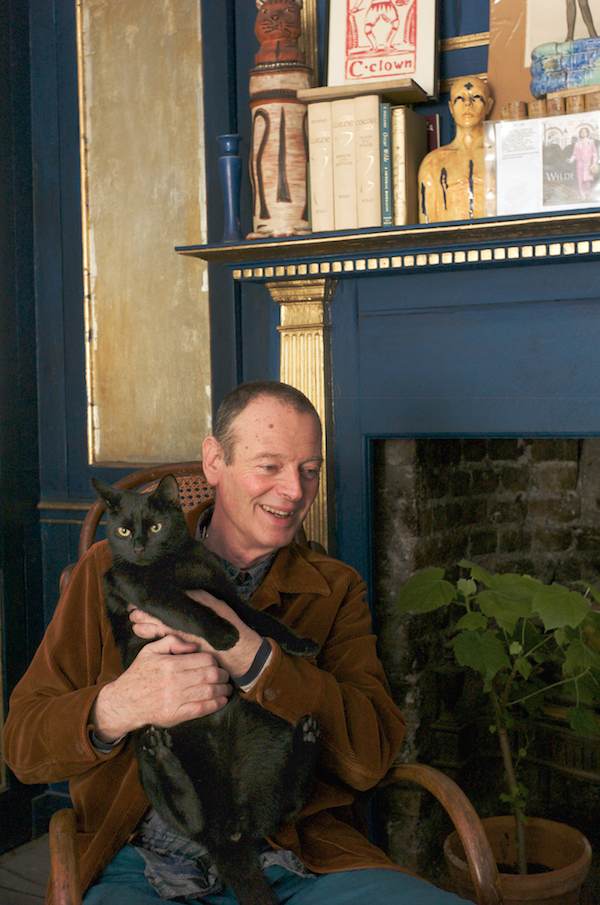
Fitzroy & Rodney Archer
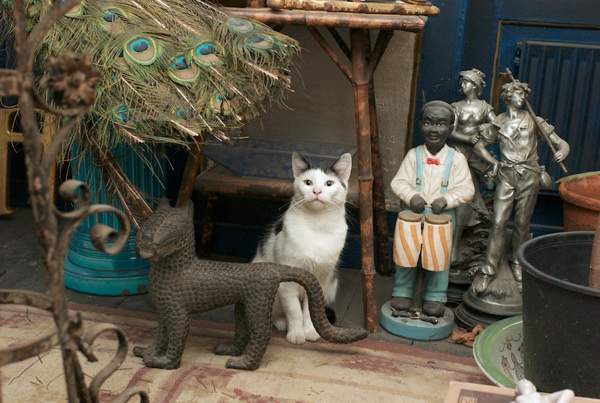
Earl & Fitzroy & Rodney Archer
“I was mourning my last cat for two years and I didnʼt want another cat. But then mice moved into the guest rooms upstairs, so I went to a cat rescue place just before Christmas last year. It was like an adoption agency – I had to be interviewed but there was no problem because Iʼve kept cats for forty years. They phoned me after a while and I had to explain that the cats were undergoing a personality change due to being renamed.
The black and white cat is Earl and the black cat is Fitzroy. Theyʼre named after good friends although one of them is allergic to cats. He does sometimes feed them when Iʼm away though. Because they werenʼt kittens, they came already formed but Iʼm beginning to love them although they do knock things off window ledges and I find vases on the floor. They get on pretty well together even though Earl tends to jump out at Fitzroy, and whereas Earl will sit on the bed, itʼs a huge honour if Fitzroy enters the room.”
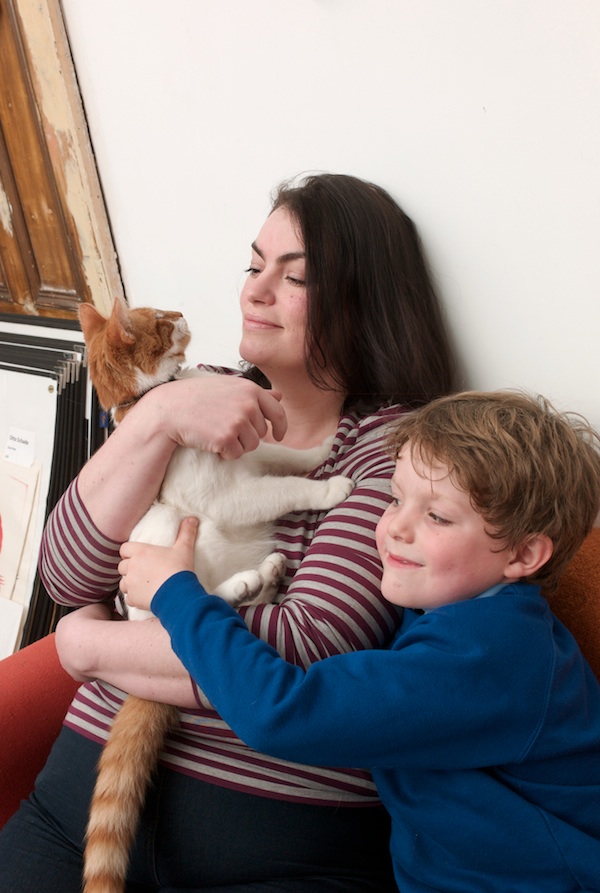
Sparkly & Melanie & Harvey Denyer
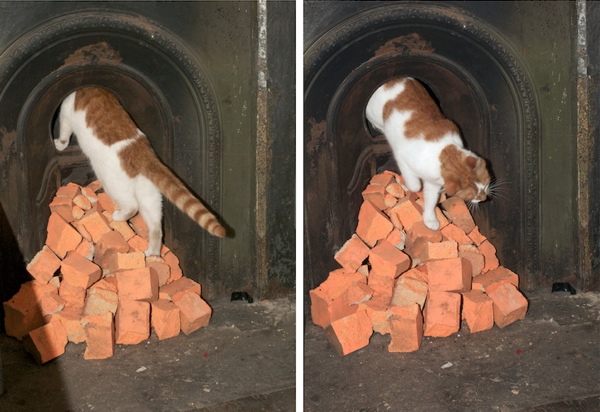
Sparkly is a curious cat
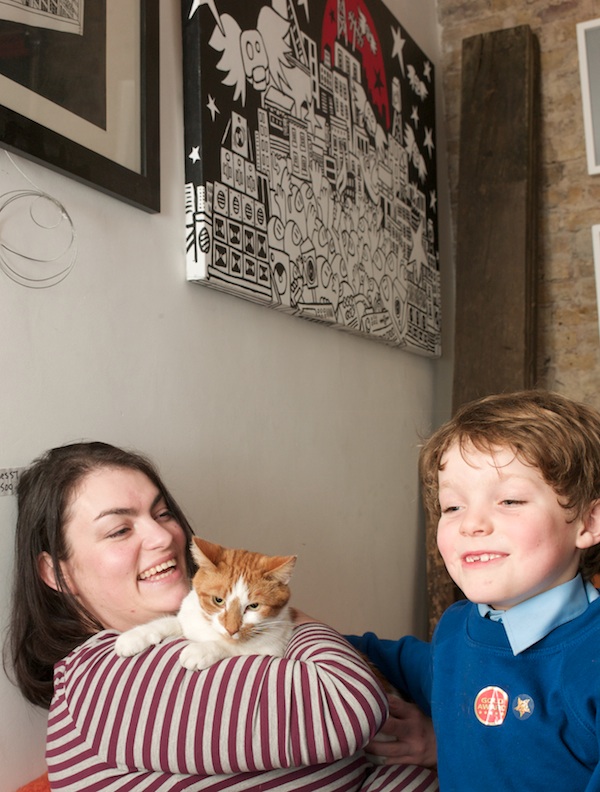
Sparkly & Melanie & Harvey Denyer
Melanie – “Sparkly came from Battersea Dogs & Cats Home three years ago. Sparkly is quite famous in the area and even before we had the cafe he was always known as The Rag Factory cat. (The Rag Factory on Heneage St is used for rehearsals, filming, classes and exhibitions)
Then he became well known in the cafe too. He liked to be with the customers, and children from the local school would stop and talk to him. Unfortunately, we had a visit from the environmental health people and heʼs banned from the cafe now.
Sparkly was twelve weeks old when he came and my son Harvey was only three, but Battersea are fantastic about matching cats with families. Sparkly was a lot more forgiving then he might have been.
Our worst experience with Sparkly was when he disappeared from The Rag Factory last November. He was missing for five months. We think he must have got into a builderʼs van. He was found in Essex and taken to the PDSA but when they examined him the vet didnʼt find his chip. Then a local shelter fostered him but before he was rehomed he was scanned again and they found the chip. When he came back, he behaved as though heʼd never been away though heʼs a bit more of a homebody now.”
Harvey – “Heʼs my cat really. I named him. We were going to call him Sparkle but I accidentally said Sparkly.”
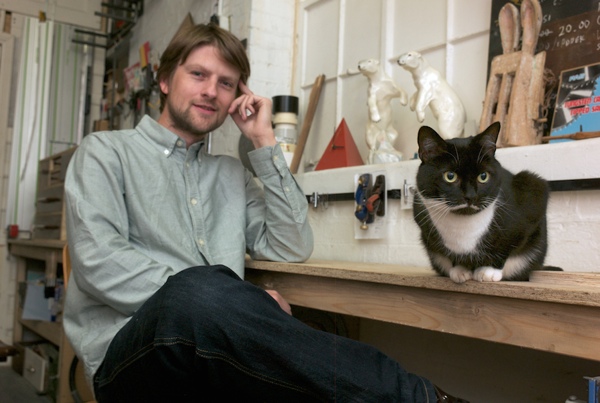
Carlos & Rupert Blanchard
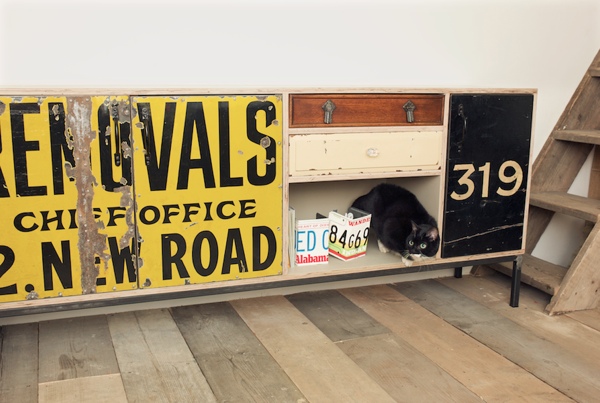
Carlos & a piece of Rupert’s furniture
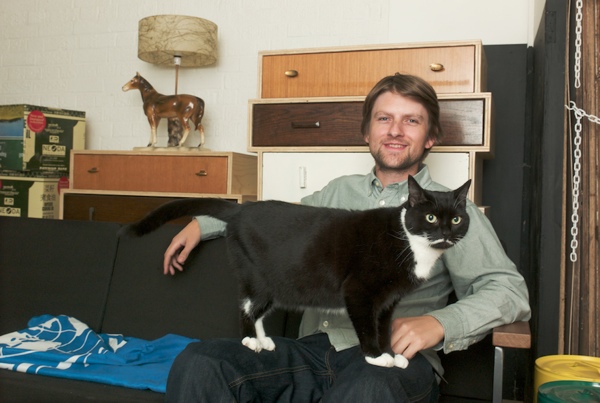
Carlos & Sofia & Rupert Blanchard & Polly Benfield
“Rupert Blanchard (cat person) met Polly Benford (dog person) in Swindon in 1999 and in 2003, they moved in together in Hackney.
The guys next door got a pair of cats to deal with mice, but moved to Mexico after having had the cats for only six months. Polly turned into a cat person because, she says, “Carlos is gentle and friendly like a dog” and we inherited the cats. The cats had been named Carlos and Sofia after King Juan Carlos and Queen Sofia of Spain. The first week we had Sofia and Carlos, they presented us with six mice. We havenʼt seen another one since, although one of the cats caught a moth recently.
They have a holiday once a year in the Wiltshire countryside with six other family cats. Just about everyone in the family has cats. Carlos always dominates.
We think they are brother and sister and are about eleven years old. Carlos is strong, healthy and very friendly but gets scared easily by the Hoover. He loves going out onto the rooftops. He also gets into every film and photo shoot possible. Sofia is always in and out of the vets, prefers life under the bed or on an Eames chair and is scared of new people. Both are much loved.”
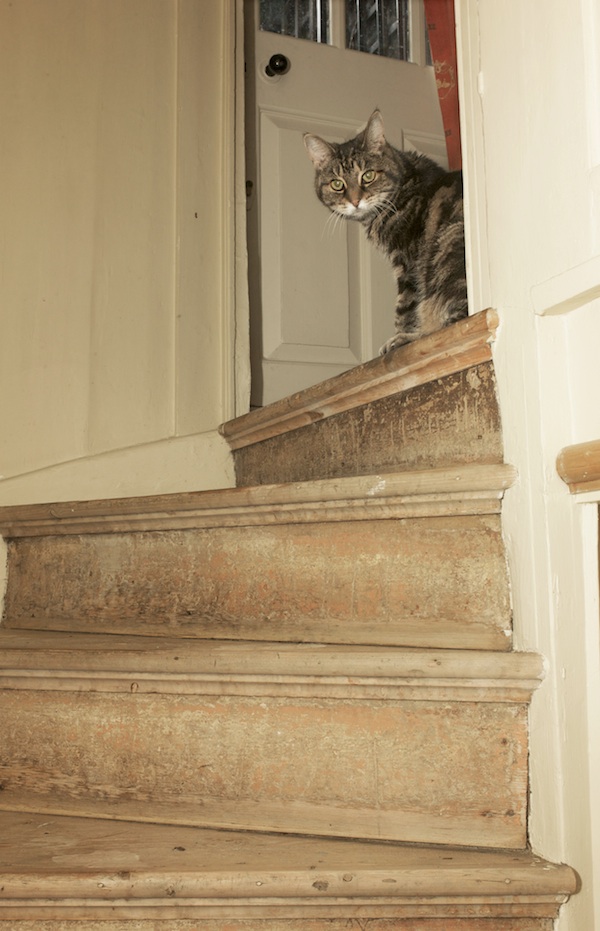
Theodora
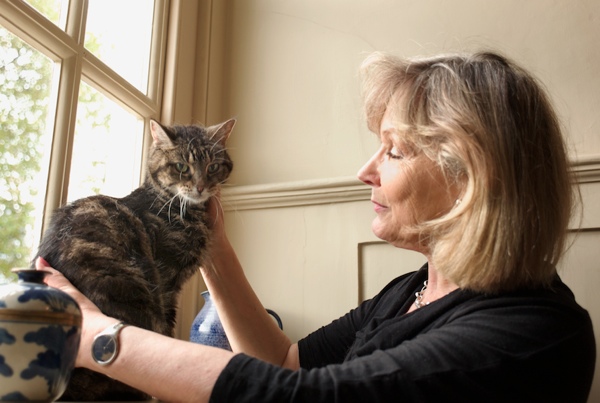
Theodora & Charlie de Wet
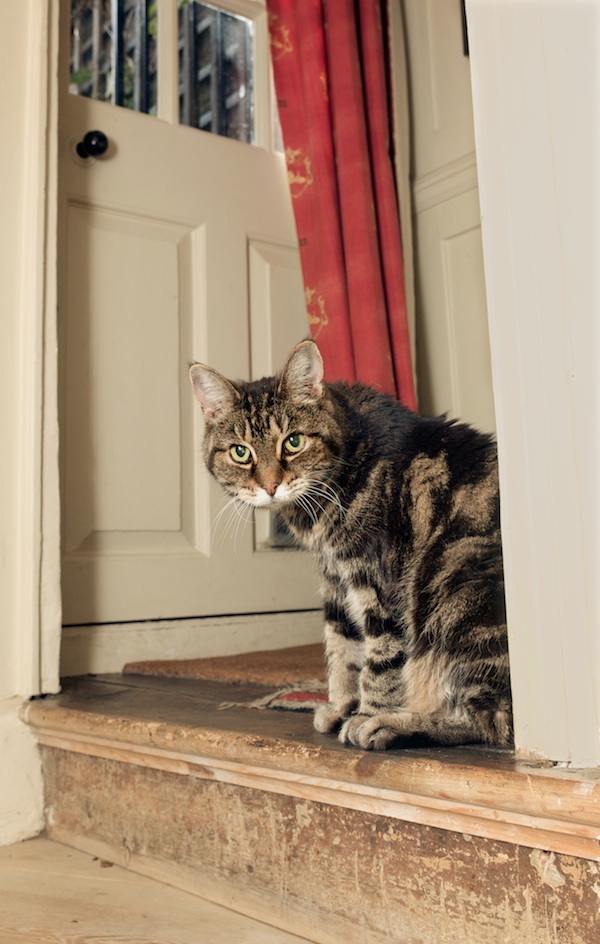
Theodora & Charlie de Wet
“Opera is my passion and Theodora is named after an opera. Maybe the next kitty will be called Aida, Nora or Maria Stuada!
Theodora, or “Dorable Dora” as she also is known, is my granny cat. She sleeps twenty-two hours of the day and night in front of the Aga dreaming. During the remaining two hours, always from 2.00am to 4.00am, she climbs three floors to tell me about these dreams. I get a swipe across my face to wake me up to listen. And then she plays like a kitten and relates every detail of her dreams. Aghhhh…but I love her dearly. When Theodora has told me everything she can remember she jumps off the bed and, if I am lucky, I get to sleep. If not, memories of all my furry family come flooding back – Puppy, Gorgeous Ginger Tom, Miss Gingerbits, Debbie & Greta, Dee Dee & Kennington. All were strays and some were in the most appalling condition, but they were all wonderful characters who shared and enhanced my life.
We were a five kitty household and Theodora is the last of that family. She and her sister Miss Fluff Bunny cost £5 each and came from Fiona Wheeler who, fourteen years ago, lived in Wilkes St. Mother Cat had several litters and so quite a few homes in the area have kitties who are related. Before Fitzroy and Earl moved in with Rodney Archer, he used to have a very fine cat called Horace who would drape himself around Rodneyʼs shoulders. He was a cousin of my girls and there must be many more of them …”

Bungy & Sammy Dobkin at Forest Reclaim
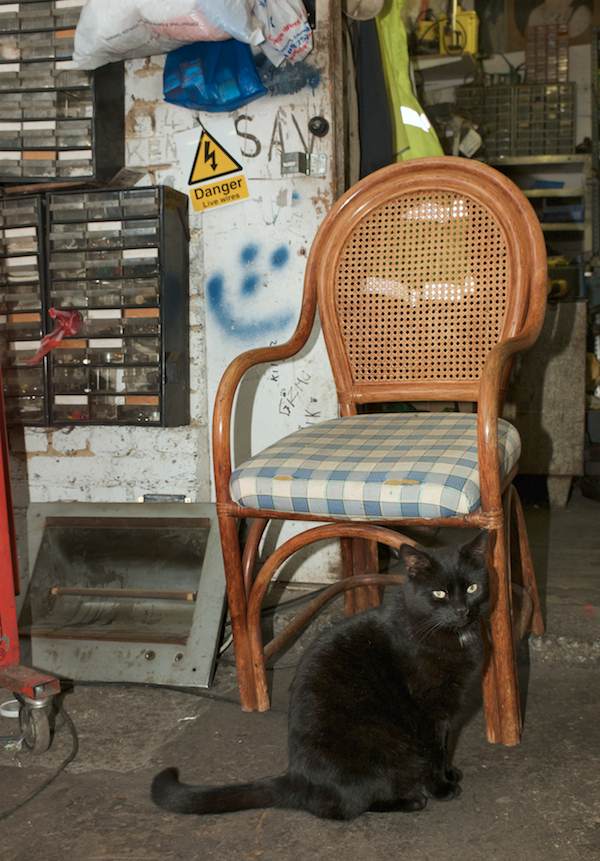
Shadow
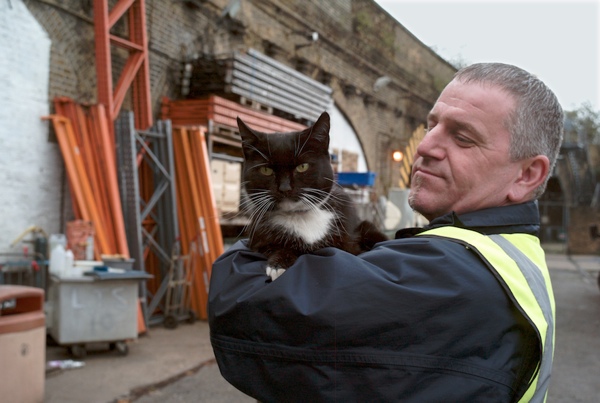
Bungy & Shadow & Sammy Dobkin at Forest Reclaim
“Iʼve worked here for a couple of years. Itʼs a family business and Daniel the owner is my cousin. Bungy, the black and white cat and Shadow, the black cat, live on the premises. Theyʼre both good mousers and Shadow loves a pigeon. I feed them both – Shadow prefers dry food and Bungy likes wet food.
Shadow turned up about a year and a half ago. He could be from anywhere because he tends to jump into strange vans. Someone put Bungy through the fence when he was just a kitten and heʼs been here for about eight or ten years.
Customers like them and people who are passing often stop and talk to them, but theyʼre spending a lot of time in front of the fire at the moment.”
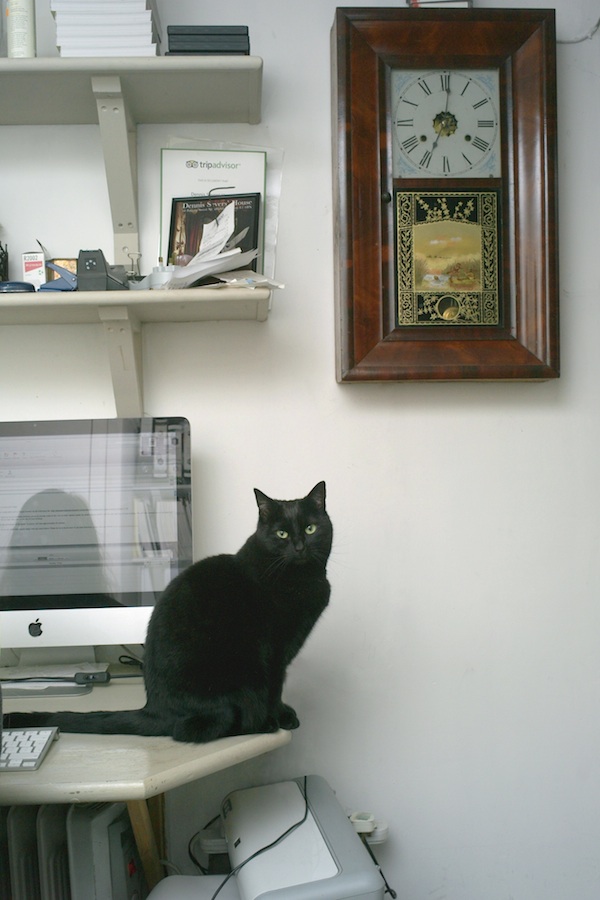
Madge in the office at Dennis Severs’ House

Madge & David Milne, Curator
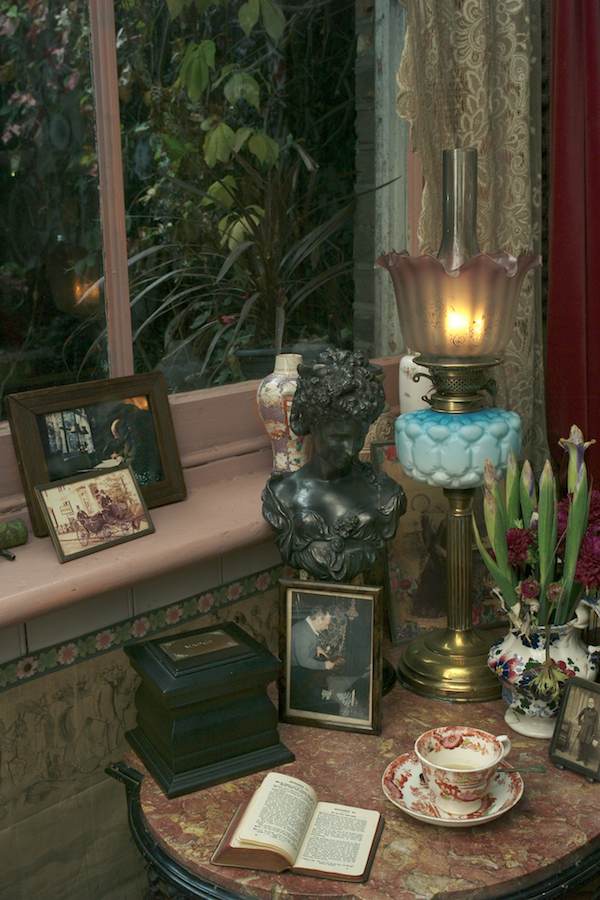
The ashes of Madge’s predecessor are in the urn.
Madge & David Milne, Curator at Dennis Severs’ House
“Thereʼs always been a cat here, and the last three have been called Madge. The first Madge was buried in the back yard in September 1991, and the ashes of the second cat are in an urn in the Victorian room beneath a portrait of Dennis Severs.
The current Madge came from a rescue place in Hackney. She was a bit frightened at first but she was only a baby, so we kept her in the office then slowly took her out into the rest of the house. Now she has secret places all over the house, including the attic. We donʼt know where she goes.
Sheʼs often around during visits. Unfortunately, some people think sheʼs a prop and give her a prod. Sheʼll respond with a miaow or a nip. She often sits in the same places and the same chairs that the previous cat liked.
She knows we put food out when the visitors come and she likes licking the butter off the toast. And sheʼs been known to tip over the eggs and eat the yolk.
She likes to be outside on the terrace in warm weather. She has friends too. She goes into Tedʼs house next door. I donʼt live here but Dennis and I were good mates and I always enjoyed the house before I became Curator.
My own cat is an Oriental Havana with emerald eyes. I was on a waiting list for two years for that particular colour and her breeders said, “If she doesnʼt like you, you canʼt have her.” Luckily when I brought her home she came out of her box, had a look round and went to sleep. Sheʼs very possessive and if there are other people in the flat sheʼll bring something to me so that I notice her.”
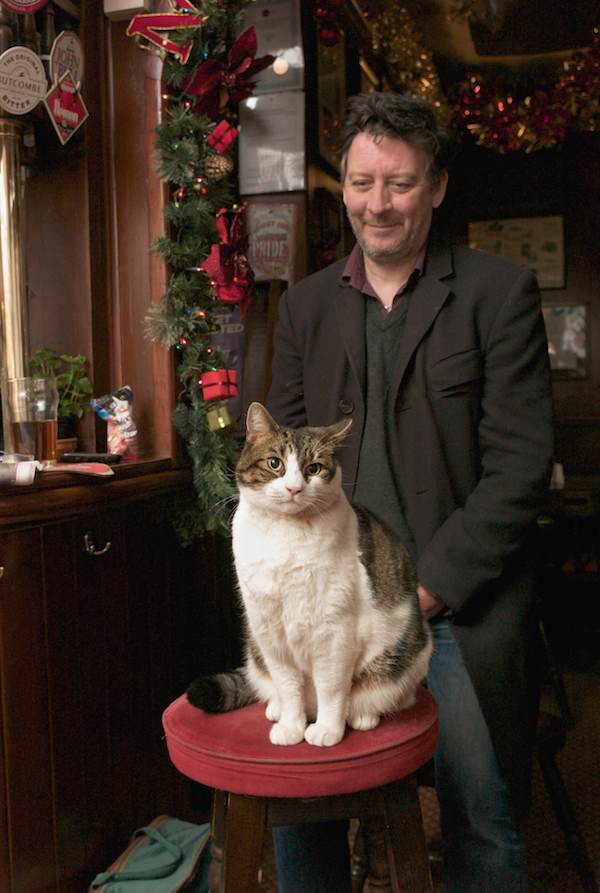
Lenny, pub cat at The Pride of Spitalfields, with admirer Dean Whatmuff.
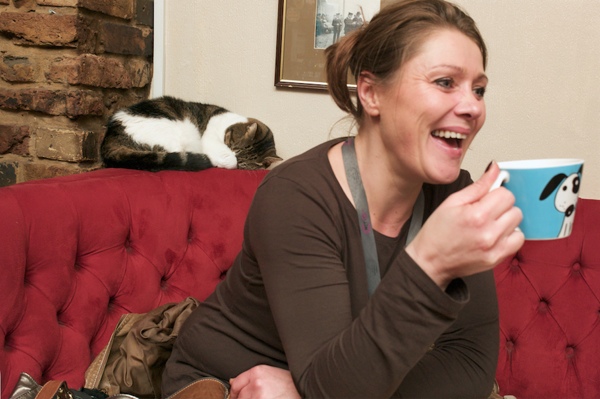
Lenny snuggles in a cosy corner.
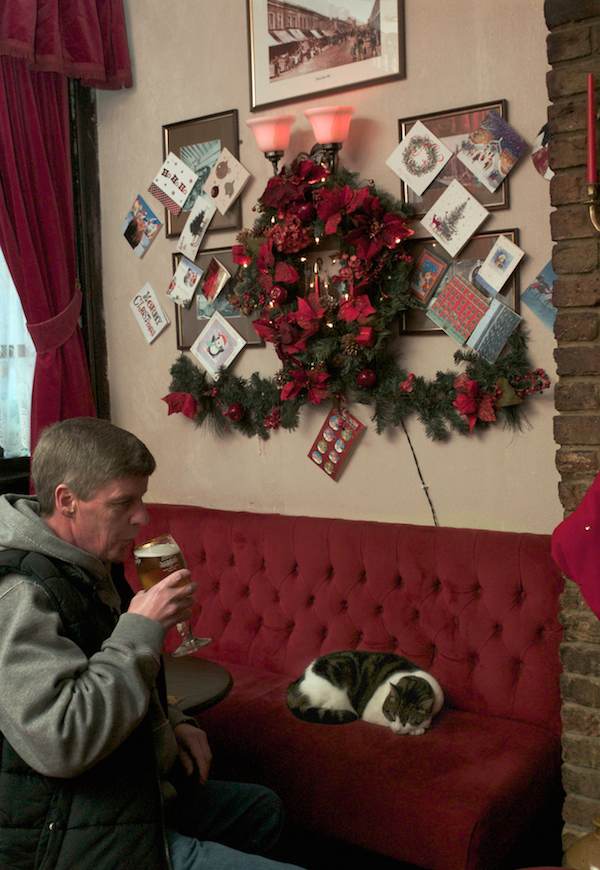
Lenny napping watched over by Terry Hutton.
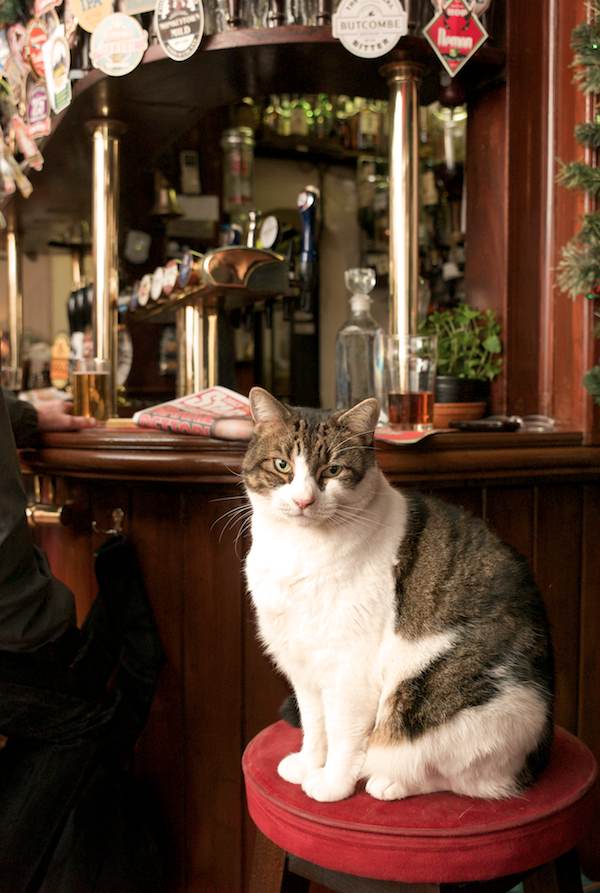
Lenny at The Pride of Spitalfields with Anne Butler, landlady & Terry Hutton & Dean Whatmuff, regulars.
Anne Butler – “Lenny is from a Liverpool refuge centre. He is nine years old and immediately took to being among the customers, but moving for no-one. He is very good with my other cat, Patch, although they fight a bit, he is always cleaning him and lets Patch get to his dinner first. He has a real good fan base and affection for all those who give him titbits.”
Terry Hutton – “Iʼve been coming here since I was fourteen. I like the atmosphere – and the cat. I was born in Spelman St and the old chicken market used to be nearby, so there were always a lot of stray cats and sometimes the cat lady used to feed them.”
Dean Whatmuff – “Iʼm from Yorkshire and Iʼve lived in Spitalfields since 1981. I went to the Slade in 1983 and my first studio was near here in the early eighties. Shoreditch was like a ghost town at night then and you had to come to the beigel shop to get something to eat. Iʼve been sketching the customers here for a while now. Itʼs part of a long term project and I hope theyʼll be displayed locally. I do some building work at the pub too and rehang the pictures occasionally. It doesnʼt change much. And Iʼm a DJ at the disco here every Monday at six. Itʼs called ‘mondayvinyl’ and weʼre the ‘one-deck-wonders.’”
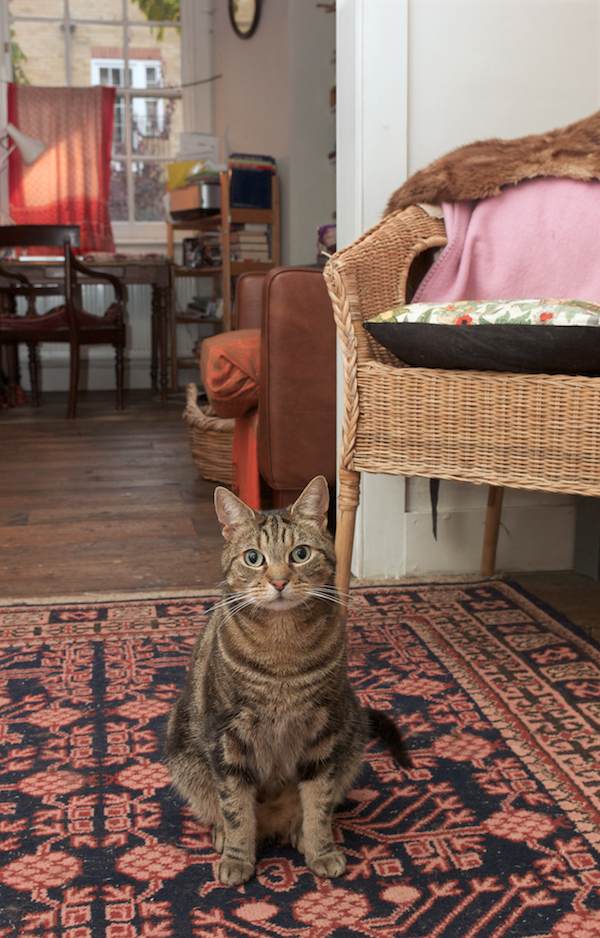
Battie
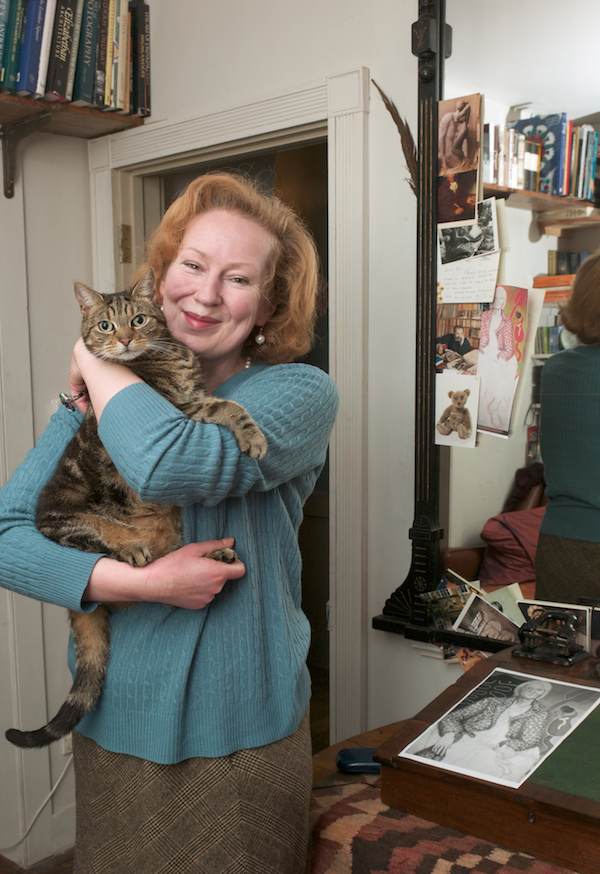
Battie with Philippa Stockley
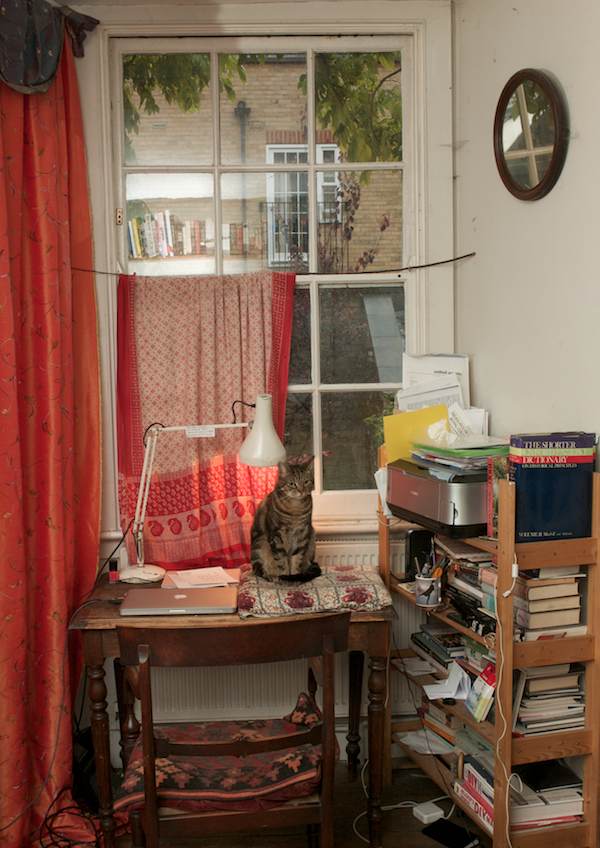
Battie & Philippa Stockley
“Battie is a rescue cat, heʼs half Bengal and half Fat Tabby. There was a pair of kittens and this little cat on its own in a box looking miserable. Suddenly, he jumped into my arms – and I gave him back because Iʼm heartless. So he walked round my legs and sprayed me like a tree. Iʼd been marked out as his.
He was frightened at first but now heʼs my constant companion. Heʼs nearly seven, heʼs always waiting when I come home and heʼs only happy if Iʼm within smelling distance. And heʼs a most beautiful jumper.”
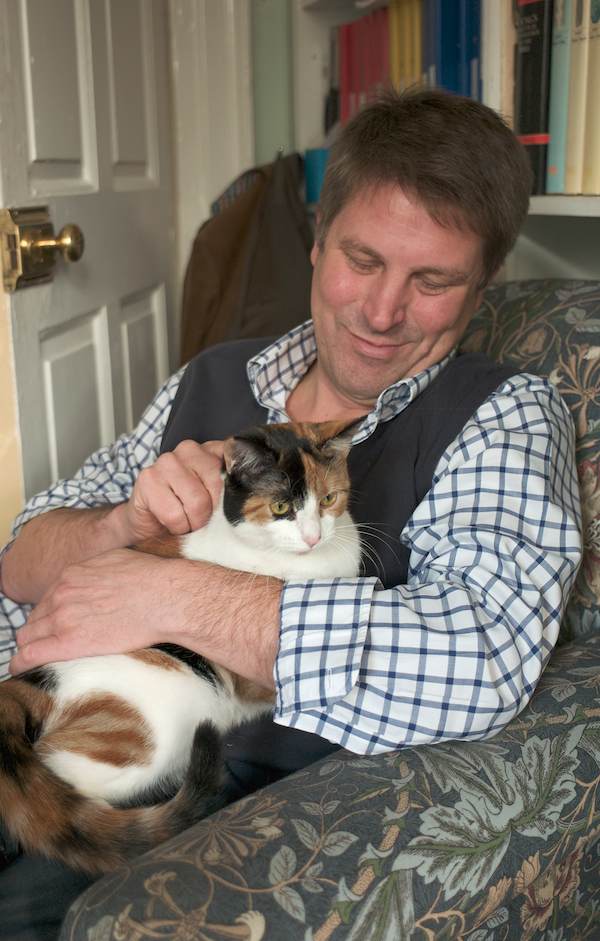
Ambrosia & Rev Andy Rider, Rector of Christ Church

Ambrosia & Rev Andy Rider, Rector of Christ Church, Spitalfields
“Weʼve only had Ambrosia for four and a half months. We wanted a tortoiseshell and her name had to begin with the letter A, so sheʼs named after my favourite pudding. Our golden retriever, Archie, is her role model. She definitely aspires to be a dog and she doesnʼt realise sheʼs quite small. Sheʼll make a dive and hang on to Archieʼs leg but, luckily, heʼs very tolerant.
I always say Iʼm not all that bothered about pets, but my wife would dispute that. Our first cats here came from Eric Elstob, who lived in Fournier St. He was one of the great champions of the restoration of Christ Church and, when he died in 2003, his house-keeper asked us to take on the two cats Julio & Antonio. Towards the end of their lives, we thought weʼd better have a new cat to take over mousing duties. So far no results from Ambrosia, but weʼre encouraged by some scurrying under kitchen cupboards.
The painting by Alison Neville, where Ambrosia is sitting, was part of an exhibition in the Rectory gallery. Itʼs a detail of St. Johnʼs, Smith Sq and the sale of that church paid for part of the rebuilding work at Christ Church.”
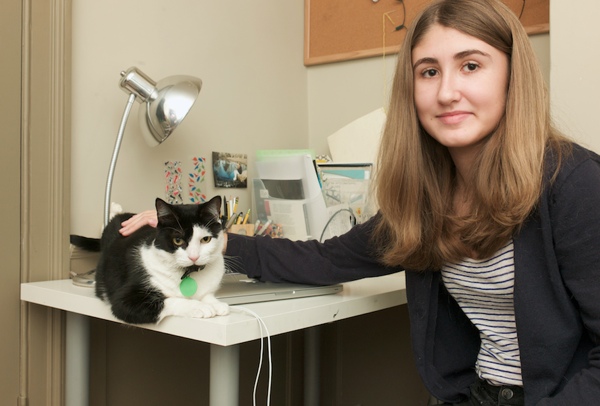
Mittens & Yasmin
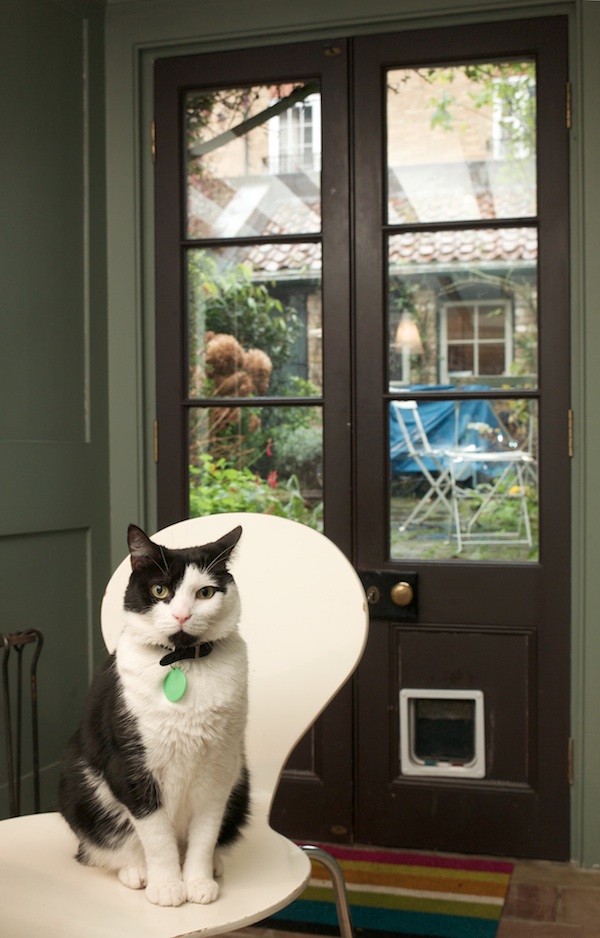
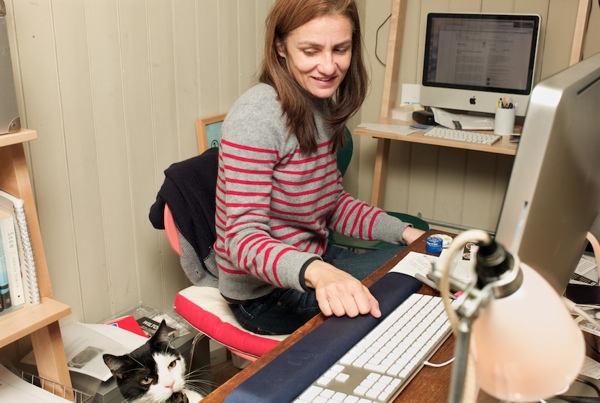
Mittens & Rosie Dastgir & her daughter Yasmin
“Mittens came from the 5th Ave Cat Clinic, Brooklyn. Sheʼd been in the window for a while with a sign saying CAT FOR SALE. My daughter Yasmin used to walk past the window and she really wanted this cat. When she saw the SOLD sign she was so disappointed. Luckily for her, Iʼd just bought the cat.
Bringing her back to this country was a complicated business – there were problems with the microchip (the vet put in an American chip instead of a European standard one), there were questions about the size of the crate, she was driven from Heathrow to Aldgate in a Defra endorsed van, and the whole operation cost a fortune.
But now sheʼs taken control of her territory better than she did in New York. There was an aggressive stray where we lived that used to fight with her. We named it Evil Kitty. So far, we find the London cats more friendly.”
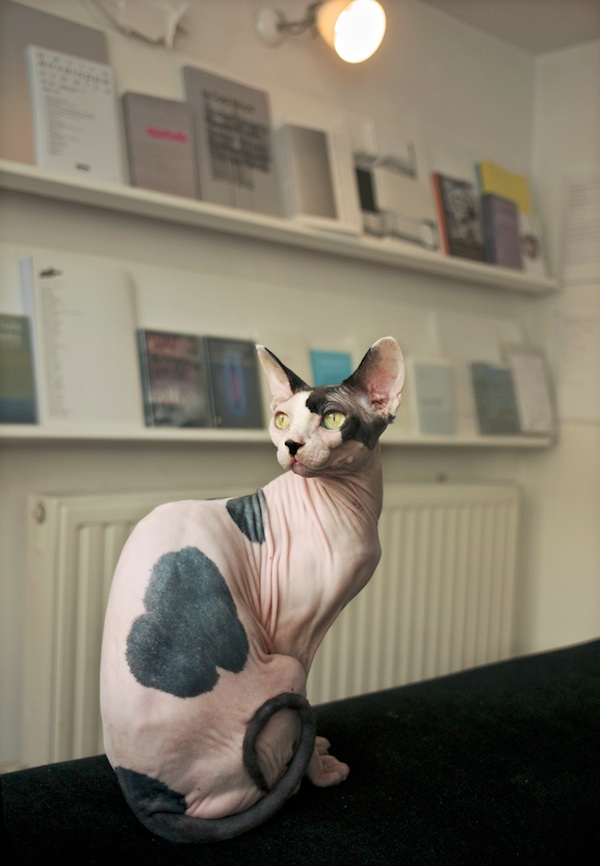
Sebastian
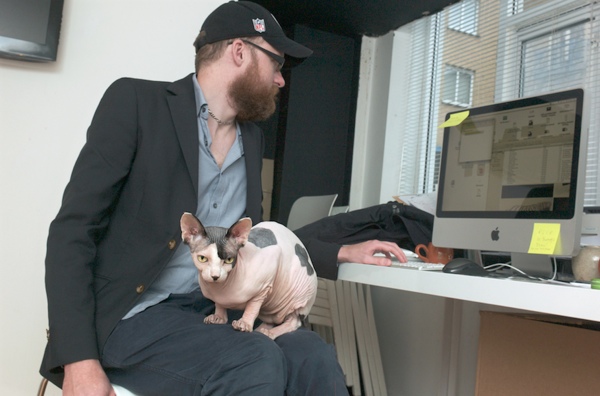
Sebastian & Mark
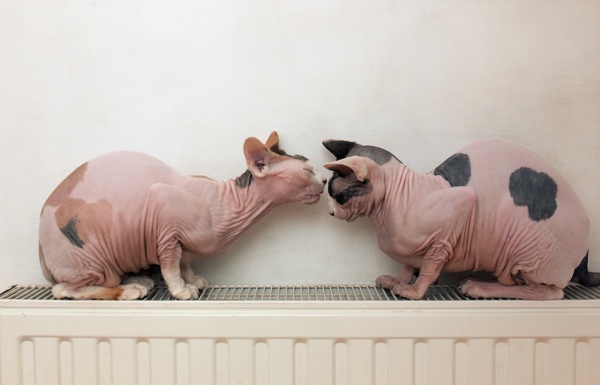
Sebastian & Cordelia & Lindsay Friend & Mark Jackson at IMT Gallery
“Sebastian & Cordelia are Sphinx cats. They are named after characters in Brideshead Revisited and theyʼve grown into their namesakes. Sebastian is a bit roguish and he eats anything he can find – he once tried to eat staples – whereas Cordelia is more sensible, she tells him off and looks after him a bit.
Iʼve always liked this breed. I saw a picture of them in a book once when I was a child and immediately wanted to have one. And theyʼre the friendliest of all breeds. Mark likes them because he studied axolotl salamanders in a biology class and he thinks their faces are similar.
They came from a north London breeder. We just wanted Sebastian, but at our interview Cordelia took a shine to Mark so then we had to have them both. Theyʼre brother and sister and they were three and a half years old in March. Theyʼre quite high maintenance, they have to be bathed once a week and have their ears and claws cleaned.
They live with us at the gallery, so thereʼs constant stimulation and they are always around when people come to the gallery. Our exhibitions are constantly changing and some of our artists produce particularly cat-friendly work. Sebastian & Cordelia joined in during a session of voice recording recently.
The little girl who lives opposite, who is about eight, likes to come and see the cats when theyʼre sitting on the window sill. They adore her and sheʼs transfixed by them. We once overheard her telling her friend, ‘These are my cats. Well, theyʼre not actually my cats but they love me.’ She has two cats of her own now but she still comes to see Sebastian & Cordelia.”
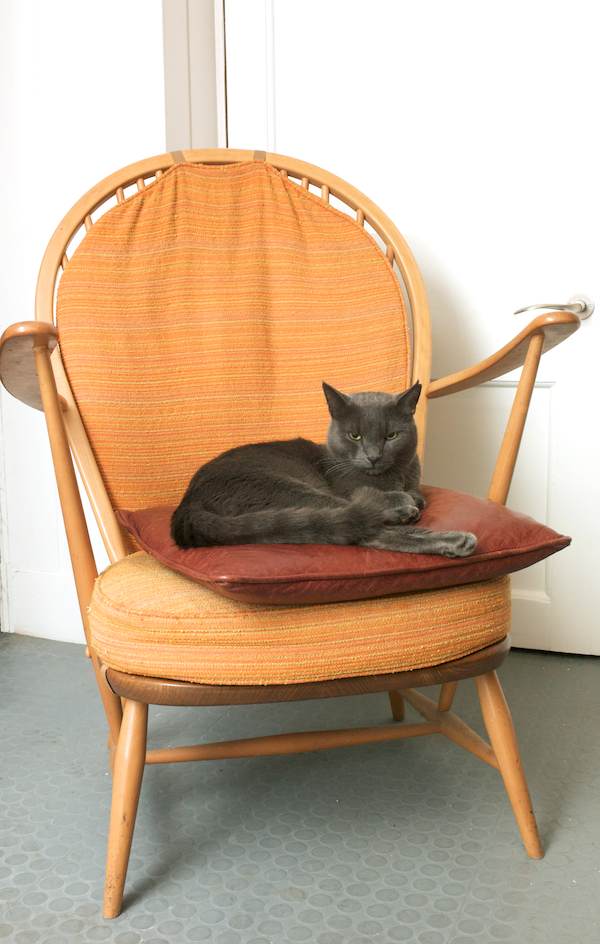
Truman
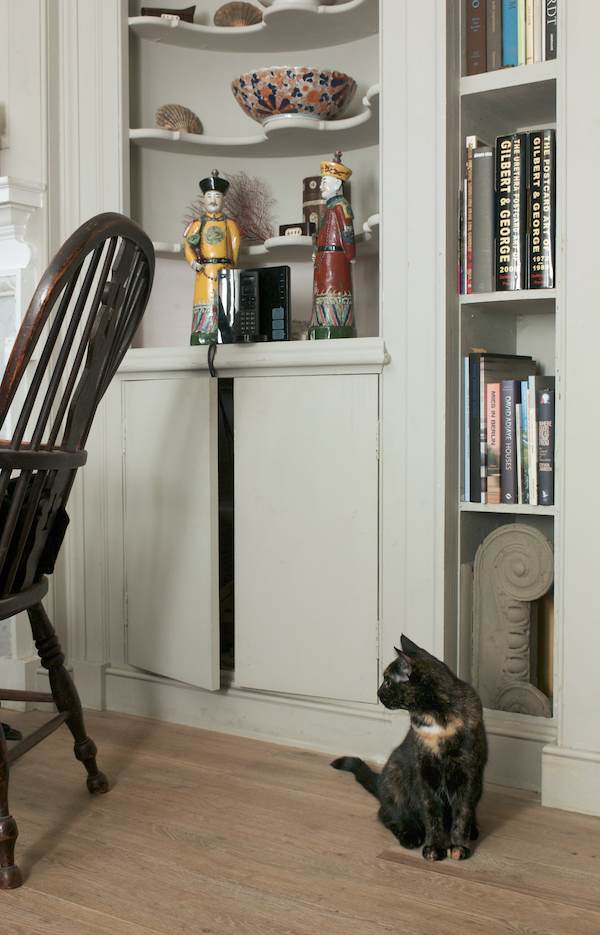
Stella
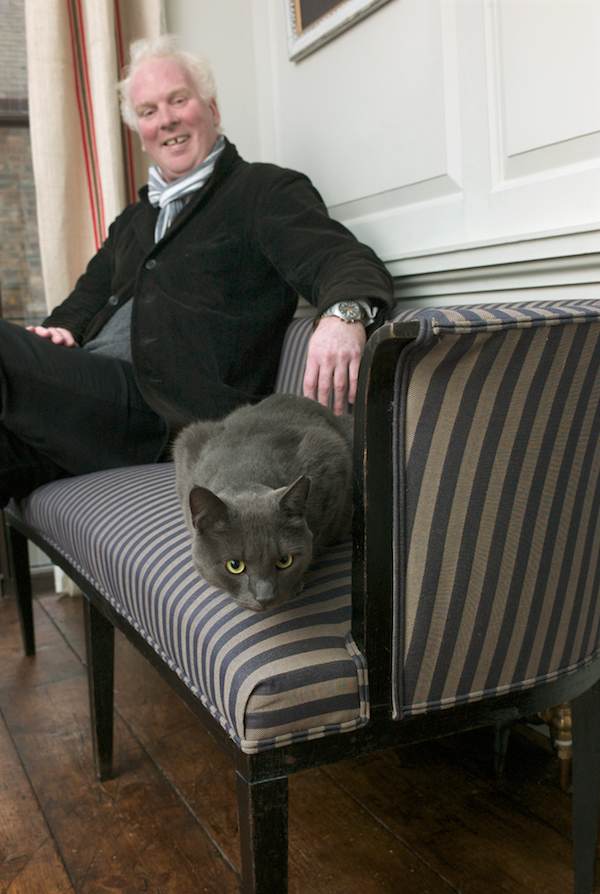
Truman & Stella & Chris Dyson
“Truman came from a Mare St pet shop. His father is a Russian Blue and his mother a Norwegian Long Hair. We bought him as a kitten in 2009 and our other cat, Stella, came six months later. We found her very pregnant mother on the doorstep of Number Eleven and took her to Samantha Morton who lives nearby because we knew she looked after cats. So when the cat produced her litter the very next day, we felt obliged to have one of the kittens. And Truman was going slightly nutty on his own – these cats love company, they always want to join the party.
You never know with cats how the chemistry will work. Stella is basically a street cat, sheʼs a mixture of ginger tabby and tortoiseshell and sheʼs always been very nervous. The two of them get on reasonably well although Truman picks on her if he gets bored. But she fights back and now heʼs got a bit of ear missing, so heʼs more careful.
Theyʼve both fallen from the parapet of the gallery. Truman used to run around on the rooftops and, one wet day, he fell off. Fortunately, he landed on all fours but his chin was bruised. He never did it again. Stella has done the same too, so theyʼve both fallen three storeys to solid ground and are still standing.
Truman sometimes disappears for a few days but we know he calls on friends. He likes the girls in offices nearby who feed him titbits and someone else said recently, ‘Your cat calls on me on Thursday afternoons.'”
Photographs copyright © Chris Kelly
Chris Kelly’s THE NECESSARY CAT – A PHOTOGRAPHER’S MEMOIR is available from many independent bookshops including Brick Lane Books, Broadway Books & Newham Bookshop.
You may also like to read about
and take a look at these other pictures by Chris Kelly
Chris Kelly’s Columbia School Portraits 1996
Chris Kelly’s Cable St Gardeners
Neville Turner of Elder St
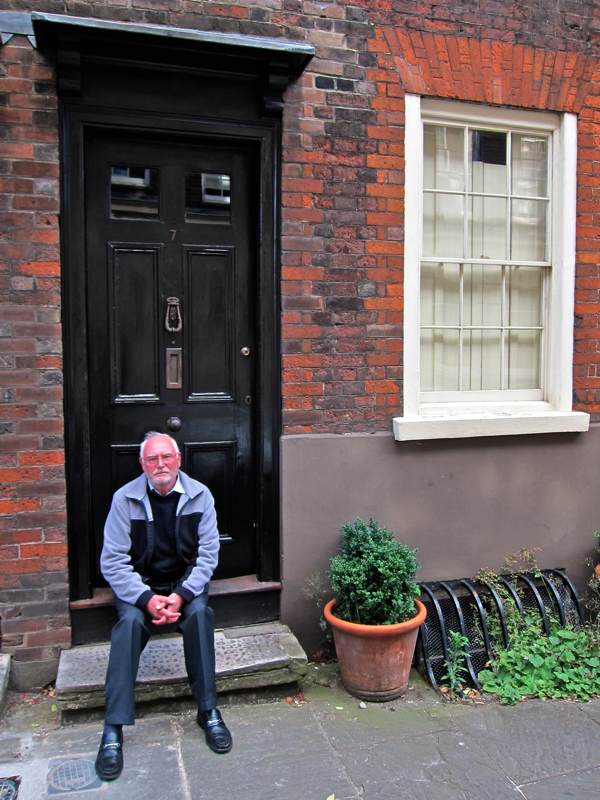
This is Neville Turner sitting on the step of number seven Elder St, just as he used to when he was growing up in this house in the nineteen forties and fifties. Once upon a time, young Neville carved his name upon a brick on the left hand side of the door, but that has been removed and replaced now that these are prized houses of historic importance.
When Neville lived here, the landlords did no maintenance and the building was dilapidated. But Neville’s Uncle Arthur wallpapered the living room with attractive wisteria wallpaper, which became the background to the happy family life they all enjoyed, in the midst of the close-knit community in Elder St during the war and afterwards. Subsequently, the same wisteria wallpaper appeared as a symbol of decay, hanging off the wall, in photographs taken to illustrate the dereliction of Elder St when members of the Spitalfields Trust squatted it to save the eighteenth century houses from demolition.
It was only when an artist appeared – one Sunday morning in Neville’s childhood – sketching the pair of weaver’s houses at number five and seven, that Neville became aware that he was growing up in a dwelling of historic importance. Yet to this day, Neville protests he carries no sentiment about old houses. “This affection for the Dickensian past is no substitute for hot and cold running water,” he admitted to me frankly, explaining that the family had to go the bathhouse in Goulston St each week when he lived in Elder St.
However, in spite of his declaration, it soon became apparent that this building retains a deep personal significance for Neville on account of the emotional history it contains, as he revealed to me when he returned to Spitalfields this week.
“My parents moved from Lambeth into number seven Elder St in 1931 and lived there until they were rehoused in 1974. The roof leaked and the landlords let these houses fall into disrepair, I think they wanted the plots for redevelopment. But then, after my parents were rehoused in Bethnal Green, the Spitalfields Trust took them over in 1977.
I was born in 1939 just before the war began and my mother called me Neville after Neville Chamberlain, who she saw as the bringer of peace. I got a lot of stick for that at school. I had two elder brothers, Terry born in 1932 and Douglas born in 1936. My father was a firefighter and consequently we saw a lot of him. I felt quite well off, I never felt deprived. In the house, there was a total of six rooms plus a basement and an outside basement, and we lived in four rooms on the ground floor and on the first floor, and there was a docker and his wife who lived up on the top floor.
My earliest memory is of the basements of Elder St being reinforced as air raid shelters in case the buildings collapsed – and of going down there when the sirens sounded. Even people passing in the street took shelter there. Pedlars and knife-grinders, they would bang on the door and come on down to the basement. That was normal, we were all part and parcel of the same lot. I recall the searchlights, I found it interesting and I wondered what all the excitement was about. War seemed quite mad to me and, when it ended, I remember the street party with bonfires at each end of the street and everybody overjoyed, but I couldn’t understand why they were all so happy. None of the houses in Elder St were damaged.
We used to play out in the street, games like Hopscotch and Tin Can Copper. All the houses had a door where you could go up onto the roof and it was normal for people in the terrace to walk along the roof, visiting each other. You’d be sitting in your living room and there’d be a knock on the window from above, and it was your neighbours coming down the stairs. As children, we used to go wandering in the City of London, and I remember seeing typists typing and thinking that they did not actually make anything and wondering, ‘Who makes the cornflakes?’ Across Commercial St, it was all manufacturing, clothing, leather and some shoemaking – quite a contrast.
After the war, my father worked as a bookie’s runner in the Spitalfields Market, where the porters and traders were keen gamblers, and he operated from the Starting Price Office in Brushfield St. He never got up before ten but he worked late. They were not allowed to function legally and the police would often take them in for a charge – the betting slips had to be hidden if the police came round. At some parts of the year, we were well off but other parts were call the ‘Kipper Season’ which was when the horse-racing stopped and the show-jumping began, then we had very little. I knew this because my pocket money vanished.
I joined the Vallance Youth Club in Chicksand St run by Mickey Davis. He was only four foot tall but he was quite a strong character. He was attacked a few times in the street on account of being short and a few of us used to call up to his flat above the Fruit & Wool Exchange, so that he could walk with us to the club, but then he got ill and died. Tom Darby and Ashel Collis took over running the club, one was a silversmith and the other was a passer in the tailoring trade. We did boxing, table tennis and football, and they took us camping to Abridge in Essex. We got a bus all the way there and it only cost sixpence.
I moved on to the Brady Club in Hanbury St – it changed my outlook on life. They had a music society, a chess society, a drama society and we used to go to stay at Skeate House in Surrey at weekends. If you signed up to pay five shillings a week, you could go on a trip to Switzerland for £15. Yogi Mayer was the club captain. He called me in and said, ‘This is a private chat. We are asking every boy – If you can’t manage the £15, we will make up the shortfall. But this is between you and I, nobody else will know. I believe that everybody in the East End should be able to have an overseas holiday each year.’ It endeared him to me and made a big impression. When I woke in Switzerland, the sight of the lakes and the mountains was such a contrast to Elder St, and when we came back from our fortnight away I got very down – depressed, you would say now. I was the only non-Jewish person in the Brady Club, only I didn’t realise it. On one of the weekends at Skeate House, I did the washing up and dried it with the yellow towel on a Saturday. But Yogi Mayer said, ‘I won’t tell anyone.’
A friend of my brother’s worked in Savile Row and I thought it would be good for me too. I went to French & Stanley just behind Savile Row and they said they did need somebody but not just yet. So then I went to G.Ward & Co and asked if they wanted anybody, and there was this colonel type and he said, ‘Start tomorrow!’ I was fifteen and a bit, I had left school that Christmas-time. It lasted a couple of years and they were good to me. The cutter would give you the roll of work to be made up and say, ‘It’s for a friend of yours, Hugh Gaitskell.’ When I asked the manager what this meant, he said, ‘We’re Labour and they’re not.’
In 1964, I left Elder St for good, when I got married. I met my wife Margaret at work, she was the machinist and I was the cutter. She used to bring in Greek food and I liked it, and she said, ‘Would you like to come and have it where I live? You’ll have no excuse for forgetting the address because it’s Neville Rd!’
When I started in tailoring, the rateable value of the houses in Elder St was low because of the sitting tenants and low rents, and nobody ever moved. We thought it was good, it was a kind of security. The money people had they spent on decorating and, in my memory, it was always warm and brightly decorated. There was a good sense of well-being, that did seem generally to be the case. We were offered to buy both the houses, five and seven Elder St, for eighteen hundred quid but my father refused because we didn’t want them both.”

Neville with his grandmother.
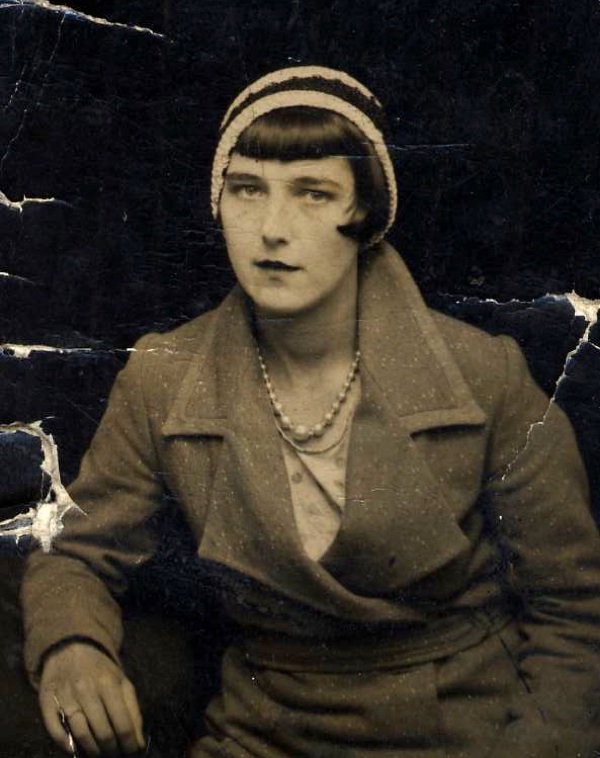
Neville’s mother Ada Sims.

Neville’s father Charles Turner was in the fire service during the war (fourth from left in back row).
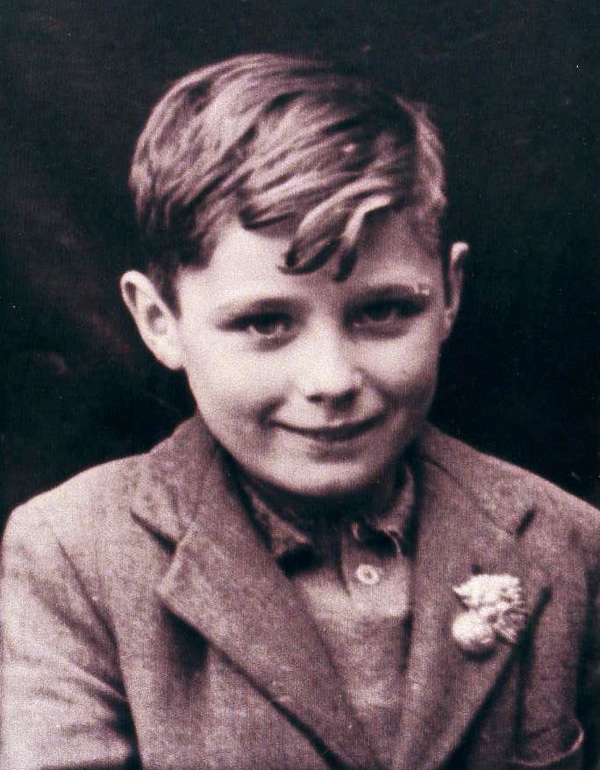
Neville as a schoolboy.
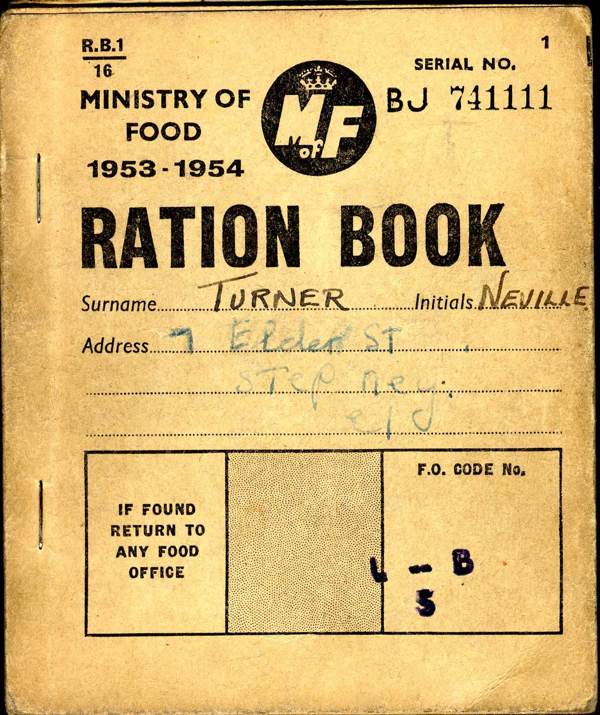
Neville’s ration book.
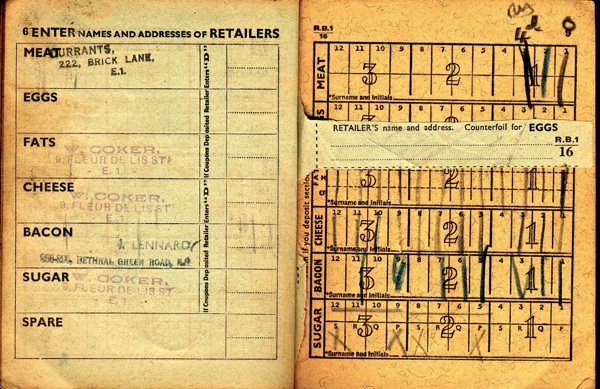
Coker’s Dairy in Fleur de Lis St used to take care of their regular customers – “If you were loyal to them, they’d give you an extra piece of cheese under the counter.”
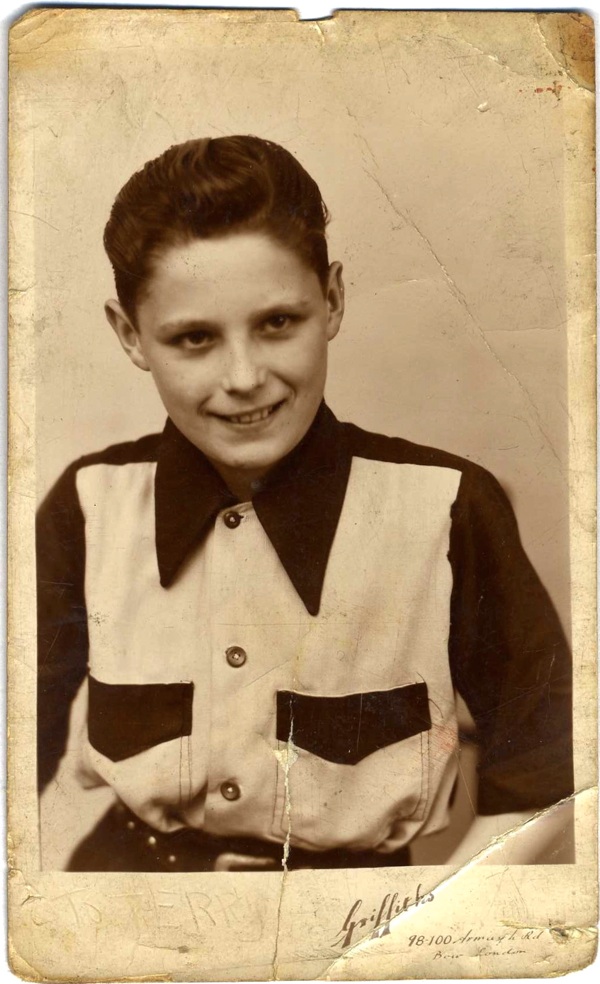
Neville aged eleven in 1951, photographed by Griffiths of Bethnal Green.

Neville at Saville Row when he began his career as a pattern cutter at sixteen.

Neville’s friend Aubrey Silkoff, photographed when they hitched to Amsterdam in 1961.
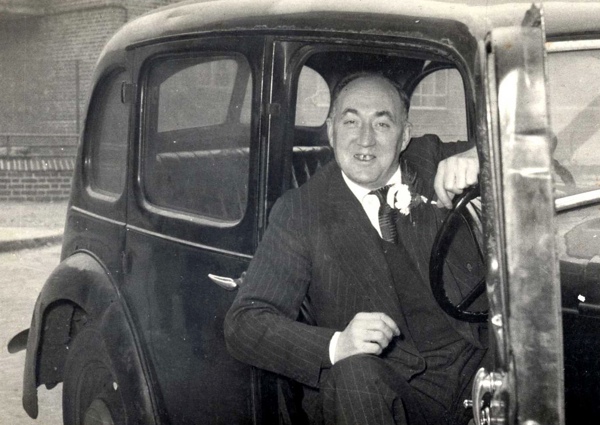
Neville’s father Charles owned the only car in Elder St – “We had a car in Elder St when nobody had a car in Elder St, but it vanished when we had no money.”
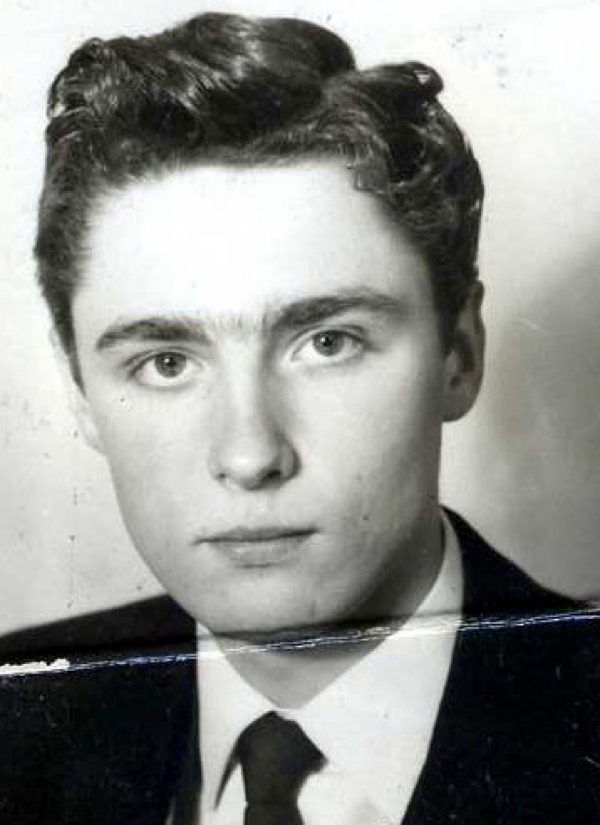
Neville as a young man.
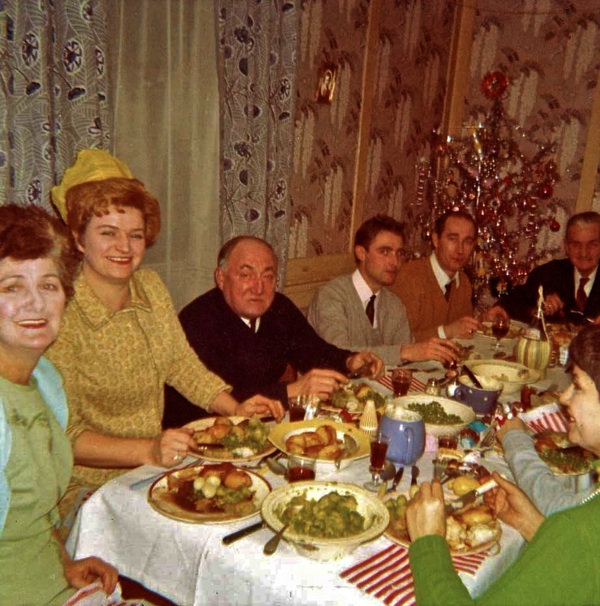
A family Christmas in Elder St, 1968 – Neville sits next to his father at the dinner table.
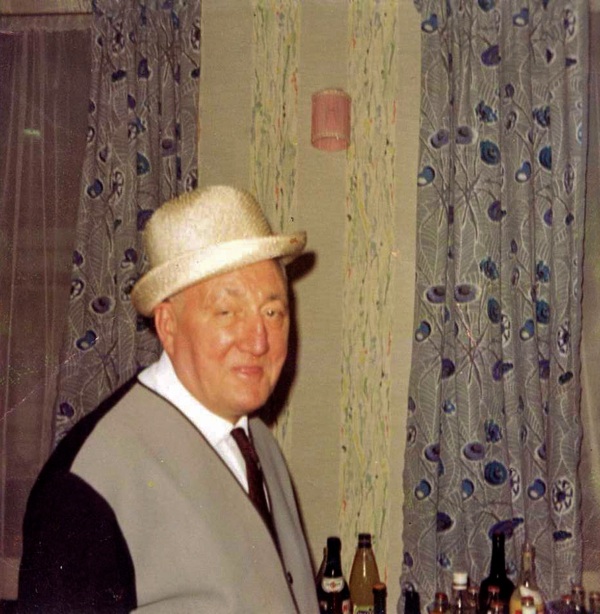
Neville’s father, Charles.
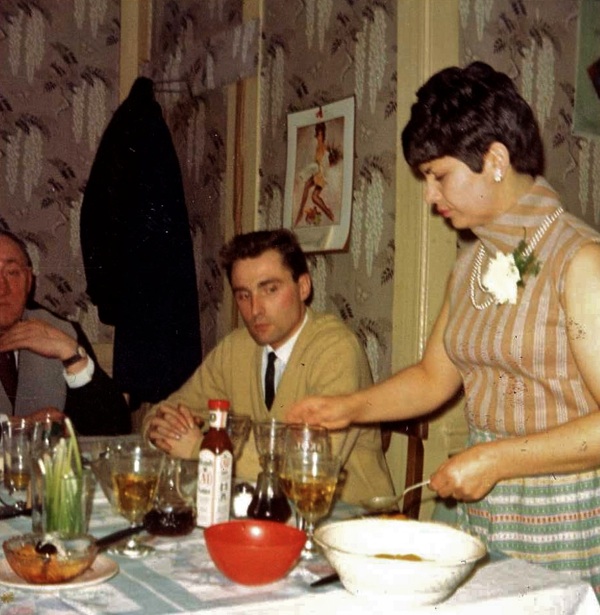
Neville and Margaret.
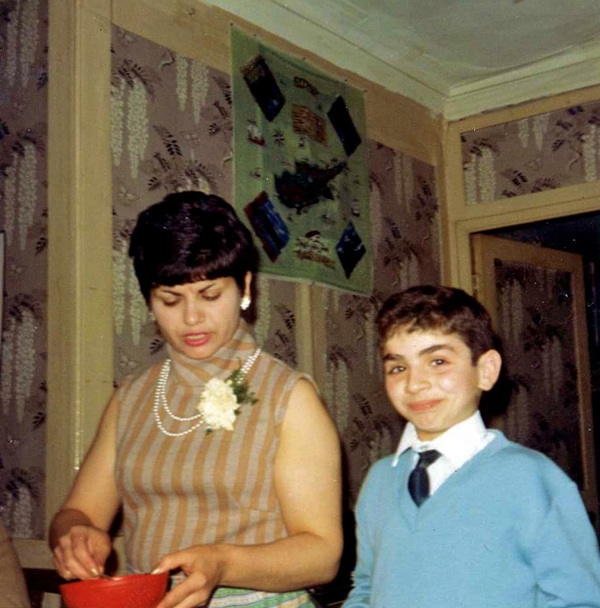
Margaret and Minas.
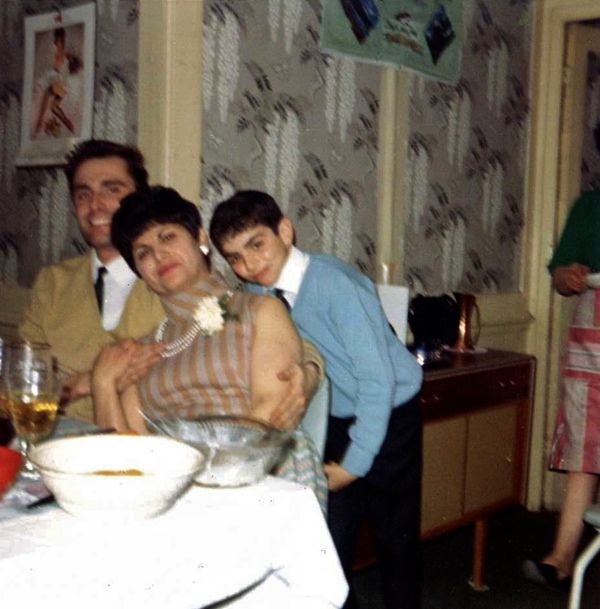
Neville, Margaret and their son Minas.
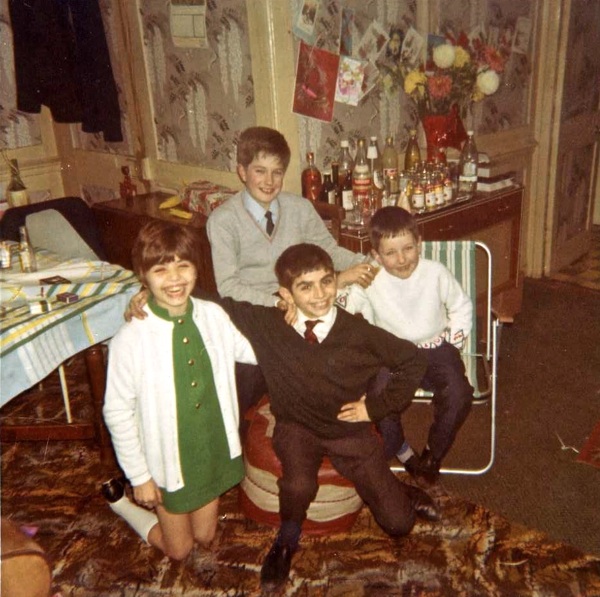
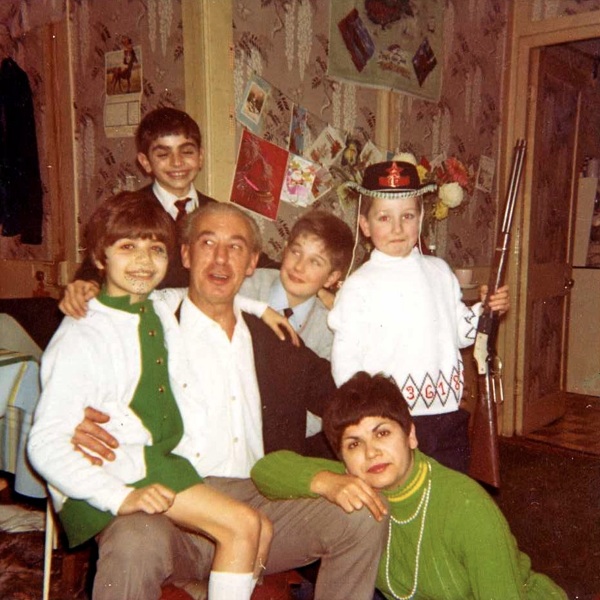
Neville’s Uncle Arthur who hung the wisteria wallpaper.
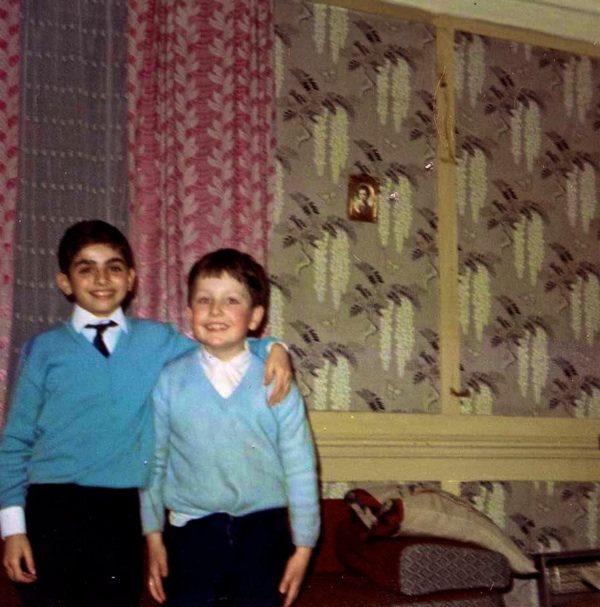
Minas and Terry.

The living room of number seven photographed by the Spitalfields Trust in 1977 with Uncle Arthur’s wisteria wallpaper hanging off the walls.

Dan Cruickshank and others staged a sit-in at number seven to save the house from demolition in 1977.
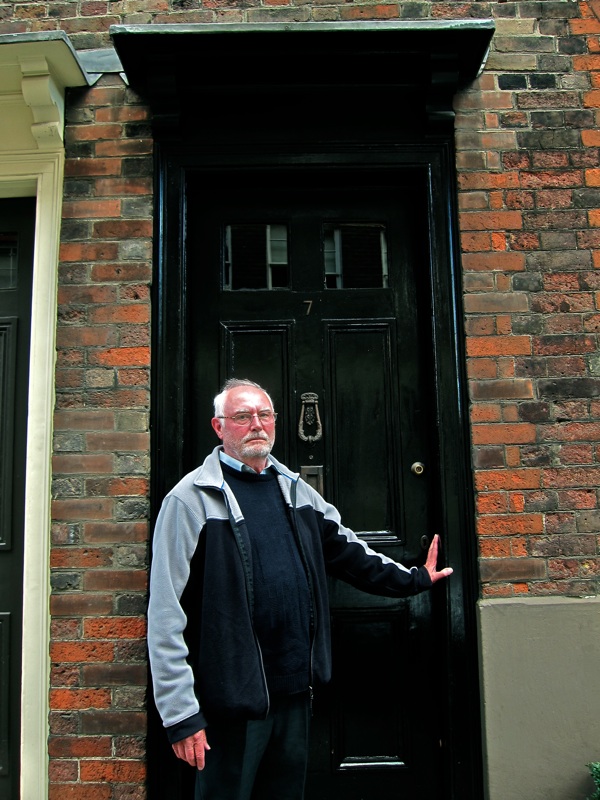
Neville Turner outside number seven Elder St where he grew up.
You may also like to read about Neville’s childhood friend
Eleanor Crow’s East End Cafes
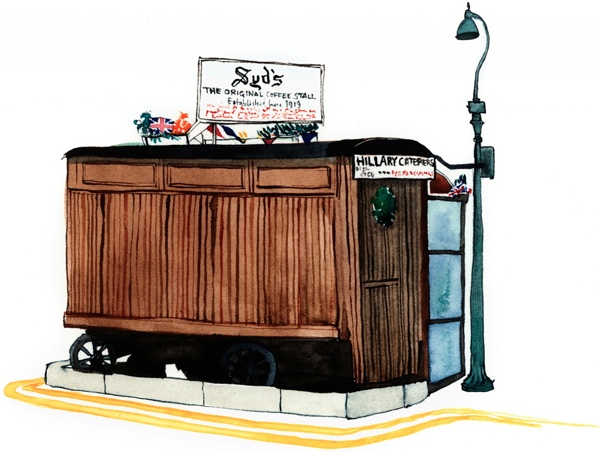
Syd’s Coffee Stall, Shoreditch High St
Illustrator Eleanor Crow made this set of watercolour portraits of cafes as a tribute to those cherished institutions which incarnate the essence of civility in the East End. “It’s because they’re individual concerns, often owned by families across generations who get to know all their customers,” admitted Eleanor, revealing the source of her devotion to cafe culture ,“I like the frontages because each is designed uniquely for that café with wonderful sign-writing or lettering and eye-catching colours. Some of these cafés have been here for a very long time and everyone in the area is familiar with them, and is very fond of them. They make the streets into a better place and are landmarks upon the landscape of the East End.”
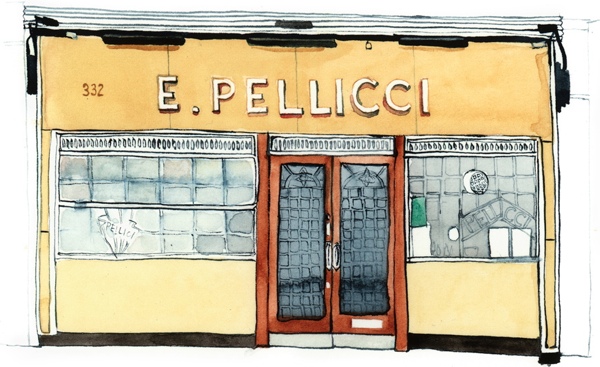
E. Pellicci, Bethnal Green Rd
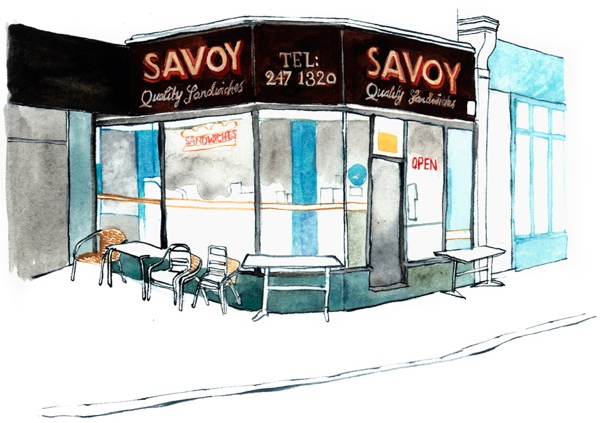
Savoy, Norton Folgate
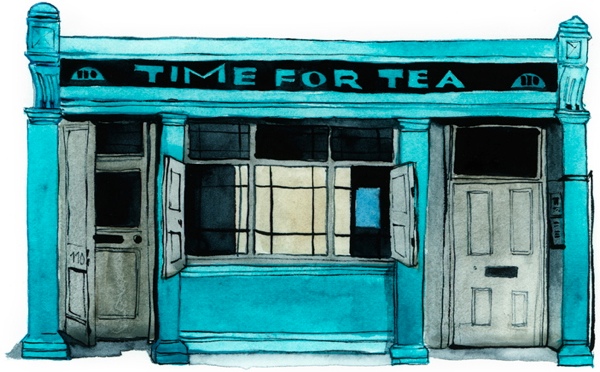
Time for Tea, Shoreditch High St
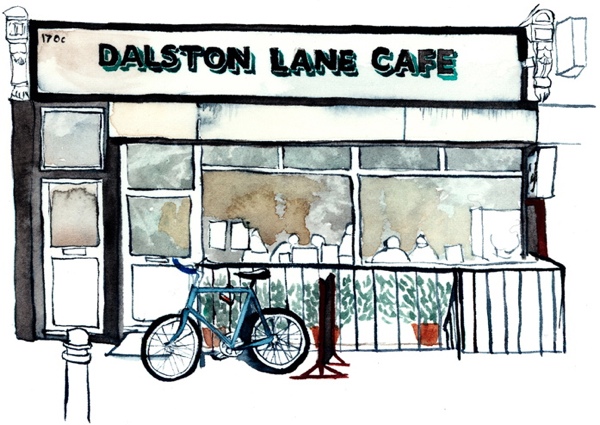
Dalston Lane Cafe
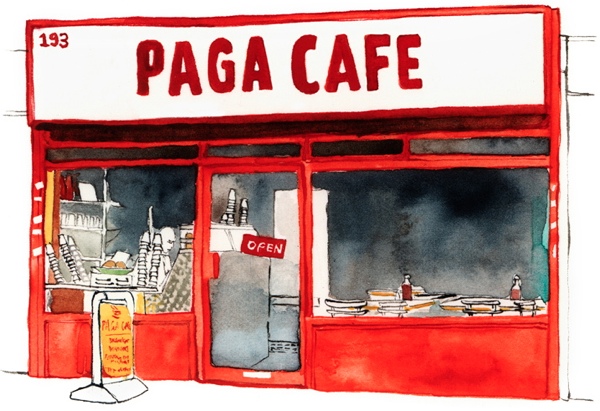
Paga Cafe, Lea Bridge Rd
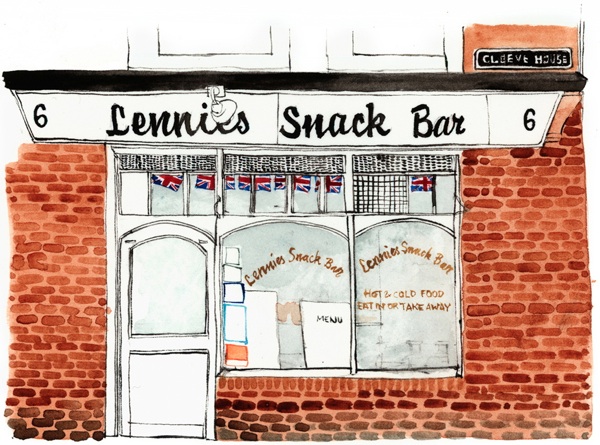
Lennies Snack Bar, Calvert Avenue
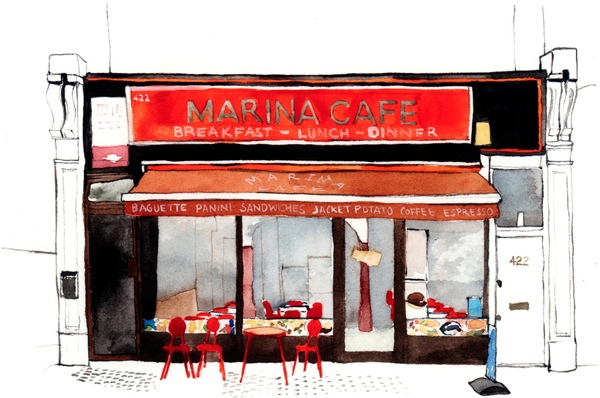
Marina Cafe, Mare St
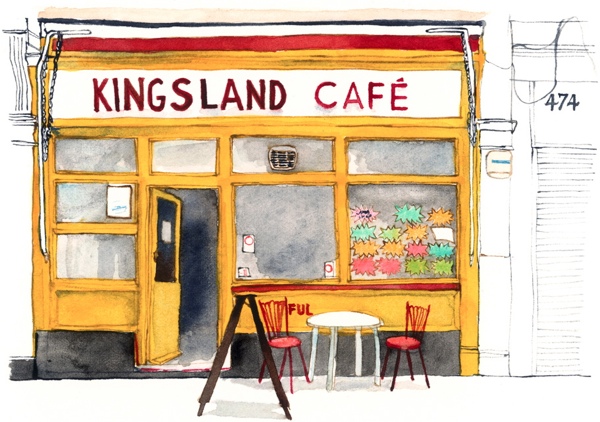
Kingsland Cafe, Kingsland Rd
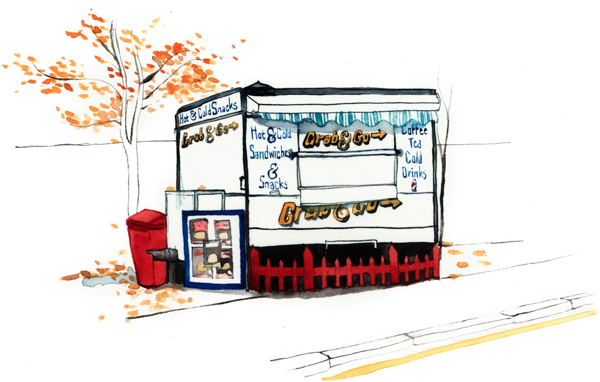
Grab & Go, Blackhorse Lane
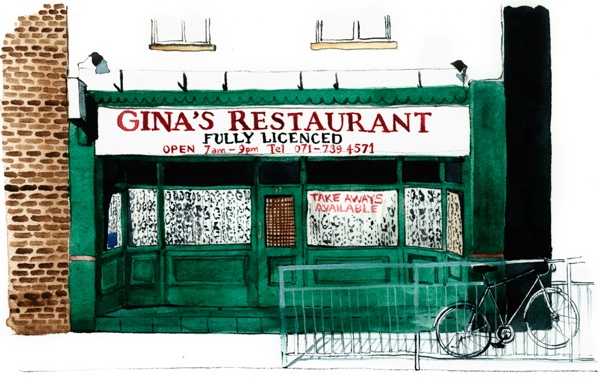
Gina’s Restaurant, Bethnal Green Rd

Copper Grill, Eldon St

Billy Bunter’s Snack Bar, Mile End Rd
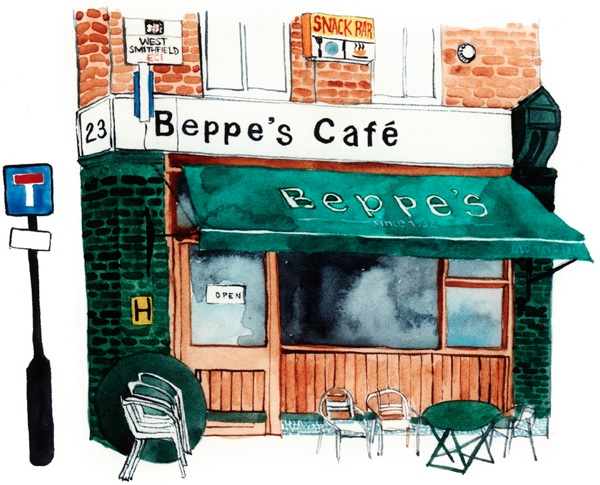
Beppe’s Cafe, West Smithfield
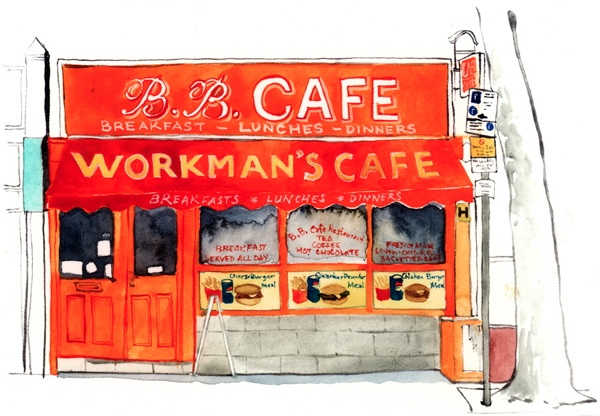
B.B. Cafe, Lea Bridge Rd

Savoy Cafe, Graham Rd

A.Gold, Brushfield St
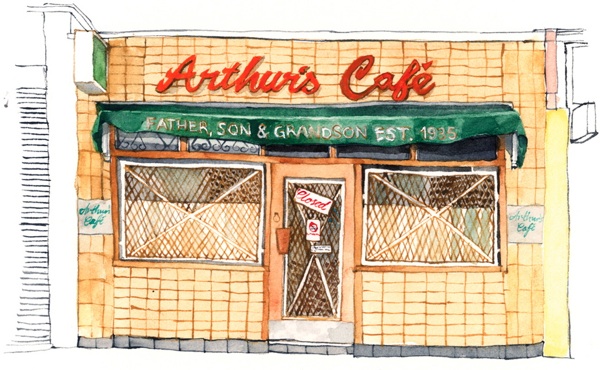
Arthur’s Cafe, Kingsland Rd
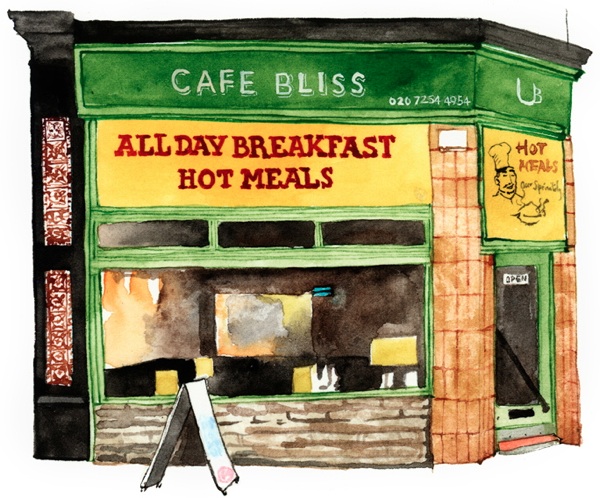
Cafe Bliss, Dalston Lane
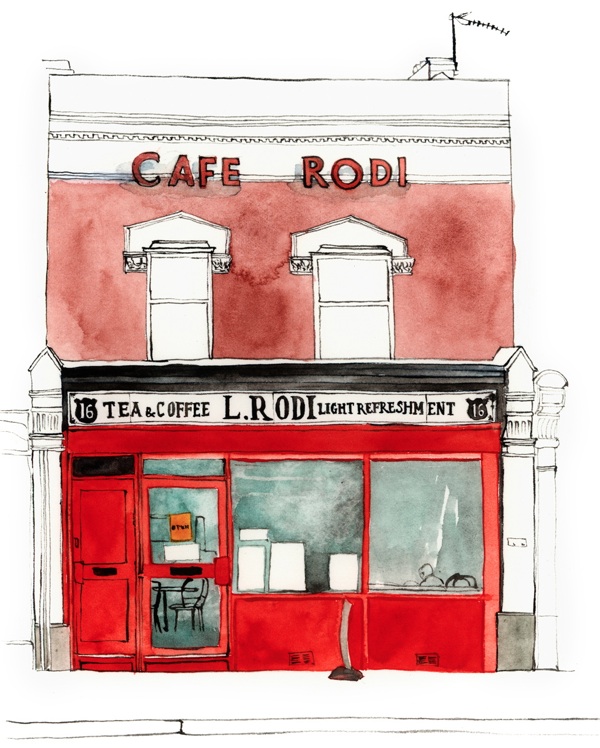
Cafe Rodi, Blackhorse Lane
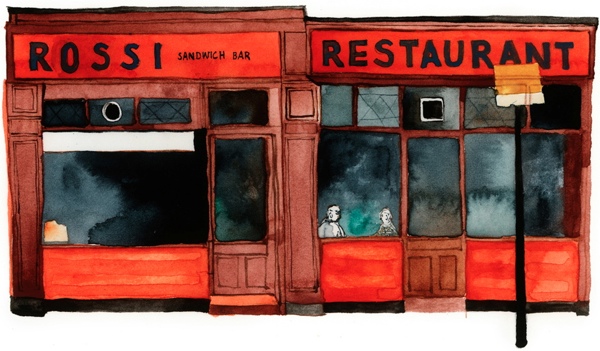 Rossi Restaurant, Hanbury St (Gone but not forgotten)
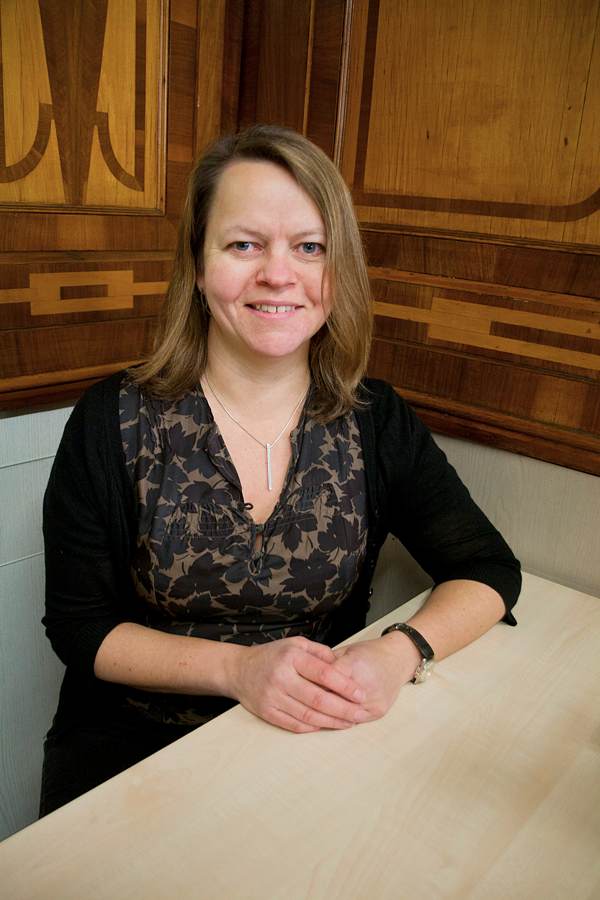
Eleanor Crow at E.Pellicci
Drawings copyright © Eleanor Crow
Portrait copyright © Colin O’Brien
You may also like to read
At Regis Cafe, Leadenhall Market
At Syd’s Coffee Stall, Shoreditch High St
At Embassy Electrical Supplies

Mehmet Murat
It comes as no surprise to learn that at Embassy Electrical Supplies in Clerkenwell, you can buy lightbulbs, fuses and cables, but rather more unexpected to discover that, while you are picking up your electrical hardware, you can also purchase olive oil, strings of chili peppers and pomegranate molasses courtesy of the Murat family groves in Cyprus and Turkey.
At certain fashionable restaurants nearby, “Electrical Shop Olives” are a popular feature on the menu, sending customers scurrying along to the Murats’ premises next morning to purchase their own personal supply of these fabled delicacies that have won acclaim in the global media and acquired a legendary allure among culinary enthusiasts.
How did such a thing come about, that a Clerkenwell electrical shop should be celebrated for olive oil? Mehmet Murat is the qualified electrician and gastronomic mastermind behind this singular endeavour. I found him sitting behind his desk at the rear of the shop, serving customers from his desk and fulfilling their demands whether electrical or culinary, or both, with equal largesse.
“I am an electrician by trade,” he assured me, just in case the fragrance of wild sage or seductive mixed aromas of his Mediterranean produce stacked upon the shelves might encourage me to think otherwise.
“I arrived in this country from Cyprus in 1955. My father came a few years earlier, and he got a job and a flat before he sent for us. In Cyprus, he was a barber and, according to our custom, that meant he was also a dentist. But he got a job as an agent travelling around Cyprus buying donkeys for Dr Kucuk, the leader of the Turkish Cypriots at that time – the donkeys were exported and sold to the British Army in Egypt. What he did with the money he earned was to buy plots of land around the village of Louroujina, where I was born, and plant olive saplings. He and my mother took care of them for the first year and after that they took care of themselves. Once they came to the UK, they asked relatives to watch over the groves. They used to send us a couple of containers of olive oil for our own use each year and sold the rest to the co-operative who sold it to Italians who repackaged it and sold it as Italian oil.
I trained as an electrician when I left school and I started off working for C.J. Bartley & Co in Old St. I left there and became self-employed, wiring Wimpy Bars, Golden Egg Restaurants and Mecca Bingo Halls. I was on call twenty-four hours and did electrical work for Faye Dunaway, the King of Jordan’s sister and Bill Oddie, among others. Then I bought this shop in 1979 and opened up in 1982 selling electrical supplies.
In 2002, when my father died, I decided I was going to bring all the olive oil over from Louroujina and bottle it all myself, which I still do. But when we started getting write-ups and it was chosen as the best olive oil by New York Magazine, I realised we had good olive oil. We produce it as we would for our own table. There is no other secret, except I bottle it myself – bottling plants will reheat and dilute it.
If you were to come to the village where I was born, you could ask any shopkeeper to put aside oil for your family use from his crop. I don’t see any difference, selling it here in my electrical shop in Clerkenwell. It makes sense because if I were to open up a shop selling just oil, I’d be losing money. The electrical business is still my bread and butter income, but many of the workshops that were my customers have moved out and the Congestion Charge took away more than half my business.
Now I have bought a forty-five acre farm in Turkey. It produces a thousand tons of lemons in a good year, plus pomegranate molasses, sweet paprika, candied walnuts and chili flakes. We go out and forage wild sage, wild oregano, wild St John’s wort and wild caper shoots. My wife is there at the moment with her brother who looks after the farm, and her other brother looks after the groves in Cyprus.”
Then Mehmet poured a little of his precious pale golden olive oil from a green glass bottle into a beaker and handed it to me, with instructions. The name of his farm, Murat Du Carta, was on the label beneath a picture of his mother and father. He explained I was to sip the oil, and then hold it in my mouth as it warmed to experience the full flavour, before swallowing it. The deliciously pure oil was light and flowery, yet left no aftertaste on the palate. I picked up a handful of the wild sage to inhale the evocative scent of a Mediterranean meadow, and Mehmet made me up a bag containing two bottles of olive oil, truffle-infused oil, marinated olives, cured olives, chili flakes and frankincense to carry home to Spitalfields.
We left the darkness of the tiny shop, with its electrical supplies neatly arranged upon the left and its food supplies tidily stacked upon the right. A passing cyclist came in to borrow a wrench and the atmosphere was that of a friendly village store. Outside on the pavement, in the sunshine, we joined Mark Page who forages truffles for Mehmet, and Mehmet’s son Murat (known as Mo). “I do the markets and I run the shop, and I like to eat,” he confessed to me with a wink.
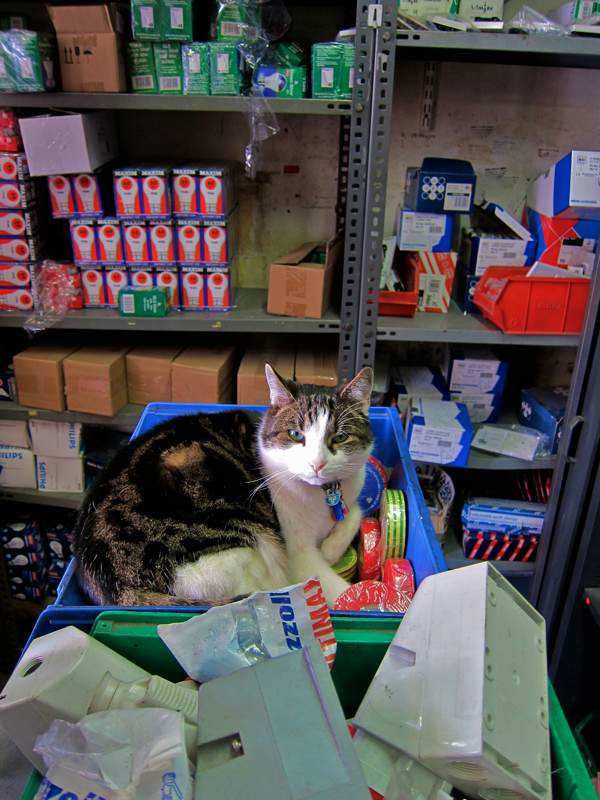
Carter, the electrical shop cat.

From left to right, Mark Page (who forages truffles), Murat Murat (known as Mo) and Mehmet Murat.
Embassy Electical Supplies, 76 Compton St, Clerkenwell, EC1V 0BN
Fourth Annual Report
It was four years ago that I published my first post here in the pages of Spitalfields Life and I did it blindly without any grasp of where it might lead. I did not know if I was capable of writing a sentence or taking a photograph, but I hoped that by practising every day I might progress.
Yet these first four years have been a much more eventful journey that I could have imagined. While my central endeavour of doing interviews and writing people’s stories is more than its own reward, there have also been many other unexpected joys resulting indirectly from this activity. So I hope you will not think me immodest if I take this opportunity of the Annual Report to outline a few highlights here.
As a naturally timid person, I would not aspire to overt political action, yet I felt to compelled to write celebrating Gardners Market Sundriesmen, Spitalfields’ oldest family business, when the landlord wanted to replace this beloved institution with a chain store, and it was the resultant public outcry which caused the landlord to relent in his policy. The beauty that I found in the culture and practice of this small independent shop led me to write about hundreds of other such proprietor-owned-and-run establishments that are an important part of the social fabric of the East End. When these shopkeepers read about each other and recognised that they were all struggling with similar issues, two hundred met together in Christ Church, Spitalfields, last November to form the East End Trades Guild of which Paul Gardner is the founding member. Since then, they have constituted themselves as a co-operative to speak for the interests of all small traders in the East End.
The spring, when the Geffrye Museum set out to demolish The Marquis of Lansdowne which had stood on the corner of Geffrye St since at least 1838 to replace it with a concrete box to house their new designer restaurant, I had the pleasure of interviewing George Barker who had been born in a room above the pub in 1931. His family ran The Marquis for more than half a century and his story outlined the meaning and importance of it as a focus for the extended families that once lived in the surrounding streets and worked in the furniture trades based there. It was a recognition of the cultural value of The Marquis of Lansdowne in Haggerston, where long-established communities had been devastated by slum clearances, that was a crucial factor in the Hackney Council Planning Committee’s refusal of permission to demolish the pub.
I often think of how we used to write stories at school and there were so many more talented storytellers than I, yet it puzzles me I am the only one that became a writer. Teaching a series of writing courses over the past eighteen months has been an uplifting experience because – without exception – all of the students have produced talented and accomplished pieces of writing, speaking eloquently in their own voices and confirming my belief in the latent writing abilities of the general population. Additionally, each of these courses has spawned a group of writers who remain in touch, circulating their work and offering moral support to each other.
In July, it was my privilege to give an illustrated lecture at the National Portrait Gallery showing more than one hundred portraits of East Enders from Spitalfields Life, complementing the gallery’s own exhibition of the great and the good from their archive. The lively response of the audience reflected my own excitement in this triumphant moment which gave me the opportunity to feature the work of all the Contributing Photographers whose pictures regularly enliven these pages.
Finally, the book of Spitalfields Life sold out its print run of ten thousand copies in hardback, inspiring me with the courage to become a publisher in my own right. The first title published under the Spitalfields Life Books imprint, Travellers’ Children in London Fields by Colin O’Brien, came out at the beginning of July with The Gentle Author’s London Album, a magnificent picture book funded by you the readers, to be published in October.
No-one is more astonished than I by these outcomes of the act of writing daily stories about the people and culture of the East End. Since my own existence is spent engrossed in my work, although I understand there is a wide readership that extends globally, I only envisage the people that I know reading it. Similarly, I could only conceive of the existence of copies of Spitalfields Life that I saw with my own eyes. Thus it was a strange experience to sign stock copies in Waterstones Piccadilly, London’s largest bookshop, and then go back a week later to discover that my signatures had vanished. It was half an hour later before I realised the obvious, that the signed books had been sold and these were new stock.
You might think that all these activities could prove too much of an appealing distraction, yet it is the practice of publishing a story every day that permits me to limit these marginalia and keeps me focussed upon my central task and delight. When I sit down to write my story, I put the hurly-burly of the day behind me and, in that moment, I am at home. This is the time I look forward to, when I am free to write – and I hope to be doing it for many years to come.
And thus, with all these thoughts in mind, I come to the end of this fourth year of Spitalfields Life.
I am your loyal servant
The Gentle Author
For the next week, I shall be publishing favourite stories from the past year and resuming with new stories on Monday 2nd September.
You may like to read my earlier Annual Reports
Anna Carter, Carters Steam Fair

“It’s my baby”
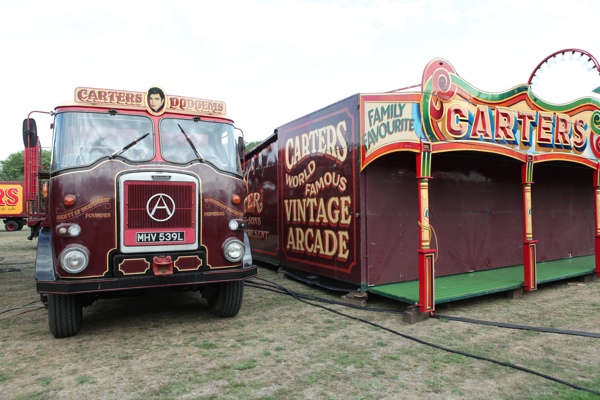
Carters Steam Fair graces Victoria Park this weekend and Contributing Photographer Colin O’Brien & I went along yesterday to meet Anna Carter, who started the fair with her husband John more than thirty years ago and runs it today with her sons and their families. Britain’s only vintage steam-powered fair, Carters in a national treasure containing a magnificent array of traditional fairground rides of historic importance all kept in full working order.
We discovered the fair already set up on the grass near Grove Rd, waiting for the crowds to arrive, and resembling your dream of what a fairground should be – immaculately cared for, dripping with light bulbs and garnished with flamboyant lettering, and every surface shining with neat paintwork in the dominant colours of butter and oxblood. The rides were arranged around the enormous merry-go-round which is the proud centrepiece, while splendid vintage lorries in tip top condition stood between the gleaming attractions and, at the fringes of the encampment, we found the personal caravans of the Carter family.
When we arrived, Anna was holding court at a council meeting of her extended family, like a general preparing for battle, but, once the conference was over, we were privileged to sit outside her old caravan with its handsome leaded windows and take tea, while she told us the story of Carters Steam Fair – a family business on a grand scale with three generations involved and travelling the country twenty-eight weeks of the year.
“My late husband collected things,” revealed Anna with spectacular understatement, when I asked her how the fair started, “he collected slot machines, horn gramophones, 78 records, enamel signs and American cars – anything interesting. And one day, we made some money and he said we could buy a house or we could buy the gallopers. So we opted for the gallopers.”
‘Gallopers’ is the proper but less-well-known term for a merry-go-round, and the gallopers in question sat across the grass from us as we sipped our tea. Swathed in a green tarpaulin concealing the decorated horses within, only the painted conical top was visible and it looked for all the world like some enormous cake, just waiting to be unwrapped. “We bought it off an amusement park in 1976 and it fell apart on the way home, “ Anna recalled fondly, “It had been built in 1895 and we even managed to buy the steam engine that had been taken off it, three miles down the road.” She and her husband restored the gallopers together, with John rebuilding the structure and mechanics and Anna recreating the authentic paint finishes.
“He was the son of a policeman and I was the daughter of a chef,” she explained, “My father had some land and used to let John hold stock car races on it. He was five years older than me and he was leaving Maidenhead College of Art when I left, so we never met then but got together later after we both had failed marriages and were divorced.” The couple had three sons together, making a family of six children including offspring from their previous marriages.
Already, John and Anna had been organising steam fairs, air shows and vintage car rallies, and it was possible to show their gallopers at these events but, within a couple of years, they acquired a chairoplane, some sideshows and juvenile rides and were doing tiny village fairs in their own right. Before long, Carters Steam Fair was playing twenty-eight different locations each summer and the routine of the travelling became established, moving each Tuesday to a new location.
It was was John’s unexpected death at fifty-eight that was the catalyst for Anna to take the running of the fair upon herself – yet by then she had grown-up sons involved. “When John died thirteen years ago, I sat down with the boys and said what do you want to do?” she confided to me, “It was a unanimous decision that we carry on.” Today, Seth runs the dodgems, the octopus, the skid and the coconut shy, while Joby runs the gallopers, the steam yachts, the swing boats and the jungle thriller ark. “We do respect each other’s space but the grandchildren run everywhere and are little pests,” she informed me with pleasure, “when my children were young all their friends used to work in the fair, and now my children’s children’s friends work here whenever we need extra staff.”
“It’s my baby,” Anna confessed to me in summation, casting her eyes around at the magical fairground that has been the focus of her family endeavour for so many years. With extraordinary stamina and strength of personality, Anna has kept the show on the road, negotiating labyrinthine regulations and red tape. Yet as much as she is an astute hard-working business woman, Anna is a romantic in love with the romance of the fairground, and it is thanks to the vision she shared with John that Carters exists today as Britain’s last steam fair, keeping traditional rides working which would otherwise be destined for the museum or the scrapheap.
“We’re not interested in modern rides, we love the winter months when we do the restoration – there’s always something tatty and in need of repainting,” she revealed to me, “By October, you are sick of being on the road, it’s muddy and cold and you think how nice to go home – but then when spring comes you always want to go off again. This is my life and I don’t want to do anything else. It means so much to me, we live and breathe it.”




Anna Carter with her dog, Saffy the Staffy
Photographs copyright © Colin O’Brien
Carters Steam Fair is at Victoria Park until Monday. Open today 12-8pm, Friday & Saturday 12-9pm, Sunday & Monday 12-8pm.
31st August & 1st September, Streatham Common, open 12-8pm each day.
Julius Mendes Price’s London Types, 3
This is the third set of London Types designed and written by artist Julius Mendes Price and issued by Carreras with Black Cat Cigarettes in 1919. Of particular note are the Billingsgate Fish Porters who almost survived another century, only to be abolished in 2012, and the Lodging House Keeper – a ‘Rowton House’ in Whitechapel persisted until recent years when it was converted into executive flats.


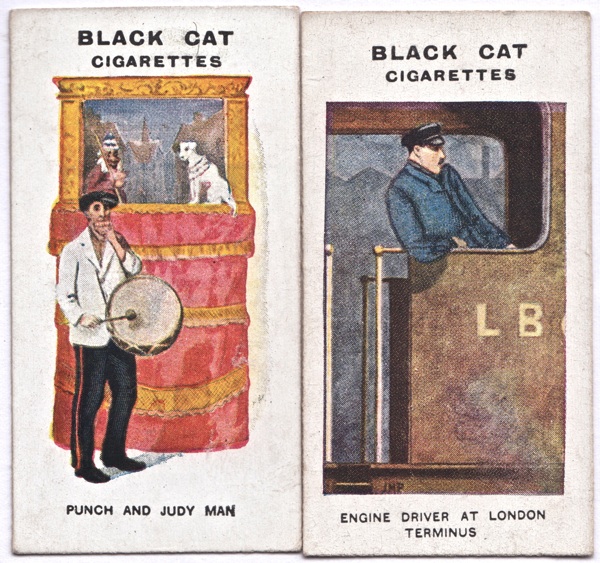


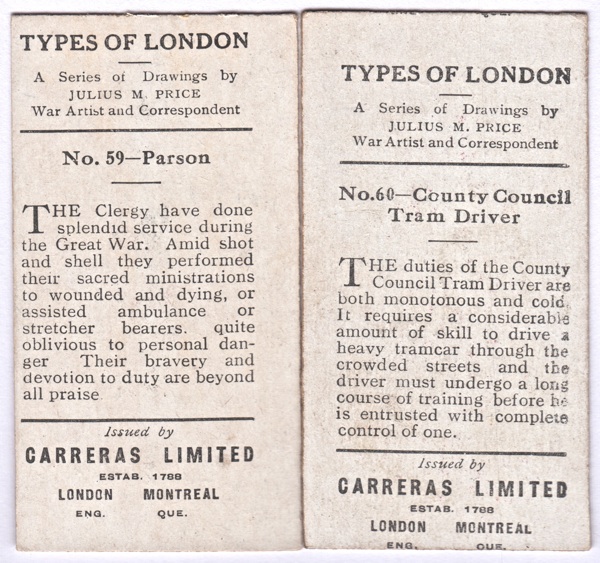
You may also like to take a look at these other cigarette card sets of the Cries of London
Julius Mendes Price’s London Types 1
Julius Mendes Price’s London Types 2