
Come To Bob Mazzer’s UNDERGROUND!

Less than a year ago, I published the work of an unknown photographer by the name of Bob Mazzer, yet the response to his extraordinary pictures from the hundreds of thousands of readers who have seen them in these pages has now brought him widespread acclaim.
As a result of this huge wave of enthusiasm, and the personal generosity of a number of Spitalfields Life readers in particular, we are able to publish a magnificent large-format two hundred page hardback of Bob’s tube photography entitled UNDERGROUND for £20, coinciding with the opening of his debut London exhibition at the Howard Griffin Gallery, 189 Shoreditch High St.
Please join me in a celebration of this glorious moment, because I want you to be the first to see the show.
Come to the launch of Bob’s book and the opening of his exhibition on Thursday 12th June from 6-9pm. On the night, you can visit the Howard Griffin Gallery – which has been fitted with tube seats in anticipation of the event – and join Bob in the covered yard next door where he will signing books and we will be serving complimentary Truman’s Beer.
To add to the festivities on this tremendous night, buskers and street performers will be performing.





CLICK HERE TO ORDER A COPY OF BOB MAZZER’S UNDERGROUND FOR £20
You may also like to read about
Another Fireplace Of John Moyr Smith Tiles
You may recall that over the course of 2011, I collected enough Minton tiles designed by the nineteenth century artist John Moyr Smith to tile the fireplace in my living room – many were cracked or broken but that suited both my budget and my purpose. Now I have opened the fireplace in my bedroom, which was previously bricked-up, and so the process has begun all over again.
I love his lyricism, sly humour and the absurd mixture of stories that Moyr Smith chose to illustrate in his tiles, and I am attracted to the notion that they will be the last thing I see before I fall asleep. If anyone can help me find more please get in touch.
Here are the beginnings of my new collection – not sure my pet, Mr P, will approve of the last in this series. I shall place it discreetly at the back of the fireplace lest it alarm him.

Aesop’s Fables – The Fox & The Goat In The Well

Jack & Jill Went Up The Hill
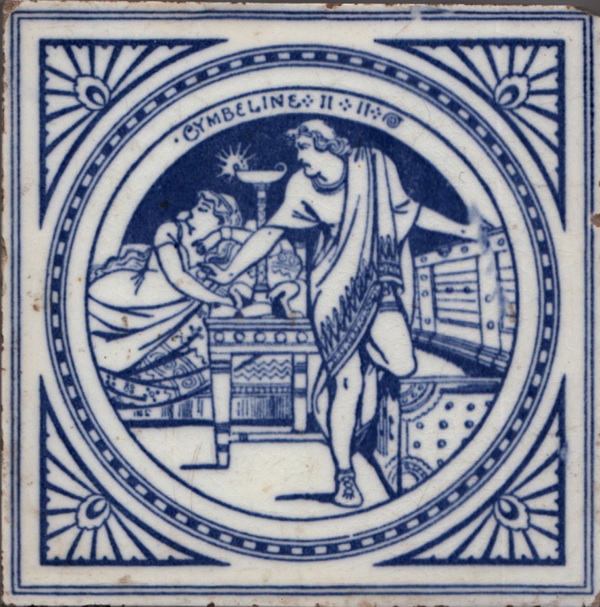
Cymbeline – Iachimo Climbs From The Trunk In Imogen’s Bed Chamber

Julius Caesar Lands In Britain

Richard Coeur de Lion & Bertrand de Gourdon AD1199

Aesop’s Fables – The Tortoise Which Wished to Learn To Fly

King Harold Wounded At The Battle Of Hastings 1066

Winter – The Snow Storm

Aesop’s Fables – King Log & King Stork

Grimm’s Fairy Tales – Rumpelstiltskin

King Edward The Martyr

Aesop’s Fables – The Ape, Cat & The Roast Nuts
You may also like to read about
George Dodd’s Spitalfields, 1842
George Dodd came to Spitalfields to write this account for Charles Knight’s LONDON published in 1842. Dodds recalls the rural East End that still lingered in the collective memory and described the East End of weavers living in ramshackle timber and plaster dwellings which in his century would be “redeveloped” out of existence by the rising tide of brick terraces, erasing the history that existed before.
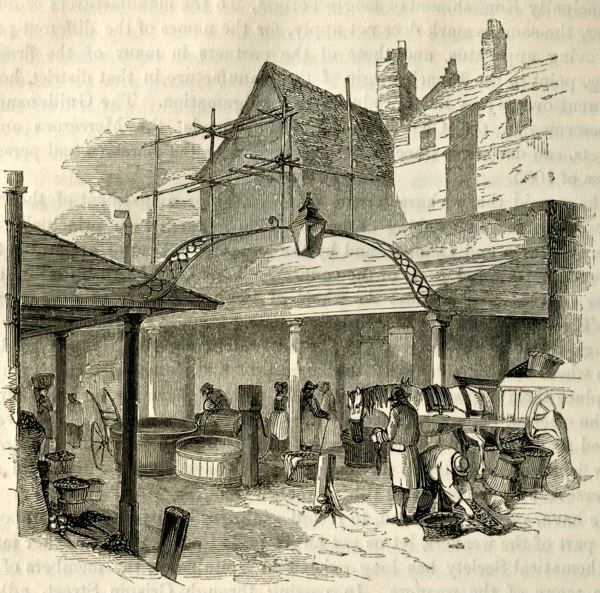
Spitalfields Market
It is not easy to express a general idea respecting Spitalfields as a district. There is a parish of that name but this parish contains a small portion only of the silk weavers and it is probable that most persons apply the term Spitalfields to the whole district where the weavers reside. In this enlarged acceptation, we will lay down something like a boundary in the following manner – begin at Shoreditch Church and proceed along the Hackney Rd till it is intersected by Regent’s Canal, follow the course of the canal to Mile End Rd and then proceed westward through Whitechapel to Aldgate, through Houndsditch to Bishopsgate, and thence northward to where the tour commenced.
This boundary encloses an irregularly-shaped district in which nearly the whole of the weavers reside and these weavers are universally known as “Spitalfields” weavers. Indeed, the entire district is frequently called Spitalfields although including large portions of Bethnal Green, Shoreditch, Whitechapel and Mile End New Town. By far the larger portion of this extensive district was open fields until comparatively modern times. Bethnal Green was really a green and Spitalfields was covered with grassy sward in the last century.
It may now not unreasonably be asked, what is “Spitalfields”? A street called Crispin St on the western side of Spitalfields Market is nearly coincident in position with the eastern wall of the Old Artillery Ground and this wall separated the Ground from the Fields which stretched out far eastward. Great indeed is the change which this portion of the district has undergone. Rows of houses, inhabited by weavers and other humble persons, and pent up far too close for the maintenance of health, now cover the green spot now known as Spitalfields.
In the evidence taken before a Committee in the House of Commons on the silk trade in 1831-2, it was stated that the population of the district in which the Spitalfields weavers resided could be no less at that time than one hundred thousand, of whom fifty thousand were entirely dependent on the silk manufacture and remaining moiety more or less dependent indirectly. The number of looms seems to vary between about fourteen to seventeen thousand and, of these, four to five thousand are unemployed in times of depression. It seems probable, as far as the means exist of determining it, that the weavers are principally English or of English origin. To the masters, however the same remark does not apply, for the names of the partners in the firms now existing, point to the French origin of manufacture in that district.
A characteristic employment or amusement of the Spitalfields weavers is the catching of birds. This is principally carried on in the months of March and October. They train “call-birds” in the most peculiar manner and there is an odd sort of emulation between them as to which of their birds will sing the longest, and the bird-catchers frequently lay considerable wagers on this, as that determines their superiority. They place them opposite each other by the width of a candle and the bird who sings the oftenest before the candle is burnt out wins the wager.
If we have, on the one hand, to record the unthrifty habits and odd propensities of the weavers, let us not forget to do them justice in other matters. In passing through Crispin St, adjoining the Spitalfields Market, we see on the western side of the way a humble building, bearing much the appearance of a weaver’s house and having the words “Mathematical Society” written up in front. Lowly and inelegant the building may be but there is a pleasure in seeing Science rear her head in a locality, even if it is humble one.
A ramble through Bethnal Green and Mile End New Town in which the weavers principally reside, presents us with many curious features illustrative of the peculiarities of the district. Proceeding through Crispin St to the Spitalfields Market, the visitor will find some of the usual arrangements of a vegetable market but potatoes, sold wholesale, form the staple commodity. He then proceeds eastwards to the Spitalfields Church, one of the “fifty new churches” built in the reign of Queen Anne and along Church St to Brick Lane. If he proceed northward up the latter, he will arrive, first, at the vast premises of Truman, Hanbury & Buxton’s brewery, and then at the Eastern Counties Railway which crosses the street at a considerable elevation. If he extends his steps eastwards, he will at once enter upon the districts inhabited by the weavers.
On passing through most of the streets, a visitor is conscious of a noiselessness, a dearth of bustle and activity. The clack of the looms is heard here and there, but not to a noisy degree. It is evident in a glance that many of the streets, all the houses were built expressly for weavers, and in walking through them we noticed the short and unhealthy appearance of the inhabitants. In one street, we met with a barber’s shop in which persons could have “a good wash for a farthing.” Here we espied a school at which children were taught “to read and work at tuppence a week.” There was a chandler’s shop at which shuttles, reeds and quills, and the smaller parts of weaving apparatus were exposed for sale in a window in company with split-peas, bundles of wood and red herrings. In one little shop, patchwork was sold at 10d, 12d and 16d a pound. At another place was a bill from the parish authorities, warning the inhabitants that they were liable to a penalty if their dwelling were kept dirty and unwholesome, and in another – we regretted this more than anything else – astrological predictions, interpretations of dreams and nativities, were to be purchased “from three pence upwards.”
In very many of the houses, the windows numbered more sheets of paper than panes of glass and no considerable number of houses were shut up altogether. We would willingly present a brighter picture, but ours is a copy from the life.
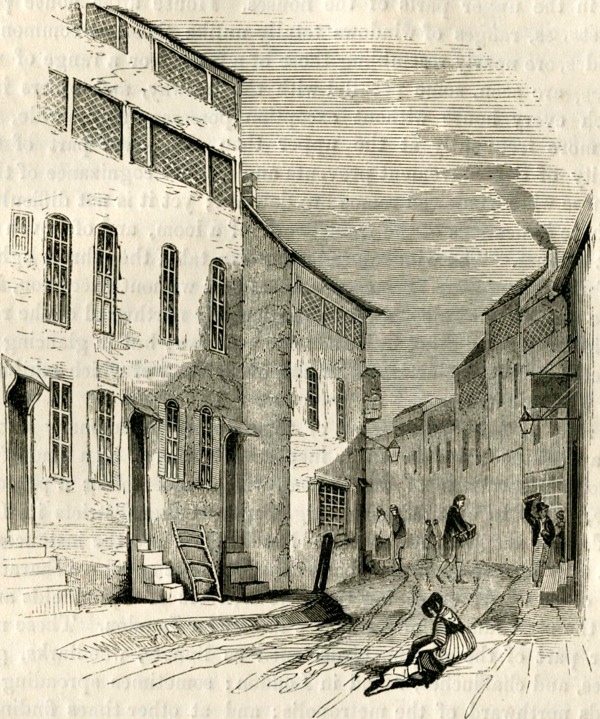
Pelham St (now Woodseer St), Spitalfields

Booth St (now Princelet St), Spitalfields
Images courtesy © Bishopsgate Insitute
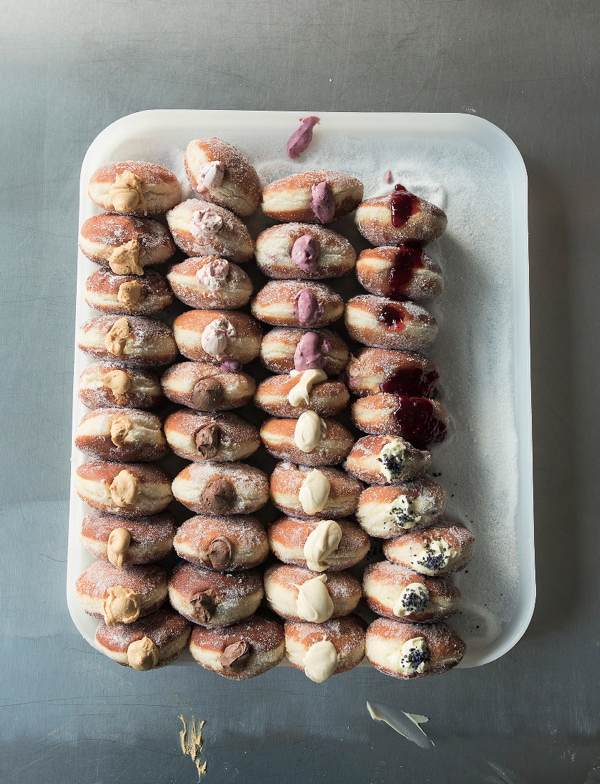
Justin Gellatly’s Doughnut Recipe
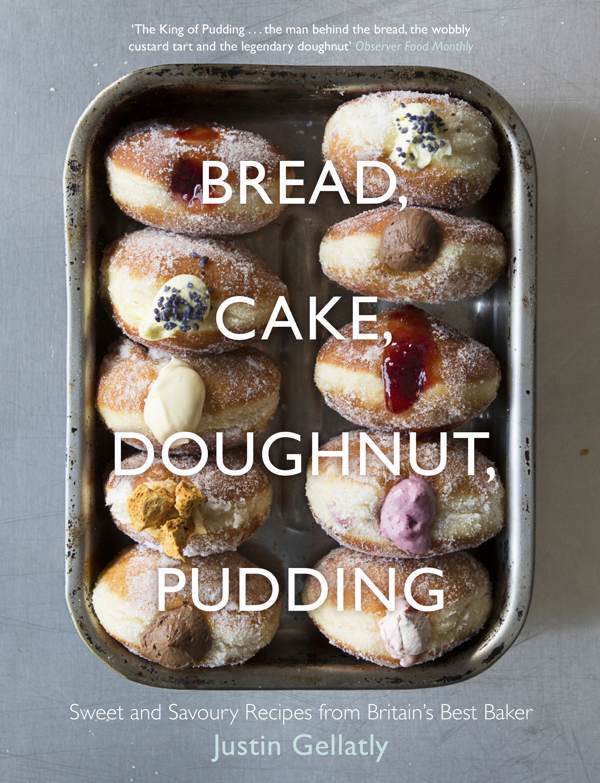
Some time ago, I became hooked by the baking of Justin Gellatly (especially his sourdough bread, eccles cakes, custard tarts, hot cross buns, mince pies and doughnuts) and, over the years, I have written many stories charting his ascendancy. So it is my great pleasure to publish Justin’s recipe for doughnuts today, celebrating the rise of an heroic baker upon the publication of his first book, succinctly titled, BREAD, CAKE, DOUGHNUT, PUDDING.
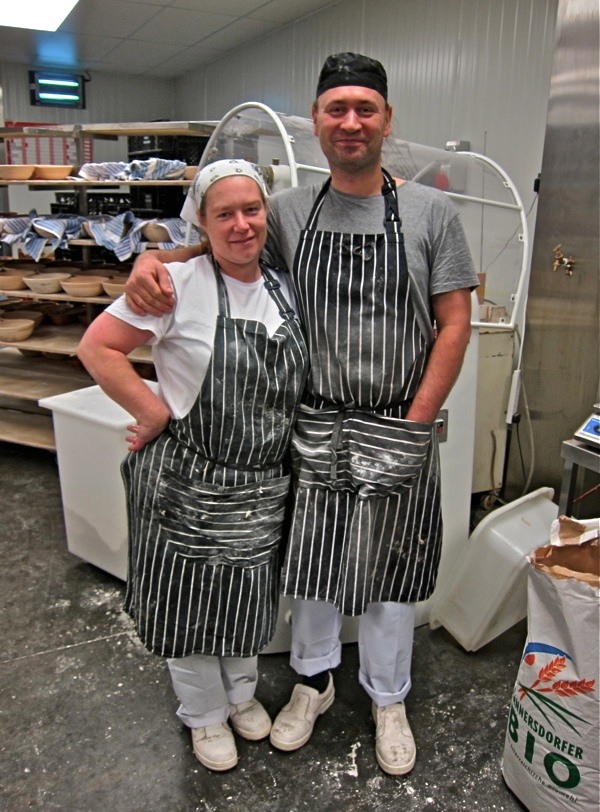
Justin & Louise Gellatly
“I started making my doughnuts while working at St John Restaurant over ten years ago and, if I say so myself, they have become a bit legendary. Once you’ve had my doughnuts there is no going back.
I normally keep the fillings quite classic – custard, jam, lemon curd and apple cinnamon. But I have been developing many new flavours for this book, like my most fought-over one, the caramel custard with salted honeycomb sprinkle, which has become a bit of a signature for me, and another that I launched at Glastonbury, the violet custard with sugared violets and Parma violet sprinkle.
As in my bread recipes, I always weigh the water when I’m making doughnuts, it’s a lot more accurate than using a measuring jug.
I would recommend using a deep-fat fryer (you can pick up a Breville 3 litre one for about £30), which is a lot safer than a pan of hot oil. Either way, PLEASE be careful when using hot oil – I have had many burns and it’s really not very nice.
You will also need an electric mixer such as a Kenwood or KitchenAid, and if you don’t have a deep-fat fryer (which will have an integral thermometer) you will need a good digital thermometer to check that the oil is at the right temperature.
You can try out your own fillings by using the recipe for crème patissière and just folding in your additional filling of choice, but I am not a fan of the savoury doughnuts that are popping up in a few places.”
THE DOUGHNUT DOUGH
Makes about 20 doughnuts (about 1kg dough)
Preparation time: 45 minutes, plus proving and overnight chilling
Cooking time: 4 minutes per doughnut, fried in batches; about 30–40 minutes total
FOR THE DOUGH
500g strong white bread flour
60g caster sugar
10g fine sea salt
15g fresh yeast, crumbled
4 eggs
zest of 1⁄2 lemon
150g water
125g softened unsalted butter
FOR COOKING
about 2 litres sunflower oil, for deep-frying
FOR TOSSING
caster sugar
INSTRUCTIONS
Put all the dough ingredients apart from the butter into the bowl of an electric mixer with a beater attachment and mix on a medium speed for 8 minutes, or until the dough starts coming away from the sides and forms a ball.
Turn off the mixer and let the dough rest for 1 minute.Take care that your mixer doesn’t overheat – it needs to rest as well as the dough!
Start the mixer up again on a medium speed and slowly add the butter to the dough – about 25g at a time. Once it is all incorporated, mix on high speed for 5 minutes, until the dough is glossy, smooth and very elastic when pulled, then cover the bowl with cling film and leave to prove until it has doubled in size. Knock back the dough, then re-cover the bowl and put into the fridge to chill overnight.
The next day, take the dough out of the fridge and cut it into 50g pieces (you should get about 20). Roll them into smooth, taut, tight buns and place them on a floured baking tray, leaving plenty of room between them as you don’t want them to stick together while they prove. Cover lightly with cling film and leave for about 4 hours, or until about doubled in size.
Get your deep-fat fryer ready, or get a heavy-based saucepan and fill it up to the halfway point with rapeseed oil (please be extremely careful, as hot oil is very dangerous). Heat the oil to 180°C.
When the oil is heated to the correct temperature, carefully remove the doughnuts from the tray by sliding a floured pastry scraper underneath them, taking care not to deflate them, and put them into the oil. Do not overcrowd the fryer – do 2–3 per batch, depending on the size of your pan. Fry for 2 minutes on each side until golden brown – they puff up and float, so you may need to gently push them down after about a minute to help them colour evenly. Remove from the fryer and place on kitchen paper, then toss them in a bowl of caster sugar while still warm. Repeat until all are fried, BUT make sure the oil temperature is correct every time before you fry – if it is too high they will colour too quickly and burn, and will be raw in the middle, and if it is too low the oil will be absorbed into the doughnut and it will become greasy. Set aside to cool before filling.
To fill the doughnuts, make a hole in the crease of each one (anywhere around the white line between the fried top and bottom). Fill a piping bag with your desired filling and pipe into the doughnut until swollen with pride. Roughly 20–50g is the optimum quantity, depending on the filling; cream will be less, because it is more aerated. You can fit in more than this, but it doesn’t give such a good balance of dough to filling.
The doughnuts are best eaten straight away, but will keep in an airtight tin and can be reheated to refresh them.

CUSTARD (CRÈME PATISSÈRIE)
Makes about 900g (45g filling each for 20 doughnuts)
Preparation time: 20 minutes
Cooking time: 5 minutes
1 vanilla pod
500ml full fat milk
6 egg yolks
125g caster sugar, plus an extra 2 tablespoons
80g plain flour
200ml double cream
Slit the vanilla pod open lengthways and scrape out the seeds. Put both pod and seeds into a heavy-based saucepan with the milk and bring slowly just to the boil, to infuse the vanilla.
Meanwhile place the egg yolks and the 125g of sugar in a bowl and mix together for a few seconds, then sift in the flour and mix again.
Pour the just-boiling milk over the yolk mixture, whisking constantly to prevent curdling, then return the mixture to the saucepan. Cook over a medium heat, whisking constantly for about 5 minutes, until very thick.
Pass through a fine sieve, discarding the vanilla, and place a sheet of cling film on the surface of the custard to prevent a skin forming. Leave to cool, then refrigerate.
Whip the cream and the 2 tablespoons of sugar together until thick but not over-whipped and fold into the chilled custard.
HOW I FIRST DISCOVERED JUSTIN GELLATLY’S DOUGHNUTS
October 2009
In the past, I was never that crazy about doughnuts and though I can appreciate the pop sensibility of Dunkin Donuts and Krispy Kremes that I encountered in America with their infinite permutations of sprinkles and coloured icings, I never wanted to eat them.
Disenchantment set in at an early age. From the works of Richmal Crompton and other favourite childrens’ authors, I learnt that doughnuts were something completely delicious that all children loved to eat, but then my expectations were crushed once I actually tasted one. It was horrible, a greasy sticky lump of sponge filled with synthetic cream and a squirt of sickly red syrup at its heart. Like Proust with his madeleine, I can remember it now, only I should rather forget.
But then last week as I was buying my daily loaf at St John Bread & Wine in Commercial St, one of the waiters dropped a hint that Justin Gellatly was baking doughnuts at the weekend and my curiosity was piqued. I decided – in the interests of keeping an open mind – to give doughnuts a second shot. On Sunday on the dot of ten, opening time, I was there at St John to inspect the doughnuts, a pile of freshly baked custard-filled ones nestling together like eggs in a basket. Even as I paid for mine, another customer arrived and went straight for the doughnuts, so I knew something was up.
Once I got home, it all went into slow motion. The world dissolved as I bit into my doughnut and the intensity of the moment of consummation exploded to fill my consciousness entirely. In that first bite, there was the delicate nutty flavour of the outside mingling with the feathery sponge of the inside and then both of these mixed with the rush of delicious custard. It wasn’t too sweet, and the texture of the sponge was ideally contrasted with both the sugary exterior and the creamy custard interior.
Then I woke, as if from a dream, the world came back to me and I realised my face and hands were covered in sugar. Now I understand what all the fuss was about. Now I know, this is what doughnuts should be like!
[youtube XVdNs8cNcj4 nolink]
Visit Justin’s bakery – Bread Ahead (Bakery & Baking School), Cathedral St, SE1, with Borough Market Stall from Monday to Saturday
Read some of my other stories about Justin Gellatly
Night in the Bakery at St John
Visit The Secret Gardens of Spitalfields
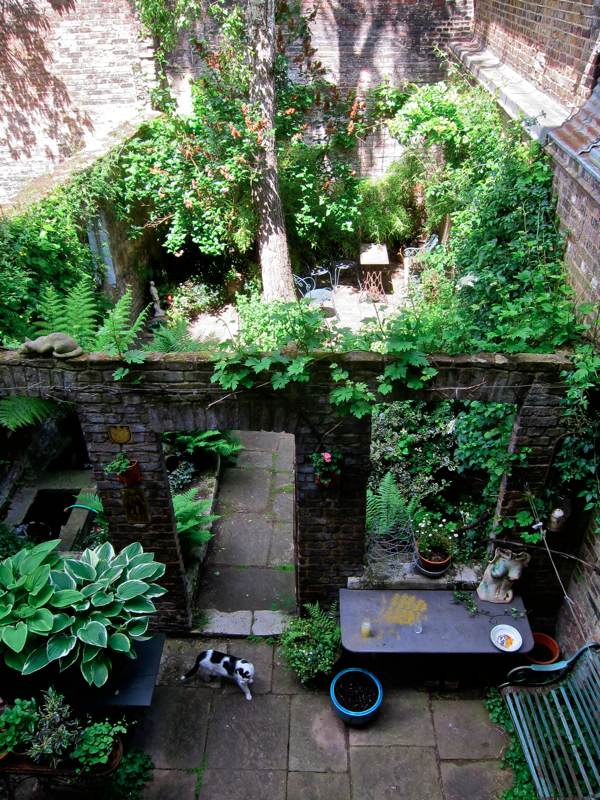
Rodney Archer’s garden in Fournier St
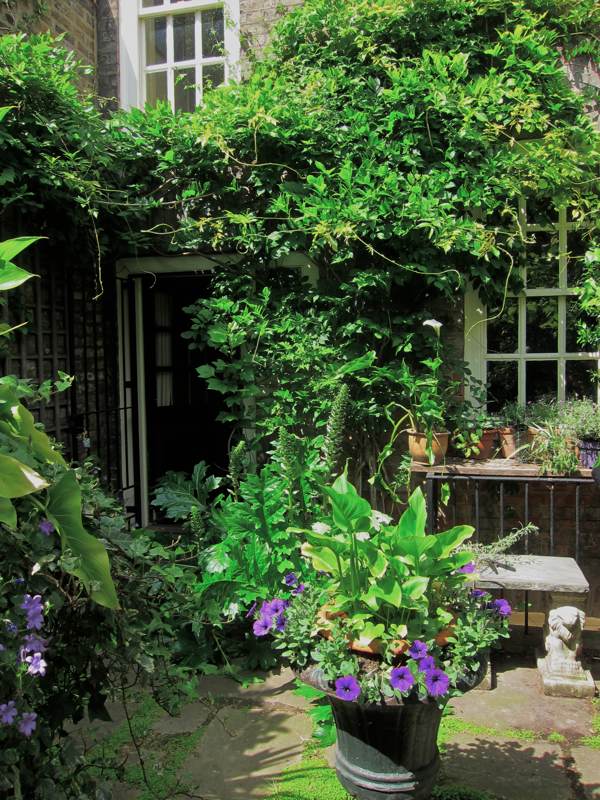
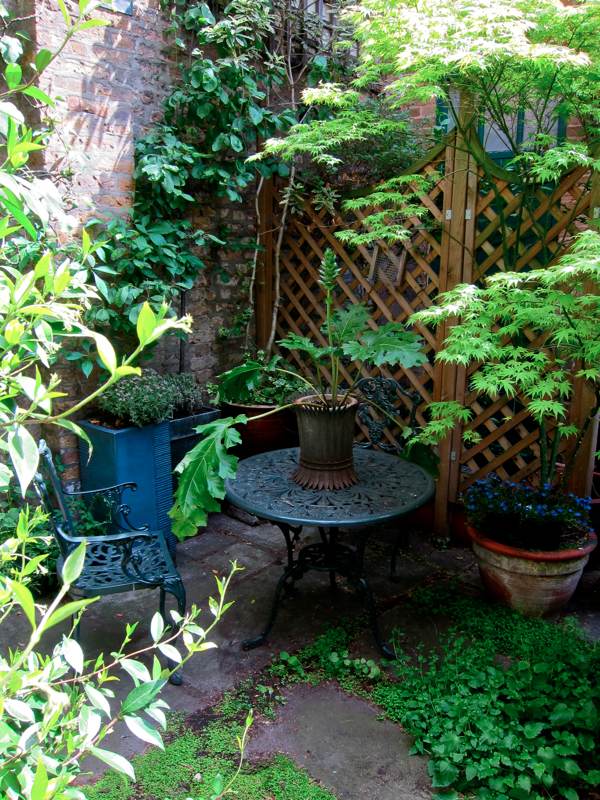
With the gracious permission of the owners, on Saturday 7th June from 10am until 4pm, you are invited to visit these hidden enclaves of green that are entirely concealed from the street by the houses in front and the tall walls that enclose them.
If you did not know of the existence of these gardens, you might think Spitalfields was an entirely urban place with barely a leaf in sight, but in fact every terrace conceals a string of verdant little gardens and yards filled with plants and trees that defy the dusty streets beyond.
Please support this opening in aid of charity – tickets cost £12 to visit all six gardens in Spitalfields and you can find out more on the website of the National Gardens Scheme
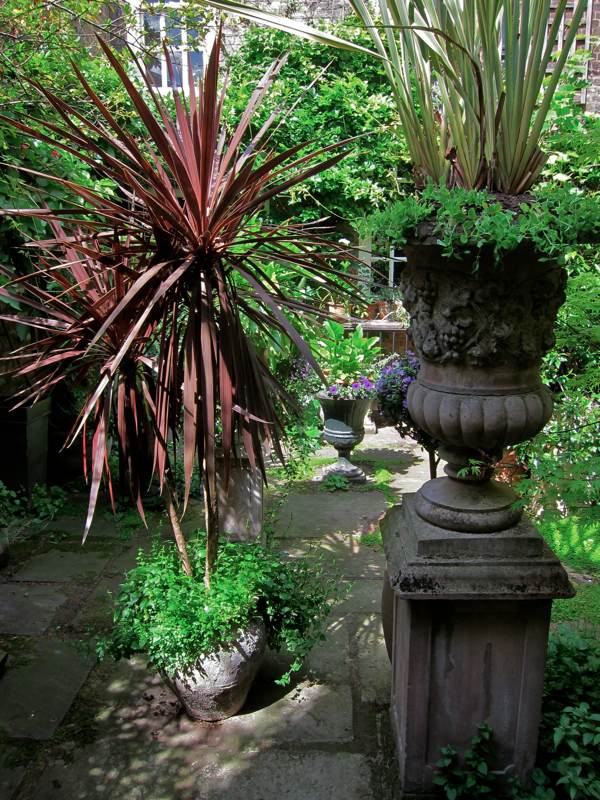
In Fournier St
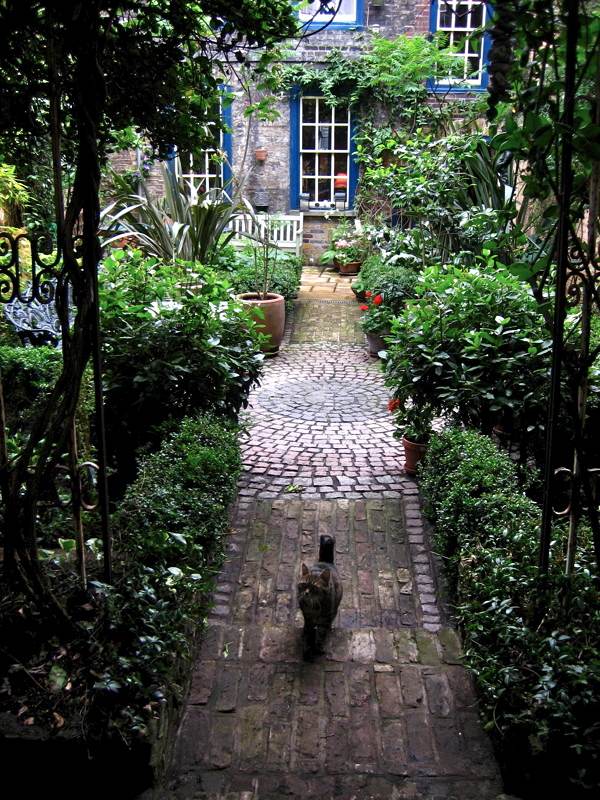
In Princelet St

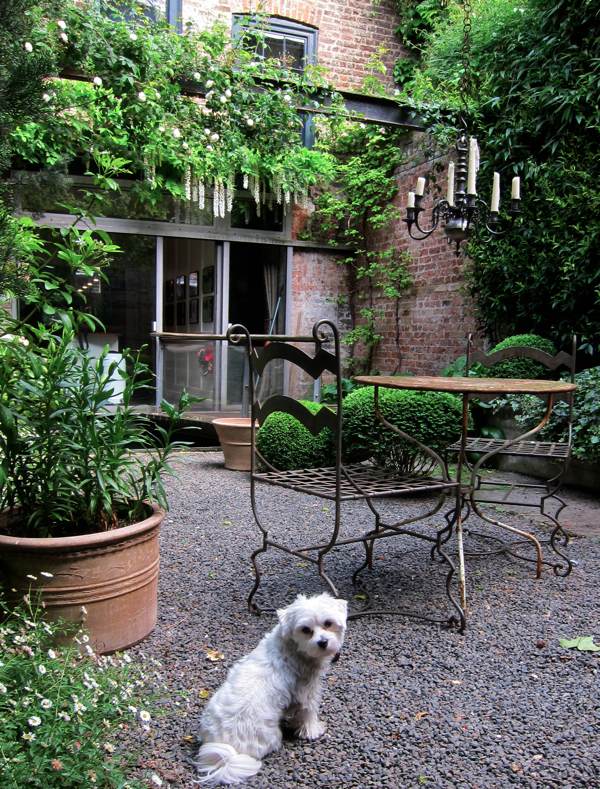
An architect’s garden in Wilkes St
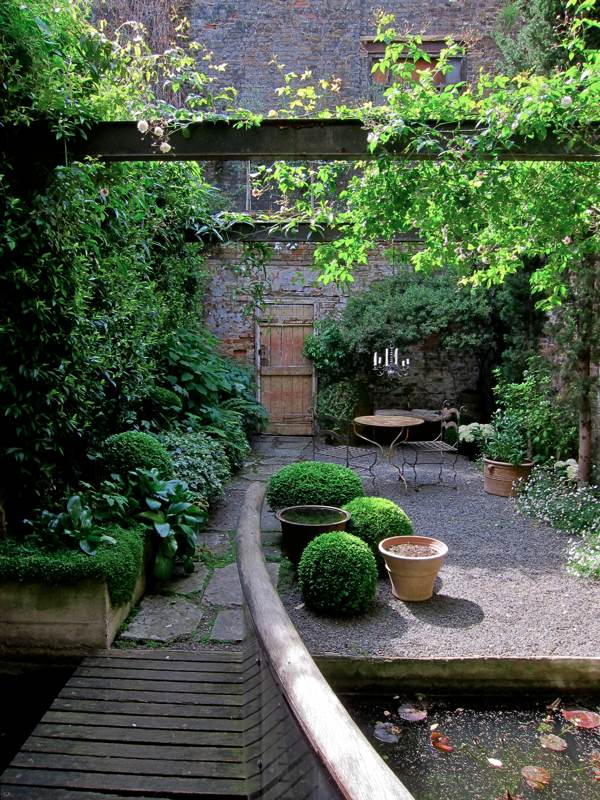
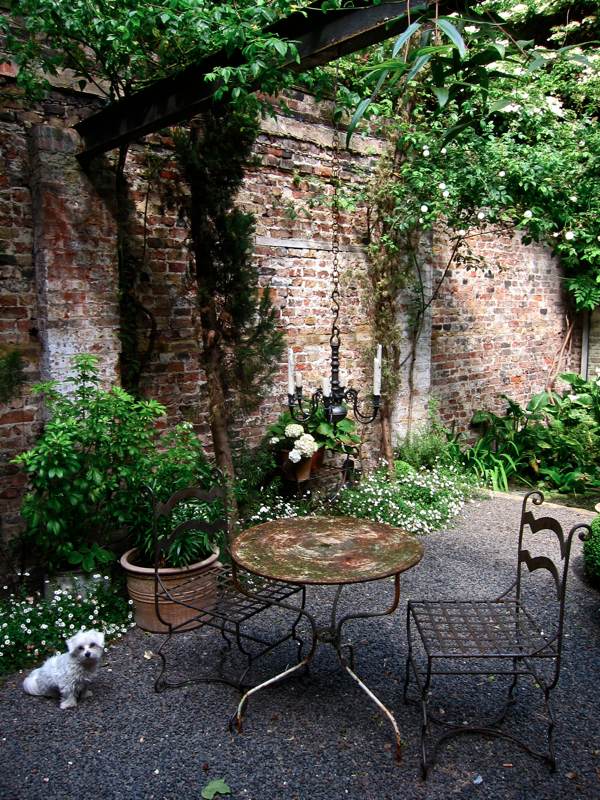
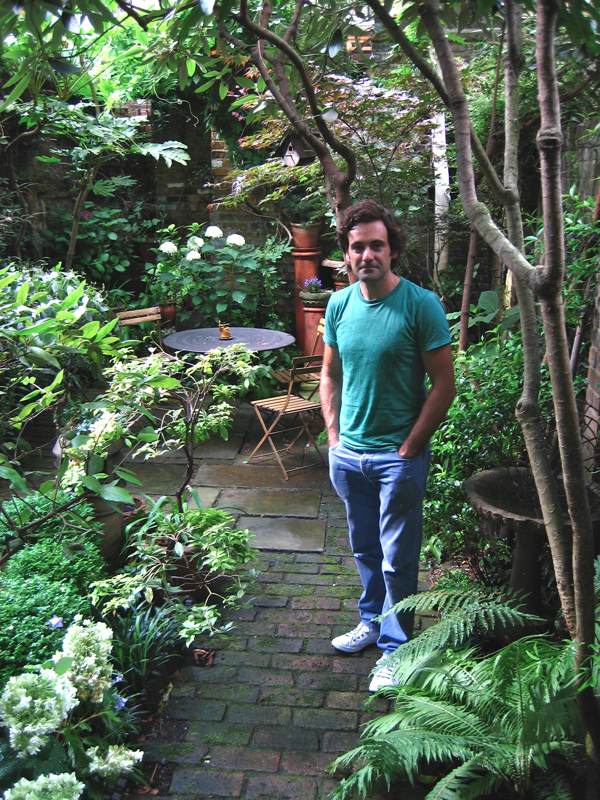
Luis Buitrago, gardener in Fournier St
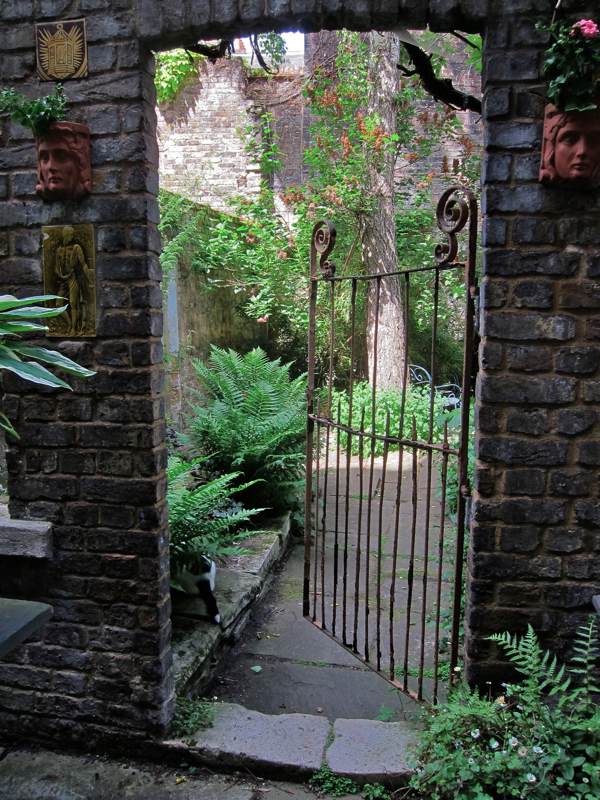
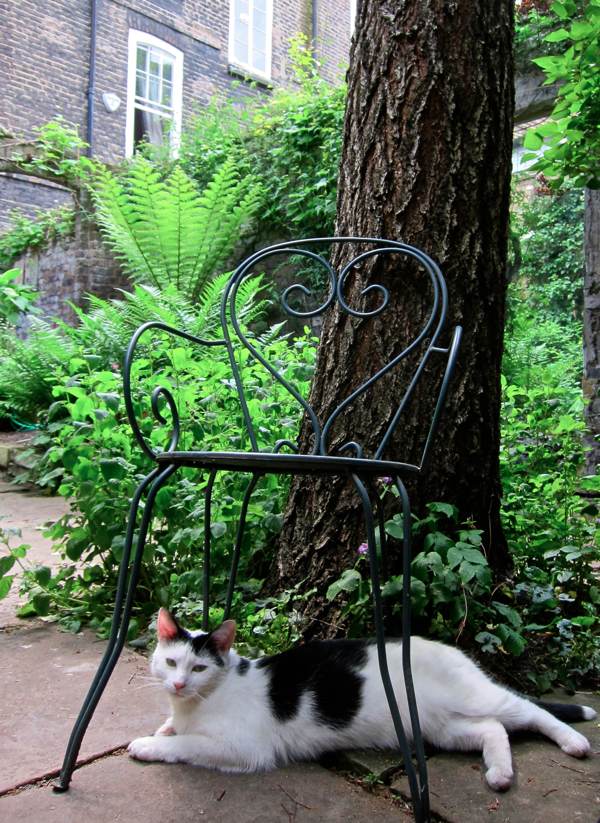
Rodney Archer’s cat
You may also like to read about
Mr Pussy’s New Game

My old cat, Mr Pussy, loves water. While others detest getting their feet wet, he has never been discouraged by rain, even delighting to roll in the wet grass. Consequently, when he languishes in hot weather, I commonly sponge him down with cold water – an ecstatic experience that leaves him swooning.
Although I am conscientious to leave him a daily dish of fresh water beside his bowl of dry biscuits, he prefers to drink rain water or running water, seeking out puddles, ponds and dripping taps. Sometimes when I have been soaking in the bath, he has even appeared – leaping nimbly onto the rim – and craned his long neck down and extended his pink tongue to lap up my bath water, licking his lips afterwards out of curiosity at the tangy, soapy flavour. And when I choose to stand in the bath and take a shower, he likes to jump in as I jump out to lap up the last rivulets before they vanish down the drain.
One day, I took the shower-head and left it lying upon the floor of the bath, switching on the water briefly to wash away the soap in order to leave him clean water to drink. Thus a new era began. He perched upon the rim of the bath, his eyes widening in fascination at the surge of water bouncing off the sides of the tub in criss-crossing currents. This element introduced a whole new level of interest for him and now it has become a custom, that I switch on the shower for a couple of seconds, so that he may leap onto the bath and manoeuvre himself down to lick up the racing trails before they disappear.
It was something I did occasionally to indulge him, then daily, and now he demands it whenever he sees me in proximity – perhaps a dozen times yesterday and sometimes in the middle of the night too. The game begins with the spectacle of the surge of water coursing around the bath. He gets pretty excited watching the rush. And then, as soon as the water is switched off, he lets himself down head first, leaving his back legs on the rim and moving swiftly to slurp up the rivulets as they run. Each time it is a different challenge and the combination of the necessity of quick thinking, of nimble gymnastics and the opportunity of refreshment is compelling for him.
In the winter – you will recall – I found myself letting him in and out of the drawing room door, as he sought respite from the warmth and then re-admission again five minutes later. I am aware of his controlling nature and the pleasure he draws in extricating these favours from me, yet this new game has become a compulsion for him in its own right. When it gives him such euphoria, I cannot refuse his shrill requests, trilling liking a song bird and indicating the bathroom with a deliberate twist of his neck.
From the moment I turn my steps in that direction he is ahead of me, leaping up and composing his thoughts upon the brink with the intensity of a diver before a contest. Hyper-alert when I switch on the tap momentarily, he is rapt by the sensory overload of the multiple spiralling streams of water and intricate possibilities for intervention. Running all the decisions in his mind, he may even make a move before the water is switched off. Unafraid to soak his feet, he places two paws down into the swirling current and starts to lap it up fast. Observing his skill and engagement as a credulous yet critical spectator of his sport, I cannot deny he is getting better at negotiating the bathtub and the runnels. His technique is definitely improving with practice.
Within a minute, the water has drained to trickles and, before I may rediscover my own purpose, he seeks a repeat performance of his new game – and thus, with these foolish pastimes, we spend our days and nights in the empty house in Spitalfields.

You may also like to read
Mr Pussy Gives his First Interview
and take a look at
The Cats of Spitalfields (Part One)
A Walk Down The Mile End Rd
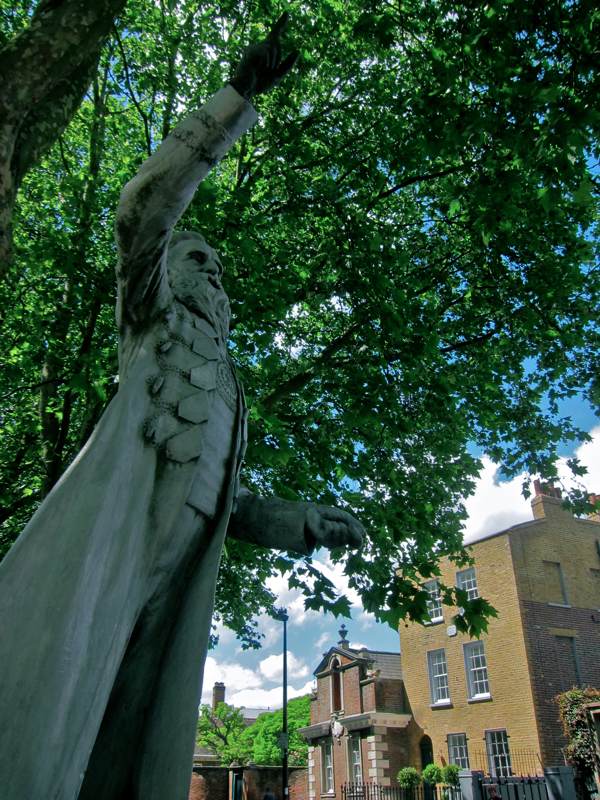
William Booth points the way
It was once the custom for East Enders to promenade along the Mile End Rd at weekends, dressed in their Sunday best and admiring the shop windows, and – in similar vein – I set out down the road with my camera yesterday to record some of the sights for you.
Mile End Rd takes its name from the turnpike in Whitechapel, which stood exactly a mile from the City of London situated at the crossroads where Cambridge Heath Rd meets the Whitechapel Rd. Traders who had come far, bringing their goods to market in the City, would pass through this gate and park their wagons safely upon the wide thoroughfare, spending the night at one of the taverns in Whitechapel, before rising early to arrive in London next morning.
Beyond Whitechapel, lies Mile End Waste where William Booth preached against the degradations of drink in the nineteenth century, giving sermons which led to the founding of the Salvation Army to minister to the poor and destitute that congregated here – and, more than a century later, the Salvation Army still maintains Booth House in Whitechapel to fulfil the same purpose. Yet Booth’s statue by George E. Wade of 1927 stands outside Trinity Green Almshouses of 1695 for “decay’d Masters & Commanders,” revealing an earlier history of this area defined by the proximity to the London Docks.
Just across the road, is the site of Captain’s Cook’s House dating from the eighteenth century, when the land was open upon either side of the Mile End Rd and the masts of ships might been seen by travellers approaching London. Further east, the magnificent terrace built by Anthony Ireland in 1717 and Malplaquet House built by Thomas Andrews in 1741-2, along with equally affluent dwellings on Stepney Green attest to the wealth of those who made their money through maritime trade. Elsewhere, Bellevue Place, Maria Terrace and Mile End Place are more modest dwellings which survive as dignified examples of housing for those employed in local industries, brewery workers and artisans.
Remarkably these fragmentary survivals still hold their own amongst the dense nineteenth and twentieth century developments – accelerated by bombing and slum clearance and now the incursion of the City – and thus the entire history of the East End is to be found along the Mile End Rd.
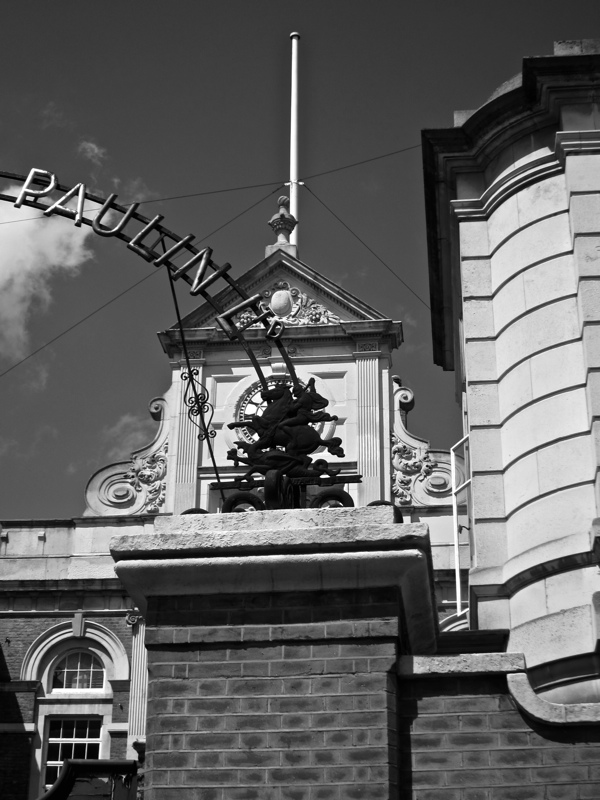
The Albion Brewery, Whitechapel
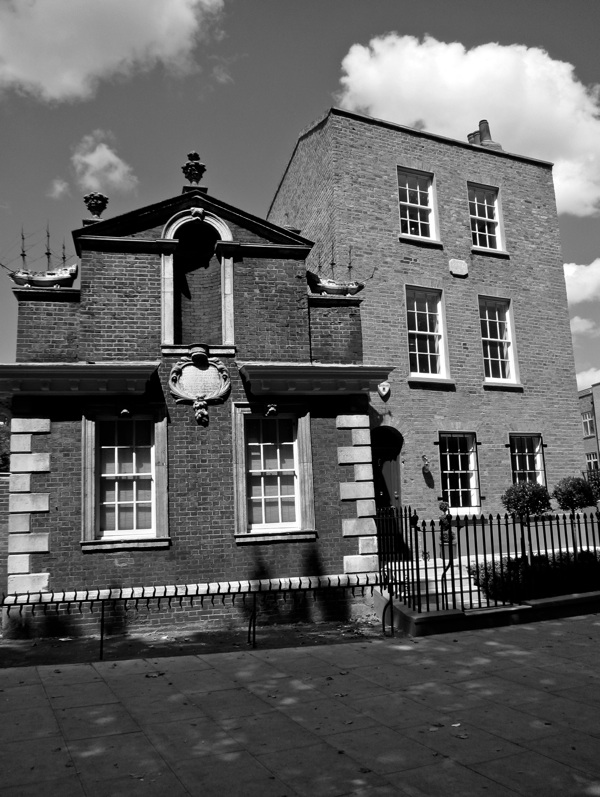
Trinity Green Almshouses beside Park House, built c.1820 by the Barnes family, property developers
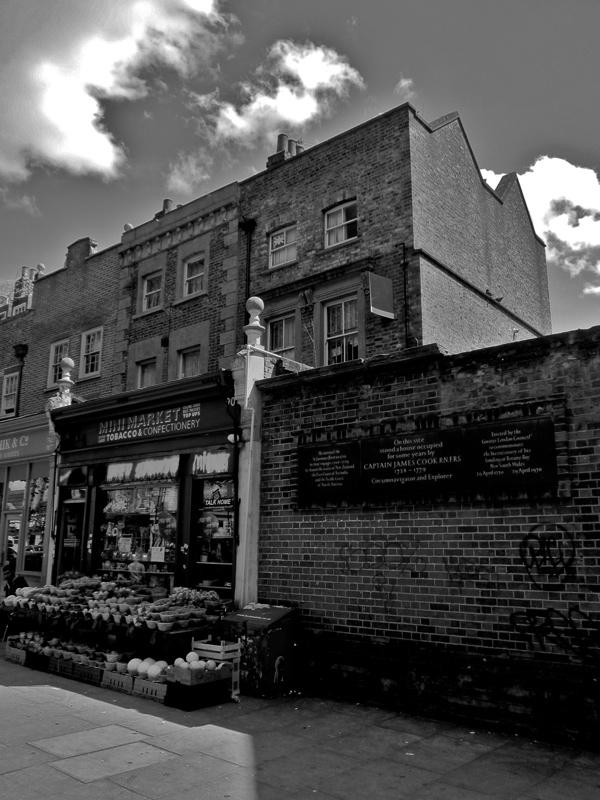
On this site stood Captain’s Cook’s house, demolished in the fifties and commemorated in the seventies
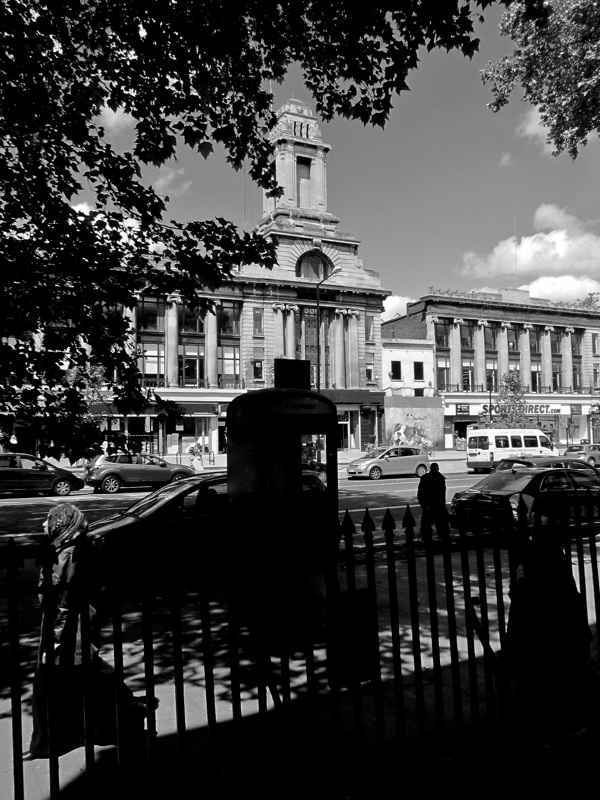
The former Wickhams Department Store, constructed 1927
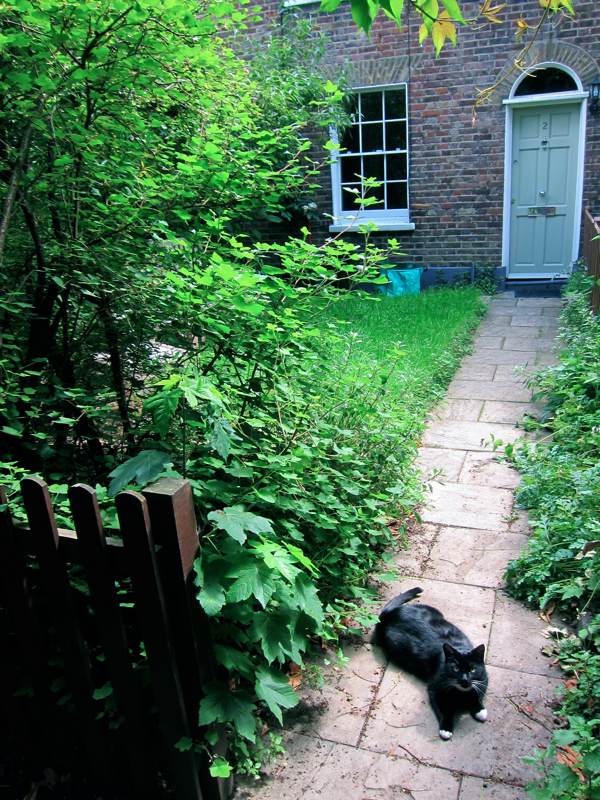
In Bellevue Place, cottages once attached to the Charrington Brewery
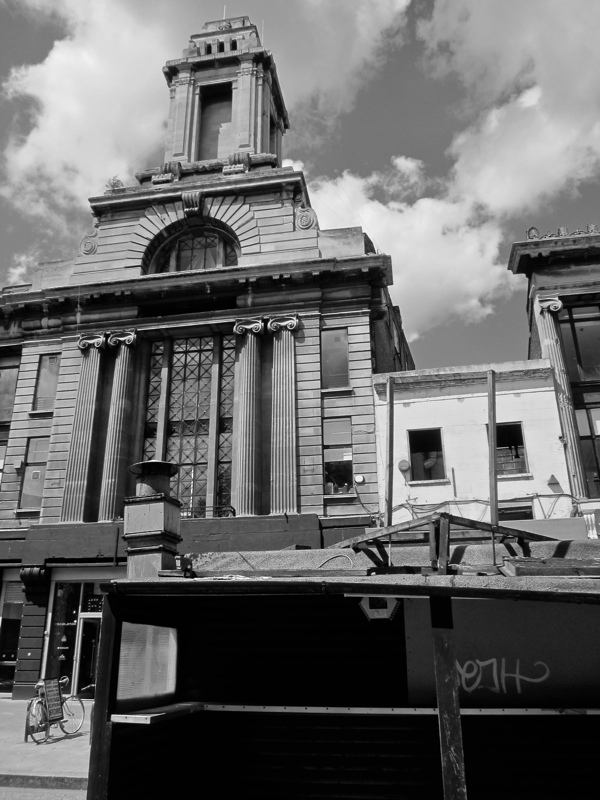
The much-missed Billy Bunter’s Tea Stall
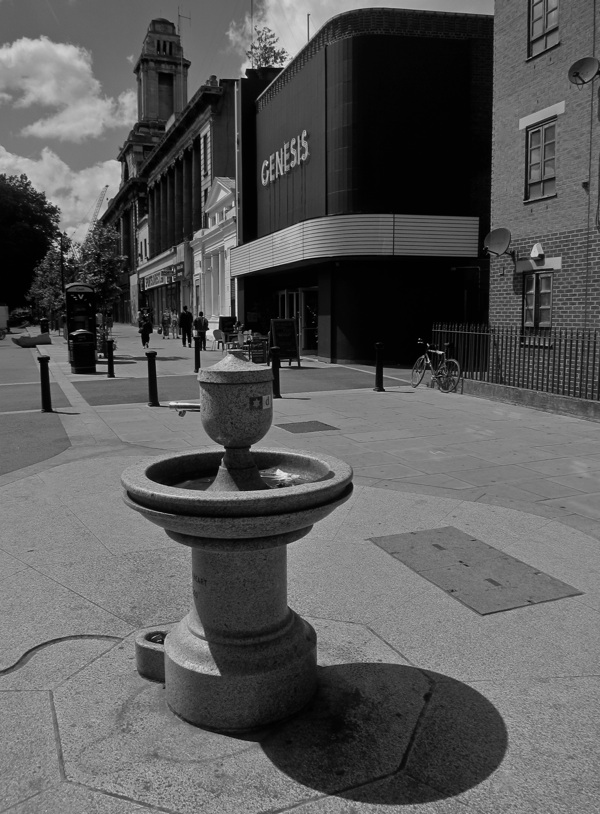
Genesis Cinema, built 1939, replacing Frank Matcham’s Paragon Theatre of 1885
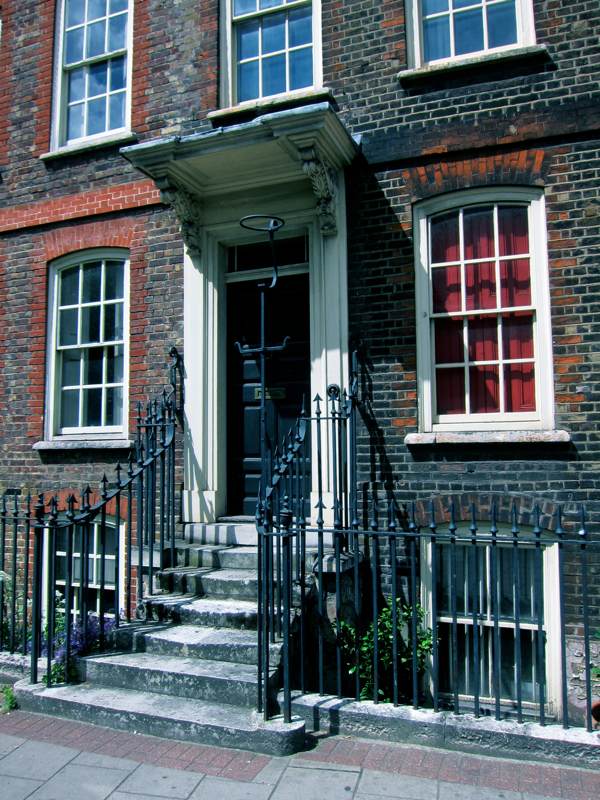
Terrace built by Anthony Ireland in 1717
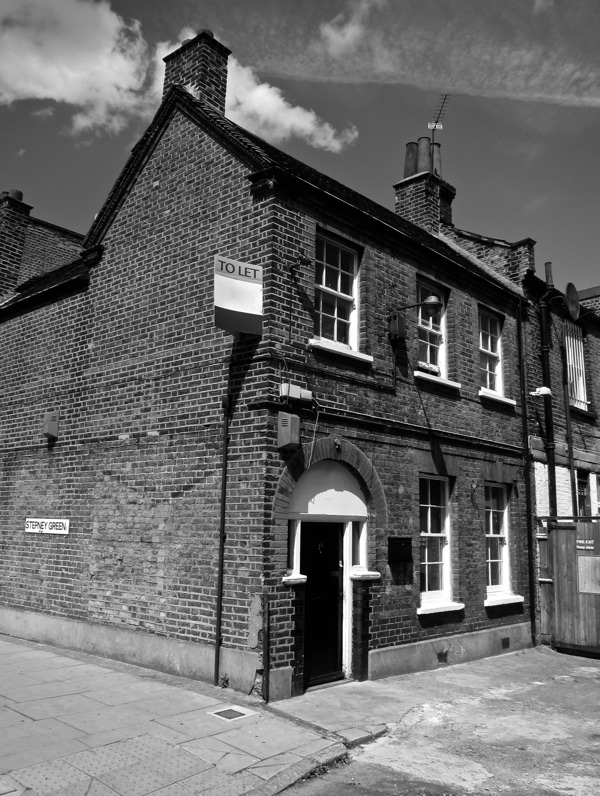
Nineteenth-century cottage in Stepney Green
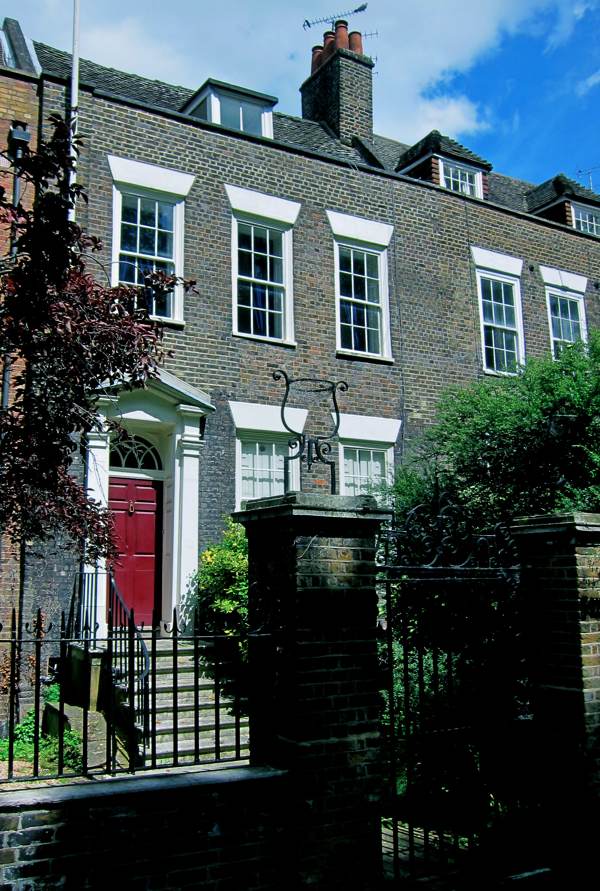
Eighteenth century terrace in Stepney Green

Built in Stepney Green c.1694 for Dormer Sheppherd, a wealthy merchant with overseas connections and acquired c.1714 by Dame Mary Gayer, widow of East India Company’s Governor of Bombay

Malplaquet House, constructed by Thomas Andrews in 1741-2
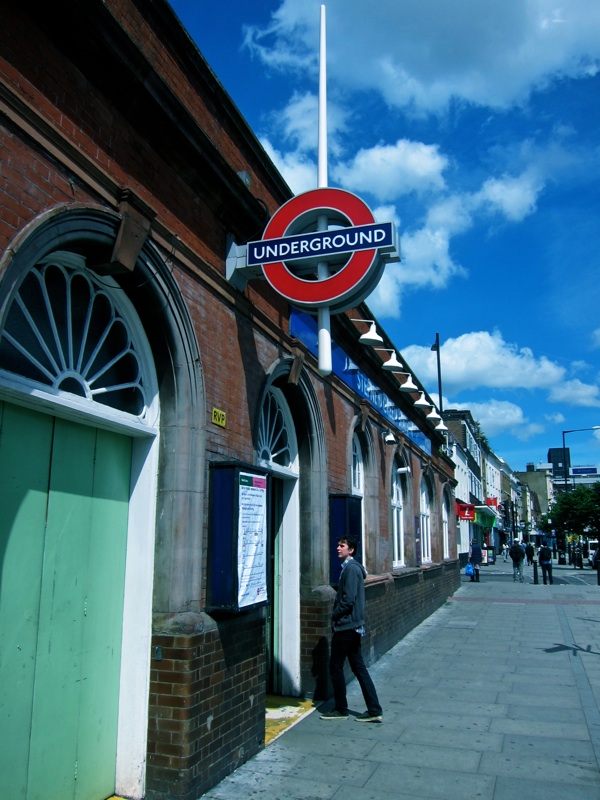
Stepney Green Station by C.A. Brereton, 1902
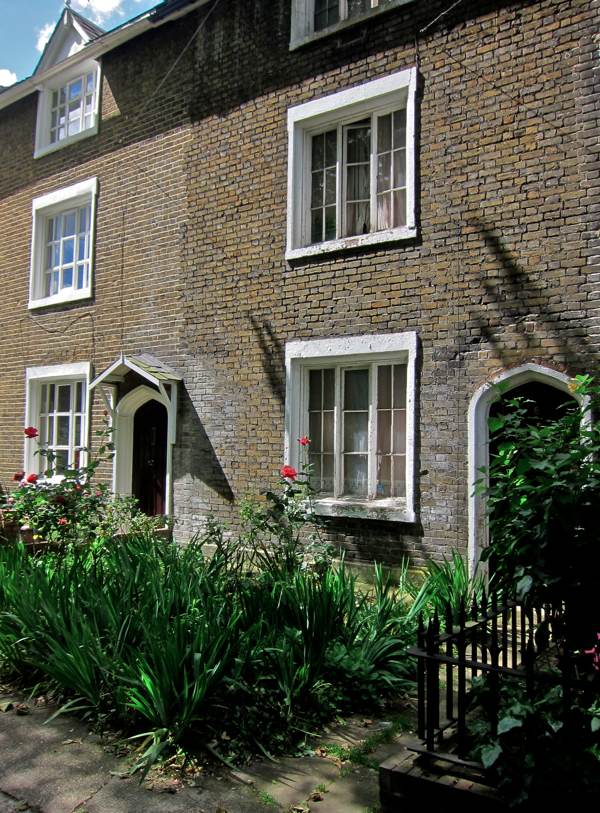
Gothic Cottages in Maria Terrace

Eric Gill’s relief sculpture on the front of the New People’s Palace, 1936

The People’s Palace, built 1886-92
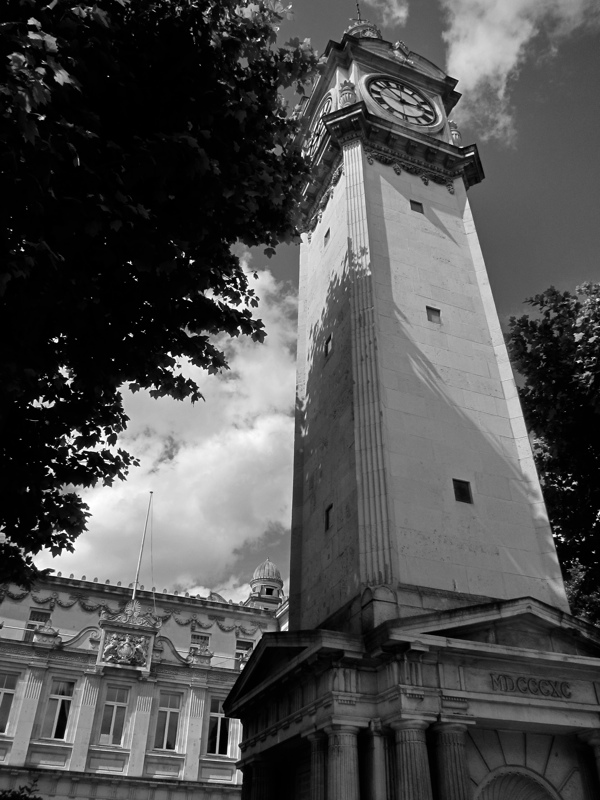
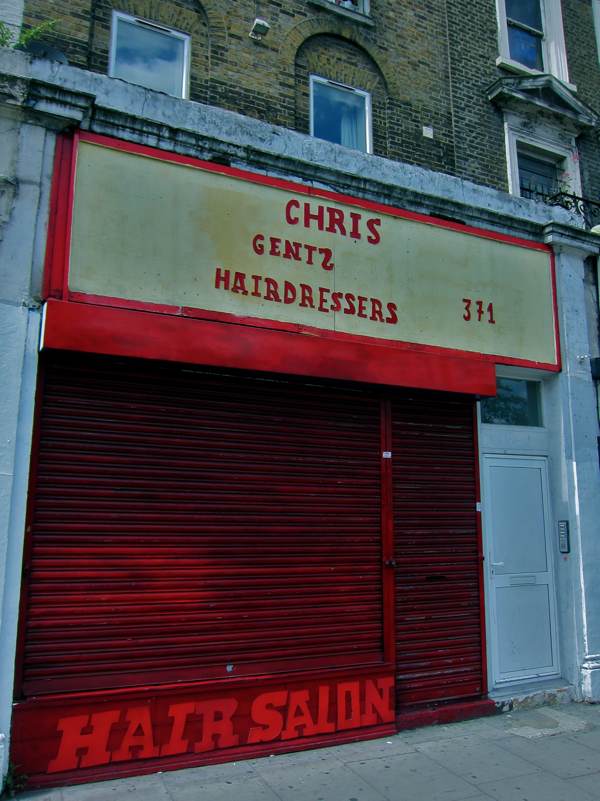
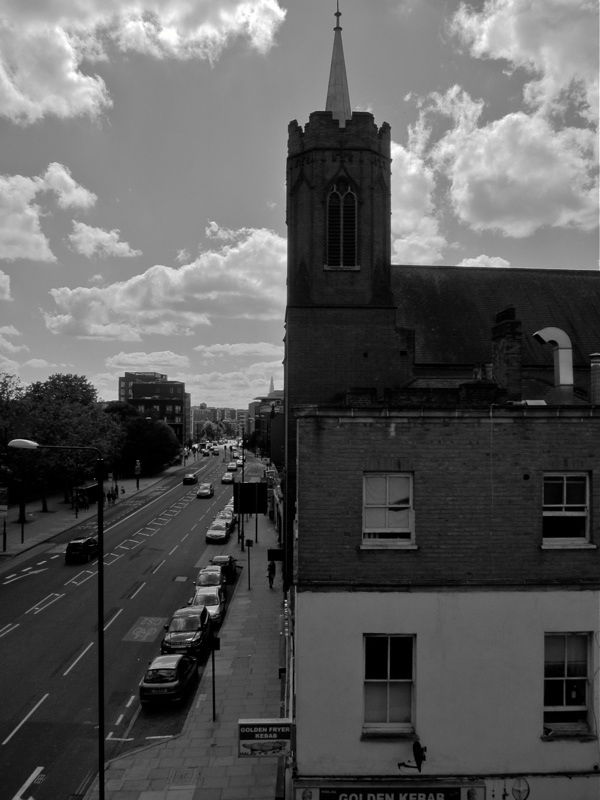
Looking west along the Mile End Rd
You may also like to look at












