East End Saree Shops

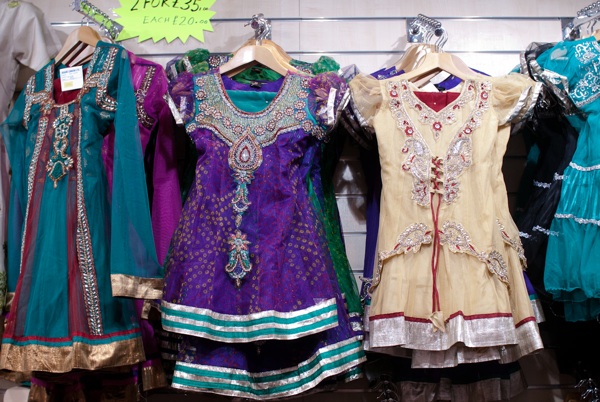
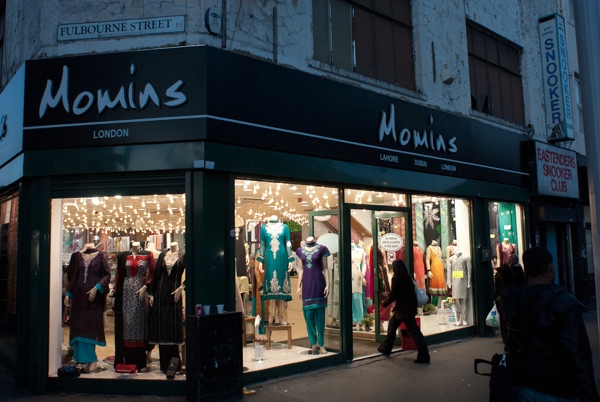
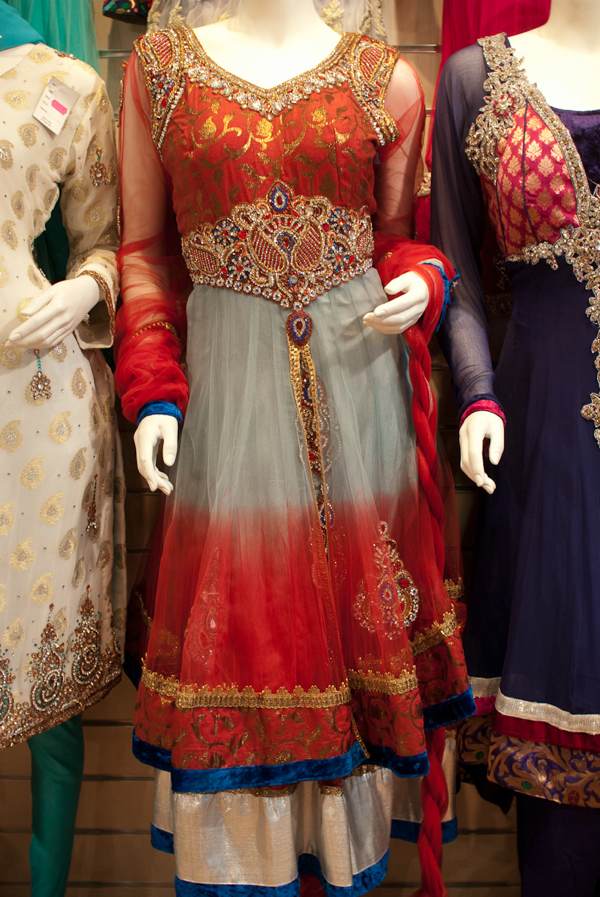
In these days, when it barely gets lighter than dusk and I walk around bent double in the driving rain, I find myself lifting my gaze occasionally in admiration at the illuminated windows of saree shops that cluster in Bethnal Green and Whitechapel. So, when Contributing Photographer Sarah Ainslie brought me these poignant images of saree shops glimmering with colour and light despite the pervasive gloom, I suggested we pay a few of these establishments a call and discover more of the world of the East End saree shops.
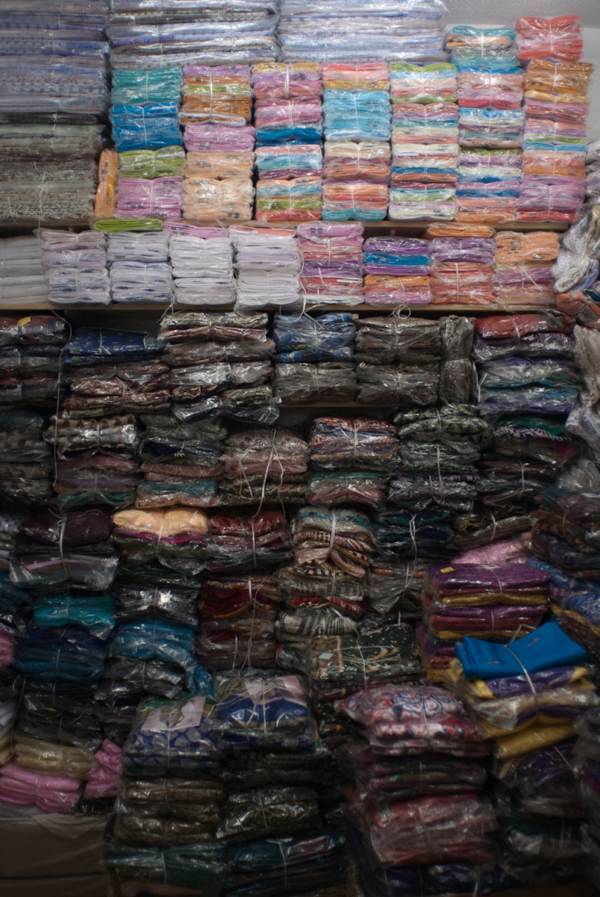
In Bethnal Green, at Zhara Fashion House we were greeted by three women, Majida, Shuheli and Afsana, who have just started in business one month ago, specialising in selling fabric lengths which permit their young customers to make sarees to their own patterns and thus avoid the ready made styles that fill the other shops. Their youthful optimism was in harsh contrast to Abdul Latif at Modhubon Ltd who had been trading for twenty-one years across the road in a shop stacked to the ceiling with sarees folded neatly on shelves. “I used to go to India once a year to buy stock, but not for the last three years,” he confessed with a frown, “I’ve had a very bad run.” Mr Latif’s customers are senior women who have been economising with their purchases, he revealed, and this week, far outside the summer wedding season, he was alone in his magnificently decorated shop like the host of a party to which nobody came.
Yet just a couple of doors down, we discovered a brisk trade at Mahir where lots of saree bargains were to be had in the sale and the entire range of stock was accessible to the eager women browsing on rails. Sumsun Nahar Shirne, the briskly efficient under-manager, explained that this was one of seven branches scattered as far apart as Leeds and Luton, owned by her cousin Shurajul Islam Akbas. “Customers come from as far away as Germany, Italy, France, even America,” she bragged.
Similarly at Zari, next door, where Shofig Islam brought ten years of retail experience at Superdrug to the family business, there was no shortage of customers. Shofig had an impressive array of vibrantly coloured glittering sarees, yet he was eager to stress that he stocked a wide range of different garments to suit the tastes of younger women who like to mix western and eastern clothes in their every day wardrobes and only wear full sarees for special occasions. Alert to social trends, working closely with manufacturers in India to deliver the designs that women want and with his richly-coloured stock creating a dazzling display, Shofig admitted to me that he had been able to expand the business recently.
Taking the stroll down Vallance Rd, we set out to explore the saree shops shining in the shadows of the alleys leading off Whitechapel Rd and – among other delights – discovered the wonders of Zai, a compact traditional establishment where proprietor Helal Khan, who has been in business for ten years, welcomed us kindly. Mr Khan has a loyal trade of local women who frequent his discreet premises with its immaculately organised stock.
The dusk that had prevailed all day turned to darkness as the rain set in again and we just had time left to step into Cuckoo Fashions in Whitechapel Market, which we found remarkable for the selection of panels of richly patterned printed silks at just fifteen pounds each. It was tempting to carry some away but we were spoiled for choice, as we had been all day by the sensuous hues and tinsel on display at every shop we visited. In spite of social changes, we were reassured that the saree shops will be with us for the foreseeable future to bring glitz to our dowdy East End streets. So we set off into the murk with our spirits lifted by the exposure to so much glowing colour and vowed to come back another day.


Abdul Latif, Modhubon Ltd.


Shofig Islam at Zari.




Helal Khan at Zai in Whitechapel.



Fatima Chowdury, Jumara Noor Eli and Sumsun Nahar Shirna at Mahir in Bethnal Green.



Photographs copyright © Sarah Ainslie
You may also like to read about
The Chicken Shops of Spitalfields
The Spitalfields Bowl

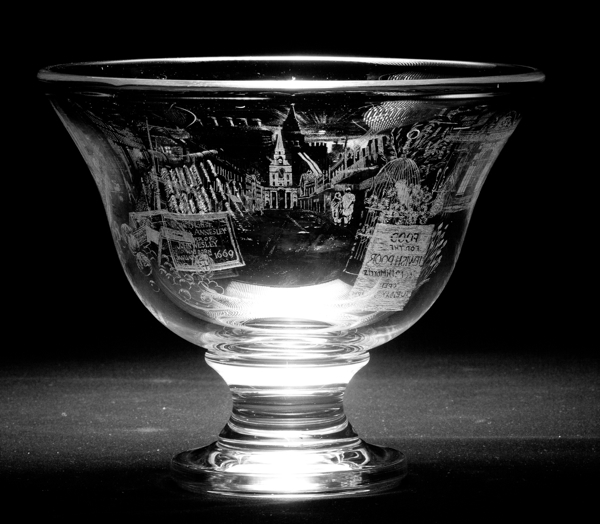
One of these streets’ most-esteemed long-term residents summoned me to view an artefact that – until today – few have seen, the fabled Spitalfields Bowl. Engraved by Nicholas Anderson, a pupil of the great master of the art, Laurence Whistler, it incarnates a certain moment of transition in the volatile history of this place.
I arrived at the old house and was escorted by the owner to an upper floor, and through several doors, to arrive in the room where the precious bowl is kept upon its own circular table that revolves with a smooth mechanism, thus avoiding any necessity to touch the glass. Of substantial design, it is a wide vessel upon a pedestal engraved with scenes that merge and combine in curious ways. You have the option of looking down upon the painstakingly-etched vignettes and keeping them separate them in your vision, or you can peer through, seeing one design behind the other, morphing and mutating in ambiguous space as the bowl rotates – like overlaid impressions of memory or the fleeting images of a dream.
Ever conscientious, the owner brought out the correspondence that lay behind the commission and execution of the design from Nicholas Anderson in 1988. Consolidating a day in which the glass engraver had been given a tour of Spitalfields, one letter lists images that might be included – “1. The church and steeple of Christ Church, Spitalfields, and its domination of the surrounding areas. 2. The stacks, chimneys and weaving lofts. 3. The narrowness of the streets and the list and lean of the buildings with their different doorways and casement windows.”
There is a mesmerising quality to Nicholas Anderson’s intricate design that plays upon your perception, offering insubstantial apparitions glimpsed in moonlight, simultaneously ephemeral and eternal, haunting the mind. You realise an object as perilously fragile as an engraved glass bowl makes an ideal device to commemorate a transitory moment.
“It took him months and months,” admitted the proud owner,“and it represents the moment everything changed in Spitalfields, in which the first skyscraper had gone up and there were cranes as evidence of others to come. The Jewish people have left and the Asians are arriving, while at the same time, you see the last of the three-hundred-year-old flower, fruit and vegetable market with its history and characters, surrounded by the derelict houses and filthy streets.”
Sequestered in a locked room, away from the human eye, the Spitalfields Bowl is a spell-binding receptacle of time and memory.


The Jewish soup kitchen

To the left is the Worrall House, situated in a hidden courtyard between Princelet St & Fournier St


A moonlit view of Christ Church over the rooftops of Fournier St

The bird cage with the canary from Dennis Severs House


“He was a tinker who overwintered in Allen Gardens and used to glean every morning in the market…”

To the left is Elder St and the plaque commemorating the birth of John Wesley’s mother is in Spital Sq.

An Asian couple walk up Brushfield St, with the market the left and the Fruit & Wool Exchange and Verdes to the right
Photographs copyright © Lucinda Douglas-Menzies
On Missing Mr Pussy In Winter
There is an empty space by the fireside since the death of my beloved old cat in August

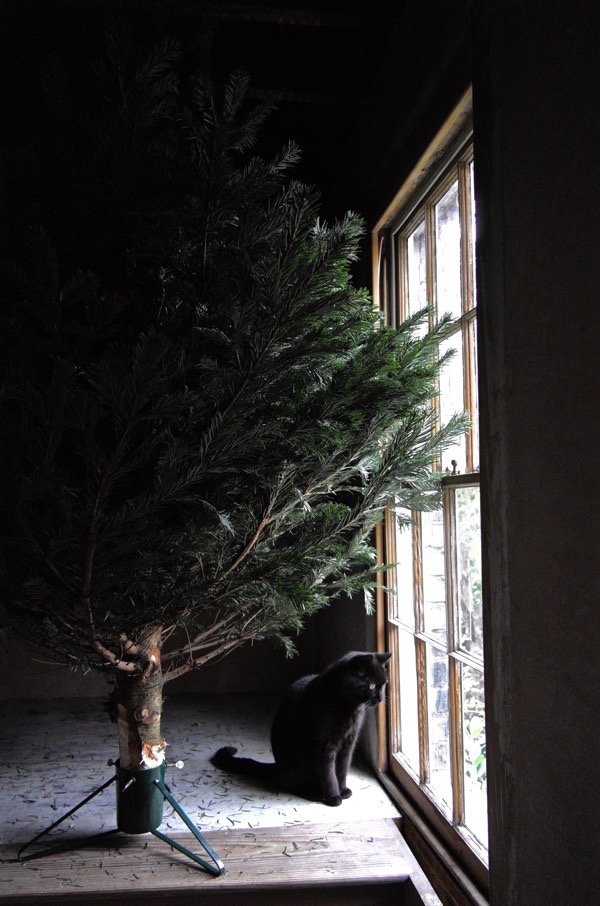
On dark winter nights, Mr Pussy seldom stirred from the chimney corner. Warmed by a fire of burning pallets, he had no need of whisky to bring him solace through the dark hours, instead he frazzled his brain in a heat-induced trance. Outside in the streets, Spitalfields might have lain under snow, the paths might have been coated in sheet ice and icicles might be hanging from the gutters, but this spectacle held no interest for Mr Pussy. Like the cavemen of ancient times, his sole fascination was with the mesmerising dance of flames in the grate. And as the season descended towards its nadir in the plunging temperatures of the frozen byways, at home Mr Pussy fell into his own warm darkness of stupefaction.
When Mr Pussy grew old and the world was no longer new to him, his curiosity was ameliorated by his love of sleeping. Once he was a brat in jet black, yet he became a gentleman in a chenille velvet suit, as tufts of white hair increasingly flecked his glossy pelt. One summer, I noticed he was getting skinny and then I discovered that his teeth had gone which meant he could no longer crunch the hard biscuits that were always his delight. Extraordinarily, he made little protest at this starvation diet, even as he lost weight through lack of food. I learnt to fill his dish with biscuits and top it up with water, so that he might satisfy his hunger by supping the resulting slush. And through this simple accommodation – plus a supplement of raw meat – his weight was restored to normal and he purred in gratification while eating again.
Once Mr Pussy was a wild rover, ranging over the fields in Devon, disappearing for days on end and returning proudly with a dead rabbit in his mouth. Yet in the end, he did not step beyond the end of the alley in Spitalfields and, in sub-zero temperatures, he only ventured outside to do his necessary business. Sprinting up the stairs and calling impatiently outside the door of the living room, he was ever eager to return to the fireside and warm his cold toes afterwards, sore from scraping at the frost in the vain attempt to dig a hole in the frozen earth. Like a visionary poet, Mr Pussy acquired a vivid internal life to insulate himself against the rigours of the world and, in the absence of sunlight, the fire provided his imaginative refuge, engendering a sublime reverie of peace and physical ease.
Yet Mr Pussy still loved to fight. If he heard cats screeching in the yard, he would race from the house to join the fray unless I could shut the door first and prevent him. Even when he had been injured and came back leaking blood from huge wounds, he appeared quite unconcerned. Only two small notches in his ears persisted as permanent evidence of this violent tendency, although I regularly checked his brow for tell-tale scratches and the occasional deep bloody furrows that sometimes caused swelling around his eyes. But I could stop him going out, even though it was a matter of concern to me that – as he aged and his reflexes lessened – he might get blinded in a fight one day, losing one of his soulful golden eyes. Since he was blissfully unaware of this possibility, I had no choice but to take consolation from his response when he could not eat, revealing that Mr Pussy had no expectations of life and consequently no fear of loss. His nature was to make his best accommodation to any exigency with grace.
Be assured, Mr Pussy could still leap up onto the kitchen counter in a single bound. He could still bring in a live mouse from the garden when he pleased and delightedly crunch its skull between his jaws on the bedroom floor. If I worked late into the night, he would still cry and tug on the bed sheets to waken me in the early morning to see the falling snow. When the fancy seized him, he could be as a sprightly as a kitten. Come the spring, he would be running up trees again, even if – in the darkest depth of winter – he only wanted to sleep by the fire.
When I was alone here in the old house in Spitalfields at night, Mr Pussy became my sole companion, the perfect accomplice for a writer. When I took to my bed to keep warm while writing my stories, he was always there as the silent assistant, curled into a ball upon the sheepskin coverlet. As the years passed and Mr Pussy strayed less from the house, I grew accustomed to his constant presence. He taught me that, rather than fear for his well-being, I needed to embrace all the circumstances and seasons that life sends, just as he did.
In the spring of 2018 I will be publishing a memoir, collecting together all the favourite stories of my beloved old cat, entitled The Life & Times of Mr Pussy

You may also like to read
Harriet Slaughter, Florist
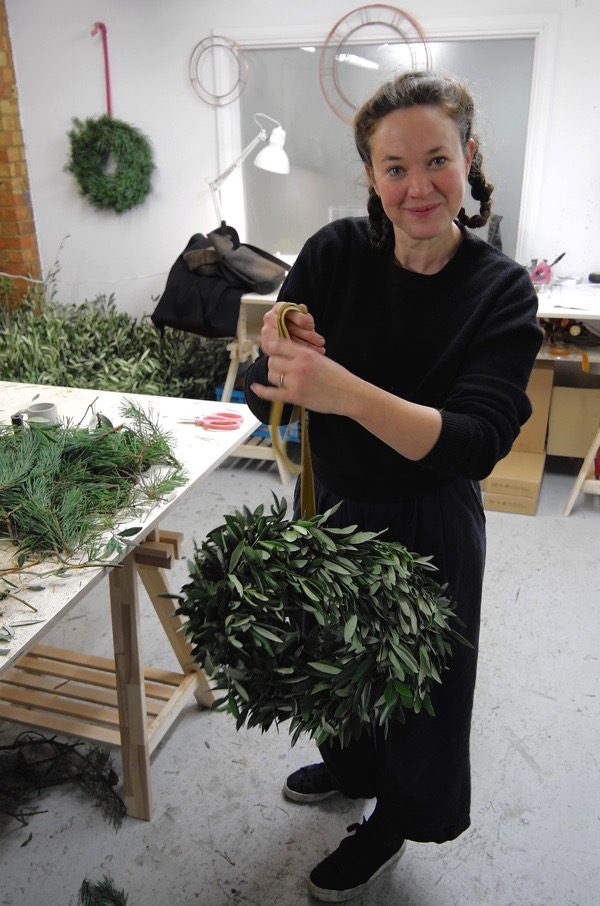
Harriet Slaughter
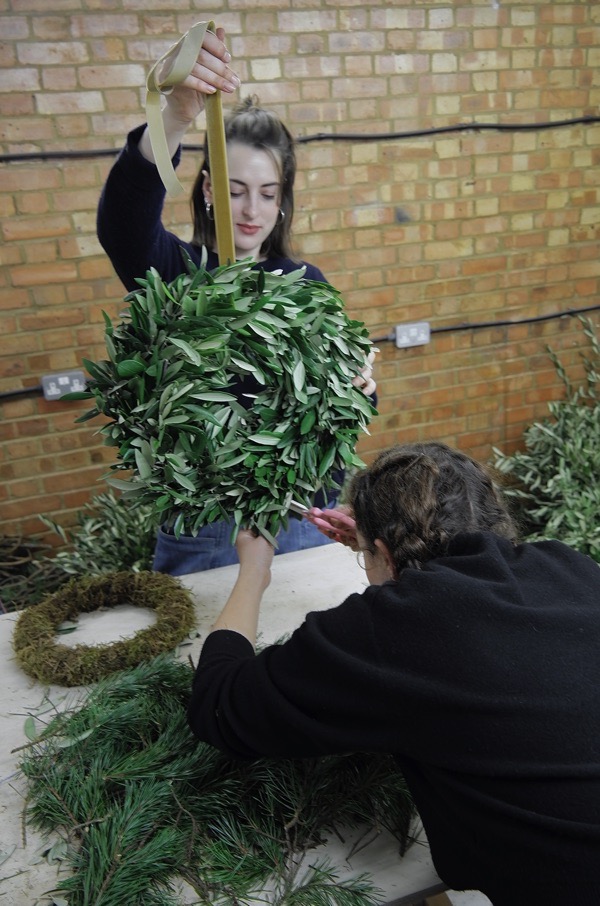
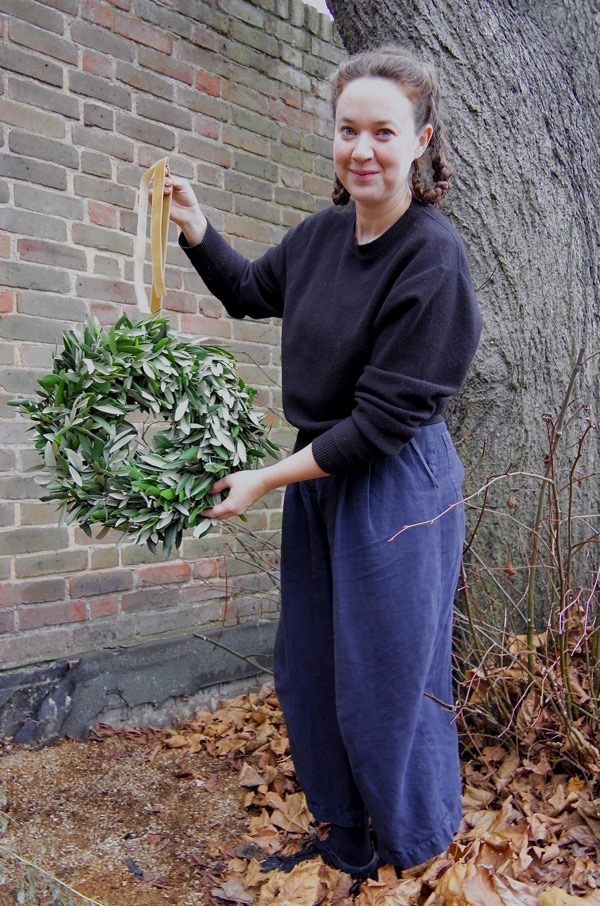
Last week, I braved the frost to visit the workshop of florist Harriet Slaughter and photograph her at work making festive wreaths for St Nicholas Eve celebrations at Leila’s Shop on Tuesday.
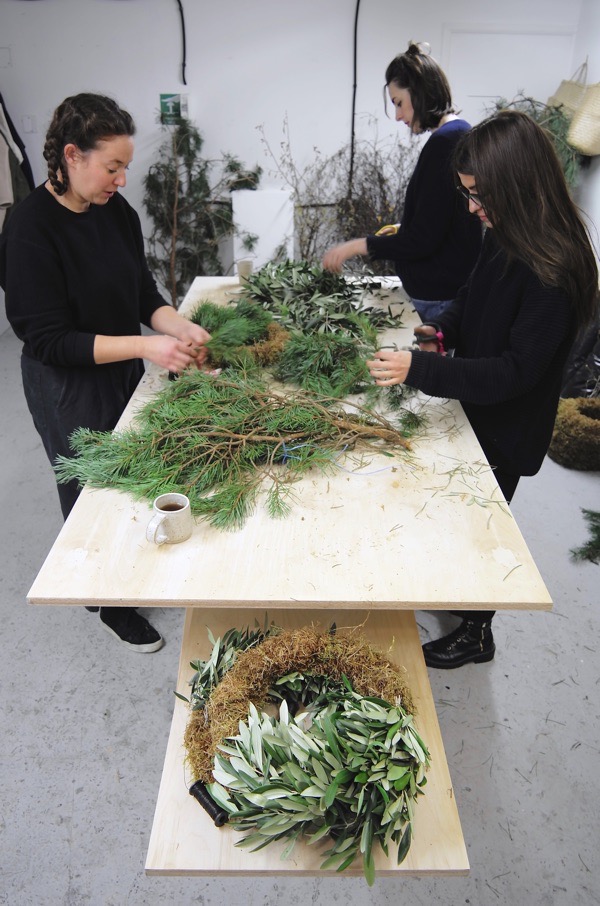
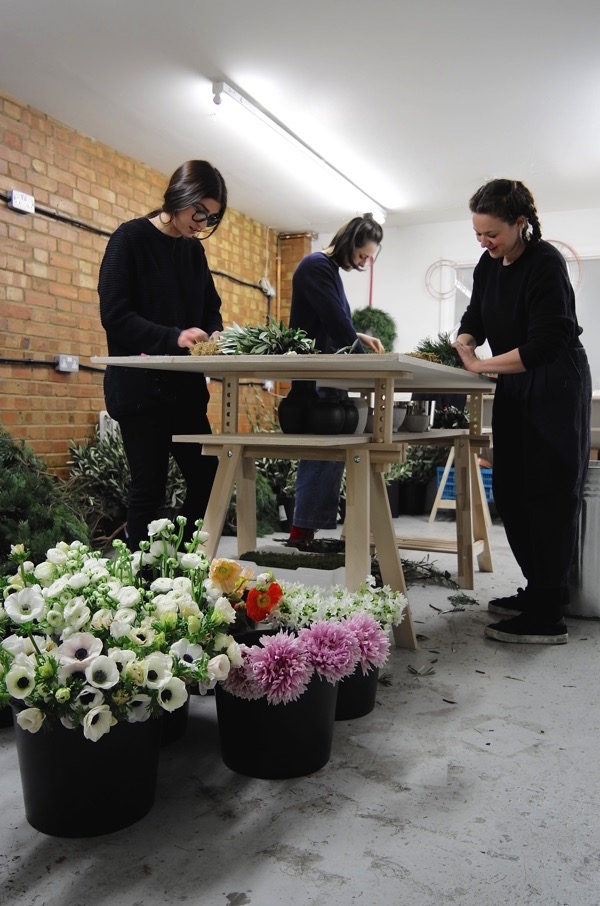
I found Harriet and her assistants Rowan Lewis and Camille Lambert surrounded by copious amounts of sweet-smelling greenery, including olive branches from Covent Garden Market and Scots Pine from her father’s garden. They had been awake since before dawn, and were trimming the pine and olive in sprigs and weaving them onto the moss bases. One held the twigs in place while the other wound the wire around to secure the wreath. Harriet’s hands soon became coated in sticky pine sap and she showed me the old florists’ trick of rubbing her hands with moss to absorb the surplus oil.
It was time-consuming, fiddly, repetitive work, yet it was compelling to observe how the diverse elements resolved into elegant finished wreaths set for front doors across the capital this Christmas. Beneath the bench sat buckets of white narcissi and anemones with some lush dark scabious nearby, all ready for arrangements to be delivered to the Garden Museum in Lambeth that evening. So, once I had taken my pictures and Harriet had told me her story, I left them to their day’s work.
“My dad’s a gardener, he spends every day in the garden and that is how I learnt about plants. My family are all gardeners. We are bonkers about it.
A couple of years ago, I got married and the florist who did our flowers was very inspiring to me. So I asked he if she would train me and in return I did office work for her. I realised that I really liked the work and it has now become a huge part of my life.
I am a studio florist, which means I do not have a shop, instead I do deliveries for restaurants, events including weddings, and photoshoots. It can be quite brutal getting up at three thirty if you have to run a shop as well!
When you get to the wholesale flower market in the middle of the night, you have to go in brave. Ninety-five per cent of those who work there are men and they see a lot of florists starting out but as soon as they realise you are serious then you win their respect. At four in the morning, there is quite a lot of banter and it is quite hard if you have feeling faint-hearted. The flowers do not look good under fluorescent light and it is cold, hard environment. Yet I have developed a good relationship with several traders and I usually bump into a couple of friends. You become really aware of the seasons. I always get excited when the first daffodils arrive and the first day that the English dahlias come into the market is something I look forward to.
It is nice to develop your own style in a saturated market. I love it when I get a sympathetic client and we can design what we are going to do together.
My work is very influenced by the garden, drawing the viewer’s attention to the natural quality of plants and flowers rather than dressing them up too much. I like to create an arrangement that looks like something which might have grown in the garden, but with an urban element too. I am not a country cottage florist. I like my work to communicate a sense of composure without being regimented.“
Harriet Slaughter operates her floristry studio under the name Bold Oxlip
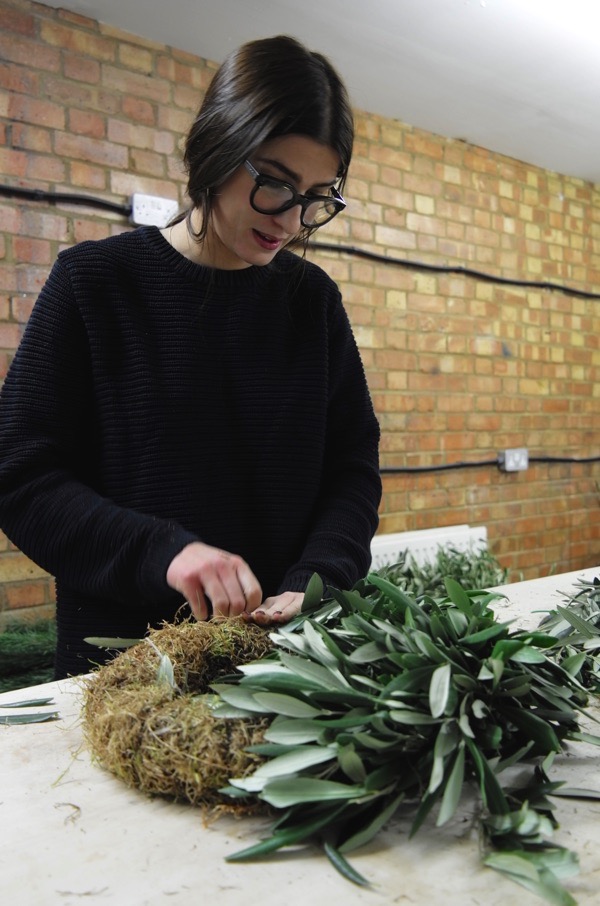
Rowan Lewis
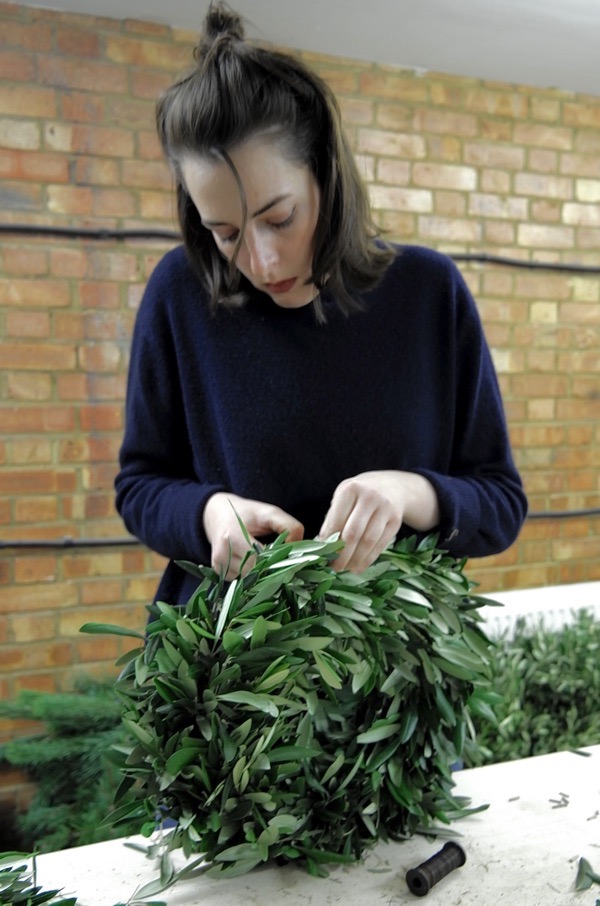
Camille Lambert

Harriet Slaughter’s wreaths will on sale as part of ST NICHOLAS EVE celebrations on Tuesday 5th December 6-9pm at Leila’s Shop, 15-17 Calvert Avenue, E2 7JP. Gimlet Bar will be serving cocktails and Rosie Sykes of The Sunday Night Book will be serving seasonal delicacies.
You may also like to read about
Sarah Ainslie’s Somali Portraits
Contributing Photographer Sarah Ainslie undertook this fine series of Somali portraits, accompanied with eloquent testimonies dictated by her subjects
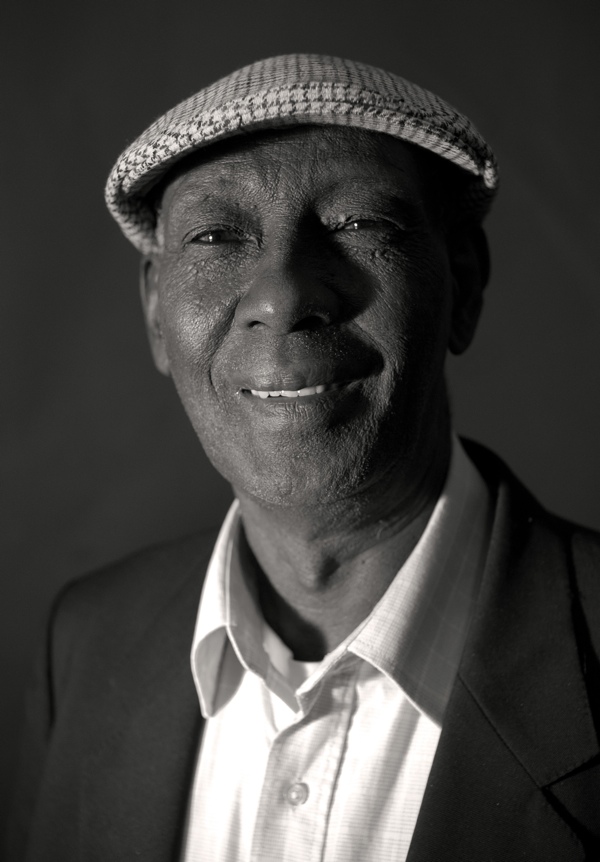
Adan Jama Mohammed – Seaman
“I came to this country when I was twenty years old in 1958. Before than I was in Aden, working on a small passenger boat, but when I came here I was thirty years as a seaman and living in Middlesbrough. I started on 8th April 1959 as a merchant seaman, earning £21.50 a month. Until 1980 it was my job, then I worked on big container ships. We didn’t have much to do. I married in 1987 and I had a family in Middlesbrough, but we had to leave because they closed the docks and the factories. I had a house and a family, and a mortgage I couldn’t pay. The building society said if I didn’t pay £70 a month, they would take the house back. I had to sell the house at half price, and now my children are grown up and don’t want to know me. I live on my own in a flat at the Seamen’s Mission in West Ferry Rd, Isle of Dogs, and my family live on the other side of London. I don’t like living here in this city, there’s too many people – but you can’t help it, if you don’t have a choice. I do have some friends at the Mission. It was a hard life as a seaman.”
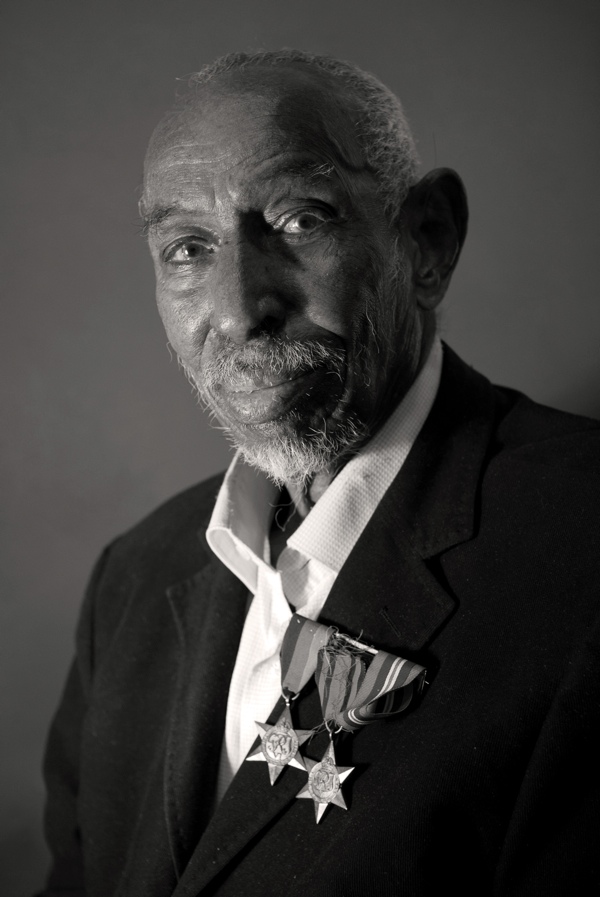
Ahmed Hassan Sulieman – Seaman
“I was born in Aden, when I was a schoolboy everyone over sixteen joined the army. My father was in the First World War and he was killed fighting for the British in Egypt in 1918, when I was four. So my brother and I, we wanted to join the army and take revenge on the people who killed him. All my family were in the army. All the army, they treated us very good – white and black together, no colour bar.
In 1944, I was shot in the leg while I was on a British ship that was sunk by two German U-boats off Durban. We were at sea on a raft for two days and two nights before we were marooned on land without food. I went inland and walked for six days to search for help before the British found us and took us to Durban, and when we recovered they sent us back to fight. In Egypt, four thousand people were being killed a day at that time.
I was also in Germany and Japan, the kamikaze pilots crashed into our ship. It was a very bad war, but we wanted to win – losing was nothing. I am brave because I wanted to beat the Germans and I fought for myself, I didn’t want to be captured. I was happy when we won the war and I’m happy that I’m still alive. I had four medals but I lost two recently, I never asked for them.
At the end of the war, they gave us a passport and a suit of clothes, and they brought us here to the Seamen’s Mission where I live today. So we were quite happy. I’ve been here seventy years. They said you are fit to work and I joined the Merchant Navy. I got £200 a month, before that I only got £24 a month and I had to shovel coal but the food was free. I worked as a merchant seaman until I got too old and I have lived in the Seamen’s Mission for the last forty years. I and my brother we used to go back to Somalia every year, until he was killed in a car crash in Poplar in 1980.
They told me I could bring my family over, but there’s nowhere here for them to stay. I had eight children, all grown up. Now haven’t seen them for over a year and I feel sick, and I want to go home for good. I’m too old and I want to see my children.”

Shamsa Hersi – Manager of Somali Elders Day Centre
“I was born in a town called Burao in Somaliland and I came to UK as a refugee in 1990 when I was a child. From an early age, I wanted to work for UNICEF and in those days my great uncle used to work for the United Nations, he talked to me about his work when I was eight. I cared for my family for many years in Somalia – it is second nature to me, but you have to train to be a Social Worker. I believe that if you can work with people to help them, then it gives you a more rewarding life. I studied at university in the UK and I have a qualification in psycho-therapy and a diploma in working with people who have had traumatic life experiences. It’s about giving something back for the support I received when I came to this country. It takes a lot of guts and hard work and skills to build relationships, but it’s a privilege to work with these people – they are survivors.”
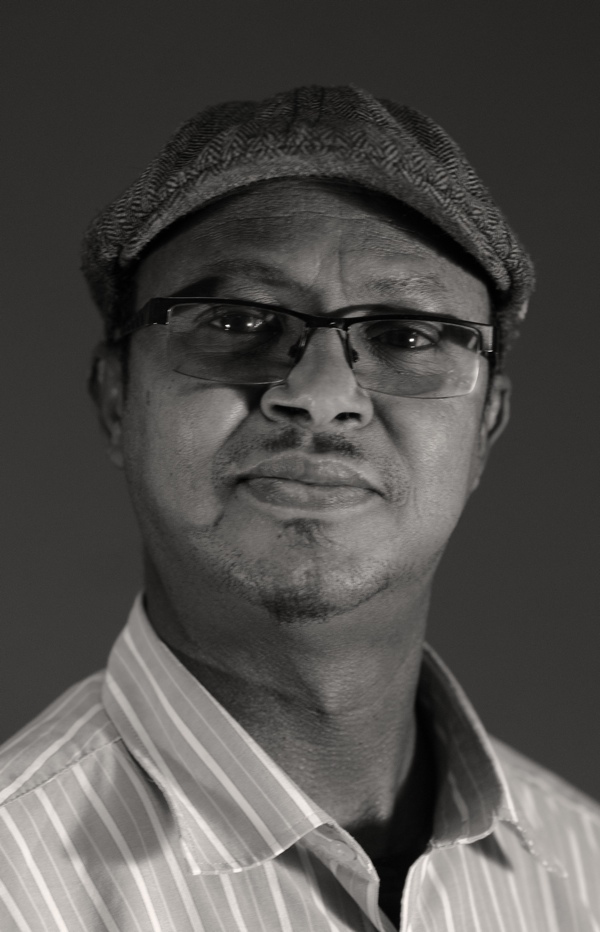
Ali Mohammad – Day Care Officer
“In 1988, there was a civil war in Somalia and I fled to my brother Isaac who was a senior official at the Ministry of Education in Mogadishu. Then, in 1989, there was a massacre – fifty-six people in my tribe were shot. They dug a mass grave and shovelled them in, but there was boy who was not shot and fell in the grave too. He managed to get out and spread the news. My brother told me to go to South Africa or India, anywhere away from Somalia, and he gave me 200,000 Somali shillings and $100. I went to India and then to Bangladesh where I studied at Dhaka University, hoping to come to Europe. My grandfather Uma Hassan sent me some money from London and my visa came through before I graduated, so he told me to come at once and I arrived at Heathrow on August 21st 1992. Because I had a family address, I decided to surprise them. I took a minicab to Poplar and they couldn’t believe it was me when I arrived!
I shared a two bedroom flat with another guy in Woolwich. The country was in recession at that time and there were no jobs. Some of the Somalis who came before me didn’t try to find work, they were so negative. They said, ‘As a black guy, you haven’t got a chance.’ But I tried and, after a month, I got a job as a kitchen porter at Queen Elizabeth Military Hospital in Woolwich, all the kitchen staff and cleaners were employed by a contractor. At first, I found it hard to get all the work completed on time but it got easier after a while. I got £2.85 an hour. Language was a problem and it was a very physical job, I found it exhausting. I couldn’t understand the people I worked with because they spoke colloquially – innit? – whereas I spoke more formal English.
I enrolled at Greenwich University and while I was working seven until seven for five days, on the other two days I did my part-time course. What I earned, I sent home but there wasn’t much left after I paid the bills. I lost my job when the contract ended after one year and eight months but by the time I finished I was earning £4.50 an hour. After three years at university, I left with a diploma in computing but I was unemployed for three months. I could only get work one day a week, doing cleaning and security in the City, I couldn’t find a decent job – they were all shut to me.
Someone told me there was an apprenticeship in Social Care available for a resident of the Ocean Estate. I was still living in Woolwich but I thought, ‘I could move to the Ocean Estate.’ A Somali landlord had a four bedroom flat with an empty room, so I took it and I got the job. They paid £500 a month and I did six months working in Social Care with disabled people, seniors and children. I did well and, in 1995, I spotted a job for a Day Care Officer advertised. By then I had my certificate, so I applied and I won that one. And this is the job I do now here at the Somali Elders Day Centre. I got married in 1997 and I have three daughters and I live in Bethnal Green, five minutes walk from my work. I know everyone in this area.”
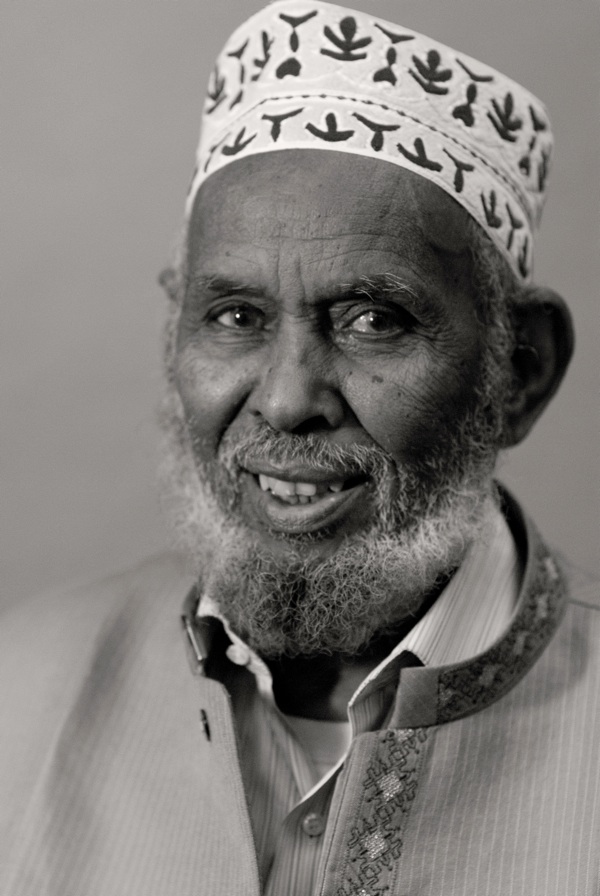
Ahmed Yunis – Seaman
“I came here in 1956 when I was a sailor in the Royal Navy. I felt comfortable in London because at that time my country was a British colony. I came on a Saturday and I left on the Monday. I was only here two days, I went to the Merchant Navy office and they gave me a job which lasted until 1982, when I retired. I lived in Liverpool for twenty-eight years but I consider London my home.
I am ninety-three years old. I have two wives, one here and one in Somalia. My London wife is forty-five and I have four children under eleven, the youngest is six. I am a grateful father. I am also a great-grandfather. If you don’t smoke or drink or kiss women, you stay healthy.”

Kinsi Abdulleh – Artist
“When I got off the plane in the eighties as an eighteen-year-old refugee, I had an older family of relations to go to in Cable St. I remember thinking, ‘We’re going to England.’ and we passed Westminster and the Tower, and we ended up in this run-down, dark little side street. I thought, ‘God, what have we come to? This is really poor, like being in Africa. I’m jumping from the frying pan into the fire!’ But, on the other hand, I fell in love with the place. I went to college and it was exciting that I could get up and go without supervision. I watched the Jackson 5 on TV and bought jeans, even though the older generation expected me to be more conventional. They said, ‘You’ve only been in the city two days and you’re going ice skating!’ They had a false outdated view of my country that I was supposed to believe. I came from the city not the village. People imagine you’ve come from Zululand and you live up a tree. I spent the formative years of my life being displaced, so I should be the one longing for tribal culture, but I am frustrated by the patriarchal tribal culture. I’ve been fortunate to end up in a place where people have extended a hand to me. I can go anywhere in Tower Hamlets, and that’s why I’ve stayed because I can walk down the street here and make my own history.”
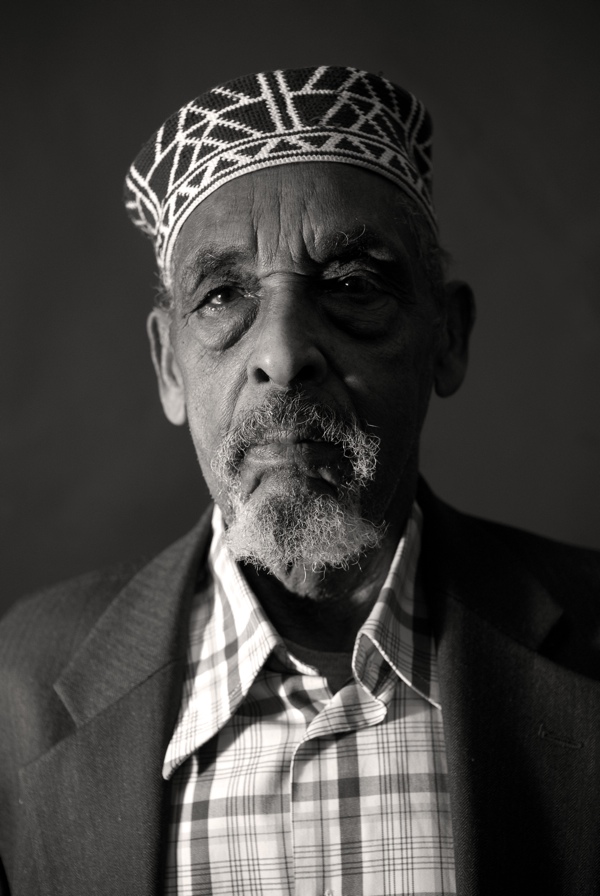
Ali Mohammed Adan – Seaman
“I first came to London by ship in March 1958. I stayed in Aldgate for a night and went to Newport where my cousin had a house. There are many Somalis there. From that day until I retired in 1990, I was in the Merchant Navy, and I brought my family over from Somaliland. In 1970, I moved back to London to Bethnal Green but my wife and daughters chose to stay in Newport.
In Somaliland, I owned over a hundred camels and sheep. Nobody keeps camels anymore, everyone sold them and moved to the city. They say, ‘It’s too much work.’ But keeping camels and sheep and living on a farm, it’s a good life because you eat every day. Everybody wants to do it again now.”
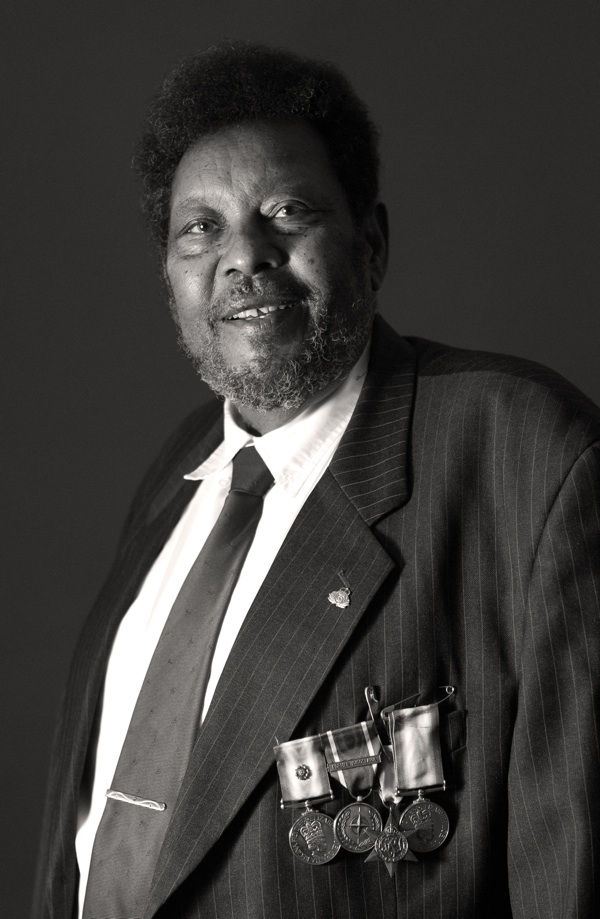
Ismail Ibrahim – Seaman
“I came to this country in 1958 from the South Yemen which was a British colony. I was born a British subject and I am still a British subject. They say to me, ‘Why do you like it so much?’ I say, ‘I don’t know any other government.’ I joined the Merchant Navy in 1960. After we fought in the Falkland Islands in 1982, I came back and joined the Ministry of Defence from 1983 until 2000. I was in Czechoslovakia with the United Nation Forces from 1984-89, then I was in Georgia. I was in Cyprus but when they were going into Iraq, I said, ‘I’m not going.’ I retired four years ago. In the Navy, I worked in the engine room and in the Merchant Navy, I was coxswain.
I was born in British Somaliland, in the city of Berbera, one of six brothers and four sisters. In 1960, we got independence and they joined British Somaliland to Somalia which had been an Italian colony and was run by the mafia – they rape, they kill. So we decided to get our land back and have self-government, and we fought for twelve years. They killed my father, they killed my brother and they killed my children.
In 1991, we got independence again, and we settled down and all was ok in Somaliland. The country needs European help because there are no roads and no facilities. So what can I do now? – I’m ok but a bit old. I’ve got four boys and two girls, and an ex-wife in Somlia that my brother took on, and a wife here in the City Rd that I don’t live with. I was away on a ship while my children were being born, I was always at sea not here with my children as they grew up. They don’t know me. My life was sea, sea, sea.”

Ahmed Esa – Seaman
“I joined the Navy in 1953 in Aden, I was a young guy and I just wanted to work and visit other countries. I came to Plymouth in 1953 and stayed with the Navy until 1969 when I joined the Merchant Navy. I retired in 1988 after thirty-nine years. My brother was in the Merchant Navy too, he was younger than me. He came to London and enlisted, but I never worked in London. All that time, my family was at home, so I fetched them here and they live in London now. I haven’t been back to Somalia since 1996, I can’t afford to cost of the trip. Being in the Navy, it was a hard life – all that time at sea, even if you got to different countries. I’ve have no home, I’m living here in the Seaman’s Mission and waiting for flat of my own. I’m a single man again, now my children have grown up. My brother caught a virus and died in Forest Gate. Life in London is solitary, though I have a few friends at the Mission from the Merchant Navy. I was a deck hand, a carpenter and an able-bodied seaman, an odd-jobs man.”
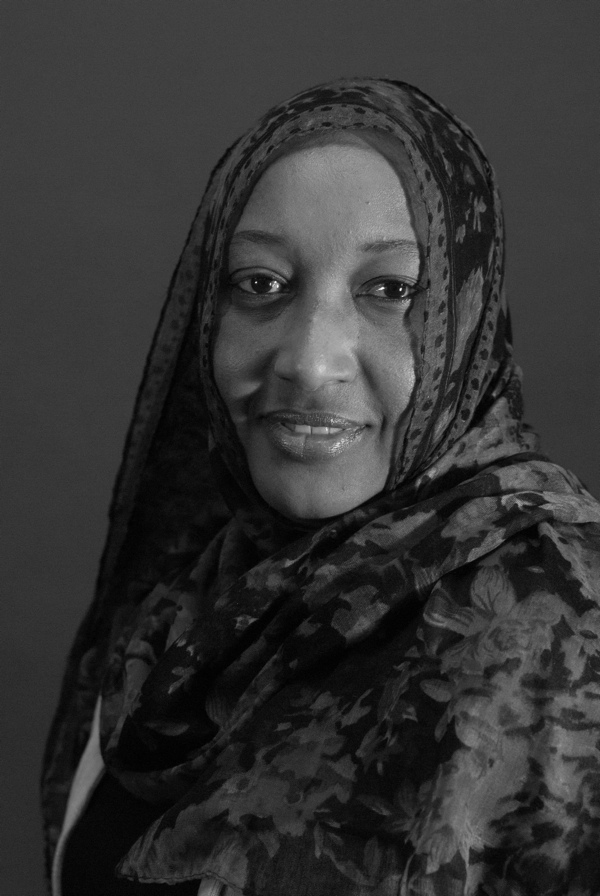
Yurub Qalib Farah – Day Care Officer
“I came to this country on my own as an asylum seeker in 2001. I had friends here to stay with and I went to college in Haringey, studying English Language and Computers – before I came this country I was working as a secretary. In 2002, I started searching for work, and people said Tower Hamlets is the best place to find a job and I learned that Mayfield House was advertising for a Day Care Worker. I called up the number and came for an interview with the manager at 2pm on November 11th 2002, and I have worked here ever since. My ambition is to help people and be a good care worker, and in this job I am using the experience I have had to help others. I got married in February 2004, and we don’t have children but my sister came to join us. I went back to visit my family in Somalia for the first time in ten years last Christmas. There had been some changes and my friends had moved to a different area, so it was like another country to the one I knew. It was safe but so hot. I think I have two homes, here and there – and I’m glad to have that. When I said to my friends, ‘I’m going home,’ they say,‘Which home?’ And then they say, ‘Can we come with you?'”

Ahmed Awad Yusuf – Seaman
“I first came here in 1959 at nineteen years old. At that time Somalia was a British colony and I had a British passport. Seven of us, we took a ship to Marseilles and caught a train to Dover and then arrived at Liverpool St. There were a couple of Somali coffee shops in Leman St and I stayed at one for three days. A friend of mine lived in Newport so I took a train from Paddington and stayed with him for four weeks, and then I lived in Cardiff for three years. First of all, I went to the Social Security and they gave me £2.10 a week, while I was looking for a job. I worked three years in Cardiff Dock. The Merchant Navy were looking for seamen and they gave me a job for twenty six and a half years. I moved back over here to London in 1965, and I lived in Leman St, Cable St and at the Seamen’s Mission in East India Dock Rd, and in 1984, I returned to Somaliland. But in 1990, I came back here with my wife and children. I live in Leman St, it’s the place I first came and it’s where the people I know are. I’ve been all over the world, Africa, Canada, Australia, New Zealand, Gulf States, China, Japan – all the places the British ruled.”
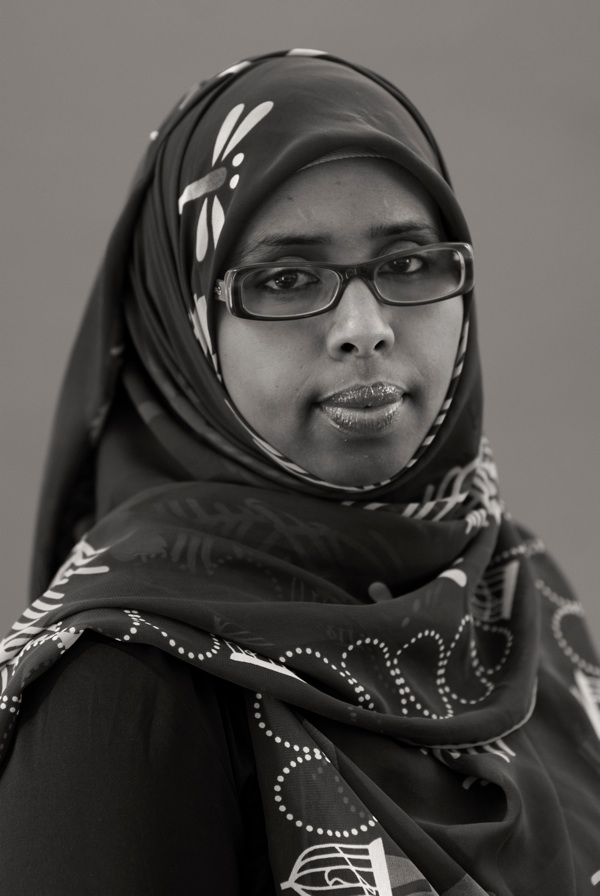
Ruquiya Egeh – Housing Association Manager
“I came here in 1988 as refugee from Somalia at the age of fourteen. I came speaking not a word of English. I was one of twelve children, but both of my parents were teachers and my father was able to send money to support us. Fortunately, my elder sister who I came with was nineteen, that’s why we weren’t fostered, she was old enough to be my guardian. At first, we were taken to the Home Office and then sent to a refugees’ hostel somewhere in London, before being taken to temporary accommodation in Forest Gate. We met some Saudi people at the mosque and I was able to go to Swanley School in Whitechapel. But the other pupils treated me as a stupid person because I couldn’t speak the language and I had playground fights because I thought they were swearing at me. Within a space of two years, I managed to learn enough English to pass seven GCSEs. I came from a good educational background and I wanted to prove I knew something.
I found college much more difficult because there was less support yet I managed to pass Health & Social Care, but I hated it and my sister went through depression at that time too. In the second year of college, I changed courses so that I could use my strengths and I did Arabic, Maths, Chemistry, Biology and Physics, and I did well and applied to University. Getting into University was a big deal and I studied Biomedical Science at Greenwich University. I got married in my second year of college and became pregnant with my first child, which let me down because I was so exhausted I fell asleep in classes. But my husband supported me and his parents looked after the baby so I could work. By the third year of University, I had three children. It made me want to achieve, I was the first person in my family to get a University degree and, when I rang my father, he said, ‘Well done, you made me proud. You were my first child to go University, now I can hold my head up.’
When I work with people who have got language problems, I know their frustration. Now I’m pushing my children. I say,‘You’ve got to be first in the class,’ just like my father said to me. I tell them, ‘If you have a good education, you can get a good job and earn good money. Knowledge is power.'”
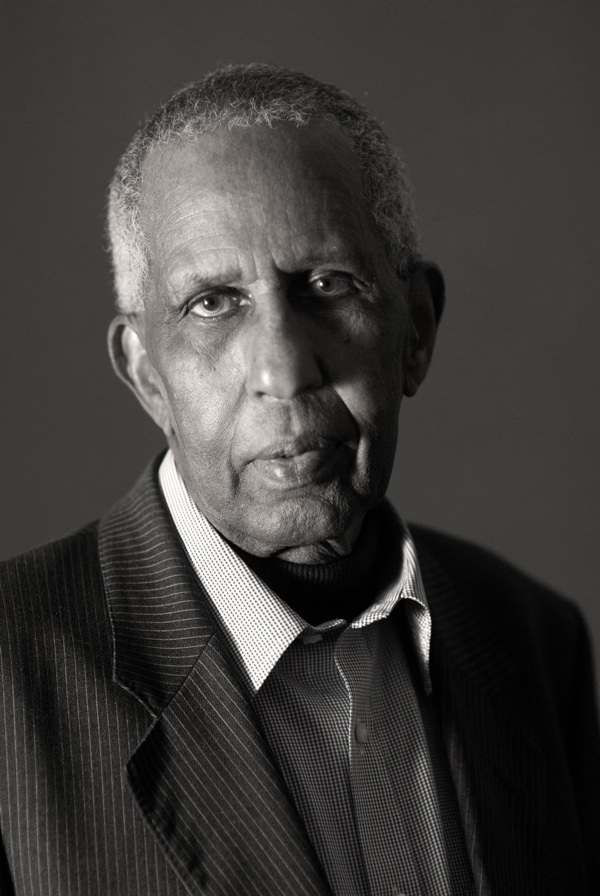
Mahoumed Ali Mohammed – Seaman
“I came to London in 1948 and I stayed here at Seaman’s Mission for a while and for four months at the Strand Palace Hotel. I worked for the British railways for twenty years, as a porter, as an assistant lorry driver and in signalling in the Underground. Then, in the seventies, I joined the Merchant Navy and the Royal Navy for another twenty years until I retired in 1992. I was based in Cardiff but I came back to London in 1996. I have a girl and boy and my wife lives in Cardiff. When I called and said,‘I’m going to London,’ she said, ‘I’m staying here with my kids.’ I’m eighty-eight now and I live in Bethnal Green.”
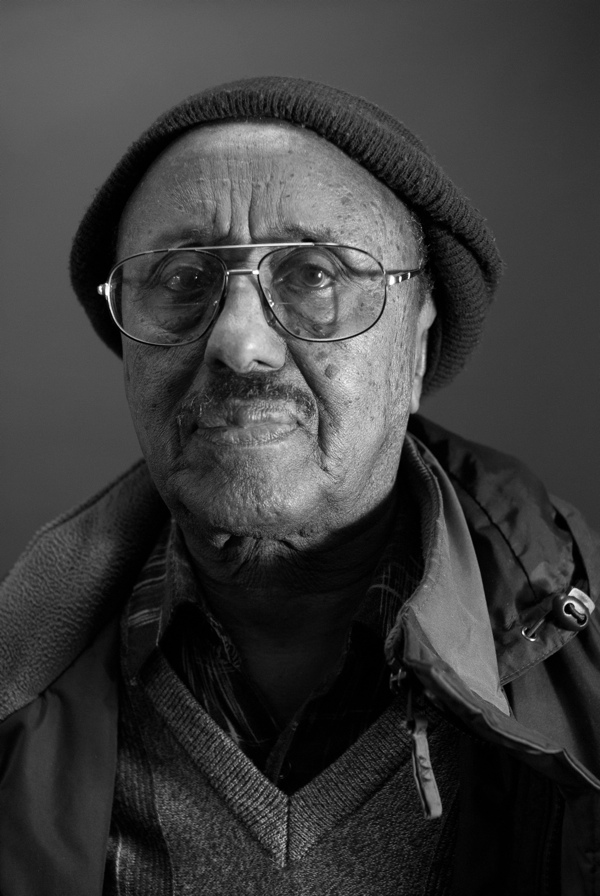
Ibrahim Abdullah – Surveyor of Works
“I first came to London in 1956 and studied at the Brixton School of Building for a Diploma in Civil Engineering and then I went back home. At that time, the British ruled the country and I became a Surveyor of Works. I did not return to Britain until 15th June 1990, fleeing the Civil War, and then I brought my wife and family with me. We became British Citizens and now I come regularly to Mayfield House Day Centre to meet other Somalis who were seamen, and there are lots of them. I find it calm and cool, no problems here.”
Photographs copyright © Sarah Ainslie
You may also like to take a look at
The Map Of East End Independents
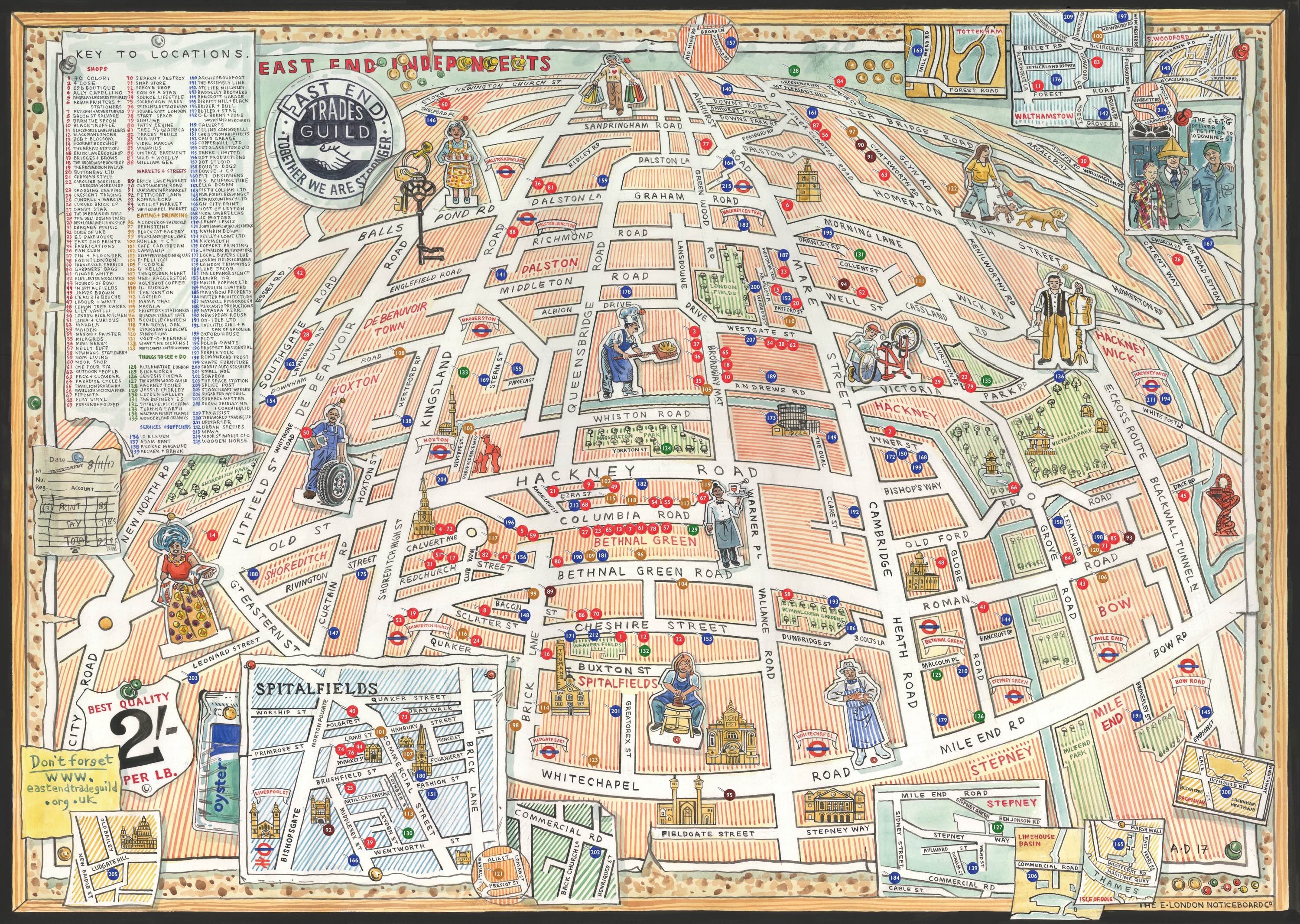
Click on this map to enlarge it and explore
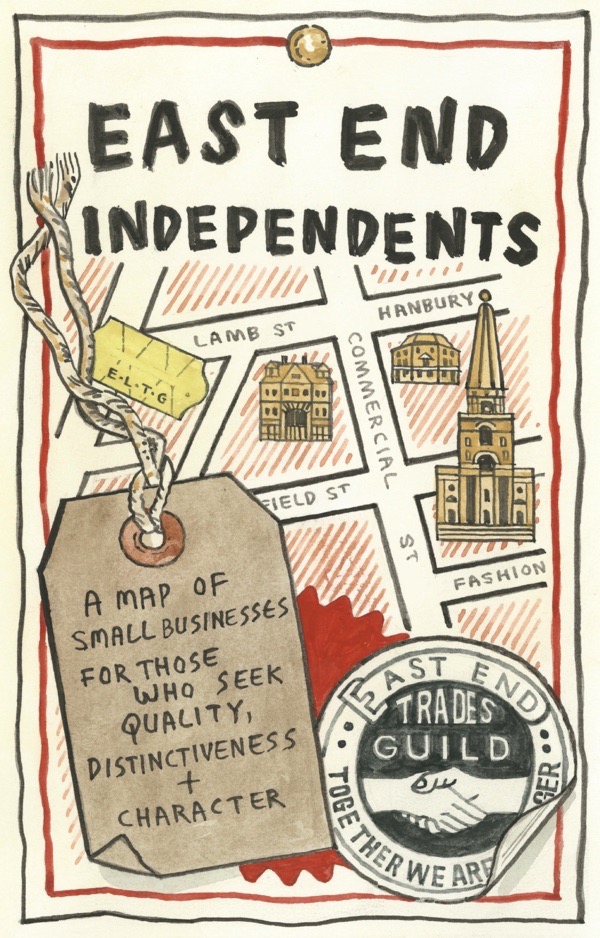
The East End Trades Guild commissioned this map from cartographer extraordinaire Adam Dant, featuring the independent shops and small businesses of the East End. Twenty thousand copies have been produced by Herb Lester and printed by Calverts of Bethnal Green, and Adam’s original artwork will be exhibited at Pelliccis’ Cafe this Friday and Saturday. You can pick up your free copy there and at any of the places featured on the map as part of East End Independents Weekend 1st, 2nd & 3rd December, encouraging everyone to support their local shops and businesses.
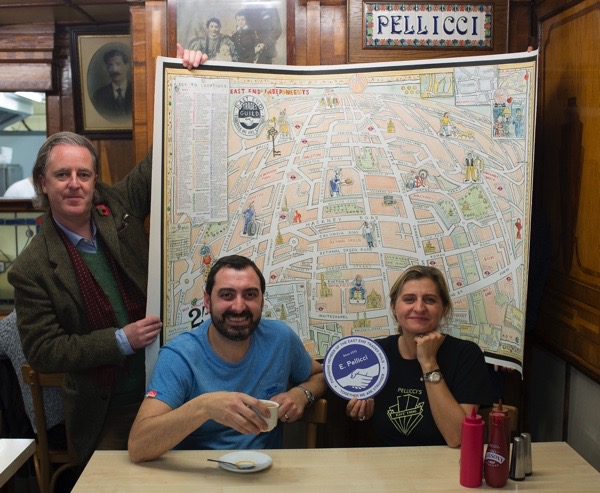
Adam Dant with Nevio & Anna Pellicci photographed by Sarah Ainslie
“The map is a panorama of the East End and what makes it tick, from cafes, mechanics, independent shops and traditional trades to new industries – there’s a whole range. It is a trompe l’oeil noticeboard with stuff pinned on; keys, receipts, photos and invoices. Using a corkboard effect and layering maps and pictures on top proved a good solution when we have so many trades to feature in the East End.” – Adam Dant
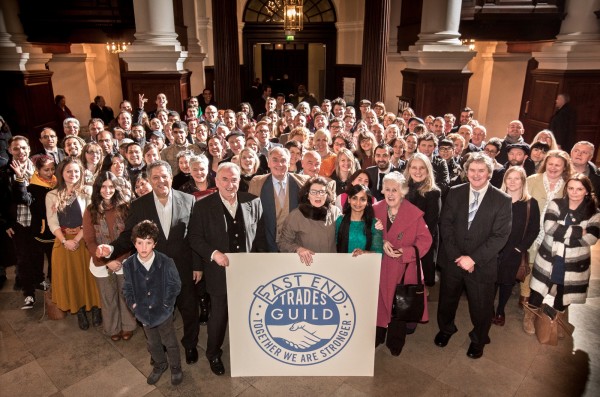
The founding members of the East End Trades Guild photographed by Martin Usborne

You may also like to read about
The Founding of The East End Trades Guild
A Petition to Save Our Shopkeepers
Paul Gardner Goes To Downing St
At St George’s Lutheran Church In Aldgate
There is an ideal opportunity to visit the atmospheric St George’s German Lutheran Church in Aldgate for an Advent Concert next Wednesday 6th December at 7pm. Tickets are £6 on the door, including free gluhwein and stollen.
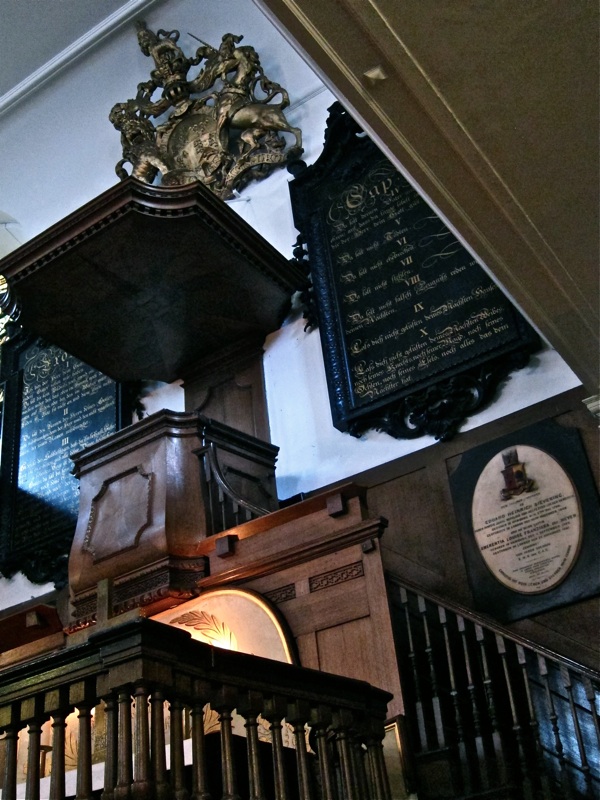
The Altar and Pulpit at St George’s German Lutheran Church, Alie St
In Aldgate, caught between the thunder of the traffic down Leman St and the roar of the construction on Goodman’s Fields sits a modest church with an unremarkable exterior. Yet this quiet building contains an important story, the forgotten history of the German people in the East End.
Dating from 1762, St George’s German Lutheran Church is Britain’s oldest surviving German church and once you step through the door, you find yourself in a peaceful space with a distinctive aesthetic and character that is unlike any other in London.
The austere lines of the interior emphasise the elegant, rather squat proportion of the architecture and the strong geometry of the box pews and galleries is ameliorated by unexpected curves and fine details. In fact, architect Joel Johnson was a carpenter by trade which may account for the domestic scale and the visual dominance of the intricately conceived internal wooden structure. Later iron windows of 1812, with their original glass in primary tones of red and blue, bring a surprising sense of modernity to the church and, even on a December afternoon, succeed in dispelling the gathering gloom.
This was once the heart of London’s sugar-baking industry and, from the mid-seventeenth century onwards, Germans brought their particular expertise to this volatile and dangerous trade, which required heating vast pans of sugar with an alarming tendency to combust or even explode. Such was the heat and sticky atmosphere that sugar-bakers worked naked, thus avoiding getting their clothes stuck to their bodies and, no doubt, experiencing the epilatory qualities of sugar.
Reflecting tensions in common with other immigrant communities through the centuries, there was discord over the issue of whether English or the language of the homeland should be spoken in church and, by implication, whether integration or separatism was preferable – this controversy led to a riot in the church on December 3rd 1767.
As the German community grew, the church became full to overcrowding – with the congregation swollen by six hundred German emigrants abandoned on their way to South Carolina in 1764. Many parishioners were forced to stand at the back and thieves capitalised upon the chaotic conditions in which, in 1789, the audience was described in the church records as eating “apples, oranges and nuts as in a theatre,” while the building itself became, “a place of Assignation for Persons of all descriptions, a receptacle for Pickpockets, and obtained the name St George’s Playhouse.”
Today the church feels like an empty theatre, maintained in good order as if the audience had just left. Even as late as 1855, the Vestry record reported that “the Elders and Wardens of the Church consist almost exclusively of the Boilers, Engineers and superior workers in the Sugar Refineries,” yet by the eighteen-eighties the number of refineries in the vicinity had dwindled from thirty to three and the surrounding streets had descended into poverty. Even up to 1914, at one hundred and thirty souls, St Georges had the largest German congregation in Britain. But the outbreak of the First World War led to the internment of the male parishioners and the expulsion of the females – many of whom spoke only English and thought of themselves as British.
In the thirties, the bell tower was demolished upon the instructions of the District Surveyor, thus robbing the facade of its most distinctive feature. Pastor Julius Reiger, an associate of Dietrich Bonhoeffer, a leading opponent of the Nazis, turned the church into a relief centre offering shelter for German and Jewish refugees during World War II, and the congregation continued until 1996 when there were only twenty left.
St George’s is now under the care of the Historic Chapels Trust, standing in perpetuity as a remembrance of more than two centuries of the East End’s lost German community.

The classically-patterned linoleum is a rare survival from 1855
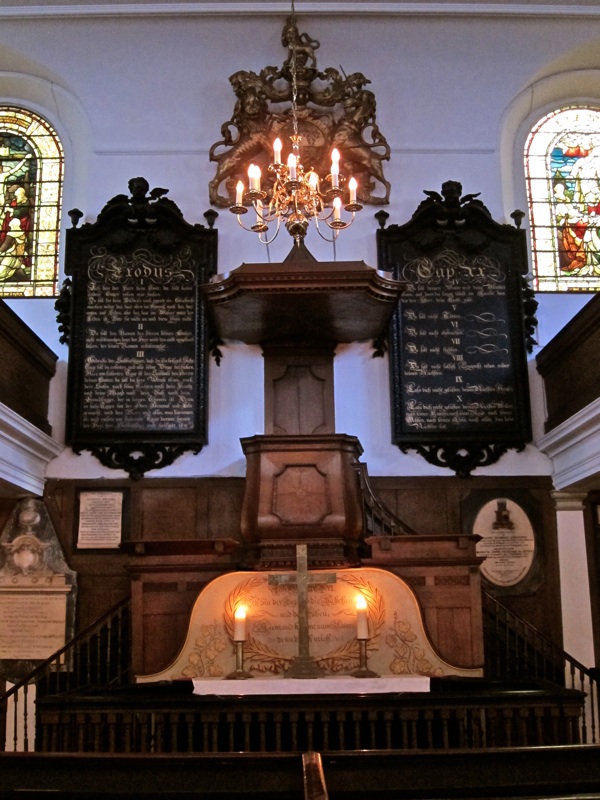

The arms of George III, King of England & Elector of Hanover
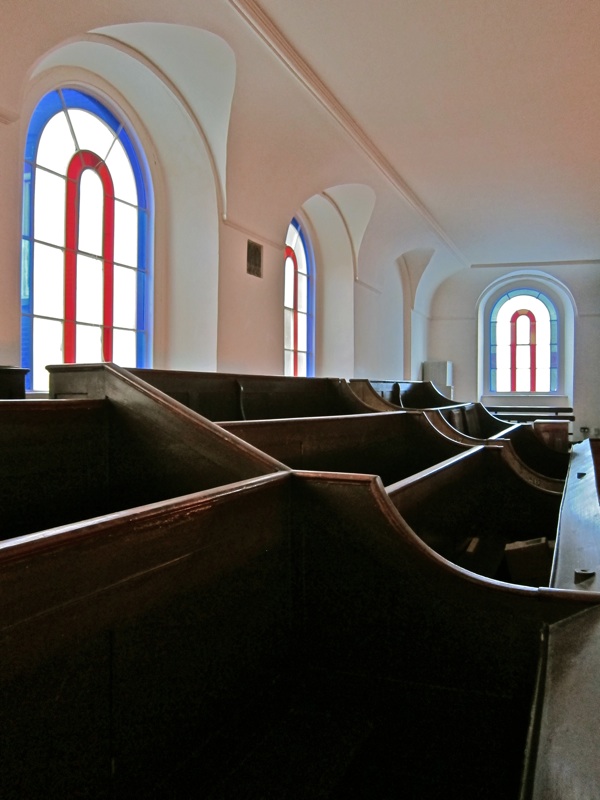
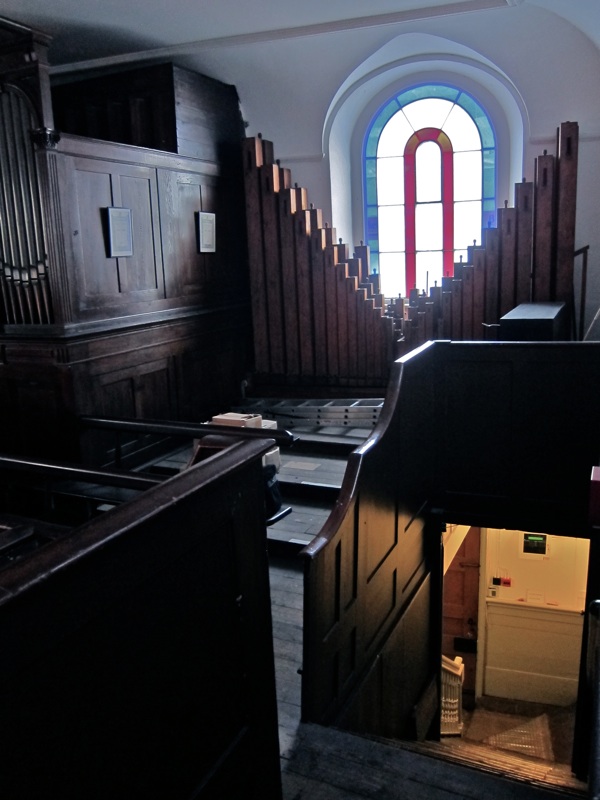
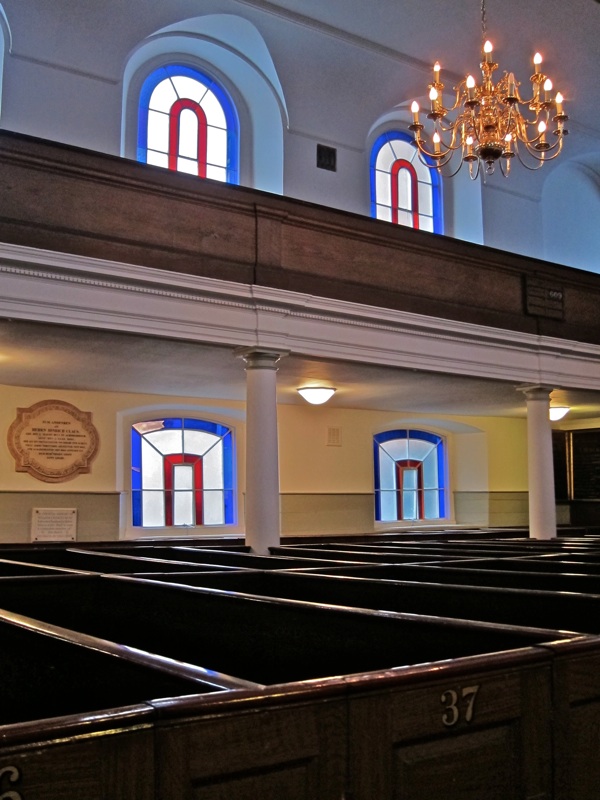

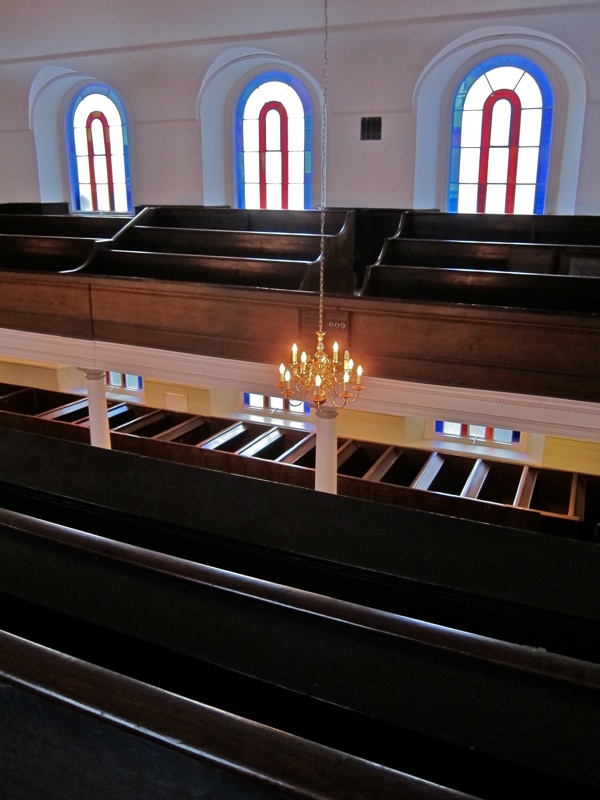


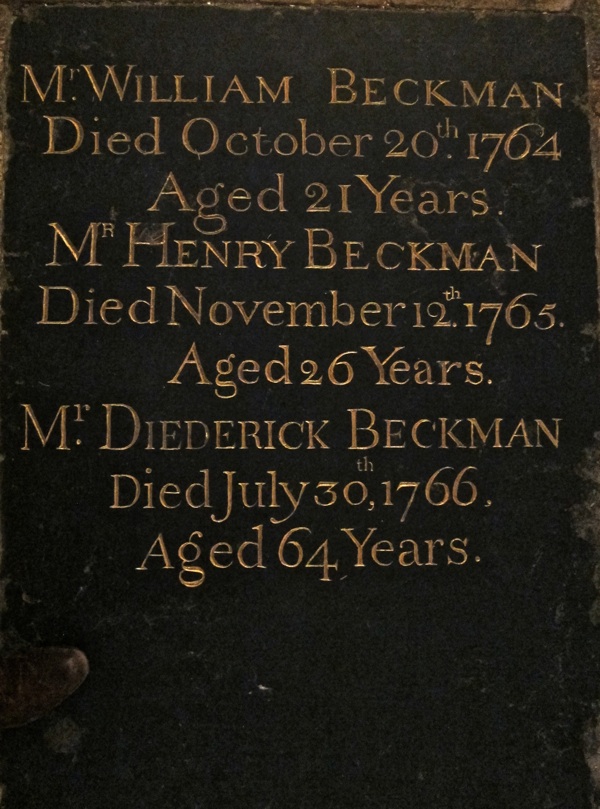
The principal founder of the church Diederick Beckman was a wealthy sugar refiner.
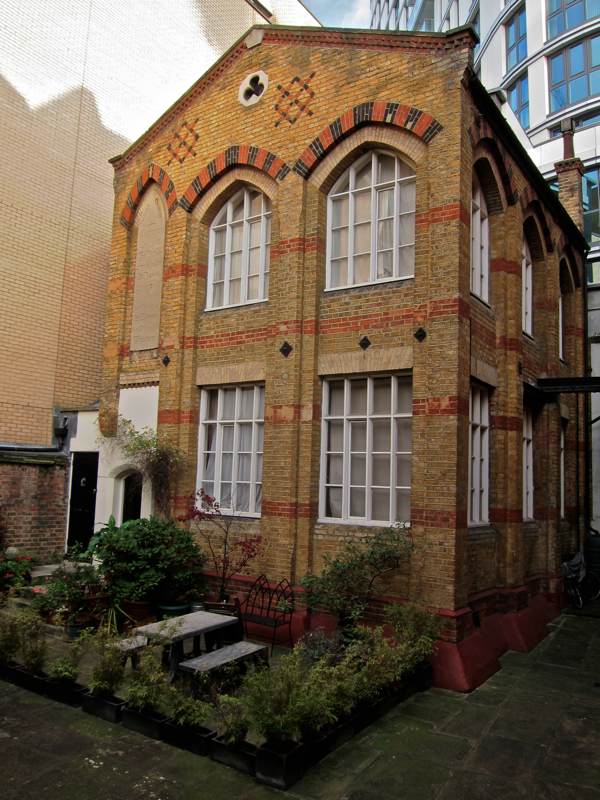
The Infant School was built in 1859 as gift from the son of Goethe’s publisher, W. H. Göschen

Names of benefactors carved into bricks above the vestry entrance.
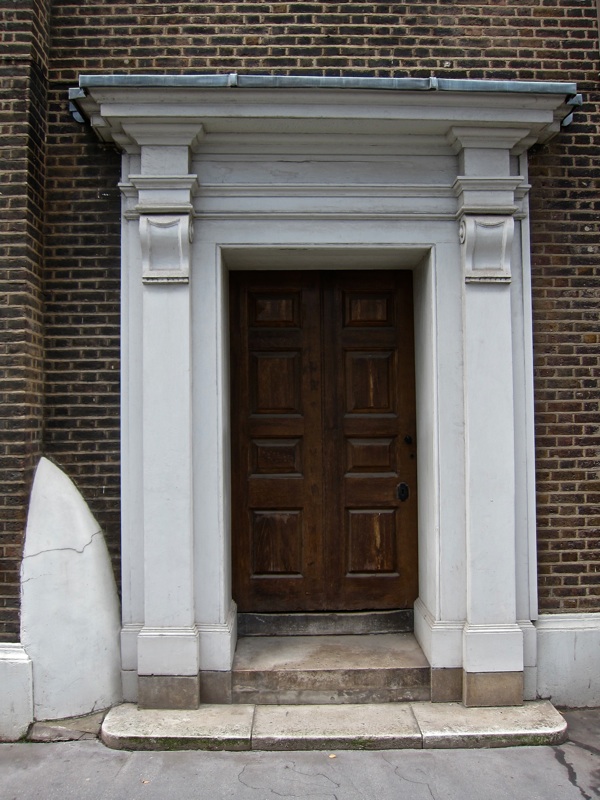
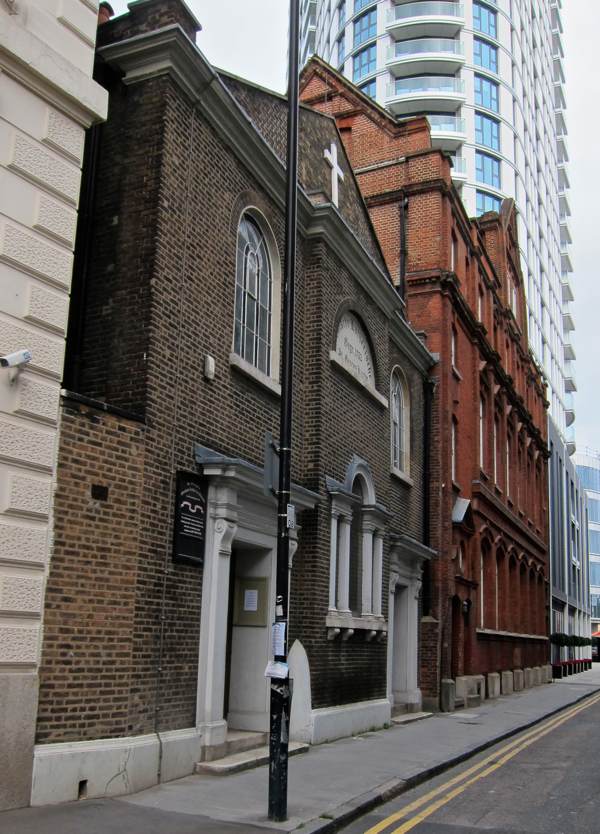
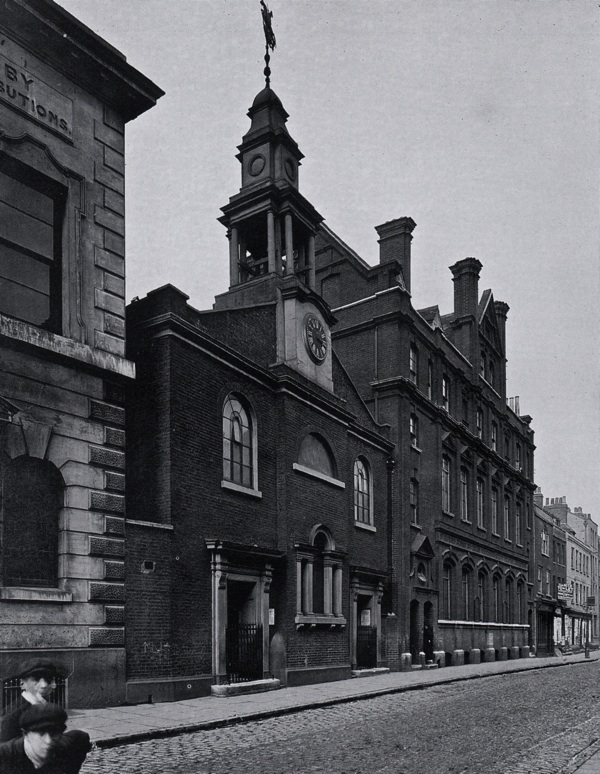
St Georges German Lutheran Church, c. 192o

The bell turret with weathervane before demolition in 1934
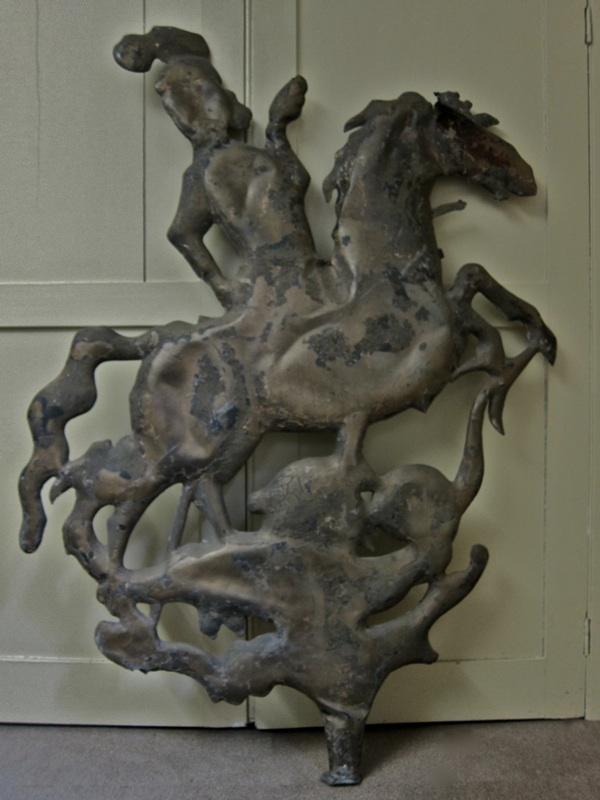
The original eighteenth century weathervane of St George & the Dragon that was retrieved from ebay
You may also like to take a look at