
Lucinda Rogers At Ridley Rd Market II
In the second of this series, Contributing Artist Lucinda Rogers & I visit Ridley Rd Market in Dalston to meet some of the traders featured in her current exhibition Lucinda Rogers: On Gentrification – Drawings of Ridley Rd Market at House of Illustration in Kings Cross until March
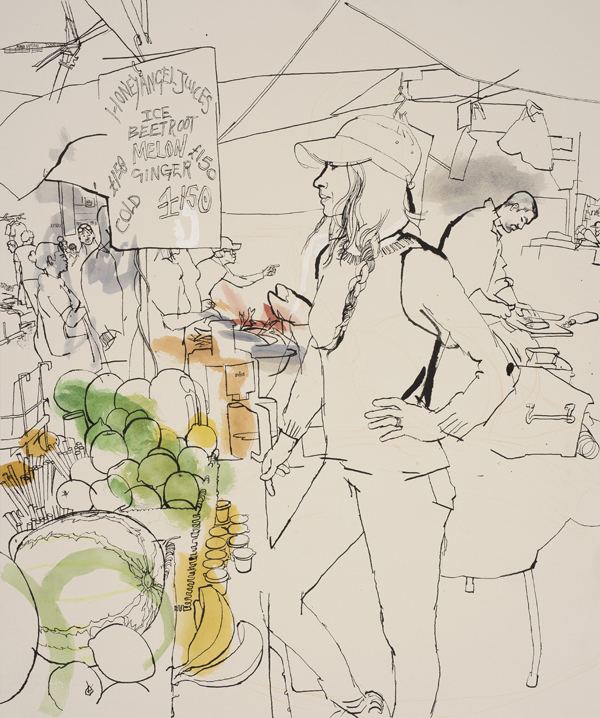
Soniya and Tariq
Soniya – “I started in Chapel Market in 2002. I had my baby and I was out with my mum when we saw a sign advertising for a shop assistant, but when I went in to enquire they gave me such a filthy look, so I said to my mum, ‘I’m going to open my own stall.’ At first, I bought £100 worth of soap and set up a soap stall, but that was not right for me. After that, I set up a juice stall. I bought everything I needed off the internet and set up the stall in my living room to try it out. Then I came here to Ridley Rd Market as a casual trader in 2015. At first, they put my stall at the top end but after six months I came down this end and I have a permanent pitch here now. When my son was four years old, he told me I was his ‘Honey Angel,’ so when the bank asked me the name of my business, I told them ‘Honey Angel Juices.'”
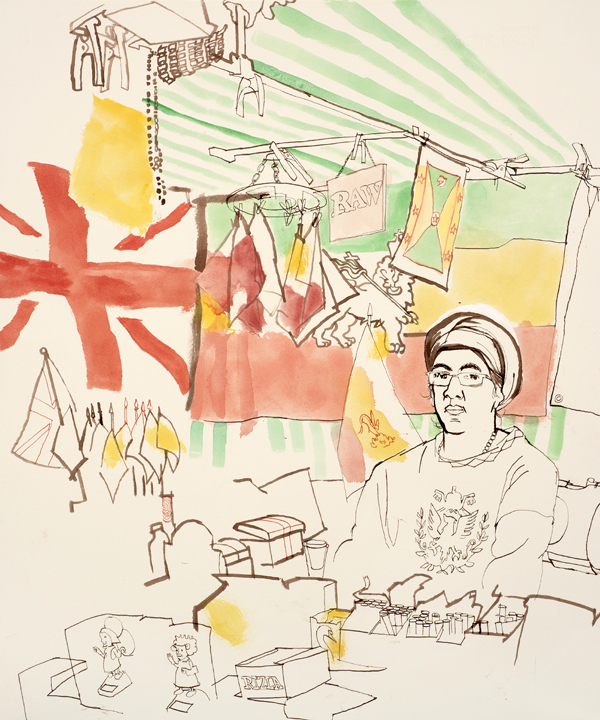
Sarje’s stall
Sarjeet Singh – “My brother had a stall on Kingsland Waste in the seventies and I helped him in 1973. It was so cold, I could not imagine working there, but as I got older I started by myself selling novelty items and flags from around the world, they are very popular when the football season comes. I also worked as roadie for Frankie Paul, John Holt, Dennis Brown, UB40 and Commander Cody. Ridley Rd is a great market, I have been here since ‘seventy-six and I have not got bored yet. It is a very honest place. You have to be honest in the market because otherwise it comes back to bite you. A woman left a purse here with seven hundred pounds in cash on my stall recently and I kept it for her. She came back and asked, ‘Did I leave my purse here?'”
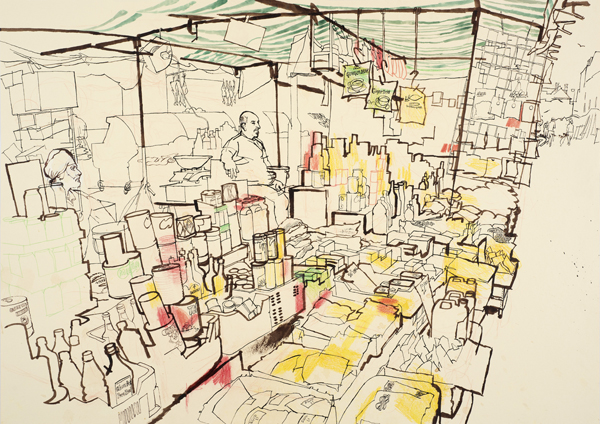
Red, yellow and green landscape at Greg’s stall
Gregory Spyris – “I arrived in London on a Tuesday and started work on this stall on the Wednesday, and that was forty years ago! I came for my brother’s wedding and I stayed in this country. For twenty-four years, I had two shops but I sold them and just had this stall for the past twenty years or so, selling West Indian and African groceries. I have family here now, children and grandchildren, and I only go back to Cyprus for holidays.
Drawings copyright © Lucinda Rogers
Lucinda Rogers: On Gentrification – Drawings from Ridley Rd Market is open at House of Illustration, Tuesday – Sunday from 10am-6pm until 25th March
You may also like to take a look at
Lucinda Rogers at Ridley Rd Market
Furniture Trade Cards Of Old London
I discovered these old furniture trade cards hidden in the secret drawer of a hypothetical cabinet
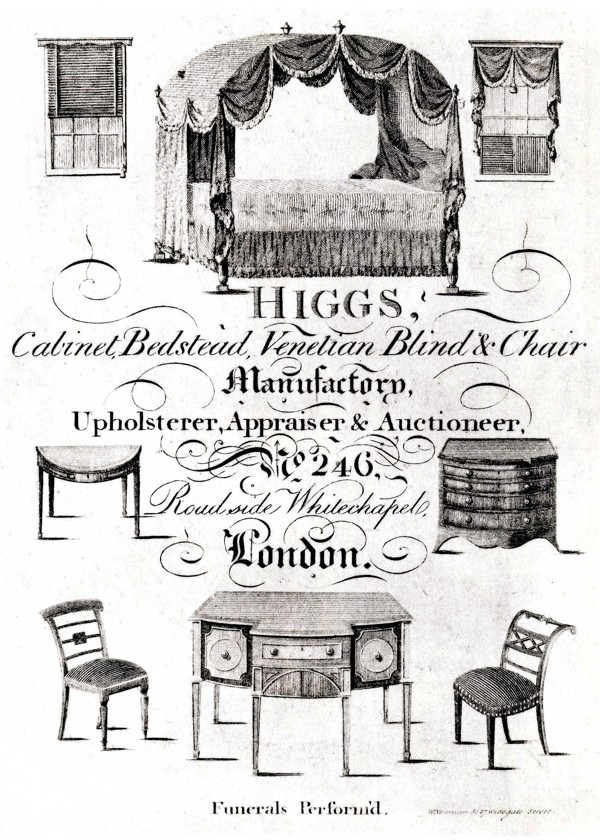
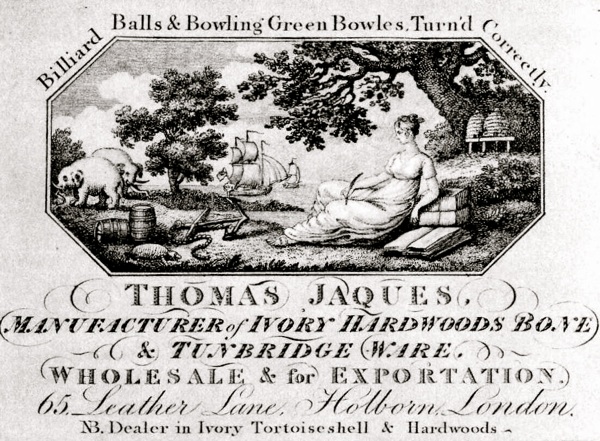
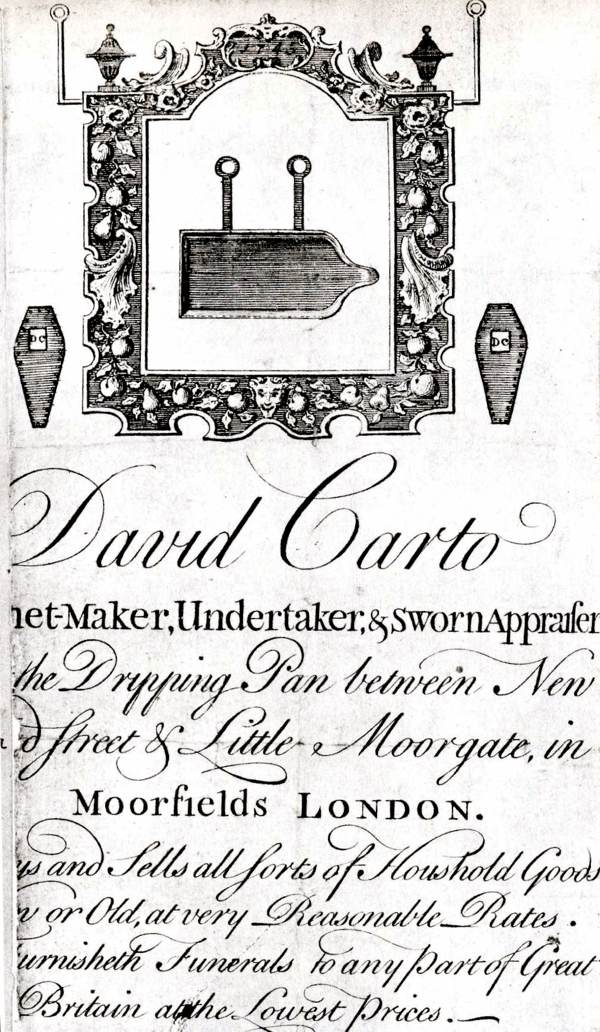
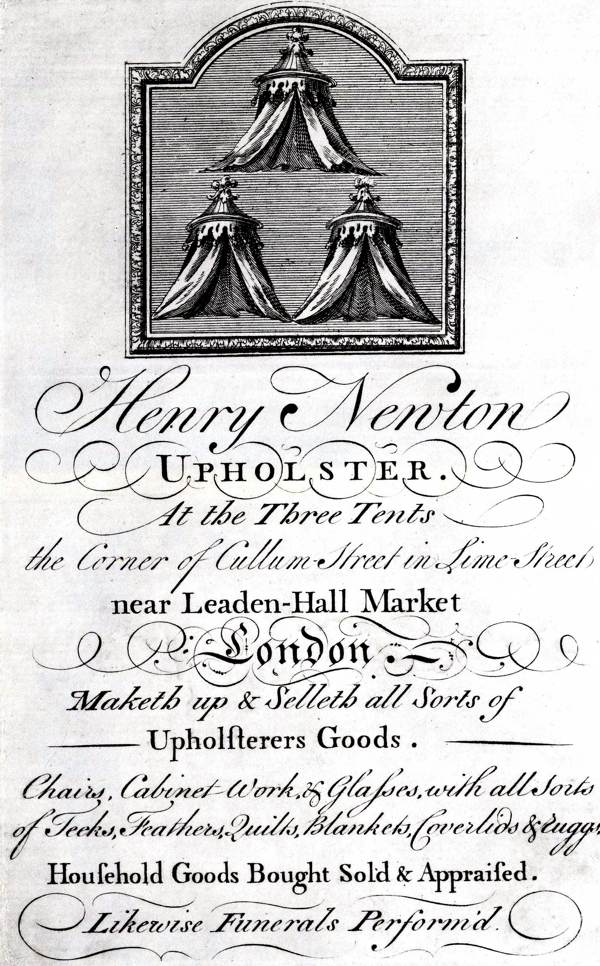

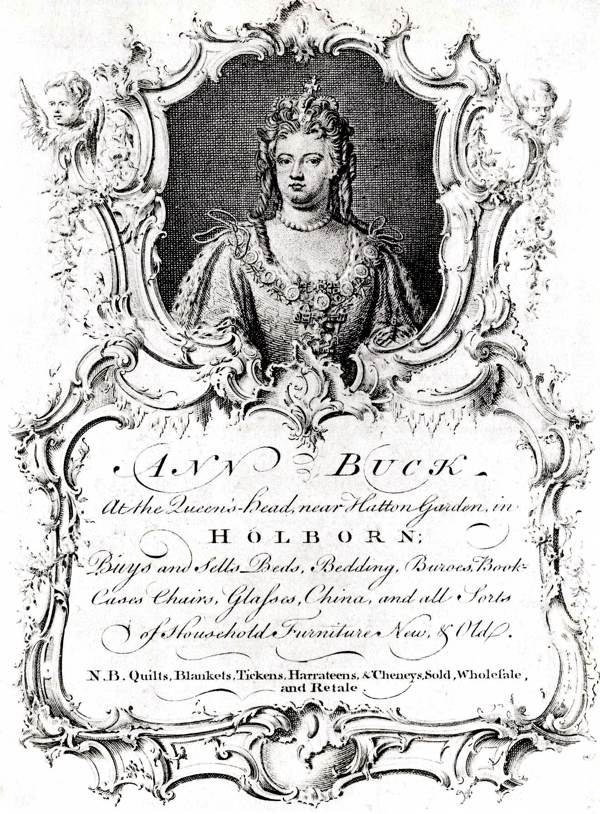

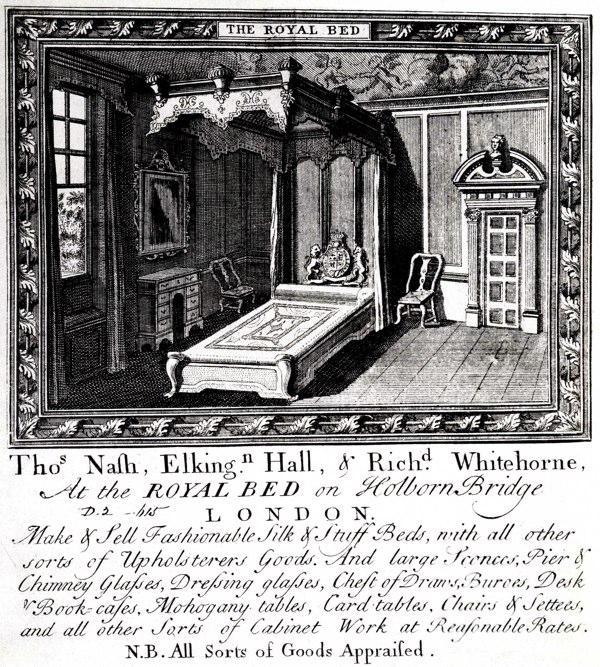

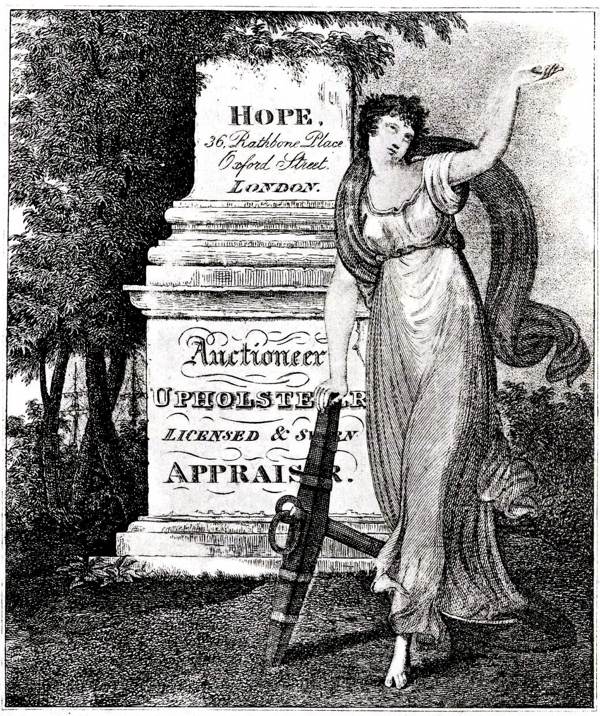
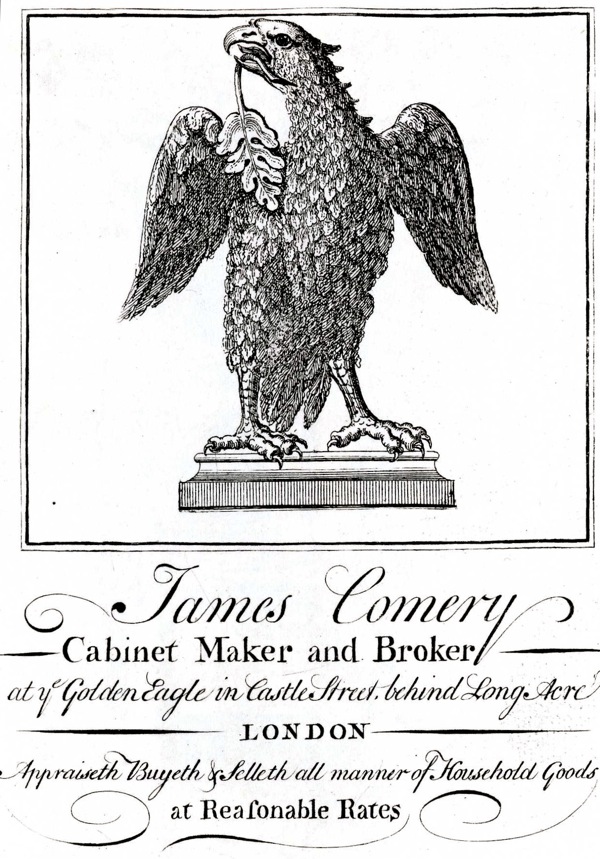


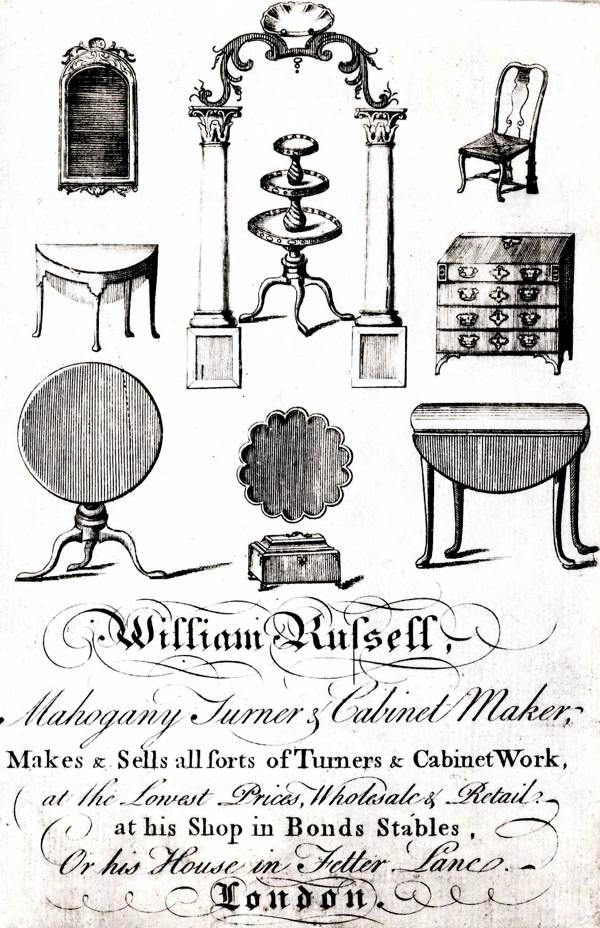
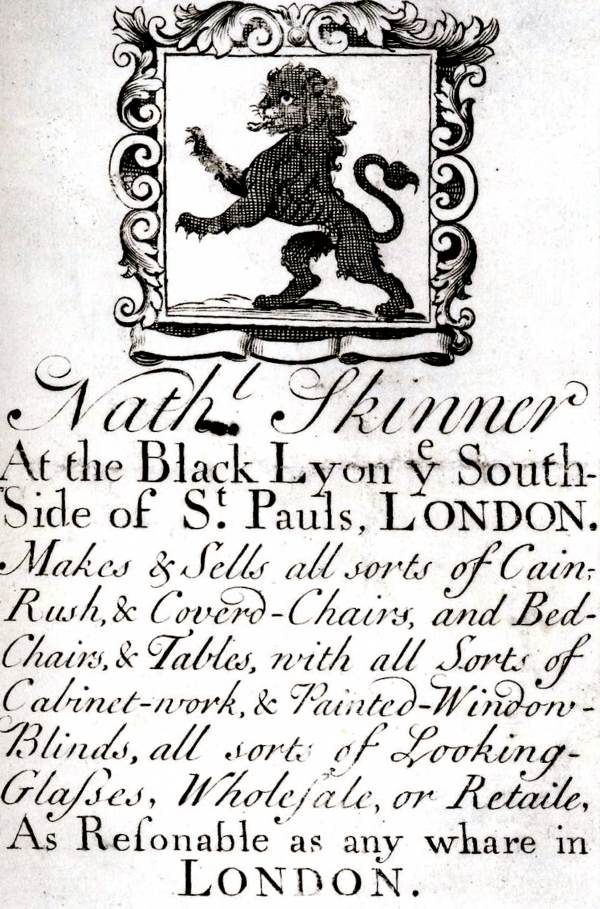
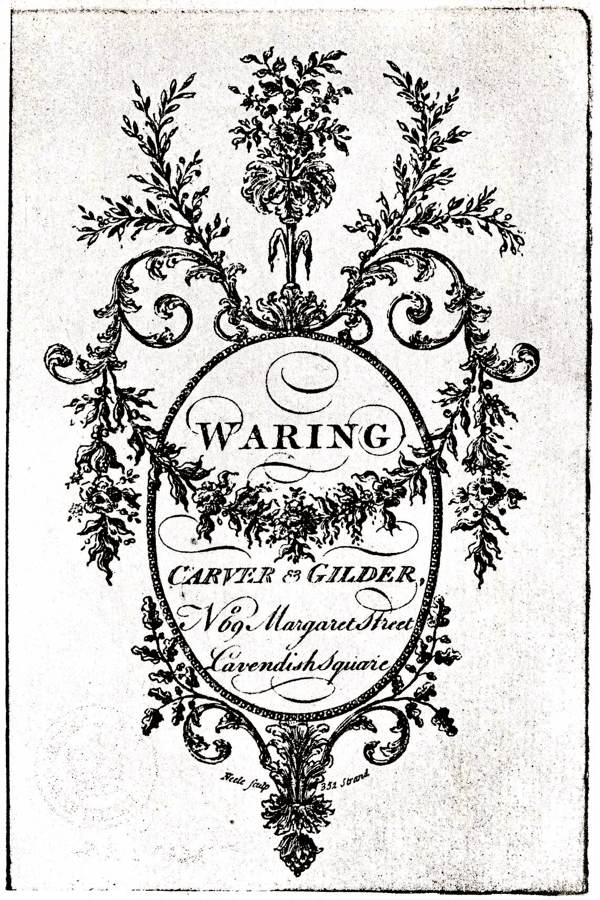
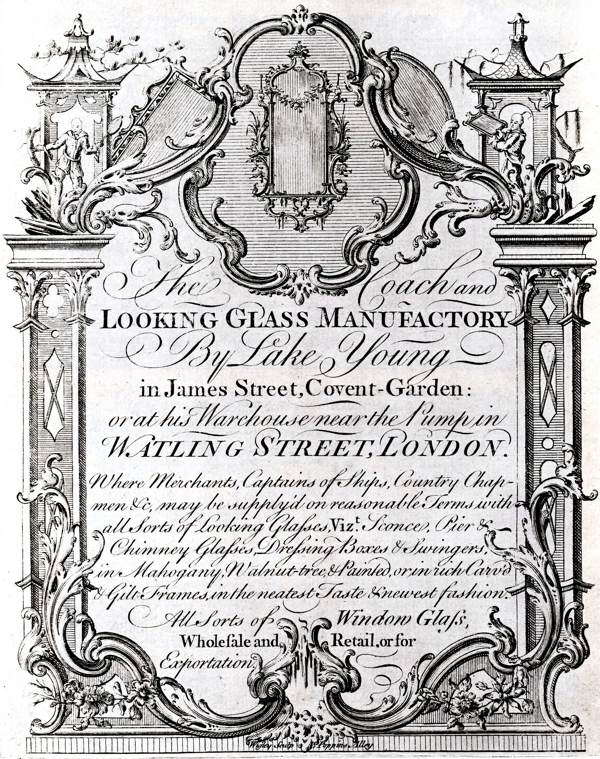

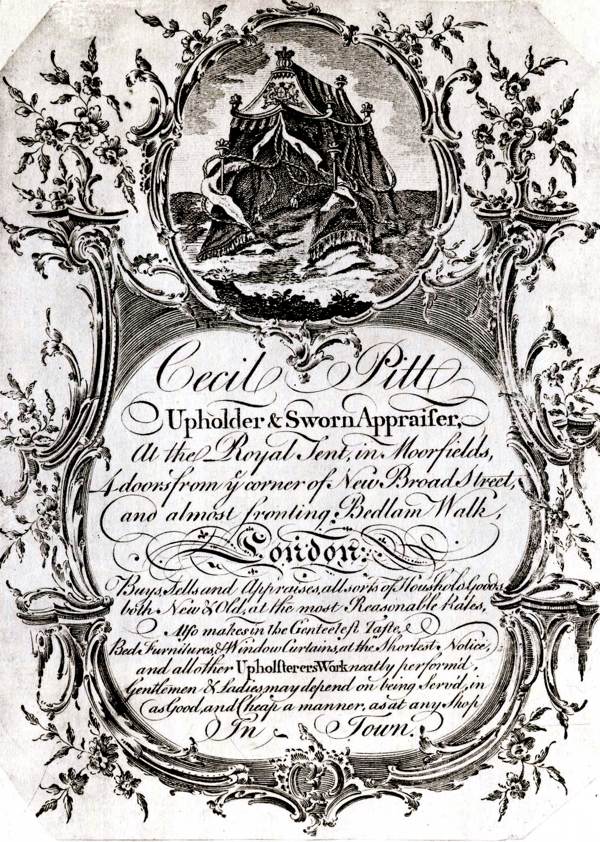

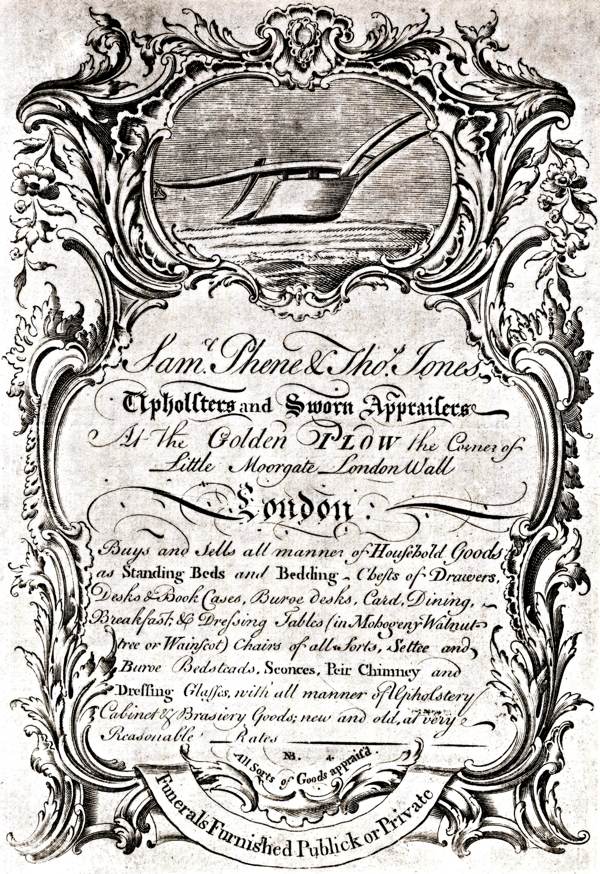

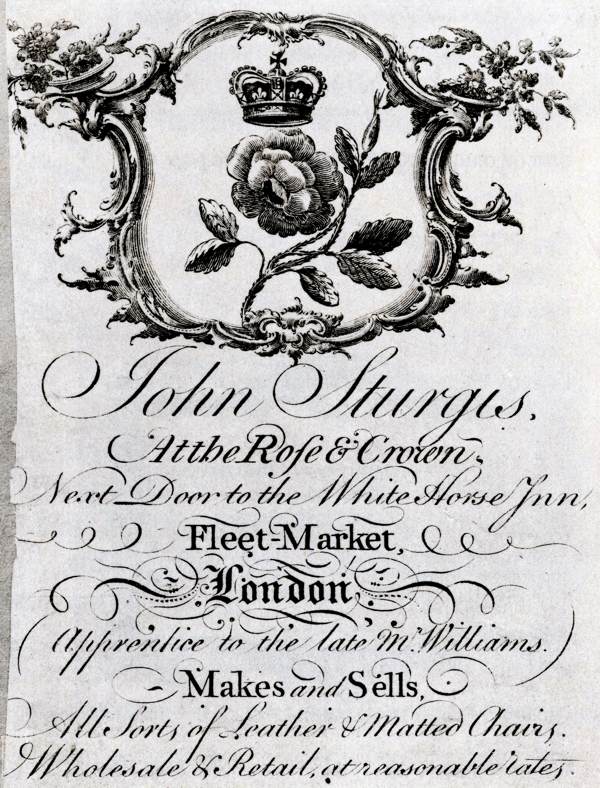

Images courtesy Bishopsgate Institute
You may like to see my earlier selections
More Trade Cards of Old London
Yet More Trade Cards of Old London
Even More Trade Cards of Old London
The Great Cat & Dog Massacre
Hilda Kean introduces her new book The Great Cat & Dog Massacre – The Real Story of the Second World War’s Unknown Tragedy, recently published by University of Chicago Press
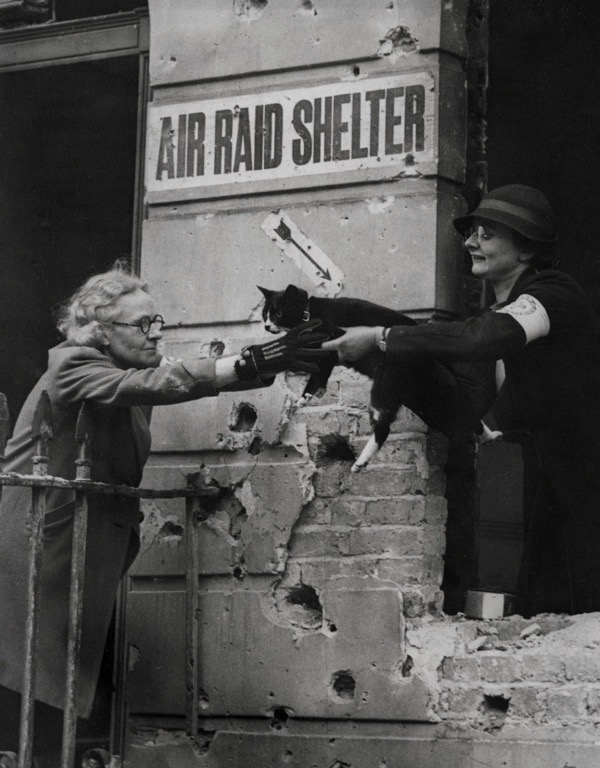
Blue Cross rescue of a cat (Courtesy of State Library of Victoria)
Frequently we hear the Second World War described as “The People’s War” and this phrase has become set in the public imagination, but – too often – the experiences of our own (or our relatives’) cats and dogs at the time are forgotten. Of the start of the war in September 1939, much is remembered. Certainly we remember that at the time school children were evacuated to the countryside, blackout curtains were made and even flower beds were starting to be dug up to create vegetable patches. Yet such positive action was rather different to what happened to cats and dogs at the start of the war.
In September 1939, many animals were killed by their owners. Politician Sir Robert Gower, who was also the president of the Royal Society for the Prevention of Cruelty to Animals, argued that at the decisions of ordinary people themselves nearly 750,000 pet animals were killed. Later the RSPCA and Brigadier Clabby, the author of the official history of the Royal Army Veterinary Corps, declared that 400,000, representing around 26% of cats and dogs in London alone, pet animals were killed. And this killing happened in the first week of the war in September 1939.
These acts of killing were not imposed by the government, but were undertaken by people taking their pet animals to vets and animal charities. Yet these were not the explicit decisions of the charitable organisations. Prior to the war, the RSPCA organised a conference on horse welfare involving many organisations and – in partnership with the National Air Raid Precautions Committee and with Home Office support – set up a body “to advise on all problems affecting animals in wartime.” Vets were annoyed and, with too little involvement from the government, they issued their own literature arguing that it was their responsibility to persuade people from having their pets killed.
But at the start of the war thousands of animals were killed. The RSPCA, the oldest animal charity in the world, reported the number of dogs and cats being brought in to be destroyed had doubled at its London clinics, and wrote “the work of destroying animals was continued, day and night, during the first week of the war.” The People’s Dispensary for Sick Animals, well known for its work in East London, noted that destructors were overwhelmed by thousands of animals brought for death to its clinics. Then the National Canine Defence League, set up in the eighteen-nineties to protect dogs at a time of rabies hysteria, reported that, so extensive was the slaughter of dogs, its supplies of choloroform had been exhausted. The Battersea Dogs’ Home killed fewer than other charities, having argued in the Bow and Battersea branches that people should take their animals home. Even at London Zoo there was an initial killing of poisonous snakes, and some birds including kestrels, herons and kites that were observed flying over Regent’s Park. Yet after a few months, many zoo animals were financially sponsored and continuing their lives there at the zoo – even including a dormouse paid for at the cost of a shilling per week !
During the war the government did much to ensure the status of dogs and cats including through BBC broadcasts. By Spring 1942, it was widely publicised that cats were doing work of “national importance.” Again the BBC would praise the NARPAC for offering free identification discs with the animal’s own collar. Less than half-way through the war, over three and a half million animals became registered and wore large blue and white discs.
Internally, civil servants were also working busily explaining to their ministers that “dogs are not to be interfered with” and ensuring the dogs “must be fed.” As a result, dogs could eat thousands of tons of food and cats could drink gallons of milk. If the civil service was to restrict materials for the manufacturing of dog biscuits then, they concluded, people would probably substitute for them other forms of human food! Given that so many people were in favour of their pets, the civil servants allowed genuine breeding to continue. For some months, civil servants thought about increasing dog tax but recognising such a topic was unpopular, they proposed psychological factors should be taken into account. They also rejected going along with the Nazi policy for conscription of the dog population for their war effort!
Vulnerable dogs as well as cats were looked after by the sanctuary organised by the Animal Defence House near Salisbury, which drove them to the countryside from Central London. Some of the dogs were taken to the home of Nina Duchess of Hamilton where they, together with moggies and pedigree cats, found countryside premises away from the London bombing. In their diaries and even in their mass observation interviews, many men and women talked about their own animals. Thus the writer, Fryniwyd Tennyson, took in two new cats- sharing their own food but also supporting their owner’s belief “they know nothing about war.”-
Sometimes the war situation was tragic. Thus Lilian Margaret Hart, living in Bethnal Green Rd with her husband George in the Air Raid Precautions, looked everywhere for Gyp the dog and Timmy the cat but sadly both had died in the bombing. On similar occasions others survived. Thus a parrot from Samuda St on the Isle of Dogs was kept alive in his squashed-up cage by being fed with bacon rind and crusty bread, only to give a wonderful recital of obscene language. Other animals, such as the canaries in the photograph below were rescued from a public house in southeast London. Thus the local community in West Hampstead searched for the mother of a local cat who was found by demolition workers in the debris of a nearby shop who carried her home in a sack. She was thin but was none the worse for her ordeal! In the Poplar air raids, Rip the dog helped find victims with Mr King the local air raid warden and stayed with him next to his small allotment. Together, they regularly visited an air raid shelter comforting those sheltering. As a result of his positive actions, Rip received a Dickin medal for his bravery.
Many animals were looked after and their stories passed on to children of all ages to give them emotional support. As one respondent argued, her father had given her The Photo Book of Pretty Pets for Christmas in 1940 and she recalls “The quality of my life has been enhanced by animals.”
On some occasions, children questioned why people were carrying their pets to a vet for their destruction. As a result of one particular boy becoming upset, his family returned home with the rescued ginger cat who had been about to be killed. Others, such as the late Brian Sewell, art critic, noted the seaside killing of his own dog as a “cold, hard, vengeful aversion lodged” in his long memory.
In diaries and in the records of Mass Observation during the war many adults told their stories. As one young man said to Mass Observation, “Probably dogs do more to uphold morale among their owners than anything else.” In many diaries, animals were witnessed and encouraged. Thus, the well-known Nella Last was an enthusiast about her dog Sol and cat Mr Murphy, explaining that, “To me he is more than an animal: he has kindness, understanding and intelligence and not only knows all that is said but often reads my mind to an uncanny degree.”
Even Winston Churchill publically celebrated his black cat Nelson at 10 Downing St and his ginger cat at his Chartwell home. When Rab Butler, pioneer of the 1944 Education Act, came to his room one night while Nelson was curled up at Churchill’s feet, Winston started the conversation by expressing that, “This cat does more for the war effort than you do!”
For some years the experience of wartime animals, especially in London, had stuck in my head as I rarely found them to be included when I was reading any conventional histories of the war. In my earlier book on Animal Rights: Political and Social Change in Britain since 1800, I wrote no more than a few pages about the treatment of the animals in war. This was not through ignorance but because of the paucity of animal material. Although Angus Calder’s The People’s War had talked very briefly of the destruction of animals, his common phrase “people’s war” ignored the effect on animals in the main.
Thinking about animals and researching the diary writers, family stories, animal charities and state archives, from that time highlighted the specific plight of animals in London and the East End for me. It also demonstrated the long established (if sometimes erased ) presence of animals, as well as those only thinking themselves and their ancestors as participating in ‘the people’s war.’ Rather than forgetting about this time of varying treatment, perhaps we should choose to think in different ways, remembering cats and dogs as much as humans.
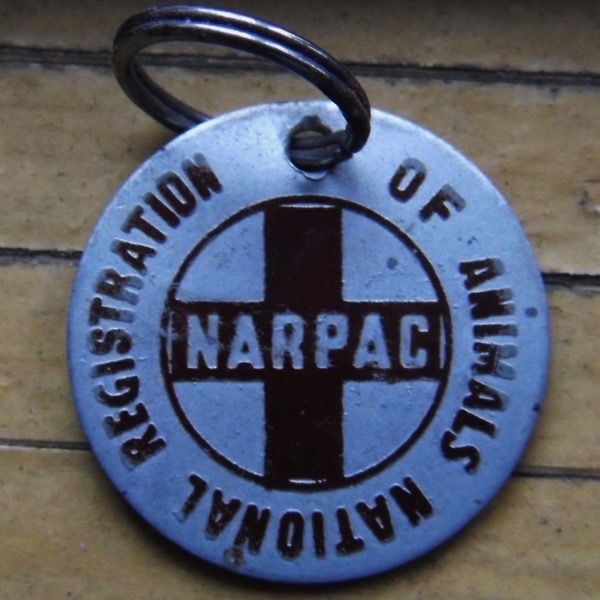
Disc of the National Air Raids Precaution Animals’ Committee
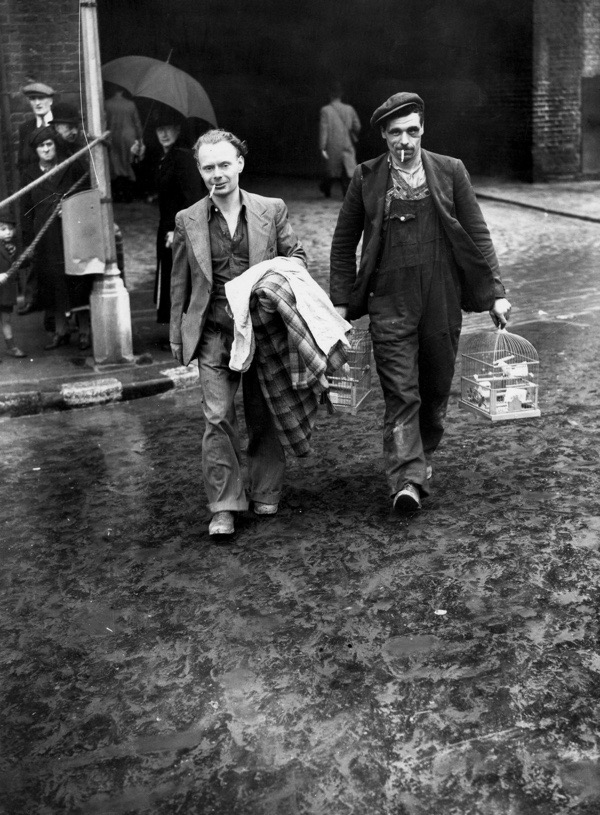
Canaries rescued from a pub in southeast London, September 1940
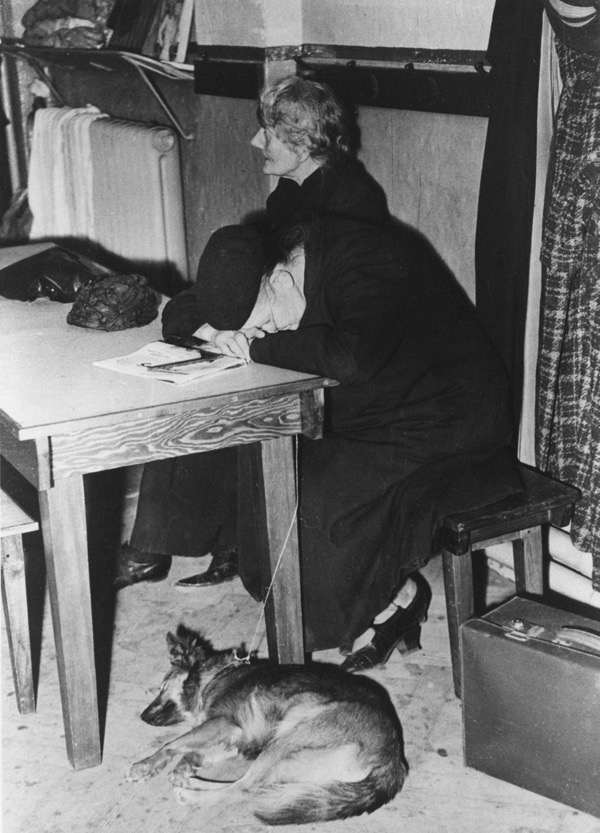
Joint canine and human fatigue at Southwark Rest Centre c. 1940
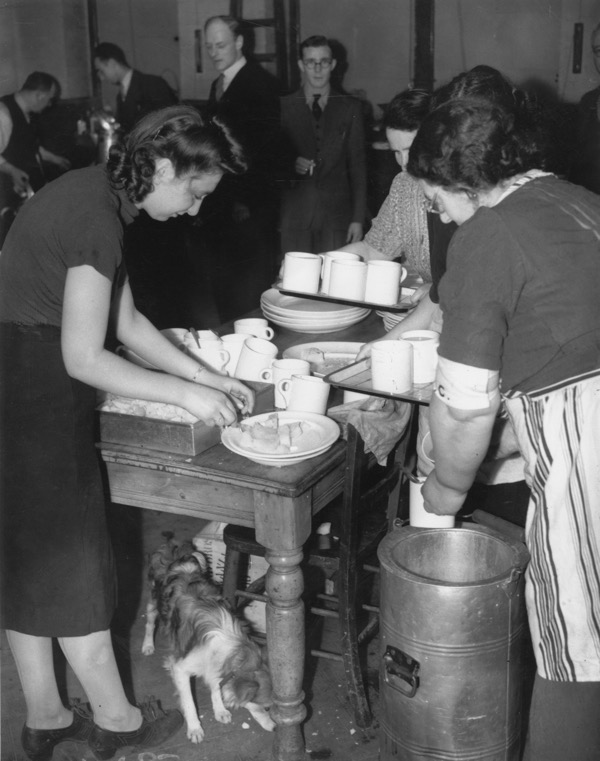
Dog at an East End rest centre, September 1940
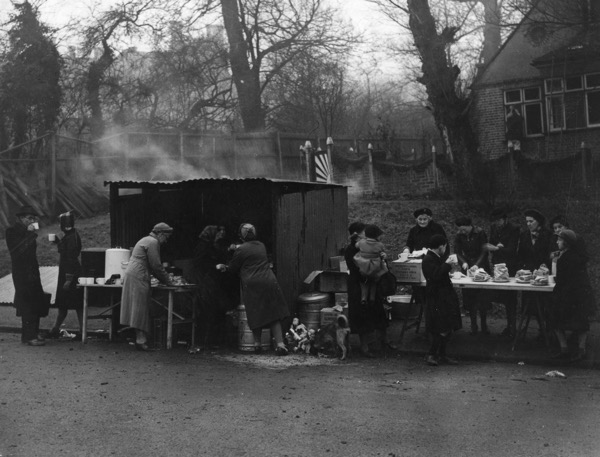
Families, including children and a dog, at an emergency feeding unit in Chingford, January 1945
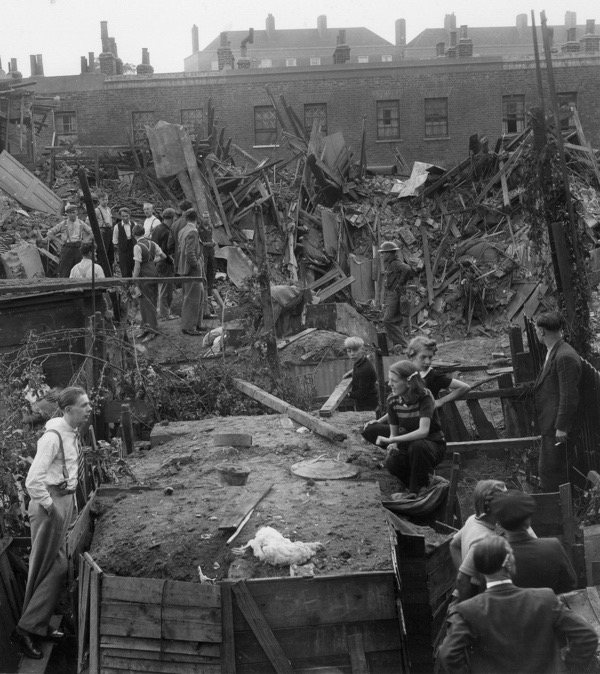
A hen is a victim of the bombing in Hackney
Images courtesy Bishopsgate Institute
You may also like to read about
Adverts From The Jewish East End
Stefan Dickers, Archivist at Bishopsgate Institute showed me these fascinating advertisements he found in an almanac from 1925 that originally came from Sandys Row Synagogue, evoking a lost East End world of Kosher Viands, Lodzer Cakes and Keating’s Powder.
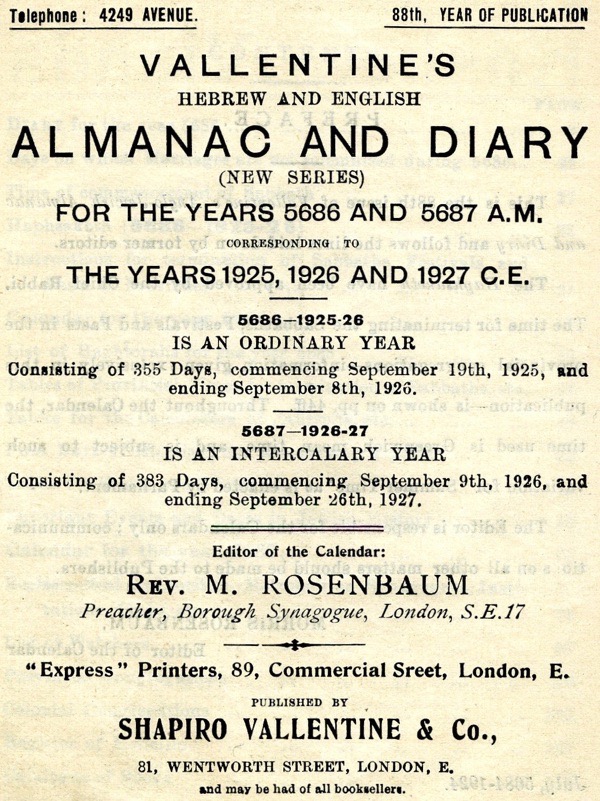
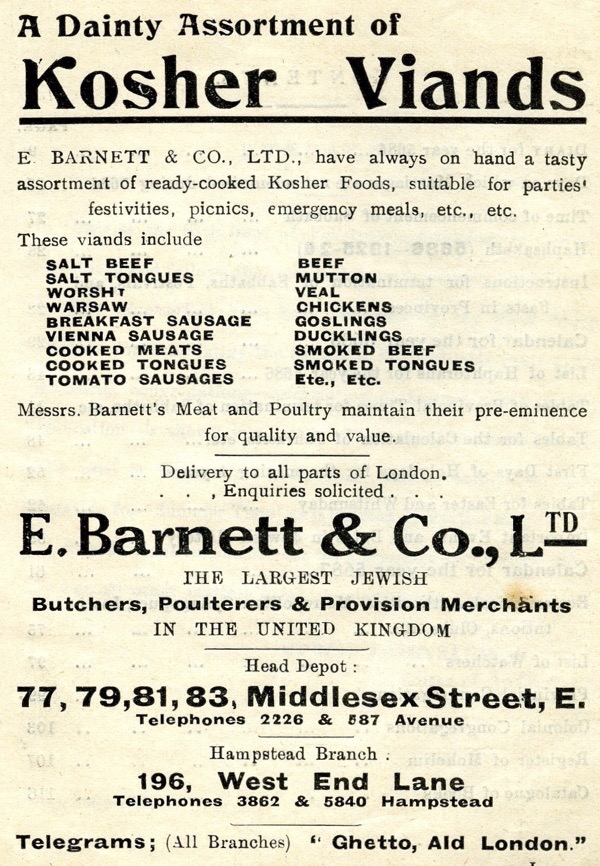
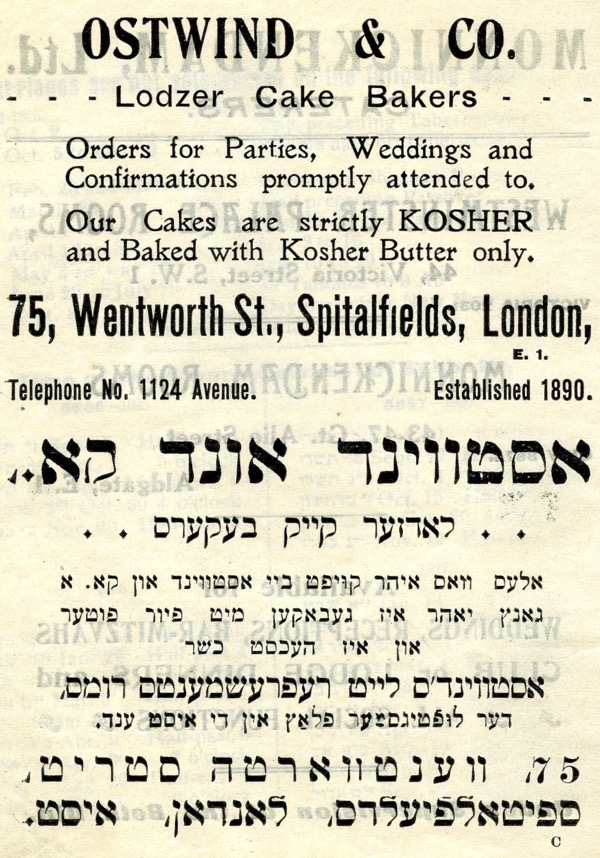
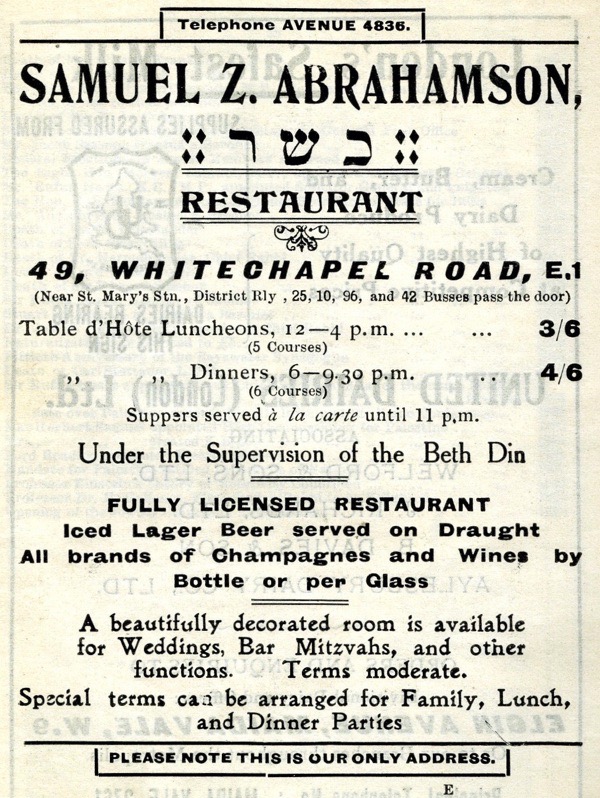
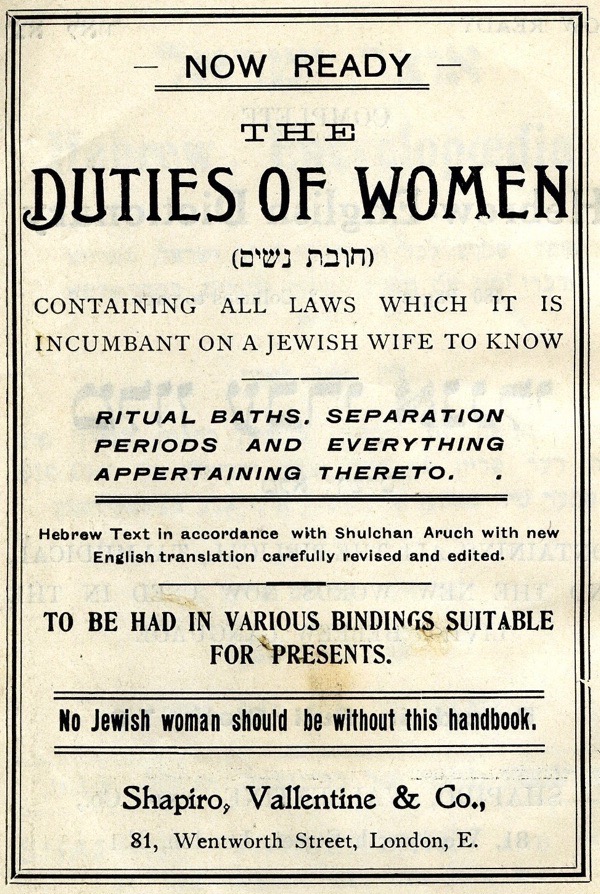
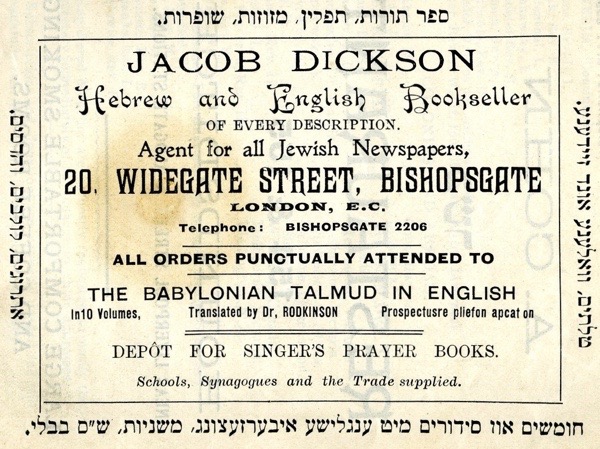
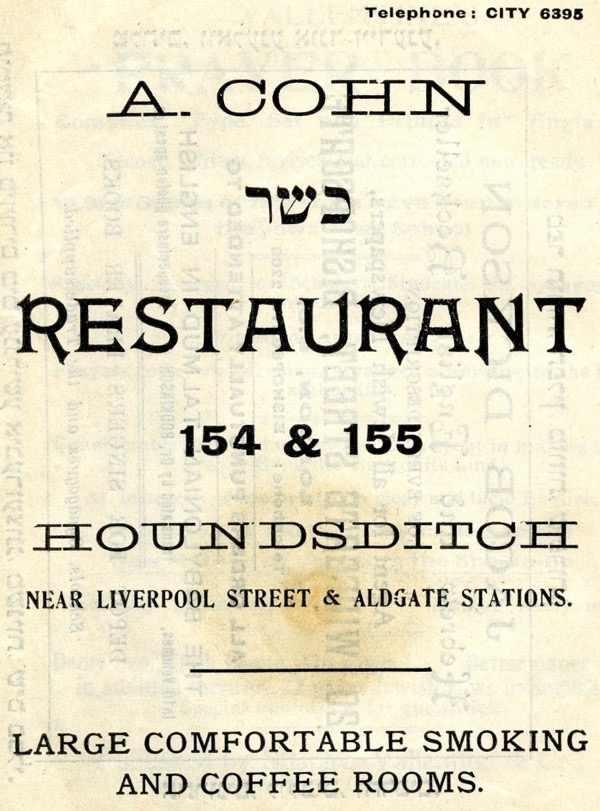
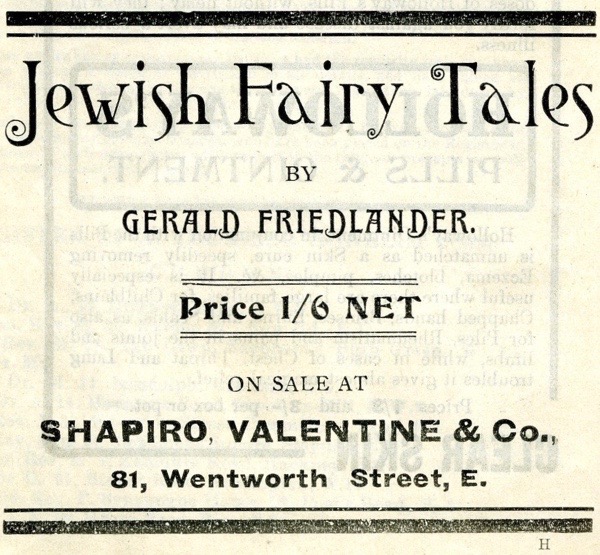
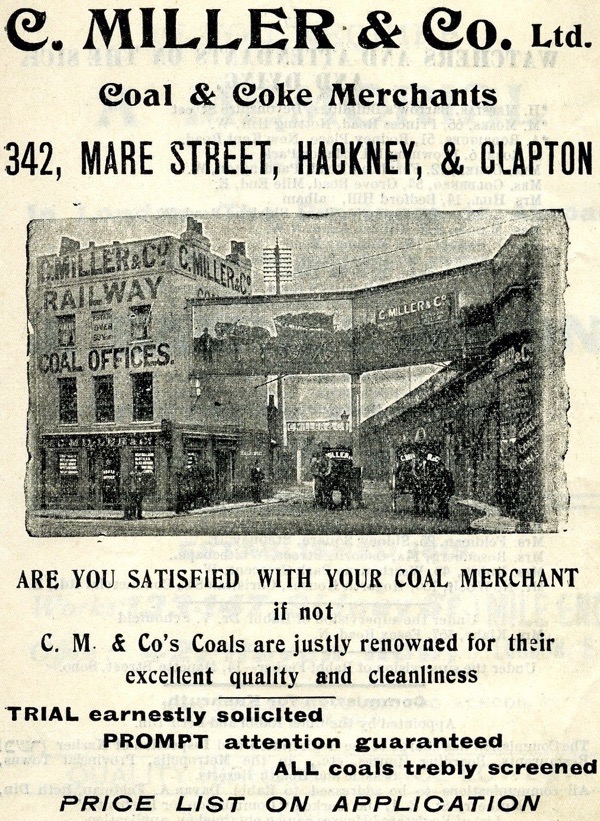
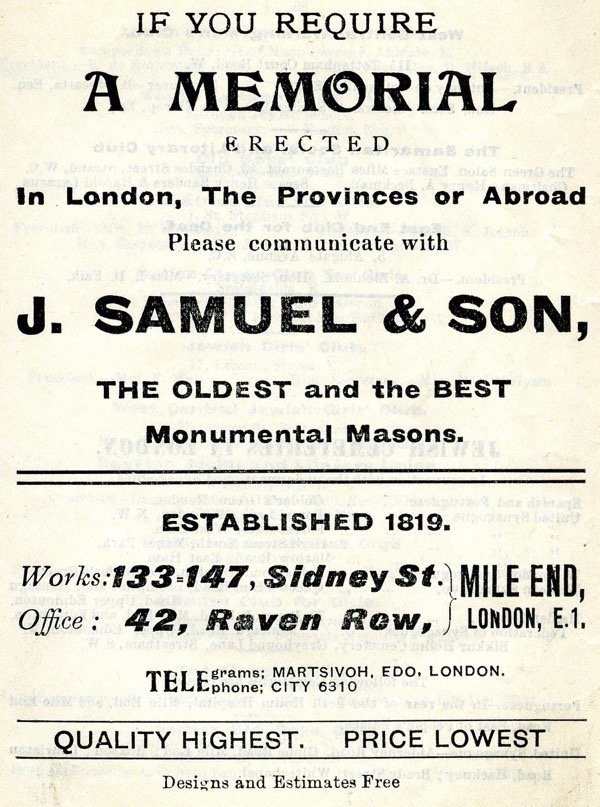
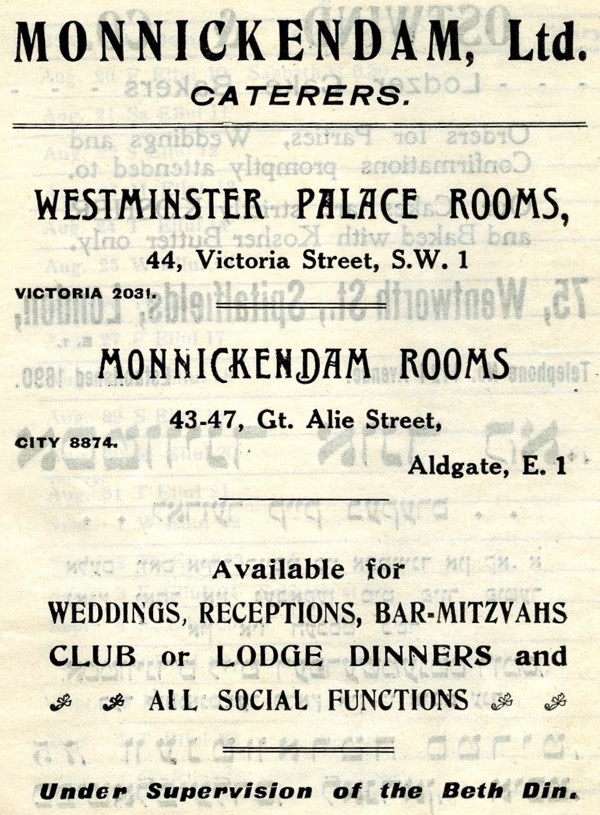
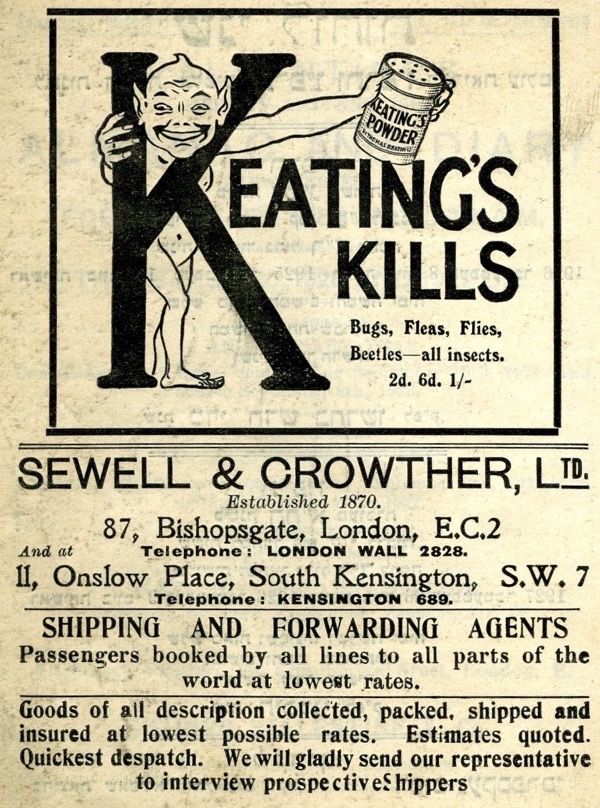
Images courtesy Bishopsgate Institute
You might also like to take a look at
Adverts from Stepney Borough Guide
Joginder Singh, Shoe Maker
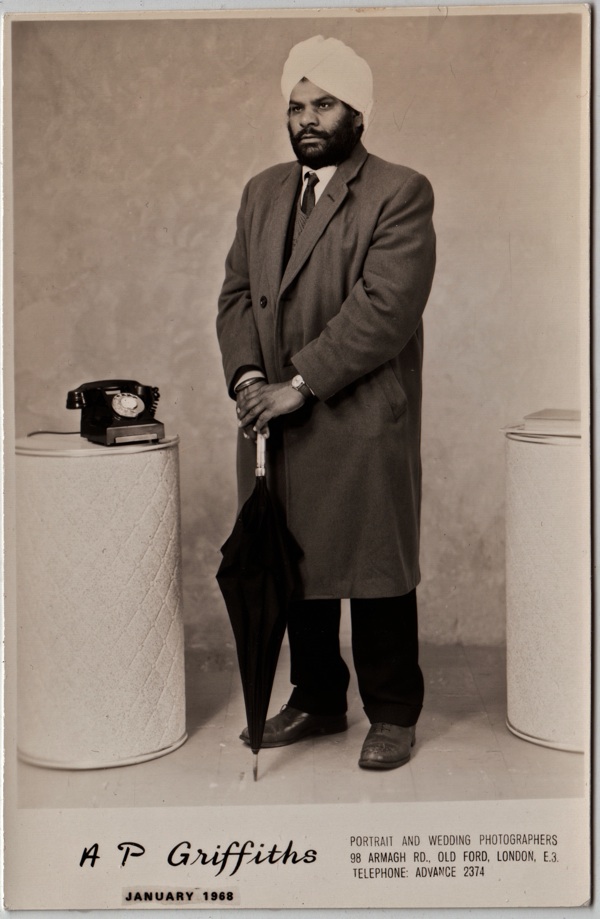
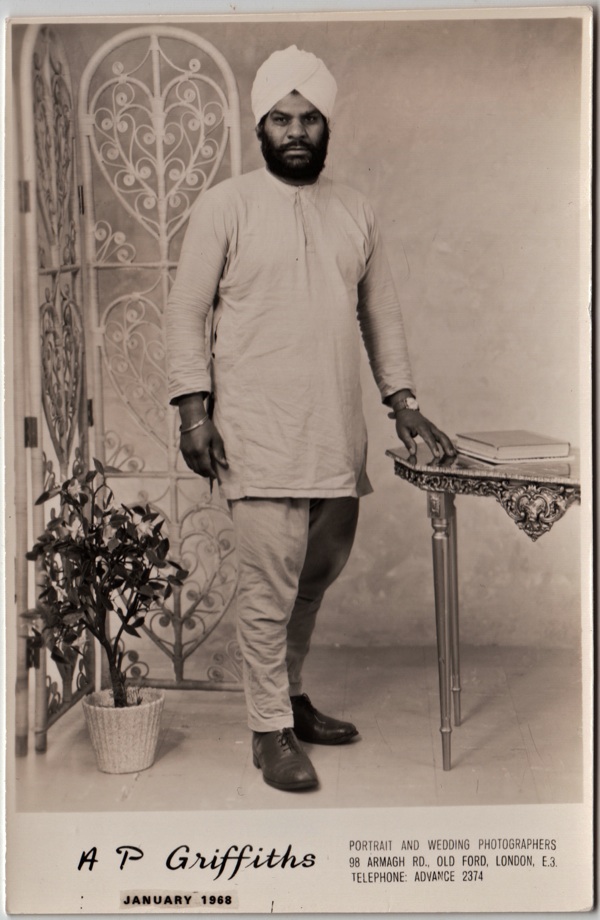
Observe these two handsome portraits of Joginder Singh taken in Bethnal Green in January 1968 and note his contrasted demeanour and clothing. In one, he wears western garb and is accompanied by the accoutrements of the modern business man, a telephone and an umbrella, while in the other he wears traditional clothing and is accompanied by a bamboo screen, a plant and a decorative table with a book. These pictures speak eloquently of the different worlds that Joginder inhabited simultaneously, as a Sikh living in Princelet St.
More than thirty years after Joginder’s death, his son Suresh spoke to me recently about his father’s life. In spite of the poor living conditions that his family endured in Princelet St and the racism he suffered, Suresh recalls the experience of growing up there affectionately and the family photographs which accompany this interview confirm his fond memories of a happy childhood in a crowded house in Spitalfields.
“My dad came to this country in 1949 from Nangal Kalan Hashiarpur in the Punjab. He came to Princelet St in Spitalfields and we’ve lived there ever since. He couldn’t read or write. He was a shoe shine at Liverpool St Station for twenty-one years and then he became labourer until he dropped dead in 1986 at fifty-six. My dad was tall and strong and, when they lined them all up in the village, it was decided he should be the one to go to Britain. They all said to dad, ‘Come on, let’s go!’ and he was one of the first over. All the men came first, so mum didn’t came over until 1952. My dad came by plane but she came by boat from Bombay and it took six months. She couldn’t read or write either.
My dad was a Pacificist, so he didn’t want to go in the army like my uncles who were in the Bombay Engineers. He was of the old school, he was influenced by the Naxolites, Trotskyites who came in to the Punjab from Communist China, and my dad used to hide them in the field. He didn’t like the religion or the materialism of Sikhism.
He was a shoe maker. He knew how to kill a cow, strip the hide, dry it and make shoes. He was of the lowest caste, an untouchable – because the cow was a sacred creature. He came to Spitalfields with just a satchel with shoe polish in it. When dad got here, he wore a turban and couldn’t get a job. So he went to a friend in Glasgow who said, ‘I’ll tell you how to get a job.’ He took off my dad’s turban and shaved his head, and my dad came straight back to Spitalfields and got a job at once.
My dad was not selfish, he was good to everybody. He brought lots of people over, nephews and cousins, and he’d pick people up in the street and bring them home. The Environment Health tried to close our house down because we had fifty people living in it. The Council said, ‘We’ll close this place, it’s full of bedbugs and fleas and you piss in a bucket. How can you live like this? It’s a slum.’ I was born in Mile End Hospital and I had TB at the age of ten because of the number of people that lived in our house. It’s a four storey house and, eventually, he bought it for two grand and I still live there today.
A lot of my friends at school were in the National Front but they thought I was OK because I spoke Cockney. In 1972, the National Front sold their newspapers in Brick Lane and, in 1977, when punk happened I became the first Pakistani Punk, so I attracted a lot of racist attention. I played drums for Spiz Energy on their single ‘Where’s Captain Kirk?’ that made it to number sixty in the Rough Trade vinyl chart. I was so bullied at Daneford School, I got a lot of ‘Paki-bashing’ abuse. I wasn’t terribly macho, I was a quiet boy who was interested in architecture and I went on to study it at University College London. Then I became a NEET (Not in Education, Employment or Training) and now I am principal of a school in Southwark that teaches NEETs.
Eddie Stride, Rector of Christ Church was my best mate. I remember Mary Whitehouse, Cliff Richard, Malcolm Muggeridge and Lord Longford all popping in to the Rectory at 2 Fournier St.
Other Sikhs moved out to Ilford, East Ham and Southall, but my father wanted to stay here in Spitalfields, he didn’t want to go. They said to him, ‘How can you live among Muslims and Jews?’ and he said, ‘At least they don’t gossip!’ I don’t know why my dad stayed in Spitalfields. He lived next to the synagogue and the church – Spitalfields was multicultural and I think that’s what he loved.
We still go to the Punjab every year, dad bought so much land over there, he lived in a slum here so he could send every penny back to buy fields and farms in the Punjab.”
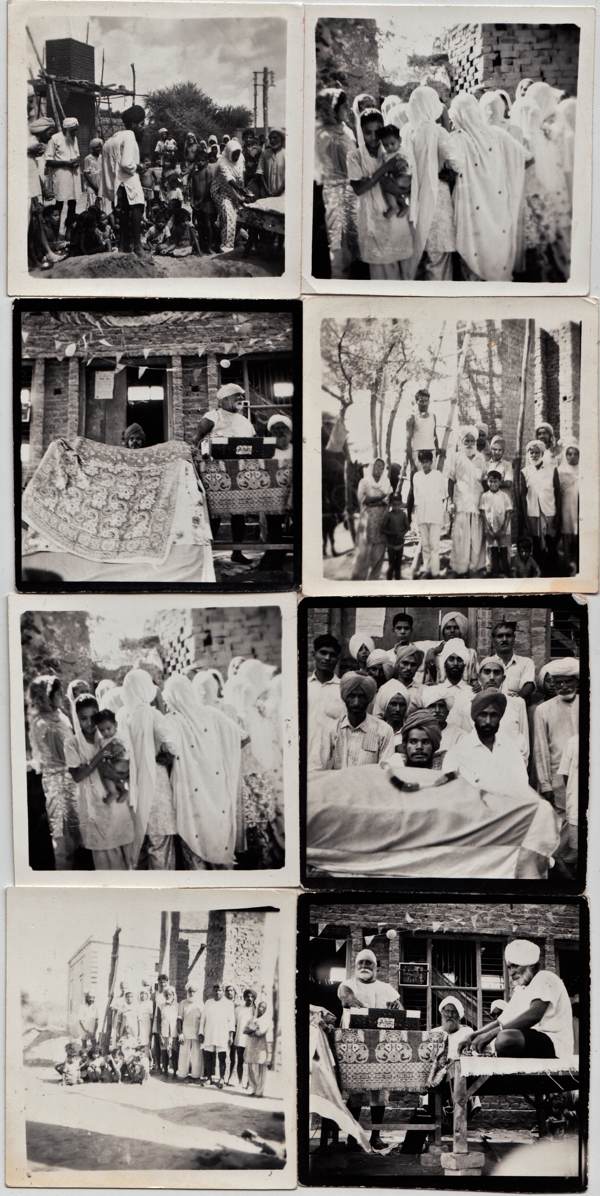
Joginder’s photographs of his trip home to the Punjab in 1972
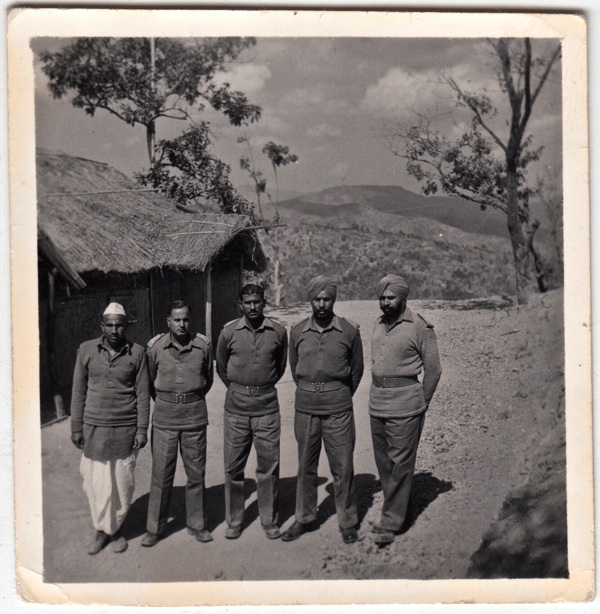
Joginder’s brothers were in the Bombay Engineers
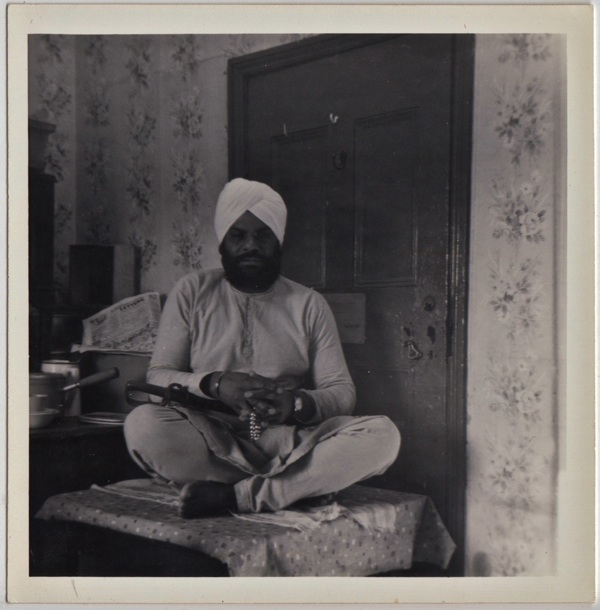
In Princelet St, 1972 – “Sometimes my father got the urge to dress up and be a Sikh”
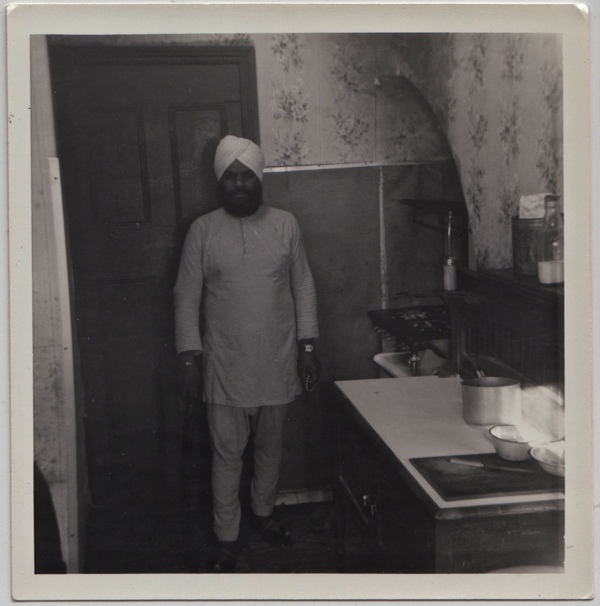
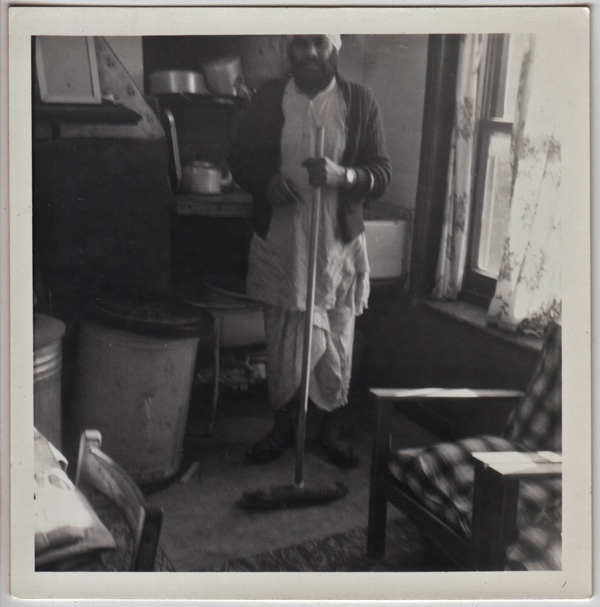
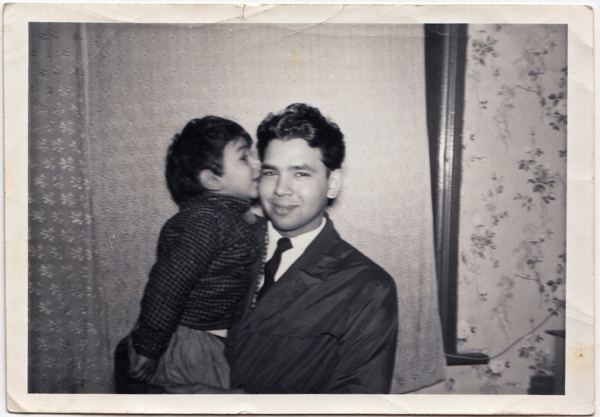
Suresh and his cousin Sarwan Singh, 1968
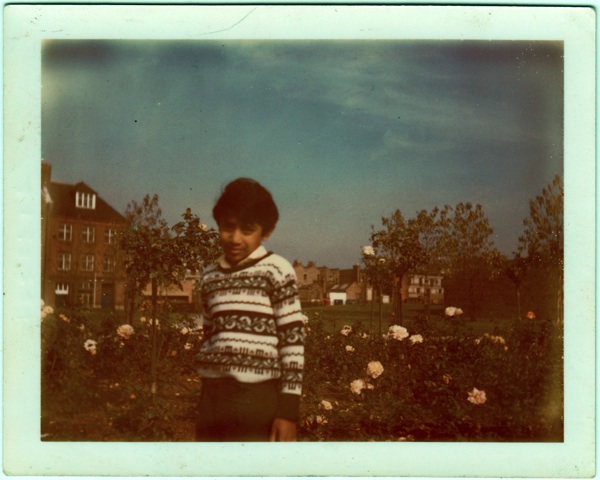
Suresh, 1972
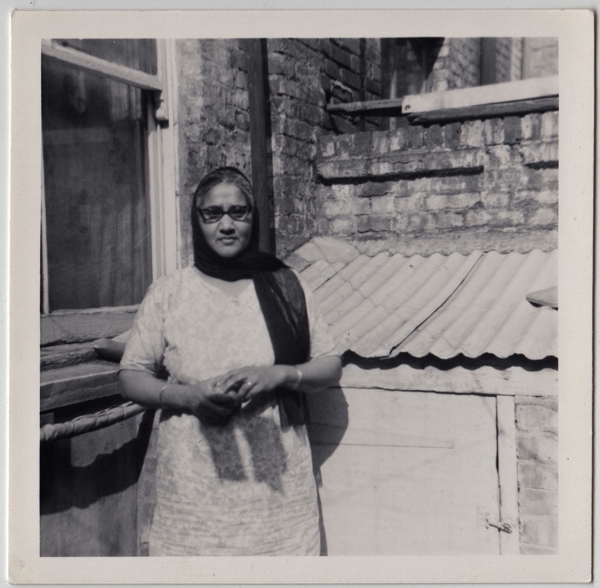
Chinnee Kaulder
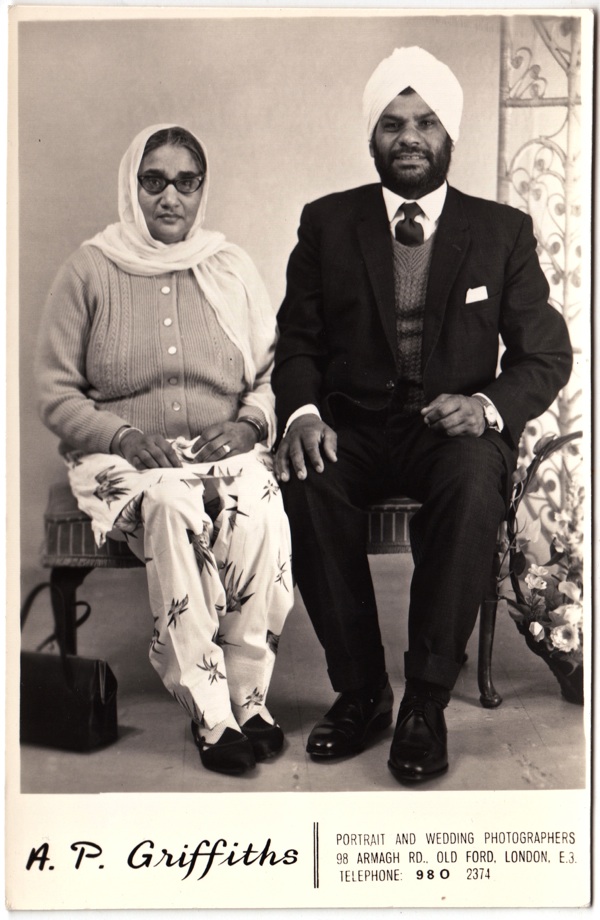
Chinnee Kaulder & Joginder Singh, 1968
At The Great Yiddish Parade
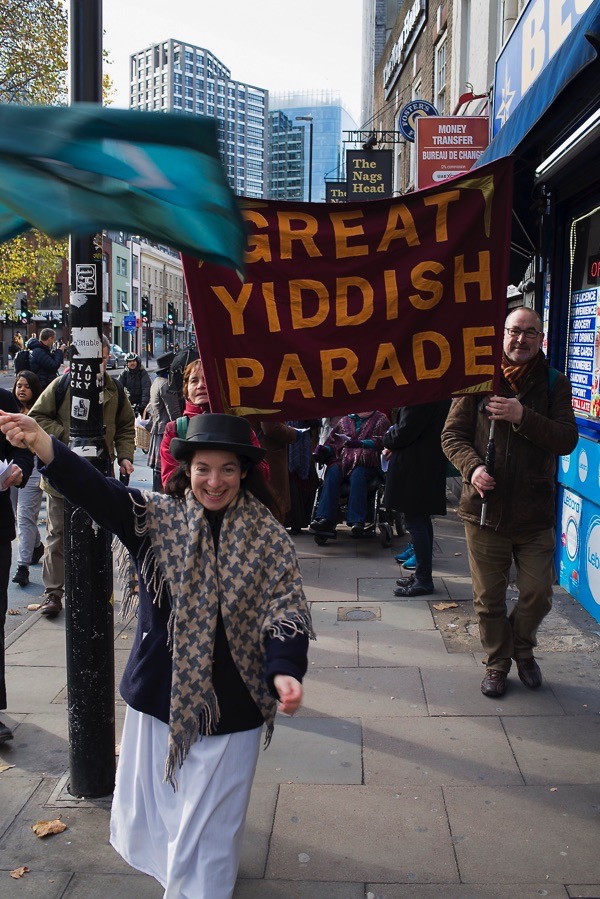
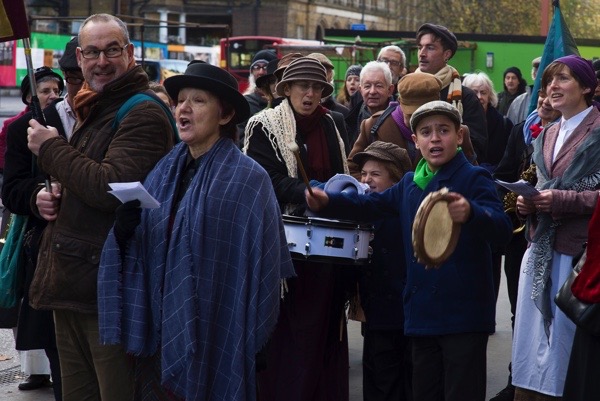
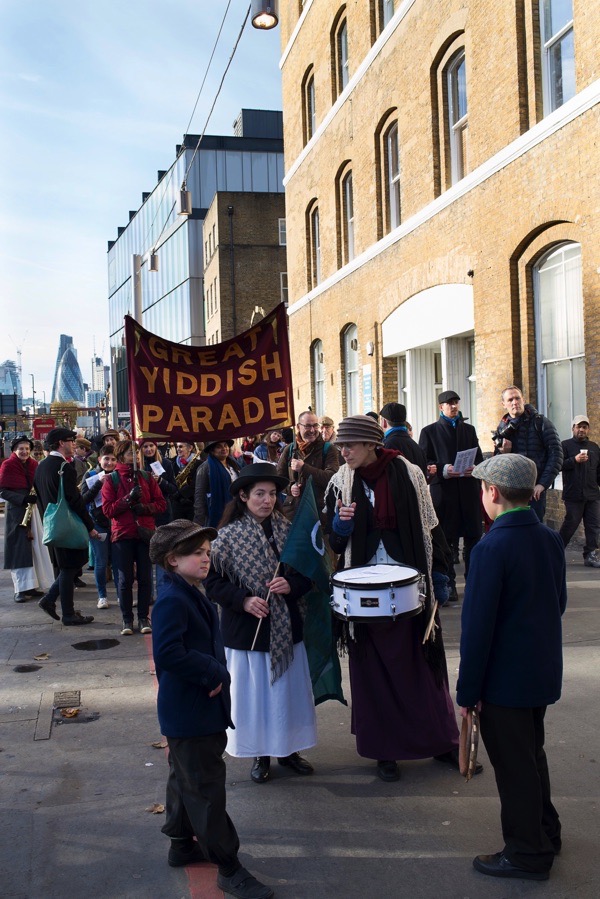
Did you spot a ragtag procession of musicians, people in costume, children and dogs marching from Aldgate through Whitechapel to Mile End Waste last Sunday? Behind this light-hearted frolic was a serious intent, for this was the Great Yiddish Parade, commemorating the procession of Jewish unemployed and garment workers which took place here in 1889. Contributing Photographer Sarah Ainslie & I joined the parade to lend our support and bring you this feature.
Whitechapel was once the centre of London’s Jewish community but, during the last century, they left to seek better housing in the suburbs. Yet it remains a significant location for many whose ancestors arrived here a hundred years ago or more, escaping persecution in Eastern Europe and building new lives in this country. Indeed, many of those inspired to participate in Sunday’s parade had past family connections to Whitechapel.
The original parade processed from Berners St in Stepney to the Great Synagogue in Aldgate, demanding that the Chief Rabbi condemn exploitative working practices in East End tailoring trades. After he refused to do so, they continued their march up Whitechapel Rd to Mile End Waste, where last Sunday’s parade culminated in a series of speeches from the eighteen-eighties. A klezmer band led the procession enlivened by rousing Yiddish songs of protest.
Above all, it was a heartfelt celebration to honour the moral courage of those who, in their disadvantage, discovered the power of collective action, advancing social progress for all through their fight for better working conditions. Growing public awareness of modern-day slavery and recent challenges to the dubious practices of the so-called ‘gig economy’ suggest uneasy parallels with our own time, revealing that this struggle is far from over.
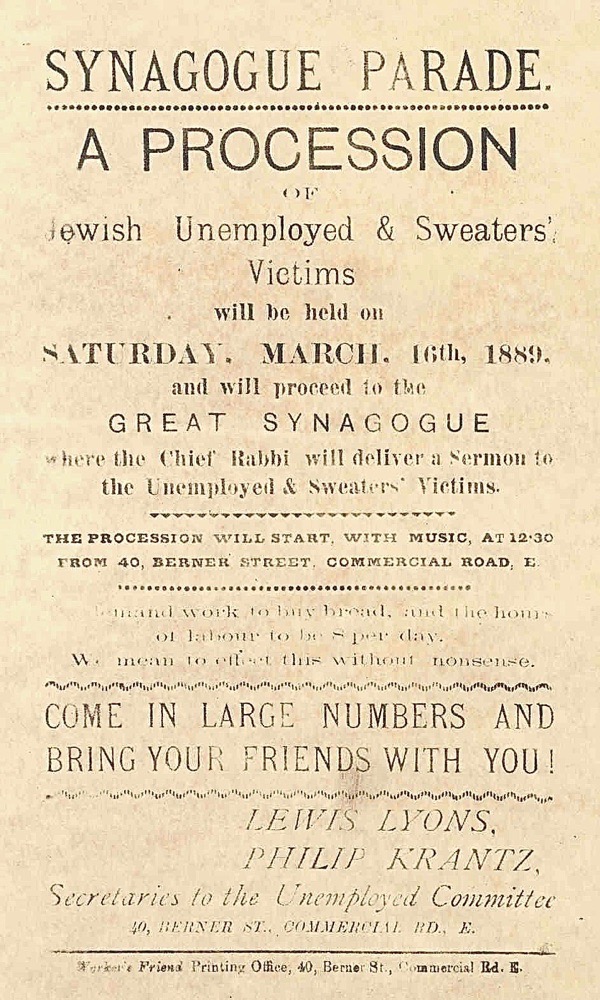
(Courtesy of Modern Records Centre, University of Warwick)
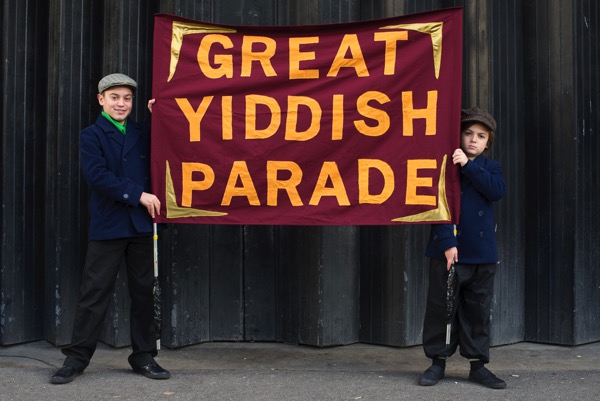
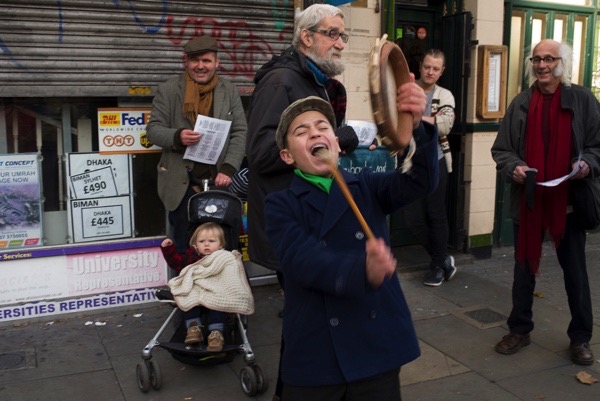
Orlando & Lucian Valman
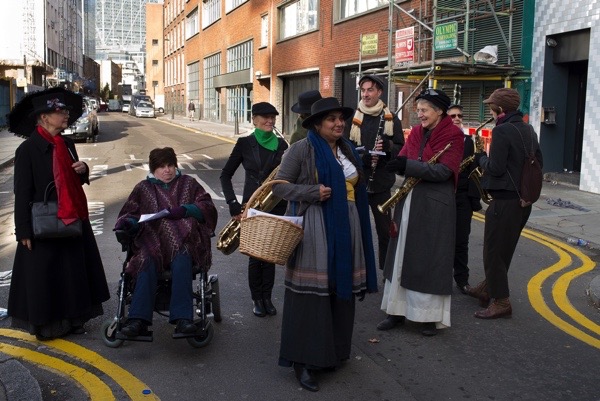
The parade gathers in Aldgate
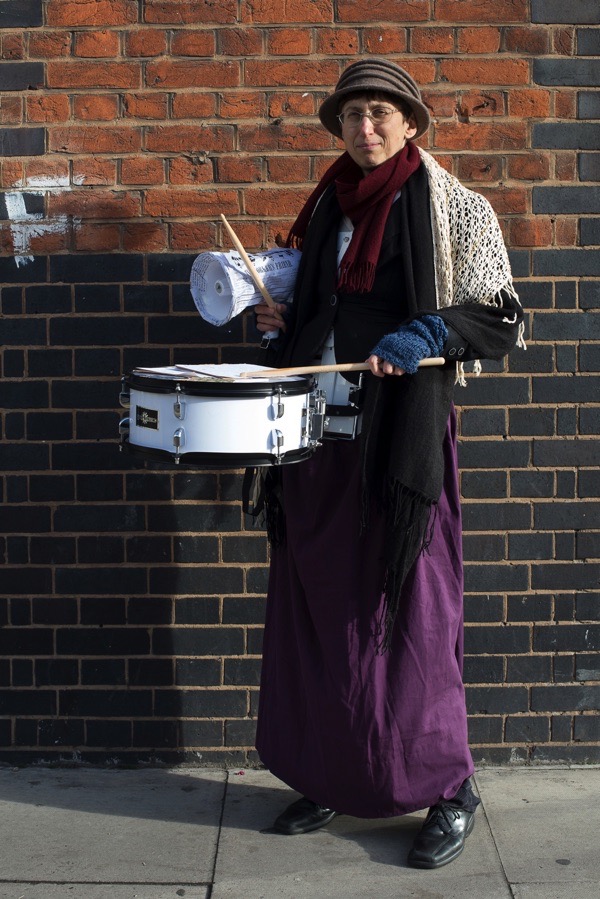
Vivi Lachs, Historian & Yiddisher, who established The Great Yiddish Parade
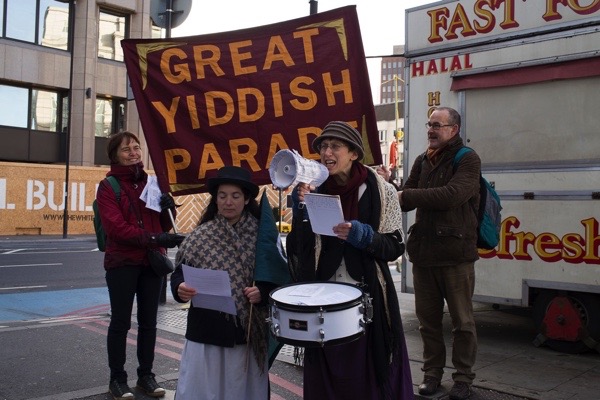
Vivi rallies her comrades
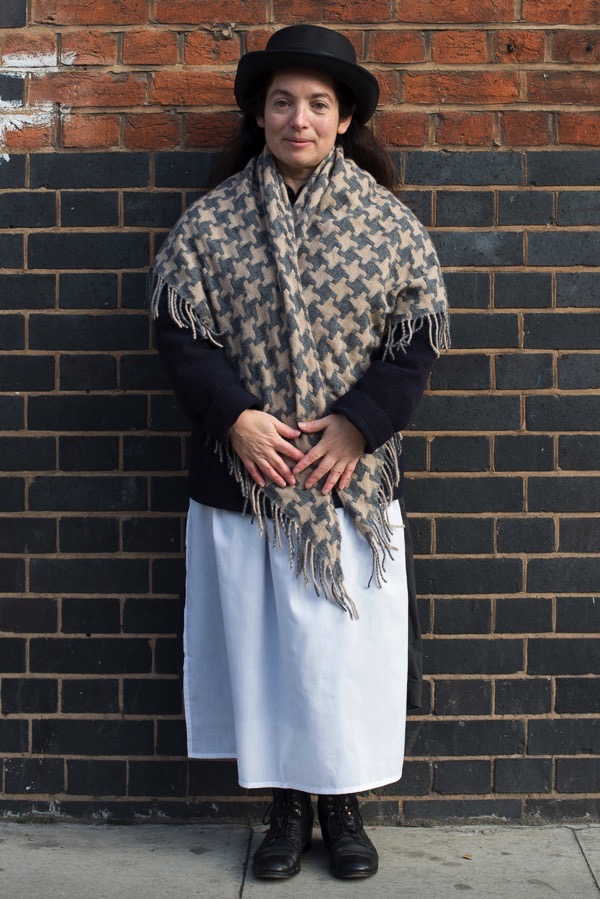
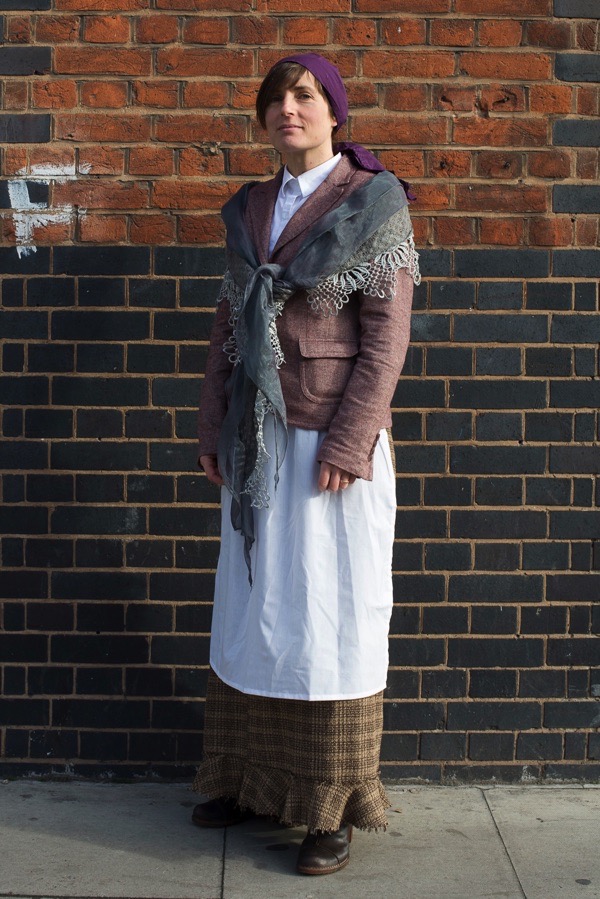
Nadia Valman, organiser of the parade, dressed as seamstress of 1889
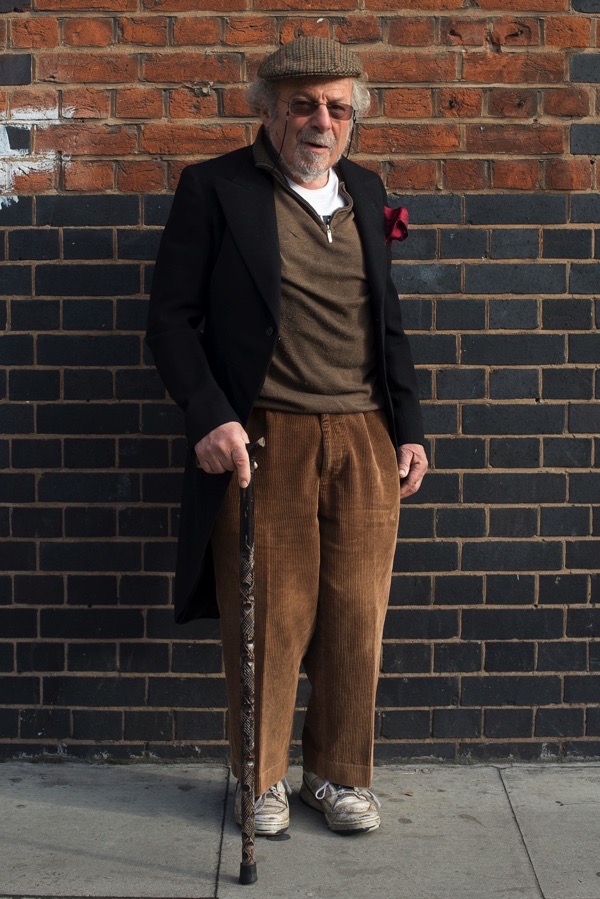
Michael Ellman in his grandfather’s tailcoat
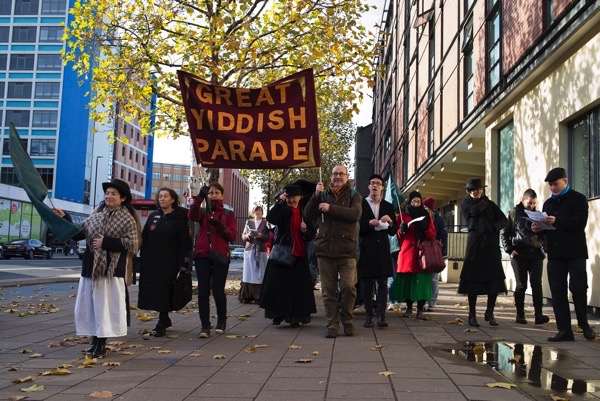
Walking through Aldgate
Esther Neslen, Singer
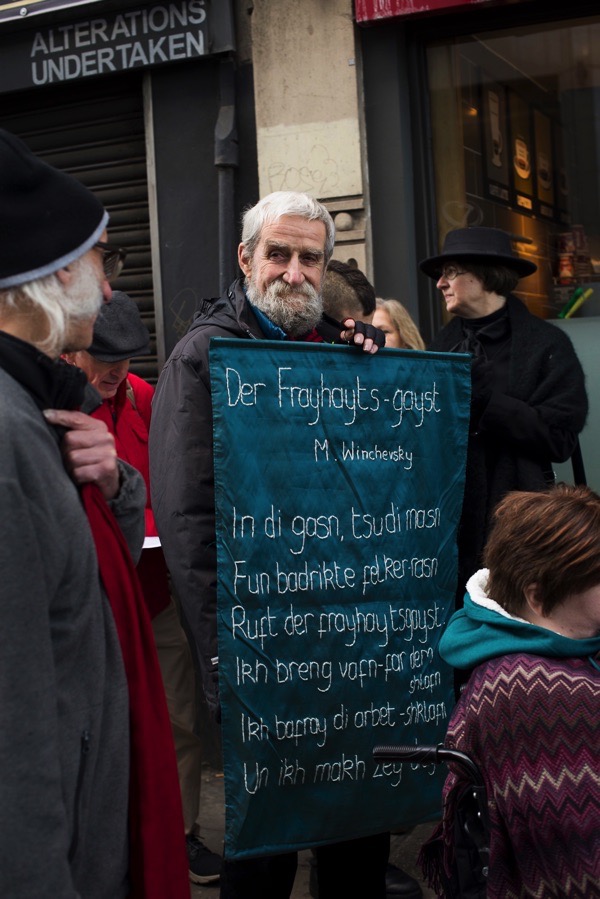
Poet Stephen Watts reads a banner carried by Artist Dan Jones
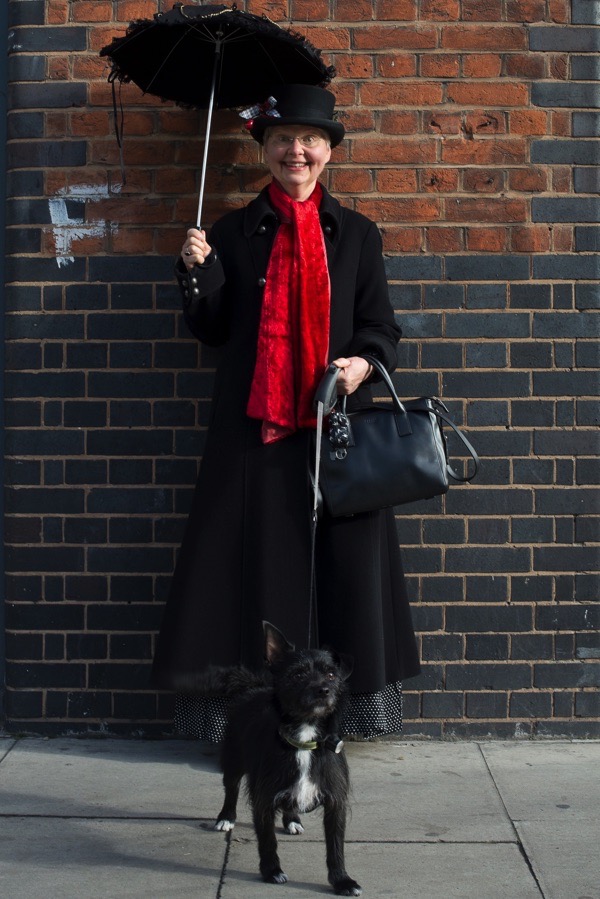
Rabbi Janet Burden of Ealing Liberal Synagogue and her dog Raz
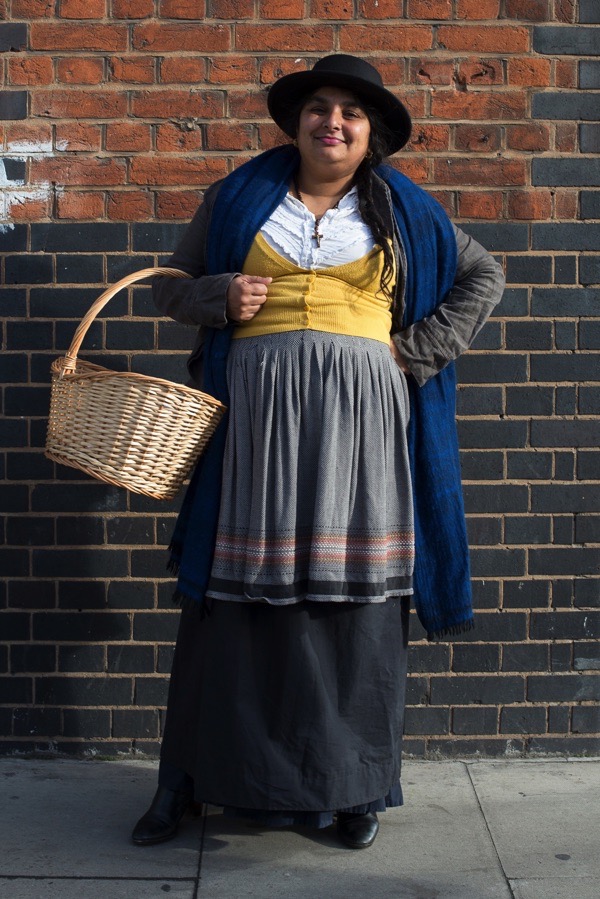
Julie Begum as Olive Christian Malvery, an Anglo-Indian freelance journalist who reported on the conditions of female and child workers in the East End in the eighteen-eighties.
“So I would like to ask you, brothers and sisters, have any of you here been to a bar lately? I am sure that many of you are familiar with the establishments of the Whitechapel Rd. Well, I want to talk to you about the lives of the barmaids who work there. Many of the young girls who earn their living in this arduous calling are subjected to numerous temptations. And yet they remain good, upright, and respectable women. Often they are obliged to stand behind a counter serving semi-drunken, coarse, and foul-mouthed persons of both sexes. They are obliged to listen to the vile talk of that class of man who makes it a pastime to insult young women engaged in this business. As a girl once said to me,’The life is hard enough without having to be insulted by cads.'”
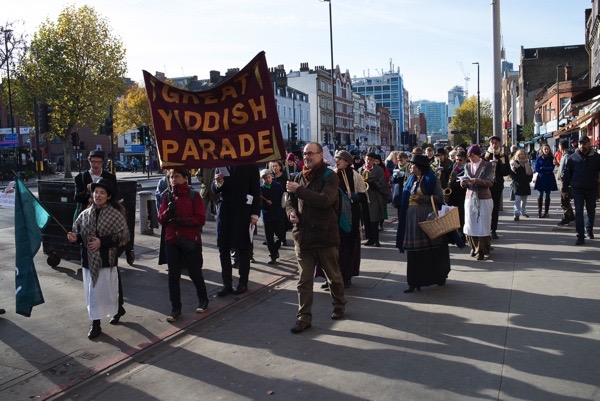
Walking through Whitechapel
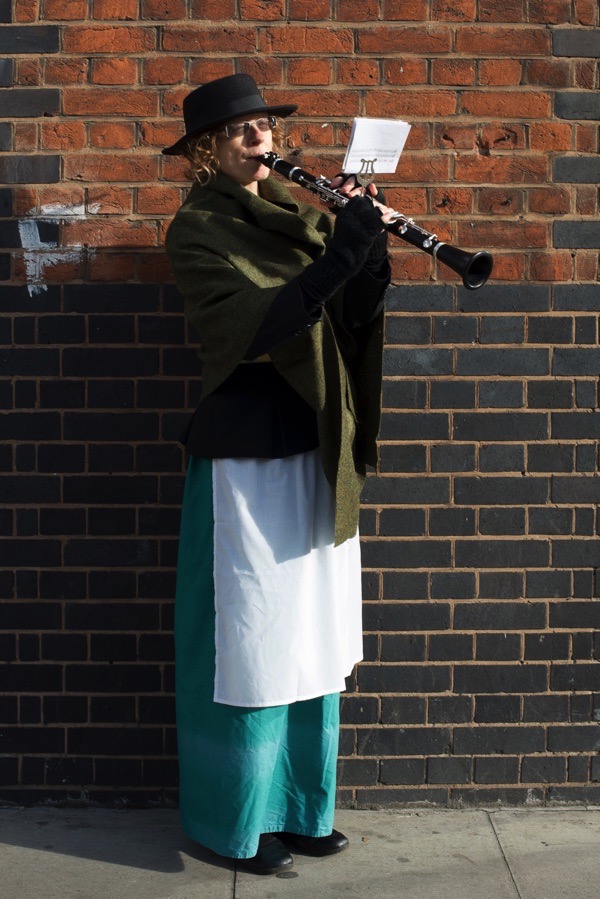
Jo Green, Clarinetist
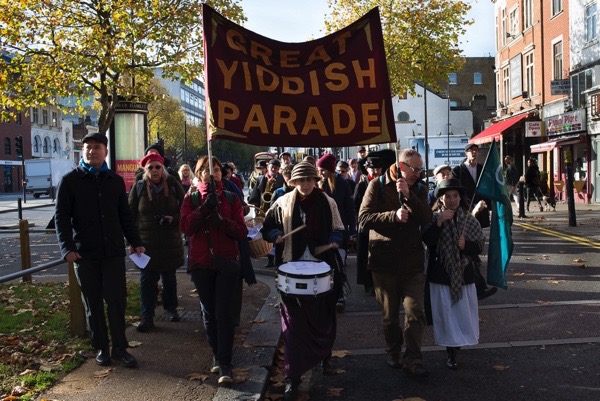
Walking through Mile End
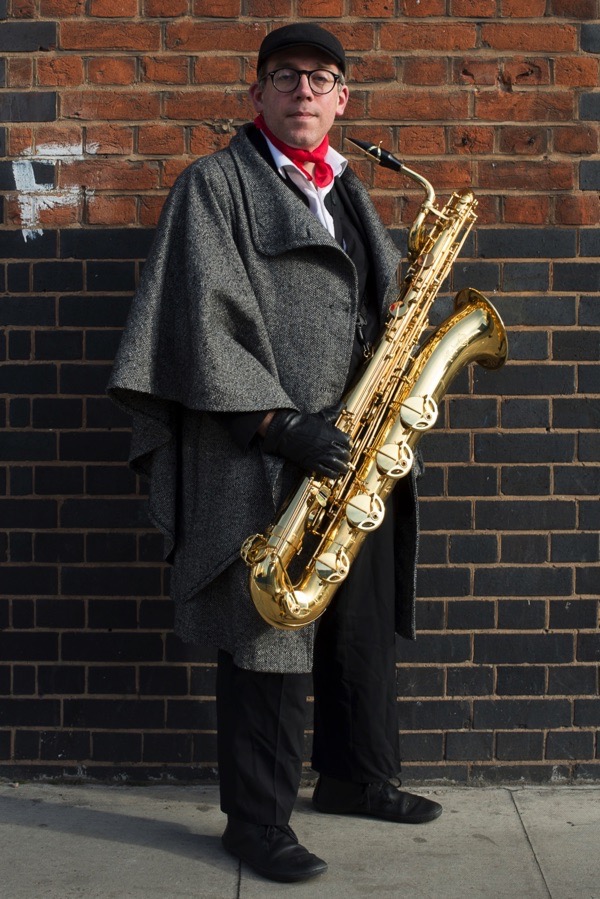
Phil Whaite, Saxophonist
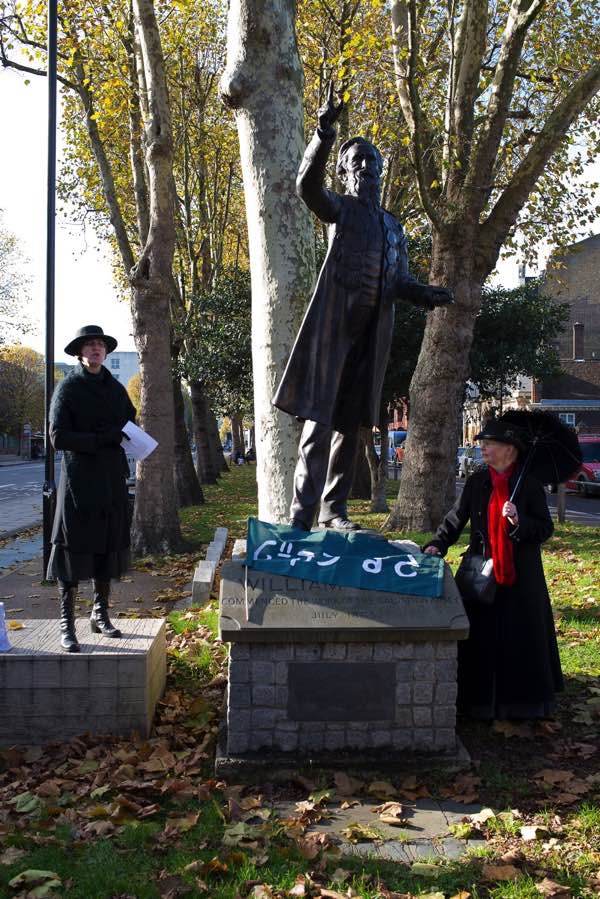
Speeches at Mile End Waste beside the statue of General Booth
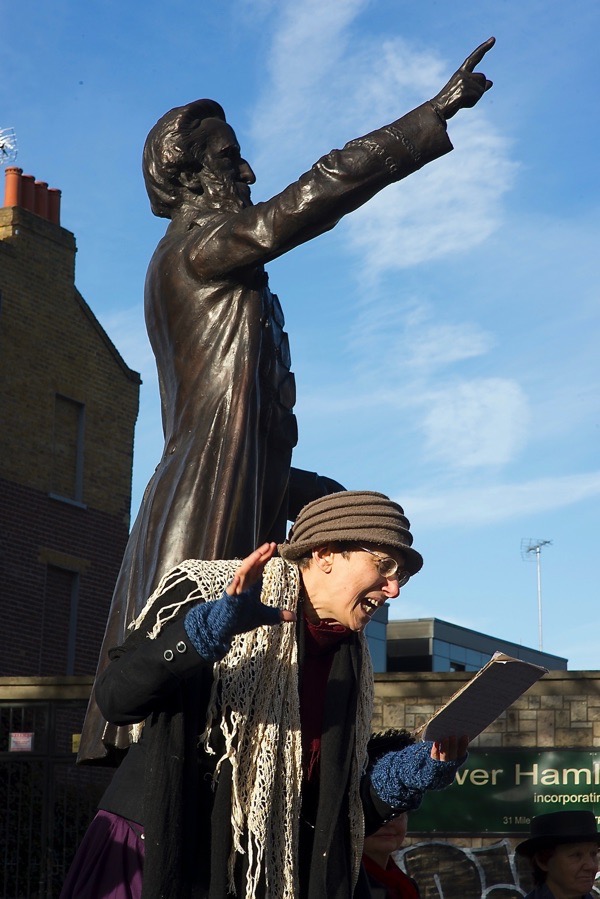
“I have come to you in the East End of London from the United States of America. My friends, I am an Anarchist, and I will tell you why. Anarchism is the great liberator of man from the phantoms that have held him captive. What are these phantoms? Religion, the dominion of the human mind, Property, the dominion of human needs, and Government, the dominion of human conduct, represent the stronghold of man’s enslavement and all the horrors it entails. Break your mental fetters, says Anarchism to man, for not until you think and judge for yourself will you get rid of the dominion of darkness, the greatest obstacle to all progress.”- Emma Goldman, Anarchist & Writer, spoke in Whitechapel in the eighteen-eighties
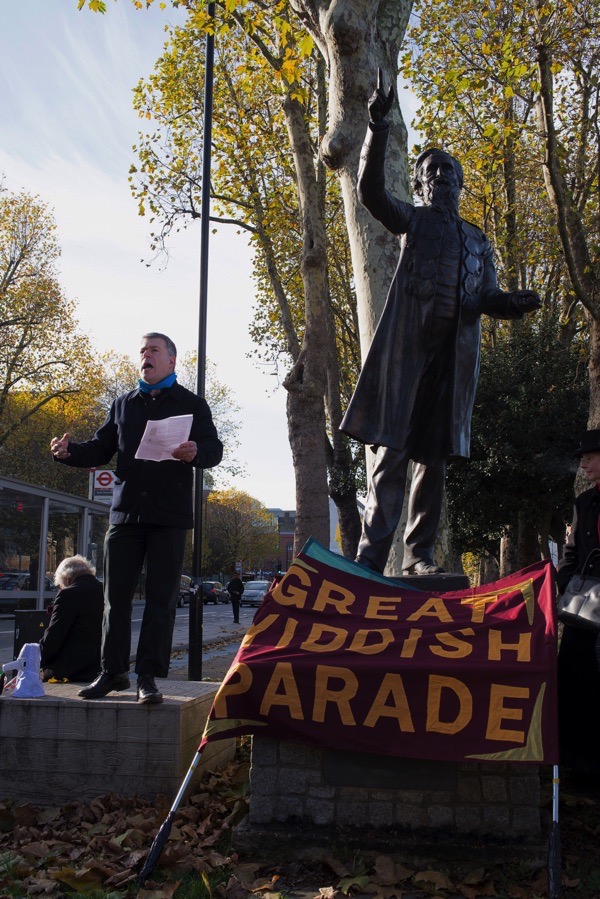
“‘A good man will be contented fast enough if he be fed and clothed sufficiently, but if a man be not well fed and clad, he is a base wretch to be contented.’ So says William Cobbett, and certainly the strikers might have one more banner with this inscription written on it. We have learned a good deal since William Cobbett’s time, and some of us have become very ‘refined’ indeed, but still on this foundation of victuals and shelter without anxiety must you build ‘refinement’ and all.'” – William Morris, who spoke at Mile End Waste in 1889
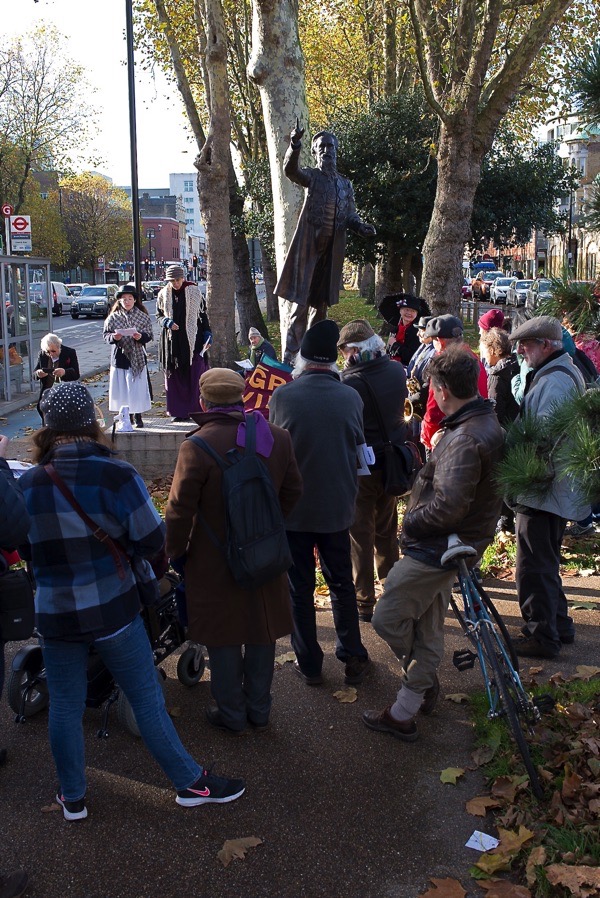
“I’d like to know if there are sadder sights anywhere than those we now see around us? I mean the homes of honest working men who have nothing to do, skilled workmen whose trades are itching at their fingers’ ends, who spend their days tramping about looking for work, and come home at night with empty pockets to hungry wives and children? I need draw no picture of these things. You not only see them, but feel them. You know what it is to have wives fainting for want of food, and children crying for crusts you cannot give them. ” – Words of a young man speaking on Mile End Waste from Margaret Harkness’ novel of 1888, Out of Work.
Photographs copyright © Sarah Ainslie
You may also like to read about these other parades
Rose At The Golden Heart

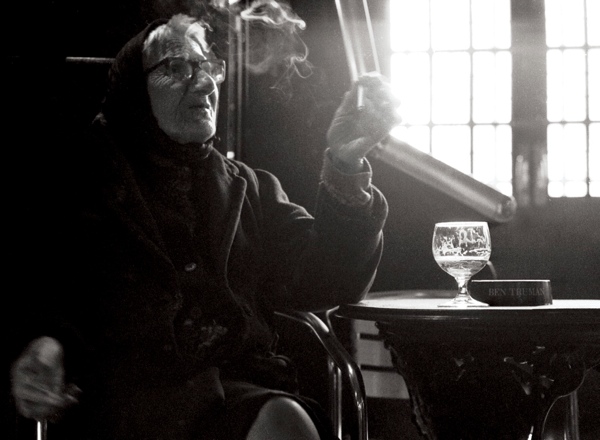
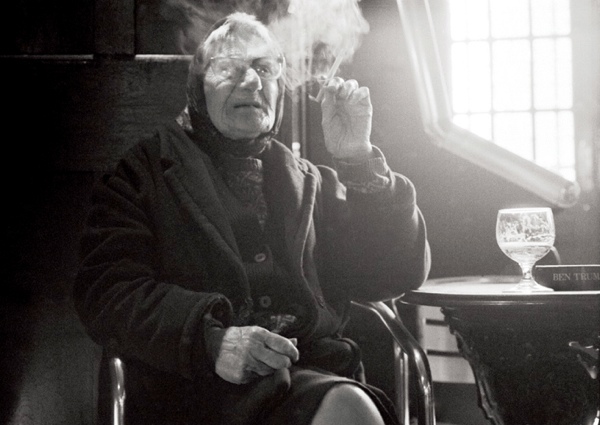
Rose
When Sandra Esqulant, celebrated landlady of The Golden Heart in Commercial St, saw this photo taken by Contributinf Photographer Phil Maxwell of Rose sitting in her barroom twenty years ago she told me the story of an unforgettable character who became one of her most loved regulars.
“I loved Rose. I don’t know what happened to her, she’s got to be dead now hasn’t she?
What happened was – you know how you fall in love with some people? – this woman appeared in the pub one day and I fell in love with her. I just liked her.
She asked for a rum & lemonade, and she never had to pay for a drink in my pub.
I used to have to warn everyone when Rose was coming in because she used to pick up everyone’s cigarettes and put them in her bag.
I used to dance with her.
You might think she was dumb, but she was the most astute person I ever met. She didn’t like my husband while I was there, but when I wasn’t there it was a different story!
My husband liked her a lot.
You know I lost my husband.
When she stopped coming, I went round to the Sally Army in Old Montague St, where she lived, but they told me they didn’t know what happened to her, so I went to the Police Station and they were going to search the morgue. I kept going back to the Sally Army and this Irish woman said to me, ‘Are you looking for Rose? She moved to Commercial Rd.’ So I went round to the Commercial Rd shelter and there was Rose. She was very sad because the Sally Army had put her out after forty years. So I used to send a cab to pick her up and take her back from my pub.
The Sally Army, they should have known how fond I was of her and told me where she had gone.
One Sunday, when I was on my own, she collected all the glasses and the ashtrays and the crisp packets and emptied them over the bar. I didn’t mind, Rose could do anything in my pub.
People like Rose would go into a pub and people wouldn’t serve them, but I had everyone in here – this was the dossers’ bar!
One day, Phil Maxwell asked Rose if he could put her in one of his films and she didn’t like that, but he set his camera on the table and took these pictures. And after that, he always had her picture in his exhibitions.
She must have known I was fond of her.
She did like me.
I know she liked me.
She was lovely.
She used to talk about her daughter, but I sometimes wonder if she ever had a daughter.
At Christmas, she always asked me for a Christmas box and, of course, I always gave her one.
They moved her out after forty years, what a thing to do to someone.
If Rose was here today, I’d let her smoke in my pub – I don’t care about the law.
Very special, she was.”



Photographs copyright © Phil Maxwell
See more of Phil Maxwell’s work here
Phil Maxwell’s Kids on the Street
Phil Maxwell & Sandra Esqulant, Photographer & Muse
More of Phil Maxwell’s Old Ladies
Phil Maxwell’s Old Ladies in Colour












