
Philip Marriage’s Firework Labels
Philip Marriage sent me this glorious collection of firework labels. He said, “If these look as if they’ve been buried or blown up and burnt, it’s because they have!”

“This box of Brock’s bangers was a left-over from my teenage years, preserved in a tin box in the garage for past sixty years. These firework labels give a snapshot of a time when the cry of ‘A penny for the Guy’ was any child’s means to purchase a packet of tuppenny bangers.
I kept them because they possess the unsophistication of another era, bought not only for their visual appeal but primarily for the power of their explosive content.
Brock’s Fireworks go back a long way, founded in 1698 and manufacturing in Islington before moving to Whitechapel in 1815 where their factory blew up in an accident. They moved to Hemel Hempstead in 1910 just down the road from Redbourn in Hertfordshire, where I lived for a decade after I was married in 1968.”
Philip Marriage


You may also like to take a look at
So Long, Ivan Kingsley
Today, I publish my portrait of market traders, Ivan & Irene Kingsley, as a tribute to Ivan who died on Sunday aged eighty-eight.

Ivan & Irene walking through Petticoat Lane Market
Although it may not be apparent to the casual visitor, Middlesex St is the boundary between the Borough of Tower Hamlets and the City of London. It is a distinction of great significance to residents of this particular neighbourhood, because – as Irene Kingsley, who lived there her whole life, put it to me with succinct humour – “When you are in the gutter, you are in Tower Hamlets but when you are on the pavement, you are in the City.”
“I live in the City now, but I spent most of my life in Tower Hamlets.” she added as a qualification, just in case I should take her quip in the wrong spirit. Although Irene had ascended to the lofty heights of a flat in Petticoat Tower on the City side of Middlesex St, she was not bragging that she had gone up in the world, but rather admitting that her heart remained back on the other side of the street where she started out. And when I went to visit her and her husband Ivan, I understood the difference at once, as I climbing the steps from the shabby Petticoat Lane Market into the well-tended courtyard garden of Petticoat Tower, quite a contrast to comparable developments in Tower Hamlets.
In the hallway of their flat on the seventeen floor more plants flourished, these were tended by the Kingsleys. I had only a moment to contemplate them before Ivan appeared to hustle me through the modest yet comfortable flat to the living room where Irene was waiting. Then, as I entered, my eyes were drawn by the yawning chasm of the view over the City from their window. “Everyone goes straight for the view!” Irene declared, exchanging a knowing smile with Ivan. “We used to be able to see the Tower of London, until they built that,” she said, indicating a blue glass block. “And we could see the Monument, before the Gherkin went up,” said Ivan, pointing in the other direction. With such an astonishing prospect, I could understand how anyone might get a little proprietorial.
“We’ve seen a lot of changes in Petticoat Lane.” Irene admitted to me as we sat down, exchanging another a glance with Ivan which was the cue for him to serve tea and biscuits. I knew this was the beginning of her story.
“I was born in Brune House in Toynbee St. My father was a bus conductor and my mother was a seamstress.” she explained, “My grandfather was a cobbler in Artillery Passage and my grandmother had a tea stall in Leyden St, she had seven daughters and they all worked with her, and as time went on all the daughters had their own stalls and they were passed down to grandchildren. I left school at fifteen to work in the office of a clothing factory in Golding St, near Cable St. Until I was fifteen, I lived at Brune House, then I to moved to Herbert House nearby to live with my aunt, she had a daughter of her own and she took me in because I lost my mother. She treated me just like a mother, she took over as my mother.
In 1956 I went to Los Angeles. I took the Queen Mary to New York and then I went by plane from New York to Los Angeles. I worked in the office of an insurance company and I loved it there but I was very homesick, so after a year I came back to pick up the pieces. I had various office jobs and I enjoyed travelling with girlfriends but I never settled down. When I turned fifty, I decided to go into the market selling baby clothes and that’s where I met my husband…”
At this point Ivan and Irene exchanged big smiles, because this was the part where it became a shared narrative.
“We both started out as casual traders,” continued Irene, still looking at Ivan and saying “casual traders,” as if it were a term of endearment, “You had to put your name down on the list and wait around until there were available pitches and it just happened that while we were waiting we used to go to a cafe together. Then the old lady at the stall next to us, she had a granddaughter and we were both invited to the Bell for a celebration and we haven’t look back since!
This was the moment when Ivan took over.“I am not an East End boy,” he announced, “though until I was seven I lived on Underwood St in Spitalfields and from there we moved to Ford Sq in Whitechapel, until in 1940 when we moved to Stoke Newington which in those days was upmarket. I ran a furniture factory in Newington Green until 1976, when I took a job as milkman and from there I went to work for Conway Trading in Toynbee St. They sold socks and underwear for men, and I learnt about that trade, so when they went bankrupt I put what I had learnt into practice, I used to go up North to the sock makers, buy stock and sell it to the retailers. I even applied for the lease to the Conway Trading shop, but for some reason the council refused me and the place is still empty, all these years later.”
By now, I realised where this was going, because – like Irene – the climax of Ivan’s story was becoming a market trader.
“So I decided to start trading in the market.” he said, speaking like a true zealot, “Sundays was brilliant and when I started, even in the week, it was good. It was a wonderful experience because you met so many different kinds of people, all sorts, and, because you were all working in the gutter together, you got to know each other. We were all friends since we were all in the same position. At one point, the council wanted to stop casual traders for nine months, so we went on strike and marched to Bethnal Green Town Hall and demonstrated there. They realised the market could fold and they couldn’t take away the livelihood from seventy people, so from then on we got licences to trade. It was an education, and it was a hard life too, but while you are working you enjoy it.”
Irene and Ivan had stalls side by side and then they combined stalls, unifying their presence in the market, just as their lives became intertwined in marriage. “I retired from the market when my husband was seventy-five and I was seventy-two, so we felt we’d done enough,” explained Irene, clasping her hands in satisfaction.
Yet both acknowledged that trading in the Petticoat Lane Market was a highlight of their existence, a source of livelihood, a social education and a romantic adventure too, which all goes to prove that sometimes the gutter can be a better place to be than the pavement.

Ivan (centre) as a young man on Hythe Beach with his family

Irene at Canon Barnett School, 1947 – she is the sixth from the left in the back row

Irene Kingsley, Herbert House, Spitalfields 1957

Irene (left) at Riccione Beach in 1970 with her friends Phyllis Gee, Stella Spanjar and Celina Martin

Ivan returns to Conway Trading on Toynbee St where he worked in the seventies. Ivan tried to lease it from the council forty years ago but they refused and it was been empty until it was redeveloped three years ago

Irene & Ivan Kingsley in their flat in Petticoat Tower

Looking towards the City from Irene & Ivan’s flat in Petticoat Tower
Photographs copyright © Jeremy Freedman
You might also like to read about
Laurie Allen of Petticoat Lane
Vivian Betts Of The Primrose

Vivian & Toto outside The Primrose
You will not meet many who can boast the distinction of being brought up on the teeming thoroughfare of Bishopsgate but Vivian Betts is one who enjoyed that rare privilege, growing up above The Primrose on the corner of Primrose St where her parents were publicans from 1955 until 1974. Yet it was a different Bishopsgate from that of the present day with its soaring glass towers housing financial industries. In her childhood, Vivian knew a street lined with pubs and individual shops where the lamplighter came each night to light the gas lamps.
Living in a pub on the boundary of the City of London, Vivian discovered herself at a hub of human activity. “I had the best of both worlds,” Vivian confessed to me, when she came up to Spitalfields on a rare visit, “I had the choice of City life or East End life, I could go either way. I had complete freedom and I was never in any danger. My father said to me if I ever had any trouble to go to a policeman. But all my friends wanted to come over to my place, because I lived in a pub!”
Vivian knew Bishopsgate before the Broadgate development swallowed up the entire block between Liverpool St and Primrose St. And as we walked together past the uniform architecture, she affectionately ticked off the order of the pubs that once stood there – The Kings Arms, The Raven and then The Primrose – with all the different premises in between. When we reached the windswept corner of Primrose St beneath the vast Broadgate Tower, Vivian gestured to the empty space where The Primrose once stood, now swallowed by road widening, and told me that she remembered the dray horses delivering the beer in barrels on carts from the Truman Brewery in Brick Lane.
In this landscape of concrete, glass and steel, configured as the environment of aggressive corporate endeavour, it was surreal yet heartening to hear Vivian speak and be reminded that human life once existed there on a modest domestic scale. Demolished finally in 1987, The Primrose had existed in Bishopsgate at least since 1839.
“My brother Michael was born in 1942, while Bill my father was away in the war, and Violet my mother got a job as a barmaid, and when he came back she said, ‘This is how I want to spend my life.’ Their first pub was The Alfred’s Head in Gold St, Stepney, in about 1946, and she told me she was washing the floor there in the morning and I was born in the afternoon. We left when I was three and all I remember of Stepney was walking over a bomb site to look at all the caterpillars.
In 1955, we moved into The Primrose at 229 Bishopsgate, directly opposite the Spitalfields market – you could look out of the window on the first floor and see the market. My first memory of Bishopsgate was lying in bed and listening to the piano player in the pub below. We had three pianos, one in the public bar, one in the first floor function room and one in our front room. On Sunday lunchtimes at The Primrose, it was so busy you could hardly see through the barroom for all the hats and smoke.
I used to go to Canon Barnet School in Commercial St and, from the age of seven, my dad would see me across Bishopsgate and I’d walk through the Spitalfields Market on my way to school where the traders would give me an apple and a banana – they all knew me because they used to come drinking in the pub. It was a completely Jewish school and, because no-one else lived in Bishopsgate, all my friends were over in Spitalfields, mostly in the Flower & Dean Buildings, so I spent a lot of time over there. And I used to come to Brick Lane to go the matinees at the cinema every Saturday. Itchy Park was our playground – in those days, the church was shut but we used to peek through the window and see hundreds of pigeons inside.
My dad opened one of the first carveries in a pub, where you could get fresh ham or turkey cut and made up into sandwiches and, in the upstairs room, my mum did sit-down lunches for three shillings – it was like school dinners, steak & kidney pudding and sausage & mash. She walked every day with her trolley to Dewhurst’s the butchers opposite Liverpool St, she got all her fruit and vegetables fresh from the Spitalfields Market, and she used to go to Petticoat Lane each week to buy fresh fish.
Every evening at 5pm, we had all the banks come in to play darts. On Mondays, it was the ladies of The Primrose darts team and on Wednesdays it was the men’s darts league. And, once each year, we organised the Presentation Dance at the York Hall. Every evening in the upstairs function room, we had the different Freemason’s lodges. Whenever I came out of my living room, I could always see them but I had to look away because it was part of my life that I wasn’t supposed to see. After I left school, I went to work for the Royal London Mutual Insurance Co. in Finsbury Sq – five minutes walk away – as a punchcard operator and, whenever it was anyone’s birthday, I’d say ‘Come on back to my mum’s pub and she’ll make us all sandwiches.’
Then in 1973, Truman’s wrote to my dad and gave him a year’s notice, they were turning the pub over to managers in April 1974, so we had to leave. But I had already booked my wedding for July at St Botolph’s in Bishopsgate, and I came back for that. Eighteen months later, in 1976, my mum and dad asked me and my husband to go into running a pub with them. It was The Alexandra Hotel in Southend, known as the “Top Alex” because there were two and ours was at the top of the hill.
Three months after we moved in, my dad died of cancer – so they gave it to my mum on a year’s widow’s lease but they said that if me and my husband proved we could run it, we could keep it. And we stayed until 1985. Then we had a murder and an attempted murder in which a man got stabbed, and my husband said, ‘It’s about time we moved.’ And that’s when we moved to our current pub, The Windmill at Hoo, near Rochester, twenty-eight years ago. We had a brass bell hanging behind the counter at The Primrose that came off a train in Liverpool St Station which we used to call time and we’ve taken it with us – all these years – but though we don’t call time any more, we still use it to ring in the New Year.
I’ve only ever had two Christmases not in a pub in my life, when you’re born to it you don’t know anything else.”
Vivian told me that she often gets customers from the East End in The Windmill and they always recognise her by her voice. “They say, ‘We know where you come from!'” she confided to me proudly.

The Primrose, 229 Bishopsgate, as Vivian knew it.

Toto sits on the heater in the panelled barroom at The Primrose.

Vivian at Canon Barnet School in Commercial St.

Bill and Vi Betts

“My first Freemason’s Lodge night when I was twelve or thirteen in 1965. My brother Michael with his wife Valerie on the right.”

Vivian stands outside The Primrose in this picture, looking east across Bishopsgate towards Spital Sq with Spitalfields market in the distance.
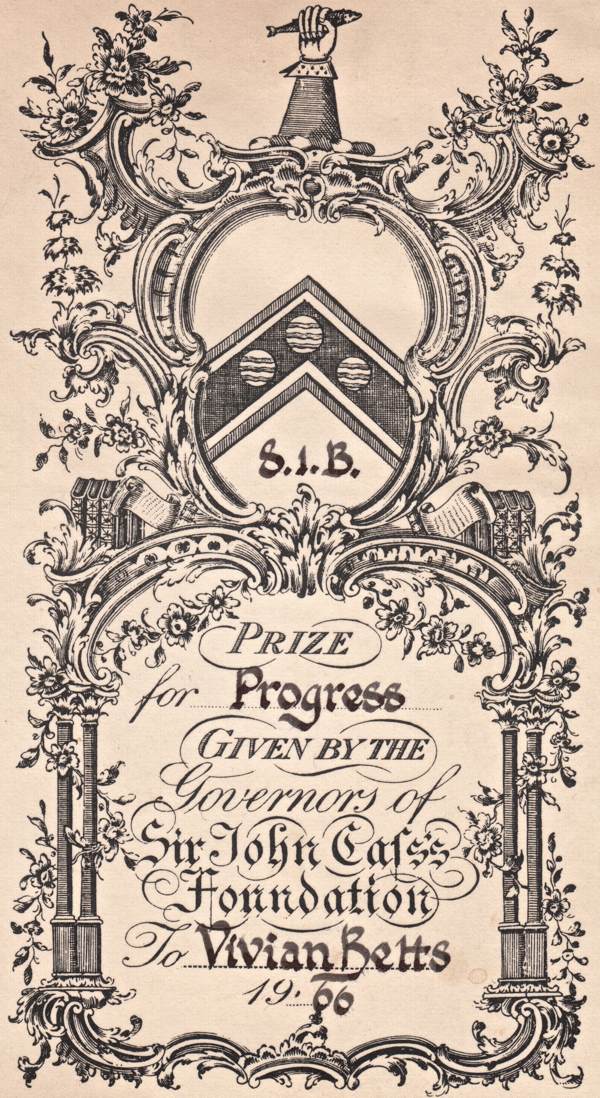
Vivian was awarded this certificate while a student at Sir John Cass School, Houndsditch.

Vivian on the railway bridge, looking west towards Finsbury Sq.

Vivian outside the door which served as the door to the pub and her own front door.

Vivian’s friends skylarking in Bishopsgate – “They always wanted to come over to my place because I lived above a pub!”
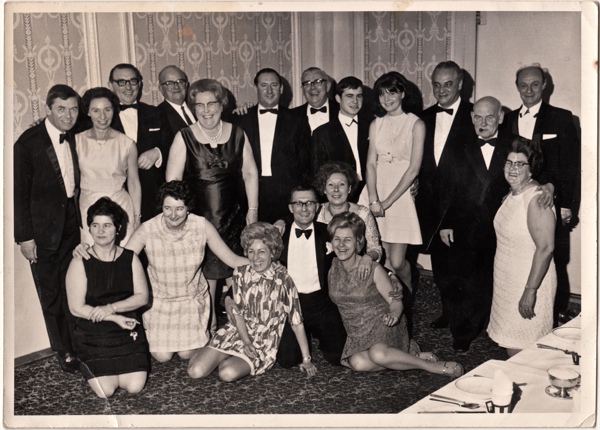
“When I was eight, we went abroad on holiday for the first time to Italy, we bought the tickets at the travel agents across the road and, after that, twelve or fourteen couples would come with us – my parents’ friends – and I was always the youngest there.”

Vivian prints out a policy at the Royal London Mutual Insurance Co. in Finsbury Sq.

“And what do you do?” – Vivian meets Prince Charles on a visit to Lloyd Register of Shipping in Fenchurch St.

“Harry the greengrocer and Tom the horse, they used to get their fruit & vegetables in the Spitalfields Market. My husband Dennis worked for this man when he was about twelve years of age, driving around the Isle of Dogs. He loved horses, and we’ve got a piece of land with our pub now and we’ve kept horses since 1980.”

Bill & Vi Betts in later years.

Vivian Betts at St Botolph’s Bishopsgate where she married her husband Dennis Campbell in 1974.

The Primrose in a former incarnation, photographed in 1912.

Bishopsgate with The Primrose halfway down on the right, photographed in 1912 by Charles Goss.

Bishopsgate today.
Archive photographs courtesy Bishopsgate Institute
You might also like to take a look at these other Bishopsgate Stories
The Romance of Old Bishopsgate
A Dead Man In Clerkenwell
At Halloween, it suits my mood to contemplate the dead man in the crypt in Clerkenwell

This is the face of the dead man in Clerkenwell. He does not look perturbed by the change in the weather. Once winters wore him out, but now he rests beneath the streets of the modern city he will never see, oblivious both to the weather and the wonders of our age, entirely oblivious to everything in fact.
Let me admit, although some might consider it poor company, I consider death to be my friend – because without mortality our time upon this earth would be worthless. So I do not fear death, but rather I hope I shall have enough life first. My fear is that death might come too soon or unexpectedly in some pernicious form. In this respect, I envy my father who always took a nap on the sofa each Sunday after gardening and one day at the age of seventy nine – when he had completed trimming the privet hedge – he never woke up again.
It was many years ago that I first made the acquaintance of the dead man in Clerkenwell, when I had an office in the Close where I used to go each day and write. I was fascinated to discover a twelfth century crypt in the heart of London, the oldest remnant of the medieval priory of the Knights of St John that once stood in Clerkenwell until it was destroyed by Henry VIII, and it was this memento mori, a sixteenth century stone figure of an emaciated corpse, which embodied the spirit of the place for me.
Thanks to Pamela Willis, curator at the Museum of the Order of St John, I went back to look up my old friend after all these years. She lent me her key and, leaving the bright October sunshine behind me, I let myself into the crypt, switching on the lights and walking to the furthest underground recess of the building where the dead man was waiting. I walked up to the tomb where he lay and cast my eyes upon him, recumbent with his shroud gathered across his groin to protect a modesty that was no longer required. He did not remonstrate with me for letting twenty years go by. He did not even look surprised. He did not appear to recognise me at all. Yet he looked different than before, because I had changed, and it was the transformative events of the intervening years that had awakened my curiosity to return.
There is a veracity in this sculpture which I could not recognise upon my previous visit, when – in my innocence – I had never seen a dead person. Standing over the figure this time, as if at a bedside, I observed the distended limbs, the sunken eyes and the tilt of the head that are distinctive to the dead. When my mother lost her mental and then her physical faculties too, I continued to feed her until she could no longer even swallow liquid, becoming as emaciated as the stone figure before me. It was at dusk on the 31st December that I came into her room and discovered her inanimate, recognising that through some inexplicable prescience the life had gone from her at the ending of the year. I understood the literal meaning of “remains,” because everything distinctive of the living person had departed to leave mere skin and bone. And I know now that the sculptor who made this effigy had seen that too, because his observation of the dead is apparent in his work, even if the bizarre number of ribs in his figure bears no relation to human anatomy.
There is a polished area on the brow, upon which I instinctively placed my hand, where my predecessors over the past five centuries had worn it smooth. This gesture, which you make as if to check his temperature, is an unconscious blessing in recognition of the commonality we share with the dead who have gone before us and whose ranks we shall all join eventually. The paradox of this sculpture is that because it is a man-made artifact it has emotional presence, whereas the actual dead have only absence. It is the tender details – the hair carefully pulled back behind the ears, and the protective arms with their workmanlike repairs – that endear me to this soulful relic.
Time has not been kind to this figure, which originally lay upon the elaborate tomb of Sir William Weston inside the old church of St James Clerkenwell, until the edifice was demolished and the current church was built in the eighteenth century, when the effigy was resigned to this crypt like an old pram slung in the cellar. Today a modern facade reveals no hint of what lies below ground. Sir William Weston, the last Prior, died in April 1540 on the day that Henry VIII issued the instruction to dissolve the Order, and the nature of his death was unrecorded. Thus, my friend the dead man is loss incarnate – the damaged relic of the tomb of the last Prior of the monastery destroyed five hundred years ago – yet he still has his human dignity and he speaks to me.
Walking back from Clerkenwell, through the City to Spitalfields on this bright afternoon in late October, I recognised a similar instinct as I did after my mother’s death. I cooked myself a meal because I craved the familiar task and the event of the day renewed my desire to live more life.


The Museum of the Order of St John, St John’s Gate, Clerkenwell, EC1M 4DA
Luke Clennell’s Dance of Death
Twenty years have passed since my father died at this time of year and thoughts of mortality always enter my mind as the nights begin to draw in, as I prepare to face the spiritual challenge of another long dark winter ahead. So Luke Clennell’s splendid DANCE OF DEATH engravings inspired by Hans Holbein suit my mordant sensibility at this season.
First published in 1825 as the work of ‘Mr Bewick’, they have recently been identified for me as the work of Thomas Bewick’s apprentice Luke Clennell by historian Dr Ruth Richardson.

The Desolation

The Queen
 The Pope

The Cardinal

The Elector

The Canon

The Canoness

The Priest

The Mendicant Friar
 The Councillor or Magistrate

The Astrologer

The Physician

The Merchant

The Wreck

The Swiss Soldier

The Charioteer or Waggoner
 The Porter

The Fool
 The Miser
 The Gamesters

The Drunkards

The Beggar

The Thief

The Newly Married Pair

The Husband

The Wife

The Child

The Old Man

The Old Woman
You may also like to take a look at
Geraldine Beskin, Witch

Geraldine Beskin presides as serenely as the Mona Lisa from behind her desk at the Atlantis Bookshop in Museum St, Bloomsbury – the oldest occult bookshop in the world, one of London’s unchanging landmarks and the pre-eminent supplier of esoteric literature to the great and the good, the sinister and the silly, since 1922. “My father came into the shop one day and Michael Houghton, a poet and a magician, who founded it and knew everyone from W.B.Yeats to Aleister Crowley, took a good look at him and said, ‘You’ll own this place one day,'” Geraldine told me, with a gentle smile that indicated a relaxed acceptance of this happy outcome as indicative of the natural order of things.
“I started working here when I was nineteen, and I’ve read a tremendous amount and I’ve done some of it – because you have to be a reader to be a good bookseller,” she said, casting her eyes around with proprietary affection at the sage green shelves lined with diverse and colourful books old and new, organised in alphabetical categories from angels and fairies, by way of magic and paganism, to werewolves and vampires.“This place was set up by magicians for magicians and that’s a tradition we continue today,” boasted Geraldine, who guards this treasure trove with her daughter Bali, the third generation in the book trade and a fourth generation occultist.
Yet in spite of the exoticism of her subject matter, Geraldine recognises the necessity for a certain rigour of approach.“There are New Age shops that sell dangly things and crystals, but we don’t, we’re a quality bookshop” she said, laying her cards boldly yet politely upon the table,”We are not faddist, we have an awareness of the contents of the books.” Working at her desk, sustained by copious amounts of tea, Geraldine is an enthusiastic custodian of a wide range of esoteric discourse upon matters spiritual. “The esoteric is an endless source of fascination,” she assured me, her eyes sparkling to speak of a lifetime’s passion,“There are so many facets to the esoteric that you need never run out of things to be amazed by.”
I am ashamed to confess that even though I pass it every time I walk to the West End, I never visited the Atlantis Bookshop before because – such is the nature of my credulity – I was too scared. But thanks to Simon Costin of the Museum of British Folklore who arranged my introduction to Geraldine, I made it across the threshold eventually, and once I was in conversation with Geraldine who admits to being a witch and practising witchcraft, although she prefers the term “occultist,” I discovered my fears were rootless. However, my ears pricked up at the innocent phrase, “I’ve done some of it,” which Geraldine dropped into the middle of her sentence quite naturally and so I enquired further, curious to learn more about the nature of “it.”
“My grandmother, me and my daughter all do it. My dad did it.” she declared, as if “it” was the most common thing in the world, “I come from a family of esoterics. I was born into it, so I think it would be immoral to own a shop like this and not appreciate what people are doing. Loosely it could be called witchcraft, but in reality it is a certain perception or background intuition.”
“Our subject has become very fashionable and young academics don’t have a bloody clue, which is very frustrating for us.” she continued, rolling her eyes at the inanity of humanity,“We try to disabuse people of the myths about witches, they are good kind people on the whole. Most witches are as mortgage-bound and dog-walking as everyone else. Most witches do healing, and buy toilet paper. And there is this side of trying to commune with nature and be aware of the cycle of change. It’s a very rich and rewarding way of life. I practise a bit of magic – there’s so much you can’t learn from books and you have to do it yourself.”
With her waist-length grey hair, deep eyes, and amusingly authoritative rhetorical style, Geraldine is an engaging woman of magnanimous spirit. And I cannot deny a certain vicarious excitement on my part, brightening an overcast morning to discover myself seated in this elegant empty bookshop in Bloomsbury in conversation with a genuine witch. Yet I was still curious about the nature of “it.” So I asked again.
“Witchcraft is a very benign religion, where you work around the seasons of the year,” explained Geraldine patiently, in a pleasant measured tone, “You start off in darkness, and, in Mid-Summer, the Holly King and the Corn King have a fight and the Holly King wins and then the light begins to decline. At Yule, they fight again and the Corn King wins and the light begins to come back to the world. In agrarian societies, people got up at dawn and worked until dusk, and they adjusted how they lived by the seasons. It was the Christians who gave us the devil and we don’t know what to do with him. We have a horned god who is the god of positive male energy – not a devil at all, but the poor soul has been demonized over the years.”
Geraldine convinced me that esoteric cultures from the ancient world remain vibrant, by reminding me that witches were always “green,” ahead of their time in ecological awareness, and – although she could not disclose names – by revealing that top celebrities, from princes to pop-stars, have always frequented the Atlantis Bookshop. “We make a play of only giving out the names of our famous dead customers,” she confided to me with a tantalising smirk. “Most of our customers are practitioners – witchcraft has become the default teenage rebellion religion today,” she added with an ambivalent grin, confirming that, in spite of everything, the future looks bright for witches.

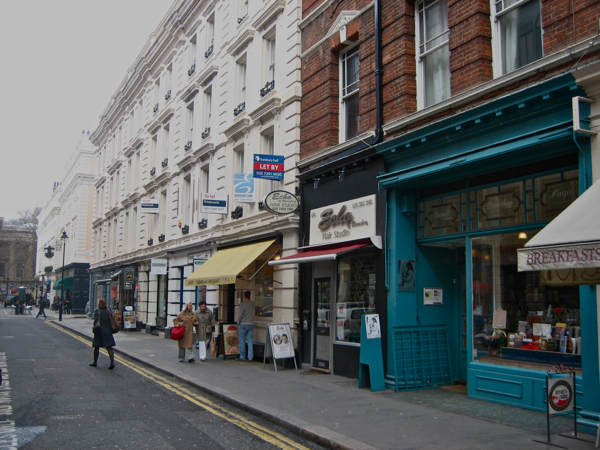
The British Museum awaits at the end of the street


Geraldine and her sister Tish outside the bookshop in the nineteen-seventies – “Those were the days when the Rolling Stones and the Beatles used to come in.”
You may also like to read about
Upon The Nature Of Gothic Horror

I believe I was born with a medieval imagination. It is the only way I can explain the explicit gothic terrors of my childhood. Even lying in my cradle, I recall observing the monstrous face that emerged from the ceiling lampshade once the light was turned out. This all-seeing creature, peering at me from above, grew more pervasive as years passed, occupying the shadows at the edges of my vision and assuming more concrete manifestations. An unexpected sound in my dark room revealed its presence, causing me to lie still and hold my breath, as if through my petrified silence I could avert the attention of the devil leaning over my bedside.
When I first became aware of gargoyles carved upon churches and illustrated in manuscripts, I recognised these creatures from my own imagination and I made my own paintings of these scaled, clawed, horned, winged beasts, which were as familiar as animals in the natural world. I interpreted any indeterminate sound or movement from the dark as indicating their physical presence in my temporal existence. Consequently, darkness, shadow and gloom were an inescapable source of fear to me on account of the nameless threat they harboured, always lurking there just waiting to pounce. At this time of year, when the dusk glimmers earlier in the day, their power grew as if these creatures of the shades might overrun the earth.
Nothing could have persuaded me to walk into a dark house alone. One teenage summer, I looked after an old cottage while the residents were on their holiday and, returning after work at night, I had to walk a long road that led through a deep wood without street lighting. As I wheeled my bicycle up the steep hill among the trees in dread, it seemed to me they were alive with monsters and any movement of the branches confirmed their teeming presence.
Yet I discovered a love of ghost stories and collected anthologies of tales of the supernatural, which I accepted as real because they extended and explained the uncanny notions of my own imagination. In an attempt to normalise my fears, I made a study of mythical beasts and learnt to distinguish between a griffin and a wyvern. When I discovered the paintings of Hieronymous Bosch and Pieter Breughel, I grew fascinated and strangely reassured that they had seen the apocalyptic visions which haunted the recesses of my own mind.
I made the mistake of going to see Ridley Scott’s The Alien alone and experienced ninety minutes transfixed with terror, unable to move, because – unlike the characters in the drama – I was already familiar with this beast who had been pursuing me my whole life. In retrospect, I recognise the equivocal nature of this experience, because I also sought a screening of The Exorcist with similar results. Perhaps I sought consolation in having my worst fears realised, even if I regretted it too?
Once, walking through a side street at night, I peered into the window of an empty printshop and leapt six feet back when a dark figure rose up from among the machines to confront my face in the glass. My companions found this reaction to my own shadow highly amusing and it was a troubling reminder of the degree to which I was at the mercy of these irrational fears even as an adult.
I woke in the night sometimes, shaking with fear and convinced there were venomous snakes in the foot of my bed. The only solution was to unmake the bed and remake it again before I could climb back in. Imagine my surprise when I visited the aquarium in Berlin and decided to explore the upper floor where I was confronted with glass cases of live tropical snakes. Even as I sprinted away down the street, I felt the need to keep a distance from cars in case a serpent might be lurking underneath. This particular terror reached its nadir when I was walking in the Pyrenees, and stood to bathe beneath a waterfall and cool myself on a hot day. A green snake of several feet in length fell wriggling from above, hit me, bounced off into the pool and swam away, leaving me frozen in shock.
Somewhere all these fears dissolved. I do not know where or when exactly. I no longer read ghost stories or watch horror films and equally I do not seek out dark places or reptile houses. None of these things have purchase upon my psyche or even hold any interest anymore. Those scaly beasts have retreated from the world. For me, the shadows are not inhabited by the spectral and the unfathomable darkness is empty.
Bereavement entered my life and it dispelled these fears which haunted me for so long. My mother and father who used to turn out the light and leave me to sleep in my childhood room at the mercy of medieval phantasms are gone, and I have to live in the knowledge that they can no longer protect me. Once I witnessed the moment of death with my own eyes, it held no mystery for me. The demons became redundant and fled. Now they have lost their power over me, I miss them – or rather, perhaps, I miss the person I used to be – yet I am happy to live a life without supernatural agency.


Fourteenth century carvings from St Katherine’s Chapel, Limehouse
You might also like to read about


