
The Wallpaper Of Spitalfields

One house in Fournier St has wallpapers dating from 1690 until 1960. This oldest piece of wallpaper was already thirty years old when it was pasted onto the walls of the new house built by joiner William Taylor in 1721, providing evidence – as if it were ever needed – that people have always prized beautiful old things.
John Nicolson, the current owner of the house, keeps his treasured collection of wallpaper preserved between layers of tissue in chronological order, revealing both the history and tastes of his predecessors. First, there were the wealthy Huguenot silk weavers who lived in the house until they left for Scotland in the nineteenth century, when it was subdivided as rented dwellings for Jewish people fleeing the pogroms in Eastern Europe. Yet, as well as illustrating the precise social history of this location in Spitalfields, the wider significance of the collection is that it tells the story of English wallpaper – through examples from a single house.
When John Nicolson bought it in 1995, the house had been uninhabited since the nineteen thirties, becoming a Jewish tailoring workshop and then an Asian sweatshop before reaching the low point of dereliction, repossessed and rotting. John undertook a ten year renovation programme, moving into the attic and then colonising the rooms as they became habitable, one by one. Behind layers of cladding applied to the walls, the original fabric of the house was uncovered and John ensured that no materials left the building, removing nothing that predated 1970. A leaky roof had destroyed the plaster which came off the walls as he uncovered them, but John painstakingly salvaged all the fragments of wallpaper and all the curios lost by the previous inhabitants between the floorboards too.
“I wanted it to look like a three hundred year old house that had been lovingly cared for and aged gracefully over three centuries,” said John, outlining his ambition for the endeavour, “- but it had been trashed, so the challenge was to avoid either the falsification of history or a slavish recreation of one particular era.” The house had undergone two earlier renovations, to update the style of the panelling in the seventeen-eighties and to add a shopfront in the eighteen-twenties. John chose to restore the facade as a domestic frontage, but elsewhere his work has been that of careful repair to create a home that retains its modest domesticity and humane proportions, appreciating the qualities that make these Spitalfields houses distinctive.
The ancient wallpaper fragments are as delicate as butterfly wings now, but each one was once a backdrop to life as it was played out through the ages in this tottering old house. I can envisage the seventeenth century wallpaper with its golden lozenges framing dog roses would have gleamed by candlelight and brightened a dark drawing room through the winter months with its images of summer flowers, and I can also imagine the warm glow of the brown-hued Victorian designs under gaslight in the tiny rented rooms, a century later within the same house. When I think of the countless hours I have spent staring at the wallpaper in my time, I can only wonder at the number of day dreams that were once projected upon these three centuries of wallpaper.
Flowers and foliage are the constant motifs throughout all these papers, confirming that the popular fashion for floral designs on the wall has extended for over three hundred years already. Sometimes the flowers are sparser, sometimes more stylised but, in general, I think we may surmise that, when it comes to choosing wallpaper, people like to surround themselves with flowers. Wallpaper offers an opportunity to inhabit an everlasting bower, a garden that never fades or requires maintenance. And maybe a pattern of flowers is more forgiving than a geometric design? When it comes to concealing the damp patches, or where the baby vomited, or where the mistress threw the wine glass at the wall, floral is the perfect English compromise of the bucolic and the practical.
Two surprises in this collection of wallpaper contradict the assumed history of Spitalfields. One is a specimen from 1895 that has been traced through the Victoria & Albert Museum archive and discovered to be very expensive – sixpence a yard, equivalent to week’s salary – entirely at odds with the assumption that these rented rooms were inhabited exclusively by the poor at that time. It seems that then, as now, there were those prepared to scrimp for the sake of enjoying exorbitant wallpaper. The other surprise is a modernist Scandinavian design by Eliel Saarinen from the nineteen twenties – we shall never know how this got there. John Nicolson likes to think that people who appreciate good design have always recognised the beauty of these exemplary old houses in Fournier St, which would account for the presence of both the expensive 1895 paper and the Saarinen pattern from 1920, and I see no reason to discount this theory.
I leave you to take a look at this selection of fragments from John’s archive and imagine for yourself the human dramas witnessed by these humble wallpapers of Fournier St.

Fragments from the seventeen-twenties

Hand-painted wallpaper from the seventeen-eighties

Printed wallpaper from the seventeen-eighties

Eighteen-twenties

Eighteen-forties

Mid-nineteenth century fake wood panelling wallpaper, as papered over real wooden panelling

Wallpaper by William Morris, 1880

Expensive wallpaper at sixpence a yard from 1885

1895

Late nineteenth century, in a lugubrious Arts & Crafts style

A frieze dating from 1900

In an Art Nouveau style c. 1900

Modernist design by Finnish designer Eliel Saarinen from the nineteen-twenties

Nineteen-sixties floral

Vinyl wallpaper from the nineteen-sixties

Items that John Nicolson found under the floorboards of his eighteenth-century house in Fournier St, including a wedding ring, pipes, buttons, coins, cotton reels, spinning tops, marbles, broken china and children’s toys. Note the child’s leather boot, the pair of jacks found under the front step, and the blue bottle of poison complete with syringe discovered in a sealed-up medicine cupboard which had been papered over. Horseshoes were found hidden throughout the fabric of the house to bring good luck, and the jacks and child’s shoe may also have been placed there for similar reasons.
In The Charnel House

I wonder if those who work in the corporate financial industries in Bishop’s Sq today ever cast their eyes down to the cavernous medieval Charnel House of c. 1320 beneath their feet, once used to store the dis-articulated bones of many thousands of those who died here of the Great Famine in the fourteenth century.
Inspector of Ancient Monuments, Jane Siddell, believes starving people flooded into London from Essex seeking food after successive crop failures and reached the Priory of St Mary Spital where they died of hunger and were buried here. It was a dark vision of apocalyptic proportions on such a bright day, yet I held it in in mind as we descended beneath the contemporary building to the stone chapel below.
At first, you notice the knapped flints set into the wall as a decorative device, like those at Southwark Cathedral and St Bartholomew the Great. London does not have its own stone and Jane pointed out the different varieties within the masonry and their origins, indicating that this building was a sophisticated and expensive piece of construction subsidised by wealthy benefactors. A line of small windows admitted light and air to the Charnel House below, and low walls that contain them survive which would once have extended up to the full height of the chapel.
When you stand down in the cool of the Charnel House, several metres below modern ground level, and survey the neatly-faced stone walls and the finely-carved buttresses, it is not difficult to complete the vault over your head and imagine the chapel above. Behind you are the footings of the steps that led down and there is an immediate sense of familiarity conveyed by the human proportion and architectural detailing, as if you had just descended the staircase into it.
This entire space would once have been packed with bones, in particular skulls and leg bones – which we recognise in the symbol of the skull & crossbones – the essential parts to be preserved so that the dead might be able to walk and talk when they were resurrected on Judgement Day. Yet they were rudely expelled and disposed of piecemeal at the Reformation when the Priory of St Mary Spital was dissolved in 1540.
Brick work and the remains of a beaten earth floor indicate that the Charnel House may have become a storeroom and basement kitchen for a dwelling above in the sixteenth century. Later, it was filled with rubble from the Fire of London and levelled-off as houses were built across Spitalfields in the eighteenth century. Thus the Charnel House lay forgotten and undisturbed as a rare survival of fourteenth century architecture, until 1999 when it was unexpectedly discovered by the builders constructing the current office block. Yet it might have been lost then if the developers had not – showing unexpected grace – reconfigured their building in order to let it stand.
Around the site lie stray pieces of masonry individually marked by the masons – essential if they were to receive the correct payment from their labours. Thus our oldest building bears witness to the human paradox of economic reality, which has always co-existed uneasily with a belief in the spiritual world, since it was a yearning for redemption in the afterlife that inspired the benefactors who paid for this chapel in Spitalfields more than seven centuries ago

The exterior walls are decorated with knapped flints, faced in Kentish Ragstone upon a base of Caen Stone with use of green Reigate Stone for corner stones


Window bricked up in the sixteenth century


Inside the Charnel House once packed with bones

Twelfth century denticulated Romanesque buttress brought from an earlier building and installed in the Charnel House c.1320 – traces of red and black paint were discovered upon this.


Fine facing stonework within the Charnel House


Fourteenth century masons’ marks


The Charnel House is to be seen in the foreground of this illustration from the fifteen-fifties

The Charnel House during excavations
You may also like to read about
Terry Smith, Envelope Cutter
Today we celebrate Terry Smith who cut the beautiful handmade envelopes donated by Baddeley Brothers for our Spitalfields Life 2022 calendar in support of Spitalfields City Farm

CLICK HERE TO ORDER YOUR SPITALFIELDS CITY FARM CALENDAR FOR £10

There is not much that Terry Smith does not know about envelopes. He has been cutting them for sixty years at Baddeley Brothers, the longest-established family firm of fine stationery manufacturers in London. “When I tell people I make envelopes, sometimes they look at you and ask, ‘What does it take to make envelopes?’ Terry revealed to me with a knowing smile, “So I tell them to get hold of a piece of paper and a knife and a ruler, and try to cut out the shape – because that is the trade of envelope making.”
Envelopes, especially of the brown manila variety, are mostly mundane objects that people prefer not to think about too much. But, at Baddeley Brothers, they make the envelopes of luxury and the envelopes of pleasure, envelopes with gilt crests embossed upon the flap, envelopes with enticing windows to peer through and envelopes lined with deep-coloured tissue – envelopes to lose yourself in. This is envelope-making as an art form, and Terry Smith is the supreme master of it.
Did you know there are only four types of envelope in the world? Thanks to Terry, the morning post will never be the same as I shall be categorising my mail according to styles of envelope. Firstly, there is the Diamond Shape, made from a diamond-shaped template and in which all four points meet in the middle – once this is opened, it cannot be resealed. Secondly, there is the “T” Style, which is the same as the Diamond Shape, only the lower flap ends in a straight edge rather than a point – permitting the top flap to be tucked underneath, which means the envelope can be reused. Thirdly, there is the Wallet, which is a rectangular envelope that opens on the long side. And lastly, the Pocket – which is a rectangular envelope that opens upon the short side.
“The skill of it is to make all the points meet in the middle,” confided Terry, speaking of the Diamond Shape, and I nodded in unthinking agreement – because by then I was already enraptured by the intriguing world of bespoke envelope-making.
“I was born in Shoreditch, and my mother and father were both born in Hackney. My dad was a telephone operator until the war and then he became a chauffeur afterwards. My first job, after I left school at fifteen, was at a carton maker but I was only there for three or four weeks when a friend came along and said to me, would I like to work in a ladies clothing warehouse? And I did that for a year until it got a bit iffy. The Employment Exchange sent me along to Baddeley Brothers and I joined when I was seventeen, and stayed ever since.
The company was in Tabernacle St then and I worked in the warehouse alongside the envelope cutters. It was a good thing because as somebody left another one joined and I worked with them, and I picked stuff up. Eventually when one left, they said to me, ‘Do you think you can do it?’ And I said, ‘Oh yes, give me a try.’ At first, I did the easy ones, punching out envelopes, and then I started to learn how to make the patterns and got into bespoke envelopes.
It is something that I should like to pass on myself, but I have not found anyone that can handle the paper. Once you have got the paper under the guillotine, it can be hard to get just the shape you want. And it can be quite difficult, because if the stack shifts beneath the pattern it can be very tricky to get it straight again. After you have trimmed the paper in the guillotine, then you put it in the adjustable press, and set up your pattern to cut through the paper and give you the exact shape of the envelope. I design all the patterns and, if we need a new knife, I design the shape and make the pattern myself. All of this can be done on a computer – the trade is dying, but this firm is thriving because we do bespoke. If a customer comes to us, I will always make a sample and nine times out of ten we get the job. You won’t find many people like me, because there’s not many left who know how to make bespoke envelopes.
I retired at sixty-five after I trained somebody up, but two months later I got the phone call saying, ‘Will you please come back?’ That was two years ago nearly and I was pleased to come back because I was getting a bit bored. It’s a great pleasure producing envelopes, because I can do work that others would struggle with. There’s a lot of pressure put upon you, you’ve got a couple of machines waiting and a few ladies making up the finished envelopes.
I was brought up with sport and I ran for London, I am a good all-rounder. I am a swimming instructor with disabled people at Ironmonger’s Row Baths. Every morning, I do press ups and sit ups to keep in shape – a good hour’s work out. I know that when I come into work, I’m ready to go. I’m probably fitter than most of the people here.
They’ve asked me how long can I go on making envelopes and I answer, ‘As long as I am able and as long as I am needed.'”

Terry at work making envelopes in 1990 in Boundary St

Terry sets a knife to cut the final shape of a stack of envelopes

Die cutting, 1990

Checking the quality of foiling, 1990

Alan Reeves and envelope machine, 1990

Die press proofing, 1990

Folding envelopes by hand, 1990

Proofing Press, 1990

Baddeley Brothers at Boundary St in the building that is now the Boundary Hotel, 1990
Colour photographs copyright © Estate of Colin O’Brien
Black & white photographs copyright © Baddeley Brothers
You may also like to read about
At Newmans Stationery
Today we celebrate the wonderful Newmans Stationery in Bethnal Green who printed our Spitalfields Life 2022 calendar in support of Spitalfields City Farm
CLICK HERE TO ORDER YOUR SPITALFIELDS CITY FARM CALENDAR FOR £10

Qusai & Hafiz Jafferji
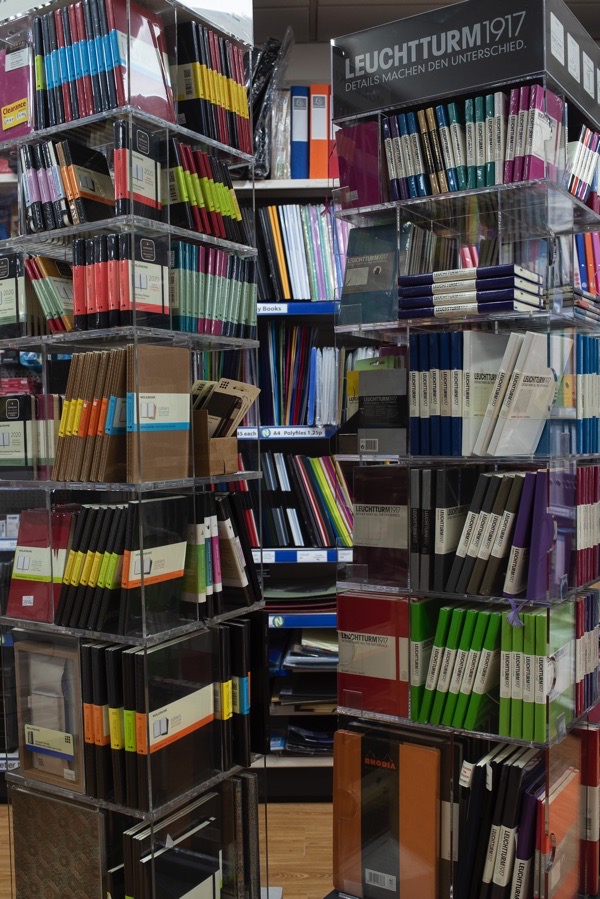
Barely a week passes without at least one visit to Newmans Stationery, a magnificent shop in Bethnal Green devoted to pristine displays of more pens, envelopes, folders and notebooks than you ever dreamed of. All writers love stationery and this place is an irresistible destination whenever I need to stock up on paper products. With more than five thousand items in stock, if you – like me – are a connoisseur of writing implements and all the attendant sundries then you can easily lose yourself in here. This is where I come for digital printing, permitting me the pleasure of browsing the aisles while the hi-tech copiers whirr and buzz as they fulfil their appointed tasks.
Swapping the murky January streets for the brightly-lit colourful universe of Newmans Stationers, Contributing Photographer Sarah Ainslie & I went along to meet the Jafferjis and learn more about their cherished family business – simply as an excuse to spend more time within the hallowed walls of this heartwarming East End institution.
We thought we would never leave when we were shown the mysterious and labyrinthine cellar beneath, which serves as the stock room, crammed with even more stationery than the shop above. Yet proprietor Hafiz Jafferji and his son Qusai managed to tempt us out of it with the offer of a cup of tea in the innermost sanctum, the tiny office at the rear of the shop which serves as the headquarters of their personal empire of paper, pens and printing. Here Hafiz regaled us with his epic story.
“I bought this business in October 1996, prior to that I worked in printing for fifteen years. It was well paid and I was quite happy, but my father and my family had been in business and that was my goal too. I am originally from Tanzania and I was born in Zanzibar where most of my relatives have small businesses selling hardware.
I began my career as a typesetter, working for a cousin of mine in Highgate, then I studied for a year at London College of Printing in Elephant & Castle. My father told me to start up a business running a Post Office in Cambridge in partnership with another cousin. They sold a little bit of stationery so I thought it was a good idea but my mind was always in printing. Every single day, I came back after working behind the counter in Cambridge to work at printing in Highgate, before returning to Cambridge at maybe one or two in the morning. I did that for almost two years, but then I said, ‘I’m not really enjoying this’ and decided to come back to London and work full time with my cousin in Highgate again.
I wondered, ‘Shall I go back to Tanzania where my dad is and start a business there or just carry on here?’ After I paid off my mortgage on my tiny flat, I left the print works and I was doing part time jobs and working a hotel but I thought, ‘Let’s try the army!’ Yet by the time I got to the third interview, I managed to find a job working for a printer in Crouch End. Then I had my mother pushing me to get married. ‘You’ve got a flat and you’ve got a job,’ she said but I could not even afford basic amenities in my house. If I wanted to eat something nice, I had to go to aunt’s house.
I realised I needed a decent job and I joined a printing firm in the Farringdon Rd as a colour planner, joining a team of four planners. Although I had learnt a lot from my previous jobs, I was not one of the most experienced workers there and I found that the others chaps would not teach me because I was the only Asian in the workforce. I used to do my work and watch the others with one eye, so I could pick up what they were doing and get better. I think I was a bit slow and so, for a long time, I would sign out and carry on working after hours to show that I was fulfilling my duties.
We did a lot of printing at short notice for the City and my boss always needed people to stay on and work late. Sometimes he would ring me at midnight and ask. ‘Hafiz, a plate has gone down, can you come in and redo it?’ I always used to do that, I never said ‘No.’
After five years, the boss asked me to become manager but I realised that I wasn’t happy because there were communication difficulties – people would not listen to me. My colleagues did not like the fact that I never said ‘No’ to any job. So I felt uncomfortable and had to refuse the promotion. When I decided to leave they offered me 50% pay rise.
Then a friend of mine who was an accountant told me about Newmans, he said was not doing very well but it was an opportunity. We looked at the figures and it did not make sense financially, compared to what I had been earning, yet me and wife decided to give it a go anyway. It took us seven years to re-establish the business.
I am still in touch with Mr & Mrs Newman who were here in Bethnal Green twelve years before we came along in 1996. Before that, they were in Hackney Rd, trading as ‘Newmans’ Business Machinery’ selling typewriters. I remember when we started there were stacks of typewriter ribbons everywhere! Digital was coming in and typewriters were disappearing so that business was as dead as a Dodo.
It was always in my mind to go into business. My idea was simply that I would be the boss and I would have people working for me taking the money. After working fourteen hours a day for six days a week, I thought it would be easy. Of course, it was not.
We refurbished the shop and increased the range of stock. We had a local actor who played Robin Hood when we re-opened. We wanted an elephant but we had to make do with a horse. We announced that a knight on horseback was coming to our shop.
We deal directly with manufacturers so we can get better discounts and sell at competitive prices. I concentrate on local needs, the demands of people within half a mile of my shop. I go to exhibitions in Frankfurt and Dubai looking for new products and new ideas, I have become so passionate about stationery…”


Nafisa Jafferji


Marlene Harrilal


‘We wanted an elephant but we had to make do with a horse’


The original Mr Newman left his Imperial typewriter behind in 1996


Hafiz Jafferji



Qusai Jafferji quit his job in the City to join the family business


Qusai Jafferji prints a t-shirt in the recesses of the cellar


Photographs copyright © Sarah Ainslie
Newmans Stationery (Retail, Wholesale & Printing), 324 Bethnal Green Rd, E2 0AG
You may also like to read about
Spitalfields City Farm Calendar
“There is poetry in the unexpected presence of agriculture in the city and it always makes my heart leap to hear animal cries in this urban setting, connecting me to the rural landscape beyond and reminding us of the fields that were here before the streets were built up. Despite the tower blocks visible through the greenery at Spitalfields City Farm, it is nature that prevails here.”
The Gentle Author
I am delighted to announce the first Spitalfields Life calendar, produced in support of our beloved Spitalfields City Farm and featuring Rachel Ferriman‘s splendid photographs from her features published in these pages.
This handsome wall calendar is a collaboration between our friends Newmans Stationers who have done the printing, Baddeley Brothers who have donated handmade envelopes and Gardners Bags who have donated paper bags.
ORDER YOUR SPITALFIELDS LIFE 2022 CALENDAR NOW FOR £10

January

February

March

April

May

June

July

August

September

October

November

December
Photographs copyright © Rachel Ferriman
Retailers can order wholesale copies direct from q@newmans-stationery.co.uk
You may also like to take a look at
Winter At Spitalfields City Farm
Alan Dein’s East End Shops

P.Lipman, Kosher Poultry Dealers, Hessel St
“In my twenties, I’d been doing a number of oral history recordings, working for the Museum of the Jewish East End which was very active recording stories of the life of Jewish people who had settled here.”explained Alan Dein, broadcaster and oral historian, outlining the background to his unique collection of more than a hundred photographs of East End shopfronts.
“My photographs of the derelict shopfronts record the last moments of the Jewish community in the area. The bustling world of the inter-war years had been moved into the suburbs, and the community that stayed behind was less identifiable. In the nineteen eighties they were just hanging on, some premises had been empty for more than five years. They were like a mouthful of broken teeth, a boxer’s mouth that had been thumped, with holes where teeth once were.”
Feeding his twin passions for photography and collecting, Alan took these pictures in 1988 while walking around the streets of the East End at a time when dereliction prevailed. Although his family came from the Jewish East End and his Uncle Lou was a waiter at Blooms, Alan was born elsewhere and first came to study. “As a student at the City of London Polytechnic in Old Castle St, I spent a lot of time hanging out here – though the heart of the area for me at that time was the student common room and bar.” he told me.
“Afterwards, in 1988, I moved back to live in a co-operative housing scheme in Whitehorse Rd in Stepney and then I had more time to walk around in this landscape that evoked the fragmentary tales I knew of my grandparents’ lives in the East End. The story I heard from their generation of the ‘monkey parade’, when once people walked up and down the Mile End Road to admire the gleaming shopfronts and goods on display. My family thought I was mad to move back because when they left the East End they put it behind them, and it didn’t reflect their aspirations for me.
The eighties were a terrible time for removing everything, comparable to what the Victorians had done a century earlier. But I have always loved peeling paint, paint that has been weathered and worn seafront textures, and this was just at the last moment before these buildings were going to be redeveloped, so I photographed the shopfronts because this landscape was not going to last.”
In many of these pictures, there is an uneasy contradiction between the proud facades and the tale of disappointment which time and humanity has written upon them. This is the source of the emotionalism in these photographs, seeing faded optimism still manifest in the confident choice of colours and the sprightly signwriting, becoming a palimpsest overwritten by the elements, human neglect and graffiti. In spite of the flatness of these impermeable surfaces, in each case we know a story has been enclosed that is now shut off from us for ever. Beyond their obvious importance as an architectural and a social record, Alan’s library of shopfronts are also a map of his exploration of his own cultural history – their cumulative heartbreak exposing an unlocated grief that is easily overlooked in the wider social narrative of the movement of people from the East End to better housing in the suburbs.
Yet Alan sees hope in these tantalising pictures too, in particular the photo at the top, of Lipman’s Kosher Poultry Dealers, in which the unknown painter ran out of paint while erasing the name of the business, leaving the word “Lip” visible. “A little bit of lip!” as Alan Dein terms it brightly, emblematic of an undying resilience in the face of turbulent social change.

Goulston St

In Whitechapel

Commercial Rd

Redchurch St

Stepney Green

Cheshire St

Alie St

Hessel St

Hackney Rd

Quaker St

Mile End Rd

Toynbee St

Alie St

In E2

Brick Lane

Great Eastern St

Commercial St

Hessel St

Mile End Rd

Relocated to Edgeware

Bow Common Lane

Brick Lane

Ben Jonson Rd

Wilkes St

Bow Rd

Ridley Rd

New Goulston St.
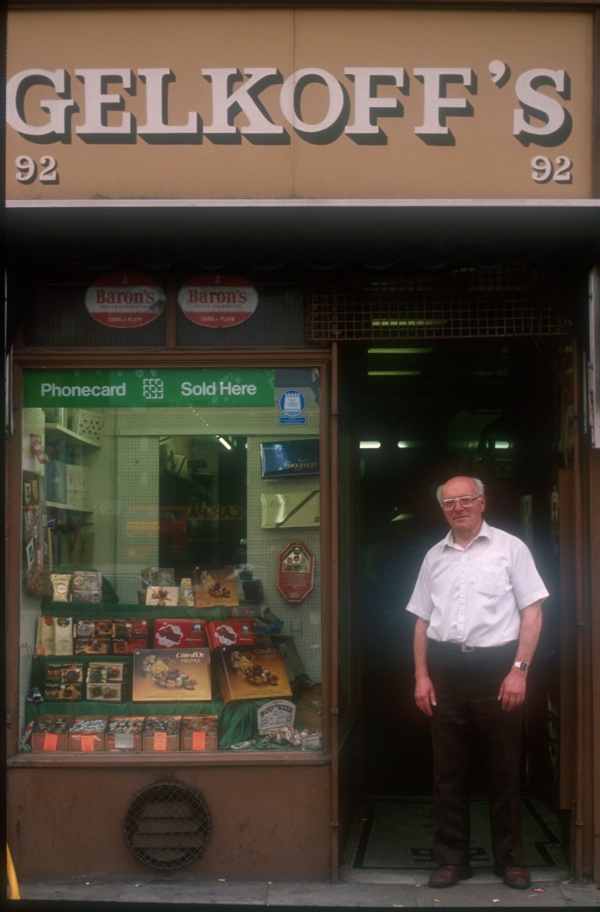
Whitechapel High St

Alderney Rd, Stepney
Photographs copyright © Alan Dein
You may also like to take a look at
In The Orchards Of Kent

Five years ago, when I first visited the National Collection of Fruit Trees at Brogdale outside Faversham in Kent to enjoy the spring blossom, I vowed to go back in the autumn to admire the crop. This year, I fulfilled my ambition in the company of Contributing Photographer Rachel Ferriman and we were blessed with a golden October afternoon in the North Kent Fruit Belt.
Nothing prepared me for the seemingly infinite variety of fruit that exists in nature. Walking into an orchard of two-thousand-two-hundred varieties of apple, all in fruit, is a vertiginous prospect that is only compounded by your guide who informs you this is merely a fraction of the over ten thousand varieties in existence.
What can you do? Your heart leaps and your mind boggles at the different colours and sizes of fruit. You recognise russets, laxtons and allingtons. Even if you had all day, you could not taste them all. Despite the cold spring, it has been a good year for apples. You stand wonderstruck at the bounty and resilience of nature. Then you start to get huffy at the pitiful few varieties of mostly-bitter green apples available to buy in shops, always sold unripe for longer shelf life. How is this progress?
Yet this thought evaporates as you are led through a windbreak into another orchard where five hundred varieties of pear are in fruit. By now your vocabulary of superlatives has failed you and you can only wander wide-eyed through this latter day Eden.
That afternoon there was no-one there but me, Rachel and the guide. We were delighted to have the orchards to ourselves. But this is when you realise the world has gone mad if no-one else is interested to witness this annual spectacle that verges on the miraculous. Walking on, as if in a medieval dream poem, you discover an orchard of medlars and another of quinces.
By now, your feet are barely touching the ground and you hatch a plan – as you munch an apple – to return at this same time of year, decide upon your favourite varieties and then plant your own orchard of soft fruit. When you stumble upon such an ambition, you realise that life is short yet we are all still permitted to dream.


Medlars

Quince

Plum

Mike Austen, our guide

Photographs copyright © Rachel Ferriman
The National Collection of Fruit Trees at Brogdale
You may like to read about my first visit


