
Remembering London’s Oldest Ironmonger
Tickets are available for The Gentle Author’s Tour of Spitalfields on Saturday 25th May

The frontage at 493-495 Hackney Rd

The factory at the rear of the shop

London’s oldest ironmongers opened for business in 1797 as Presland & Sons, became W.H. Clark Ltd in the eighteen-nineties and was still trading from the same location, over two hundred years later, as Daniel Lewis & Son Ltd – The One Stop Metal Shop. Operating at first from a wooden shack built around 1760, they constructed their own purpose-built shop and factory at the beginning of the nineteenth century, which suited their needs so perfectly that – in an astonishing and rare survival – it stood almost unaltered to the end.
It was architecture of such a utilitarian elegance and lack of ostentation that it did not draw attention to itself. I had no idea there was a complete Georgian shopfront in the Hackney Rd until David Lewis, the proprietor, pointed it out to me and I compared it to the illustration above. Remarkably, even the decorative coloured-glass lozenge above the door was exactly as in the engraving.
When contributing photographer Simon Mooney & I went along to explore, we were amazed to discover a unique complex of buildings that carried two centuries of history of industry in the East End, with many original items of nineteenth century hardware still in stock.
“We were here before the canal, the railway and the docks,” David Lewis informed us proudly,“When the Prince Regent banned horses from being stabled in the city, this area became the centre of the carriage and coach-building industry.” An ironmonger with a lyrical tendency, David reminded us that Cambridge Heath Rd was once a heath, that Bishop Bonnar once built his mansion on this land before the Reformation and that an oval duckpond once existed where the Oval industrial estate stands today behind his premises – all in introduction to the wonders of his personal domain which had been there longer than anything else around.
You entered from the street into the double-height shop, glazed with floor-to-ceiling windows and lined to the roof with meticulously-labelled wooden pigeon-holes, built-in as part of the original architecture. A winding stair led you into the private offices and you discovered beautiful bow-fronted rooms, distinguishing the rear of the terrace that extended two storeys above, offering ample staff quarters. On one side, was an eccentric, suspended office extension built in 1927 and constructed with panelling and paint supplied by the Great Western Railway, who were customers. This eyrie served as David’s private den, where he sat smoking at a vast nineteenth century desk surrounded by his collection of custom number plates, all spelling Lewis in different configurations of numbers and letters.
A ramp down from the shop led to the rear, past cellars lined with pigeon-holes constructed of the flexo-metal plywood that was the source of the company’s wealth for decades. At the back, was a long factory building with three forges for manufacturing ironwork where you could still feel the presence of many people in the richness of patina created by all the those who worked there through the last two centuries. Occasionally, David paused and, in delight, pulled out boxes full of brass fixtures and iron bolts necessary for nineteenth century carriage building. Upstairs, he showed us an arcane machine for attaching metal rims to wagon wheels, essential when the streets of London went from dirt to cobbles in the nineteenth century.
To the left of the factory, stood a long cobbled shed where the carriages came in for repair, and beneath a slab flowed a stream and there were stones of the Roman road that ran through here. In the layers of gloss paint and the accumulation of old things, in the signs and the ancient graffiti, in the all the original fixtures and fittings, these wonderful buildings spoke eloquently of their industrial past. Yet for David they contained his family history too.
“My dad was Lewis Daniel John Lewis, he was known as Lewis Lewis and his father was also known as Lewis Lewis. It went back to my great-great-great-great- grandfather and my father wanted me to be Lewis Lewis too but my mum wasn’t having it, so I am David Richard Lewis. I first came here with my dad as a nipper, when I was four or five years old, on Saturday mornings while he did the books. I played with all the nuts and bolts, and I was curious to see what was in all the boxes. And I used to run up and down the ramp, I was fascinated by it. I’ve learnt that it’s there because the Hackney Rd follows a natural ridge and there were once mushroom fields on either side at a lower level.
My dad started at W.H.Clark in 1948 as a young boy of fifteen, he had already studied book-keeping and he was taken on as an office junior. At eight years old, it was discovered he was diabetic when he was found lying on the pavement here in Hackney Rd, where my grandparents had a grocer and dairy. He always had to have insulin injections after that. He was tall, six foot one, and a little skinny because he didn’t have much of an appetite – except for chocolate biscuits which he shouldn’t have had, but he enjoyed them with a cup of tea.
He learnt the trade and he worked his way up to office manager. Then, in 1970, one of the partners retired and the other suffered a tragedy and turned to drink and became unsteady. So my grandfather bought the business for my father in 1971 and he took over the directorship of the company. He already knew how to run the business and he set out to build the company up with new customers – he got St Paul’s Cathedral as a customer and we still supply them.
Our biggest selling product was flexo-metal plywood, we had the exclusive distribution contract and we supplied it to the coach-building industry across the entire South-East of England for the construction of buses, coaches, lorries and trucks. They used to pull up outside with vehicles that had no body, no cab – just the engine and a chassis with the driver sitting on a tin bucket. They bought flexo-metal plywood to build the body and we could supply them with a windscreen, lights, chains for tailboards, everything – all the components. Any time I see a van in a fifties or sixties film, it is one of ours. At that time, we employed eighteen people.
I joined in 1992. I went to college and did business studies and I wanted to prove to my dad that I could do it on my own. I became a trademark lawyer, working for the Trademarks Consortium in Pall Mall that protected the trademarking for brands like Cadburys, Bass, Tesco and Schweppes. I’ve always been fascinated by labels because of looking at all the different trademarks on the boxes of screws here and I collect custom number plates.
When the business that supplied flexo-metal plywood went to the wall, my father employed Peter Sandrock who used to run it. He was approached by many global companies because he was a genius mathematician who could do figures in his head, but he wanted to work for my dad because they always got on well and would help each other. He worked for my dad for ten years until 1992 and that’s when I came in, just after I got married.
I started as an office junior like my dad but I found it boring because I had already done other things. So I said, ‘Can I go down and serve behind the counter?’ but he said, ‘You haven’t got the build to carry steel.’ I surprised him by developing muscles and soon I could do it with ease – I’ve got broad shoulders now when I didn’t use to have.
When I was made a director, all the carriage-building trade was moving up north, so I refocused the company towards aluminium and steel supply to metal fabricators, architects and sculptors. But in recent years, due to installation of cctv cameras and the council issuing £130 fines to our customers while picking up orders, our trade has dropped by fifty per cent. We have two to three hundred customers a day and I reckon the council have earned £63,000 a year in fines out of them and so, in a few months, after two centuries of business in this location, we are going to move from here .
It was in 2002, I changed the name of the company from W.H.Clark Ltd, who had been a Mayor of Hackney in the nineteenth century, to Daniel Lewis & Son Ltd, in memory of my father. I am the son.”
London’s oldest ironmonger closed in 2014

Nineteenth century storage filled with nineteenth century carriage fittings in the factory

The enamel sign that was taken down from the frontage in 2002

This is the cobbled workshop where the carriages were wheeled in for repair.

The ceiling in the storeroom is lined with timber painted with nineteenth century sign-writing

Carriage bolts are still in stock

The wooden pigeon-holes stretch to the ceiling in the double-height shop and are contemporary with the building

Daniel Lewis & Son Ltd has collets in stock – pins used for attaching cartwheels to the shaft


David in the factory building

Bert left to in 1962 Good By

Machine for applying metal rims to cartwheels in the factory


A threading machine in the factory


This brick was laid by “Ole Bill” 1927 RIP

View towards the bonded warehouse of the Chandlers & Wiltshire Brewery – burnt out in World War II, it is London’s last bombsite and a memorial to the Blitz in the East End

A display of Nettlefolds screws wired to a board in a gilt-crested frame that was displayed at the Great Exhibition of 1851

The glass over the entrance was part of the original design of the building, dating from the early nineteenth century


Packaging for hinged metal indicator lights, still in stock


Keep this door shut

The crackle on the office wall is authentic, achieved by age, not a paint effect

The name of W.H.Clark impressed upon a carriage shaft manufactured in the forge

Before 1920, no road vehicle was permitted to travel at more than 20mph and had a plate attached to this effect – Daniel Lewis & Son Ltd still had them in stock

The Ascot water heater in David’s office was fully-functional

The shop with the ramp going down towards the factory at the back

The steps from the shop going up to the office

David Lewis at his desk in the rear office lined with panelling and paint supplied by the Great Western Railway
Photographs copyright © Simon Mooney
You may also like to take a look at
Tony Hall’s Shops
Tickets are available for The Gentle Author’s Tour of Spitalfields on Saturday 25th May

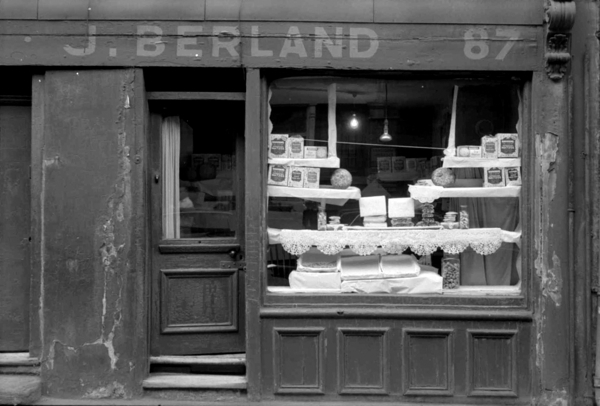
Tony Hall loved shops, as you can see from this magnificent array of little shops in the East End that he captured for eternity, selected from the thousand or so photographs which survive him.
In the sixties and seventies when these pictures were taken, every street corner that was not occupied by a pub was home to a shop offering groceries and general supplies to the residents of the immediate vicinity. The owners of these small shops took on mythic status as all-seeing custodians of local information, offering a counterpoint to the pub as a community meeting place for the exchange of everybody’s business. Shopkeepers were party to the smallest vacillations in the domestic economy of their customers and it was essential for children to curry their good favour if the regular chore of going to fetch a packet of butter or a tin of custard, or any other domestic essential, might be ameliorated by the possibility of reward in the form of sweets, whether there was any change left over or not.
Yet, even in the time these photographs were taken, the small shops were in decline and Tony Hall knew he was capturing the end of a culture, erased by the rise of the chain-stores and the supermarkets. To the aficionado of small shops there are some prize examples here – of businesses that survived beyond their time, receptacles of a certain modest history of shopkeepers. It was a noble history of those who created lives for themselves by working long hours serving the needs of their customers. It was a familiar history of shopkeepers who made a living but not a fortune. Above all, it was a proud history of those who delighted in shopkeeping.




Photographs copyright © Libby Hall
Images courtesy of the Tony Hall Collection at the Bishopsgate Institute
You may also like to read
Libby Hall, Collector of Dog Photography
and take a look at these other pictures of East End Shops
Maureen Rose, Button Maker
Some tickets are available for The Gentle Author’s Tour this Saturday 18th May

‘Every button tells a story’
On the ground floor of the house where Charles Dickens grew up at 22 Cleveland St in Fitzrovia is a wonderful button shop that might easily be found within the pages of a Dickens novel. Boxes of buttons line the walls from floor to ceiling, some more than a hundred years old, and at the centre sits Maureen Rose, presiding regally over her charges like the queen of the buttons.
“A very nice gentleman – well turned out – stood in my doorway and asked, ‘Charles Dickens doesn’t live here anymore, does he?'” Maureen admitted to me with a sly grin. “I said, ‘No, he doesn’t.’ And he said, ‘Would you have his forwarding address?’ So I said, ‘No, but should I get it, I’ll put a note in the window.'”
Taylor’s Buttons & Belts is the only independent button shop in the West End, where proprietor Maureen sits making buttons every day. It is a cabinet of wonders where buttons and haberdashery of a century ago may still be found. “These came with the shop,” explained Maureen proudly, displaying a handful of Edwardian oyster and sky blue crochetted silk buttons.
“Every button tells a story,” she informed me, casting her eyes affectionately around her exquisite trove. “I have no idea how many there are!” she declared, rolling her eyes dramatically and anticipating my next question. “I like those Italian buttons with cherries on them, they are my favourites,” she added as I stood speechless in wonder.
“Let me show you how it works,” she continued, swiftly cutting circles of satin, placing them in her button-making press with nimble fingers, adding tiny metal discs and then pressing the handle to compress the pieces, before lifting a perfect satin covered button with an expert flourish.
It was a great delight to sit at Maureen’s side as she worked, producing an apparently endless flow of beautiful cloth-covered buttons. Customers came and went, passers-by stopped in their tracks to peer in amazement through the open door, and Maureen told me her story.
“My late husband, Leon Rose, first involved me in this business. He bought it from the original Mr Taylor when it was in Brewer St. The business is over a hundred years old with only two owners in that time. It was founded by the original Mr Taylor and then there was Mr Taylor’s son, who retired in his late eighties when he sold it to my husband.
My husband was already in the button business, he started his career in a button factory learning how to make buttons. His uncle had a factory in Birmingham – it was an old family business – and he got in touch with Leon to say, ‘There’s a gentleman in town who is retiring and you should think about taking over his business.’
Leon inherited an elderly employee who did not like the fact that the business had been sold. She had been sitting making buttons for quite some time and she said she would like to retire. So at first my mother went in to help, when he needed someone for a couple of hours a day, and then – of course – there was me!
I was a war baby and my mother had a millinery business in Fulham. She was from Cannon St in Whitechapel and she opened her business at nineteen years old. She got married when she was twenty-one and she ran her business all through the war. As a child, I used to sit in the corner and watch her make hats. She used to say very regularly to me, ‘Watch me Maureen, otherwise one day you’ll be sorry.’ But I did not take up millinery. I did not have an interest in it and I regret that now. She was very talented and she could have taught me. She had done an apprenticeship and she knew how to make hats from scratch. She made all her own buckram shapes.
I helped her for while, I did a lot of buying for her from West End suppliers in Great Marlborough St where there were a lot of millinery wholesalers. It was huge then but today I do not think there is anything left. There was big fashion industry in the West End and it has all gone. It was beautiful. We used to deal with lovely couture houses like Hardy Amies and Norman Hartnell. I used to go to see their collections, it was glamorous.
I only make buttons to order, you send me the fabric – velvet, leather or whatever – and I will make you whatever you want. We used to do only small orders for tailors for suits, two fronts and eight cuff buttons. Nowadays I do them by the hundred. I do not think Leon ever believed that was possible.
Anybody can walk into my shop and order buttons. I also make buttons for theatre, television, film and fashion houses. I do a lot of bridal work. I am the only independent button shop in the West End. I get gentleman who buy expensive suits that come with cheap buttons and they arrive here to buy proper horn buttons to replace them.
My friends ask me why I have not retired, but I enjoy it. What would I do at home? I have seen what happens to my friends who have retired. They lose the plot. I meet nice people and it is interesting. I will keep going as long as I can and I would like my son Mark to take it over. He is in IT but this is much more interesting. People only come to me to buy buttons for something nice, although I rarely get to see the whole garment.
I had a customer who was getting married and she loved Pooh bear. She wanted buttons with Pooh on them. She embroidered them herself with a beaded nose for the bear and sent the material to me. I made the buttons, which were going down the back of the dress. I said, ‘Please send me a picture of your wedding dress when it is finished.’ She sent me a picture of the front. So I never saw Pooh bear.
A lady stood in the doorway recently and asked me, ‘Do you sell the buttons?’ I replied, ‘No, it’s a museum.’ She walked away, I think she believed me.”


‘Presiding regally over her charges like the queen of the buttons’

Cutting a disc of satin

Placing it in the mould

Putting the mould into the press


Edwardian crochetted silk buttons

“I like those Italian buttons with cherries on them, they are my favourites”


Dickens’ card while resident, when Cleveland St was known as Norfolk St (reproduced courtesy of Dan Calinescu)
You may also like to read about
At Eastbury Manor House
Some tickets are available for The Gentle Author’s Tour this Saturday 18th May

If you are seeking an afternoon’s excursion from the East End, you can do no better than visit Eastbury Manor in Barking, which is only half an hour on the District Line from Whitechapel yet transports you across four centuries to Elizabethan England.
Once Eastbury Manor stood in the centre of its own domain of rolling marshy farmland, extended as far as you can see from the top of its pair of octagonal turrets, but today it sits in the centre of a suburban estate built as Home for Heroes in the twenties in the pseudo-Elizabethan style, which casts a certain surreal atmosphere as you arrive. Yet by the time you have entered the gate and walked up the path lined with lavender to the entrance, the mellow brick facade of Eastbury Manor has cast its spell upon you.
Built in the fifteeen-sixties by Clement Sisley, Gentleman & Justice of the Peace, Eastbury Manor is among the earliest surviving Elizabethan houses, combining attractive domestic interior spaces with an exterior embellished by showy architectural elements in the renaissance manner. This curious contradiction of modest form and ambitious style speaks of Sisley’s eagerness to impress as a self-made property developer and landowner. He owned a house in the City of London and thus Eastbury grants us a vision of how those lost mansions that once lined Bishopsgate and Leadenhall St might have been.
Formerly part of the lands of Barking Abbey, after the Dissolution the property was sold to an absentee landlord before it was acquired by Clement Sisley in 1556. From apothecary bills, we know he fell ill and died in September 1578, bequeathing arms, weapons, armour and dags (guns) to his son Thomas ‘to him and his heirs forever at Eastbury’, in the hope that the manor might become a family home for generations to come.
Yet within only a few years Eastbury Manor was tenanted by John Moore, a Diplomat and Tax Collector, and his Spanish wife Maria Perez de Recalde. They were responsible for commissioning the lyrical and mysterious wall paintings, depicting an unknown European landscape rich in allegorical potential, glimpsed through a classical arcade of baroque barley-sugar-twist pillars.
Over two hundred years, the old house spiralled down through the ownership of a series of families with connection to the City of London until it became a farm, with animals housed in the fine Elizabethan chambers, and was threatened with demolition at the beginning of the last century.
Octavia Hill and C R Ashbee of the Survey of London, who had been responsible for saving Trinity Green Almshouses in Whitechapel, began a campaign to save Eastbury Manor by seeking guarantors to purchase the property from the owner. Once they had done so, the Society for the Protection of Ancient Buildings arranged for the National Trust to accept ownership of the building in 1918. Thanks to the initiative of these enlightened individuals a century ago, we can enjoy Eastbury Manor today.
It is a sublime experience to escape the blinding sunlight of a summer’s afternoon and enter the cool air of the shadowy interior with its spiralling staircases and labyrinth of chambers. Ascend the turret to peer across Barking to the Thames, descend again enter the private enclosed yard at the rear, enfolded by tall ancient walls, and discover yourself in another world.

Eastbury Manor in 1796


Nonagenerian guide Dougie Muid welcomes visitors to Eastbury Manor – ‘Children often ask me if I have been here since the house was built’


Visit Eastbury Manor, Eastbury Square, Barking, Essex, IG11 9SN
You may also like to read about
Christopher Marlowe In Norton Folgate

On my tour we visit Norton Folgate where Christopher Marlowe lived
SOME TICKETS AVAILABLE FOR SATURDAY 18th MAY

“What nourishes me destroys me” – Christopher Marlowe aged twenty-one in 1585
Towards the end of the sixteenth century, Shoreditch and Norton Folgate comprised theatre land for Elizabethan London, with a monument in St Leonard’s Church today commemorating the actors who once lived locally and tax records suggesting William Shakespeare was a parishioner of St Helen’s, Bishopsgate, in 1598.
A warrant issued in September 1589 for the arrest of the mysterious yet charismatic tragedian & poet Christopher Marlowe confirms that the twenty-five year old writer was resident in the Liberty of Norton Folgate. He shared lodgings with fellow playwright Thomas Kyd and his Cambridge friend Thomas Watson, the poet, lived nearby. Marlowe’s plays were likely to have been performed at The Theatre in New Inn Yard and The Curtain in Curtain Rd at this time.
“Thomas Watson of Norton Folgate in Middlesex County, gentleman, and Christopher Marlowe of the same, yeoman….were delivered to jail the 18th day of September by Stephen Wyld, Constable of the same on suspicion of murder” reads the warrant.
The story goes that Marlowe was set upon in Hog Lane – now Worship St – by William Bradley, an innkeeper’s son, over a unpaid debt and Thomas Watson intervened with his sword to protect his friend, stabbing Bradley to death. Although Marlowe took flight, he was arrested and imprisoned in Newgate with Watson for a fortnight. On 3rd December, they were tried and, after Watson’s claim of self-defence was accepted, both were discharged with a warning to keep the peace.
But in May 1592, Marlowe was summoned again to appear at the Middlesex sessions for assaulting two constables in Holywell Lane, Shoreditch – when the constables attested that they went in fear of their lives because of him. Once more, Marlowe was required to keep the peace or to appear before the magistrates at the next general session and receive a penalty of twenty pounds. There is no record whether he ever answered to this charge.
The final years of Marlowe’s life are traced through a series of violent encounters with the law, yet between 1588 and his death at twenty-nine in 1593, Marlowe wrote Edward II, Doctor Faustus, The Jew of Malta and The Massacre of Paris – which means that we may conclude that all or at least part of these plays were written while he was a resident of Norton Folgate.

A manuscript page from The Massacre at Paris, in Christopher Marlowe’s handwriting or that of his secretary Hugh Sanford, which may have been composed while Marlowe was resident in Norton Folgate

Worship St (formerly Hog Lane) where Christopher Marlowe was accosted in 1589 by innkeeper’s son William Bradley, over an unpaid debt, and Marlowe’s friend Thomas Watson killed Bradley. The tower on the right is the European headquarters of Amazon.

Holywell Lane where Christopher Marlowe assaulted two constables in May 1592

You may also like to read about
In Search of Shakespeare’s London
Stepney Old People’s Welfare Association
SOME TICKETS AVAILABLE FOR SATURDAY 18th MAY

Roger Preece, Master of the Royal Foundation of St Katharine invited me to Limehouse to explore the archives, where I found this wonderful album of photographs documenting the activities of the Stepney Old People’s Welfare Association from the decades after the war.
The Welfare Association was the enlightened brainchild of John Groser, Master of the Foundation from 1947. For its first fifteen years, the Association was run from the Foundation and these photographs date from that era. As well as social events, the Association offered a meals on wheels service and home visits, developing a pattern that was widely adopted by other similar organisations across the country. It continues today as Tower Hamlets Friends & Neighbours.
An Australian by birth, Groser was appointed curate in Poplar in 1922 but dismissed in 1927 for his left-wing views, before moving to Christ Church, Watney St, where he also served as President of the Stepney Tenants’ Defence League. He stayed in the East End for his whole working life and his progressive initiatives at St Katharine’s were the natural outcome of his beliefs as a Christian and a Socialist.
There is so much joy in these glorious pictures, which acquire a certain poignancy when you realise that these people were born in the nineteenth century, lived through two world wars and the blitz in the East End. The fortitude in their faces is tangible as is their desire to have a good time, whether a card game, a dressing up contest or an egg and spoon race. These were years of austerity but they all have pride in their appearance in warm coats and hats, tailored suits and flowery dresses. Their physical expressions of affection and delight in collective activities speak eloquently of a strong sense of community forged through hard times.


Celebrating the Coronation

A beano


Podiatry

Caretaker at St Katharine


Queen Mother intervenes in a game of bridge

Queen Mother visits St Katharine’s Chapel


Dressing up contest

Morris dancing

Egg and spoon race

Speech by the Mayoress

Recipient of a bouquet

High jinks at St Katharine’s

Father John Groser
The Royal Foundation of St Katharine and the Yurt Cafe continue to serve local needs through the Limehouse Aid voluntary network, the foodbank and providing space and retreats for community groups and individuals.
You may also like to read about
At John Keats’ House
SOME TICKETS AVAILABLE FOR SATURDAY 18th MAY

“Much more comfortable than a dull room upstairs, where one gets tired of the pattern of the bed curtains” – Keats was moved to this room on 8th February 1820 at the onset of tuberculosis
I set out with the intention to photograph the morning sunshine in John Keats’ study at his house in Hampstead. Upon my arrival, the sky turned occluded yet I realised this overcast day was perhaps better suited to the literary history that passed between these walls two centuries ago. The property was never Keats’ House in any real sense but, rather, where he had a couple of rooms for eighteen months as a sub-let in a shared dwelling.
Born in a tavern in Moorgate in 1795, where the Globe stands today, and baptised at St Botolph’s Bishopsgate, John Keats was ridiculed by John Gibson Lockhart in Blackwood’s magazine in 1817 for being of the ‘Cockney School,’ implying his rhymes suggested working class speech. Qualifying at first as an Apothecary and then studying to be a Surgeon, in 1816 John Keats sacrificed both these professions in favour of poetry. “It is a better and a wiser thing to be a starved Apothecary than a starved Poet, so back to the shop Mr John, back to plasters, pills, and ointment boxes,” wrote Lockhart condescendingly, but Keats was not dissuaded from his chosen path.
Early on the morning of 1st December 1818, after passing the night nursing his brother Tom through the terminal stage of tuberculosis at 1 Well Walk, Hampstead, John Keats walked down the hill to the semi-detached villas known as Wentworth Place to visit his friend Charles Armitage Brown. He invited Keats to move in with him, sharing his half of the house and contributing to the household expenses.
John Keats’ arrival at Wentworth Place was also the entry to a time when he found love with Fanny Brawne, who moved in with her mother to the other half of the villa, as well as his arrival at the period of his greatest creativity as a poet. It was a brief interlude that was brought to an end in early 1820 when Keats discovered he had tuberculosis like his brother, from whom he had almost certainly contracted the infection.
Within three weeks of moving in, Keats suffered from a severe sore throat and worried for his own health as he struggled to complete his epic ‘Hyperion,’ yet his spirits were raised by an invitation for Christmas from Mrs Brawne at Elm Cottage and the growing attachment to her daughter Fanny, whom he had previously described as “animated, lively and even witty.”
In April, the tenants vacated the other part of Wentworth Place and Mrs Brawne moved in with her daughters, which meant that John Keats met the eighteen-year-old Fanny Brawne continuously in the gardens that surround the house. At any moment, he might glance her from the window and thus their affection grew, leading to the understanding of an engagement for marriage between them. This romance coincided with a flowering of creativity on Keats’ part, including the composition of of his celebrated ‘Ode to a Nightingale,’ inspired by hearing the nightingale sing while on a walk across Hampstead Heath
Yet Keats spent the summer away from Hampstead, visiting the Isle of Wight, Winchester and Bath, while engaging in an emotionally-conflicted correspondence with Fanny and pursuing the flow of poetic composition that had begun in the spring. Although Keats wrote to Brown of his attraction to return to Fanny, admitting “I like and cannot help it,” perversely he took rooms in Great College St rather than moving back to Wentworth Place. But on Keats’ return to Hampstead to collect his possessions on 10th October, Fanny Brawne opened the door to him and he was smitten by her generosity and confidence, and his hesitation dissolved. He moved back to Wentworth Place almost at once and presented Fanny with a garnet ring, even though he could not afford to marry.
Living in such close proximity to the object of his affection led Keats to adopt a vegetarian diet in the hope of lessening his physical desire. During the long harsh winter that followed, Keats was often isolated at Wentworth Place by heavy snow and freezing fog, making only occasional trips down to London to visit literary friends. Catching a late coach back to Hampstead, Keats had left his new warm coat behind at Wentworth Place and sat on the top of the coach to save money. Descending in Pond St, Keats felt feverish but, by the time he reached Wentworth Place, he was coughing blood and realised he had suffered a lung haermorrhage. Yet he wrote that all he could think of was, “the love that has been my pleasure and torment.” He was twenty-four years old.
At first Mrs Brawne tried to keep Fanny and John Keats apart in the tiny house and he wrote her twenty-two letters in six weeks, but it proved impossible to sustain the separation and she permitted her daughter to visit him every day while he was recuperating. Keats could not see her without recognising that death would separate them and he wrote a poem entitled ‘To Fanny’ in recrimination against himself.
The tragedy of the situation was compounded when Brown, Keats’ landlord, decided to lease his part of Wentworth Place, forcing Keats to leave in the spring. At the beginning of May, he moved to cheaper lodgings in Kentish Town, still within a mile of Fanny Brawne. In July, ‘Hyperion’ was published but by then he realised was living in the shadow of death and told a friend he was suffering from a broken heart.
In August, Keats went to Wentworth Place in distress and laid himself upon the mercy of Mrs Brawne, who took him in and permitted him to live under the same roof as her daughter for a few weeks before he travelled to Italy for his health. On Wednesday 13th September 1820, John Keats walked with Fanny Brawne from Wentworth Place to the coach stop in Pond Place and they said their last farewells. Fanny went home and wrote “Mr Keats left Hampstead” in her copy of the Literary Pocket Book that he gave her for Christmas 1818. They did not meet again and Keats never returned to Wentworth Place, dying in Rome on 23rd February 1821.
Within decades, the railway came to Hampstead and then the tube train, and the village became a suburb. An actress bought Wentworth Place, redeveloping it by combining the two houses into one and adding a large dining room on the side. In 1920, the house was threatened with demolition to make way for a block of flats. However, funds were raised to restore the house as a memorial to Keats. Thus you may visit it today and enter the place John Keats and Fanny Brawne fell in love, and where he wrote some of the greatest poems in our language.

John Keats in 1819 when he lived at Wentworth Place

Wentworth Place, completed 1816 as one of the first houses to be built in Lower Hampstead Heath

John Keats lived here

In John Keats’ study

The right hand room on the ground floor was John Keats’ study and the room above was his bedroom

Keats’ room where he learnt he had tuberculosis which had killed his brother Tom a year earlier

“Dearest Fanny … They say I must remain confined to this room for some time. The consciousness that you love me will make a pleasant prison of the house next to yours.” 4th February, 1820

In Fanny Brawne’s room


The boiler for hot water. The house had no running water which had to be brought from the pump.

The Mulberry tree is believed to have been planted in the seventeenth century and predates the house.

The death mask in John Keats’ bedroom at Wentworth Place

The font at St Botolph’s, Bishopsgate, where John Keats was baptised in 1795
Visit Keats House, Keats Grove, Hampstead, NW3 2RR
You may also like to read about


