
The Robin’s Christmas
This extract is from ‘Aunt Louisa’s Keepsake’ published by Frederick Warne which was given to me by Libby Hall who died earlier this year. The copy is inscribed ‘Christmas 1896’ inside the front cover.

‘Twas Christmas-time, a dreary night,
The snow fell thick and fast,
And o’er the country swept the wind,
A keen and wintry blast.

The Robin early went to bed,
Puffed up just like a ball,
He slept all night on one small leg,
Yet managed not to fall.
No food had touched his beak,
And not a chance had he
Of ever touching food again,
As far as he could see.

The stove had not burnt very low,
But still was warm and bright,
And round the spot whereon it stood,
Threw forth a cheerful light.
Now Robin from a corner hopped,
Within the fire’s light.
Shivering and cold, it was to him
A most enchanting sight.
But he is almost starved, poor bird!
Food he must have, or die,
Unless it seems, alas! for that
Within these walls to try.
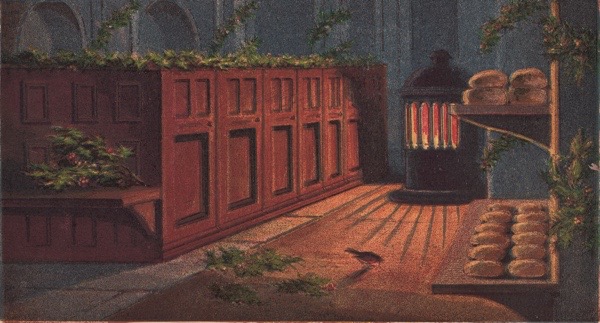
Perhaps ‘t is thought by those who read
To doubtful to be true,
That just when they were wanted so
Some hand should bread crumbs strew.
But this is how it came to pass,
An ancient dame had said,
Her legacy unto the poor
Should all be spent on bread.
Enough there was for quite a feast,
Robin was glad to find.
The hungry fellow ate them all,
Nor left one crumb behind.


You may also like to take a look at
At Pellicci’s Christmas Party
Click here to order a signed copy of The Gentle Author’s new book ON CHRISTMAS DAY for £10
Today I recall a Christmas party of long ago when my friends Rodney Archer and Colin O’Brien were still alive.

Rodney Archer gives his rendition of ‘Santa Claus is Coming to Town’…
A rain storm engulfed the East End early on the Saturday morning before Christmas, yet the foul weather did not discourage me from rolling out of my bed and along the Bethnal Green Rd to the celebrated E.Pellicci before nine in the morning with the hope of witnessing Rodney Archer perform “Santa Claus is Coming to Town.” The golden glow of the cafe interior shone like a beacon through the foul weather as I arrived to be greeted by the Christmas crib with the baby Jesus, angels and shepherds, all just visible through the steamed-up window. Once inside, I joined Rodney at the corner table where he was conscientiously studying the lyrics in advance of his big moment.
Even though the volume of custom was depleted on account of the filthy weather, Nevio Pellicci was not discouraged. He understood that what we lacked in numbers we gained in emotional solidarity as fellow refugees from the storm. And so, taking the initiative in the role of host that is his birthright and which he fulfils so superlatively, he handed out the carol sheets. Striking the metal chimney upon the boiler for the hot water with a spoon, Nevio drew the cafe to order, causing the two tables of families with children to look up with especial eagerness from their fried breakfasts – as he led the assembly in a spirited rendition of “Rudolph the Red-Nosed Reindeer.”
Photographer Colin O’Brien arrived in the midst of the carol, an expression of wonderment spreading across his face as he stepped from the chilly street into the cafe. And then, it was Rodney Archer’s moment. He stood and sang all the verses of his chosen carol, articulating the lyrics with a practised eloquence, and the entire cafe joined in with “You’d better watch out, you’d better beware, because Santa Claus is coming to town…” Visibly relieved to sit down again during his applause, “I didn’t sleep all night,” he confessed to me wiping the perspiration from his brow, “And now it’s over.”
Yet the concert party was just about to change gear, as the members of the Tower Hamlets Environmental Services Team arrived at the same moment as members of the London Late-Starters Orchestra came in for for breakfast, as they always do when practising in the rehearsal room across the road. Gina Boreham stood up and gave a elegantly modulated performance of “When you’re young at heart,” which brought the cafe to a standstill and then followed it with a soulful version of “When the hangover strikes.”
By now, things were going with quite a swing which prompted Nevio Pellicci to bring out his wedding photos and Maria and her crew to emerge from the kitchen bedecked in tinsel. “When I was a kid, all the stallholders from the market used to come in for hot toddies at this time of year,” Nevio recalled fondly, thinking back to years past, “And I used to get lots of Christmas presents.” Colin O’Brien took the rare opportunity to capture all the Pellicci team in one picture which prompted Nevio to say, “That’s the Christmas card sorted for next year!”
By this time, the rain had relented and it was just growing light outside. There was time for a last collective rendition of “Silent Night” before all realised that – once we had exchanged seasonal greetings – it was the moment to disperse upon our respective Christmas errands, while the saner residents of the East End were yet to stir from their slumbers.

The renowned baritone voice of Nevio Pellicci led the carols.


Gina Boreham


Magda and Maria


“I didn’t sleep all night and now it’s over.”


Silva, Maria, Tony, Nevio, Kinga & Magda

Photographs copyright © Colin O’Brien
You may like to read these other Pellicci stories
Maria Pellicci, The Meatball Queen of Bethnal Green
Colin O’Brien’s Pellicci Portraits ( Part One)
Colin O’Brien’s Pellicci Portraits (Part Two)
Fritz Wegner’s Christmas Plates
Click here to order a signed copy of The Gentle Author’s new book ON CHRISTMAS DAY for £10
A few years ago, I came across this set of small souvenir Christmas plates Fritz Wegner designed for Fleetwood of Wyoming between 1980 and 1983 in limited editions, which I acquired for almost nothing. They are crudely produced, not unlike those ceramics sold in copy shops with photographic transfers, yet this cheap mass-produced quality endears them to me and I set them out on the dresser every Christmas with fondness.
I discovered my delight in the work of illustrator Fritz Wegner (1924-2015) in primary school through his drawings for Fattypuffs & Thinifers by Andrew Maurois. Throughout my childhood, I cherished his book illustrations whenever I came across them and the love of his charismatically idiosyncratic sketchy line has stayed with me ever since.
Only recently have I learnt that Fritz Wegner was born into a Jewish family in Vienna and severely beaten by a Nazi-supporting teacher for a caricature he drew of Adolf Hitler at the age of thirteen. To escape, his family sent him alone to London in August 1938 where he was offered a scholarship at St Martin’s School of Art at fourteen years old, even though he could barely speak English.

Journey to Bethlehem, 1983

The Shepherds, 1982

The Holy Child, 1981

The Magi, 1980
You may also like to take a look at
Christmas With Dennis Severs
Click here to order a signed copy of The Gentle Author’s new book ON CHRISTMAS DAY for £10
I often wonder if those who visit the Christmas installation at Dennis Severs’ House in Folgate St in spellbound silence today have any idea of what it was like when the creator was alive. The late Rodney Archer was a close friend of Dennis and, in this extract from Volume One of his Diary This Strange Re-collection of People (1980-88), Rodney spills the beans. Illustrated with archive photographs.

Christmas was for me the best time of the year to visit Dennis Severs in his house, which he shared with Mr & Mrs Jervis and their children in the Liberty of Norton Folgate. The hall was festooned with garlands of holly and ivy and mistletoe. No tinsel marred the scene! The smell of Christmas spices assaulted your nostrils as you entered the front door. Oranges stuck with cloves abounded and the warm hospitality of the Jervises’ was almost palpable.
Young boys in velvet waistcoats and knee britches and enchanting young girls in Kate Greenaway muslin dresses would greet you as you entered, offering rum punch circa 1730. Steven, who was eventually to run a restaurant from the ground floor of his house in Church St, had found the recipe in an old eighteenth century cookbook and Dennis was delighted. These children bearing punch were the sons and daughters of neighbours, friends and guests. If you were among the favoured, invited to one of Dennis’ private parties, you had to be prepared to join in and not rock the boat. Everything and everyone was highly organised.
As midnight struck, we were all hurried out of the drawing room and upstairs in the dark to the attic. This was the room in which the sitting tenant, who died within minutes of Dennis signing the contract to secure the house, lived and so promptly perished. It was also the room in which Dorian, the most beautiful of Dennis’ footmen, had his lodging. Towards the end of his brief life, when he was dying of AIDS, Dorian was forced to step into the cupboard when the tours came round to see the room inhabited – in the fiction of it – by Tiny Tim and his father, Bob Cratchet. I am not sure how the Jervises were connected to the Cratchets but what with the arrival of the Spinning Jenny in the early nineteenth century, hard times overtook the silk weavers of Spitalfields and perhaps Mrs Jervis had to take in a lodger? Eventually, Dorian was to move to Church St, two doors away from where I lived with my mother.
“Shhh, don’t talk any of you, shhh… Steven, Arlecchino, Quiet!” Dennis ordered like the matron in charge of a hospital ward. Think Hattie Jacques in ‘Carry on Nurse.’ “Where are Beyond & Ken? Not behind again?!” he asked, wondering if the two performance artists who attended the Hornsey School of Art had lost their way.
Beyond & Ken had lingered too long in the front room on the first floor, called somewhat grandly the ‘piano nobile.’ They were duly fetched and fixed in Dennis’ disapproving eye. All ready and inspected, we followed faithfully and quietly behind as he pushed open the door to his bedroom where we saw the four poster bed covered in red velvet. The bed and canopy had been made from pallets and refuse rescued from the nearby fruit and vegetable market – Dennis was an early recycler.
“Nothing here is real,” he cautioned as Judy (Edgar-in-Elder-St’s first wife) dared to touch a papier mache wig stand. In real life, the bed was Dennis’ own but for the purpose of the pantomime had become… “The bed of Ebenezeer Scrooge, just imagine it,” he said in an almost conspiratorial whisper. Dennis took himself very seriously in these moments and woe betide anyone who did not share his enthusiasm. I wondered why I often felt the need to come out of the illusion he had spent so long in creating. Perhaps, even though I was not a ‘Guardian’ reader, there was something in me that felt too manipulated in these moments? A kind of scepticism mixed with jealousy perhaps? After these many years, now Dennis has departed to join the great Ebenezeer in the sky, I ask his pardon if I did not always share his vision. It was complete but unrelenting and did not allow for one’s own response.
“Imagine,” he continued, “the Ghost of Christmas Past, Present and Future flying overhead.”
Being dyslexic, Dennis had probably never read ‘A Christmas Carol,’ although he would have seen and loved that most famous version with the peerless Alistair Sim as the old miser and, of course, he would have remembered his mother, in the years before she fell ill, reading it to him in the far-removed and warm and sunny clime of California, in the town of Escondido where he had been born.
“You must imagine the snow falling on the rooftops and the frost on the windowpanes of Scrooge’s London house,” she might embroider, delighting her enchanted son, who would one day bring back to the land of its origin the very tale that had been exported so far across the world.
The tape of ‘A Christmas Carol’ would be playing in the background as we all stood, unable to hear it clearly, while Dennis in headmistress mode kept us quiet and I suspect, if we were honest, slightly resentful. Or did the others just feel, “Dear Dennis, he’s so eccentric, how wonderful!” ?
Finally, we were ushered into the drawing room on the ‘piano nobile’ floor where wine glasses and Christmas punch awaited. Dennis proposed a toast to Christmas,
“To Christmas, Ebeneezer Scrooge, the Queen and Spitalfields,”
to which we all added,
“And Dennis,”
“And Dennis,”
“And Dennis.”
Lionheart marred the occasion to my mind – I may have stood outside of it a bit but I never deliberately sabotaged the tale – Lionheart laughed and stabbed out with, “The Queen!” stressing Her Majesty in such a way that it was quite clear what queen he had in mind. There was little love lost between Lionheart and Dennis. There always existed between them that false bonhomie that just manages to control the very real dislike underneath.
Later on, I made moves to go. Phyllis, my mother, had already said goodnight amongst much gooing and gahing, cooing and cahing and was waiting for me downstairs. She was always a bit ambivalent about Dennis and the house he shared with the Jervis family. But she responded to his flattering ways and purred appropriately when stroked. Outside, on the way, home her tarter, or perhaps even her Tartar side, would emerge.
“Well, I’m glad that’s over for another year. I can’t bear those garlands made out of nuts. And, as for the Queen,” she added tetchily.
The garlands in question were draped across the panels in Mrs Jervis’ drawing-room and, from a distance, looked remarkably like the Grinling Gibbons’ carvings found in many a stately mansion and English country house. Up close, however, the illusion vanished and you saw that they were an ingenious hodgepodge of walnuts, almonds and brazil nuts sewn together of an evening by Dennis and his friends. Dennis would often have his most trusted fans around for a night in the smoking room. There, clad cap-a-pie in leather, they would celebrate the joys of friendship in a modern version of the eighteenth century Hellfire Club, sharing a pipe of marijuana and a working class lad or two.
“All is illusion and magic, that is the whole point,” he warned, his voice veering into a higher key as his eagle eyebeam struck the further side of the room, where Ian Gladly had been sighted examining a painting of Gainsborough’s ‘Blue Boy’ too closely. It looked real but how could it be?! Had Dennis raided the Tate Gallery? He was known for his daring.
“Do not all charms fly/ At the mere touch of cold philosophy?” – our host amazed nearly everyone by quoting John Keats. I was not amazed, though I was amused, because I had given Dennis the Keats quotation only a week before when he was complaining about the people who had not “got it” because their reading of ‘The Guardian’ and their critical eye got in the way. Duly chastised, Ian scurried away to refill his empty glass with the Christmas punch circa 1730.
“Dennis, I must go now too. Thank you for a wonderful evening,” I ventured, not realising that I was skating on very thin ice. Dennis replied with suave charm,“Thank you, Rodney, thank you for sticking it out for so long.”
For a moment, I did not feel the pain. I genuinely thought he was thanking me and then I realised that his was as much an attack as Lionheart’s had been. Maybe I had sounded rather grand, rather condescending? – I have that effect occasionally but, on this occasion, I chose my words carefully and was genuinely grateful. Perhaps, and this is more likely, he had picked up on my attitude at a much deeper level? Dennis was not an intellectual in any way. He was very much a creature of instinct, emotion and intuition. And he would sniff out any insincerity on your part and snuff you out immediately like a candle in an eighteenth century wall sconce. When riled he was a veritable tiger. He himself was, however, notoriously insincere. He liked to think of himself as very American and straightforward, but he could smile and be a villain with the best of us. In short, he was a ‘character.’
A group of us had gathered in the hall on the ground floor, fumbling for our coats in the Victorian room which opened off the room in which the Christmas goose sat proudly on its big eighteenth century platter, awaiting consumption.
“The wonderful thing about Denny,” Edgar-in-Elder-St drawled, “is he is a confidence man, a trickster. He sold to the English what was already theirs. It’s better than bottled water – and what a swizz that is – And we fell for it completely. We bought it!”
“Very American, that,” Lionheart added, as he struggled to find Arlecchino’s opera cape which had somehow gone missing.
“Lionheart, where ees my cape, I can’t pass thee market porters dressed as a ‘macaroni’, a kind of Yankee Doodle Dandy! I will be a laughing stocking.”
At this point Arlecchino’s eyes met those of Whitechapel, Dennis’ black and white cat, sitting at the bottom of the stairs and enjoying the festivities. Finally, we found the cape and Arlecchino’s costume was hidden from the amused and even scornful eyes of the market porters, through whom he imagined himself moving so perplexingly.
I had confided to Lionheart earlier that I found the house too much of a museum and a bit too Hollywood for my taste. I can say this without doing Dennis any harm at all because, in all these years, I have only met two other people who felt the same as I did. Dennis prided himself on being the real thing. The ‘real thing’ in terms of taste and decoration was distinguished by him as the ‘Joan Collins School of Decoration’ versus the ‘Queen Mother’s School of Decoration.’ There was even a television programme on the area in which Dennis and William Candy, the architectural-historian-who-wore-a-kilt-and-sported-a-pigtail, were seen wandering around Spitalfields and Brick Lane, past the Jewish Soup Kitchen for the Poor, along the Moorish Arcade in Fashion St, examining different facades and door fronts, lintels and fanlights, approving or disapproving as the Queen Mother dictated.
Our door front had been a thing of beauty and a joy forever, until we had to have it taken away and repaired and, in that process, hundreds of years of paint stripped off – O, God, forgive me – to reveal the original contours sleeping unsuspected beneath and then the door became a bad thing. In vain did I argue that mother and I had very little choice in the matter – the architect insisted – but Dennis would have none of it, and so Phyllis and I had the indignity of hearing Dennis and William Candy, the architectural-historian-who-wore-a-kilt-and-sported-a-pigtail, stop in front of our door and exclaim to the nation in a televised documentary, “This is very much an example of the Joan Collins School of Decoration! We prefer the Queen Mother’s School.” They both shook hands on it and that was that. Our fate was sealed.
My mother and I had been consigned to that uncomfortable circle of Dante’s Inferno shared by homosexuals and failed house restorers. Though he would have been mortally offended to hear it, Dennis’ house had a bit too much of the ‘Metro Goldwyn Mayer School of Decoration’ itself but God protect you if you ever hinted so much. He was not only very sensitive in these matters but also – and the two go together like a horse and eighteenth century carriage – deeply insecure.
I had previously joked with Lionheart about Dennis’ ordering us all about as if we were servants, “Now those of you who are sitting in them, bring the eighteenth century chairs up to the drawing room.”
“Dennis, which ones are they?” I asked.
“O, Rodney, really! The eighteenth century chairs have no arms, thereby enabling Mrs Jervis and her daughter, Sophia, to sit with their farthingales and hoopskirts unimpeded,” he emphasised, somewhat pedantically in his short quick trans-Atlantic accent.
Well, lah-di-bloody-dah, my dears, and God bless you all – Dennis, Ebeneezer Scrooge, the Queen and Spitalfields!


Text copyright © Estate of Rodney Archer
Photographs copyright © Dennis Severs House
Dennis Severs House, 18 Folgate St, Norton Folgate, E1 6BX
Rodney Archer’s diary is preserved in the archive at Bishopsgate Institute
You might also like to read
The Spitalfields Nativity Procession

Click here to order a signed copy of The Gentle Author’s new book ON CHRISTMAS DAY for £10

There was no doubt whatsoever that the Christmas season had arrived in Spitalfields when Photographer Colin O’Brien & I joined a procession of characters from the nativity story advancing up Brick Lane accompanied by all the pupils of Christ Church School singing carols.
We arrived at the school just as the final preparations were taking place. In the hallway, school governors, members of the parent-teachers’ association and any other adults that could be recruited were changing into colourful biblical costumes. They were joined by the pupils, some of whom had been assigned specific roles in the drama and other who had opted for generic nativity outfits. Once we were all gathered in the yard at the front of the school, there was just time for a group photo before the unlikely procession set off up Brick Lane, singing carols enthusiastically to dispel the grim atmosphere of damp and cold.
The curry touts were astonished by this unexpected demonstration of seasonal goodwill and resisted their natural impulse to offer meal deals and free beers to Mary & Joseph, on the their way to Bethlehem via Brick Lane. In fact, the first destination was the Spitalfields City Farm where the holy couple were to acquire a donkey for Mary to ride on their journey. Although legend has it that farm animals gain the power of speech on Christmas Eve, the pig at the City Farm grew impatient and joined in loudly with the carol-singing, much to the delight of the school children.
After readings telling the nativity story and more carols, and once Mary had put on her safety helmet and was securely mounted upon Bayleaf the donkey, we were all set to continue on our Christmas pilgrimage around Spitalfields. The attenuated procession stretched the length of Allen Gardens, offering great amusement to passengers on the East London Line gawping in delight from the train windows as they sped by.
We crossed Brick Lane again and followed the perimeter wall of the Truman Brewery to emerge onto Commercial St. Passing along the side of Spitalfields Market down Lamb St, the procession entered Bishop’s Sq just as it was thronging with office workers at lunchtime. The line of singing children led by a donkey invaded the adult workaday world, as harbingers of the approaching festive season – they had come to remind everyone that very soon everything must stop for Christmas.

The procession assembles at Christ Church School

Advancing up Brick Lane

Arriving at the Spitalfields City Farm

Jasmin as Mary, with Mhairi from Spitalfields City Farm and Bayleaf the donkey

Mary-Jane played the drum with Eleanor on accordion

Hamza, Josh and Kevin as the three kings

Setting out from the farm


Joseph & Mary advancing along Buxton St


Janzaib as the angel
Photographs copyright © Estate of Colin O’Brien
You may also like to read about
Christmas Ravioli At E Pellicci
Click here to order a signed copy of The Gentle Author’s new book ON CHRISTMAS DAY for £10

Elide Pellicci looks down upon Maria & Nevio Pellicci
If you should spot a light, gleaming after hours in the back kitchen at E. Pellicci in the Bethnal Green Rd at this time of year, that will be Maria Pellicci making the Christmas ravioli for her family as she has done each year since 1962.
Maria originates from the same tiny village of Casciana near Lucca in Tuscany as her late husband Nevio Pellicci (senior). And, to her surprise, when Maria first arrived in London she discovered his mother Elide Pellicci, who came over in 1899, was already making ravioli to the same recipe that she knew from home in Italy.
Elide is the E. Pellicci celebrated in chrome letters upon the primrose yellow art deco facade of London’s best-loved family-run cafe, the woman who took over the running of the cafe in the thirties after the death of her husband Priamo who worked there from 1900 – which means we may be assured that the Christmas ravioli have been made here by the Pelliccis in this same spot for over a century.
Thus it was a great honour that Contributing Photographer Patricia Niven & I were the very first outsiders to be invited to witness and record this time-hallowed ritual in Bethnal Green. But I regret to inform you that this particular ravioli is only ever made for the family, which means the only way you can get to taste it is if you marry into the Pelliccis.
“It’s a Tuscan Christmas tradition – Ravioli in Brodo – we only do it once a year and every family has their own recipe,” Maria admitted to me as she turned the handle of the machine and her son Nevio Pellici (junior) reached out to manage the rapidly emerging yellow ribbon of pasta. “My mother and my grandmother used to make it, and I’ve been doing it all my life.”
In recent years, Maria has been quietly tutoring Nevio in this distinctive culinary art that is integral to the Pellicci family. “I was going with the boys to see Naples play against Arsenal tonight, but that’s down the drain,” he declared with good grace – revealing he had only discovered earlier in the day that his mother had decided the time was right for making the special ravioli, ready for the whole family to eat in chicken broth on Christmas Day.
“He’s a good boy,” Maria declared with a tender smile, acknowledging his sacrifice, “years ago I used to stay here on my own making the ravioli until eleven o’clock at night.”
“She’s trying to hand it over to me,” Nevio confirmed proudly.
“Nevio’s good and he’s got the patience,” Maria added encouragingly, as Nevio lowered the pasta carefully onto the ravioli mould.
“I’ve got the rubbish job, I have to fill the ravioli,” he complained in mock self-pity, grinning with pleasure as the two of them set to work with nimble fingers to fill the ravioli. Although the precise ingredients are a fiercely guarded secret, Maria confided to me that the filling comprises beef and pork with Parmigiano and Percorino, along with other undisclosed seasonings. “Everyone does it differently,” she confessed modestly, making light of the lifetime of refining that lies behind her personal recipe.
Already Maria had cooked the mixture slowly for a hour and added a couple of eggs to bind it, and – now it had cooled – she and Nevio were transferring it into the ravioli mould. “We used to do this by hand,” she informed me, turning contemplative as she watched Nevio expertly produce another ribbon of yellow pasta to sit on top of the mould. “We rolled the pasta out on the table before we had the machine. Sometimes, large families used to fill the whole table rolling out enough pasta to feed everyone on Christmas Day. When my mother was small, they were poor and lived in a hut but they had their own flour and eggs, so they could always make pasta.”
It was Nevio’s task to turn the mould over and press it down hard onto the table, binding the layers of pasta together. Then, with intense concentration as Maria waited expectantly, he peeled the ravioli away from the mould, revealing a sheet that looked like a page of neatly upholstered postage stamps. Making swift work of it, Maria wielded her little metal wheel by its wooden handle, separating the individual ravioli and transferring them to a metal tray.
In the kitchen of the empty restaurant, mother and son surveyed their fine handiwork with satisfaction. Each mould produced forty ravioli and, in the course of the evening, they made eight batches of ravioli, thus producing three hundred and sixty ravioli to delight the gathered Pelliccis on Christmas Day – and thereby continuing a family tradition that extends over a century. Yet for Maria, Ravioli in Brodo is more than a memento of her origin in Tuscany, making it here in the East End over all this time incarnates this place as her home.
“I am happy here and I know everyone in Bethnal Green,” she admitted to me, “It’s my village and it’s my family.”

Maria & Nevio rolling out the pasta

Maria sprinkles semolina in the mould to stop the pasta sticking


Maria & Nevio placing the meat filling in the ravioli


Nevio presses down on the ravioli mould

The ravioli are turned out from the mould

Maria cuts out the individual ravioli


Over three hundred ravioli ready for Christmas Day

Elide & Priamo, the Pellicci ancestors look down in approval upon the observance of making Christmas ravioli for more than a century in Bethnal Green
Photographs copyright © Patricia Niven
E.Pellicci, 332 Bethnal Green Rd, E2 0AG
You may like to read my other Pellicci stories
Maria Pellicci, The Meatball Queen of Bethnal Green
Colin O’Brien’s Pellicci Portraits ( Part One)
Colin O’Brien’s Pellicci Portraits (Part Two)
Christmas At The Salvation Army, 1975
Click here to order a signed copy of The Gentle Author’s new book ON CHRISTMAS DAY for £10

Photographer David Hoffman recently discovered these pictures he took at the Salvation Army Christmas Day lunch in Cambridge Heath Rd in 1975
“On Christmas Day 1975, I was squatting in Fieldgate Mansions in Whitechapel and it was a bit boring because all my friends were away for the holiday. The shops were shut and I was looking for something interesting to do with the day. I had seen that the Salvation Army were holding an open Christmas lunch at Sigsworth Hall in Globe Rd so I rocked up there with my camera and, without any formality, I just started to take photographs.
It was terribly dark. I had no flash and I had to work hard in the darkroom to coax these images from the horribly under-exposed and heavily over-developed film. The prints I made at the time were flat and grey but, now that I have been able to convert them to digital files, they do look a bit better and remind me of a very different era, now lost without trace.” – David Hoffman


Photographs copyright © David Hoffman
You may also like to take a look at
David Hoffman at Fieldgate Mansions


