
The Highdays & Holidays Of Old London
Join me for THE GENTLE AUTHOR’S TOUR OF THE CITY OF LONDON this afternoon Easter Monday 1st April at 2pm or Sunday 21st April
CLICK HERE TO BOOK
On Easter Monday, let us to consider the highdays & holidays of old London

Boys lining up at The Oval, c.1930
School is out. Work is out. All of London is on the lam. Everyone is on the streets. Everyone is in the parks. What is going on? Is it a jamboree? Is it a wingding? Is it a shindig? Is it a bevy? Is it a bash?
These are the high days and holidays of old London, as recorded on glass slides by the London & Middlesex Archaeological Society and once used for magic lantern shows at the Bishopsgate Institute.
No doubt these lectures had an educational purpose, elucidating the remote origins of London’s quaint old ceremonies. No doubt they had a patriotic purpose to encourage wonder and sentiment at the marvel of royal pageantry. Yet the simple truth is that Londoners – in common with the rest of humanity – are always eager for novelty, entertainment and spectacle, always seeking any excuse to have fun. And London is a city ripe with all kinds of opportunities for amusement, as illustrated by these magnificent photographs of its citizens at play.
Are you ready? Are you togged up? Did you brush your hair? Did you polish your shoes? There is no time to lose. We need the make the most of our high days and holidays. And we need to get there before the parade passes by.

At Hampstead Heath, c.1910.

Walls Ice Cream vendor, c.1920.

At Hampstead Heath, c.1910.

At Hampstead Heath, c.1910.

Balloon ascent at Crystal Palace, Sydenham, c.1930.

At the Round Pond in Kensington Gardens, 1896.

Christ’s Hospital Procession across bridge on St Matthews Day, 1936.

A cycle excursion to The Spotted Dog in West Ham, 1930.

Pancake Greaze at Westminster School on Shrove Tuesday, c.1910.

Variety at the Shepherds Bush Empire, c.1920.

Dignitaries visit the Chelsea Royal Hospital, c.1920.

Games at the Foundling Hospital, Bloomsbury, c.1920.

Riders in Rotten Row, Hyde Park, c.1910.

Physiotherapy at a Sanatorium, 1916.

Vintners’ Company, Master’s Installation procession, City of London, c.1920.

Boating on the lake in Battersea Park, c.1920.

The King’s Coach, c.1911.

Queen Victoria’s Diamond Jubilee procession, 1897.

Lord Mayor’s Procession passing St Paul’s, 1933.

Policemen gives directions to ladies at the coronation of Edward VII, 1902.

After the procession for the coronation of George V, c.1911.

Observance of the feast of Charles I at Church of St. Andrew-by-the-Wardrobe, 1932.

Chief Yeoman Warder oversees the Beating of the Bounds at the Tower of London, 1920.

Schoolchildren Beating the Bounds at the Tower of London, 1920.

A cycle excursion to Chingford Old Church, c.1910.

Litterbugs at Hampstead Heath, c.1930.

The Foundling Hospital Anti-Litter Band, c.1930.

Distribution of sixpences to widows at St Bartholomew the Great on Good Friday, c.1920.

Visiting the Cast Court to see Trajan’s Column at the Victoria & Albert Museum, c.1920.
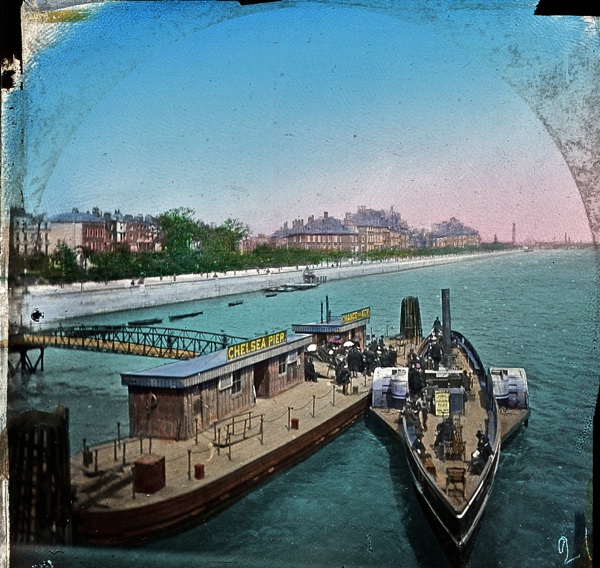
A trip from Chelsea Pier, c.1910.

Doggett’s Coat & Badge Race, c.1920.

Feeding pigeons outside St Paul’s, c.1910.

Building the Great Wheel, Earls Court, c.1910.
Glass slides copyright © Bishopsgate Institute
You may also like to take a look at
My Scrap Collection

Join me for THE GENTLE AUTHOR’S TOUR OF THE CITY OF LONDON on Easter Monday 1st April at 2pm
CLICK HERE TO BOOK
For some years, I have been collecting Victorian scraps of tradesmen and street characters, and putting them in a drawer. The Easter holidays gives me the ideal opportunity to search through the contents and study my collection in detail. I am especially fascinated by the mixture of whimsical fantasy and social observation in these colourful miniatures, in which even the comic grotesques are derived from the daily reality of the collectors who once cherished these images.

Street Photographer

Exotic Birds

Sweets & Dainties

Acrobat & Performing Dog

Performing Dogs

The Muffin Man

Street Musician

Street Musician

Baker

Smoker

Butcher

Waiter

Itinerant

Sweep

Naturalist

Lounge Lizard

Dustman

Costermonger

Spraying the roads

Milkman

Knife Grinder

Scottish Herring Girls followed the shoals around the East Coast, gutting and packing the herring.

Herring Girl
You may like to see these other scraps from my collection
East End Letterheads & Receipts

Join me for THE GENTLE AUTHOR’S TOUR OF THE CITY OF LONDON on Easter Monday 1st April at 2pm
CLICK HERE TO BOOK
It is my delight to publish this selection of local examples from Philip Mernick‘s astonishing ephemera collection of East End. Many are remarkable for the beauty of their typographic design as well as revealing the wide range of industry and commerce.


The oldest slop shop in Wapping sold clothing for the slave trade. Click here to read about slave clothing

This advertisement was printed on a one million mark bank note from the German reich, giving it novelty value and also making a bold political statement to customers

All letterheads and receipts courtesy of Philip Mernick
You may also like to take a look at
The Way Of The Cross In Stepney

Join me for THE GENTLE AUTHOR’S TOUR OF THE CITY OF LONDON on Easter Monday 1st April at 2pm
CLICK HERE TO BOOK
Later this year we shall be publishing David Hoffman’s monograph JOY & ENDURANCE IN THE EAST END 1971-87, accompanied by a an exhibition at the Museum of the Home

A costume fitting
In the late seventies, Contributing Photographer David Hoffman documented the religious drama enacted upon the streets of Stepney around Easter time, recording astonishing images of magical realist intensity which feel closer to the medieval world than to our own day.
Gordon Kendall who played Jesus wrote this memory of his experience.
‘On a cold wet and depressing evening in April 1980, well over 100 actors, production crew and 2000 people lived through the experience of Our Lord’s Way Of The Cross enacted in the streets and estates of Stepney.
The excitement and challenge of playing Jesus really began on the Sunday before the event. Some of the actors were trying out their costumes and they looked very impressive.
Half way through the rehearsal, I needed to visit the toilet and so excused myself from the bodyguard of soldiers in costume. I knocked at the door of a flat. A lady came out and I requested the use of her toilet. She looked at me very oddly – she was a elderly lady – and she asked me who I was. I replied I was playing the part of Jesus and she flashed me a look which revealed she did not believe me, but she said ‘Come in.’
As I went through the flat I could see someone sleeping on the sofa in the lounge. When I closed the bathroom door, I could hear the woman waking up her friend and saying, ‘Nell, there’s a man in the toilet who says he’s Jesus.’ Then I heard some rapid movement and I could only wonder at the thoughts of this woman, struggling to her feet.
There was a knocking at the front door as I came out of the toilet and the two women opened it to be confronted by a fierce Roman Centurion in full regalia, asking if Jesus was in the flat. Fortunately, they relaxed into joyous smiles and it was kisses and handshakes all round as we departed.’

Roman soldiers


Jesus in flares

The arrest of the two thieves

Preparing for the crucifixion


A Roman legion marching


Pilate speaks


Roman soldiers at St Dunstan’s


Jesus consoles Mary

Bespectacled Jesus

Roman Centurion in regalia

Jesus gives himself up


The march to the crucifixion

The soldiers stripping Jesus of his raiments

Crucifixion courtesy of Whitbread

Behold, Jesus is risen in St Dunstan’s Church!
Photographs copyright © David Hoffman
You may also like to take a look at
Viscountess Boudica’s Easter

Why not join me for THE GENTLE AUTHOR’S TOUR OF SPITALFIELDS today Easter Thursday 28th March at 2pm or THE GENTLE AUTHOR’S TOUR OF THE CITY OF LONDON on Easter Monday 1st April at 2pm?
CLICK HERE TO BOOK YOUR EASTER TREAT
At Easter, we celebrate our dearly beloved Viscountess Boudica of Bethnal Green who once entertained us with her seasonal frolics and capers but now is exiled to Uttoxeter

She may be no Spring chicken but that never stopped the indefatigable Viscountess Boudica of Bethnal Green from dressing up as an Easter chick!
As is her custom at each of the festivals which mark our passage through the year, she embraced the spirit of the occasion wholeheartedly – festooning her tiny flat with seasonal decor and contriving a special outfit for herself that suited the tenor of the day. “Easter’s about renewal – birth, life and death – the end of one thing and the beginning of another,” she assured me when I arrived, getting right to the heart of it at once with characteristic forthrightness.
I felt like a child visiting a beloved grandmother or favourite aunt whenever I call round to see Viscountess Boudica because, although I never knew what treats lie in store, I was never disappointed. Even as I walked in the door, I knew that days of preparation preceded my visit. Naturally for Easter there were a great many fluffy creatures in evidence, ducks and rabbits recalling her rural childhood. “When my uncle had his farm, I used to put the little chicks in my pocket and carry them round with me,” she confided with a nostalgic grin, as she led me over to admire the wonder of her Easter garden where yellow creatures of varying sizes were gathering upon a small mat of greengrocer’s grass, around a tree hung with glass eggs, as if in expectation of a sacred ritual.
I cast my eyes around at the plethora of Easter cards, testifying to the popularity of the Viscountess, and her Easter bunting and Easter fairy lights that adorned the walls. There could be no question that the festival was anything other than Easter in this place. “As a child, I used to get a twig and spray it with paint and hang eggs from it,” she explained, recalling the modest origin of the current extravaganza and adding, “I hope this will inspire others to decorate their homes.”
“Cadbury’s Dairy Milk is my favourite,” she confessed to me, chuckling in excited anticipation and patting her waistline warily, “I probably will eat a lot of chocolate on Easter Monday – once I start eating chocolate, I can’t stop.” And then, just like that beloved grandmother or favourite aunt, Viscountess Boudica kindly slipped a chocolate egg into my hands, as I said my farewell and carried it off under my arm back to Spitalfields as a proud trophy of the day.


Viscountess Boudica writes her Easter cards


“yellow creatures of varying sizes were gathering upon a small mat of greengrocer’s grass, around a tree hung with glass eggs, as if in expectation of a sacred ritual”

Viscountess Boudica turns Weather Girl to present the forecast for the Easter Bank Holiday – “I predict a dull start with a few patches of sunshine and some isolated showers. In the West Country, it will be nice all day with temperatures between sixty and eighty degrees Farenheit. There will be a small breeze on the coast and sea temperature of around fifty-nine degrees Farenheit.”


Easter blessings to you from Viscountess Boudica!

Viscountess Boudica and her fluffy friends
Be sure to follow Viscountess Boudica’s blog There’s More To Life Than Heaven & Earth
Take a look at
The Departure of Viscountess Boudica
Viscountess Boudica’s Domestic Appliances
Viscountess Boudica’s Halloween
Viscountess Boudica’s Christmas
Viscountess Boudica’s Valentine’s Day
Viscountess Boudica’s St Patrick’s Day
Read my original profile of Mark Petty, Trendsetter
and take a look at Mark Petty’s Multicoloured Coats
Good Friday At St Bartholmew’s
If you are at a loose end over the forthcoming Easter holidays, why not join me for THE GENTLE AUTHOR’S TOUR OF SPITALFIELDS on Easter Thursday 28th March at 2pm or THE GENTLE AUTHOR’S TOUR OF THE CITY OF LONDON on Easter Monday 1st April at 2pm?
CLICK HERE TO BOOK YOUR EASTER TREAT
This Friday at 11:30am sees the Ceremony of the Widow’s Sixpence in Smithfield

Distribution of buns to widows in the churchyard of St Bartholomew the Great
St Bartholomew the Great is one of my favourite churches in the City, a rare survivor of the Great Fire, it boasts the best Norman interior in London. Composed of ancient rough-hewn stonework, riven with deep shadow where feint daylight barely illuminates the accumulated dust of ages, this is one of those rare atmospheric places where you can still get a sense of the medieval world glimmering. Founded by Rahere in 1123, the current structure is the last vestige of an Augustinian Priory upon the edge of Smithfield, where once martyrs were burnt at the stake as public entertainment and the notorious St Bartholomew Fair was celebrated each summer from 1133 until 1855.
In such a location, the Good Friday tradition of the distribution of charity in the churchyard to poor widows of the parish sits naturally. Once known as the ‘Widow’s Sixpence,’ this custom was institutionalised by Joshua Butterworth in 1887, who created a trust in his name with an investment of twenty-one pounds and ten shillings. The declaration of the trust states its purpose thus – “On Good Friday in each year to distribute in the churchyard of St. Bartholomew the Great the sum of 6d. to twenty-one poor widows, and to expend the remainder of such dividends in buns to be given to children attending such distribution, and he desired that the Charity intended to be thereby created should be called ‘the Butterworth Charity.'”
Those of us who gathered in the churchyard at St Bartholomew the Great on Good Friday were blessed with sunlight. Yet we could not resist a twinge of envy for the clerics in their heavy cassocks and warm velvet capes as they processed from the church in a formal column, with priests at the head attended by vergers bearing wicker baskets of freshly buttered Hot Cross Buns, and a full choir bringing up the rear.
In the nineteen twenties, the sum distributed to each recipient was increased to two shillings and sixpence, and later to four shillings. Resplendent in his scarlet robes, Rev Martin Dudley, Rector of St Bartholomew the Great climbed upon the table tomb at the centre of the churchyard traditionally used for that purpose and enacted the motions of this arcane ceremony – enquiring of the assembly if there were a poor widow of the parish in need of twenty shillings. To his surprise, a senior female raised her hand. “That’s never happened before!” he declared to the easy amusement of the crowd.
I detected a certain haste to get to the heart of the proceedings – the distribution of the Hot Cross Buns. Rev Dudley directed the vergers to start with choir who exercised admirable self-control in only taking one each. Then, as soon as the choir had been fed, the vergers set out around the boundaries of the yard where senior females with healthy appetites reached forward eagerly to take their allotted Hot Cross Buns in hand. The tense anticipation gave way to good humour as everyone delighted in the strangeness of the ritual which rendered ordinary buns exotic. Reaching the end of the line at the furthest extent of the churchyard, the priests wasted no time in satisfying their own appetites and, for a few minutes, silence prevailed as the entire assembly munched their buns.
Then Rev Martin returned to his central position upon the table tomb. “And now, because there is no such thing as free buns,” he announced, “we’re going to sing a hymn.” Yet we were more than happy to oblige, standing replete with buns on Good Friday and enjoying the March sunlight.

The Priory Church of St Bartholomew the Great, a century ago.


John Betjeman once lived in this house overlooking the churchyard.


The ceremony of the Widow’s Sixpence in the nineteen twenties.

“God’s blessing upon the frosts and cold!”

A crowd gathers for the ceremony a hundred years ago.

Hungry widows line up for buns.

The churchyard in the nineteenth century.


Rev Martin Dudley BD MSc MTh PhD FSA FRHistS AKC is the 25th Rector since the Reformation.

Testing the buns.


The clerics ensure no buns go to waste.

Hymns in the cold – “There is a green hill far away without a city wall…”


The Norman interior of St Bartholomew the Great at the beginning of the twentieth century.

The Gatehouse prior to bombing in World War I and reconstruction.

Archive images courtesy Bishopsgate Institute
You may also like to read about
Easter Procession In Stepney
If you are at a loose end over the forthcoming Easter holidays, why not join me for THE GENTLE AUTHOR’S TOUR OF SPITALFIELDS on Easter Thursday 28th March at 2pm or THE GENTLE AUTHOR’S TOUR OF THE CITY OF LONDON on Easter Monday 1st April at 2pm?
CLICK HERE TO BOOK YOUR EASTER TREAT

Every Easter, George & Dunstan, donkeys at Stepney City Farm enjoy an outing when they join the Parishioners of St Dunstan’s for the annual procession around the vicinity on Palm Sunday – and, one year, Contributing Photographer Colin O’Brien & I joined the enthusiastic throng on a cold and grey spring morning.
Walking down from Whitechapel, Colin & I followed Stepney Way, which was once a path across the fields used by worshippers when St Dunstan’s was the parish church for the whole of Tower Hamlets. St Dunstan founded it in 952 and it stands today as earliest surviving building after the Tower on this side of London.
At the old stone church, we discovered the wardens were eager to show us their ancient silver, a mace and a staff, with images of St Dunstan, the Tower and a Galleon referring to the days when this was the parish of seafarers. Once, all those who were born or died at sea were entered here in the parish register.
Curate Chris Morgan led off across the churchyard along the fine avenue of plane trees, swinging incense and followed by church wardens, sidesmen, George & Dunstan the donkeys, members of the parish and a solo trumpeter, with the Rector Trevor Critchlow bringing up the rear.
Anyone still nursing a hangover from Saturday night might have been astounded to be awoken by the sound of a heavenly host, and parted the curtains to discover this rag tag parade. Yet it was a serious commemoration of Christ’s entry into Jerusalem in which the streets of Stepney became transformed into the Via Sacra for a morning.
They marched through the empty terraced streets, past the large development site, turned left at the curry restaurant, passing the pizza takeaway and the beauty parlour, before turning left again at the youth centre to re-enter the churchyard. Then there was just time to pet the donkeys before they filed into the church to warm up again and begin Sunday morning prayers. And this was how Easter began in Stepney.

St Dunstan with his metalworkers’ tongs on top of the seventeenth century mace

A galleon upon an eighteenth century staff is a reminder St Dunstan’s was the parish of seafarers

Tower of London upon the reverse of the staff

Sidesmens’ batons from the era of George IV

Julian Cass, Sidesman

Jenny Ellwood, Sidesperson, and Sarah Smith, Parish Clerk

Trevor Critchlow, Rector of St Dunstan’s


Curate Chris Morgan leads the procession


Photographs copyright © Estate of Colin O’Brien
You may also like to read about
Nativity Procession In Spitalfields
Easter Flowers At St Dunstan’s


