
Remembering Rogg’s Delicatessen

Alan Dein fondly remembers Barry Rogg and his celebrated Whitechapel delicatessen

Barry Rogg by Shloimy Alman, 1977
As the years tick by and the places and the people I have loved pass on, I would like to take this opportunity to reflect on a remarkable character whose shop was an East End institution for over fifty years.
Just south of Commercial Rd, Rogg’s delicatessen stood at the junction of Cannon Street Rd and Burslem St with its white-tiled doorway directly on the corner. One step transported you into a world of ‘heimishe’ or homely Jewish food that still had one foot in the past, a land of old-time street market sellers and their Eastern European roots.
Rogg’s was crammed from floor to ceiling with barrels, tins and containers of what Barry Rogg always called “the good stuff”. He was the proud proprietor who held court from behind the counter, surrounded on all sides by his handpicked and homemade wares. The shelves behind him were lined with pickles and a variety of cylindrical chub-packed kosher sausages dangled overhead.
Barry’s appearance was timeless, a chunky build with a round face that sometimes made him look younger or older than he was. He would tell you the story of Rogg’s if you wanted to know, but he was neither sentimental about the heyday of the ‘Jewish East End’ nor did he run a nostalgia-driven emporium. Rogg’s customers were varied and changed with the times. There was always the Jewish trade but, up to their closure, Rogg’s was also a popular a haunt for dockers who would traipse up from the nearby Thames yards. After that his customers were made up from the local Asian community, until there came another wave when he was being discovered by the national press increasingly focusing eastwards.
Barry’s grandfather started in the business at another shop on the same street in 1911. By 1944, when Barry was fourteen and still at school, he had already begun to help the family out at their new corner shop at 137 Cannon Street Rd. In 1946 he moved in for good, though he had only anticipated it would be a two-year stint as the building was earmarked for compulsory purchase for a road widening scheme that fortunately never happened.
I got to know Barry Rogg in 1987 when I joined a team of part-time workers at the Museum of the Jewish East End – now the Jewish Museum – who were collecting reminiscences and artefacts relating to East End social history. Then Rogg’s was one of the very last of its kind in East London. By the nineties it was Barry alone who was flying the flag for the Yiddisher corner deli scene that had proliferated in Whitechapel from the late nineteenth century. Thankfully, due to his popularity and the uniqueness in the last decade of the twentieth century, we have some wonderful photographs and articles to remember Barry by.
There are tantalising images of the food but we no can longer taste it. An array of industrial-sized plastic buckets filled with new green cucumbers, chillies, bay leaves and garlic at various stages of pickling, the spread of homemade schmaltz herrings, fried fish, gefilte fish, salt beef, chopped liver, the cheesecake. I am sure everyone reading this who visited Rogg’s will remember how their senses went into overdrive. The smells of the pickles, the herrings, the fruit and the smoked salmon, the visual bombardment of all the packaging and the handwritten labels. “Keep looking” was a favourite Barry catchphrase and how could you possibly not?
Of course, you could spend all day listening to the banter with his customers. I also fondly recall conversations with his partner Angela, who helped out but generally kept a low profile in the back of the shop. Rogg’s was Barry’s stage. He had a deep love for the theatre and for art, and one wonders what else he might have done if – like so many of his generation – he had not ended up in the family business as a fifteen-year-old out of school.
Barry died in 2006 at the age of seventy-six. Years ago, I co-compiled an album for JWM Recordings, Music is the Most Beautiful Language in the World: Yiddisher Jazz in London’s East End from the twenties to the fifties. As a follow-up, my co-compiler and regular companion on trips to Rogg’s, Howard Williams suggested releasing another disc, this time with a food theme and dedicated to Barry Rogg.
This disc dishes up two sides recorded in New York in the late thirties and forties. Slim Gaillard – whose hip scatological word play would be celebrated in On the Road – performs a paean to the humble yet filling Matzoh Balls, dumplings made of eggs and matzoh meal. Yiddish singer Mildred Rosner serves Gefilte Fish a galloping love affair with this slightly sweet but savoury ancient recipe which consists of patties made of a poached mixture of ground deboned white fish, boiled or fried. These two classic dishes have graced the Jewish luncheon or dinner table for generations and the recipes are included.
On the label is Irv Kline’s portrait of Barry from 1983. Irv was an American who had retired to live in London. Barry’s photograph formed part of Irv’s study of surviving Jewish businesses in the East End, a travelling exhibition which I helped to hang during the eighties. I recall Irv being a real jazz buff so I hope that he too would appreciate the music accompanying his portrait of Barry Rogg.
Click here for information about the ‘Gefilte Fish/Matzoh Balls’ recording

Irv Kline’s portrait of Barry Rogg, 1983

Alan Dein’s photograph of Rogg’s with one of Barry’s regular customers framed in the doorway, 1988

Shloimy Alman’s photograph of Rogg’s interior, 1977
You may also like to take a look at
Clive Murphy’s Matchbox Labels

Cover price is £35 but if you order now you can buy it for £30 and you will receive a signed copy on publication in October.
CLICK HERE TO ORDER A SIGNED COPY OF ENDURANCE & JOY

Clive Murphy, Phillumenist
Nothing about this youthful photo of the late novelist, oral historian and writer of ribald rhymes, Clive Murphy – resplendent here in a well-pressed tweed suit and with his hair neatly brushed – would suggest that he was a Phillumenist. Even people who have knew him since he came to live in Spitalfields in 1973 never had an inkling. In fact, evidence of his Phillumeny only came to light when Clive donated his literary archive to the Bishopsgate Institute and a non-descript blue album was uncovered among his papers, dating from the era of this picture and with the price ten shillings and sixpence still written in pencil in the front.
I was astonished when I saw the beautiful album and I asked Clive to tell me the story behind it. “I was a Phillumenist,” he admitted to me in a whisper, “But I broke all the rules in taking the labels off the matchboxes and cutting the backs off matchbooks. A true Phillumenist would have a thousand fits to see my collection.” It was the first time Clive had examined his album of matchbox labels and matchbook covers since 1951 when, at the age of thirteen, he forsook Phillumeny – a diversion that had occupied him through boarding school in Dublin from 1944 onwards.
“A memory is coming back to me of a wooden box that I made in carpentry class which I used to keep them in, until I put them in this album,” said Clive, getting lost in thought, “I wonder where it is?” We surveyed page after page of brightly-coloured labels from all over the world pasted in neat rows and organised by their country of origin, inscribed by Clive with blue ink in a careful italic hand at the top of each leaf. “I have no memory of doing this.” he confided to me as he scanned his handiwork in wonder,“Why is the memory so selective?”
“I was ill-advised and I do feel sorry in retrospect that they are not as a professional collector would wish,” he concluded with a sigh, “But I do like them for all kinds of other reasons, I admire my method and my eye for a pattern, and I like the fact that I occupied myself – I’m glad I had a hobby.”
We enjoyed a quiet half hour, turning the pages and admiring the designs, chuckling over anachronisms and reflecting on how national identities have changed since these labels were produced. Mostly, we delighted at the intricacy of thought and ingenuity of the decoration once applied to something as inconsequential as matches.
“There was this boy called Spring-Rice whose mother lived in New York and every week she sent him a letter with a matchbox label in the envelope for me.” Clive recalled with pleasure, “We had breaks twice each morning at school, when the letters were given out, and how I used to long for him to get a letter, to see if there was another label for my collection.” The extraordinary global range of the labels in Clive’s album reflects the widely scattered locations of the parents of the pupils at his boarding school in Dublin, and the collection was a cunning ploy that permitted the schoolboy Clive to feel at the centre of the world.
“You don’t realise you’re doing something interesting, you’re just doing it because you like pasting labels in an album and having them sent to you from all over the world.” said Clive with characteristic self-deprecation, yet it was apparent to me that Phillumeny prefigured his wider appreciation of what is otherwise ill-considered in existence. It is a sensibility that found full expression in Clive’s work as an oral historian, recording the lives of ordinary people with scrupulous attention to detail, and editing and publishing them with such panache.


Clive Murphy, Phillumenist
Images courtesy of the Clive Murphy Archive at the Bishopsgate Institute
You may like to read my other stories about Clive Murphy
Rose At The Golden Heart
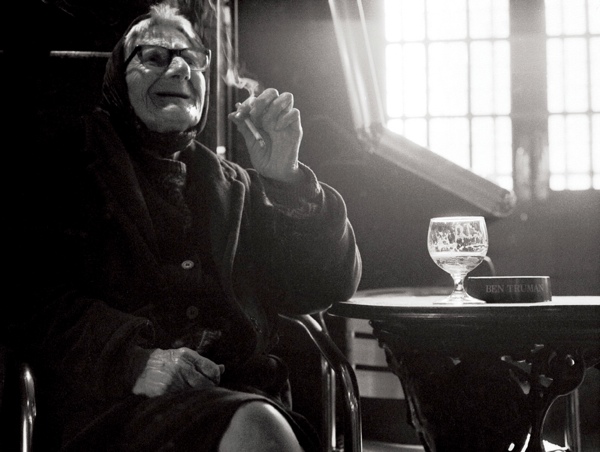
Rose
When Sandra Esqulant, celebrated landlady of The Golden Heart in Commercial St, saw this photo taken by Phil Maxwell of Rose sitting in her barroom more than twenty years ago she told me the story of an unforgettable character who became one of her most loved regulars.
“I loved Rose. I don’t know what happened to her, she’s got to be dead now hasn’t she?
What happened was – you know how you fall in love with some people? – this woman appeared in the pub one day and I fell in love with her. I just liked her.
She asked for a rum & lemonade, and she never had to pay for a drink in my pub.
I used to have to warn everyone when Rose was coming in because she used to pick up everyone’s cigarettes and put them in her bag.
I used to dance with her.
You might think she was dumb, but she was the most astute person I ever met. She didn’t like my husband while I was there, but when I wasn’t there it was a different story!
My husband liked her a lot.
You know I lost my husband.
When she stopped coming, I went round to the Sally Army in Old Montague St, where she lived, but they told me they didn’t know what happened to her, so I went to the Police Station and they were going to search the morgue. I kept going back to the Sally Army and this Irish woman said to me, ‘Are you looking for Rose? She moved to Commercial Rd.’ So I went round to the Commercial Rd shelter and there was Rose. She was very sad because the Sally Army had put her out after forty years. So I used to send a cab to pick her up and take her back from my pub.
The Sally Army, they should have known how fond I was of her and told me where she had gone.
One Sunday, when I was on my own, she collected all the glasses and the ashtrays and the crisp packets and emptied them over the bar. I didn’t mind, Rose could do anything in my pub.
People like Rose would go into a pub and people wouldn’t serve them, but I had everyone in here – this was the dossers’ bar!
One day, Phil Maxwell asked Rose if he could put her in one of his films and she didn’t like that, but he set his camera on the table and took these pictures. And after that, he always had her picture in his exhibitions.
She must have known I was fond of her.
She did like me.
I know she liked me.
She was lovely.
She used to talk about her daughter, but I sometimes wonder if she ever had a daughter.
At Christmas, she always asked me for a Christmas box and, of course, I always gave her one.
They moved her out after forty years, what a thing to do to someone.
If Rose was here today, I’d let her smoke in my pub – I don’t care about the law.
Very special, she was.”


Photographs copyright © Phil Maxwell
See more of Phil Maxwell’s work here
Phil Maxwell’s Kids on the Street
Phil Maxwell & Sandra Esqulant, Photographer & Muse
More of Phil Maxwell’s Old Ladies
Phil Maxwell’s Old Ladies in Colour
Cruikshank At The Tower Of London

The Execution of Lady Jane Grey at Tower Green
“It has been for years, the cherished wish of the writer of these pages to make the Tower of London the groundwork of a Romance,” wrote William Harrison Ainsworth in 1840, introducing his novel, “The Tower of London” – and it is an impulse that I recognise, because I know of no other place in London where the lingering sense of myth and the echoing drama of the past is more tangible that at the Tower.
Whenever I have entered those ancient walls, I am struck anew by the mystery of the place. I have to stop and reconcile my knowledge of history with the location where it happened, and each time I become more spellbound by the actuality of the place, which in spite of Victorian rebuilding still retains its integrity as an ancient fortress. I always make a point to pause and read the age-old graffiti, to stop in each doorway and take in the prospect at this most dramatic of monuments.
When I discovered “The Tower of London” by William Harrison Ainsworth I was captivated by George Cruikshank’s illustrations, realising that not only had this favourite of mine amongst nineteenth century illustrators once stood in exactly the same places I had stood, but he had the genius to draw the images inspired by these charged locations.
“Desirous of exhibiting the Tower in its triple light of a palace, a prison and a fortress, the author has shaped his story with reference to that end, and he has also endeavoured to combine such a series of incidents as should naturally introduce every relic of the old pile, its towers, halls, chambers, gateways and drawbridges – so that no part of it should remain uninvolved.” explained Ainsworth in his introduction to his sensationalist fictionalised account of the violent end of the short reign of Lady Jane Grey. Yet it is George Cruikshank’s engravings which bring the work alive, providing not just a tour of the architectural environment but also of the dramatic imaginative world that it contains – and done so vividly that I know already that when I return I shall be looking out for his characters in my mind’s eye while I am there.
There is a grim humour and surreal poetry in pictures which, to my eyes, presage the work of Edward Gorey, who like George Cruikshank also created a sinister diaphanous world out of dense hatching. Maurice Sendak was another master of the mystery that can be evoked by intricate webs of woven lines in which – as in these Tower of London engravings – three dimensional space dissolves into magical possibility. But to me the prime achievement of these pictures is that George Cruikshank has given concrete life to the Tower’s past, creating figures that convincingly take command of the stage offered by its charged spaces and, like the acting of Henry Irving, appear as if momentarily illuminated by flashes of lightning. Cruikshank’s pictures are like glimpses of a strange dream, drawing the viewer into a compelling emotional universe with its own logic, peopled by its own inhabitants and where it is too readily apparent what is going on.
The popularity of William Harrison Ainsworth’s novel was responsible for creating the bloodthirsty reputation of the Tower of London which still endures today – even though for centuries the Tower was used as a domestic royal residence and administrative centre, headquarters of the royal ordinances, records office, mint, observatory, and a menagerie amongst other diverse functions throughout its thousand year history. Yet although it may be just one of the infinite range of tales to be told about the Tower of London, William Harrison Ainsworth’s Romance does witness historical truth. There is a neglected plaque in the corner of Trinity Green, just outside Tower Hill station, which is a memorial to those executed there through the centuries – as testament to the reality of the violence enacted upon those with the misfortune to find themselves on the wrong side of authority in past days.

Jane Grey’s first night in the Tower – “Prompted by an undefinable feeling of curiosity, she hastened towards it and, holding forward the light, a shudder went through her frame, as she perceived at her feet – an axe!”

Cuthbert Cholmondeley surprised by a mysterious figure in the dungeon adjoining the Devilin Tower.

Jane Grey interposing between the Duke of Northumberland and Simon Renard.

Jane Grey and Lord Gilbert Dudley brought back to the Tower through Traitors’ Gate – “Never had Jane experienced such a feeling of horror as now assailed her – and if she had crossed the fabled Styx, she could not have greater dread. Her blood seemed congealed within her veins as she gazed around. The light of the torches fell upon the black arches – upon the slimy walls and upon the yet blacker tide.”

Jane imprisoned in the Brick Tower – “Alone! The thought struck her to the heart. She was now captured. She heard the doors of the prison bolted – she examined its stone walls, partly concealed by tapestry – she glance at its barred windows, and she gave up hope.”

Simon Renard and Winwinkle, the warder, on the roof of the White Tower – “There you behold the Tower of London,” said Winwinkle, pointing downwards. “And there I read the history of England,” replied Renard. “If it is written in these towers, it is a dark and bloody history, ” replied the warder.

Mauger sharpening his axe – ” A savage-looking individual seated on a bench at a grinding stone, he had an axe blade which he had just been sharpening, and he was trying its edge with his thumb. His fierce blood-shot eyes, recessed far beneath his bent and bushy brows were fixed upon the weapon.”

Execution of the Duke of Northumberland upon Tower Hill – “As soon as the Duke had disposed himself upon the block, the axe flashed like a gleam of lightning in the sunshine – descended – and the head was severed from the trunk. Mauger held it aloft, almost before the eyes were closed, crying out to the the assemblage in a loud voice, “Behold the head of a traitor!”

Cuthbert Cholmondeley discovering the body of Alexia in the Devilin Tower – “Pushing aside the door with his blade, he beheld a spectacle that filled him with horror. At one side of the cell upon a stone seat, rested the dead body of a woman, reduced almost to a skeleton. On the wall, close to where she lay, and evidently carved by her own hand, the name ALEXIA.”

Queen Mary surprises Courtenay and Princess Elizabeth

Lawrence Nightgall dragging Cicely down the secret stairs in the Salt Tower

Courtenay’s escape from the Tower

The burning of Edward Underhill at Tower Green – “As the flames rose, the sharpness of the torment overcame him. He lost control of himself, and his eyes started from their sockets – his contorted features and his writhing frame proclaimed the extremity of his agony. It was a horrible sight, and a shudder burst forth from the assemblage.”

The Death Warrant – “Mary tried to ascertain the cause of the animal’s disquietude as its barking changed to a dismal howl. Not without misgiving, she glanced towards the window and there between the bars she beheld a hideous black mask, through the holes of which glared a pair of flashing eyes.”

Elizabeth confronts Sir Thomas Wyatt in the torture chamber – “‘Sir Thomas Wyatt,’ Elizabeth declared in a loud and authoritative tone, and stepping towards him, ‘If you would not render your name forever infamous, you must declare my innocence!'”

The Fall of Nightgall – “Nightgall struggled desperately against the horrible fate that waited him, clutching convulsively against the wall. But it was unavailing. He uttered a fearful cry, and tried to grab at the roughened surface. From a height of nearly ninety feet, he fell with a terrific smash upon the pavement of the court below.”

The Night before the Execution – “In spite of himself, the executioner could not repress a feeling of dread and the contrary urge, which represented his curiousity. He pointed towards the church porch, from which a figure, robed in white, but insubstantial as the mist, suddenly appeared. It glided noiselessly along and without turning its face to the beholders.”

Jane Grey meeting the body of her husband at the scaffold – “She knew it was the body of her husband, and unprepared for so terrible an encounter, uttered a cry of horror.”

Plaque at Trinity Green on Tower Hill
You may also like to read
John Keohane, Chief Yeoman Warder at the Tower of London
Blues Dances


Photographer Barry Weston introduces his exuberant pictures of the Blues Dances held in Greenwich and Woolwich in the eighties, published for the first time here today.
‘My route into the Blues Dances began in the mid-seventies when I ventured into a newly opened reggae record shop by Plumstead station. The shop was tiny, an end-of-row one-storey triangle barely six foot at its widest.
I was looking for the album King Tubby Meets The Upsetter at Grass Roots of Dub which I had read a review of and, although the owner, Noldie, did not have a copy, he asked if I was in a hurry and then played me some of the latest tunes he had. After selecting a small stack of singles I settled up and Noldie added a final 45 to the bag with the words ‘I think you’ll like this one.’ Sure enough Burn Babylon by Sylford Walker was the best of the bunch and with that I was hooked, returning every free day I had for the rest of the decade.
Through Noldie I met Lloyd ‘Junior’ McQueen and we started to hang out together at the Lord Howick pub in Woolwich. Noldie later arranged a slot DJ-ing at the Howick. Friday to Sunday, with me playing the Friday night and opening the other two nights from early ’78 to late ’79.
In ‘79 Junior started playing the Blues Dance at Guilford Grove in Greenwich. The Blues was run by Ghent & Mary in the basement of their large family house. At that time Blues Dances gave the Black British community a place to hang out and dance to reggae, free from the hassle that so often happened in pubs and clubs at the time, particularly when the National Front was at its most active.
We would leave the Howick on a Saturday night and then start the Blues at around half eleven at night, the dance running through to the early hours when the buses started again. It was a running joke to play the Jah Stitch toast with the lyrics ‘milkman coming in the morning’ just as the electric float and the clinking bottles could be heard before the first hint of dawn.
Junior would play through the the night with support from his brother Danny. I would step up and play a short set to give them a break and a chance to have a plate of Mary’s delicious food. To this day nothing can compare to fried red mullet goatfish at three in the morning with a Red Stripe to wash it down.
In early 1980, after seven years of working, I applied to the London College of Printing Art Foundation course as a mature student. To add to my portfolio I borrowed an Olympus Trip 35, a decent point-and-shoot compact camera, to teach myself the basics of photography. I was also planning on moving across to South London, so wanted to capture what had been a large part of my life over the preceding years.
These photos were taken over three consecutive Saturdays, mostly at the Blues Dance at Guildford Grove. One film roll starts at the Howick with George Thompson at the decks. Some photos show the bus trip between the Howick and the Blues and other pictures were taken at Noldie’s second, far bigger, record shop in 1981.
Between the time the photos were taken in 1980 and 1981, there was the appalling tragedy of the New Cross Fire at a party just half a mile down the road from Guildford Grove. This was movingly documented in Steve McQueen’s three part TV program Uprising about the fire and its consequences. The roots of Black British music sprang from Blues Dances like these, once running in West Indian communities in many cities, which have now largely disappeared.’ – Barry Weston


Photographs copyright © Barry Weston
The Return Of Benjamin Pollock

Benjamin Pollock’s Toy Shop at 73 Hoxton Market was destroyed by bombing in 1944 but this autumn its magical interior is reimagined at Dennis Severs’ House from 4th October until 10th November. Designed in collaboration with Pollock’s Toy Museum, the garden room of 18 Folgate Street will be transformed by a joyous cast of 19th-century toy-theatre characters and backgrounds alongside a Victorian printing press, finely-engraved copper plates, Mr Redington’s original box of pigments, Pollock’s own storage boxes and antique toy theatres hung from the walls and ceiling.
In November, you can attend toy theatre performances at Museum of the Home in Hoxton, The Bottle Imp on Saturday 1st and Dick Whittington and Cinderella on Sunday 24th. By employing copies of the extremely rare 1830s ‘twopence coloured’ sheets, and the authentic reduced script, the effect of the original stage plays will be recreated.
In December, Townhouse Spitalfields will be hosting a Pollock’s Toy Museum pop-up shop.
Today The Gentle Author outlines the history of toy theatres in the East End.

Benjamin Pollock outside his shop in Hoxton Market
THE TOY THEATRES OF HOXTON & SHOREDITCH
These days, Old St is renowned for its digital industries but – for over a hundred years – this area was celebrated as the centre of toy theatre manufacture in London. Formerly, these narrow streets within walking distance of the City of London were home to highly skilled artisans who could turn their talents to the engraving, printing, jewellery, clock, gun and instrument-making trades which operated here – and it was in this environment that the culture of toy theatres flourished.
Between 1830 and 1945, at a handful of addresses within a half mile of the junction of Old St and City Rd, the modest art of publishing engraved plates of characters and scenery for Juvenile Dramas enjoyed its heyday. The names of the protagonists were William Webb and Benjamin Pollock. The overture was the opening of Archibald Park’s shop at 6 Old St Rd in 1830, and the drama was brought to the public eye by Robert Louis Stevenson in his essay A Penny Plain and Twopence Coloured in 1884, before meeting an ignominious end with the bombing of Benjamin Pollock’s shop in Hoxton St in 1945.
Responsibility for the origin of this vein of publishing belongs both to John Kilby Green of Lambeth and William West of Wych St in the Strand, with the earliest surviving sheets dated at 1811. Green was just an apprentice when he had the notion to produce sheets of theatrical characters but it was West who took the idea further, publishing plates of popular contemporary dramas. From the beginning, the engraved plates became currency in their own right and many of Green’s vast output were later acquired by Redington of Hoxton and eventually published there as Pollock’s. West is chiefly remembered for commissioning artists of acknowledged eminence to design plates, including the Cruickshank brothers, Henry Flaxman, Robert Dighton and – most notably – William Blake.
Green had briefly collaborated to open Green & Slee’s Theatrical Print Warehouse at 5 Artillery Lane, Spitalfields, in 1805 to produce ‘The Tiger’s Horde’ but the first major publishers of toy theatres in the East End were Archibald Park and his family, rising to prosperity with premises in Old St and then 47 Leonard St between 1830 until 1870.
Park’s apprentice from 1835-42, William Webb, set up on his own with shops in Cloth Fair and Bermondsey before eventually opening a quarter a mile from his master at 49 (renumbered as 146) Old St in 1857. Webb traded here until his death in 1898 when his son moved to 124 Old St where he was in business until 1931. Contrary to popular belief, it was William Webb who inspired Robert Louis Stevenson’s famous essay upon the subject of toy theatres. Yet a disagreement between the two men led to Stevenson approaching Webb’s rival Benjamin Pollock in Hoxton St, who became the subject of the story instead and whose name became the byword for toy theatres.
In 1876, at twenty-one years old, Benjamin Pollock had the good fortune to acquire by marriage the shop opened by his late father-in-law, John Redington in Hoxton in 1851. Redington had all the theatrical plates engraved JK Green and, in time, Benjamin Pollock altered these plates, erasing the name of ‘Redington’ and replacing it with his own just as Redington had once erased the name ‘Green’ before him. Although it was an unpromising business at the end of the nineteenth century, Pollock harnessed himself to the work, demonstrating flair and aptitude by producing high quality reproductions from the old plates, removing ‘modern’ lettering applied by Redington and commissioning new designs from the naive artist James Tofts.
In 1931, the writer AE Wilson had the forethought to visit Webb’s shop in Old St and Pollock’s in Hoxton St, talking to William Webb’s son Harry and to Benjamin Pollock, the last representatives of the two surviving dynasties in the arcane world of Juvenile Dramas. “In his heyday, his business was very flourishing,” admitted Harry Webb speaking of his father,” Why, I remember we employed four families to do the colouring. There must have been at least fifteen people engaged in the work. I could tell their work apart, no two of them coloured alike. Some of the work was beautifully done.”
Harry recalled visits by Robert Louis Stevenson and Charles Dickens to his father’s premises. “Up to the time of the quarrel, Stevenson was a frequent visitor to the shop, he was very fond of my father’s plays. Indeed it was my father who supplied the shop in Edinburgh from which he bought his prints as a boy,” he told Wilson.
Benjamin Pollock was seventy-five years old when Wilson met him and ‘spoke in strains not unmingled with melancholy.’ “Toy theatres are too slow for the modern boy and girl,” he confessed to Wilson, “even my own grandchildren aren’t interested. One Christmas, I didn’t sell a single stage.” Yet Pollock spoke passionately recalling visits by Ellen Terry and Charlie Chaplin to purchase theatres. “I still get a few elderly customers,” Pollock revealed, “Only the other day, a City gentleman drove up here in a car and bought a selection of plays. He said he had collected them as a boy. Practically all the stock has been here fifty years or so. There’s enough to last out my time, I reckon.”
Shortly after AE Wilson’s visit to Old St & Hoxton, Webb’s shop was demolished while Benjamin Pollock struggled to earn even the rent for his tiny premises until his death in 1937. Harry Webb lived on in Caslon St – named after the famous letter founder who set up there two centuries earlier – opposite the site of his father’s Old St shop until his death in 1962.
Robert Louis Stevenson visited 73 Hoxton St in 1884. “If you love art, folly or the bright eyes of children speed to Pollock’s” he wrote fondly afterwards. Stevenson was an only child who played with toy theatres to amuse himself in the frequent absences from school due to sickness when he was growing up in Edinburgh. I too was an only child enchanted by the magic of toy theatres, especially at Christmas, but I cannot quite put my finger on what still draws me to the romance of them.
Even Stevenson admitted “The purchase and the first half hour at home, that was the summit.” As a child, I think the making of them was the greater part of the pleasure, cutting out the figures and glueing it all together. “I cannot deny the joy that attended the illumination, nor can I quite forget that child, who forgoing pleasure, stoops to tuppence coloured,” Stevenson concluded wryly. I cannot imagine what he would have made of Old St’s ‘Silicon Roundabout’ today.

Drawings for toy theatre characters by William Blake for William West
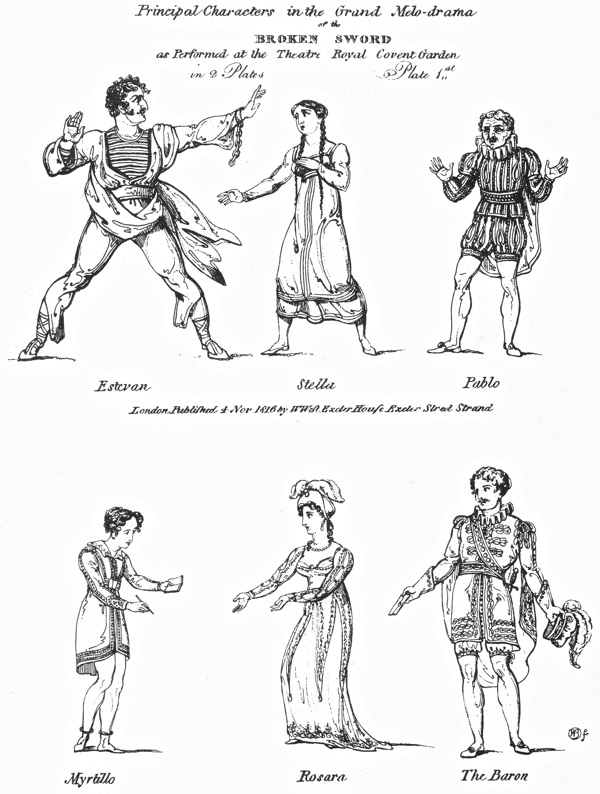
The sheet as published by William West, November 4th 1816 – note Blake’s initials, bottom right
 Another sheet engraved after drawings by William Blake, 1814

124 Old St, 1931


73 Hoxton St (formerly 208 Hoxton Old Town) 1931

Benjamin Pollock at his shop on Hoxton St in 1931


An Invitation From The Gentle Author
THIS IS NOW FULL BUT THERE WILL BE FURTHER EVENTS FOR THIS BOOK THROUGH THE AUTUMN & THE EXHIBITION RUNS UNTIL 30th MARCH


