
Down A Well In Spitalfields


Thirty years ago, eighteen wooden plates and bowls were recovered from a silted-up well in Spitalfields. One of the largest discoveries of medieval wooden vessels ever made in this country, they are believed to be dishes belonging to the inmates of the long-gone Hospital of St Mary Spital, which gave its name to this place. After seven hundred years lying in mud at the bottom of the well, the thirteenth century plates were transferred to the London Museum store in Hoxton where I went to visit them as a guest of Roy Stephenson, Head of Archaeological Collections.
Almost no trace remains above ground of the ancient Hospital of St Mary yet, in Spital Sq, the roads still follow the ground plan laid laid out by Walter Brune in 1197, with the current entrance from Bishopsgate coinciding to the gate of the Priory and Folgate St following the line of the northern perimeter wall. Stand in the middle of Spital Sq today, and you are surrounded by glass and steel corporate architecture, but seven hundred years ago this space was enclosed by the church of St Mary and then you would be standing in the centre of the aisle where the transepts crossed beneath the soaring vault with the lantern of the tower looming overhead. Stand in the middle of Spital Sq today, and the Hospital of St Mary is lost in time.
In his storehouse, Roy Stephenson had eleven miles of rolling shelves that contain all the finds excavated from old London in recent decades. He opened one box containing bricks in a plastic bag that originated from Pudding Lane and were caked with charcoal dust from the Fire of London. I leant in close and a faint cloud of soot rose in the air, with an unmistakable burnt smell persisting after four centuries. “I can open these at random,” said Roy, gesturing towards the infinitely receding shelves lined with boxes in every direction, “and every one will have a story inside.”
Removing the wooden plates and bowls from their boxes, Roy laid them upon the table for me to see. Finely turned and delicate, they still displayed ridges from the lathe, seven centuries after manufacture. Even distorted by water and pressure over time, it was apparent that, even if they were for the lowly inhabitants of the hospital, these were not crudely produced items. At hospitals, new arrivals were commonly issued with a plate or bowl, and drinking cup and a spoon. Ceramics and metalware survive but rarely wood, so Roy is especially proud of these humble platters. “They are a reminder that pottery is a small part of the kitchen assemblage and people ate off wood and also off bread which leaves no trace.” he explained. Turning over a plate, Roy showed me a cross upon the base made of two branded lines burnt into the wood. “Somebody wanted to eat off the same plate each day and made it their own,” he informed me, as each of the bowls and plates were revealed to have different symbols and simple marks upon them to distinguish their owners – crosses, squares and stars.
Contemporary with the plates, there were a number of ceramic jugs and flagons which Roy produced from boxes in another corner of his store. While the utilitarian quality of the dishes did not speak of any precise period, the rich glazes and flamboyant embossed designs, with studs and rosettes applied, possessed a distinctive aesthetic that placed them in another age. Some had protuberances created with the imprints of fingers around the base that permitted the jar to sit upon a hot surface and heat the liquid inside without cracking from direct contact with the source of heat, and these pots were still blackened from the fire.
The intimacy of objects that have seen so much use conjures the presence of the people who ate and drank with them. Many will have ended up in the graveyard attached to the hospital and then were exhumed in the nineties. It was the largest cemetery ever excavated and their remains are now stored in the tall brick rotunda where London Wall meets Goswell Rd outside the Museum of London. This curious architectural feature that serves as a roundabout is in fact a mausoleum for long dead Londoners and, of the seventeen thousand souls whose bones are there, twelve thousand came from Spitalfields.
The Priory of St Mary Spital stood for over four hundred years until it was dissolved by Henry VIII who turned its precincts into an artillery ground in 1539. Very little detail is recorded of the history though we do know that many thousands died in the great famine of 1258, which makes the survival of these dishes at the bottom of a well especially plangent.
Returning to Spitalfields, I walked again through Spital Sq. Yet, in spite of the prevailing synthetic quality of the architecture, the place had changed for me after I had seen and touched the bowls that once belonged to those who called this place home seven centuries ago – and thus the Hospital of St Mary Spital was no longer lost in time.

Sixteenth century drawing of St Mary Spital as Shakespeare may have known it, with gabled wooden houses lining Bishopsgate.
“Nere and within the citie of London be iij hospitalls or spytells, commonly called Seynt Maryes Spytell, Seynt Bartholomewes Spytell and Seynt Thomas Spytell, and the new abby of Tower Hyll, founded of good devocion by auncient ffaders, and endowed with great possessions and rents onley for the releffe, comfort, and helyng of the poore and impotent people not beyng able to help themselffes, and not to the mayntennance of chanins, preestes, and monks to lyve in pleasure, nothyng regardyng the miserable people liying in every strete, offendyng every clene person passyng by the way with theyre fylthy and nasty savours.” Sir Richard Gresham in a letter to Thomas Cromwell, August 1538

Finely turned ash bowl.

Fragment of a wooden plate

Turned wooden plate marked with a square on the base to indicate its owner.

Copper glazed white ware jug from St Mary Spital

Redware glazed flagon, used to heat liquid and still blackened from the fire seven hundred years later.

White ware flagon, decorated in the northern French style.


A pair of thirteenth century boots found at the bottom of the cesspit in Spital Sq.

The gatehouse of St Mary Spital coincides with the entrance to Spital Sq today and Folgate St follows the boundary of the northern perimeter .
Bruyne:
- My vowes fly up to heaven, that I would make
- Some pious work in the brass book of Fame
- That might till Doomesday lengthen out my name.
- Near Norton Folgate therefore have I bought
- Ground to erect His house, which I will call
- And dedicate St Marie’s Hospitall,
- And when ’tis finished, o’ r the gates shall stand
- In capitall letters, these words fairly graven
- For I have given the worke and house to heaven,
- And cal’d it, Domus Dei, God’s House,
- For in my zealous faith I now full well,
- Where goode deeds are, there heaven itself doth dwell.
(Walter Brune founding St Mary Spital from ‘A New Wonder, A Woman Never Vexed’ by William Rowley, 1623)
You may also like to read about
Harry T Harmer, Artist

St Botolph’s Without Aldgate, 1963
The facts of the life of Harry T. Harmer (1927-2013) are scarce yet his distinctive paintings speak eloquently of his personal vision. Born in Kennington, Harry was afflicted with epilepsy and married his wife Ruby when they were both in their adolescence. Ruby offered Harry emotional support in the face of a father who did not recognise his disorder and the couple enjoyed a marriage that lasted through eight decades.
Disqualified from military service, Harry worked in the parks department and, possessing a strong sense of justice, he fought for the rights of fellow workers through many years as a union representative. In the mid-fifties, Harry discovered an ability to draw and paint, travelling around Kennington and north of the river to the East End, making sketches of places that embodied the living city he knew intimately.
Harry had his first exhibition in 1963 and continued to paint and show his works for the rest of his life. Although sometimes described as a naive artist, it is obvious that the sensibility behind Harry’s painting is far from unsophisticated. His compelling pictures are concerned with more than straightforward representation of places, offering instead emotional landscapes of the lives of working people rendered in his own individual style.
Ruby kept Harry’s treasured copy of the drawings of L. S. Lowry in two volumes as a token of his major artistic influence. Yet Harry forged a visual language of his own, placing his curious bird-like figures strategically within a delicately painted streetscape that appears on the point of dissolving.
For most of their married life, Harry and Ruby Harmer occupied a council flat in a dignified Victorian terrace in Kennington, where Ruby lived on tending to an appealingly unkempt garden and a posse of neighbourhood cats. In the back room overlooking the garden where Harry did his paintings, his small formica topped work table stood by the window where a box of his ashes sat beside a bunch of fresh flowers that Ruby changed each week. The popularity of Harry’s works meant that Ruby was the devoted custodian of just a few of her husband’s paintings, and a suitcase of his pencil sketches, press cuttings and exhibition catalogues.

Wellclose Sq, 1962

St Katharine’s Way, 1962

Cable St, 1962

Harry T. Harmer, 2009
Paintings copyright © Ruby Harmer
Published courtesy of Tower Hamlets Local History Library & Archives
Take a look at some of the other artists featured in East End Vernacular
John Thomas Smith’s Rural Cottages

Near Battlebridge, Middlesex
As September draws to a close and autumn closes in, I get the urge to go to ground, hiding myself away in some remote cabin and not straying from the fireside until spring shows again. With this in mind, John Thomas Smith’s twenty etchings of extravagantly rustic cottages published as Remarks On Rural Scenery Of Various Features & Specific Beauties In Cottage Scenery in 1797 suit my hibernatory fantasy ideally.
Born in the back of a Hackney carriage in 1766, Smith grew into an artist consumed by London, as his inspiration, his subject matter and his life. At first, he drew the old streets and buildings that were due for demolition at the turn of the eighteenth and nineteenth centuries in Ancient Topography of London and Antiquities of London, savouring every detail of their shambolic architecture with loving attention. Later, he turned his attention to London streetlife, the hawkers and the outcast poor, portrayed in Vagabondiana and Remarkable Beggars, creating lively and sympathetic portraits of those who scraped a living out of nothing but resourcefulness. By contrast, these rural cottages were a rare excursion into the bucolic world for Smith, although you only have to look at the locations to see that he did not travel too far from the capital to find them.
“Of all the pictoresque subjects, the English cottage seems to have obtained the least share of particular notice,” wrote Smith in his introduction to these plates, which included John Constable and William Blake among the subscribers, “Palaces, castles, churches, monastic ruins and ecclesiastical structures have been elaborately and very interestingly described with all their characteristic distinctions while the objects comprehended by the term ‘cottage scenery’ have by no means been honoured with equal attention.”
While emphasising that beauty was equally to be found in humble as well as in stately homes, Smith also understood the irony that a well-kept dwelling offered less picturesque subject matter than a derelict hovel. “I am, however, by no means cottage-mad,” he admitted, acknowledging the poverty of the living conditions, “But the unrepaired accidents of wind and rain offer far greater allurements to the painter’s eye, than more neat, regular or formal arrangements could possibly have done.”
Some of these pastoral dwellings were in places now absorbed into Central London and others in outlying villages that lie beneath suburbs today. Yet the paradox is that these etchings are the origin of the romantic image of the English country cottage which has occupied such a cherished position in the collective imagination ever since, and thus many of the suburban homes that have now obliterated these rural locations were designed to evoke this potent rural fantasy.

On Scotland Green, Ponder’s End

Near Deptford, Kent

At Clandon, Surrey – formerly the residence of Mr John Woolderidge, the Clandon Poet

In Bury St, Edmonton

Near Jack Straw’s Castle, Hampstead Heath

In Green St, Enfield Highway

Near Palmer’s Green, Edmonton
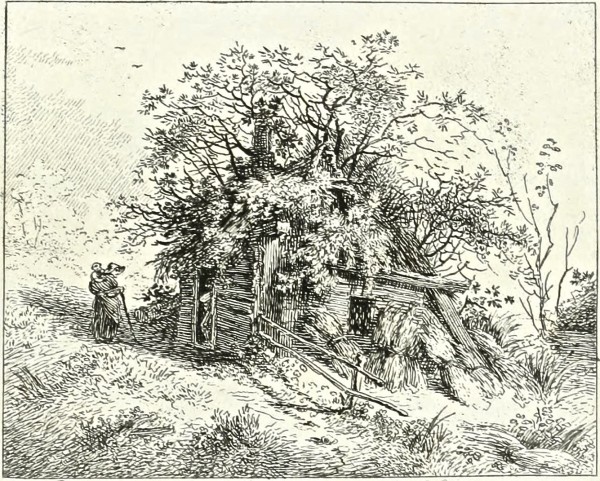
Near Ranelagh, Chelsea

In Green St, Enfield Highway

At Ponder’s End, Near Enfield

On Merrow Common, Surrey

At Cobham, Surrey – in the hop gardens

Near Bull’s Cross, Enfield

In Bury St, Edmonton

On Millbank, Westminster

Near Edmonton Church

Near Chelsea Bridge

In Green St, Enfield Highway

Lady Plomer’s Place on the summit of Hawke’s Bill Wood, Epping Forest

You may also like to take a look at these other works by John Thomas Smith
John Thomas Smith’s Ancient Topography of London
John Thomas Smith’s Antiquities of London
John Thomas Smith’s Vagabondiana
John Thomas Smith’s Vagabondiana II
Colin O’Brien At Chats Palace
There is currently a posthumous exhibition of work by former Contributing Photographer Colin O’Brien at Chats Palace, 42-44 Brooksby’s Walk, E9 6DF. Colin had an affinity with young people and this show focusses on his photography of children in the post-war years. Curator Peter Young introduces the exhibition.

‘I first came across Colin and his photography in December 2006 when he exhibited at the Oxo Tower Gallery. The walls were packed with strong black and white images of working class life in London and beyond, portrayed in a straightforward and dignified humanist style.
Colin was on hand to chat and showed me a portfolio of prints which was where I first saw ‘Lady in a summer dress Chatsworth Rd 1980s.’ Benjamin the chemist plus the landmark clock, and Percy Ingle the baker, were all present and correct in the background. I had walked down that street for twenty years. This was by far the best picture I had seen which summed up the atmosphere of unexpected and quiet beauty that pervaded the urban backwater of Homerton and Clapton at that time.
In 2015, Colin became a patron of Chats Palace and the following year a small exhibition of his work was installed in the recently refurbished Blue Room where it hangs to this day. As with all his work, it shows the people of London in all their multifarious ethnic and cultural, working and non-working forms. Inquisitive, outward looking and confident.’ – Peter Young


Colin’s photograph of his pals, taken in 1948 at the age of eight in Hatton Garden.

Photographs copyright © Estate of Colin O’Brien
Take a look at more pictures by Colin O’Brien
Travellers’ Children in London Fields
Marie Lenclos’ Still Light
Artist Marie Lenclos introduces her new exhibition of paintings Still Light which opens at Townhouse this Saturday 28th September and runs until Sunday 13th October

Blue Door, Fournier St
‘When I first came to London in the nineties as an Erasmus student, Spitafields immediately became a favourite place to explore. For a young Parisian, there was magic in its dense urban fabric. Brick Lane was where you went to find a cheap bike or pick up old crockery. There were surprises at every corner, human stories or colourful stalls, and the tall town houses loomed over you with the weight of their past. I liked the fact I was a foreigner amongst many others.
This was before the creation of the Overground which opened a whole new transport route for me between my home in Denmark Hill and an area of London I still love to get lost in. I walk down Fournier St and the whole place feels like a museum to me, every street corner evokes a scene from another era. The industrial past is ever present and the richness of old brickwork is illuminated by the fleeting sunlight.
These oil paintings are a record of what I notice when I walk these streets. There is noise everywhere, the perpetual movement of passers by, hurried workers carrying coffees, cars starting and stalling, suddenly honking. But to me, there is only calm. When I focus on the scene in front of me, with its play of light and its colourful texture, it is like a mental pause.
My paintings are urban landscapes caught in a moment of calm amongst the chaos. Light is the most important actor, its role is to reveal the permanence and unexpected beauty.’ – Marie Lenclos

Red shutters, Fournier St

Lamp Post, Fournier St

Window, Spitalfields

View from a house on Princelet St

Brick patchwork, Off Columbia Rd

Across Old St, Shoreditch

Telephone Exchange, Shoreditch

Blue Gate, Kingsland Rd

Near Hoxton Station

Hoxton Arches

Posters, Shoreditch

Paintings copyright © Marie Lenclos
You my also like to take a look at
Conservation At St Bartholomew’s Hospital

Cover price is £35 but if you order now you can buy it for £30 and you will receive a signed copy on publication in October.
CLICK HERE TO ORDER A SIGNED COPY OF ENDURANCE & JOY

William Palin, who is responsible for supervising the conservation of the historic James Gibbs buildings at St Bartholomew’s Hospital in Smithfield, invited me over to take a look.
An intricate web of scaffolding has been woven through the these mighty structures to enable access to the ceiling for the restoration of the Great Hall and the cleaning of William Hogarth’s murals on the staircase, so I put on a hard hat and climbed up to take a closer look.
Afterwards, Will outlined the nature of his undertaking to me.
‘We’re sitting in James Gibbs’ North Wing that dates from the 1730s. It’s a fantastic building of incredibly significant architecture with two spectacular interiors, the Great Hall and the Hogarth Stair. It has not been well looked after for the past thirty years, so we have a lot of problems.
Bart’s Heritage has taken lease of the building from the hospital and raised the money to do the first phase of conservation of the envelope of the structure, with around half coming from the Heritage Lottery Fund.
This consists of repairing the stonework, the brickwork, one hundred and sixty windows, stripping the roof slates back and laying new lead. For the interiors, it is a loving conservation project using the best experts and craftsmen from around the country, with training and apprenticeships built in at every level. They will be cleaning, repairing and redecorating the surfaces, and we will be reopening in September next year hopefully.
The Great Hall will then be splendid and open regularly to the public for the first time in its history. Until the end of January, you can join a Conservation Tour to go up onto the deck and watch the restoration of the ceiling and the Hogarth Stair in progress, meet the conservators and get a feel of what the project is all about.’
Click here if you would like to take a tour and learn more

‘Bird’s nest’ scaffolding supported by external trusses fills the Great Hall


Steps up to the roof

The letters B and H are interwoven on the ceiling as the insignia of the hospital

The temporary deck installed for the restoration of the ceiling

The plan of the ceiling design

Early ground and base coats revealed

Wooden panels honour donors in the eighteenth century


Paint samples for the repainting of the ceiling

A crack caused by water ingress


A cartouche with a grotesque face high up on the wall

The good Samaritan and his charge as portrayed by Hogarth and viewed through scaffolding

Jesus at Bethesda viewed through scaffolding

A wealthy woman seeking healing viewed through scaffolding

Poor women seeking healing viewed through scaffolding

The grand chandelier from the staircase has been removed for restoration
You may also like to read about
Purim In Stamford Hill
Photographer Neil Martinson introduces his pictures of the Purim festival celebrated by an orthodox Jewish community in Hackney

‘It’s the most surprising festival in London, in which the largest orthodox Jewish community in Europe discard their traditional black clothing and break into a dazzle of colour and costumes for the festival of Purim.
Hackney has always been a place of incredible diversity and energy. The orthodox Jewish community in Stamford Hill has long been an integral part of the borough, and I wanted to share their story, particularly around Purim, which is such an expressive and joyful festival. I first took photos of Purim in 1981 when it was a modest event held in peoples homes.
The Charedi community was established in Hackney in the 1920s, growing significantly after the Second World War as survivors of the Holocaust and refugees fled the devastation of Europe. Now numbering at least 30,000, there are seventy-five synagogues within walking distance of their homes. As the community has grown so has the festival. This is a celebration of their strength, their joy, and their traditions.’ – Neil Martinson




Photographs copyright © Neil Martinson
You may also like to take a look at

Click here to buy a copy of Neil Martinson’s 28 page book of photos for £11


