Jonathon Green, Lexicographer

Jonathon Green knows more dirty words than anyone else in the English speaking world, including twelve hundred for penis and a thousand for vagina, and yet, much to my disappointment, I found he is capable of engaging in civilised conversation without recourse to any unpleasant, vulgar or colourful vocabulary.
If you sat next to him at dinner you would count yourself lucky to enjoy such amusing and well-educated company. You would not guess that he is the top lexicographer of slang, the foremost scholar of filth, author of the definitive Green’s Dictionary of Slang, published by Chambers in three fat volumes last year – as the product of more than twenty years tireless application to the frayed margins of the English language, earning him the title Mr Slang.
“It’s my life’s work,” he confessed to me with a reckless smile of delight, “it has occupied my very being from the tips of my toes to the top of my head. I am the latest in a long line of slang lexicographers that is quite tangible and continuous stretching back to Robert Copeland in 1538. One day I realised, ‘You are doing the right thing for you,’ because I enjoy teasing out etymologies. I am fascinated by the margins, and I’m sure it’s linked to being a Jew and being an only child. Marginal language is more interesting to me, I wouldn’t want to be a mainstream lexicographer. I think, every book that I have written, it has always been about, ‘What can we learn from this?'”
“The primary difference between my work and that of earlier lexicographers is that they had to go looking, whereas, in the modern world, I don’t know where to stop!” continued Jonathon, exhilarated at the potential of the universe to offer up material for his pleasure. “Slang is thematic and there are certain themes,” he added with a conscientious orderliness,” – crime, drink, drugs, parts of the body and what we do with them, being unpleasant to other people, being nice about yourself, racism and having a good time. There’s also bodily fluids, shitting, pissing, fucking and farting. And on top of that there’s words for stupid, fools, prostitutes and the whole world of commercial sex.”
Judging from the nature of his curosity you might assume that Jonathon inhabits a hovel in the gutter, but in fact he lives with his wife in an airy modern rooftop apartment in Clerkenwell, less than a mile East of Dr Johnson’s house where this whole dictionary business began. “I feel a true relationship with my predecessors.” he confided to me, “I can relate to Samuel Johnson, but the one I most identify with is John Camden Hotten author of ‘The Dictionary of Modern Slang, Cant & Vulgar Words’ 1859, because he wrote pornography and since I also used to write for top shelf titles, I always recognise a certain kinship with him.”
Before I could enquire further about the pornography, Jonathon launched into a history of slang, explaining how Robert Copeland once asked the porter outside St Bartholomew’s Hospital in Smithfield what the poor people were saying and received the reply, “They have their own language.” From this chance conversation over five centuries ago, just a quarter of a mile South from Jonathon’s flat, came the first book of cant, entitled “The Highway to the Spital House,” thereby initiating the field of scholarship Jonathon ploughs today. “Because slang is marginal only criminal stuff was written down at first since there was no other reason to record it,” he explained, before reeling off the names of those who have gone before him, from Eric Partridge to John S. Farmer to C.G. Leyland to John Camden Hotten to Francis Grose, reaching the early nineteenth century when the term slang appeared in our language. Then, enthusiastically pulling treasured copies off his shelves to show me,“Slang Dictionaries have always been independent,” he declared with a sparkle in his eye, “I am an independent, but there aren’t people like me any more – institutions and publishers make dictionaries now.”
After editing dictionaries of quotations in the early eighties, Jonathon wrote his first dictionary of contemporary slang in 1984 – just eleven and a half thousand entries, compared to twelve thousand in his current work for the letter “S” alone. In 1993, he was asked to write a broader dictionary of slang that was published in 1998, which in turn led to the commission for the current work comprising 110,000 entries, that, including the work of assistants, has taken an estimated fifty years of human labour to complete. Jonathon’s good humoured yet pale faced wife Susan Ford, who refers to herself succintly as “the slave,” visited the British Library five or six days a week for ten years to pursue research for the dictionary and, when Jonathon’s advance ran out only the unexpected legacy from an obscure uncle enabled him to continue, until the day the publishers hauled the mighty beast into publication.
Unsurprisingly, Jonathon admits to feeling depressed since his dictionary was completed, recognising that the changing world of publishing means there will never be a second edition and, more than this, there is unlikely ever to be another printed dictionary of slang. With some poignancy, Jonathon understands that his work is the last dictionary of slang – the end of the sequence of books that began with Copeland in 1538 – because the future lies in electronic databases. A realisation which has permitted Jonathon to ameliorate his sadness by continuing with the work of expanding his personal files in preparation for the day his beautiful dictionary of filth can become a continuously updated online resource.
“There have been moments of drudgery,” revealed Jonathon, almost reluctantly, “but you when you publish the book you become a little tin god – an expert.” With laconic irony, Jonathon encapsulated the apotheosis of the lexicographer, from drudge into deity and then, at this natural conclusion, he returned to his desk while I continued my conversation with Susan. But I could not help noticing that Jonathon appeared to be having a few problems with his computer, judging from the string of expletives worthy of the pages of his dictionary that emanated from his direction. And I was glad, because what is the use of knowing all these bloody words if you cannot savour their rich poetry upon your own tongue?
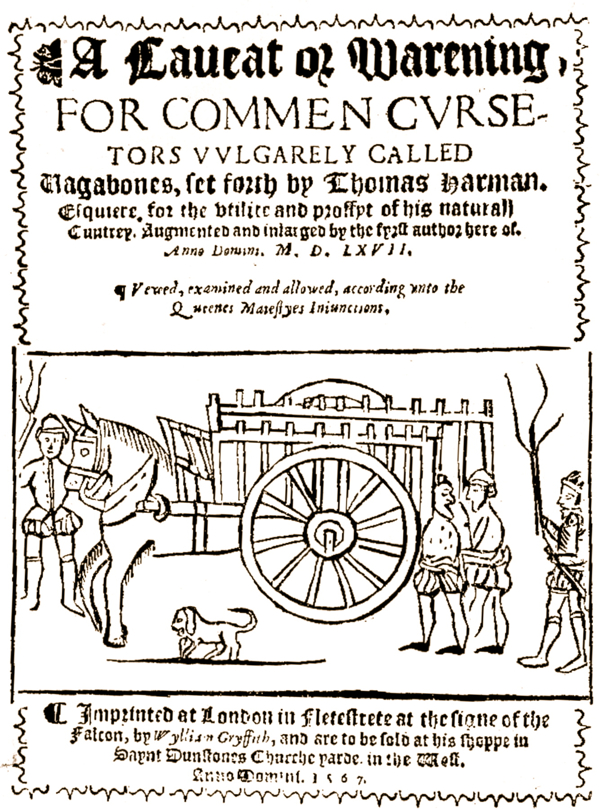 The Caveat for Common Cursetopurs by Thomas Harman, 1567

The New Dictionary of the Canting Crew by B.E. Gent, c.1698
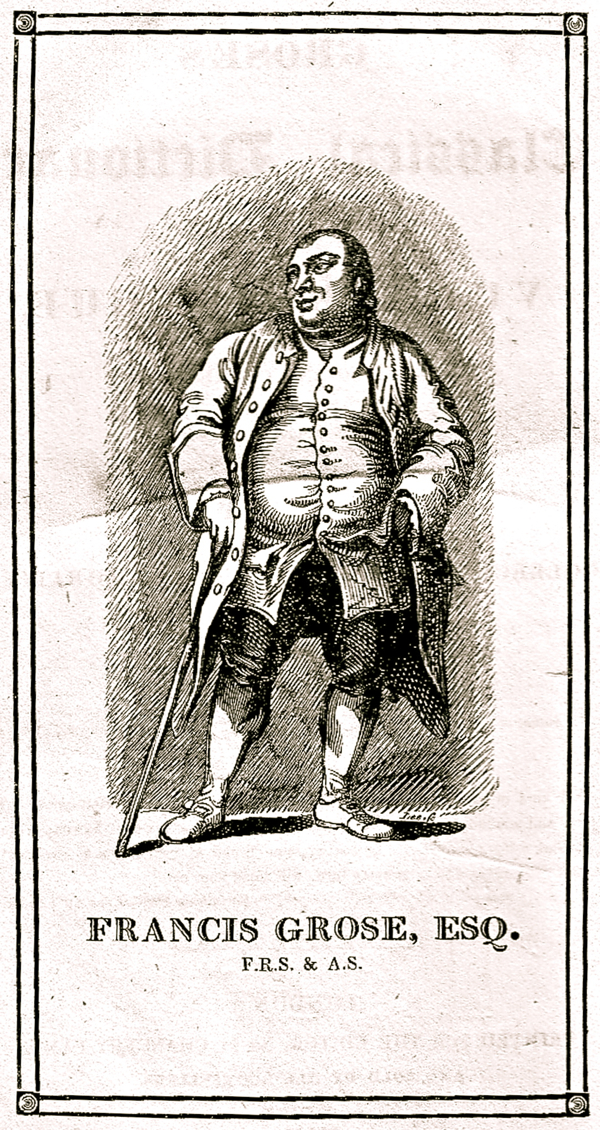
Francis Grose author of “The Classical Dictionary of the Vulgar Tongue,” 1785.
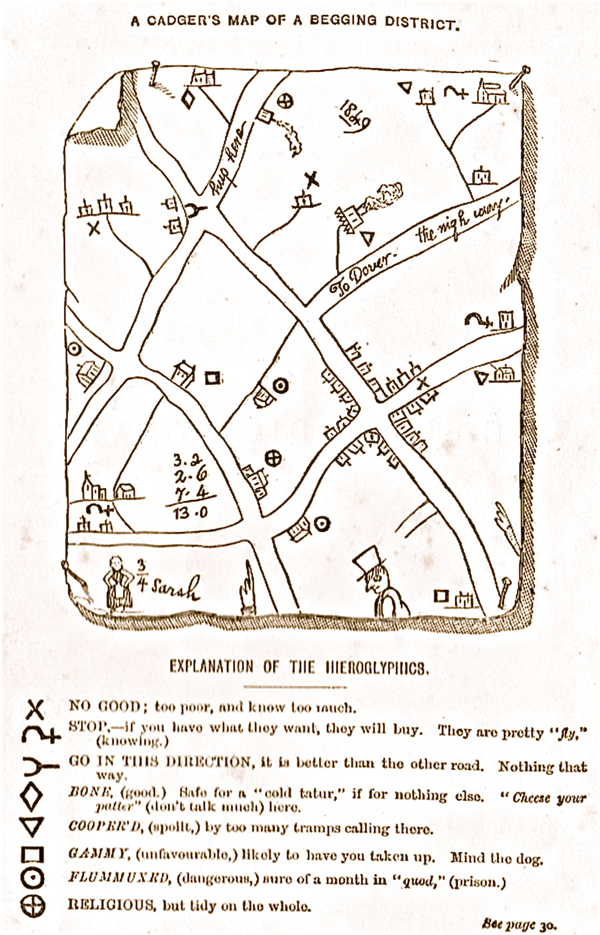
A Cadger’s map from The Vulgar Tongue by Ducange Anglicus, 1857

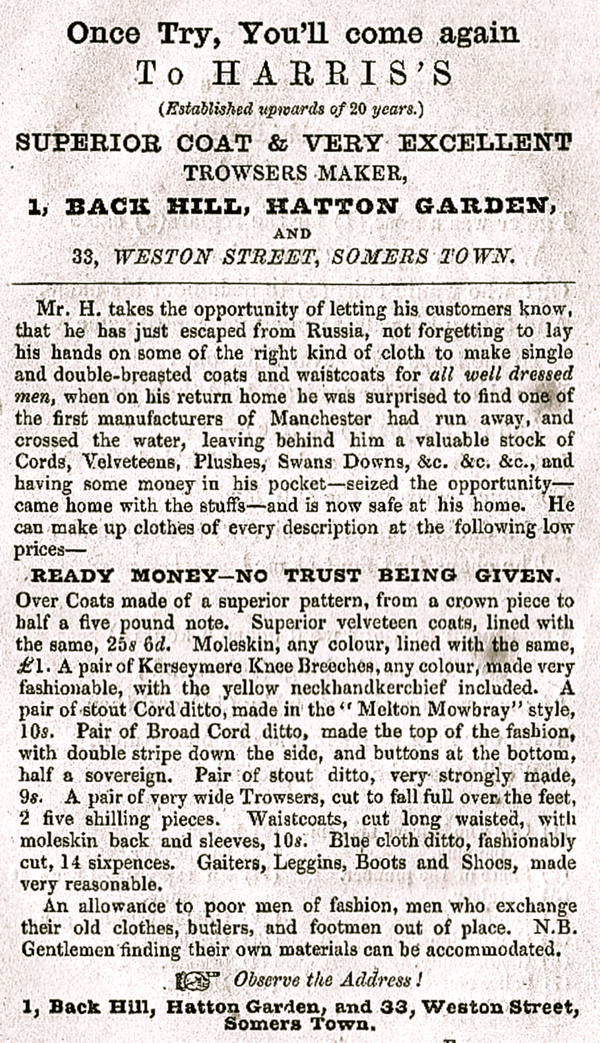
Advertisement in Cockney with text in standard English below from The Vulgar Tongue by Ducange Anglicus, 1857
At God’s Convenience
“Slovenliness is no part of Religion. Cleanliness is indeed close to Godliness” – John Wesley, 1791
Oftentimes, walking between Spitalfields and Covent Garden, I pass through Bunhill Fields where – in passing – I can pay my respects to William Blake, Daniel Defoe and John Bunyan who are buried there, and sometimes I also stop off at John Wesley’s Chapel’s in the City Rd to pay a visit to the underground shrine of Thomas Crapper – the champion of the flushing toilet and inventor of the ballcock.
It seems wholly appropriate that here, at the mother church of the Methodist movement, is preserved one of London’s finest historic toilets, still in a perfect working order today. Although installed in 1899, over a century after John Wesley’s death, I like to think that if he returned today Wesley would be proud to see such immaculate facilities provided to worshippers at his chapel – thereby catering to their mortal as well as their spiritual needs. The irony is that even those, such as myself, who come here primarily to fulfil a physical function cannot fail to be touched by the stillness of this peaceful refuge from the clamour of the City Rd.
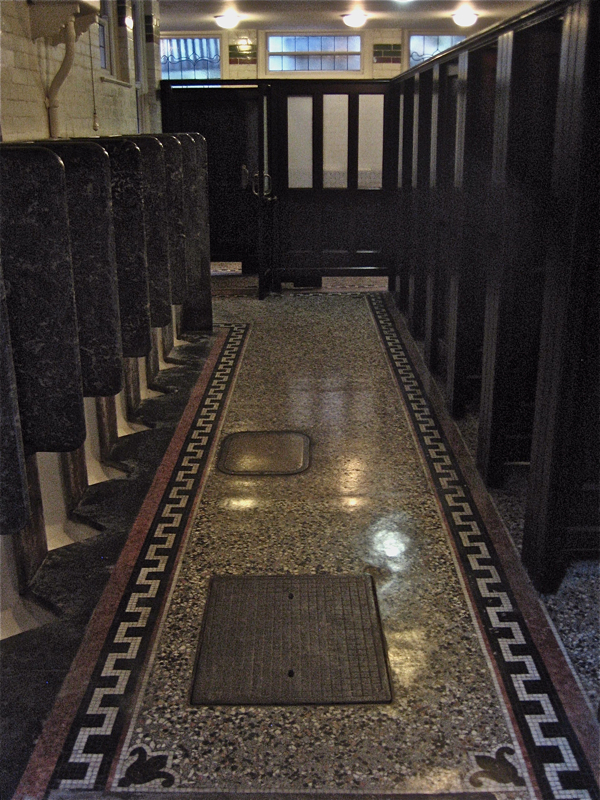
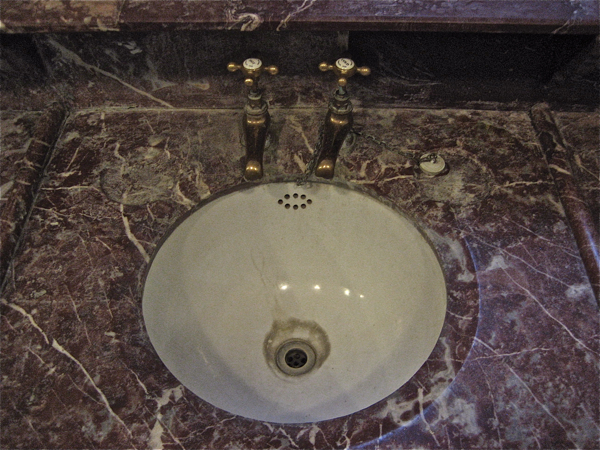
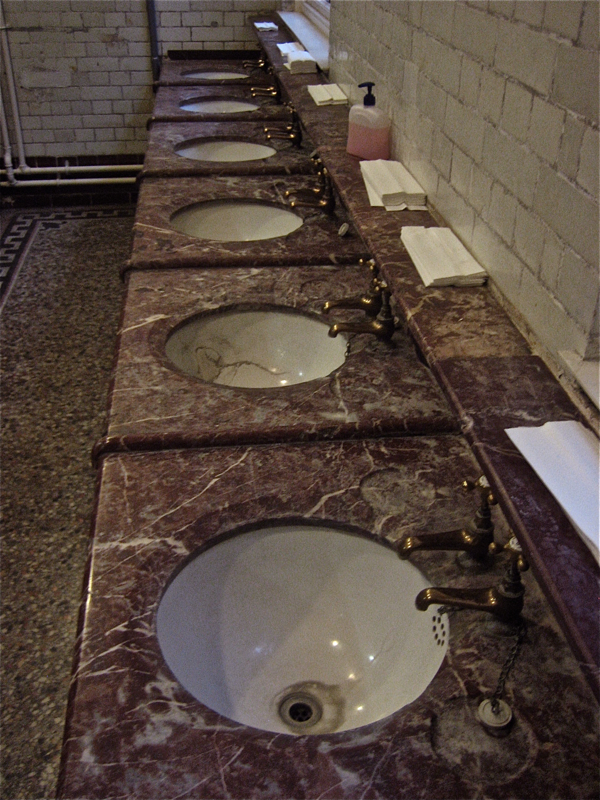
There is a sepulchral light that glimmers as you descend beneath the chapel to enter the gleaming sanctum where, on the right hand side of the aisle, eight cedar cubicles present themselves, facing eight urinals to the left, with eight marble washbasins behind a screen at the far end. A harmonious arrangement that reminds us of the Christian symbolism of the number eight as the number of redemption – represented by baptism – which is why baptismal fonts are octagonal. Appropriately, eight was also the number of humans rescued from the deluge upon Noah’s Ark.
Never have I seen a more beautifully kept toilet than this, every wooden surface has been waxed, the marble and mosaics shine, and each cubicle has a generous supply of rolls of soft white paper. It is both a flawless illustration of the rigours of the Methodist temperament and an image of what a toilet might be like in heaven. The devout atmosphere of George Dance’s chapel built for John Wesley in 1778, and improved in 1891 for the centenary of Wesley’s death – when the original pillars made of ships’ masts were replaced with marble from each country in the world where Methodists preached the gospel – pervades, encouraging solemn thoughts, even down here in the toilet. And the extravagant display of exotic marble, some of it bearing an uncanny resemblance to dog meat, complements the marble pillars in the chapel above.
Sitting in a cubicle, you may contemplate your mortality and, when the moment comes, a text on the ceramic pull invites you to “Pull & Let Go.” It is a parable in itself – you put your trust in the Lord and your sins are flushed away in a tumultuous rush of water that recalls Moses parting the Red Sea. Then you may wash your hands in the marble basin and ascend to the chapel to join the congregation of the worthy.
Yet before you leave and enter Methodist paradise, a moment of silent remembrance for the genius of Thomas Crapper is appropriate. Contrary to schoolboy myth, he did not give his name to the colloquial term for bowel movements, which, as any etymologist will tell you, is at least of Anglo-Saxon origin. Should you lift the toilet seat, you will discover “The Venerable” is revealed upon the rim, as the particular model of the chinaware, and it is an epithet that we may also apply to Thomas Crapper. Although born to humble origins in 1836 as the son of a sailor, Crapper rose to greatness as the evangelist of the flushing toilet, earning the first royal warrant for sanitary-ware from Prince Edward in the eighteen eighties and creating a business empire that lasted until 1963.
Should your attention be entirely absorbed by this matchless parade of eight Crapper’s Valveless Waste Preventers, do not neglect to admire the sparkling procession of urinals opposite by George Jennings (1810-1882) – celebrated as the inventor of the public toilet. 827,280 visitors paid a penny for the novelty of using his Monkey Closets in the retiring rooms at the Great Exhibition of 1851, giving rise to the popular euphemism, “spend a penny,” still in use today in overly polite circles.
Once composure and physical comfort are restored, you may wish to visit the chapel to say a prayer of thanks or, as I like to do, visit John Wesley’s house seeking inspiration in the life of the great preacher. Wesley preached a doctrine of love to those who might not enter a church, and campaigned for prison reform and the abolition of slavery, giving more than forty thousand sermons in his lifetime, often several a day and many in the open air – travelling between them on horseback. In his modest house, where he once ate at the same table as his servants, you can see the tiny travelling lamp that he carried with him to avoid falling off his horse (as he did frequently), his nightcap, his shoes, his spectacles, his robe believed to have been made out of a pair of old curtains, the teapot that Josiah Wedgwood designed for him, and the exercising chair that replicated the motion of horse-riding, enabling Wesley to keep his thigh muscles taut when not on the road.
A visit to the memorial garden at the rear of the chapel to examine Wesley’s tomb will reveal that familiar term from the toilet bowl “The Venerable” graven in stone in 1791 to describe John Wesley himself, which prompts the question whether this was where Thomas Crapper got the idea for the name of his contraption, honouring John Wesley in sanitary-ware.
Let us thank the Lord if we are ever caught short on the City Rd because, due to the good works of the venerable Thomas Crapper and the venerable John Wesley, relief and consolation for both body and soul are readily to hand at God’s convenience.
Watch Thomas Crapper’s works in action in this short film by clicking here.
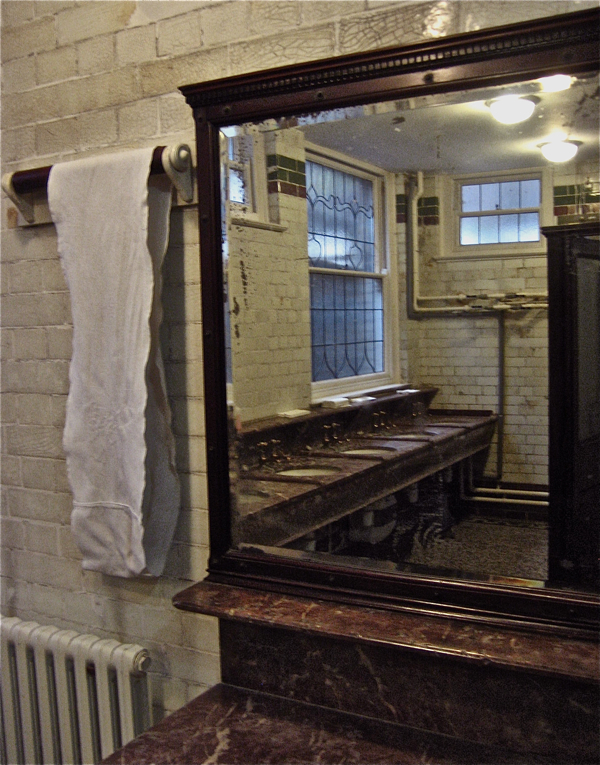

Nineteenth century fixtures by Thomas Crapper, still in perfect working order.
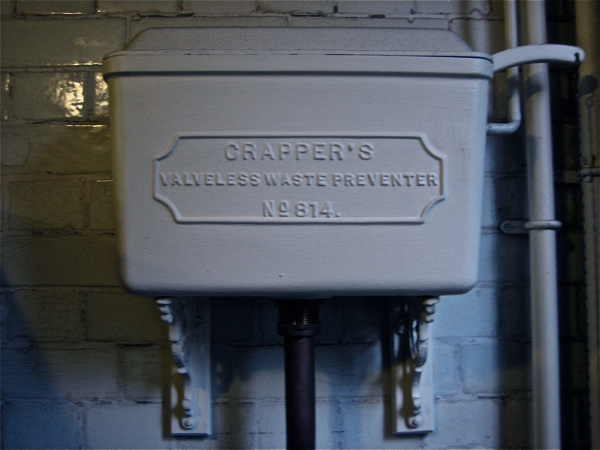

“The Venerable”
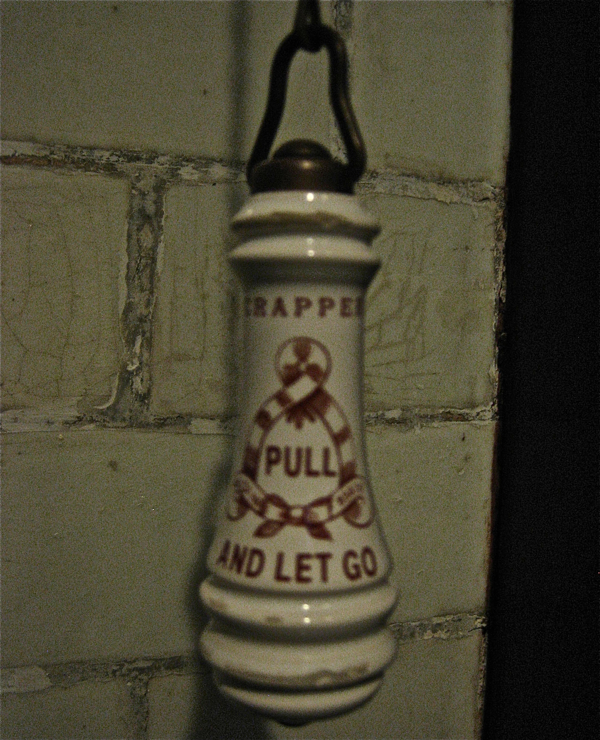
Put your trust in the Lord.
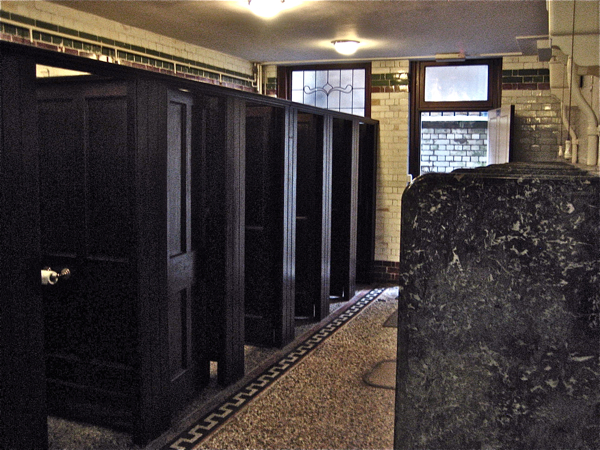
Cubicles for private worship.
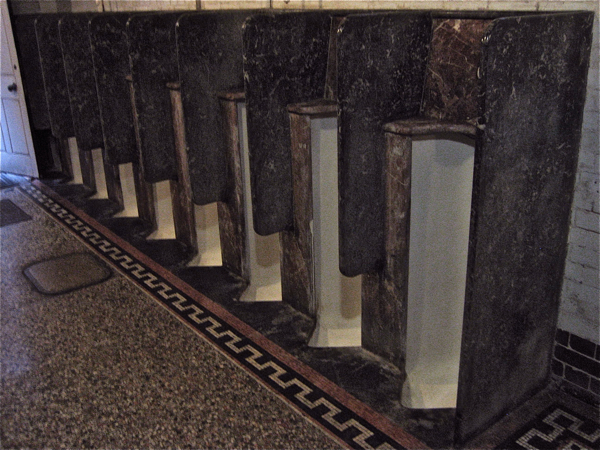
Stalls for individual prayer.
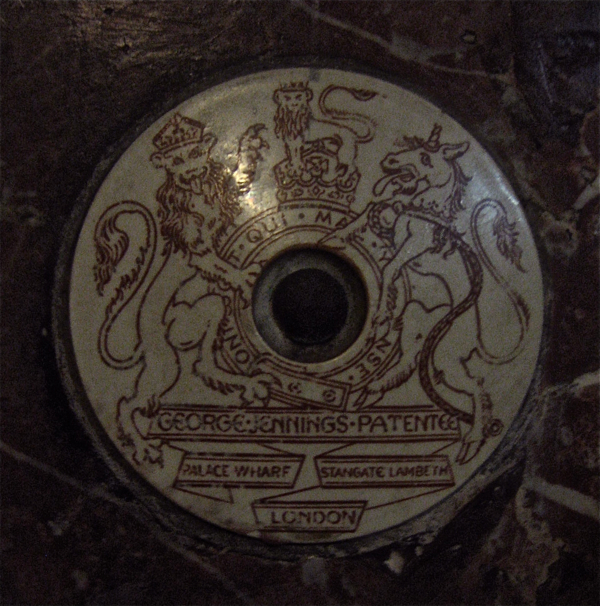
In memoriam, George Jennings, inventor of the public toilet.
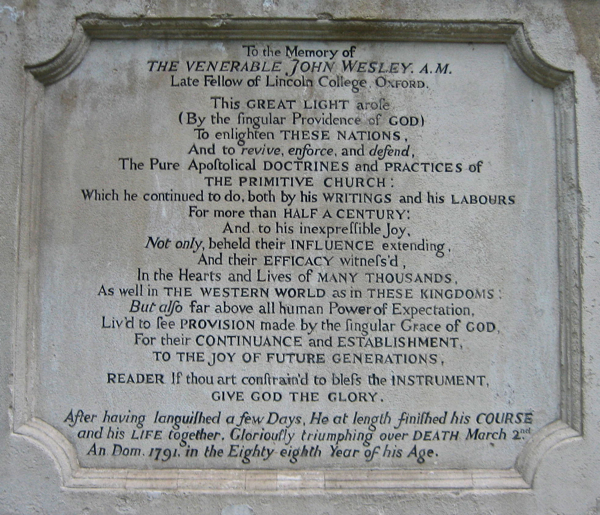
Upon John Wesley’s Tomb.

John Wesley’s Chapel

John Wesley’s exercise chair to simulate the motion of horseriding,
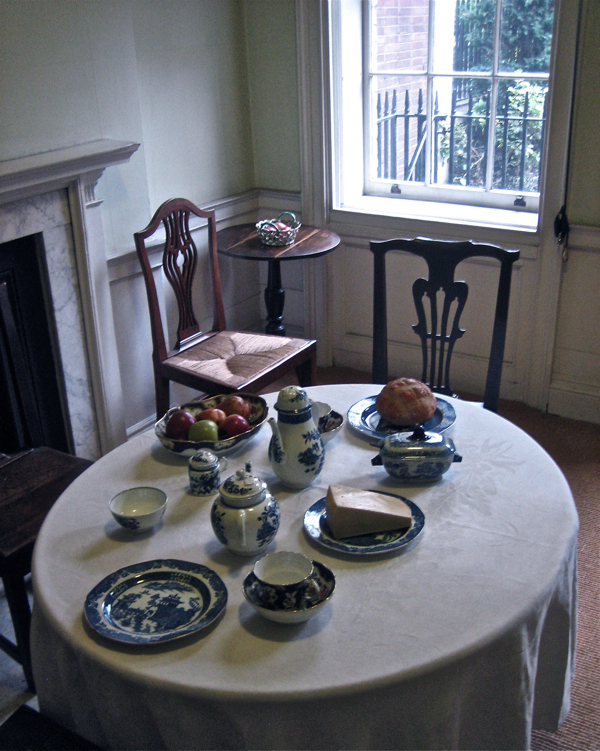
John Wesley excused himself unexpectedly from the table …

New wallpaper in John Wesley’s parlour from an eighteenth century design at Kew Palace.
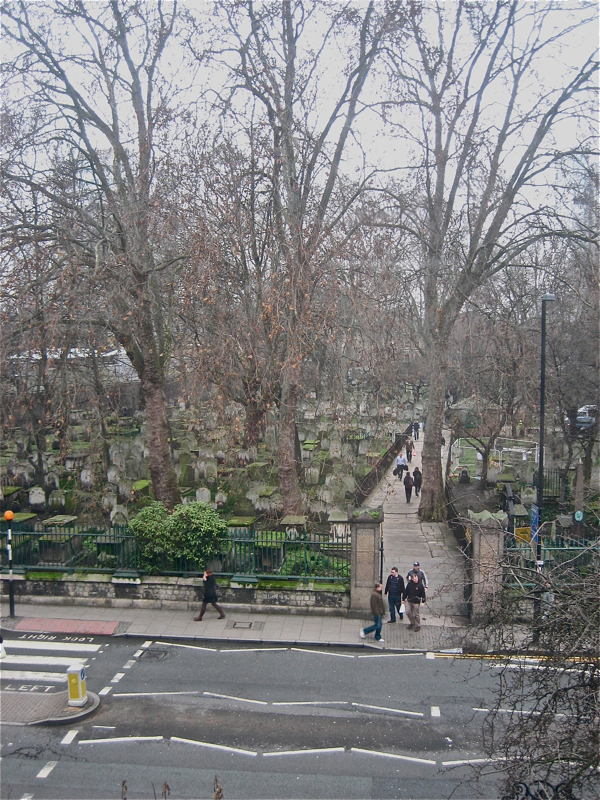
The view from John Wesley’s window across to Bunhill Fields where, when there were no leaves upon the trees, he could see the white tombstone marking his mother’s grave.
Learn about John Wesley’s chapel at www.wesleyschapel.org.uk
Crapper sanitary-ware is still available from www.thomas-crapper.com
You may also like to read about Agnese Sanvito, Toilets at Dawn
A Renovation in Fournier St

This is the eighteenth century house in Fournier St that Jane Cumberbatch and her husband Alastair renovated in the nineteen eighties. Today its serene appearance belies the ambitious restoration that was undertaken to bring it back from the verge of collapse a quarter of a century ago.
“Neither of us really realised what we were taking on,” admitted Jane with a winsome smile to find herself standing outside the house she bought in 1985, more than ten years since she left it, “We didn’t realise how beautiful it was because all the panelling was hidden behind layers of hardboard – but we knew we had to do major work because there was a bow in the back wall and a dodgy roof in danger of collapse. Though we were so lucky to find some wonderful people, Richard Naylor was the architect who drew up the plans, Jimmy Brunton was the builder, Bodhan Antoniuw was the carpenter, Robert Davies carved the corbels and Jim Howett made the shutters and our bed, which we still sleep in today.”
Yet before she could achieve her dream, Jane had to suffer the nightmare of the back wall collapsing in the midst of the two year programme of work required before she could move in. “At one point you could look through the floor from the attic to the basement.” she recalled with a sentimental grin, “We had to take it back to the skeleton, but we tried to keep as much as we could and we used recycled boards where we couldn’t. One of the problems is how far do you go, we tried to make the house work for now but you have to retain its integrity. Dan Cruickshank was always around as a sounding board and everyone involved was very passionate.”
When Jane came to live in Spitalfields, the Fruit & Vegetable Market was still in operation and it was a more utilitarian place. “At first people would say, ‘Where is Spitalfields? Is it safe?” Jane informed me, wincing with retrospective irony, before giving in to her affectionate reminiscences, “I remember Nelly, the longest established resident of Fournier St at ninety years old, she had been born there. And Michael and David Gillingham opposite, who had the perfect Georgian house, with a poltergeist that had to be exorcised. And John, who once had a good job, but would stand and rant outside the church gates, yet stop to pat the children on their heads nicely. And there were hawks nesting on the church tower that ate the rats. And one night somebody dumped five hundred tins of used cooking oil outside our front door. And one night somebody set fire to a skip in the street. And there were bombs in the City and Brick Lane, and our windows shook. There was always something going on! And there were so many down and outs, I wonder what happened to them?”
Among Jane’s fond memories of Spitalfields, one night stands out above all others, 16th October 1987. “The night of the hurricane was very scary,” she announced, rolling her dark eyes, “We were woken by this howling wind and the lights went out in the City. All the trees came down in the churchyard and there was this huge gap because the planes opposite were not there any more. I couldn’t get to work next morning, so I went out into the churchyard and took pictures.”
“I don’t think I’ve ever got over leaving Spitalfields because it was magic, but we have all these tangible memories.” said Jane tenderly, thinking out loud and reconciling herself to her experiences, as we looked through her old photographs together, “I used to feel the houses were so old and an awful lot of misery had happened in them. It would have been a rooming house – so many people came through. And we were just another wave of immigrants, amongst all the waves and waves of of different people. Yet all the friends we made here, we still keep in touch, because there were lots of children then and they all used to play in each other’s houses.”
Over the passage of time, Jane Cumberbatch has come to recognise that no-one ever truly owns these old houses, the inhabitants are mere custodians. These photographs (selected from nearly three hundred that she took of the house she eventually left in 1997) record the transformation that she is proud to have supervised, as her personal contribution to the ongoing stewardship of these soulful edifices which have seen so much life over the centuries.

This is the house when Jane first saw in 1985 as U-Tex of London Ltd, Trouser Manufacturer.

The view from the weaver’s loft towards the market.

The derelict loft.
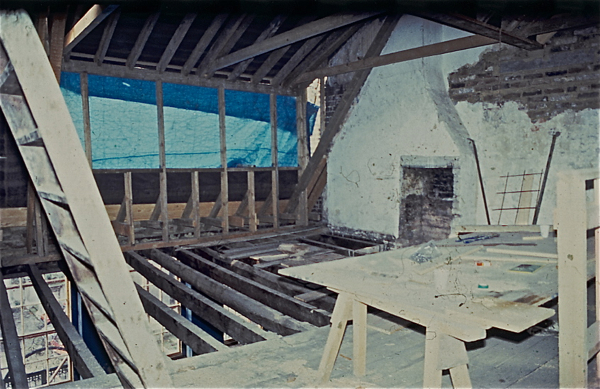
During the replacement of the roof and the floor.

After renovation.
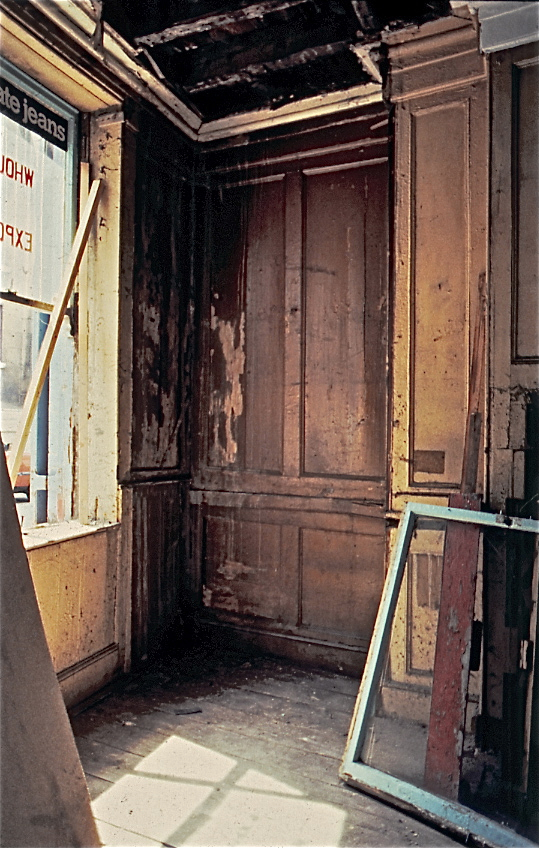
Eighteenth century panelling uncovered on the ground floor.
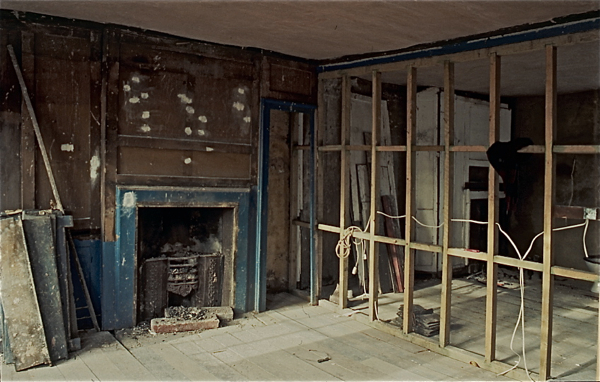
Restoring the original position of a partition wall.

The dining room.

The facade with the signage removed.

The facade with new windows and shutters replicating those of the seventeen twenties.

The bedroom.


The banana merchant at number one Fournier St.

The rear elevation with the bowed back wall.

The absence of back wall after its collapse.

The reconstructed back wall using recycled bricks.

Jane contemplates the dereliction she bought into.


The living room.

Jim Howett, still renovating houses in Fournier St today, fits the new windows.

October 1987, the night of the hurricane in Spitalfields.

Plane trees in the churchyard brought down by the hurricane .
Photographs of renovations copyright © Jane Cumberbatch
Photographs of interiors after renovation copyright © Henry Bourne
Jane Cumberbatch’s book “Pure Style” is published by RPS and you can follow her work through her blog www.purestyleonline.com
You may also like to read my other Fournier St stories
The Wallpapers of Spitalfields
Hugo Glendinning, Photographer
Andy Rider, Rector of Christ Church Spitalfields
The World of the East End Car Wash

Mohaimenul Islam, Car Washer
Car washes come and go in the East End, opening up in vacant railway arches or disused petrol stations, enjoying a brief flowering and then vanishing as unexpectedly as they appeared. When Spitalfields Life contributing photographer Sarah Ainslie and I drove around in her (unwashed) car last week, we found several favourites had gone whilst others had sprung up overnight. Yet within the mutable world of the car washes, business goes on relentlessly, because as quickly as vehicles are cleaned, the traffic and the weather and the mud restore the necessity for it to be done all over again. Teams of men work ceaselessly in shifts, twenty-four hours a day, at a job that requires astounding stamina and patience.
Let me admit, it gives me the shivers just to imagine the lot of a car washer, working outside through the damp and cold of a London Winter, so I was humbled by the goodwill that I encountered from these men, demonstrating resilience and tenacity in circumstances that few would envy. Arriving at T2 Car Wash under the railway arches at the Western extremity of Cable St, beneath the main line coming out of Fenchurch St Station, the car washers welcomed me into their cosy cubby hole off the main working area, a den where they enjoyed a bowl of porridge and watched satellite TV, toasting their toes by the heater during a rare break from the everlasting parade of taxis which pass through here night and day.
Yet once a vehicle pulled up, they were all over it with a preternatural dexterity and speed. Working in concert, they were spraying shampoo, mopping it with sponges – one in each hand – then rinsing it down and polishing it up with chamois leathers – again one in each hand – until the customer received his charge back, gleaming and spotless. And then the car washers moved on to the next in line with undiminished enthusiasm. While one team attended to the exterior, others were hoovering and cleaning out the interior, and everyone worked round each other – like some elaborate dance in which the moves kept shifting as everyone accommodated to everyone else in the constant imperative to keep things moving. These men are expert at what they do and show grace, in demonstrating the warmth of mutual respect, and excelling in an endeavour which to others might be of little consequence.
All this spectacle takes place within a whitewashed arch lit by fluorescents, open to daylight at either end, where, in a glacial mist, every surface glistens with damp and the floor is awash with water and soap suds draining away through culverts. For the most part these men do not wear gloves, even working with wet sponges and wringing them out in cold water, but when I asked “Don’t you get cold?” – the answer was automatic – “We don’t feel the cold when we’re working, and when we’re not working we’re in by the heater.”
In each car wash, I sought human details – the Christmas baubles, or the plastic birds, or the bunting, or the odd chairs scattered around, or the newspaper cuttings stuck to the wall, indicating that the employees had taken possession of their space. Be aware, the car wash is an arena we entered as guests, because the car washers are rulers of their soapy domain and customers must understand the decorum and necessity which requires a retreat to the waiting room, or to use the facilities, or to stand outside, at a respectful distance from the centre of activity.
Alone in the den at the T2 Car Wash, a room excavated into the thickness of the old brick vault, where I was privileged to hover and warm myself, I realised that I had found the inner sanctum in which the car washers came to regroup, sitting upon the worn couch and old office chairs, wiling away the long dark nights and bolstering each other’s resolve to make it through another Winter. In the face of this arduous repetitive work, a group of Ghanaians and Romanians have banded together to make the best of it under an arch in Cable St.
You might say that washing cars is a pointless activity since the vehicles get dirty again at once, yet, as with many human occupations, the nobility lies not in the nature of the task or even in the reward, but in the manner of its execution. And there on the wall in the den, I saw the medal for car washing, awarded to the team for the ever-growing number of customers each month, objective evidence – if it were ever necessary – of the otherwise unacknowledged heroism of the proud car washers of the East End.



George


The den.

Rosoi Lucian

Working without gloves in February.

Kofi shows off the customer facilities.

Car washers never cease work, twenty-four hours a day.

Albani Cletesteanu
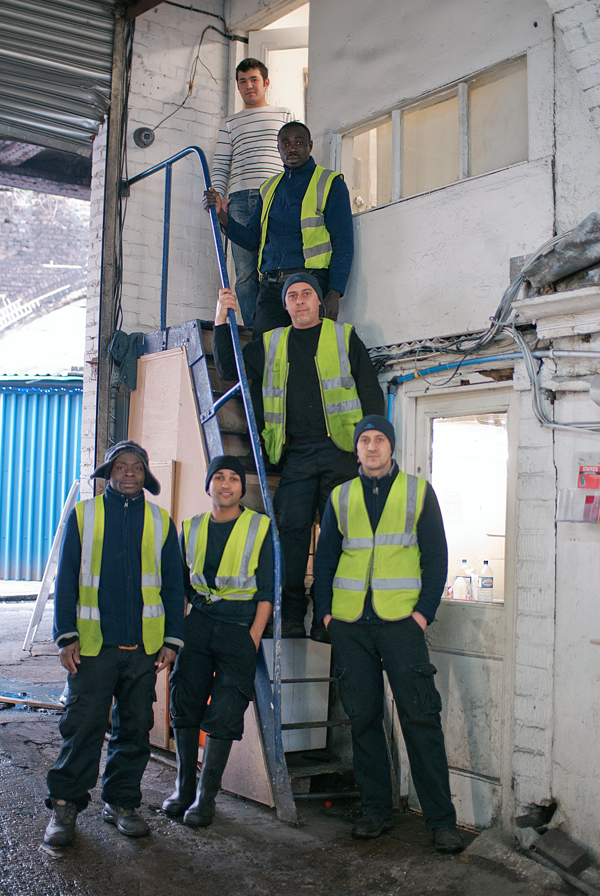
The champion car washers of Cable St.

Wet boots and socks.


Photographs copyright © Sarah Ainslie
Brick Lane Market 1
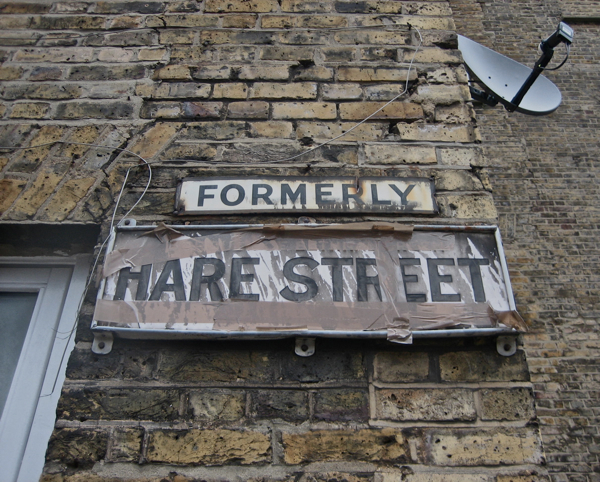
As the first of these Brick Lane posts, it is my pleasure to introduce you to Dennis and Arthur, two stalwarts who incarnate the spirit of the market. You will find them occupying Hare Marsh each Sunday – the cul-de-sac down towards the railway line at the end of Cheshire St, formerly Hare St.

Wiry and agile and full of vitality, Dennis Major has been dealing in toiletries, cut-price chocolate and general hardware in the market for more than thirty-five years. “When I first started, I was down the other end of Cheshire St.” he explained to me casting his beady eyes around at the fabled market that once was here,“They used to sell dogs and cats then, and sometimes I took sickly kittens home that were abandoned in the gutter but they always died. There was a stall that who sold chickens, they would wring their necks and pluck them for you before your eyes. We were next to the bird man, he would go crazy because everybody would be all over the bird cages, and the birds would make such a racket. We did have some laughs.”
For many years Dennis ran a hardware shop in Norbury but, even retired now, he cannot break the habit of Sunday in Brick Lane because the same customers keep coming back to greet him after all these years. While we were talking, Arthur Whitmore, a senior market gardener from Cambridgeshire with hardy features and straggly white hair, who has been travelling down on the bus each Sunday for more than fifteen years in search of “something fresh to see,” popped by to have his weekly chat with Dennis. “There’s no end of villages where I come from,” he informed me, hinting at the workaday nature of his rural life.
When Arthur departed, in a brief lull, Dennis pointed across Cheshire St and confided to me quietly , “One Sunday, I came down when Ginger Marks was killed outside the Carpenter’s Arms. The was a bullet hole in the wall and they’d roped it off where he’d been shot but they never found the body. If you lost a bike in South London you could always find it here next Sunday. This was a good market. People off the boats in the docks would come here and you could sell them all sorts of things. There was a fellow who sold train sets. Most of them have died, there’s not so many like me down here any more.”
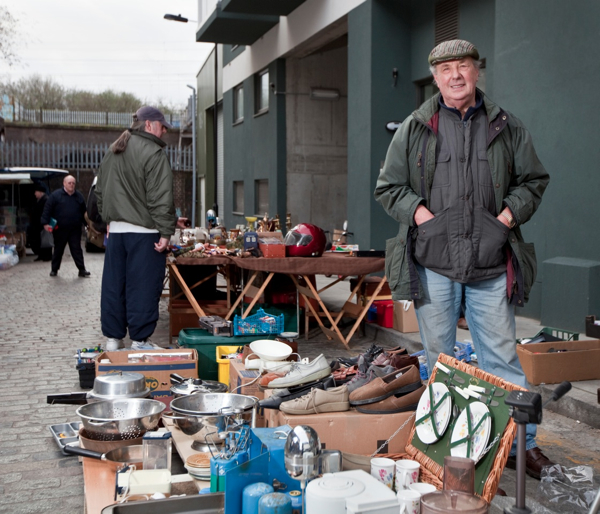
“I’ve been coming here since I first visited with my father to buy canaries for our shop in Woking, that was sixty-two years ago,” revealed Arthur with the relaxed genial air of one entirely at home in the market, for whom doing deals and taking money off a string of customers is second nature. “I’ve always been at this end of the street, since I started as a very young lad fly-pitching with a pram full of bits and pieces.” he recalled enthusiastically, “And I have been on this spot as a licenced trader for at least twenty-five years. I took over from Frank Fisher who’d been here many moons before me, he was a Smithfield meat porter. This little area was packed then, it was a job to get a pitch – they used to fight over them. Ever since I could drive, it’s been a weekly ritual coming into London on Sunday.”
Such is Arthur’s trustworthy reputation that local people will confidently buy used electrical gadgets from him, “I always offer a refund on anything electrical,” he assured me as an African lady delightedly carried off a food processor in her bag for twenty pounds, “I remember what I buy and sell and I know the price of everything. Sometimes I keep things in the interests of future prosperity, and I’ve got a nice rug as a future heirloom. Once I bought a lion with with its foot on the globe for fourteen shillings, then sold it for fifty shillings to a lady named Sylvia. It turned out to be early eighteenth century Capo de Monte and went for £2000 at auction – but when she died ten years ago, she left me £1000 in her will.”
Arthur buys at house clearances and jumble sales, hoping to clear a quarter of the stock that he keeps in his van and top it up again each week. “My father bred canaries and showed them at Crystal Palace. He used to buy the birds up here in the market because he had the experience to know what he was buying. I remember the first thing I ever sold, a BSA bantam motorcycle in Club Row when I was seventeen, and I still can’t keep away from it today.” Arthur confessed to me with an amiable modest grin, hooked by the endless cycle of market life – appreciating it as a place of commerce, and equally as an important location of social life and collective memory.
Market trader portraits copyright © Jeremy Freedman
More John Player’s Cries of London
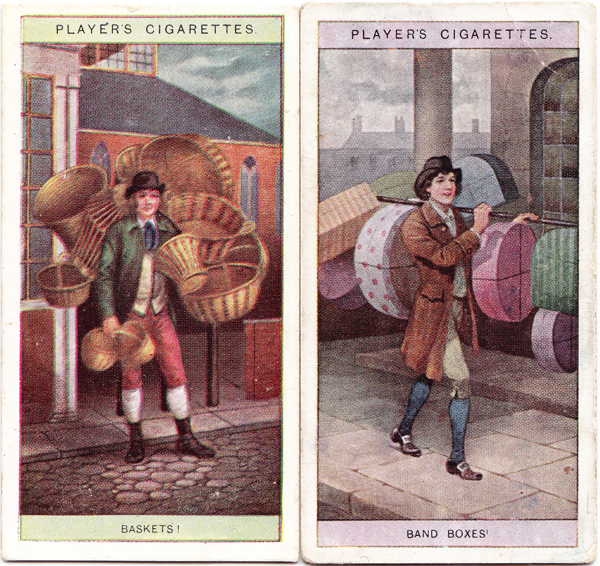
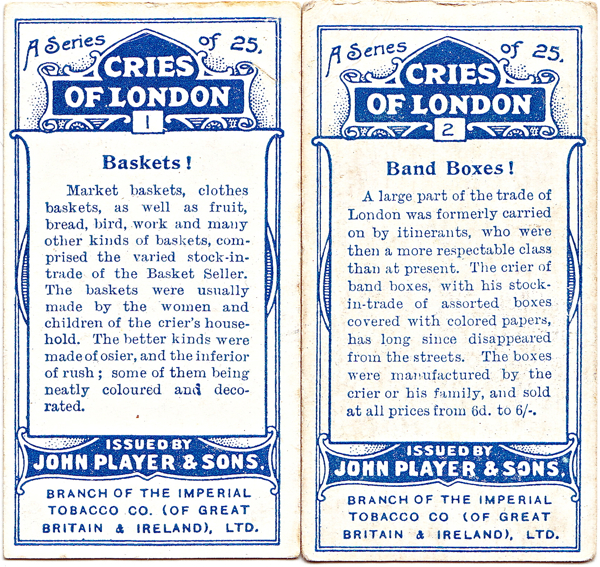
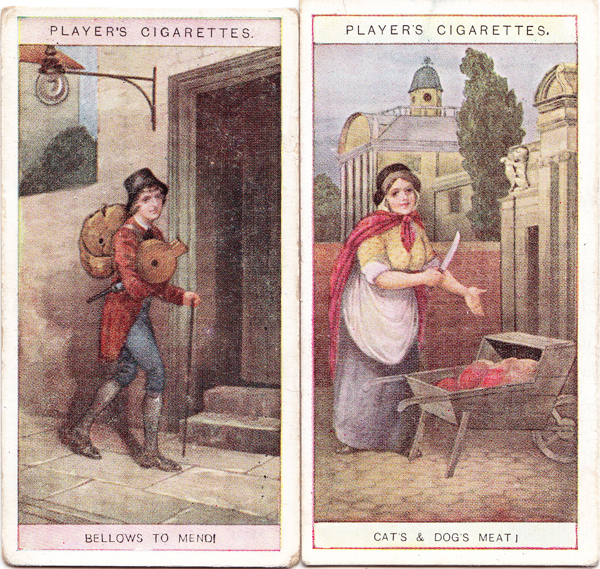
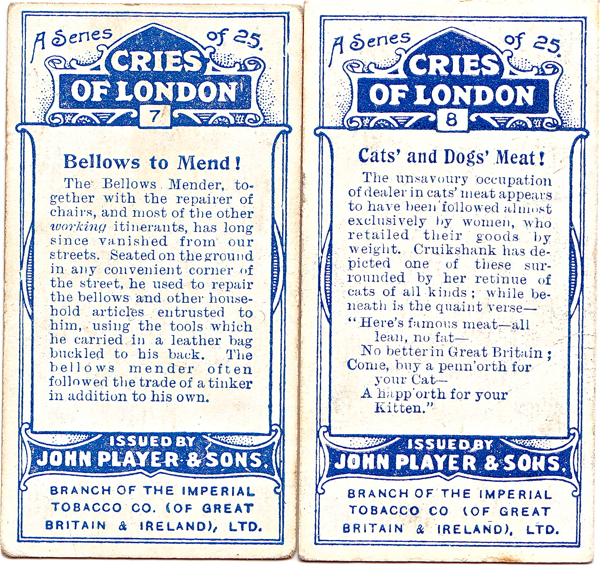
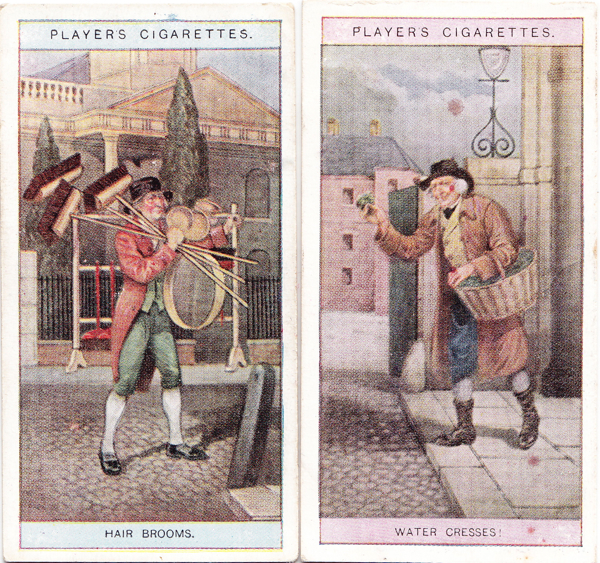
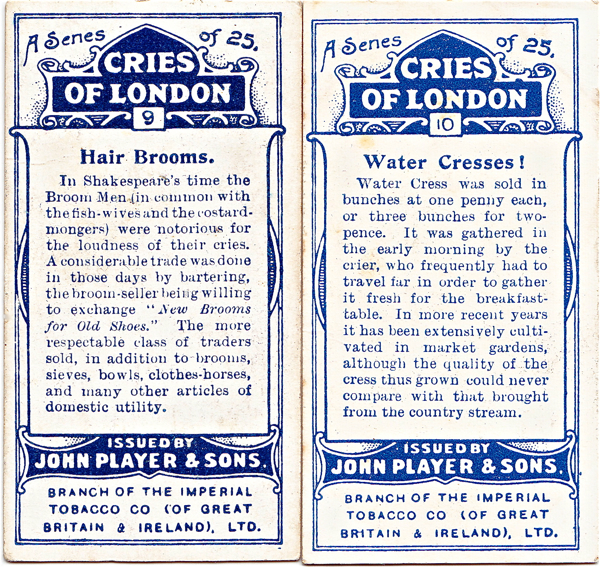
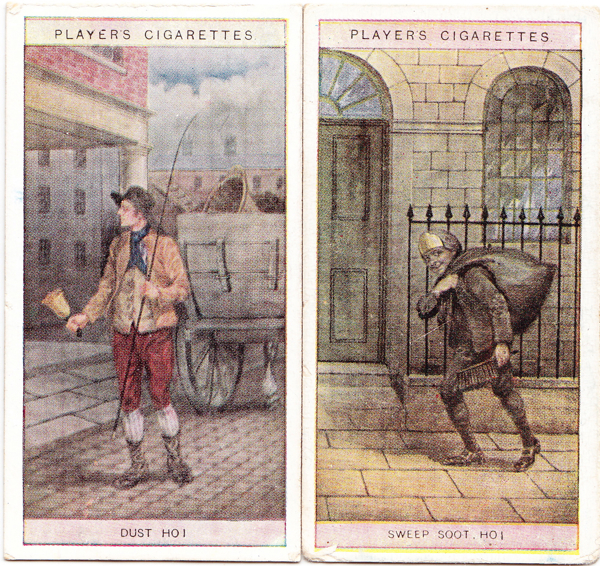
Since I showed you my set of John Player’s Cries of London from 1916 last week, I found this earlier set issued in 1913. The same appealing pantomime aesthetic prevails, and these crudely printed cards portray a surreal idealised old London in which the cats’ meat is as pink as the spots on a hat box and the hawkers are resolutely cheery as they go about the the streets plying their wares -although the clouded skies that accompany each vendor will strike an unexpectedly familiar note of authenticity for any Londoner.
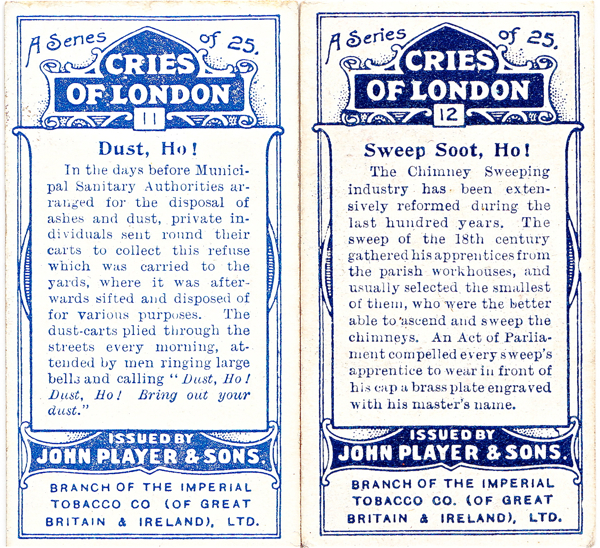
I cannot deny there is a little moralism in the text on the reverse of these cards, apparent when we are told that these itinerants, “were then a more respectable class than at present,” evidenced by the basket seller’s family who made “better kinds of baskets… some of them being neatly coloured and decorated.” Elsewhere we encounter “the cleanly housewife who strews sand plentifully over her floor,” and “the London housewives” who place Lavender in their linen cupboards. Player’s Cries of London are a model of decorum, lacking the playful eroticism of Francis Wheatley’s set from 1790, the celebration of Vagabondia in John Thomas Smith’s set of 1817 and the subversive irony of John Leighton’s set of 1851.
Yet the last two cards are exceptions to this, the Dust Man (whose title still lingers in the vocabulary to describe Refuse Collectors) and the Chimney Sweep – who are missing their implicit companion, the Night Soil man, as presumably too scatological. The Dust Man looks distracted while the Chimney Sweep is overly cheerful verging on the demonic. So, even if these charismatic gaudy images have been more than a little sanitised, in the wicked grin of this bratty little urchin we are reminded of the witty libertarian spirit of the old Cries of London.
All Cries of London are fascinating to me – whether prints, cigarette cards, biscuit tins, plates or playing cards, because the changing nature of these images traces evolving perceptions of the urban poor. It is a genre that delights me by celebrating the infinite resourcefulness of people in creating a living out of nothing.
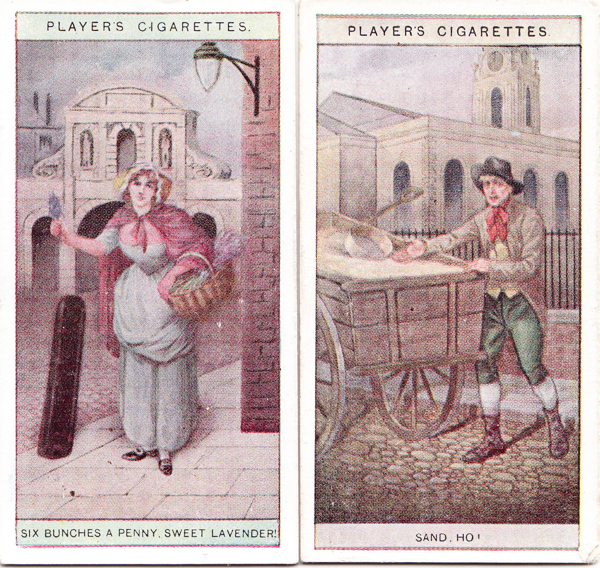
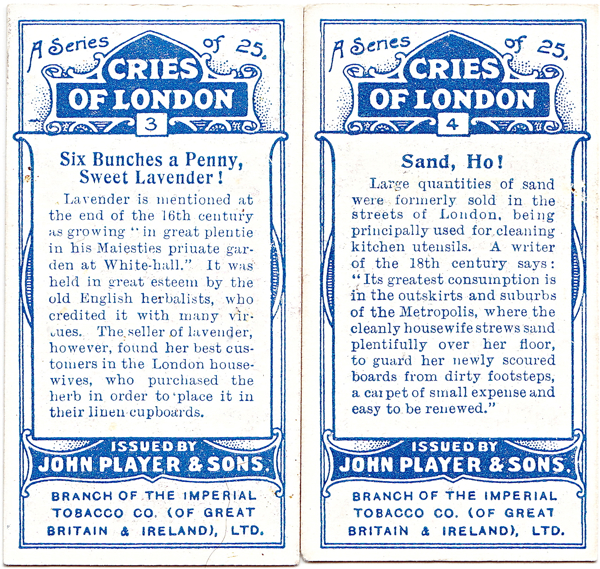
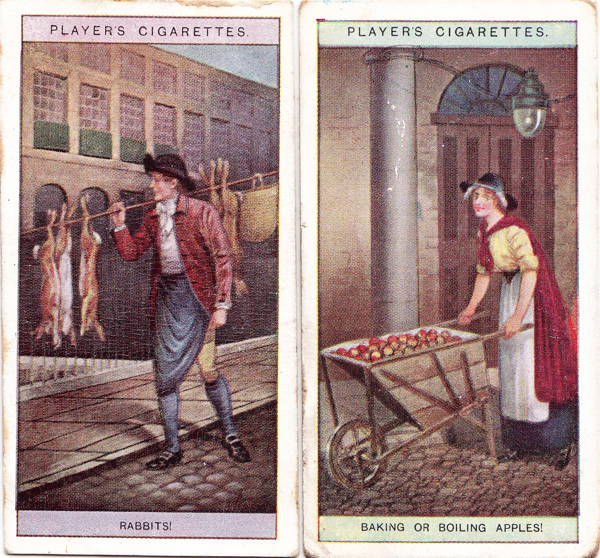
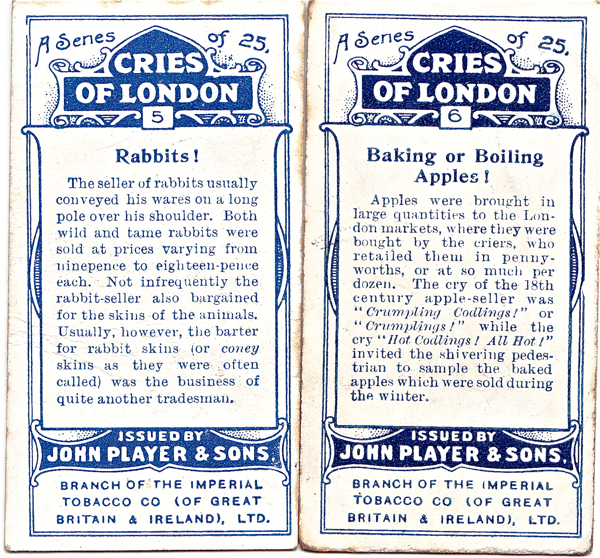
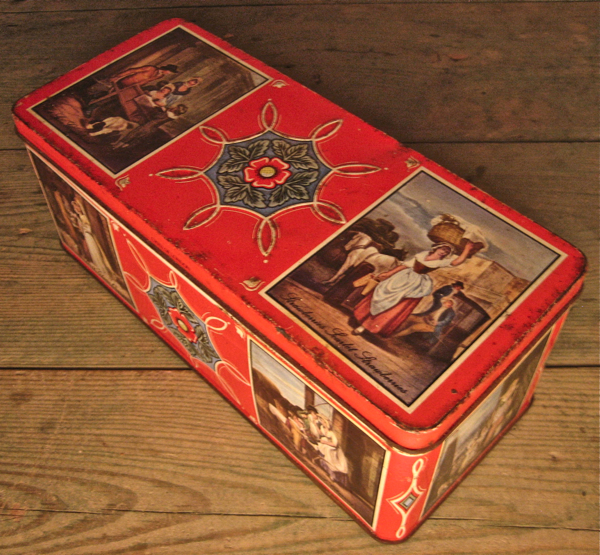
Cries of London – the biscuit tin.
You may like to take a look at
William Nicholson’s London Types
Francis Wheatley’s Cries of London
At the Hoop & Grapes

David Milne (curator at Dennis Severs’ House in Folgate St) took me along to the Hoop & Grapes in Aldgate for a drink yesterday, revisiting a special haunt that he was introduced to by Dennis Severs back in the nineteen eighties.
We walked together from Spitalfields up through Petticoat Lane until we arrived at the busy junction in Aldgate where traffic careers in every direction.“This was the major road in and out of London and it would always have been as full of people as it is now.” said David, as he peered down the road towards Whitechapel, wrinkling his brow to imagine centuries of travellers, before fixing his gaze directly across the road at three of the last remaining timber frame buildings surviving from before the fire of London. The central building, squeezed between its neighbours like a skinny waif sat between two fat people on a bus, was the Hoop & Grapes.
It is the oldest licensed house in the City, built in 1593 and originally called The Castle, then the Angel & Crown, then Christopher Hills, finally becoming the Hoop & Grapes – referring to the sale of both beer and wine – in the nineteen twenties. The first impression when you turn your back on the traffic to enter, is of the appealingly crooked Tudor frontage with sash windows fitted in the seventeen twenties at eccentric angles, and of two ancient oak posts guarding the entrance, each with primitive designs of vines incised upon them.
Stepping through the heavy door patched together over centuries, the plan of the narrow house is still apparent even though the partition walls have been removed. A narrow passageway ran ahead down the left of the building with small rooms leading off to the right, a structure which is revealed today by the placing of the beams in the ceiling and the bulges in the wall where the fireplaces in each room have been sealed up. Opening to your left is the bar, where the premises have expanded into the next house and to the back is flagged floor next to the largest chimney breast in a space that was a kitchen in the sixteenth century.
David and I enjoyed the privilege of access to the cellar where the landlady led us through a sequence of narrowing brick vaults built in the thirteenth century, until we reached the front of the building where she pointed out an old iron hook in the ceiling, held back by a lead catch. “No-one knows what this was for,” she admitted, prompting David to look down at his feet where a metal cover was set into the floor.“There was a well beneath,” he said, speculating,“the Aldgate pump was not far from here and the water table is high.” Then the landlady released the hook to hang vertical and it hung directly over the centre of the cover, perfect for hauling up a bucket. We all exchanged a smile of triumph at solving the puzzle, and stood together to appreciate this rare medieval space, essentially unchanged since Elizabeth I met Mary Tudor fifty yards away at Aldgate in 1553.
Upstairs, the landlady pointed out the site of a listening tube, centuries old yet covered over when a speaker system was fitted recently. This tube enabled whoever was in the cellar to hear what was spoken in the bar and vice versa. David believes it was used in the days of Oliver Cromwell by the landlord, who was in the pay of the authorities, to eavesdrop upon conspirators who chose this pub just outside the City gate for illicit liaisons, and there is no doubt that – thanks to the sparse renovations – once you have been here for a while you can begin to imagine the picture.
We sat down at the quiet corner table next to the crooked window with our drinks. “Dennis and I had this way of looking at things and making it more than it is,” confessed David to me with a contemplative affectionate smile “and that’s what we called ‘the theatre of life’. I used to come and visit him, and we’d go for walks around Spitalfields and end up here for a pint. We were looking for what remains – the signposts to the great City of old – the street that ran down to the City of London was full of houses like this. We would sit here and create a story about the merchants who lived in these ancient houses.”
In this no-man’s land between the City and Whitechapel, the Hoop & Grapes is a reliably peaceful place to go where just a few commuters drop in for a pint and tourists rarely appear – because it does not readily declare its history. Yet time gathers here in the stillness of this modest Tudor building – constructed atop a medieval foundation with eighteenth, nineteenth and twentieth century accretions – while the world rushes past as it always has done.
Through his house in Folgate St, Dennis Severs’ reinvented the way that historic buildings are presented. When David Milne came here with Dennis Severs thirty years ago, all that was in the future, and today more than ten years after his death, David is one of those who maintains Dennis Severs’ creation. “He was a remarkable man,” confided David, as we took our leave of the Hoop & Grapes, “and now this place is a signpost to my past with him.”


David Milne first came here with Dennis Severs thirty years ago.

The thirteenth century cellars.

An ancient hook above the well in the cellar.

Two venerable oak posts carved with vines guard the door, and sash windows added in the seventeen twenties sit within a crooked sixteenth century structure.

An insurance plate from 1782 still adorns the frontage.

The three sixteenth century timber frame houses in Aldgate, predating the fire of London which came within fifty yards. The house on the right was refaced in brick in the eighteenth century.
Photograph of the Hoop & Grapes in the nineteen fifties copyright © Bishopsgate Institute
You may also like to read about
Sandra Esqulant at the Golden Heart
Other Dennis Severs’ House stories
Mick Pedroli, Manager at Dennis Severs’ House