Trevor Chelsea, Smithfield Butcher
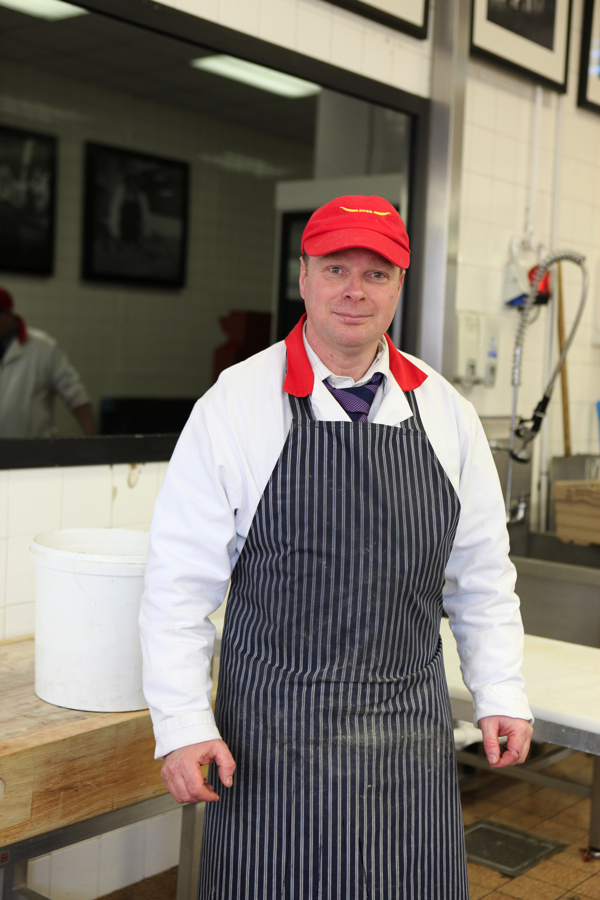
Trevor Chelsea
“It was market-morning. The ground was covered, nearly ankle-deep, with filth and mire, and a thick steam, perpetually rising from the reeking bodies of the cattle, and mingling with the fog, which seemed to rest upon the chimney-tops, hung heavily above … Countrymen, butchers, drovers, hawkers, boys, thieves, idlers, and vagabonds of every low grade, were mingled together in a mass…” – This is Charles Dickens’ vivid account of the livestock market in Smithfield, described in Oliver Twist in 1838. Seventeen years later the trade in live animals was forced to move north to the open space of Islington, due to the frequency of injuries and deaths caused by wayward cattle stampeding through the narrow streets of the City. And in 1868, the Meat Market at Smithfield formally opened as the London Central Meat Market in new permanent buildings designed by the famous City Architect, Sir Horace Jones.
And it is to this monument of Victorian vision and practicality that I am heading; its ornamental coloured cast iron as familiar to me as the dome of the Old Bailey, which peeks out from the periphery.
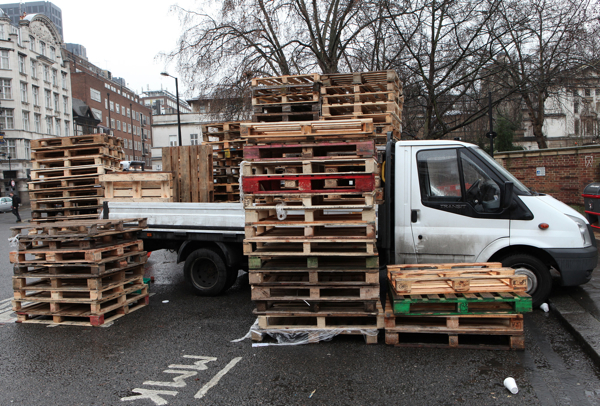
The market is sleepy and the workers have gone – the forgotten joke will have to wait for another night. Discarded takeaway cups are filling with rain and the litter from a night of work plasters the sodden streets. Wooden pallets are packed away, and lights within start to dim, as yawns set in. But not everyone is closing down, the day butchers are ready and waiting for custom.
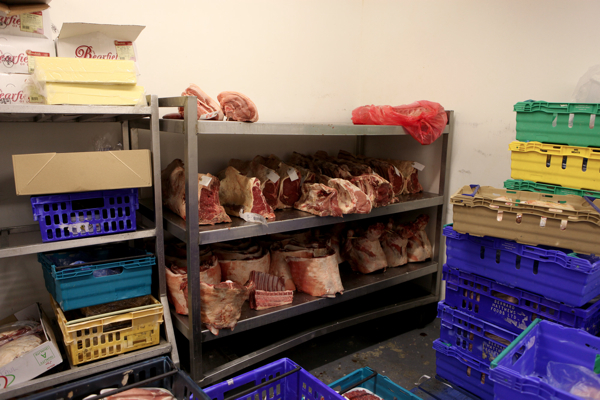
At Smithfield Butchers a typical day starts at five am, with orders prepared for the pubs and hotels, with deliveries and shop displays and, of course, with “the breaking down” – dividing carcasses into those recognisable cuts of meat. This to me is a male world. A man is never without a hatchet or a knife, or a lump of meat, working skilfully amidst blood and bone and flesh, carving to extract the perfect cut. This is a world of affable men, natural storytellers whose banter is as rich and as succulent as a belly of pork, a world where birth names are replaced by nicknames.
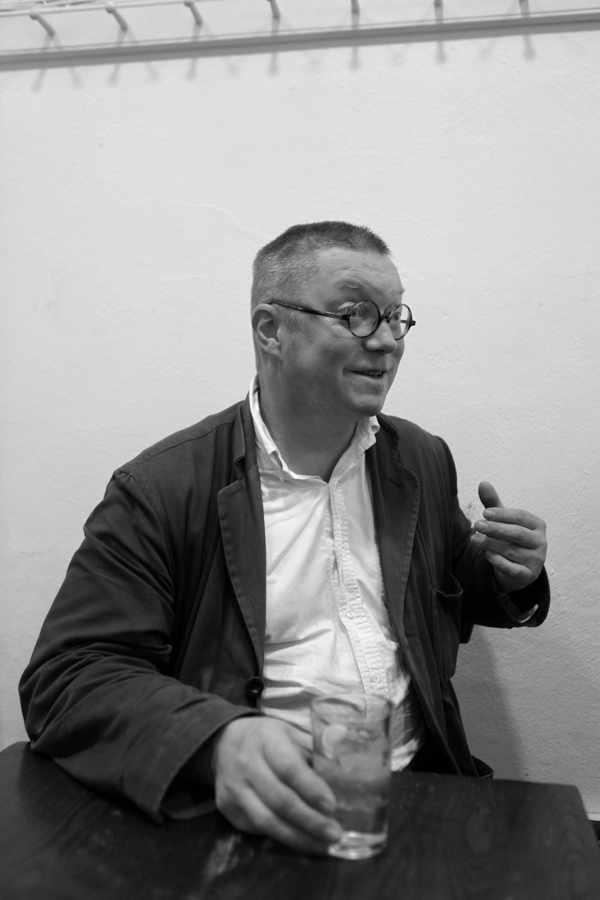
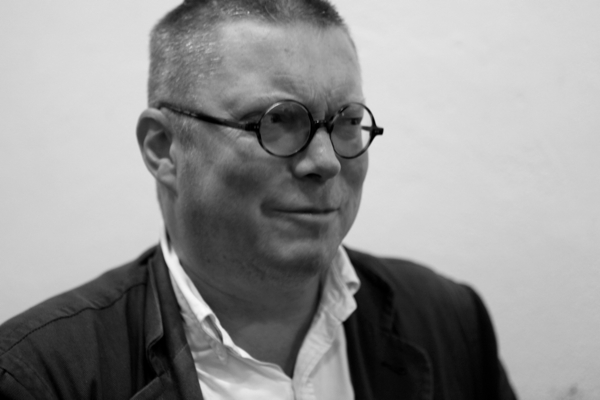
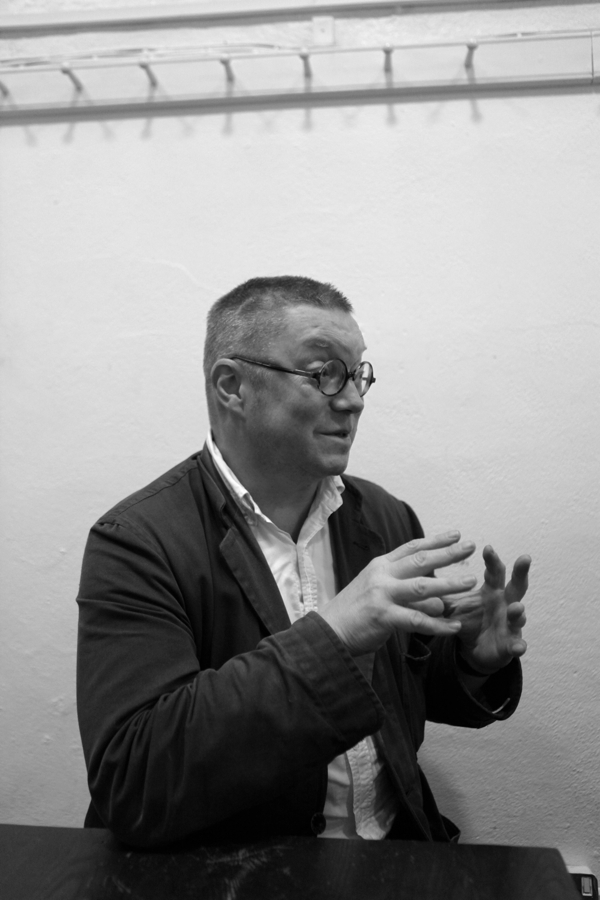
Trevor Chelsea (or “Chels” as he is known – “because I support Chelsea”) is no exception. He has worked at the market for twenty-five years now, and I used to pass him and his colleagues as I made my daily way along Charterhouse street, the “hello” to the men at Crosby’s a natural ritual. They had been there since 1971, a bit of a landmark, always there and always would be there, I thought. But one compulsory purchase by the railways later, and the butchers moved to the west side of the market, leaving a yawning gap where they used to be.
“There was no time for a celebration or a quiet drink with your memories,” says Trevor, “it was a Bank Holiday, I remember, we packed up on the Friday and were in the new premises on the Monday. We had orders to fill and we got on with it.
The market has changed a lot since I started twenty-five years ago. A lot of business is done behind closed doors now, and all the characters are leaving or have left. In those early days, there was a real hustle and bustle, lots of laughing and joking, like a proper market, like Petticoat Lane. Loads of shouting.
It was the camaraderie,” he continues. “If I was to leave tomorrow, that’s what I’d take with me. And the laughs. You had to – In the early days my shift started at two am and went on till two pm. In winter it was freezing, hands had chilblains, it was real hard work, and those winters seemed colder then, maybe because we were outside all the time. But joking around kept you warm – kept your spirits up.
The rules and regulations were unwritten then, but you always knew what line not to cross. It was about what you could get away with. We used to cut off rabbit heads and nail ‘em to the front doors of customers who hated rabbit! Joe Pasquale used to work down here too – he liked to put a chicken on his head and run around. Teddy Lynch too – the brother of the entertainer Kenny Lynch – he was the first black man down here to be a bummaree,” and I must have looked quizzical because he added, “You know the barrow boys who load the meat and carcasses for the customer. They were the only ones who had the right to carry meat in the market. When I started there were about fifteen hundred bummarees – now there’s five.”
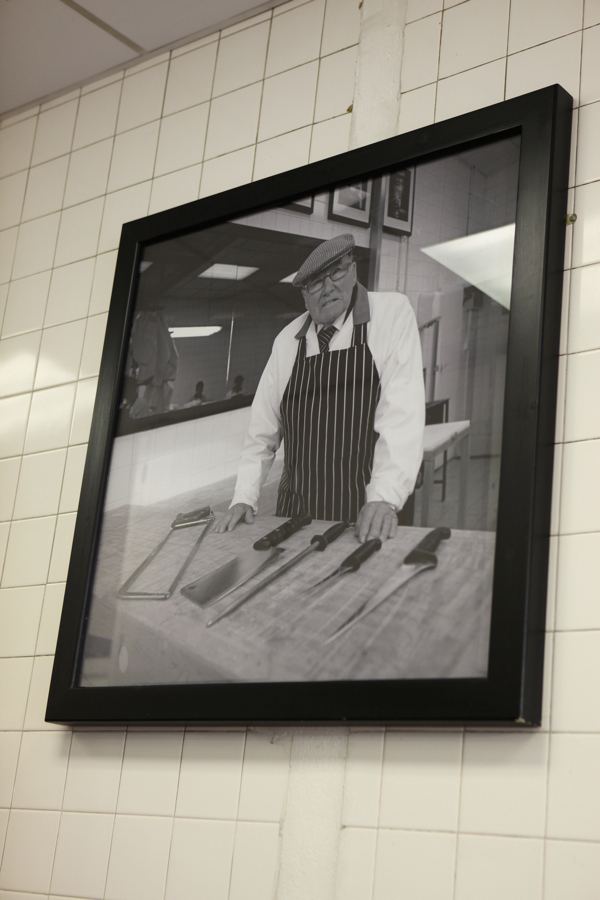
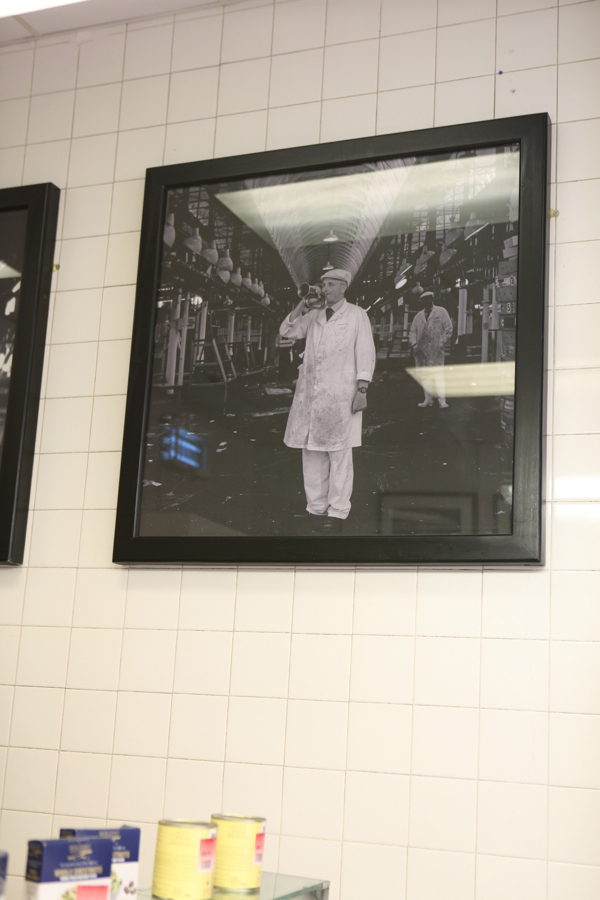
And Trevor leads me inside to look at the photographs on the wall, the photos of these “barrow boys”. And yet I see no boys, just men over fifty, the hard toil etched into their faces, of a working life that starts when most are asleep, and ends as daylight ferociously erupts across the city skyline.
“Him there, sitting on the stone,” says Trevor, pointing to an old man, “well that’s “Disley” – when he retired he had no one left. All his family had died, so he just came back down here and sat and watched. And that one there, that’s “Treacle” – they called him that because he had sticky fingers. You couldn’t leave meat around when he was about. And that one, him with the glasses, that’s Pat Crosby – brought up in a workhouse. Number D12. He still works. And him there, with the bugle, that’s Johnny Green, he played the Last Post the day the market died.” (The day the market temporarily closed in the mid-nineties to bring it up to EU food safety regulations).
“So did you always want to be a butcher?” I ask.
“No, at first I was a signwriter in Queensway for seven months, and it seemed like I wrote the same word for seven months! It drove me mad, so I left. But there was a recession and the only job I saw advertised was for an experienced butcher, so I went for it – told ‘em I’d worked as a butcher for a year. They found me out when they sent me to the fridge to get something – hadn’t got a clue what they were on about. But they kept me on and trained me. And I’m still here today. Cold and hungry, as we say.”

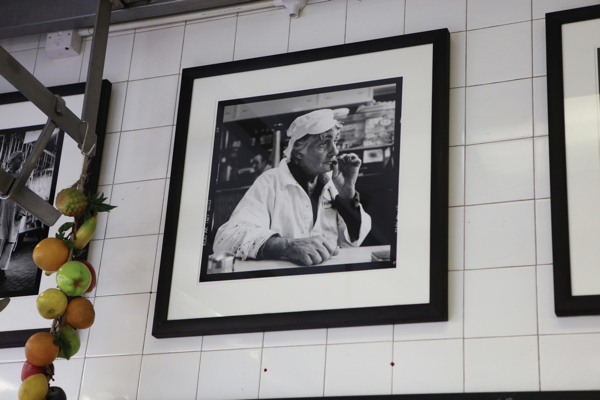
Treacle

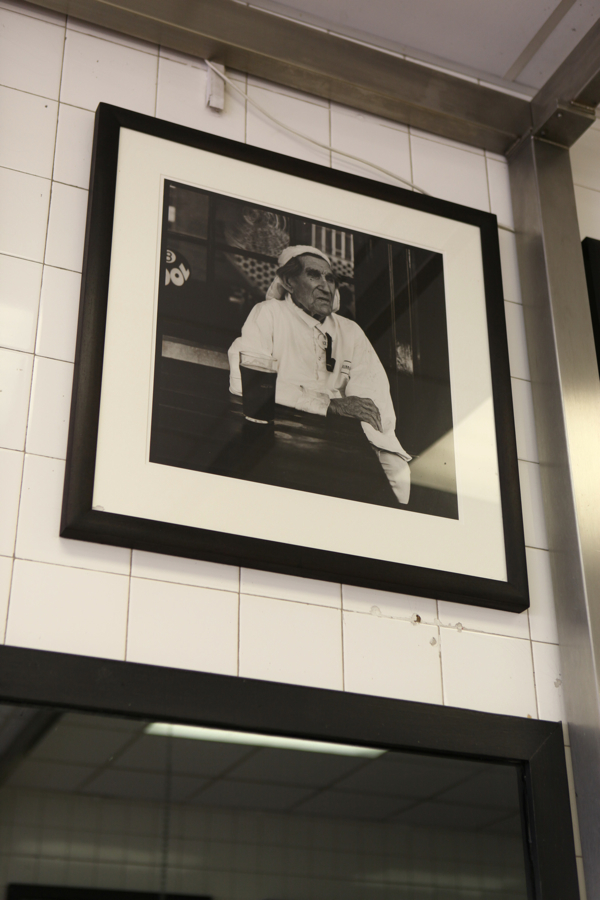
Disley
Pat Crosby

Trevor

Johnny Green
Black and white portraits copyright © Chris Clunn
Colour photographs copyright © Patricia Niven
You may also like to read about
Ivor Robins, Fruit & Vegetable Purveyor
At the City Corner Cafe

Delfina Cordani
The City Corner Cafe is exactly where its name suggests – on the corner of Middlesex St and Bishopsgate, where it has been for over fifty years. I approached it one crisp morning when the sun had not as yet delivered the promise of warmth, and its steamed windows lured me towards the prospect of delicious smells and chat and coffee inside, and, of course, towards a meeting with the owners, the delightful Delfina Cordani and her son Alexander – a formidable double act.
Time stops as you enter. This is a sixties cafe – a film set almost – with blue vinyl banquettes and panelled walls and a beautiful well-loved coffee machine by the renowned W.M Still and Son. And I imagine the deals done at these tables over the years, the stories read, the hands held, the illicit whispers of love, and I feel grateful, that here is a cafe of character and charm and warmth, a far cry from the generic, sterile cafes of today.
On the back wall is a beautifully polished mosaic from 1836 depicting the story of Dick – later the eponymous Dirty Dick – a prosperous city merchant and warehouse owner called Nathaniel Bentley, who fell into an abyss of dirt and decay and self-neglect after his fiancé suddenly died on their intended wedding day. Apparently there were two more mosaics to accompany this story, Alex tells me – one of the deceased’s funeral carriage with white horses and the other of a Town Crier, both, however, are missing.
Delfina sits down with her coffee. She is an engaging woman, blessed with a youthful spirit and a mischievous smile that belies her eighty-two years. Brought up on a farm in Italy, in Emilia Romagna, she was one of seven children and first came to London as a nursemaid before going to work at Great Ormond Street Hospital.
“At eight o’clock exactly, I used to make coffee for the matron and the governor. I made it by burning the dry grounds of coffee in a saucepan and then adding the boiling water. They loved my coffee, and I still have the saucepan…” she whispers conspiratorially.
“I think I was matron’s favourite,” she laughs. “I did a bit of everything – looked after the children because in those days parents were not allowed to stay in the hospital. Matron used to give me tickets to the theatre and opera. It was quite a special thing in those days – I had to buy a new dress so they’d let me in. I saw La Boheme,” she says, beaming.
“I loved working there. It was a wonderful environment, felt very equal. In Italy, if a man was a doctor he could be a bit snooty, but there it felt different. I remember one consultant raising his hat to me and I told him he didn’t have to do that – I wasn’t an important person – and he said ‘You’re just like me. I had the chance to study. Maybe you didn’t. But that’s our only difference.’
It was my friend Ida who persuaded me to leave the hospital and I went and worked with her as a waitress in Covent Garden in a busy Italian restaurant. I went from a calm environment to the bustle of Covent Garden. But I was never without flowers or vegetables!”
During this time, she met Giuseppe at a dance in the basement of the Italian Church in Clerkenwell, and in 1958 they were married. It was Giuseppe who was eager to set up his own business, and after a quick search, Delfina and Giuseppe spent their first day in the City Corner Cafe in June 1963.
“I was nervous to start with. An Irish girl who worked there before we took it over, stayed on with us and taught me the rules – lots of rules! – ‘Faster Delfina!’ she’d say. ‘People are in a hurry – you must do things faster!’ The cafe was small, few tables. And one day someone from Dirty Dick’s pub came to us and asked if we’d like to expand into the old alleyway beside us. We bought the alleyway and, of course, the mosaic which was part of the ancient wall. It gave us an extra five tables.
I’ve had a very happy life here, met so many wonderful people. We had customers who would come around the counter and make their own tea and leave the money on the side. People were honest then. We had lots of regulars – I would always get birthday cards and Valentine cards. A tall slim distinguished Englishman bought me an orchid on Valentine’s Day – such a rare flower then. If my husband didn’t like it, he certainly didn’t show it! I often wonder what happens to people. They become part of your life and tell you about their families and then one day they disappear. Maybe they’ve retired, maybe moved away? Maybe died? You never know.”
There is a quiet moment as she reflects on the years and the faces and the memories they hold. And then Alexander comes over and asks proudly. “Have you told her about hiding the British soldiers on your farm?”
“That was another life ago,” Delfina says.
“I’d like to know,” I say. And so she tells me.
“It was 1944, I think. I was thirteen. Blonde and small. I noticed my father making lots of sandwiches and I became suspicious because we didn’t eat lots of sandwiches. He told me that he had two British soldiers hidden under the hay in the barn. He had found them hiding in his vineyard and told them to stay put until dark, because the area was full of Germans. He hadn’t told us children because children talk, and if word got out the Germans would have burned down the farm and killed us all. He forbade me tell anyone. They stayed for a week, I think. I saw one of them once, he had blonde wavy hair. And then they disappeared and that was it. After the war the British MoD sent my father a plaque thanking him for his bravery. They also sent him money to pay for those soldiers keep.
I think they must have survived those soldiers, don’t you?”
And she looks at me with those deep eyes, as if she needed reassurance that her father’s brave efforts had not been in vain.

The extension of the cafe into a former alley.

The mosaic from 1836 upon the wall of what was once an alley leading to Dirty Dick’s next door.

Delfina


Alexander


A food order

Carlian

Delfina’s lunch

In Middlesex St
Photographs copyright © Patricia Niven
You may also like to read
Mama Thai, the Noodles of Spitalfields
A Lesson in Tripe
“Tripe strikes fear in people”
If there is one dish with the reputation to send someone rushing to the bathroom before trying it, then it has to be tripe. In its raw state, I’ve always thought it looks like coral, but that is as far as my musings go. It is edible offal from the stomachs of various animals, and no amount of imagination or similes can ultimately disguise that grisly fact. Tripe has quite a following away from these shores and is part of an everyday dining tradition in France, Spain and Italy. In the Mercato Centrale in Florence, there is even a “tripperie” – a fast food outlet serving those busy people of Tuscany who simply can’t get enough of the stuff.
“One tripe burger, please and hold the mayo!” – It just seems so wrong.
In Britain we tend to use beef tripe the most, the variants thereof sporting names like leaf, bible, carpet, blanket, plain, reed, honeycomb – gentle, innocuous names masking the unfamiliar terrain beneath. Plain comes from the first stomach of the cow, honeycomb the second and bible, or leaf, the third. The fourth stomach, I read, apart from the extraction of rennet, seems to be used less frequently “due to its glandular tissue….” Oh dear.
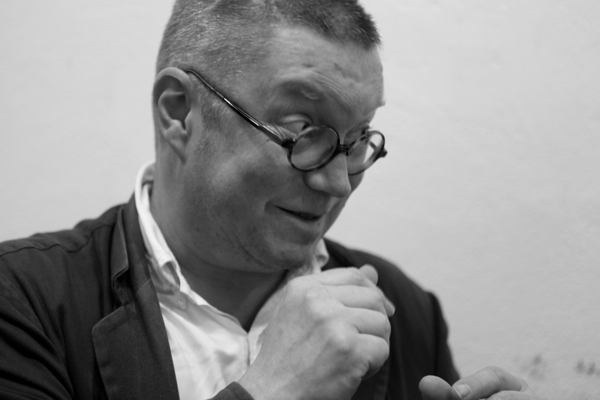
Having attempted to walk this life with an open mind, I soon realized that I had tripe prejudice simmering on a low heat in my heart. In order to advance my knowledge of this murky, intestinal world, I needed to procure the help of a master – nay, the King of Tripe! – who else but the inestimable, hugely affable, ridiculously talented Mr Fergus Henderson of St John Restaurant.
“Tripe stirs fear in people,” says Mr Henderson rather knowingly. There is a long pause, in which I feel the said fear. “Most people shut down and close their hearts to tripe. But people who come to the restaurant for tripe, really love tripe. They are tripe fiends.
There is no particular season for tripe. It is a forever dish: any time, any place, an anywhere dish. It’s tummy, so it doesn’t really change. Of course, jellied tripe is a more summery dish – it is an initiate’s dish one might say, and it tends to win over a lot of people. I like to serve it with cornichons. Accompanied by a jolly rosé – that to me would be perfect.
Could I tell the difference between honeycomb tripe and carpet tripe and leaf tripe?” – Another pause – “Well, if I wiggled my tongue and got the texture, then yes, probably.
Tripe and onions actually shows tripe at its best. Use unbleached tripe – it needs a good rinse in salted water as it is a little brown by nature – and then you soften the onions in milk, add the tripe and simmer for up to an hour. I would call this an enthusiast’s dish.
The great thing about tripe is that it achieves a great culinary combination, both steadying and uplifting at the same time. It rescues one from life. It is a white food and needs mashed potato – something to “anchor” it to the “*!*!*!” (Please note: At this point Mr Henderson makes a long slurping sound that completely enhances one’s understanding of the dish). Accompanied, of course,” he continues, “by a red burgundy.
Deep fried tripe is like a grown-up Quaver. Use unbleached tripe again. After cooking for eight hours season and flour and then throw in the deep fat fryer. It fans out – expansive gesture – and it’s wonderfully crispy. Eat with salt and vinegar. Accompanied, of course…”
“With a red sparkling wine,” interjects Mr Trevor Gulliver joyously. “A Portuguese or a Shiraz.”
“Or a red burgundy,” says Mr Henderson, with emphasis.
There is a moment to reflect. The simmering has stopped, and my heart is opening. I feel like an acolyte in an airless vault. In the presence of a Master. I refill my water glass, my head buzzing, my understanding clearer. We continue.
“Tripe needs enough chew,” continues Mr Henderson. “It shouldn’t yield straight away – maybe not until the third chew, and then it starts to give way, then it becomes submissive.”
My hand is suddenly in the air, waving.
“Yes?” says Mr Henderson.
“I read somewhere that tripe can increase libido. Four fold.”
There is a very long pause in which Mr Gulliver raises his eyebrows.
“Well,” says Mr Henderson, “It’s heady stuff, tripe. Uplifting.”
“Can you eat it as a dessert?” asks the photographer.
“You’d be very foolish,” says Mr Henderson.
“What you need to understand,” says Mr Henderson, “is that food is mood-led. You wake up and think…Ahhh, tripe and onions. One needs to test the perception of beauty. Tripe is a beautiful thing. It brings you back from the edge when you think there’s no hope… But then you remember there’s tripe and onions – it’s pretty impressive.” Mr Henderson sits back against the wall and exhales deeply. “First initiation into tripe,’ he says ‘I think we’ve had a good stab at it.”
Here Endeth the Lesson.
“Jellied tripe – an initiate’s dish. “
“If I wiggled my tongue and got the texture…”
“It shouldn’t yield straight away…”
“It fans out…”
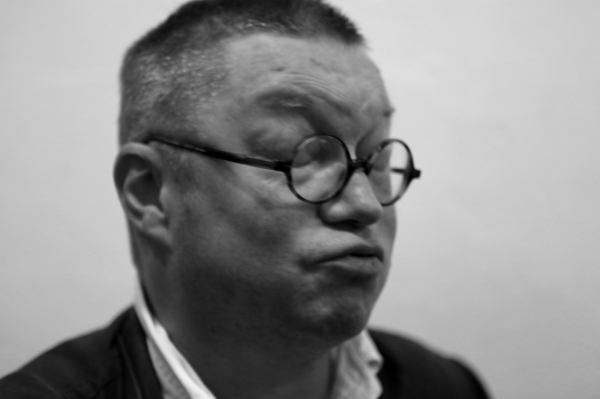
“Can tripe increase libido?”
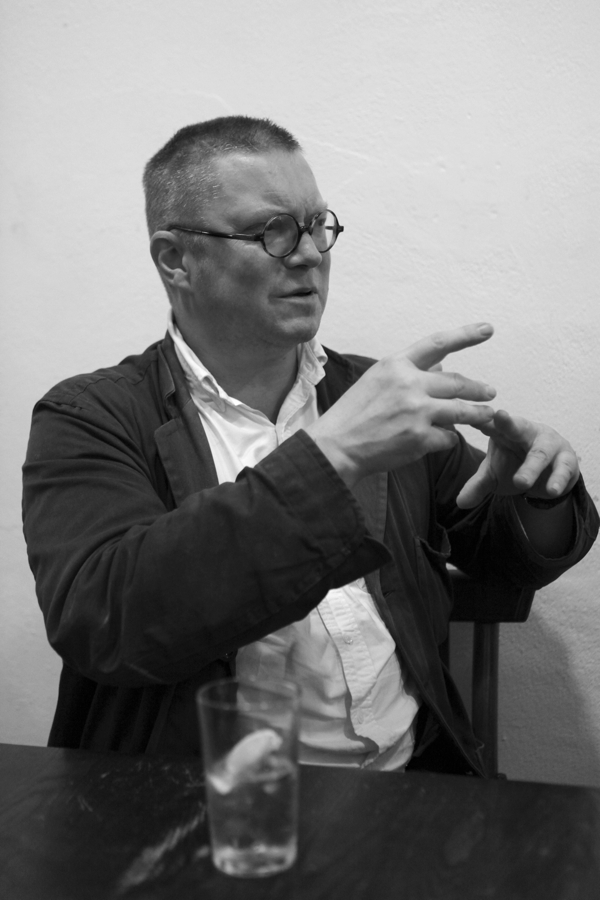
“It rescues one from life.”


Edmund Martin Ld, Tripe Dresser in Lindsey St, Smithfield, demolished last year.
Portraits of Fergus Henderson copyright © Patricia Niven
Tripe photograph in “Nose to Tail Eating” by Jason Lowe
Photograph of Edmund Martin Ltd by the Gentle Author
You may also like to read these other St John stories
James Lowe, St John Bread & Wine
Night in the Bakery at St John
The First Mince Pies of the Season
Justin Piers Gellatly, Baker & Pastry Chef
At Bunhill Fields
“After five hundred and forty-two stories, it is my pleasure to welcome Sarah Winman to take over for a week in celebration of the publication of her debut novel When God was a Rabbit on Thursday 3rd March. Sarah is an outstanding new talent in British fiction, and I can happily recommend her writing to you in the knowledge that you are in safe hands until my return on Monday 7th March” – the Gentle Author
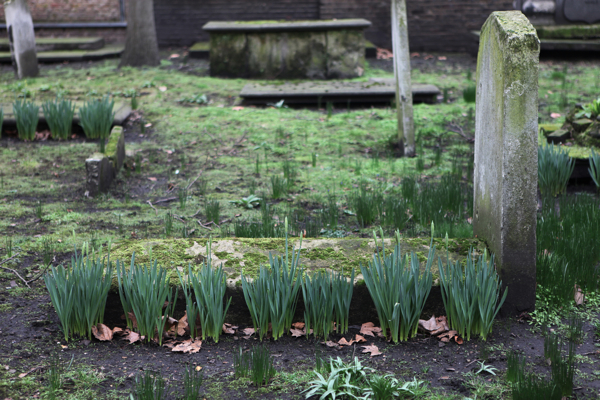
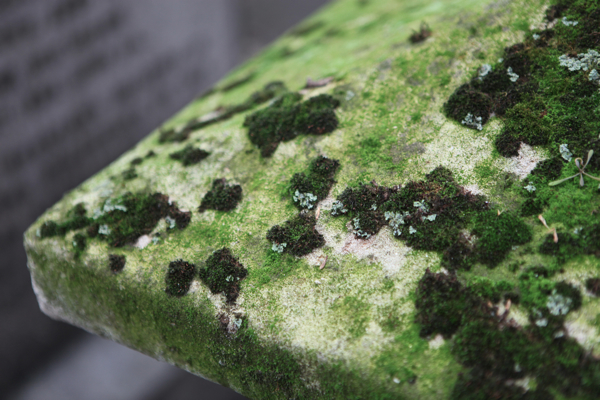
As I walk through the familiar black metal gates, the moss on the headstones looks vivid green in the dull, wet gloom of February light. The sodden earth, fragrant and rich, is punctuated by thick clusters of daffodil stems – that precious moment when spring meets at the boundary of winter, the moment when we sigh, knowing the worst has passed, the short days have passed, and we, like nature, head towards the light.
I have always come to Bunhill Fields, since my early days of living in the City of London. But about three years ago I made a pact to come here every day for a year – my antidote to my father’s rampaging illness and those days spent on hospital wards – my need to understand the cyclical nature of life. And walking through these black iron gates, the markers of lives and stories past on either side, I breathe in the constancy and honesty of nature.
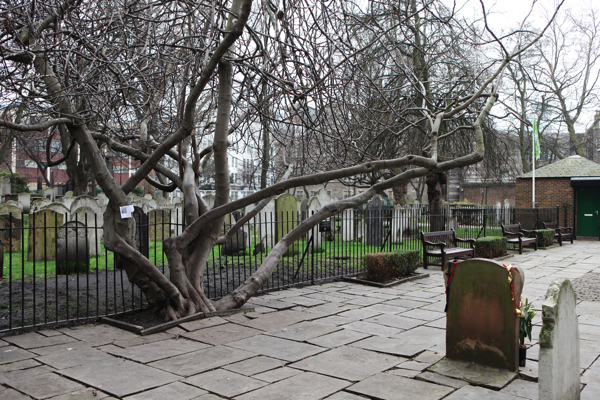
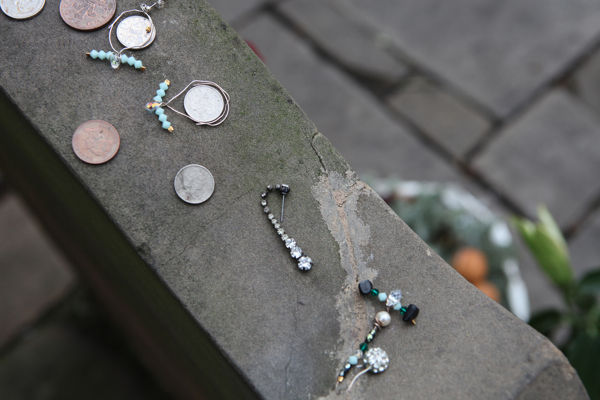
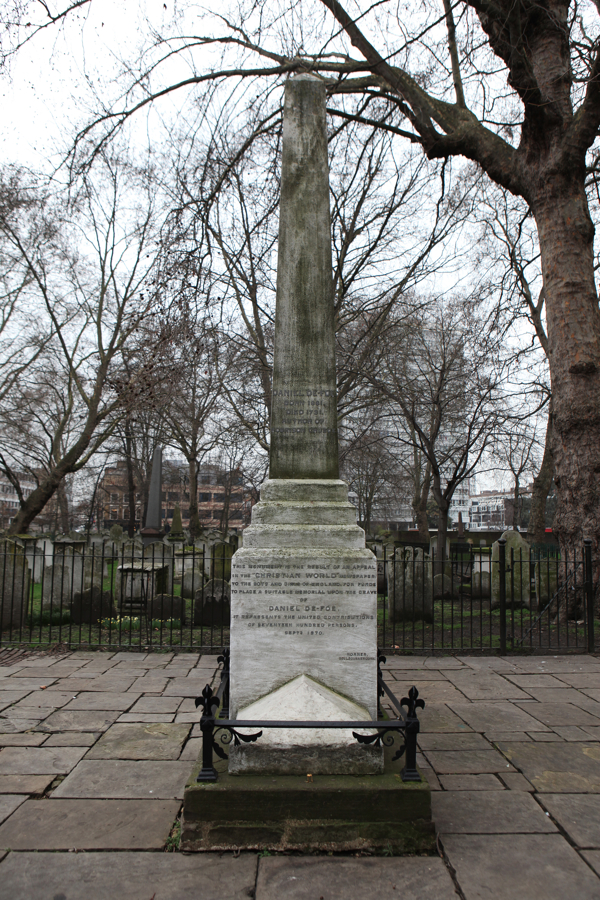
Over that year, I watched this small space adapt and change with the seasons. I went sometimes simply to listen out for the delicate drilling of a woodpecker. I watched the fig tree, once energised by encroaching spring and gloriously laden in the sweetness of summer, wilt heavily as autumn whispered across its branches, as its leaves drooped like shoulders, before falling to a frosty floor. I noted the multiple textures of light – the late evening buttery light of a summer day, the metallic light of a frost-covered morning, when my misted breath led me over to the graves of Daniel Defoe, John Bunyan, and to the uniquely cherished grave of William Blake, where trinkets and offerings and earrings and flowers lay beside, in front of, and on top – all in tribute and memory to a poet, artist and visionary, a man who continues to touch lives, and never more so than in this great City of ours.
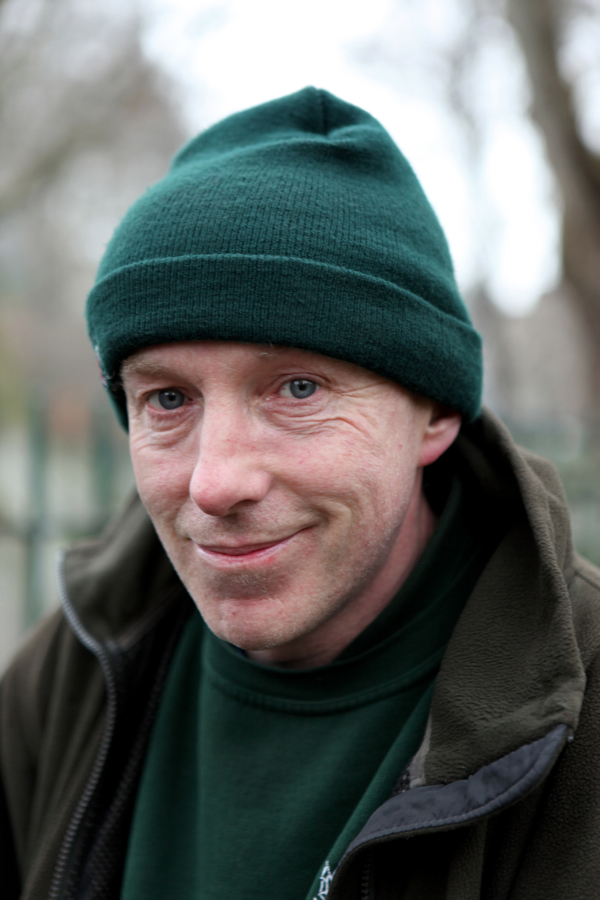
“To see the world in a grain of sand/And heaven in a wild flower/Hold infinity in the palm of your hand/And eternity in an hour – This is what sums up Blake for me,” says Tom the Gardener, as he joins me on a bench for a quiet chat.
Tom has worked in Bunhill Fields for the last ten years, and he talks about the environment with passion, pride and wit – qualities all the best Irish storytellers share.
“You know this is supposed to be the most haunted graveyard in London. I haven’t seen anything yet, but I know people who have. Lots of women with big hats suddenly emerging,” he says, wryly smiling. “I love this place. I love the peace and tranquillity and because I am surrounded by history. I know it’s a graveyard but it’s all about people and their stories. All these histories add to what little knowledge we have.
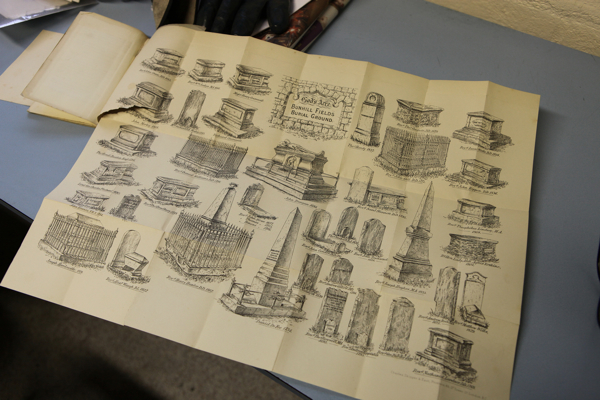
The graves here are very simple, as you can see. Nonconformists are buried here so the stones are not really elaborate. These men and women were free thinkers, radical thinkers, seeking liberty away from church and government. Look over there,” says Tom, “the grave of Thomas Bayes. Statisticians from all over the world come to the grave to honour the man’s theories of probability.
Bunhill – Bonehill – This place is also known as God’s Acre because of the amount of preachers buried here. Lots of Americans make a pilgrimage here – Wesleyans, Baptists, Methodists. They all try and convert me!”
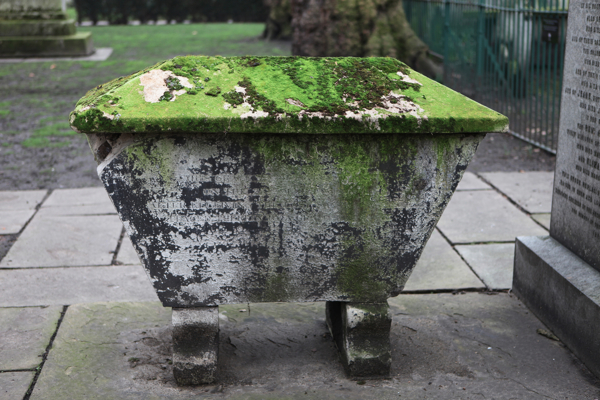
We wander through the stones. We pass thick layers of moss blanketing tombs like table cloths, and fox dens dug deep by the sides, their entrances curtained by hanging roots and an occasional spider’s web.
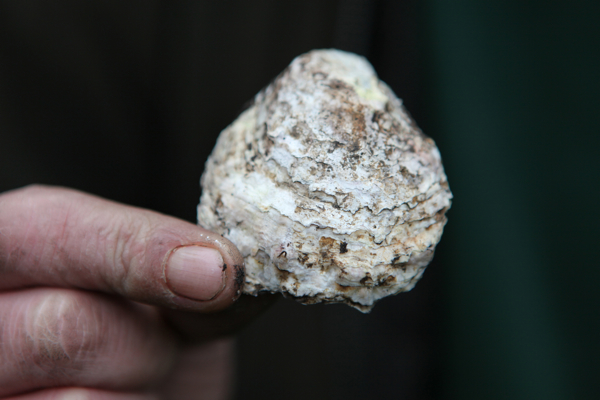
“I find lots of clay pipes in the dirt the foxes excavate, oysters too: the poor man’s food. I haven’t found anything Anglo Saxon yet. One day,” he says, with a glint in his eye.
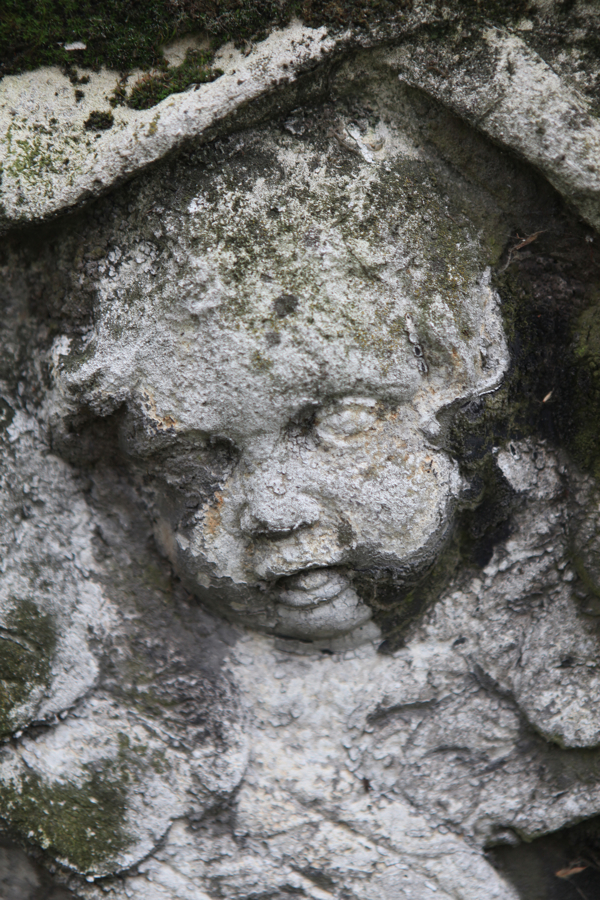
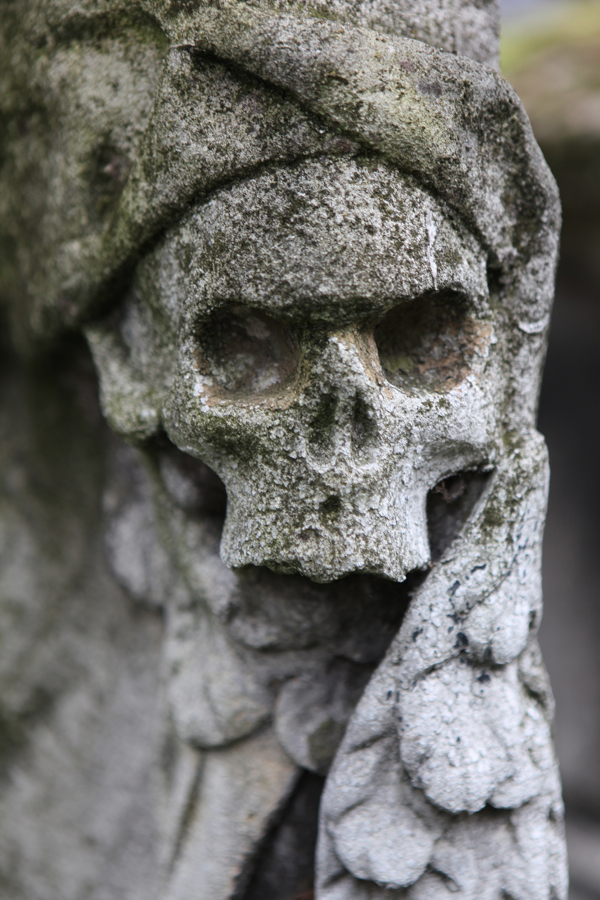
“One of my favourite graves is over here – the grave of Thomas Miller – it has carved cherubs and skulls, and the face of the cherub really stands out” And as we approach, I can see that it does – the face peers through the dingy gloom like the serene face of a child, and I wonder if a moment like this has enhanced imagination and brought the realm of improbable into the realm of the real.
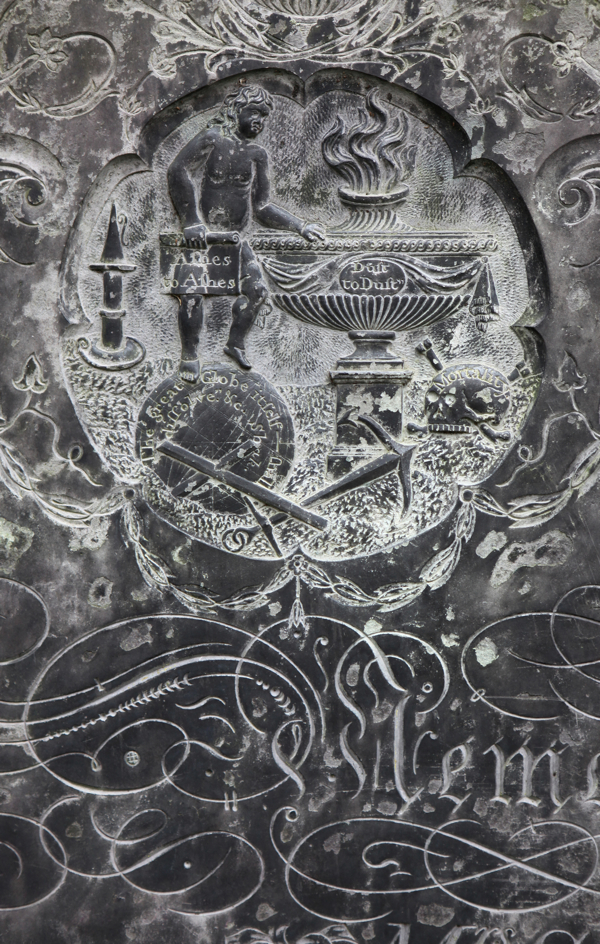
“The skulls too have an eerie feel,” continues Tom. “Skulls in the early eighteenth century were the symbol of mortality. This is another favourite,” he says, and leads me over to a grey slate stone – that of the departed Wheatlys from Ave Maria Lane – a carved tale featuring a globe, a cross, an anchor, and the words ashes to ashes, dust to dust. “People lived with death all the time then, early death, children’s deaths, they walked hand in hand with it. There was an acceptance of it. Not like today. We’re so scared of it,” he says, and his voice trails off into the fading light.
And we sit silently once again, as the City stills. There is no hush of breeze to stir the bare branches of the old plane trees, so self-consciously naked. And I look over the lawn as tufts of newly-seeded grass take hold, and the crocuses erupt in shuddering yellows and mauves: new life amidst this gentle setting of earthly departure, and I feel all is well. And all is just so.
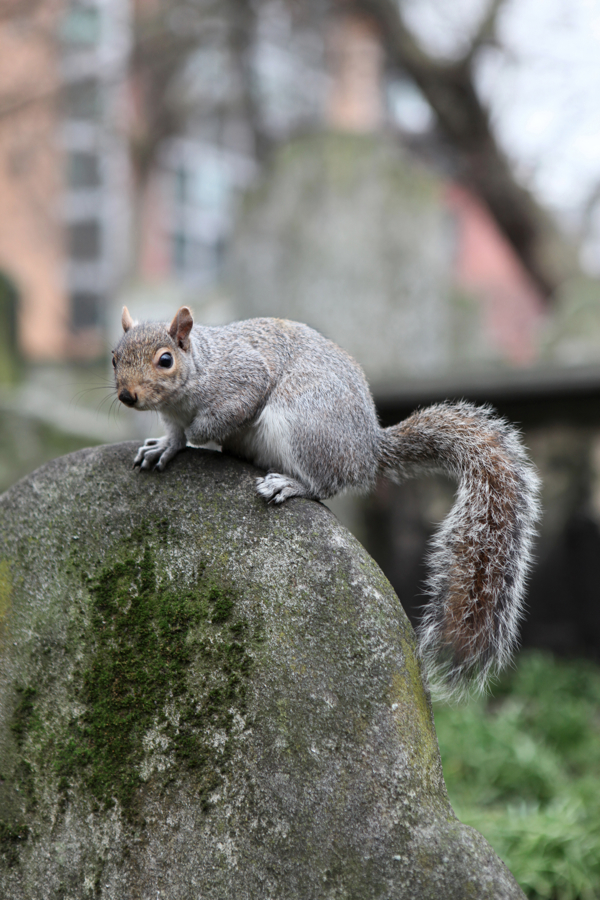
A squirrel poses by a puddle before taking a drink. The sound of a faint siren draws us back to the present. Tom leans over towards me.
“Apparently Churchill came here during the war. A bomb had dropped just over there and the trees were on fire and he was fighting the flames with his hat…”
The stories continue.
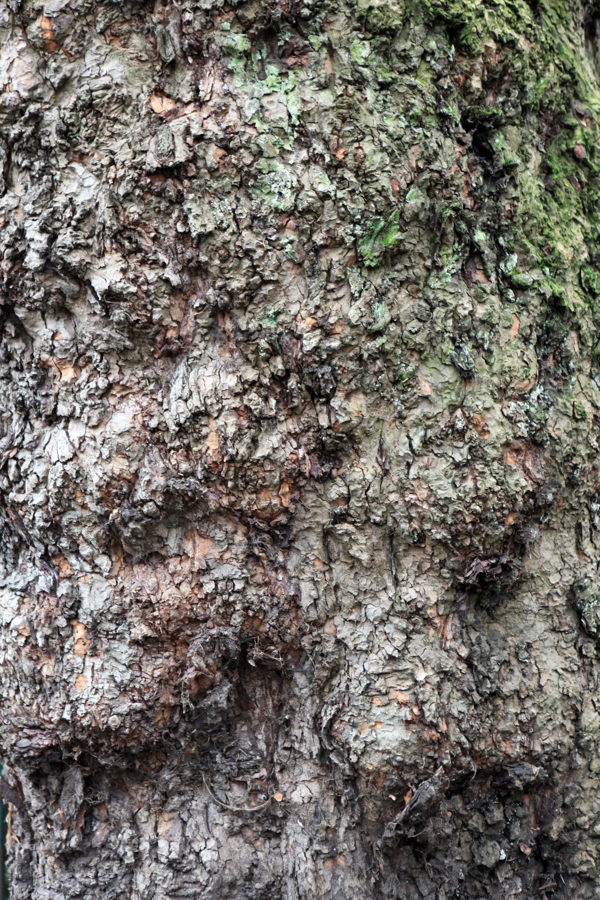

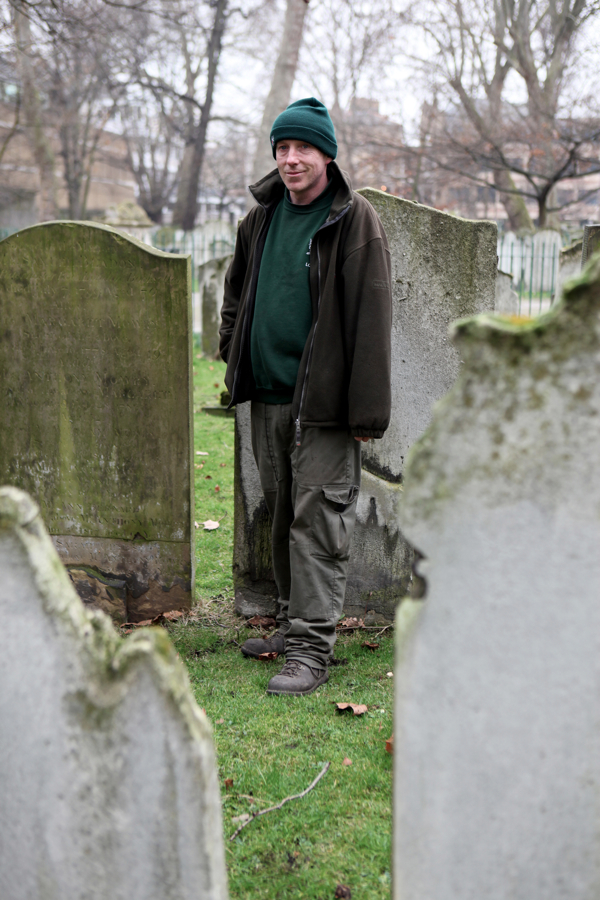
Tom the Gardener.
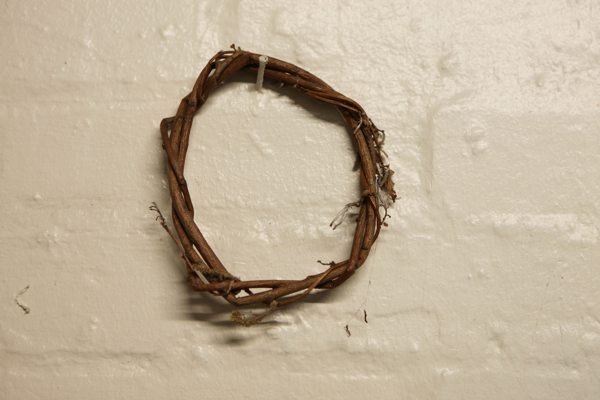
Upon the wall in Tom’s hut.
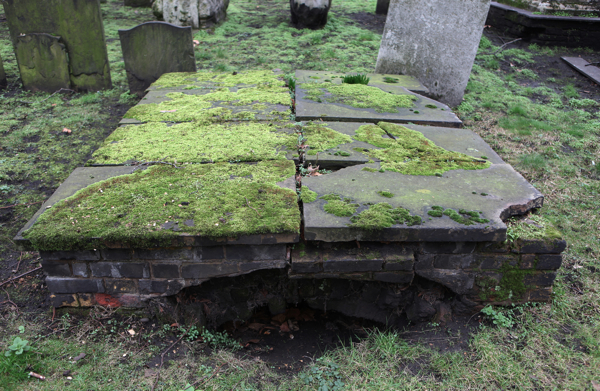
The fox den under a tomb.

Photographs copyright © Patricia Niven
You may also like to read
Columbia Road Market 69

While the weather outside remains capricious, I am able to enjoy my indoor garden of Spring flowers in old pots upon the dresser every day. Now that Spring bulbs are coming into flower in the garden, the end of the season for potted bulbs at Columbia Rd means a large variety are available for as little as one pound a pot. Consequently, each week, I have been carrying trays of these back to Spitalfields and replanting them into my collection of old bowls, that I have amassed over the years from the market, to create an abundant display in my living room.
I cannot plant bulbs in my garden without squirrels simply eating them all, but I have found that if I plant out these Columbia Rd bulbs once they have flowered, they come up again next year and the squirrels do not touch them. Last week, I came back with a tray of late-flowering Pheasant’s Eye Narcissus, to replace the first wave of miniature Daffodils which have already flowered upon my window sill, and also five pots of Grape Hyacinths that I potted up indoors – all these were a mere one pound a pot.
The first Auriculas are in the market now, also at just a pound a pot and, each year, I can never resist these plants – with their exotically artificial-looking flowers – which are said to have been introduced to Britain by the Huguenots. Finally, I bought a coral-coloured Primula, which evokes a specimen my grandmother had of this exact shade when I was a child, and which I recall her showing me with great pride. Even though she died in 1991, when I see these plants each year, it always gives me a shock of recognition and I feel they belong to her. It is a tender reminiscence for the expenditure of just four pounds.

Grape Hyacinths.

Primula.
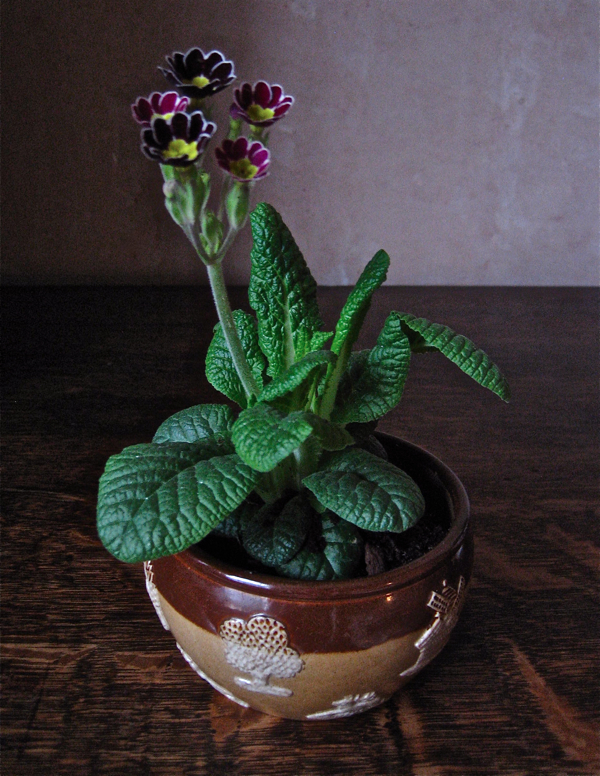
Auricula.
Ally Capellino, Bag Lady
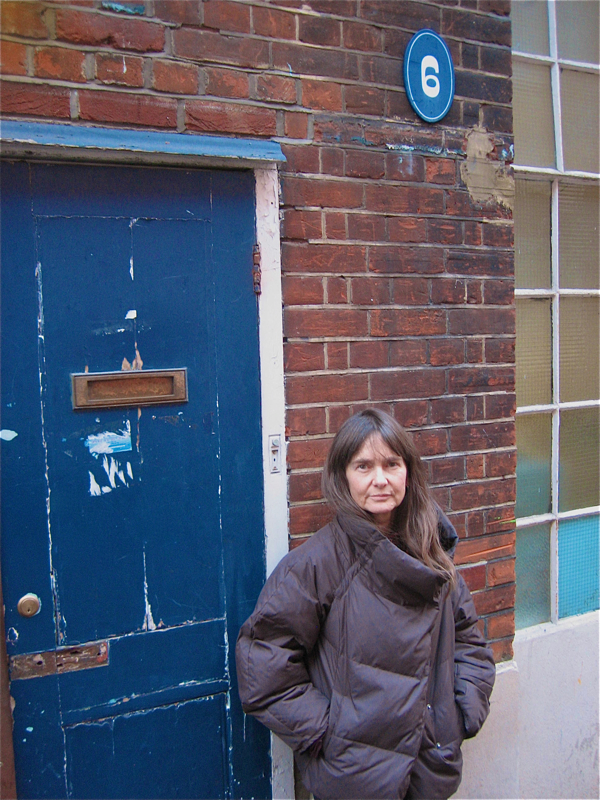
This is Ally Capellino outside number six Sunbury Workshops at Arnold Circus where she started her own label thirty years ago. It is just a short walk from her design studio and bag shop in Calvert Avenue, which she opened in 2005. Yet it has been a long journey that Ally travelled between these two locations, during which she designed clothes for twenty years, then split from her partner and re-established herself again independently as a designer of bags.
Years ago, I used to cherish the clothes that Ally Capellino designed and sold in her shop in Soho. And I remember pulling a shelf of my books off the wall, one miserable afternoon at this time of year, and selling them to a second hand book dealer – in order to go and buy myself a new coat at Ally Capellino to cheer myself up. Let me assure you, I never regretted it and I still have the velvet coat in question.
When I bought my coat, I did not know if Ally Capellino was a man or a woman, and – since it was Soho – I somehow imagined Ally Capellino was of Italian descent and, in my mind’s eye, Ally wore a straw hat just like the gondoliers of Venice. In fact, it was a pleasant surprise to discover recently that Ally is a diminutive yet superlatively elegant Englishwoman with deep grey eyes and long glossy brown hair to her waist. Wrapped in indeterminate layers of coats and cardigans, accessorised with beads and silk scarves in a style that recalls Vita Sackville-West, and possessing an impressive manner of walking, striding forth as if she were a tall person – Ally is the most sophisticated bag lady you could imagine.
Visiting Ally in her large design studio in the former counting house of the Boundary Estate in Calvert Avenue, where members of her all female staff scurry around between crates of bags piled up high, it was immediately apparent that this is no cottage industry. Yet Ally sits quietly in a corner, and assumes a levity of tone which dispels any sense of professional hauteur that you might expect from one whose identity is manifest as an internationally recognised brand. Ironically, it is her personal sense of understatement that the cognoscenti appreciate in her designs – in other words Ally Capellino does “plain” brilliantly. Her work exists as the antithesis of those fancy bags which are the vogue, adorned with buckles and straps and quilting and tags and gilt and labels and other frippery.
“I think we’re getting plainer,” revealed Ally, as if she were forecasting the weather, “we’ve discovered our customers like to take the labels off. I’ve always started with materials, I’ve never designed anything and then worked out what to make it from. I’m interested in materials – quite often pretty basic, unpretentious, cheap ones – that have an inherent quality and stand up for themselves. But I’d never made anything in leather before I made bags, so I’ve had to learn to work with it.”
And you can find these covetable bags in Ally’s Calvert Avenue shop (once Feldman the tailors) that exemplify this pared-down aesthetic, of durable construction and graceful proportion, with subtle contrasts of canvas and coloured leather. It was Ally’s sympathetic utilitarian style that led to her commission to design new outfits for the Brownies and Girl Guides, and, thanks to her, never was Guiding as stylish as it is today.
Ally pulled on her Peruvian knitted hat and we set out together up the Kingsland Rd in the biting wind to visit the workshop of Rupert Blanchard, who has a way with material too. He works with discarded timber, old doors, drawers and anything else he can get hold of – chopping them up and reassembling them to make contemporary furniture and fittings. When we walked into Rupert’s workshop in the labyrinthine spaces at the rear of the former Shoreditch Police Station, where he has been cutting up rotten old doors salvaged from Bethnal Green to make a new counter for Ally’s shop and a display for her bags at Liberty, I expected piles of sawdust and disordered piles of scrap timber but instead I discovered his painstakingly organising trove of raw materials and curios. A pale-faced man with wayward lanky hair, who likes to hoover up every grain of sawdust after each job, Rupert seemed happy alone here tending his collection of broken things and so we chose not to interrupt him too long.
Returning to Arnold Circus, we sneaked around the back to the Sunbury Workshops to visit the place where Ally started. Climbing up the worn old stairs in the gloom, ahead of me, “It hasn’t changed at all!” she declared in a whisper as, in excitement and without compunction, she walked right walking into her former studio. Today people mostly sit at laptops in these workshops designed for artisans, although we learnt that wood turning continues below as it did in the days when Ally was first here. The man behind the computer, whom we walked in on, was happy to meet the celebrated Ally Capellino in person, succumbing to her charm, and as quickly as I noticed that his bag was one of hers, he produced his wallet that Ally had designed, proffering it with a smile to show her in illustration of how nicely it had weathered.
As we walked back to her studio, I asked Ally how she has preserved her capacity for delight after more than thirty years, and she gave a modest explanation. “I love Scrabble, and my job is bit like Scrabble, the manoeuvring and making it fit together.” she explained, revealing a naturally fertile imagination. Then, “I play Scrabble online constantly.” she confessed with a wicked smile of self-parody.
In the world of fashion and style, where so many designers come and go, Ally Capellino is still here and still enjoying herself too.
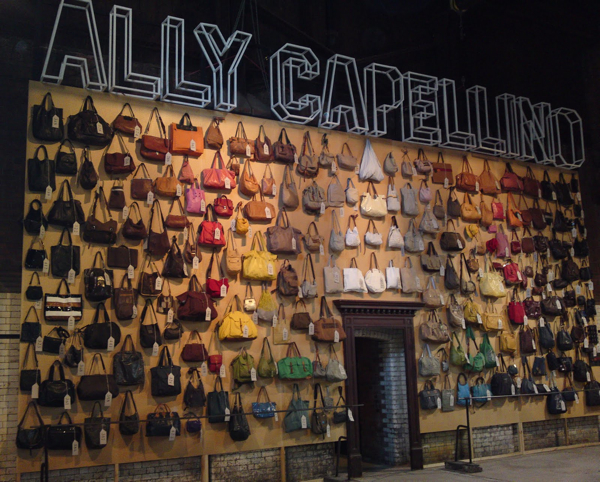
Ally’s bags loaned by their owners for her thirty year retrospective last year.
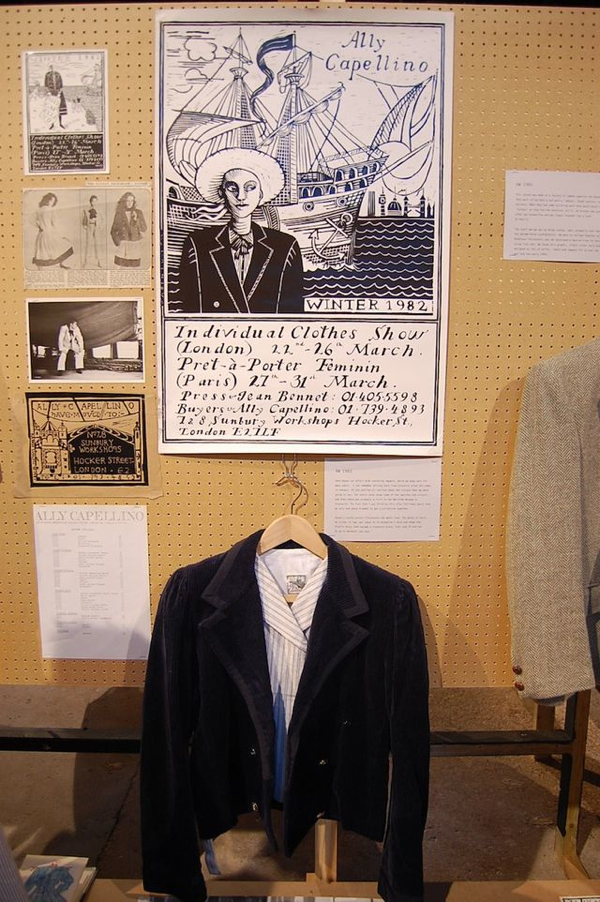
Designs from when Ally began at the Sunbury Workshops at Arnold Circus in the early eighties.
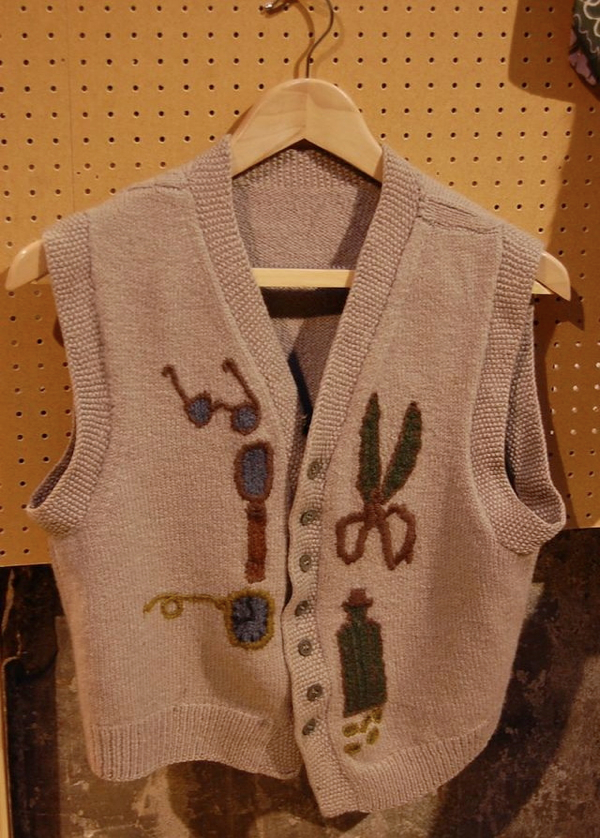
A desirable knitted waistcoat.
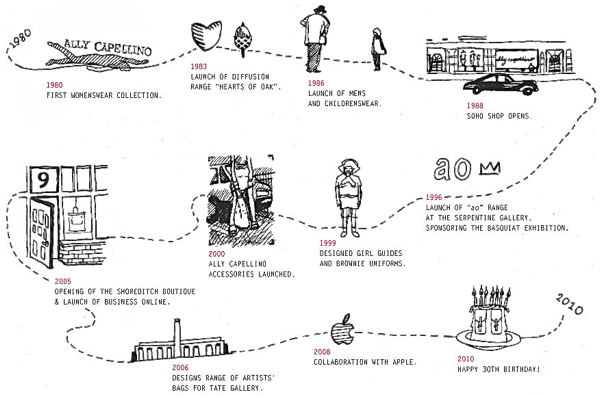
The history of Ally Capellino.
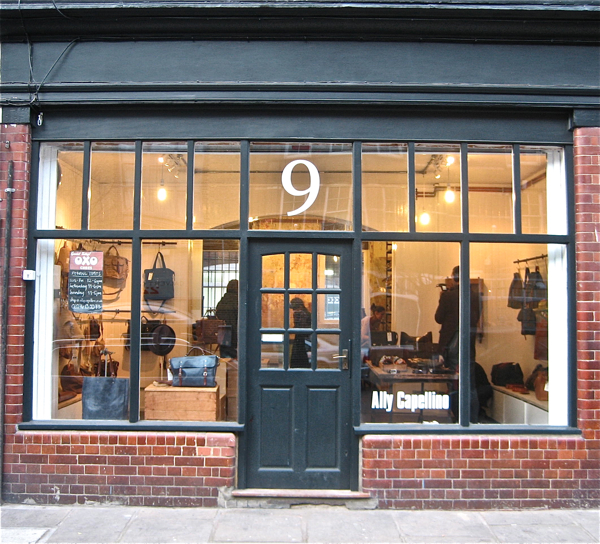
Ally’s shop in Calvert Avenue.
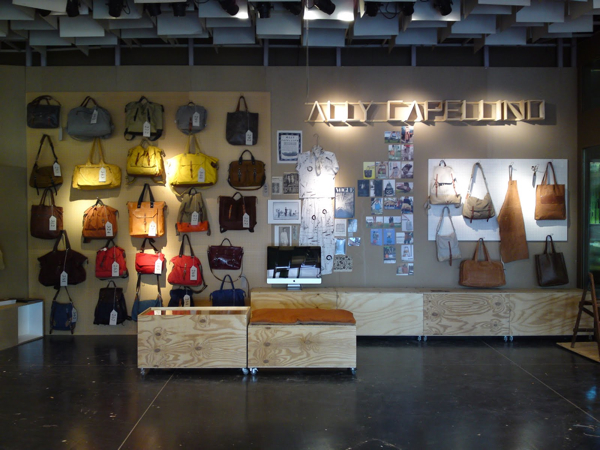
Ally Capellino at Pitti Immagine Uomo in Florence.
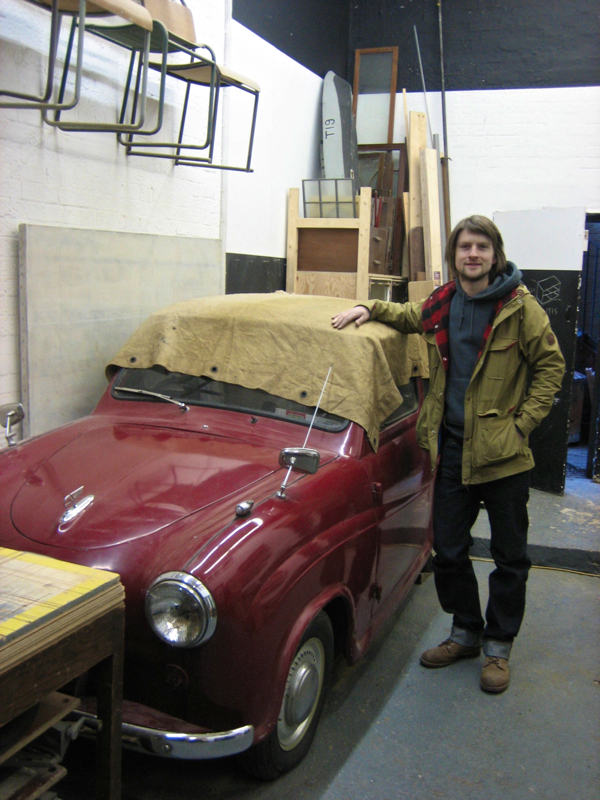
Rupert Blanchard in his workshop.
My other Calvert Avenue stories:
How Raymond’s Shop became Leila’s Shop
Ainsworth Broughton, Upholsterer
Tom Disson, Fishmonger

Tom shows Jesus’ thumbprint on a Haddock
Cod are spawning now. We are in that short season of four to five weeks each Spring when fresh Cod roe is available – and fishmonger Tom Disson has his supply, that he boiled up at the back of his shop in the Roman Rd, on sale now. Tom’s long-standing East End customers are eager to enjoy this celebrated annual treat – far superior to the frozen variety – delicious spread on toast or prepared in the traditional manner, sliced and deep fried in batter. From behind the counter yesterday, viewing the world through the narrow frame of the shopfront at “George’s Plaice,” I watched them all come along and halt in their tracks to admire Tom’s magnificent display of steaming Cod roe glistening on the slab.
Tom knows his customers by name and our conversation was regularly punctuated as Tom turned his head to utter a greeting to each person that appeared in the field of his peripheral vision, flitting past the shop window – “Hello Mary Love!”- “Hello Ted!” – “Hello Ginger!” There has been a fishmonger on this site since 1898 and today “George’s Plaice” is the centre of the world in the Roman Rd, where customers come to introduce their daughters to cockles and to order jellied eels for their mother’s funeral, while Tom keeps everything buoyant with constant flow of banter, both lewd and lugubrious by turns. “Are you looking for service? I’m feeling chesty today.” proposed Tom with a provocative comedy smirk as his customers scrutinised the kippers, heroically suppressing the heavy cold that is getting him down.
“My dog had a wart on its ear and do you know what it cost me? – £387 to have it removed!” protested Tom, sharing his affront at the iniquity of our times, with Rene who matched it with an account of her greyhound’s broken leg that cost £475 to set, a statement countered by Tom’s revelation that his dog required cream for its foot, to stop it scratching, that cost £85. A resultant empathetic silence of mutual outrage prevailed while Tom wrapped up Rene’s fish, before an exchange of genial smiles accompanied the close of the transaction.
“I was a banana salesman at Fyffes Bananas for fifteen years, until I met my lovely wife at an eel stall in Club Row and that’s how I came to be here.” Tom confided proudly, “She’s an East End girl, born in Poplar from a family of twelve. I’m from West London, but I never had cause to regret moving here because I’ve met some lovely, lovely people over the years. My brother-in-law George was a fishmonger, he used to go down to the country, buying crabs and whelks in Norfolk and Suffolk. He ran this shop for seven years before I took over from him in 1982, and the fellow before him, he was porter from Billingsgate Fish Market.”
Tom has decorated his walls over the last thirty years with an appealing gallery of pictures, some of the old East End, others of himself in former days – with two stuffed oystercatchers in a glass box as the centrepiece of the shop. And the view from the pavement, looking across the expanse of coloured fish to where Tom stands in his white apron and flat cap with the backdrop of framed pictures is a memorable spectacle.
Week in, week out, through all weathers, Tom sits keeping his fish company with his good pal Geoffrey (“East End born and bred”) a former publican. “There used to be thirty-two pubs between here and Shoreditch, but if there’s eight now it’s a lot,” posited Geoffrey regretfully, in a quiet moment yesterday. “We’ve definitely seen the best days,” agreed Tom, nodding with a sardonic grimace, playing Vladimir to Geoffrey’s Estragon in this fish shop re-enactment of “Waiting for Godot.” “Years ago, you had so much banter with the people, we used to have queues both ways on a Saturday morning!” continued Tom, crossing his arms, gazing across the gleaming fish for consolation, and smiling fondly in a reverie of the glory days of fishmongery in the Roman Rd.
Yet the moment a customer appeared, Tom and Geoffrey both sprang into animated life, eager to please, because they appreciate the esteem with which the local people hold this shop – as an unchanging landmark and reminder of the time when people always greeted each other in this neighbourhood. For Tom Disson, it is no duty, it is his joy, because this is his community. His customers may be aging but the affection with which “George’s Plaice” is held by the populace of the Roman Rd ensures that this performance is destined to run on for a few more years yet. And in the meantime, you must take the chance to visit the last old fish shop in the East End, and enjoy for yourself the rare delicacy of freshly boiled Cod’s roe while it is still in season.

Choosing the Haddock.

Choosing the Cod Roe.

Tom waits while customers deliberate over the Skate.

A satisfied customer, delighted with her Cod Roe.


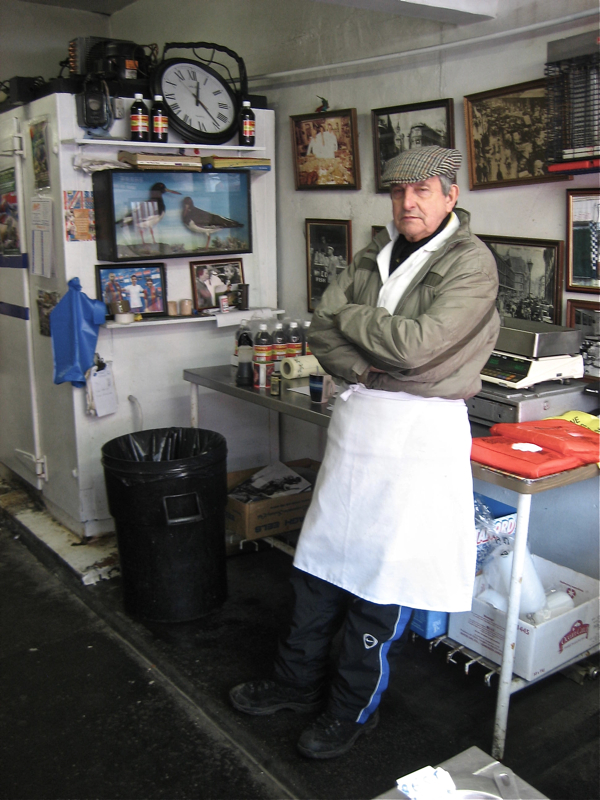

1985


1985
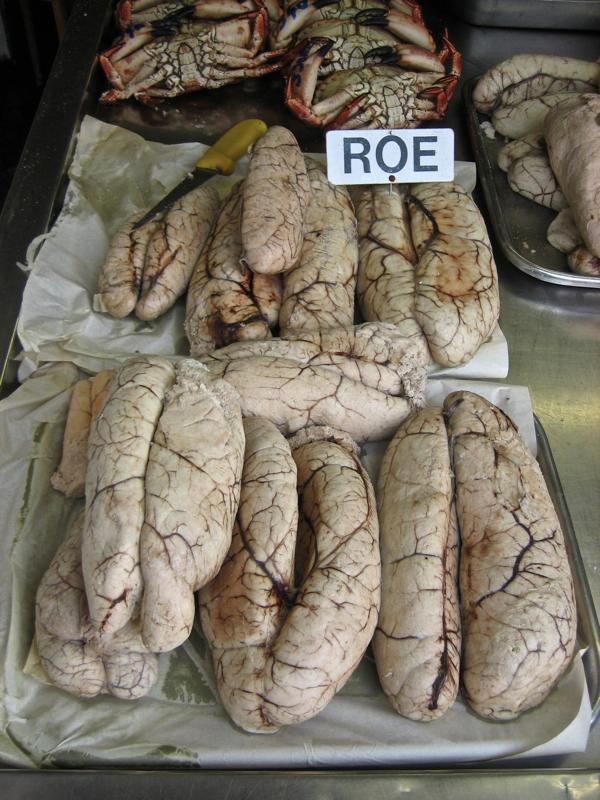
Tom’s magnificent display of freshly boiled Cod roe.

Tom Disson, 1985

Tom Disson, 2011
You may also like to read my stories about Gary Arber’s Printing Works in the Roman Rd