
The Old Signs of Spitalfields

Commit no Nuisance
I am the keeper of the old signs in Spitalfields. I have embraced it as my self-appointed duty, because although many are “dead” and others have become “ghosts,” disappearing into ether, they are all of interest to me. By “dead” signs, I mean those that no longer have a function, where their useful life is over, and by “ghost” signs, I refer to the next stage in the afterlife of signage where the text fades into illegibility until eventually no trace remains.
Some old signs are prominently placed and some are hidden in obscure corners but, irrespective of their locations, their irrelevance has rendered them invisible – yet I welcome them all into my collection. The more shabby and disregarded, the more I like them, because, as the passing years have taken away their original purpose, these signs have become transformed into poetry. In many cases, the people whom these notices address are long gone, so unless I am there to pay attention to these redundant placards and grant them dignity, they can only talk to themselves like crazy old folk rambling in the dark.
Given that the street name was altered generations ago, who now requires a sign (such as you will find at the junction with St Matthew’s Row) to remind them that Cheshire St was formerly Hare St, just in case of any confusion? I doubt if even the oldest resident, ninety-six year old Charlie Burns in nearby Bacon St, can remember when it was Hare St. And yet I cannot deny the romance of knowing this older name, recalling the former hare marsh at the end of the street.
Ever since someone pointed out to me that “Refuse to be put in this basket” could be interpreted as an instruction to reject being placed in the basket yourself, the literal netherworld implied by signs has captivated me. Now when I see the sign outside the travel agent in Brick Lane with the image of Concorde, I yearn to go in and ask to buy a ticket for Concorde as if – through some warp in reality – the sign was a portal inviting me to a different world where Concorde is still flying and this office in Spitalfields is the exclusive agent. I am fascinated by the human instinct to put up signs, craving permanent declarations and desiring to accrete more and more of them, whilst equally I recognise it is in the survival instinct of city dwellers that we learn to exclude all the signs from our consciousness, if we are to preserve our sanity.
To my mind, there is an appealing raffish humour which these old signs acquire through longevity, when they cock a snook at us with messages which the passage of time has rendered absurd. “Commit no Nuisance” painted discreetly in Fournier St on the side of Christ Church, Spitalfields, has long been a cherished favourite of mine. I wonder what genius came up with this notion, which if it were effective would surely be emblazoned on every street in the world. It could solve many of the problems of humanity at a stroke. Although, unfortunately, it does rely upon a certain obedient compliance from those most likely to offend, who are also those most unlikely to pay attention. Almost faded into illegibility today, with pitiful nobility, “Commit no Nuisance,” speaks in a polite trembling whisper that is universally ignored by those passing in Commercial St.
Even in the face of evidence to the contrary, signs can still propose a convincing reality, which is why it is so perplexing to see those for businesses that no longer exist. They direct me to showrooms, registered offices and departments which have gone, but as long as the signs remain, my imagination conjures the expectation of their continued existence. These old signs speak of the sweatshops and factories that defined the East End until recently, and they talk to me in the voices of past inhabitants, even over the hubbub of the modern city. Such is the modest reward to be drawn from my honorary role as the keep of old signs in Spitalfields.

Generations have passed since Cheshire St was known as Hare St.

This sign at the entrance to Dray Walk in the Truman Brewery, closed twenty years ago, was once altered from “Truman’s” to “Truman Ltd” when the company was sold, and, with due respect, the name of successive company secretaries was updated in stencilled lettering. These considerations are mere vanities now upon a dead sign surrounded by ads for the shops and bars that occupy Dray Walk today.

Travel agent on Brick Lane offering flights on Concorde.

Steam department works office in Fashion St.

Today’s top prices at the scrap metal dealer in Valance Rd.

Incised on the side of Christ Church Spitalfields: In case of fire apply for the men of the engine house and ladders at the Station House, No 1 Church Passage, Spital Square. 1843. A precaution adopted after the great fire of 1836.

No more enamelling on Brick Lane.

No more veneers on Great Eastern St.

Car Park on Petticoat Lane.

Registered Office in Commercial St.

Charlie’s Motors once offered services from £30 in Brady St.

On Christ Church, Spitafields: All applications about Marriages, Burials & c. at this church must be made to Mr Root. Note the reference to Church St – renamed Fournier St in the nineteenth century.

Car Spares on Three Colts Lane.

On Commercial St, “Woollen” overpainted onto “Glass Globes”

In Aldgate, Ben Eine adorns Stick ‘Em Up! sandwich bar.

Off Charlotte Rd, a courteous hand directs you to non-existent showrooms.

Diaphanous oblivion on Commercial St.
Jimmy Keane, Caretaker

Here is Jimmy Keane, sitting comfortably in his executive chair in his office in the basement of the former Godfrey & Phillips Tobacco building in Commercial St where he has been caretaker for forty years. This mighty edifice on Commercial St, clad in biscuit-brown ceramic bricks, is so large that you can see it filling the entire top left corner of the photograph of Spitalfields which is our header this month.
Few ever get to venture down to Jimmy’s secret lair in the basement of his building, and I recognised I was a favoured guest when he escorted me in from the cold and wet, down the stairs, along the passage and into his private enclave where, as I passed through the metal door, I realised the air was several degrees warmer. “They call me site manager but really I’m just a caretaker. I listen to complaints from the tenants and I sort it out if I can and, if not, I refer it to my superiors.” he said as he poured me a cup of tea, outlining the boundaries of his responsibility with elegant equanimity.
We were in a sparsely furnished room with no windows, that possessed both tranquillity and a climate of its own, where Jimmy could feel at ease in his short-sleeved shirt even in the depths of Winter, and be at peace with his thoughts.“I was in at four-thirty this morning,” he explained with sprightly humour and an Irish twang, gesturing to his thin windcheater drying on a coat-hanger suspended from a pipe, “It was chucking it down, but you just keep walking, because you’ve got to get to work even if it’s raining.”
So there we were in a cosy bunker beneath Spitalfields, where I could ask Jimmy anything and no-one could overhear our conversation. The nature of Jimmy’s employment has given him a unique view of the social changes during his tenure, as an observer with privileged access, and I was eager to learn his appraisal of the different worlds that have passed before his eyes between the walls of this former cigarette factory.
“When I took this job in 1971, the rag trade people were running this area – all Jewish factories in them days. It was rough and ready, now it’s a bit more upmarket. The people working in the sweatshops didn’t have a great deal of freedom, you either did the work or you were sacked. The rag trade wasn’t an easy life to be in. What do you call progress? I suppose it’s progress that those things aren’t done in this country anymore. I saw all that go, and now I’m dealing with a different crowd of people now who’ve got credit cards and they’re upmarket. I haven’t got the education for that kind of thing. What people got in this country was barely a living, they were exploited. But there’s more pressure now on these people I see here on their laptops – if they lose, they can lose a lot. Don’t get me wrong, I’ve had my knocks and I’ve put them behind me. These people come with stress every day. They’re nice people, but I don’t envy them because I’ve got freedom, to me these people haven’t got freedom.
Thirty or forty years ago, people might earn £4 a week and spend £3 of it on beer! They were getting a weekly wage in cash and they didn’t worry about mortgages. When the market and brewery were working twenty-four hours, there were singsongs in the pubs at six in the morning. It was a different buzz and people were happier in themselves, but they were crazy gamblers, horse-racing, dog-racing, dice, cards. They’d love a gamble! I say there’s only two kinds of people that gamble, the needy and the greedy.
When the rag trade was here, I used to go home at Christmas with three or four hundred pounds in cash from tips, now the excuse is, “We don’t carry cash.” They’re a different quality of people today, they’re more selfish. They think because they’re middle class they can look down their nose at you sometimes, but I’m one of those who won’t take it from my employer and I won’t take it from these people either. It’s a lot of snobbery! At the end of the day, I don’t need them but they need me, so I am in a strong position. I’m more or less my own governor here and I’m quite contented.
I was born in Ireland in 1935. There was little work there in the early nineteen fifties, so when my father completed his twenty years in the British army, based in Birmingham, we moved down to the East End. That was 1951. There wasn’t much work in London, I did lots of jobs from making ice cream to being a cooper’s mate. Things only picked up in the late fifties and early sixties, when the building trade expanded. I used to do a bit of work for the family that owned this building and I came here to do a bit of painting, they were Orthodox Jews. Very nice people, and I have worked for three generations of the same family. They wanted a caretaker and I have been here ever since.”
It was a clear-eyed testimony, told with humour and without cynicism, and I was full of admiration for the way Jimmy had recognised the beauty of his situation and negotiated a self-respecting independence of spirit. Resuming a professional persona, he pulled on his long blue coat, standing up with all vigour and swagger of a man half his age, and bragging of how he kept fit running up and down all the stairs.
And when we emerged into the public area, Jimmy began telling me how he had been featured in a fashion shoot by Dazed & Confused when they were based in the building, and how it led to some other modelling work, and how much he enjoyed it, and how he had done quite well out of it, and how they told him he was a natural. Then several young people who worked in the building in media and fashion companies ran up to him, to greet and embrace him enthusiastically, which delighted him, and I saw how popular he was, and I realised that I had been party to the private thoughts of Jimmy Keane, the caretaker – but fortunately I know I can rely upon you to maintain his personal discretion.

Down in Jimmy’s den.

Jimmy, the proud custodian.

In Jerome St, the lettering of the former cigarette factory remains.

Geraldine Beskin, Occultist

Geraldine Beskin presides as serenely as the Mona Lisa from behind her desk at the Atlantis Bookshop in Museum St, Bloomsbury – the oldest occult bookshop in the world, one of London’s unchanging landmarks and the pre-eminent supplier of esoteric literature to the great and the good, the sinister and the silly, since 1922. “My father came into the shop one day and Michael Houghton, a poet and a magician, who founded it and knew everyone from W.B.Yeats to Aleister Crowley, took a good look at him and said, ‘You’ll own this place one day.'” Geraldine told me, with a gentle smile that indicated a relaxed acceptance of this happy outcome as indicative of the natural order of things.
“I started working here when I was nineteen, and I’ve read a tremendous amount and I’ve done some of it – because you have to be a reader to be a good bookseller.” she said, casting her eyes around with proprietary affection at the sage green shelves lined with diverse and colourful books old and new, organised in alphabetical categories from angels and fairies, by way of magic and paganism, to werewolves and vampires.“This place was set up by magicians for magicians and that’s a tradition we continue today.” boasted Geraldine, who guards this treasure trove with her daughter Bali, the third generation in the book trade and a fourth generation occultist.
Yet in spite of the exoticism of her subject matter, Geraldine recognises the necessity for a certain rigour of approach.“There are New Age shops that sell dangly things and crystals, but we don’t, we’re a quality bookshop” she said, laying her cards boldly yet politely upon the table,”We are not faddist, we have an awareness of the contents of the books.” Working at her desk, sustained by copious amounts of tea, Geraldine is an enthusiastic custodian of a wide range of esoteric discourse upon matters spiritual. “The esoteric is an endless source of fascination,” she assured me, her eyes sparkling to speak of a lifetime’s passion,“There are so many facets to the esoteric that you need never run out of things to be amazed by.”
I am ashamed to confess that even though I pass it every time I walk to the West End, I never visited the Atlantis Bookshop before because – such is the nature of my credulity – I was too scared. But thanks to Simon Costin of the Museum of British Folklore who arranged my introduction to Geraldine, I made it across the threshold this time, and once I was in conversation with Geraldine who admits to being a witch and practising witchcraft, although she prefers the term “occultist,” I discovered my fears were rootless. However, my ears pricked up at the innocent phrase, “I’ve done some of it,” which Geraldine dropped into the middle of her sentence quite naturally and so I enquired further, curious to learn more about the nature of “it.”
“My grandmother, me and my daughter all do it. My dad did it.” she declared, as if “it” was the most common thing in the world, “I come from a family of esoterics. I was born into it, so I think it would be immoral to own a shop like this and not appreciate what people are doing. Loosely it could be called witchcraft, but in reality it is a certain perception or background intuition.”
“Our subject has become very fashionable and young academics don’t have a bloody clue, which is very frustrating for us.” she continued, rolling her eyes at the inanity of humanity,“We try to disabuse people of the myths about witches, they are good kind people on the whole. Most witches are as mortgage-bound and dog-walking as everyone else. Most witches do healing, and buy toilet paper. And there is this side of trying to commune with nature and be aware of the cycle of change. It’s a very rich and rewarding way of life. I practise a bit of magic – there’s so much you can’t learn from books and you have to do it yourself.”
With her waist-length grey hair, deep eyes, and amusingly authoritative rhetorical style, Geraldine is an engaging woman of magnanimous spirit. And I cannot deny a certain vicarious excitement on my part, brightening a grim January morning to discover myself seated in this elegant empty bookshop in Bloomsbury in conversation with a genuine witch. Yet I was still curious about the nature of “it.” So I asked again.
“Witchcraft is a very benign religion, where you work around the seasons of the year.” explained Geraldine patiently, in a pleasant measured tone, “You start off in darkness, and, in Mid-Summer, the Holly King and the Corn King have a fight and the Holly King wins and then the light begins to decline. At Yule, they fight again and the Corn King wins and the light begins to come back to the world. In agrarian societies, people got up at dawn and worked until dusk, and they adjusted how they lived by the seasons. It was the Christians who gave us the devil and we don’t know what to do with him. We have a horned god who is the god of positive male energy – not a devil at all, but the poor soul has been demonized over the years.”
Geraldine convinced me that esoteric cultures from the ancient world remain vibrant, by reminding me that witches were always “green,” ahead of their time in ecological awareness, and – although she could not disclose names – by revealing that top celebrities, from princes to pop-stars, have always frequented the Atlantis Bookshop. “We make a play of only giving out the names of our famous dead customers,” she confided to me with a tantalising smirk. “Most of our customers are practitioners – witchcraft has become the default teenage rebellion religion today,” she added with an ambivalent grin, confirming that, in spite of everything, the future looks bright for witches.
You watch a short film of Geraldine Beskin at the Atlantis Bookshop by clicking here.

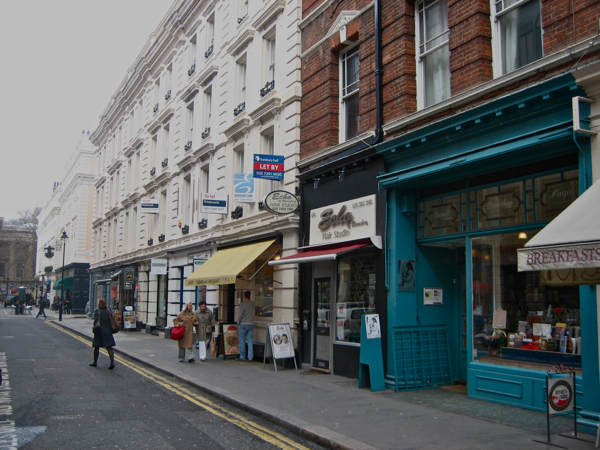
The British Museum awaits at the end of the street.


Geraldine and her sister Tish outside the bookshop in the nineteen seventies – “Those were the days when the Rolling Stones and the Beatles used to come in.”
Norman Phelps, Model Boat Club President
In July, it was my privilege to interview Norman Phelps in what proved to be his last Summer upon the lake at Victoria Park where he sailed boats for more than seventy years. Norman died on Christmas Eve and today I am republishing my pen portrait as a tribute to a wonderful man who became a legend in the world of model engineering.

This is Norman Phelps, President of the Victoria Steam Boat Club, proudly displaying his ratchet lubricator that he made recently – just the latest example of an enthusiasm that began in 1935 when, at the age of five years, he fell into the boating lake in Victoria Park. It might have been a tragedy but instead it was the beginning of a lifetime’s involvement with model boats, and seventy-five years later, you can still find him at the lakeside on Sundays, giving the benefit of his experience to the junior members of the club.
Norman was understandably wary of speaking to me because the last time he gave an interview in 1951, he got taken for a ride by the News Chronicle. Although Norman spoke at length about the venerable club, all that got published was a souped-up account of how he courted his wife at the lake over the model boats. Seizing the opportunity to set the record straight, Norman generously sat down with me next to the boating lake last Sunday and spoke with lyrical ease.
“I was always known, not by my father’s name of Phelps, but as Watson – because my mother was famous as “Dolly Watson” on account of running the sweetshop in Rockmead Rd, where I grew up. I stayed in London all through the blitz and I saw the city burning and I saw this park blown apart, and our house was destroyed by a rocket in early 1945. Because of the bombing everyone knew everyone else. I saw neighbours dead on the pavement and I heard people crying out from beneath the wreckage of buildings where we could never dig them out. I saw the Home Guard practising with wooden rifles because we didn’t have real ones. It was crazy!
Funnily enough, I married a girl from Seweston Rd, on the other side of the park. I met her dancing at the Hackney Town Hall and because we were keen dancers and won prizes, we decided we would race model boats and see if we could win. We joined separately, but we did our courting through the club, and she won a lot of prizes and ruffled a few feathers. She’s been running boats her whole life and she still is at seventy-eight.
We got married in 1956, had our reception in the clubhouse and I was made secretary of the club at the same time. They gave us a presentation box of cutlery as a wedding present that we have today. In the early days, I supported my wife because she had such an enormous predilection to compete. She’s won so many prizes, we’ve got boxes full. If we turned up to compete, other people would say, “Let’s give up now!” It was the art of straight-running. I did the designing, and she did the maintenance and cleaning. My wife was the talent, and I tended to stay in the background and be the club secretary and that was enough.
To be a great straight-runner you have to know a lot about the water and the wind, and the boat itself has to be considered too. The greatest talents in the world have competed here. So many people have gone now but I saw all the greatest exponents, like Stan Pillinger of Southampton, John Benson of Blackheath, Peter Lambert of St Albans, Jim King of Welwyn and Edgar Westbury, editor of Model Engineer. In this club we were lucky, we had pawnbrokers, jewellers, butchers, several tug skippers from the Thames – many of our members were skilled people. They didn’t have any money, so they built boats out of cocoa tins and orange boxes, producing some of the finest straight-running hulls in the club.”
Norman recognises that the flourishing of the boat club was in direct correlation with the heyday of skilled trades. He speaks passionately of the deference that existed between the members who all brought their different areas of experience and abilities to the boat club, and the culture of mutual respect that went with it, based never upon economic status but always upon skill. Tanned and lined from endless Summers on the lake, still with thick white hair and a scrawny energetic physique, he looks like a character drawn by Mervyn Peake. Possessing an eloquent tongue and a raucous laugh, Norman is engaging company too, with tender stories to tell of former members, especially his friend Bill, “even though he was a South London boy, we managed to see eye to eye.”
“So many have pegged out. I can’t get my head round it. I suppose I’m next for the chop.” he continued with a droll grimace, crossing his arms protectively. Yet Norman remains fiercely proud of the culture of the boat club and their marvellous vessels, honed to perfection over so many years. “This is still the home of straight-racing, we have the greatest talents here.” he said, indicating a pale young man in waders enjoying a quiet sandwich, who blushed readily as I was authoritatively informed he was the grandson of “a great talent”.”These skills are rare now. I spoke to the editor of Model World recently and he told me they have people ringing up because they can’t even put kits together today,” Norman declared in breathless amazement, before lowering his voice further and raising his brows to confide, “None of our members can give out their home addresses, because the boats have become too valuable and they don’t want to get turned over.”
“Who needs a computer?” asked Norman in derision, “I have a problem with the lubrication of my boat engine to solve.” But in spite of his disaffection, the contemporary world is affecting the boat club in ways that are not entirely disadvantageous, and even skills nurtured through computer games have their place here. “We have lowered the age limit for membership from twelve to ten, because nowadays ten-year-olds are better with the radio controls than we are.” declared Norman proudly.
I can understand Norman’s ambivalence when he has lived through such big times, during which the Victoria Model Steamboat Club sailed on as a beacon of civility across troubled water. Its survival today as one of only two in existence (along with Blackheath), makes it all the more important as a reminder of the best of that other world, before the computer, when just a few people sat behind desks and most possessed a skilled trade that enabled them to earn their living and achieve self-respect too.


You also like to take a look at these other stories about the Victoria Model Steam Boat Club
Fiona Skrine, the Sit-in at Spital Square

Architectural historians, Mark Girouard and Colin Amery, with Fiona Skrine and Joanna Price during their sit-in, December 1981

Fiona Skrine came to Spitalfields as a student and left as a married woman with three children, and in the midst of this sojourn she found herself photographed for a national newspaper as part of a sit-in organised by the Spitalfields Historic Buildings Trust to save St Botolph’s Hall in Spital Square from the bulldozers in December 1981.
During the post-war boom in fresh fruit & vegetables in the nineteen fifties, the expansion of the market had destroyed some of London’s finest Georgian houses in Spital Square, which had otherwise survived almost unchanged since Dickens visited a silk warehouse there a century earlier. But now, emboldened by a saving a couple of eighteenth century weaver’s houses in Elder St by occupying them, the Trust decided to challenge the trustees of the Central Foundation Girl’s School who wanted to demolish their school hall without entertaining the possibility that it might have a future.
It is a measure of the success of this protest, in which Fiona is proud to have played a part, that last week she was able to return to Spital Square, almost thirty years later, to admire the handsome red brick edifice in the Flemish Renaissance style which is now home to the celebrated La Chapelle restaurant, and one of the few original buildings left to grant a significant gravitas in what might otherwise be a soulless corner. In retrospect, the occupation of St Botolph’s Hall marked a change in public opinion, as the moment when the unquestioning demolition of old buildings became unacceptable. And, today, the Spitalfields Trust, which stemmed the tide of destruction in Spitalfields that began in the nineteen sixties, is itself a venerable institution, even though when it was started by a group of architectural students who adopted the tactics of radical intervention – through squatting, occupations and sit-ins – they were, as the Director Douglas Blain recently admitted, “street fighters.”
“My sister Anna saw the bulldozers moving in, so she rang around to get enough people into the building and have it occupied so they couldn’t knock it down.” recalled Fiona, filling with enthusiasm to savour the memory, “I took a day off college, and my friend Joey (Joanna Price) also took the day off to support me. It was so dark and cold in December. The place had been stripped out, with no floorboards, and we wished we had brought warmer clothing and a thermos. We were there for one night, and then others took over and I’d done my bit. Although next day I had to justify it because you had to sign in at college, but fortunately it was very much in the spirit of the place, (the City & Guilds Art School in Kennington where I studied decorative art techniques) and when my teacher said, ‘Where were you yesterday?’ I said, ‘I was saving a building!'”
I could not tell whether spending a freezing night in St Botolph’s Hall in December with the threat of bulldozers outside, while locked in by the police for her own safety, was a rite of passage for Fiona. Yet in spite of living in a rat-infested house at first, she developed a great affection for Spitalfields – becoming drawn into the close knit society of young people of limited means and great imaginative enterprise who set about restoring the dilapidated eighteenth century houses with their own hands. Fiona’s sister Anna Skrine and Fiona’s husband photographer Simon de Courcy Wheeler were portrayed by ceramicist Simon Pettet in the famous fireplace of delft tiles that he made for Dennis Severs’ House illustrating Spitalfields personalities of the day. So it was highly appropriate that Simon made a delft fireplace as a wedding present for Fiona and her husband, when they took on the renovation of a house in Wilkes St as their family home.
“We bought an eighteenth century house with no floors or walls, and we threw a party with candles and that was how it began.” said Fiona, proud to recount the exuberant folly of her youth, “Wilkes St was pretty grotty in those days, the smell of the hops from the brewery at the end of the street was overpowering and these huge lorries of produce for the market thundered past. The house was in bad repair, it needed to be gutted, re-roofed and the panelling put back, although there were enough original fireplaces and surviving panelling to work out how to restore it. The house cost £40,000 and my father put aside another £40,000 for the building work. I was still at art school then, but I scraped and filled and painted every inch of that house myself, I did all the manual work once the builders had left.
We bought most of our furniture on Brick Lane, it was a tremendous adventure, getting up early and carting old chairs and chests of drawers back. The early eighties were a great time to be in Spitalfields with the excitement of everyone doing up their houses. We did it ourselves because we didn’t have much money, and there was always plenty of gossip and shenanigans going on. We were endlessly in and out of each others houses in those days and the Market Cafe in Fournier St was were we all met up. I had a lovely time because, in between having three children, restoring the house in Wilkes Street was the springboard for my career as a decorative artist and my first couple of commissions were auspicious.
English Heritage asked me to reproduce the colour ways of twenty Pugin wallpapers for the Palace of Westminster that was being renovating at the time. So I spent a few months at the V&A, reproducing the colours as accurately as I could with my gouaches, and then I was commissioned to paint replicas of old wall hangings for the Tower of London. I enjoyed these historic commissions, although later my work involved me in creating new decorative schemes around London and in Europe too.
Each Summer, I’d take the children to Ireland and it would be a shock to return to this soulful little house in this dark street, where you hardly saw the light and there were no trees – really quite grim, yet with lots of life too. All my children were born in the house, three home births. The midwife came on a motor bike when I had my first child, and it was 1987, the night of the hurricane, she was dodging falling chimney pots and trees.”
“I couldn’t go back to the house after we sold it, because I put too much of myself into it.” she confided in conclusion, as the emotion of the story dawned upon her.
Fiona came down from her home in North London to spend a morning with me before driving one of her grown-up children to university in Sheffield, and as well as walking over to Spital Sq in the rain, we visited the houses that the Spitalfields Trust is currently renovating in Fournier St. I realised it was a sentimental pilgrimage for Fiona Skrine and I was delighted to accompany her because, as the photos above reveal, she carries the same bright energy today and still cherishes her moment of youthful protest.

Ann Skrine, as portrayed in Simon Pettet’s tiles at Dennis Severs House

Simon de Courcy Wheeler, Fiona’s husband.

Fiona at St Botolph’s Hall
Columbia Road Market 65

My personality is such that once the Christmas decorations come down, I discover myself looking out the window and searching vainly in the garden for signs of Spring, even though I know there are months of Winter yet to pass. Over the years, I have discovered a means to ameliorate this unfortunate character flaw, I go to Columbia Rd Market and buy bulbs to create Spring indoors in January. It never fails to lift my spirits when – walking into the living room each morning – I am surprised by the heady scent of Hyacinths, sprouting in a dish upon the dresser. You may recall those that I plant annually in the old blue bowl which, after last year’s aberration of pink flowers, turned out blue again, thus permitting my grandmother who started this Hyacinth rigmarole to sleep peacefully in her grave for another year.
The scented Paper-whites above cost me just £1 at Columbia Rd and they fit nicely in this fine early nineteenth century porcelain bowl that I found in Brick Lane Market for £5. Prices for Winter bulbs at Columbia Rd have dropped dramatically since Christmas with potted Amaryllis that I bought for £3 in December now on sale at just £1, which makes it worth braving the weather to go along and bring some home to elevate your days. £1 also buys a pot of miniature Daffodils, which encouraged me to buy a tray of ten and fill two flowerpots on my window sill, so that I can look out and be rewarded with the sight of new life, even while the garden itself is dormant. Now each day brings me new growth to sustain my hopes, as a harbinger of the Spring that I know will come eventually.


Epilogue. The Weasel

You recall Detective Inspector Frederick Porter Wensley who played such an important role in the detection of the Houndsditch Murders and the subsequent Siege of Sidney St. Throughout his long and spectacularly successful career, he kept an album now preserved in the archive at Bishopsgate Institute where he pasted all his press reports conscientiously and labelled them with beautiful hand drawn lettering.
It was a labour undertaken with such consideration and care that it must have become an important solace for the great crimefighter to repair to his study with scissors and a pot of glue, and spend countless hours innocently engaged in arranging his cuttings. Many aspire to become the hero of the their own life story, but Wensley read it in the newspapers. It was a story that began in Spitalfields when he joined the police at the time of the Whitechapel Murders in 1887 and ended when he died in the era of the Krays in 1949. Just like a movie star contemplating his rave reviews, Wensley took pleasure in his write-ups, as witnessed by the attention he lavished upon collecting and preserving them, and it fascinates me to turn the pages of his precious album and appreciate something of the enigma of the man they knew as “the weasel.”
A year after the violent shootout on Sidney St, Inspector Frederick Porter Wensley was promoted to Chief Inspector of the Detective Department at Scotland Yard, though crucially he remained in charge of the Whitechapel District where he made his reputation. Prior to the Houndsditch case, Wensley was frustrated that he had not been appointed to the role of detective because it would mean a transfer out of Whitechapel, when his local knowledge proved invaluable to the local constabulary. As well as this promotion, Wensley was awarded a medal by the King and this recognition was the first step in his rise to become the pre-eminent London detective of the day, the man later described by the Sunday Express as, “Sherlock Homes in real life.”
Yet while the papers where quick to celebrate Wensley’s triumphs in crimefighting, they did not quite idealise the man – reading between the lines – as these character descriptions attest,“Frederick Wensley is not a talkative man. He speaks with blunt vigour and stops when he has finished. And his mind works in something of this direct fashion. He goes straight to the heart of the matter. He disregards the non-essentials so completely that I am inclined to think he does not notice them. So far as he is concerned they do not exist. One bludgeon stroke and they are gone.”
“He was a rare physical fighter when criminals showed fight. In his active outdoor days, a fight, if forced upon him, was all in a day’s work.”
“A burglar wrote: ‘Of all the police I have known in my life, he was easily the sternest.'”
In the years following the Houndsditch case, Wensley arrested the notorious Stinie Morrison who murdered Leo Beron on Clapham Common, and then convicted Voisin the Butcher who murdered Madame Gerard in Bloomsbury. Later, he brought Edith Thompson & Frederick Bywaters to justice, the perpetrators of the Ilford Tragedy, and took charge of the investigation into the case of the poisoned chocolates sent to Sir William Horwood. However the laughs were not all on Wensley’s side, because one night burglars broke into his house in Palmer’s Green whilst he and his wife were sleeping peacefully in their beds and stripped the house of everything of value including his Police Medal presented by the King. Wensley gamely told the press, “Whoever was responsible for the burglary, I am obliged for the sporting way they have behaved.”
Upon retirement, Wensley wrote ‘Detective Days,’ his bestselling biography with accounts of crimes to outstrip any work of fiction. And when the newspapers no longer had new heroic exploits of Wensley to report, he wrote his own for the press, retelling the tales of crimes long ago for a whole new generation, and rounding out his life story nicely.
When I consider Wensley’s involvement in the investigation of the Houndsditch murders, although I grant that he went bravely under gunfire to rescue Sergeant Leeson who had been shot in Sidney St, there is another detail that sticks in my mind. Entering the house in Grove St after the tip-off that a body was there, he was concerned lest gunmen be lying in wait, as his colleagues had discovered to their cost in Houndsditch a few days earlier. Ever the pragmatist, Wensley boasts in his autobiography, how, to remedy this eventuality, he pushed the fat landlady upstairs ahead of him, thus creating a human shield.
As the portrait above suggests, with its strange expression that is simultaneously half-serious and half-smiling, there were different sides to Wensley’s personality. May I remind you of origin of the word ‘”weasel,” and you can decide upon its suitability or otherwise as a nickname for Wensley? – because “weasel” derives from the Anglo-Saxon root “weatsop” meaning “a bloodthirsty animal.”

Detective Inspector Wensley disguised as a soldier raids an East End gambling den.


Wensley’s album with his personal collection of villains’ mugshots that he carried in his wallet.


Images copyright © Bishopsgate Institute
You can read the full pitiful story of the Houndsditch Murders and the Siege of Sidney St here
Chapter 1. Murder in Houndsditch
Chapter 3. A Funeral at Christmas
Chapter 5. Shootout in Sidney St


