Maurice Franklin, Wood Turner

If you were to rise before dawn and walk down the empty Hackney Rd past the dark shopfronts in the early morning, you would very likely see a mysterious glow emanating from the workshop at the rear of number forty-five where spindles for staircases are made. If you were to stop and press your face against the glass, peering further into the depths of the gloom, you would see a shower of wood chips flying magically into the air, illuminated by a single light, and falling like snow into the shadowy interior of the workshop where wood turner Maurice Franklin, who was born upstairs above the shop in 1920, has been working at his lathe since 1933 when he began his apprenticeship.
In the days when Maurice started out, Shoreditch was the centre of the furniture industry and every premises there was devoted to the trade. But it has all gone long ago – except for Maurice who has carried on regardless, working at his lathe. Now at ninety-one years old, being in semi-retirement, Maurice comes in a few days each week, driving down from North Finchley in the early hours to work from four or five, until eight or nine in the morning, whenever he fancies exercising his remarkable talent at wood turning.
Make no mistake, Maurice is a virtuoso. When rooms at Windsor Castle burnt out a few years ago, the Queen asked Maurice to make a new set of spindles for her staircase and invited him to tea to thank him for it too. “Did you grow up in the East End?” she enquired politely, and when Maurice nodded in modest confirmation of this, she extended her sympathy to him. “That must have been hard?” she responded with a empathetic smile, although with characteristic frankness Maurice disagreed. “I had a loving family,” he told her plainly, “That’s all you need for a happy childhood, you don’t need palaces for that.”
Ofer Moses who runs The Spindle Shop – in the former premises of Franklin & Sons – usually leaves a list for Maurice detailing the work that is required and when he returns next morning, he finds the completed wood turning awaiting him, every piece perfectly achieved. But by then Maurice will already be gone, vanished like a shade of the night. So, in order to snatch a conversation with such an elusive character, a certain strategy was necessary which required Ofer’s collaboration. Early one morning, he waited outside the shop in his car until I arrived, and then, once we had checked that there was a light glimmering inside the shop, he unlocked the door and we went in together to discover the source of the illumination. Sure enough, the wood chips were flying, accompanied by the purr of the motor that powered the lathe, and hunched over it was a figure in a blue jacket and black cap, liberally scattered with chips and sawdust. This was Maurice.
Unaware of our presence, he continued with his all-engaging task, and we stood mesmerised by the sight of the master at work, recognising that we were just in time to catch him as he finished off the last spindles to complete a pristine set. And then, as he placed the final spindle on the stack, Maurice looked up in surprise to see us standing there and a transformation came upon him, as with a twirl he removed his overall and cap, sending a shower of wood chips fluttering. The wood turner that we saw hunched over the lathe a moment before was no more and Maurice stood at his full height with his arms outstretched, assuming a relaxed posture with easy grace, as he greeted us with a placid smile.
“This firm was the wood turning champion of Britain in 1928,” announced Maurice with a swagger.“Samuel, my father, had been apprenticed in Romania and was in the Romanian army for two years before he came here at the beginning of the twentieth century, and then he served in the British Army in the 14/18 war before he opened this place in 1920. He had been taught by the village wood worker in Romania, they made everything from cradles to coffins. All the boys used to sleep on a shelf under the bench then.”
Maurice told me he was one of a family of twelve – six boys and six girls – and he indicated the mark in the floor where the staircase once ascended to the quarters where they all lived. “I started when I was thirteen, I’ve still got my indenture papers” he informed me conscientiously, just in case I wanted to check the veracity of his claim, “I took to it from the start. It’s creative and at the end of the day you see what you’ve made. I’m proud of everything I do or I wouldn’t do it.”
In spite of his remarkable age, Maurice’s childhood world remains vivid to him. “Here in Shoreditch, ninety per cent were Jewish and the ones that weren’t were Jewish in their own way. Over in Hoxton, they’d take your tie off you when you arrived and sell it back to you when you left – but now you couldn’t afford to go there. In 1925, you could buy a house in Boundary St for £200, or you could put down a pound deposit and pay the rest off at three shillings a week. I was born here in 1920 and I went to Rochelle School – They won’t remember me.”
The only time Maurice left his lathe was to go and fight in World War II, when although he was offered war work making stretcher poles, he chose instead to enlist for Special Operations. Afterwards, Franklin & Sons expanded through acquiring the first automatic lathe from America, and opening a factory in Hackney Wick to mass-produce table legs. “Eventually we closed it up because everyone was getting older, except me.” quipped Maurice with a tinge of melancholy, as the last of his generation now, carrying the stories of a world known directly only to a dwindling few.
Yet Maurice still enjoys a busy social calendar, giving frequent lectures about classical music – the other passion in his life. “I especially like Verdi, Puccini and Rossini,” he declared, twinkling with bright-eyed enthusiasm, because having made chairs for the Royal Opera House he is a frequent visitor there. “I like all music except Wagner. You’ll never hear me listening to Wagner, because he was Hitler’s favourite composer.” he added, changing tone and catching my eye to make a point. A comment which led me to enquire if Maurice had ever gone back to Romania in search of his roots. “I’ve got no family there, they were all wiped out in the war. My father brought his close relatives over, but those that stayed ended up in Auschwitz.” he confided to me, with a sombre grimace, “Now you know why I wanted to go to war.”
And then, after we had shared a contemplative silence, Maurice’s energy lifted again, pursuing a different thought, “I remember the great yo-yo craze of the nineteen thirties,” he said, his eyes meeting mine in excitement, “We worked twenty-four hours a day.”
“What’s the secret?” I asked Maurice, curious of his astonishing vitality, and causing him to break into a smile of wonderment at my question. “All you’ve got to do is keep on living, and then you can do it. It isn’t very difficult.” he said, spreading his arms demonstratively and shaking his head in disbelief at my obtuseness. “Are you happy?” I queried, provocative in my eagerness to seize this opportunity of learning something about being a nonagenarian. “I’ll tell you why I am happy.” said Maurice, with a grin of unqualified delight and raising one hand to count off his blessings, “I’ve got a wonderful family and wonderful children. I’ve been successful and I’ve got an appetite for life, and I’ve eaten every day and slept every night.” Maurice was on a roll now. “I was going to write a book once,” he continued, “but there’s no time in this life. By the time you know how to live, it’s over. This life is like a dress rehearsal, you just make it up as you go along. One life is not enough, everyone should live twice.”
There was only one obvious question left to ask Maurice Franklin, so I asked it, and his response was automatic and immediate, with absolute certainty. “Yes, I’d be a wood turner again.” he said.


“I wake up every day and I stretch out my arms and if I don’t feel any wood on either side, then I know I can get up.”


Maurice’s handiwork.

Ofer Moses, proprietor of the The Spindle Shop

Maurice’s service book from World War II.

Maurice as a young soldier, 1941


Maurice as a child in the nineteen twenties, in the pose he adopts leaning against his lathe today.

The figure on the left is Maurice’s father Samuel in the Romanian army in the eighteen nineties.

Samuel Franklin as proprietor of Franklin & Sons, Shoreditch.

Maurice Franklin
Photographs copyright © Patricia Niven
You may also like to read about Hugh Wedderburn, Master Woodcarver
The Wax Sellers of Wentworth St

Franceskka Abimbola, Franceskka Fabrics
On a rainy Sunday in Spitalfields when everything is grey, I wend my way to Wentworth St to visit the African textile stores, that glow like multicoloured lanterns illuminated in the dusk – where a troupe of magnificent women preside, each one a shining goddess in her own universe. A radiance which Spitalfields Life contributing photographer Jeremy Freedman celebrates in his exuberant portraits published here.
Sunday is when it all happens in Wentworth St, when customers coming from as far as away as Aberdeen and the Netherlands converge to savour its wonders as the international destination for the best Holland Wax, French Lace, Swiss Voile and Headties to be found anywhere.
Weaving through the Petticoat Lane Market and pausing in the drizzle to gaze into the shop windows, you will spy the fine ladies of Wentworth St holding court in their shops to the assembled throng, simultaneously displaying the wit of matriarchs, the authority of monarchs and the glamour of movie-stars, and all dressed up to show off the potential of their textiles. Identified upon the fascias by their first names, as Franceskka Fabrics, Tayo Fashions & Textiles, and Fola Textile, many of these women put themselves forward personally as bold trendsetters, designing their own fabrics, defining the fashion and styling their customers too. In this, the oldest part of Spitalfields, the textile industry which has defined this neighbourhood for centuries is alive and thriving today thanks to the talents of these shrewd businesswomen of Wentworth St.
Franceskka Abimbola, whose business is the longest established here, welcomed me into her kaleidoscopic shop with mirrored ceiling and walls draped in lush fabrics, just as there was a brief lull in the mid-afternoon trade. “In the late eighties, I came here from Edinburgh to Petticoat Lane to buy this fabric and I found the dealers were all Jewish who didn’t wear it and didn’t understand it,” she explained with a humorous frown, “I spoke to Solomon at Renee’s who introduced me to his supplier. So then I wanted to be the first African woman to open a shop, and I used to buy it and sell it from the back of a car. But when I spoke to the supplier about opening my own place, he said, ‘You want to open a shop and start selling my fabrics? I’m going to break you into pieces!’”
Undeterred, Franceskka bravely opened her shop in the Kingsland Rd – at a respectable distance – and, fourteen years ago, she was one of the very first to open in Wentworth St, thus initiating this extraordinary phenomenon where now every other shop here sells Wax, all fiercely competing with their own styles and prices. Thankfully, Franceskka is still in one piece and, in reward for her courage, she is a big success.
“Lots of Nigerian women came at first to buy and ask advice,” she revealed delightedly, “but then women from Gambia, Senegal, Sierra Leone, Zimbabwe and Ghana came too. Many didn’t know how to tie the headtie so I teach them how to do it.” With an unassuming relaxed presence, Franceskka, who has a Post Graduate Diploma in Business Studies, controls her international business empire from this tiny shop, extending to two more in Lagos and a third in Abuja. “I go to the fabric exhibitions in Paris and Spain to get inspiration, I design the fabrics myself and get them manufactured in Switzerland. The French Laces are in vogue at the moment and they are very expensive, but if it’s for a wedding people will go all out to look beautiful.” she said, with a delicate smile and lift of her brow, merely hinting at the razzle-dazzle on offer.
Banke Adetoro at Royal Fashions incarnates the notion of sassy with her extravagant eyelashes, constantly fluttering like butterflies. “There’s nothing you want that you can’t get here,” she informed me with an amused gesture of unqualified authority, when I dropped in, “I get all the latest stuff. I can do as many as twenty buying trips in a year. My shop is the biggest and the most beautiful!” You really need to visit this shop to experience the vast phantasmagoria of patterns on display.
By contrast, across the road at Tayo Fashions & Textiles, I met the alluring Tayo herself in her modestly-sized shop. “My mother used to do this back in Africa, and I picked it up,” she confided to me quietly, “I just started trading at home and through the church, and then I started in a small shop with a little help from the bank. Now I have a shop in Lagos too and I go three times a year.” Outlining the convenient balance between the trade in both continents, “At Christmas it’s busy there when it’s quiet here, and it’s busy here in the Summer when it’s quiet there.” she said. Tayo’s two sons help her out in the shop and I was fascinated that in every single shop I visited these women had their children present. In fact, most had come into it through their families and some already had their children working with them, and I found it an interesting contrast to the perceived dilemma between children and career that many European women face.
Betwixt the fabulous fabric shops in Wentworth St are those selling the accessories to complete the outfit, the gleaming metallic pointy shoes and matching bags in multiple colourways and, of course, the jewellery. My favourite is Beauty Stones, lined entirely with coral necklaces that cascade like a waterfall down the walls to create an environment enraptured like a magic cave in a fairy tale. “In the beginning of African culture, anyone that wears it will be honoured,” declared Onome, the gentle custodian of the coral, “In Africa, we believe it is more precious than gold but, in this market, I have realised that lots of people are in love with it too.” Standing proud, Onome who is a celebrant in her own tribe, gestured to the coral that surrounded her, feeling its benign presence. “It’s my mother’s business,” she continued fondly,”but when she died ten years ago I couldn’t let the business die too.” And today the business is lively, since Onome’s nine children work in the shop (two were adopted after her sister’s death) and, as we spoke, happy little children ran around our legs playing with strings of corals beads they were threading. “It’s really is lovely to look at – sometimes when I put my hand on a bead, it tells me what to do, how to make the necklace,” Onome admitted, clasping a string of coral in her hand, “and the children are very good at the beads too, it’s in the family.”
Speaking with the Wax sellers of Wentworth St, who taught me the Yoruba concept of “Aso- Ebi” – using co-ordinated textiles at a social gathering to express the inter-relationships of all the people there – I realised that these modest shops contain an entire cultural universe with its own sophisticated language spoken in the vocabulary of textiles. Fashion exists here but, more than this, each decision taken, both in the choice and combination of fabrics makes a personal statement, which gives every single outfit a vibrant poetry all of its own.

Sheba Eferoghene, Novo Fashions

Tayo Oladele, Tayo Fashions & Textiles

Fola Mustapha, Fola Textile

Banke Adetoro, Royal Fashions
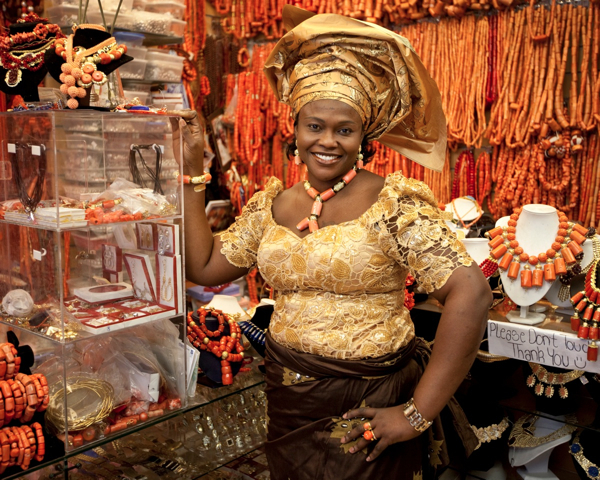
Onome Efebeh-Atano, Beauty Stones
Photographs copyright © Jeremy Freedman
With grateful thanks to Sheba Eferoghene for making the introductions.
You can read my original feature about Jo & Sheba Eferoghene, Novo Fashions
Steve Brooker, Mudlark
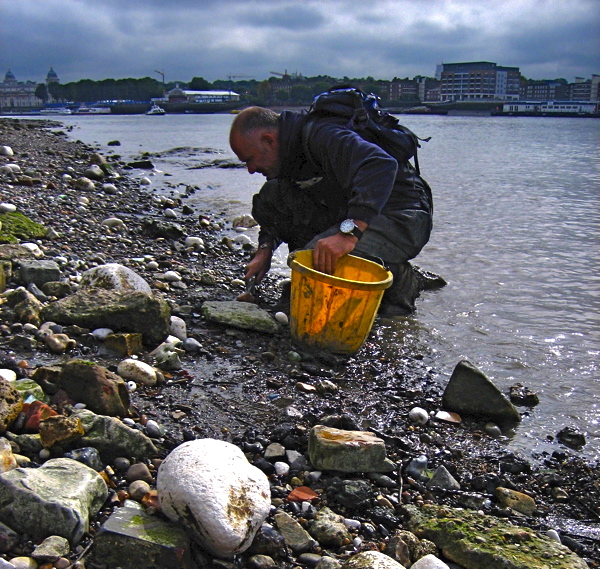
In London, the Thames has always been the natural receptacle for concealing and disposing things, creating a miry hoard of secrets, all just waiting for Steve Brooker, the mudlark, to come along and snaffle them up. Over the last seventeen years while he has been searching, the mud has been eroded by wash from the Thames Clippers, exposing an unprecedented level of finds that compel Steve to come mudlarking several times each week at low tide and be the first to see what has been newly revealed.
Steve is widely known as the Mud God – which seemed a little far fetched to me – until I saw him striding towards me eagerly in his chest-high bespattered waders, clutching his yellow plastic bucket and trowel. Over six feet tall with a grizzled beard and intense, glittering eyes, he was as excited to get down onto the beach as a child on the first day of the Summer holiday. Only someone with Steve’s natural authority can carry off such unmediated enthusiasm naturally. He is a man who is confident of his place in the world, and that place is the foreshore of the Thames.
We came down the slipway as the tide fell towards its lowest ebb. The day was mild yet occluded, and my heart lifted as I was released from city streets into a vast open space, the domain of water and sky. The territory of the Mud God. He understands the idiosyncrasies of the tide, and the nuances of the mud banks and the river bed. As well as coins and buttons, he finds Roman shoes, Medieval pins, eighteenth century witches’ bottles, nineteenth century lovers’ tokens, twentieth century voodoo dolls, live bombs and new guns – and sometimes he find human bodies too. He knows where to look and he does not need a metal detector because he has sharp eyes.
When Helen Mirren lost her ring throwing her grass clippings over the river wall from her Wapping garden, it was Steve who found it for her in the river. When villains throw handguns and sawn-off shot guns into the river at Woolwich to lose them forever, it is Steve who collects them and hands them to the police – he found fifteen recently.
Mudlarks tend to work in pairs for safety’s sake on this hazardous river and I had the privilege to be Steve’s partner in slime for a day. And I was happy to be in his company because Steve is a member of the Society of Thames Mudlarks, has a licence from the Port of London Authority and has the necessary experience to judge the treacherous movement of the tide against the access points to the shore.
On the beach, Steve used his trowel to indicate where the mud had been washed away revealing a fresh bed of stones beneath, suggesting the type of location worthy of searching. Scraping away the top layer, he scanned for objects and passed me a Medieval pin – a sign that other personal or domestic artifacts might be present. Thus the pattern was established of walking, scanning and pausing to scrape at promising sites. We continued until Silvertown where thousands of bullets mysteriously litter the foreshore, an unexplained military dump from World War II. All around the Isle of Dogs, we walked upon a shore littered with the metalwork of the ship building industry that was once here. Lying redundant, we saw eighteenth century iron splitters used for breaking up tree trunks into planks, to build ships sunk long ago.
At low tide, we reached Mast Point where Steve finds whole clay pipes. Pipes that once fell from a stevedore’s hand and sunk into the mud without breaking. Here I saw impacted layers of eighteenth and nineteenth century river bed, now exposed by erosion, with tantalising fragments of white pipe protruding. We squatted down to peer at the tiny bowl of a pipe, washed from the mud by the waves that very day and exposed from the mud for the first time. In the shape of a lady with a wide skirt that formed the bowl of the pipe, it was a tiny sculpture with a presence all its own, and we were the first to touch it since whoever dropped it two hundred years ago. Steve’s eyes popped because he never saw one like it before. Moments like this are what keep bringing Steve back, because he knows will always find something, yet he never knows what it will be.
We walked miles along the water’s edge in the centre of London and the only others we met were two friends of Steve’s, also searching the shore. I forgot entirely about the city on the river bank above us, because I was down in the river bed in the land of the mudlarks. All of the history of London was present with us, you just had to look, and it was a magical place to be.
Take a look at www.thamesandfield.com where you can see more than thirteen thousand pictures of Steve Brooker’s incredible finds that have earned him his reputation as the Mud God.
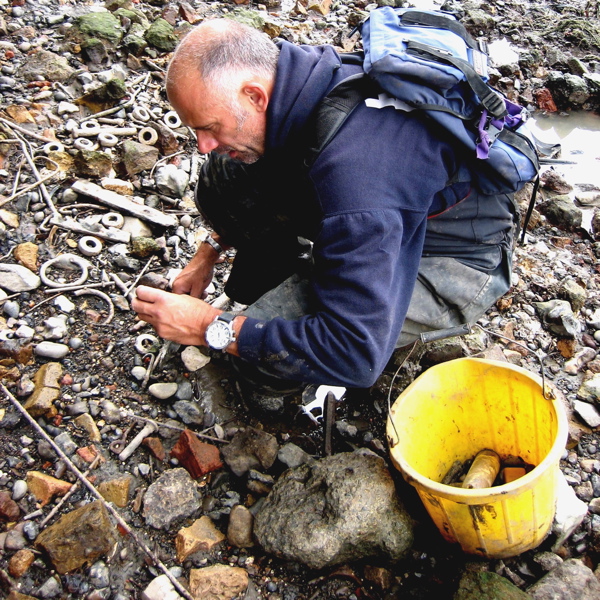
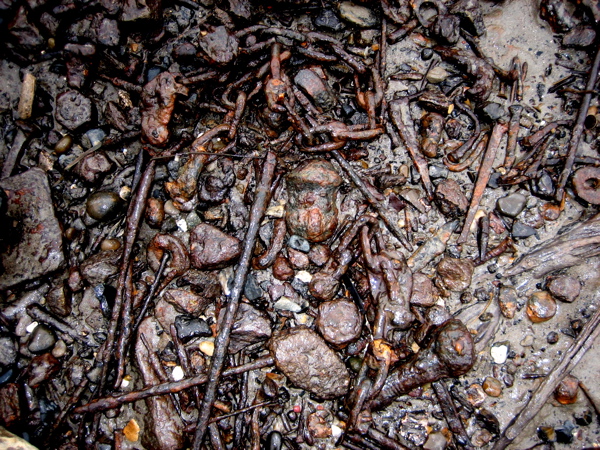
The detritus of the former shipyards lines the shore.

Thousands of bullets lie in the mud at Silvertown.
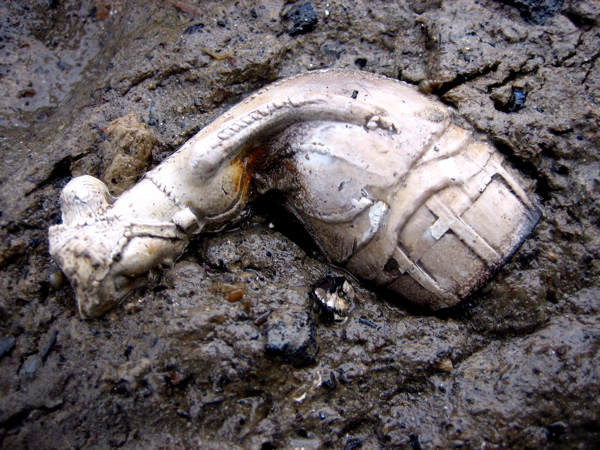
The lady as we found her face down in the Thames mud

The lady recovered after two hundred years.
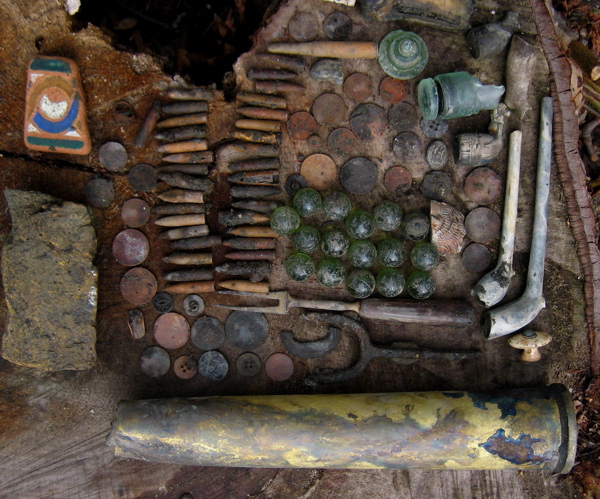
Our haul, a tudor brick, decimal coins, bullets, marbles, a spur, an eighteenth century fork, a cabinet handle, clay pipes, a shell dated 1942, a fragment of a Bellemine jug, a broken seventeenth century buckle and a horse’s tooth.
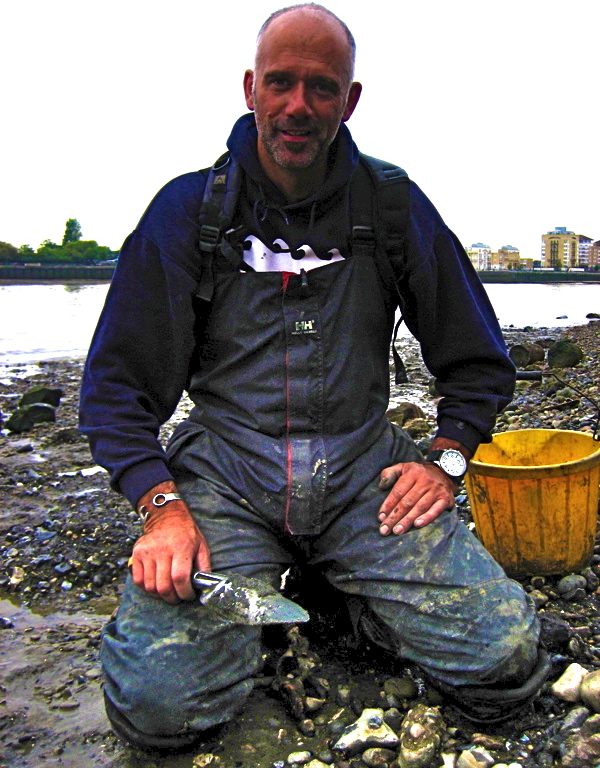
Steve Brooker, the Mud God.

Mudlarking on the Thames, with remnant of a mesolithic forest in the foreground.
You may also like to read
At the Bunny Girls’ Reunion

On Sunday night, I attended the most glamorous party of my life. It was a Bunny Girls & Playboy Models’ reunion hosted by ex-Bunny Barbara Haigh, esteemed landlady of The Grapes in Limehouse. Never have I encountered more voluptuous charismatic ladies per square metre than were crammed joyfully together in the tiny bar-rooms of this historic riverside pub that night.
With Sarah Ainslie, Spitalfields Life contributing photographer, as my chaperone, I was thrilled to join this exuberant sisterhood of more than a hundred garrulous alpha females for a knees-up. Squeezing my way through the curvy bodies – fine specimens of their sex who have all got what it takes to succeed in life – I arrived on the river frontage where waves were crashing theatrically over the verandah as if, in reenactment of Botticelli’s Venus, each of these goddesses had just emerged triumphant from the Thames’ spray to delight the souls of mere mortals like myself.
The first Aphrodite to catch my eye was cheeky Bunny Sandie (pictured above), the seventh Bunny to join the newly opened Playboy Club in Park Lane in 1966, who is more formally known these days as Lady Sandra Bates. Within seconds of our introduction, Sandie gleefully revealed she had bedded Sean Connery, Frank Sinatra, Warren Beatty and Telly Savalas, emphasising that her most important conquest was Sir Charles Clore, owner of Selfridges and Mappin & Webb. “I was living in a house in Mayfair at the time, but the owner put it up for sale and wanted to throw me out, so I told Charles and he bought it for me!” she declared with a glittering smile, rolling her chestnut eyes, batting her eyelashes and clutching her hands in girlish pleasure. “You should see my art collection!” she proposed recklessly now that her husband Sir Charles is no more, as we shared a glass of wine on the veranda and the setting sun lit up the clouds, turning the river livid pink.
It was a remarkable overture to an unforgettable evening, because these girls all know how to party. Bunnies had flown in from all over the world, Tasmania, Las Vegas, the Bahamas, Egypt and as far away as Australia to celebrate the glory days of the British Playboy Club that ran from 1966 until 1980. As Marilyn Cole (the first full frontal nude in the history of Playboy in 1972) put it so elegantly in her speech of welcome, “When people ask ‘Where did you go to school?’ I say, ‘Fuck that, I went to the University of Playboy! You learn much more about life.’” An astute comment that drew roars of approval from the assembled Bunnies.
Marilyn, resplendent in a quilted leather miniskirt and thigh length high-heeled boots, ushered me over to meet her famously reclusive husband Victor Lownes, who opened the London Playboy Club. Formerly in charge of all Playboy’s gaming operations, Victor Lownes is a bon-viveur who was once Britain’s highest paid executive, counted Francis Bacon and Roman Polanski as friends and reputedly had five girls a day, sometimes two at once. He looked at me benignly from under a mop of white hair across the chasm of our different experiences of life. “Do you miss it?” I enquired tentatively, and Victor rolled his twinkly eyes in good-humoured irony. “What do you think? I am eighty-two years old!” he replied with dignified restraint.
There was a giddy atmosphere in the Grapes that night and so I chose to embrace the spirit of the occasion and mingle with as many Bunnies as possible. “I was a young girl from a very religious strict background in Birmingham who ran away from home.”admitted Bobbie, one of first black Bunnies, who worked at the Playboy Club from 1975-80, “I was shopping one day and I went along to ‘a cattle drive’ and out of fifty girls was one of a handful accepted to be a Bunny. I had four wonderful years that totally changed my life. It was a terrific experience. I have run my own business for the past twenty years and the things I learnt at Playboy set me on the road to be able to do that.”
“There was only one rule,’Don’t touch the Bunnies!’”explained Bunny Erica, raising a finger of authority,“Membership of the Playboy Club came with a key, which members handed in when they arrived and collected when they left. If somebody went too far the management took away their key. So the men always behaved respectfully. You were never forced to do anything. It’s made to seem cheap now – but we wore two pair of tights, our costumes were fitted and stiffened with whalebone, we even put toilet rolls down the front as padding – it was an illusion. We were supposed to share tips, but I put mine down my costume and when I took it off all the banknotes would fall out. The money was fabulous. Playboy gave us the most amazing part of our lives. It gave us freedom. It gave us a love of humanity. It enlightened us.”
“I was the very first UK Bunny to be hired in 1966,” declared Bunny Alexis, still glowing with pride over forty years later, “I was a dancer at the Talk of the Town in Leicester Sq on £12 a week, but at Playboy I earned £200. I was already married with a child and on the strength of my two years as a Bunny I was able to buy our first house in Wood Green. It was the hardest work, eight hours a day on five-inch heels with just one half hour break. But it was good fun and we met all the most amazing people. 1966 was a very good year!”
People often ask what happened to the nineteen sixties, yet here the evidence was all around me. It was a buzz to be in a room full of such self-confident women who knew who they were and were supremely comfortable with it too, women with their wits about them, who counted brains amongst other natural assets when it came to interactions with the opposite sex. Women who knew how to make the best of the situation they found themselves in at the Playboy Club – unashamedly constructed as an arena of male fantasy yet, paradoxically, as all these women testify thirty years on, provided opportunities for them to take control of their lives.
Undoubtedly there were those that, as Bunny Serena put it succinctly, “screwed their way to the top,” but equally there were many who, as Bunny Lara confirmed, found it, “An empowering experience. They sent us on management training courses, and I learnt how to handle people and manage staff. All of which has come in useful ever since in everything I have done.” She now runs a young offenders’ programme, training staff in conflict management. Many women I spoke with occupy senior management roles in the gaming and entertainment industry today – including one who manages a chain of casinos – in jobs that would have been closed to them previously.
Above all, these were women who were full of life, they had seen so much life and had so many stories to tell, that it was wonderful simply to be amongst them, confirming Bunny Lara’s fond verdict on her experience working at the Playboy Club, “The camaraderie was phenomenal.”

Bunny Cleo, with evidence of her encounter with Sid James at The Playboy Club.

Marilyn Cole, “Whatever else happens in life, good, bad or indifferent, we can always say we had this!”

Bunny Maretta & Bunny friend.

Bunny Marisa is now an artist painting in oils.

Bunny Dilys & Bunny friend.

Bunny Alexis, ex-Windmill Girl was the very first UK Bunny to be recruited in 1966.

Bunny Serena & Bunny Jane.

Bunny Bobbie

Bunny Brenda, Bunny Nancy & Bunny Marion

Victor Lownes, “What is a playboy? It is someone who is getting more sex than you are.”
Photographs copyright © Sarah Ainslie
You may also like to read about
At Lady Sandra Bates’ Birthday Bash
or
A Fox in Hoxton

At this time of year, as the shadows get longer, the foxes of the East End grow bolder, reclaiming their territory. Those that have acquired a taste for curry come streaming down Brick Lane in the early hours to pillage the bins, and throughout Spitalfields you may even see foxes during daylight hours skulking in the side streets, as familiar with humans as we have become with them. Consequently, I did not blink when I caught a glance of the first of Spitalfields Life Contributing Photographer Martin Usborne’s fascinating fox photographs. My immediate assumption was to admire his skill in capturing a rare moment – until I saw the other pictures and realised that a sly ruse was involved.
Now that digital manipulation of photography has become commonplace, there is an elegant poetry in the plain contrivance of taking a stuffed fox and placing it in the street, because a natural correlation exists between the still life of taxidermy and the frozen moment of a photograph. So familiar are we with photography as a record of an event that we naturally imagine the movement before and after the frame, an impulse that still exists even after we know the fox is immobile.
There is also the delight of complicity here, in observing how different people gamely participated in Martin’s project, when he spent three days wandering around with a dead fox that he rented from “Get Stuffed” taxidermy hire in Islington. (Martin was assured that the fox died of natural causes and was given to the taxidermist by the RSPCA.) The comedy of the undertaking is irresistible, even if it is underscored by the poignancy of this displaced creature returning to its urban habitat after death.
Athough foxes are common in the city, the surrealism of their presence never fails to startle, and these cunning photographs play upon this familiarity, pushing the limit of credibility. Since foxes appear to be as at home in the East End as we humans are, it would not actually be out of character for them to do any of the things shown here. It makes perfect sense to see a fox get cash from a machine and then hit the fried chicken shop. Equally, when I saw the picture of the fox with the girls in the cocktail bar, I could not help wondering if it was a hen night.
In reality, there is a large family of foxes that live in a secret enclave in the Old Truman Brewery, Brick Lane, which makes them perfectly placed to take advantage of the night life on their doorstep. Here in Spitalfields, I have become quite used to seeing foxes gambolling in my back yard. Although guests get excited to see the foxes emerging from the undergrowth seeking chicken bones whenever I serve dinner in the garden, this has become commonplace to me now. Sometimes in the Spring, fox cubs waken me with their cries while playing outside my bedroom window and if I go out at night to bring in washing from the line they prowl around me in the dark. Similarly, the neighbourhood cats appear to have entered into an understanding with the foxes, and I even saw Mr Pussy rubbing noses with a fox this Summer. And I shall never forget returning from the premiere of “Fantastic Mr Fox” to confront a fox on the street in Spitalfields at midnight and half-expecting him to ask, “How was it then?”
So you will understand why Martin Usborne’s clever fox photographs stuck a chord, they are only one step removed from actuality – and their subtle irony renders them as playful and engaging satires upon the absurdity of our curious inner-city existence.


Photographs copyright © Martin Usborne
You may also enjoy Martin’s pictures of Joseph Markovitch of Hoxton.
Second Annual Report
As a slow writer who struggles to put words together, it astonishes me to discover myself writing this Second Annual Report. It certainly was a foolhardy undertaking that I set out upon two years ago on 26th August 2009 – promising to write a story every single day – but I do not regret it because it has brought me so much pleasure.
I do not quite know how to account for the more than seven hundred stories that I have published since then. In fact, I try to avoid an overview because it fills me with vertigo to contemplate how many words I have written, almost as disorienting as trying to imagine what lies ahead over the next quarter century of this endeavour. Yet the reality of this project consists always in writing today’s story and, as far as possible, I submit myself to the job in hand, which can be relied upon to provide more than sufficient challenge to fill one day.
As a child, I never understood why I could not go and speak with everybody, and I used to knock on the doors of people in my street and ask about their lives. Even now I do not know why people choose to be strangers to one another and not enter into conversations at bus stops and on transport. Fortunately, my chosen occupation permits me to fulfil my lifelong curiousity about the lives of others. And, in the last two years, I have met more people than I ever did in my life up to the moment I began writing these pen portraits, and a good many have now become friends.
Although I had some experience of writing before I commenced, these two years of contriving a story daily have changed my life. Sometimes people assume that I knock off several at once and publish them at leisure. But the truth is that I always write tomorrow’s story today, often working late into the night until it is ready.
Whenever I get the chance to look back at previous posts, I am struck how they flow one after another, as if preordained, when, in fact, I rarely know what is coming next. It is a situation that creates a certain internal drama, exciting and terrifying at the same time. While – from those already published – I may persuade myself that tomorrow’s story will appear inevitably, I get fidgety as the day fades if I have not yet begun writing, or – worse – I have not decided what I am writing about. Yet each night, when I publish my story, the drama is resolved and I can go to sleep peacefully, before waking up ready to start again.
As you will appreciate, it keeps me on my toes, with so many people to write about and you, the readers, awaiting tomorrow’s story. I recognise a constant imperative to do my subjects justice and I know I cannot disappoint you. It is a perfect situation for a writer, especially a slow writer.
I did not realise that this would be the outcome when I set out, but I am very grateful for it, because it has proved so rewarding. Years ago, when I complained of my long afternoons struggling to compose a single sentence, people used to say, “If someone put a gun to your head, couldn’t you write faster?” Now this is situation is remedied, I can answer those people by declaring, “I have found the gun!”
As I pass the two year milestone, I am going to take a moment to draw breath, celebrating this anniversary by publishing a week of favourite posts. Meanwhile, I shall take the opportunity to tidy my desk, weed the garden, sew on buttons and prepare myself to set forth again through the streets of Spitalfields. But first, I have something extraordinary planned to commemorate this auspicious moment and I must leave you here while I run off to do it. Naturally, you will read an account, as the first post opening the third year of stories on Monday 5th September.
And thus, with all these thoughts in mind, I come to the end of this second year of Spitalfields Life.
I am your loyal servant
The Gentle Author

You may also like to read the First Annual Report
The Return of Norah Pam

Norah Pam first came to Spitalfields in August 1931 and this week she made a return visit, just to see how things were ticking over in her old neighbourhood eighty years later. Here you can see her standing outside 11 Victoria Cottages, where her great-grandparents Lewis Carr, a silk dyer, and his wife Louisa came to live with their three children, shortly after the terrace was built in the 1860s. Norah was delighted to see that the gardens are well kept – just as she remembers them in her childhood in the 1930s.
By 1881, the family had moved to the flats at the rear of the cottages, known as Albert Family Dwellings and it was there that Norah grew up. She still has vivid memories of these formative years in Spitalfields, even though she only came to live in the Dwellings at the age of six and left in 1940 at the age of fifteen when the bombing of London made it too risky to stay.
It was my pleasure to introduce Norah to Spitalfields resident Mavis Bullwinkle who also grew up in Albert Family Dwellings in the 1930s, which was the cause of considerable mutual excitement since – although Mavis does not remember Norah – Norah, being seven years older, remembers seventy-nine year old Mavis being born. “You were such a little baby,” she recalled sweetly, causing Mavis to blush, “I remember when your sister was born, she had golden curls and blue eyes and everyone doted on her, and my mother said to me, ‘Pay some attention to the little girl standing at the side of the pram,’and that was you.”
This was a cause of great amusement to Mavis, who shrieked with girlish delight to confirm this unexpected recollection. “Yes, that’s right” she exclaimed in surprise, “My hair was was straight as die!” Yet all these years later, this conversation was evidence that Norah had taken notice of her mother’s instruction. “I can see you now coming down the stairs beside the pram,” she added, thinking back across time, on the occasion of meeting someone she had not seen in more than seventy years.
We all sat in a garden at Victoria Cottages and enjoyed a sunny morning chatting together, while Norah brought out her family photographs, which span dizzying amounts of time, and beguiled us with her account of her Spitalfields childhood.
We moved into a flat in Albert Family Dwellings to be close to my grandmother – the family had been in Spitalfields since the 1840s.
I went to All Saints School in Buxton St. Some of the children were quite poor. I had a friend whose father was a ganger – a roadworker – and if it rained he got no work and he had no money. Several children had parents who were builders, they couldn’t work in bad weather either. Some were railway people, and if they had big families they couldn’t manage. My friend’s family worked in the parcels office, they were comfortable, they even had a holiday because they got free travel. There was a lot of poverty because in 1931 all public service workers had a pound cut from their pay – a wage of three pounds and five shillings a week went down to two pounds and five shillings a week. It was a significant amount of money and people had to cut back.
I wasn’t allowed to play outside. I was an only child and very protected, but I caught Scarlet Fever. I was taken to Homerton in the fever ambulance which was grey. My parents weren’t allowed to visit. They would bring a parcel each week and stand outside. The flat was sealed and the bedding taken away for fumigation, and my father had to have three days off work because it was so contagious. Then after six weeks, they said I had Nasal Diptheria and I had to stay another six weeks, so it was very harrowing for all of us. My mother cried when people asked how I was.
When the war came, everyone was evacuated but, because I had been seriously ill, I pleaded with my parents to let me stay at home, and there was no school, so I had a heyday. I remember the bombing of the docks. On that day, I went on my own to Dalston on the bus to buy a skirt at Marks & Spencer. The air raid siren went at two o’clock and we were told to get off the bus and go to a shelter. Then, at four, I bought my skirt and walked back to Spitalfields.
I wanted a pair of silk stockings to go with my skirt and in Hanbury St there was a little shop that sold everything. The owner was Noah Cohen, so I went to his shop and there was this little old lady and her daughter who was in her thirties. Noah let them go into the back to change and he told me their story. The girl had been in the bath when the air raid siren went and her mother called her to go to the Anderson shelter. The house was in Jamaica St and it got a direct hit, but they were saved by the shelter and all she had left was the dress she put on when she got out of the bath. Her mother had come to buy her a set of underwear to go a night shelter in a school, and he let her change into her new clothes. I often wondered what happened to that woman because a lot of the schools were hit.
I went home and, by the time I got to the Cottages, I was running because I could smell the fires burning at the docks. And, as my mother opened the door, the people upstairs were coming down for safety. We sat in the doorway and my mother made tea while the bombs fell. The German planes made a particular noise. They got nearer and nearer and nearer, and you heard the bombs dropping, and you thought, “This is us,” and then they went over.
The people in the building across the road all left, and they set their cats and dogs loose. We found a dog in the street and my mother called it “Victory “because she said, “We’re going to have victory! They can continue bombing but we won’t give in. They can do what they like.” We kept him for seven years and he died on 31st May 1946, on my twenty-first birthday, in his sleep.
Then, in 1940, a landmine fell on the Crown & Leek in Deal St and they evacuated a mile around, and that’s when we all decided to leave. But even after we moved out, I was always coming back to see my friends. I missed by friends. And my father said, “But I thought you wanted a house with a garden?!”
Today, the Albert Family Dwellings have long gone, demolished in 1975. Mavis Bullwinkle who lived in the Dwellings until the end and now lives a quarter a mile away, told me she had not been over to this area of Spitalfields for thirty years, “Because I miss them so much.” The pair of terraces named Victoria and Albert Cottages, and St Anne’s Church, are all that remain now of the world that Norah and Mavis knew in their childhood. Yet for a couple of hours it came alive again, as they sat in the garden and shared recollections of the two old ladies who ran the sweetshop across the road – gone more than half a century ago – the mission hall that moved to Bethnal Green in 1935, and of the teachers at Sir John Cass School where they were both pupils before the war.
In contrast to the general assumption of poverty in the East End, Norah and Mavis’ history reveals a more complex social picture of people of different incomes living in close proximity. Norah and Mavis were also keen to emphasise the self-respecting ethic they grew up with.“They think we were all prostitutes and drunks, and we were dirty, but our working class morality was strong,” declared Mavis, turning passionate, “We didn’t think we were poor, we had enough to eat and we never wasted anything.” A statement which prompted the exchange of a glance of unity between the two women.
Then it was time to say goodbye – once Norah Pam and Mavis Bullwinkle had swapped numbers, because a new friendship had been kindled that morning. Norah took one last glance at the gardens of Victoria Cottages, where her great-grandparents lived one hundred and fifty years ago, and looked up to the space in the sky where Albert Family Dwellings once stood. “I had a happy childhood here,” she said.
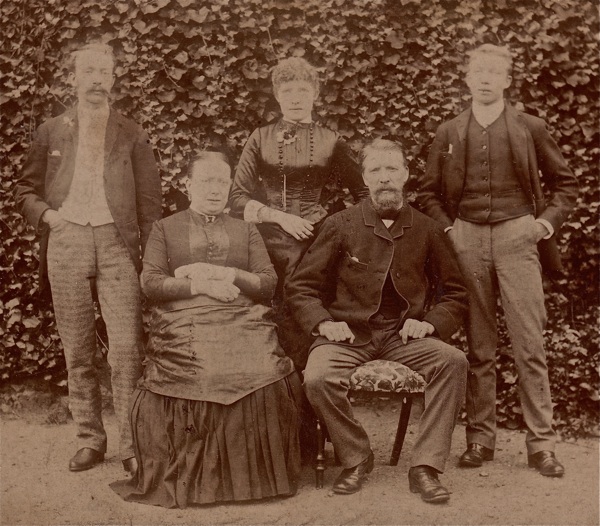
Norah’s great grandparents, Lewis and Louisa Carr, and their children, Lewis, Louisa Ann and George – the residents of 11 Victoria Cottages, Spitalfields. On the reverse of this photograph Norah has written, “When my great-grandfather became a widower, he went to lunch each Sunday with my gran, always arriving wearing wearing a tall silk hat.”

Norah’s great uncle, Lewis Carr. He became a vaccination officer for Smallpox and lived on Cheshire St.

Norah’s grandmother, Louisa Ann Carr as a young woman. She worked at home sewing waistcoat buttons for Savile Row.

Norah’s grandmother, Louisa Ann, as an older woman at Albert Family Dwellings.

Norah’s parents’ on their wedding day.

Norah’s father Edward Samuel Simmonds in 1939.
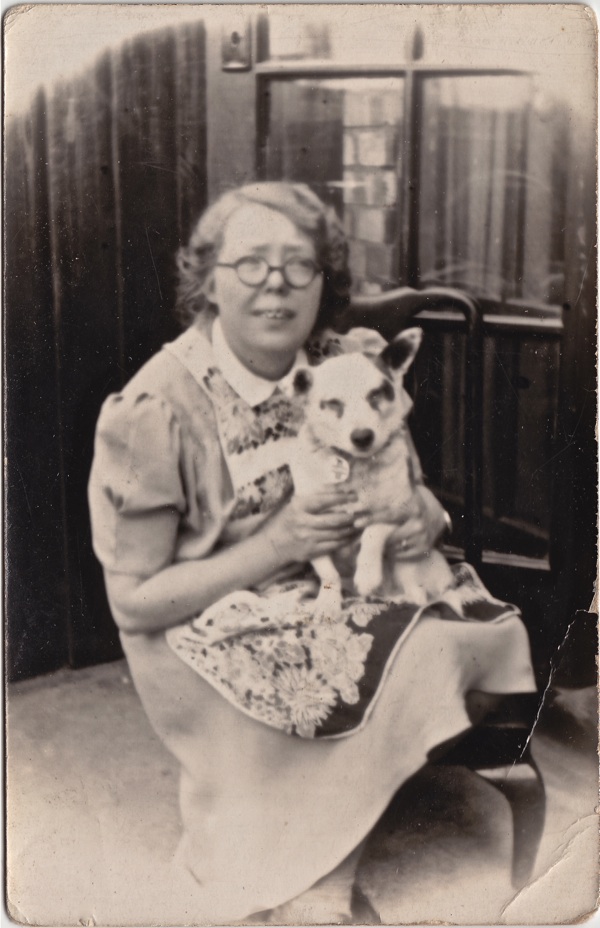
Norah’s mother, Violet Louisa Simmonds, with their dog Victory.

Norah’s class at All Saints’ School, Buxton St in 1934. Nine year old Norah is in the check dress with spectacles, third from the right in the first row seated on chairs. Norah’s glasses were from Mr Stutter, the optician in Bishopsgate.

Norah in 1940, aged fifteen.

Norah and Mavis both grew up in the Albert Family Dwellings in Deal St that were demolished in 1975.

The last May Queen at Sir John Cass School in 1939, Mavis is third from the right in the front row of girls standing.

Mavis’ Aunt Ada and her mother Gwen in Deal St outside the Albert Family Dwellings in the 1920s.

Norah Pam & Mavis Bullwinkle at Victoria Cottages.
You may like to read my profile of Mavis Bullwinkle, Secretary