
The Pump of Death

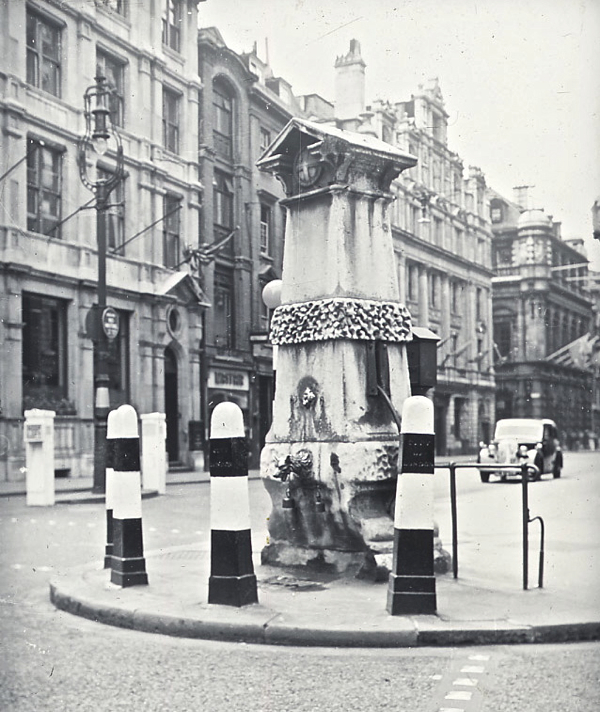
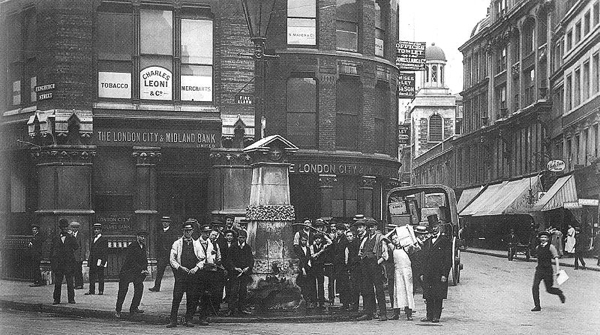
See these people come and go at the junction of Fenchurch St and Leadenhall St in the City of London in 1927. Observe the boy idling in the flat cap. They all seem unaware they are in the presence of the notorious “Pump of Death” – that switched to mains supply fifty years earlier in 1876, when the water began to taste strange and was found to contain liquid human remains which had seeped into the underground stream from cemeteries.
Several hundred people died in the resultant Aldgate Pump Epidemic as a result of drinking polluted water. Obviously a distant memory by the nineteen twenties, when Whittard’s tea merchants used to “always get the kettles filled at the Aldgate Pump so that only the purest water was used for tea tasting.”
Yet before it transferred to a supply from the New River Company of Islington, the spring water of the Aldgate Pump was appreciated by many for its abundant health-giving mineral salts, until – in an unexpectedly horrific development – it was discovered that the calcium in the water had leached from human bones.
This bizarre phenomenon quickly entered popular lore, so that a bouncing cheque was referred to as “a draught upon Aldgate Pump,” and in rhyming slang “Aldgate Pump” meant to be annoyed – “to get the hump.” The terrible revelation confirmed widespread morbid prejudice about the East End, of which Aldgate Pump was a landmark defining the beginning of the territory. The “Pump of Death” became emblematic of the perceived degradation of life in East London and it was once declared with superlative partiality that “East of Aldgate Pump, people cared for nothing but drink, vice and crime.”
Today this sturdy late-eighteenth century stone pump stands sentinel as the battered reminder of a former world, no longer functional, and lost amongst the traffic and recent developments of the modern City. No-one notices it anymore and its fearsome history is almost forgotten, despite the impressive provenance of this dignified ancient landmark, where all mileages East of London are calculated. Even in the old photographs you can trace how the venerable pump became marginalised, cut down and ultimately ignored.
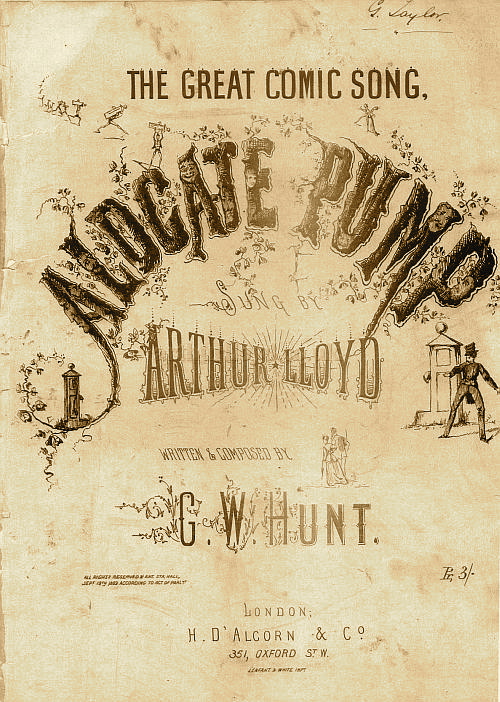
Aldgate Well was first mentioned in the thirteenth century – in the reign of King John – and referred to by sixteenth century historian, John Stowe, who described the execution of the Bailiff of Romford on the gibbet “near the well within Aldgate.” In “The Uncommercial Traveller,” Charles Dickens wrote, “My day’s business beckoned me to the East End of London, I had turned my face to that part of the compass… and had got past Aldgate Pump.” And before the “Pump of Death” incident, Music Hall composer Edgar Bateman nicknamed “The Shakespeare of Aldgate Pump,” wrote a comic song in celebration of Aldgate Pump – including the lyric line “I never shall forget the gal I met near Aldgate Pump…”
The pump was first installed upon the well head in the sixteenth century, and subsequently replaced in the eighteenth century by the gracefully tapered and rusticated Portland stone obelisk that stands today with a nineteenth century gabled capping. The most remarkable detail to survive to our day is the elegant brass spout in the form of a wolf’s head – still snarling ferociously in a vain attempt to maintain its “Pump of Death” reputation – put there to signify the last of these creatures to be shot outside the City of London.
In the photo from 1927, you can see two metal drinking cups that have gone now, leaving just the stubs where the chains attaching them were fixed. Tantalisingly, the brass button that controls the water outlet is still there, yet, although it is irresistible to press it, the water ceased flowing in the last century. A drain remains beneath the spout where the stone is weathered from the action of water over centuries and there is an elegant wrought iron pump handle – enough details to convince me that the water might return one day.
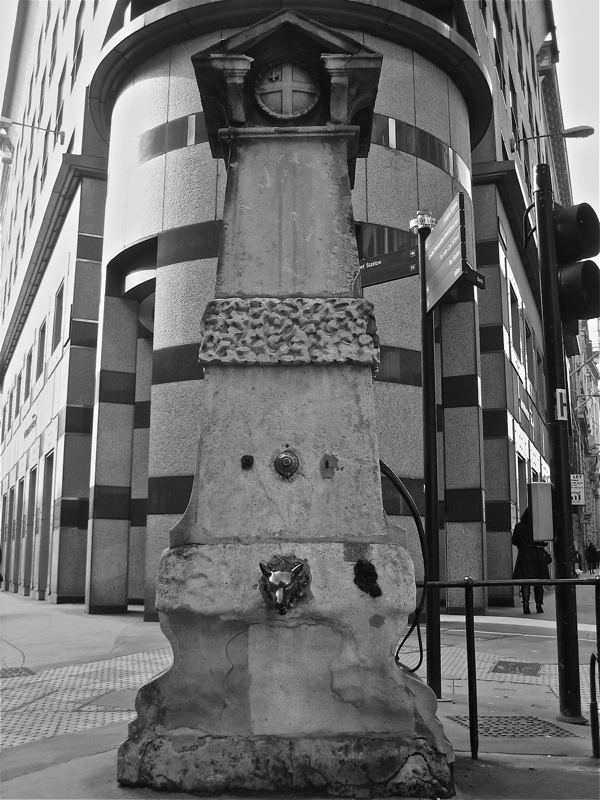
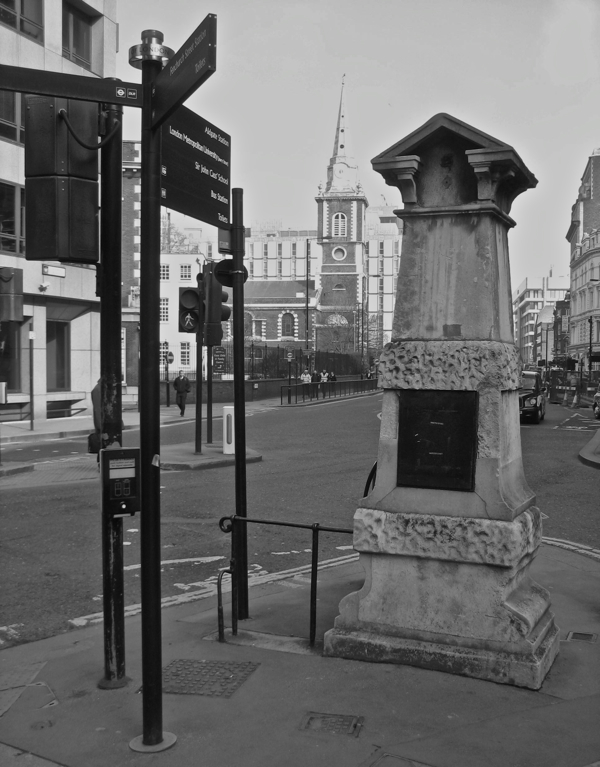
Looking towards Aldgate.

The water head, reputed to be an image of the last wolf shot in London
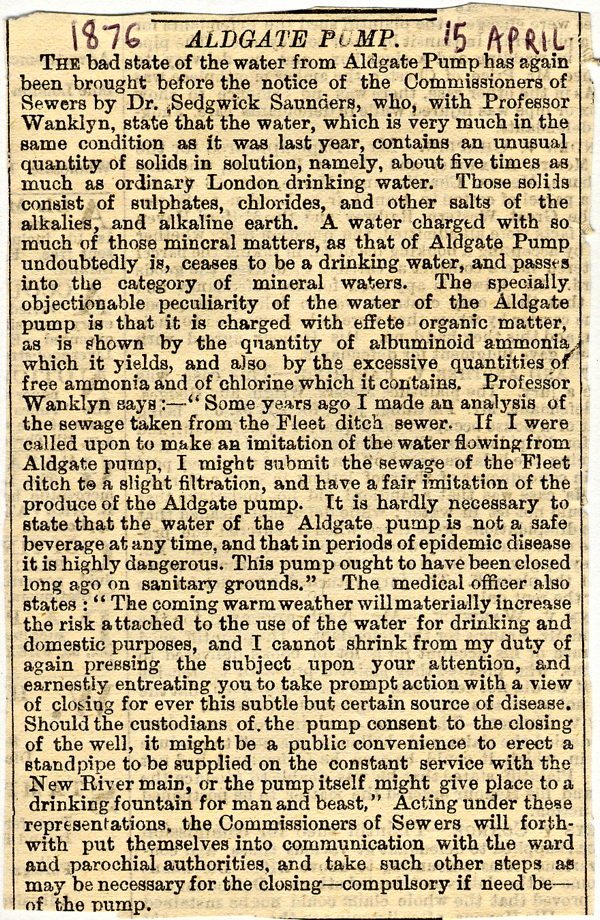
The pump was closed in 1876 and the outlet switched to mains water supply.


Molly the Swagman
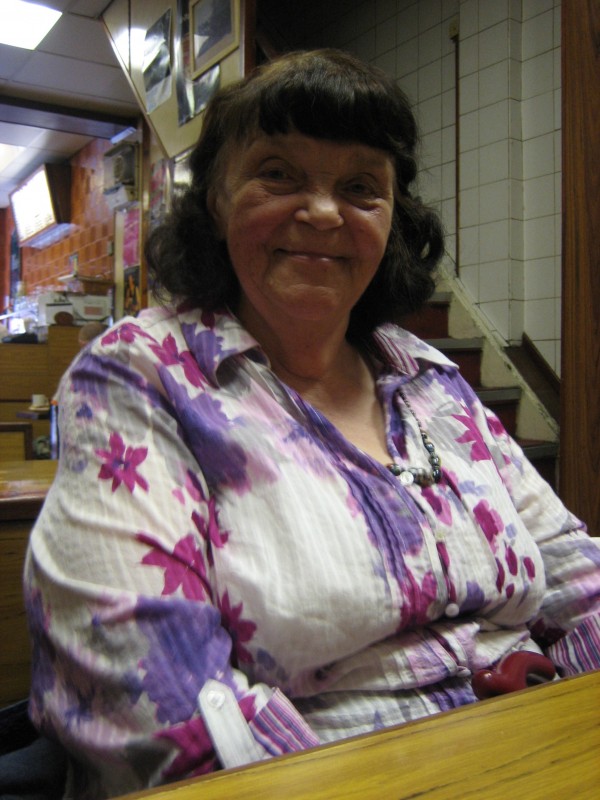
Make no mistake, Molly is a swagman. It is a title that carries its own raffish assertion of independence, there are no swagwomen, only swagmen and Molly is a proud swagman. She told me it all began with her great-grandfather who was a swagman on Petticoat Lane and he lived to be ninety-nine. And now I shall expect no less from Molly herself – because there is no doubt that, as a fourth generation swagman, she is the shrewd inheritor of the good humoured perseverance which is required to achieve longevity in market life.
Although I always knew the word “swag” from comic books where masked burglars have it written on their sacks, it was Molly herself who first explained to me that, “Swag is when you are selling a variety of goods, from clothes to jewellery – anything you can find.” And she gave me a significant glance of complicity, which led me to assume there might be a shady history, before returning to her plate of bacon and egg accompanied by a pile of toast, that formed the primary focus of her attention at that moment. We were enjoying a hearty breakfast in Dino’s Cafe in Commercial St, huddled together round a small table at the back with Molly’s old friend Jimmy Cuba and Ellen, her loyal associate from the market, completing the party.
“My first market was down the lane,” Molly confided in tender reminiscence, pushing the empty plate to one side and lifting her mug of tea,“I was about three, toddling around on my first day in Petticoat Lane where we lived. The house where I was born, it was in Leyden St, number six. My great-grandfather had the pitch and it went down through the family, that’s how it was in those days. Anything you could sell, he would sell it. He was a dodgy dealer, he used to do deals. My grandfather, my father and uncle were all in it too. They used to hire a cab for the day and go to the races together sometimes. Uncle Bob and grandad used to front the stall, while my father was the money behind the scenes. My father had the advantage of going to school, my grandmother was in films so she sent her two sons to boarding schools. He was a very snappy dresser, when he had some money he used to go and get two new suits made. He had the whole look, the cufflinks and the polished shoes. ‘You have to dress up to do business,’ he said. Grandad sold linens off the back of the van and Uncle Bob was the one with china, he threw it up in the air. And I used to take the money, it’s where I learnt to add up.”
Molly’s pedigree as a swagman imparts a certain singularity of attitude which baulks no condescension, and graces her with a sharp line in back chat to accompany it. “If they say, ‘You’ve got to give me a discount.’” recounted Molly, raising her eyebrows in delight and assuming a hoity-toity voice, “I say ‘Why? Do I know you?” Then she chuckled to herself, recalling another recurring dialogue. “Those yuppies, they ask ‘If I buy this, can I get this free?’ So then I put on my best Cockney voice…” she continued, placing a hand on my forearm and assuming an archly demure manner, “and I say, ‘Here love, come back next week, when you’ve got a bit more money.’” Chuckling, again and launching into a raucous self parody, “They’ve got to be hedge-ucated!” she declared with a triumphant grimace, pressing the ball of her hand on the table in response to the general mirth of those of us who comprised her audience.
I learned that Molly’s experience is not restricted to market life, because for five years, she worked as girl-Friday to Peter Grant, the manager of Led Zeppelin and, as we sipped tea and digested our breakfasts, she regaled Jimmy, Ellen and me with her tales of the rock and roll years. “The boys used to call me ‘ma’.”she revealed shyly, “I knew them all, Mickie Most, Adam Faith and the rest. They all came down to the country where I used to cook breakfast for the guests, walk them round the house and make up these fantastic ghost stories. When I was down there, I treated them just like anybody else. One day this tall blond guy came down with his laundry, so I showed him how to work the machine – that was Robert Plant.” At this point, Jimmy Cuba contained himself no longer, interposing, “This was when Led Zeppelin were the biggest band on the planet!” and Molly smiled bashfully, blushing a little to recall her days as a rock chick now.
Each Wednesday, Thursday and Friday, you will see Molly stalling out in the Spitalfields Market with Ellen at her side, the lone swagman with her modest swag spread out before her on the table. Even after all these years Molly cannot predict each day’s trading, market life is akin to gambling in that way. The two self-effacing women preside like sentinels, whispering together about the ceaseless spectacle passing before them. For Molly, it is a fleeting show, because she is the living representative of the three that came before her and it gives her a unique sense of perspective. Market life has made her circumspect and she would not tell me her full name or even reveal the name of her great-grandfather who lived to be ninety-nine. Yet I was honoured to speak with her because Molly is an extraordinary woman, dignified, witty and with great strength of character, and she is the last of the Spitalfields swagmen.
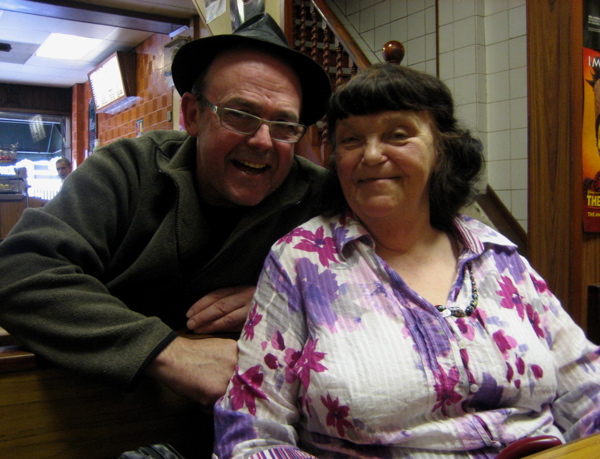
Jimmy Cuba & Molly
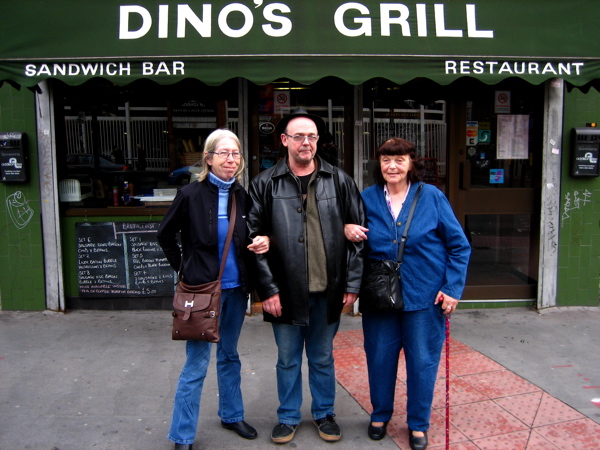
Ellen, Jimmy & Molly outside Dino’s in Commercial St.
Colin O’Brien’s Clerkenwell Car Crashes

Accident, daytime 1957
When photographer Colin O’Brien lived at Victoria Dwellings on the corner of Clerkenwell Rd and Faringdon Rd, there was a very unfortunate recurring problem which caused all the traffic lights at the junction to turn green at once. In the living room of the top floor flat where Colin lived with his parents, an ominous “crunch” would regularly be heard, occasioning the young photographer to lean out of the window with his box brownie camera and take the spectacular car crash photographs that you see here. Unaware of Weegee’s car crash photography in New York and predating Warhol’s fascination with the car crash as a photographic motif, Colin O’Brien’s car crash pictures are masterpieces in their own right.
Yet, even though they possess an extraordinary classically composed beauty, these photographs do not glamorise the tragedy of these violent random events – seen, as if from from God’s eye view, they expose the hopeless pathos of the situation. And, half a century later, whilst we all agree that these accidents were profoundly unfortunate for those involved, I hope it is not in poor taste to say that, in terms of photography they represent a fortuitous collision of subject matter and nascent photographic talent. I say this because I believe that the first duty of any artist is to witness what is in front of you, and this remarkable collection of pictures which Colin took from his window – dating from the late forties when he got his first camera at the age of eight until the early sixties when the family moved out – is precisely that.
Yesterday, I accompanied Colin as he returned to the junction of the Clerkenwell Rd and Faringdon Rd in the hope of visiting the modern buildings upon the site of the former Victoria Dwellings. To our good fortune, once we explained the story, Tomasz, the superintendent of Herbal Hill Buildings, welcomed Colin as if he were one of current residents who had simply been away for the weekend. Magnanimously, he handed over the keys of the top flat on the corner – which, by a stroke of luck, is currently vacant – so that Colin might take pictures from the same vantage point as his original photographs.
We found a split-level, four bedroom penthouse apartment with breathtaking views towards the City, complete with statues, chandeliers and gold light switches. It was very different to the poor, three room flat Colin lived in with his parents where his mother hung a curtain over the gas meter. Yet here in this luxury dwelling, the melancholy of the empty rooms was inescapable, lined with tired beige carpet and haunted with ghost outlines of furniture that had been taken away. However, we had not come to view the property, we had come to look out the window and after Colin had opened three different ones, he settled upon the perspective that most closely correlated to his parents’ living room and leaned out.
“The Guinness ad is no longer there,” he commented – almost surprised – as if, somehow, he expected the reality of the nineteen fifties might somehow be restored up here. Apart from the blocks on the horizon, little had changed, though. The building on the opposite corner was the same, the tube embankment and bridge were unaltered, the Booth’s Distillery building in Turnmills St still stood, as does the Clerkenwell Court House where Dickens once served as cub reporter. I left Colin to his photography as he became drawn into his lens, looking back into the midst of the last century and upon the urban landscape that contained the emotional history of his youth.
“It was the most exciting day of my life, when we left,” admitted Colin, with a fond grin of reminiscence, “Canvassers from the Labour Party used to come round asking for our votes and my father would ask them to build us better homes, and eventually they did. They built Michael Cliffe House, a tower block in Clerkenwell, and offered us the choice of any flat. My parents wanted one in the middle but I said, ‘No, let’s get the top flat!’ and I have it to this day. I took a photo of lightning over St Paul’s from there, and ran down to Fleet St and sold it to the Evening Standard.”
Colin O’Brien’s car crash photographs fascinate me with their intense, macabre beauty. As bystanders, unless we have specialist training, car crashes only serve to emphasise the pain of our helplessness at the destructive intervention of larger forces, and there is something especially plangent about these forgotten car crashes of yesteryear. In a single violent event, each one dramatises the sense of loss that time itself engenders, as over the years our tenderest beloved are taken from us. And they charge the photographic space, so that even those images without crashes acquire an additional emotionalism, the poignancy of transience and the imminence of potential disaster. I can think of no more touching image of loneliness that the anonymous figure in Colin O’Brien’s photograph, crossing the Clerkenwell Rd in the snow on New Year’s Eve, 1961.
After he had seen the interior of Herbal Hill Buildings, Colin confided to me he would rather live in Victoria Dwellings that stood there before, and yet, as he returned the keys to Tomasz, the superintendent, he could not resist asking if he might return and take more pictures in different conditions, at a different time of day or when it was raining. And Tomasz graciously assented as long as the apartment remained vacant. I understood that Colin needed the opportunity to come back again, now that the door to the past had been re-opened, and, I have to confess to you that, in spite of myself, I could not resist thinking, “Maybe there’ll be a car crash next time?”

Accident in the rain.

Accident in the rain 2.

Accident at night, 1959.

Snow on New Year’s Eve, 1961.

Trolley buses, nineteen fifties.

Clerkenwell Italian parade, nineteen fifties.

Firemen at Victoria Dwellings, nineteen sixties.


Have a Guinness when you’re tired


Colin’s new photograph of the junction of the Clerkenwell Rd and Faringdon Rd view from Herbal Hill Buildings that now stand on the site of the former Victoria Dwellings.

Colin O’Brien sees his childhood view for the first time in fifty years.
Photographs copyright © Colin O’Brien
More photographs by Colin O’Brien
Travellers’ Children in London Fields
Colin O’Brien’s Brick Lane Market
Mark Petty, Trendsetter

This is what I consider a classic Mark Petty outfit. It has the high-waisted flares, wide lapels and tie – all in a vibrant colour scheme – and Mark wears it with the audacious flair that we have come to expect from him. Anyone that frequents Brick Lane on a regular basis will be familiar with Mark and his boldly coloured leather suits, because he has honoured us by adopting these streets as his stage, or rather his catwalk, upon which he performs his celebrated theatrics of fashion.
Mark and his clothing have become part of the fabric of our neighbourhood, and it always lifts my spirits to spot him among a crowd of unremarkably dressed people, bringing a splash of eye-catching colour to elevate the scene. It is a joy that is compounded when I see him later in an entirely different outfit – an event which can occur several times in the same day, increasing the delight and admiration of the many residents who hold Mark in high esteem, as our self-styled ambassador for colour.
Amongst all the snazzy dressers of Shoreditch, what makes Mark special is that he designs his own clothes, not merely to look fashionable but as an unmediated expression of himself. More than anyone else I can think of Mark uses clothing to express who he is. He shows how he feels – revealing his inner self openly – and in the process his liberationist example has become an inspiration to us all.
“The reason I started was because in the seventies I was too young to wear the fashions, and by the time I was old enough flared trousers had gone,” explained Mark as we sat in his pink living room in a quiet corner of Bethnal Green, “So I went round to Mr Singh at Batty Fashions in the Bethnal Green Rd to see if he could make me some. I have no training in fashion yet I cut my own cardboard patterns, though it wasn’t easy at first doing flares.
I tried going out in Bethnal Green and the reaction was very hostile – from children who threw bottles at me – but I thought, ‘I’ll persevere because fashion is too drab and life should be full of colour.’ I’m not the kind of person that gives in. So I went to Ridley Rd Market in my lilac seventies outfit and on the whole the reaction was good. I find each area is different, you can’t ascertain in advance whether you’ll get mugged or chased. The older people here say, ‘You’re a rebel,’ and I get requests to wear particular outfits. My most popular request is for pink.
I’ll never forget the gang of Scottish football supporters I met at a bus stop in Shoreditch High St, they said, ‘It takes a lot of nerve to wear what you’re wearing.’ and asked to be photographed with me. Hopefully something good will come of it and people will realise that life isn’t all beige and black, and you need to express yourself. It needs a kick up the backside. When I went to Tottenham, where they all wear baseball caps, track suits and have designer dogs, they said,’You’re ruining our culture!’ In Croydon, when they realised I was from East London, they said, ‘We don’t get a lot of people from the North here.’
I moved to London from Essex sixteen years ago. I was born in Oxford but my mother decided to marry and live in Essex. I had a problem in Essex at school because I had a West Country accent. They said, ‘You’re a foreigner so we don’t like you!’ My mother’s been there thirty years now and they still say to her, ‘You’ll never be one of us.’ I was forced out of of Braintree. It was all over the newspaper headlines. Once you come through that you can come through anything. I used to lie on the floor of my flat with my three cats in the dark and pretend to be out. This went on for months, until they came round at night with flaming torches and smashed all the windows.
Moving to London, I found people in pubs and clubs very cold, and I settled in London in Tottenham on the Broadwater Estate which had a fearsome reputation. I thought, ‘I’m here on my own,’ so I got Rose an English bull terrier, but it was quite terrifying even walking to the park with the dog. As they said to me in Islington when they saw my outfit, ‘There’s not a lot of people that’s got the courage.’
I must know everyone in Bethnal Green now, they say, ‘You’re quite a celebrity round here,’ but I never thought of it that way, I just did what I had to do. We had a lot of builders round here last year, so I used to try my designs out on them to see what they thought, unfortunately they’ve gone now. I used to get a lot of offers but none have been taken up. I went to Walthamstow Market recently and the girls were holding their boyfriends’ hands because they were looking at me rather than their girls. If only people could experiment more and show their bodies. Even women here dress like men. The worse thing they ever did was invent the remote control, no-one gets any exercise anymore.
I’ve noticed in Romford and Ilford that guys are starting to wear pink. You’d expect it to be the little skinny ones but it’s the big butch guys. A woman said to me in Bethnal Green Tesco, ‘You’re corrupting our men! It’s dirty and perverted.’ I said, ‘That’s pathetic.’ Her twenty-four year old son wants to dress like me apparently and I get the blame. If people don’t express themselves they’re always repressed, but you only have one life and you have to live it as you think fit. The kids still abuse me and the police are useless, so I have to take care of myself. You have to stand up to them. They say they don’t like how I look, and I tell them, ‘If you don’t like it you can put up with it,’ because I’ve been through so much that I’m not going to be persecuted anymore.”
It was a painful journey Mark travelled to realise the truth of himself and square up to the violence, hatred and ignorance he confronted as a consequence of his emotional honesty. Yet in the face of this resistance he has discovered moral courage. I was humbled to recognise Mark’s strength of character as he told his stories filled with magnanimous humour and sympathy for his tormentors.
Nowadays, the clothing he adopted as a declaration of fearless independence has become Mark’s life and, as we talked, he produced outfit after outfit to show me, each more extravagant than the one before. Simultaneously his armour and his joy, Mark takes great delight in his multicoloured wardrobe which incarnates the transformation act he has pulled off to emerge as the peacock of Brick Lane.
“A bit of colour highlights people’s moods,” Mark declared as, with a beaming smile, he proudly modelled his pink leather trousers with cupcake applique motifs which he created as a homage to a dress he saw Fanny Craddock wear. There is a certain holy innocence about Mark, like the jesters of old who were licensed to speak what no-one else dare say. It still takes courage for him to go out, but Mark Petty is a kind man who discovered bravery in the face of cruelty, and a neighbourhood dandy we are all proud to know.


Mark Petty aged nine, in the nineteen seventies.
You may also like to see Mark Petty’s Multicoloured Coats
The Curry Chefs of Brick Lane

With the blizzard whirling down Brick Lane this week, it was the ideal moment for a hot curry to warm the spirits, and so – dodging the mischievous curry touts’ snowball bouts between rival restaurants – I set out in the company of Spitalfields Life contributing photographer Jeremy Freedman, to make the acquaintance of some of Brick Lane’s most celebrated Curry Chefs. We were privileged to be granted admission to the modest kitchens tucked away at the back or in the basement of the curry houses, where Head Chefs martial whole teams of underchefs in a highly formalised hierarchy of responsibility.
It was a relief to step from the cold street into the heat of the kitchens, where we discovered our excited subjects glistening with perspiration, all engaged in the midst of the collective drama that results in curry. We found that these were men who – for the most part – had worked their way up over many years from humble kitchen porters to enjoy their heroic leading roles, granting them the right to a degree of swagger in front of the lense.
We encountered the charismatic Zulen Ahmed (pictured above) standing over his clay-lined tandoori oven beneath the Saffron restaurant where he has been Head Chef for ten years now. Trained by the renowned Curry Chef, Ashik Miah, Zulen served eight years as a porter before ascending to run his own kitchen, now supervising a team consisting of two chefs who do the spicing and make the sauces, a tandoori chef, two cooks who cook rice and poppadums, a second chef who prepares side dishes and a porter who does the washing up. “The Head Chef listens to everybody,” he explained deferentially, with his staff standing around within earshot, and thereby revealing himself to be a natural leader.
Across the road at Masala, we met Head Chef, Shaiz Uddin, whose mother is a chef in Bangladesh. She taught him to cook when he was ten years old. Shaiz told me he worked in her kitchen as Curry Chef for seven years, before he came to London ten years ago to bring the authentic style to Brick Lane, where today he is known for his constant invention in contriving new dishes for his eager customers.
It was quickly apparent that there is a daily routine common to all the curry kitchens of Brick Lane. At eleven each morning, the chefs come in and work until three to prepare the sauces and half cook the meat for the evening. At three they take a break until six, while the underchefs, who arrive at three, prepare the vegetables and salad. Then at six, when the chefs return, the rice is cooked and – now the kitchen is full – everyone works as a team until midnight, when it is time to throw out the leftovers and make the orders for the next day. This is the pattern that rules the lives of all involved. “I like to be busy,” Nurul Alam, Head Chef at Preem & Prithi, informed me blithely – he regularly cooks three hundred curries a night.
Over at the Shampan, Monzur Hussain, emerged from the kitchen with his brow covered in perspiration to brag about his meteoric rise, commencing as a kitchen porter in 1997, becoming a chef in 2000 and winning Best Chef in the Brick Lane Curry Festival in 2005. Monzur sets an example that is an inspiration to Dayem Ahmed, a porter who has been there just six months, already daydreaming of achieving Best Curry Chef in 2018.
Finally, at the Aladin we met Brick Lane’s most senior Curry Chef, the distinguished Rana Miah who started work in 1980 as a kitchen porter when he arrived from Bangladesh, graduating to chef in 1988.“At that time we served only Bengalis, but by 1995 the customers were all Europeans,” he recalled, describing his tenure as chef at one of Brick Lane’s oldest curry houses, which opened in 1985 and is second only to the Clifton in age. Rana explained that he runs his kitchen upon the system of “Handy Cooking,” based around the use of large stock pots to cook the food. “That’s the way it’s done in Bangladesh,” he confirmed, “This is a traditional restaurant.” As the longest serving Curry Chef, Rana gets frequent consultations from the other chefs on Brick Lane and, remains passionate about his vocation, arriving before everyone each day and leaving after everyone else too.
We never asked the Curry Chefs to cross their arms, but they all assumed this stance, independently and without prompting – even Dayem, the kitchen porter, yet to commence his training as a chef, knew what to do. It is a posture that proposes professionalism, dignity and self-respect, yet it also indicates a certain shared reticence, a reserved nature that prefers to let the culinary creations speak for themselves. So I ask you to spare a thought for these proud Curry Chefs, working away like those engineers slaving below deck on the great steam ships of old, they are the unseen and unsung heroes of Brick Lane’s Curry Mile.
(Originally published December 2010)

Abdul Ahad Forhad, Curry Chef at Monsoon, 78 Brick Lane – “I’m the master of curry!”

Head Chef Shaiz Uddin with his colleague Monul Uddin, Tandoori Chef at Masala, 88 Brick Lane.

Nurul Alam, Head Chef at Preem & Prithi, 124/6 Brick Lane, cooks three hundred curries a night.

Rana Miah, Brick Lane’s longest serving Curry Chef stands centre, flanked by Kholilur Rahman and Mizanur Khan in the kitchen of the Aladin, 132 Brick Lane.

Monzur Hussain, Head Chef at Shampan, 78 Brick Lane.

Dayem Ahmed, kitchen porter of six months standing and aspiring chef, at Shampan.
Photographs copyright © Jeremy Freedman
The Wallpaper of Spitalfields

One house in Fournier St has wallpapers dating from 1690 until 1960. This oldest piece of wallpaper was already thirty years old when it was pasted onto the walls of the new house built by joiner William Taylor in 1721, providing evidence – as if it were ever needed – that people have always prized beautiful old things.
John Nicolson, the current inhabitant of the house, keeps his treasured collection of wallpaper preserved between layers of tissue in chronological order, revealing both the history and tastes of his predecessors. First, there were the wealthy Huguenot silk weavers who lived in the house until they left for Scotland in the nineteenth century, when it was subdivided as rented dwellings for Jewish people fleeing the pogroms in Eastern Europe. Yet, as well as illustrating the precise social history of this location in Spitalfields, the wider significance of the collection is that it tells the story of English wallpaper – through examples from a single house.
When John Nicolson bought it in 1995, the house had been uninhabited since the nineteen thirties, becoming a Jewish and then later an Asian tailoring shop before reaching the low point of dereliction, repossessed and rotting. John undertook a ten year renovation programme, moving into the attic and then colonising the rooms as they became habitable, one by one. Behind layers of cladding applied to the walls, the original fabric of the house was uncovered and John ensured that no materials left the building, removing nothing that predated 1970. A leaky roof had destroyed the plaster which came off the walls as he uncovered them, but John painstakingly salvaged all the fragments of wallpaper and all the curios lost by the previous inhabitants between the floorboards too.
“I wanted it to look like a three hundred year old house that had been lovingly cared for and aged gracefully over three centuries,” said John, outlining his ambition for the endeavour, “- but it had been trashed, so the challenge was to avoid either the falsification of history or a slavish recreation of one particular era.” The house had undergone two earlier renovations, to update the style of the panelling in the seventeen-eighties and to add a shopfront in the eighteen-twenties. John chose to restore the facade as a domestic frontage, but elsewhere his work has been that of careful repair to create a home that retains its modest domesticity and humane proportions, honouring the qualities that make these Spitalfields houses distinctive.
The ancient wallpaper fragments are as delicate as butterfly wings now, but each one was once a backdrop to life as it was played out through the ages in this tottering old house. I can envisage the seventeenth century wallpaper with its golden lozenges framing dog roses would have gleamed by candlelight and brightened a dark drawing room through the Winter months with its images of Summer flowers, and I can also imagine the warm glow of the brown-hued Victorian designs under gaslight in the tiny rented rooms, a century later within the same house. When I think of the countless hours I have spent staring at the wallpaper in my brief existence, I can only wonder at the number of day dreams that were once projected upon these three centuries of wallpaper.
Flowers and foliage are the constant motifs throughout all these papers, confirming that the popular fashion for floral designs on the wall has extended for over three hundred years already. Sometimes the flowers are sparser, sometimes more stylised but, in general, I think we may surmise that, when it comes to choosing wallpaper, people like to surround themselves with flowers. Wallpaper offers an opportunity to inhabit an everlasting bower, a garden that never fades or requires maintenance. And maybe a pattern of flowers is more forgiving than a geometric design? When it comes to concealing the damp patches, or where the baby vomited, or where the young mistress threw the wine glass at the wall in a tantrum, floral is the perfect English compromise of the bucolic and the practical.
Two surprises in this collection of wallpaper contradict the assumed history of Spitalfields. One is a specimen from 1895 that has been traced through the Victoria & Albert Museum archive and discovered to be very expensive – sixpence a yard, equivalent to week’s salary – entirely at odds with the assumption that these rented rooms were inhabited exclusively by the poor at that time. It seems that then, as now, there were those prepared to scrimp for the sake of enjoying exhorbitant wallpaper. The other surprise is a modernist Scandanavian design by Eliel Saarinen from the nineteen twenties – we shall never know how this got there. John Nicolson likes to think that people who appreciate good design have always recognised the beauty of these exemplary old houses in Fournier St, which would account for the presence of both the expensive 1895 paper and the Saarinen pattern from 1920, and I see no reason to discount this noble theory.
I leave you to take a look at this selection of fragments from John’s archive and imagine for yourself the human dramas witnessed by these humble wallpapers of Spitalfields.
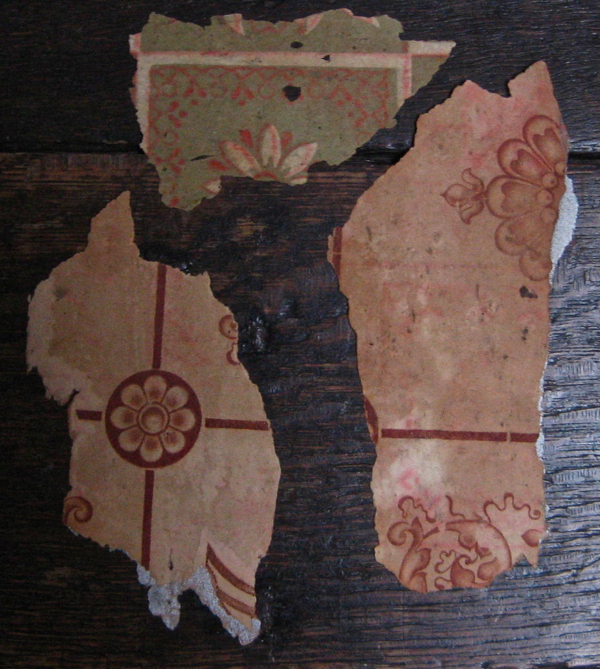
Fragments from the seventeen twenties.

Hand-painted wallpaper from the seventeen eighties.

Printed wallpaper from the seventeen eighties.
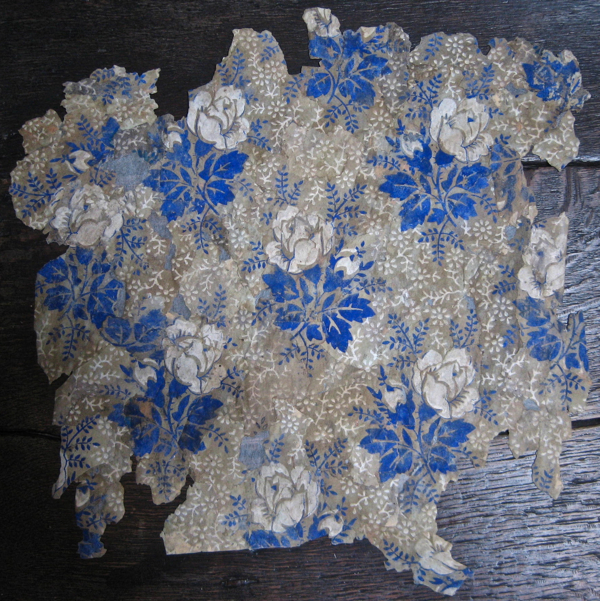
Eighteen twenties.
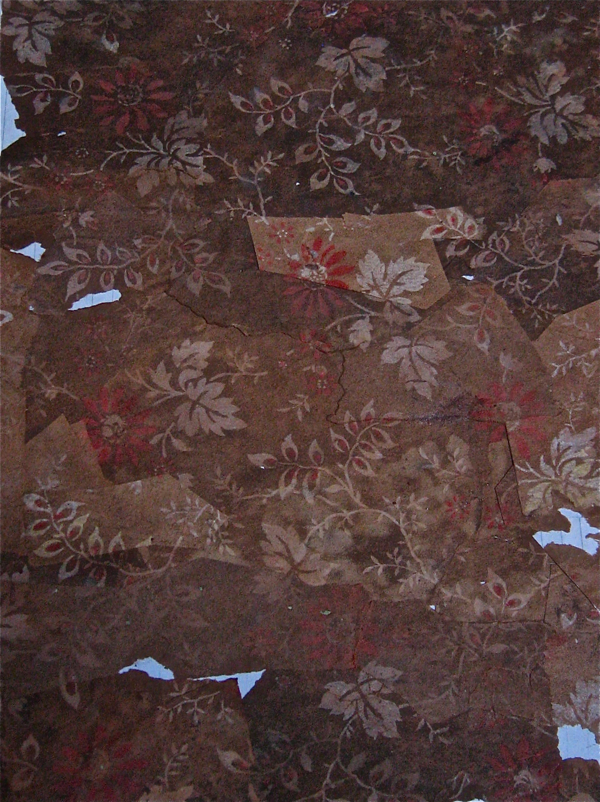
Eighteen forties.

Mid-nineteenth century fake wood panelling wallpaper, as papered over real wooden panelling.

Wallpaper by William Morris, 1880.
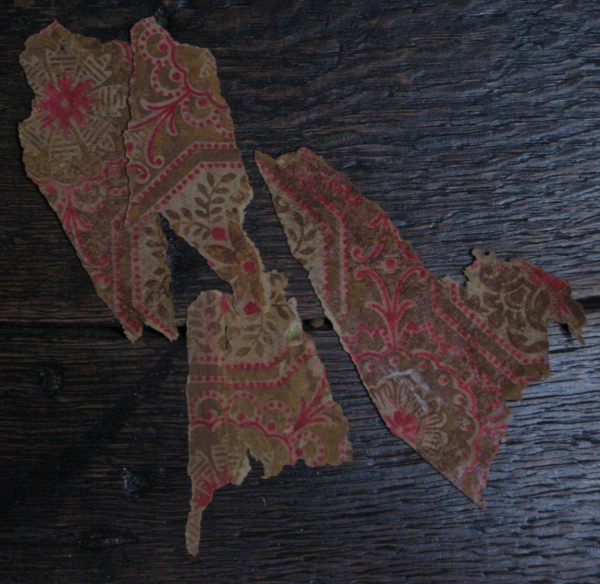
Expensive wallpaper at sixpence a yard from 1885.
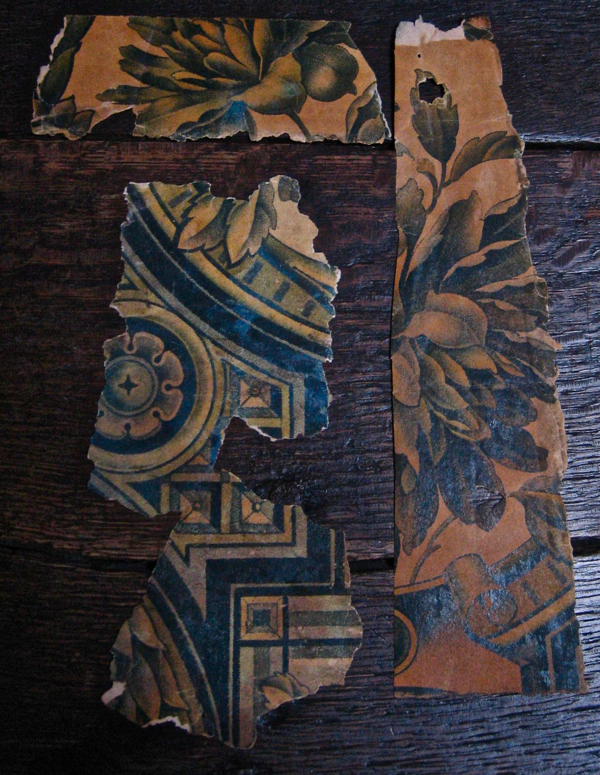
1895
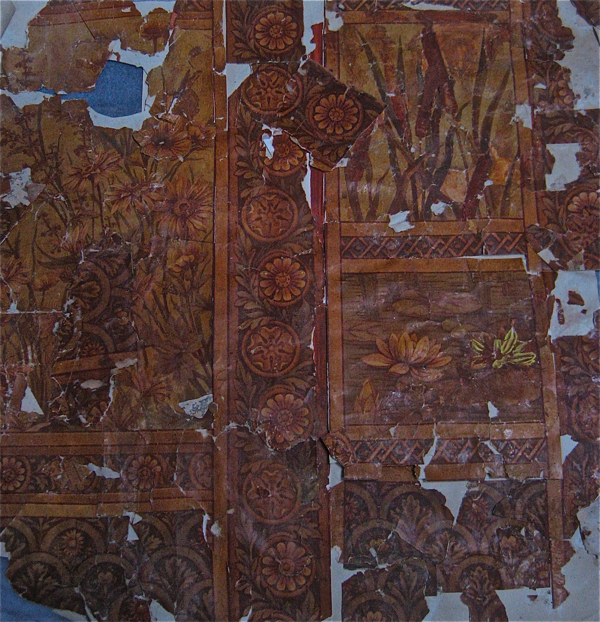
Late nineteenth century, in a lugubrious Arts & Crafts style.
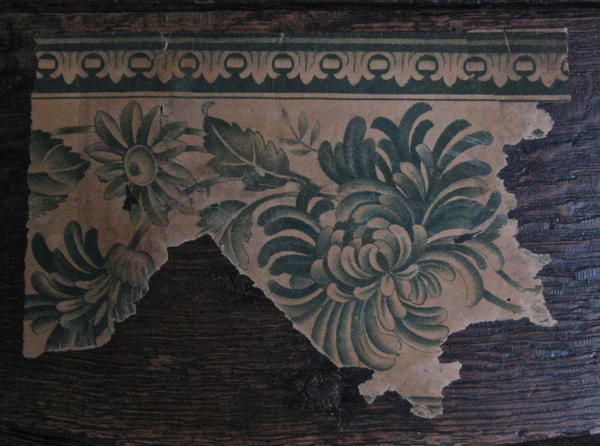
A frieze dating from 1900.
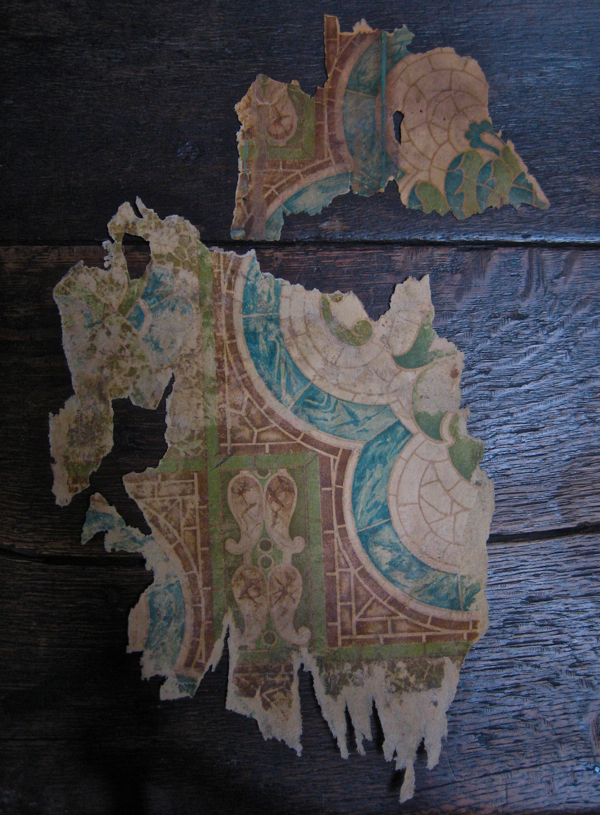
In an Art Nouveau style c. 1900.
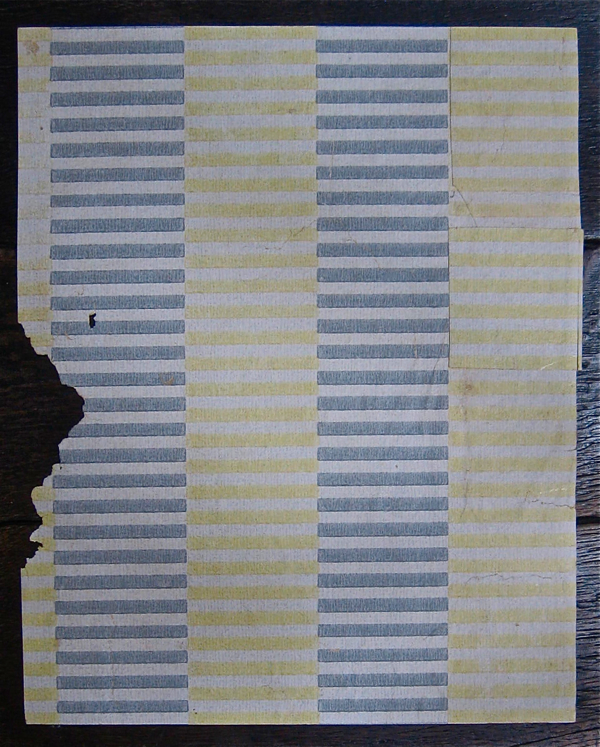
Modernist design by Finnish designer Eliel Saarinen from the nineteen twenties.
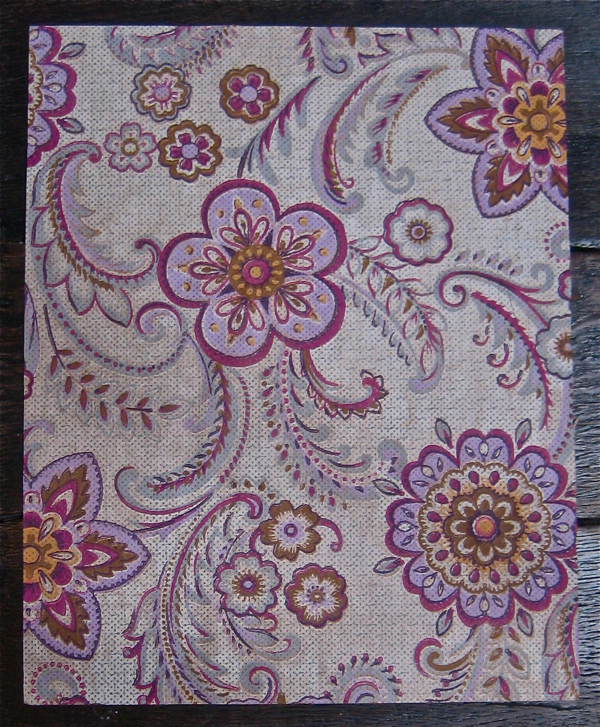
Nineteen sixties floral.
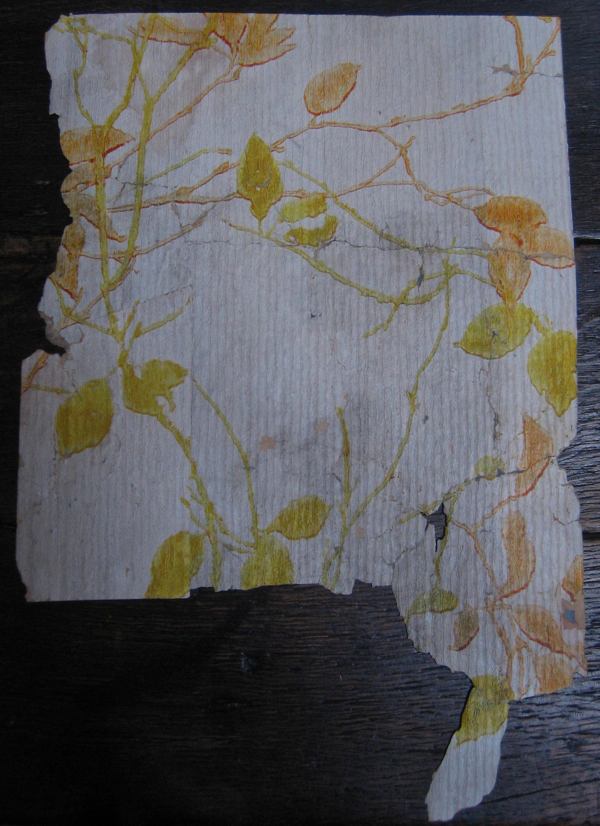
Vinyl wallpaper from the nineteen sixties.

Items that John Nicolson found under the floorboards of his eighteenth century house in Fournier St, including a wedding ring, pipes, buttons, coins, cotton reels, spinning tops, marbles, broken china and children’s toys. Note the child’s leather boot, the pair of jacks found under the front step, and the blue bottle of poison complete with syringe discovered in a sealed-up medicine cupboard which had been papered over. Horseshoes were found hidden throughout the fabric of the house to bring good luck, and the jacks and child’s shoe may also have been placed there for similar reasons.
You may also like to see the house these papers came from Before & After in Spitalfields
The Manhole Covers of Spitalfields

Ever since I wrote about sculptor Keith Bowler’s Roundels, describing how he set new manhole covers into the pavements of Spitalfields with motifs to commemorate all the people, cultures and trades that have passed through, I have been noticing the old ones that inspired him in the first place. This one from the eighteen eighties in Fournier St is undoubtably the most snazzy in the neighbourhood with its dynamic sunburst and catherine wheel spiral. So much wit and grace applied to the design of a modest coalhole cover, it redefines the notion of utilitarian design. In Bath, Bristol, Brighton and Edinburgh, I have seen whole streets where each house has a different design of coalhole cover, like mismatched buttons on a long overcoat, but in Spitalfields they are sparser and you have to look further to find them.
There is a second example of this Clark, Hunt & Co sunburst, that I like so much, in Redchurch St, just a hundred yards from the former showrooms at 159/60 Shoreditch High St of this company who called themselves the Middlesex Iron Works – founded in 1838, proud contractors to the H.M. War Office, the Admiralty and London County Council. And like many local ironworks, gone long ago, but outlived by their sturdy cast iron products. Alfred Solomons of 195 Caledonian Rd is another name I found here in Spitalfields on a couple of manhole covers, with some rather fetching, almost orientalist, nineteenth century flourishes. I discovered that the Jewish Chronicle reported the birth of a son to Alfred’s wife Celia on 18th December 1894 at the Caledonian Rd address, so these plates commemorate them personally now.
Meanwhile Hayward Brothers of 187 & 189 Union St, Borough, are the most ubiquitous of the named manufacturers with their handsome iron artefacts in the pavements of our neighbourhood. They were founded by William & Edward Hayward, glaziers who had been trading since 1783 when they bought Robert Henley’s ironmongery business in 1838. As glaziers they brought a whole new progressive mentality to the humble production of coalhole covers, patenting the addition of prisms that admitted light to the cellar below. You can see one of their “semi-prismatic pavement lights” illustrated below, in Calvert Avenue. Such was the success of this company that by 1921 they opened a factory in Enfield, and even invented the “crete-o-lux” concrete system which was used to repave Regent St, but they ceased trading in the nineteen seventies when smokeless zones were introduced in London and coal fires ceased. Regrettably, Spitalfields cannot boast a coalhole by the most celebrated nineteenth century manufacturer, by virtue of their name, A.Smellie of Westminster. The nearest example is in Elizabeth St, Victoria, where I shall have to make a pilgrimage to see it.
Unfailingly, my fascination with the city is deepened by the discovery of new details like these, harbouring human stories waiting to be uncovered by the curious. Even neglected and trodden beneath a million feet, by virtue of being in the street, these ingenious covers remind us of their long dead makers’ names more effectively than any tombstone in a churchyard. There was rain blowing in the wind yesterday but when the sun came out afterwards, the beautiful old iron covers shone brightly like medals – for those who had the eyes to see them – emblazoned upon the streets of Spitalfields.
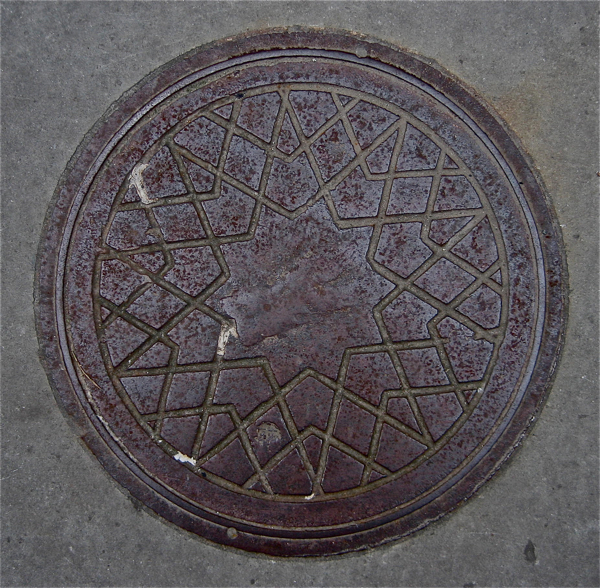
In Old Broad St.

In Fournier St, a nineteenth century coalhole cover by Alfred Solomons, 195 Caledonian Rd – I am reliable informed there are similar covers in Doughty St and around Bloomsbury.
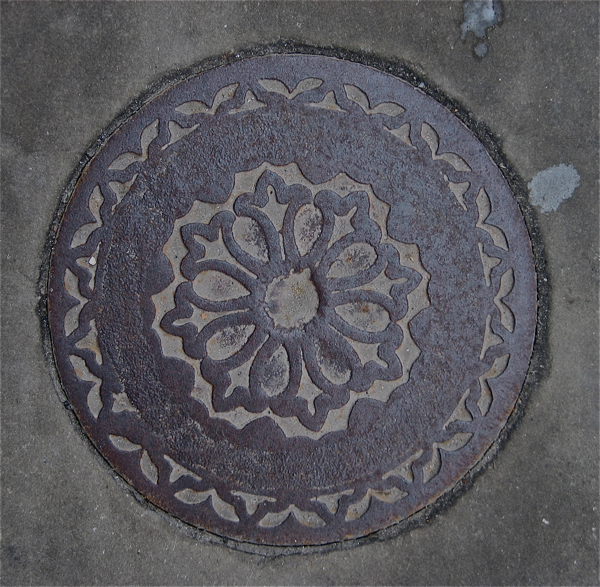
A more minimal variant on the same design by Alfred Solomons.

Hayward Brothers’ “Patent Self-Locking Semi-Prismatic Pavement Light” in Calvert Avenue.

A more recent example of Hayward Brothers’ self -locking plate.

In Gunthorpe St, this drain cover commemorates Stepney Borough Council created in 1900 and abolished in 1965.

At the Rectory in Fournier St, this early plate by Hayward Brothers of 187 & 189 Union St, Borough, which is also to be found in Lower Richmond Rd.

Another by Haywood Brothers in Spitalfields – although unlabelled, it follows the design of the plate above.

Bullseye in Chance St
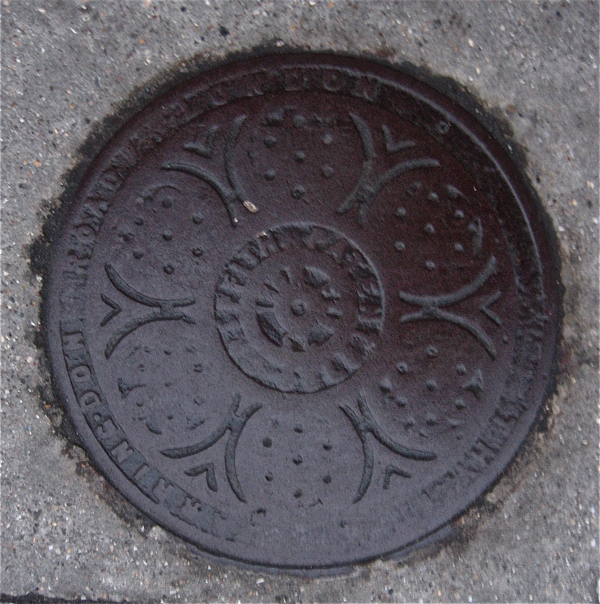
In Commercial St, at the junction with Elder St, is this worn plate is made by Griffith of Farringdon Rd, Clerkenwell.

In Middlesex St. LCC – London County Council was abolished in 1965. Can it be only co-incidental that this old manhole cover in Petticoat Lane Market, in the former Jewish quarter, has a star of David at the centre?












