Mark Petty’s New Outfits

“Oh Romford! There is nowhere quite like it,” says Mark, “For Essex, the people are quite friendly.”
With London Fashion Week upon us and the change in the seasons requiring everyone to reconsider their wardrobes, it was the ideal time this week to pay a visit to my friend Mark Petty, the trendsetter. While there are many who pursue fashion in the East End, Mark’s approach to clothes transcends such frippery – for him, clothing is an unmitigated form of personal expression that redefines the notion of being a style pioneer.
Yet even more remarkable than the audacity of Mark’s outfits is the moral courage he summons to carry them off. Mark understands that the reaction he encounters on the street is a barometer of the degree of social acceptance of him as a human being, and this is why he refuses to be cowed or compromise his appearance for the sake of an easy life. The wicked humour and delight in colour that Mark expresses in his clothing is irresistible to me because it is a brave affirmation of life and personal freedom – specifically the right to be different. This is why Mark makes sacrifices to be able to afford these clothes, spending every penny he has upon their manufacture. In a grey world, Mark’s multicoloured outfits manifest his capacity for joy, and his regular presence in Brick Lane is an inspiration to us all.
The outfits you see here are all the product Mark’s feverish creativity over the last six months. Although Mark would not necessarily use these words, I do not think he would object to us describing them as – the Mark Petty Collection for Autumn/ Winter 2011/2. Essential Mark Petty style is characterised by the generous use of coloured leather with words and images applied in contrasted colours. He works in partnership with Mr Batty of Batty Fashions in the Hackney Rd who sews the clothes from Mark’s patterns. Mark and Mr Batty enjoy a symbiotic relationship something like that of Domenico Dolce & Stefano Gabbana – in the sense that Mark brings the creative ideas while Mr Batty is a conservative force, achieving the practical make-up of the garments and occasionally offering (futile) resistance to the elements of Mark’s unfettered imagination that transgress his personal notion of social convention.
As we sat in Mark’s pink living room in Bethnal Green, he told me about his current obsession with shorts, some emblazoned with the names of places that have an emotion meaning for him and others carrying slogans of personal significance. Additionally Mark is passionate about the cultural identity of the regions, especially Wales and Ireland, as well as a possessing a fascination with English history and figures that inspire him – such as Boudicca, Robin Hood and Dick Turpin. As yet, Mark has only completed his Boudicca outfit in this projected series which means we have Robin Hood and Dick Turpin yet to look forward to.
It was in recognition of his Celtic origins that Mark chose to dye his hair red, emphasising his own Irish ancestry. This colour is also ideal for Mark’s Boudicca outfit which consists of shorts, jacket and cape, celebrating a woman who is a personal inspiration for him. “I’m thinking of changing my name to Boudicca O’Reilly,” Mark confessed to me, “Boudicca, because I admire the way she was able to command attention and O’Reilly, because of my Irish descent.”

Mark’s Welsh Coat.
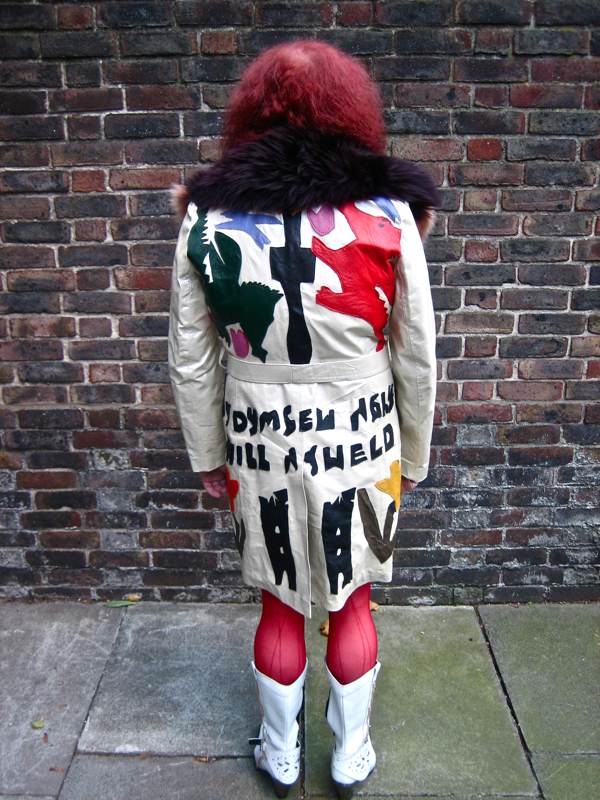
The reverse of the Welsh Coat features dragons and a text in Welsh, “tydymgen nghy faillngweld” meaning “Hello my friend.”

Mark’s Irish Coat.

The reverse of Irish Coat features Irish dragons and the greeting “Top of the Morning.”

Mark in the short jacket he wears to complement his shorts.

“Boudica Rides Again” with applique design of chariot and horses.
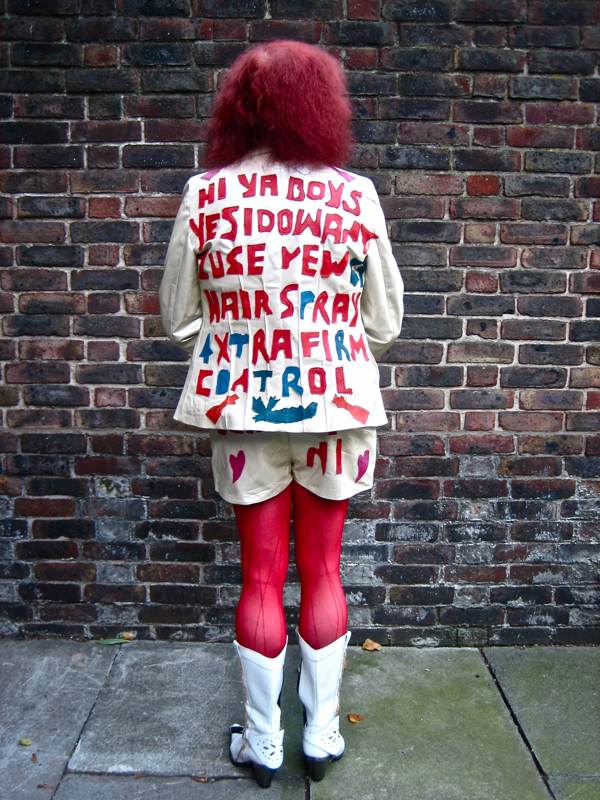
This jacket matches the “Islington” shorts just visible.

Mark’s tribute to Dublin’s fair city.


Mark made these shorts as a souvenir of the generosity of spirit he encountered in Manchester.

Mark made these to celebrate the genius of William Shakespeare.

The first in a series of capes Mark is planning to protect him from the elements in the coming Winter.


Read my original profile of Mark Petty, Trendsetter
and take a look at Mark Petty’s Multicoloured Coats
Leila’s Shop Report 5

Each Monday night throughout the year, Leila McAlister goes to Covent Garden Market to buy vegetables and drives back in the early hours with the pick of the season. Each Tuesday morning, Norman Hyams arrives at seven thirty to make up the weekly delivery boxes from Leila’s purchases and thereby supply some of the freshest fruit and vegetables in the East End. With the assistance of Lindsay Sekulowicz, who organises the displays in the shop, he lays out the green plastic crates under the brown awning in Calvert Avenue and together they distribute the produce between the boxes and, by eleven o’clock, he is on the road making his deliveries.
If you are lucky enough to receive one of these, then it turns Tuesday morning into one of the highlights of the week, and the contents of the box becomes a regular indicator of the changing seasons as different fruit and vegetables appear in each new crate. It never fails to excite me, as I search through the contents when it arrives, popping the bunches of parsley and mint in water, and assessing the possibilities for the days ahead. As a point of honour, I always eat all the vegetables within the week, which increases my consumption of greens, and makes shopping for meals easy, because I simply buy meat or fish to accompany what is in the box. In fact, such is the beauty of these lush colourful boxes of vegetables, and such is my fascination with the progress of the year, that I photograph the box each week to create an informal vegetable calendar – you can see the last few months below.
“I’ve been doing it for two years, and Leila did it for at least three years before me, “explained Norman enthusiastically, as we set off in the van together this week on the round, spiralling around the streets from Arnold Circus, “And it just gets bigger and bigger!”
“I was born opposite Leila’s Shop, in Shiplake House,” he volunteered, “that’s what made me come back.” Norman is a painter who lives in Ladbroke Grove and commutes to his studio in Bow – except for one day a week, when he does the deliveries for Leila.“I left when I was an infant so I don’t have any memories of it, but I remember my mother telling me she was was keen to get out of the Boundary Estate.” he revealed, shaking his head in bemusement, “In those days nobody wanted to live here. My mum and dad both lived in Shoreditch when they were young, and we moved around quite a lot when I was a child. Council flats were easy to get in those days, so every time they had another baby, we got a new place to live, and I have two brothers and two sisters.”
I thought I had the cushy job, ticking off the names on a clipboard for Norman while he carried the boxes in to the make the deliveries, but then I realised that on each call he was welcomed so eagerly by the recipients, and I became so intrigued by the different worlds he entered, that I leapt out of the van and accompanied him inside. Curious eyes peered hungrily over laptops at the Abake studio where the designers sat round a table working at their computers as if at a meal, and once we left our vegetable box – we presume – they swapped their devices for the serious business of lunch. Equally, at the Boudicca fashion label, where furious preparations for London Fashion Week were underway, the same roving eyes followed the box as we carried it in and put it down.
Norman delights in all the fleeting conversations in these worlds where he is the vegetable envoy. “I used to work a couple of days a week for my brother in hospitality and it was doing my head in,” he confessed to me with a frown as we walked back to the van, “So I thought it would nice to work for Leila and I texted her asking her if she needed anyone to do washing up, but there was nothing doing – instead she offered me the vegetable round.” And he gave me a smile of triumph, which indicated that he couldn’t believe his luck.
By now we were almost done, yet I had become at home with the constant fragrance of fresh parsley as we drove around the East End. “When you get basil in the delivery boxes, the whole van smells of basil,” Norman said, with a broad smile, breathing in with a sigh of pleasure, half-lowering his eyelids in illustration of the intensity of his delight.

Norman Hyams


You may also like to read
Leila’s weekly vegetable boxes are available for delivery throughout Shoreditch, Dalston, London Fields, Bethnal Green, Spitalfields and Whitechapel.
You can find the vegetable box blog by clicking here.
Dan Jones’ Paintings
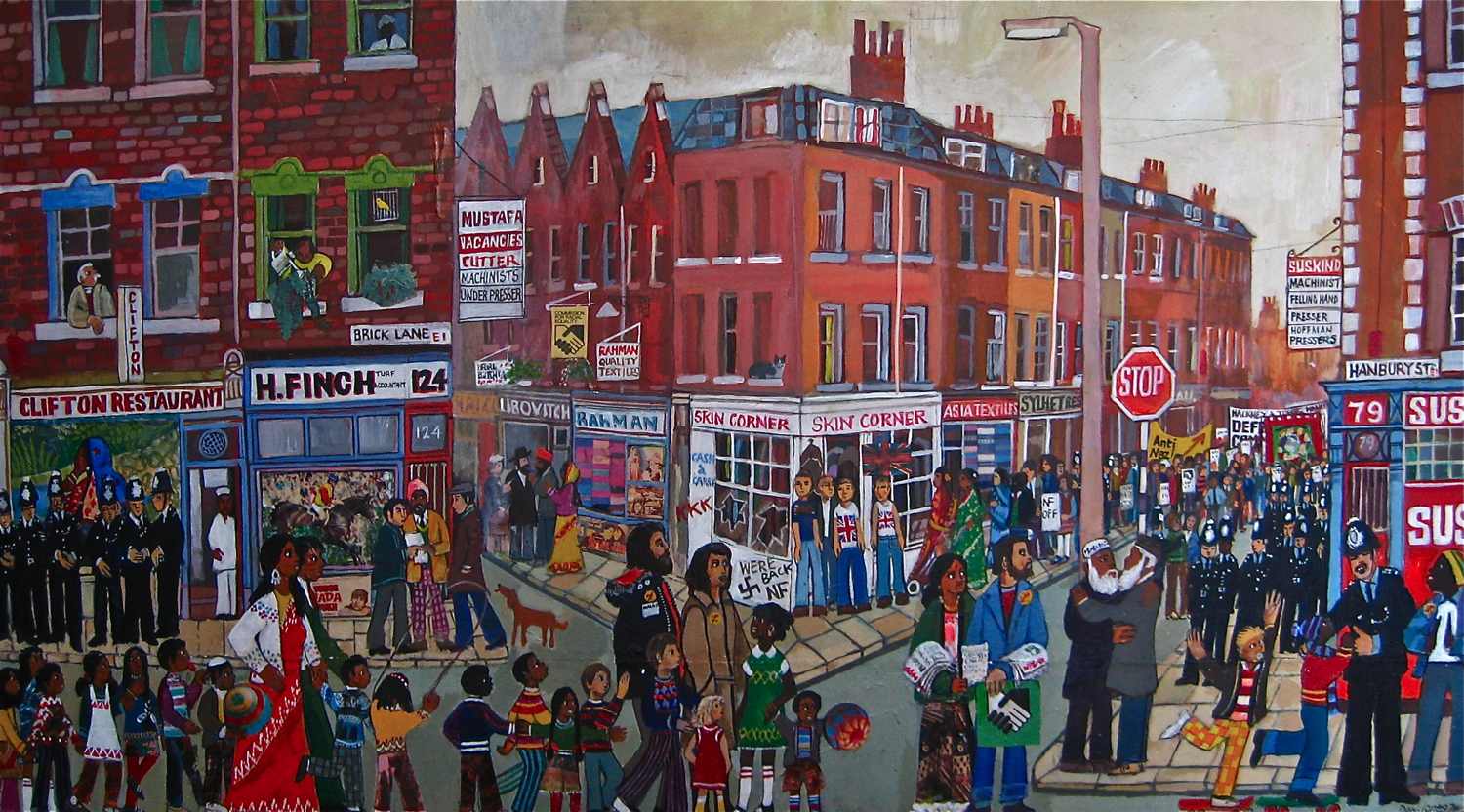
Click to enlarge Dan Jones’ painting of Brick Lane 1978
In Dan Jones’ exuberant and playful painting, Brick Lane is a stage upon which an epic political drama is enacted. From this vantage point at the corner of the Truman Brewery, we see an Anti-Racist demonstration advancing up Brick Lane, while a bunch of skinheads stand at the junction with Hanbury St outside the fortuitously named “Skin Corner.” Meanwhile, a policeman stops a black boy on the opposite corner in front of a partially visible sign reading as “Sus,” in reference to the “Sus” law that permitted police to stop and search anyone on suspicion, a law repealed in 1981. And in the foreground of all this action, life goes on – two senior Bengali men embrace, as Dan and his family arrive to join the march, while bystanders of different creeds and colours chat together. More than thirty years since Dan painted this scene, many of the premises on Brick Lane have changed hands, but the recent attempted march by the English Defence League brings the central drama of this picture back into the present tense.
Dan Jones’ mother was the artist Pearl Binder, who came to live in Whitechapel in the nineteen twenties, and since 1967, Dan has lived down in Cable St where he brought up his family in an old terraced house next to the Crown & Dolphin. A prolific painter, Dan has creating many panoramic works – often of political scenes, such as you see here, as well as smaller pictures produced to illustrate two books of Nursery Rhymes, “Inky, Pinky, Ponky” and “Mother Goose comes to Cable St,” both published in the eighties. In recent years, he has undertaken a series of large playground murals portraying school children and the infinite variety of their games and rhymes.
Employed at first in youth work in the Cable St area, and subsequently involved in social work with immigrant families, Dan has been a popular figure in the East End for many years, and his canvases are crammed with affectionate portraits of hundreds of the people that he has come to know through his work and political campaigning. Today Dan works for Amnesty International, and continues to paint and to pursue his lifelong passion for collecting rhymes.
There is a highly personal vision of the East End manifest in Dan Jones’ paintings, which captivate me with the quality of their intricate detail and tender observation. When Dan showed me his work, he pointed out the names of all the people portrayed and told me the story behind every picture. Like the Pipe & Drum Band in Wapping painted by Dan in 1974 – to give but one example – which had been going since the eighteen eighties using the same sheet music, their performances were a living fossil of the music of those days until a row closed them down in 1980. “They were good – good flute players and renowned as boxers,” Dan informed me respectfully.

The End of Club Row, 1983. The animal market held in Sclater St and Club Row was closed after protests by Animal Rights’ Campaigners.
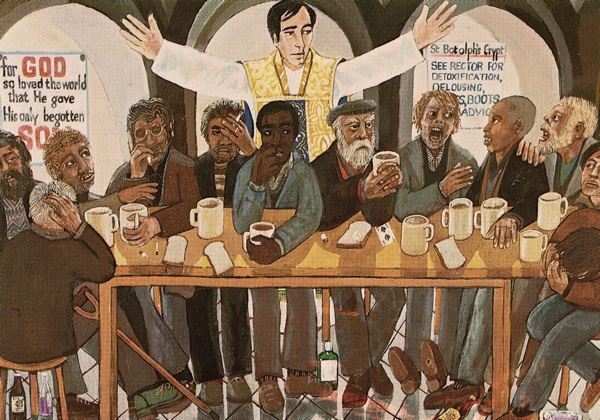
Last Supper at St Botolph’s, Aldgate. Reverend Malcolm Johnston preaches to the homeless at Easter 1982.

Pipe and Drum Band in Tent St, Wapping, 1974.
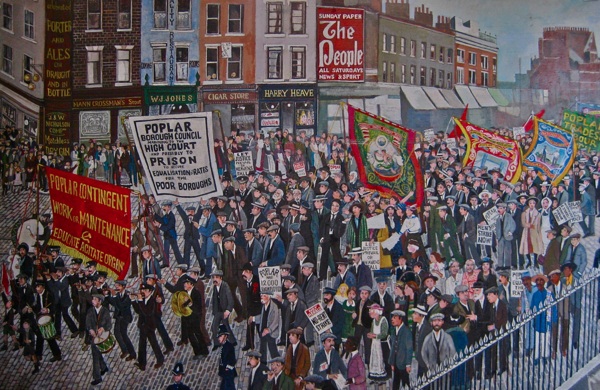
The Poplar Rates Rebellion of 1921

Parade on the the sixtieth anniversary of the Battle of Cable St, 1996
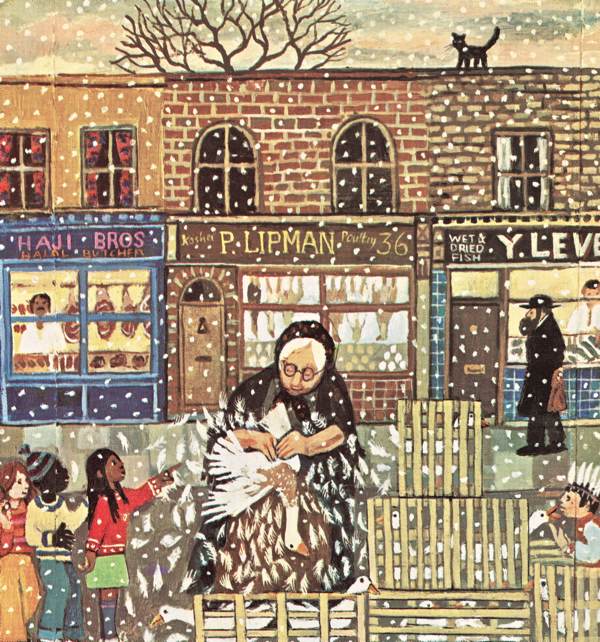
Live poultry sold in Hessel St.

Fishing at Limehouse Basin.

Tubby Isaacs in Goulston St, Petticoat Lane.

Palaseum Cinema in Commercial Rd

A Teddy Bear rampages outside the Whitechapel Bell Foundry.
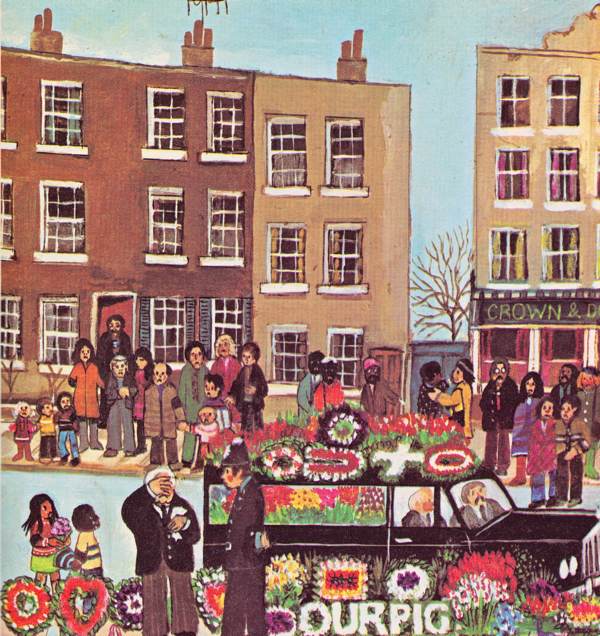
Funeral of a pig in Cable St, Dan Jones and his family come out of their house to watch.

Christ Church School, Brick Lane

Liverpool St Station
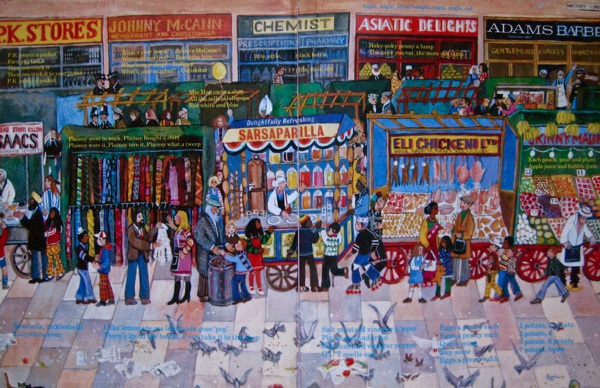
Watney Market

Dan Jones
Paintings copyright © Dan Jones
Look at Dan’s interactive playground painting by clicking here.
Read my original profile of Dan Jones, Rhyme Collector
and Dan Jones’ mother Pearl Binder, Artist & Writer
Clive & Steven Phythian, Master Cutter & Apprentice

“When I was twelve my father said, ‘What are you going to do in life? You need to learn something.'” recalled Clive Phythian, Head Cutter at Alexander Boyd when I dropped by to see what he had in hand last week. He spoke as he worked at the cutting table in the small tailoring workshop that he shares with his son Steven at the rear of the shop in Artillery Passage. “
I learnt a little but I couldn’t say I learnt a lot” confessed Clive with laconic reserve, considering those Saturdays spent in his grandfather’s tailoring shop in Walthamstow which were the outcome of that conversation with his father. “At twelve you’d rather be outside running about,” he acknowledged with a sympathetic smile, “but it gave me the discipline and I saw how hard he had to work.”
Every Saturday, I worked with him and, as I grew older, I had clothes made for me which was absolutely fantastic – I was the envy of my friends. At the time, my father was Head Cutter at Blades in Savile Row. When I was fourteen, I used to go up there with him and I started making the baists (first fittings) of jackets and waistcoats. I had my eyes opened to what goes on there, and my father said, “I’m going to try and get you a place at the London College of Fashion on a three year City & Guilds tailoring course.” I must admit, I thoroughly enjoyed it, and I won cups for my work too.
Prior to leaving, I had two interviews, one with Davis & Sons, traditional bespoke West End tailors, and the other was with Gieves & Hawkes in Savile Row. I went to Gieves & Hawkes! When you are a young person, you see a bigger company and you think you are going to go places, and I worked there nine years – a fantastic experience. There were nine cutters and I managed to learn so much from them, they were a fount of knowledge. In some respects, I have forgotten some of the things I learnt at Gieves & Hawkes, but I expect they are still slotted away somewhere in the back of my mind. From there, I went to work for my uncle who had a very successful business in the City, Aspers in Cullum St, by Lloyds of London. You could say he poached me from Gieves & Hawkes because he offered more money. The West End is the more elegant side and you have more time, whereas in the City people always want it yesterday.
Then my father moved from the West End and set up his own business in the City too. I knew I would always work for my father, so there came a time when I said to my uncle, “I’m going to work with my dad,” and it put his nose out of joint – but you can choose your friends, not your family.The company my father bought was J.G.Chappels near Fenchurch St Station. I enjoyed working alongside him, and my brother joined the company as well. But then my father father died, and although my brother and I ran the business for another three years, we got tired of it. So we decided to take a gap year and I went to do tarmacking. When I was a young kid, my uncle used to work in tarmacking and I helped him out, so I had the knowledge. It was much to my wife’s disgust, but we needed a year out to get our heads back together.
One of my friends, Stuart Lemprell, was Head Cutter at Timothy Everest and he gave me a call and said, “Do you want to come back in?” So I said, “Yes.” I enjoyed working there for four years, until new people arrived who wanted to computerise things, so I said, “I’m off.” I’ve got morals. I don’t want a computer to do what I do. I don’t need a computer, my knowledge is in the tape, the square and the yardstick.
I came and spoke with Boyd, and I’ve been here as Master Cutter at Alexander Boyd ever since, more than five years now. The role of the Master Cutter is very important, without the knowledge of someone who knows how a garment is put together and how it should be cut, you’re not going to get a good product. You have to measure, but if your eye tells you it’s not right, even if the measurement is correct you know it’s wrong.
I get immense satisfaction from seeing a client put on a garment I have made and walk out of the shop with a big smile on his face. I love cutting. I’ve been doing it thirty-six years and I’m still learning. Cutting is my passion. You have to have that… something. Steven has it. He’s inherited it from my grandfather who was a tailor, and my father, and my uncles, Roy, Terry and Paul, they were all tailors, and my aunty Pam, she was a tailor too. So I suppose you could say it’s in the genes.”
“Dad’s always said, ‘Do what you want to do,’ there’s been no pressure to become a tailor,” Steven Phythian confided to me with unaffected honesty, when I joined him at the counter where he was cutting patterns for trousers. It was quite a different story from his father, yet the result was the same – though Steven revealed he had worked in Argos, as a car valet and as pizza delivery man, as well qualifying as a locksmith, even applying to the police force, in the ten years after college before he chose to follow in his father’s footsteps and become the fourth generation to work in tailoring.
“It will be quite a long process,” he admitted with calm acceptance, just six months into his apprenticeship, “Five years before I can fully understand all aspects of cutting. But as my father says – even after more than thirty years – he’s still learning.”
So I left them there, both absorbed in their work in the quiet of the tailoring shop, the atmosphere broken occasionally by customers coming and going. Whenever I walk through Artillery Passage in future, I shall always cast a glance in their window to catch a glimpse of Clive & Steven at work. Almost the last tailors in Spitalfields – a place that once the centre of tailoring – yet I think we may be assured these two will be here for many years to come.


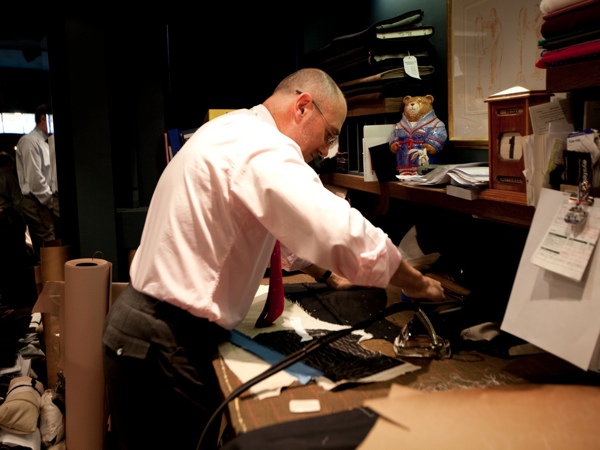


Clive Phythian in Men’s Wear, February, 1977

Steven Phythian, September 2011

Clive Phythian’s three piece co-ordinate in Walnut dogtooth check that won first prize in the IMBEX Student Fashion Competition, 1977.

Clive Phythian, Master Cutter at Alexander Boyd, September 2011.


Clive & Steven Phythian
Photographs copyright © Jeremy Freedman
London Melodies

I saw a raggedy man with crazy eyes disappear down Catherine Wheel Alley, so I followed to see what he was up to. When I entered the putrid alley, he disappeared around the corner, yet I heard him cry, “Rabbit, Rabbit. Nice Fat Rabbit!” So I hurried to catch up, and found myself lost in the maze of passages and back streets that fill the space between Bishopsgate and Middlesex St. Arriving at a cross-ways where several paths met, I could not see him anywhere. Uncertain which way to turn, I spotted a large woman swathed in layers of old clothes and wielding a heavy basket, trudging off down another alley with evident fatigue. Once she turned the corner, I followed her at a discreet distance and I could hear her shrill cry, “Lilies of the Valley, Sweet Lilies of the Valley,” echoing between the high walls. But again, when I turned the corner, she had vanished. Then, I heard another behind me, crying, “Hot Mutton Dumplings – Nice Dumplings, All Hot!” and so I retraced my steps.
Let me explain, I had just spent the morning in the Bishopsgate Institute poring over a small book of prints entitled, “London Melodies; or Cries of the Seasons.” Published anonymously and bound in non-descript brown boards, and printed on cheap paper with several torn pages – even so, the appreciative owner had inscribed it with his name and the date 1823 in a careful italic script.
This book entranced me with the vivid quality of its beautiful wood engravings of street hawkers. Commonly in the popular prints illustrating Cries of London, the peddlers are sentimentalised, portrayed with cheerful faces and rosy cheeks, ever jaunty as they ply their honest trades. These lively wood engravings could not be more different. These people look filthy, with bad skin and teeth, dressed in ragged clothes, either skinny as cadavers or fat as thieves, and with hands as scrawny as rats’ claws. You can almost smell their bad breath and sweaty unwashed bodies, pushing themselves up against you in the crowd to make a hard sell. These Cries of London are never going to be illustrated on a tea caddy or tin of Yardley Talcum Powder and they don’t give a toss. They are a rough bunch with ready fists, that you would not wish to encounter in a narrow byway on a dark night, yet they are survivors who know the lore of the streets and how to turn a shilling as easily as a groat. With unrivalled spirit, savage humour, profane vocabulary and a rapacious appetite, they are the most human of all the Cries of London I have come across. And they call to me across the centuries, crying, “Sweet and Pretty Beau-Pots – One a-Penny” and “Buy my Live Scate.”
I do not know who was responsible for these superlative wood engravings, which capture the vigorous life of these loud characters with such art. From a contemporary perspective these are portraits that sit naturally alongside the work of Ronald Searle, Ralph Steadman, Ian Pollock, Quentin Blake and Martin Honeysett. This artist glories in the grotesque features and unrestrained personalities of street people, while also permitting them a humanity which we can recognise and respect. How I wish I could catch up with them all and record their stories for you.

Rabbit, Rabbit – Nice fat Rabbit
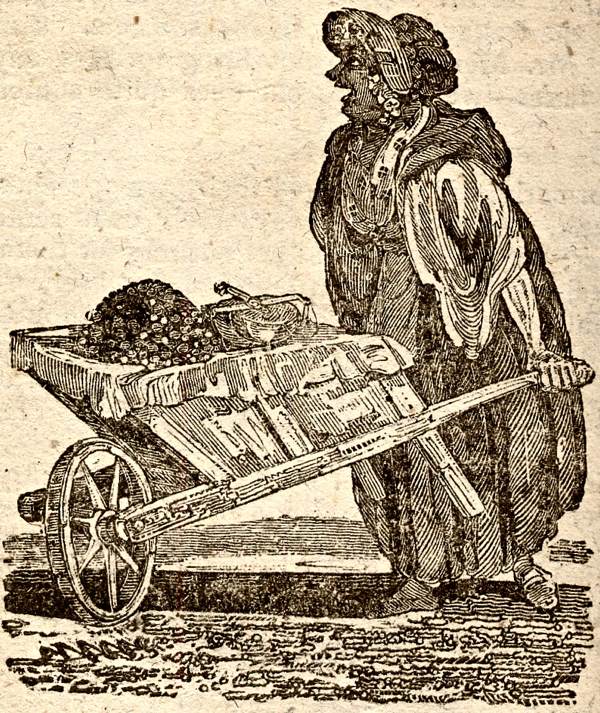
All Round & Sound, Full Weight, Threepence a Pound, my Ripe Kentish Cherries.

Buy my Fresh Herrings, Fresh Herrings, O! Three a Groat, Herrings, O!

Buy a Nice Wax Doll – Rosy and Fresh.

The King’s Speech, The King’s Speech to both Houses of Parliament.

Here’s all a Blowing, Alive and Growing – Choice Shrubs and Plants, Alive and Growing.

Hot Spice Gingerbread, Hot – Come buy my Spice Gingerbread, Smoaking Hot – Hot Spice Gingerbread, All Hot.

Any Earthen Ware, Plates, Dishes, or Jugs, today – any Clothes to Exchange, Madam?

Hot Mutton Dumplings – Nice Dumplings, All Hot.

Buy a Hat Box, Cap Box, or Bonnet Box.

Buy my Baskets, a Work, Fruit, or a Bread Basket.

Chickens, a Nice Fat Chicken – Chicken, or a Young Fowl.

Sweet and Pretty Beau-Pots, One a-Penny – Chickweed and Groundsel for your Birds.

Buy my Wooden Ware – a Bowl, Dish, Spoon or Platter.

Six Bunches a-Penny, Sweet Lavender – Six Bunches a-Penny, Sweet Blooming Lavender.

Here’s One a-Penny – Here’s Two a-Penny, Hot Cross Buns.

Lilies of the Valley, Sweet Lilies of the Valley.
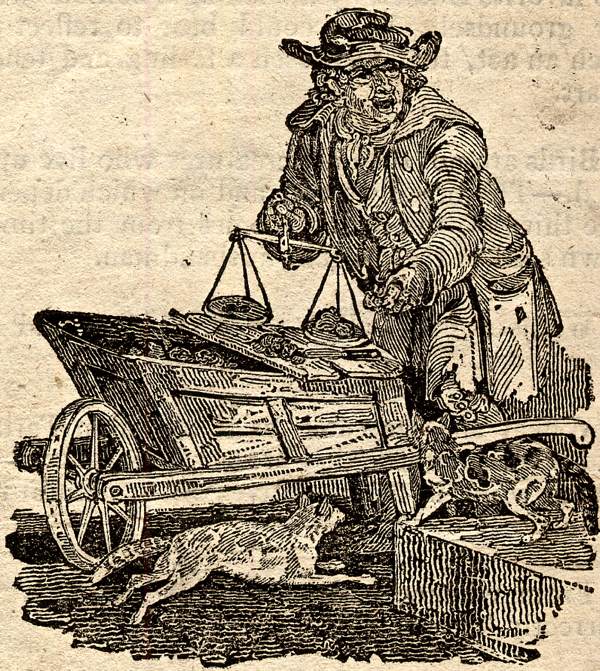
Cats Meat, Dogs Meat – Any Cat’s or Dog’s Meat Today?

Buy my Live Scate, Live Scate – Buy my Dainty Fresh Salmon.

Mackerel, O! Four for shilling, Mackerel, O!

Hastings Green and Young Hastings. Here’s Young Peas, Tenpence a Peck, Marrow-fat Peas.
Images copyright © Bishopsgate Institute
You may like to take a look at
H.W.Petherick’s London Characters
John Thomson’s Street Life in London
Aunt Busy Bee’s New London Cries
Marcellus Laroon’s Cries of London
More John Player’s Cries of London
William Nicholson’s London Types
Francis Wheatley’s Cries of London
John Thomas Smith’s Vagabondiana of 1817
Thomas Rowlandson’s Lower Orders
A Long Way From Spitalfields
Ten years ago this morning, I woke in an apartment in New York City. It was around eight thirty when my friend called from outside the bank in Midtown, where he had gone to deposit cheques. He had left early to be there at opening time and, as he was standing in line waiting for a teller, he saw on the television that there was a fire in one of the towers at the World Trade Centre.
I got out of bed and climbed up onto the flat roof of the apartment. It was a beautiful day, clear and bright with a blue sky after days of rain and cloud, and the humidity which overwhelms Manhattan in July and August had cleared. Although most people try to avoid New York in the Summer, and residents who have the option seek refuge in beach houses, it is my favourite time of year in the city. The one time when the pace slows, languor prevails, and there is peace in the shadowy air-conditioned buildings where people linger to avoid the baking temperature and blinding light outside in the streets.
Summer was drawing to an end and there would be no more of the trips to Long Island that had punctuated my time in the City. Just a week earlier, on Labor Day, which marks the change in the season, the beaches had closed for the year.
I stood on this same roof on July 4th and watched the fleet line up in the East River, admiring the firework display as I ate dinner with friends. Looking across Manhattan that morning, I could see the distant plume of smoke from the westerly of the towers. It did not mean anything to me then, but I was puzzled how it could have happened, so I went downstairs and switched on the television. The television was reporting a plane had crashed into the tower. It was an extraordinary event for which the news anchor had no explanation, and so I went back to bed and dozed again.
I was awoken by the return of my friend who had cycled back from his errand at the bank. People were getting really excited about this fire, he told me, and he switched on the television again. For the first time, I sensed the panic and helplessness which was to envelop the city that day, as the presenters struggled to find words and keep their cool in the face of inexplicable and unprecedented events.
Then came the strangest moment of television I ever saw. Upon the screen, a plane jetted out of nowhere and disappeared into one the towers. “That’s a re-run, you’re seeing here, of the plane hitting the tower that we reported earlier,” commented the news-anchor, only to swallow her words – almost choking – as she exclaimed, “Oh no! That’s not a re-run, that’s another plane.”
Exactly a week earlier, at eight thirty in the morning, I visited the World Trade Centre accompanying my friend who was applying to an office there for a street traders’ licence. We came through the subway which opened up into a shopping mall and emerged onto the plaza directly beneath the towers. I recalled the first time I came to New York and stood at the top. Stretching my arms between those external struts and gazing down upon Manhattan from such a height, it was as if looking from the window of an aeroplane. My birthday was in a few days and we vowed to return to the top for a celebration, but we did not go back.
Once the second plane hit the towers, the tenor of events changed. Very quickly, reports came in of hijackings and other planes unaccounted for. I went back up onto the roof of the apartment and looked again to confirm the reality of the television news with my own eyes. Now there were two plumes of smoke in the sky, and sirens erupted through the streets as fire crews and police hurtled down the avenues of Manhattan. I returned to the television and stayed there, compelled. I had a pocket email machine and I was able to write messages to everyone in London to let them know I was alright, before the lines went dead.
A campaign was underway, something I could only comprehend through reference to science fiction such as “The War of the Worlds.” An attack had commenced that morning without indication how long it would last. As I sat there in shock at the accumulating reports of the plane hitting the Pentagon and the crash of United 93, a dread grew inside me. There was no reason to assume that this would not continue all day and it was impossible to know where and when it would end. It felt like the end of the world – there was no way to grasp the nature of what was happening. When I returned to the roof and looked again, the World Trade Centre had gone completely, replaced by a vast black tower of smoke billowing into the blue.
Twenty-one months earlier, I had been in Los Angeles at the time of the Millennium. Somehow, everybody expected a transformation and a new era to begin then. Nobody wanted to admit it was a non-event. But that morning, I realised that I was witnessing the actual moment when one century ended and a different world was born.
For a couple of years, I had been working with producers in Times Sq who were to present a play of mine on Broadway, opening on September 15th 2001. I loved being in New York in those days, it was a true metropolis of glamour and affluence – a world incarnated in the now over-familiar fiction of “Sex & the City.” Many times I enjoyed Cosmopolitans at the Bowery Bar, the location where Candice Bushnell’s novel, which was the origin of that series, began.
Walking out onto the street on that September day, several miles from the unfolding catastrophe at the World Trade Centre, the scene was not dissimilar from usual, except – as people went about their business – I knew what everyone was thinking. We were all looking at each other in fear and knowing that we could only enact the semblance of routine. I went to the grocery story and bought food for the next few days. On my way back to the apartment, I saw a postcard of the World Trade Centre on a rack and, without thinking, I took the entire stack in hand, went into the store and paid for them.
Back at the apartment, I addressed postcards to everybody in my address book in England and then I went to the Post Office and mailed them all. I still do not understand why I did this, because I never wrote any messages on the cards, yet I knew everyone would realise who sent them and why. In fact, half arrived within ten days and half arrived four months later, intercepted perhaps as suspicious material in the collective paranoia that ensued.
On the first day J.F.Kennedy Airport reopened, I flew back to London, peering from the window of the jet at the smoke still rising from the foot of Manhattan. At once, I went to see my parents in Devon and found them well, but within a week my father died unexpectedly. My mother had dementia and could no longer live alone, so I chose to move back into the family house to care for her. My play never opened on Broadway and I did not have the American career that I so longed for at that time, but after the events I had witnessed it no longer mattered to me.
At KTS The Corner
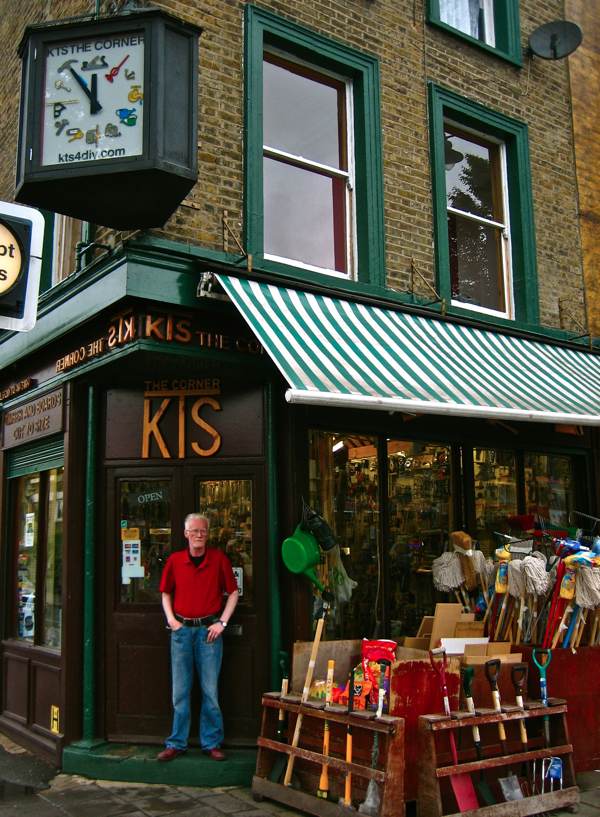
Everyone in East London knows KTS The Corner, Tony O’Kane’s timber and DIY shop. With Tony’s ingenious wooden designs upon the fascia and the three-sided clock he designed over the door, this singular family business never fails catch the eye of anyone passing the corner of the Kingsland Rd and Englefield Rd in Dalston. In fact, KTS The Corner is such an established landmark that it is “a point of knowledge” for taxi drivers.
Yet, in spite of its fame, there is an enigma about KTS which can now be revealed for the first time. “People think it stands for Kingsland Timber Service,” said Tony with a glint in his eye, “Even my accountant thinks it does, but it doesn’t – it stands for three of my children, Katie, Toni and Sean.” And then he crossed his arms and tapped his foot upon the ground, chuckling to himself at this ingenious ruse. It was entirely characteristic of Tony’s irrepressible creative spirit which finds its expression in every aspect of this modest family concern, now among the last of the independent one-stop shops for small builders and people doing up their homes.
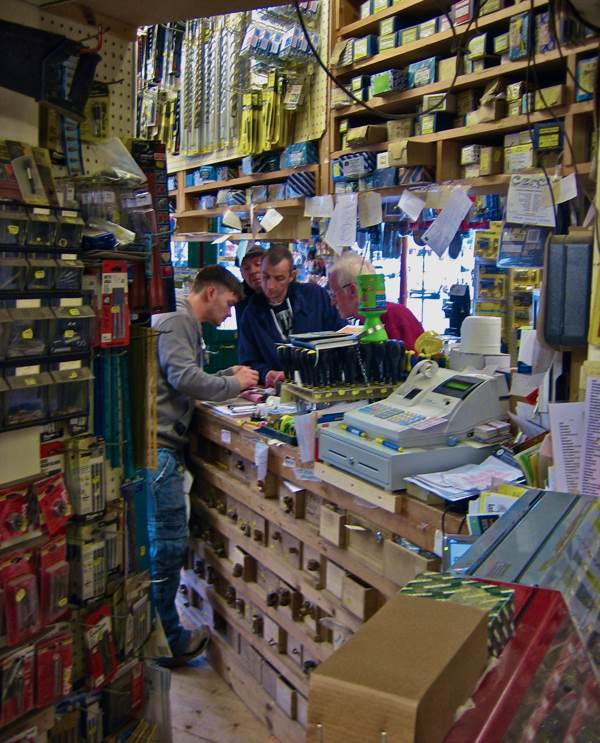
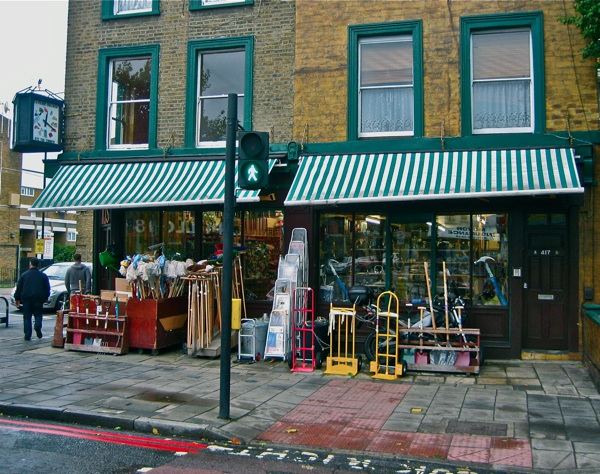
On the Kingsland Rd, Tony’s magnificent pavement display of brushes, mops and shovels, arrayed like soldiers on parade, guard the wonders that lie within. To enter, you walk underneath Tony’s unique three-sided clock – constructed to be seen from East, South and North – with his own illustrations of building materials replacing the numerals. Inside, there are two counters, one on either side, where Tony’s sons and daughters lean over to greet you, offering key cutting on your left and a phantasmagoric array of fixtures to your right. Step further, and the temporal theme becomes apparent, as I discovered when Tony took me on the tour. Each department has a different home made clock with items of stock replacing the numerals, whether nails and screws, electrical fittings, locks and keys, copper piping joints, or even paints upon a palette-shaped clock face. Whenever I expressed my approval, Tony grimaced shyly and gave a shrug, indicating that he was just amusing himself.
Rashly, Tony left his sons in charge while we retired to his cubicle office stacked with invoices and receipts where, over a cup of tea, he explained how he came to be there.
I’m from from Hoxton, I went to St Monica’s School in Hoxton Sq. To get me to concentrate on anything they had to tie me down, but, if anything physical needed doing, like moving tables and chairs, I’d be there doing it. My dad did his own decorating and my mother wanted everything completely changed every year or eighteen months, so he taught me how to hang wallpaper and to do lots of little jobs. After Cardinal Pole’s Secondary School, I did an apprenticeship in carpentry and got a City & Guilds distinction. Starting at fifteen, I did four years apprenticeship at Yeomans & Partners. Back then, when you came out of your apprenticeship, they made you redundant. You got the notice in your pay packet on the Thursday but on Saturday you’d get a letter advertising that they needed carpenters at the same company. They wanted you to work for them but without benefits and you had to pay a weekly holiday stamp.
I went self-employed from that moment. At the age of nineteen, I started my own company. I covered all the trades because I learnt that the first person to arrive on a building site is a carpenter and the last person to leave the site upon completion is a carpenter. Nine out of ten foremen are ex-carpenters and joiners, since the carpenter gets involved with every single other trade. So, over the years, I picked up plumbing, heating, electrics. When I started my company, I wouldn’t employ anyone if I couldn’t do their job – so I knew how much to pay ’em and whether they was doing it right or wrong.
This was in 1973, and Hackney Council offered me a grant to do up a building in Broadway Market. I just wanted an office, a workshop and a warehouse but they said you have to open a shop. So, as I was a building company, I opened a builders’ merchants and then, twenty years ago, I bought this place. When I bought it, it was just the corner, there was no shopfront. I designed the shopfront and found the old doors. I used to come here with my dad when we were doing the decorating for my mum, because they made pelmets to order here but, as a child, I never thought I’d own this place.
Tony is proud to assure you that he stocks more lines than those ubiquitous warehouse chains selling DIY materials, and he took me down into the vast cellar where entire aisles of neatly filed varieties of hammers and hundreds of near-identical light fixtures illustrated the innumerable byways of unlikely creativity. At the rear of the shop, through a narrow door, I discovered the carpentry workshop where resident carpenter Mike presides upon some handsome old mechanical saws in a lean-to shed stacked with timber. He will cut wood to any shape or dimension you require upon the old workbench here.
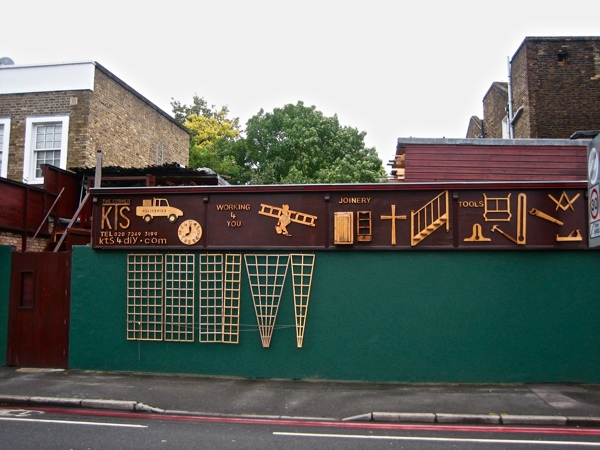
Tony’s witty designs upon the Englewood Rd side of the building are the most visible display of his creative abilities, in pictograms conveying Plumbing & Electrical, Joinery, Keys Cut, Gardening and Timber Cut-to-Size. When Tony took these down to overhaul them recently, it caused a stir in the national press. Thousands required reassurance that Tony’s designs would be reinstated exactly as before. It was an unexpected recognition of Tony’s talent and a powerful reminder of the secret romance we all harbour for traditional hardware shops.
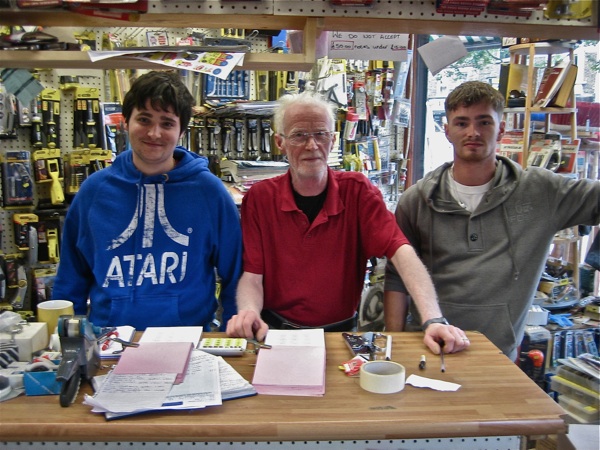
Tony with his sons Jack and Sean.
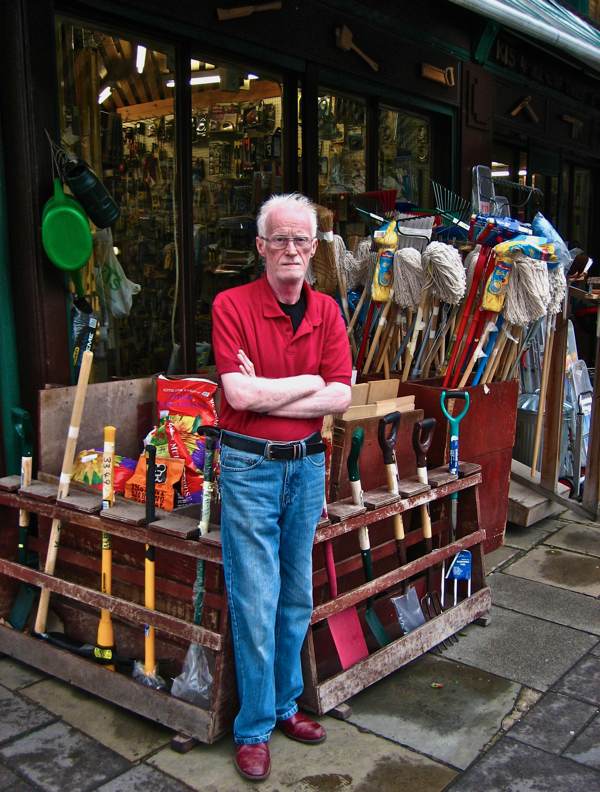
A magnificent pavement display of brushes, mops and shovels.
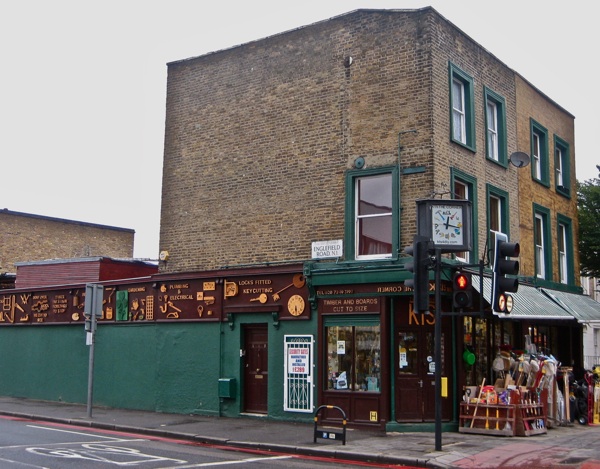
The temporary removal of Tony’s wooden pictograms triggered a public outcry in the national press.
In the Kingsland Rd, you may also like to read about