
At KTS The Corner

Everyone in East London knows KTS The Corner, Tony O’Kane’s timber and DIY shop. With Tony’s ingenious wooden designs upon the fascia and the three-sided clock he designed over the door, this singular family business never fails catch the eye of anyone passing the corner of the Kingsland Rd and Englefield Rd in Dalston. In fact, KTS The Corner is such an established landmark that it is “a point of knowledge” for taxi drivers.
Yet, in spite of its fame, there is an enigma about KTS which can now be revealed for the first time. “People think it stands for Kingsland Timber Service,” said Tony with a glint in his eye, “Even my accountant thinks it does, but it doesn’t – it stands for three of my children, Katie, Toni and Sean.” And then he crossed his arms and tapped his foot upon the ground, chuckling to himself at this ingenious ruse. It was entirely characteristic of Tony’s irrepressible creative spirit which finds its expression in every aspect of this modest family concern, now among the last of the independent one-stop shops for small builders and people doing up their homes.
On the Kingsland Rd, Tony’s magnificent pavement display of brushes, mops and shovels, arrayed like soldiers on parade, guard the wonders that lie within. To enter, you walk underneath Tony’s unique three-sided clock – constructed to be seen from East, South and North – with his own illustrations of building materials replacing the numerals. Inside, there are two counters, one on either side, where Tony’s sons and daughters lean over to greet you, offering key cutting on your left and a phantasmagoric array of fixtures to your right. Step further, and the temporal theme becomes apparent, as I discovered when Tony took me on the tour. Each department has a different home made clock with items of stock replacing the numerals, whether nails and screws, electrical fittings, locks and keys, copper piping joints, or even paints upon a palette-shaped clock face. Whenever I expressed my approval, Tony grimaced shyly and gave a shrug, indicating that he was just amusing himself.
Rashly, Tony left his sons in charge while we retired to his cubicle office stacked with invoices and receipts where, over a cup of tea, he explained how he came to be there.
I’m from from Hoxton, I went to St Monica’s School in Hoxton Sq. To get me to concentrate on anything they had to tie me down, but, if anything physical needed doing, like moving tables and chairs, I’d be there doing it. My dad did his own decorating and my mother wanted everything completely changed every year or eighteen months, so he taught me how to hang wallpaper and to do lots of little jobs. After Cardinal Pole’s Secondary School, I did an apprenticeship in carpentry and got a City & Guilds distinction. Starting at fifteen, I did four years apprenticeship at Yeomans & Partners. Back then, when you came out of your apprenticeship, they made you redundant. You got the notice in your pay packet on the Thursday but on Saturday you’d get a letter advertising that they needed carpenters at the same company. They wanted you to work for them but without benefits and you had to pay a weekly holiday stamp.
I went self-employed from that moment. At the age of nineteen, I started my own company. I covered all the trades because I learnt that the first person to arrive on a building site is a carpenter and the last person to leave the site upon completion is a carpenter. Nine out of ten foremen are ex-carpenters and joiners, since the carpenter gets involved with every single other trade. So, over the years, I picked up plumbing, heating, electrics. When I started my company, I wouldn’t employ anyone if I couldn’t do their job – so I knew how much to pay ’em and whether they was doing it right or wrong.
This was in 1973, and Hackney Council offered me a grant to do up a building in Broadway Market. I just wanted an office, a workshop and a warehouse but they said you have to open a shop. So, as I was a building company, I opened a builders’ merchants and then, twenty years ago, I bought this place. When I bought it, it was just the corner, there was no shopfront. I designed the shopfront and found the old doors. I used to come here with my dad when we were doing the decorating for my mum, because they made pelmets to order here but, as a child, I never thought I’d own this place.
Tony is proud to assure you that he stocks more lines than those ubiquitous warehouse chains selling DIY materials, and he took me down into the vast cellar where entire aisles of neatly filed varieties of hammers and hundreds of near-identical light fixtures illustrated the innumerable byways of unlikely creativity. At the rear of the shop, through a narrow door, I discovered the carpentry workshop where resident carpenter Mike presides upon some handsome old mechanical saws in a lean-to shed stacked with timber. He will cut wood to any shape or dimension you require upon the old workbench here.
Tony’s witty designs upon the Englewood Rd side of the building are the most visible display of his creative abilities, in pictograms conveying Plumbing & Electrical, Joinery, Keys Cut, Gardening and Timber Cut-to-Size. When Tony took these down to overhaul them recently, it caused a stir in the national press. Thousands required reassurance that Tony’s designs would be reinstated exactly as before. It was an unexpected recognition of Tony’s talent and a powerful reminder of the secret romance we all harbour for traditional hardware shops.


Tony with his sons Jack and Sean.

A magnificent pavement display of brushes, mops and shovels.

The temporary removal of Tony’s wooden pictograms triggered a public outcry in the national press.


In the Kingsland Rd, you may also like to read about
The Map of Spitalfields Life

It is my pleasure to present the third exhibition from Spitalfields Life – Adam Dant, Unusual Cartography of East London at Town House, 5 Fournier St, Spitalfields, opening next Thursday 15th September and running until Sunday 2nd October.
At the rear of an eighteenth century weavers’ house is a beautifully proportioned doctor’s surgery of the eighteen twenties, where you are invited to come and scrutinise the jewel-like originals of Adam Dant’s wonderful and strange maps that it has been my privilege to publish over the past year – maps which have established Adam Dant as London’s pre-eminent mapmaker extraordinaire.
Most excitingly, the centrepiece of the exhibition is The Map of Spitalfields Life drawn by Adam Dant with stories by yours truly, showing fifty people who make Spitalfields distinctive. Please join us next Thursday for drinks from 7:30pm to view the map on the night of its unveiling to the people of Spitalfields by Sandra Esqulant, landlady of the Golden Heart in Commercial St. Many of the characters you have read about in these pages will be present to discover how Adam Dant has represented them on the map – so this is your chance to come and meet them.
The Map of Spitalfields Life will be published by Herb Lester and – once it has been unveiled – full-colour copies will be on sale at £4. On the reverse, you will find the stories of all the people portrayed on the front, plus a guide to Spitalfields landmarks and destinations. Adam Dant is also producing a hand-tinted limited edition for collectors and Spitalfields aficionados. Overseas and out-of-London readers will be relieved to know that, from 16th September, you will be able to buy these different versions of the map online at www.spitalfieldslife.com and have them delivered to your door.
Adam Dant and I have been burning the midnight oil to contrive The Map of Spitalfields Life for your delight and we can barely contain our excitement to show it to the world next week. The map has been produced under conditions of the strictest secrecy and, at this moment, Adam Dant and I alone know who is on the map. Today, I have been running around Spitalfields like the White Rabbit, delivering invitations to the unveiling. Yet although those who get an invitation are confirmed of their place on the map, they will not discover who else is on it until Sandra Esqulant unveils it. Already rumour, gossip and speculation about the map are spreading like wildfire through the narrow streets of Spitalfields, and we anticipate this conflagration to reach white heat by next Thursday. I do hope you will come to join the party.
Adam Dant says, “We hope this exhibition may assist the cartographic aesthetic to leap forward beyond the homogeneity of computerised rendering and the turgid angst of psycho- geography.”
The exhibition at the Town House, 5 Fournier St, London E1 6QE is open every day except Monday from 11:30am until 5:30pm, and at other times by contacting Town House.


Adam Dant tries vainly to hide The Map of Spitalfields Life from prying eyes.
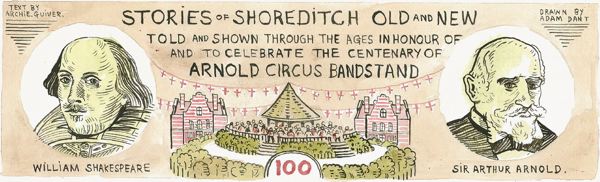
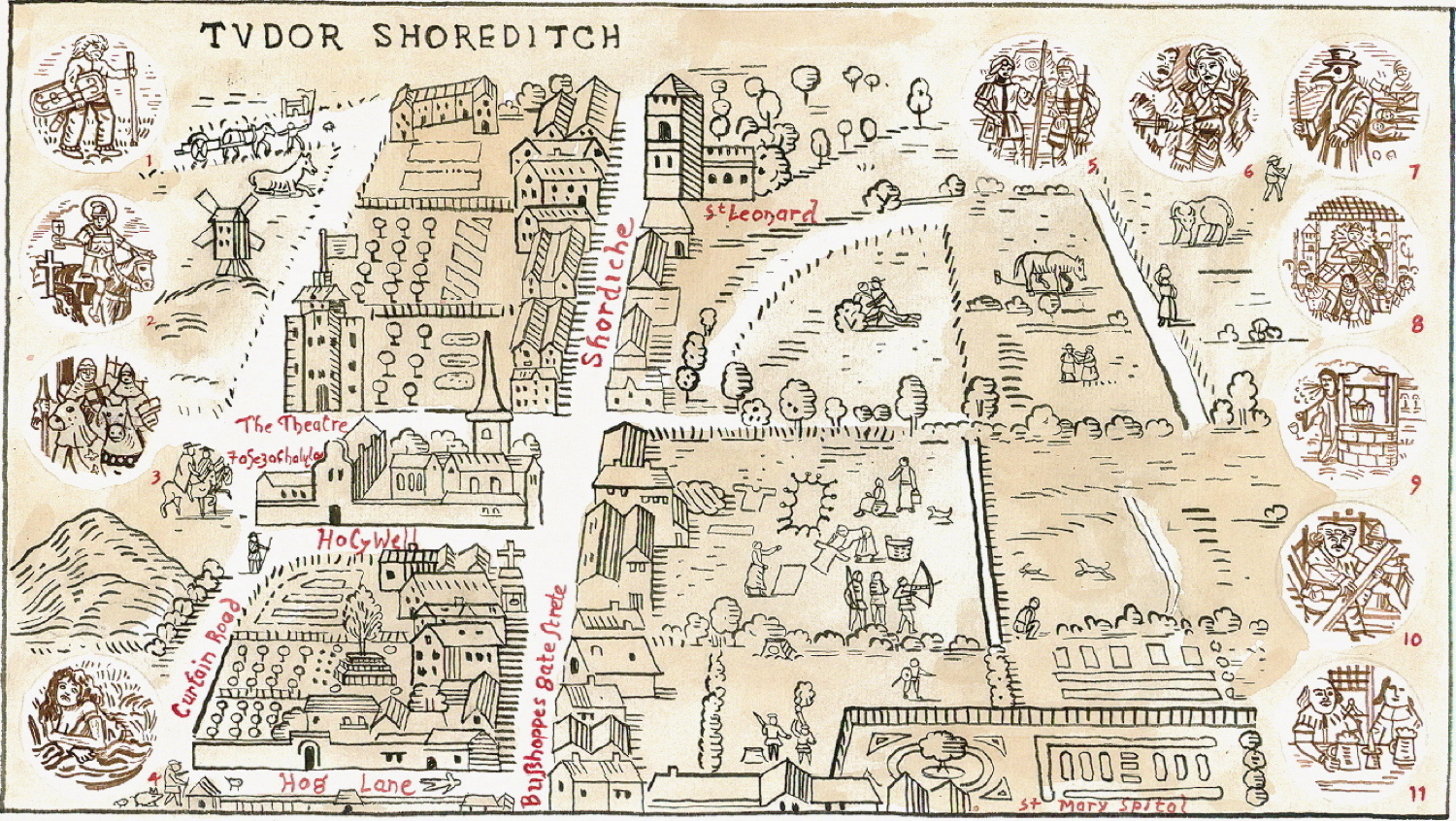
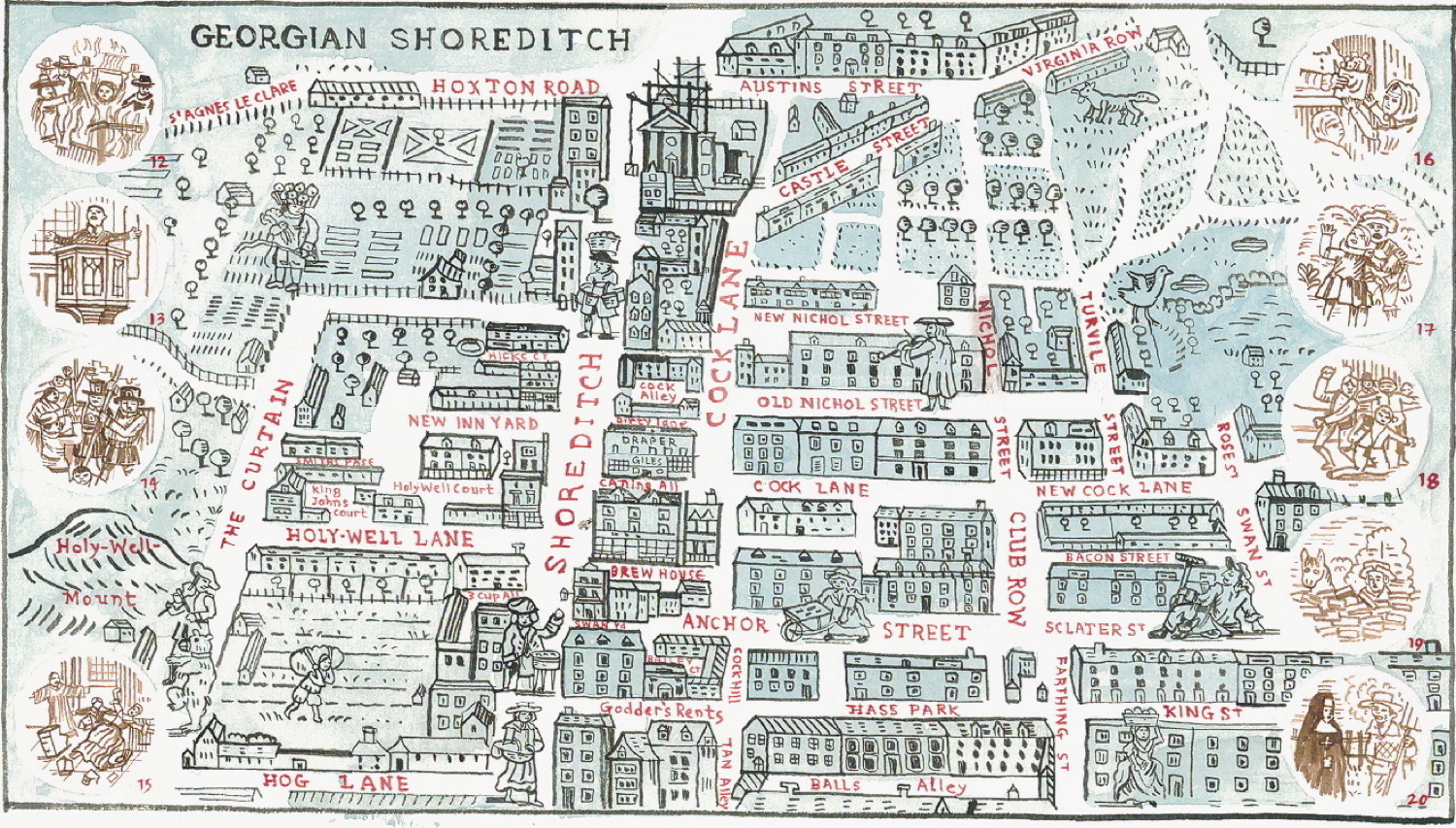
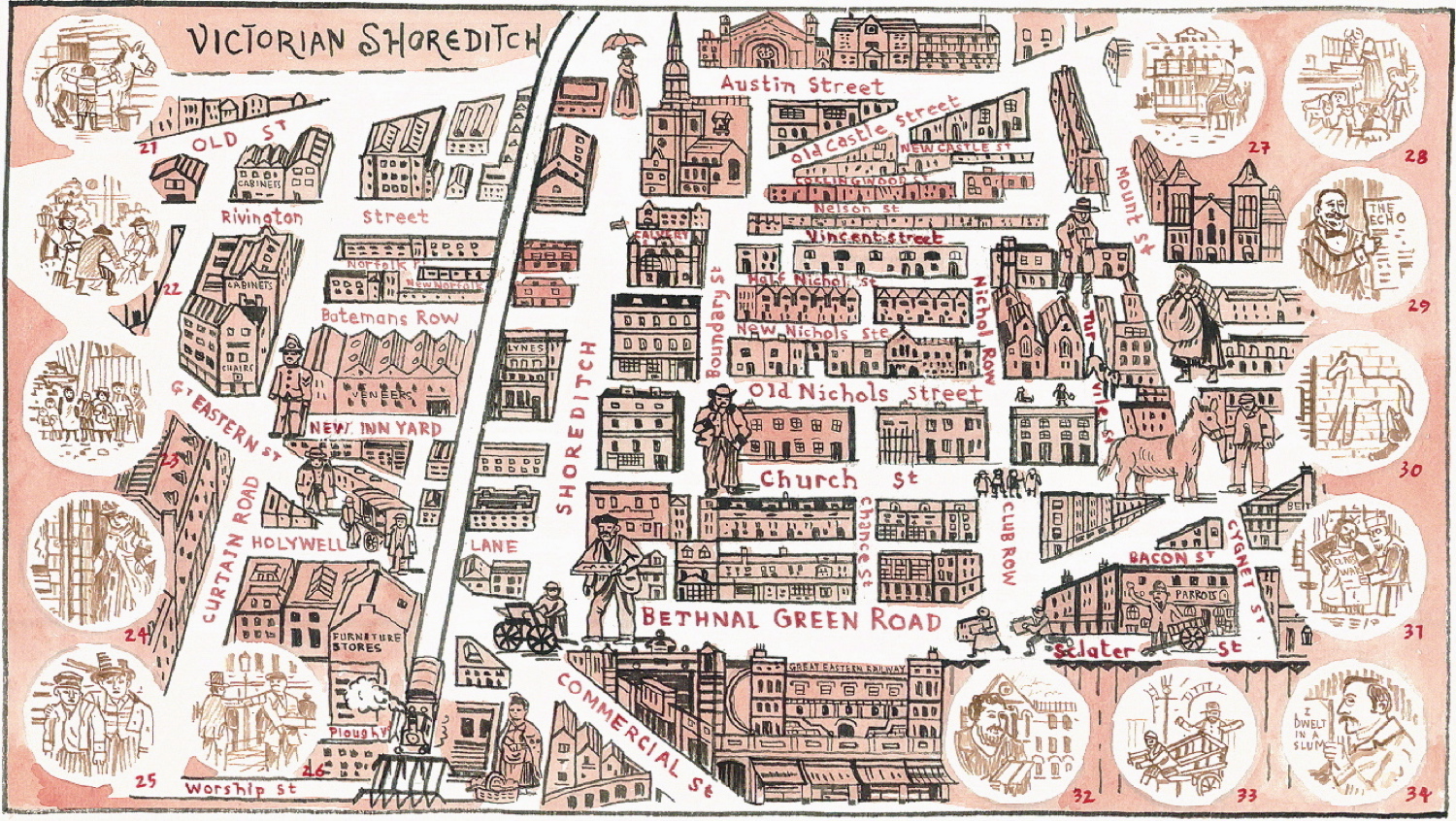
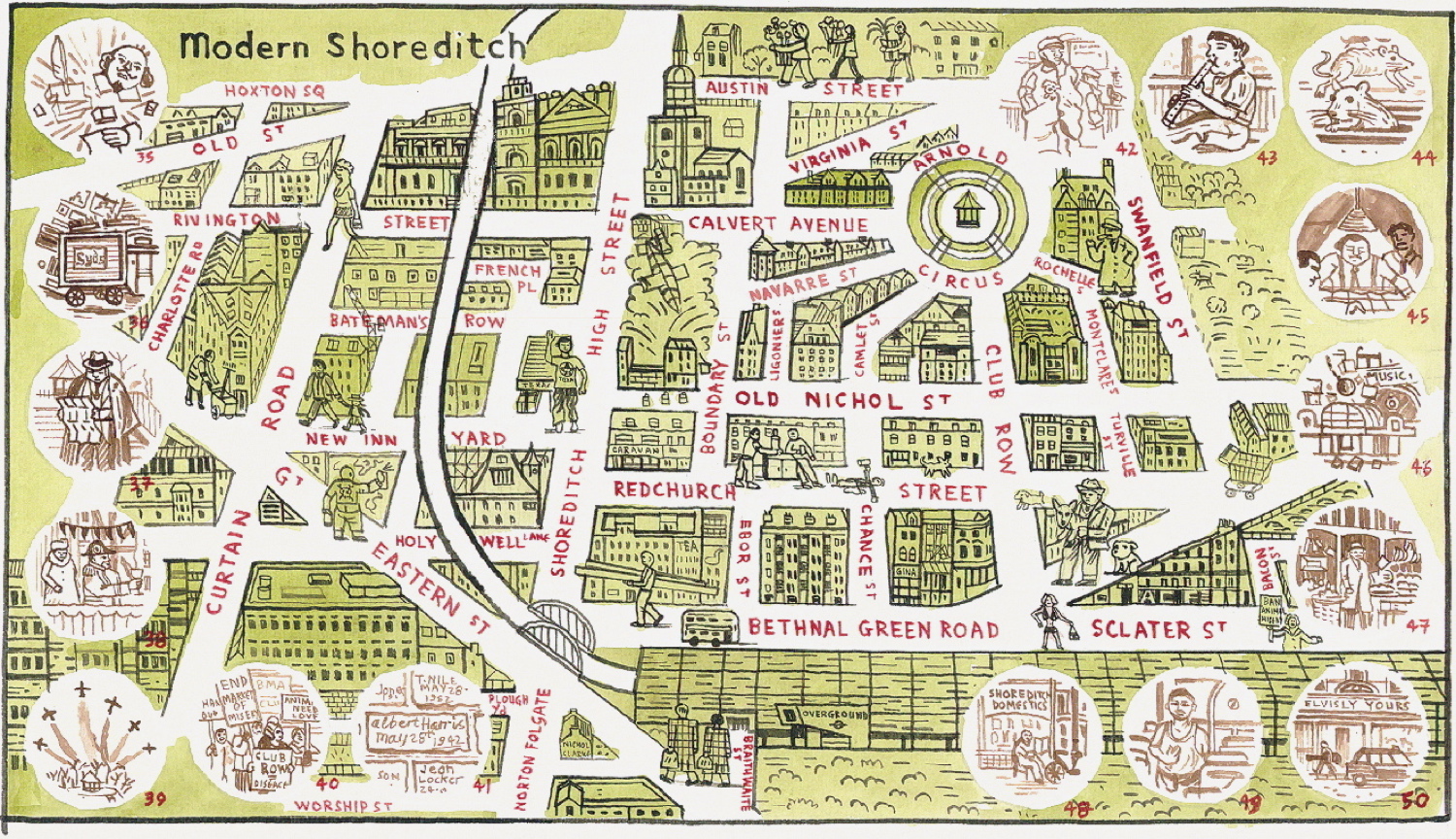
Map of the Stories of Shoreditch, Old & New.


Map of the Stories of Clerkenwell, Old & New.

The Map of Hoxton Square.

The Map of the Treasures of Hackney.

Donald Parsnips’ Plan of Shoreditch in Dream Format.

The Map of Shoreditch in the Year 3000.

The Map of Shoreditch as the Globe
Maps copyright © Adam Dant
You may like to take this moment to look back at some of Adam Dant’s Maps featured in the exhibition
Map of the History of Shoreditch
Map of Shoreditch in the Year 3000
Spitalfields Antiques Market 26

This sassy lady is Charlotte Sellers who grew up above a shop called “Junktique” that was run by her mother. “The shop was so small, rammed with chandeliers, glass and furniture etc that I was parked in my pram on the pavement outside.” she explained in fond reminiscence, “People would stop and ask inside the shop for the best price on the baby.” Charlotte’s father traded in military watches and important automobiles while her aunt traded in jewellery and coins. “It’s been in the family a long time, this second hand furniture business,” she informed me proudly, “I’m currently upholstering a bunch of chairs from the Battle of Waterloo.” But, whether Charlotte was referring to their origin in a pub of that name, or from the actual battleground, or merely the period of the seating in question, I never discovered.

This cheery fellow is Chris Williams. “I’ve only been back four months and I love every second of it,” he declared with aplomb, assuming a philosophical detachment from his own caprice, “I actually started in the market when I left school at sixteen in 1976, but I gave it up in 1986 thinking I could find better things in life to do.” After a career in transport, Chris is now like a lion let out of a cage. “I ran a courier company that I started in my bedroom and it went to twenty-five vans – then I sold it,” he confessed with a happy flourish. “I love looking for a bargain. I love selling things and meeting lots of different people, and in Spitalfields Market you meet lots of different people!”

These enigmatic women in black are Marcellina Amelia & Rebecca Dewinter who met while studying illustration at Westminster University and live in a big old warehouse in Bow, full of things they have collected. “This is how we make our money,” revealed Marcellina, with stark candour, gesturing to their stall, “because we are both artists.” Yet as well as their own personal artistic endeavours, Marcellina & Rebecca also contrive exotic jewellery and cleverly rework old clothes which you can see at Ivory Jar. “Sometimes we give stuff away too cheap because people beg us for things,” Marcellina whispered with a helpless grin, placing a hand protectively over a suitcase full of ducklings rendered in lifelike taxidermy,“We regret selling stuff we really like.”

This dignified figure is Roy Price who can be forgiven for looking a little fatigued because he just returned from Dorset, leaving at nine the previous evening to arrive back in London at one and then get up at six to come to the market. But Roy had no regrets. “I’ve done really well today,” he confided to me with a weary yet satisfied smile, “I’m so glad I came back.” Roy specialises in eighteenth century antiques. “I’ve traded from when I was eighteen because my dad did it and he used to sell this kind of stuff.” Roy said – assuring me even as his eyelids were drooping, “I do know what I’m doing and I’m knowledgeable.” Given Roy’s evident conscientious nature, I think we may conclude such warrants are unnecessary.
Photographs copyright © Jeremy Freedman
Remembering Jean Rondeau the Huguenot

Marney & Ian MacDonald
This weekend the Huguenots returned to Spitalfields – three hundred years after they originally came from France and Belgium fleeing religious persecution and bringing flair and sophistication to the textile industry that was to occupy this corner of London for subsequent centuries. The occasion of this recent gathering was the dedication of a plaque to Jean Rondeau, Master Silk Weaver and Sexton of Christ Church from 1761-1790, honouring all those Huguenot families who passed through Spitalfields so long ago.
Here you see Marney MacDonald from Montreal being photographed in Christ Church by her husband Ian in front of the new plaque to her great-great-great-great-great-great-grandfather Jean Rondeau – or, as he is known in the family, John the Sexton, to distinguish him from his father Jean Rondeau who came here from Paris in 1685. Naturally, it was necessary have a record of the proud event, because it was the culmination of a long journey from the day Marney picked up on her father’s research into her great grandmother Phoebe Rondeau (Jean’s granddaughter), begun more than forty years ago.
Through a chance meeting in Christ Church when she visited as a tourist in 1999, Marney learnt of the study being undertaken of the human remains exhumed from the crypt and she met Stanley Rondeau, a voluntary tour guide who is a fellow descendant of Jean Rondeau. They pooled researches into their forbears, even going to the Natural History Museum where John the Sexton’s bones are now preserved to examine the remains of their common ancestor. And together they have been responsible for initiating this new memorial.
On Sunday, around thirty guests gathered on the North staircase in a location that would have been familiar to John the Sexton, while Andy Rider, Rector of Christ Church, undertook the dedication of the plaque and, although for the most part these people did not know each other, there was the affectionate intimate atmosphere of a family gathering in which no-one was a stranger to another. And in spite of the tenuous nature of the threads stretching across long periods of time which connect these people, there were visible shared qualities of visage, physique and colouration. “Being involved in finding ones antecedents is a fascinating process,” Marney confided to me in a quiet moment, speaking of a project that has occupied her for decades, “Something old in Canada might be two hundred years old but things here go back much further.”
Yet even though we were in the building that John the Sexton knew, he did seem very far away – until I joined the guests for a cup of tea afterwards and was introduced to so many of his relatives, especially seven week old Cassandra Stanley, his great-great-great-great-great-great-great-granddaughter. Peacefully sleeping through the event, she was summoning her energies for a whole life ahead. Among the speeches and announcements, including a letter of greetings from the Queen, was an apology for absence from ninety-two year old Lynn Rondeau who wished it to be known that she was “proud to be a Rondeau.”
Marney showed me the album she has collected with copies of the documents relating to John the Sexton, an extraordinary paper trail which constitutes the evidence of her ancestor’s life – his name on the petition to parliament for Christ Church to be built, silk designs made for him by Anna Maria Garthwaite, his will and even the collection to raise a fund for his widow Margaret. The book is the result of detective work on Marney’s part. “How I wish I had the forethought to ask certain questions of my grandfather, that it has taken me a lifetime to answer.” she admitted in good humoured resignation as she closed the book.
Jean Rondeau was one of between twenty and twenty-five thousand Huguenots who came to Spitalfields, around half of the total of all those who came to make new lives in Britain. Although his story is documented and his descendants have traced the lineage, establishing the Rondeaus as one of Spitalfields’ oldest families, equally there exists all those other families that will never be traced and whose stories have faded forever into the ether. Yet the story of Jean Rondeau reminds us of the direct connection we share to forebears known and unknown, and of the common bonds of humanity that unite us all.

The Rondeaus gather in Christ Church where their ancestor was Sexton two hundred and fifty years ago.

Just seven weeks old, Cassandra Stanley (held by her great aunt Beryl Happe) is the youngest descendant of Jean Rondeau the Huguenot, her great-great-great-great-great-great-great-grandfather who came to Spitalfields in 1685.

Stanley Rondeau
If you visit Christ Church on a Tuesday, when Stanley works there as a guide, he will show you the album collected by Marney MacDonald with all the documents and information about their common ancestor.
You may like to read my other stories about Stanley Rondeau
At Walton on the Naze

All this time, Walton on the Naze has been awaiting me, nestling like a forgotten jewel cast up on the Essex coast, and less than an hour and a half from Liverpool St Station.
Families with buckets and spades joined the train at every stop, as we made our way eastwards to the point where Essex crumbles into the North Sea at the rate of two metres a year. Yet all this erosion, while reminding us of the force of the mighty elements, also delivers a perfect sandy beach – the colour of Cheddar cheese – that is ideal for sand castles and digging. Stepping from the small train amongst the flurry of pushchairs and picnic bags, at once the sea air transports you and the hazy resort atmosphere enfolds you. Unable to contain yourself, you hurry through the sparse streets of peeling nineteenth century villas and shabby weather-boarded cottages to arrive at a rise overlooking Britain’s third longest pier, begun in 1830.
In spite of the majestic pier, this is a seaside resort on a domestic scale. You will not find any foreign tourists here because Walton on the Naze is a closely guarded secret, it is kept by the good people of Essex for their sole use. At Walton on the Naze everyone is local. You see Essex families running around as if they owned the place, playing upon the beach in flagrant carefree abandon, as if it were their own back yard – which, in a sense, it is.
This sense of ownership is manifest in the culture of the beach huts that line the seafront, layers deep, in higgledy-piggledy terraces receding from the shore. These little wooden sheds are ideal for everyone to indulge their play house and dolls’ house fantasies – painting them in fanciful colours, giving them names like “Ava Rest,” and furnishing the interiors with gas cookers and garish curtains. At the seaside, all are licenced to pursue the fulfilment of residual childhood yearning in harmless whimsy. The seaside offers a place charged with potent emotional memory that we can return to each Summer. It is not simply that people get nostalgic for seaside resorts, but that these seasonal towns become the location of nostalgia itself – because the sea never changes and we revisit our former selves when we come back to the beach.
Walton Pier curls to one side like a great tongue taking a greedy lick from an ocean of ice cream, and the beach curves away in a crooked smile that leads your eye to the “Naze,” or “nose” to give its modern spelling. This vast bulbous proboscis extends from the profile of Essex as if from a patient in need of plastic surgery, provided in the form of relentless abrasion from the sea.
With so many attractions, the first thing to do is to sit down at the tables upon the beach outside Sunray’s Kiosk which serves the best fish & chips in Walton on the Naze. Every single order is battered and cooked separately in this tiny establishment, that also sells paper flags for sandcastles and shrimping nets and all essential beach paraphernalia. From here a path leads past a long parade of beach huts permitting you the opportunity to spy upon these domestic theatres, each with their proud owners lounging outside while their children run back and forth, vacillating between their haven of security and the irresistible wonder of the waves crashing at the shoreline.
Here I joined some girls, excitedly fishing for crabs with hooks and lines off a small jetty. They all screamed when one pulled out a much larger specimen than the tiddlers they had in their buckets, only to be reassured by the woman who was overseeing their endeavour. “Don’t be frightened – it’s just the Mummy!” she declared with a wicked smile, as she held up the struggling creature by a claw. From this jetty, I could see the eighty foot tower built upon the Naze in 1720 as a marker for ships entering the port of Harwich and after a gentle climb up a cliff path, and a strenuous ascent up a spiral staircase, I reached the top. Like a fly perched upon the nose of Essex, I could look North across the estuary of the Orwell towards Suffolk on the far shore and South to the Thames estuary with Kent beyond – while inland I could see the maze of inlets, appealingly known as the Twizzle.
In the week that Summer broke up, I was blessed with one clear day of sunshine for my holiday. And I returned to the narrow streets of Spitalfields for another year with my skin flushed and buffeted by the elements – grateful to have experienced again the thrall of the shoreline, where the land runs out and the great ocean begins.


Sunray’s Kiosk on the beach, for the best fish & chips in Walton on the Naze.


“On this promontory is a new sea mark, erected by the Trinity-House men, and at the publick expence, being a round brick tower, near eighty foot high. The sea gains so much upon the land here, by the continual winds at S.W. that within the memory of some of the inhabitants there, they have lost above thirty acres of land in one place.” Daniel Defoe, 1722


You may like to read about the Gentle Author’s previous holidays
The Gentle Author Opens Tower Bridge

What better way could there possibly be to commence the third year of daily stories than to open Tower Bridge? Yet I could barely believe it was going to happen as I walked down through the City and up onto the bridge approach where tourists milled on the pavement.
None knew the secret I was carrying as, emboldened by privileged information, I waved to the men inside the control cabin and they ushered me swiftly inside. At once, I shook hands with Bridgemaster Eric Sutherns – tall and dignified in a peaked cap, he looked for all the world like the captain of a ship, and here, suspended above the water with the controls before us, it was as if were upon the bridge of a liner. The outlook was breathtaking, but there was no time to contemplate it as the Bridgemaster introduced me to Bridgedriver David Duffy who, in the few brief minutes remaining, was eager to induct me into my task.
In moments, the controls of the most famous bridge in the world were to be given into my hands. A single black knob, resembling a gearstick, drives the raising and the lifting of the bascules – as the halves of the bridge are known. Eyeballing me with his intense blue pupils, David explained quickly that I needed raise the bascules to between seventy-six and seventy-eight degrees, but once the bridge reached fifty degrees, I must press the button that changed the light on the bridge from red to green, indicating to the vessel that it was safe to proceed. Already, David had initiated the sequence of events that culminated in raising the bridge. Sirens were sounding, traffic lights were flashing, gates were descending upon the roadway as cars and vans drew to a halt, and wardens in fluorescent jackets were shepherding pedestrians back behind the barriers.
Keen to give a semblance that I was capable to undertake the task, I nodded confidently as the vital instructions passed through one ear and out the other. Somehow I had put myself at the centre of a train of events that were entirely alien to me, but as the challenge drew close, it was essential that I maintain the sham of competence. Yet the staff at Tower Bridge were one step ahead of me. “Check that the vessel is in sight,” instructed Bridgedriver David Duffy, preoccupied with the multiple television monitors showing activity on the bridge as the last tourists scurried out of sight. Sublimated entirely by the expertise of the master, I turned and peered down the river, expecting to see an unremarkable craft.
In an instant, the intensity of the event was amplified a thousand fold as I saw a tall ship, with three masts and lines of sailors standing upon the rigging, coming straight towards me. No longer was I living in my familiar world but inhabiting a vision. Inescapably, it was time to open the bridge. I turned back to David Duffy and Eric Sutherns, only to discover they were excited too, because even to these experienced bridgemen, this was a rare spectacle. In unison, they directed their gaze to the control lever and David placed my hand upon it, with a nod that only meant one thing. I looked up to the computer monitor, which showed that the linking bolts, that hold the bridge rigid when it is closed, had retracted, and then I pulled the lever slowly towards me. There are two speeds – creep and full speed. With the audacity of a beginner, I chose full speed, and two and a half thousand tons of steel moved into life.
I held on, as if it were to life itself, alternating my gaze between the rising bridge outside the cabin, the monitor where the counter clocked up the angle of incidence, and the tall ship bearing down upon me. At fifty degrees, I hit the button that gave the Captain clearance to enter the bridge and he reciprocated by a blast upon the hooter. Then the bridge was at seventy-seven degrees and it was time to halt and hold on. Now the ship was upon us, so close that I could no longer see its entirety but only the section passing by. Unexpectedly, from behind me came the sound of cheering and out of the corner of my eye I could glimpse flags waving, because this was ARC Gloria, the training ship of the Colombian Navy, and the bridge was full with excited Colombians come to show their national pride.
Even in the face of a morbid fantasy that I might release the bascules to crash down, sinking the vessel, causing massive casualties and triggering an international incident, I could not resist my awe at the wonder of the spectacle passing before my eyes. So tall that it only cleared the walkway above by a few metres – eighty-one cadets dressed in the red, yellow and blue of the Colombian flag were standing in formation upon the rigging of ARC Gloria, singing their anthem and waving for joy at this glorious moment of passing through Tower Bridge.
Once the ship passed, it was time to switch the light on the bridge back to red and close it again. But then, as soon as I had recovered my breath, it was already time to open the bridge for the return of Arc Gloria to complete its ceremonial passage before leaving to cross the Alantic Ocean. Consequently, I was able to open the bridge a second time and enjoy it without being in the grip of the terror that overwhelmed my debut. The bridge went up, the ship went through and then it was all over. David closed the blinds in the cabin and presented me with an intricate certificate as evidence of my achievement.
I followed him down a staircase within the bridge structure and into the engine room where oil hydraulic pumps have replaced the steam engines which ran here until 1976. We stepped through a door leading to a gantry in a vast dark cavern of diabolic industrial gloom, extending below water level, constructed within the base of the bridge. Here I understood that each half of the bridge is a seesaw with the counterbalance hidden from view inside the towers. “It’s a unique job,” admitted David, with proud reticence, as we paused here beside this mammoth iron construction weighted with four hundred tons of lead.
Visiting one of the four control cabins which is still fitted out with its original equipment, David explained that four were necessary in the days of the London fogs, before telephone and radio, when often the bridge drivers could often not even see across to the other side of the bridge. Today, ships book their openings a day in advance and Tower Bridge opens between eight hundred and a thousand times a year, but when it originally came into service in 1894, the bridge opened six thousand times a year, responding to signals from ships entering and leaving the busy Pool of London at any time of the day or night.
There is a superlatively idiosyncratic logic to this marvel of nineteenth century engineering, which apart from switching from steam power to oil hydraulics still runs exactly as it was built. David told me that the bearings which the bridge turns upon are original. David told me that the architect Sir Horace Jones intended Tower Bridge to look industrial, faced in red brick, but he died before completion and they altered his design to face it in stone, making it more Gothic to harmonise with the Tower of London. David told me that Hitler instructed the bomber pilots to avoid Tower Bridge, so that it could be retained as a landmark. David told me that elevators were installed so pedestrians could cross by the walkways above when the bridge was open, but they were closed in 1910 because of the prostitutes that solicited there. David told that the Bridgemasters used to live in the houses built over the suspension bridges and as we spoke a wedding was taking place in the Bridgemaster’s dining room.
We shook hands upon the bridge. “I bet you didn’t realise it was so easy to move two and a half thousand tons of steel?” David queried with a kindly smile, as we made our farewells before we went our separate ways through the crowds. It had been an emotional visit and I was staggered by this mighty masterpiece, but I returned home secure in the knowledge that now I have moved two and a half thousand tons of steel with the hand that writes these words, it should be a simple matter to craft a new story for you every day.

David Duffy, Bridgedriver, at the control panel of Tower Bridge.


The vast cavity down inside a pier of the bridge.

“It’s a unique job”

This control cabin retains its original equipment.

In the nineteenth century, unable to leave their posts, Bridgedrivers required the use of portable toilets.

In this diagram you can see the toothed quadrants used to move the bascules. A miscalculation in the size of these quadrants means that they stick out of the walls on the inner side of the towers and metal boxes were constructed upon the exterior to cover where the ends protrude.

ARC Gloria of the Colombian Navy, with eighty-one cadets on the rigging singing their anthem.
With grateful thanks to Eric Sutherns, Bridgemaster, and all the staff of Tower Bridge.
Max Levitas, Anti-Fascist Campaigner

Max Levitas became an East End hero when he was arrested in 1934, at the age of nineteen years old, for writing anti-Fascist slogans on Nelson’s Column in Trafalgar Square. “There were two of us, we did it at midnight and we wrote ‘All out on September 9th to fight Fascism,’ ‘Down with Fascism’ and ‘Fight Fascism,’ on Nelson’s Column in whitewash,” he told me, his eyes shining with pleasure, still fired up with ebullience at ninety-seven years of age, “And afterwards we went to Lyons Corner House to have something to eat and wash our hands, but when we had finished our tea we decided to go back to see how good it looked, and we got arrested – the police saw the paint on our shoes.”
On September 9th, Oswald Mosley, the leader of the British Union of Fascists, was due to speak at a rally in Hyde Park but – as Max is happy to remind you today – he was drowned out by the people of London who converged to express their contempt. It was both fortuitous and timely that the Times reprinted Max’s slogans on September 7th, two days before the rally, in the account of his appearance at Bow St Magistrates Court, thereby spreading the message.
Yet this event was merely the precursor to the confrontation with the Fascists that took place in the East End, two years later in October 1936, that became known as the Battle of Cable St, and in which Max is proud to have played a part – a story he tells today as an inspirational example of social solidarity in the face of prejudice and hatred. And, as we sat in a quiet corner of the Whitechapel Library last week, watching the rain fall upon the street market outside, it was a story that I was eager to hear in Max’s first hand account, especially now that he is one of last left of those who were there.
Politics have always been personal for Max Levitas, based upon family experience of some of the ugliest events of the twentieth century. His father Harry fled from Lithuania and his mother Leah from Latvia in 1913, both escaping the anti-semitic pogroms of Tsarist Russia. They met in Dublin and married but, on the other side of Europe, Harry’s sister Sara was burnt to death along with fellow-villagers in the synagogue of Akmeyan, and Leah’s sister Rachel was killed with her family by the Nazis in Riga.
“My father was a tailor and a trade unionist,” Max explained in the lively Dublin brogue that still colours his speech today, even after eighty years in the East End. “He formed an Irish/Jewish trade union and then employers blacklisted him, making sure he could never get a job,” Max continued with a philosophical grin, “The only option was to leave Dublin and we lived in Glasgow from 1927 until 1930, but my father had two sisters in London, so we came here to Durward St in Whitechapel in 1931 and stayed ever since.”
With this background, you can appreciate the passionate concern of Max – when he was nineteen and secretary of the Mile End Young Communist League – at a time when the British Government was supporting the Fascist General Franco in the Spanish Civil War. “Even after Hitler was appointed Chancellor in 1931, the British Government was developing arms with Germany,” Max informed me, widening his eyes in condemnation and bringing events into vivid reality that I had viewed only as history until he filled them with personal emotion.
“I was working as a tailor’s presser in a small workshop in Commercial St at the time. Mosley wanted to march through Whitechapel because it was where a large number of Jewish people lived and worked, and I knew the only way to stop him was to have unity of the people. I approached a number of unions, Jewish organisations and the Communist League to band together against the Fascists but although they agreed what I was doing was right, they wouldn’t support me.
But I give credit to the huge number of members of the Jewish and Irish communities and others who turned out that day, October the fourth, 1936. There were thousands that came together in Aldgate, and when we heard that Mosley’s intention was to march along Cable St from Tower Hill into Whitechapel, large numbers of people went to Cable St and barricades were set up. The police attempted to clear Cable St with horses, so that the march could go ahead, but the people of Cable St fought back and the police had to give in.
At three o’clock, we heard that police had decided that the march would not take place, because if it did a number of people would be killed. The Fascists were defeated by the ordinary people of Stepney, people who emptied buckets of water and chamber pots out of their houses, and marbles into the street. This was how they stopped Mosley marching through the East End of London. If he had been able to do so, more people would have joined him and he would have become stronger.”
Max Levitas spoke of being at the centre of a definitive moment in the history of the East End, seventy-five years ago, when three hundred thousand people came together to form a human chain – in the face of three thousand fascists with an escort of ten thousand police – to assert the nature of the territory as a place where Fascism and racism are unacceptable. It was a watershed in resistance to Fascism in Europe and the slogan that echoed around Stepney and Whitechapel that day was, “No paseran” – from the Spanish Civil War, “They shall not pass.”
After the war, Max became a highly respected Communist councillor in Stepney for fifteen years and, a natural orator, he remains eloquent about the nature of his politics.“It was never an issue to forge a Communist state like in the Soviet Union,” he informed me, just in case I got the wrong idea,“We wanted to ensure that the ordinary working people of England could lead decent lives – not to be unemployed, that people weren’t thrown out of their homes when they couldn’t pay their rent, that people weren’t homeless, as so many are today, living with their parents and crowded together in rooms.”
Max’s lifelong political drive is the manifestation of a tenacious spirit. When Max arrived in Whitechapel Library, I did not recognise him at first because he could pass for a man thirty years younger. And later, when I returned his photos to his flat nearby, I discovered Max lived up five flights of stairs and it became obvious that he walks everywhere in the neighbourhood, living independently even at his astounding age. “I used to smoke,” Max admitted to me shyly, when I complimented him on his energy.” I stopped at eighty-four, when my wife died – until then I used to smoke about twenty cigarettes a day, plus a pipe and cigars.” Max confessed, permitting himself a reckless grin of nostalgia.
“My mother and father both died at sixty-five,” Max revealed, turning contemplative,“I put that down to the way they suffered and poverty. My father worked around the clock to keep the family going. He died two years after my mother. At that time there was no National Health Service, and I phoned the doctor when she was sick, asking him to come, and he said, ‘You owe me some money. Unless you pay me, I won’t come.’ I said, ‘You come and see my mother.’ He said, ‘You will have to pay me extra for coming plus what you owe.’ But she died before he came and I had to get an ambulance.”
It was a story that revealed something more of the personal motivation for Max’s determination to fight for better conditions for the people of the East End – yet remarkably, in spite of the struggle of those around him and that he himself has known, Max is a happy man. “I’m always happy, because I can say that my life was worth living, ” he declared to me without qualification.
Max Levitas wants to live as long as possible to remind us of all the things he has seen. “I believe if racists marched through the East End today, people would stop them in the same way,” he assured me with the unique confidence granted only to those who have known ninety-seven years of life.


Max in 1945.

Max campaigning in Stepney in the nineteen sixties.


Max with his wife on a trip to Israel in the nineteen seventies.

The Cable St mural
Portrait of Max Levitas copyright © Phil Maxwell
You can hear Max Levitas talking about the Battle of Cable St by clicking here
Watch original footage of the Battle of Cable St here
And learn more about Phil Maxwell & Hazuan Hashim’s film From Cable Street to Brick Lane featuring Max Levitas.


