
Samuel Pepys’ Cries Of London
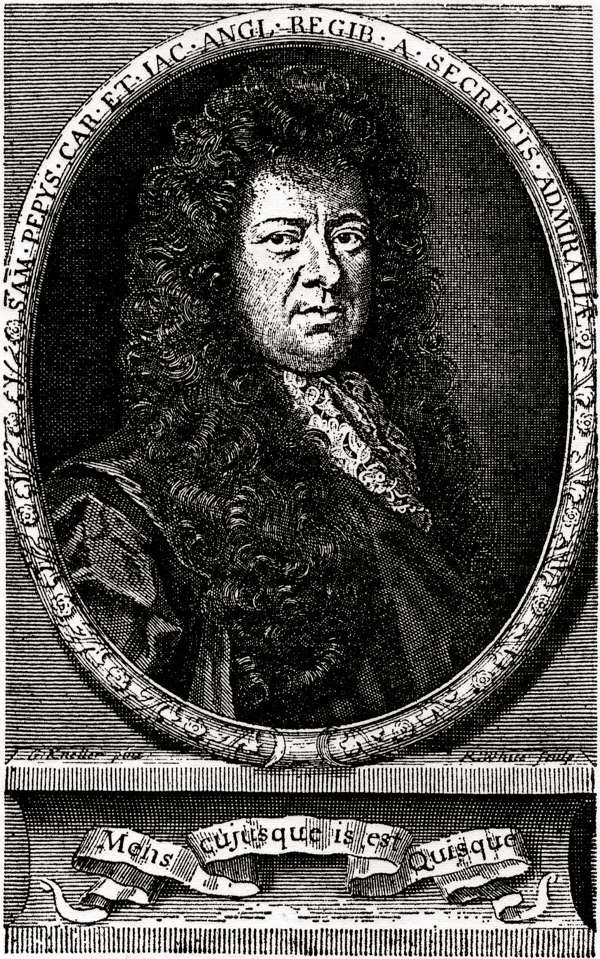
What a man’s mind is, that is what he is
For a while now, I have been collecting sets of Cries of London down through the ages and I am fascinated by the diverse permutations of these cheaply-produced prints which, even at their most stylised or sentimental, always reveal something of the reality of those who earned their living by street trading.
Recently, I was curious to discover that more than three hundred years ago, Samuel Pepys (coincidentally, also a regular at The George in Commercial Rd) was equally in thrall to these popular images of street vendors and hawkers. Among more than ten thousand engravings and eighteen hundred printed ballads he amassed in his library was a folio entitled “Cryes consisting of Several Setts thereof, Antient & Moderne: with the differ Stiles us’d therein by the Cryers.” In this binder, Pepys kept three sets of the Cries of London, plus two Cries of Bologna, and single sets each of the Cries of Rome and Paris.
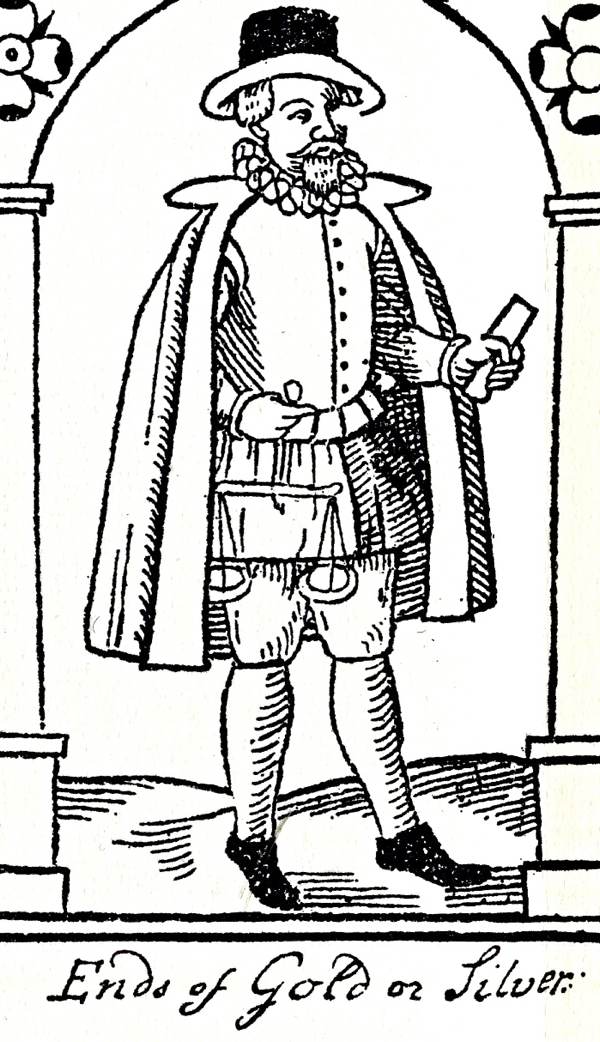
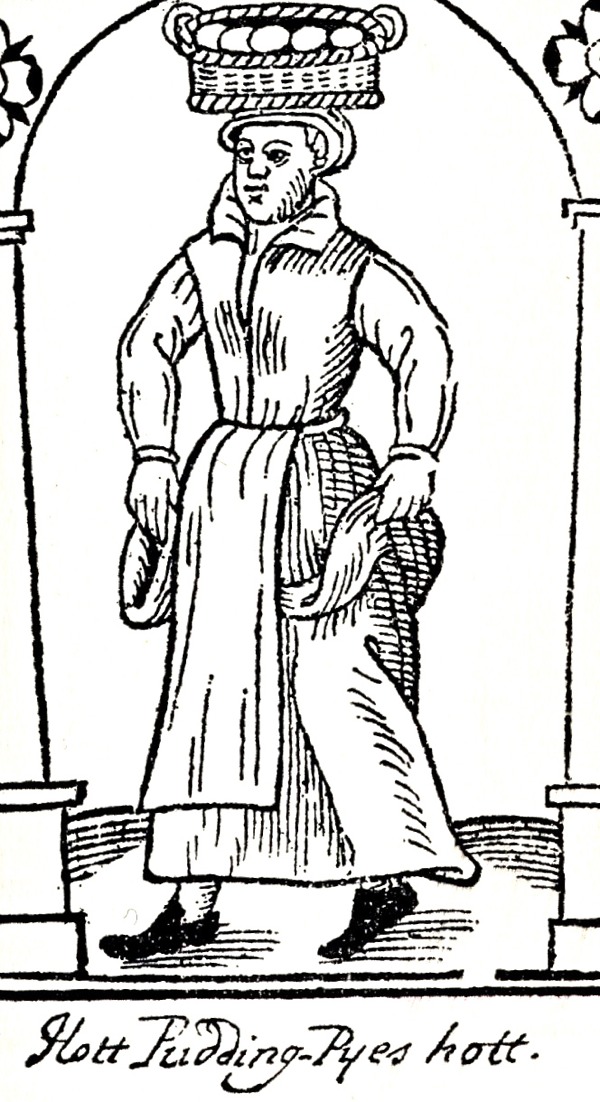
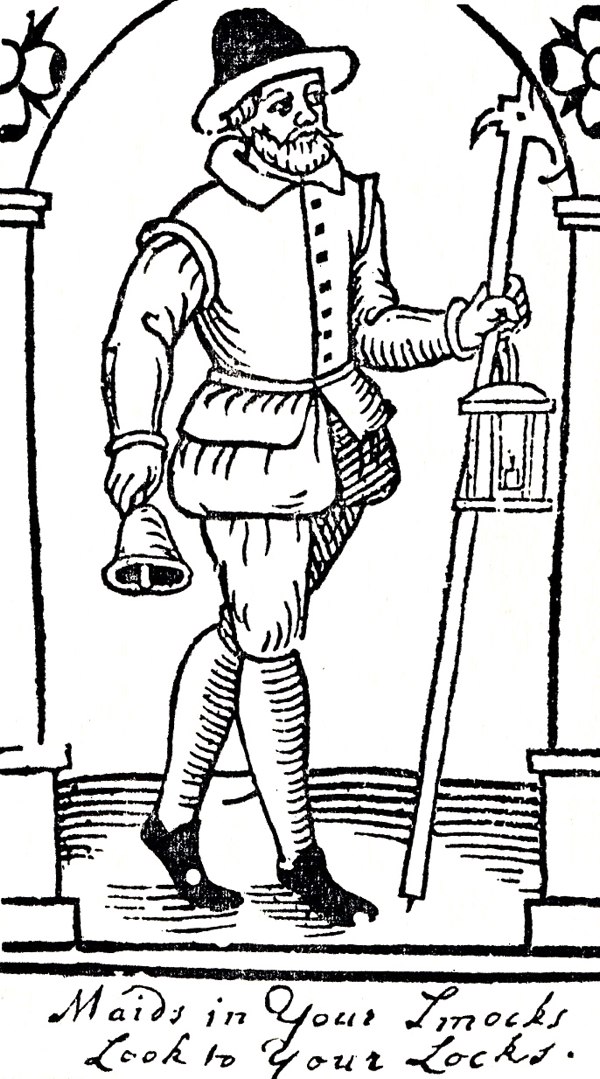
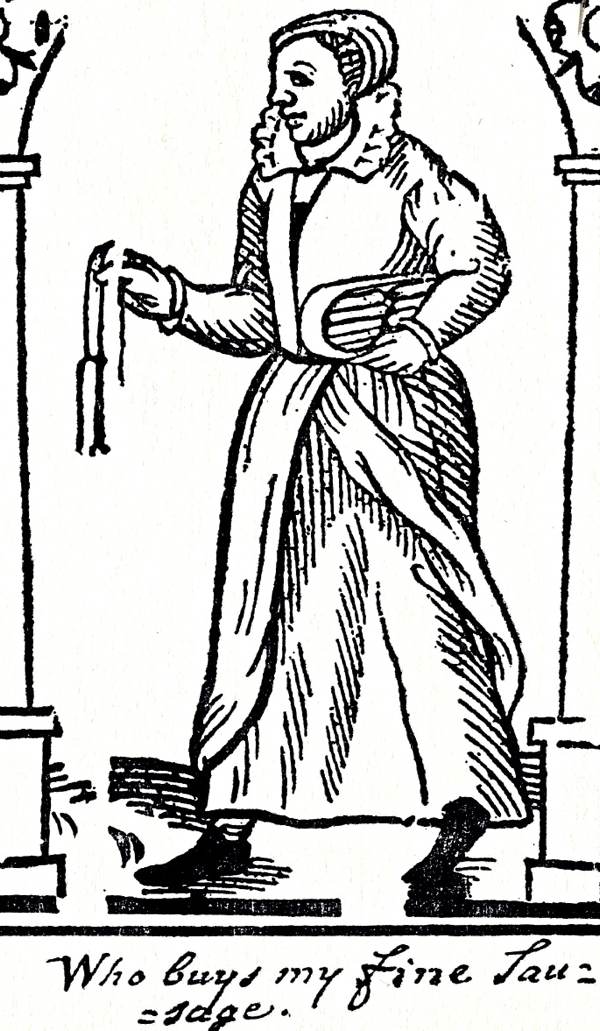
Published below are the anonymously produced Cries of the earliest set in Pepys’ collection which was already a century old when he acquired it – described thus “A very antient Sett thereof, in Wood, with the Words then used by the Cryers.” Printed in the late sixteenth century, this set of twenty-four illustrates the Cries that would have been familiar constituents of the street life of Shakespeare’s London.
The Cries genre itself originated with a woodcut produced in Paris around 1500, beginning a tradition that lasted into the twentieth century, spreading to major cities across the globe and spawning an infinite variety of portrayals of pedlars. By the time the series illustrated here was created, the Cries were already available throughout Europe, bringing images of the urban poor into common currency for the first time.
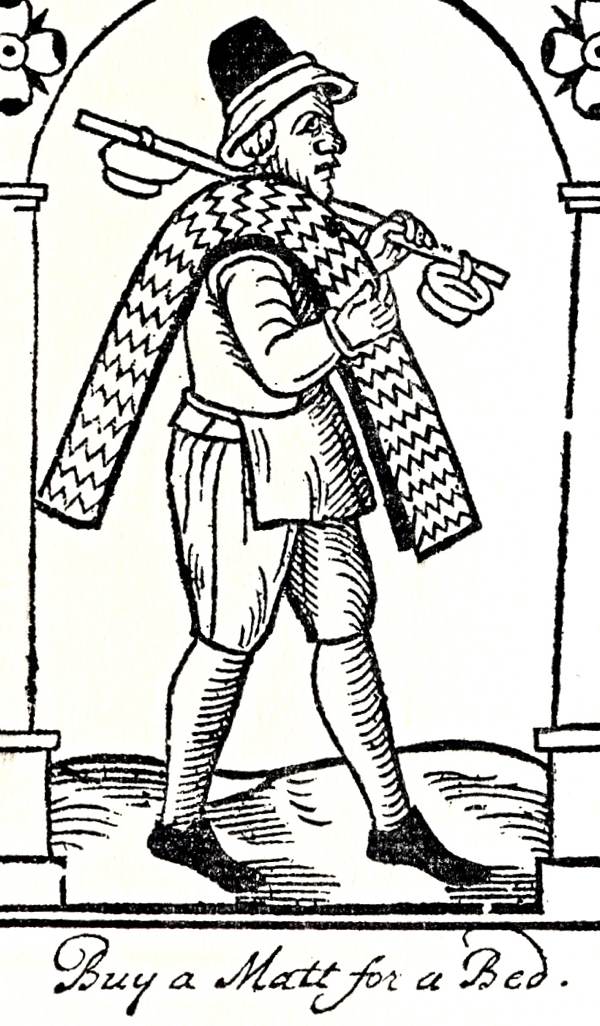

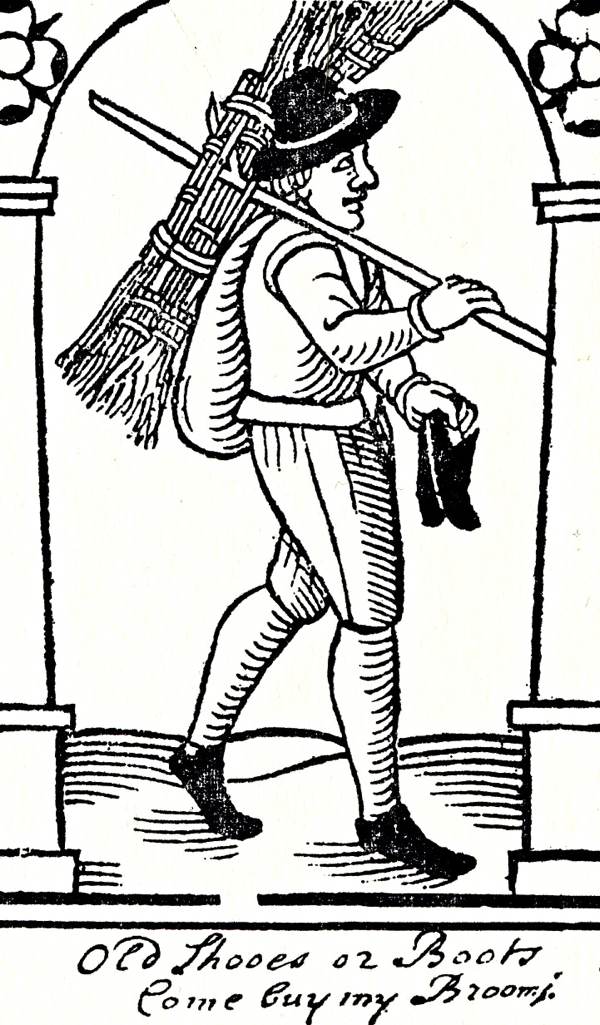
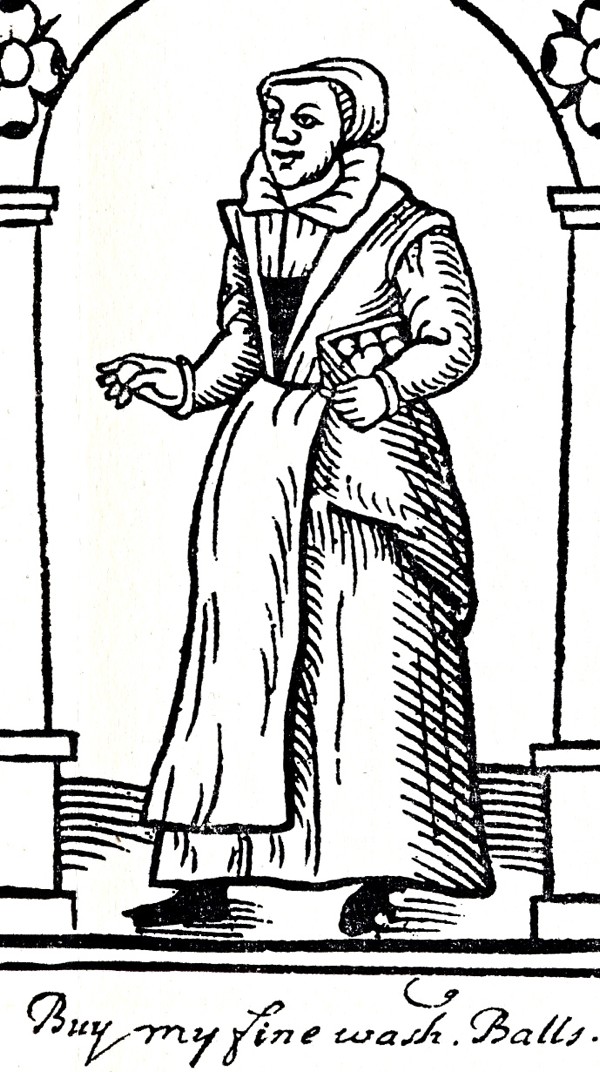
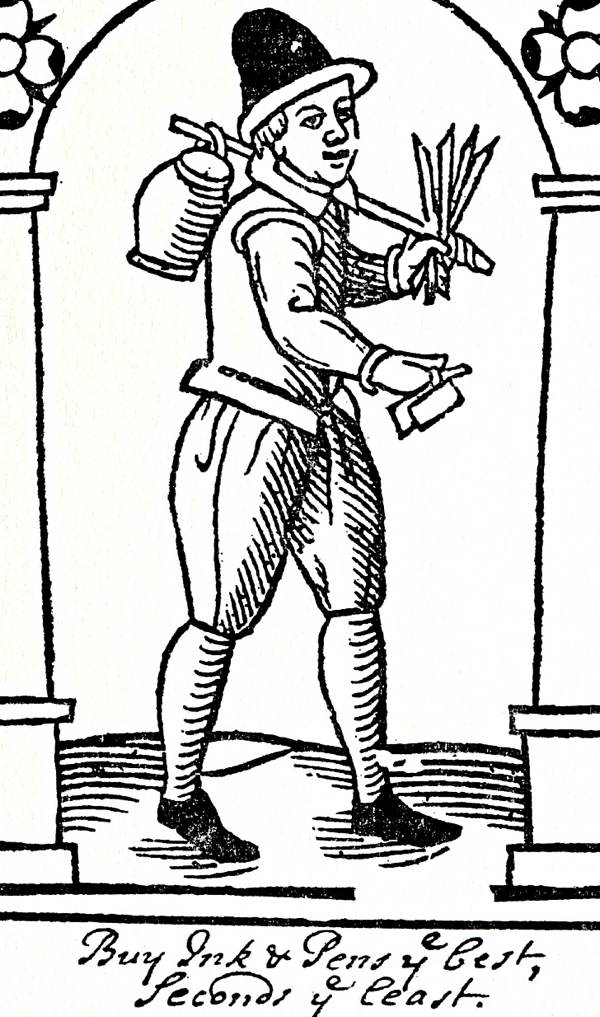
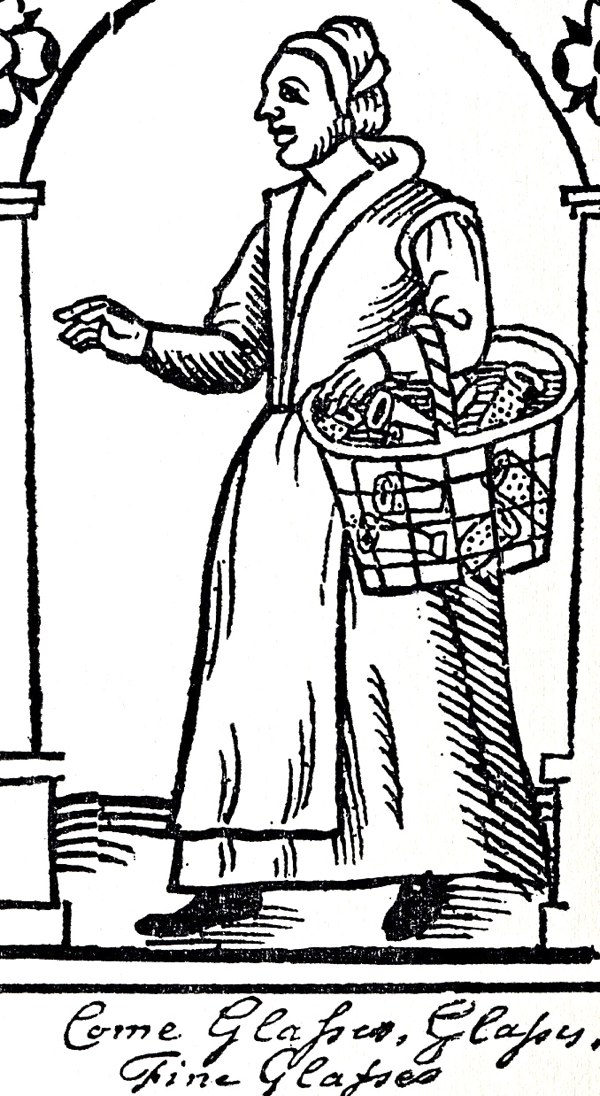
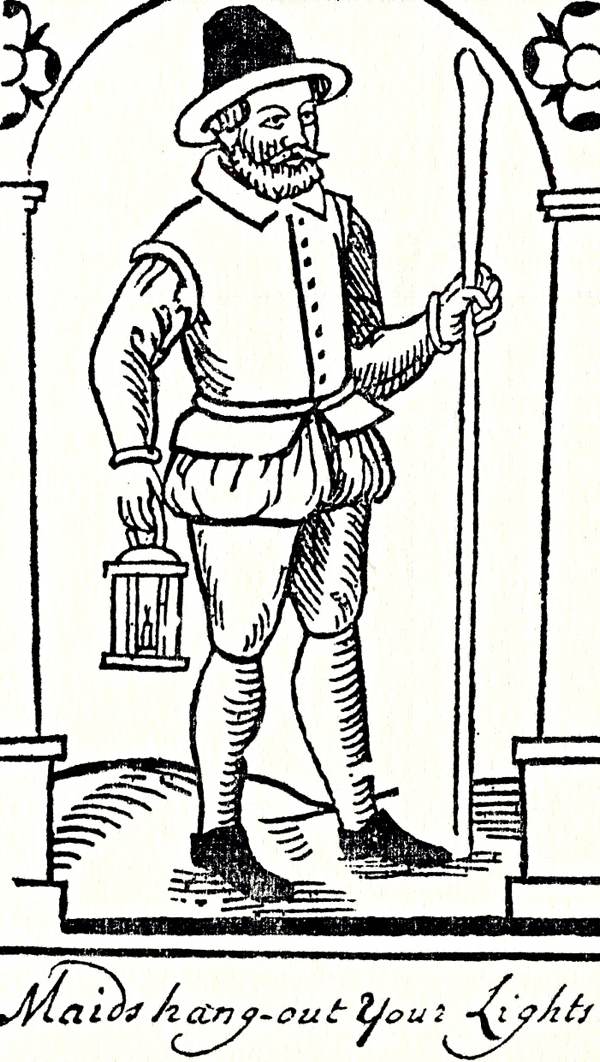
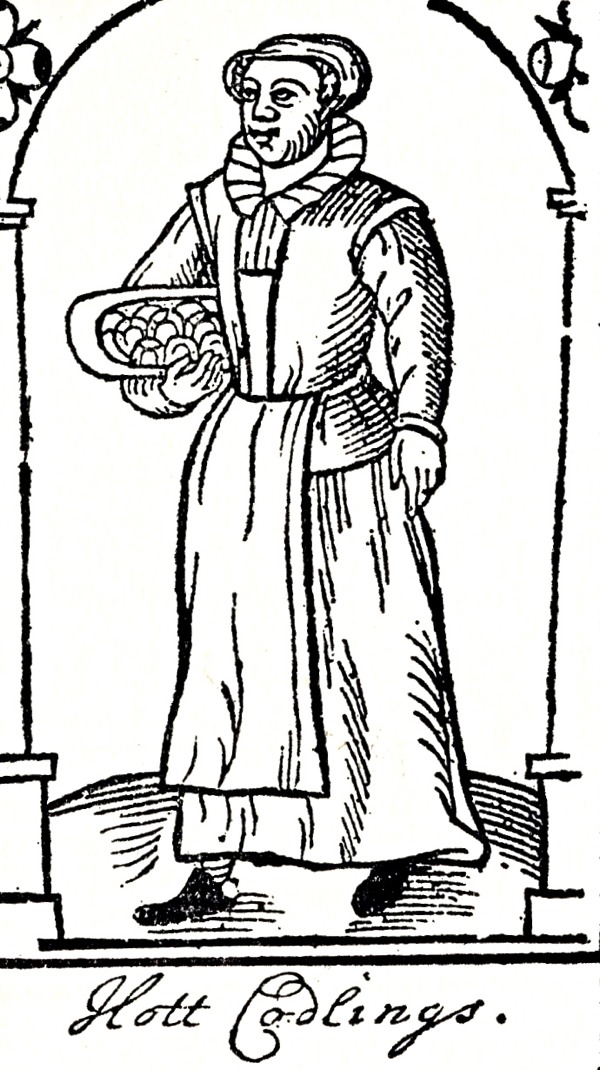
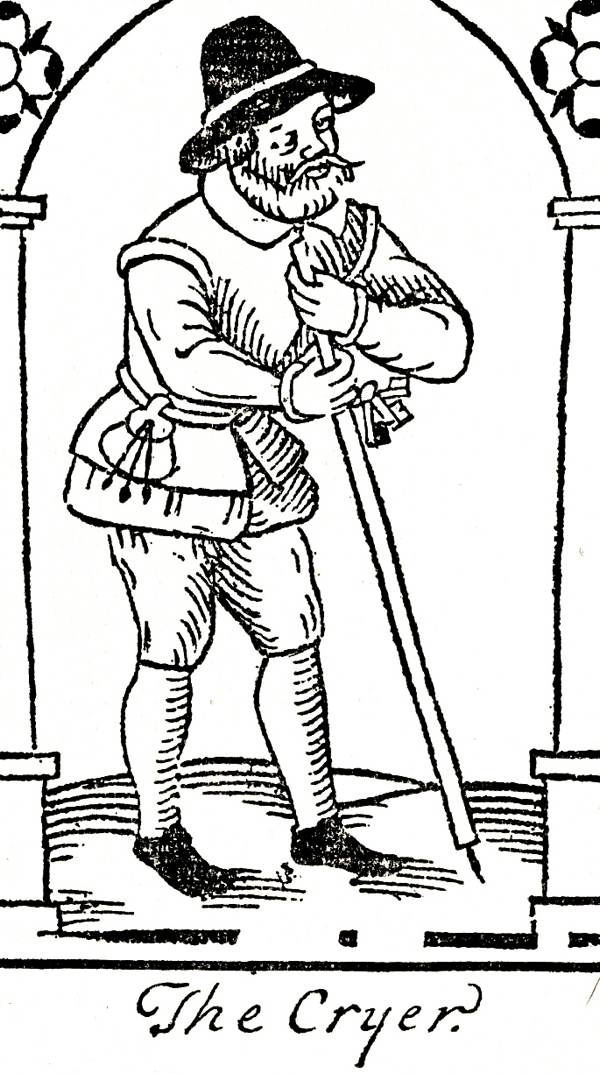
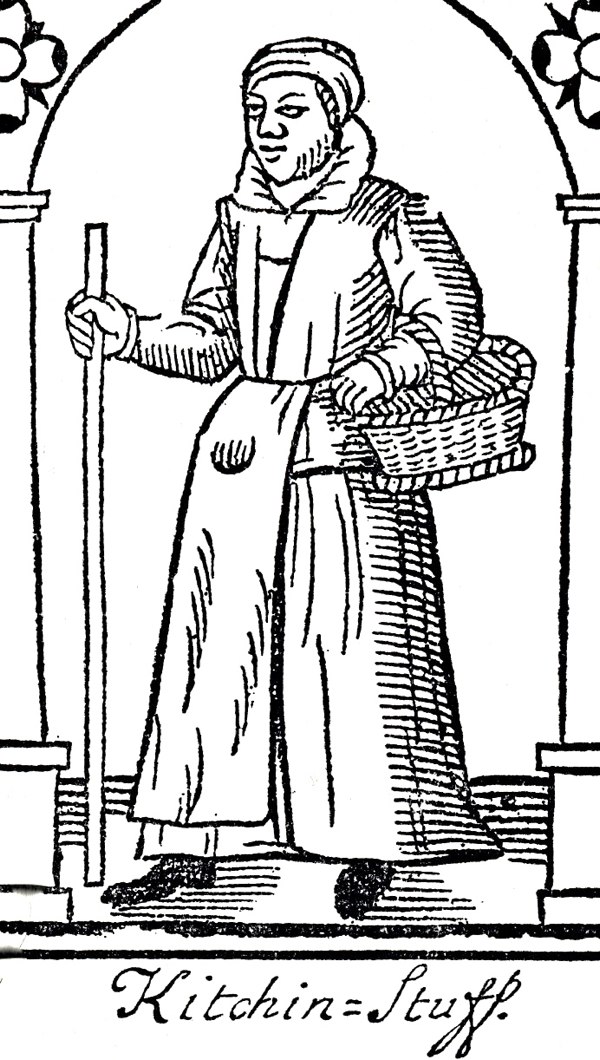
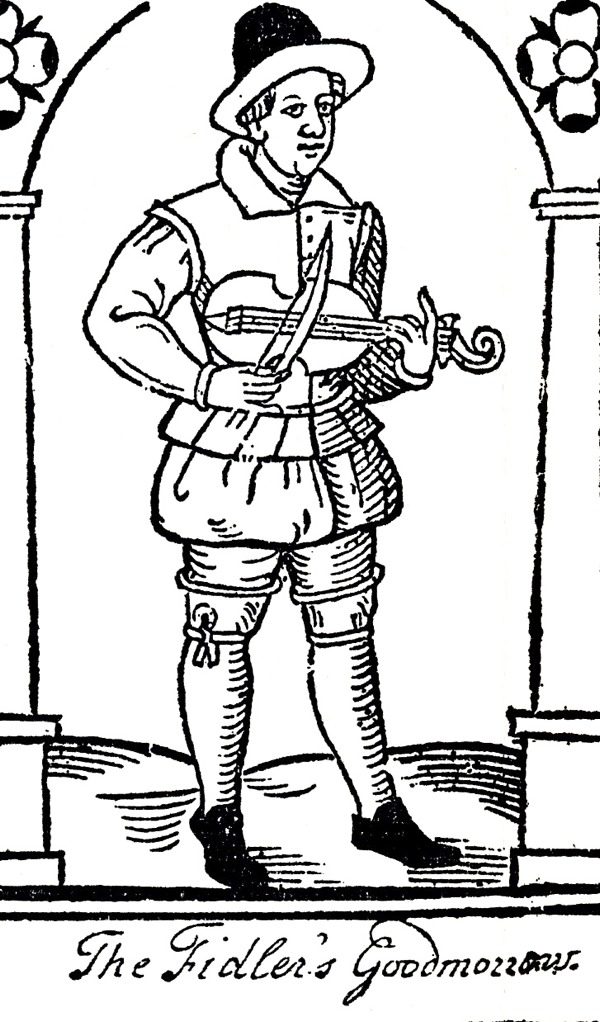
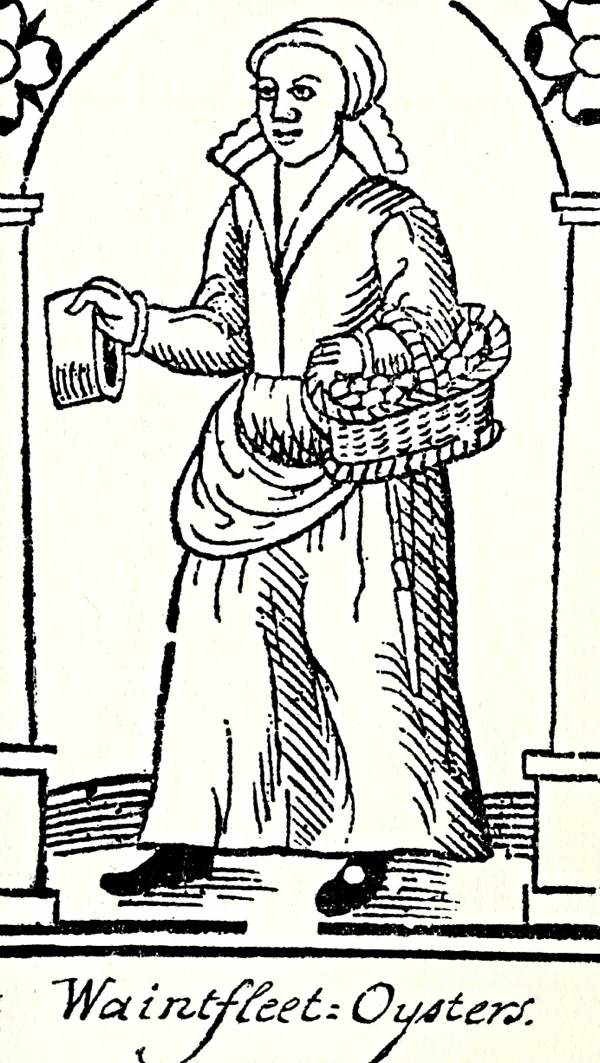
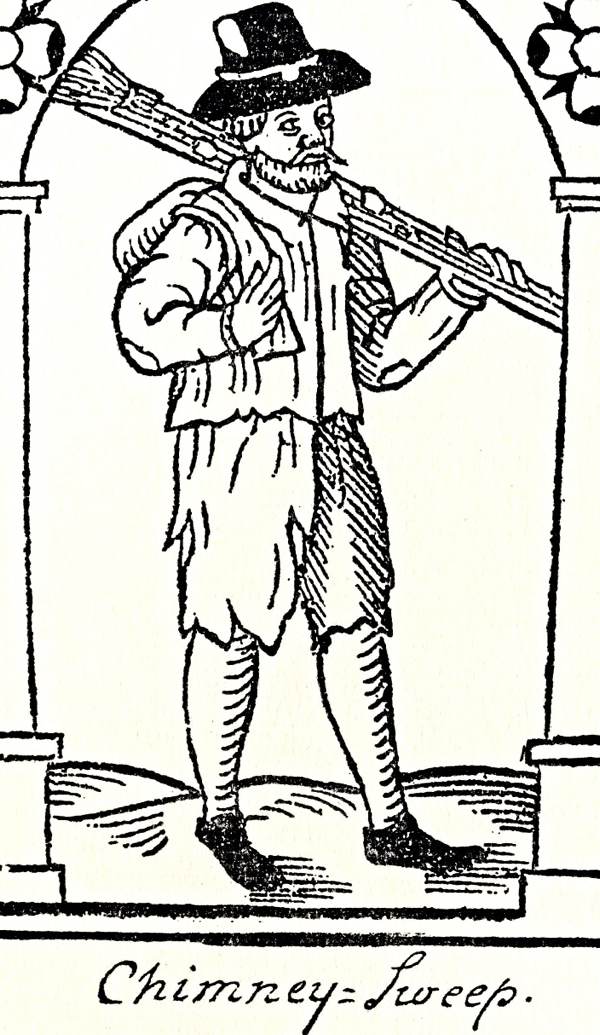
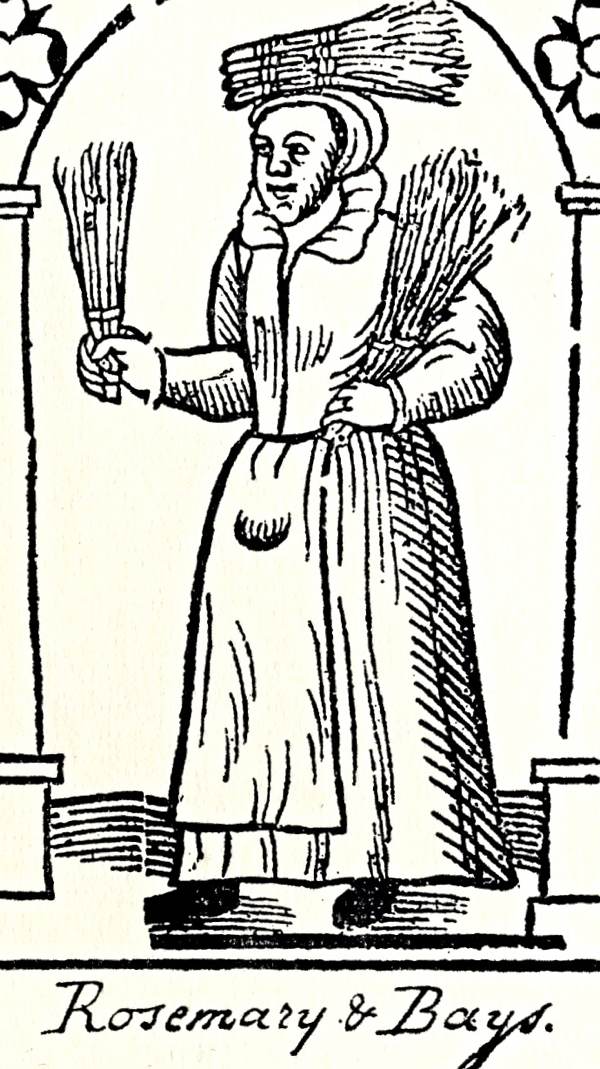
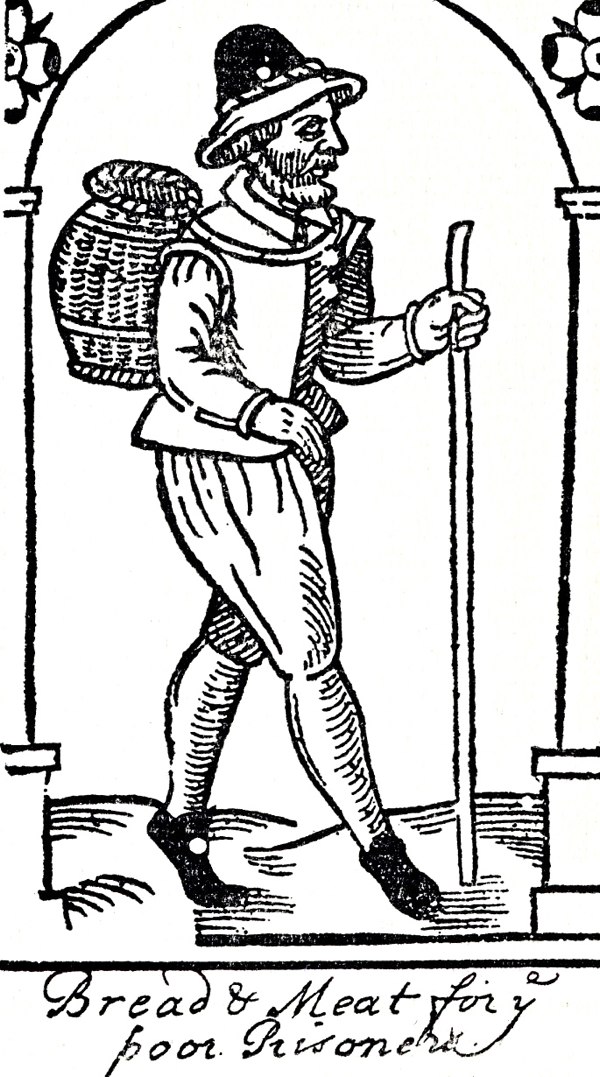
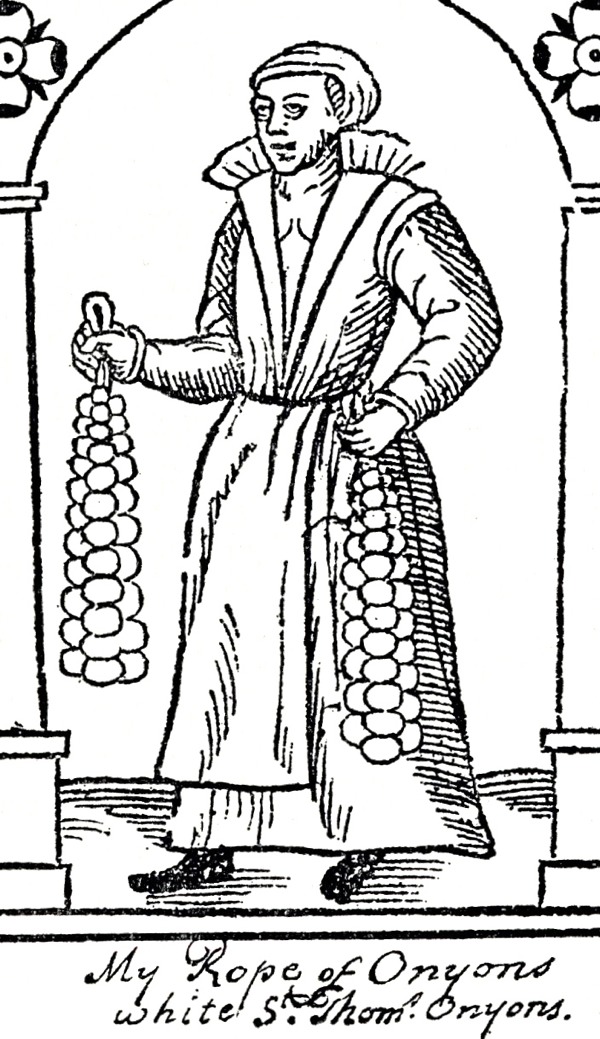
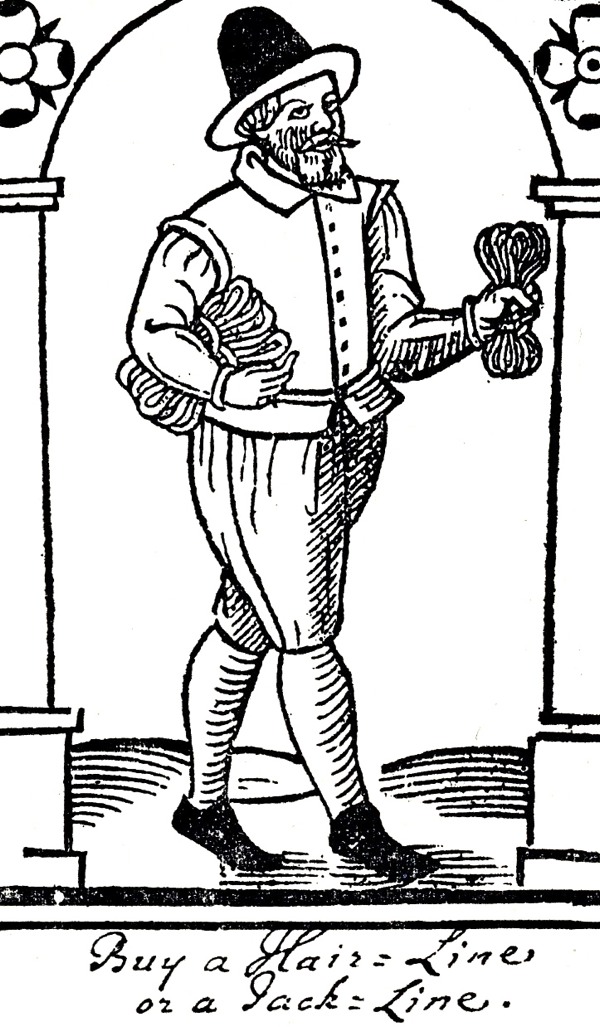
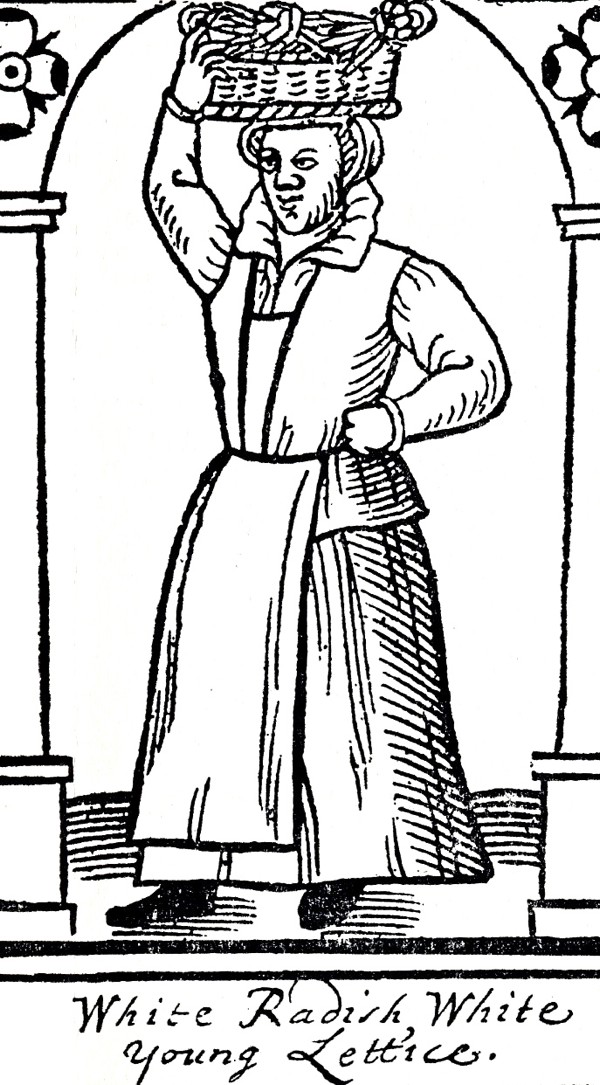
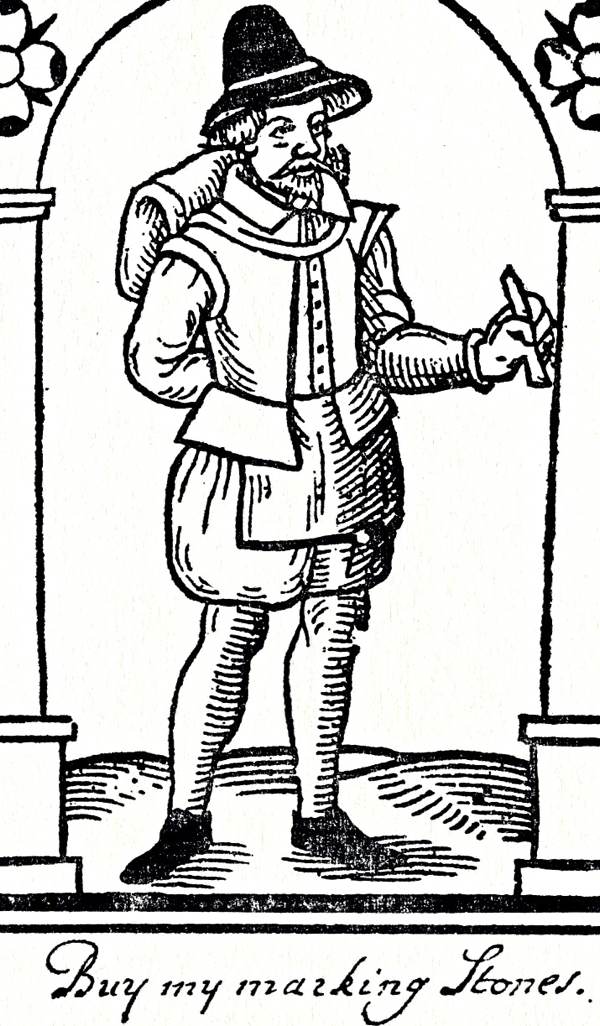
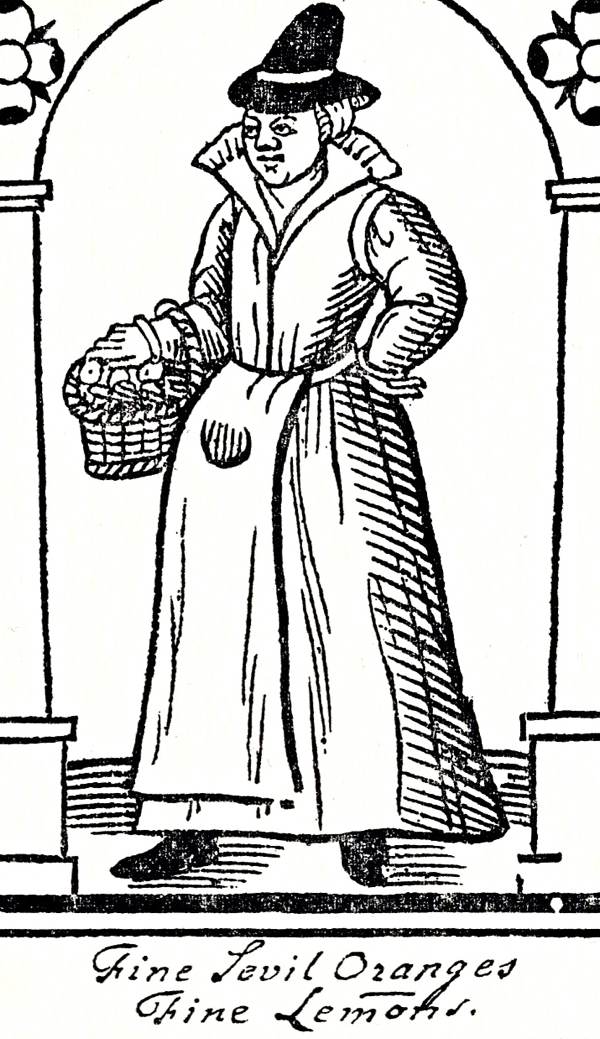
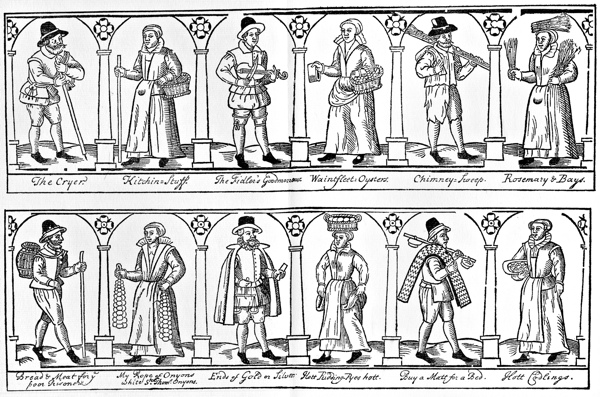
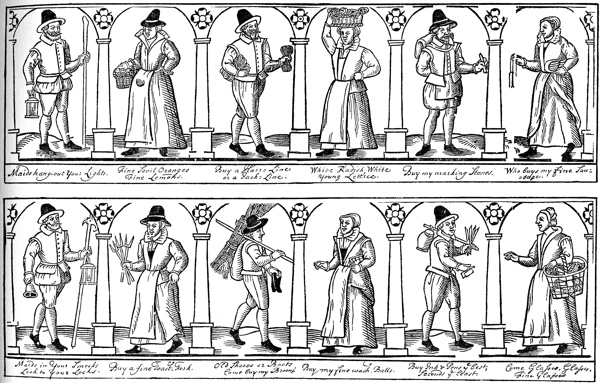
Images courtesy Bishopsgate Institute
You may also like to take a look at these other sets of the Cries of London
Geoffrey Fletcher’s Pavement Pounders
William Craig Marshall’s Itinerant Traders
H.W.Petherick’s London Characters
John Thomson’s Street Life in London
Aunt Busy Bee’s New London Cries
Marcellus Laroon’s Cries of London
More John Player’s Cries of London
William Nicholson’s London Types
Francis Wheatley’s Cries of London
John Thomas Smith’s Vagabondiana of 1817
John Thomas Smith’s Vagabondiana II
John Thomas Smith’s Vagabondiana III
Thomas Rowlandson’s Lower Orders
More of Thomas Rowlandson’s Lower Orders
Tony Bock, Photographer

At The Royal Oak, Bethnal Green
These pictures – published here for the first time – are a selection from those taken in the five years between 1973 and 1978, when Tony Bock lived in the East End working as a photographer for the East London Advertiser. “Britain in the nineteen seventies never seemed comfortable with itself,” Tony admitted to me, “caught between the post-war years that hung on too long and the late twentieth century that seemed late in arriving.”
Although he was brought up in Canada where his parents emigrated in 1952, Tony was born in Paddington and, after being thrown out of photography school in Toronto in 1972, he decided to return to his country of birth and the East End where his mother’s family came from. “My grandfather was a docker his entire working life, working at Hay’s Wharf near London Bridge in the nineteen twenties then moving on to ‘The Royals’ (as the Royal Docks were known) until he retired.” he explained.
Yet Tony’s return was destined to be short-lived and there is an ambivalence which runs through these eloquent photographs. While he had a personal connection to the world that he portrayed, equally Tony was a stranger to it. In many of these pictures a dramatic tension exists between the empathy of the photographer and an underlying sense of dislocation – though it was not simply the dislocation of an outsider, but that of a world undergoing transition and fragmentation. In these photographs, Tony explored his relationship to the culture of his own origin, yet he discovered it was a troubled society in which he could never feel at home.
“I lived in Wapping for several years and met Lyn, my wife-to-be, who was also a journalist at the East London Advertiser.” Tony recalled, “But in 1978, I was offered work at The Toronto Star, the largest paper in Canada. The racism and pollution in the East End were getting me down and when Maggie Thatcher was elected – well – that was enough to send me back home.”
Tony’s spell at photography school granted him an awareness of the work of the great international photographers of the twentieth century and this knowledge informed the confident aesthetic of his East End pictures, with their strong compositions and deftly-balanced multiple points of focus within a single frame. For Tony Bock, his sojourn in the East End delivered the opportunity he needed to take a clear-eyed look at his roots before returning to pursue a career as a photojournalist in Toronto. Today, these pictures from the mid-seventies offer us an invaluable personal vision of a not-so-distant world that is rapidly fading from memory.
“I worked at The Star for over thirty years, it was a great place to be a photojournalist. It was a paper that cared about photography, had the budget to undertake long term projects, sent staff around the world, and dealt with social issues.” he told me, “Oddly, my life in East London followed the route my mother’s family had taken years earlier.”

Saturday night out, Dagenham

Children playing in Poplar

Clown at Stratford Broadway

At J.Kelly, Pie & Mash, Bethnal Green

At The White Swan, Poplar

At the E1 Festival, Stepney

Train departing Liverpool St Station

In Watney Market

Corner Shop, Sidney St

Boy with a gun and his sister, Pearl St, Wapping

Wapping Stairs

Demolition at Tiller Rd, Isle of Dogs

Commercial Docks, Rotherhithe

No remuneration to Place-keepers.
Photographs copyright © Tony Bock
At Clerkenwell Fire Station

Clerkenwell Fire Station is the oldest operating fire station in Britain, serving the people of London continuously from its handsome red brick tower at the junction of Rosebery Avenue and Farringdon Rd since 1872. Contributing Photographer Colin O’Brien grew up a quarter of a mile from here in Victoria Dwellings, a tenement just down the road at the corner of Clerkenwell Rd and Farringdon Rd, and as a young photographer in the nineteen sixties he leaned out of the window to photograph the Clerkenwell firemen when they came to extinguish a conflagration in his building.
So when I learned that there was a possibility that Clerkenwell Fire Station might shut forever in June, I realised that Colin and I needed to pay a visit upon the firefighters of Clerkenwell, to celebrate these heroic individuals and record their brave endeavours, lest this be the end of their operations here after one hundred and forty years. In spite of the fact that they had all received letters before Christmas inviting them to take voluntary redundancy, we found them in buoyant mood and it was only towards the end of our visit I learnt that several members of the watch had recently received awards for bravery after saving people trapped in a cradle high above the new University College London Hospital in Gower St.
Firefighters work in “watches” of fourteen and there are four watches at Clerkenwell Fire Station who work alternating shifts, two days of 9:30am until 8pm and two days of 8pm until 9:30am, a total of forty-eight working hours each week followed by three days off, thus providing cover every hour, every day of the year. Colin and I had the privilege of being the guests of Tim Dixey’s watch, arriving in the morning to discover the team around the table in the mess, at the end of the days’s briefing before they headed out to the yard to run through the drill that is a constant of life as a firefighter, designed to hone the co-ordination, proficiency and team work of the watch.
Although the fire station opened in 1872, it is still fully functional and it was a pleasure to see the working parts of the old building cherished – freshly painted, cleaned and maintained in tip-top order, still in daily use for the purpose for which they were built. On the Farringdon Rd side of the building are two wooden doors, a narrower one originally used for the hand cart fire engine and a wider one for the horse drawn engine.
Tim Dixey, a veteran of twenty-nine years in the service who joined at eighteen years old, explained that the founders of the Metropolitan Fire Brigade in 1866 came from a naval background and every station was designed to be sufficient to itself. “They were conceived as ships on land,” he told us. Many of the early firefighters were ex-naval men who were comfortable with heights and familiar with ropework, introducing the structure of shifts and terminology of “watches” that is still used in the fire service today.
Meeting the firefighters of Tim’s watch for the first time, Colin and I were touched by the generosity of spirit and emotional openness with which they accepted our presence. I recognised the depth of trust necessary between those who risk their lives in the course of their work and must depend upon each other absolutely. We were surprised to meet a father and son, Andy Simkins and Dave Smith, working together as firefighters in the same watch, yet it only served to enforce the sense of intimate reliance among the crew.
At Tim’s request, firefighter Gregg Edwards took us on a tour of the upper floors of the station which have been disused for decades. With views across the rooftops to the City, we found the washrooms of the eighteen seventies with huge white sinks lined up for the firemen of a century ago to wash the soot off their faces. In the next room, an elaborate series of metal racks offered arcane facilities for drying wet uniforms in a heated chamber. Walking through another door, we entered the former accommodation of firefighters under the eaves. There were neat delft tied fireplaces and rooms still lined with faded nursery wallpaper. Abandoned in the middle of the last century, when the firefighters sought a degree of independence from their employers, these flats are now designated “unfit for purpose” even though with a modicum of repairs they could be a boon to the firefighters of today, who are unable to afford housing locally and must commute long distances as a consequence.
Then we had the opportunity to watch the fire drill as the watch in their yellow and black overalls, swarming like bumble bees, slid the tall aluminium ladder off the engine, extending it to the highest extremity of the tower. We asked some obvious questions, about the whether the fireman’s lift is still practised and enquired about the frequency of cats stuck in trees. “You’re not supposed to carry people down ladders,” we were told, “But, if it needs that, we will.” We learnt that rescuing felines did not take up a great deal of the fightfighters’ time. “How many skeletons of cats do you see in trees?” quipped Dave Smith, speaking with authority after twenty years in the service.
And then a call came in. Tim Dixey waved a slip of paper that reported a mother who had locked herself out of her flat when the wind blew her front door shut, trapping her baby inside.“We all go and we don’t leave anyone behind,” Tim joked, introducing a personal tenet, as he and his fellow firefighters climbed aboard their engine. In a moment, the truck turned into the Farringdon Rd, disappearing into the traffic as the siren faded into the distance, and Colin and I were left standing.

Colin O’Brien’s photograph of firemen at Victoria Dwellings in the nineteen sixties.
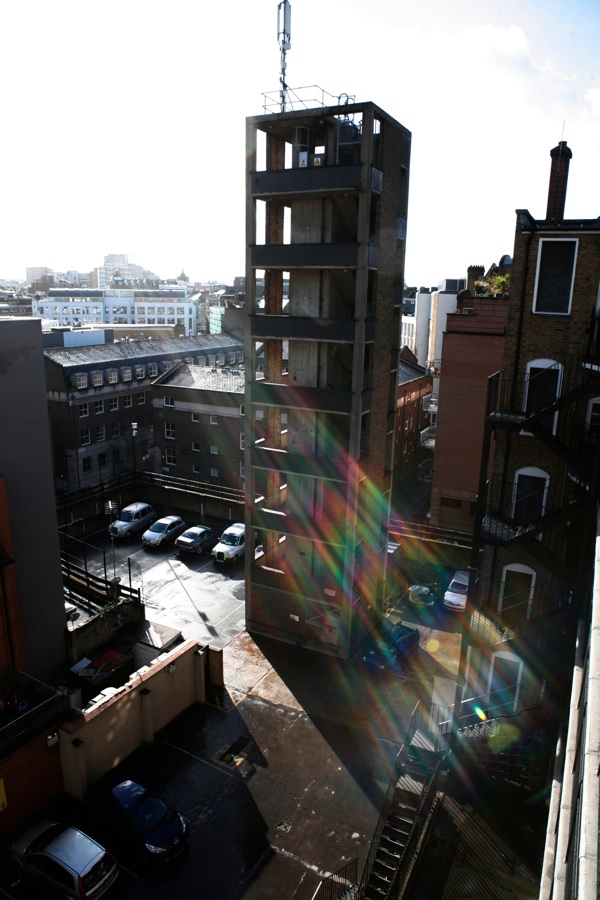
Tower used for firefighting exercises and as a lookout.


Firefighter Craig Wellock, six years in the fire service.
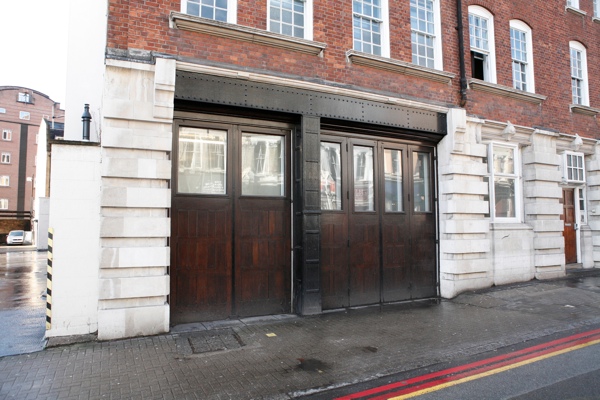
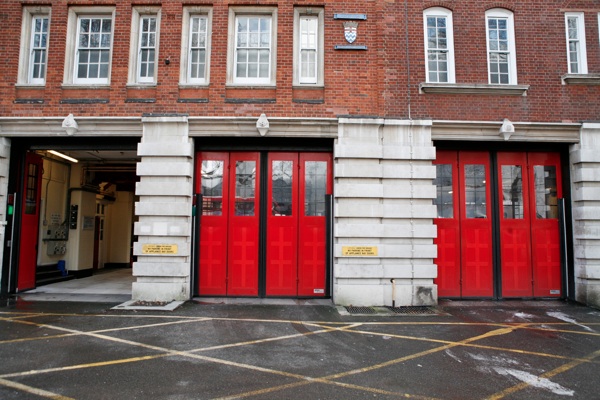
In 1872, the door on the left was for the handcart fire engine and the door on the right for the horse-drawn fire engine.
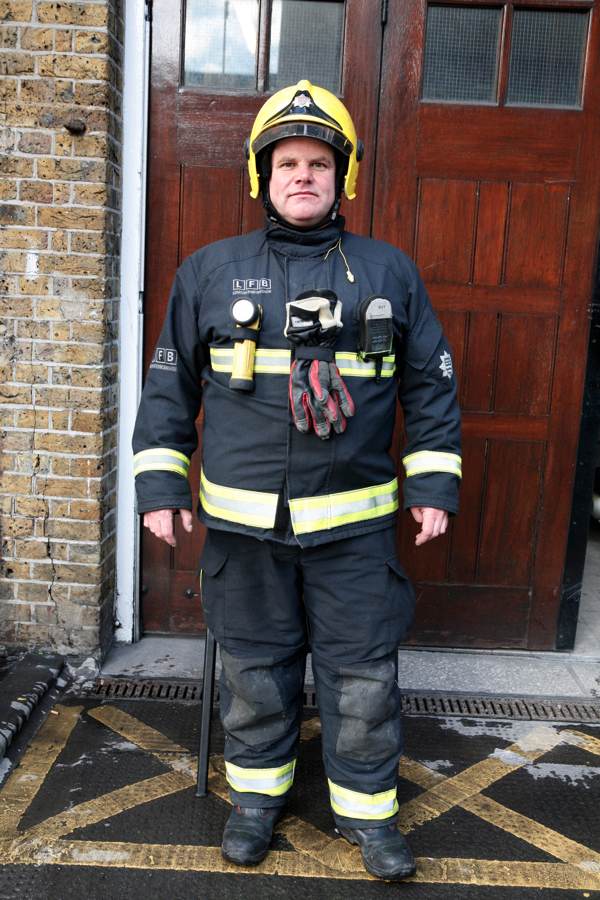
Firefighter Dave Smith, twenty years in the fire service.
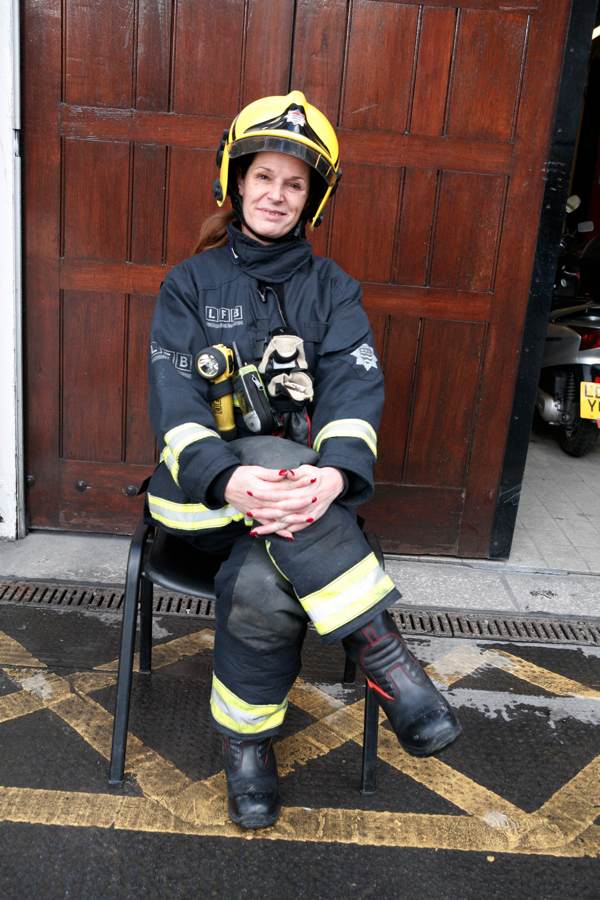
Firefighter Mandy Watts, thirteen years in the fire service.

Wash room from 1872, used by firefighters on their return from duty.

Father and son firefighters, Andy Simkins and Dave White – twenty-six years and six years in the fire service respectively.
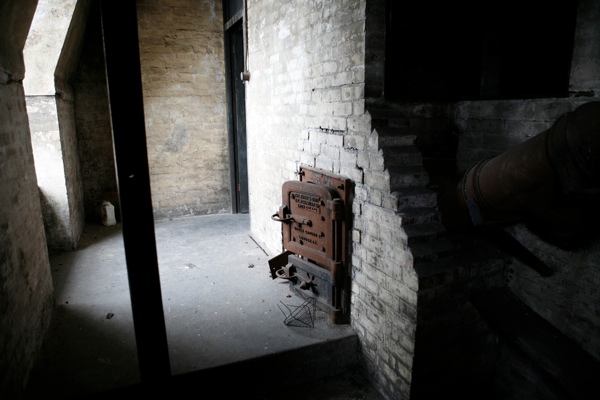
Disused furnace to heat the drying room for wet uniforms, dating from 1872.
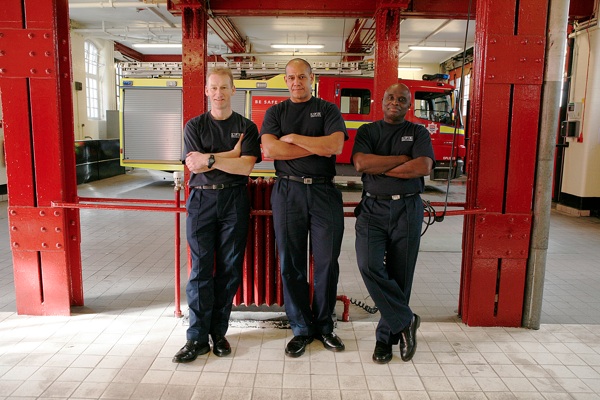
Firefighters Gregg Edwards, Merrick Josephs and Henry Ayanful.

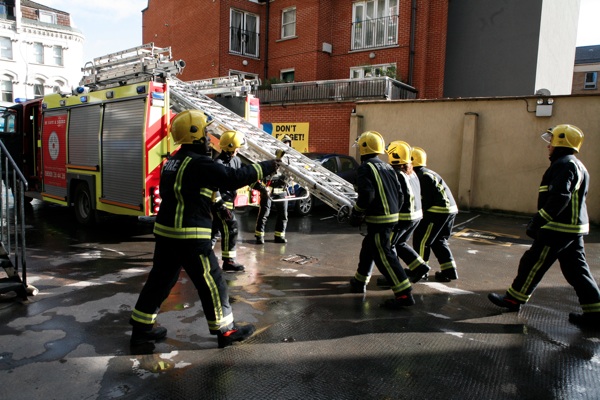

Firefighters Gregg Edwards, Henry Ayanful, Watch Manager Tim Dixey, Firefighters Nasir Jilani and Merrick Josephs.

The change in the brickwork indicates where the station was expanded in the eighteen eighties.

Firefighter Gregg Edwards.

The view from the accommodation floor where firefighters once lived with their families.

Firefighter Henry Ayanful, twenty-one years in the fire service.


Station Manager Steve Gray, twenty-five years in the fire service.
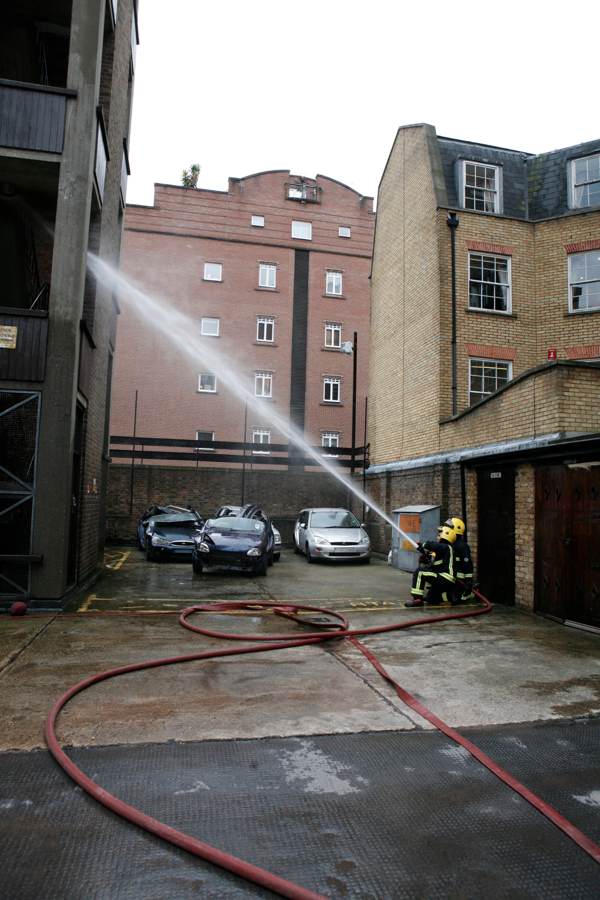
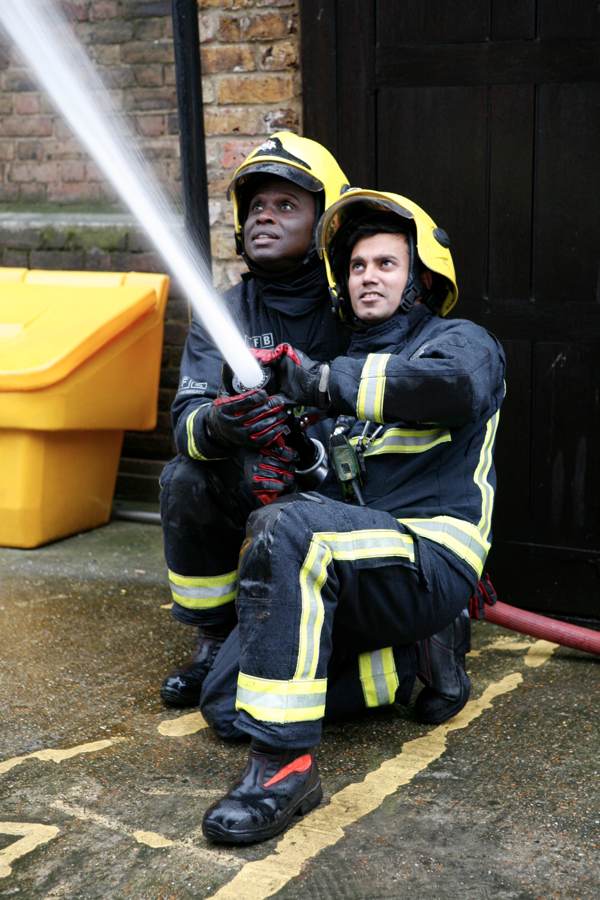

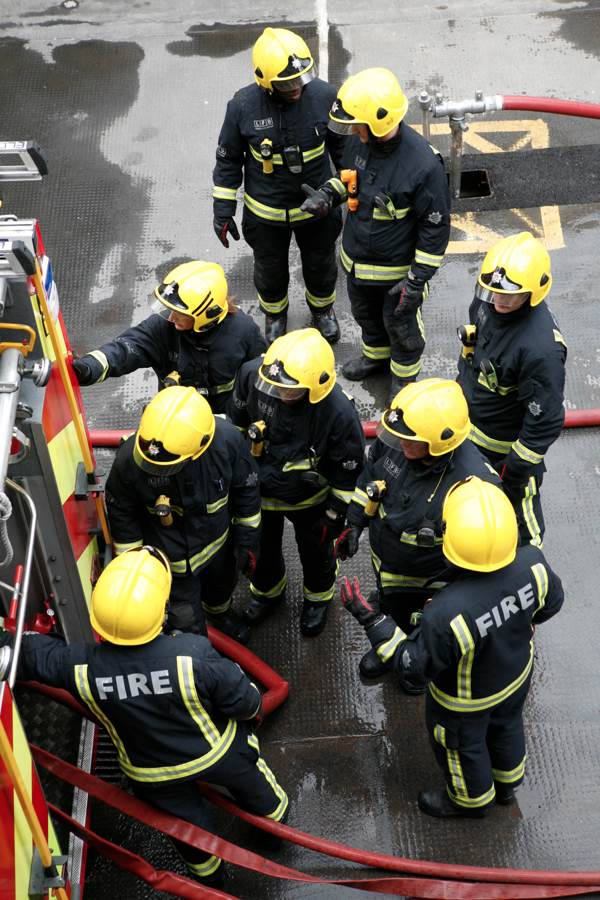
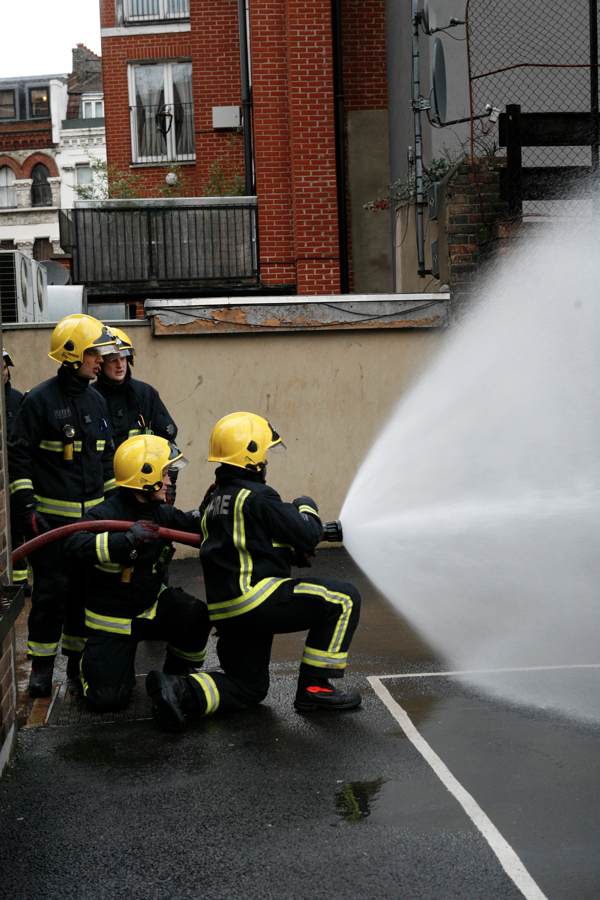

Watch Manager Tim Dixey – twenty-nine years in the fire service, joined at the age of eighteen.

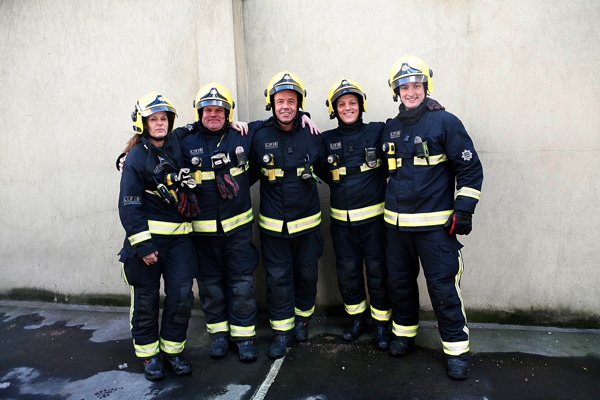
Firefighters Mandy Watts, Dave Smith, Andy Simkins, Dave White and Craig Wellock.
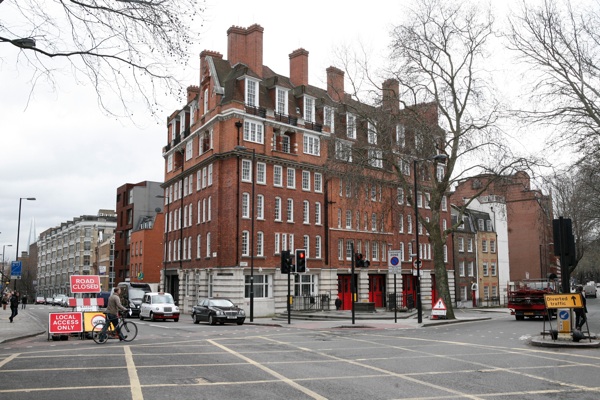
Clerkenwell Fire Station, Europe’s oldest operating fire station.
Photographs copyright © Colin O’Brien
Sign the petition to save Clerkenwell Fire Station here
You may like to look at these other pictures by Colin O’Brien
Colin O’Brien’s Clerkenwell Car Crashes
Colin O’Brien’s Kids on the Street
Travellers’ Children in London Fields
Colin O’Brien’s Brick Lane Market
At The George

Pauline Forster, publican at The George in Commercial Rd
Let me admit, The George in Commercial Rd is one of my favourite pubs in the East End. From the first moment I walked through the door, I knew I had discovered somewhere special. In the magnificently shabby bar room, with gleaming tiles and appealingly mismatched furniture all glowing in the afternoon light filtering through coloured glass windows, there was not a scrap of the tidying up and modernisation that blights the atmosphere of too many old pubs. There was no music and no advertising – it was peaceful, and I was smitten by the unique charisma of The George.
Curious to learn more, I paid a visit upon the owner recently, who has been described to me as one of the last great publicans of the East End, and I was far from disappointed to explore behind the scenes at this legendary institution because what I found was beyond what I ever imagined.
Pauline Forster, artist and publican of The George, brought up her five sons in a remote valley in Gloucestershire. It was only ten years ago that she bought The George and her sons came up to London with her, but in the intervening decade they all met partners in the bar and moved out. Yet such a satisfactory outcome of events was not the result of any master-plan on Pauline’s part, merely the consequence of a fortuitous accident in which she stumbled upon The George when it was lying neglected and fell in love with it, buying it on impulse a week later, even though it had never been her intention to become a publican.
“It’s a beauty, this building!” she declared to me as I followed her along the dark passage from the barroom, up a winding stair and through innumerable doors to enter her kitchen upon the first floor. “When I came to view it, there were twenty others after it but they only wanted to know how many flats they could fit in, none of them were interested in it as a pub.” she informed me in response to my gasps of wonder as she led me through the vast stairwell with its wide staircase and a sequence of high-ceilinged rooms with old fireplaces, before we arrived at her office lined with crowded bookcases reaching towards the ceiling. “The interior was all very seventies but I was hooked, I could see the potential.” she confided, “I gravitated to the bar and I started possessing it. I sat and waited until everyone else had gone and then I told the agent I would buy it for cash if he called off the auction.”
With characteristic audacity, Pauline made this offer even though she did not have the cash but somehow she wrangled a means to borrow the money at short notice, boldly taking possession, exchanging contracts and moving in three days later, before finding a mortgage. It was due to her personal strength of purpose that The George survived as a pub, and thanks to her intelligence and flair that it has prospered in recent years.“I thought, ‘I’ve got to open the bar, it would be a sin not to,'” she assured me, widening her sharp grey eyes to emphasise such a self evident truth, “I decided to open it and that’s what I did.”
Ten years of renovations later, the false ceilings and recently installed modern wall coverings have been stripped away to reveal the structure of the building, and this summer the early nineteenth stucco facade will be revealed in all its glory to the Commercial Rd. “I’m used to taking on challenges and I’m a hardworking person,” Pauline admitted, “I don’t mind doing quite a bit of work myself, you’ll see me up scaffolding chipping cement off and painting windows.”
Yet in parallel with the uncovering of the fabric of this magnificent old building – still harbouring the atmosphere of another age – has been the remarkable discovery of the long history of the pub which once stood here in the fields beside the Queen’s Highway to Essex before there were any other buildings nearby, more than seven hundred years ago. When Commercial Rd was cut through by the East India Company in the early nineteenth century, the orientation of the building changed and a new stuccoed frontage was added declaring a new name, The George. Before this it was known as The Halfway House, referenced by Geoffrey Chaucer in The Reeve’s Tale written in the thirteen eighties when he lived above the gate at Aldgate and by Samuel Pepys who recorded numerous visits during the sixteen sixties.
A narrow yard labelled Aylward St behind the pub, now used as a garden, is all that remains today of the old road which once brought all the trade to The Halfway House. In the eighteenth century, the inn became famous for its adjoining botanic garden where exotic plants imported from every corner of the globe through the London Docks were cultivated. John Roque’s map of 1742 shows the garden extending as far as the Ratcliffe Highway. At this time, William Bennett – cornfactor and biscuit baker of Whitechapel Fields – is recorded as gardener, cultivating as many as three hundred and fifty pineapples in lush gardens that served as a popular destination for Londoners seeking an excursion beyond the city. As further evidence of the drawing power of the The Halfway House, the celebrated maritime painter Robert Dodd was commissioned to paint a canvas of “The Glorious Battle of the Fifth of June” for the dining room, a picture that now resides in the Maritime Museum in Greenwich.
When you have ascended through all the diverse spaces of The George to reach the attic, you almost expect to look from the dormer windows and see green fields with masts of ships on the river beyond, as you once could. I was filled with wonder to learn just a few of the secrets of this ancient coaching inn that predates the East End, yet thanks to Pauline Forster has survived to adorn the East End today, and I know I shall return because there are so many more stories to be uncovered here. I left Pauline mixing pure pigments with lime wash to arrive at the ideal tint for the facade. “I don’t get time to do my own paintings anymore,” she confessed, “This is my work of art now.”

The George is covered with scaffolding while renovation takes place.

Nineteenth century tiling in the bar.
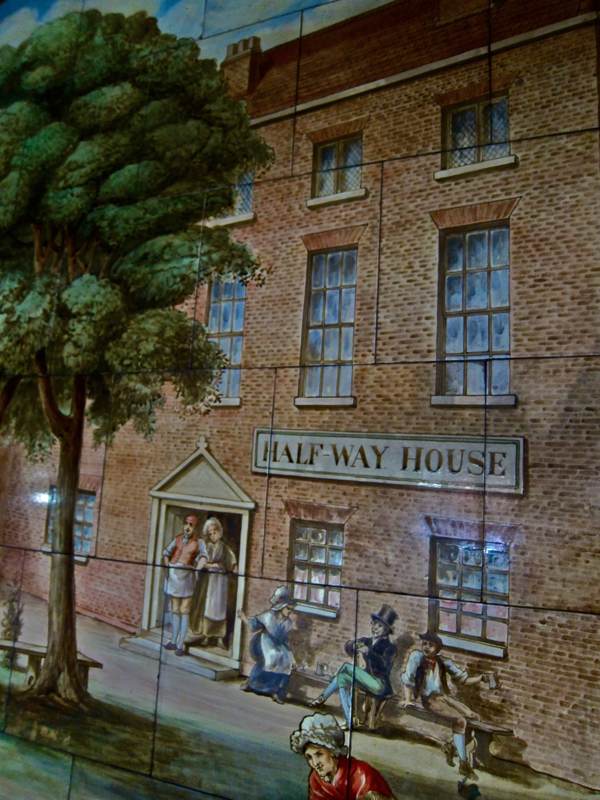
A ceramic mural illustrates The George in its earlier incarnation as The Halfway House.
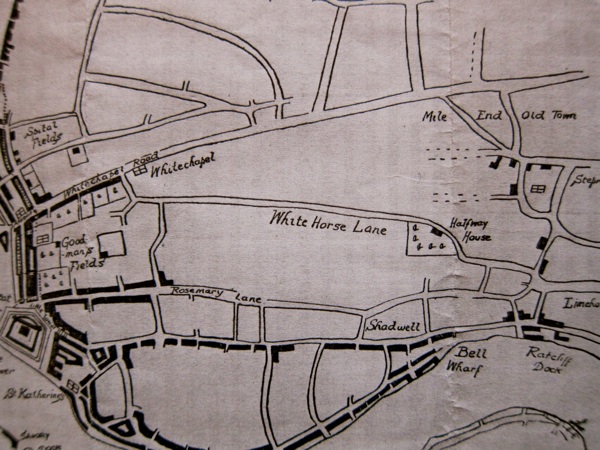
Stepney in 1600 showing The Halfway House and botanic garden on White Horse Lane, long before Commercial Rd was cut through by the East India Company in the early nineteenth century.

The Halfway House in the seventeenth century.
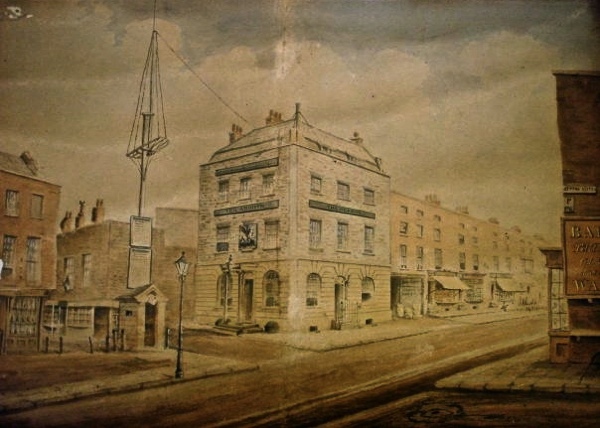
The Halfway House became The George and the orientation of the building was changed in the nineteenth century when Commercial Rd was cut through. Note the toll booth and early telegraph mast.
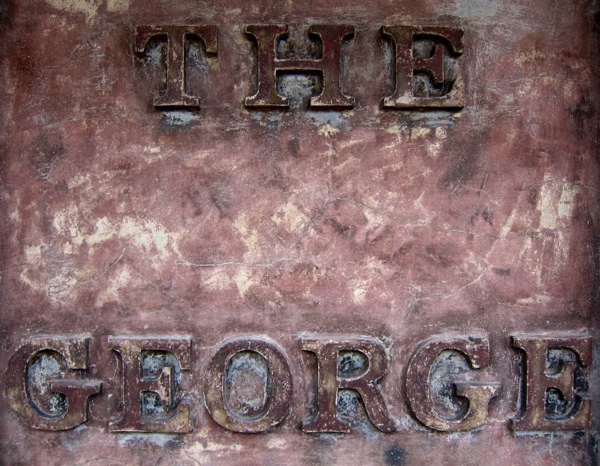
The stucco facade is currently under restoration.

The Georgian theatre serves as the pub’s entertainment suite.

In the attic, where Pauline lived when she first moved in.

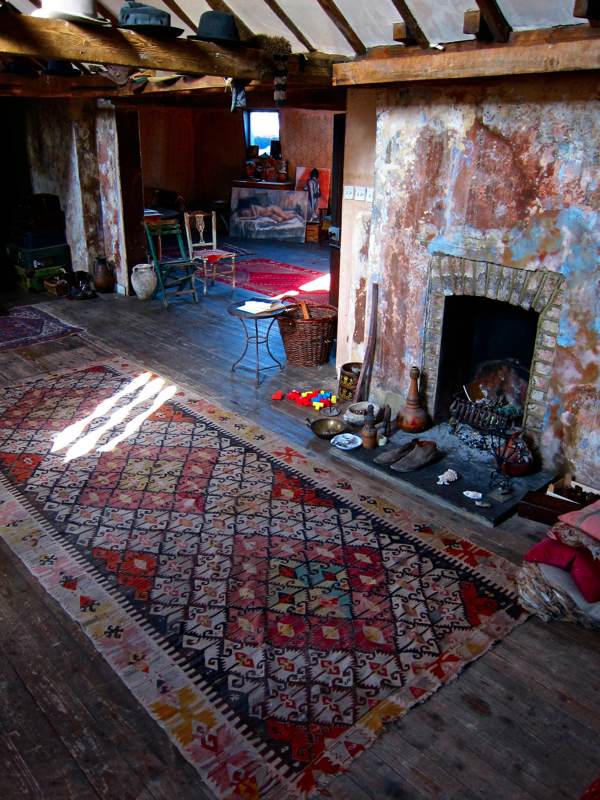

A selection of Pauline’s paintings.

Pauline’s collection includes the dried-out carcass of a rat from Brick Lane.

Bedroom under the eaves.
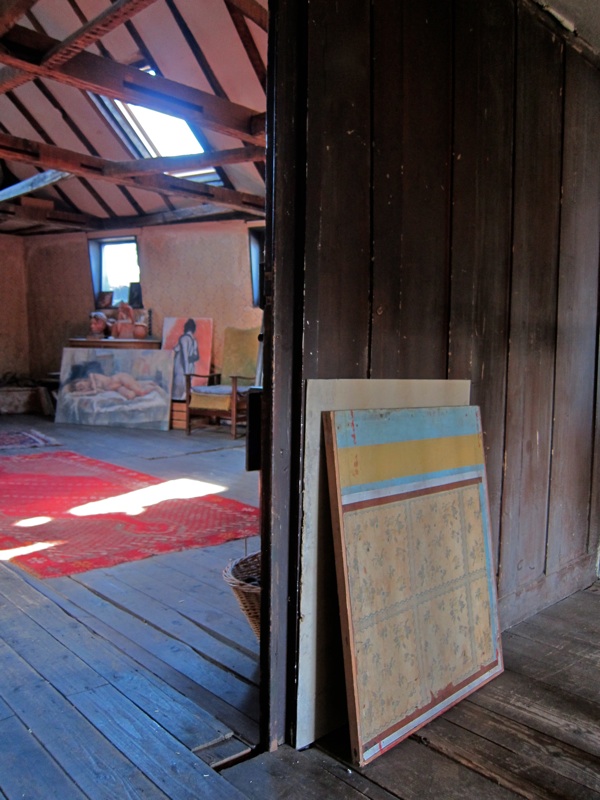
Entrance to the attic.

Pauline’s studio.
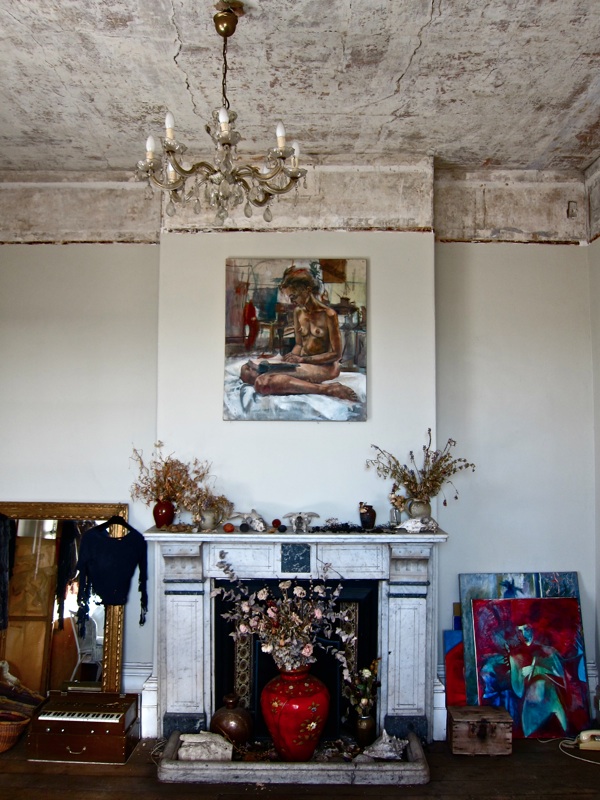
Living room.

Living room with view down Commercial Rd.
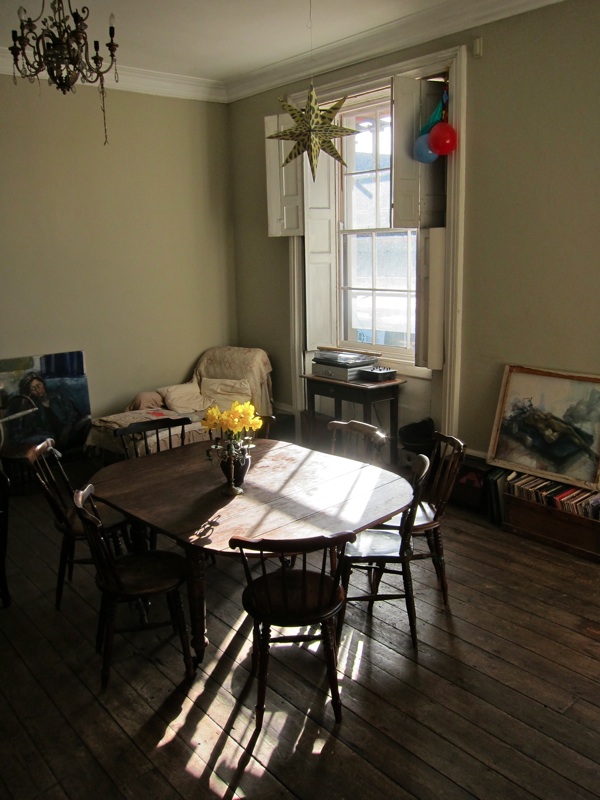
Dining Room.
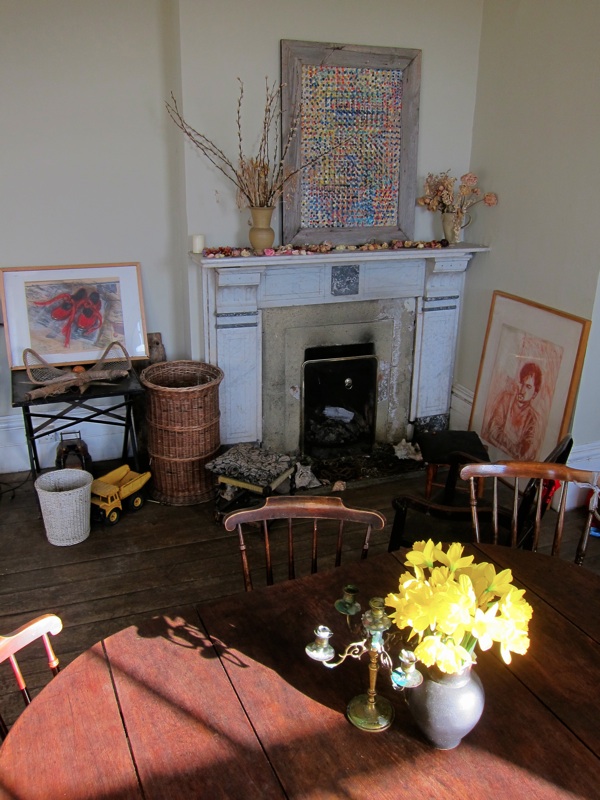
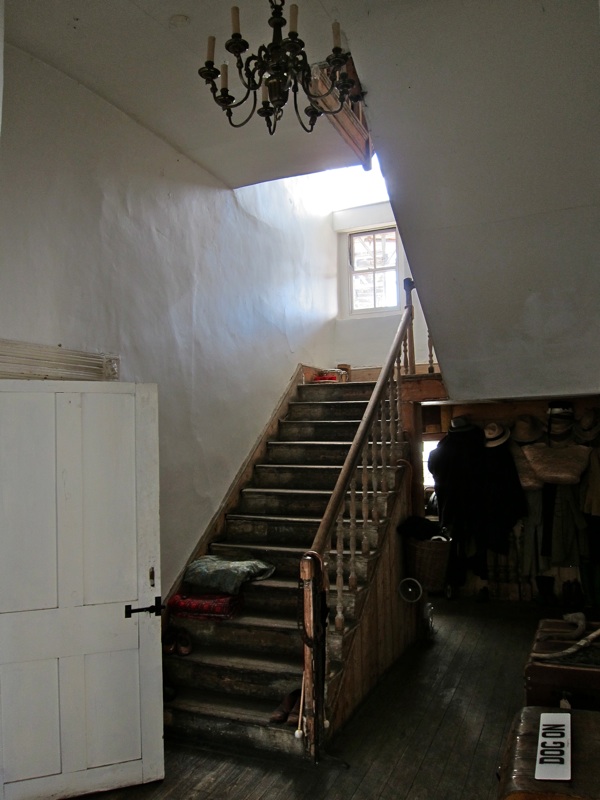
Wide eighteenth century staircase.
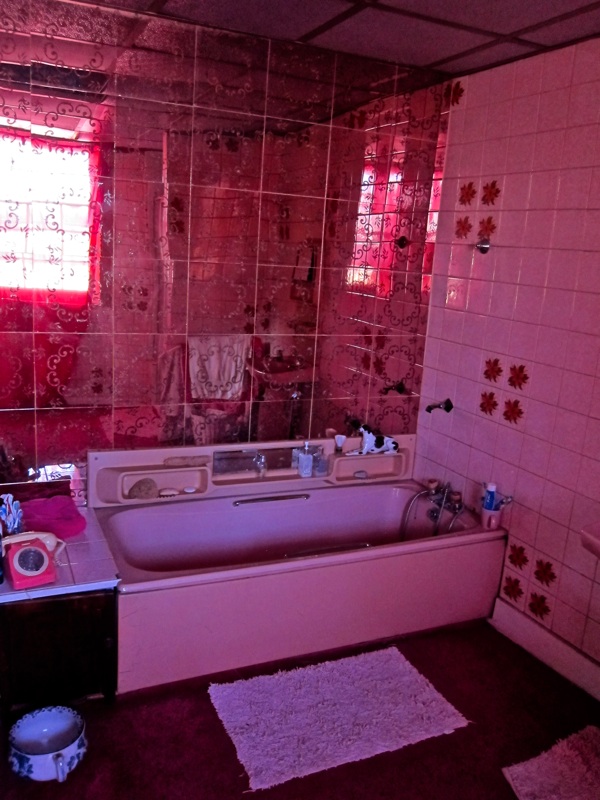
Pauline’s bathroom with matching telephone, the last fragment of the nineteen seventies interior that once extended throughout the building.

In Pauline’s office.
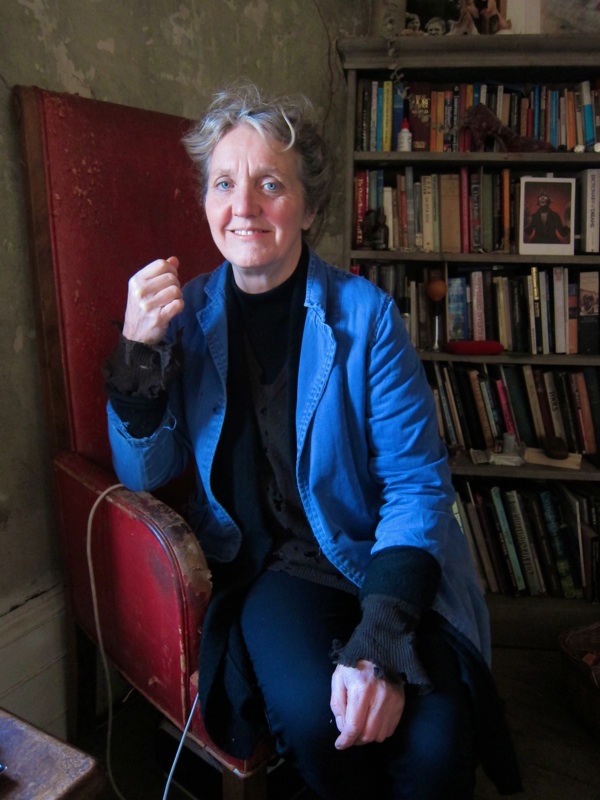
Pauline Forster, Artist & Publican.
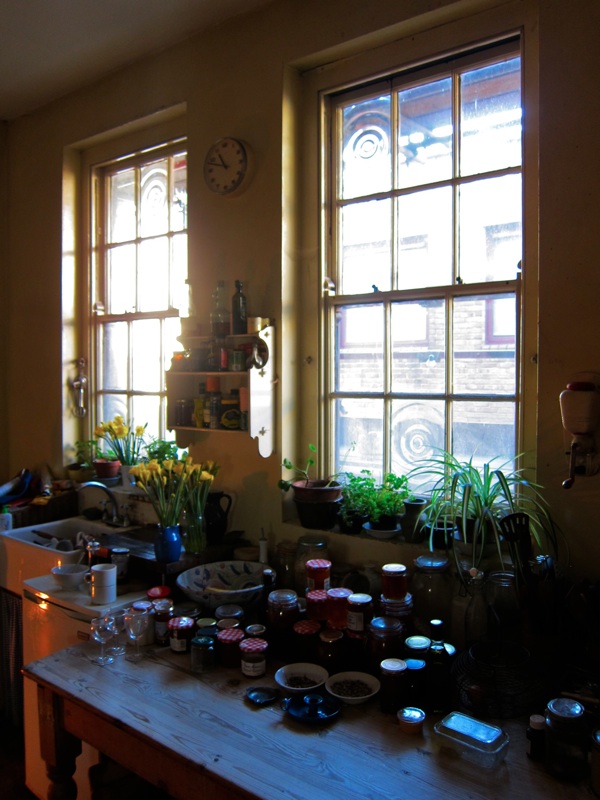
Kitchen looking out onto the former Queen’s Highway, now the pub garden.

Pauline’s newly-made Seville marmalade.
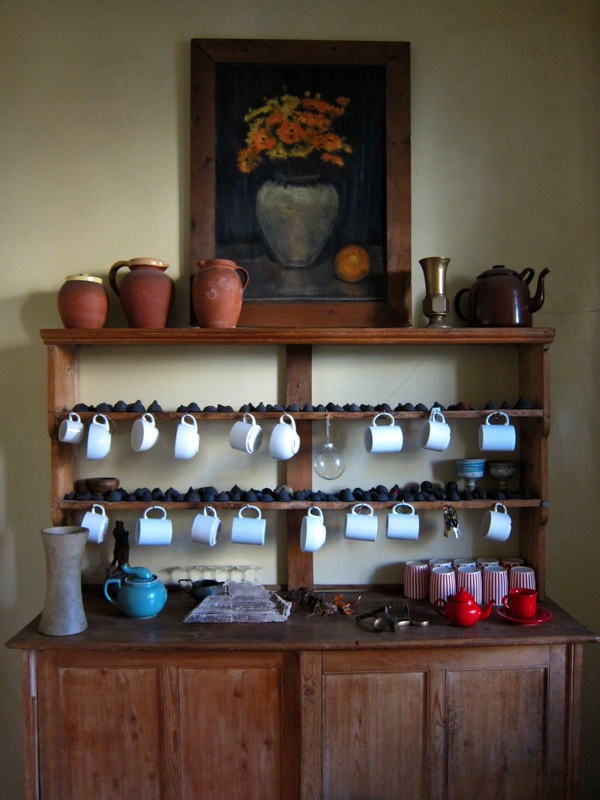
Kitchen dresser.

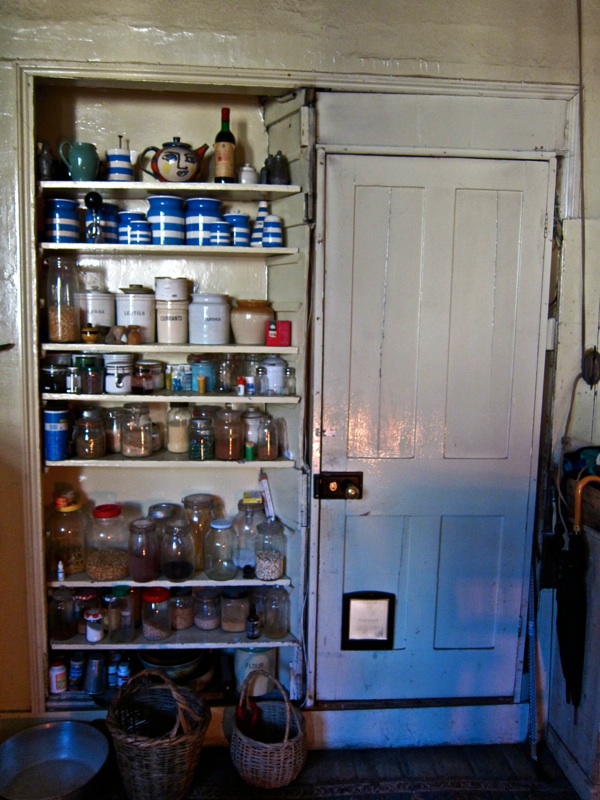
Pauline’s cat keeps close to the fire in the kitchen.
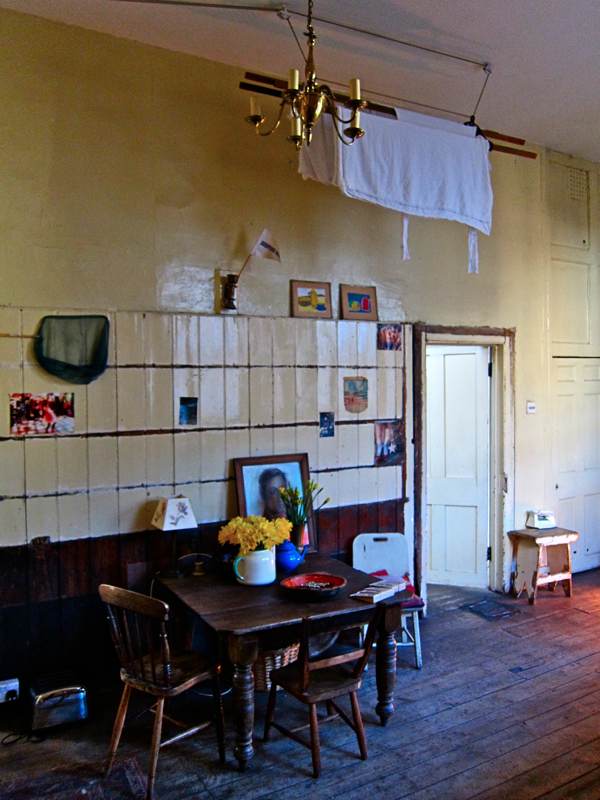


Pauline hits the light-up dancefloor at “Stepney’s” nightclub next door.
The George, 373 Commercial Rd, E1 0LA (corner of Jubilee St).
You may also like to read about
Sandra Esqulant, The Golden Heart
The Carpenter’s Arms, Gangster Pub
John Claridge’s Clowns (Act Two)
A fortnight ago, Contributing Photographer John Claridge & I attended the 67th Annual Grimaldi Service at Holy Trinity Church, Dalston, as guests of Clowns International, the world’s oldest clown club founded in 1947. This rare gathering of so many clowns offered the ideal opportunity to take a set of portraits and this week it is my pleasure to publish a second vivid selection from the startling pictures John took that afternoon, recording some intimate encounters with memorable buffoons and pranksters.
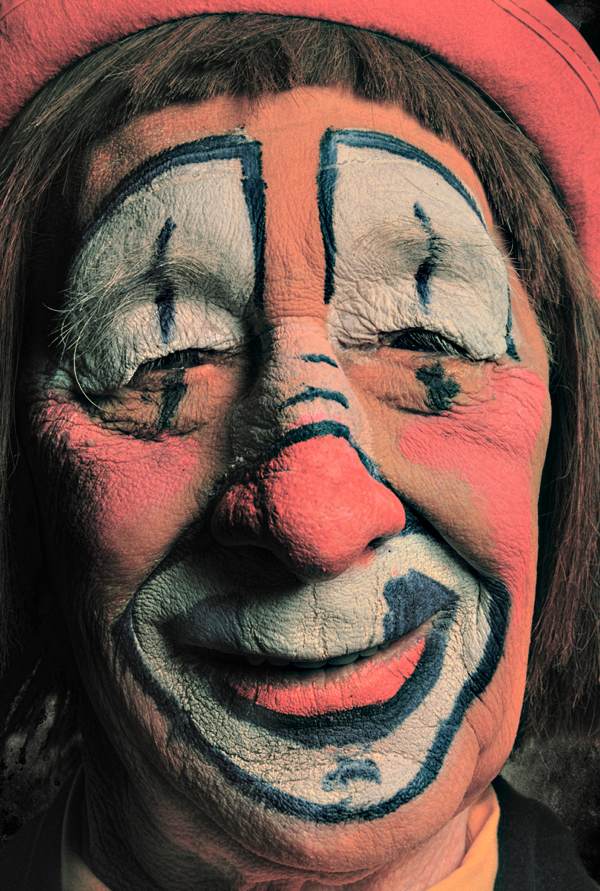
Mr Woo – Clowning since 1950. Performs in a double act with Uncle Colin as The Custard Clowns.
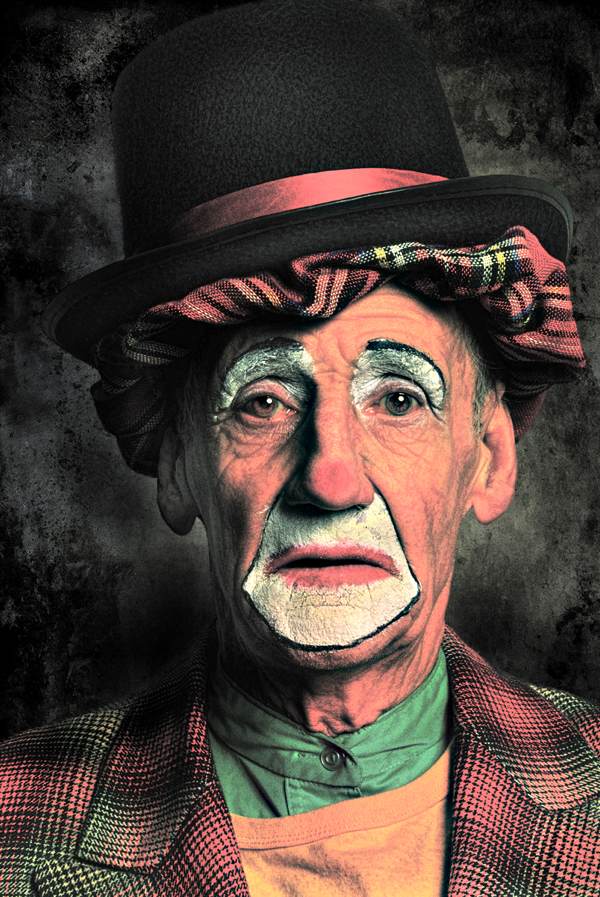
Toby Jingles – Clowning for forty years.
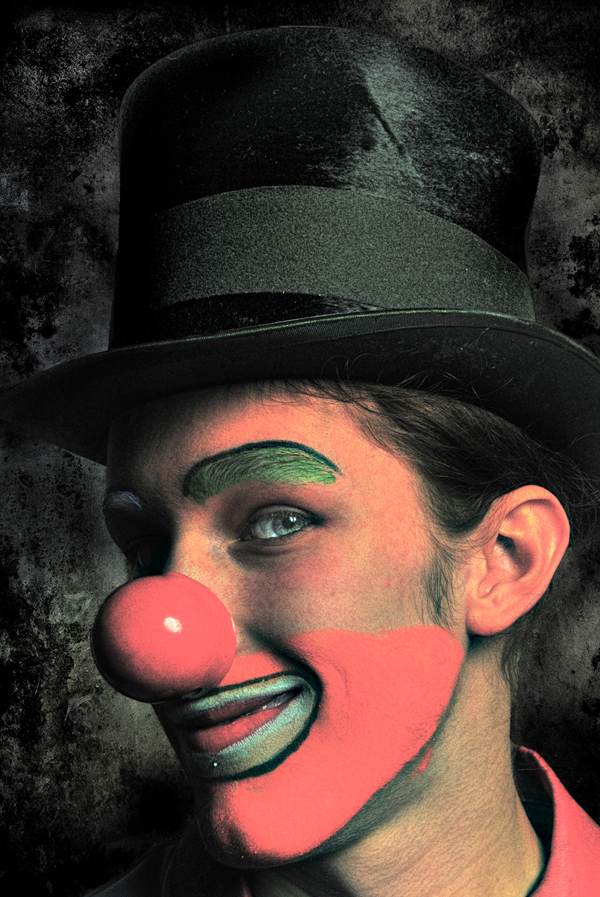
Benzy – Clowning for eight years, Benzy is Mickell’s grandson.
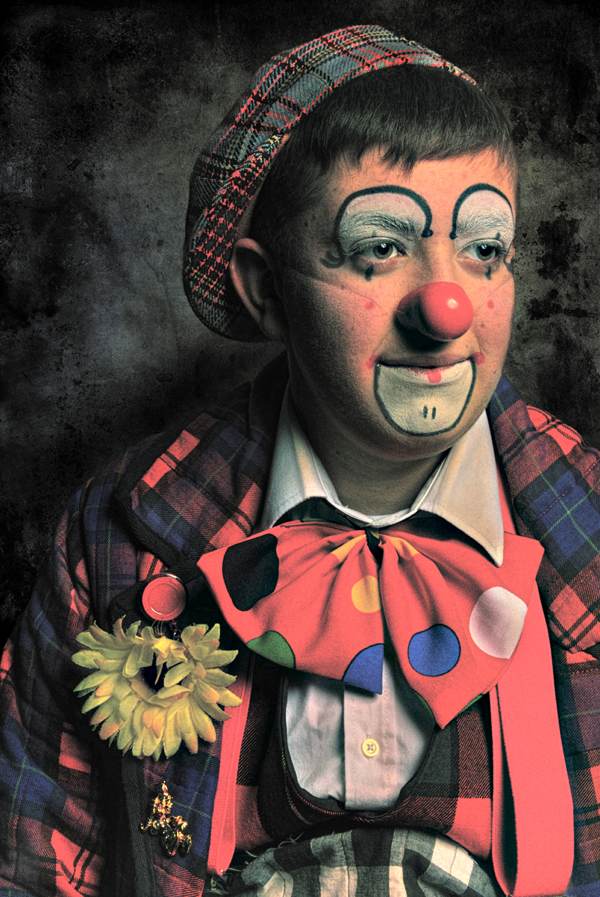
Joey the Clown – Clowning for four years.

Pippa – Children’s entertainer for thirteen years, clowning for six years.
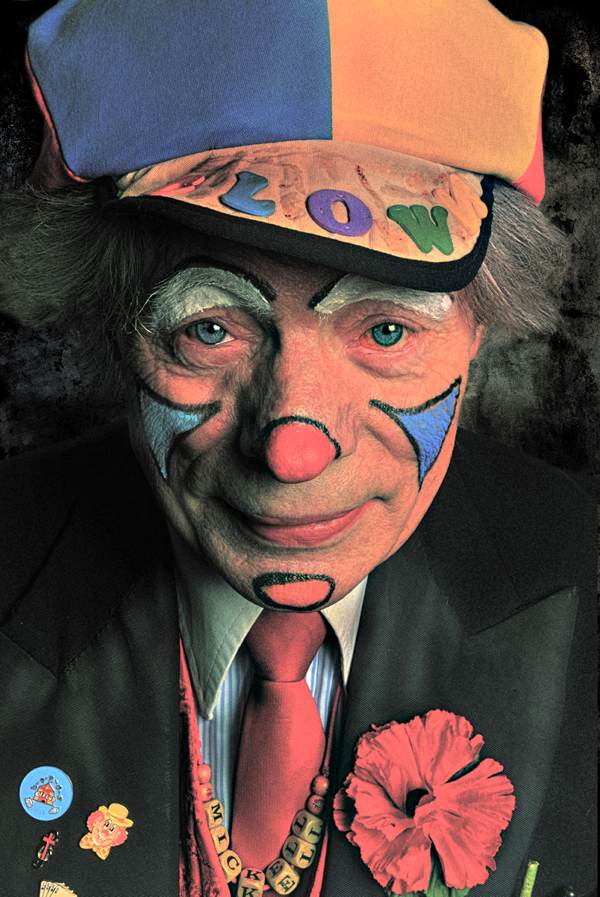
Mickell – Clowning for fifteen years.
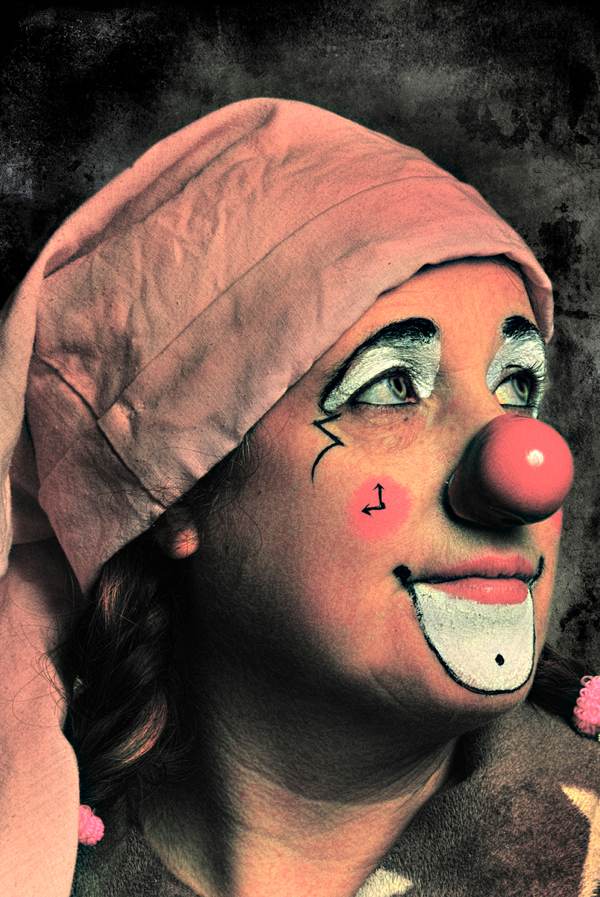
Snoozy – Clowning for four years, married to Mr Mudge.
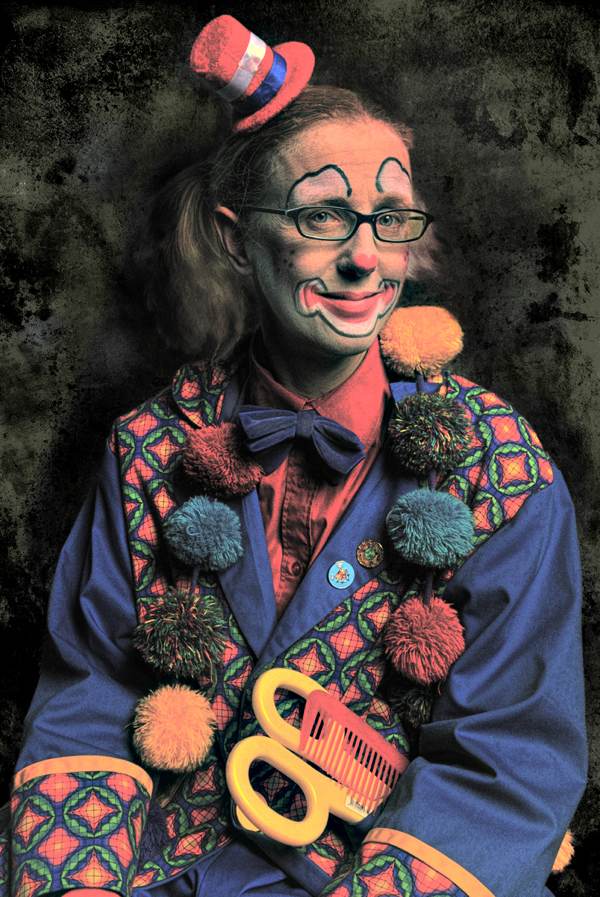
Crazy Bananas – Clowning for seven years, with her son (Crazy “Dan”anas) and daughter (Squeak).
Photographs copyright © John Claridge
You might like to take a look at
John Claridge’s Clowns (Act One)
and read my account
At the 65th Annual Grimaldi Service
or read these other Grimaldi stories
The Haggerston Nobody Knows
With the Geffrye Museum planning to demolish the Marquis of Lansdowne – one of the few remaining fragments of nineteenth century Haggerston – William Palin recalls the lost wonders of this once coherent and distinctive neighbourhood.
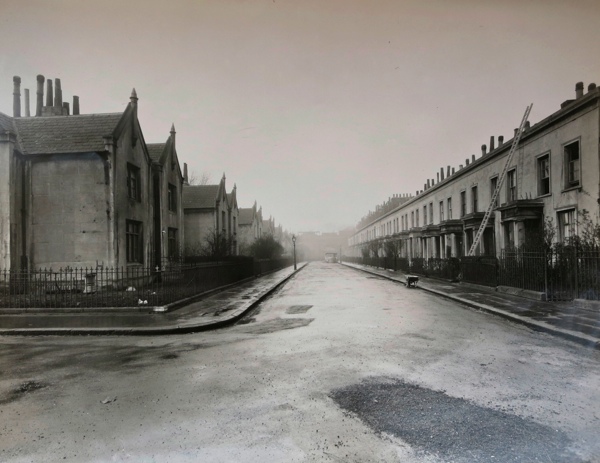
Tudor Gothic Villas in Nichols Sq, 1945
Haggerston, in the Borough of Hackney, remains one of those ‘lost’ districts of London’s inner suburbs. Even the boundaries of this elusive locale have fluctuated, yet although the current electoral ward extends deep into Shoreditch, I would draw the borders of Haggerston at Hackney Rd to the south, Queensbridge Rd to the east, Kingsland Rd to the west and Regent’s Canal to the north.
Just a few important public buildings remain in Haggerston, including the old Haggerston Library – which was left to rot in the seventies before being facaded in the nineties – and the magnificent Haggerston Baths on Whiston St with its gilded Golden Hind weather vane. Poignant indicators of the glories that once were here.
Although Haggerston suffered some bomb damage – St Mary’s Church by John Nash was completely destroyed in 1941 – it was the post-war planners who erased most of the superior nineteenth century terraces, with streets of sound houses succumbing to the bulldozers as late as 1978. While the estates that replaced them may have provided superior accommodation and new amenities, they were brutal and uncompromising in their disregard for the intimacy, cohesion, humanity and community spirit of the old streets – attributes embraced in other similar London neighbourhoods wherever the terraces were retained.
As London’s population grew rapidly in the nineteenth century, Haggerston became a densely populated industrial suburb. In many eastern districts, land ownership tended to be fragmented, resulting in a series of relatively small-scale building speculations that eventually came together to form a coherent if quirky network of streets with pubs, shops and small industry, all adding to the diverse character of the streetscape. Although individual speculators – whether a few houses or a whole street – imposed a uniformity of design, there was surprising and delightful variation between streets with even modest houses exhibiting decorative flourishes in their brickwork, fanlights, shutters and front doors. Where streets met, the junctions were resolved with an effortless dexterity which was one of the striking characteristics of the London speculative builder and, on the rare occasion a pub was absent, a corner house was built with a side entrance.
In common with most of south Hackney and Shoreditch, the dominant industries of the area were the furniture and finishing trades. An insurance map of 1930 shows timber yards, French polishers, enamellers, cabinet factories, mirror frame factories, wood carvers and a plethora of other related trades. Interestingly, the legacy of these industries is still evident today in the Hackney Rd, where Maurice Franklin the ninety-three year old wood turner works at The Spindle Shop and D.J.Simons maintain their thriving business supplying mouldings for picture framing after more than a century, as well as in the handful of second hand shops trading in the furniture once made locally.
Unquestionably, the centrepiece of Haggerston’s nineteenth century development was Nichols Sq, situated east of the Geffrye Museum beyond the railway viaduct. Built in 1841 and featuring two outward facing rows of picturesque Tudor gothic villas at its centre, Nichols Sq was further enhanced in 1867-9 by a splendid church and vicarage – St Chad’s – by the architect James Brooks. Surviving in good condition until blighted by a Compulsory Purchase Order, the square was swept away in 1963 for the Fellows Court Estate. Geoffrey Fletcher, author of ‘The London Nobody Knows,’ lamented the impending loss in 1962 by illustrating the houses in the Daily Telegraph, and describing “the delightful Gothic villas … in excellent condition [which] if they were in Chelsea would fetch anything from £10,000 to £15,000.” Savouring the architectural detail, he comments “Typical of the finesse of the period is that, while the terrace railings have a Classic flavour, the similar ones of the cottages have a Tudor outline. But after next year none of this will matter any more.”
The London County Council planning files record no evidence of any robust defence of Nichols Sq. The principal concern – ironic in the context of the current plans to demolish the Marquis of Lansdowne pub – was the effect of the new tower blocks upon the setting of the Geffrye Museum. Nichols Sq had only one entrance, which led from Hackney Rd at the south east corner, and this was guarded by a Tudor lodge. The secluded location had helped it retain an isolated respectability until the very end, despite the incursion of the railway viaduct across its western extremity just a few years after completion.
To the south of Fellows Court Estate is Cremer St, the only direct link between Hackney Rd and Kingsland Rd, which was once graced by a series of modest but elegant semi-detached villas (a building type that became a defining characteristic of Hackney). These villas are captured in a beautiful series of LCC photographs of 1946, which also show a double-fronted detached house with a wide fanlight, where an old man perches on the high front steps, lighting a pipe. In Cremer St, The Flying Scud pub, with its distinctive blue Truman’s livery survived until only a few years ago, while running south from there – now reached via a rubbish-strewn alley – is Long St, whose distinctive yellow brick houses are also illustrated in the LLC old photographs. Of these, only a few paving stones survive.
To the north of the Fellows Court Estate is Dunloe Street, once lined by neat terraces, now bleak save for St Chad’s Church – the last fragment of Nichols Sq. Dunloe St linked into a network of small streets, including Appleby St and Ormsby St, where well-maintained and well-loved terraces endured until 1978 when they were controversially emptied of their occupants and demolished. A handful of houses on the west end of Pearson St are now the only reminders we have of this once vibrant and homogenous neighbourhood.
In 1966, architectural critic Ian Nairn spoke eloquently of the lost opportunities of the rebuilding of the East End, in words that perfectly describe the fate of old Haggerston – “All the raucous, homely places go and are replaced by well-designed estates which would fit a New Town but are hopelessly out of place here. This is a hive of individualists, and the last place to be subjected to this kind of large-scale planning. Fragments survive, and the East Enders are irrepressible …but they could have had so much more, so easily.”
The tragedy is that fifty years on from the loss of Nichols Sq the destruction still continues. The only remaining building from the eighteen thirties on Cremer St is the Marquis of Lansdowne pub. It is owned by the Geffrye Museum, an institution that exists to foster an understanding of the history of domestic design, furniture and the culture of ‘the home.’ Astonishingly, the Geffrye wants to demolish it for a new extension. Perhaps the trustees need a walking tour and a history lesson? After all the needless destruction that has been enacted upon its doorstep, if even a museum cannot learn from history what hope is there?
Submit an objection to the demolition of the Marquis of Lansdowne direct to the Borough of Hackney by clicking here and entering the application number 2013/0053. The more objections the council receives the more likely it will refuse this application.
Alternatively, you can send your objection as an email to planning@hackney.gov.uk quoting application number 2013/0053 or send a written objection to Planning Duty Desk, Hackney Service Centre, 1 Hillman Street, E8 1DY.
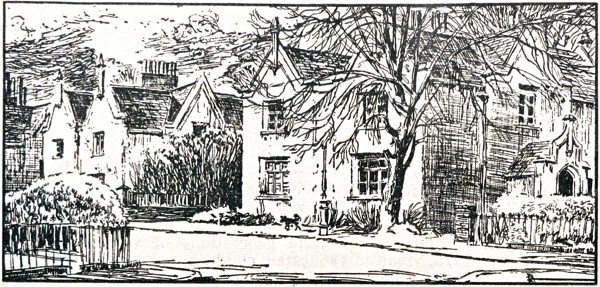
Nichols Sq by Geoffrey Fletcher, 1963
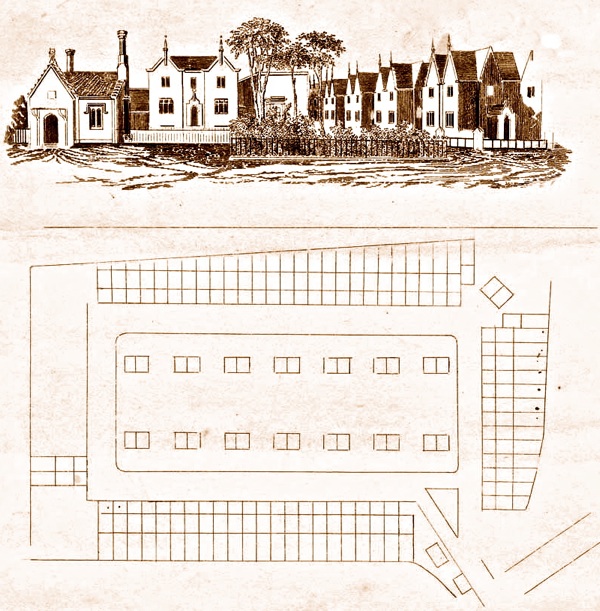
Plan and perspective of Nichols Sq, 1845 – not really a square at all but highly picturesque. (Copyright Hackney Archives Department)
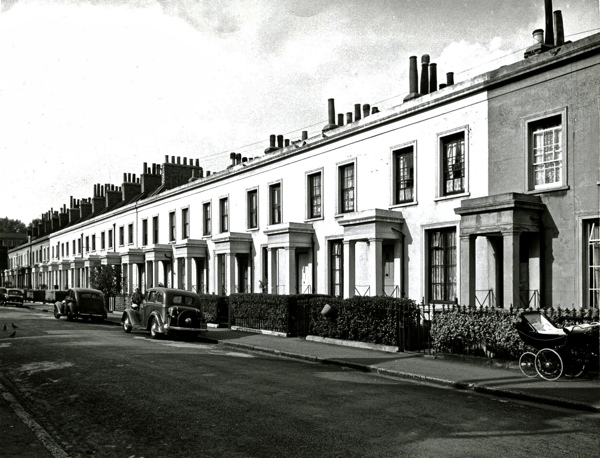
North side of Nichols Sq, 1960.
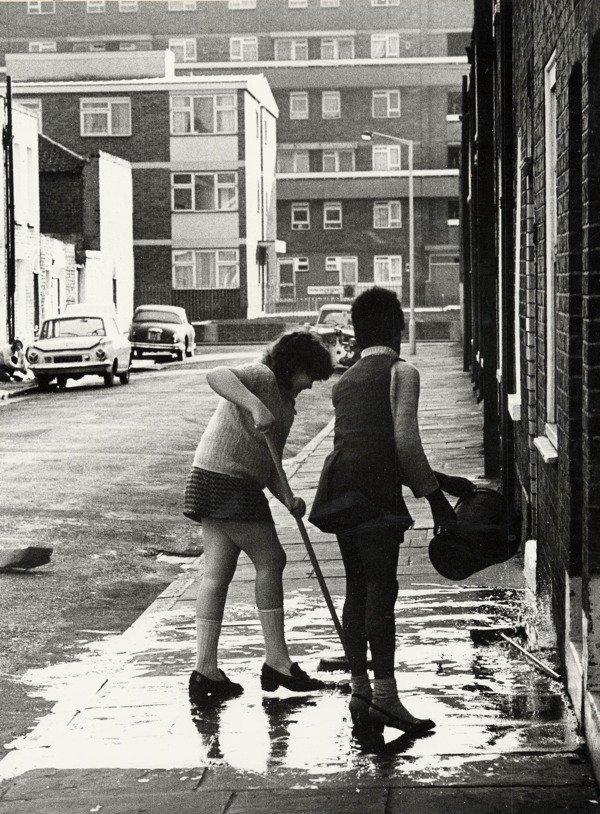
Washing the doorstep in Shap St with the Fellows Court Estate beyond, 1974. (Copyright Hackney Archives Department)
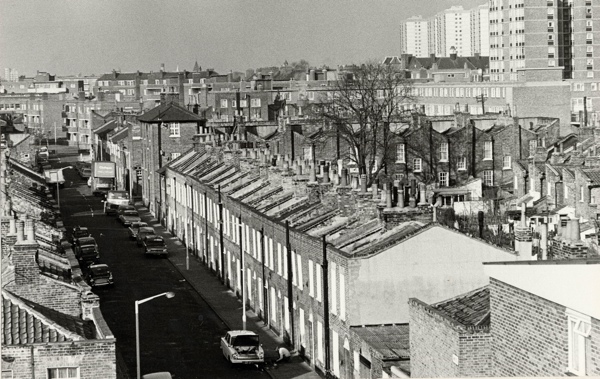
A rich and coherent cityscape – Shap St, looking north, 1974. (Copyright Hackney Archives Department)
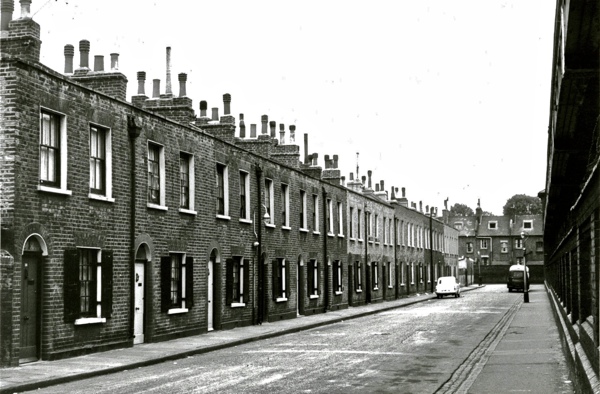
Elegant dark-painted sashes and immaculately maintained shutters in Ormsby St, 1965. (Copyright Hackney Archives Department)
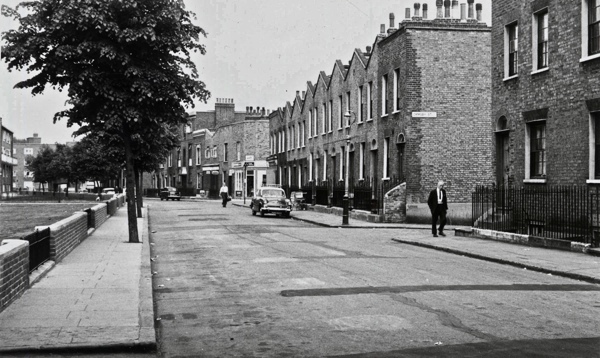
Hows St, c.1960. (Copyright Hackney Archives Department)
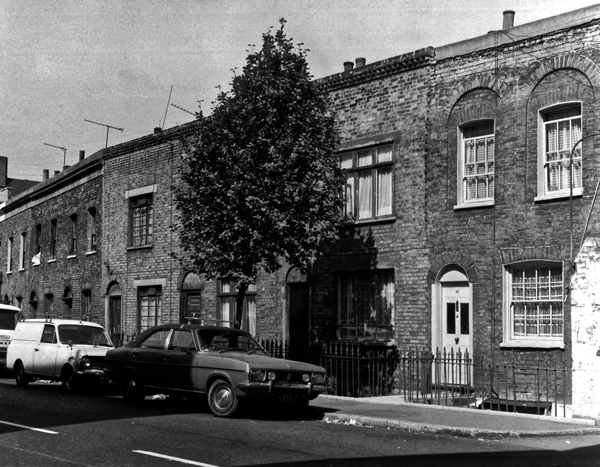
Whiston St in the hot summer of 1976, just before demolition. (Copyright Hackney Archives Department)
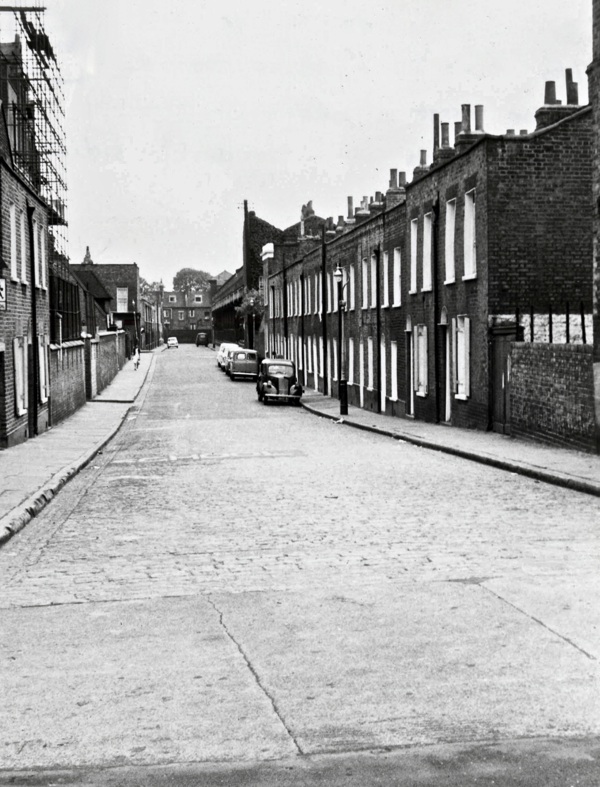
Intimate streetscape – Ormsby St, 1965. (Copyright Hackney Archives Department)
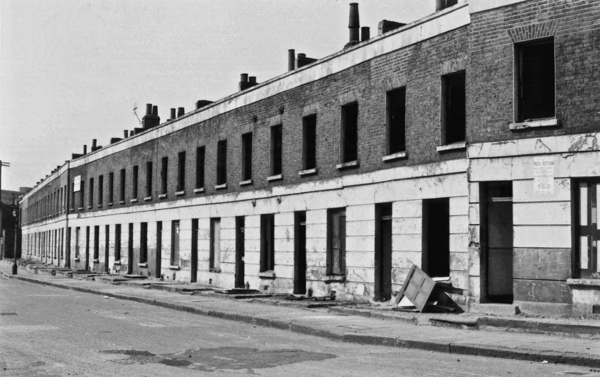
Weymouth Terrace shortly before demolition, 1964. Note the stuccoed ground floor facade. (Copyright Hackney Archives Department)
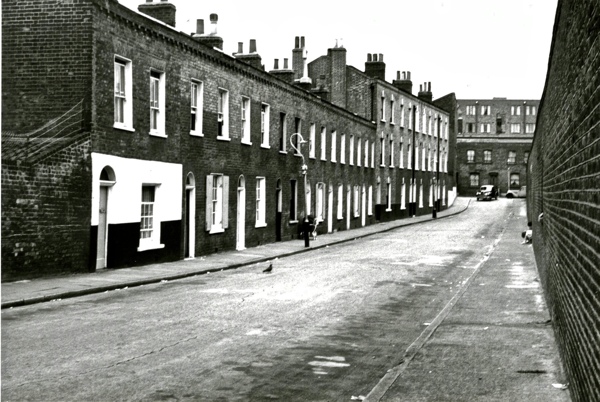
Geffrye St, 1960s (Copyright Hackney Archives Department)
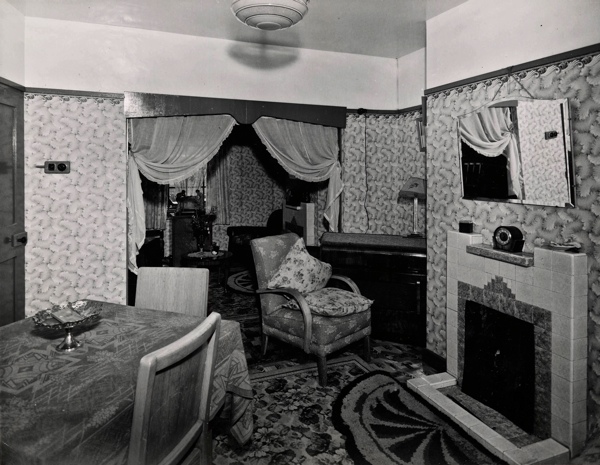
“All the homely places have gone”– Sitting room at 50 Shap St c.1959. (Copyright Hackney Archives Department)
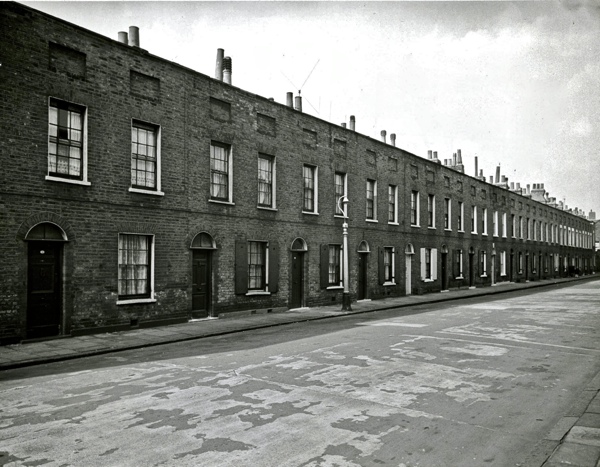
Fellows Rd, 1959. Neat terraces with blank panels at parapet level. (Copyright Hackney Archives Department)
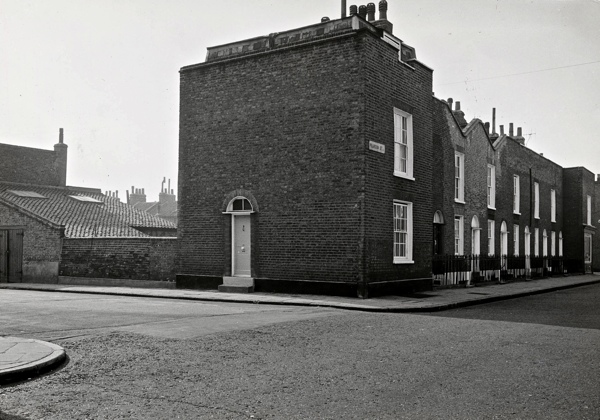
A perfect corner, courtesy of the London speculative builder. Pearson St and Fellows St, 1951. (Copyright Hackney Archives Department)
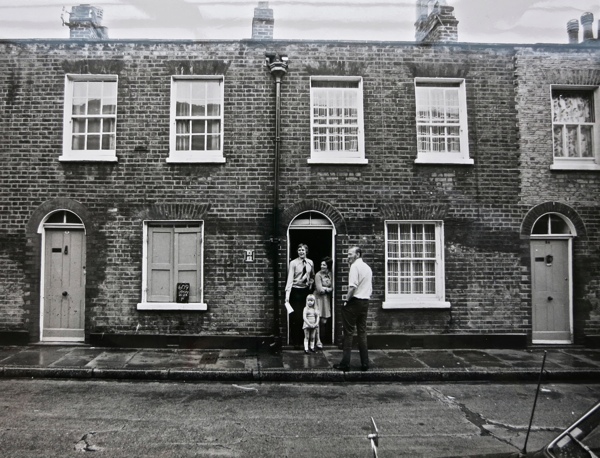
Ormsby St before demolition, 1978 – note the photographer’s blackboard on the window ledge. (City of London, London Metropolitan Archives)
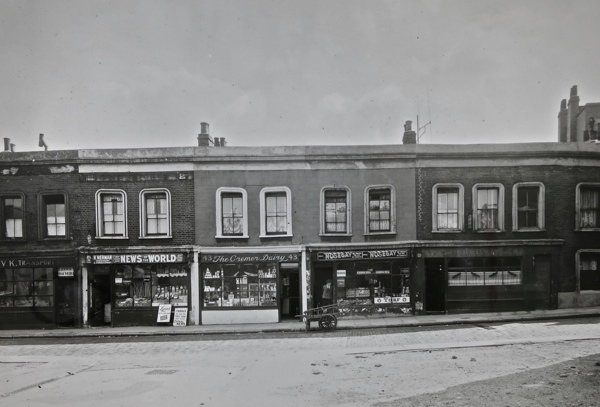
Cremer St, 1946. (City of London, London Metropolitan Archives)
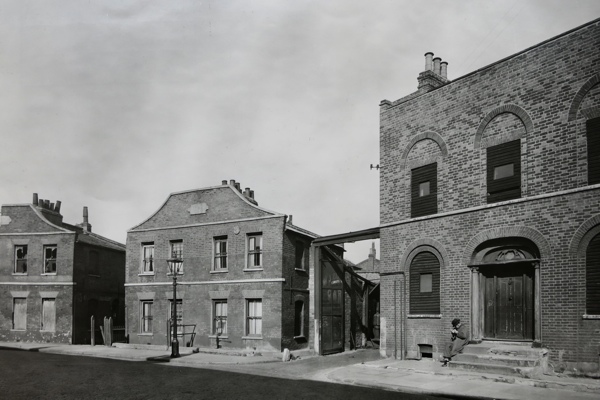
Cremer St, 1946. (City of London, London Metropolitan Archives)
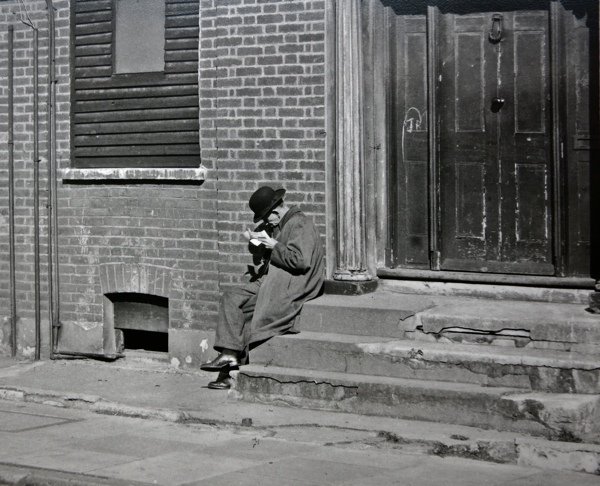
Detail – Man lights a pipe in Cremer St, 1946. (City of London, London Metropolitan Archives)
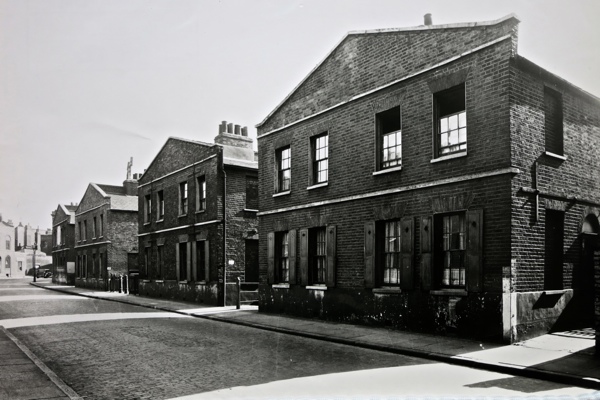
Cremer St, 1946. (City of London, London Metropolitan Archives)
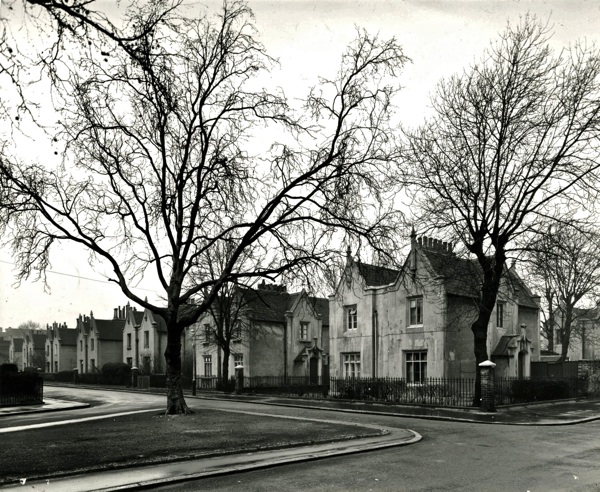
Tudor Gothic villas in Nichols Sq, 1950. (City of London, London Metropolitan Archives)
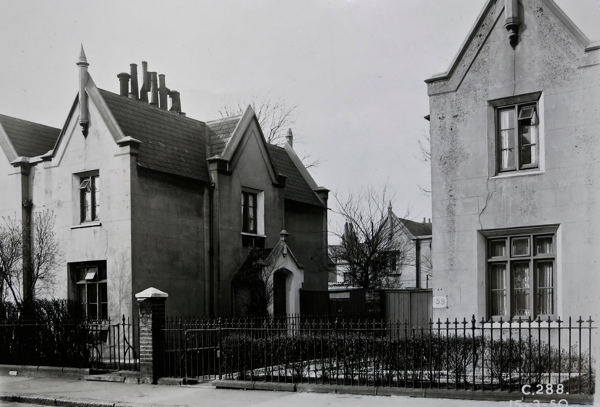
Tudor Gothic villas in Nichols Sq with fleur de lis railings, 1950. (City of London, London Metropolitan Archives)
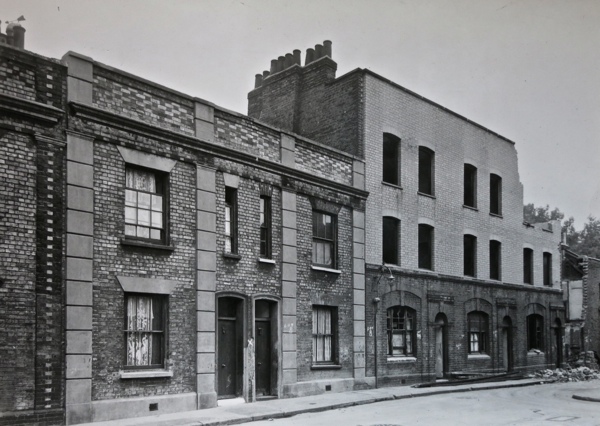
Iain Nairn described the East End as “a hive of individualists” – this applied to the builders too, as shown in the delightfully quirky design of these houses in Long St, photographed in 1951. (City of London, London Metropolitan Archives)
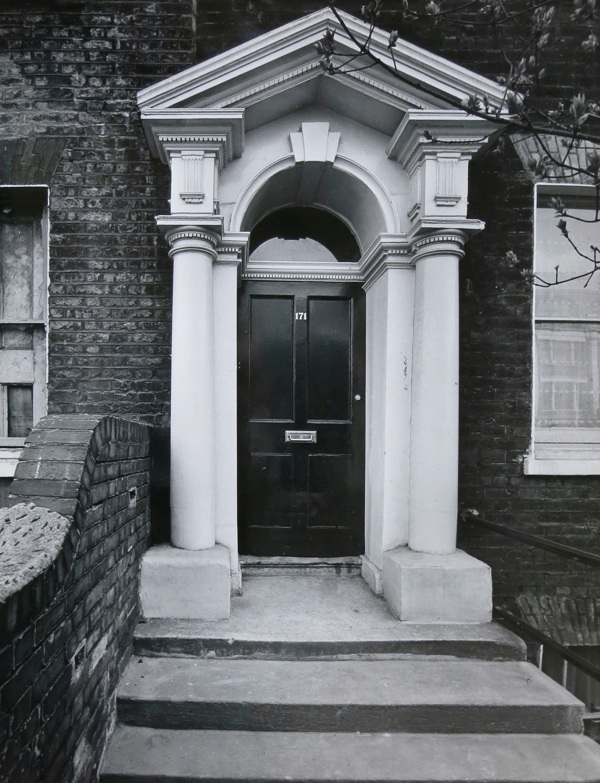
Fine eighteenth century doorcase at 171 Kingsland Road. The house and its neighbours came down in the late sixties. (City of London, London Metropolitan Archives)
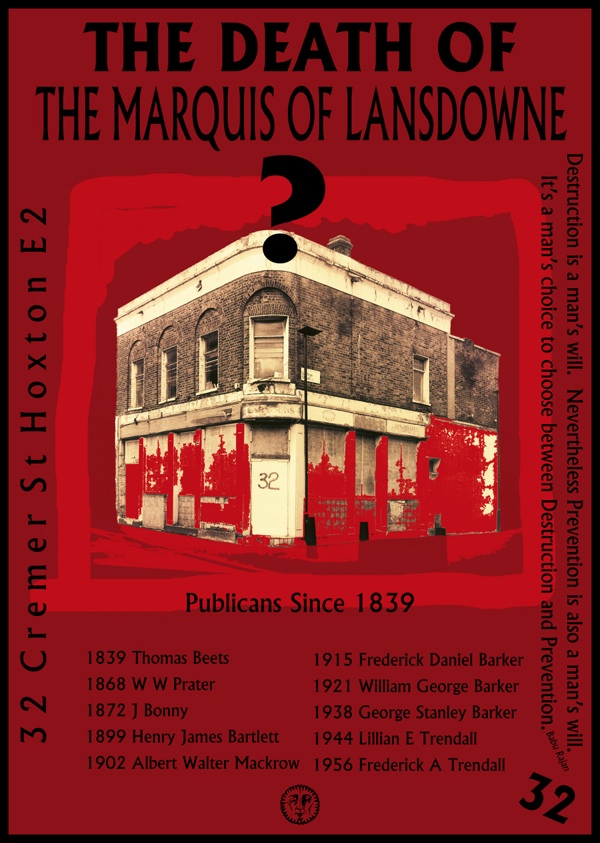
Montage by John Claridge
Sign the Petition to save The Marquis of Lansdowne here
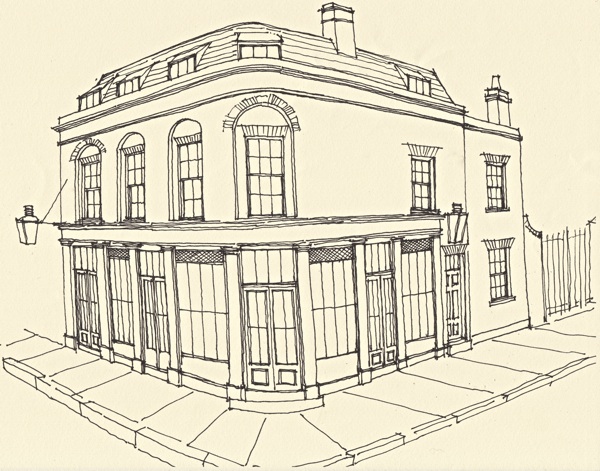
Sketch by Tim Whittaker of The Spitalfields Trust illustrating his proposal to renovate the Marquis of Lansdowne.
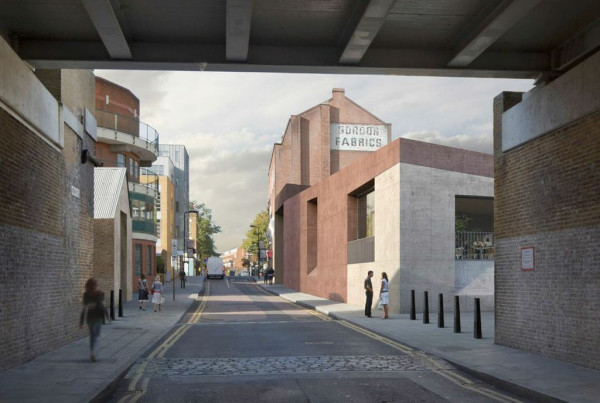
The concrete box on the right is the proposed replacement for the Marquis of Lansdowne.
You may also like to read about
Remembering Robert Poole

The novelist, Robert Poole, wrote of himself – “Born Stepney 1923, about fifty yards from Brick Lane. Education practically nil. Occupations: 1, Office boy. 2, Telegram boy. 3, Office boy. 4, Office boy. 5, Light factory hand. 6, Tomato grower (everyone was poisoned!). 7, War factory making gun brushes. 8, Volunteered for the navy, became wireless operator – anti-U-boat detection, later PYU landings in Burma. After demob became – 9, Garage store assistant. 10, Estate agent – hopeless! 11, Fractured spine in car crash, wrote short stories. 12, Joined the merchant navy as a steward. Jumped ship in New Zealand. Changed name to dodge police. Wrote and broadcast for NZ radio and became radio actor. Also an import agent and sub-editor on a daily newspaper. Police caught up. Clink for four weeks, then deportation. Back in London failed to get into the BBC so sold clothes in Oxford St. Then in 1958 went to Margate and ran the bingo stall in Dreamland. Fabulous! Showed short stories to Russell Braddon, who liked them. These stories developed into LONDON E1.” (Biography from the jacket of the first edition of LONDON E1, 1961.)
A couple of weeks ago, Robert Poole’s nephew, John Charlton, got an unexpected phone call to say that LONDON E1 was being republished for the first time since 1961. It triggered a lot of memories for John, both of his uncle Robert and of the East End of his childhood, and I was lucky enough to accompany him when he returned recently to take a look around the old territory upon the occasion of the republication of LONDON E1.
For John, revisiting his youthful past was also to recall his uncle’s novel, because the two are inextricable. Out of the eight children that survived infancy in a family of eleven siblings, John told me his mother Emmy Poole was closest to her brother Robert. It was an intimacy that was to last their whole lives and ultimately result in Robert portraying Emmy as “Janey” in LONDON E1.
“My grandfather George Poole had a stall under the railway bridge in Brick Lane selling fruit & veg. I was only eight when he died, but I remember that he used to boil up sheeps’ heads and sit there by the fire, peeling off the meat in slices with his pocket knife and slipping it into his mouth. He wore a flat cap, he loved his pint of beer, he drank in the Queens’ Head in Chicksand St and he always used to give me a couple of bob.
There was three years difference between my mother and Bobby (as we called him), and they were always together and they often used to go together to the West End. He gave a copy of the book to each one of his sisters but they all lost them except my mother, she would never part with it. I remember, when he died she was very upset. Bobby, he was very talented man, he spoke a few languages and he was a natural musician self-taught. He used to arrange music for Russ Conway, Winifred Atwell and Eartha Kitt, and he often stayed with her in Paddington. Bobby used to come down to the East End on a Sunday and play the piano at the Queens’ Head and he’d bring Eartha Kitt or some big star, and they were over the moon.
I knew him as a child, he was very quiet and well spoken, not a cockney – he changed his accent. I got on well with him, he lived with me and my mum for a while. I remember listening to him doing book reviews on the BBC. He wanted to get away from the East End. He won a scholarship to go to college but my grandfather wouldn’t let him go, he had to earn money instead to keep the family.
I remember he worked in Dunns outfitters on the corner of Goulston St and then he worked in Dunns in the West End. He worked in pubs behind the bar, anything to get a job really. And he went to work in Dreamland for six months as a bingo caller, so he could learn about fairgrounds. It was for another book that he was writing and it was almost finished when he died, “Carnival for Shadows.” I was told his publisher Secker & Warburg were going to get a ghost writer to finish it, but we never heard anything more and no-one knows what happened to the manuscript.”
Two years after the publication of LONDON E1, Robert Poole died at the age of forty of an accidental overdose of the painkillers he had being taking for the spinal injury acquired in a car crash a few years earlier. By then he was drinking heavily and the promise of his first novel was destined never to be fulfilled. He struggled and it took its toll. Yet it had been a miraculous journey he had travelled, defying extraordinary odds, as one denied further education yet blessed with exceptional abilities. The stature of Robert Poole’s writing ensures that, half a century since it was first published, LONDON E1 stands as a vivid and authentic social portrait of Spitalfields at the end of the war, when Jewish people were moving out and the first Asians were moving in.
John Charlton left forty years ago. “The East End is not as I knew it, but I don’t miss it because I got a better life by moving away,” he assured me, speaking frankly,”Leaving was the best thing I ever did.” Yet even after he left, John could not keep away, returning every day to earn his living from a stall in Petticoat Lane selling menswear until his retirement three years ago. He treasures his copy of LONDON E1, inscribed by Robert Poole in 1961 to Em, his mother, Bill, his father and to himself, Johnnie. He carried it swathed in a plastic bag for protection as we walked the streets together in the freezing drizzle, clutching it to himself as a precious object of infinite value – because the book is a reliquary that contains an entire world.

Robert Poole ‘s 1961 author photograph on the jacket of LONDON E1.

Emmy and Robert Poole as children in the nineteen twenties.

Robert Poole’s inscription in the first edition of LONDON E1 to his sister Emmy, her husband Bill Charlton and his nephew John.

The Evening Standard’s review of LONDON E1, February 1961

John Charlton returns to 14 Deal St where he lived in 1961 when his uncle’s novel was published.

Looking west from Chicksand House, where John grew up, towards Brick Lane in 1942.

John’s clothing ration book as a child.

Eleven year old John stands wearing a suit and tie, centre right at the back of the crowd celebrating the coronation in Deal St, 1953.

John’s invitation to the Deal St Coronation party.

A crowd gathers for a beano outside the Queens’ Head in Chicksand St in the early fifties. John’s grandfather George stands in the flat cap holding a bottle of beer on the right of this picture with John’s father Bill on the left of him, while John stands directly in front of the man in the straw hat.

John stands with his hands in his pockets to observe the high-jinks.

Gipsy George from Bermondsey plays the accordion for the regulars of the Queens’ Head before they set out on a beano.
LONDON E1 by Robert Poole can be ordered direct from the publisher Five Leaves and copies are on sale in bookshops including Brick Lane Bookshop, Broadway Books, Newham Bookshop, Stoke Newington Bookshop and London Review Bookshop.












