Soerditch by Dant (Chapter Six)
Time for this week’s dose of SOERDITCH, Diary of a Neighbourhood, Adam Dant’s sly satire upon the social ironies of the “New” East End – each cartoon a beautifully rendered view of the neighbourhood, captioned with a clueless thing overheard on the street.
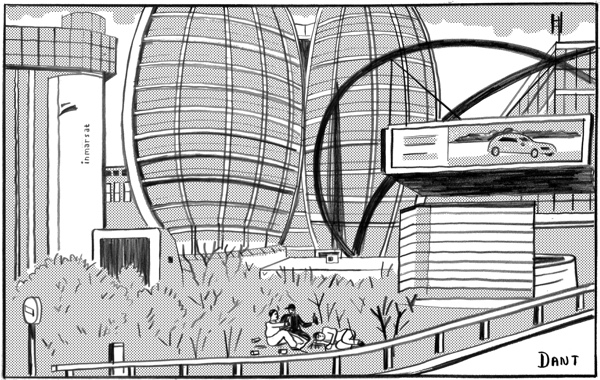
“I’m no expert, but listen … if I was architecting a building, I would not model it on a pair of buttocks!”

“They served the canapés from dustbin lids and the cocktails were in old baked bean tins … so cool!”

“My girlfriend’s started a business making laptop cases from coffee bean sacks, our flat’s a total hessian sh*t hole.”

“Got a spare £7.24 love?” … “Not funny! You asked that yesterday.” … “No, yesterday it was £6.30, it’s gone up.”

“Hey, this is where that ‘right-on’ printers was where you had your ‘class war rant’ pamphlets done.” … “Yeah, keep that one quiet at KMPG please.”

“Do you ever imagine other cities existing beneath this one?” … “No, they’re usually on top!”
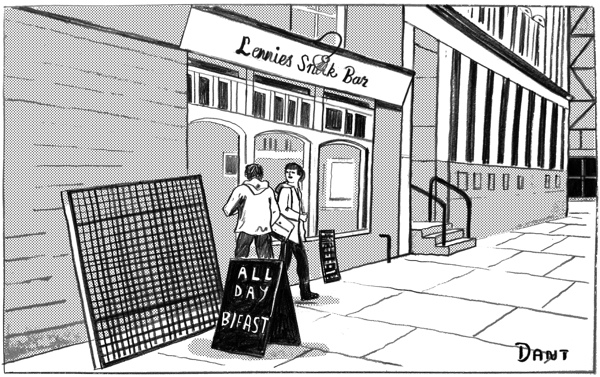
“They’ve got no soya milk, I’m just popping back home to fetch mine – want me to pick up your fags too?”

“Delivery of lambs’ tongues and pigs’ **seh0les for you…”
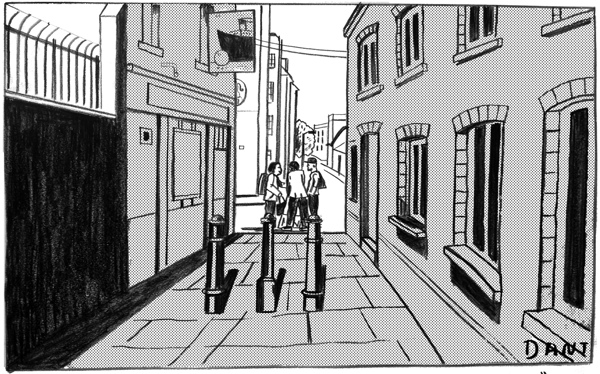
“I dare you to chuck this toy money into the drug dealer’s car instead – go on, it’d be soo funny…!”

“Glad they moved the soup kitchen … I was getting cleaned out by all the tramps at the ‘when I grow rich’ church!”

“This was an old railwayman’s chapel but apparently some architects are turning it into a neo-Victorian Cuban bar …”

“Wot’s iz name?” … “Crack-hound?”
Soerditch is the old name for Shoreditch, quoted by the historian John Stow in his Survey of London 1598, as “so called more than four hundred yeares.” It means sewer ditch, in reference to the spring beside Shoreditch Church, once the source of the lost River Walbrook which flowed from there towards the City of London.
Drawing from a pair of unlikely inspirations, namely Giles‘ cartoons for the Daily Express and Hiroshige‘s ‘One Hundred Famous Views of Edo,’ Adam Dant pulls off an astonishing sleight of hand – simultaneously portraying the urban landscape of Shoreditch with spare lines and flat tones that evoke the woodcuts of Hiroshige, while also satirising the manners and mores of the people through witty social observations in the manner of Giles.
The exhibition runs at Eleven Spitalfields Gallery until 26th April and all one hundred and twenty-five cartoons are published in an album with an introduction by Jarvis Cocker, produced in the style of Giles’ celebrated annuals and available to buy online from Spitalfields Life Shop.
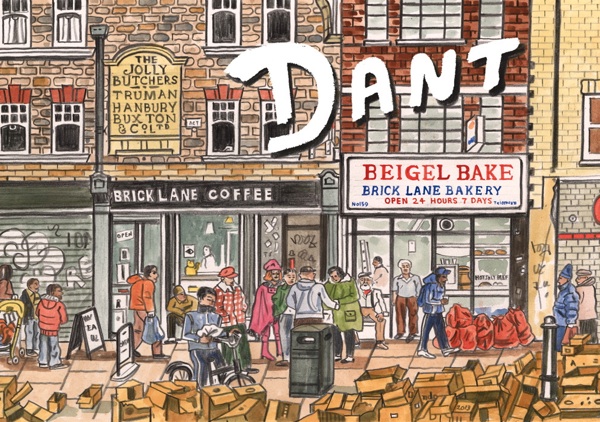
Click here to buy your copy of SOERDITCH by DANT – Diary of a Neighbourhood (125 Views of Shoreditch) – while stocks last!
Cartoons copyright © Adam Dant
Adam Dant is represented by Hales Gallery
You may also like to see these earlier selection of cartoons by Dant
Soerditch by Dant (Chapter One)
Soerditch by Dant (Chapter Two)
Soerditch by Dant (Chapter Three)
Barn The Spoon’s London Spoons
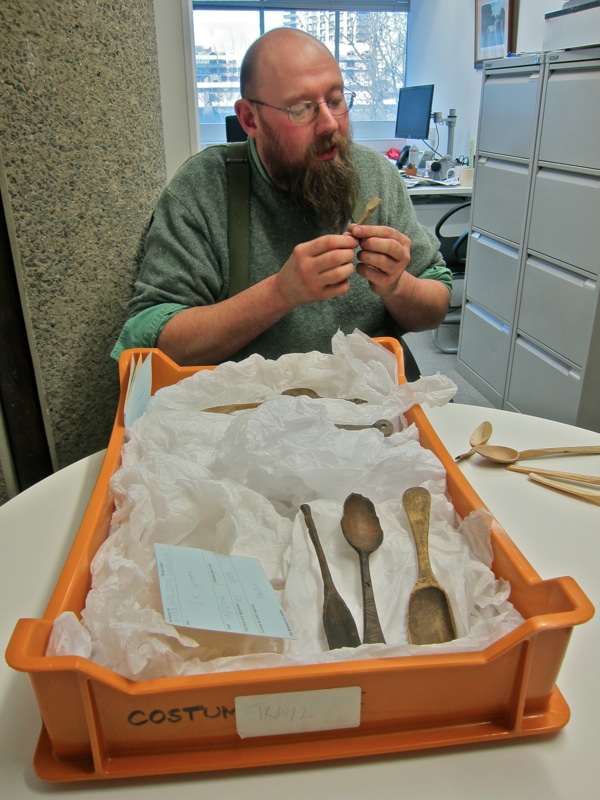
Barn the Spoon examines a two-thousand-year-old spoon
When I first met Barn the Spoon, the professional spoon carver, he told me he wanted to make London spoons – but he did not know what they would be like. So I offered to help him find out and, to this end, we paid a visit upon Roy Stephenson, Head of Archaeological Collections at the Museum of London, recently to take a look at some old spoons in his collection.
Barn’s eyes sparkled with excitement from the moment they fell upon the ancient spoons lain upon tissue, though Roy was a little apologetic at the dearth of such artefacts in his collection. We learnt that there is a mystery surrounding the lack of Medieval spoons discovered in London compared with other European capitals. “We might not have got lucky yet,” Roy admitted, “or they might have been using horn spoons that have decomposed.”
Fortunately, sufficient spoons have survived to fascinate Barn the Spoon and, with Roy’s permission, he began to lift each one in turn and scrutinise it lovingly. As I watched him, I thought of what Barn had told me once – that he could look at any wooden spoon and know how it was made. In his mind, Barn was travelling across time and making contact with the spoon carvers of Medieval London. “If I met the maker of one of these, I could immediately have a conversation with them,” he confided to me, “I’d have more in common with them than I do with most people today.”
Barn was curious that they all so tiny and I wondered if this was because people had smaller hands centuries ago, but Roy was able to resolve this dilemma for us by explaining that the wood had shrunk over the centuries. Two spoons in particular caught Barn’s attention, a modest fig-shaped apple wood Medieval spoon collected from Railway Approach, London Bridge in July 1914, and an alder wood spoon of more formal design with a pattern of incised bands across the shaft. Roy showed us another similar alder wood spoon found in Tabard St in the City of London 1912, housed in a display devoted to the Rose Theatre and artefacts of Shakespeare’s era,.
“The experience of holding them,” Barn revealed to me as we walked back east through the City, “it was soothing, like coming home, because in my mind I live in a world where spoons are made with axes and knives, so those designs were familiar to me – and they came from here.”
Three days later, Barn surprised me when I dropped in to visit him, by tumbling a fistful of spoons in these same designs into my hand with a burst of triumphant laughter. I was filled with awe to see new spoons in these age-old styles that would have been familiar to our distant forebears. All were subtly different, just as every one of Barn’s spoons is unique, but the spirit of the originals was still present. “It’s about trying to wean yourself away from your natural tendencies and towards the tendencies of the people who first made them and get inside their spoon carving mentality,” Barn confessed, turning contemplative as he saw me wondering over the spoons, “I’ve made about twenty to get a good idea of how they were made, specifically the cuts used and their sequence.” In fact, he had manufactured two of the “Shakespearean” spoons but more than twenty-five of the Medieval one – this most humble of artefacts was the spoon that had caught his imagination.
“Making spoons professionally, I’ve always shied away from that design in the past – which is linked to how quick and easy they are to make, but I realised there’s a very beautiful naive aesthetic.” he told me, “it’s like doing a different dance and I like it.” In contrast to the later design, which more closely resembled spoons we used today, these spoons in the Medieval design spoke of those Londoners in an earlier world who long ago huddled by fires to enjoy their bowls of porridge, broth or stew, eaten with the most utilitarian of implements. “It was fascinating to hold those old spoons at the museum and, by trying to copy them, I learnt something new,” Barn assured me fondly, “I loved making those spoons in this design, when I had once turned my back on it.”
“That particular one, I shall be offering it for sale in my shop permanently,” he informed me, continuing his thought, “and I’d love to sit in the Museum of London one day, knocking them out and selling them.” It was a satisfying notion, yet we realised that our quest was not over – we shall be taking these new spoons back to the museum to see how they closely they compare with their venerable antecedents, the spoons of old London.
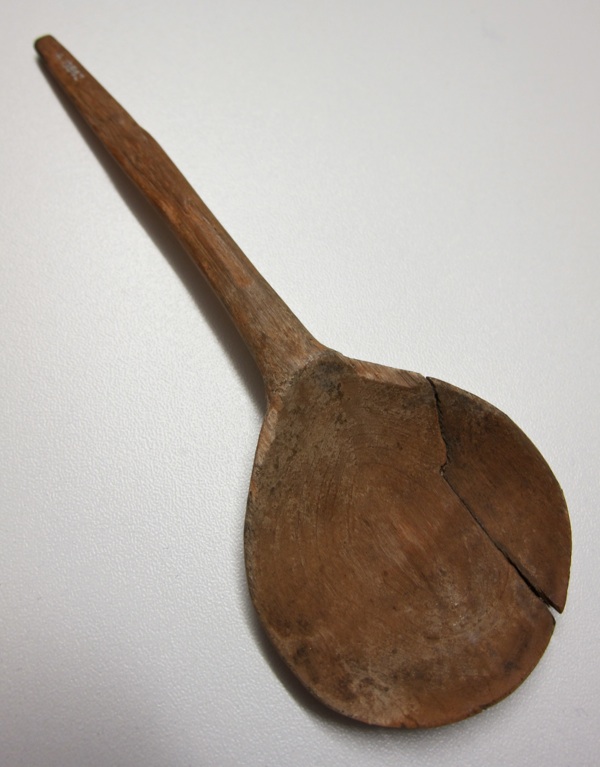
A fig-shaped apple wood Medieval spoon collected from Railway Approach, London Bridge in July 1914
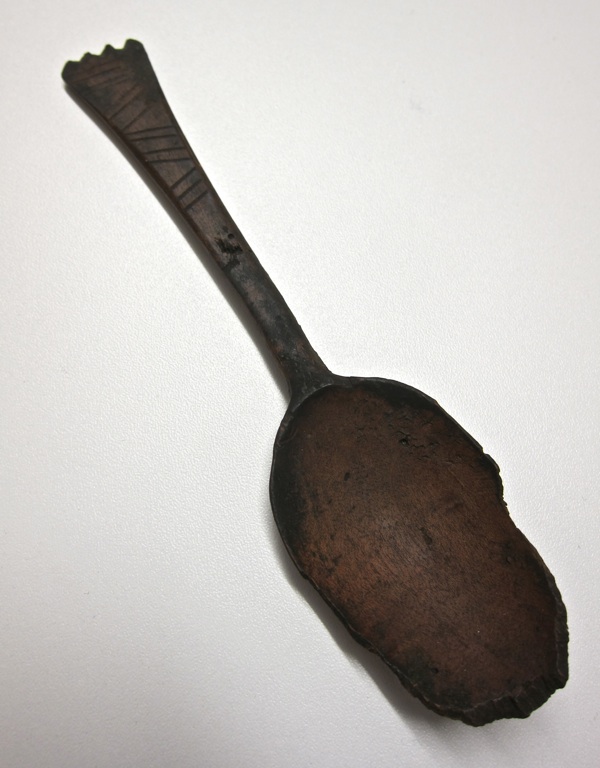
An alder wood spoon with incised band decoration, of a design used in Shakespeare’s London.
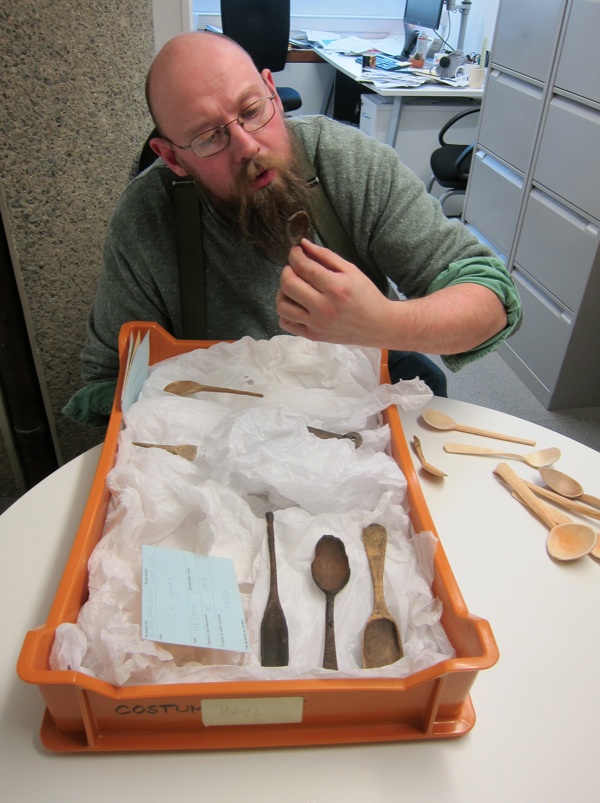
“If I met the maker of one of these, I could immediately have a conversation with them.”
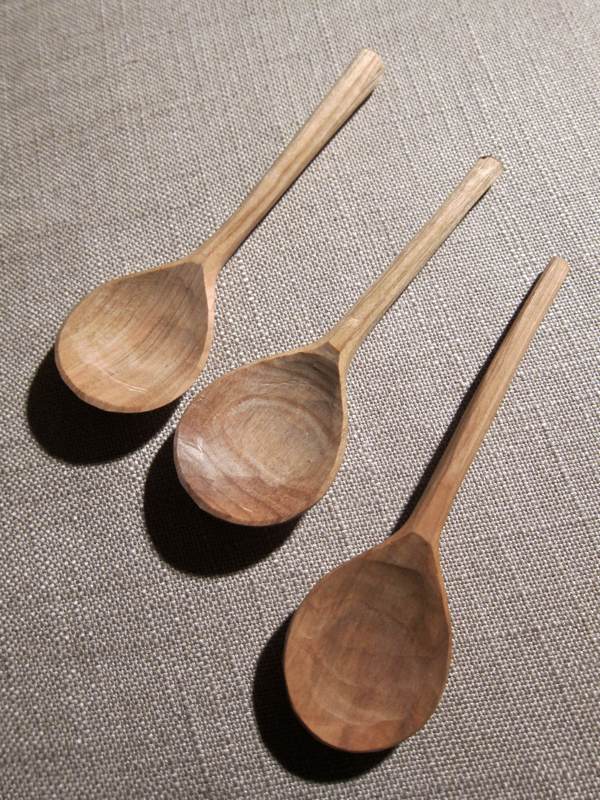
Barn the Spoon’s versions of the Medieval London spoon in cherry.
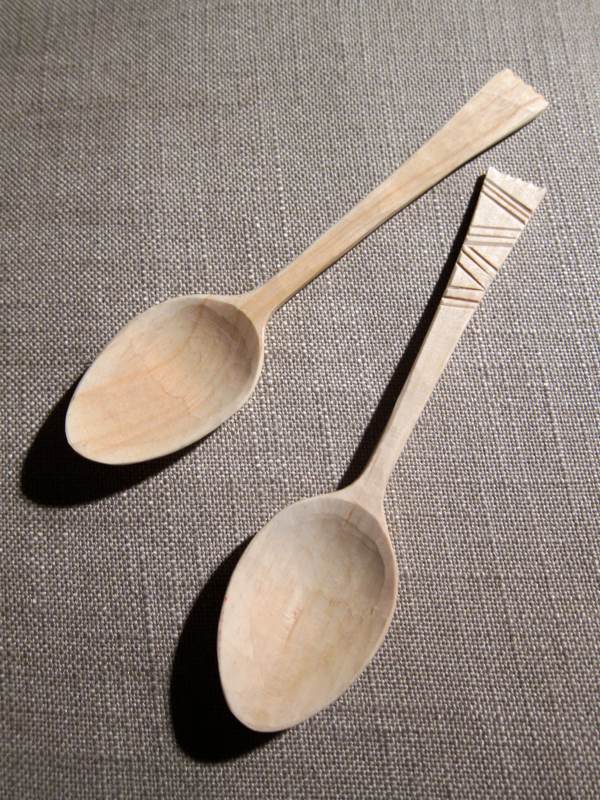
Barn the Spoon’s versions of the Shakespearian spoon in hawthorn.
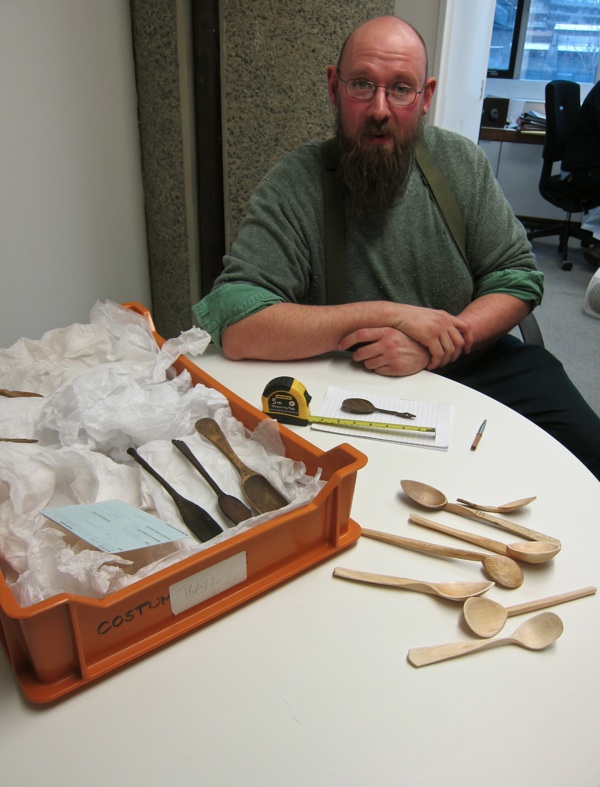
“The experience of holding them – it was soothing, like coming home, because in my mind I live in a world where spoons are made with axes and knives, so those designs were familiar to me – and they came from here.”
London Spoons are available from Barn the Spoon at 260 Hackney Rd, E2 7SJ. Friday – Tuesday, 10am – 5pm.
You may also like to read my original pen portrait
and
Phyllis Bray, Artist
David Buckman author of From Bow To Biennale: Artists of the East London Group recalls the forgotten name of Phyllis Bray. Celebrated for her murals at the People’s Palace in Mile End, Bray was a significant talent and an integral part of the lost history of one of the major artistic movements to come out of the East End in the last century.

Detail of mural ‘The Drama’ by Phyllis Bray at the People’s Palace
Many artists, writers and composers enter a twilight period after death while their work is reassessed. Some recover and others do not, yet one enjoying a positive reassessment at present is the artist Phyllis Bray, with two recent events spotlighting her work.
The first was the refurbishment of the People’s Palace in Mile End, where part of her large mural The Drama has been restored and is now on permanent display. The other is the first exhibition for eighty years of the East London Group, where one of her finest paintings is on display – The Lobster & The Lighthouse, portraying the now-demolished lighthouse at Braunton in Devon.
Phyllis Bray was born in 1911 and, after studying at Queenwood, Eastbourne, attended the Slade School of Fine Art between 1927-31, where she was fortunate to catch the end of Henry Tonks’ distinguished professorship. He had a reputation for acerbic comments upon the work of female students, occasionally reducing them to tears, but Bray was a gifted favourite. She won a string of awards and, at the strawberry tea honouring Tonks on the day of his departure in 1930, she was one of those chosen to wait on him.
Bray gained her fine art diploma in 1931 and that summer married John Cooper, who had been a teacher of evening classes since he left the Slade in 1922. It was his second marriage, after an unsuccessful one to another Slade student, Helen Taylor. By 1931, Cooper had established the East London Group through classes he taught at the Bow & Bromley Evening Institute in Coborn Rd from the mid-twenties onwards. The debut exhibition of work by the East London Art Club at the Whitechapel Art Gallery in December 1928, part of which was shown at what is now the Tate Britain in early 1929, led in November of that year to the first of eight annual East London Group exhibitions at Alex. Reid & Lefevre patronised by wealthy collectors from high society.
The show was an astonishing success and had to be extended for several weeks, described by the Manchester Guardian as “one of the most interesting and significant things in the London art season.” It was there that Cooper and other East London Group stalwarts, including as William Coldstream, Murroe FitzGerald, Archibald Hattemore, Elwin Hawthorne, Harold and Walter Steggles, and Albert Turpin established their careers.
Phyllis Bray began her participation by showing two paintings at the second exhibition in December 1930, among a total of ninety catalogued works, and each year after that her paintings and drawings became important features of these group shows. She was also a valuable additional teacher at Bow, as Cooper struggled to cope with his commitment there of three nights a week while also holding classes in Lambeth and Shoreditch and, eventually, at the Central School of Art too. By the 1937-38 academic season, Cooper was no longer at Bow and Bray took responsibility for overseeing the students herself with the support of another teacher.
But by then her marriage to the volatile Cooper had collapsed. The crisis came in 1936, the year of the last East London Group winter show at Alex. Reid & Lefevre and Bray’s commission to paint murals for the New People’s Palace. It was during this work in Mile End that she formed an emotional attachment to the architect George Coles.
The old People’s Palace had long been a centre of East End cultural life. Its creation was due to the beneficence of painter, property owner and philanthropist John Barber Beaumont who donated money to found a Philosophical Institution in Mile End that would provide educational and recreational facilities for working men. In 1887, Queen Victoria opened the Queen’s Hall as part of her Golden Jubilee celebrations but a fire had destroyed the building in 1931. Construction of a New People’s Palace proceeded in 1936, with the front of the building enhanced by five sculpted reliefs by Eric Gill of Drama, Music, Fellowship, Dancing, Sport and Recreation.
Architect George Coles oversaw the interior and fellow architect Victor Kerr advocated the inclusion of Phyllis Bray’s murals. Coles was a master of the Art Deco style, and his works included the Gaumont State Cinema in Kilburn, the Carlton Cinema in Islington, the Troxy in Stepney and several Odeons. At the Queen’s Hall, it was decided that instead of painting direct onto plaster as she originally proposed, Bray would undertake three panels on canvas, each twelve feet by ten feet, and the subjects would be The Dance, The Drama and The Music.
A contemporary photograph shows Bray, elegantly balanced upon a precarious stepladder, busy painting The Dance. She was always athletic, and later in life famously strode early in the morning to plunge at dawn into the ladies’ pool near her home in Hampstead and turned a cartwheel on the Heath in celebration of her sixtieth birthday.
King George VI and Queen Elizabeth performed the opening ceremony at the New Queen’s Hall on 13th February 1937. Previously, in November of 1936, Queen Mary November had seen Bray at work and been impressed by her painting and, several months after the opening, the Queen returned again, requesting to view the completed murals. Yet, although the New People’s Palace enjoyed some success before the war, by 1953 it was put up for sale and Queen Mary College acquired it.
The fate of the murals was unknown until 2011 when Queen Mary College began restoring the People’s Palace and the mystery was uncovered by Eoin O’Maolalai, Senior Estates Project Manager at Queen Mary, after a researcher at Tate Britain inquired whether the paintings had survived. Although the lower half of the murals had been destroyed when the hall was converted to a lecture theatre, O’Maolalai realised that the top half still existed in a storeroom above the theatre. “I found the wall and ran my fingers over the painted surface. What I felt wasn’t plaster, it was more like fabric. I looked more closely, found a tear in the fabric, peeled off some of the paint and below it I could see the vague outlines of what could be one of the murals.” O’Maolalai told me,“I peeled off some more of the paint and realised that I had found the top half of the murals. It was clear that the bottom half had been removed, possibly in the 1950s when a suspended ceiling was installed in the Small Hall.”
Restoration concentrated on the central panel, The Drama. Paint specialist Catherine Hassall scraped flecks of the covering paint off with scalpel, millimetre by millimetre, to reveal Bray’s work underneath. Hassall also carried out paint analysis during restoration work in the Great Hall of the People’s Palace, to match the Hall’s redecoration to its original colour scheme. Once the overpaint was scraped off, the Bray canvas was carefully removed from the wall, lined and stretched – and a decision was made not to touch up the picture, to avoid losing original paint. The fragment was put on display at the official reopening of the People’s Palace, after a £6.3 million renovation, on 20th March. Alongside it, are displayed photographs of the building and murals from the venue’s thirties heyday.
After her failed marriage to John Cooper, Bray married Eric Phillips, a distinguished civil servant. She died in 1991 after a successful career as an artist, with multiple mixed and solo exhibitions. As well as commercial work, including a string of book illustrations, she used her talents as a muralist in assisting Hans Feibusch, a collaboration lasting over forty years – creating paintings in Chichester Cathedral, Dudley Town Hall in Worcestershire, the Civic Centre in Monmouth and many parish churches. London examples are St Crispin’s in Bermondsey, with a fine ceiling by Bray, and St Alban the Martyr in Holborn.

Phyllis Bray, c. 1936

At work on the People’s Palace murals, 1936

The completed murals – The Dance, The Drama and The Music

The Dance, watercolour study

Elwin Hawthorne, Phyllis Bray, John Cooper and Brynhild Parker at the Lefevre Galleries, c. 1932

Temple of Juno Agrigento, gouache (courtesy of Louise Kosman, Edinburgh)

Selinunte, Sicily, gouache (courtesy of Louise Kosman, Edinburgh)

Landscape, gouache (courtesy of Louise Kosman, Edinburgh)

French Harbour, gouache (courtesy of Louise Kosman, Edinburgh)

Landscape near Brockweir, gouache (courtesy of Louise Kosman, Edinburgh)

The Mill, oil on canvas, 1933

The Lobster & The Lighthouse, oil on canvas

Phyllis Bray sketching in Bow by Hannah Cohen, c. 1932, crayon drawing

Drama, relief by Eric Gill on the front of the People’s Palace, 1936

Music, relief by Eric Gill on the facade of the People’s Palace, 1936
You may also like to read David Buckman’s other features about the East London Group
From Bow to Biennale: Artists of the East London Group by David Buckman can be ordered direct from the publisher Francis Boutle and copies are on sale in bookshops including Brick Lane Bookshop, Broadway Books, Newham Bookshop, Stoke Newington Bookshop and London Review Bookshop.
The exhibition From Bow to Biennale – Artists of the East London Group including Phyllis Bray’s painting ‘The Lobster & The Lighthouses’ runs at Abbott & Holder, Museum St, Bloomsbury,WC1, until Saturday 6th April.
More East End Cats
Spitalfields Life Contributing Photographer Chris Kelly is making a survey of the esteemed felines of the East End, and today it is my delight to publish more of her portraits of famous cockney cats and their human admirers – from Bethnal Green, Spitalfields and Moorfields.
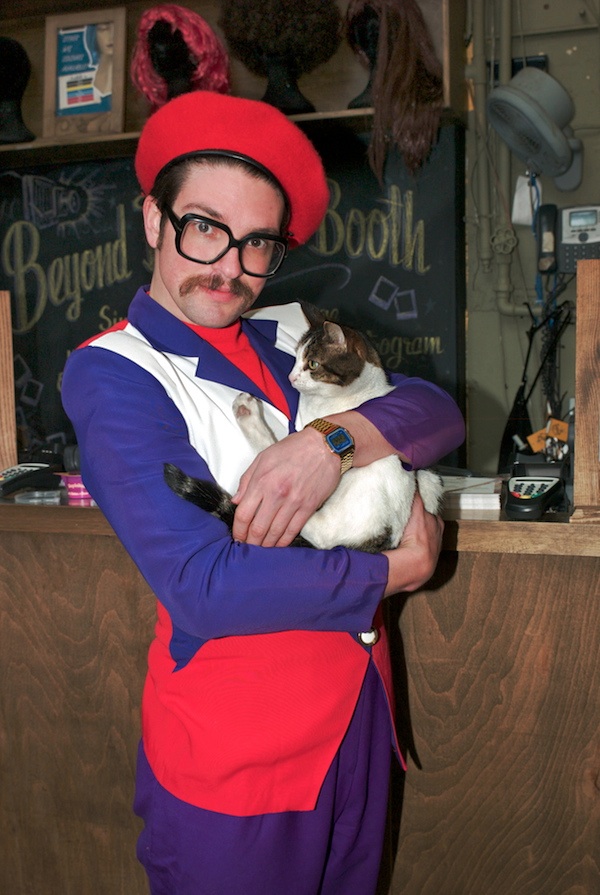
Tiny & Kristofj von Strass
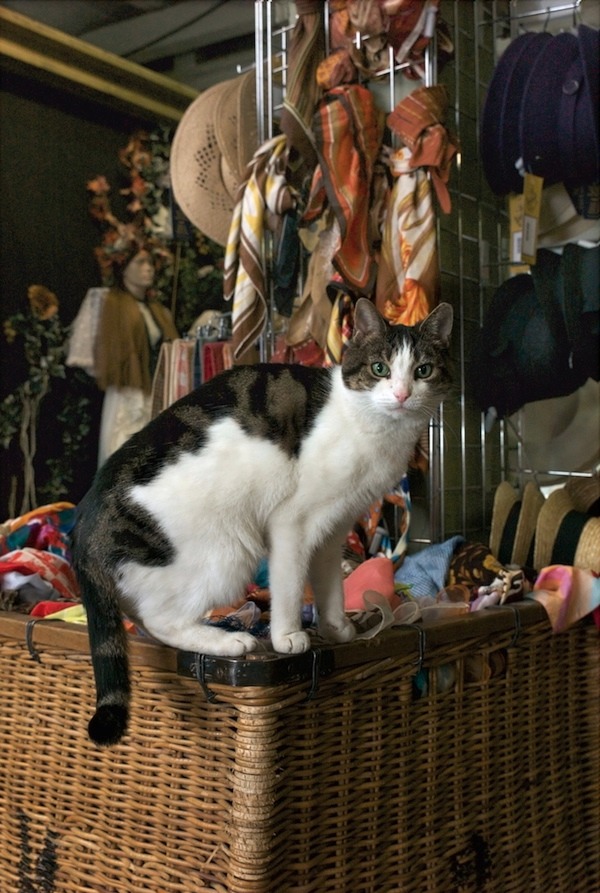
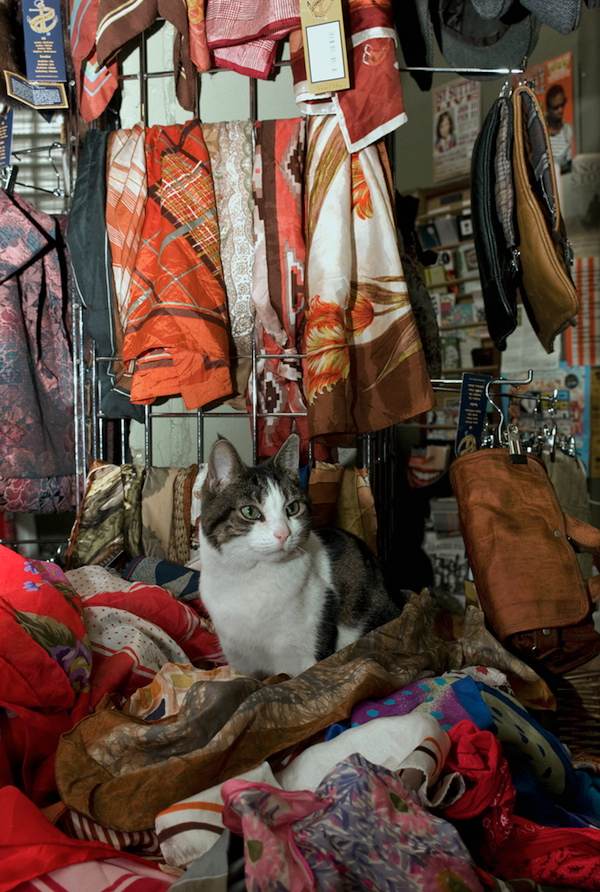
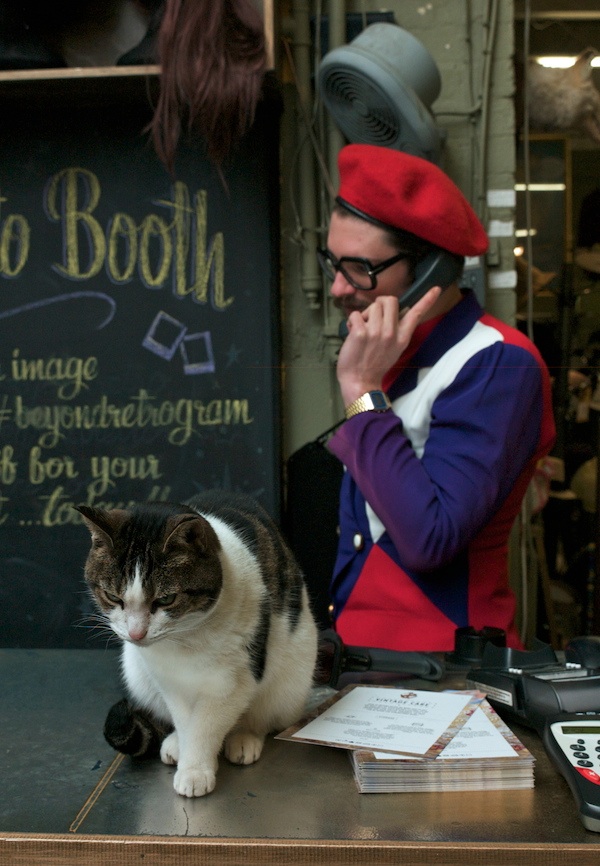
Tiny & Kristofj von Strass at Beyond Retro, vintage clothing shop on Cheshire St
“Iʼm from Nice and Iʼve worked at Beyond Retro for four years, but Tiny was here before me. Iʼm told she just turned up on the doorstep one day, and sheʼs happy here and sheʼs very good with customers.
Tiny has met many of the celebrities who shop here and become a celebrity herself, featured in a double page spread in ‘Your Cat’ magazine, as well as appearing in several street style books and music videos. She likes sitting on the counter so she can see the customers and sheʼs often in the office. Tiny tends to stay in more as she gets older though usually takes a walk in the morning.
I love cats, but my flat is too small so itʼs good to have a cat at work.”
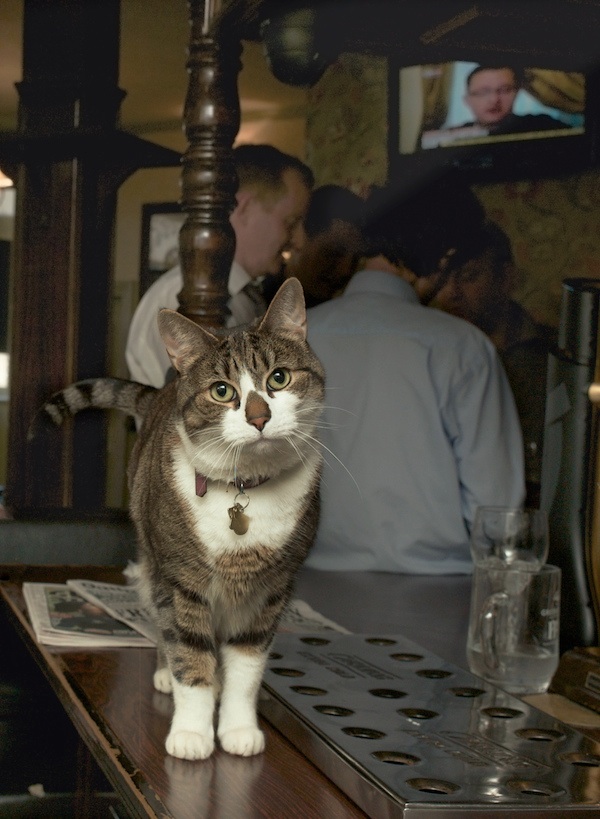
Sally at The Old King’s Head
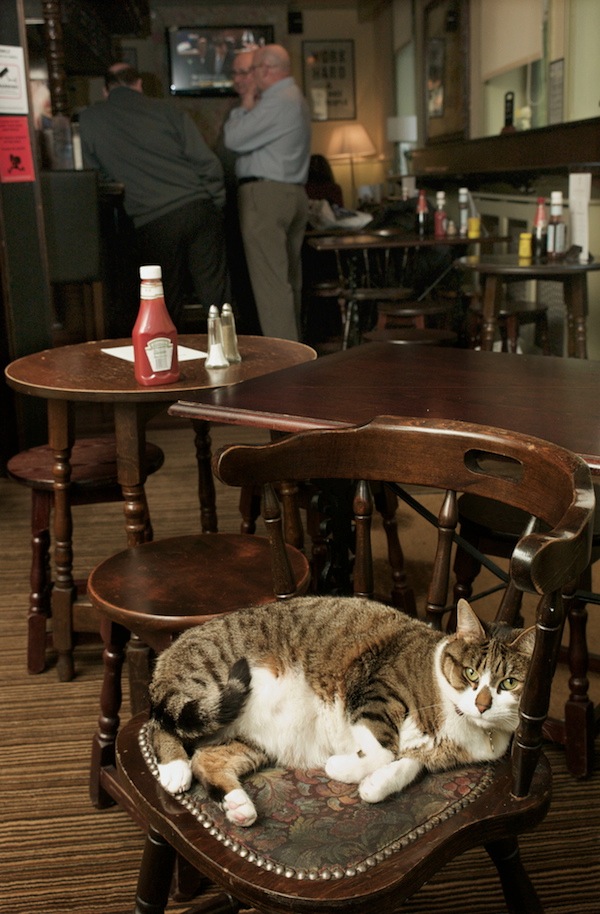

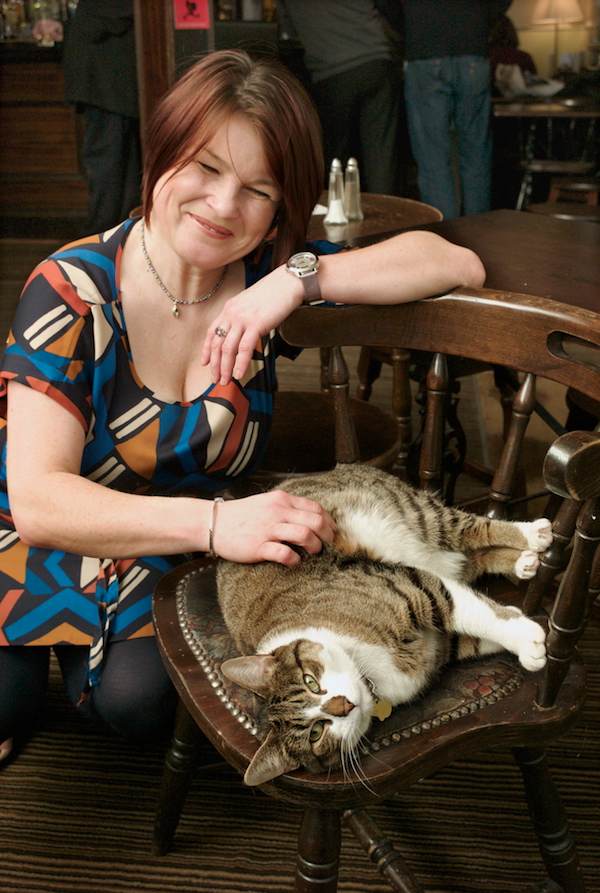
Sally & Rita Kalkauskiene at The Old Kingʼs Head, Holywell Row
“You can call me the manager if you like – I donʼt really have a title, I just do everything. Weʼve had the pub for five years and we have a good mixture of customers.
The cat is Sally. We took her in about three and a half years ago from someone who was homeless. We did have a Harry and a Sally, until Harry disappeared – we think he was stolen. Everyone adores Sally, they come here to see her not to see me, and she just loves the customers, especially the men. She does go out but is very careful. I often see her sitting in the window watching people and, when I come into the bar in the morning, sheʼll be stretched out full-length on one of the ledges.”
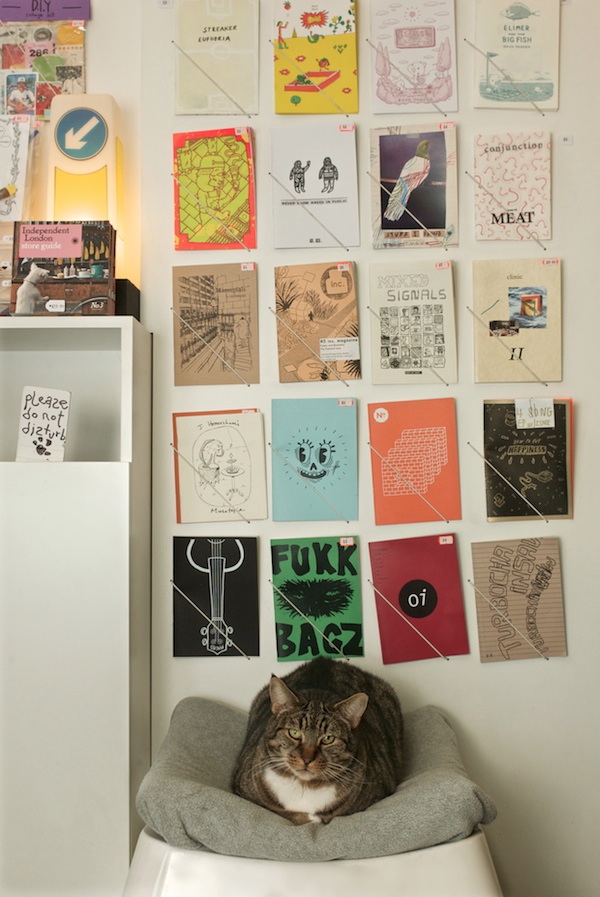
Oskar at Lik & Neon
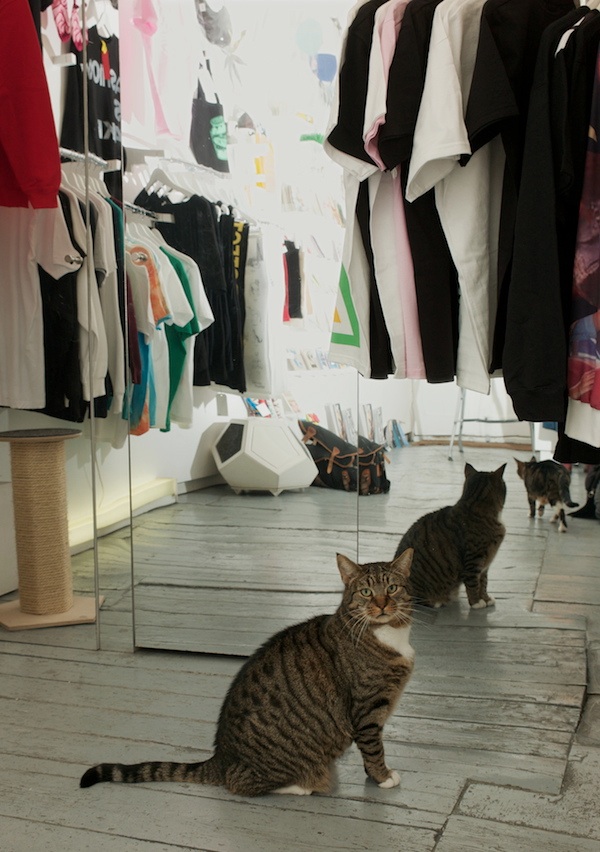
Oskar & Makita
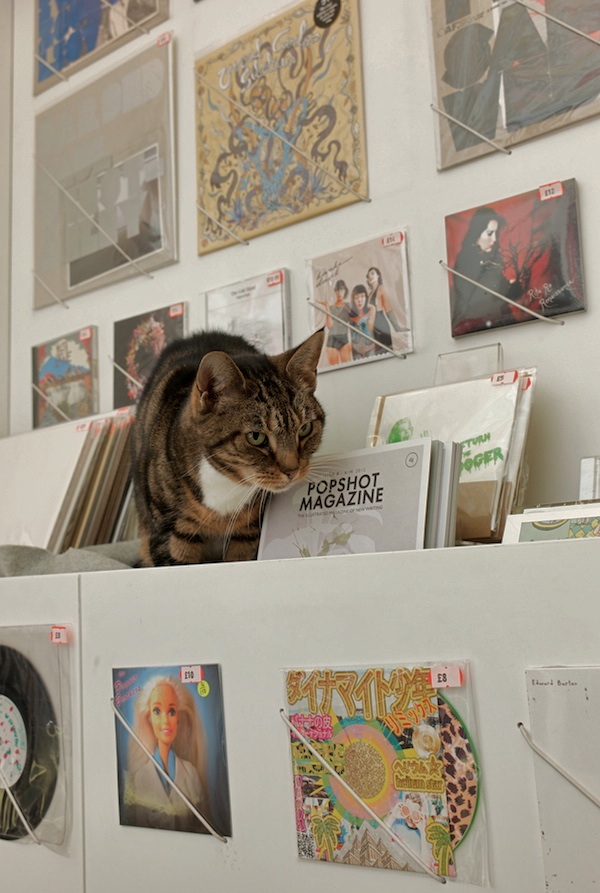
Makita
Browser & Makita
Bobby & Katie
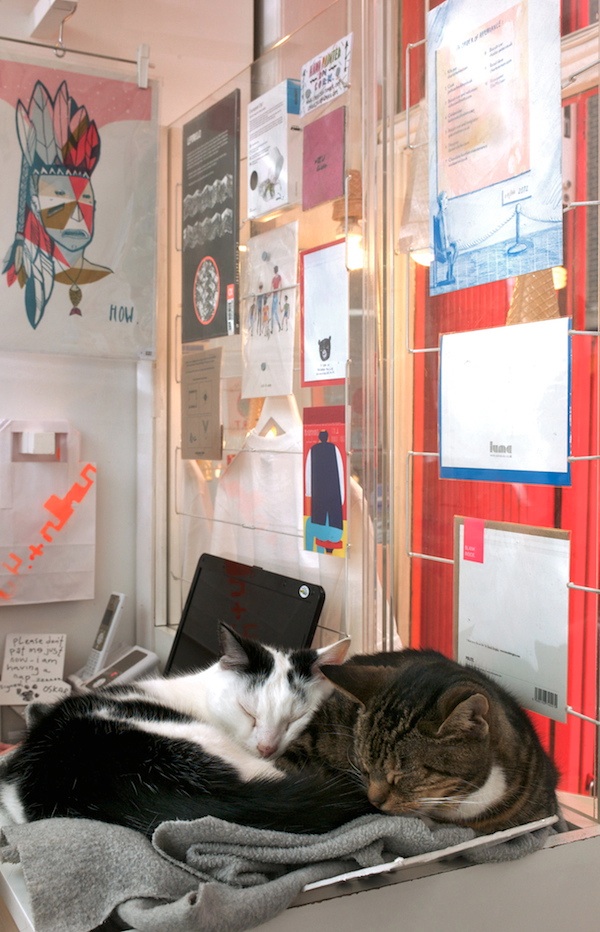
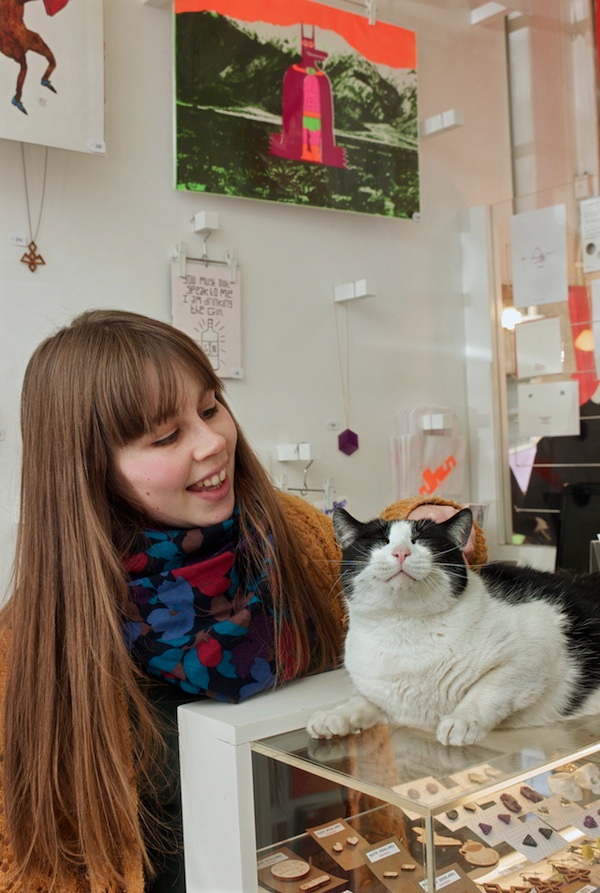
Oskar & Bobby & Makita & Browser & Janice Taylor & Katie Anstey at Lik & Neon
Katie – “The cats here are becoming famous partly, I think, because of the cat cafe thatʼs going to open in the East End. We had a German TV crew in yesterday. Bobby is my favourite – if he was human weʼd be dating. Heʼs always getting into scrapes, scamping outside in the car park and getting dirty. Last week, he got diesel oil all over his paws and had to go to the vet to be cleaned up.
The big tabby is Oskar, he has a very strong personality and heʼs a bit of a boss cat. Heʼs constantly challenging territory with Bobby, although they go around together a lot of the time. Bobby is such a ladiesʼ man, he loves it when four or five girls are petting him in the shop. Itʼs lovely to see them first thing in the morning – they sit in a row on the high wall in the yard waiting for us to arrive and give them breakfast.”
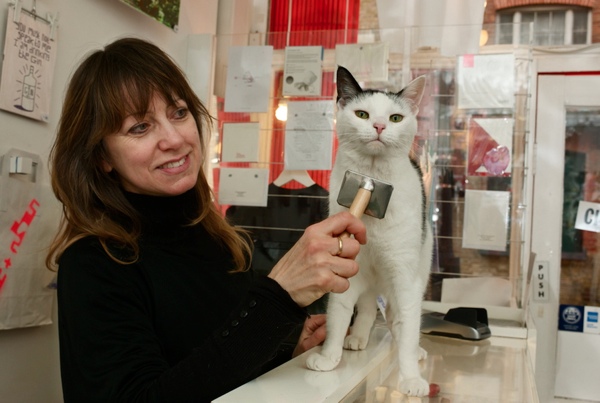
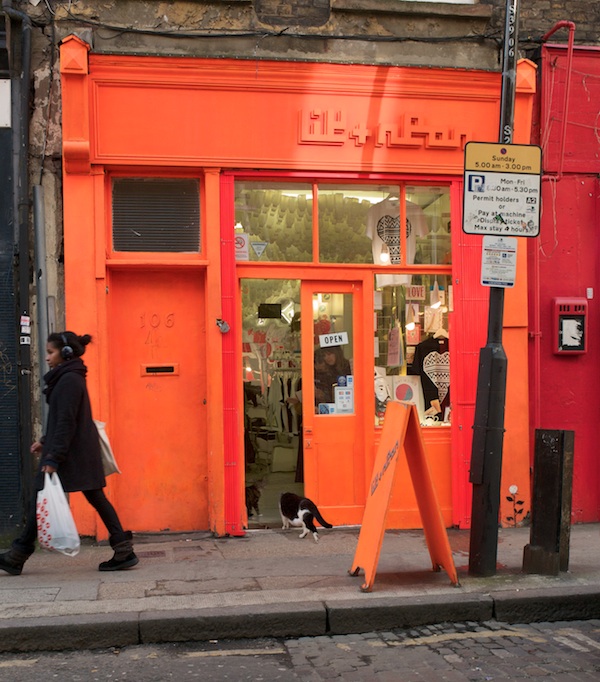
Janice – “The cats lived here from the start – this is an animal-enhanced environment and some people visit just to see them.
The small tabby is Makita. She used to live in my carpentry workshop and sheʼs named after the tool brand. She and Browser, both females, sleep together and groom each other, and they tend to keep themselves to themselves. Makitaʼs mother is completely black and she was named Gap by some French people who were fascinated by the Underground. Unfortunately, she and Makita fight so Granny Gap lives at home.
Tiny lived here too but she went missing and we searched for nine months before discovering sheʼd been living at Beyond Retro half a mile away on Cheshire St.”
Browser & Janice
Lik & Neon, Sclater St
Photographs copyright © Chris Kelly
Chris Kelly’s THE NECESSARY CAT – A PHOTOGRAPHER’S MEMOIR is available from many independent bookshops including Brick Lane Books, Broadway Books & Newham Bookshop.
You may also like to see
The Cats of Spitalfields (Part One)
The Cats of Spitalfields (Part Two)
Blackie, the Last Spitalfields Market Cat
and read about
George Barker & The Marquis of Lansdowne
At the recent public meeting to discuss the Geffrye Museum‘s development plans financed by the Heritage Lottery Fund, Museum Director David Dewing told the audience that he had “no interest in the culture of the Labouring Classes,” justifying the demolition of The Marquis of Lansdowne, which stood upon the corner of Geffrye St since 1839, as a building of “no historic significance.”
Yet the Geffrye Museum was originally created as a museum of furniture, reflecting the industry that once existed in the surrounding streets, and the story of those who manufactured it is as integral to an understanding of the collection as the culture of those who bought it. With this in mind, I went to meet George Barker who was born in The Marquis of Lansdowne in 1931 and whose family ran the pub for three generations, from before 1915 until after World War II, serving “the Labouring Classes” in the shape of the joiners, wood turners, cabinet makers and french polishers of Haggerston.

George Barker in the yard at The Marquis of Lansdowne aged six in 1937
The Marquis of Lansdowne is the only old building left on Cremer St, yet it contains the history of the people who have been here for the last two centuries, their culture, their society and their industry. For George Barker, born in the upper room of the pub in 1931, it was his family home, spanning three generations of Barkers – his grandfather William who came from a village in East Anglia at the end of the nineteenth century, his mother Lilian who ran the pub alone through the war and opened up every day during the Blitz, and lastly himself, the one who got a grammar school education and a Masters degree in Maths and has lived for the last fifty years in a beautiful house in Chorleywood.
No infamous killer took his victim to The Marquis of Lansdowne for her last drink. Charles Dickens did not visit The Marquis of Lansdowne and base a character in one of his novels upon a local eccentric discovered propping up the bar. In fact, the story of The Marquis of Lansdowne is a more important one that either of these, it is that of the working people who lived in the surrounding streets, for whom it was the centre of their community and meeting place for their extended families. In this sense, it is a quintessential East End pub and the history of this place cannot be told without reference to these people.
Haggerston has changed almost beyond recognition in recent decades and, all this time, The Marquis of Lansdowne has remained as the lone sentinel of a lost world. Yet when I met George Barker and he told me the story of his family and the life they led there, he brought that world alive.
“My earliest memory is of being a kid playing on the street, everybody played on the street in those days. A couple of times, I went into the Geffrye Museum and we collected caterpillars in the gardens. They used to have a playground with swings and a place to play football at the back of the museum.
I was born at The Marquis of Lansdowne in February 1931, but my family’s involvement with the pub goes back to the beginning of the century. My grandfather William George Barker told me that the Barker family came from a group of villages near Ipswich, moving to Hoxton at the end of the nineteenth century. He came to London in 1899 and worked as a barman for year in the East End before becoming a policeman for twenty years.
Frederick Daniel Barker, my grandfather’s brother, was licensee of The Marquis of Lansdowne until he died of TB in 1919, when my grandfather took it over from Frederick’s wife Mary Ann. Then, when my grandfather died in the thirties, my father George Stanley Barker took it over until he died in 1937 when my mother Lily ran it. She remarried in 1939 and, as Lilian Edith Trendall, she held the license until 1954 when her husband Frederick Trendall took over after her death. I think they all made a living but it wasn’t a terribly easy life.
We had a side bar and then another one on the corner we called the darts bar, as well as the front bar and the saloon bar. Even then, there were redundant doors which meant that at one time the pub was divided up into more bars. The saloon bar had upholstered bench seats and bar stools, but the other bars just had wooden benches with Victorian marble-topped tables. The curved bar itself was in the centre, spanning all the divisions with a tall central construction for display of spirits and optics, and the beer pumps were in the front bar. I remember, as you came in the side door from Geffrye St, the wall had a large decorative painted panel advertising Charrington’s Beer and there were mirrors at the rear. The pub windows were of etched and cut glass, and above the main door was an illuminated panel with the words ‘Toby Beer.’ It was a Charrington pub and a wagon came with dray horses to deliver once a week from the brewery in Mile End. Further down Cremer St was the Flying Scud, a Truman’s pub, and the Star & Pack, a Whitbread pub.
On the Geffrye St side of the building was a kitchen which was – in effect – where we all lived, and an office. Above the kitchen was my bedroom, with a window looking onto Geffrye St and the railway arches. On the first floor at the corner was the front room where we didn’t go very often, and the main bedroom – where I was born – was on Cremer St, divided from the front room by a construction of wooden panels, as if it once had been one big room. All the arches were coal depots in those days. It was brought by railway every morning at six thirty and all the coal men would be filling sacks, and bringing their horses and wagons to carry it away. But it never woke me up though, because I got used to it.
In those days, on one side of the pub was a terrace of houses and on the other there were three shops. I remember Mrs Lane who ran the sweet shop next door and Mrs Stanley who had a cats’ meat shop where they sold horsemeat. In the thirties, there was a couple of fellows making springs for prams in the building across the road which became a garage in the nineteen forties. I recall there was a baker’s on the other side of the street too and H.Lee, a big furniture manufacturer, on the corner of the Kingsland Rd.
My mother, Lily, ran The Marquis of Lansdowne singled-handed through World War II. It was heavily bombed in the surrounding streets and, when there were raids, she took shelter in the spirit cellar which had been reinforced with stanchions. She had grown up in the area, and most people knew her and she knew them, and they had been to school together. She was quite an outgoing woman who enjoyed a bit of banter and a lot of chat with the customers. She was the daughter of James Wilson who ran the scrap iron yard opposite across Cremer St under a couple of arches. He started the business there and he had a place in Tottenham, so he left his three sons to run it.
There was a friendly community on our doorstep, she ran the pub and her three brothers ran the scrap iron business across the road, and there was another uncle called Harmsworth who had another two arches where he ran a furniture business – one of my aunts married him. All my uncles and aunts lived within about one hundred yards of each other. They were the Barkers, the Wilsons and the Cheeks. A Barker married a Wilson and then a Wilson married a Cheek and then a Cheek married a Barker. My mother had another three children with my stepfather in the forties, and we all lived together in the Marquis of Lansdowne. There was me and my sister Eileen, plus the twins Maureen and Christine, and their younger brother Freddie.
At the age of eight, I was evacuated during the Blitz, but when I came back it was still quite dangerous so I went to stay with an aunt in Kensal Green. I never lost contact because I cycled over at weekends and moved back at the end of the war when I was thirteen.
In the fifties, the business started to drift away. People didn’t have much money and television came along, so it could be quiet on week nights but it was always busy at weekends, and for celebrations like VE Day and the Coronation we got a special licence and opened from midday until midnight. Even if people had moved away, they came back for Saturday evenings to meet with their relatives and friends. I would be serving behind the bar – probably a little younger than I should have been – and by the age of eighteen I was regularly working there. I always looked after the place when they went in holiday.
My mother died in 1954 and my stepfather took over the pub. I studied for a Masters Degree in Maths at Woolwich Polytechnic and I was away from 1954-56 doing National Service. In 1957, I left The Marquis of Lansdowne forever – I was working for Hawker Aircraft in Langley by then. I only went back occasionally after that, not too often. As people moved out, it started dwindling away and I think my stepfather sold it to a family called Freeland who had been coalmen under the arches and then he moved away too.
If it had been up to me, I probably would have become a publican but I wasn’t going to wait for everyone else to die off first and, because of the war, I went to grammar school and then to university. I haven’t been back to Haggerston since the nineteen sixties.”
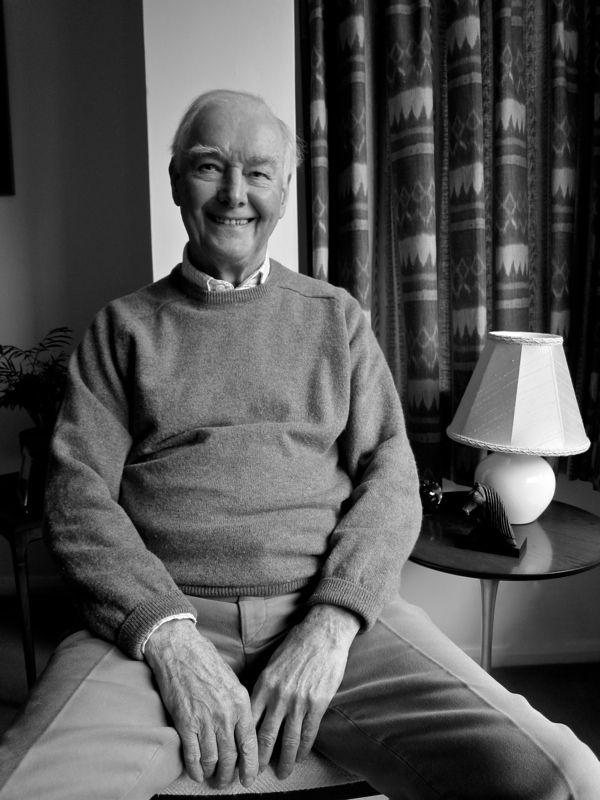
George Barker today.
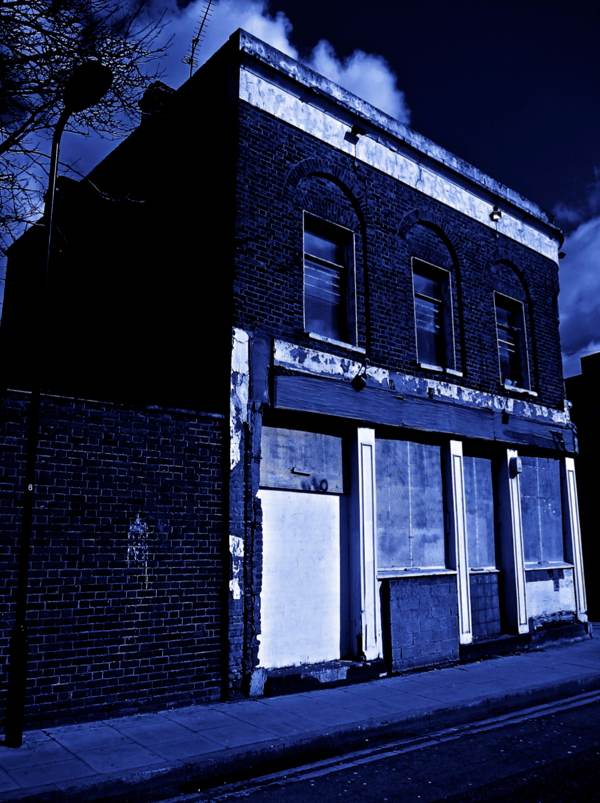
George Barker was born in the bedroom facing onto Cremer St, indicated by the window on the left.
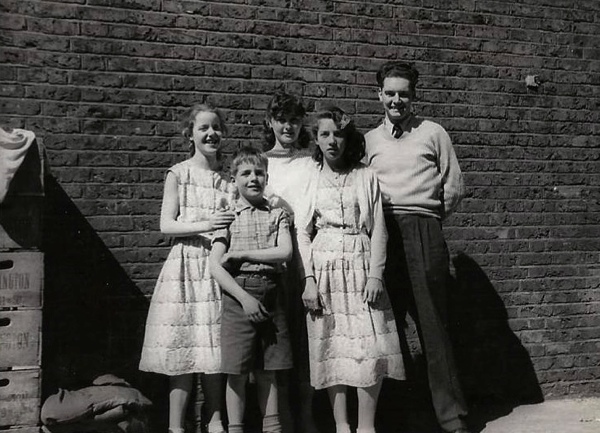
At The Marquis of Lansdowne, 1957. George Barker on right, aged twenty-five, with sister Eileen, centre back. The other three are his half-brothers and sisters from his mother Lilians second marriage to Frederick Trendall. The twin girls are Maureen on the left and Christine on right, with their brother Freddie between them.
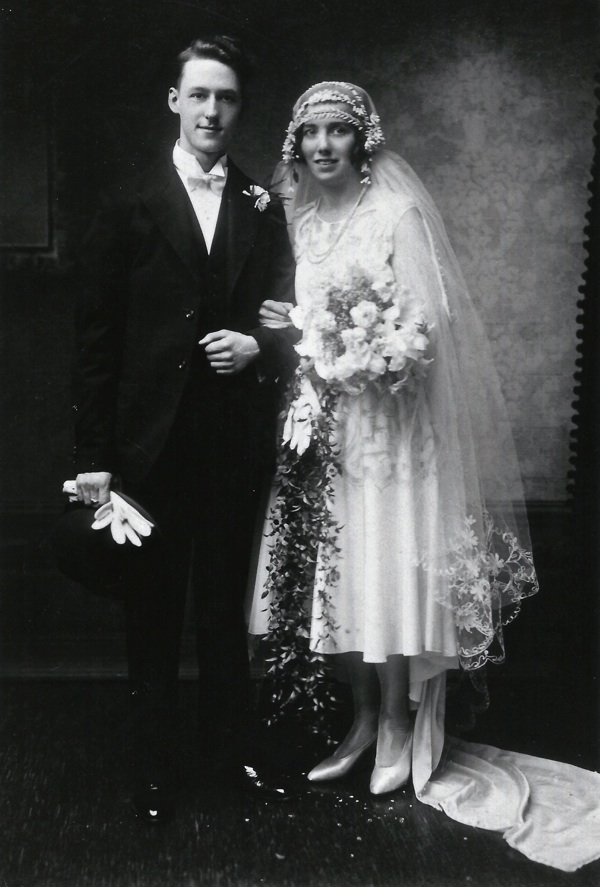
George Stanley Barker & Lilian Edith Wilson, married at St Leonards, Shoreditch on 7th September 1929. Lilian ran the pub after the death of her husband in 1937 until she died in 1954.
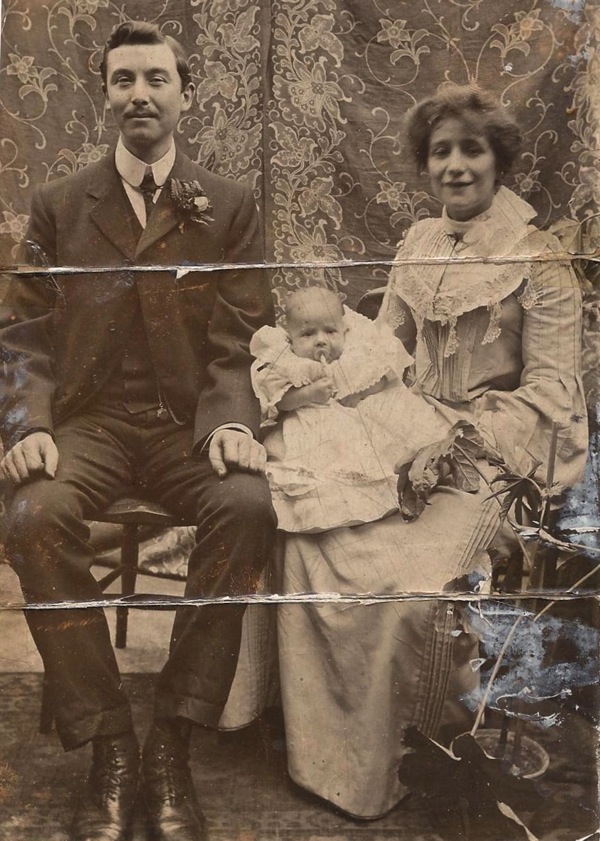
Ex-policeman William George Barker who ran The Marquis of Lansdowne from 1919 – photographed in 191o, with his wife Annie Susannah Oakenfold and son George Stanley Barker, who took over from his father and ran the pub until 1937.
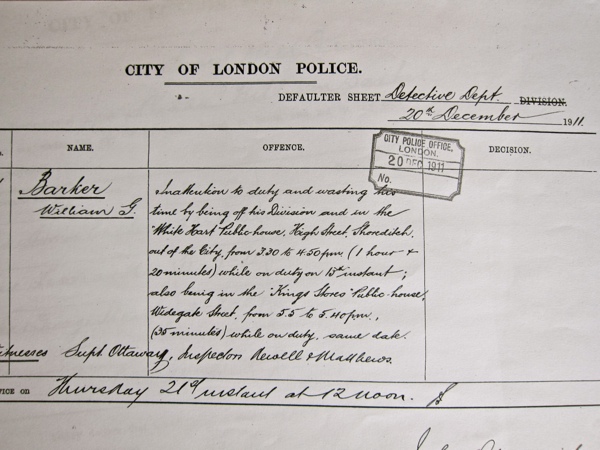
20th December 1911, William George Barker is reprimanded for bring caught in pubs in Shoreditch and Spitalfields while on duty as a policeman – eight years later he became landlord of The Marquis of Lansdowne and spent the rest of his life in a pub. – “Inattention to duty and wasting his time by being off his Division and being in the White Hart Public House, High St, Shoreditch, out of the City from 3:30 to 4:50pm (1 hour & 2o minutes) while on duty on 13th instant. Also, being in the King’s Stores Public House, Widegate St, from 5:05 to 5:40pm (35 minutes) while on duty, same date.”
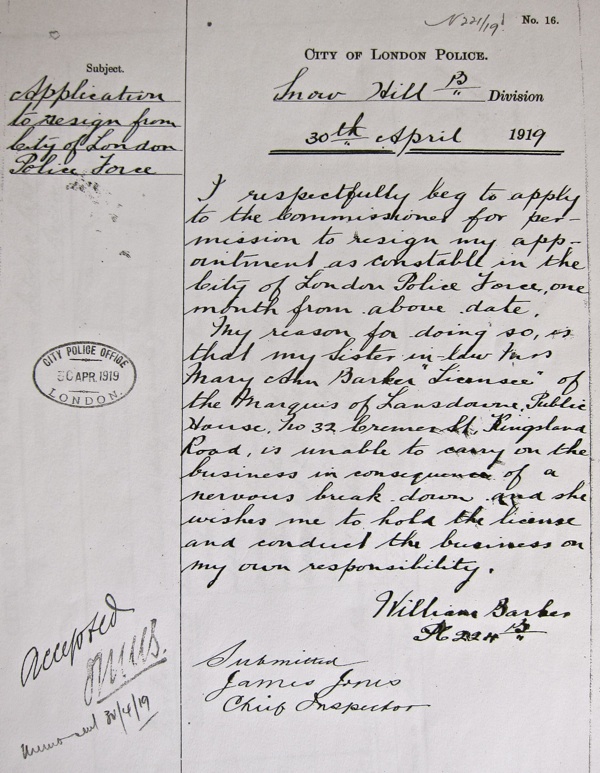
February 22nd 1919, William George Barker applies to leave the police to take over the running of The Marquis of Lansdowne from his sister-in-law after the death of his brother Frederick Daniel Barker. “I respectfully beg to apply to the Commissioner for permission to resign my appointment as Constable in the City of London Police Force, one month from the above date. My reason for doing so is that my sister-in-law Mrs Mary Ann Barker Licensee of The Marquis of Lansdowne Public House, No 32 Cremer St, Kingsland Rd, is unable to carry on the business in consequence of a nervous breakdown and she wishes me to hold the license and conduct the business on my own responsibility.”
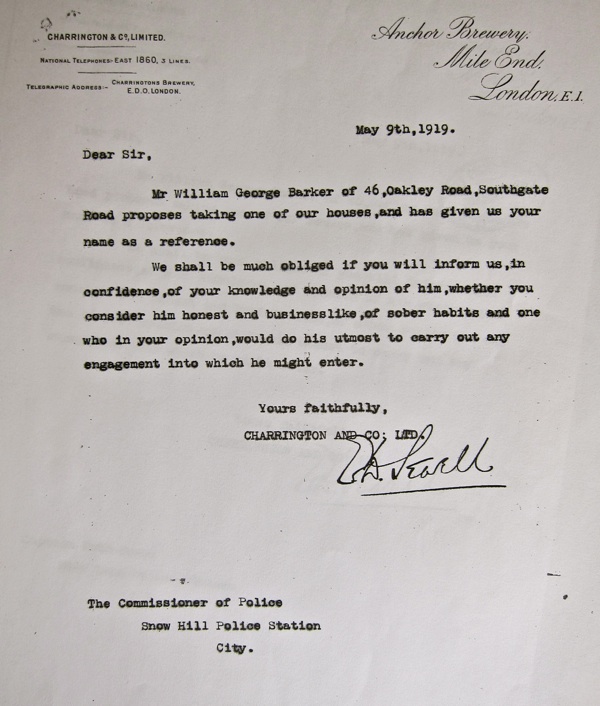
May 9th 1919, Charrington’s, Anchor Brewery, Mile End, seeks a reference for William George Barker from the Commissioner of Police at Snow Hill. Presumably, the incidents of Christmas 1911 were discreetly forgotten.
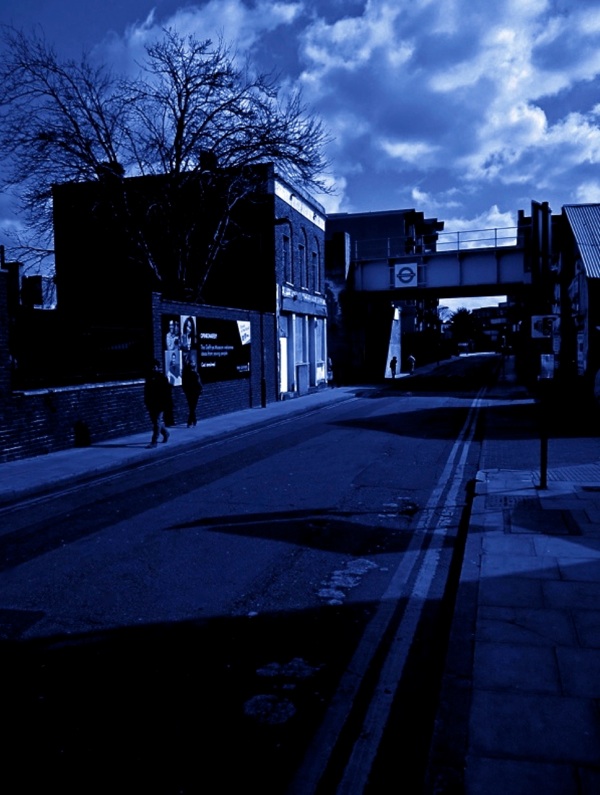
Dating from the Regency era, The Marquis of Lansdowne is the only old building left on Cremer St.

Geffrye Museum Director David Dewing says he has “no interest in the culture of the Labouring Classes” and believes a modernist concrete box, that will serve as a winter garden extension to his new designer restaurant, is more valuable to the museum than renovating The Marquis of Lansdowne which has stood on the corner of Geffrye St since 1839.

Architect David Chipperfield’s proposed extension to the Geffrye Museum, with the concrete box replacing The Marquis of Lansdowne in the bottom left corner.
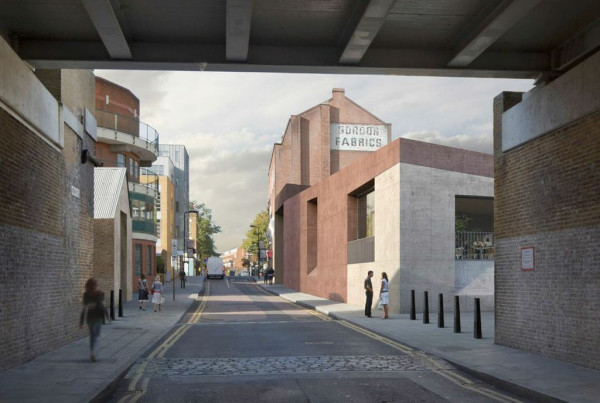
The concrete building on the right is the proposed replacement for The Marquis of Lansdowne.
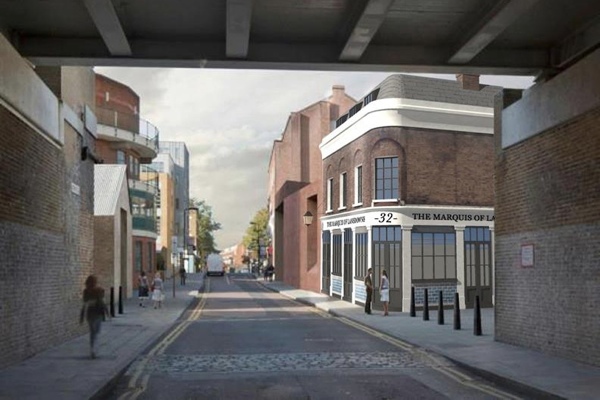
The same view with The Marquis of Lansdowne restored.
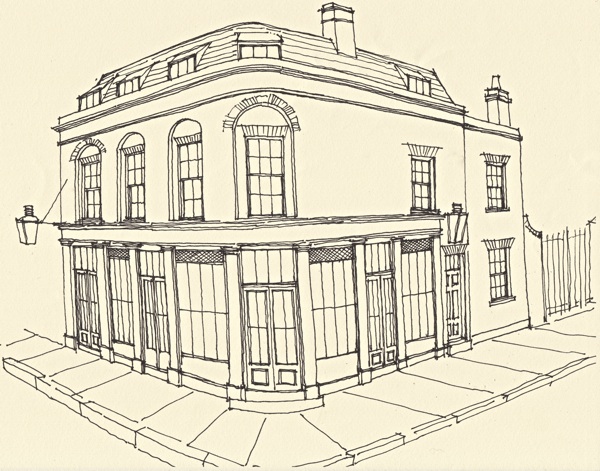
Sketch by Tim Whittaker of The Spitalfields Trust, illustrating his proposal to renovate The Marquis of Lansdowne.
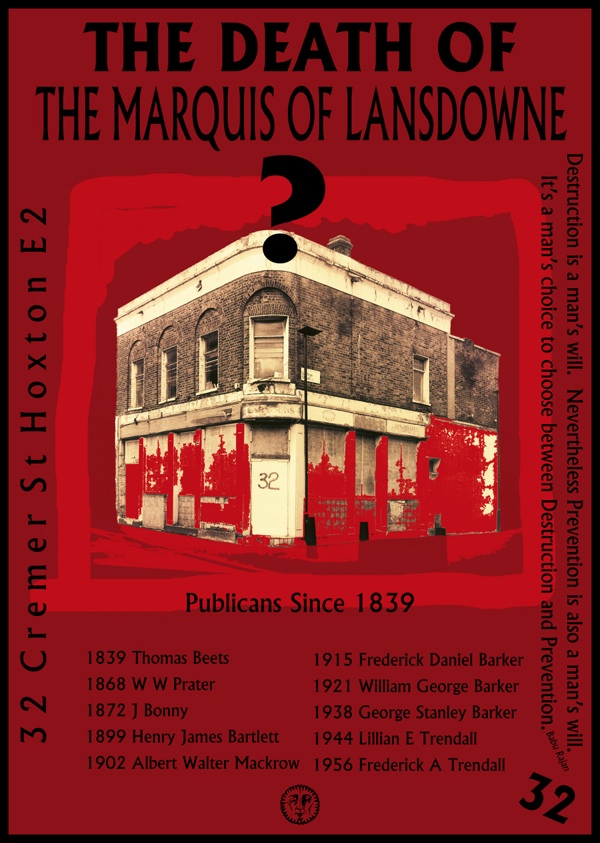
Sign the Petition to save The Marquis of Lansdowne here
Montage by John Claridge
Photograph of David Dewing © Colin O’Brien
You may also like to read about
Hot Cross Buns at St Bartholomew the Great

Distribution of buns to widows in the churchyard of St Bartholomew the Great
St Bartholomew the Great is one of my favourite churches in the City, a rare survivor of the Great Fire, it boasts the best Norman interior in London. Composed of ancient rough-hewn stonework, riven with deep shadow where feint daylight barely illuminates the accumulated dust of ages, this is one of those rare atmospheric places where you can still get a sense of the medieval world glimmering. Founded by Rahere in 1123, the current structure is the last vestige of an Augustinian Priory upon the edge of Smithfield, where once martyrs were burnt at the stake as public entertainment and the notorious St Bartholomew Fair was celebrated each summer from 1133 until 1855.
In such a location, the Good Friday tradition of the distribution of charity in the churchyard to poor widows of the parish sits naturally. Once known as the ‘Widow’s Sixpence,’ this custom was institutionalised by Joshua Butterworth in 1887, who created a trust in his name with an investment of twenty-one pounds and ten shillings. The declaration of the trust states its purpose thus – “On Good Friday in each year to distribute in the churchyard of St. Bartholomew the Great the sum of 6d. to twenty-one poor widows, and to expend the remainder of such dividends in buns to be given to children attending such distribution, and he desired that the Charity intended to be thereby created should be called ‘the Butterworth Charity.'”
Those of use who gathered at St Bartholomew the Great on Good Friday this year were blessed with sunlight to ameliorate the chill as we shivered in the churchyard. Yet we could not resist a twinge of envy for the clerics in their heavy cassocks and warm velvet capes as they processed from the church in a formal column, with priests at the head attended by vergers bearing wicker baskets of freshly buttered Hot Cross Buns, and a full choir bringing up the rear.
In the nineteen twenties, the sum distributed to each recipient was increased to two shillings and sixpence, and later to four shillings. Resplendent in his scarlet robes, Rev Martin Dudley, Rector of St Bartholomew the Great climbed upon the table tomb at the centre of the churchyard traditionally used for that purpose and enacted the motions of this arcane ceremony – enquiring of the assembly if there were a poor widow of the parish in need of twenty shillings. To his surprise, a senior female raised her hand. “That’s never happened before!” he declared to the easy amusement of the crowd, “But then, it’s never been so cold at Easter before.” Having instructed the woman to consult with the churchwarden afterwards, he explained that it was usual to preach a sermon upon this hallowed occasion, before qualifying himself by revealing that it would be brief this year, owing to the adverse meteorological conditions. “God’s blessing upon the frosts and cold!” he announced with a grin, raising his hands into the sunlight, “That’s it.”
I detected a certain haste to get to the heart of the proceedings – the distribution of the Hot Cross Buns. Rev Dudley directed the vergers to start with choir who exercised admirable self-control in only taking one each. Then, as soon as the choir had been fed, the vergers set out around the boundaries of the yard where senior females with healthy appetites, induced by waiting in the cold, reached forward eagerly to take their allotted Hot Cross Buns in hand. The tense anticipation induced by the freezing temperature gave way to good humour as everyone delighted in the strangeness of the ritual which rendered ordinary buns exotic. Reaching the end of the line at the furthest extent of the churchyard, the priests wasted no time in satisfying their own appetites and, for a few minutes, silence prevailed as the entire assembly munched their buns.
Then Rev Martin returned to his central position upon the table tomb. “And now, because there is no such thing as free buns,” he announced, “we’re going to sing a hymn.” Yet we were more than happy to oblige, standing replete with buns on Good Friday, and enjoying the first sunlight we had seen in a week.

The Priory Church of St Bartholomew the Great, a century ago.


John Betjeman once lived in this house overlooking the churchyard.


The ceremony of the Widow’s Sixpence in the nineteen twenties.
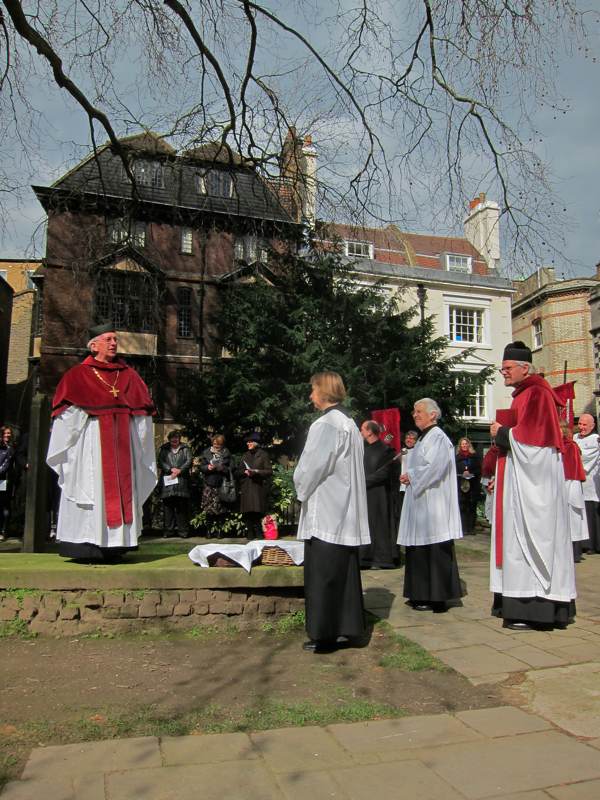
“God’s blessing upon the frosts and cold!”

A crowd gathers for the ceremony a hundred years ago.

Hungry widows line up for buns.

The churchyard in the nineteenth century.


Rev Martin Dudley BD MSc MTh PhD FSA FRHistS AKC is the 25th Rector since the Reformation.

Testing the buns.


The clerics ensure no buns go to waste.

Hymns in the cold – “There is a green hill far away without a city wall…”


The Norman interior of St Bartholomew the Great at the beginning of the twentieth century.

The Gatehouse prior to bombing in World War I and reconstruction.

Archive images courtesy Bishopsgate Institute
You may also like to read about
Huguenot Portraits
As a prelude to the Huguenots of Spitalfields Festival which opens next week, Contributing Photographer Lucinda Douglas-Menzies (who is of Huguenot descent) accompanied me on a visit to the French Hospital in Rochester which has offered accommodation for Huguenots since 1718.
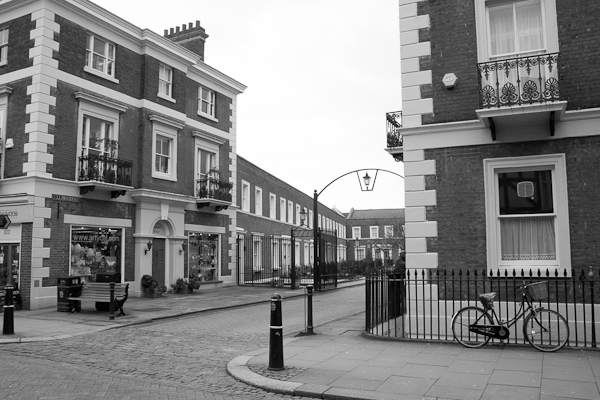
La Providence, Rochester
“An interesting community of Huguenot refugees had its centre in Spitalfields. Their forebears had come over from France in the years following the Revocation of the Edict of Nantes in 1685. They had become naturalized in England yet their descendants still formed a foreign community – a closed society with the intelligence that accompanies the easy use of two languages, along with the piety of a persecuted race and with the frugal wealth of Frenchmen who are, or have been, dependent upon their own exertions for a living.” – from ‘Time and Chance. The Story of Arthur Evans and his forebears’ by Joan Evans, Lucinda Douglas-Menzies’ great-great-aunt.
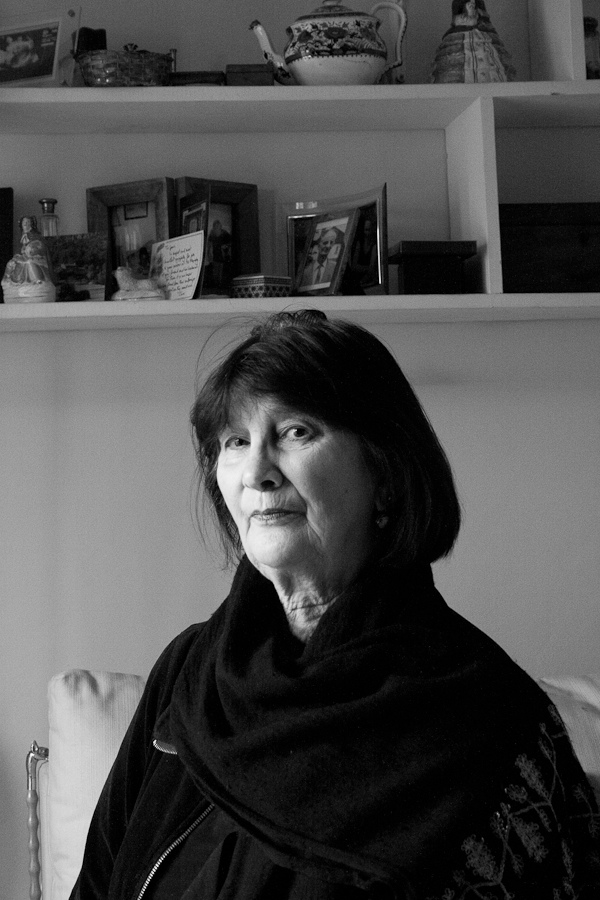
Jane Brown
“I am descended from Rev Francois Guillaume Durand who married Anne de Brueys de Fontcourverte. He was captured by soldiers and imprisoned in the castle in Sommieres with other pastors, but he managed to escape and lived in the woods where his parishioners brought him food and clothing. Eventually he left to Savoy and helped raise two Huguenot regiments to fight for William III, and he became the first pastor of the Walloon Church in Nijmegen – but his wife, Anne, was captured and put in a convent and died there, and his three children were seized by Jesuits and brought up as Roman Catholic. He made a bargain with God that if he got out of France alive, he’d devote his sons to the church and subsequently his grandson became a clergymen. Eventually, he came to England and was the first pastor at the Dutch Church in Norwich and then in Canterbury.
It was my grandmother, Helen Durand who was the Huguenot and I was brought up on it. I thought I had better put my name down for the French Hospital, so I sent an enquiry and got a reply back within half an hour saying we’ve got a flat for you. I was a Public Relations practitioner in race relations for a long time and I learnt that knowing your roots is quite important. My husband was from Jamaica and was very proud of his background. I teach journalism and publishing, and I edit the quarterly magazine ‘Rotary in London.'”
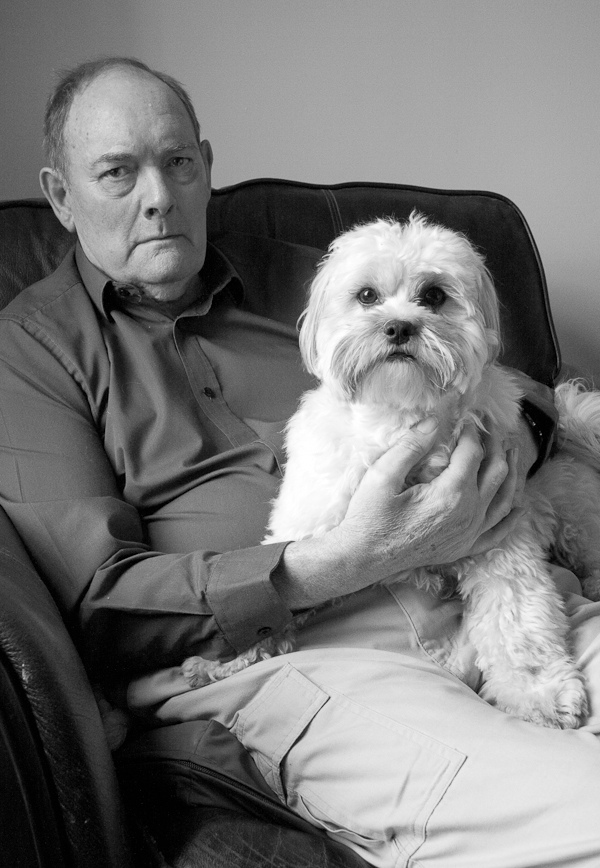
Jack Minett & Poppy
“I’m seventy-five, I haven’t got my teeth in and I’m not going to put them in because I am an old fellow. I’ve always known I was a Huguenot, but I didn’t know what it meant. My Huguenot ancestry was researched by my aunt – I believe there were two brothers who came over as refugees before all the chopping went on. One went to Gloucestershire and became a farmer, and the other was a doctor who set up a clinic in Camberwell.
My grandfather was a butcher in Forest Hill and I was born in Peckham. I’ve been very poorly and they sent me home to die – that was seventeen years ago when I came here to the Hospital with my wife Maureen, and I am still alive! I have two sons and a grandson, so the name continues. The founder of the Huguenot Society was a Minett and Charles Dickens has a Dr Manet in ‘Tale of Two Cities.’ And you’ve got to realise that Poppy, my little dog, is now a Huguenot too.”
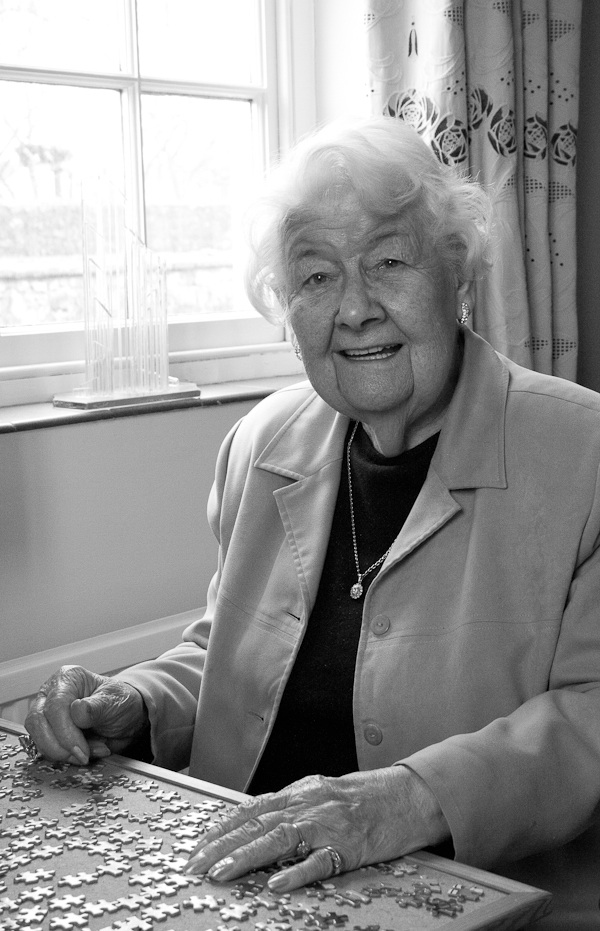
Doreen Chaundy
“Chaundy is the family name and it goes back twelve generations to a small village called Chauny, north of Paris – a little before the Huguenots. They are recorded in the parish records of Ascott-under-Wychwood in 1548, but my branch ends with me because I have no children and my brother died in the war. He was shot down in the North Sea when he was nineteen. I have no relations. I am eighty-six years old and I have been here twenty-four years.
I was a secretary and I passed my insurance exams but I was a bit early – I realise I was forty years too soon when I see what girls are able to do now, in those days we were just secretaries. I was born in Glasgow but my father was a Londoner and, when I bought a house in Wembley in my early thirties, both my parents came to join me and they stayed for thirty years. Both of them lived into their nineties and my father lived to be ninety-eight. When I he died, I applied to come and live here. I have had two brain operations and survived them. I always say I am a refugee from the Glasgow rain.”
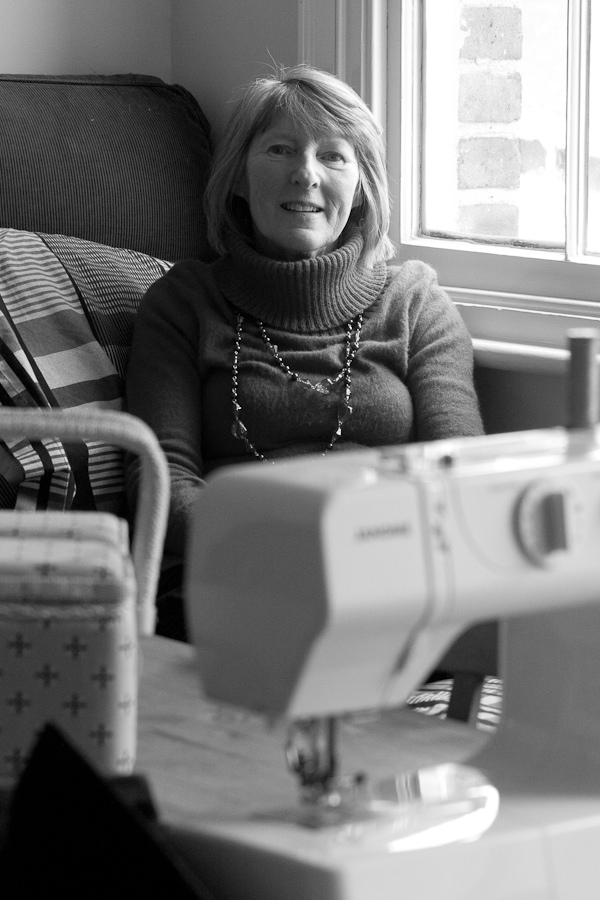
Jenny Turner
“My great-grandmother was Eleanor Grimmo of Spitalfields. Her great-grandfather was Peter Grimmo, a weaver, who in 1839 was living at 4 Fort St, Old Artillery Ground, Spitalfields. By January 1869, his son Peter was living at 10, Turville St, Church St (now Redchurch St), Shoreditch, when he married Mary Fulseer of Bethnal Green – and in July of that year, Mary gave birth to my great-grandmother Eleanor. She told me that her father Peter Grimmo was a seal fur dyer who invented the Silver Fox Fur. My grandmother spoke French and German and was an interpreter in the First World War. We weren’t a highly educated family, so we were amazed at this but her mother was also fluent in French and her grandparents were wholly French, so it all ties in.
I’m sixty-nine and I’m on my own these days. I was a primary school teacher for forty-two years and I retired four years ago. I’ve always known we had French relatives, but it has only been in the past ten years that my daughter has been researching the family ancestry and that’s how we found out about this place.”
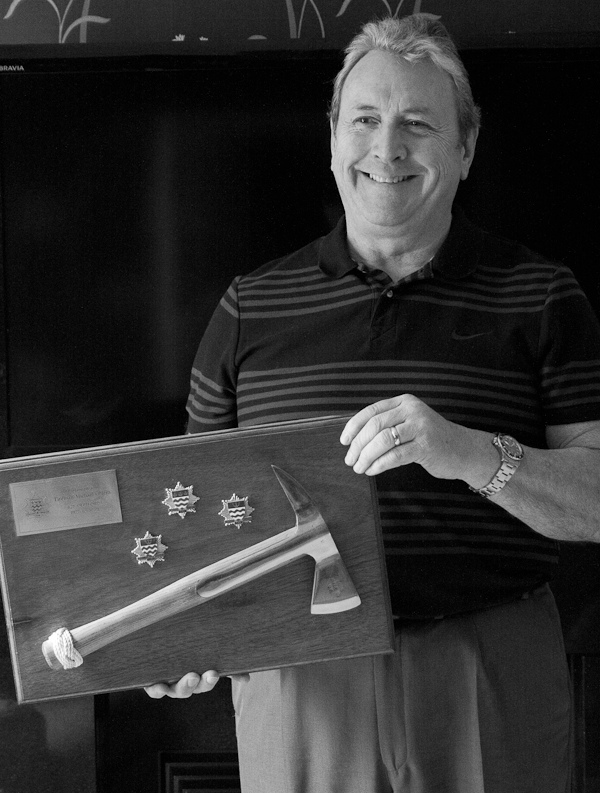
Michael Oblein
“My ancestor Noe Oblein came to London in 1753. He was was weaver in Shoreditch and he married Marie Dupre at St Matthew’s Bethnal Green in 1774. My father did the family research and everyone called Oblein is a relative. There are about five hundred alive. We are in contact with others all over the world, in Australia and in Rochester in America – where they have reunions every year. My father went to one and I’d like to go.
I was firefighter in Deptford for thirteen years. We came here last August, it’s brilliant – they look after you so well. I was born in Deptford and lived in Plumstead and Chatham. We sold our house and we always said how nice it was here. I shall never forget how I felt when I first walked through the gates. On Friday and Saturday nights, it’s a riot out in the High St but it’s always peaceful in here.”
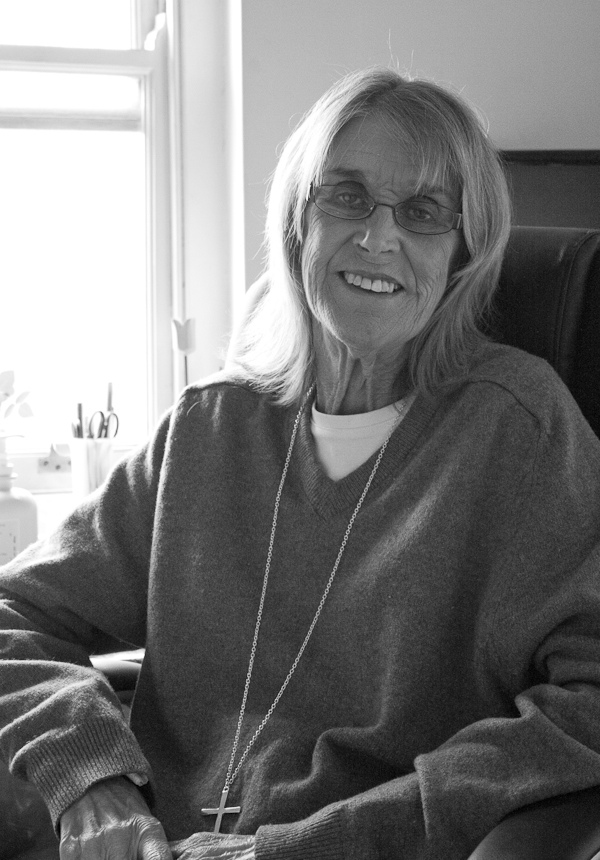
Christine Cordier
“It was my husband, Ray, that wanted to come here – he was the one with the Huguenot connection. I was a teacher and he was a dental hygienist, one of the first men to do that. We met in church and we were married in Gillingham United Reform Church in 1970.
I came here in 2007, we had planned to come here together. Five years earlier, we had moved to North Lincolnshire because we wanted to live in a small village and we had a lovely home. Then we decided it was time we put our names down here, but unfortunately he developed a brain tumour as we were in the process of moving and he died so I came here on my own. It can be lonely, but I spend a lot of time at Rochester Cathedral, working in the shop and the welcome desk, so I have got to know a lot of people that way.”
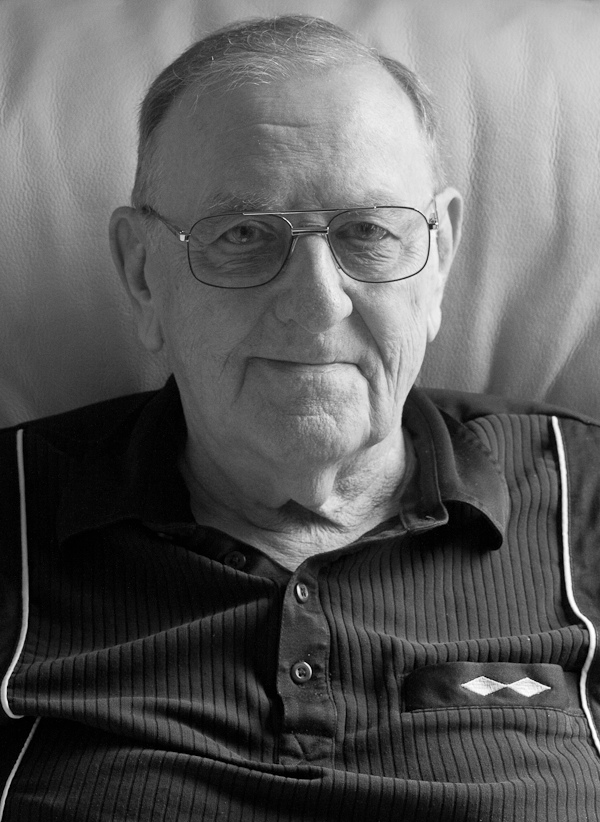
Nigel Marchment
“My Huguenot ancestor was Joseph Poitier who came from Lot to Bethnal Green in 1749, I think he was a carpenter. I’ve always known this since I was small because my father always said we were French, but he couldn’t remember how. So after I retired and I lost my wife, I decided to find out and I built up the family tree. Joseph’s son, George Poitier, was baptised in St Leonard’s, Shoreditch, in 1768.
During the war, when was five, I was evacuated to my grandparents in Eastbourne and the Huguenot Society paid for my education until I left school in Forest Gate at aged fifteen. I studied book-keeping and shorthand typing but never touched it from the day I left school. I started off as an office boy at Arnett & Co (cargo superintendents at Fenchurch St in the City) from 1949-50, then I became accounts clerk at Reliance Telephones in WC2 from 1950-56, I worked for the Cleveland Petroleum Co in Euston from 1956-58, then I was a despatch clerk at Silcock & Colling Ltd, Ford’s delivery agent in Dagenham from 1958-72 and finally I moved to Basildon where I worked for Standard telephone & cables from 1973-1977 and Morse Controls Ltd from 1977 -1997. I took early retirement to care for my wife until she passed away on April 3rd 2001 and then I had heart attack on the morning of April 4th. They said it was caused by stress. I came to live here in the French Hospital in August 2008.”
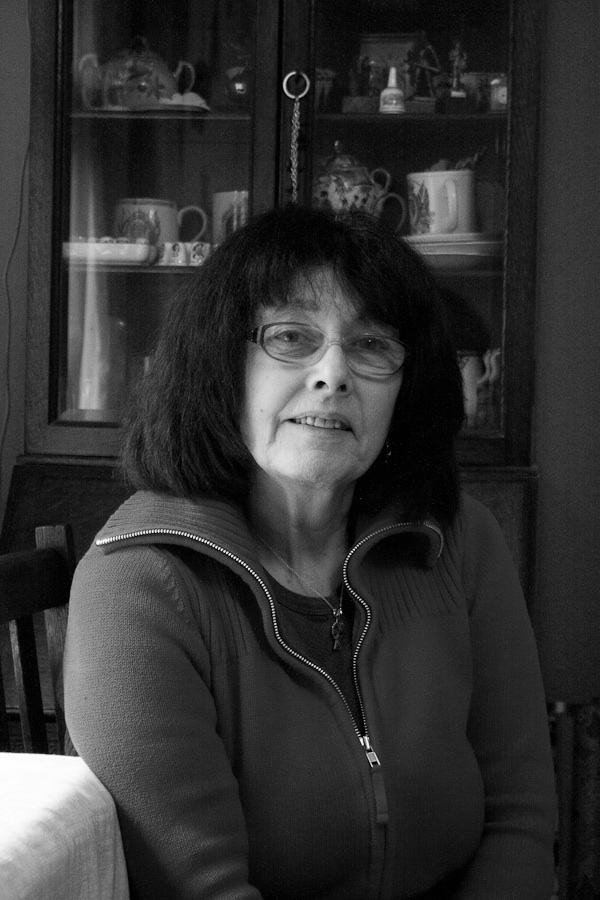
Ann Blyth
“The Huguenot was my grandfather, his name was Ravine. The family were based in Canterbury around the Via St Gregory. I’ve only traced them back as far as 1721 but when I pack up my job, I’m going to find out more. It wasn’t until my father died and my brother was chopping wood and breaking coal in Felstead in Essex and I was trying to bring my mother here, that I got to know the Steward. He said, ‘You’ve got to be a Huguenot,’ so I said, ‘We are!’
I was in my forties and she was in her seventies, and she moved in here in 1983 and she was here for fourteen and a half years. I came in August 2005. I teach T’ai Chi and I do a weekly session with ten regular students. One is ninety-seven and she can stand on one leg. I didn’t start until I was sixty and I’ve been doing it fourteen and a half years, and it’s made all the difference to my fitness and balance.”
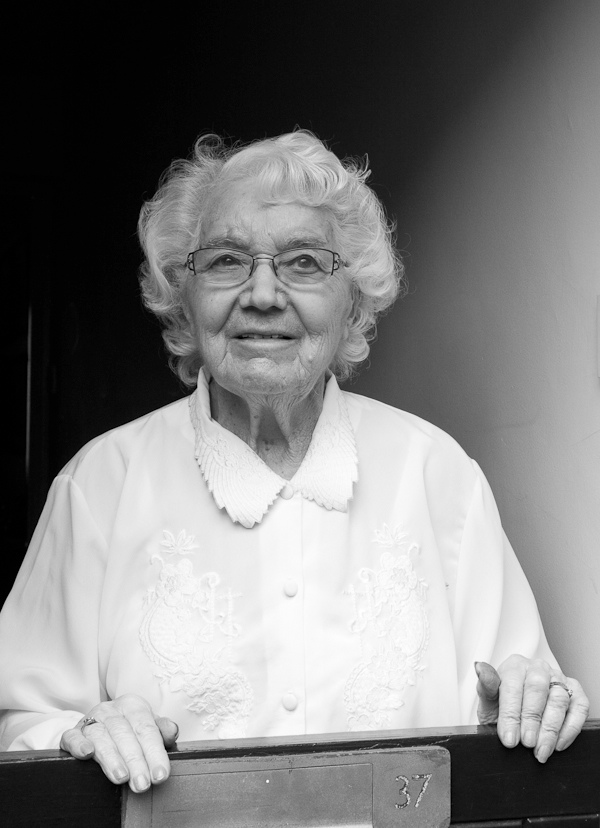
Eileen Bell
“I’m ninety-one. I came here with my husband, Bill, thirty-three years ago because he wanted to get out of London. If he was here he could explain the Huguenot connection, but he died twelve years ago. I was born in Bermondsey and lived all my life in Bermondsey. I worked for twenty years for the gas board. I have one son and one grandson. I’ve never been back to Bermondsey.”
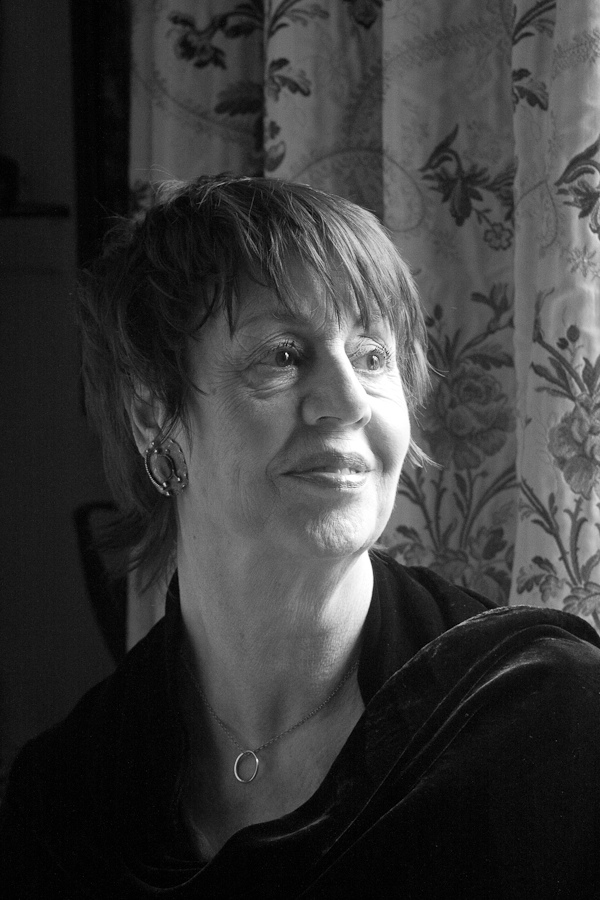
Bobby Bloyce
“My Huguenot ancestor, Alexander Bearnville de Blois, came in 1685 and settled in Spitalfields. I found out when my great-aunt found pieces of parchment in the attic and that was our family tree. I was the ‘baby’ when I moved into the French Hospital fifteen years ago. My grandmother and my great uncle lived here in the Hospital, so I’ve been visiting since I was seventeen. I was born in Rochester and I have lived most of my life in Rochester, and my son lives here as well. I love being here, I’ve always wanted to live here – it’s like a village.”
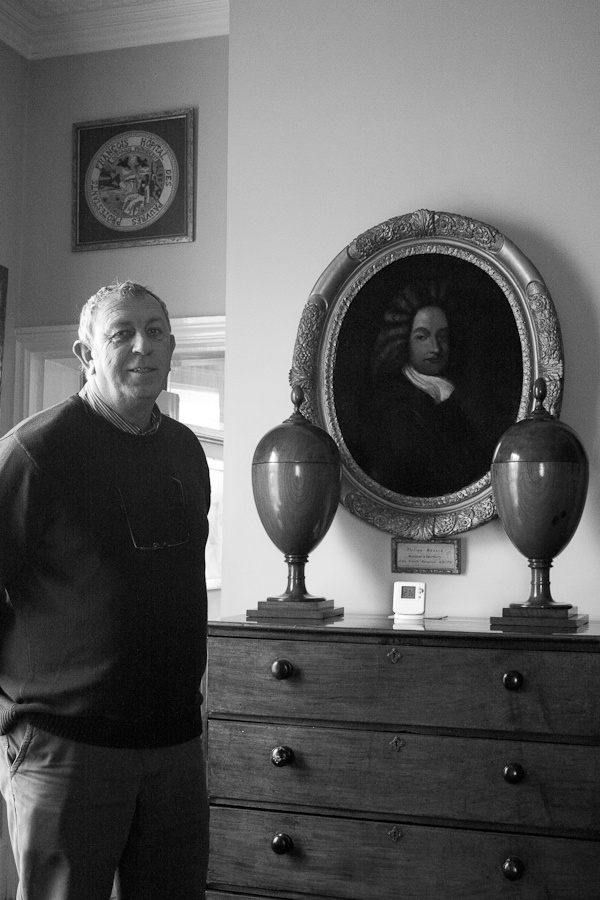
Jon Corrigan, Master Steward
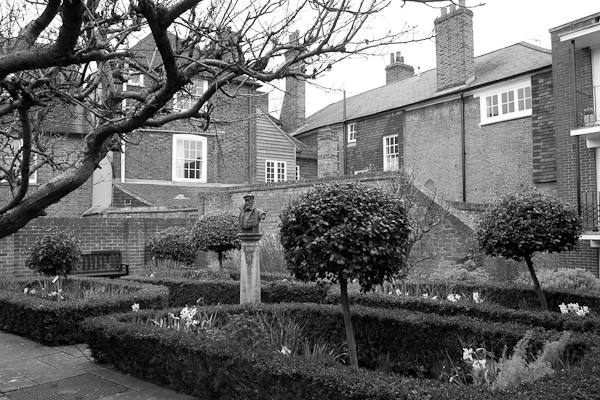
Huguenot garden at the French Hospital in Rochester.

Weathervane of Elijah fed by the ravens in the wilderness, emblematic of ‘La Providence’ – the name of the Hospital.
Photographs copyright © Lucinda Douglas-Menzies
You may also like to read about